

Submitted:
17 April 2026
Posted:
20 April 2026
You are already at the latest version
Abstract
Epilepsy is increasingly understood as a disorder of neural circuit hyperexcitability arising from disruptions in the balance between excitatory glutamatergic and inhibitory GABAergic signaling. In many forms of epilepsy, recurrent seizures are associated with excessive glutamate release and calcium influx, along with inflammatory signaling, oxidative stress, and maladaptive changes in synaptic transmission. These processes can further destabilize vulnerable networks, particularly within hippocampal and cortical circuits. Endogenous mechanisms that normally constrain hyperexcitability—including endocannabinoid signaling through CB1 receptors—may become insufficient or dysregulated in chronic epilepsy, creating conditions that favor recurrent seizure generation. Here, we propose that multi-phytocompound combinations may influence neural balance in epilepsy by engaging several molecular systems that regulate neuronal excitability and seizure threshold. Cannabinoids and terpenes derived from Cannabis sativa interact with diverse molecular targets implicated in epilepsy, including CB1 receptors, GPR55, transient receptor potential (TRP) channels, GABAA receptors, voltage-gated ion channels, glycine and serotonergic receptors, as well as endocannabinoid metabolic pathways. Through these convergent mechanisms, phytocannabinoids and terpenes may influence excitatory and inhibitory signaling, limit excitotoxic processes, and modulate pathways associated with neuroinflammation and oxidative stress. Within this context, we outline a theoretical multi-compound approach composed of a dozen cannabinoids and terpenes selected for their potential synergy and interactions with pathways implicated in seizure generation, synaptic transmission, and neuroprotection, yielding testable predictions for future experimental and clinical investigation. This perspective provides a systems-level model for understanding how coordinated, multi-target modulation of neural signaling pathways may influence circuit stability in epilepsy and offers a foundation for future experimental validation of multi-compound strategies.
Keywords:
epilepsy
; neural excitability
; excitatory–inhibitory balance
; cannabinoids
; terpenes
; synaptic plasticity
; endocannabinoid signaling
; neuropharmacology
Background
Ancient Chinese Emperor Fu Hsi described cannabis as having yin and yang properties that restore balance within the body [1]. In modern neuroscience, this balance reflects excitatory and inhibitory neural signaling, whose dynamic ratio is essential for maintaining stable neuronal excitability and circuit function. Imbalances in excitatory and inhibitory signaling are central to current models of epilepsy, where shifts toward excitation promote network hyperexcitability and seizure generation[1,2,3]. Within this context, cannabis has been explored for its potential effects on seizure activity, with both historical accounts and modern studies describing anticonvulsant properties[4,5].
Over the past several decades, scientific investigation has begun to elucidate the cellular and molecular mechanisms underlying these effects. Early studies demonstrated that the two most abundant cannabinoids in the cannabis plant—cannabidiol (CBD) and Δ9-tetrahydrocannabinol (Δ9-THC)—each exhibit anticonvulsant properties[6,7,8,9,10,11,12]. Since then, additional cannabinoids, including cannabidivarin (CBDV)[13,14,15,16,17] and cannabinol (CBN)[18,19], as well as terpenes such as linalool[19,20,21] and caryophyllene[22,23], have demonstrated anticonvulsant effects. Cannabinoids exhibit anti-inflammatory and antioxidant properties[24,25,26], as well as neuroprotective effects[27], which may be particularly relevant in the context of seizure-associated neuroinflammation and excitotoxic stress. In specific contexts, cannabinoids have also demonstrated anti-cancer[28] and anti-tumor[29] activity, which may indirectly influence seizure activity associated with tumor-related neural dysfunction. In addition, cannabinoids have been reported to exert analgesic[30,31,32] and neuromodulatory effects, and may influence a range of biological processes through interactions with diverse receptor systems and signaling pathways[33,34,35]. Collectively, these properties suggest that cannabinoids engage multiple complementary mechanisms that may modulate physiological and neurobehavioral function.
After decades of legal restrictions, Cannabis sativa has been approved for medicinal use in the majority of U.S. states. Patients are using cannabis-derived products for epilepsy, chronic pain, anxiety, neurodegenerative disorders, insomnia, and many other medical conditions. The safety and efficacy of cannabinoid-based therapeutics is highlighted by several FDA-approved drugs, including Marinol and Cesamet for cancer-associated nausea and Epidiolex for seizures. Epidiolex consists of purified CBD, which is safe and well tolerated even at large doses[36]. Purified CBD, however, may represent a more limited approach, as products containing multiple cannabinoids and terpenes could produce distinct or enhanced effects[1,37,38,39,40]. The synergetic interactions between cannabinoids and terpenes, their engagement of multiple neural receptors, and their modulation of diverse biological pathways (including components of the endocannabinoid system) are commonly referred to as the “entourage effect”—a concept proposing that combinations of phytocompounds may produce effects that differ from or exceed those of isolated constituents. Within this context, multi-compound approaches may engage a broader range of molecular targets—including G-protein–coupled receptors, ion channels, and signaling pathways involved in excitatory–inhibitory balance—thereby influencing neural circuit stability through convergent mechanisms. To examine this possibility, we propose a theoretical multi-compound system composed of a dozen cannabinoids and terpenes selected based on their reported interactions with pathways implicated in seizure generation and neural excitability. This framework provides a basis for evaluating whether such combinations may offer advantages over single-compound approaches in modulating neural function in epilepsy.
Mechanistic Basis of Multi-Compound Phytocannabinoid Signaling
CBD and Δ9-THC represent two primary phytocannabinoids relevant to the modulation of neural circuits involved in seizure generation. Several lines of evidence suggest that their combined effects may be more pronounced than those of isolated CBD or Δ9-THC alone[39,41,42,43,44]. Adverse effects in humans may also be more frequent in products containing purified CBD compared to extracts that include several cannabinoids and terpenes[39], suggesting a synergetic formula with multiple cannabinoids and terpenes may in some cases be better tolerated compared to products that only contain a single plant-derived compound. Some of the effects of Δ9-THC likely arise from its mechanism of action as a partial agonist of type-1 cannabinoid receptors (CB1Rs). CB1Rs are Gi/o-linked G-proteins that can powerfully modulate brain activity via several cellular and molecular cascades within neurons[45,46]. CB1Rs are the most prevalent G-proteins in the entire brain[47] and they are strategically located in neural circuits that generate seizures, such as the hippocampus[48,49]. CB1Rs are activated by exogenous cannabinoids like Δ9-THC and endogenous cannabinoids (or endocannabinoids/eCBs) like 2-arachyldonylglycerol (2-AG) and anandamide. Data from experimental epilepsy models suggest that excess glutamate release from axon terminals during seizures may engage the eCB-CB1R system, which, in turn, operates to dampen overactive circuits[50]. In this ‘circuit breaker’ scenario, seizure activity and excessive release of the excitatory neurotransmitter glutamate promotes spillover of glutamate from the synaptic cleft. This excess glutamate binds to extra-synaptic mGluR receptors and activates a molecular pathway that drives 2-AG synthesis. The endocannabinoid 2-AG is subsequently released from postsynaptic neurons and binds to CB1Rs on presynaptic glutamatergic axon terminals. This suppresses glutamate release and prevents the over-excited circuit from uncontrolled hyperexcitability that leads to seizures. The levels of both eCBs, 2-AG and anandamide, are increased in the brain shortly after acute insults[51,52,53] including seizures[54,55]. This transient surge in eCBs likely engages presynaptic CB1R signaling and may limit excessive excitation by decreasing glutamate release. However, chronic on-going epilepsy may lead to alterations in eCB synthesis pathways and decreased CB1R expression on glutamatergic axon terminals[1,49]. These changes in the eCB-CB1R system may functionally compromise the eCB-mediated negative feedback that normally works to protect against seizures. Consistent with this, the levels of anandamide and the 2-AG synthesizing enzyme, DAGLα, are significantly decreased in the brain and spinal fluid of those with chronic temporal lobe epilepsy[56,57]. The diminished production of eCBs may contribute to epileptic seizures, as excess glutamate release proceeds unchecked and the excitatory/inhibitory ratio (E/I ratio) shifts towards excitation. Exogenous CB1R agonists like Δ9-THC can engage the CB1R signaling system and potentially boost the circuit dampener when eCBs are diminished. In support of this notion, CB1R agonists are anticonvulsant in several animal models of epilepsy and hyperexcitability[55,58,59,60,61], perhaps by decreasing glutamatergic transmission and restoring a healthy E/I ratio. Δ9-THC could also act on CB1Rs to keep overactive synaptic plasticity, which facilitates seizures, in check, by dampening activity in hippocampal circuits prone to runaway excitatory activity[62].
Years of anecdotal evidence suggests cannabis derivatives with “some THC”, are more effective at treating seizures than pure CBD alone and that a 20:1 CBD:THC ratio may be favorable[1,4]. One comprehensive review that examined 34 studies conducted in 6 animal species found Δ9-THC was anticonvulsant in over 60% of seizure models[1]. There is also evidence that Δ9-THC has anti-convulsant properties in humans[63]. Aside from CB1Rs, the anticonvulsant mechanism of Δ9-THC could involve transient receptor potential (TRP) channels. Δ9-THC can activate and subsequently desensitize TRPA1, TRPV1, and TRPV2 channels[64,65,66]. Through desensitization of calcium-permeable TRP channels, Δ9-THC may contribute to the modulation of neuronal excitability and calcium-dependent processes implicated in neurotoxicity and seizure generation. Δ9-THC may also help regulate neuronal excitability via the inhibition of T-type voltage-gated Ca2+ channels[67]. Given T-type calcium channels are expressed in thalamic, cortical, and hippocampal neurons[68] where they support low-threshold burst firing and network synchronization[69], inhibition of these channels by Δ9-THC may reduce neuronal excitability by limiting burst generation, disrupting pathological oscillations, and stabilizing hyperexcitable circuits implicated in seizure activity. Δ9-THC also has potent anti-inflammatory and antioxidant properties and is neuroprotective against toxicity in multiple biological models[70,71,72,73,74,75,76,77]. Since CB1Rs may be several-fold more strongly coupled to downstream signaling pathways on glutamatergic neurons than on GABAergic neurons[78,79], relatively low levels of Δ9-THC may preferentially engage CB1R signaling at excitatory neuron terminals while limiting strong CB1R-mediated effects on inhibitory neurons (even if they express higher levels of CB1Rs[80]). This differential coupling may allow CB1R activation to reduce excitation while preserving inhibition, supporting the concept that lower relative levels of THC may be advantageous in multi-compound cannabinoid approaches.
Since it was first isolated in 1940[81], CBD has been reported to exhibit antioxidant, anti-inflammatory, anxiolytic, and antidepressant properties[77,82]. It has also been shown to reduce seizure frequency and severity in several mouse models of epilepsy and in human patients with the disease[12,83,84,85,86,87,88,89,90,91,92,93,94,95,96,97]. In preclinical models, CBD reduced spontaneous recurrent seizures[91] and regulated excitatory–inhibitory (E/I) ratio in acute seizures[92,93]. In humans, CBD showed efficacy in treating Dravet syndrome[83,94,95], Lennox-Gastaut syndrome[96] and tuberous sclerosis[97], which led to FDA approval of highly purified, plant-derived CBD for epilepsy. CBD can modulate brain activity by engaging multiple cellular pathways. One proposed anticonvulsant mechanism involves interference with LPI–GPR55 signaling at presynaptic boutons of excitatory glutamatergic neurons in the hippocampus[98]. GPR55 is a G-protein coupled receptor that mediates increases in intracellular Ca2+ within neurons, leading to subsequent neurotransmitter release from axon terminals[99]. Lysophosphatidylinositol (LPI) is a lipid signaling molecule that has pro-excitatory actions when it binds to GPR55. The binding of LPI to GPR55 causes presynaptic Ca2+ rise in glutamatergic axon terminals and the release of glutamate[99]. LPI-GPR55 interactions can also decrease inhibitory neural signaling in the hippocampus, therefore shifting the E/I ratio in favor of excitation two ways. Seizures were found to elevate LPI and GPR55 levels in the brain, putting the cellular substrates in place to perpetuate a harmful positive-feedback loop of hyperactivity that could lead to more seizures. In experimental models of epilepsy, CBD was found to block LPI-GPR55 signaling, thereby decreasing LPI’s ability to enhance excitation, reduce inhibition, and generate seizures[98]. Given that healthy brain function relies on a balance between excitatory and inhibitory neural signaling (Figure 1), CBD’s ability to modulate excitatory–inhibitory (E/I) balance and limit neuronal hyperexcitability likely contributes to its prominence as one of the most well-studied cannabinoids in epilepsy. The therapeutic action of CBD may also rely on CBD’s modulation of several other ion channels and G-proteins in the brain.
CBD can inhibit transient receptor potential (TRP) channels by stimulating and then desensitizing them[100,101,102], which may help put a brake on excitotoxic calcium entry into neurons, excitatory depolarization, and TRP-mediated synaptic plasticity. CBD also functions as an agonist of 5HT1A serotonin receptors[103], which can evoke inhibitory actions in neurons via its G-protein signaling cascades. CBD is also an agonist of glycine receptors[104], which mediate fast inhibitory synaptic transmission between neurons. CBD’s action on glycine receptors may contribute to enhancing inhibitory tone within neural circuits. CBD is an antagonist of TRPM8 receptors[64] and inhibits voltage-gated Ca2+ channels[67] and voltage-gated Na+ channels[105]. The inhibitory action of CBD on ion channels could potentially protect against excitotoxicity and excessive glutamate release from synaptic terminals. CBD’s ability to reduce neuronal excitability by enhancing K+ channel currents may also contribute to its ability to help prevent seizures[106]. By inhibiting the uptake of anandamide and fatty acid amide hydrolase (the enzyme that breaks it down), CBD can also increase extracellular anandamide levels[101,107,108], which may have anti-epileptic effects. Collectively, these mechanisms highlight CBD as a key modulator of neuronal excitability within multi-compound approaches targeting epileptic circuits (Figure 2).
Cannabinoid–Terpene Synergy
Dr. Raphael Mechoulam, widely regarded as the father of cannabinoid research, was among the first to propose that whole-plant cannabis extracts may produce pharmacological effects distinct from isolated constituents. These effects may arise from synergistic modulatory interactions among cannabinoids, terpenes, and other phytochemicals that converge on multiple receptor systems and endogenous cannabinoid signaling pathways[42,109]. Around the time Mechoulam was elucidating the structures of CBD and THC, and isolating THC and anandamide, he postulated that multiple cannabinoids and terpenes could enhance the body’s endogenous cannabinoid signaling system. This may occur through coordinated effects on receptor activity, endocannabinoid synthesis and degradation, and synaptic release dynamics, which collectively shape retrograde signaling and circuit-level excitability[109]. Building on this concept, Wagner and Ulrich-Merzenich[110] proposed 4 potential synergistic mechanisms for phytotherapeutics using cannabis as an example: 1) multitarget effects (e.g., cannabinoids and terpenes engaging a variety of ion channels and G-proteins); 2) pharmacokinetic effects (e.g., enhanced bioavailability or modulation of endocannabinoid levels, such as increased anandamide via reduced degradation[107]); 3) improved bacterial resistance; and 4) modulation of adverse events (e.g., CBD’s ability to counteract the psychoactive effects of Δ9-THC[35]). Within this framework of multi-target synergy, individual phytocannabinoids can be understood as contributing distinct yet complementary mechanisms to the overall functional profile.
Cannabidivarin (CBDV) represents a secondary phytocannabinoid of interest within this framework, with potential to complement the pharmacological effects of both Δ9-THC and CBD. Preclinical studies demonstrate that CBDV can reduce seizure activity in multiple preclinical models of epilepsy[13,14,15], and emerging clinical data suggest it may also reduce seizure burden in human patients while remaining generally safe and well tolerated in both adult and pediatric populations[16,111]. At the molecular level, CBDV appears to exert anticonvulsant effects through multi-target modulation of neuronal excitability. CBDV modulates intracellular calcium dynamics via transient receptor potential (TRP) channels, including TRPV1, TRPV2, and TRPA1[64,65]. These channels regulate calcium influx and play a central role in controlling neuronal firing and network excitability, providing a mechanistic basis for CBDV’s effects on hyperexcitable neural circuits. Emerging evidence suggests that CBDV may indirectly influence excitatory and inhibitory neurotransmission through its effects on neuronal excitability and gene expression, potentially contributing to a shift in excitatory–inhibitory (E/I) balance toward a more stable state[13,14,15,16]. Together, these mechanisms suggest that CBDV may complement the effects of other cannabinoids (Figure 2).
Cannabigerol (CBG) may interact with multiple neurotransmitter systems, receptors, ion channels, and intracellular signaling pathways[112,113]. CBG can inhibit voltage-gated Na⁺ channels[112], which could potentially reduce high-frequency neuronal firing and limit the initiation and propagation of action potentials—key processes underlying seizure generation and spread. Phytocannabinoids including CBG modulate multiple transient receptor potential (TRP) channels, including TRPV1, TRPV2, and TRPA1, key regulators of calcium influx and neuronal excitability[64,65,66]. In addition, CBG has been shown to interact with cannabinoid receptors, acting as a low-affinity agonist at CB1 and CB2 receptors[114]. CB1 receptor engagement is relevant to epilepsy because CB1 receptors are positioned on presynaptic terminals where they suppress neurotransmitter release, such as glutamate release in hyperexcitable circuits. CB2 receptor signaling is less directly tied to fast synaptic transmission, but it may still be therapeutically relevant through modulation of neuroinflammatory pathways, which are increasingly recognized as contributors to seizure susceptibility and epileptogenesis. Taken together, even relatively weak or low-affinity CBG activity at CB1 and CB2 could complement other cannabinoids by adding both circuit-dampening and anti-inflammatory effects. CBG is also believed to be an agonist of α2-adrenoceptors[115]. α2-adrenoceptor activation is especially attractive in an antiepileptic framework because these receptors are Gi/o-coupled and generally reduce neurotransmitter release, dampen neuronal firing, and oppose excessive excitatory drive[116]. Since α2-adrenoceptors are expressed by excitatory neurons throughout the hippocampus and cortex[117,118] and their activation can reduce glutamate release from hippocampal neurons[119], CBG’s activation of these receptors may contribute to reductions in network excitability, which fits well with a multi-compound approach aimed at stabilizing hyperexcitable circuits. Since Cascio et al. found CBG to be a potent α2-adrenoceptor agonist, this may be one of the stronger mechanisms through which CBG contributes to seizure-threshold stabilization. In addition, CBG is thought to antagonize 5-HT1A serotonin receptors[115], which are Gi/o-coupled inhibitory receptors expressed on both excitatory pyramidal neurons and GABAergic interneurons within hippocampal (including CA1 and dentate gyrus) and cortical circuits[120]. CBG’s antagonism of 5HT1A receptors may prevent serotonergic suppression of interneuron activity, thereby preserving inhibitory tone within hyperexcitable networks implicated in seizure generation. Through these combined mechanisms, CBG could support stabilization of excitatory–inhibitory balance and complement the effects of other cannabinoids within multi-compound combinations.
Cannabinol (CBN) has been reported to exhibit anticonvulsant-like effects in preclinical models of seizures and epilepsy[18,19]. Studies demonstrate that cannabis-derived constituents, including CBN, can reduce seizure-like behavior in both chemically induced and genetic models of epilepsy[19], although the effects of CBN appear less consistent than those of cannabidiol (CBD)[18]. At the molecular level, CBN has been reported to interact with cannabinoid receptors (CB1 and CB2)[121] and may influence synaptic transmission through effects on ion channel activity and neurotransmitter release[1]. Emerging evidence suggests that CBN may modulate voltage-gated sodium channels by stabilizing inactivated channel states and reducing neuronal excitability[122], as well as interacting with TRP channels[64,65], mechanisms that could contribute to reduced neuronal excitability and calcium-dependent signaling. In addition, CBN exhibits anti-inflammatory and neuroprotective properties[1,53], which may help mitigate neuroinflammatory signaling and excitotoxic stress—processes that contribute to seizure initiation and propagation. Although clinical data in human epilepsy are limited, these convergent mechanisms suggest that CBN may contribute to seizure modulation, particularly when combined with other cannabinoids and terpenes targeting complementary pathways.
Cannabichromene (CBC) may have beneficial effects including anti-inflammatory, analgesic, and antidepressant activities[123]. CBC can also modulate the endocannabinoid system through multiple mechanisms, including activation of CB2 receptors[124] and interaction with transient receptor potential (TRP) channels such as TRPA1 and TRPV1[64,65], which are functionally integrated with endocannabinoid signaling pathways[125]. Emerging evidence also suggests that CBC possesses anticonvulsant properties. In preclinical models, CBC has been shown to reduce seizure activity and delay seizure onset in chemically induced epilepsy paradigms, including models of Dravet syndrome, indicating a direct effect on neuronal excitability[126]. Mechanistically, recent studies demonstrate that CBC can act as a positive allosteric modulator of GABAA receptors, enhancing inhibitory neurotransmission and increasing GABAergic tone—one of the primary mechanisms through which many anti-seizure medications exert their effects[127]. Through these combined actions—enhancing inhibitory signaling while modulating excitatory ion channel activity—CBC may contribute to stabilization of hyperexcitable neural circuits and elevation of seizure threshold. Interestingly, hemp extracts containing significant amounts of CBC, CBN, and CBD exhibited greater anticonvulsant activity than purified CBD alone[127], supporting the idea that multi-compound combinations may produce enhanced effects in experimental models.
Although clinical data in human epilepsy remain limited, CBC is frequently detected in cannabis-derived formulations used by patients with treatment-resistant epilepsy, and accumulating preclinical evidence supports its inclusion as a potentially active component within multi-compound cannabinoid therapies.
Collectively, these cannabinoids may converge on a shared neurobiological objective: stabilization of neural excitability through restoration of excitatory–inhibitory (E/I) balance. Dysregulation of this balance—characterized by excessive glutamatergic activity and/or insufficient GABAergic inhibition—is a central feature of epilepsy and related neurological conditions. Individual constituents within multi-compound approaches may target complementary nodes within this system. Importantly, these compounds do not act in isolation. Rather, their combined pharmacology suggests a systems-level modulation of neural circuits, simultaneously targeting presynaptic neurotransmitter release, postsynaptic receptor activity, ion channel conductance, intracellular signaling pathways, and neuroinflammatory processes. This multi-target approach may enable more robust stabilization of hyperexcitable networks compared to single-compound strategies, particularly in treatment-resistant epilepsy where multiple pathological mechanisms coexist. In this context, the “entourage effect” may be understood not simply as additive synergy, but as coordinated modulation of interconnected biological systems governing neuronal excitability, synaptic plasticity, and network homeostasis.
To further expand these complementary and potentially synergetic interactions, bioactive terpenes with neuromodulatory, anti-inflammatory, and anticonvulsant properties are also relevant. Linalool has neuroprotective, anxiolytic, and antidepressant actions[128,129], as well as direct anticonvulsant effects in preclinical models[20,21]. Linalool-rich preparations reduce seizure frequency and severity in both pentylenetetrazole (PTZ) and maximal electroshock (MES) models[20,21]. Studies suggest that linalool may increase GABAA currents[130] and inhibit both voltage-gated Ca2+ channels and voltage-gated Na+ channels[131], mechanisms that may contribute to the stabilization of network activity by restoring inhibitory transmission and limiting excessive depolarization and Ca2+ entry.
β-Caryophyllene contributes anti-inflammatory and neuroprotective effects and has demonstrated antiseizure activity in rodent models, including reductions in recurrent seizure activity and attenuation of blood–brain barrier disruption following pilocarpine-induced status epilepticus[22,23]. As a CB2 receptor agonist[132], β-caryophyllene may also modulate neuroinflammatory pathways that contribute to seizure susceptibility and epileptogenesis, thereby indirectly supporting restoration of E/I balance.
Additional monoterpenes, including limonene, myrcene, and pinene, further expand mechanistic diversity. Limonene has been reported to exhibit antioxidant, anti-inflammatory, and anticancer properties[133,134]. Limonene has also been shown to suppress PTZ-induced seizures and kindling, potentially through adenosine A2A receptor–mediated modulation of GABAergic neuronal activity[135]. Through this mechanism, limonene may enhance inhibitory neurotransmission and reduce network hyperexcitability in circuits prone to seizure generation. Myrcene is believed to have anxiolytic, antioxidant, anti-inflammatory, and analgesic properties[136]. In PTZ-induced seizure models, β-myrcene increases latency to convulsion and improves survival, consistent with a reduction in network hyperexcitability[137]. Pinene-related effects appear structure-dependent, with β-pinene—but not α-pinene—reducing seizure severity and prolonging survival in PTZ models[138,139], while α-pinene potentiates GABAA responses through direct binding to GABAA receptors[140]. Both α-pinene and β-pinene can modestly increase GABAA receptor inhibitory currents[130], so both forms of the terpene may help boost inhibition in circuits prone to runaway excitation and seizure generation. Pinene may also inhibit acetylcholinesterase activity[141] which could contribute to anticonvulsant effects in a context-dependent manner by enhancing cholinergic tone, which can preferentially recruit inhibitory interneurons[142], drive glutamate/GABA balance towards inhibition[143] and promote desynchronization of hypersynchronous network activity[144]. Collectively, these findings suggest that terpene components complement cannabinoid actions by engaging convergent mechanisms that regulate neuronal excitability, including enhancement of inhibitory signaling, receptor-mediated neuromodulation, and suppression of inflammation-driven hyperexcitability. Through these combined effects, terpenes may help restore E/I balance and stabilize hyperexcitable neural circuits.
Given that epilepsy and autism are thought to share overlapping neurobiological features and etiological pathways[145], related mechanistic frameworks have been put forth suggesting that multi-compound cannabinoid–terpene interactions may influence circuit-level excitatory–inhibitory balance in autism[146]. These cross-condition parallels further support the relevance of multi-target approaches in modulating network-level excitability.
Conclusion
The perspective presented here integrates findings from preclinical models and mechanistic studies; however, direct evidence supporting the efficacy of specific multi-compound cannabinoid–terpene combinations in human epilepsy remains limited and requires validation in controlled clinical trials. Nevertheless, it yields several testable predictions: that multi-compound combinations may produce greater reductions in neuronal hyperexcitability and seizure frequency than isolated cannabinoids, more effectively restore excitatory–inhibitory balance within hippocampal and cortical circuits, and demonstrate improved tolerability through coordinated modulation of complementary molecular pathways. These predictions could be evaluated through electrophysiological recordings of excitatory–inhibitory balance, calcium imaging of network activity, and clinical assessments of seizure frequency and severity in controlled trials, as well as through molecular and transcriptomic analyses of pathways involved in synaptic plasticity and neuronal excitability.
More broadly, these findings raise the possibility that complex, multi-compound systems may harness coordinated interactions among phytocompounds to produce effects that extend beyond those of isolated constituents. Much like individual musical notes combining to form a symphony, such interactions may give rise to emergent properties that stabilize neural circuit dynamics and support balanced network function. Together, this framework provides a mechanistically grounded and experimentally testable approach for investigating multi-compound cannabinoid–terpene interactions in the modulation of neural excitability in epilepsy.
Figure 1.
Excitatory–Inhibitory Balance in Neural Circuits. Healthy brain function depends on maintaining a balance between excitatory (E) and inhibitory (I) neural signaling (top left). Disruptions in this balance may contribute to neurological conditions such as epilepsy. For example, when activity shifts toward excitation (top right), network hyperexcitability may emerge and promote seizure generation.Excessive glutamatergic signaling and impaired GABAergic inhibition contribute to neuronal hyperexcitability and seizure generation.
Figure 1.
Excitatory–Inhibitory Balance in Neural Circuits. Healthy brain function depends on maintaining a balance between excitatory (E) and inhibitory (I) neural signaling (top left). Disruptions in this balance may contribute to neurological conditions such as epilepsy. For example, when activity shifts toward excitation (top right), network hyperexcitability may emerge and promote seizure generation.Excessive glutamatergic signaling and impaired GABAergic inhibition contribute to neuronal hyperexcitability and seizure generation.

Figure 2.
Cannabinoid modulation of synaptic transmission and excitatory–inhibitory (E/I) balance in epileptic circuits. Cannabidiol (CBD), cannabidivarin (CBDV), and Δ9-tetrahydrocannabinol (Δ9-THC) act on multiple molecular targets that may reduce excitatory drive and stabilize network activity.
Figure 2.
Cannabinoid modulation of synaptic transmission and excitatory–inhibitory (E/I) balance in epileptic circuits. Cannabidiol (CBD), cannabidivarin (CBDV), and Δ9-tetrahydrocannabinol (Δ9-THC) act on multiple molecular targets that may reduce excitatory drive and stabilize network activity.
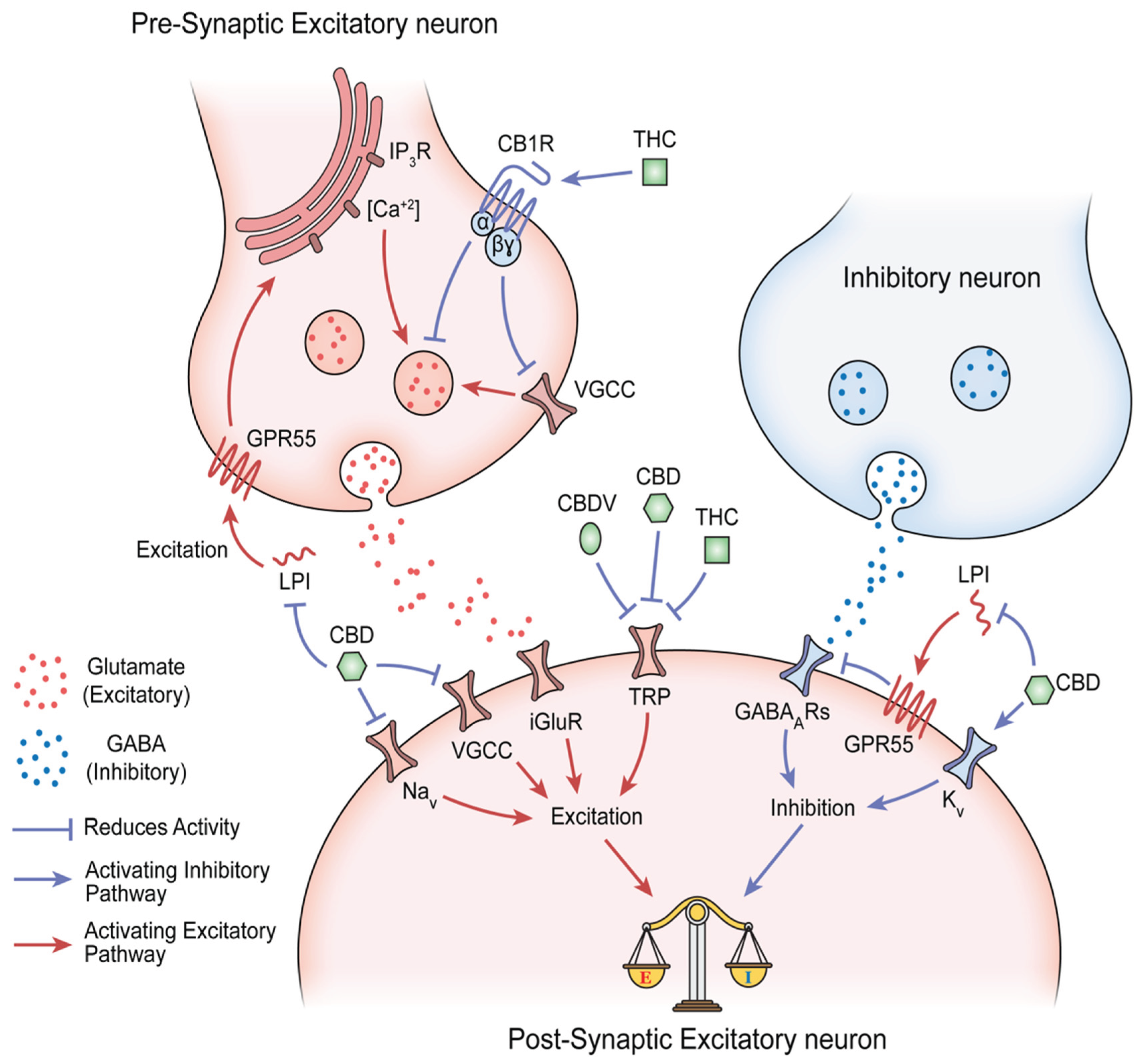
Presynaptic activation of cannabinoid receptor type 1 (CB1R), particularly by Δ9-THC and endocannabinoids, inhibits neurotransmitter release via Gi/o-coupled signaling, reducing calcium (Ca²⁺) influx through voltage-gated calcium channels (VGCCs) and suppressing glutamate release. CBD may further reduce glutamate release by interfering with lysophosphatidylinositol (LPI)–G protein-coupled receptor 55 (GPR55) signaling, thereby limiting presynaptic Ca²⁺ influx. Reduced glutamate release decreases activation of postsynaptic ionotropic glutamate receptors (iGluRs), including AMPA and NMDA receptors, which drive excitatory transmission and long-term plasticity.
CBD, CBDV, and Δ9-THC also modulate intracellular Ca²⁺ dynamics through transient receptor potential (TRP) channels (e.g., TRPV1, TRPV2, TRPA1), contributing to stabilization of neuronal excitability. In addition, CBD can inhibit voltage-gated sodium (NaV) channels and VGCCs, while activating voltage-gated potassium (KV) channels, further reducing neuronal firing.
Because GPR55 signaling has been associated with reduced γ-aminobutyric acid type A (GABAA receptor) expression, CBD-mediated interference with LPI–GPR55 pathways may help preserve inhibitory tone. Together, these complementary mechanisms may reduce network hyperexcitability, enhance inhibitory control, and increase seizure threshold, thereby supporting restoration of E/I balance in epileptic circuits. Schematic created by the author.
This article presents a mechanistic perspective informed by existing scientific literature. The content is intended for educational and scholarly purposes and should not be interpreted as medical advice or as evidence of clinical efficacy. Translation to clinical practice requires validation through rigorously controlled human studies.
Acknowledgments
The author thanks Dr. Zaven Kaprielian for insightful discussions and thoughtful feedback on the manuscript.
Abbreviations
AMPA, α-amino-3-hydroxy-5-methyl-4-isoxazolepropionic acid receptor; Ca²⁺, calcium; CB1R, cannabinoid receptor type 1; CBD, cannabidiol; CBDV, cannabidivarin; Δ⁹-THC, Δ⁹-tetrahydrocannabinol; E/I balance, excitatory–inhibitory balance; GABAA receptor, γ-aminobutyric acid type A receptor; GPR55, G protein-coupled receptor 55; iGluR, ionotropic glutamate receptor; KV, voltage-gated potassium channel; LPI, lysophosphatidylinositol; NaV, voltage-gated sodium channel; NMDA, N-methyl-D-aspartate receptor; TRP, transient receptor potential; TRPV1/2, transient receptor potential vanilloid 1/2; TRPA1, transient receptor potential ankyrin 1; VGCC, voltage-gated calcium channel.
References
- Rosenberg, E.C.; Tsien, R.W.; Whalley, B.J.; Devinsky, O. Cannabinoids and Epilepsy. Neurotherapeutics: the journal of the American Society for Experimental NeuroTherapeutics 2015, 12, 747–768. [Google Scholar] [CrossRef]
- Scharfman, H.E. The neurobiology of epilepsy. Current neurology and neuroscience reports 2007, 7, 348–354. [Google Scholar] [CrossRef]
- McCormick, D.A.; Contreras, D. On the cellular and network bases of epileptic seizures. Annual review of physiology 2001, 63, 815–846. [Google Scholar] [CrossRef]
- Mechoulam, R. Cannabis and epilepsy. Epilepsy & behavior: E&B 2017, 70, 278–279. [Google Scholar] [CrossRef]
- Rosenthal, F. The herb hashish versus medieval Muslim society. Leiden: E. J. Brill 1971. [Google Scholar]
- Chesher, G.B.; Jackson, D.M. Anticonvulsant effects of cannabinoids in mice: drug interactions within cannabinoids and cannabinoid interactions with phenytoin. Psychopharmacologia 1974, 37, 255–264. [Google Scholar] [CrossRef] [PubMed]
- Johnson, D.D.; McNeill, J.R.; Crawford, R.D.; Wilcox, W.C. Epileptiform seizures in domestic fowl. V. The anticonvulsant activity of delta9-tetrahydrocannabinol. Canadian journal of physiology and pharmacology 1975, 53, 1007–1013. [Google Scholar] [CrossRef]
- Wada, J.A.; Osawa, T.; Corcoran, M.E. Effects of tetrahydrocannabinols on kindled amygdaloid seizures and photogenic seizures in Senegalese baboons, Papio papio. Epilepsia 1975, 16, 439–448. [Google Scholar] [CrossRef]
- Ten Ham, M.; Loskota, W.J.; Lomax, P. Acute and chronic effects of beta9-tetrahydrocannabinol on seizures in the gerbil. European journal of pharmacology 1975, 31, 148–152. [Google Scholar] [CrossRef]
- Boggan, W.O.; Steele, R.A.; Freedman, D.X. 9 -Tetrahydrocannabinol effect on audiogenic seizure susceptibility. Psychopharmacologia 1973, 29, 101–106. [Google Scholar] [CrossRef]
- Corcoran, M.E.; McCaughran, J.A., Jr.; Wada, J.A. Acute antiepileptic effects of 9- tetrahydrocannabinol in rats with kindled seizures. Experimental neurology 1973, 40, 471–483. [Google Scholar] [CrossRef]
- Consroe, P.; Benedito, M.A.; Leite, J.R.; Carlini, E.A.; Mechoulam, R. Effects of cannabidiol on behavioral seizures caused by convulsant drugs or current in mice. European journal of pharmacology 1982, 83, 293–298. [Google Scholar] [CrossRef] [PubMed]
- Huizenga, M.N.; Sepulveda-Rodriguez, A.; Forcelli, P.A. Preclinical safety and efficacy of cannabidivarin for early life seizures. Neuropharmacology 2019, 148, 189–198. [Google Scholar] [CrossRef] [PubMed]
- Hill, T.D.; Cascio, M.G.; Romano, B.; Duncan, M.; Pertwee, R.G.; Williams, C.M.; Whalley, B.J.; Hill, A.J. Cannabidivarin-rich cannabis extracts are anticonvulsant in mouse and rat via a CB1 receptor-independent mechanism. British journal of pharmacology 2013, 170, 679–692. [Google Scholar] [CrossRef] [PubMed]
- Amada, N.; Yamasaki, Y.; Williams, C.M.; Whalley, B.J. Cannabidivarin (CBDV) suppresses pentylenetetrazole (PTZ)-induced increases in epilepsy-related gene expression. PeerJ 2013, 1, e214. [Google Scholar] [CrossRef]
- Hurley, E.N.; Ellaway, C.J.; Johnson, A.M.; Truong, L.; Gordon, R.; Galettis, P.; Martin, J.H.; Lawson, J.A. Efficacy and safety of cannabidivarin treatment of epilepsy in girls with Rett syndrome: A phase 1 clinical trial. Epilepsia 2022, 63, 1736–1747. [Google Scholar] [CrossRef]
- Hill, A.J.; Williams, C.M.; Whalley, B.J.; Stephens, G.J. Phytocannabinoids as novel therapeutic agents in CNS disorders. Pharmacology & therapeutics 2012, 133, 79–97. [Google Scholar] [CrossRef]
- Karler, R.; Cely, W.; Turkanis, S.A. The anticonvulsant activity of cannabidiol and cannabinol. Life sciences 1973, 13, 1527–1531. [Google Scholar] [CrossRef]
- Thornton, C.; Dickson, K.E.; Carty, D.R.; Ashpole, N.M.; Willett, K.L. Cannabis constituents reduce seizure behavior in chemically-induced and scn1a-mutant zebrafish. Epilepsy & behavior: E&B 2020, 110, 107152. [Google Scholar] [CrossRef]
- de Sousa, D.P.; Nóbrega, F.F.; Santos, C.C.; de Almeida, R.N. Anticonvulsant activity of the linalool enantiomers and racemate: investigation of chiral influence. Natural product communications 2010, 5, 1847–1851. [Google Scholar] [CrossRef]
- Koutroumanidou, E.; Kimbaris, A.; Kortsaris, A.; Bezirtzoglou, E.; Polissiou, M.; Charalabopoulos, K.; Pagonopoulou, O. Increased seizure latency and decreased severity of pentylenetetrazol-induced seizures in mice after essential oil administration. Epilepsy research and treatment 2013, 2013, 532657. [Google Scholar] [CrossRef] [PubMed]
- de Oliveira, C.C.; de Oliveira, C.V.; Grigoletto, J.; Ribeiro, L.R.; Funck, V.R.; Grauncke, A.C.; de Souza, T.L.; Souto, N.S.; Furian, A.F.; Menezes, I.R.; Oliveira, M.S. Anticonvulsant activity of β- caryophyllene against pentylenetetrazol-induced seizures. Epilepsy & behavior: E&B 2016, 56, 26–31. [Google Scholar] [CrossRef]
- Mallmann, M.P.; Mello, F.K.; Neuberger, B.; da Costa Sobral, K.G.; Fighera, M.R.; Royes, L.F.F.; Furian, A.F.; Oliveira, M.S. Beta-caryophyllene attenuates short-term recurrent seizure activity and blood-brain- barrier breakdown after pilocarpine-induced status epilepticus in rats. Brain research 2022, 1784, 147883. [Google Scholar] [CrossRef] [PubMed]
- Peltner, L.K.; Gluthmann, L.; Börner, F.; Pace, S.; Hoffstetter, R.K.; Kretzer, C.; Bilancia, R.; Pollastro, F.; Koeberle, A.; Appendino, G.; Rossi, A.; Newcomer, M.E.; Gilbert, N.C.; Werz, O.; Jordan, P.M. Cannabidiol acts as molecular switch in innate immune cells to promote the biosynthesis of inflammation- resolving lipid mediators. Cell chemical biology 2023, 30, 1508–1524.e7. [Google Scholar] [CrossRef]
- Shebaby, W.; Saliba, J.; Faour, W.H.; Ismail, J.; El Hage, M.; Daher, C.F.; Taleb, R.I.; Nehmeh, B.; Dagher, C.; Chrabieh, E.; Mroueh, M. In vivo and in vitro anti-inflammatory activity evaluation of Lebanese Cannabis sativa L. ssp. indica (Lam.). Journal of ethnopharmacology 2021, 270, 113743. [Google Scholar] [CrossRef]
- Hampson, A.J.; Grimaldi, M.; Lolic, M.; Wink, D.; Rosenthal, R.; Axelrod, J. Neuroprotective antioxidants from marijuana. Annals of the New York Academy of Sciences 2000, 899, 274–282. [Google Scholar] [CrossRef]
- Sánchez, A.J.; García-Merino, A. Neuroprotective agents: cannabinoids. Clinical immunology 2012, 142, 57–67. [Google Scholar] [CrossRef]
- Kovalchuk, O.; Kovalchuk, I. Cannabinoids as anticancer therapeutic agents. Cell cycle 2020, 19, 961–989. [Google Scholar] [CrossRef]
- Bogdanović, V.; Mrdjanović, J.; Borišev, I. A Review of the Therapeutic Antitumor Potential of Cannabinoids. Journal of alternative and complementary medicine 2017, 23, 831–836. [Google Scholar] [CrossRef]
- Meng, H.; Johnston, B.; Englesakis, M.; Moulin, D.E.; Bhatia, A. Selective Cannabinoids for Chronic Neuropathic Pain: A Systematic Review and Meta-analysis. Anesthesia and analgesia 2017, 125, 1638–1652. [Google Scholar] [CrossRef]
- Romero-Sandoval, E.A.; Kolano, A.L.; Alvarado-Vázquez, P.A. Cannabis and Cannabinoids for Chronic Pain. Current rheumatology reports 2017, 19, 67. [Google Scholar] [CrossRef] [PubMed]
- Safakish, R.; Ko, G.; Salimpour, V.; Hendin, B.; Sohanpal, I.; Loheswaran, G.; Yoon, S.Y.R. Medical Cannabis for the Management of Pain and Quality of Life in Chronic Pain Patients: A Prospective Observational Study. Pain medicine 2020, 21, 3073–3086. [Google Scholar] [CrossRef] [PubMed]
- Mahmud, M.S.; Hossain, M.S.; Ahmed, A.T.M.F.; Islam, M.Z.; Sarker, M.E.; Islam, M.R. Antimicrobial and Antiviral (SARS-CoV-2) Potential of Cannabinoids and Cannabis sativa: A Comprehensive Review. Molecules 2021, 26, 7216. [Google Scholar] [CrossRef] [PubMed]
- Ferber, S.G.; Namdar, D.; Hen-Shoval, D.; Eger, G.; Koltai, H.; Shoval, G.; Shbiro, L.; Weller, A. The "Entourage Effect": Terpenes Coupled with Cannabinoids for the Treatment of Mood Disorders and Anxiety Disorders. Current neuropharmacology 2020, 18, 87–96. [Google Scholar] [CrossRef]
- Iseger, T.A.; Bossong, M.G. A systematic review of the antipsychotic properties of cannabidiol in humans. Schizophrenia research 2015, 162(1-3), 153–161. [Google Scholar] [CrossRef]
- Velayudhan, L.; McGoohan, K.; Bhattacharyya, S. Safety and tolerability of natural and synthetic cannabinoids in adults aged over 50 years: A systematic review and meta-analysis. PLoS medicine 2021, 18, e1003524. [Google Scholar] [CrossRef]
- McPartland, J.; Russo, E. Cannabis and Cannabis Extracts: Greater Than the Sum of Their Parts? J Cannabis Therapeutics 2001, 1, 103–132. Available online: https://www.researchgate.net/publication/228897917_Cannabis_and_Cannabis_Extracts_Greater_Than_the_Sum_of_Their_Parts. [CrossRef]
- Russo, E.B. The Case for the Entourage Effect and Conventional Breeding of Clinical Cannabis: No "Strain," No Gain. Frontiers in plant science 2019, 9, 1969. [Google Scholar] [CrossRef]
- Pamplona, F.A.; da Silva, L.R.; Coan, A.C. Potential Clinical Benefits of CBD-Rich Cannabis Extracts Over Purified CBD in Treatment-Resistant Epilepsy: Observational Data Meta- analysis. Frontiers in neurology 2018, 9, 759. [Google Scholar] [CrossRef]
- Maayah, Z.H.; Takahara, S.; Ferdaoussi, M.; Dyck, J.R.B. The molecular mechanisms that underpin the biological benefits of full-spectrum cannabis extract in the treatment of neuropathic pain and inflammation. Biochimica et biophysica acta. Molecular basis of disease 2020, 1866, 165771. [Google Scholar] [CrossRef]
- Carlini, E.A.; Karniol, I.G.; Renault, P.F.; Schuster, C.R. Effects of marihuana in laboratory animals and in man. British journal of pharmacology 1974, 50, 299–309. [Google Scholar] [CrossRef]
- Mechoulam, R.; Ben-Shabat, S. From gan-zi-gun-nu to anandamide and 2-arachidonoylglycerol: the ongoing story of cannabis. Natural product reports 1999, 16, 131–143. [Google Scholar] [CrossRef] [PubMed]
- Russo, E.B. Taming THC: potential cannabis synergy and phytocannabinoid-terpenoid entourage effects. British journal of pharmacology 2011, 163, 1344–1364. [Google Scholar] [CrossRef] [PubMed]
- Farrelly, A.M.; Vlachou, S.; Grintzalis, K. Efficacy of Phytocannabinoids in Epilepsy Treatment: Novel Approaches and Recent Advances. International journal of environmental research and public health 2021, 18, 3993. [Google Scholar] [CrossRef] [PubMed]
- Castillo, P.E.; Younts, T.J.; Chávez, A.E.; Hashimotodani, Y. Endocannabinoid signaling and synaptic function. Neuron 2012, 76, 70–81. [Google Scholar] [CrossRef]
- Mackie, K. Cannabinoid receptors: where they are and what they do. Journal of neuroendocrinology 2008, 20 Suppl 1, 10–14. [Google Scholar] [CrossRef]
- Marsicano, G.; Lutz, B. Expression of the cannabinoid receptor CB1 in distinct neuronal subpopulations in the adult mouse forebrain. The European journal of neuroscience 1999, 11, 4213–4225. [Google Scholar] [CrossRef]
- Katona, I.; Urbán, G.M.; Wallace, M.; Ledent, C.; Jung, K.M.; Piomelli, D.; Mackie, K.; Freund, T.F. Molecular composition of the endocannabinoid system at glutamatergic synapses. The Journal of neuroscience: the official journal of the Society for Neuroscience 2006, 26, 5628–5637. [Google Scholar] [CrossRef]
- Soltesz, I.; Alger, B.E.; Kano, M.; Lee, S.H.; Lovinger, D.M.; Ohno-Shosaku, T.; Watanabe, M. Weeding out bad waves: towards selective cannabinoid circuit control in epilepsy. Nature reviews. Neuroscience 2015, 16, 264–277. [Google Scholar] [CrossRef]
- Katona, I.; Freund, T.F. Endocannabinoid signaling as a synaptic circuit breaker in neurological disease. Nature medicine 2008, 14, 923–930. [Google Scholar] [CrossRef]
- Panikashvili, D.; Simeonidou, C.; Ben-Shabat, S.; Hanus, L.; Breuer, A.; Mechoulam, R.; Shohami, E. An endogenous cannabinoid (2-AG) is neuroprotective after brain injury. Nature 2001, 413, 527–531. [Google Scholar] [CrossRef] [PubMed]
- Hansen, H.H.; Schmid, P.C.; Bittigau, P.; Lastres-Becker, I.; Berrendero, F.; Manzanares, J.; Ikonomidou, C.; Schmid, H.H.; Fernández-Ruiz, J.J.; Hansen, H.S. Anandamide, but not 2-arachidonoylglycerol, accumulates during in vivo neurodegeneration. Journal of neurochemistry 2001, 78, 1415–1427. [Google Scholar] [CrossRef] [PubMed]
- Fernández-Ruiz, J.; Moro, M.A.; Martínez-Orgado, J. Cannabinoids in Neurodegenerative Disorders and Stroke/Brain Trauma: From Preclinical Models to Clinical Applications. Neurotherapeutics: the journal of the American Society for Experimental NeuroTherapeutics 2015, 12, 793–806. [Google Scholar] [CrossRef] [PubMed]
- Marsicano, G.; Goodenough, S.; Monory, K.; Hermann, H.; Eder, M.; Cannich, A.; Azad, S.C.; Cascio, M.G.; Gutiérrez, S.O.; van der Stelt, M.; López-Rodriguez, M.L.; Casanova, E.; Schütz, G.; Zieglgänsberger, W.; Di Marzo, V.; Behl, C.; Lutz, B. CB1 cannabinoid receptors and on-demand defense against excitotoxicity. Science 2003, 302, 84–88. [Google Scholar] [CrossRef]
- Wallace, M.J.; Blair, R.E.; Falenski, K.W.; Martin, B.R.; DeLorenzo, R.J. The endogenous cannabinoid system regulates seizure frequency and duration in a model of temporal lobe epilepsy. The Journal of pharmacology and experimental therapeutics 2003, 307, 129–137. [Google Scholar] [CrossRef]
- Ludányi, A.; Eross, L.; Czirják, S.; Vajda, J.; Halász, P.; Watanabe, M.; Palkovits, M.; Maglóczky, Z.; Freund, T.F.; Katona, I. Downregulation of the CB1 cannabinoid receptor and related molecular elements of the endocannabinoid system in epileptic human hippocampus. The Journal of neuroscience: the official journal of the Society for Neuroscience 2008, 28, 2976–2990. [Google Scholar] [CrossRef]
- Romigi, A.; Bari, M.; Placidi, F.; Marciani, M.G.; Malaponti, M.; Torelli, F.; Izzi, F.; Prosperetti, C.; Zannino, S.; Corte, F.; Chiaramonte, C.; Maccarrone, M. Cerebrospinal fluid levels of the endocannabinoid anandamide are reduced in patients with untreated newly diagnosed temporal lobe epilepsy. Epilepsia 2010, 51, 768–772. [Google Scholar] [CrossRef]
- Wallace, M.J.; Wiley, J.L.; Martin, B.R.; DeLorenzo, R.J. Assessment of the role of CB1 receptors in cannabinoid anticonvulsant effects. European journal of pharmacology 2001, 428, 51–57. [Google Scholar] [CrossRef]
- Wallace, M.J.; Martin, B.R.; DeLorenzo, R.J. Evidence for a physiological role of endocannabinoids in the modulation of seizure threshold and severity. European journal of pharmacology 2002, 452, 295–301. [Google Scholar] [CrossRef]
- Shafaroodi, H.; Samini, M.; Moezi, L.; Homayoun, H.; Sadeghipour, H.; Tavakoli, S.; Hajrasouliha, A.R.; Dehpour, A.R. The interaction of cannabinoids and opioids on pentylenetetrazole-induced seizure threshold in mice. Neuropharmacology 2004, 47, 390–400. [Google Scholar] [CrossRef]
- Blair, R.E.; Deshpande, L.S.; Sombati, S.; Falenski, K.W.; Martin, B.R.; DeLorenzo, R.J. Activation of the cannabinoid type-1 receptor mediates the anticonvulsant properties of cannabinoids in the hippocampal neuronal culture models of acquired epilepsy and status epilepticus. The Journal of pharmacology and experimental therapeutics 2006, 317, 1072–1078. [Google Scholar] [CrossRef] [PubMed]
- Jensen, K.R.; Berthoux, C.; Nasrallah, K.; Castillo, P.E. Multiple cannabinoid signaling cascades powerfully suppress recurrent excitation in the hippocampus. Proceedings of the National Academy of Sciences of the United States of America 2021, 118, e2017590118. [Google Scholar] [CrossRef] [PubMed]
- Lorenz, R. On the application of cannabis in paediatrics and epileptology. Neuro endocrinology letters 2004, 25, 40–44. [Google Scholar] [PubMed]
- De Petrocellis, L.; Vellani, V.; Schiano-Moriello, A.; Marini, P.; Magherini, P.C.; Orlando, P.; Di Marzo, V. Plant-derived cannabinoids modulate the activity of transient receptor potential channels of ankyrin type-1 and melastatin type-8. The Journal of pharmacology and experimental therapeutics 2008, 325, 1007–1015. [Google Scholar] [CrossRef]
- Muller, C.; Morales, P.; Reggio, P.H. Cannabinoid Ligands Targeting TRP Channels. Frontiers in molecular neuroscience 2019, 11, 487. [Google Scholar] [CrossRef]
- Qin, N.; Neeper, M.P.; Liu, Y.; Hutchinson, T.L.; Lubin, M.L.; Flores, C.M. TRPV2 is activated by cannabidiol and mediates CGRP release in cultured rat dorsal root ganglion neurons. The Journal of neuroscience: the official journal of the Society for Neuroscience 2008, 28, 6231–6238. [Google Scholar] [CrossRef]
- Ross, H.R.; Napier, I.; Connor, M. Inhibition of recombinant human T-type calcium channels by Delta9-tetrahydrocannabinol and cannabidiol. The Journal of biological chemistry 2008, 283, 16124–16134. [Google Scholar] [CrossRef]
- Talley, E.M.; Cribbs, L.L.; Lee, J.H.; Daud, A.; Perez-Reyes, E.; Bayliss, D.A. Differential distribution of three members of a gene family encoding low voltage-activated (T-type) calcium channels. The Journal of neuroscience: the official journal of the Society for Neuroscience 1999, 19, 1895–1911. [Google Scholar] [CrossRef]
- Huguenard, J.R. Low-threshold calcium currents in central nervous system neurons. Annual review of physiology 1996, 58, 329–348. [Google Scholar] [CrossRef]
- Abood, M.E.; Rizvi, G.; Sallapudi, N.; McAllister, S.D. Activation of the CB1 cannabinoid receptor protects cultured mouse spinal neurons against excitotoxicity. Neuroscience letters 2001, 309, 197–201. [Google Scholar] [CrossRef]
- van der Stelt, M.; Veldhuis, W.B.; Bär, P.R.; Veldink, G.A.; Vliegenthart, J.F.; Nicolay, K. Neuroprotection by Delta9-tetrahydrocannabinol, the main active compound in marijuana, against ouabain- induced in vivo excitotoxicity. The Journal of neuroscience: the official journal of the Society for Neuroscience 2001, 21, 6475–6479. [Google Scholar] [CrossRef] [PubMed]
- El-Remessy, A.B.; Khalil, I.E.; Matragoon, S.; Abou-Mohamed, G.; Tsai, N.J.; Roon, P.; Caldwell, R.B.; Caldwell, R.W.; Green, K.; Liou, G.I. Neuroprotective effect of (-)Delta9-tetrahydrocannabinol and cannabidiol in N-methyl-D-aspartate-induced retinal neurotoxicity: involvement of peroxynitrite. The American journal of pathology 2003, 163, 1997–2008. [Google Scholar] [CrossRef] [PubMed]
- Mechoulam, R.; Panikashvili, D.; Shohami, E. Cannabinoids and brain injury: therapeutic implications. Trends in molecular medicine 2002, 8, 58–61. [Google Scholar] [CrossRef]
- Gilbert, G.L.; Kim, H.J.; Waataja, J.J.; Thayer, S.A. Delta9-tetrahydrocannabinol protects hippocampal neurons from excitotoxicity. Brain research 2007, 1128, 61–69. [Google Scholar] [CrossRef] [PubMed]
- Nagayama, T.; Sinor, A.D.; Simon, R.P.; Chen, J.; Graham, S.H.; Jin, K.; Greenberg, D.A. Cannabinoids and neuroprotection in global and focal cerebral ischemia and in neuronal cultures. The Journal of neuroscience: the official journal of the Society for Neuroscience 1999, 19, 2987–2995. [Google Scholar] [CrossRef]
- Zani, A.; Braida, D.; Capurro, V.; Sala, M. Delta9-tetrahydrocannabinol (THC) and AM 404 protect against cerebral ischaemia in gerbils through a mechanism involving cannabinoid and opioid receptors. British journal of pharmacology 2007, 152, 1301–1311. [Google Scholar] [CrossRef]
- Hampson, A.J.; Grimaldi, M.; Axelrod, J.; Wink, D. Cannabidiol and (-)Delta9-tetrahydrocannabinol are neuroprotective antioxidants. Proceedings of the National Academy of Sciences of the United States of America 1998, 95, 8268–8273. [Google Scholar] [CrossRef]
- Steindel, F.; Lerner, R.; Häring, M.; Ruehle, S.; Marsicano, G.; Lutz, B.; Monory, K. Neuron-type specific cannabinoid-mediated G protein signalling in mouse hippocampus. Journal of neurochemistry 2013, 124, 795–807. [Google Scholar] [CrossRef]
- Busquets-Garcia, A.; Bains, J.; Marsicano, G. CB1 Receptor Signaling in the Brain: Extracting Specificity from Ubiquity. Neuropsychopharmacology: official publication of the American College of Neuropsychopharmacology 2018, 43, 4–20. [Google Scholar] [CrossRef]
- Katona, I.; Sperlágh, B.; Sík, A.; Käfalvi, A.; Vizi, E.S.; Mackie, K.; Freund, T.F. Presynaptically located CB1 cannabinoid receptors regulate GABA release from axon terminals of specific hippocampal interneurons. The Journal of neuroscience: the official journal of the Society for Neuroscience 1999, 19, 4544–4558. [Google Scholar] [CrossRef]
- Adams, R.; Pease, D.C.; Clark, J.H. Isolation of cannabinol, cannabidiol, and quebrachitrol from red oil of Minnesota wild hemp. J Am Chem Soc 1940, 62, 2194–2196. [Google Scholar]
- Crippa, J.A.; Guimarães, F.S.; Campos, A.C.; Zuardi, A.W. Translational Investigation of the Therapeutic Potential of Cannabidiol (CBD): Toward a New Age. Frontiers in immunology 2018, 9, 2009. [Google Scholar] [CrossRef] [PubMed]
- Devinsky, O.; Cross, J.H.; Laux, L.; Marsh, E.; Miller, I.; Nabbout, R.; Scheffer, I.E.; Thiele, E.A.; Wright, S. Cannabidiol in Dravet Syndrome Study Group Trial of Cannabidiol for Drug-Resistant Seizures in the Dravet Syndrome. The New England journal of medicine 2017, 376, 2011–2020. [Google Scholar] [CrossRef] [PubMed]
- Cunha, J.M.; Carlini, E.A.; Pereira, A.E.; Ramos, O.L.; Pimentel, C.; Gagliardi, R.; Sanvito, W.L.; Lander, N.; Mechoulam, R. Chronic administration of cannabidiol to healthy volunteers and epileptic patients. Pharmacology 1980, 21, 175–185. [Google Scholar] [CrossRef]
- Devinsky, O.; Marsh, E.; Friedman, D.; Thiele, E.; Laux, L.; Sullivan, J.; Miller, I.; Flamini, R.; Wilfong, A.; Filloux, F.; et al. Cannabidiol in patients with treatment-resistant epilepsy: an open-label interventional trial. The Lancet. Neurology 2016, 15, 270–278. [Google Scholar] [CrossRef]
- Tzadok, M.; Uliel-Siboni, S.; Linder, I.; Kramer, U.; Epstein, O.; Menascu, S.; Nissenkorn, A.; Yosef, O.B.; Hyman, E.; Granot, D.; Dor, M.; Lerman-Sagie, T.; Ben-Zeev, B. CBD-enriched medical cannabis for intractable pediatric epilepsy: The current Israeli experience. Seizure 2016, 35, 41–44. [Google Scholar] [CrossRef]
- Carlini, E.A.; Cunha, J.M. Hypnotic and antiepileptic effects of cannabidiol. Journal of clinical pharmacology 1981, 21, 417S–427S. [Google Scholar] [CrossRef]
- Consroe, P.; Wolkin, A. Cannabidiol--antiepileptic drug comparisons and interactions in experimentally induced seizures in rats. The Journal of pharmacology and experimental therapeutics 1977, 201, 26–32. [Google Scholar] [CrossRef]
- Jones, N.A.; Glyn, S.E.; Akiyama, S.; Hill, T.D.; Hill, A.J.; Weston, S.E.; Burnett, M.D.; Yamasaki, Y.; Stephens, G.J.; Whalley, B.J.; Williams, C.M. Cannabidiol exerts anti-convulsant effects in animal models of temporal lobe and partial seizures. Seizure 2012, 21, 344–352. [Google Scholar] [CrossRef]
- Mao, K.; You, C.; Lei, D.; Zhang, H. High dosage of cannabidiol (CBD) alleviates pentylenetetrazole- induced epilepsy in rats by exerting an anticonvulsive effect. International journal of clinical and experimental medicine 2015, 8, 8820–8827. [Google Scholar]
- Patra, P.H.; Barker-Haliski, M.; White, H.S.; Whalley, B.J.; Glyn, S.; Sandhu, H.; Jones, N.; Bazelot, M.; Williams, C.M.; McNeish, A.J. Cannabidiol reduces seizures and associated behavioral comorbidities in a range of animal seizure and epilepsy models. Epilepsia 2019, 60, 303–314. [Google Scholar] [CrossRef] [PubMed]
- Kaplan, J.S.; Stella, N.; Catterall, W.A.; Westenbroek, R.E. Cannabidiol attenuates seizures and social deficits in a mouse model of Dravet syndrome. Proceedings of the National Academy of Sciences of the United States of America 2017, 114, 11229–11234. [Google Scholar] [CrossRef] [PubMed]
- Khan, A.A.; Shekh-Ahmad, T.; Khalil, A.; Walker, M.C.; Ali, A.B. Cannabidiol exerts antiepileptic effects by restoring hippocampal interneuron functions in a temporal lobe epilepsy model. British journal of pharmacology 2018, 175, 2097–2115. [Google Scholar] [CrossRef] [PubMed]
- Scheffer, I.E.; Halford, J.J.; Miller, I.; Nabbout, R.; Sanchez-Carpintero, R.; Shiloh-Malawsky, Y.; Wong, M.; Zolnowska, M.; Checketts, D.; Dunayevich, E.; Devinsky, O. Add-on cannabidiol in patients with Dravet syndrome: Results of a long-term open-label extension trial. Epilepsia 2021, 62, 2505–2517. [Google Scholar] [CrossRef]
- Miller, I.; Scheffer, I.E.; Gunning, B.; Sanchez-Carpintero, R.; Gil-Nagel, A.; Perry, M.S.; Saneto, R.P.; Checketts, D.; Dunayevich, E.; Knappertz, V. GWPCARE2 Study Group Dose-Ranging Effect of Adjunctive Oral Cannabidiol vs Placebo on Convulsive Seizure Frequency in Dravet Syndrome: A Randomized Clinical Trial. JAMA neurology 2020, 77, 613–621. [Google Scholar] [CrossRef]
- Devinsky, O.; Patel, A.D.; Cross, J.H.; Villanueva, V.; Wirrell, E.C.; Privitera, M.; Greenwood, S.M.; Roberts, C.; Checketts, D.; VanLandingham, K.E.; Zuberi, S.M. GWPCARE3 Study Group Effect of Cannabidiol on Drop Seizures in the Lennox-Gastaut Syndrome. The New England journal of medicine 2018, 378, 1888–1897. [Google Scholar] [CrossRef]
- Thiele, E.A.; Bebin, E.M.; Bhathal, H.; Jansen, F.E.; Kotulska, K.; Lawson, J.A.; O'Callaghan, F.J.; Wong, M.; Sahebkar, F.; Checketts, D.; Knappertz, V. GWPCARE6 Study Group Add-on Cannabidiol Treatment for Drug-Resistant Seizures in Tuberous Sclerosis Complex: A Placebo-Controlled Randomized Clinical Trial. JAMA neurology 2021, 78, 285–292. [Google Scholar] [CrossRef]
- Rosenberg, E.C.; Chamberland, S.; Bazelot, M.; Nebet, E.R.; Wang, X.; McKenzie, S.; Jain, S.; Greenhill, S.; Wilson, M.; Marley, N.; et al. Cannabidiol modulates excitatory-inhibitory ratio to counter hippocampal hyperactivity. Neuron 2023, 111, 1282–1300.e8. [Google Scholar] [CrossRef]
- Sylantyev, S.; Jensen, T.P.; Ross, R.A.; Rusakov, D.A. Cannabinoid- and lysophosphatidylinositol- sensitive receptor GPR55 boosts neurotransmitter release at central synapses. Proceedings of the National Academy of Sciences of the United States of America 2013, 110, 5193–5198. [Google Scholar] [CrossRef]
- De Petrocellis, L.; Ligresti, A.; Moriello, A.S.; Allarà, M.; Bisogno, T.; Petrosino, S.; Stott, C.G.; Di Marzo, V. Effects of cannabinoids and cannabinoid-enriched Cannabis extracts on TRP channels and endocannabinoid metabolic enzymes. British journal of pharmacology 2011, 163, 1479–1494. [Google Scholar] [CrossRef]
- Bisogno, T.; Hanus, L.; De Petrocellis, L.; Tchilibon, S.; Ponde, D.E.; Brandi, I.; Moriello, A.S.; Davis, J.B.; Mechoulam, R.; Di Marzo, V. Molecular targets for cannabidiol and its synthetic analogues: effect on vanilloid VR1 receptors and on the cellular uptake and enzymatic hydrolysis of anandamide. British journal of pharmacology 2001, 134, 845–852. [Google Scholar] [CrossRef] [PubMed]
- Etemad, L.; Karimi, G.; Alavi, M.S.; Roohbakhsh, A. Pharmacological effects of cannabidiol by transient receptor potential channels. Life sciences 2022, 300, 120582. [Google Scholar] [CrossRef]
- Russo, E.B.; Burnett, A.; Hall, B.; Parker, K.K. Agonistic properties of cannabidiol at 5-HT1a receptors. Neurochemical research 2005, 30, 1037–1043. [Google Scholar] [CrossRef] [PubMed]
- Ahrens, J.; Demir, R.; Leuwer, M.; de la Roche, J.; Krampfl, K.; Foadi, N.; Karst, M.; Haeseler, G. The nonpsychotropic cannabinoid cannabidiol modulates and directly activates alpha-1 and alpha-1-Beta glycine receptor function. Pharmacology 2009, 83, 217–222. [Google Scholar] [CrossRef] [PubMed]
- Ghovanloo, M.R.; Shuart, N.G.; Mezeyova, J.; Dean, R.A.; Ruben, P.C.; Goodchild, S.J. Inhibitory effects of cannabidiol on voltage-dependent sodium currents. The Journal of biological chemistry 2018, 293, 16546–16558. [Google Scholar] [CrossRef]
- Zhang, H.B.; Heckman, L.; Niday, Z.; Jo, S.; Fujita, A.; Shim, J.; Pandey, R.; Al Jandal, H.; Jayakar, S.; Barrett, L.B.; Smith, J.; Woolf, C.J.; Bean, B.P. Cannabidiol activates neuronal Kv7 channels. eLife 2022, 11, e73246. [Google Scholar] [CrossRef]
- Leweke, F.M.; Piomelli, D.; Pahlisch, F.; Muhl, D.; Gerth, C.W.; Hoyer, C.; Klosterkötter, J.; Hellmich, M.; Koethe, D. Cannabidiol enhances anandamide signaling and alleviates psychotic symptoms of schizophrenia. Translational psychiatry 2012, 2, e94. [Google Scholar] [CrossRef]
- Rakhshan, F.; Day, T.A.; Blakely, R.D.; Barker, E.L. Carrier-mediated uptake of the endogenous cannabinoid anandamide in RBL-2H3 cells. The Journal of pharmacology and experimental therapeutics 2000, 292, 960–967. [Google Scholar]
- Ben-Shabat, S.; Fride, E.; Sheskin, T.; Tamiri, T.; Rhee, M.H.; Vogel, Z.; Bisogno, T.; De Petrocellis, L.; Di Marzo, V.; Mechoulam, R. An entourage effect: inactive endogenous fatty acid glycerol esters enhance 2-arachidonoyl-glycerol cannabinoid activity. European journal of pharmacology 1998, 353, 23–31. [Google Scholar] [CrossRef]
- Wagner, H.; Ulrich-Merzenich, G. Synergy research: approaching a new generation of phytopharmaceuticals. Phytomedicine: international journal of phytotherapy and phytopharmacology 2009, 16, 97–110. [Google Scholar] [CrossRef]
- Brodie, M.J.; Czapinski, P.; Pazdera, L.; Sander, J.W.; Toledo, M.; Napoles, M.; Sahebkar, F.; Schreiber, A. GWEP1330 Study Group A Phase 2 Randomized Controlled Trial of the Efficacy and Safety of Cannabidivarin as Add-on Therapy in Participants with Inadequately Controlled Focal Seizures. Cannabis and cannabinoid research 2021, 6, 528–536. [Google Scholar] [CrossRef] [PubMed]
- Hill, A.J.; Jones, N.A.; Smith, I.; Hill, C.L.; Williams, C.M.; Stephens, G.J.; Whalley, B.J. Voltage-gated sodium (NaV) channel blockade by plant cannabinoids does not confer anticonvulsant effects per se. Neuroscience letters 2014, 566, 269–274. [Google Scholar] [CrossRef] [PubMed]
- Nachnani, R.; Raup-Konsavage, W.M.; Vrana, K.E. The Pharmacological Case for Cannabigerol. The Journal of pharmacology and experimental therapeutics 2021, 376, 204–212. [Google Scholar] [CrossRef] [PubMed]
- Navarro, G.; Varani, K.; Reyes-Resina, I.; Sánchez de Medina, V.; Rivas-Santisteban, R.; Sánchez-Carnerero Callado, C.; Vincenzi, F.; Casano, S.; Ferreiro-Vera, C.; Canela, E.I.; Borea, P.A.; Nadal, X.; Franco, R. Cannabigerol Action at Cannabinoid CB1 and CB2 Receptors and at CB1-CB2 Heteroreceptor Complexes. Frontiers in pharmacology 2018, 9, 632. [Google Scholar] [CrossRef]
- Cascio, M.G.; Gauson, L.A.; Stevenson, L.A.; Ross, R.A.; Pertwee, R.G. Evidence that the plant cannabinoid cannabigerol is a highly potent alpha2-adrenoceptor agonist and moderately potent 5HT1A receptor antagonist. British journal of pharmacology 2010, 159, 129–141. [Google Scholar] [CrossRef]
- Gilsbach, R.; Hein, L. Are the pharmacology and physiology of α₂ adrenoceptors determined by α₂-heteroreceptors and autoreceptors respectively? British journal of pharmacology 2012, 165, 90–102. [Google Scholar] [CrossRef]
- Talley, E.M.; Rosin, D.L.; Lee, A.; Guyenet, P.G.; Lynch, K.R. Distribution of alpha 2A-adrenergic receptor-like immunoreactivity in the rat central nervous system. The Journal of comparative neurology 1996, 372, 111–134. [Google Scholar] [CrossRef]
- Wang, M.; Ramos, B.P.; Paspalas, C.D.; Shu, Y.; Simen, A.; Duque, A.; Vijayraghavan, S.; Brennan, A.; Dudley, A.; Nou, E.; Mazer, J.A.; McCormick, D.A.; Arnsten, A.F. Alpha2A-adrenoceptors strengthen working memory networks by inhibiting cAMP-HCN channel signaling in prefrontal cortex. Cell 2007, 129, 397–410. [Google Scholar] [CrossRef]
- Bickler, P.E.; Hansen, B.M. Alpha 2-adrenergic agonists reduce glutamate release and glutamate receptor-mediated calcium changes in hippocampal slices during hypoxia. Neuropharmacology 1996, 35, 679–687. [Google Scholar] [CrossRef]
- Riad, M.; Garcia, S.; Watkins, K.C.; Jodoin, N.; Doucet, E.; Langlois, X.; el Mestikawy, S.; Hamon, M.; Descarries, L. Somatodendritic localization of 5-HT1A and preterminal axonal localization of 5-HT1B serotonin receptors in adult rat brain. The Journal of comparative neurology 2000, 417, 181–194. [Google Scholar]
- Pertwee, R.G. The diverse CB1 and CB2 receptor pharmacology of three plant cannabinoids: delta9-tetrahydrocannabinol, cannabidiol and delta9-tetrahydrocannabivarin. British journal of pharmacology 2008, 153, 199–215. [Google Scholar] [CrossRef] [PubMed]
- Ghovanloo, M.R.; Effraim, P.R.; Tyagi, S.; Zhao, P.; Dib-Hajj, S.D.; Waxman, S.G. Functionally-selective inhibition of threshold sodium currents and excitability in dorsal root ganglion neurons by cannabinol. Communications biology 2024, 7, 120. [Google Scholar] [CrossRef] [PubMed]
- Sepulveda, D.E.; Vrana, K.E.; Kellogg, J.J.; Bisanz, J.E.; Desai, D.; Graziane, N.M.; Raup-Konsavage, W.M. The Potential of Cannabichromene (CBC) as a Therapeutic Agent. The Journal of pharmacology and experimental therapeutics 2024, 391, 206–213. [Google Scholar] [CrossRef] [PubMed]
- Udoh, M.; Santiago, M.; Devenish, S.; McGregor, I.S.; Connor, M. Cannabichromene is a cannabinoid CB2 receptor agonist. British journal of pharmacology 2019, 176, 4537–4547. [Google Scholar] [CrossRef]
- Chávez, A.E.; Chiu, C.Q.; Castillo, P.E. TRPV1 activation by endogenous anandamide triggers postsynaptic long-term depression in dentate gyrus. Nature neuroscience 2010, 13, 1511–1518. [Google Scholar] [CrossRef]
- Anderson, L.L.; Ametovski, A.; Lin Luo, J.; Everett-Morgan, D.; McGregor, I.S.; Banister, S.D.; Arnold, J.C. Cannabichromene, Related Phytocannabinoids, and 5-Fluoro-cannabichromene Have Anticonvulsant Properties in a Mouse Model of Dravet Syndrome. ACS chemical neuroscience 2021, 12, 330–339. [Google Scholar] [CrossRef]
- Wang, Z.; Zheng, H.; Yang, H.; Song, H.; Lian, J.; Peng, C.; Wang, H.; Zhang, H.; Zheng, Y.; Wang, Q.; Lan, L.; Duan, G.; Ma, L.; Peng, X.; Huang, Z. Cannabichromene from full-spectrum hemp extract exerts acute anti-seizure effects through allosteric activation of GABAA receptors. Fundamental research 2024, 4, 1357–1364. [Google Scholar] [CrossRef]
- Guzmán-Gutiérrez, S.L.; Bonilla-Jaime, H.; Gómez-Cansino, R.; Reyes-Chilpa, R. Linalool and β-pinene exert their antidepressant-like activity through the monoaminergic pathway. Life sciences 2015, 128, 24–29. [Google Scholar] [CrossRef]
- Weston-Green, K.; Clunas, H.; Jimenez Naranjo, C. A Review of the Potential Use of Pinene and Linalool as Terpene-Based Medicines for Brain Health: Discovering Novel Therapeutics in the Flavours and Fragrances of Cannabis. Frontiers in psychiatry 2021, 12, 583211. [Google Scholar] [CrossRef]
- Kessler, A.; Sahin-Nadeem, H.; Lummis, S.C.; Weigel, I.; Pischetsrieder, M.; Buettner, A.; Villmann, C. GABA(A) receptor modulation by terpenoids from Sideritis extracts. Molecular nutrition & food research 2014, 58, 851–862. [Google Scholar] [CrossRef]
- Narusuye, K.; Kawai, F.; Matsuzaki, K.; Miyachi, E. Linalool suppresses voltage-gated currents in sensory neurons and cerebellar Purkinje cells. Journal of neural transmission 2005, 112, 193–203. [Google Scholar] [CrossRef]
- Gertsch, J.; Leonti, M.; Raduner, S.; Racz, I.; Chen, J.Z.; Xie, X.Q.; Altmann, K.H.; Karsak, M.; Zimmer, A. Beta-caryophyllene is a dietary cannabinoid. Proceedings of the National Academy of Sciences of the United States of America 2008, 105, 9099–9104. [Google Scholar] [CrossRef] [PubMed]
- Zhang, L.L.; Yang, Z.Y.; Fan, G.; Ren, J.N.; Yin, K.J.; Pan, S.Y. Antidepressant-like Effect of Citrus sinensis (L.) Osbeck Essential Oil and Its Main Component Limonene on Mice. Journal of agricultural and food chemistry 2019, 67, 13817–13828. [Google Scholar] [CrossRef] [PubMed]
- Vieira, A.J.; Beserra, F.P.; Souza, M.C.; Totti, B.M.; Rozza, A.L. Limonene: Aroma of innovation in health and disease. Chemico-biological interactions 2018, 283, 97–106. [Google Scholar] [CrossRef] [PubMed]
- Seo, S.; Song, Y.; Gu, S.M.; Min, H.K.; Hong, J.T.; Cha, H.J.; Yun, J. D-limonene Inhibits Pentylenetetrazole-Induced Seizure via Adenosine A2A Receptor Modulation on GABAergic Neuronal Activity. International journal of molecular sciences 2020, 21, 9277. [Google Scholar] [CrossRef]
- Surendran, S.; Qassadi, F.; Surendran, G.; Lilley, D.; Heinrich, M. Myrcene-What Are the Potential Health Benefits of This Flavouring and Aroma Agent? Frontiers in nutrition 2021, 8, 699666. [Google Scholar] [CrossRef]
- Viana, G.S.; do Vale, T.G.; Silva, C.M.; Matos, F.J. Anticonvulsant activity of essential oils and active principles from chemotypes of Lippia alba (Mill.) N.E. Brown. Biological & pharmaceutical bulletin 2000, 23, 1314–1317. [Google Scholar] [CrossRef]
- Ueno, H.; Shimada, A.; Suemitsu, S.; Murakami, S.; Kitamura, N.; Wani, K.; Takahashi, Y.; Matsumoto, Y.; Okamoto, M.; Ishihara, T. Alpha-pinene and dizocilpine (MK-801) attenuate kindling development and astrocytosis in an experimental mouse model of epilepsy. IBRO reports 2020, 9, 102–114. [Google Scholar] [CrossRef]
- Felipe, C.F.B.; Albuquerque, A.M.S.; de Pontes, J.L.X.; de Melo JÍ, V.; Rodrigues, T.C.M.L.; de Sousa, A.M.P.; Monteiro, ÁB.; Ribeiro, A.E.D.S.; Lopes, J.P.; de Menezes, I.R.A.; de Almeida, R.N. Comparative study of alpha- and beta-pinene effect on PTZ-induced convulsions in mice. Fundamental & clinical pharmacology 2019, 33, 181–190. [Google Scholar] [CrossRef]
- Yang, H.; Woo, J.; Pae, A.N.; Um, M.Y.; Cho, N.C.; Park, K.D.; Yoon, M.; Kim, J.; Lee, C.J.; Cho, S. α-Pinene, a Major Constituent of Pine Tree Oils, Enhances Non-Rapid Eye Movement Sleep in Mice through GABAA-benzodiazepine Receptors. Molecular pharmacology 2016, 90, 530–539. [Google Scholar] [CrossRef]
- Miyazawa, M.; Yamafuji, C. Inhibition of acetylcholinesterase activity by bicyclic monoterpenoids. Journal of agricultural and food chemistry 2005, 53, 1765–1768. [Google Scholar] [CrossRef]
- Poorthuis, R.B.; Enke, L.; Letzkus, J.J. Cholinergic circuit modulation through differential recruitment of neocortical interneuron types during behaviour. The Journal of physiology 2014, 592, 4155–4164. [Google Scholar] [CrossRef]
- Martinello, K.; Mascia, A.; Casciato, S.; Di Gennaro, G.; Esposito, V.; Zoli, M.; Gotti, C.; Fucile, S. α4β2* nicotinic acetylcholine receptors drive human temporal glutamate/GABA balance toward inhibition. The Journal of physiology 2025, 603, 1645–1662. [Google Scholar] [CrossRef]
- Takács, V.T.; Cserép, C.; Schlingloff, D.; Pósfai, B.; Szőnyi, A.; Sos, K.E.; Környei, Z.; Dénes, Á; Gulyás, A.I.; Freund, T.F.; Nyiri, G. Co-transmission of acetylcholine and GABA regulates hippocampal states. Nature communications 2018, 9, 2848. [Google Scholar] [CrossRef]
- Zahra, A.; Wang, Y.; Wang, Q.; Wu, J. Shared Etiology in Autism Spectrum Disorder and Epilepsy with Functional Disability. Behavioural neurology 2022, 2022, 5893519. [Google Scholar] [CrossRef]
- Jensen, K.R. Supporting Cognitive Flexibility in Autism: Mechanistic Insights into Cannabinoid–Terpene Interactions. Preprints 2026. [Google Scholar] [CrossRef]
Disclaimer/Publisher’s Note: The statements, opinions and data contained in all publications are solely those of the individual author(s) and contributor(s) and not of MDPI and/or the editor(s). MDPI and/or the editor(s) disclaim responsibility for any injury to people or property resulting from any ideas, methods, instructions or products referred to in the content. |
© 2026 by the authors. Licensee MDPI, Basel, Switzerland. This article is an open access article distributed under the terms and conditions of the Creative Commons Attribution (CC BY) license (http://creativecommons.org/licenses/by/4.0/).
Copyright: This open access article is published under a Creative Commons CC BY 4.0 license, which permit the free download, distribution, and reuse, provided that the author and preprint are cited in any reuse.


