
Submitted:
17 April 2026
Posted:
20 April 2026
You are already at the latest version
Abstract
Diabetic neuropathy (DN) is a progressive nerve disorder caused by diabetes, characterized by chronic high blood sugar that leads to nerve inflammation and damage, resulting in pain, numbness, and loss of sensation. Current synthetic therapies often produce adverse effects such as hypoglycaemia, weight fluctuations, and organ toxicity, which hinder patient compliance and increase interest in herbal alternatives. This study evaluated a novel polyherbal extract (PHE) against diabetic neuropathy induced by a high-fat diet and streptozotocin (HFD-STZ) in rats. The PHE was prepared in a 2:2:1 composition ratio by decoction method. In the rat model, subjects received different doses of PHE (100, 200, and 400 mg/kg p.o) or gabapentin (300 mg/kg p.o) for 45 days. At the highest dose of 400 mg/kg, PHE significantly alleviated neuropathic symptoms, as shown by reduced mechanical allodynia and thermal hyperalgesia. It also improved glycemic control, normalized lipid profiles, and decreased oxidative stress markers by lowering lipid peroxidation while increasing levels of glutathione, superoxide dismutase, and catalase. Additionally, PHE enhanced gastric emptying time and exhibited neuroprotective effects by preserving the architecture of the sciatic nerve. In MIN6 β-cells, PHE maintained cell viability and stimulated glucose-dependent insulin secretion, highlighting its therapeutic potential for managing diabetic neuropathy.
Keywords:
diabetic neuropathy
; polyherbal formulation
; antioxidant
; anti-inflammatory
; neuroprotection
Introduction
Diabetic neuropathy (DN) is a serious scenario linked to diabetes, primarily caused by chronic hyperglycaemia [1]. Current estimates suggest that by 2050, around one-third of the global population, projected to be 9.7 billion, may have diabetes, with approximately 50 % of these affected likely to experience diabetic neuropathy [2]. The etiology of DN is due to complex interactions between metabolic, vascular, and neural factors, primarily triggered by chronic hyperglycaemia. This leads to insulin resistance and dyslipidaemia, causing peripheral nerve damage and microvascular dysfunction, which impairs nerve signalling and worsens neural ischemia [3].
Current diabetic neuropathy management focuses on glycaemic control and targeted therapies, including ROS inhibitors, aldose reductase inhibitors, and PKC inhibitors for the underlying mechanism in DN [4], along with SNRIS, anticonvulsants, and NMDAR antagonists for symptom relief [5]. However, these drugs often cause adverse effects like hypoglycaemia, weight changes, and organ toxicity, which have led to a decline in patient trust. Because of this, more people around the world are turning to herbal remedies instead of synthetic drugs [6].
Herbal formulations are often preferred because they generally have a better safety profile compared to traditional oral hypoglycaemic agents [7]. Various earlier studies have shown that using a single herb may not be enough to achieve the desired medicinal effect [8], however, combining multiple herbs, known as polyherbalism, can enhance their medicinal properties and reduce toxicity [9]. This approach capitalizes on the complementary pharmacological actions of different plant compounds, allowing for more comprehensive therapeutic effects with minimized adverse reactions [10]. Several evidence-based herbal formulations, such as Hyponidd, Trasina, Punchparna tincture, Diasulin, and Diamed, have demonstrated effectiveness in managing diabetes, hyperlipidemia, and oxidative stress through their multi-targeted pharmacological actions [11].
Withania somnifera, Gymnema sylvestre, Syzygium cumini, Tinospora cordifolia, Emblica officinalis, Pterocarpous marsupium, Azadirachta indica, and Momordica charantia have all individually demonstrated antidiabetic, antihyperlipidemic, and antioxidant activities. However, there is no scientific data have been reported on their synergistic effects in DN, hence current investigation assesses the effects of polyherbal extract (PHE) all the above herbs together on a high-fat diet (HFD) and streptozotocin (STZ) induced diabetic neuropathy in experimental animals.
Materials and Methods
Material
Collection and Authentication of Plants Material
Based on literature, plants which have been reported to possess antidiabetic, antihyperlipidemic, anti- inflammatory and antioxidant activities these plants are selected. The plant sample were collected fresh, while the other herbs were procured from an ayurvedic shop in Malegaon. All gathered plant samples were authenticated by the Department of Botany and the Research Centre, M.S.G. Arts, Science, and Commerce College to ensure their botanical authenticity (MSG/PG/BOT-105 04/12/2024). STZ was obtained from Otto Chemie Laboratory, Gabapentin was obtained as gift sample from SYMED LAB limited, Hyderabad.
Methods
Preparation of Polyherbal Extract
The plant parts were air-dried and pulverized using a mechanical grinder. For the preparation of extracts, decoction techniques were employed, powdered herbs were mixed in a specific ratio of 2:2:1, comprising two parts from five herbs, two parts from two herbs, and one part from the remaining herb (w/w) to achieve a homogeneous blend as detailed in Table 2 [11]. The extraction process involved mixing the dry powder with 100 ml of distilled water, heating the mixture to a boil, then reducing the heat to allow the volume to concentrate to half (50 mL). The concentrated mixture was filtered using whatman paper. The resulting filtrate was boiled again to produce a more concentrated extract, which was subsequently dried. The dried extracts were preserved in an airtight container and kept in the refrigerator, and used for pharmacological experiments [12].

Table 1.
The polyherbal extract contains bioactive phytochemicals with diverse pharmacological properties.
Table 1.
The polyherbal extract contains bioactive phytochemicals with diverse pharmacological properties.
| Plant | Phytochemicals | Pharmacological properties | Reference |
|---|---|---|---|
| Withania somnifera | Isopellertierine, anferine, withanolides, withaferins. | Antihyperglycemic, Anti-inflammatory, Antioxidant |
[13] [14] |
| Gymnema sylvestre | Hentriacontane, pentatriacontane, flavones, gymnemasaponins, and gymnemic acids. | Antidiabetic Anti-inflammatory |
[15] [16] |
| Azadirachta indica | Azadirachtin, nimbin, nimbidin, gedunin, salannin, quercetin, beta-sitosterol, limonoids, flavonoids, triterpenoids, nimbolide, margolone, cyclic peptides | Anti-inflammatory, Antidiabetic, Antioxidant, | [17] [18] |
| Tinospora cordifolia | Aporphine alkaloids, tinosporides, berberine, palmatine, magnoflorine, tinosporine, tetrahydropalmatine, isocolumbine,and choline | Antidiabetic, Anti-inflammatory, Antioxidant |
[19] [20] [21] |
| Syzygium cumini | Jambosine, anthocyanins, gallic acid, ellagic acid, corilagin, quercetin, kaempferol, myricetin, oleanolic acid, betulinic acid, friedelin, β-sitosterol, triterpenoids, tannins, flavonoids. | Antidiabetic, Antioxidant, Anti-inflammatory, |
[22] |
| Emblica officinalis | Phyllaemblic acid, quercetin, kaempferol, luteolin, apigenin, tannins, gallic acid, ellagic acid, geraniin, and vitamic C | Antioxidant, Antidiabetic, Anti-inflammatory. |
[23] [24] |
| Pterocorous marsupium | Marsupsin, pterostilbene, liquirtigenin, hydroxyflavanone, P-hydroxybenzaldehyde | Antioxidant, Antidiabetic, Anti-inflammatory. |
[25] [26] |
In Vivo Studies
Experimental Animals and Study Design
Adult male wistar rats (180-200 g) were obtained from Lacsmi Biofarm Pvt. Ltd. in Pune, India and the study protocol was approved (KBH/IAEC/2024/12-04) by the Institutional Animal Ethics Committee of K.B.H.S.S. Trust’s Institute of Pharmacy, Malegaon. Diabetes was induced in rats by HFD and low dose of STZ (35mg/kg, i.p.), then, after 4 weeks the rats with glucose level above 300 mg/dl were randomly divided into six group (n=6).
In which the first group comprised of non-diabetic rats whereas the rest of the groups include diabetic rats. The normal control group (G1NC) and diabetic control group (G2DC) did not receive any treatment but were allowed free access to distilled water. The third group (G3S) of diabetic rats received standard drug Gabapentin orally at the dose 300 mg/kg in 1% normal saline solution. The groups four, fifth and sixth diabetic rats were treated with polyherbal extract (p.o.) at doses: PHE-I (100 mg/kg), PHE-II (200 mg/kg), and PHE-III (400 mg/kg) respectively. During the study period of 45 days non-diabetic rats received standard chow diet, while diabetic rats were fed a HFD with ad libitum water.
Behavioral Estimations
In diabetic neuropathy, various behavioral parameters like mechano-tactile allodynia (using the Von Frey hair test, Aesthesio, DanMic Global LLC, USA) [27], and thermal hyperalgesia (using tail immersion and hot plate tests, Eddy hot plate, Omega India) [28,29] were assessed on the 0th, 22nd, and 45th day of the treatment schedule.
Biochemical Parameters in Blood and Tissue Homogenate
Blood was collected and serum was separated for various biochemical markers, including glucose, triglyceride, total cholesterol, HDL-C, and LDL-C, using Merilizer Auto Quant 100 Amara, commercial diagnostic kits (Meril Diagnostics Pvt. Ltd, India). Rats were sacrificed, and the sciatic nerves were rapidly excised. Sciatic nerve tissue was homogenized in 0.1 M Tris-HCL buffer (pH 7.4). The resulting supernatant was analyzed for lipid peroxidation (LPO) [30], glutathione (GSH) [31], superoxide dismutase (SOD) [32], catalase (CAT) [33], and TNF-α levels using ELISA (SciTesla, Mumbai).
Gastric Emptying Time
Gastric emptying was assessed using a phenol red method. Animals were administered 0.3 ml of phenol red test meal by oral gavage and euthanized 20 minutes later. The stomach was then isolated and homogenized with its contents in 25 ml of 0.1 N NaOH. After settling for 1 hour at room temperature, 8 ml of the supernatant was combined with 1 ml of 33% trichloroacetic acid to precipitate proteins. The mixture was centrifuged at 1600g for 30 minutes, and 2 ml of 2N NaOH was added to the resulting supernatant. The final homogenate was measured for absorbance at 560 nm [34].
Histopathological Assessment of the Sciatic Nerve
The sciatic nerve was randomly isolated, preserved in 10% formalin, and sent to the SciTesla laboratory, Mumbai, for histopathological examination.
In Vitro Studies
MIN6 Cell Culture
Dulbecco’s Modified Eagle Medium (DMEM) with 25 mmol/L glucose was used to grown MIN6 cells. The conditions were kept at 37 0C and 5 % CO2 in 95% air. 15% fetal calf serum, 50 mg/L penicillin sulfate were added to the medium. The MIN6 cells used in this study were collected between passages 16 and 23.
Cell Viability Assay
Cell viability was assessed using the 3-(4,5-Dimethylthiazol-2yl)-2,5-Diphenyltetrazolium Bromide (MTT) test. Thirty thousand MIN6 cells were initially incubated into 96- well plates and allowed to adhere overnight. The cells were then treated with PHE at concentration of 10, 40, and 100 μg/ml and incubated for 72 hours. Next, a 20-microliter solution of MTT at a concentration of 5 mg/ml was added to each well and incubated to each well and incubated for 4 hours. Subsequently, 100 microliters of dimethyl sulfoxide (DMSO) were employed to solubilise the formazan crystals produced during MTT reduction. Plates were gently agitated for 10 seconds to achieve complete dissolution, and absorbance was measured at 450 nm using an ELISA microplate reader (Benesphere 21) [35].
Insulin Secretion Assay
The experiment on β- cell insulin secretion included placing roughly 3 × 10⁴ MIN6 cells per well in 6-well plates.
During the study, the cells were incubated for 60 minutes under with only Krebs-Ringer bicarbonate buffer (KRB) (135 mmol/1 Nacl, 5 mmol/1 KCL, 1 mmol/1 MgSO4, 0.4 mmol/1 K2HPO4, 11 mmol/1 Glucose, 20 mmol/1 HEPES, pH 7.4), KRB containing glucose at 11 mM glucose (hyperglycaemic conditions). PHE was administered at a concentration of 1000 µg/mL to assess its effect on insulin secretion, while Glibenclamide was used at a concentration of 10 µM. Following the 60-minute incubation period, aliquots from each well were collected into Eppendorf tubes and centrifuged at 4000 g for 5 minutes at 4˚C. The insulin levels were then analysed using C-peptide kits [36].
Statistical Analysis
Data were expressed as the mean with a standard deviation (SD). The analysis was conducted using GraphPad Prism version 8.4.2 software. Behavioural test results were analysed using two-way analysis of variance (ANOVA), while one-way ANOVA was utilised to evaluate data on blood and tissue indicators. Bonferroni's multiple range test was employed for analysis.
Results
Effect of Aqueous Polyherbal Extract on Body Weight
The rats administered with the aqueous polyherbal extract (PHE) at varying doses (100,200, and 400 mg/kg) exhibited a dose-dependent increase in body weight compared to DC (Figure 1).
Effect of Aqueous Polyherbal Extract on Mechano-Tactile Allodynia (Von Frey Hair Test) in Diabetic Rats
The paw withdrawal threshold (PWT) from days 22 to 44, markedly diminished in the diabetic rats (###P < 0.05) as compared to NC. Additionally, PHE administration resulted in dose-dependent increases in PWT at doses of 100, 200 and 400 mg/kg when compared to the DC rats (*p < 0.05, *** p < 0.001) (Figure 2A).
Effect of Aqueous Polyherbal Extract on Thermal Hyperalgesia (Hot Plate Test and Tail Immersion Test) in Diabetic Rats
The significant reduction (### P<0.05) in both PWL and TWL was observed in DC rats from day 22 to day 44. Administration of PHE at doses of 100, 200, and 400 mg/kg progressively enhanced both PWL and TWL compared to the DC, demonstrating a marked improvement in thermal hyperalgesia (*p< 0.05, **p< 0.01, ***p<0.001) (Figure 2B and 2C).
Effect of Aqueous Polyherbal Extract on Serum Biochemical Parameters in Diabetic Rats
The diabetic group exhibited significantly lower levels of HDL cholesterol and higher levels of glucose, LDL, TC, and TG compared to normal controls (### P<0.001). PHE at doses of 100, 200, and 400 mg/kg significantly improved hyperglycaemia and lipid profile abnormalities compared to the DC group (*p< 0.05, **p< 0.01, *** P<0.001) (Table 3).
Effect of Aqueous Polyherbal Extract on Oxidative Stress and Inflammatory Marker in Diabetic Rats
Diabetic rats showed markedly increased oxidative stress markers, including elevated LPO and inflammatory marker, including TNF- α and significantly decreased levels of GSH, SOD, and CAT, in comparison to normal controls (###P < 0.001). PHE at 100, 200 and 400 mg/kg produced dose-dependent, significantly reduced LPO and increased GSH, SOD, and CAT levels. Additionally, inflammatory markers, specifically TNF-α, were reduced compared to DC (*p< 0.05, **p< 0.01, ***P< 0.001) (Table 4).
Effect of Aqueous Polyherbal Extract on Gastric Emptying Time in Diabetic Rats
Diabetic animals showed significantly delayed gastric emptying times compared to healthy controls (###P< 0.001). PHE at doses (100, 200 and 400 mg/kg) resulted in progressively enhanced gastric emptying time compared to DC (*p< 0.05, **p< 0.01, ***P< 0.001) (Figure 3).
Effects of Aqueous Polyherbal Extract on Cell Viability Assays in MIN6 Cell Line
We examined the effect of a polyherbal extract on cell viability using the MTT assay. The normal control group maintained optimal cell viability, but H2O2 treatment significantly reduced it. The PHE at 10, 40, and 100 μL showing dose-dependent enhanced cell viability compared to the H2O2 group (See Table 5).
Effects of Aqueous Polyherbal Extract on Insulin Secretion Assays (MIN6 Cell Line)
The polyherbal extract demonstrated glucose-responsive insulinotropic effects in MIN6 β-cells cultured under hyperglycaemic conditions (11 mM glucose). At a dosage of 1000 μg/mL, the treatment resulted in a notable insulin release of 2.12 μU/mL and a corresponding C-peptide secretion of 6.47 pmol/mL, compared to control levels of 1.46 pmol/mL C-peptide. While its secretory potency was lower than that of the standard drug glibenclamide (10 μM; 3.32 μU/mL insulin, 9.97 pmol/mL C-peptide), the extract displayed relevant insulinotropic activity.
Table 6.
Effect of sample-PHE in insulin secretion in MIN6 cell line.
| Sr no. | Compounds | Concentration | C Peptide secretion (pmol/ml) | Insulin secretion (µU/ml) |
|---|---|---|---|---|
| 1 | Control | 10 μM | 01.46 | |
| 2 | Standard (Glibenclamide) |
10 μM | 9.97 | 3.32 µU/ml |
| 3 | Polyherbal extract | 1000 µg/mL | 6.47 | 2.12µU/ml |
Calculation- 1 pmol /ml C peptide ~ 0.333 µU/ml Insulin.
So, c peptide level- 6.47 pmol/ml Insulin level ~ 6.47 pmol/ml *0.333 = 2.12µU/ml
Effect of Aqueous Polyherbal Extract on Sciatic Nerve Histology in Diabetic Rats
Figure 4 shows intact sciatic nerve morphology in normal controls (NC), while diabetic controls (DC) displayed severe damage, including neuronal degeneration, inflammation, and edema. Treatment with polyherbal extract (100, 200, and 400 mg/kg) significantly reduced these abnormalities compared to DC. These results underscore the enhanced efficacy of the PHE in managing diabetic neuropathy, likely attributed to its improved bioavailability and combined antioxidant and anti-inflammatory properties.
Discussion
The HFD-STZ model is a validated and widely utilised method for inducing diabetes, and it has proven to be highly effective in inducing DN [37].
The rodent model of diabetic neuropathy used is the HFD-STZ model, which uses a HFD to cause insulin resistance coupled with the destruction of beta cells by STZ, leading to extreme hyperglycaemia [38]. A polyherbal extract reduces blood glucose may be due to inhibiting α-amylase/α-glucosidase [39,40] and activating GLUT4 translocation [41] and AMPK signaling, thereby enhancing peripheral insulin sensitivity and restoring metabolic balance [42].
Hyperglycaemia affects the use of glucose in the body and, such as, results in the catabolism of fats and structural proteins, especially muscle, to provide energy requirements [43]. This is the breakdown of protein that leads to progressive weight loss and is one of the indicators of uncontrolled diabetes, where the catabolism of protein is enhanced, and nitrogen is lost [44]. Polyherbal extract that effectively address glucose metabolism problem may be due to inhibition of α-glucosidase and α-amylase, and protection of proteins as well as increasing lipid production via synergistic phytochemicals [45]. It is a multi-faceted treatment mode that strives to provide metabolic balance and provoke weight regain in diabetes-related weight loss [46].
DN is linked to a reduced pain threshold, which has been demonstrated through behavioral nociceptive assessments. Mechanical allodynia was assessed in this study by Von Frey hair test [47], thermal hyperalgesia by Eddy hot plate, and the tail immersion test [48]. The polyherbal extract raising the pain threshold, may be due to increasing insulin sensitivity and maintaining the functioning of the pancreatic β- cells. This will help to deal with the underlying metabolic disturbances which play a part in neuropathy development [49].
Dyslipidaemia is a common issue in those with type 2 diabetes, characterized by elevated levels of TC, TG and LDl-C, along with reduced levels of HDL-C. This condition poses a great risk to cardiovascular diseases [50]. A polyherbal extract is proven to be significantly effective in reducing the levels of TC, LDL-C and TG and raising the levels of HDL-C as compared to DC. This beneficial action may be due to inhibition of hepatic HMG-CoA reductase that lessens cholesterol production [51], and stimulation of the PPAR-gamma pathway, which augments lipid metabolism and ameliorates cardiovascular risk factors [52].
Oxidative stress occurs when excess reactive oxygen species (ROS) exceed the body's antioxidant defenses, facilitating to diabetic neuropathy through a process called lipid peroxidation, as evidenced by elevated levels of malondialdehyde (MDA) [53]. Additionally, ROS suppress the activity of SOD and decrease levels of GSH and CAT [54,55,56]. The polyherbal extract was observed to have an anti-oxidative effect, which may be due to the activation of the Nrf2/HO-1 pathway [57], suppressed NF-kB, ROS scavenging capacity, metabolic chelation, and maintenance of mitochondrial integrity. These activities assist in recuperating the levels of antioxidant enzymes and alleviate LPO [58].
In diabetic neuropathy, hyperglycaemia activates the TLR4/MyD88 signaling pathway, leading to the release of the pro-inflammatory cytokine NF-kB and an increase in TNF-alpha [59]. These activities result in nerve injury. The polyherbal extract has an ameliorating effect on inflammation, likely due to the inhibition of TLR4/MyD88 signaling [60],and the suppressed activity of NF-kB. This mechanism reduces the level of TNF-alpha, provides neuroprotection, and enhances nerve conduction [61].
Diabetic neuropathy HFD-STZ induced gastroparesis is a delay in gastric emptying that occurs in response to sustained hyperglycaemia [62]. The polyherbal extract improves gastric transit, which may be due to restoring the vagal tone, supports interstitial cells and improves the contractility of smooth muscle [63].
This study systematically assessed the therapeutic effect of a polyherbal extract on pancreatic β-cells function in MIN6 cells. When MIN6 β-cells are exposed to H₂O₂, they produce excessive ROS that exceed their antioxidant defences, leading to oxidative damage and reduced cell viability. However, treatment with a polyherbal extract significantly restored cell survival, likely by activating the Nrf2/HO-1 antioxidant pathway [61], additionally, the administration of the polyherbal extract enhanced glucose stimulated insulin secretion (GSIS) in MIN6 cells, possibly due to its effect on insulin receptor mediated signalling cascades, resulting in PI3K/AKT-mediated enhancement of glucokinase activity and improved glucose phosphorylation efficiency [64].
The anti-diabetic effects of phytoconstituents are mediated via different but interlinked molecular pathways that involve inhibition of key proteins in glucose regulation and control of metabolism [65]. Taken together, this multi-target mechanism highlights the synergistic anti-diabetic effect of polyherbal extract in the management of type 2 diabetes mellitus through concomitant regulation of glucose metabolism, insulin sensitivity, oxidative stress, and inflammation.
References
- Pop-Busui, R.; Ang, L.; Boulton, A.J.; Feldman, E.L.; Marcus, R.L.; Mizokami-Stout, K.; Singleton, J.R.; Ziegler, D. Diagnosis and treatment of painful diabetic peripheral neuropathy. 2020, 1–32. [Google Scholar] [CrossRef] [PubMed]
- Yu, Y.B.; Qiu, M.Z.; Zhang, D.Y. Apigenin ameliorates diabetic neuropathy in rats by modulating the TLR4/MyD88 signaling pathway. Asian Pacific Journal of Tropical Biomedicine 2023, 13(11), 469–78. [Google Scholar] [CrossRef]
- Smith, S.; Normahani, P.; Lane, T.; Hohenschurz-Schmidt, D.; Oliver, N.; Davies, A.H. Pathogenesis of distal symmetrical polyneuropathy in diabetes. Life 2022, 12(7), 1074. [Google Scholar] [CrossRef] [PubMed]
- Arora, K.; Tomar, P.C.; Mohan, V. Diabetic neuropathy: an insight on the transition from synthetic drugs to herbal therapies. Journal of Diabetes & Metabolic Disorders 2021, 20(2), 1773–84. [Google Scholar] [CrossRef]
- Kumar, A.; Deshpande, S.; Deshpande, V. Gas Chromatography-Mass Spectrometry (GC-MS)-Based Phytochemical Analysis and Potential Therapeutic Evaluation of Vajra Guggulu in Diabetic Neuropathy. 2025. [Google Scholar] [CrossRef]
- Mehmood, M.H.; Malik, A.; Akhtar, M.S.; Haider, G.; Gilani, A.H. Antihyperglycaemic, antihyperlipidaemic and antihypertensive effect of a polyherbal formulation in alloxan-.
- Induced diabetic rats. Farmacia ORIGINAL ARTICLE. 2020, 68(5), 882–90. [CrossRef]
- Suvarna, R.; Shenoy, R.P.; Hadapad, B.S.; Nayak, A.V. Effectiveness of polyherbal formulations for the treatment of type 2 Diabetes mellitus-A systematic review and meta-analysis. Journal of Ayurveda and integrative medicine 2021, 12(1), 213–22. [Google Scholar] [CrossRef] [PubMed]
- Başaran, N.; Paslı, D.; Başaran, A.A. Unpredictable adverse effects of herbal products. Food and Chemical Toxicology 2022, 159, 112762. [Google Scholar] [CrossRef] [PubMed]
- Kumar, A.; Negi, A.S.; Chauhan, A.; Semwal, R.; Kumar, R.; Semwal, R.B.; Singh, R.; Joshi, T.; Chandra, S.; Joshi, S.K.; Semwal, D.K. Formulation and evaluation of SGLT2 inhibitory effect of a polyherbal mixture inspired from Ayurvedic system of medicine. Journal of Traditional and Complementary Medicine 2022, 12(5), 477–87. [Google Scholar] [CrossRef] [PubMed]
- Anusha, R.; Akhila, N.; Nikhitha, J.; Harish, K.; Abdull, R.S.; Inamul, S.Y. Formulation and evaluation of herbal hair serum: a review. International Journal of Basic & Clinical Pharmacology 2023, 12(5), 759–66. [Google Scholar] [CrossRef]
- Reddy, K.S.; Sudheer, A.; Pradeepkumar, B.; Reddy, C.S. Effect of a polyherbal formulation in streptozotocin-induced diabetic nephropathy in wistar rats. Indian Journal of Pharmacology 2019, 51(5), 330–6. [Google Scholar] [CrossRef] [PubMed]
- GUEHAIRIA Mohamed, T.H. Effect of Withania somnifera (Ashwagandha) on biochemical and neurobehavioral disturbances induced by chronic restraint stress in an animal model . Doctoral dissertation, Université Echahid Chikh Larbi Tebessi-Tebessa, 2023. [Google Scholar]
- Hussain, A.; Aslam, B.; Muhammad, F.; Faisal, M.N. In vitro antioxidant activity and in vivo anti-inflammatory effect of Ricinus communis (L.) and Withania somnifera (L.) hydroalcoholic extracts in rats. Brazilian Archives of Biology and Technology 2021, 64, e21200783. [Google Scholar] [CrossRef]
- Hashem, H.A.; Nabil, Z.I.; El-Hak, H.N. Ashwagandha root extract’s phenolic compound counteracts alloxan’s effects on oxidative stress, inflammatory cytokines, and peripheral neuropathy in rats. Comparative Clinical Pathology 2023, 32(5), 867–80. [Google Scholar] [CrossRef]
- Gunasekaran, V.; Srinivasan, S.; Rani, S.S. Potential antioxidant and antimicrobial activity of Gymnema sylvestre related to diabetes. J. Med. Plants. 2019, 7(2), 05–11. [Google Scholar]
- Kang, M.H.; Lee, M.S.; Choi, M.K.; Min, K.S.; Shibamoto, T. Hypoglycemic activity of Gymnema sylvestre extracts on oxidative stress and antioxidant status in diabetic rats. Journal of agricultural and food chemistry 2012, 60(10), 2517–24. [Google Scholar] [CrossRef] [PubMed]
- Satyanarayana, K.; Sravanthi, K.; Shaker, I.A.; Ponnulakshmi, R. Molecular approach to identify antidiabetic potential of Azadirachta indica. Journal of Ayurveda and integrative medicine 2015, 6(3), 165. [Google Scholar] [CrossRef] [PubMed]
- Rahmani, A.; Almatroudi, A.; Alrumaihi, F.; Khan, A. Pharmacological and therapeutic potential of neem (Azadirachta indica). Pharmacognosy Reviews 2018, 12(24), 250–5. [Google Scholar] [CrossRef]
- Sharma, R.; Amin, H.; Prajapati, P.K. Antidiabetic claims of Tinospora cordifolia (Willd.) Miers: critical appraisal and role in therapy. Asian Pacific Journal of Tropical Biomedicine 2015, 5(1), 68–78. [Google Scholar] [CrossRef]
- Philip, S.; Tom, G.; Vasumathi, A.V. Evaluation of the anti-inflammatory activity of Tinospora cordifolia (Willd.) Miers chloroform extract–a preclinical study. Journal of Pharmacy and Pharmacology 2018, 70(8), 1113–25. [Google Scholar] [CrossRef] [PubMed]
- Kannadhasan, R.; Venkataraman, S. In vitro capacity and in vivo antioxidant potency of sedimental extract of Tinospora cordifolia in streptozotocin induced type 2 diabetes. Avicenna journal of phytomedicine 2013, 3(1), 7. [Google Scholar] [PubMed]
- Franco, R.R.; Zabisky, L.F.; de Lima Júnior, J.P.; Alves, V.H.; Justino, A.B.; Saraiva, A.L.; Goulart, L.R.; Espindola, F.S. Antidiabetic effects of Syzygium cumini leaves: A non-hemolytic plant with potential against process of oxidation, glycation, inflammation and digestive enzymes catalysis. Journal of Ethnopharmacology 2020, 261, 113132. [Google Scholar] [CrossRef] [PubMed]
- Nain, P.; Saini, V.; Sharma, S.; Nain, J. Antidiabetic and antioxidant potential of Emblica officinalis Gaertn. leaves extract in streptozotocin-induced type-2 diabetes mellitus (T2DM) rats. Journal of ethnopharmacology 2012, 142(1), 65–71. [Google Scholar] [CrossRef] [PubMed]
- Middha, S.K.; Goyal, A.K.; Lokesh, P.; Yardi, V.; Mojamdar, L.; Keni, D.S.; Babu, D.; Usha, T. Toxicological evaluation of Emblica officinalis fruit extract and its anti-inflammatory and free radical scavenging properties. Pharmacognosy Magazine 2015, 11 (Suppl 3), S427. [Google Scholar] [CrossRef] [PubMed]
- Pant, D.R.; Pant, N.D.; Yadav, U.N.; Khanal, D.P. Phytochemical screening and study of antioxidant, antimicrobial, antidiabetic, anti-inflammatory and analgesic activities of extracts from stem wood of Pterocarpus marsupium Roxburgh. Journal of Intercultural Ethnopharmacology 2017, 6(2), 170. [Google Scholar] [CrossRef] [PubMed]
- Perera, H. Antidiabetic effects of Pterocarpus marsupium (Gammalu). Eur. J. Med. Plants. 2016, 13(4), 1–4. [Google Scholar] [CrossRef]
- Dhanshree, S.; Aman, U.; Chandrashe, U. Neuroprotective effects of protocatechuic acid in diabetes induced neuropathic pain. American Journal of Biochemistry and Molecular Biology 2017, 7(3), 111–7. [Google Scholar] [CrossRef]
- Krishnamurthy, B.; Prashanth, A.; Sathyanarayanan, A. Comparison of the effects of zonisamide and flupirtine on paclitaxel induced peripheral neuropathy in rats. J Clin Diagno Res. 2018, 12(1). [Google Scholar] [CrossRef]
- Bakare, A.O.; Owoyele, B.V. Bromelain reduced pro-inflammatory mediators as a common pathway that mediate antinociceptive and anti-anxiety effects in sciatic nerve ligated Wistar rats. Scientific Reports 2021, 11(1), 289. [Google Scholar] [CrossRef] [PubMed]
- Slater, T.F.; Sawyer, B.C. The stimulatory effects of carbon tetrachloride and other halogenoalkanes on peroxidative reactions in rat liver fractions in vitro. General features of the systems used. Biochemical Journal 1971, 123(5), 805–14. [Google Scholar] [CrossRef] [PubMed]
- Khan, R.; Upaganlawar, A.B.; Upasani, C. Protective effects of Dioscorea alata L. in aniline exposure-induced spleen toxicity in rats: a biochemical study. Toxicology International 2014, 21(3), 294. [Google Scholar] [CrossRef] [PubMed]
- Bagheri, S.; Sarabi, M.M.; Gholami, M.; Assadollahi, V.; Khorramabadi, R.M.; Moradi, F.H.; Ahmadvand, H. D-limonene in diabetic rats. Journal of Renal Injury Prevention 2021, 10(3), e24. [Google Scholar] [CrossRef]
- Hadwan, M.H. Simple spectrophotometric assay for measuring catalase activity in biological tissues. BMC biochemistry 2018, 19, 1–8. [Google Scholar] [CrossRef] [PubMed]
- Amira, S.; Soufane, S.; Gharzouli, K. Effect of sodium fluoride on gastric emptying and intestinal transit in mice. Experimental and Toxicologic Pathology 2005, 57(1), 59–64. [Google Scholar] [CrossRef] [PubMed]
- Lv, J.; Cao, L.; Zhang, R.; Bai, F.; Wei, P. A curcumin derivative J147 ameliorates diabetic peripheral neuropathy in streptozotocin (STZ)-induced DPN rat models through negative regulation AMPK on TRPA1. Acta cirurgica brasileira 2018, 33(06), 533–41. [Google Scholar] [CrossRef] [PubMed]
- Ishihara, H.; Asano, T.; Tsukuda, K.; Katagiri, H.; Inukai, K.; Anai, M.; Kikuchi, M.; Yazaki, Y.; Miyazaki, J.I.; Oka, Y. Pancreatic beta cell line MIN6 exhibits characteristics of glucose metabolism and glucose-stimulated insulin secretion similar to those of normal islets. Diabetologia 1993, 36, 1139–45. [Google Scholar] [CrossRef] [PubMed]
- Mehta, B.K.; Nerkar, D.; Banerjee, S. Characterization of peripheral neuropathy in rat model of type 2 diabetes. Indian J Pharm Educ Res. 2017, 51(51), 92–101. [Google Scholar] [CrossRef]
- Srinivasan, K.; Viswanad, B.; Asrat, L.; Kaul, C.L.; Ramarao, P.J. Combination of high-fat diet-fed and low-dose streptozotocin-treated rat: a model for type 2 diabetes and pharmacological screening. Pharmacological research 2005, 52(4), 313–20. [Google Scholar] [CrossRef] [PubMed]
- Dirir, A.M.; Daou, M.; Yousef, A.F.; Yousef, L.F. A review of alpha-glucosidase inhibitors from plants as potential candidates for the treatment of type-2 diabetes. Phytochemistry Reviews 2022, 21(4), 1049–79. [Google Scholar] [CrossRef] [PubMed]
- Lam, W.Y. Phytochemical profiling, antioxidant property, alpha amylase and alpha-glucosidase inhibitory activities of medicinal fern christella dentata . Doctoral dissertation, UTAR, 2014. [Google Scholar]
- Albzoor, R. Medicinal Plants as a Source of Inhibitors of the Digestive Enzymes: Alpha-glucosidase, Alpha-amylase and Pancreatic Lipase . Doctoral dissertation, Raghad Albzoor, 2019. [Google Scholar]
- Chung, M.Y.; Choi, H.K.; Hwang, J.T. AMPK activity: a primary target for diabetes prevention with therapeutic phytochemicals. Nutrients 2021, 13(11), 4050. [Google Scholar] [CrossRef] [PubMed]
- Persaud, S.J.; Al-Majed, H.; Raman, A.; Jones, P.M. Gymnema sylvestre stimulates insulin release in vitro by increased membrane permeability. Journal of endocrinology 1999, 163(2), 207–12. [Google Scholar] [CrossRef] [PubMed]
- Noshahr, Z.S.; Shahraki, M.R.; Ahmadvand, H.; Nourabadi, D.; Nakhaei, A. Protective effects of Withania somnifera root on inflammatory markers and insulin resistance in fructose-fed rats. Reports of biochemistry & molecular biology 2015, 3(2), 62. [Google Scholar] [PubMed]
- Anwer, T.; Sharma, M.; Pillai, K.K.; Iqbal, M. Effect of Withania somnifera on insulin sensitivity in non-insulin-dependent diabetes mellitus rats. Basic & clinical pharmacology & toxicology 2008, 102(6), 498–503. [Google Scholar] [CrossRef] [PubMed]
- Udayakumar, R.; Kasthurirengan, S.; Mariashibu, T.S.; Rajesh, M.; Anbazhagan, V.R.; Kim, S.C.; Ganapathi, A.; Choi, C.W. Hypoglycaemic and hypolipidaemic effects of Withania somnifera root and leaf extracts on alloxan-induced diabetic rats. International journal of molecular sciences 2009, 10(5), 2367–82. [Google Scholar] [CrossRef] [PubMed]
- Chaplan, S.R.; Bach, F.W.; Pogrel, J.W.; Chung, J.M.; Yaksh, T.L. Quantitative assessment of tactile allodynia in the rat paw. Journal of neuroscience methods 1994, 53(1), 55–63. [Google Scholar] [CrossRef] [PubMed]
- Dawane, J.S.; Pandit, V.A.; Bhosale, M.S.; Khatavkar, P.S. Evaluation of effect of nishamalaki on STZ and HFHF diet induced diabetic neuropathy in wistar rats. Journal of Clinical and Diagnostic Research: JCDR 2016, 10(10), FF01. [Google Scholar] [CrossRef] [PubMed]
- Lim, D.W.; Kim, J.G.; Lim, E.Y.; Kim, Y.T. Antihyperalgesic effects of ashwagandha (Withania somnifera root extract) in rat models of postoperative and neuropathic pain. Inflammopharmacology 2018, 26, 207–15. [Google Scholar] [CrossRef] [PubMed]
- Gesto, D.S.; Pereira, C.M.; Cerqueira, N.M.; Sousa, S.F. An atomic-level perspective of HMG-CoA-reductase: the target enzyme to treat hypercholesterolemia. Molecules 2020, 25(17), 3891. [Google Scholar] [CrossRef] [PubMed]
- Xie, P.; Luo, H.T.; Pei, W.J.; Xiao, M.Y.; Li, F.F.; Gu, Y.L.; Piao, X.L. Saponins derived from Gynostemma pentaphyllum regulate triglyceride and cholesterol metabolism and the mechanisms: A review. Journal of Ethnopharmacology 2024, 319, 117186. [Google Scholar] [CrossRef] [PubMed]
- Suganya, S.; Natarajan, S.; Chamundeeswari, D.; Anbarasu, A.; Balasubramanian, K.A.; Schneider, L.C.; Nandagopal, B. Clinical evaluation of a polyherbal nutritional supplement in dyslipidemic volunteers. Journal of Dietary Supplements 2017, 14(6), 679–90. [Google Scholar] [CrossRef] [PubMed]
- Shields, H.J.; Traa, A.; Van Raamsdonk, J.M. Beneficial and detrimental effects of reactive oxygen species on lifespan: a comprehensive review of comparative and experimental studies. Frontiers in cell and developmental biology 2021, 9, 628157. [Google Scholar] [CrossRef] [PubMed]
- Fujita, H.; Fujishima, H.; Chida, S.; Takahashi, K.; Qi, Z.; Kanetsuna, Y.; Breyer, M.D.; Harris, R.C.; Yamada, Y.; Takahashi, T. Reduction of renal superoxide dismutase in progressive diabetic nephropathy. Journal of the American Society of Nephrology 2009, 20(6), 1303–13. [Google Scholar] [CrossRef] [PubMed]
- Hwang, J.; Jin, J.; Jeon, S.; Moon, S.H.; Park, M.Y.; Yum, D.Y.; Kim, J.H.; Kang, J.E.; Park, M.H.; Kim, E.J.; Pan, J.G. SOD1 suppresses pro-inflammatory immune responses by protecting against oxidative stress in colitis. Redox Biology 2020, 37, 101760. [Google Scholar] [CrossRef] [PubMed]
- Sekhar, R.V.; McKay, S.V.; Patel, S.G.; Guthikonda, A.P.; Reddy, V.T.; Balasubramanyam, A.; Jahoor, F. Glutathione synthesis is diminished in patients with uncontrolled diabetes and restored by dietary supplementation with cysteine and glycine. Diabetes care 2011, 34(1), 162–7. [Google Scholar] [CrossRef] [PubMed]
- Uddandrao, V.S.; Parim, B.; Singaravel, S.; Ponnusamy, P.; Ponnusamy, C.; Sasikumar, V.; Saravanan, G. Polyherbal formulation ameliorates diabetic cardiomyopathy through attenuation of cardiac inflammation and oxidative stress via NF-κB/Nrf-2/HO-1 pathway in diabetic rats. Journal of Cardiovascular Pharmacology 2022, 79(1), e75-86. [Google Scholar] [CrossRef] [PubMed]
- Patel, S.S.; Shah, R.S.; Goyal, R.K. Antihyperglycemic, antihyperlipidemic and antioxidant effects of Dihar, a polyherbal ayurvedic formulation in streptozotocin induced diabetic rats. 2009. [Google Scholar] [PubMed]
- Abdel-Kader, M.S.; Abdel-Rahman, R.F.; Soliman, G.A.; Ogaly, H.A.; Alamri, M.A.; Alharbi, A.G. Oleuropein Relieves Pancreatic Ischemia Reperfusion Injury in Rats by Suppressing Inflammation and Oxidative Stress through HMGB1/NF-κB Pathway. International Journal of Molecular Sciences 2024, 25(18), 10171. [Google Scholar] [CrossRef] [PubMed]
- Akpoveso, O.O.; Ubah, E.E.; Obasanmi, G. Antioxidant phytochemicals as potential therapy for diabetic complications. Antioxidants 2023, 12(1), 123. [Google Scholar] [CrossRef] [PubMed]
- Sharma, R.; Amin, H.; Prajapati, P.K. Antidiabetic claims of Tinospora cordifolia (Willd.) Miers: critical appraisal and role in therapy. Asian Pacific Journal of Tropical Biomedicine 2015, 5(1), 68–78. [Google Scholar] [CrossRef]
- Qiu, W.C.; Wang, Z.G.; Lv, R.; Wang, W.G.; Han, X.D.; Yan, J.; Wang, Y.; Zheng, Q.; Ai, K.X. Ghrelin improves delayed gastrointestinal transit in alloxan-induced diabetic mice. World Journal of Gastroenterology: WJG 2008, 14(16), 2572. [Google Scholar] [CrossRef] [PubMed]
- Lu, K.H.; Cao, J.; Oleson, S.; Ward, M.P.; Phillips, R.J.; Powley, T.L.; Liu, Z. Vagus nerve stimulation promotes gastric emptying by increasing pyloric opening measured with magnetic resonance imaging. Neurogastroenterology & Motility 2018, 30(10), e13380. [Google Scholar] [CrossRef] [PubMed]
- Jiang, Z.; Zou, Q.; Chen, Q.; Zhang, J.; Tang, H.; Chen, J.; Qin, Y.; Yang, L.; Chen, Z.; Cao, L. Therapeutic role of Wuda granule in gastrointestinal motility disorder through promoting gastrointestinal motility and decreasing inflammatory level. Frontiers in Pharmacology 2023, 14, 1237686. [Google Scholar] [CrossRef] [PubMed]
- Bharti, S.K.; Krishnan, S.; Kumar, A.; Kumar, A. Antidiabetic phytoconstituents and their mode of action on metabolic pathways. Therapeutic Advances in Endocrinology and metabolism 2018, 9(3), 81–100. [Google Scholar] [CrossRef] [PubMed]
Figure 1.
Effect of aqueous PHE on body weight in diabetic rats. Data are represented as means ± SD (n=6/group). Two-way ANOVA followed by the Bonferroni test for multiple comparisons. ###P< 0.001 when compared to normal control (NC) *p<0.05, ***p < 0.001 when compared to diabetic control (DC).
Figure 1.
Effect of aqueous PHE on body weight in diabetic rats. Data are represented as means ± SD (n=6/group). Two-way ANOVA followed by the Bonferroni test for multiple comparisons. ###P< 0.001 when compared to normal control (NC) *p<0.05, ***p < 0.001 when compared to diabetic control (DC).
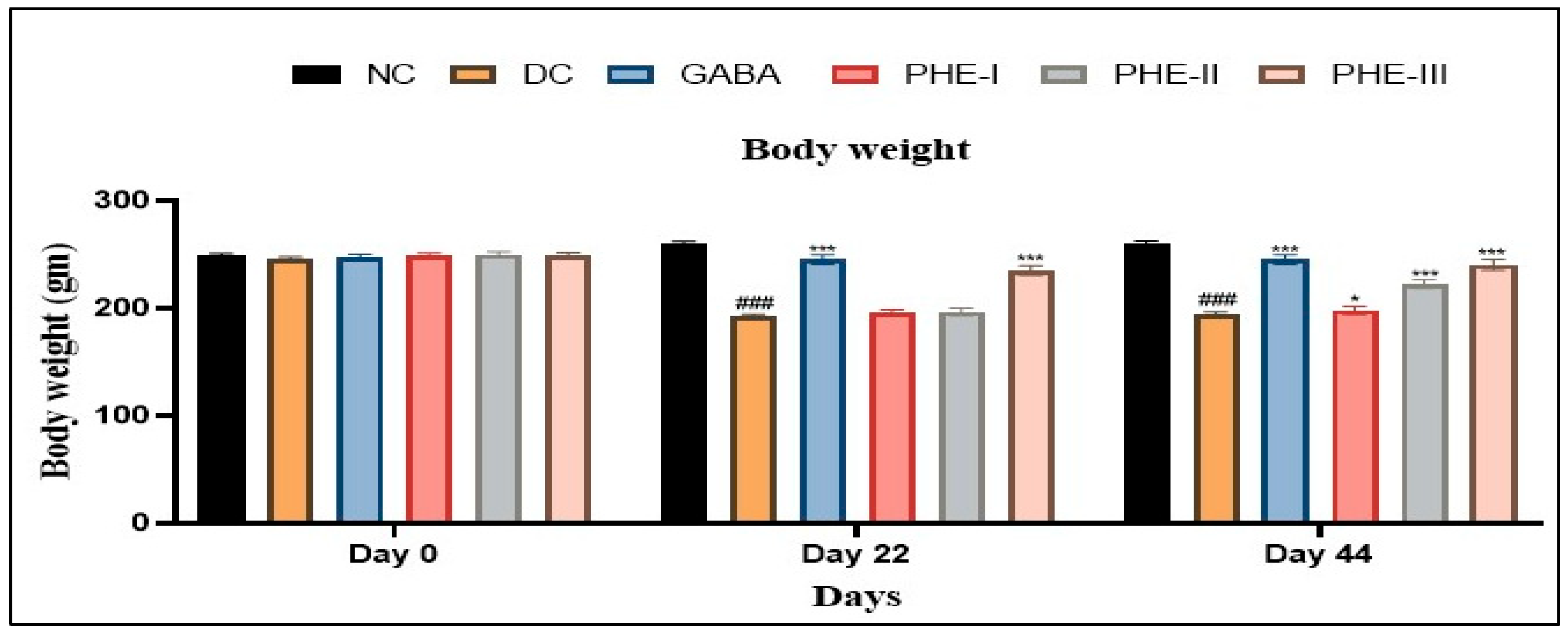
Figure 2.
Effect of aqueous polyherbal extract on mechano-tactile allodynia (Von Frey hair test) (A) and Thermal hyperalgesia (Hot plate and Tail immersion test) (B and C) in diabetic rats. Data are presented as means ± SD (n=6/group). Two-way ANOVA followed by the Bonferroni test for multiple comparisons. ### P<0.001 when compared to NC, *p< 0.05, **p< 0.01, ***P<0.001 when compared to DC.
Figure 2.
Effect of aqueous polyherbal extract on mechano-tactile allodynia (Von Frey hair test) (A) and Thermal hyperalgesia (Hot plate and Tail immersion test) (B and C) in diabetic rats. Data are presented as means ± SD (n=6/group). Two-way ANOVA followed by the Bonferroni test for multiple comparisons. ### P<0.001 when compared to NC, *p< 0.05, **p< 0.01, ***P<0.001 when compared to DC.
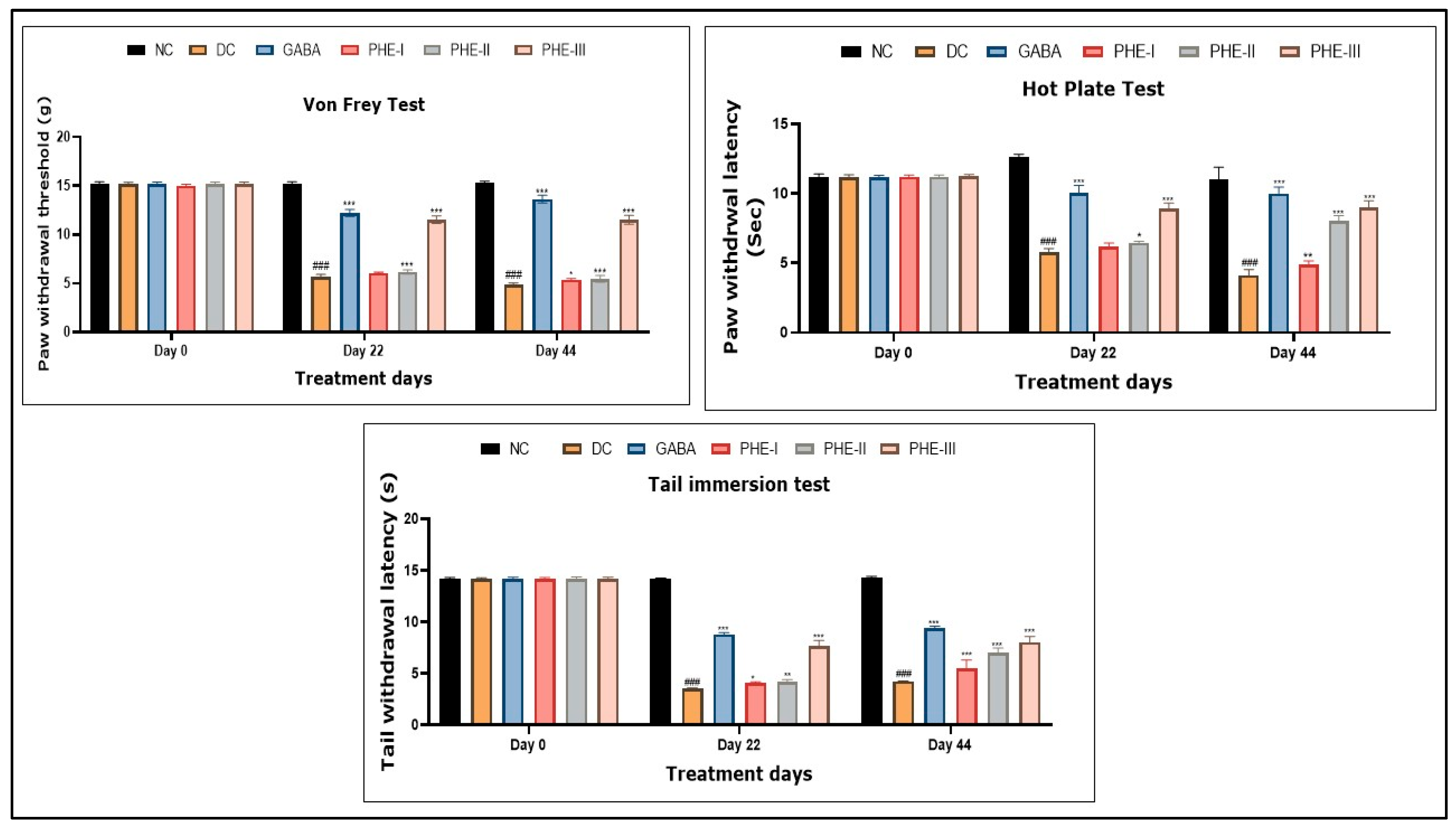
Figure 3.
Effect of aqueous polyherbal extract on gastric emptying time in diabetic rats. Data are presented as means ± SD (n=6/group). One-way ANOVA followed by the Bonferroni test for multiple comparisons. ### P<0.001 when compared to NC, *p< 0.05, **p< 0.01, ***P< 0.001 when compared to DC.
Figure 3.
Effect of aqueous polyherbal extract on gastric emptying time in diabetic rats. Data are presented as means ± SD (n=6/group). One-way ANOVA followed by the Bonferroni test for multiple comparisons. ### P<0.001 when compared to NC, *p< 0.05, **p< 0.01, ***P< 0.001 when compared to DC.
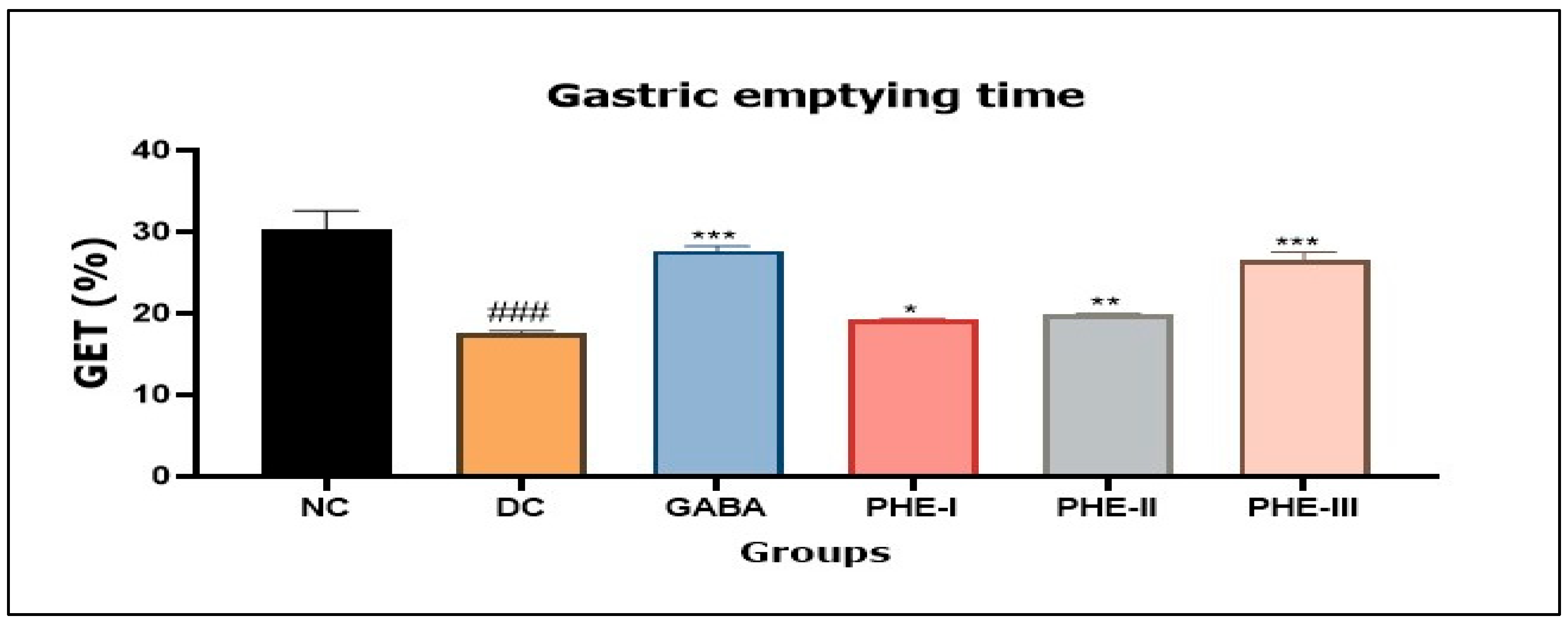
Figure 4.
Effect of aqueous polyherbal extract on histopathological changes of sciatic nerve in rats. Histopathological image of sciatic nerve sections from rats stained with H&E (100×). Degeneration (black arrow).
Figure 4.
Effect of aqueous polyherbal extract on histopathological changes of sciatic nerve in rats. Histopathological image of sciatic nerve sections from rats stained with H&E (100×). Degeneration (black arrow).
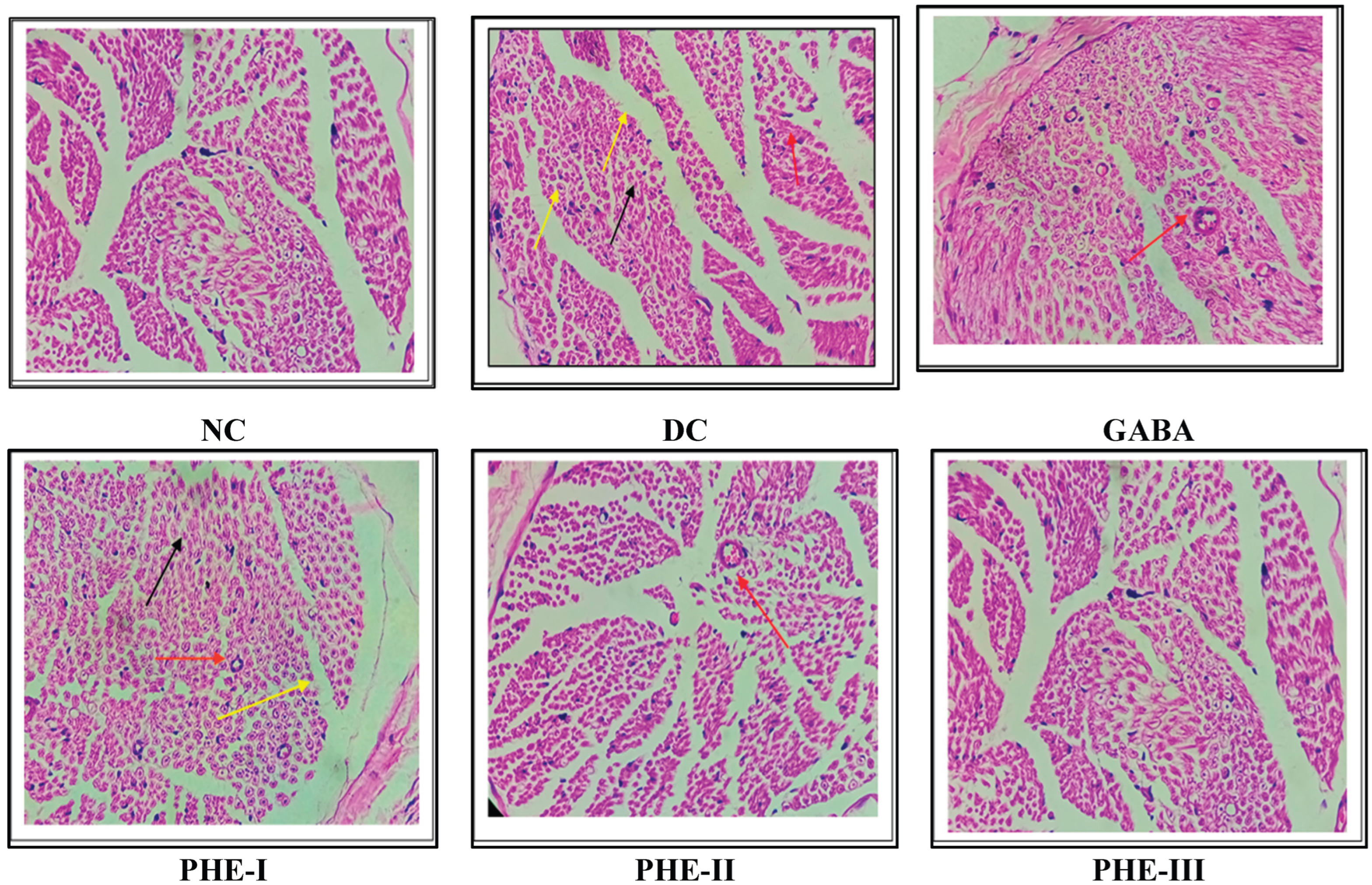
Table 2.
Polyherbal extract composition.
| Name of plant | Family | Part used | Weight (g) |
|---|---|---|---|
| Withania somnifera | Solanaceae | Root | 15 |
| Gymnema sylvestre | Asclepiadaceae | Fruit | 15 |
| Azadirachta indica | Meliaceae | Leaves | 15 |
| Tinospora cordifolia | Menispermaceae | Stem | 15 |
| Momardica charanita | Cucurbitaceae | Fruit | 15 |
| 2 parts of the above herbs | |||
| Syzygium cumini | Myrtaceae | Seeds | 10 |
| Emblica officinalis | Phyllanthaceae | Fruit | 10 |
| 2 parts of the above herbs | |||
| Pterocorous marsupium | Fabaceae | Stem | 5 |
| 1 part of the above herb | |||
Table 3.
Effect of an aqueous polyherbal extract on the biochemical estimation in diabetic rats.
| Parameters | NC | DC | GABA | PHE-I | PHE-II | PHE-III |
|---|---|---|---|---|---|---|
|
Glucose (mg/dL) |
92.67±1.36 | 257.5± 4.63### | 212.0± 2.44*** | 249.7± 1.36* | 238.0± 1.41*** | 188.5± 8.57*** |
|
TC (mg/dL) |
110.2 ± 5.94 | 197.6 ± 3.31### | 115.4 ± 6.84*** | 190.8 ± 1.47 | 182.3 ± 2.73*** | 143.5 ± 3.61*** |
|
TG (mg/dL) |
107.5 ± 2.15 | 186.5±3.27### | 98.3 ± 6.11*** | 178.5 ± 1.87** | 168.2 ± 4.46*** | 110.5 ± 2.25*** |
|
LDL-C (mg/dL) |
29.85 ± 2.60 | 65.34 ± 2.06### | 36.41 ± 3.74*** | 61.84 ± 1.72 | 58.68 ± 1.17** | 35.56 ± 3.94*** |
|
HDL-C (mg/dL) |
55.6 ± 3.4 | 27.40 ± 1.53### | 52.8 ± 3.2*** | 31.10 ± 0.88* | 34.18 ± 1.71*** | 47.31 ± 1.54*** |
NC– Normal control, DC– Diabetes control, GABA– Standard (Gabapentin), PHE- Polyherbal extract -I, II, III. Data are presented as means ± SD (n=6/group)—One-way ANOVA followed by the Bonferroni test for multiple comparisons. ###p< 0.001when compared to normal control (NC); *p< 0.05, **p< 0.01, ***p< 0.001 when compared to diabetic control (DC).
Table 4.
Effect of aqueous polyherbal extract on oxidative stress markers and TNF-α levels in diabetic rats.
Table 4.
Effect of aqueous polyherbal extract on oxidative stress markers and TNF-α levels in diabetic rats.
| Parameters | NC | DC | GABA | PHE-I | PHE-II | PHE-III |
|---|---|---|---|---|---|---|
|
LPO (nM/mg protein) |
3.30 ± 0.88 | 10.29 ± 0.82### | 4.85 ± 1.04*** | 8.45 ± 0.92* | 7.77 ± 1.34*** | 4.93 ± 1.04*** |
|
GSH (μg/mg protein) |
2.20 ± 0.50 | 0.64 ± 0.06### | 2.07 ± 0.56*** | 0.83 ± 0.05 | 1.32 ± 0.07** | 1.82 ± 0.25*** |
|
SOD (U/mg protein) |
22.83 ± 1.49 | 8.35 ± 1.07 ### | 19.53 ± 1.08*** | 8.35 ± 0.68 | 10.67 ± 1.18** | 16.63 ± 1.03*** |
|
CAT (U/mg protein) |
51.30 ± 3.23 | 19.55 ± 1.37### | 45.63 ± 3.67*** | 23.23 ± 0.57* | 24.38 ± 1.37** | 42.15 ± 1.39*** |
|
TNF-α (Pg/ml) |
56.28 ± 2.29 | 184.3 ± 4.09### | 105.2 ± 3.77*** | 178.4 ± 1.37** | 116.2 ± 3.11*** | 84.88 ± 2.00*** |
NC– Normal control, DC– Diabetes control, GABA– Standard (Gabapentin), PHE- Polyherbal extract -I, II, III. Data are presented as means ± SD (n=6/group). One-way ANOVA followed by the Bonferroni test for multiple comparisons. ### P<0.001 when compared to NC, *p< 0.05, **p< 0.01, ***P<0.001 when compared to DC.
Table 5.
Effect of aqueous polyherbal extract on cell viability against the MIN6 cell line.
| Sr. No | Concentration (µg/ml) | Absorbance | Cell viability | |||
|---|---|---|---|---|---|---|
| 1 | 2 | 3 | Average | |||
| 1. | Control | 1.596 | 1.598 | 1.599 | 1.597 | 85.09 |
| 2. | H2O2 induced (0.4 mM) | 0.426 | 0.441 | 0.435 | 0.434 | 27.17 |
| 3. | PHF-I (10 µg/ml) | 0.633 | 0.639 | 0.637 | 0.636 | 39.82 |
| PHF-II (40 µg/ml) | 0.955 | 0.953 | 0.951 | 0.953 | 59.64 | |
| PHF-III (100µg/ml) | 1.263 | 1.261 | 1.262 | 1.262 | 78.99 | |
Disclaimer/Publisher’s Note: The statements, opinions and data contained in all publications are solely those of the individual author(s) and contributor(s) and not of MDPI and/or the editor(s). MDPI and/or the editor(s) disclaim responsibility for any injury to people or property resulting from any ideas, methods, instructions or products referred to in the content. |
© 2026 by the authors. Licensee MDPI, Basel, Switzerland. This article is an open access article distributed under the terms and conditions of the Creative Commons Attribution (CC BY) license (http://creativecommons.org/licenses/by/4.0/).
Copyright: This open access article is published under a Creative Commons CC BY 4.0 license, which permit the free download, distribution, and reuse, provided that the author and preprint are cited in any reuse.


