

Submitted:
17 April 2026
Posted:
20 April 2026
You are already at the latest version
Abstract
The rapid development of the Internet of Things (IoT) technologies is significantly transforming approaches to monitoring and controlling technological processes in Smart Grid systems, providing enhanced capabilities for integrating distributed energy resources. The increasing complexity and heterogeneity, as well as the scaling up of modern decentralized energy systems, necessitate the coordinated integration of data collection and analytics models with control algorithms within a unified conceptual architecture. This article presents a structured framework for intelligent energy management within an IoT-based Smart Grid infrastructure, progressing from architectural foundations to intelligent system-level approaches. This work presents a generalized classification and a comprehensive analysis of approaches categorized as data-driven, model-driven, knowledge-driven, agent-based, and hybrid-oriented within a unified IoT-based environment. The integration principles of mobile energy sources are taken into account and are treated here as dy-namic data sources that influence the formation of information flows and decision-making pro-cesses. The key challenges associated with uncertainty, scalability, interoperability, coordination, cybersecurity, and the integration of modern artificial intelligence (AI) approaches have been identified. The proposed framework expands understanding of the interaction between IoT infra-structure and intelligent control mechanisms and can be used to develop rational models for the digitalization of energy systems.
Keywords:
smart grid
; internet of things
; energy management
; hybrid-oriented approach
; intelligent monitoring
; predictive control
; digital twin
; artificial intelligence
; big data
1. Introduction
1.1. Relevance of the Topic and Research Motivation
Current trends in the rapid development of intelligent approaches to improving energy systems are driven by a wide range of global challenges related to energy security, decarbonization, and the digital transformation of production and business processes. Traditional power systems that rely on centralized generation technologies and one-way reactive power control are proving to be insufficiently efficient for the integration of renewable energy sources (RES) and decentralized energy resources. In this context, the concept of the Smart Grid, integrated with Industry 4.0 technologies, in particular the IoT, AI, machine learning (ML), and digital twins (DT), is becoming a priority area for the development of the modern energy sector [1,2,3,4]. Such rapid development of approaches to the intellectualization and decentralization of energy systems and complexes is driven by their significant impact on improving economic, environmental, technological, and social impacts.
Analytical studies conducted by the International Energy Agency (IEA), the Organization for Economic Co-operation and Development (OECD), McKinsey & Company, and the Global e-Sustainability Initiative (GeSI) have demonstrated that the implementation of digitalized Smart Grid technologies delivers significant economic benefits. According to research by the IEA [5], digitalization and intelligent data analytics can reduce overall energy system costs by cutting maintenance and operational costs, improving power grid efficiency, and reducing the number of unscheduled outages and downtime. The estimated total savings from the implementation of digital measures could amount to approximately $80 billion per year between 2016 and 2040. This represents approximately 5 % of total annual electricity generation costs, provided that existing digital and smart technologies are widely implemented across power stations and grid infrastructure worldwide. In addition, according to the OECD assessment [6], it has been established that a low level or the absence of digitalization in electricity systems leads to significant economic losses, which could reach $1.3 trillion by 2030 and reduce the gross domestic product of individual countries by up to 6 %, while also causing annual losses due to inefficiency and unauthorised electricity consumption ranging from $80 to $100 billion. According to estimates by McKinsey & Company [7], the introduction of smart metering and digital energy technologies could yield annual savings of $15 to $20 billion through the reduction of network losses. The total economic impact of digital energy technologies could be $50 to $95 billion per year in the medium term. Furthermore, according to the GeSI report [8], digitalized smart grid solutions have the potential to deliver energy savings of up to 6.3 billion MWh by 2030, which directly translates into a significant reduction in energy system costs.
Another important factor is that the digitalization and smartification of energy networks represent a highly effective approach to delivering positive environmental benefits and, consequently, to achieving global climate goals. According to an analytical report on the outcomes of the Clean Energy Ministerial forum [9], the Smart Grid has the potential to reduce global CO₂ emissions by more than 2 gigatons per year by 2050. This effect is achieved through the implementation of adaptive peak load management technologies, the reduction of transmission and distribution losses, and the dissemination of information on energy consumption. A study conducted by the National Renewable Energy Laboratory found that the global rollout of smart RES could reduce the adverse health effects of air pollution by 50 % [10]. Consequently, the implementation of the Smart Grid is a vital and effective component in achieving carbon neutrality.
It is also worth noting that the Smart Grid serves as the technological foundation for the development of smart cities and digital infrastructure in many countries worldwide. The integration of smart and digital solutions into energy grids brings numerous technological and social benefits. The main benefits are as follows: improved reliability of power systems (e.g., self-healing grids and predictive maintenance) [11], the empowerment of consumers (prosumers) [12], the practical implementation of two-way ‘consumer–grid’ interaction [13], enhanced safety and resilience of power systems [14], as well as the support and innovative development of industrial structures [15].
Such a comprehensive impact resulting from the creation and implementation of digitalized and intelligent energy systems is made possible, in particular, by the dynamic development and rapid adaptation of practical approaches to decentralized electricity generation. In particular, these include the integration of cyber-physical systems and the IoT, the use of advanced AI and ML algorithms for predictive and optimization data analytics, the active integration of RES and electric vehicles (EVs) into the power grid, as well as the transition to autonomous energy management systems [16,17]. Taken together, these trends enable the practical implementation of the conceptual paradigm of an intelligent power system capable of adapting to changes in influencing parameters and factors in real time and of rationally balancing the modes of electricity generation, storage, and consumption. This development is driven by global and local initiatives, particularly those set out in regulatory and analytical documents that facilitate the harmonization and standardization of approaches, as well as the scaling up of best international practice, as systematically illustrated in Figure 1.
An analysis of the strategic initiatives presented indicates a clear convergence in approaches to the development of smart energy systems at all levels. A common feature across all levels is a focus on decarbonizing the energy sector, integrating RES, improving energy efficiency, and implementing the Smart Grid concept as the core platform for modernizing electricity systems. At the same time, there is a clear trend toward the systematic strengthening of the role of digital and intelligent technologies, which provide the technological foundation for the practical implementation of Industry 4.0 conceptual principles in the energy sector. The differences between these levels lie primarily in the level of detail and in the degree of practical implementation of the identified priorities. Global initiatives are more general in nature and define strategic development directions, thereby establishing the framework for the transformation of energy systems. The European level is characterized by greater regulatory specificity, including mechanisms for the functioning of the electricity market, the integration of distributed energy resources (DER), the development of smart metering, and the promotion of innovation through targeted programs. At the national level, Ukraine adapts European and global approaches while also developing its own, taking into account the specific characteristics of its power system development. The key priorities remain the modernization of infrastructure, the enhancement of energy security, and the gradual integration of digital technologies within the framework of initiatives such as WINWIN2030 [18]. Thus, the alignment of strategic priorities, coupled with varying degrees of implementation, confirms a sustained global trend toward the digital transformation of the energy sector and the development of smart grids. This, in turn, demonstrates the relevance and necessity of research into IoT technologies to enhance Smart Grid efficiency.
1.2 Historical Development, Current State, and Future Trends
The active development of approaches to improving the efficiency of energy systems through digitalization is directly linked to the evolution of information, computing, and communication technologies, which have enabled the practical transformation of traditional power grids into Smart Grid systems [19,20,21], as illustrated in general terms in Figure 2.
In most practical scenarios in the early stages (roughly from the 1980s to the 2000s), energy systems operated as centralized infrastructures with limited process automation and a lack of large-scale data exchange. Data exchange occurred predominantly within isolated communication networks. Practical approaches to energy distribution were characterized by one-way monitoring processes [22].
Between 2000 and 2010, the practical foundations for implementing distributed wireless sensor and computing technologies were actively established through the development of mobile telecommunications (3G), the standardization of data transmission protocols, and the integration of supervisory control and data acquisition (SCADA) systems into technological and production processes. During this period, the foundations for the integration of sensor networks and remote monitoring were laid, thereby providing opportunities for the development of decentralized energy systems [23,24,25].
The period from 2010 to 2015 was characterized by the rapid development of IoT technologies and their integration into networks, particularly within energy systems. DER, smart meters, demand response systems, and big data platforms began to emerge. The IoT enables continuous data collection and exchange among network components, thereby enhancing the efficiency, reliability, and flexibility of energy systems. It was during this period that the Smart Grid began to transform into an efficient digitalized complex [26,27].
The current stage, from approximately 2015 to 2026, is characterized by the transition to the widespread adoption of IoT solutions, combined with AI, edge computing, unified digital solutions, high-speed information and communication protocols, and effective cybersecurity mechanisms. Smart Grid infrastructure is evolving into a platform with integrated software and hardware tools for the intelligent, real-time analysis of large volumes of data, enabling predictive control, energy consumption optimization, and the large-scale integration of RES. Vehicle-to-Grid (V2G) technology is being actively integrated into the Smart Grid. The concept of ‘consumer–grid’ interaction is of particular importance, and is being realized through the large-scale integration of IoT platforms [28,29,30,31].
In the near future (approximately from 2026 to 2035), the primary focus of Smart Grid development is expected to lie in expanding the role of the IoT and related technologies through the widespread roll-out of 6G, the standardization of digital twins, the mass deployment of autonomous energy systems, and the application of specialised generative AI models for ergonomic and reliable decision-making support in energy management. The development of autonomous, optimized Smart Grid solutions is anticipated, in which the IoT will facilitate interaction across all functional levels of energy systems [32,33,34].
Thus, an analysis of past, current, and prospective trends in the development of digital energy system approaches reveals that the IoT should be viewed as an integrative methodological platform that combines advances in sensor, communication, computing, and analytical technologies, rather than as a standalone technology. In the context of the Smart Grid, the IoT enables the continuous acquisition, transmission, and processing of data in real time, creating a unified digital environment for interaction between physical infrastructure and intelligent services. This establishes a practical foundation for the dynamic transformation of energy infrastructure into decentralized, adaptive, autonomous, and intelligent energy systems that are capable of self-regulation and predictive control. Therefore, the IoT serves as the fundamental technological foundation for the digital transformation of the energy sector, defining the architecture and functional capabilities of modern Smart Grids. This necessitates further research to develop methods and tools that enhance the efficiency of smart energy systems.
1.3 Bibliographic Analysis
Given the rapid pace of development in intelligent energy systems and the interdisciplinary nature of research in Smart Grid systems, it is appropriate to conduct a bibliometric analysis of scientific publications indexed in internationally recognized scientometric databases. Such an analysis is necessary to identify the main scientific directions, the evolution of research trends, and the interrelationships among technologies that shape the current Smart Grid development paradigm. For the purposes of this analysis, this article used the specialized software VOSviewer [35], which enabled the identification and graphical interpretation of the dominant thematic trends and the assessment of their intensity by accounting for relationships between the frequencies of various keyword combinations. In this study, the main focus of the bibliographic analysis was on identifying the role of hardware and software technologies, as well as system-level approaches that form the multi-level architecture of the IoT and are consequently utilized in the digital transformation of the Smart Grid. The criteria and characteristics of the bibliographic search and analysis of scientific sources considered in this study are presented in Table 1. A graphical interpretation of the results of the bibliographic analysis is shown in Figure 3, Figure 4 and Figure 5.
The results of the bibliographic analysis, shown in Figure 3, Figure 4 and Figure 5, reveal a high degree of consistency in the structure of scientific research in the field of the digitalization and intellectualization of Smart Grid systems. The graphical representations demonstrate that the Smart Grid serves as a practice-oriented platform for implementing innovative solutions grounded in the conceptual principles of Industry 4.0. The high density of inter-node connections in graph models centered on Industry 4.0 confirms its status as a global integrative concept for the digitalization and intellectualization of the electricity sector. In turn, the IoT is often regarded as a technical and functional enabler of the conceptual foundations of Industry 4.0, serving as an integrating element across a range of technological clusters, including AI, ML, Big Data, predictive models, edge and cloud computing, digital twins, cybersecurity, and related domains. The presence of clusters such as ‘classification’, ‘anomaly detection’, ‘energy efficiency’, ‘optimization’, as well as related categories in the analyzed graphical representations demonstrates the significant practical value and the diversity of problems that can be addressed through the implementation of IoT-based solutions in the Smart Grid. Thus, the conducted bibliographic analysis indicates that the current trend in Smart Grid development is focused on the creation of autonomous, self-adaptive, and predictive energy systems that integrate various energy sources and means of monitoring and controlling their status in real time. This finding highlights the necessity and importance of further research into the criteria-based analysis and logical generalization of methodological principles and technological solutions to enhance the level of digitalization and intellectualization of Smart Grids.
1.4 Global Challenges of IoT-Based Technologies for the Sustainable Development of Smart Grids
The current development of energy systems is taking place against a backdrop of rapidly increasing functional complexity. This trend is driven by the integration of DER and the active involvement of prosumers. Traditional centralized approaches to energy system management are proving insufficient to ensure the necessary levels of flexibility, adaptability, and reliability, particularly given the high share of RES and the growing role of electric mobility. In this context, global challenges are emerging regarding technology interoperability [36,37], real-time decision-making [38,39], cybersecurity [36,40,41], DER integration, and the effective coordination of energy flows [42,43,44]. Overcoming these challenges requires the systematic implementation of IoT technologies that ensure the continuous acquisition, processing, and exchange of data across energy system components [45,46]. When combined with AI, big data analytics, digital twins, and modern information and communication platforms, these technologies form the basis for the intelligent transformation of the Smart Grid, ensuring greater efficiency, resilience, and scalability of the energy infrastructure, as shown in Figure 6.
The diagram shown in Figure 6 illustrates the systemic logic underlying the transformation of modern energy systems toward an intelligent, IoT-based Smart Grid infrastructure through the sequential interaction of challenges, solutions, technologies, and their systemic effects.
At the initial level, the key challenges that significantly hinder the digital development of modern power systems have been identified. These include limited technology interoperability, insufficient efficiency in real-time decision-making, fragmented integration of AI, the complexity of integrating and coordinating DER, compatibility issues among heterogeneous energy sources, cybersecurity risks, limited prosumer integration, and insufficient integration of EV as energy assets. These issues are widely discussed in contemporary Smart Grid research, highlighting the increasing complexity of managing distributed energy systems and the need to transition to decentralized models [47].
The next level outlines possible solutions to the aforementioned problems, which primarily include the standardization and unification of technological solutions [48,49], the intelligent coordination of DER [50], the implementation of intelligent control and optimization, the development of unified energy flow monitoring and control systems, the use of secure protocols and architectures [36], as well as the improvement of decision support systems and the implementation of V2G mechanisms [51]. An analysis of relevant scientific sources demonstrates that the integration of such approaches and the implementation of corresponding technological solutions enable a transition from traditional centralized networks to adaptive, self-regulating power systems. In particular, the priority technologies that deliver a significant positive impact on the digitalization of energy systems include information and communication technologies (ICT), ML algorithms and model predictive control (MPC), DT, Big Data analytics, explainable artificial intelligence (XAI), Generative AI (GenAI), and related approaches [52,53,54]. Recent studies emphasize that the integration of such technologies into a multi-level IoT network infrastructure is essential for ensuring real-time operation, prediction, and optimization of energy systems.
Thus, an approach based on the practical development of an IoT-based Smart Grid infrastructure enables bidirectional energy and data exchange, the integration of DER, and adaptive, autonomous control of energy processes. Such a transformation leads to significant improvements in the reliability, efficiency, and resilience of energy systems, while also ensuring the active participation of prosumers in energy processes.
1.5 Aim, Objectives, and Research Approaches
The main aim of this study is to systematically identify and localize priority trends in the development of digital and intelligent technologies to improve the efficiency of Smart Grid operations, based on a comparative analysis and systematic synthesis of current scientific and applied solutions for the creation and utilization of IoT-based infrastructures. This article focuses on a coordinated examination of the technical and functional characteristics of IoT-based architectures as the fundamental operating environment for Smart Grids. The proposed approach, unlike existing ones, involves analyzing IoT-based solutions in close conjunction with intelligent system-level approaches to monitoring and control, enabling a shift from the isolated consideration of software and hardware components to a holistic view of energy management processes within the Industry 4.0 concept. This structural and logical approach is geared towards addressing challenges related to intelligent monitoring, predictive and adaptive control of energy flows, taking into account the uncertainty of RES, consumption patterns, and the growing role of active participants in the energy ecosystem, in particular, prosumers and mobile energy sources. This provides a deeper understanding of the interaction between physical processes, data, and decision-making algorithms in modern IoT-oriented energy systems. By decomposing the main aim of this study, the key tasks addressed in this work are defined as follows:
1. The analysis and logical systematization of general trends in the development of IoT-based technologies within the Smart Grid, including the identification of current challenges and the determination of potential technological approaches to addressing them, taking into account the requirements for the resilience, flexibility, and efficiency of energy systems.
2. The architectural decomposition of a multi-layer IoT-based Smart Grid infrastructure, specifically its hardware, software, and ICT components, as well as the definition of their functional capabilities in monitoring and controlling energy flows.
3. A review and critical analysis of modern system technologies for intelligent monitoring and predictive control of Smart Grids.
4. The identification and classification of key issues affecting the operation of modern decentralized energy systems.
5. The identification and critical analysis of promising areas for the development of IoT-based Smart Grid infrastructure with a view to establishing a sophisticated, digitalized organization of energy systems.
The object of this study is the processes of monitoring and controlling energy flows within an IoT-based Smart Grid infrastructure. The subject of the study is the approaches, methods, and models for the architectural integration of modern digital and intelligent technologies within the IoT-based Smart Grid infrastructure, taking into account the conceptual principles of Industry 4.0.
2 Architectural Decomposition of a Multi-Layer IoT-Based Smart Grid Infrastructure
2.1 Multi-Layer IoT Models
In current practice, the synthesis of multi-layer architectures is a fundamental approach to designing IoT-based systems, particularly in Smart Grids. This approach ensures the modularity, interoperability, and scalability of complex technological infrastructures. The decomposition of a system into functional levels enables the distinction between data acquisition and processing, information and communication processes, and application services, thereby significantly simplifying the integration of new technologies and improving the efficiency of energy process management. Relevant scientific and applied research emphasizes that the IoT enables the digitalization of energy assets, data collection, and subsequent analytics, which form the conceptual basis for Smart Grid operation [55,56]. In the context of the development of IoT-based solutions, several reference architectural models have been established, the most widely used being the International Telecommunication Union (ITU-T) Y.2060 model [57] and the model developed based on the findings of the IoT World Forum (IWF) [58]. These models formalize the structure of IoT systems by defining the main layers and their interactions, which is particularly important for decentralized technological infrastructures such as the Smart Grid.
The ITU-T Y.2060 model describes IoT system solutions as a four-layer architecture comprising device, network, service support, and application layers. This approach provides a high level of abstraction and versatility, enabling its application across various domain areas. In turn, the IWF model offers a more detailed seven-layer structure, in which the levels of data processing, storage, and abstraction, as well as business logic, are distinguished, making it more suitable for complex industrial IoT systems [57,58,59]. The results of a detailed comparison of the main technological and functional characteristics of these reference IoT models are presented in Table 2.
Research papers indicate that multi-layer IoT architectures in electrical engineering applications typically include data collection layers (e.g., sensors and smart meters), information and communication networks, and computing services and platforms, which together enable the monitoring and control of energy systems [60,61]. The choice of an architectural model for IoT-based Smart Grid infrastructure depends on the required level of detail. Generalized models, such as ITU-T Y.2060, are suitable for conceptual analysis and standardization, whereas more detailed approaches, particularly those based on the IWF model, allow for the description of real-world data processing and component interactions within energy systems.
The implementation of IoT architectures in Smart Grids is characterized by several specific features, including the need to ensure bidirectional flows of data and energy, the integration of a large number of heterogeneous devices, and stringent requirements for reliability, cybersecurity, and real-time data processing. Furthermore, the integration of IoT into Smart Grids involves the use of distributed computing models and standardized protocols to ensure interoperability and the efficient management of energy resources. This determines the feasibility of using multi-layer architectures with a clear division of functions between levels, which is a key prerequisite for creating scalable and resilient modern energy systems [62,63].
The subsequent analysis in this section focuses on the four-layer architecture. This choice is motivated by its ability to ensure an optimal balance between abstraction and detail within the Industry 4.0 conceptual framework, clearly distinguishing the key functional domains of data acquisition, transmission, processing, and application. This decomposition is sufficiently functional and objective when aligned with existing reference IoT models, while retaining practical applicability for the analysis and design of Smart Grid systems.
2.2 Level of Measurement Data Collection
This level of the IoT-based Smart Grid infrastructure represents the foundational layer. It is responsible for directly collecting information from the physical environment using sensors and measuring devices. It generates the primary data stream, which is subsequently used to monitor and control energy systems.
At this level of the Smart Grid, key electrical and operational parameters are measured, including voltage, current, frequency, active and reactive power, energy consumption, and power quality parameters (e.g., harmonics, overvoltage, fluctuations, and others). In addition, equipment condition monitoring is carried out (e.g., transformer temperature, vibrations, partial discharges, pressure, and others), which is critical for implementing predictive maintenance and improving grid reliability. Typical components at this level include smart meters, electrical sensors, equipment status sensors, identification components, GPS, and other devices [64,65,66,67].
In the context of the Smart Grid, and given the conceptual principles underlying the design of IoT systems, the data collection layer is characterized by high device heterogeneity and the need to ensure high measurement accuracy and reliability. These characteristics are further complemented by the conceptual requirements of Industry 4.0 for real-time operation [68] and by the ability to operate within a distributed energy infrastructure encompassing generation, transmission, and consumption of electricity [69,70]. Consequently, this level plays a functionally important role in the digitalization of energy systems, ensuring the continuous collection of high-precision data on the state of the grid and its components, which serves as the basis for implementing intelligent monitoring and control in the Smart Grid.
2.3 Network Level
The network level enables bidirectional data and information flow within the IoT infrastructure of the Smart Grid. The Smart Grid’s information and communication infrastructure relies on both wired and wireless technologies. Wired solutions include fiber-optic networks [71,72] and power line communication [73,74], which provide high bandwidth and reliable data transmission. Wireless technologies such as ZigBee, LoRaWAN, NB-IoT, Wi-Fi, and 5G enable flexible connectivity for large numbers of distributed devices [75,76]. The key parameters characterizing this level include bandwidth, transmission latency, reliability, scalability, and energy efficiency [77]. Low latency and high reliability are particularly important in Smart Grids, as the network infrastructure is used not only for monitoring but also for real-time control of energy processes. An equally important feature of the IoT-based Smart Grid infrastructure at this level is the need to ensure cybersecurity and data protection, given the critical nature of the energy infrastructure. This includes the use of encryption, authentication, and access control mechanisms, as well as ensuring resilience against cyberattacks and failures [78,79].
From an architectural perspective, this level implements a multi-layer network hierarchy comprising the Home Area Network, Neighborhood Area Network, and Wide Area Network, which facilitates data transmission from end users to control centers [55,80]. This approach enables effective data aggregation and ensures system scalability.
Thus, the network level serves as an integrating component of the IoT-based Smart Grid infrastructure, ensuring the efficient exchange of data and information between all components and layers of the system, thereby providing a functional foundation for the implementation of intelligent, decentralized monitoring and control of energy processes.
2.4. Level of Data Processing
This level in the IoT-based Smart Grid infrastructure is responsible for comprehensive data processing and analytics. At this level, unstructured measurement data undergoes a fundamental transformation into useful information to support decision-making and the implementation of intelligent control of the energy system. From an architectural perspective, this level is realized through a combination of distributed computing paradigms: edge, fog, and cloud computing [81,82]. The edge layer provides primary data processing directly at the sources of generation, minimizing delays and reducing the volume of data transmitted. The fog level performs intermediate aggregation and coordination functions between local nodes and the cloud infrastructure, whilst the cloud level provides scalable storage, deep analytics, and integration with application services [83].
The main procedures implemented at this level in IoT systems, particularly when applied in Smart Grids, include data pre-processing (filtering, normalization, standardization, and removal of noise and anomalies); the aggregation and integration of data from various sources; real-time analytics and batch processing; the application of AI and ML algorithms for prediction and optimization; the generation of control signals for the upper and lower levels of the system; and the storage of large volumes of data.
In the context of Smart Grids, this level processes both real-time data and historical information, taking into account formalized factors that determine the technical and functional performance of specific energy systems. This enables a wide range of tasks, including load prediction [84], anomaly detection [85], energy distribution optimization [86], predictive equipment maintenance [87], and others. The utilization of distributed computing resources facilitates a harmonization between the competing requirements of performance and the computational complexity of processing data streams, particularly in dynamic energy systems. Similar to the network level, this level is also characterized by heightened cybersecurity requirements, particularly through the implementation of access control mechanisms, encryption, and related measures [31,88].
Therefore, the data processing level serves as the computational and analytical core of the IoT-based Smart Grid infrastructure, providing practical mechanisms for intelligent monitoring and control of energy processes through the effective integration of data analytics and distributed computing.
2.5. Application Level
The application level is the uppermost level of the IoT-based Smart Grid infrastructure and is responsible for the interaction of functional services designed to facilitate user-friendly interaction with all participants in the processes of electricity generation, storage, distribution, and consumption. The primary functional purpose of this level is to interpret the results of data processing and transform them into application-level solutions for the monitoring and control of energy processes. The application level should also provide data visualization, decision support, automated control, and integration with energy system business processes [89,90]. These functions are implemented through applications such as SCADA, EMS, MRP, and demand management platforms. Currently, the application level of Smart Grids provides a wide range of services, including real-time monitoring of the energy grid status; load and generation prediction; optimization of energy resource distribution; demand management and energy system balancing; and user interaction via user-friendly interfaces [91,92].
A distinctive feature of this level is its integration with enterprise information systems and energy markets. This facilitates effective resource management and support for emerging energy consumption models, such as the prosumer paradigm [93]. Furthermore, the application level actively leverages analytics and intelligent models to enhance decision-making efficiency, particularly through the use of GenAI approaches [94].
2.6 Cross-Level Interaction and Key Issues in Multi-Layer Architecture
To summarize the functional structure of the analyzed four-layer architecture of the IoT-based Smart Grid infrastructure, it is reasonable to present it in the form of a matrix that illustrates the correspondence between the architectural levels and the main technical and functional characteristics. In contradistinction to conventional descriptive methodologies, this form of presentation (see Table 3) allows for the systematic integration of technological aspects, data types, and functional indicators that are important when designing IoT-based Smart Grid solutions.
In addition to the functional decomposition presented in Table 3, it is also reasonable to analyze the key challenges identified in the review of relevant scientific sources cited in subsections 2.2–2.5 of this article. This allows for a more comprehensive assessment of the limitations of existing IoT-based Smart Grid infrastructures and the identification of potential avenues for their further development, as summarized in Table 4.
Consequently, summarizing the results presented in Table 3 and Table 4 has enabled a systematic analysis of the functional distribution of processes and the problem-oriented aspects of implementing the IoT-based Smart Grid infrastructure. The analysis of the functional distribution demonstrates that the mandatory procedures for data collection, transmission, and primary processing are decentralized, whereas intelligent analytics and decision-making are concentrated at the upper levels of the architecture. Accordingly, the range of challenges is distributed across the levels. At the device level, hardware and metrological constraints dominate; at the network level, latency and reliability requirements prevail; whereas at the processing and application levels, issues of scalability, data integration, and the complexity of analytical models are decisive. It is worth noting that a common challenge across levels of IoT architecture is cybersecurity and information protection.
The promising areas for development outlined in Table 4 demonstrate that the technology stack is evolving in a coordinated manner, aligned with the identified challenges and constraints. The prevailing trends involve shifting some analytical and control functions closer to data sources, thereby reducing latency, enhancing resilience, and improving cybersecurity for the IoT-based Smart Grid infrastructure.
Therefore, the results of the analysis confirm that the effective implementation of any IoT-based Smart Grid infrastructure requires scientific substantiation of a comprehensive methodological approach to the design of digitized and intelligent energy systems, achieved through the systematic integration of the latest advances in sensor, computing, networking, and information technologies.
3 System-Level Approaches for Intelligent Monitoring and Predictive Control of Smart Grids
3.1 General Classification of Approaches
In contemporary IoT-based Smart Grid infrastructures, a single approach to monitoring and control is insufficient due to the considerable structural complexity and the dynamic nature of processes within energy systems. This necessitates the use of various conceptual approaches to the intelligentization and digitalization of Smart Grid operational processes. Each approach should be oriented toward solving a specific class of problems, such as intelligent analytics of large volumes of spatiotemporal data, physics-informed predictive control, decentralized and reliable interaction among system components, and others.
In the contemporary scientific and technical practice, the following approaches have gained the most traction in the context of the intellectualization and digitalization of energy systems: data-driven [95,96], model-driven [97,98], knowledge-driven [99], agent-based [100,101,102], and hybrid-oriented approaches [103,104,105,106]. The generalized technical and functional characteristics of these approaches are presented in Table 5.
Therefore, the classification of approaches presented in Table 5 forms, within the scope of this study, a conceptual framework for the further analysis and logical generalization of modern system-level approaches and technologies for intelligent monitoring and predictive control in IoT-based Smart Grid infrastructures.
3.2 Data-Driven Approach
This approach employs AI and ML methods, particularly deep learning, to analyze large volumes of data generated by IoT devices in Smart Grids. At the core of this approach lies the intelligent analysis of spatiotemporal data, enabling the identification of hidden patterns in measurement data streams. In Smart Grid, the data-driven approach is used to predict electricity generation and consumption, as well as to detect anomalies and equipment failures. This improves the efficiency of monitoring and provides the information basis for adaptive control of energy processes. The results of the analysis of known scientific studies on the development and application of the data-driven approach in Smart Grids are presented in Table 6.
As shown in the analysis of the scientific papers presented in Table 6, the main advantage of this approach is its capacity to adapt to changing system operating conditions without requiring explicit modeling of physical processes. At the same time, the approach is characterized by general functional limitations stemming from its dependence on the quality, completeness, and representativeness of input data, and, in certain cases, requires significant computational resources. In the context of an IoT-based Smart Grid architecture, the data-driven approach is primarily implemented at the data processing and application levels, where analytics and result interpretation are performed.
3.3 Model-Driven Approach
This approach is based on physically grounded mathematical and computer models of energy systems that describe their dynamic and static behavior. Key tools include models for the distribution of energy flows, the assessment of energy system stability, and the representation of electromechanical and electromagnetic processes in networks. In the context of Smart Grids, this approach provides a formalized description of the interaction between electricity generation, transmission, storage, and consumption. Currently, a well-established implementation of the model-driven approach is DTs [115,116,117], which enable the creation of dynamic digital replicas of energy systems, allowing for accurate and adaptive analysis and optimization of operating modes in real time, thereby enhancing the reliability and efficiency of Smart Grids. MPC technology has also gained significant traction in the development of model-based control techniques, enabling the optimization of control actions whilst accounting for system constraints and predicted operating modes [118,119,120]. The results of the analysis of relevant scientific studies on the development and application of the model-driven approach within energy and electrical systems are presented in Table 7.
As shown in Table 7, the main advantages of the model-driven approach are the high interpretability of results and their physical validity. This is confirmed by the significant development and use of formalized models, optimization methods, and predictive control techniques. The principles for the practical implementation of digitalization approaches have also advanced considerably, particularly those based on DTs, which ensure the cyber-physical coordination of Smart Grid system components. This accounts for the considerable effectiveness of this approach in monitoring and controlling energy systems with high reliability, security, and adaptability requirements. At the same time, the model-driven approach is characterized by certain functional limitations, mainly related to the complexity of constructing adequate models for large-scale, heterogeneous systems and limited scalability in dynamic IoT-based Smart Grid infrastructures. This motivates the integration of this approach with advanced technologies to enhance the intelligence of technological processes within the framework of hybrid approaches.
3.4 Knowledge-Driven Approach
In most practical applications, this approach relies on formalized expert knowledge of the subject domain, expressed through rule-based logic and ontologies. This enables modeling cause-and-effect relationships and ensures the explainability of decisions. In the context of Smart Grids, these solutions are applied in tasks such as relay protection, fault diagnosis, fault detection, and automated control of electrical equipment. The results of the analysis of relevant scientific studies on the development and application of the knowledge-driven approach in energy and electricity systems are presented in Table 8.
As shown in the analysis of relevant scientific literature, the main advantages of the knowledge-driven approach are its high interpretability and transparency of the decision-making logic. This approach is also effective when integrating expert knowledge via rule-based mechanisms and ontologies, as confirmed by practical applications in energy management, interoperability, and the semantic integration of heterogeneous energy systems. At the same time, limitations arise from the complexity of formalizing the domain, particularly when analyzing large-scale, dynamic energy systems, as well as from insufficient adaptability to uncertain operating conditions, even when stochastic methods are used.
3.5 Agent-Based Approach
This approach is based on multi-agent systems, in which autonomous software components interact to achieve global objectives through local decision-making. In practice, this approach enables decentralized, adaptive, and scalable control of energy systems and electricity networks. In Smart Grids, the agent-based approach is widely used in microgrids and prosumer-oriented systems, where individual agents represent software entities associated with consumers, generation sources, energy storage devices, and operators, coordinating balancing, electricity distribution, and participation in market mechanisms. The results of the analysis of relevant scientific studies on the development and application of the agent-based approach within power systems are presented in Table 9.
The main advantages of the agent-based approach are its high adaptability and fault tolerance, resulting from its decentralized architecture. This is confirmed by a wide range of practical applications. As shown in Table 9, the main application areas of this approach include microgrid energy management, DER coordination, modeling of market mechanisms and consumer behavior, and planning of grid operating modes. Furthermore, the use of semantic and ontological algorithms improves interoperability, aligns knowledge representations, and enables effective coordination among agents in heterogeneous environments. However, the main limitations of this approach include: the complexity of coordinating and harmonizing agents’ actions, the risks of unstable behavior when local objectives conflict, and increased demands on the information and communication infrastructure. A current trend in the development of the agent-based approach is the integration of AI algorithms into multi-agent systems, transforming this approach into hybrid solutions with enhanced capabilities for self-adaptation, prediction, and decision-making under conditions of uncertainty and in dynamic electricity market environments.
3.6 Hybrid-Oriented Approach
This approach integrates and combines the diverse approaches analyzed above, including AI and MPC, DTs in conjunction with ML or deep learning, physics-informed ML, and data-model fusion. This enables a more adequate, adaptive, and accurate formalization of the processes occurring in power systems, particularly in Smart Grids. Such an approach facilitates the practical integration of physics-based modeling, the predictive capabilities of AI algorithms, and digital platforms for the decentralized control of electrical and information flows. The results of the analysis of relevant scientific studies on the development and application of the hybrid-oriented approach within electricity and energy systems are presented in Table 10.
As shown in the analysis presented in Table 10, the hybrid approach is the dominant theoretical and practical concept for the digitalization and intelligentization of modern Smart Grid systems. This is supported by the considerable scale and variety of implementations. Hybrid AI–MPC solutions, in particular, have gained significant popularity, as has the combined application of data-driven and model-driven approaches, integrated with ML and deep learning algorithms, ontologies, and GenAI models.
Specifically, combining MPC with AI methods enables high-quality optimization in energy flow control tasks while accounting for uncertainty and reducing computational complexity. The use of DT in conjunction with knowledge graphs and RAG enhances prediction, monitoring, and decision support capabilities. At the same time, the application of physics-informed and hybrid ML approaches helps align models with physical laws and reduce dependence on large data volumes. Thus, the main advantages of the hybrid-oriented approach include increased accuracy, adaptability, and reliability in the monitoring and control of Smart Grid systems. Furthermore, this approach demonstrates high effectiveness in conditions of incomplete, noisy, and/or heterogeneous data, as well as in tasks involving the coordination of DER and prosumer-oriented systems.
At the same time, the implementation of such approaches is accompanied by several technical and functional challenges, including the complexity of integrating heterogeneous models and technologies, the need to coordinate physical, software, and hardware components within a unified architecture, and the optimization of resource allocation across computing resources and ICT infrastructure. This determines a prospective direction of development in the context of the transition toward comprehensive, multi-level hybrid solutions for the creation of IoT-based infrastructure for Smart Grid systems.
3.7 Generalization and Applicability of the Studied System-Level Approaches in Smart Grids
In the context of the development of IoT-based Smart Grid infrastructure, several practice-oriented approaches to the monitoring and control of decentralized energy systems have emerged. Each of these approaches is based on its own methodological framework and set of tools. In particular, data-driven, model-driven, knowledge-driven, and agent-based approaches implement the logic of a conceptual transition from data analysis to knowledge formalization and decentralized decision-making. Each approach is aimed at solving specific applied tasks but is accompanied by certain limitations related to reliance on data quality, the adequacy of the formalization of electricity generation and distribution processes, the scalability and adaptability of the software and hardware architecture, and others. A generalized structural diagram of these approaches, their technological content, the tasks they address, and the characteristic issues is shown in Figure 7.
As shown in Figure 7, the system-level approaches considered do not provide a universal solution for all aspects of Smart Grid management, necessitating the development of methods for their integration and combined application. In this context, the hybrid-oriented approach represents a logical stage of development, enabling the systematic combination of the key technical and functional advantages of various approaches. This enables the implementation, within a unified IoT software-hardware architecture, of full-cycle processing of spatiotemporal data characterizing various operational states of the Smart Grid, particularly in a predictive mode with decision-making support. Such integration improves the accuracy and reliability of system status assessment, the efficiency of energy flow optimization, and the adaptability of control under conditions of uncertainty, while placing increased demands on the computational, information, and communication resources of the IoT-based Smart Grid infrastructure.
4 Primary Challenges Facing Smart Grids and DEVELOPMENT areas of IoT-Based Infrastructure for Their Mitigation
Modern Smart Grids are characterized by high complexity, dynamism, and the integration of a large number of DER, which pose practical challenges for the implementation of intelligent control of energy flows and processes [155,156,157]. Despite the practice-oriented development of IoT architectures and modern control approaches, several fundamental challenges remain to be addressed. These include the uncertainty and stochasticity of energy processes, data heterogeneity, and coordination and cybersecurity issues. In this context, the development of IoT infrastructure is particularly significant as one of the key technological factors capable of mitigating the impact of these issues and ensuring more reliable and efficient operation of Smart Grid systems.
4.1 Uncertainty and Stochasticity in Electrical and Energy Processes
One of the most pressing challenges facing Smart Grids is the high degree of uncertainty caused by the stochastic nature of RES. This leads to significant short-term fluctuations in generation. An additional source of uncertainty is introduced by the complex and unpredictable nature of demand, linked to prosumer behavior and the integration of EVs into the grid, and characterized by both temporal and spatial variability. Furthermore, market dynamics directly influence electricity generation and consumption profiles, complicating the tasks of prediction, balancing, and optimal energy system management.
To mitigate uncertainty and stochasticity, the IoT infrastructure of the Smart Grid should evolve towards greater adaptability, scalability, and measurement precision, as well as the implementation of intelligent data processing at the network edge. The development of real-time prediction and analytical services, the integration of streaming data from multiple sources, and the use of standardized protocols to ensure interoperability are critical. This approach enables improved prediction accuracy, reduced decision-making latency, and more stable and adaptive energy system management.
4.2 Challenges in the Integration and Control of V2G
The integration of EVs into Smart Grids, based on the V2G concept, introduces additional control complexity due to bidirectional energy flows between vehicles and the grid. A key technical factor requiring continuous monitoring is battery degradation. Another key challenge in this context is the coordination of a large number of EVs while accounting for time constraints, tariffs, and user behavior. Furthermore, uncontrolled or unsynchronized charging processes can lead to overloads, voltage fluctuations, and reduced power grid stability.
To mitigate these destabilizing factors, the IoT-based Smart Grid infrastructure should enable intelligent control of charging infrastructure by integrating smart charging stations, bidirectional meters, and real-time battery monitoring systems. The use of edge computing technologies enables local charging coordination that accounts for grid conditions and user behavior, thereby helping reduce peak loads. It is important to implement EV–grid communication standards and data aggregation platforms to ensure coordinated control of a large number of EVs as a synchronized, flexible resource, thereby increasing the stability and efficiency of the power system.
4.3 Data Interoperability and Heterogeneity
One of the main challenges to the efficient operation of computing, information, and communication processes in Smart Grids is data heterogeneity. This challenge stems from the use of diverse information and communication standards and protocols, as well as the variety of data and information sources. The lack of a unified standardized data representation format and semantic incompatibility between models lead to information loss, complicate system integration, and limit the possibilities for automated real-time decision-making.
To overcome these limitations, the IoT infrastructure should evolve toward the standardization and semantic unification of data through the use of ontologies and extended common information models. The implementation of middleware solutions and API-oriented platforms, along with support for open data exchange protocols, enables the integration of distributed data sources into a unified information environment, thereby enhancing interoperability and improving the efficiency of energy system management.
4.4 Computational Load and Scalability
As the Smart Grid expands, the number of IoT devices increases significantly, necessitating the processing of large volumes of data in real time. Systems implementing a hybrid approach that integrates AI, MPC, and DT pose particular challenges, as they require the simultaneous execution of prediction, simulation, control, and optimization procedures. This creates a significant computational load and complicates the system’s real-time response to events.
To mitigate these limitations, the IoT infrastructure should evolve toward distributed and parallel computing, utilizing approaches that efficiently distribute computational tasks across the edge, fog, and cloud layers. This allows part of the processing to be moved closer to the data sources, reducing data queues and latency. It is important to implement effective adaptive hybrid solutions that balance accuracy and performance.
4.5 Coordination in Decentralized and Multi-Agent Systems
Decentralized and multi-agent approaches in Smart Grids provide flexibility and scalability; however, they also increase the complexity of agent coordination. In particular, conflicts arise between the local objectives of individual agents and the global objectives of the system, leading to inefficient or unstable operating modes. Additional constraints include communication delays and limited network bandwidth, which complicate real-time synchronization of actions.
To mitigate these issues, the IoT infrastructure should support reliable, low-latency communication channels and provide mechanisms for decision-making coordination, such as coordination protocols, consensus algorithms, and hierarchical control schemes. The large-scale deployment of edge computing technologies enables local autonomy of agents alongside global coordination, while the implementation of standards for interaction and data exchange facilitates decision-making and enhances the operational efficiency of decentralized energy systems.
4.6 Integration of GenAI
The integration of GenAI models into Smart Grids opens a wide range of possibilities for the development and implementation of highly efficient decision-support systems, particularly in analytics, prediction, and user interaction. At the same time, such systems have several limitations, including the risk of producing incorrect or unverified decisions, which is critical in energy applications. An additional challenge is the complexity of integrating LLMs with physically grounded models without conducting thorough theoretical and applied validation, which may lead to misalignment with real-world processes.
To mitigate these risks, the IoT infrastructure should support hybrid architectures that complement LLMs with proven physical models and decision-validation mechanisms. This will ensure a more reliable and effective deployment of GenAI in Smart Grids.
4.7 Cybersecurity and Privacy
The expansion of IoT infrastructure and the digitalization of Smart Grids increase the vulnerability of systems to cyber threats, potentially leading to control failures and network outages. Data poisoning attacks pose an additional risk by distorting input data and leading to incorrect decisions. It is also critical to protect communications between system components, including agent interactions in decentralized environments.
To minimize these risks, the IoT infrastructure should adopt a comprehensive information security approach, including data encryption, device authentication, secure communication protocols, and mechanisms for real-time detection and mitigation of attacks. It is important to implement data protection and user privacy measures, particularly in prosumer-oriented systems, and to apply zero-trust principles and distributed security mechanisms, thereby enhancing Smart Grid resilience to modern cyber threats.
4.7 Practical Implementation, Harmonization and Standardization of Solutions
Given the rapid development of intelligent approaches to monitoring and controlling energy generation processes and facilities, their practical implementation in Smart Grids is hindered by the lack of standardized solutions and unified standards. This leads to fragmentation of technologies and limited interoperability between systems. An additional problem is the integration of new solutions with existing infrastructure, which often has limited modernization potential.
To overcome these limitations, the IoT infrastructure should evolve toward standardized interfaces and data exchange protocols, while ensuring compatibility with existing systems, particularly through the use of middleware technologies. It is also important to take into account economic and regulatory factors, including the promotion of investment, the development of a regulatory framework, and the adoption of open standards, which will facilitate the large-scale and effective implementation of solutions for the intelligentization and digitalization of electricity systems.
5. Discussions and Suggestions for Future Research
5.1 The Scientific Novelty of the Outcomes
The scientific novelty of the results lies in the development of a structured framework for analyzing and systematizing current trends in the development of intelligent energy monitoring and control technologies within IoT-based Smart Grid infrastructure. The proposed framework is based on a sequential transition from the architectural foundations of the IoT as the basic operating environment to the analysis of intelligent system-level approaches to the operation of IoT-based solutions. Unlike existing works, this article proposes, for the first time, a generalized classification and comprehensive analysis of approaches categorized as data-driven, model-driven, knowledge-driven, agent-based, and hybrid, integrated into a unified operational logic for IoT-oriented energy systems.
An additional aspect of this contribution lies in the extension of the traditional approach to Smart Grid analysis by incorporating mobile energy sources as active elements of the IoT ecosystem. In this context, their role is interpreted not only as physical energy resources but also as dynamic monitoring entities that influence the structure of information flows, decision-making processes, and the algorithms governing the operation of intelligent control systems. This has enabled a more comprehensive understanding of the technical and technological foundations of the functioning of a multi-layer IoT-based Smart Grid infrastructure, characterized by complex monitoring and control objects, high uncertainty, and heterogeneous component interactions.
5.2 The Practical Value of the Outcomes
The practical value of the research findings lies in the development of a generalized methodological framework for selecting and combining approaches to the intelligent monitoring and control of Smart Grids, depending on the specific nature of the task. The proposed framework enables the systematic mapping of task types (prediction, optimization, coordination, and decision support) to the corresponding technological tools and their possible combinations, including AI, ML, MPC, DT, ontologies, and multi-agent systems.
Furthermore, the results of this research can be utilized in the design of IoT-based Smart Grid infrastructures, particularly to identify optimal architectural solutions, distribute functional procedures across hierarchical levels, and substantiate principles for the integration of heterogeneous components. The practical significance also lies in the potential application of the obtained results to the development of hybrid solutions that combine the advantages of different approaches, thereby increasing the efficiency and reliability of energy systems.
5.3 Self-Criticism and Research Limitations
This study constitutes a review and analytical synthesis aimed at developing a structured framework for approaches to intelligent monitoring and control in IoT-based Smart Grid infrastructure. In this context, approaches such as data-driven, model-driven, knowledge-driven, and agent-based are examined and analyzed primarily at a conceptual level, which allows their key features and interrelationships to be identified, though they may not fully account for the technological specifics of their implementation in particular Smart Grid application scenarios. Furthermore, the issue of integrating mobile energy sources is examined from the perspective of the general conceptual principles of their impact on IoT-based Smart Grid infrastructure. This creates opportunities for further research into a formalized description of these sources and their influence on the algorithms governing the operation of smart energy systems.
It should be noted that the rapid development of AI, IoT, and the technical foundations of energy systems is driving constant evolution of approaches and architectures, thereby complicating the development of universal solutions. In this context, the proposed framework reflects the current state of the industry development and short-term trends but requires further refinement to account for emerging technological directions, particularly GenAI and next-generation hybrid solutions.
It is also worth noting that the increasing technological complexity and scale of modern Smart Grids necessitate the adoption of compromise solutions that balance the universality of approaches with their adaptation to specific application conditions. Consequently, the effectiveness of the proposed conceptual solutions may vary depending on the system scale, the level of infrastructure digitalization, and the specifics of the energy environment, which determine the feasibility of their adaptation and further refinement for practical applications.
5.4 Priority Directions for Further Research
Further research is advisable to focus on the development of integrated hybrid approaches that combine data-driven and model-driven methods within a single IoT-oriented architecture, which is already recognized as a key trend in the Smart Grid domain. Particular attention should be paid to the formalization of mechanisms for interaction between different types of models, as well as to the development of methods for their coordination under conditions of uncertainty in information flows and the heterogeneity of the software and hardware technologies used.
Another promising area is an in-depth study of mechanisms for integrating EVs, energy storage systems, and prosumers within the IoT, taking into account their impact on information flows and control algorithms. Particular attention should be paid to the application of next-generation AI techniques, including LLMs, in combination with DT and knowledge-based systems. Equally important are the challenges of ensuring cybersecurity, standardization, and scalability of the IoT infrastructure, which determine the feasibility of the practical implementation of intelligent solutions in energy and electricity systems.
7. Conclusions
This article presents a review and analytical study of contemporary approaches to intelligent energy monitoring and control in IoT-based Smart Grids. Based on the research conducted, a structured framework for their systematization has been proposed, following a sequential transition from the architectural foundations of the IoT to intelligent system-level control mechanisms. Unlike existing studies, this work has developed a generalized classification of approaches into data-driven, model-driven, knowledge-driven, agent-based, and hybrid-oriented categories. This has enabled the formation of a conceptual framework for identifying the technical and functional characteristics of models for the intellectualization and digitalization of modern decentralized energy and electricity systems.
It has been substantiated that the effectiveness of intelligent energy management is determined not only by the selection of individual methods and technologies but also by their rational allocation within a multi-layer IoT architecture that ensures the collection, transmission, and processing of data in real time. Considerable attention is paid to the role of mobile energy sources and prosumers, which act as active elements of the energy ecosystem and significantly influence the data structures, the nature of information flows, and decision-making algorithms.
The key challenges of smart energy management have been identified, including uncertainty regarding generation and consumption, the complexity of integrating heterogeneous systems, scalability issues, coordination in decentralized environments, cybersecurity concerns, and the implementation of modern AI technologies. It has been demonstrated that overcoming these challenges requires the development and adaptation of IoT infrastructures, the standardization of communication protocols, and the adoption of hybrid approaches to managing both energy and information flows.
It has been further demonstrated that hybrid-oriented approaches represent a dominant trend in Smart Grid development, as they enable effective accounting for uncertainty, ensure system adaptability, and enhance the accuracy and reliability of decision-making processes. The proposed structural-logical approach can serve as a methodological basis for selecting rational software and hardware architectures in the design of modern smart energy and electric power systems.
Future research prospects include the development of integrated hybrid solutions, the refinement of interaction models in multi-agent systems, the investigation of the role of electric vehicles in V2G scenarios, and the implementation of GenAI, including LLMs, in combination with DT and physically grounded models.
Author Contributions
Conceptualization, I.L.; methodology, G.D.; validation, I.L. and G.D.; formal analysis, I.L.; investigation, I.L., G.D., and D.F.; data curation, G.D. and D.F.; writing—original draft preparation, I.L.; writing—review and editing, I.L. and G.D.; visualization, I.L.; supervision, G.D. All authors have read and agreed to the published version of the manuscript.
Funding
This research was carried out as part of the scientific project ‘Models and means of improving the energy efficiency and reliability of microgrid systems in the context of Industry 4.0 and GreenTech concepts’ funded by the Ministry of Education and Science of Ukraine at the expense of the state budget (0126U001138).
Institutional Review Board Statement
Not applicable
Informed Consent Statement
Not applicable
Data Availability Statement
The raw data supporting the conclusions of this article will be made available by the authors on request.
Conflicts of Interest
The authors declare no conflicts of interest.
References
- Arévalo, P.; Benavides, D.; Ochoa-Correa, D.; Ríos, A.; Torres, D.; Villanueva-Machado, C.W. Smart Microgrid Management and Optimization: A Systematic Review Towards the Proposal of Smart Management Models. Algorithms 2025, 18, 429. [Google Scholar] [CrossRef]
- Sitharthan, R.; Vimal, S.; Verma, A.; Karthikeyan, M.; Sundar Dhanabalan, S.; Prabaharan, N.; Rajesh, M.; Eswaran, T. Smart microgrid with the Internet of things for adequate energy management and analysis. Computers and Electrical Engineering 2023, 106, 108556. [Google Scholar] [CrossRef]
- Khan, M.R.; Haider, Z.M.; Malik, F.H.; Almasoudi, F.M.; Alatawi, K.S.S.; Bhutta, M.S. A Comprehensive Review of Microgrid Energy Management Strategies Considering Electric Vehicles, Energy Storage Systems, and AI Techniques. Processes 2024, 12, 270. [Google Scholar] [CrossRef]
- Matta, C.; Pinna, S.; Ortu, S.; Parodo, F.; Giusto, D.; Anedda, M. A Survey on IoT-Based Smart Electrical Systems: An Analysis of Standards, Security, and Applications. Energies 2026, 19, 965. [Google Scholar] [CrossRef]
- IEA. Reports. Digitalisation and Energy. Available online: https://www.iea.org/reports/digitalisation-and-energy (accessed on 6 April 2026).
- IEA: Unlocking Smart Grid Opportunities in Emerging Markets and Developing Economies. Available online: https://www.oecd.org/content/dam/oecd/en/publications/reports/2023/06/unlocking-smart-grid-opportunities-in-emerging-markets-and-developing-economies_80a3059b/3cd7a4b0-en.pdf (accessed on 6 April 2026).
- McKinsey Global Institute. India’s technology opportunity: Transforming work, empowering people. Available online: https://www.mckinsey.com/~/media/McKinsey/Industries/Technology%20Media%20and%20Telecommunications/High%20Tech/Our%20Insights/Indias%20tech%20opportunity%20Transforming%20work%20empowering%20people/MGI%20India%20tech_Full%20report_December%202014.pdf (accessed on 6 April 2026).
- GeSI: The #Smarter2030 opportunity: ICT Solutions for 21st Century Challenges. Available online: https://smarter2030.gesi.org/ (accessed on 7 April 2026).
- CEM: Smart Grid. Available online: https://www.cleanenergyministerial.org/resources-cesc/grid-integration/smart-grid/ (accessed on 7 April 2026).
- NumberAnalytics: The Environmental Impact of Smart Grids. Available online: https://www.numberanalytics.com/blog/smart-grids-environmental-impact (accessed on 7 April 2026).
- Energy Digital: Top 10: Benefits of Smart Grids. Available online: https://energydigital.com/top10/top-10-benefits-of-smart-grids (accessed on 7 April 2026).
- Espe, E.; Potdar, V.; Chang, E. Prosumer Communities and Relationships in Smart Grids: A Literature Review, Evolution and Future Directions. Energies 2018, 11, 2528. [Google Scholar] [CrossRef]
- Rehman, S.; Khan, B.; Arif, J.; Ullah, Z.; Aljuhani, A.J.; Alhindi, A.; Ali, S.M. Bi-Directional Mutual Energy Trade between Smart Grid and Energy Districts Using Renewable Energy Credits. Sensors 2021, 21, 3088. [Google Scholar] [CrossRef]
- Zahraoui, Y.; Korõtko, T.; Rosin, A.; Mekhilef, S.; Seyedmahmoudian, M.; Stojcevski, A.; Alhamrouni, I. AI Applications to Enhance Resilience in Power Systems and Microgrids – A Review. Sustainability 2024, 16, 4959. [Google Scholar] [CrossRef]
- Skėrė, S.; Bastida-Molina, P.; Skėrys, P.; Molina-Palomares, P. Empowering Industry 5.0: A Multicriteria Framework for Energy Sustainability in Industrial Companies. Appl. Sci. 2025, 15, 9170. [Google Scholar] [CrossRef]
- Arévalo, P.; Ochoa-Correa, D.; Villa-Ávila, E. Optimizing Microgrid Operation: Integration of Emerging Technologies and Artificial Intelligence for Energy Efficiency. Electronics 2024, 13, 3754. [Google Scholar] [CrossRef]
- Tasmant, H.; Bossoufi, B.; Alaoui, C.; Siano, P. A review of machine learning and IoT-based energy management systems for AC microgrids. Computers and Electrical Engineering 2025, 127 (A), 110563. [Google Scholar] [CrossRef]
- WINWIN2030: Ukraine’s Global Innovation Strategy. Available online: https://winwin.gov.ua/en (accessed on 9 April 2026).
- Alremeithi, K.; Sealy, W. Internet of Things (IoT) in Smart Grids: A Review. 2024 IEEE International Conference on Electro Information Technology, Eau Claire, WI, USA, 30 May – 01 June 2024; pp. 1–6. [Google Scholar] [CrossRef]
- Sartika, N.; Sukmana, Y.; Effendi, M.R.; Rusliana, I.; Khomisah, K.; Yuningsih, Y. A Systematic Literature Review on IoT-based Smart Grid. 2021 7th International Conference on Wireless and Telematics (ICWT), Bandung, Indonesia, 19–20 August 2021; pp. 1–5. [Google Scholar] [CrossRef]
- Tuballa, M.L.; Abundo, M.L. A review of the development of Smart Grid technologies. Renewable and Sustainable Energy Reviews 2016, 59, 710–725. [Google Scholar] [CrossRef]
- Farmanbar, M.; Parham, K.; Arild, Ø; Rong, C. A Widespread Review of Smart Grids Towards Smart Cities. Energies 2019, 12, 4484. [Google Scholar] [CrossRef]
- Yadav, G.; Paul, K. Architecture and security of SCADA systems: A review. International Journal of Critical Infrastructure Protection 2021, 34, 100433. [Google Scholar] [CrossRef]
- Kabalci, Y. A survey on smart metering and smart grid communication. Renewable and Sustainable Energy Reviews 2016, 57, 302–318. [Google Scholar] [CrossRef]
- Atzori, L.; Iera, A.; Morabito, G. The Internet of Things: A survey. Computer Networks 2010, 54(15), 2787–2805. [Google Scholar] [CrossRef]
- Ponnusamy, V.K.; Kasinathan, P.; Madurai Elavarasan, R.; Ramanathan, V.; Anandan, R.K.; Subramaniam, U.; Ghosh, A.; Hossain, E. A Comprehensive Review on Sustainable Aspects of Big Data Analytics for the Smart Grid. Sustainability 2021, 13, 13322. [Google Scholar] [CrossRef]
- Shi, J.; Ma, L.; Li, C.; Liu, N.; Zhang, J. A comprehensive review of standards for distributed energy resource grid-integration and microgrid. Renewable and Sustainable Energy Reviews 2022, 170, 112957. [Google Scholar] [CrossRef]
- Ru, J.; Gillott, M.; Shipman, R. Vehicle-to-Grid (V2G) Research: A Decade of Progress, Achievements, and Future Directions. Energies 2025, 18, 6148. [Google Scholar] [CrossRef]
- Fathollahi, A. Machine Learning and Artificial Intelligence Techniques in Smart Grids Stability Analysis: A Review. Energies 2025, 18, 3431. [Google Scholar] [CrossRef]
- Szczepaniuk, E.K.; Szczepaniuk, H. Cybersecurity of Smart Grids: Requirements, Threats, and Countermeasures. Energies 2025, 18, 5017. [Google Scholar] [CrossRef]
- Laktionov, I.; Diachenko, G.; Moroz, D.; Getman, I. A Comprehensive Review of Cybersecurity Threats to Wireless Infocommunications in the Quantum-Age Cryptography. Internet of Things 2025, 6(4), 61. [Google Scholar] [CrossRef]
- Vamvakas, D.; Papaioannou, I.; Tsaknakis, C.; Sgouros, T.; Korkas, C. Generative AI for Sustainable Smart Environments: A Review of Energy Systems, Buildings, and User-Centric Decision-Making. Energies 2025, 18, 6163. [Google Scholar] [CrossRef]
- Varga, P.; Jászberényi, ÁI.; Pásztor, D.; Nagy, B.; Nasar, M.; Raisz, D. How Beyond-5G and 6G Makes IIoT and the Smart Grid Green – A Survey. Sensors 2025, 25, 4222. [Google Scholar] [CrossRef] [PubMed]
- Perisic, A.; Perisic, B. Digital Twinning Future Trends Evaluation Framework: A Digital Twins Approach. Electronics 2026, 15, 90. [Google Scholar] [CrossRef]
- VOSviewer. Available online: https://www.vosviewer.com/ (accessed on 8 April 2026).
- Powell, J.; McCafferty-Leroux, A.; Hilal, W.; Gadsden, S.A. Smart grids: A comprehensive survey of challenges, industry applications, and future trends. Energy Reports 2024, 11, 5760–5785. [Google Scholar] [CrossRef]
- Kim, H.J.; Jeong, C.M.; Sohn, J.-M.; Joo, J.-Y.; Donde, V.; Ko, Y.; Yoon, Y.T. A Comprehensive Review of Practical Issues for Interoperability Using the Common Information Model in Smart Grids. Energies 2020, 13, 1435. [Google Scholar] [CrossRef]
- Ahmadi, M.; Aly, H.; Gu, J. A comprehensive review of AI-driven approaches for smart grid stability and reliability. Renewable and Sustainable Energy Reviews 2026, 226 (D), 116424. [Google Scholar] [CrossRef]
- Wei, T.; Li, H.; Miao, J. Integration and Development Path of Smart Grid Technology: Technology-Driven, Policy Framework and Application Challenges. Processes 2025, 13, 2428. [Google Scholar] [CrossRef]
- El Mrabet, Z.; Kaabouch, N.; El Ghazi, H.; El Ghazi, Ham. Cyber-security in smart grid: Survey and challenges. Computers & Electrical Engineering 2018, 67, 469–482. [Google Scholar] [CrossRef]
- Bouramdane, A.-A. Cyberattacks in Smart Grids: Challenges and Solving the Multi-Criteria Decision-Making for Cybersecurity Options, Including Ones That Incorporate Artificial Intelligence, Using an Analytical Hierarchy Process. J. Cybersecur. Priv. 2023, 3, 662–705. [Google Scholar] [CrossRef]
- Silva, B.L.M.; Peixoto, M.G.M.; Gonçalves, M.C. Impacts of Distributed Renewable Energy Source Integration on the Reliability of Distribution Networks: A Bibliometric Review. Energies 2026, 19, 75. [Google Scholar] [CrossRef]
- Marlés-Sáenz, E.; Gómez-Luna, E.; Guerrero, J.M.; Vasquez, J.C. Analysis of Impacts in Electric Power Grids Due to the Integration of Distributed Energy Resources. Energies 2025, 18, 745. [Google Scholar] [CrossRef]
- Panda, S.; Mohanty, S.; Rout, P.K.; Sahu, B.K.; Parida, S.M.; Kotb, H.; Flah, A.; Tostado-Véliz, M.; Abdul Samad, B.; Shouran, M. An Insight into the Integration of Distributed Energy Resources and Energy Storage Systems with Smart Distribution Networks Using Demand-Side Management. Appl. Sci. 2022, 12, 8914. [Google Scholar] [CrossRef]
- Ahmed, R.A.; Abdelraouf, M.; Elsaid, S.A.; ElAffendi, M.; El-Latif, A.A.A.; Shaalan, A.A.; Ateya, A.A. Internet of Things-Based Robust Green Smart Grid. Computers 2024, 13, 169. [Google Scholar] [CrossRef]
- Pal, R.; Chavhan, S.; Gupta, D.; Khanna, A.; Padmanaban, S.; Khan, B.; Rodrigues, J.J.P.C. A comprehensive review on IoT-based infrastructure for smart grid applications. IET Renew. Power Gener. 2021, 15, 3761–3776. [Google Scholar] [CrossRef]
- Kumar, N.M.; Chand, A.A.; Malvoni, M.; Prasad, K.A.; Mamun, K.A.; Islam, F.R.; Chopra, S.S. Distributed Energy Resources and the Application of AI, IoT, and Blockchain in Smart Grids. Energies 2020, 13, 5739. [Google Scholar] [CrossRef]
- Paustian, S.; Mattes, J. ICT Standards in Smart Grid Projects – Between a Standard’s Intended and Factual Role in Complex Technological Developments. Journal of Organizational Sociology 2024, 2(1), 1–28. [Google Scholar] [CrossRef]
- Mutule, A.; Antoskova, I.; Carroll, P.; Papadimitriou, C.; Morch, A.; Efthymiou, V. Smart Grid Standardisation: Contributions and Opportunities of EU Horizon 2020 Projects. Latvian Journal of Physics and Technical Sciences 2024, 61(4), 17–40. [Google Scholar] [CrossRef]
- Nkambule, M.S.; Hasan, A.N.; Shongwe, T. A review of intelligent control strategies for energy management systems in microgrids. Energy Conversion and Management: X 2025, 28, 101323. [Google Scholar] [CrossRef]
- Saber Eltohamy, M.; Hassan Tawfiq, M.; Ahmed, M.M.R.; Alaas, Z.; Mohammed, B.; Ahmed, J.; Youssef, H.; Raouf, A. A comprehensive review of Vehicle-to-Grid V2G technology: Technical, economic, regulatory, and social perspectives. Energy Conversion and Management: X 2025, 27, 101138. [Google Scholar] [CrossRef]
- Goyal, S.; Goyal, I.; Ahmed, T. A Review on Machine Learning Techniques in IoT-Based Smart Grid Applications. In Recent Trends in Image Processing and Pattern Recognition. RTIP2R 2023. Communications in Computer and Information Science 2024; Santosh, K., et al., Eds.; Springer: Cham, 2026. [Google Scholar] [CrossRef]
- Managre, J.; Khatri, N. A Review on IoT and ML Enabled Smart Grid for Futurestic and Sustainable Energy Management. 2022 International Conference for Advancement in Technology (ICONAT), Goa, India, 21–22 January 2022; pp. 1–8. [Google Scholar] [CrossRef]
- Singh, A.R.; Kumar, R.S.; Bajaj, M.; Khadse, C.B.; Zaitsev, Ie. Machine learning-based energy management and power forecasting in grid-connected microgrids with multiple distributed energy sources. Sci. Rep. 2024, 14, 19207. [Google Scholar] [CrossRef] [PubMed]
- Kirmani, S.; Mazid, A.; Khan, I.A.; Abid, M. A Survey on IoT-Enabled Smart Grids: Technologies, Architectures, Applications, and Challenges. Sustainability 2023, 15, 717. [Google Scholar] [CrossRef]
- Goudarzi, A.; Ghayoor, F.; Waseem, M.; Fahad, S.; Traore, I. A Survey on IoT-Enabled Smart Grids: Emerging, Applications, Challenges, and Outlook. Energies 2022, 15, 6984. [Google Scholar] [CrossRef]
- Recommendation ITU-T Y. 2060. Available online: https://www.itu.int/rec/dologin_pub.asp?lang=s&id=T-REC-Y.2060-201206-I!!PDF-E&type=items (accessed on 9 February 2026).
- El Hakim, A. Internet of Things (IoT) System Architecture and Technologies. White Paper 2018, 1–5. [Google Scholar] [CrossRef]
- Laktionov, I.; Diachenko, G.; Kashtan, V.; Vizniuk, A.; Gorev, V.; Khabarlak, K.; Shedlovska, Y. A Comprehensive Review of Recent Approaches and Hardware-Software Technologies for Digitalisation and Intellectualisation of Open-Field Crop Production: Ukrainian Case Study in the Global Context. Computers and Electronics in Agriculture 2024, 225, 1–31. [Google Scholar] [CrossRef]
- Aslani, B. Smart Grids in the IoT Era: Necessity, Challenges, and Opportunities. In: Fathi, M., Zio, E., Pardalos, P.M. (eds) Handbook of Smart Energy Systems 2023. Springer, Cham. [CrossRef]
- Diachenko, G.; Laktionov, I.; Yakupov, D.; Borovyk, R.; Yalanskyi, O. Web-Based Control System for Laboratory Electromechanical Elevator Installation. In: Pavlenko, D., Tryshyn, P., Honchar, N., Kozlova, O. (eds) Smart Innovations in Energy and Mechanical Systems. SIEMS 2025. Lecture Notes in Networks and Systems 2025, 1480, 195–204. [Google Scholar] [CrossRef]
- Cavalieri, S.; Cantali, G.; Susinna, A. Integration of IoT Technologies into the Smart Grid. Sensors 2022, 22, 2475. [Google Scholar] [CrossRef]
- Ojo, O.T.; Dada, T.J.; Ademola, Y.A.; Olurankinse, G.; Ebuka, E.E.; Acka, B.B.; Kujah, F.C. Smart Grids And IOT-Enabled Renewable Energy Integration. Path of Science 2025, 11(1), 8012–8022. [Google Scholar] [CrossRef]
- Alonso, M.; Amaris, H.; Alcala, D.; Florez, R.D.M. Smart Sensors for Smart Grid Reliability. Sensors 2020, 20, 2187. [Google Scholar] [CrossRef]
- Washiro, T. Applications of RFID over power line for Smart Grid. 2012 IEEE International Symposium on Power Line Communications and Its Applications, Beijing, China, 27–30 March 2012; pp. 83–87. [Google Scholar] [CrossRef]
- Liu, Y.; Sun, B.; Wu, Y.; Zhang, Y.; Yang, J.; Wang, W.; Thotakura, N.L.; Liu, Q.; Liu, Y. Time Synchronization Techniques in the Modern Smart Grid: A Comprehensive Survey. Energies 2025, 18, 1163. [Google Scholar] [CrossRef]
- Petrariu, A.I.; Coca, E.; Lavric, A. Large-Scale Internet of Things Multi-Sensor Measurement Node for Smart Grid Enhancement. Sensors 2021, 21, 8093. [Google Scholar] [CrossRef] [PubMed]
- Gómez Larrakoetxea, N.; Sánz Uquijo, B.; López, I.P.; Barruetabeña, J.G.; Bringas, P.G. Enhancing Real-Time Processing in Industry 4.0 Through the Paradigm of Edge Computing. Mathematics 2025, 13, 29. [Google Scholar] [CrossRef]
- Gumz, J.; Fettermann, D.C.; Frazzon, E.M.; Kück, M. Using Industry 4.0’s Big Data and IoT to Perform Feature-Based and Past Data-Based Energy Consumption Predictions. Sustainability 2022, 14, 13642. [Google Scholar] [CrossRef]
- Morelli, G.; Magazzino, C.; Gurrieri, A.R.; Pozzi, C.; Mele, M. Designing Smart Energy Systems in an Industry 4.0 Paradigm towards Sustainable Environment. Sustainability 2022, 14, 3315. [Google Scholar] [CrossRef]
- Lazaropoulos, A.G.; Leligou, H.C. Integration of LiFi, BPL, and Fiber Optic Technologies in Smart Grid Backbone Networks: A Proposal for Exploiting the LiFi LED Street Lighting Networks of Power Utilities and Smart Cities. Sustainability 2024, 16, 686. [Google Scholar] [CrossRef]
- Suhaimy, N.; Radzi, N.A.M.; Ahmad, W.S.H.M.W.; Azmi, K.H.M.; Hannan, M.A. Current and Future Communication Solutions for Smart Grids: A Review. IEEE Access 2022, 10, 43639–43668. [Google Scholar] [CrossRef]
- Sharma, K.; Saini, L.M. Power-line communications for smart grid: Progress, challenges, opportunities and status. Renewable and Sustainable Energy Reviews 2017, 67, 704–751. [Google Scholar] [CrossRef]
- Galli, S.; Scaglione, A.; Wang, Z. Power Line Communications and the Smart Grid. 2010 First IEEE International Conference on Smart Grid Communications, Gaithersburg, MD, USA, 4–6 October 2010; pp. 303–308. [Google Scholar] [CrossRef]
- Mahmood, A.; Javaid, N.; Razzaq, S. A review of wireless communications for smart grid. Renewable and Sustainable Energy Reviews 2015, 41, 248–260. [Google Scholar] [CrossRef]
- Rodriguez, J.C.; Grijalva, F.; García, M.; Chérrez Barragán, D.E.; Acuña Acurio, B.A.; Carvajal, H. Wireless Communication Technologies for Smart Grid Distribution Networks. Eng. Proc. 2023, 47, 7. [Google Scholar] [CrossRef]
- Rackley, S. Wireless Networking Technology: From Principles to Successful Implementation: Oxford; Elsevier, 2007; p. 425 p. [Google Scholar] [CrossRef]
- Rouhani, S.H.; Su, C.-L. Future cyber-resilient renewable and sustainable smart grids: A critical review from power system researchers’ perspective on emerging threats and solutions. Renewable and Sustainable Energy Reviews 2026, 226 (B), 116299. [Google Scholar] [CrossRef]
- Abbasi, A.R. Safeguarding the energy transition: A review of cybersecurity strategies for vulnerability management in smart grids. Energy Conversion and Management: X 2026, 29, 101419. [Google Scholar] [CrossRef]
- Alohali, B.; Kifayat, K.; Shi, Q.; Hurst, W. Group Authentication Scheme for Neighbourhood Area Networks (NANs) in Smart Grids. J. Sens. Actuator Netw. 2016, 5, 9. [Google Scholar] [CrossRef]
- Briatore, F.; Braggio, M. Edge, Fog and Cloud Computing framework for flexible production. Procedia Computer Science 2025, 253, 2206–2218. [Google Scholar] [CrossRef]
- Li, J.; Gu, C.; Xiang, Y.; Li, F. Edge-cloud Computing Systems for Smart Grid: State-of-the-art, Architecture, and Applications. Journal of Modern Power Systems and Clean Energy 2022, 10(4), 805–817. [Google Scholar] [CrossRef]
- Diachenko, G.; Laktionov, I.; Vovna, O.; Aleksieiev, O.; Moroz, D. Computer Model of an IoT Decision-Making Network for Detecting the Probability of Crop Diseases. IoT 2025, 6(1), 8. [Google Scholar] [CrossRef]
- Biswal, B.; Deb, S.; Datta, S.; Ustun, T.S.; Cali, U. Review on smart grid load forecasting for smart energy management using machine learning and deep learning techniques. Energy Reports 2024, 12, 3654–3670. [Google Scholar] [CrossRef]
- Guato Burgos, M.F.; Morato, J.; Vizcaino Imacaña, F.P. A Review of Smart Grid Anomaly Detection Approaches Pertaining to Artificial Intelligence. Appl. Sci. 2024, 14, 1194. [Google Scholar] [CrossRef]
- Fasogbon, S.K.; Fetuga, I.A.; Oyeniran, A.T.; Shaibu, S.A.; Afolabi, S.; Ndokwu, T.A.; Oluwadare, S.R.; Onafowokan, J.T.; Eso, O.S.; Bassey, V.B. Optimization of energy grid efficiency with machine learning: A comprehensive review of challenges and opportunities. Renewable and Sustainable Energy Reviews 2025, 223, 115980. [Google Scholar] [CrossRef]
- Mahmoud, M.A.; Md Nasir, N.R.; Gurunathan, M.; Raj, P.; Mostafa, S.A. The Current State of the Art in Research on Predictive Maintenance in Smart Grid Distribution Network: Fault’s Types, Causes, and Prediction Methods – A Systematic Review. Energies 2021, 14, 5078. [Google Scholar] [CrossRef]
- Laktionov, I.S.; Hnatushenko, V.V.; Udovyk, I.M.; Olevskyi, V.I. Simulation-driven assessment of cryptographic algorithms for resource-constrained infocommunication networks. Naukovyi Visnyk Natsionalnoho Hirnychoho Universytetu 2025, 6, 148–156. [Google Scholar] [CrossRef]
- Jia, L.; Li, Z.; Hu, Z. Applications of the Internet of Things in Renewable Power Systems: A Survey. Energies 2024, 17, 4160. [Google Scholar] [CrossRef]
- Poyyamozhi, M.; Murugesan, B.; Rajamanickam, N.; Shorfuzzaman, M.; Aboelmagd, Y. IoT – A Promising Solution to Energy Management in Smart Buildings: A Systematic Review, Applications, Barriers, and Future Scope. Buildings 2024, 14, 3446. [Google Scholar] [CrossRef]
- Assad, U.; Hassan, M.A.S.; Farooq, U.; Kabir, A.; Khan, M.Z.; Bukhari, S.S.H.; Jaffri, Z.u.A.; Oláh, J.; Popp, J. Smart Grid, Demand Response and Optimization: A Critical Review of Computational Methods. Energies 2022, 15, 2003. [Google Scholar] [CrossRef]
- Mahmood, M.; Chowdhury, P.; Yeassin, R.; Hasan, M.; Ahmad, T.; Chowdhury, N.-U.-R. Impacts of digitalization on smart grids, renewable energy, and demand response: An updated review of current applications. Energy Conversion and Management: X 2024, 24, 100790. [Google Scholar] [CrossRef]
- Parra-Domínguez, J.; Sánchez, E.; Ordóñez, Á. The Prosumer: A Systematic Review of the New Paradigm in Energy and Sustainable Development. Sustainability 2023, 15, 10552. [Google Scholar] [CrossRef]
- Kiasari, M.; Aly, H. Agentic Artificial Intelligence for Smart Grids: A Comprehensive Review of Autonomous, Safe, and Explainable Control Frameworks. Energies 2026, 19, 617. [Google Scholar] [CrossRef]
- Ahasan Habib, Md.; Hossain, M.J. Smart Grid, Smart FiT: A data-driven approach to optimize microgrid energy market. Energy Policy 2025, 203, 114618. [Google Scholar] [CrossRef]
- Ahsan, F.; Dana, N.H.; Sarker, S.K.; Li, L.; Muyeen, S. M.; Firoj Ali, Md.; Tasneem, Z.; Mehedi Hasan, Md.; Abhi, S.H.; Robiul Islam, Md.; Hafiz Ahamed, Md.; Manirul Islam, Md.; Das, S.K.; Faisal R. Badal, Md.; Das, P. Data-driven next-generation smart grid towards sustainable energy evolution: techniques and technology review. Prot Control Mod Power Syst 2023, 8, 43. [Google Scholar] [CrossRef]
- Ebeid, E.; Valov, M.; Jacobsen, R.H. Model-Driven Design Approach for Building Smart Grid Applications. 2016 Euromicro Conference on Digital System Design (DSD), Limassol, Cyprus, 31 August – 2 September 2016; pp. 260–267. [Google Scholar] [CrossRef]
- Andrén, F.P.; Strasser, T.I.; Kastner, W. Engineering Smart Grids: Applying Model-Driven Development from Use Case Design to Deployment. Energies 2017, 10, 374. [Google Scholar] [CrossRef]
- Wei, Z.; Li, F.; Sun, B. A Knowledge-driven Energy Management System Based on Cloud-edge-end Closed-loop Architecture. 2025 IEEE International Conference on Power Systems and Smart Grid Technologies (PSSGT), Chongqing, China, 11–13 April 2025; pp. 372–379. [Google Scholar] [CrossRef]
- Dragomir, O.E.; Dragomir, F. A Decentralized Hierarchical Multi-Agent Framework for Smart Grid Sustainable Energy Management. Sustainability 2025, 17, 5423. [Google Scholar] [CrossRef]
- Ringler, P.; Keles, D.; Fichtner, W. Agent-based modelling and simulation of smart electricity grids and markets – A literature review. Renewable and Sustainable Energy Reviews 2016, 57, 205–215. [Google Scholar] [CrossRef]
- Vytelingum, P.; Ramchurn, S.; Voice, T.; Rogers, A.; Jennings, N. Agent-based modeling of smart-grid market operations. 2011 IEEE Power and Energy Society General Meeting, Detroit, MI, USA, 24–28 July 2011; pp. 1–8. [Google Scholar] [CrossRef]
- Prabakar, D.; Meenalochini, P.; Dasi Reddy, A.; Edwin Deepak, F.X. A hybrid approach based internet of things assisted power monitoring system for smart grid. Analog Integr Circ Sig Process 2025, 125, 30. [Google Scholar] [CrossRef]
- Pramila, V.; Kannadasan, R.; Bharathsingh, J.; Rameshkumar, T.; Alsharif, M.H.; Kim, M.-K. Smart grid management: Integrating hybrid intelligent algorithms for microgrid energy optimization. Energy Reports 2024, 12, 2997–3019. [Google Scholar] [CrossRef]
- Zohaib, A.; Akram, F.; Khalid, S.; Nawaz, H.; Ur Rehman, M. Hybrid deep learning based load forecasting and AI-driven energy management for grid-connected multi-microgrids. Computers and Electrical Engineering 2026, 131, 110915. [Google Scholar] [CrossRef]
- Singh, A.; Shankar, R.; Kumar, A. AI-Based Forecasting and MPC-Inspired Strategy with Battery Dispatch for PID-Enhanced Frequency Regulation in Hybrid Power Systems. Preprints 2025, 2025061822. [Google Scholar] [CrossRef]
- Cavus, M.; Ayan, H.; Sari, M.; Akbulut, O.; Dissanayake, D.; Bell, M. Enhancing Smart Grid Reliability Through Data-Driven Optimisation and Cyber-Resilient EV Integration. Energies 2025, 18, 4510. [Google Scholar] [CrossRef]
- Oncioiu, I.; Man, M.; Pirvu, C.A.L.; Hojda, M.H. A Data-Driven Zonal Monitoring Framework Based on Renewable Variability for Power Quality Management in Smart Grids. Sustainability 2025, 17, 7737. [Google Scholar] [CrossRef]
- Colmenares-Quintero, R.F.; Maestre-Gongora, G.; Valderrama-Riveros, O.C.; Baquero-Almazo, M.; Stansfield, K.E. A Data-Driven Architecture for Smart Renewable Energy Microgrids in Non-Interconnected Zones: A Colombian Case Study. Energies 2023, 16, 7900. [Google Scholar] [CrossRef]
- Billanes, J.D.; Ma, Z.G.; Jørgensen, B.N. Data-Driven Technologies for Energy Optimization in Smart Buildings: A Scoping Review. Energies 2025, 18, 290. [Google Scholar] [CrossRef]
- Quesada, C.; Montero-Manso, P.; Pflugradt, N.; Astigarraga, L.; Merveille, C.; Casado-Mansilla, D.; Borges, C.E. A data-driven methodology for deriving electricity consumption typologies from smart meters. Energy Reports 2025, 14, 2420–2434. [Google Scholar] [CrossRef]
- Dzafic, D.; Džafić, I.; Akagic, A. Anomaly detection in smart grid time-series data using Graph Deviation Networks. Engineering Applications of Artificial Intelligence 2026, 165 (B), 113512. [Google Scholar] [CrossRef]
- Souabi, S.; Chakir, A.; Tabaa, M. Data-driven prediction models of photovoltaic energy for smart grid applications. Energy Reports 2023, 9(9), 90–105. [Google Scholar] [CrossRef]
- Mohamed Razick, F.R.; Musilek, P. Deep Learning for Short-Circuit Fault Diagnostics in Power Distribution Grids: A Comprehensive Review. Computers 2026, 15, 76. [Google Scholar] [CrossRef]
- Mchirgui, N.; Quadar, N.; Kraiem, H.; Lakhssassi, A. The Applications and Challenges of Digital Twin Technology in Smart Grids: A Comprehensive Review. Appl. Sci. 2024, 14, 10933. [Google Scholar] [CrossRef]
- Jørgensen, B.N.; Ma, Z.G. Digital Twin of the European Electricity Grid: A Review of Regulatory Barriers, Technological Challenges, and Economic Opportunities. Appl. Sci. 2025, 15, 6475. [Google Scholar] [CrossRef]
- Jalilzadeh, A.; Rafiee, A.; van Oosterom, P.; Konstantinou, T. A comprehensive review and framework on the applications of digital twins for energy transition at the district level. Renewable and Sustainable Energy Reviews 2026, 234, 116872. [Google Scholar] [CrossRef]
- Babayomi, O.; Zhang, Z.; Dragicevic, T.; Hu, J.; Rodriguez, J. Smart grid evolution: Predictive control of distributed energy resources – A review. International Journal of Electrical Power & Energy Systems 2023, 147, 108812. [Google Scholar] [CrossRef]
- Alharbi, Y.; Darwish, A.; Ma, X. A Review of Model Predictive Control for Grid-Connected PV Applications. Electronics 2025, 14, 667. [Google Scholar] [CrossRef]
- Hu, J.; Shan, Y.; Guerrero, J.M.; Ioinovici, A.; Chan, K.W.; Rodriguez, J. Model predictive control of microgrids – An overview. Renewable and Sustainable Energy Reviews 2021, 136, 110422. [Google Scholar] [CrossRef]
- Orellana, M.A.; Silva, J.R.; Pellini, E.L. A Model-Based and Goal-Oriented Approach for the Conceptual Design of Smart Grid Services. Machines 2021, 9, 370. [Google Scholar] [CrossRef]
- Lopez, H.; Pashajavid, E.; Rajakaruna, S.; Liu, Y.; Yin, Y. Development of Programmable Digital Twin via IEC-61850 Communication for Smart Grid. Energies 2026, 19, 703. [Google Scholar] [CrossRef]
- Costa, M.; Del Papa, G. Digital Twins for Intelligent Vehicle-to-Grid Systems: A Multi-Physics EV Model for AI-Based Energy Management. Appl. Sci. 2025, 15, 8214. [Google Scholar] [CrossRef]
- Yu, J.-U.; Cho, K.-S.; Park, S.-W.; Son, S.-Y. Digital Twin System Framework and Implementation for Grid-Integrated Electric Vehicles. Energies 2024, 17, 6249. [Google Scholar] [CrossRef]
- Fernández, F.J.V.; Segura Manzano, F.; Andújar Márquez, J.M.; Calderón Godoy, A.J. Extended Model Predictive Controller to Develop Energy Management Systems in Renewable Source-Based Smart Microgrids with Hydrogen as Backup. Theoretical Foundation and Case Study. Sustainability 2020, 12, 8969. [Google Scholar] [CrossRef]
- Lutsenko, I.; Rukhlova, N.; Kyrychenko, M.; Tsyhan, P.; Panchenko, V. Increasing the energy efficiency of modes of distribution networks with photovoltaic stations. Naukovyi Visnyk Natsionalnoho Hirnychoho Universytetu 2023, 1, 99–106. [Google Scholar] [CrossRef]
- Diachenko, G.; Laktionov, I.; Sala, D.; Pyzalski, M.; Balakhontsev, O.; Pazynich, Y. Substantiation of a Rational Model of an Induction Motor in a Predictive Energy-Efficient Control System. Energies 2025, 18(17), 4628. [Google Scholar] [CrossRef]
- Diachenko, G.; Semenov, S.; Marczak, K.; Schullerus, G.; Laktionov, I. Computerised Method of Multiparameter Optimisation of Predictive Control Algorithms for Asynchronous Electric Drives. App. Sci. 2025, 15(14), 8014. [Google Scholar] [CrossRef]
- Young, J.; Wilson, D.G.; Weaver, W.; Robinett, R.D., III. A Model Predictive Control to Improve Grid Resilience. Energies 2025, 18, 1865. [Google Scholar] [CrossRef]
- Meziane, S.; Ryad, T.; Assolami, Y.O.; Aljohani, T.M. A Hierarchical Two-Layer MPC-Supervised Strategy for Efficient Inverter-Based Small Microgrid Operation. Sustainability 2025, 17, 8729. [Google Scholar] [CrossRef]
- Lim, S.; Lee, J.; Lee, S. Model Predictive Control-Based Energy Management System for Cooperative Optimization of Grid-Connected Microgrids. Energies 2025, 18, 1696. [Google Scholar] [CrossRef]
- Camblong, H.; Zapirain, I.; Curea, O.; Ugartemendia, J.; Boussaada, Z.; Zamora, R. Rule-Based Energy Management System to Enhance PV Self-Consumption in a Building: A Real Case. Energies 2024, 17, 6099. [Google Scholar] [CrossRef]
- Hussain, A.; Kim, H.-M. A Rule-Based Modular Energy Management System for AC/DC Hybrid Microgrids. Sustainability 2025, 17, 867. [Google Scholar] [CrossRef]
- Danielsson, G.H.; da Silva, L.N.F.; da Paixão, J.L.; Abaide, A.d.R.; Neto, N.K. Rules-Based Energy Management System for an EV Charging Station Nanogrid: A Stochastic Analysis. Energies 2025, 18, 26. [Google Scholar] [CrossRef]
- Santodomingo, R.; Uslar, M.; Rodríguez-Mondéjar, J.A.; Sanz-Bobi, M.A. Rule-Based Data Transformations in Electricity Smart Grids. In: Bassiliades, N., Gottlob, G., Sadri, F., Paschke, A., Roman, D. (eds) Rule Technologies: Foundations, Tools, and Applications. RuleML 2015. Lecture Notes in Computer Science 2015, 9202. Springer, Cham. [CrossRef]
- Santodomingo, R.; Rohjans, S.; Uslar, M.; Rodríguez-Mondéjar, J.A.; Sanz-Bobi, M.A. Ontology matching system for future energy smart grids. Eng. Applications of Artificial Intelligence 2014, 32, 242–257. [Google Scholar] [CrossRef]
- Saba, D.; Sahli, Y.; Hadidi, A. An ontology based energy management for smart home. Sustainable Computing: Informatics and Systems 2021, 31, 100591. [Google Scholar] [CrossRef]
- Ma, Z.; Schultz, M.J.; Christensen, K.; Værbak, M.; Demazeau, Y.; Jørgensen, B.N. The Application of Ontologies in Multi-Agent Systems in the Energy Sector: A Scoping Review. Energies 2019, 12, 3200. [Google Scholar] [CrossRef]
- Siebert, L.C.; Aoki, A.R.; Lambert-Torres, G.; Lambert-de-Andrade, N.; Paterakis, N.G. An Agent-Based Approach for the Planning of Distribution Grids as a Socio-Technical System. Energies 2020, 13, 4837. [Google Scholar] [CrossRef]
- Oliveira, P.; Vale, Z.; Morais, H.; Pinto, T.; Praça, I. A multi-agent based approach for intelligent smart grid management. IFAC Proceedings Volumes 2012, 45(21), 109–114. [Google Scholar] [CrossRef]
- Chassin, D.P.; Fuller, J.C.; Djilali, N. GridLAB-D: An Agent-Based Simulation Framework for Smart Grids. Journal of Applied Mathematics 2014, 492320, 12 p. [Google Scholar] [CrossRef]
- Carvalho, M.; Perez, C.; Granados, A. An adaptive multi-agent-based approach to smart grids control and optimization. Energy Syst 2012, 3, 61–76. [Google Scholar] [CrossRef]
- Areekkara, S.; Kumar, R.; Bansal, R.C. An Intelligent Multi Agent based Approach for Autonomous Energy Management in a Microgrid. Electric Power Components and Systems 2021, 49(1–2), 18–31. [Google Scholar] [CrossRef]
- Ahangar, P.A.; Lone, S.A.; Gupta, N. Combining Data-Driven and Model-Driven Approaches for Optimal Distributed Control of Standalone Microgrid. Sustainability 2023, 15, 12286. [Google Scholar] [CrossRef]
- Alwar, T.; Shanmugam, P.K. Artificial Intelligence Driven Smart Hierarchical Control for Micro Grids – A Comprehensive Review. AI 2026, 7, 18. [Google Scholar] [CrossRef]
- Cai, W.; Kordabad, A.B.; Gros, S. Energy management in residential microgrid using model predictive control-based reinforcement learning and Shapley value. Engineering Applications of Artificial Intelligence 2023, 119, 105793. [Google Scholar] [CrossRef]
- Mueller, F.; de Jongh, S.; Cañizares, C.A.; Leibfried, T.; Bhattacharya, K. Comparison of machine learning and MPC methods for control of home battery storage systems in distribution grids. Applied Energy 2025, 400, 126465. [Google Scholar] [CrossRef]
- Zhang, S.; Liu, W.; Wan, H.; Bai, Y.; Yang, Y.; Ma, Y.; Lu, Y. Combing data-driven and model-driven methods for high proportion renewable energy distribution network reliability evaluation. International Journal of Electrical Power & Energy Systems 2023, 149, 108941. [Google Scholar] [CrossRef]
- Wu, Z.; Wang, Q.; Hu, J.; Tang, Y.; Zhang, Y. Integrating model-driven and data-driven methods for fast state estimation. International Journal of Electrical Power & Energy Systems 2022, 139, 107982. [Google Scholar] [CrossRef]
- Jaguemont, J.; Darwiche, A.; Bardé, F. Model Predictive Control Using an Artificial Neural Network for Fast-Charging Lithium-Ion Batteries. World Electr. Veh. J. 2025, 16, 231. [Google Scholar] [CrossRef]
- Xu, X.; Jia, Y.; Xu, Y.; Xu, Z.; Chai, S.; Lai, C.S. A Multi-Agent Reinforcement Learning-Based Data-Driven Method for Home Energy Management. IEEE Transactions on Smart Grid 2020, 11(4), 3201–3211. [Google Scholar] [CrossRef]
- Schumilin, A.; Stucky, K.-U.; Sinn, F.; Hagenmeyer, V. Towards ontology-based network model management and data integration for smart grids. 2017 Workshop on Modeling and Simulation of Cyber-Physical Energy Systems (MSCPES), Pittsburgh, PA, USA, 21 April 2017; pp. 1–6. [Google Scholar] [CrossRef]
- Ieva, S.; Loconte, D.; Loseto, G.; Ruta, M.; Scioscia, F.; Marche, D.; Notarnicola, M. A Retrieval-Augmented Generation Approach for Data-Driven Energy Infrastructure Digital Twins. Smart Cities 2024, 7, 3095–3120. [Google Scholar] [CrossRef]
- Ji, Z.; Zhang, J.; Du, K.; Zhou, T. A Hybrid Deep Learning and Model Predictive Control Framework for Wind Farm Frequency Regulation. Sustainability 2025, 17, 8445. [Google Scholar] [CrossRef]
- Pivniak, H.; Aziukovskyi, O.; Papaika, Yu.; Lutsenko, I.; Neuberger, N. Problems of Development of Innovative Power Supply Systems of Ukraine in the Context of European Integration. Naukovyi Visnyk Natsionalnoho Hirnychoho Universytetu 2022, 5, 89–103. [Google Scholar] [CrossRef]
- Pivnyak, G.; Olishevska, V.; Olishevskiy, H.; Lutsenko, I.; Lysenko, A.; Sala, D. Comprehensive study on electric vehicles and infrastructure for sustainable development in Ukraine. E3S Web Conf. 2024, 567, 01025. [Google Scholar] [CrossRef]
- Silva, N.S.e.; Castro, R.; Ferrão, P. Smart Grids in the Context of Smart Cities: A Literature Review and Gap Analysis. Energies 2025, 18, 1186. [Google Scholar] [CrossRef]
Figure 1.
Sankey diagram of policy-driven objectives and enabling Industry 4.0 technologies for Smart Grid management at the global, European, and Ukrainian levels
Figure 1.
Sankey diagram of policy-driven objectives and enabling Industry 4.0 technologies for Smart Grid management at the global, European, and Ukrainian levels
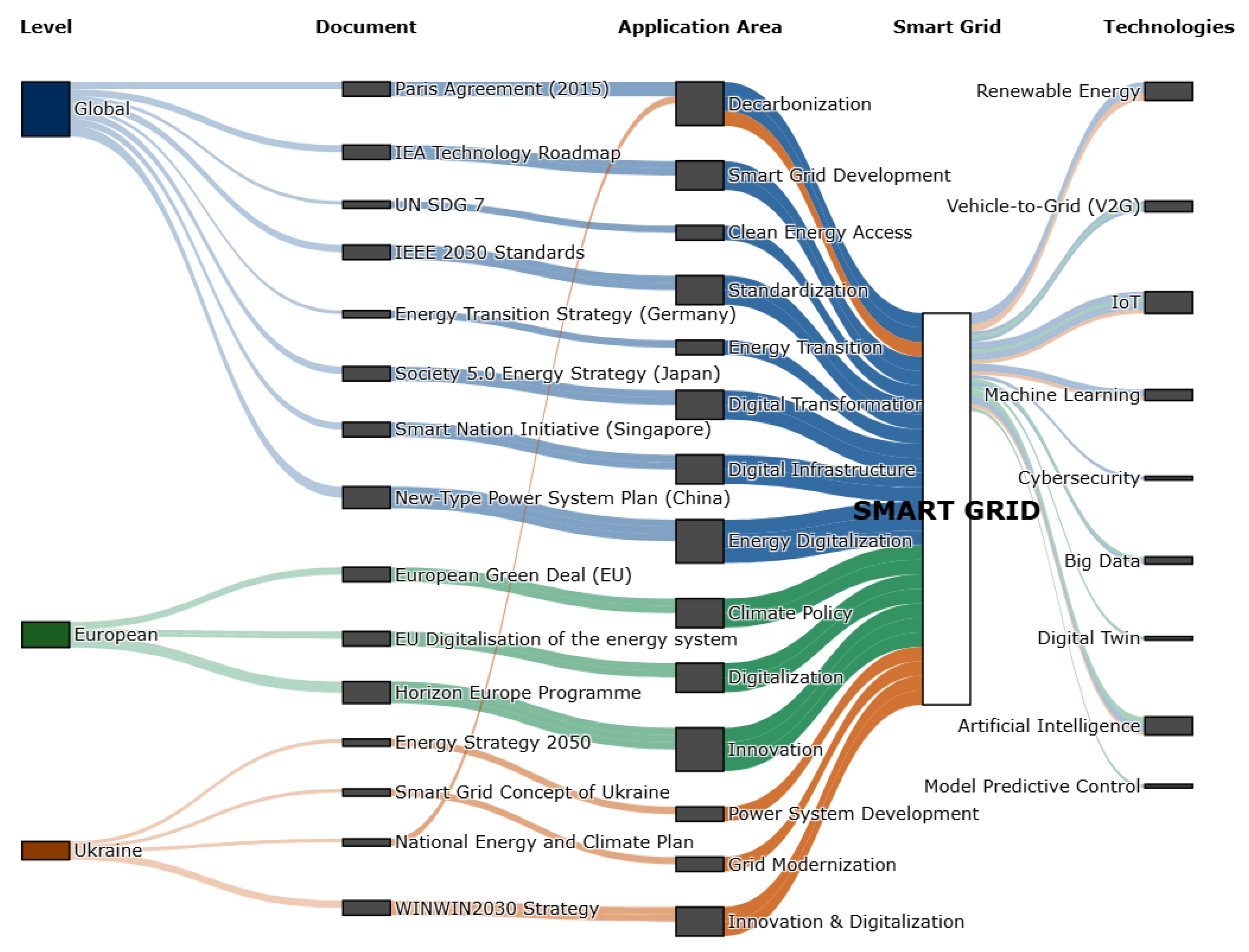
Figure 2.
Diagram of energy systems evolution via digital, computing, and communication technologies integration
Figure 2.
Diagram of energy systems evolution via digital, computing, and communication technologies integration
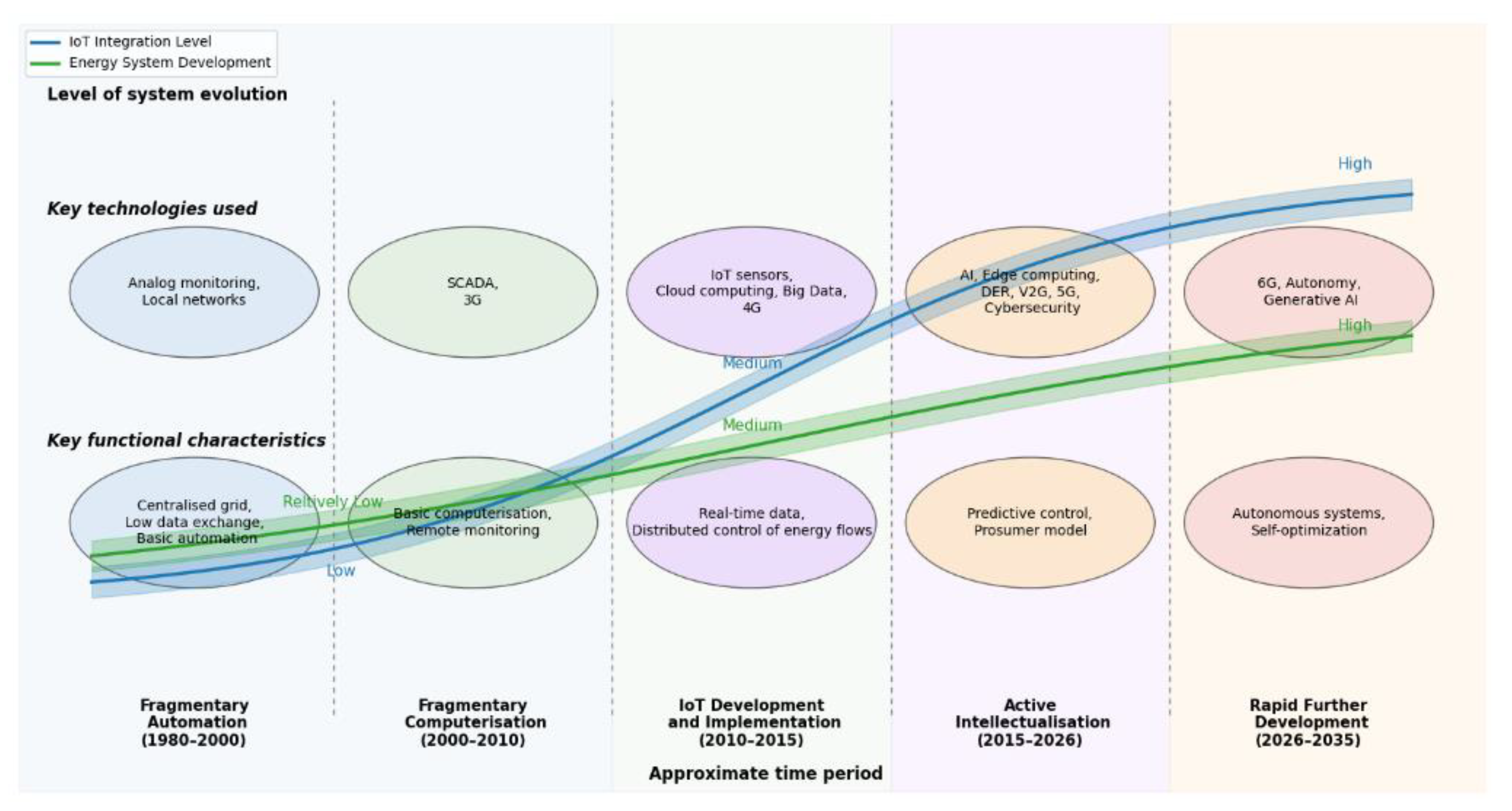
Figure 3.
Graphical representation of the bibliographic analysis based on the search query: "smart grid" AND "internet of things" AND "energy systems"
Figure 3.
Graphical representation of the bibliographic analysis based on the search query: "smart grid" AND "internet of things" AND "energy systems"
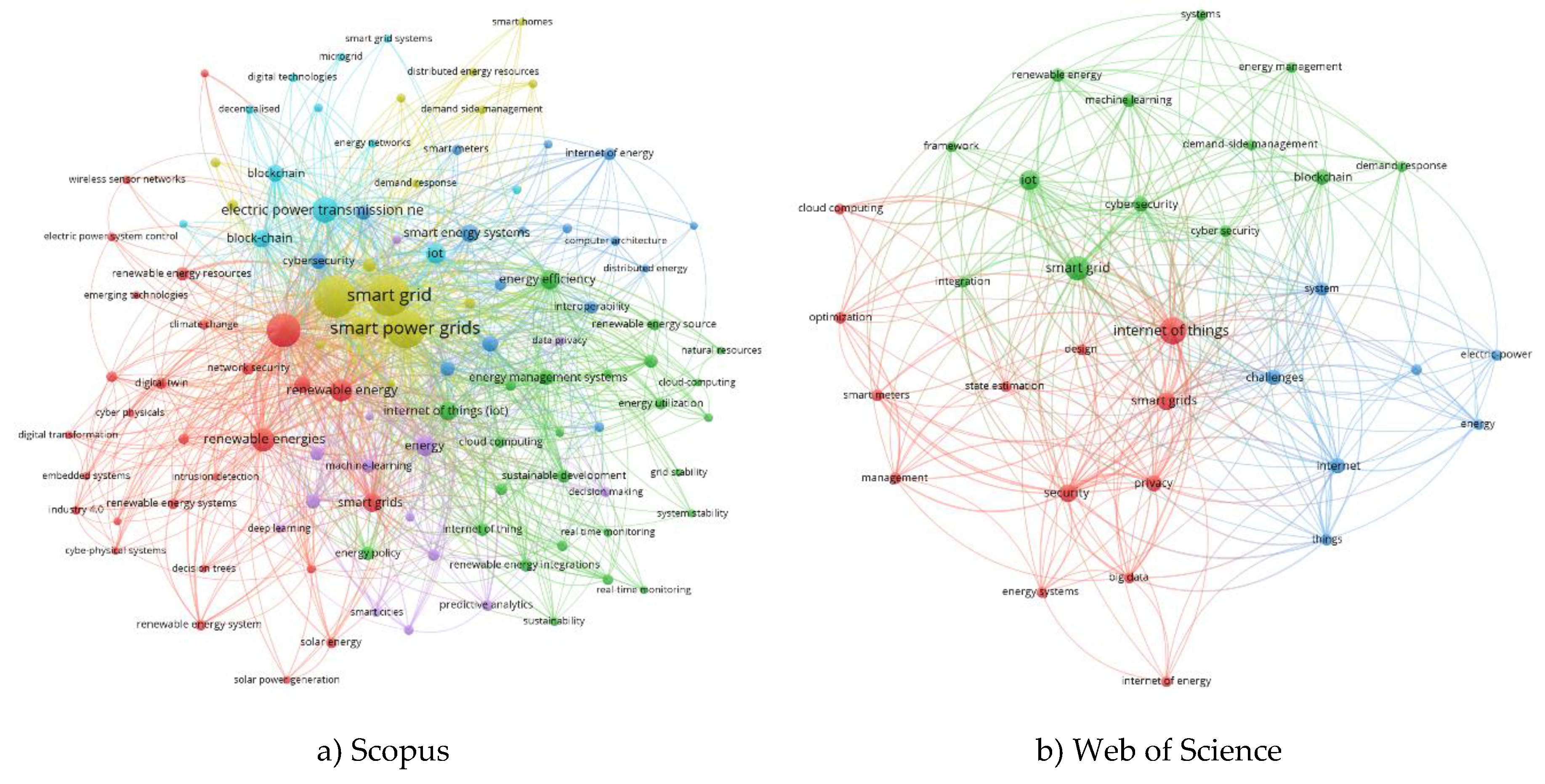
Figure 4.
Graphical representation of the bibliographic analysis based on the search query: "smart grid" AND ("IoT" OR "AI" OR "machine learning") AND "Industry 4.0".
Figure 4.
Graphical representation of the bibliographic analysis based on the search query: "smart grid" AND ("IoT" OR "AI" OR "machine learning") AND "Industry 4.0".
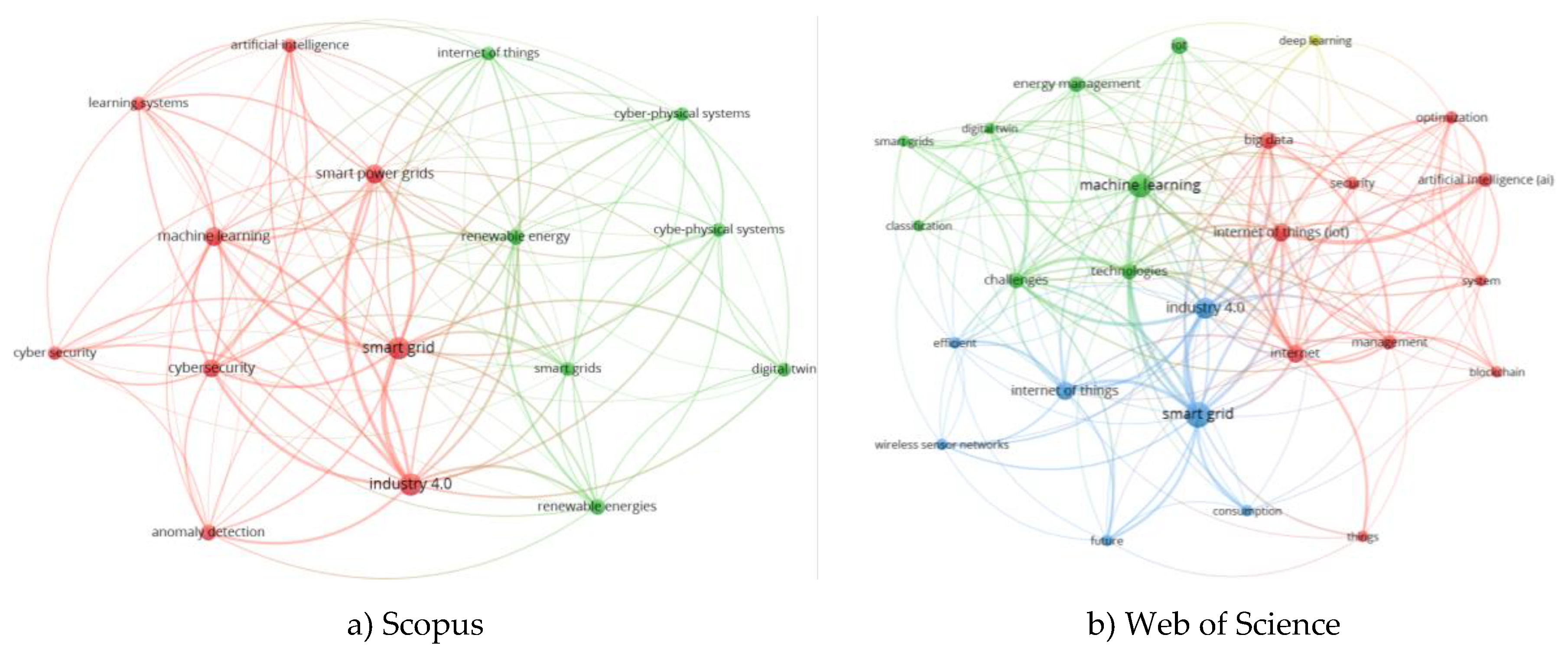
Figure 5.
Graphical representation of the bibliographic analysis based on the search query: "smart grid" AND ("digital twin" OR "big data" OR "edge computing") AND "energy management"
Figure 5.
Graphical representation of the bibliographic analysis based on the search query: "smart grid" AND ("digital twin" OR "big data" OR "edge computing") AND "energy management"
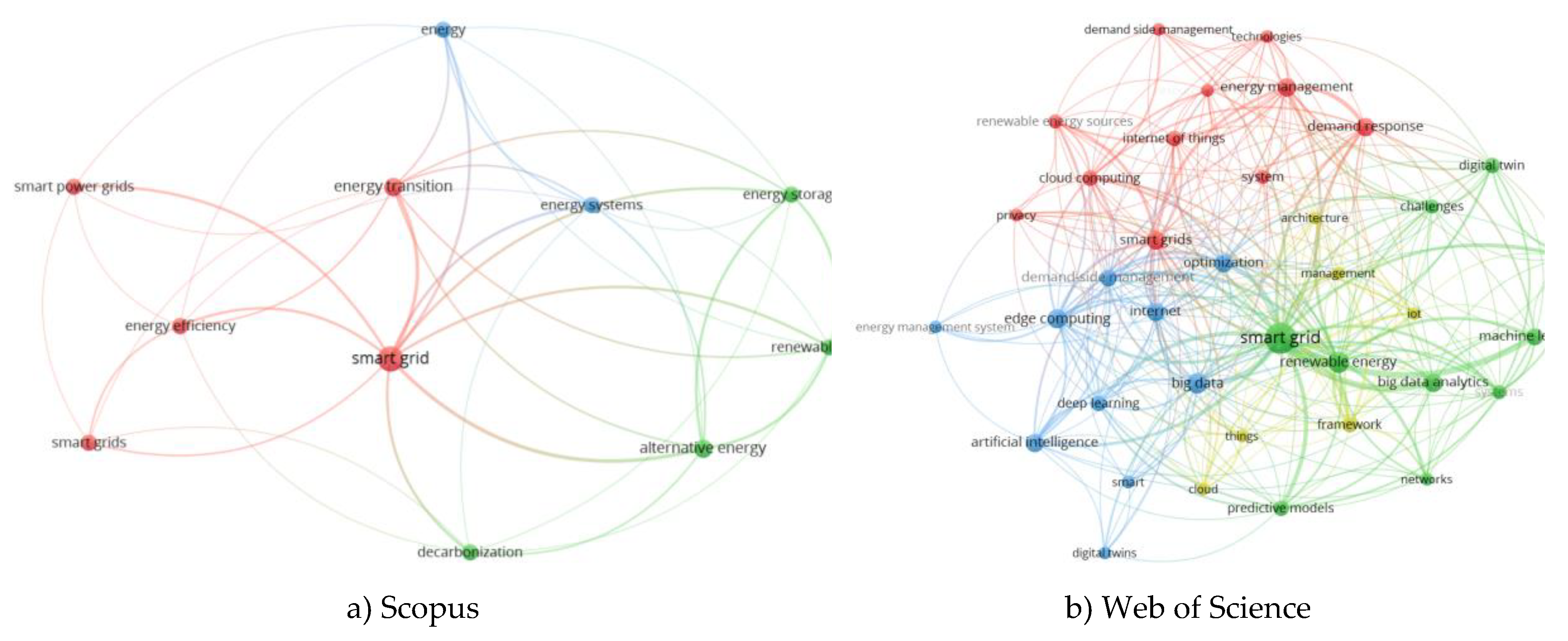
Figure 6.
Sankey diagram of the system-level interaction of challenges, solution strategies, and enabling technologies in IoT-based Smart Grid transformation
Figure 6.
Sankey diagram of the system-level interaction of challenges, solution strategies, and enabling technologies in IoT-based Smart Grid transformation
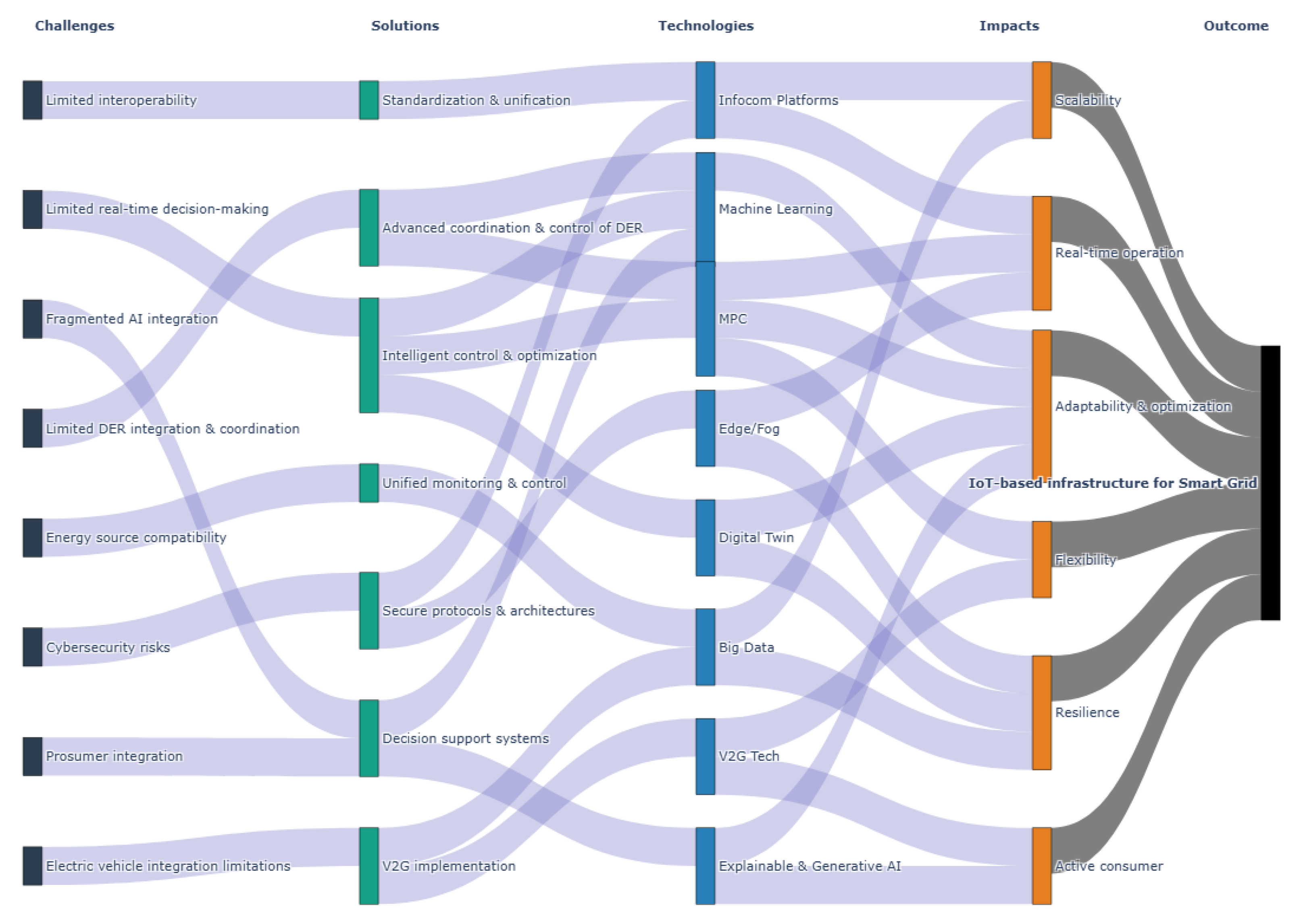
Figure 7.
A graphical representation of system-level approaches to monitoring and controlling Smart Grid systems
Figure 7.
A graphical representation of system-level approaches to monitoring and controlling Smart Grid systems
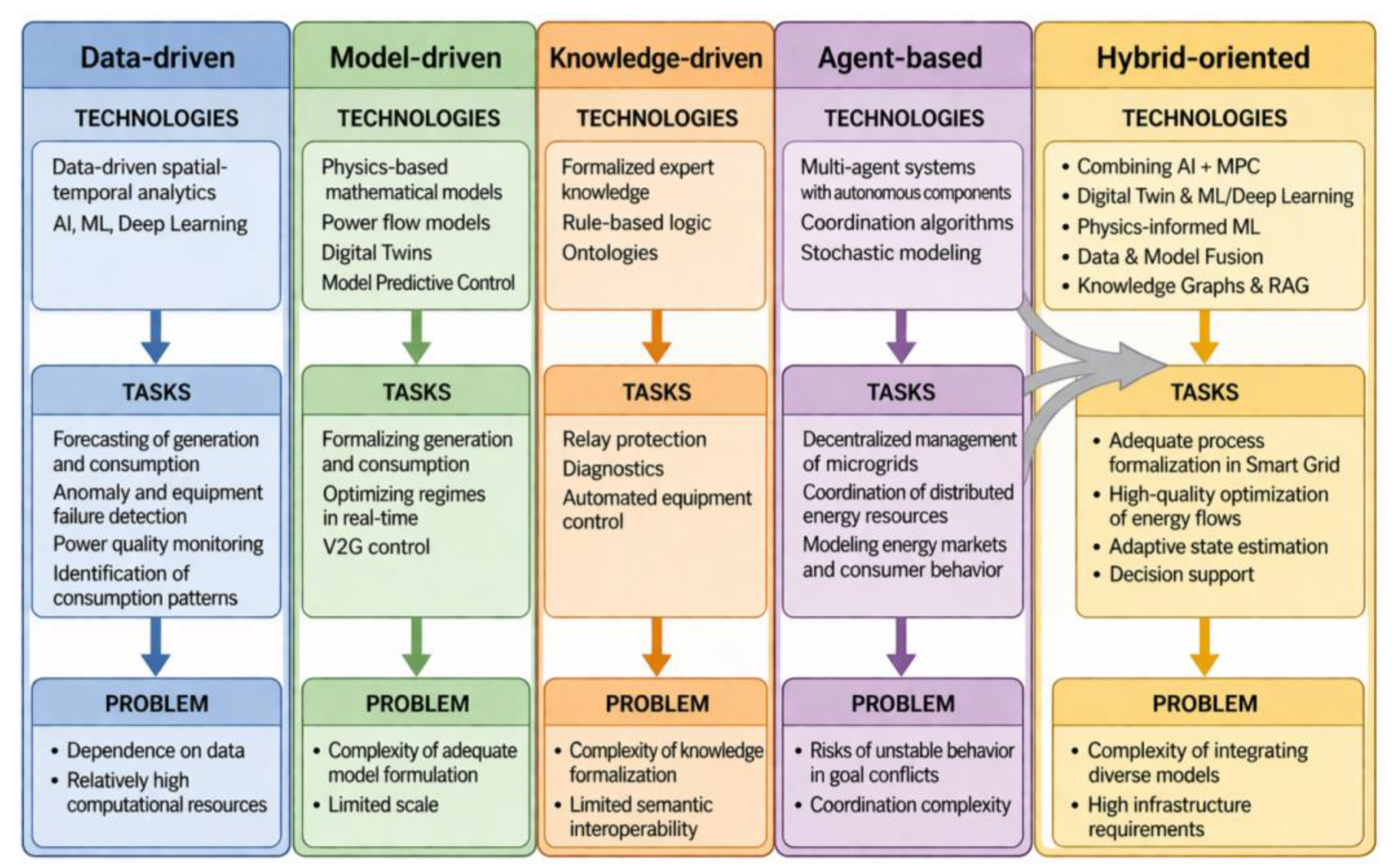

Table 1.
Informative criteria and characteristics of bibliographic search and analysis of scientific sources
Table 1.
Informative criteria and characteristics of bibliographic search and analysis of scientific sources
| Category | Criteria for the Selection and Evaluation of Scientific Literature |
|---|---|
| Scientometric databases | Scopus, Web of Science Core Collection |
| Publication time range | from 2010 to 2026 |
| Types of documents | Scopus: conference paper, article, book chapter, review, book; Web of Science: article, proceeding paper, review article, book chapter, data paper |
| Language of documents | English |
| Type of search query | keywords |
| Search query combinations | "smart grid" AND "internet of things" AND "energy systems" "smart grid" AND ("IoT" OR "AI" OR "machine learning") AND "Industry 4.0" "smart grid" AND ("digital twin" OR "big data" OR "edge computing") AND "energy management" |
| Type of analysis | co-occurrence |
| Unit of analysis | all keywords |
| Counting method | full counting |
| Minimum number of keywords | 3 |
Table 2.
Results of a comparative analysis of reference IoT models
| Technical and functional characteristics | ITU-T Y.2060 model | IWF model |
|---|---|---|
| Number and types of functional levels | 4 main levels (device, network, service support, and application levels) and 2 cross-levels (control and security capabilities) | 7 main levels (devices and controllers, communication, peripheral computing, data accumulation, data abstraction, applications, and interactions and processes levels) |
| Level of abstraction | high | detailed |
| Applied focus | generalized | industrial |
| Data processing | focused on the service support level | distributed by levels |
| Business logic | partially taken into account | listed separately at the top level |
| Suitability for Smart Grids | conceptual model | detailed synthesis and design |
Table 3.
Functional Matrix of IoT-based Smart Grid Architecture
| Functional level | Data collection | Data transmission | Data processing | AI analytics | Control | Data types |
|---|---|---|---|---|---|---|
| Device level | Voltage, current, frequency, active/reactive power, energy consumption, voltage quality (harmonics, overvoltages), equipment status (temperature, vibrations, partial discharges, pressure) | Local transmission at the level of wireless sensor networks | Preliminary analog and digital processing of sensor output signals | Not applicable | Local control actions (embedded control) | Raw data, telemetry data, alarm and/or event signals |
| Network level | Not applicable | Data transmission using a wide range of wired and wireless technologies at various hierarchical levels | Buffering, routing, packet aggregation | Not applicable | Transmission of control signals | Streaming data, control messages, packets |
| Processing level | Aggregation from distributed sources | Integration of data streams | Filtering, normalization, cleaning, storage | Load forecasting, anomaly detection, optimization, predictive maintenance | Formation of controlling influences | Aggregated data, processed data, historical information, formalized models |
| Application level | Not applicable | Integration with external information technology and enterprise management systems | Interpretation of the results | Decision support, scenario analysis | Global control (SCADA, EMS, Demand response, HMI) | Decision information, control, commands, and user-level data |
Table 4.
Results of the analysis of challenges and prospects for the development of IoT-based Smart Grid infrastructure by functional level
Table 4.
Results of the analysis of challenges and prospects for the development of IoT-based Smart Grid infrastructure by functional level
| Functional level | Key challenges and constraints | Promising areas for the development |
|---|---|---|
| Device level | Significant heterogeneity of devices, power consumption, the need for high measurement accuracy, and degradation of sensitive components due to exposure to harsh environments | The use of energy-efficient IoT devices, a widespread transition to smart sensor technologies with built-in self-diagnostic algorithms, the development of interoperability standards, and improvements to protective materials for sensitive components |
| Network level | Ensuring low latency and high reliability, network overload, and cyber threats | Large-scale deployment of 5G/6G and LPWAN technologies, use of software-defined networking and network functions virtualization, optimization of quality of service, implementation of modern cryptographic methods |
| Processing level | Processing large volumes of data, optimizing the balance between latency and computational complexity, and ensuring data and information security | Scaling edge and fog computing technologies, refining and optimizing AI and ML models, and implementing modern cryptographic protocols |
| Application level | System interoperability, data confidentiality, decision-making complexity, and integration with energy markets | The use of open standards, the implementation of multimodal large language model (LLM)-based decision support systems, and the standardization of energy management platforms |
Table 5.
An overview of system-level approaches to intelligent monitoring and control of Smart Grids
Table 5.
An overview of system-level approaches to intelligent monitoring and control of Smart Grids
| System-level approaches |
Conceptual logic | Common technologies | Applied focus |
|---|---|---|---|
| Data-driven | Comprehensive data processing and analytics | AI, ML, deep learning | Condition prediction, anomaly detection |
| Model-driven | Simulation models | MPC, DT | Analysis of operating modes, optimal, predictive, and adaptive control |
| Knowledge-driven | Formalized expert knowledge | Rule-based systems, ontologies | Diagnostics, decision support |
| Agent-based | Decentralized interaction | Multi-agent systems | Control of Smart Grid components and MicroGrid networks |
| Hybrid-oriented | A combination of approaches | Combined utilization of AI, ML, deep learning, MPC, rule-based approaches, and/or DT | A comprehensive solution for intelligent monitoring and control of decentralized power systems, with decision-making support |
Table 6.
Results of the analysis of research into the data-driven approach within the context of Smart Grids
Table 6.
Results of the analysis of research into the data-driven approach within the context of Smart Grids
| Subject of the research | Technologies and approaches used | Scientific and practical outcomes achieved | References |
|---|---|---|---|
| A data-driven, cyber-secure optimization approach for dynamic energy management in EV-coupled Smart Grids | Electric vehicle–grid communication, CatBoost, a lightweight blockchain-inspired security protocol | Development and experimental validation of a cyber-resilient, data-driven real-time framework for energy management in EV-integrated Smart Grids, which combines optimization, adaptive forecasting under incomplete data, and a lightweight blockchain-based approach to cybersecurity, thereby ensuring simultaneous improvements in the efficiency, accuracy, and security of energy processes | [107] |
| A renewable-aware, data-driven framework for zonal power quality monitoring in Smart Grids | Clustering (K-means), statistical analysis, and adaptive monitoring strategies | Development and validation of an adaptive power quality monitoring model based on a Renewable Variability Index (RVI), enabling risk-based zonal classification of power networks and reducing data acquisition requirements without compromising disturbance detection performance | [108] |
| Data-driven architecture of smart renewable energy microgrids in non-interconnected zones | IoT, big data, web technologies | Development and implementation of a data-driven architecture for smart renewable energy microgrids in non-interconnected zones, addressing contextual constraints and enabling efficient, scalable energy management in isolated regions | [109] |
| Data-driven methods and technologies for energy optimization in smart building systems | Big data, AI, ML, IoT, edge and cloud computing, wireless sensor networks (WSN), DT, blockchain, and geographic information systems | Systematic synthesis and analysis of data-driven technologies for energy optimization in smart buildings, identifying key technological enablers, adoption barriers, and business models to support efficient, sustainable, and user-centric energy management | [110] |
| Data-driven methodological framework for identifying electricity consumption typologies from smart meter data | Smart meter, time-series feature extraction, unsupervised learning, clustering algorithms, statistical analysis, expert-in-the-loop validation. | Development and validation of a data-driven methodology for extracting and clustering electricity consumption typologies from large-scale smart meter data, enabling more accurate demand modeling and supporting adaptive energy planning and tariff design. | [111] |
| Graph-based deep learning methods for anomaly detection in Smart Grid time-series data | Graph neural networks, graph deviation networks, deep learning, and ML | Development and validation of a semi-supervised graph deviation network–based approach for real-time anomaly detection in Smart Grid time-series data, enabling robust pre-filtering of corrupted data and significantly enhancing the efficiency and reliability of state estimation | [112] |
| Data-driven predictive modeling of photovoltaic energy for Smart Grid systems | Time-series data, deep learning, artificial neural networks (ANNs), statistical analysis | Development and comparative evaluation of data-driven time-series models for photovoltaic (PV) energy forecasting, demonstrating high predictive accuracy and supporting reliable integration of renewable generation into Smart Grid operations | [113] |
| A comprehensive review of deep learning–based detection and diagnosis of short-circuit faults in power distribution networks | Deep learning, Deep reinforcement learning, AI and ML models, XAI, federated and distributed learning | Comprehensive analysis and systematization of deep learning methods for the detection, classification, and localization of short-circuit faults in power distribution networks, identifying key technological trends, performance trade-offs, and research gaps for scalable and reliable Smart Grid fault diagnostics | [114] |
Table 7.
Results of the analysis of scientific research into the model-driven approach within the context of energy and electrical systems
Table 7.
Results of the analysis of scientific research into the model-driven approach within the context of energy and electrical systems
| Subject of the research | Technologies and approaches used | Scientific and practical outcomes achieved | References |
|---|---|---|---|
| A goal-oriented and model-driven framework for conceptual design and system-level specification of Smart Grid services | System-of-systems, Petri nets, linear temporal logic, service-oriented design | Development of a goal-oriented and model-based methodology for designing flexible and user-centric Smart Grid services, enabling effective integration of distributed cogeneration and adaptive energy management in heterogeneous and isolated energy systems | [121] |
| Design and implementation of a programmable DT framework based on IEC 61850 communication for Smart Grid systems | DT, IEC 61850, information and communication protocols GOOSE, MMS, embedded platform Raspberry Pi, open-source stack libIEC61850 | Development and experimental validation of an IEC 61850-compliant programmable platform for DT applications, enabling high-speed, interoperable, and bidirectional real-time interaction between physical and virtual Smart Grid components | [122] |
| A DT–based modeling framework for intelligent V2G systems with AI-driven energy management | DT, physics-based modeling, AI, ML, simulation platforms, V2G energy management algorithms, Kalman filtering | Development and validation of a high-fidelity multi-physics electric vehicle model for DT–enabled V2G systems, enabling highly accurate energy state prediction and supporting AI-driven optimization of energy management in Smart Grid environments | [123] |
| Framework design and implementation of DT systems for Smart Grid-integrated EV | DT, modular multi-agent-based architecture, Kalman filtering, V2G, predictive analytics | Development of a DT–based integrated framework for EV and charging infrastructure coordination, enabling decentralized decision-making and incentive-driven participation in grid services to enhance operational efficiency and grid stability | [124] |
| Theoretical development and case study of an extended MPC framework for energy management in renewable-based smart microgrids with hydrogen backup systems | MPC, state-space and nonlinear microgrid models, multi-criteria optimization, AI-based tuning | Development and experimental validation of an extended MPC-based energy management framework for renewable microgrids with hydrogen backup, enabling multi-objective optimization of energy distribution while accounting for system dynamics, degradation, and operational constraints | [125] |
| Methodological approaches to enhancing the energy efficiency of operating regimes in distribution networks with integrated PV generation | Spectral analysis, correlation analysis, mathematical and physical modeling, Mdaq-14, LabVIEW | Experimental identification of harmonic distortion patterns in photovoltaic inverters and development of a control method to reduce electromagnetic interference, enabling improved electromagnetic compatibility and enhanced energy efficiency of distribution networks with PV integration | [126] |
| Computer models for predictive energy-efficient control with multiparameter optimization of electromechanical systems | MPC, Matlab & Simulink, GRAMPC | Development and validation of a predictive control–based optimization methodology for induction motor drives, enabling improved energy efficiency, control accuracy, and computational performance through multi-criteria tuning of MPC algorithms | [127,128] |
| Development and application of MPC strategies for enhancing the resilience of electric power grids | MPC, reduced-order modeling, multi-objective functions, collocation methods, orthogonal spline collocation, Bernstein polynomials, numerical simulation | Development and validation of a generalized MPC-based control framework for power systems, enabling resilient integration and optimal management of intermittent energy resources through reduced-order modeling and advanced optimization techniques | [129] |
| Development of a hierarchical two-layer MPC–supervisory framework for efficient operation of inverter-dominated small-scale microgrids | Hierarchical MPC, droop and PI-based control, d–q transformation, optimization algorithms, DER integrative approaches | Development and validation of a hierarchical two-layer MPC-based control framework for inverter-dominated microgrids, enabling optimized power sharing, enhanced stability, and improved integration of RES under dynamic operating conditions | [130] |
| Development of an MPC–based energy management framework for cooperative optimization of connected microgrids | MPC, distributed and cooperative optimization, multi-microgrid coordination, state-space modeling, energy management systems (EMS), DER integrative approaches | Development and validation of an MPC-based energy management system for cooperative microgrid operation, enabling cost-efficient and stable optimization of distributed energy resources through predictive coordination and network-level interaction | [131] |
Table 8.
Results of the analysis of scientific research on the knowledge-driven approach within the context of energy and electricity systems
Table 8.
Results of the analysis of scientific research on the knowledge-driven approach within the context of energy and electricity systems
| Subject of the research | Technologies and approaches used | Scientific and practical outcomes achieved | References |
|---|---|---|---|
| Development and evaluation of rule-based energy management strategies for enhancing PV self-consumption in building energy systems | Rule-based control (if–then logic), EMS, and algorithms for optimizing PV self-consumption | Design and real-world validation of a rule-based energy management system for PV-driven buildings, enabling high self-consumption rates through IoT-based control of flexible loads while maintaining user comfort | [132] |
| Development of a modular rule-based energy framework for management and coordinated operation of hybrid AC/DC microgrids | Rule-based control (modular if–then logic), DER coordination, power balancing algorithms | Development and validation of a modular rule-based energy management system for hybrid microgrids, enabling adaptive optimization of diverse configurations through dynamic coordination of DER and system constraints | [133] |
| Development and stochastic evaluation of a rule-based energy management framework for EV charging station nanogrids | Rule-based energy management, stochastic modeling, DER integration, energy flow optimization methods | Development and validation of a rule-based energy management system for EV charging nanogrids, enabling cost-efficient and reliable operation through stochastic modeling, renewable prioritization, and forecast-aware decision-making under uncertainty | [134] |
| Development of rule-based data transformation frameworks for structured information processing in Smart Grids | Jena rule language, semantic web rule language, Smart Grid data models | Development of a rule-based data transformation framework using semantic rule languages, enabling interoperability between heterogeneous Smart Grid data models without reliance on custom integration solutions | [135] |
| Development of an ontology matching framework for semantic interoperability in next-generation Smart Grid systems | Ontology matching algorithms, semantic web technologies, and rule-based reasoning | Development and validation of an advanced ontology matching system for Smart Grids, enabling automated detection of complex semantic correspondences between heterogeneous data models to enhance interoperability of intelligent energy systems | [136] |
| Development of an ontology-driven energy management framework for intelligent smart home systems | Intelligent reasoning, domain ontology, decision-making, semantic web rule language | Development and implementation of an ontology-based smart home energy management system, enabling context-aware optimization of electricity consumption through semantic reasoning and achieving measurable energy savings | [137] |
Table 9.
Results of the analysis of scientific research on the agent-based approach within the context of energy and electricity systems
Table 9.
Results of the analysis of scientific research on the agent-based approach within the context of energy and electricity systems
| Subject of the research | Technologies and approaches used | Scientific and practical outcomes achieved | References |
|---|---|---|---|
| Systematic exploration of ontology-enabled architectures and semantic coordination mechanisms in multi-agent energy systems | Scoping review, multi-agent systems, ontology | Systematization of ontology-driven multi-agent system design in the energy domain, enabling improved interoperability, knowledge representation, and coordinated operation of complex distributed energy systems | [138] |
| Development of a hierarchical decentralized multi-agent architecture for sustainable energy management in Smart Grid systems | Multi-agent systems, agent coordination algorithms, energy management optimization, DER integration | Development and validation of a decentralized hierarchical multi-agent energy management framework, enabling scalable real-time coordination and multi-objective optimization of smart grids with high renewable and prosumer integration | [100] |
| Comprehensive analysis of agent-based modeling approaches for Smart Grids and electricity markets |
Scoping review, agent-based simulation and modeling, agent-based computational approaches | Systematization of agent-based modeling and simulation approaches for smart grids, enabling comprehensive analysis of multi-agent interactions and supporting decision-making in complex energy systems and market environments | [101] |
| Development of an agent-based planning framework for distribution grids within a socio-technical system paradigm | Multi-agent modeling, behavioral economics, agent-based modeling of consumers, energy flow analysis, causal loop diagrams | Development and application of an agent-based planning model for distribution grids, enabling the incorporation of heterogeneous consumer behavior to improve the accuracy of load forecasting and support socio-technical energy system design | [139] |
| Development of a multi-agent control framework for adaptive management of Smart Grid systems | Multi-agent systems, intelligent agents, decentralized control, agent coordination algorithms, and real-time decision-making mechanisms | Development and application of a multi-agent–based simulation framework for smart grid management, enabling analysis of market interactions, coordinated use of distributed resources, and adaptive decision-making under dynamic electricity market conditions. | [140] |
| Development and application of an agent-based simulation environment for modeling and analysis of Smart Grid systems | Agent-based modeling, power flow modeling, load, and DER models | Development and application of an agent-based simulation platform (GridLAB-D), enabling integrated time-series modeling of power systems, markets, and distributed resources for comprehensive analysis and design of smart grid technologies | [141] |
| Development of an adaptive multi-agent control and optimization framework for intelligent management of Smart Grid systems | Adaptive control, stochastic learning, reinforcement learning, multi-agent systems | Development of an adaptive multi-agent reinforcement learning–based energy management approach, enabling coordinated control of DER and energy storage under renewable variability through decentralized learning and real-time interaction | [142] |
| Development of agent-based modeling frameworks for simulation and analysis of Smart Grid market operations | Agent-based modeling, market-based trading, decentralized management, energy market modeling | Development and evaluation of agent-based market mechanisms for Smart Grids, enabling efficient decentralized energy trading and coordination among self-interested participants under uncertainty and resource constraints | [102] |
| Development of an intelligent multi-agent autonomous control framework for energy management in microgrid systems | Agent-based models for real-time prediction and correction, simulation modeling | Development and validation of a multi-agent–based energy management architecture for microgrids, enabling adaptive and efficient coordination of DER under uncertainty through prediction and real-time correction mechanisms | [143] |
Table 10.
Results of the analysis of research into the hybrid-oriented approach within the context of electricity and energy systems
Table 10.
Results of the analysis of research into the hybrid-oriented approach within the context of electricity and energy systems
| Subject of the research | Technologies and approaches used | Scientific and practical outcomes achieved | References |
|---|---|---|---|
| Unified hybrid methodology integrating data-driven and model-driven approaches for distributed optimal control of microgrid systems | Data-driven approach, model-driven approach, optimization algorithms, ML, ICT, Python, MATLAB | Development and validation of a hybrid data-driven and model-based distributed control framework, enabling accurate voltage and frequency restoration in standalone microgrids through consensus algorithms and ML–based renewable prediction | [144] |
| Systematic investigation of AI–driven hierarchical control architectures for advanced management of microgrid systems | Comprehensive review of ML, ANN, deep learning, reinforcement learning, fuzzy logic, meta-heuristic algorithms, MPC, and hybrid AI controllers | Systematization and comprehensive analysis of AI-driven hierarchical control strategies for microgrids, enabling improved efficiency, adaptability, and stability in the integration of distributed RES | [145] |
| Development of an integrated energy management framework for residential microgrids based on MPC using Shapley value and reinforcement learning | MPC, reinforcement learning, hybrid MPC–reinforcement learning approach, Shapley value, optimization algorithms, microgrid modeling | Development and validation of a hybrid MPC–reinforcement learning energy management strategy with Shapley value–based allocation, enabling cost-optimal operation of residential microgrids under uncertainty and fair distribution of cooperative economic benefits among prosumers | [146] |
| Comparative analysis of ML– and MPC–based approaches for optimal operation of residential battery energy storage systems | MPC, mixed-integer linear programming, nonlinear programming, supervised learning, reinforcement learning, imitation learning, neural networks, hybrid MPC–ML control approaches | Comparative evaluation of model-based MPC and ML control strategies for home energy management systems, demonstrating improved operational efficiency over rule-based methods while revealing trade-offs between optimization performance, constraint satisfaction, and computational complexity | [147] |
| Development of an integrated hybrid methodology combining data-driven learning and physics-based modeling for reliability assessment of distribution networks with a high proportion of renewable energy | Hybrid data-driven and model-driven approach, conditional Wasserstein generative adversarial network, clustering algorithms, mixed-integer linear programming, Monte Carlo simulation | Development and validation of a hybrid data-driven and model-based reliability assessment framework, enabling accurate quantification of distribution network reliability under renewable uncertainty through advanced scenario generation and optimization-based fault analysis | [148] |
| Development of a unified hybrid framework for accelerated power system state estimation via integration of model-based and data-driven techniques | Hybrid data-driven and model-driven approach, state estimation, physically grounded network models, deep learning, optimization algorithms, SCADA, accelerated computing methods | Development and validation of a hybrid model-driven and graph neural network–based state estimation framework, enabling fast and accurate monitoring of power system dynamics by combining physical topology awareness with data-driven feature learning | [149] |
| Development of an advanced MPC framework augmented by ANNs for optimized high-rate charging of lithium-ion battery systems | MPC, ANNs, models of lithium-ion battery systems | Development and validation of an ANN-augmented MPC framework for lithium-ion battery charging, enabling MPC-level predictive performance with drastically reduced computational complexity to support real-time control | [150] |
| Development of a data-driven multi-agent reinforcement learning–based approach for home energy management | Decision making, reinforcement learning, optimization, neural network, finite Markov decision process, Q-learning algorithm | Development and validation of a multi-agent reinforcement learning–based home energy management framework, enabling cost-efficient and user-aware demand response optimization under uncertainty through data-driven forecasting and adaptive scheduling | [151] |
| Development of an ontology-driven framework for integrated network model management and semantic data interoperability in Smart Grid systems | Unified modeling language; time series analysis; semantics; ontologies; common information model; data models | Development and validation of an ontology-based data management framework extending common information model semantics, enabling efficient integration, semantic interoperability, and advanced querying of heterogeneous Smart Grid data | [152] |
| Development of a data-driven and retrieval-augmented generation (RAG)–enabled framework for digital energy infrastructure systems | Decision-making, RAG, DT, natural user interface, API-based services, ML | Development and implementation of RAG and knowledge graph–enhanced DT framework, enabling advanced predictive analytics and intelligent decision support for energy infrastructure management through integration of ML and LLMs | [153] |
| Development of an integrated deep learning–enhanced MPC framework for advanced frequency regulation in wind farm systems | Hybrid deep learning and MPC, bi-level control architecture, deep neural networks, particle swarm optimization, physics-based modeling, MATLAB and Simulink | Development and validation of a hybrid deep learning–MPC framework for wind farm control, enabling improved frequency stability and dynamic response through coordinated data-driven inertia estimation and constrained optimal power allocation | [154] |
Disclaimer/Publisher’s Note: The statements, opinions and data contained in all publications are solely those of the individual author(s) and contributor(s) and not of MDPI and/or the editor(s). MDPI and/or the editor(s) disclaim responsibility for any injury to people or property resulting from any ideas, methods, instructions or products referred to in the content. |
© 2026 by the authors. Licensee MDPI, Basel, Switzerland. This article is an open access article distributed under the terms and conditions of the Creative Commons Attribution (CC BY) license (http://creativecommons.org/licenses/by/4.0/).
Copyright: This open access article is published under a Creative Commons CC BY 4.0 license, which permit the free download, distribution, and reuse, provided that the author and preprint are cited in any reuse.


