

Submitted:
17 April 2026
Posted:
20 April 2026
You are already at the latest version
Abstract
We investigate the consequences of modeling space–time as a finite-information substrate composed of Planck-scale quantum memory cells. In this framework, physical laws traditionally formulated in a continuous setting emerge as effective descriptions of an underlying discrete, finite-capacity system. We introduce the concept of finite-information deviations, defined as systematic differences between ideal continuum dynamics and their realizations on a discrete informational structure. These deviations arise from bounded Hilbert space dimension, local imprint accumulation, and coarse-graining of quantum information. We demonstrate that such deviations manifest as additional contributions to effective field equations, naturally reproducing phenomena previously attributed to dark matter, dark energy, and quantum gravitational corrections. The framework preserves global unitarity and locality while introducing structured, scale-dependent modifications to continuum physics. We outline observational consequences and discuss the role of these deviations as fundamental features rather than imperfections of physical law.
Keywords:
finite information
; discrete spacetime
; quantum information
; entropy field
; emergent spacetime
; effective field theory
; quantum gravity
; dark matter phenomenology
; dark energy
; modified dispersion relations
1. Introduction
Modern theoretical physics rests on the assumption that space–time is a smooth, continuous manifold supporting arbitrarily fine degrees of freedom. Within this framework, quantum field theory (QFT) and general relativity (GR) have achieved extraordinary empirical success. Nevertheless, a number of persistent challenges indicate that this continuum description may be only an effective approximation. These include the ultraviolet divergences of QFT, the absence of a complete quantum theory of gravity, and conceptual tensions such as the black hole information paradox, where semiclassical arguments suggest information loss while quantum mechanics requires unitary evolution [1,2,3]. A common feature of many approaches to these problems is the introduction of a fundamental discreteness or minimal length scale. Examples include loop quantum gravity, causal set theory, and lattice-based formulations of field theory, all of which suggest that the continuum description breaks down at sufficiently small scales [4,5,6]. In most such constructions, however, discreteness is introduced primarily at the level of geometry, while the informational content of the underlying degrees of freedom is not treated as a primary dynamical quantity. An alternative perspective has emerged in which space–time and gravity are understood as emergent phenomena arising from underlying quantum information structures. This viewpoint is supported by developments in holography and quantum entanglement, where spacetime geometry can be reconstructed from entanglement patterns in quantum states [7,8]. More recently, it has been proposed that gravitational dynamics themselves may arise from entropic or thermodynamic principles associated with microscopic degrees of freedom [9,10]. These approaches suggest that information is not merely a property of physical systems, but may play a fundamental role in determining the structure of space–time. In this context, a finite-information description of space–time provides a natural extension of these ideas. In such a framework, each elementary region is associated with a finite-dimensional Hilbert space that stores the quantum information generated by local interactions. Physical processes are recorded as localized imprints within these subsystems, and macroscopic fields arise through coarse-graining over large ensembles. This formulation provides a natural ultraviolet regulator, since the finite Hilbert space dimension bounds the number of independent local degrees of freedom, and offers a mechanism for preserving global unitarity even in regimes where semiclassical descriptions appear non-unitary [11,12]. Within such a finite-information framework, several results have been established across different physical domains. Discrete gauge constructions recover standard electrodynamics in the continuum limit while predicting Planck-suppressed corrections to photon propagation [11]. In cosmology, coarse-grained entropy fields derived from local information storage contribute effective stress–energy components that reproduce phenomena typically attributed to dark matter [13] and dark energy [14]. More generally, the relation between entropy gradients and curvature has been formalized through a covariant informational extension of thermodynamics, in which spacetime geometry reflects the flow and accumulation of quantum information [12]. Despite these advances, the conceptual implications of finite information capacity for the formulation of physical law have not been systematically analyzed. In particular, the relationship between ideal continuum dynamics and their realization on a discrete, finite-information substrate remains largely unexplored. If the underlying structure of space–time supports only a finite number of distinguishable states per local region, then the continuum equations of motion cannot be exact. Instead, they must arise as effective descriptions that neglect corrections induced by finite information storage, imprint accumulation, and coarse-graining.
In this work, we introduce the concept of finite-information deviations, defined as systematic differences between ideal continuum dynamics and the effective evolution generated by a finite-information substrate. These deviations are not stochastic errors or violations of fundamental principles. Rather, they are structured, deterministic consequences of bounded Hilbert space dimension and the discrete nature of information storage. At the microscopic level, evolution remains unitary and local. At macroscopic scales, however, coarse-grained descriptions inherit additional terms that modify effective field equations. We develop a formal representation of these deviations in terms of an entropy field defined by local reduced density matrices and show how its gradients contribute to effective dynamics. This leads to a unified interpretation of several previously derived results, in which additional stress–energy components, vacuum contributions, and higher-order operators can be understood as manifestations of finite-information structure. The framework preserves gauge invariance, locality, and unitarity while introducing scale-dependent corrections that vanish in the continuum limit. Finally, we discuss the observational consequences of finite-information deviations, including their impact on cosmological structure formation, gravitational lensing, and photon propagation. These effects provide potential avenues for empirical validation and position finite information capacity as a physically testable ingredient of fundamental theory, rather than a purely conceptual modification.
2. Continuum Idealization and Informational Substrate
This section contrasts the conventional continuum description of space–time with an alternative formulation based on a finite-information substrate. We first review the assumptions underlying continuum field theories and then introduce a discrete, information-limited structure in which these assumptions are relaxed. The transition between these descriptions is illustrated using physically motivated numerical constructions that demonstrate how continuum behavior emerges from finite-resolution representations.
2.1. Continuum Limit of Physical Theories
In the standard formulation of fundamental physics, space–time is modeled as a smooth, differentiable manifold equipped with a metric structure. Fields are defined as continuous functions over this manifold, and their dynamics are governed by differential equations derived from variational principles. This description implicitly assumes that space–time can be subdivided arbitrarily, allowing for infinitely fine resolution of physical degrees of freedom. In quantum field theory, this assumption implies the existence of modes at arbitrarily high energies and, correspondingly, short wavelengths. While renormalization procedures allow for the extraction of finite, physically meaningful predictions, ultraviolet divergences persist as a structural feature of the formalism. Similarly, in general relativity, the continuum description permits singular solutions, such as those associated with black hole interiors, where curvature invariants diverge and the classical theory breaks down. The continuum limit therefore represents an idealization in which both geometric and informational degrees of freedom are treated as unbounded. While this approximation is highly successful at accessible energy scales, it raises fundamental questions regarding its validity in regimes where quantum gravitational effects become significant. A direct comparison between a continuum field and its finite-resolution representation is shown in Figure 1. The continuum field is generated from a Gaussian random field with a physically motivated power spectrum, exhibiting correlations across a wide range of scales. The corresponding discrete representation is obtained through coarse-graining and quantization, reflecting both finite spatial resolution and bounded local state capacity. The comparison makes explicit that fine-scale structure present in the continuum description is systematically suppressed in the finite-information representation.
2.2. Discrete Informational Structure
An alternative description replaces the assumption of infinite divisibility with a finite-information substrate. In this framework, space–time is modeled as a collection of discrete elements , each associated with a finite-dimensional Hilbert space ,
Each local Hilbert space represents the set of quantum states accessible within a finite region of space–time. The dimension of is bounded by information-theoretic constraints, such as holographic entropy limits, implying that only a finite number of distinguishable states can be encoded locally. Physical interactions are registered through imprint operators that update the state of each cell, thereby recording the history of local processes. The finiteness of has immediate physical consequences. It imposes a fundamental limit on the number of independent degrees of freedom within any finite region, effectively introducing an intrinsic ultraviolet cutoff without the need for external regularization. Unlike conventional lattice approaches, where discretization is often a computational tool, the discrete structure here is treated as physical, and the associated information bound is a property of the underlying theory. Macroscopic fields and geometric structure emerge through coarse-graining over large ensembles of cells. In this limit, approximate continuity and differentiability are recovered, and standard field equations arise as effective descriptions. However, because the underlying substrate is finite and discrete, the continuum description cannot be exact. Deviations from ideal continuum behavior therefore arise systematically from finite information capacity and the dynamics of imprint accumulation. The emergence of continuum behavior from such a discrete substrate is quantified in Figure 2. The curve is obtained from a numerical experiment in which a physically motivated random field is coarse-grained at varying resolutions, and the root-mean-square deviation between the original and reconstructed fields is measured. The results show a clear, approximately power-law decrease in deviation with increasing resolution, demonstrating that continuum behavior is recovered only as an effective large-scale limit.
This perspective shifts the role of discreteness from a technical artifact to a fundamental feature, in which geometry, dynamics, and information storage are intrinsically linked. The continuum limit is thus understood as an emergent approximation of an underlying informational structure with finite resolution.
3. Definition of Finite-Information Deviations
In this section, we formalize the notion of finite-information deviations as a systematic departure from ideal continuum dynamics arising from a finite-capacity informational substrate. We introduce a deviation operator that quantifies this mismatch and identify the fundamental mechanisms responsible for its emergence. The resulting framework provides a controlled description of how finite information capacity modifies effective physical laws. We define finite-information deviations as the difference between ideal continuum evolution and the effective dynamics arising from a discrete informational substrate. In contrast to conventional discretization artifacts, these deviations are intrinsic to the physical description and arise from finite information capacity rather than numerical approximation. In the continuum limit, fields are assumed to possess arbitrarily fine structure, and their evolution is governed by differential operators acting on smooth configurations. However, when the underlying degrees of freedom are constrained by finite-dimensional Hilbert spaces, this idealization is no longer exact. The resulting deviations reflect the mismatch between infinite-resolution continuum dynamics and finite-resolution informational evolution.
3.1. Deviation Operator
Let denote the continuum evolution operator and the effective evolution derived from the discrete informational substrate. The deviation operator is defined as
By construction, captures all corrections induced by finite information capacity, imprint accumulation, and coarse-graining. Importantly, these deviations are not stochastic fluctuations or violations of fundamental principles. The underlying microscopic dynamics remain unitary and local. The deviations instead arise at the level of effective, coarse-grained descriptions. A systematic derivation of Equation (2) and its expansion in inverse Hilbert-space dimension is provided in Appendix B. In particular, the deviation operator admits an expansion of the form
where d denotes a characteristic local Hilbert-space dimension and are higher-order correction operators. At leading order, these corrections can be expressed in terms of gradients of coarse-grained entropy fields, linking finite-information effects directly to macroscopic observables.
3.2. Origin of Deviations
Finite-information deviations emerge from three fundamental mechanisms:
- 1.
- Finite local Hilbert space dimension. Each space–time cell supports only a finite number of distinguishable quantum states. This imposes a hard bound on local degrees of freedom, preventing arbitrarily fine encoding of field configurations and introducing intrinsic resolution limits.
- 2.
- Accumulation of quantum imprints. Local interactions are recorded through imprint operators acting on finite-dimensional Hilbert spaces. Over time, this leads to structured, history-dependent modifications of the local state, effectively introducing memory into the dynamics.
- 3.
- Coarse-graining over discrete cells. Macroscopic observables arise from averaging over many microscopic degrees of freedom. This process smooths local fluctuations but also introduces systematic deviations from the exact microscopic evolution, as fine-grained information is not fully resolved.
These mechanisms act in combination to produce corrections that are deterministic and structured, rather than random. In particular, the interplay between finite capacity and coarse-graining leads to effective field contributions that depend on gradients and higher-order derivatives of coarse-grained quantities, such as entropy.
The scaling behavior of these deviations as a function of local Hilbert-space dimension is quantified in Figure 3. The curve is obtained from a numerical experiment in which a physically motivated field is coarse-grained at fixed spatial resolution while varying the effective number of quantization levels, which serves as a proxy for local information capacity. The resulting root-mean-square deviation decreases systematically with increasing d, exhibiting behavior consistent with inverse power-law suppression. Reference scaling curves are shown for comparison, demonstrating that finite-information corrections vanish continuously in the large-capacity limit.
This behavior supports the interpretation of continuum dynamics as an emergent approximation of an underlying finite-information system. In the limit of large Hilbert-space dimension and sufficiently fine coarse-graining, the deviation operator vanishes, and standard continuum equations are recovered. More detailed scaling relations and their implications for different observables are discussed in Appendix E.
4. Effective Field Representation
4.1. Entropy Field and Informational Flux
Coarse-graining over discrete informational cells defines an entropy field
where denotes the reduced density matrix associated with a local region of space–time. This field provides a macroscopic measure of the information content stored within the underlying finite-dimensional Hilbert spaces. The corresponding informational flux is given by
which characterizes the spatial and temporal variation of entropy across the system. In this representation, gradients of the entropy field encode the redistribution of information induced by local interactions and coarse-graining. A schematic example of an entropy field and its associated flux is shown in Figure 4. Regions of high entropy gradient correspond to strong informational flow, providing an intuitive link between microscopic information dynamics and emergent macroscopic behavior.
Finite-information deviations can be expressed in terms of gradients and higher-order derivatives of . In particular, leading-order corrections derived in Appendix B take the form of quadratic gradient terms, establishing a direct connection between entropy variations and effective field contributions.
4.2. Modified Effective Action
The effective action incorporating finite-information deviations takes the form
where R is the Ricci scalar, G is Newton’s constant, and is a coupling parameter characterizing the strength of finite-information effects. The additional term represents the leading-order contribution arising from finite-information deviations. It captures the influence of entropy gradients on the dynamics of the system and introduces an effective field component that modifies the standard continuum action. The correction terms encode higher-order contributions derived from the deviation operator defined in Section 2. These terms are systematically suppressed by the finite information capacity scale, as detailed in Appendices B and E. In the limit of large local Hilbert-space dimension, these corrections vanish, and the standard continuum action is recovered. Importantly, the structure of Equation (6) implies that entropy gradients act as effective sources within the theory. As shown in Appendix C, this leads to a stress–energy contribution of the form
which is consistent with the form of a scalar-field stress–energy tensor. This representation provides a unified description in which finite-information effects manifest as additional field contributions within an otherwise standard continuum framework. The entropy field thereby serves as an effective macroscopic variable encoding the influence of the underlying discrete informational structure.
5. Physical Manifestations
The finite-information deviations introduced in Section 3 acquire direct physical significance when expressed in terms of effective fields and actions. In this section, we analyze how these deviations manifest across gravitational, cosmological, and gauge sectors. In each case, the corrections arise as structured, deterministic consequences of finite information capacity, rather than as stochastic fluctuations or phenomenological additions.
5.1. Gravitational Sector
Finite-information deviations contribute an additional stress–energy component derived from entropy gradients, modifying Einstein’s equations. As shown in Appendix C, the entropy field induces an effective contribution of the form
which is consistent with the stress–energy tensor of a scalar field. This additional term modifies the Einstein field equations as
introducing an effective source arising purely from informational degrees of freedom. A numerical realization of this mechanism is shown in Figure 5. The entropy profile is constructed from a physically motivated radial density distribution based on an NFW-like profile, which is converted into a normalized probability density and mapped to an entropy field. The corresponding effective source term is computed from the square of the entropy gradient. The resulting structure demonstrates that strong spatial variations in entropy naturally generate localized effective energy densities. In particular, the steep gradients near small radii produce enhanced effective contributions, illustrating how information gradients can act as gravitational sources without introducing additional particle species.
This mechanism produces effects consistent with observed dark matter phenomenology at a qualitative level, in the sense that additional gravitational attraction arises from spatial variations in an underlying scalar field. Importantly, the origin of this contribution is not an additional matter component, but the finite-information structure of space–time itself.
5.2. Vacuum and Cosmological Sector
In addition to gradient-driven effects, finite-information systems exhibit saturation behavior associated with the finite capacity of local Hilbert spaces. As imprint accumulation approaches this capacity, further information storage becomes increasingly constrained, leading to a residual contribution that is approximately uniform across space–time. At the level of the effective action, this manifests as a constant energy density term, analogous to a cosmological constant,
Unlike conventional vacuum energy, which requires fine-tuning to match observational constraints, this contribution arises dynamically from the finite storage capacity of the underlying substrate. In this sense, the observed acceleration of the universe can be interpreted as a macroscopic manifestation of information saturation at the microscopic level. More detailed connections between residual imprint structure and effective vacuum energy are discussed in Appendix E, where scaling relations for finite-information contributions are analyzed.
5.3. Gauge and Field-Theoretic Corrections
In gauge sectors, finite-information deviations appear as higher-order operators that modify propagation and interaction properties while preserving local gauge invariance and unitarity. At leading order, these corrections can be represented by modified dispersion relations of the form
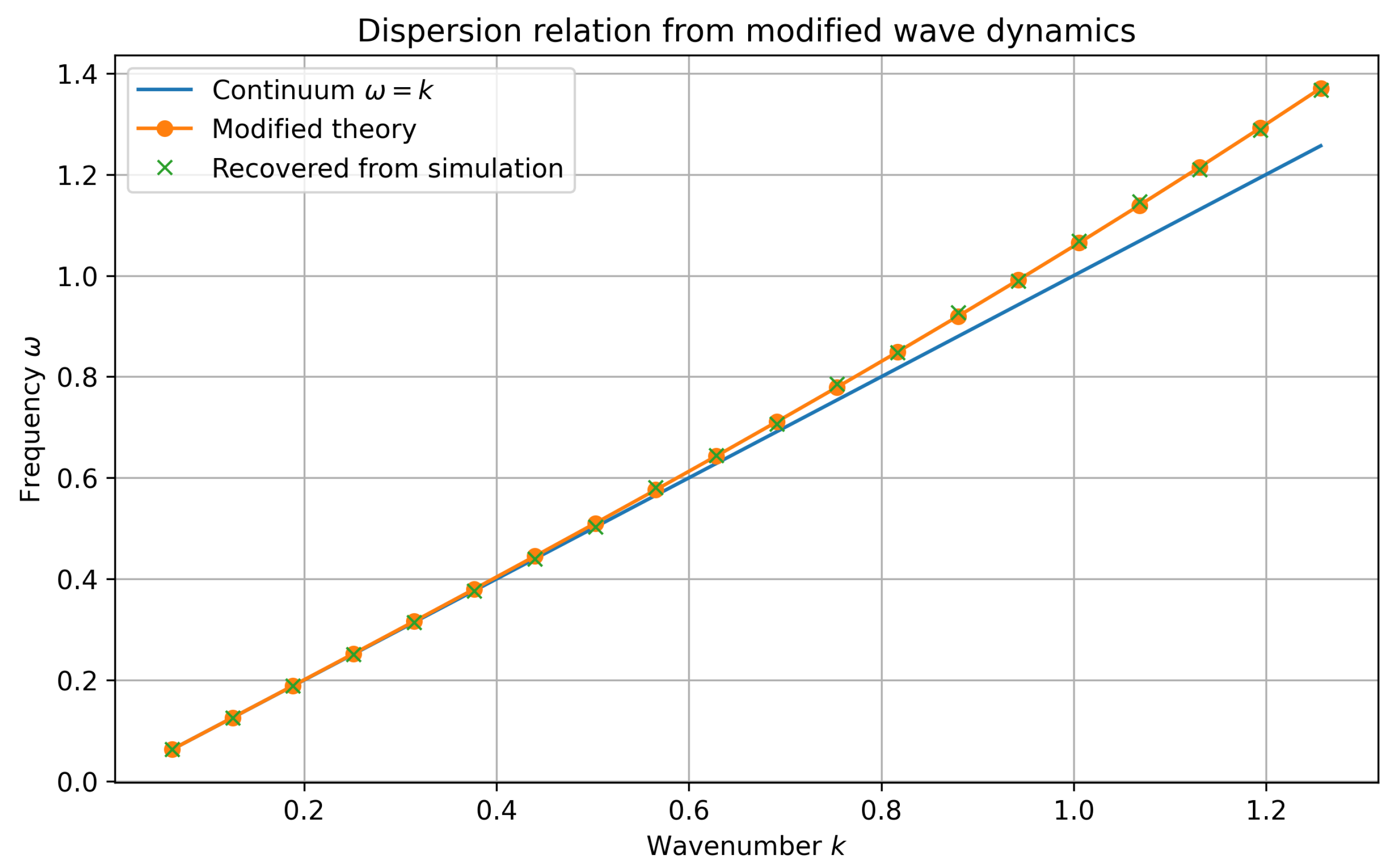
where denotes the characteristic information scale and is a dimensionless parameter encoding the strength of finite-information effects. A numerical realization of this modification is shown in Figure 6. The dispersion relation is obtained from a mode-evolution simulation in which oscillatory modes governed by the modified wave equation are evolved in time, and their frequencies are extracted via Fourier analysis. The resulting curve agrees with the predicted modified dispersion relation and demonstrates how higher-order momentum corrections emerge dynamically. The deviations remain negligible at small wavenumbers and become increasingly pronounced at larger k, ensuring consistency with established low-energy physics.
These corrections lead to measurable consequences in principle, including modifications of photon propagation, polarization effects, and vacuum structure. However, their suppression by the finite information scale ensures that they remain consistent with existing experimental bounds.
Taken together, these results demonstrate that finite-information deviations provide a unified mechanism for generating corrections across multiple physical domains. Gravitational, cosmological, and gauge phenomena can all be understood as different manifestations of the same underlying principle: the finite capacity of space–time to store and process quantum information.
6. Observational Consequences
Finite-information deviations lead to a range of testable predictions across cosmological, gravitational, and quantum field-theoretic regimes. These predictions arise directly from the structured corrections introduced by the deviation operator (Section 3) and its effective field representation in terms of the entropy field (Section 4).
6.1. Cosmological Structure and Power Spectra
In the cosmological context, entropy gradients and finite-information corrections modify the effective stress–energy content of the universe. As discussed in Section 5, these contributions can act as additional sources in the gravitational sector, influencing the growth of structure. This leads to scale-dependent modifications in cosmological power spectra, particularly in regimes where entropy gradients are non-negligible. Deviations are expected to manifest as corrections to the standard CDM predictions at intermediate and large scales, potentially affecting both matter clustering and lensing observables. The magnitude and scaling of these effects depend on the local information capacity and its evolution, as outlined in Appendix E. In particular, finite-information corrections introduce a characteristic scale at which deviations from continuum predictions become significant.
6.2. Gravitational Lensing and Effective Mass Distributions
The effective stress–energy tensor derived from entropy gradients (Appendix C) contributes to gravitational lensing in a manner analogous to additional matter components. Regions with strong entropy gradients produce enhanced gravitational deflection, modifying lensing profiles without requiring additional particle species. This suggests that discrepancies between observed lensing signals and baryonic matter distributions may, in part, be attributable to finite-information effects. In particular, deviations from standard lensing models could provide indirect evidence for the presence of entropy-driven contributions to the gravitational field.
6.3. Photon Propagation and Polarization Effects
In gauge sectors, finite-information deviations introduce higher-order corrections to dispersion relations (Section 5). As illustrated in Figure 6, these corrections are suppressed at low energies but become increasingly relevant at high frequencies or over large propagation distances. Observable consequences include small deviations in photon propagation speed, frequency-dependent dispersion, and potential modifications of polarization states. These effects are expected to be Planck-suppressed and therefore subtle, but could accumulate over cosmological distances, making high-precision astrophysical observations a potential testing ground. Such deviations are consistent with the structure of effective field theory corrections and remain compatible with existing experimental constraints.
6.4. Gravitational Wave Propagation and Memory Effects
Finite-information deviations also affect the propagation of gravitational waves through their coupling to the effective stress–energy sector. Modifications to the background informational structure can lead to small corrections in wave propagation, including dispersion and amplitude modulation. Additionally, the imprint-based dynamics underlying the framework suggest the possibility of modified gravitational wave memory effects, in which residual imprints of passing waves contribute to long-lived changes in the effective field configuration. These signatures provide a potential observational window into the interplay between information storage and dynamical space–time evolution.
Taken together, these predictions provide multiple, independent avenues for testing the framework. While individual effects are expected to be small due to suppression by the finite information scale, their consistent structure across different physical domains offers a coherent set of signatures. Importantly, the framework is falsifiable: the absence of the predicted scaling behavior, correlations, or propagation effects in sufficiently precise observations would place constraints on the underlying assumption of finite information capacity. In this sense, finite-information deviations constitute not only a theoretical extension of continuum physics but also a testable hypothesis about the fundamental structure of space–time.
7. Conceptual Implications
Finite-information deviations reinterpret physical laws as effective descriptions of an underlying informational system. In this framework, the continuum equations of motion are not fundamental, but emerge as approximations that neglect corrections induced by finite information capacity and discrete structure. Rather than representing imperfections or breakdowns of physical law, these deviations are intrinsic consequences of modeling space–time as a finite-information substrate. The apparent smoothness and continuity of classical fields arise only after coarse-graining over a large number of microscopic degrees of freedom, as illustrated in Figure 2. At sufficiently fine resolution, the limitations imposed by finite Hilbert-space dimension become unavoidable, leading to structured corrections captured by the deviation operator (Section 3). This perspective resolves the apparent tension between fundamental unitarity and emergent irreversibility. At the level of the full Hilbert space (Appendix A), evolution remains unitary and information is conserved. However, when described in terms of coarse-grained variables, such as the entropy field , effective irreversibility and entropy production naturally arise. The informational flux defined in Section 4 provides a macroscopic description of this behavior, linking microscopic information dynamics to observable thermodynamic phenomena. More broadly, this framework suggests that geometry, dynamics, and information are not independent structures, but different aspects of a single underlying description. The effective stress–energy contributions derived from entropy gradients (Appendix C) illustrate how informational degrees of freedom can manifest as physical sources, blurring the distinction between matter and geometry. In this sense, finite-information deviations provide a reinterpretation of physical law in which the apparent continuity of space–time and fields reflects the large-scale limit of a fundamentally discrete and information-limited system.
8. Conclusions
We have introduced the concept of finite-information deviations as a fundamental feature of a discrete informational description of space–time. By comparing ideal continuum dynamics with evolution on a finite-capacity substrate, we have shown that structured, deterministic corrections necessarily arise. These deviations have been formalized through the deviation operator (Section 3), expressed in terms of an entropy field and its gradients (Section 4), and incorporated into an effective action that extends standard continuum formulations. Their physical manifestations span multiple domains, including gravitational dynamics, cosmological behavior, and gauge-field propagation (Section 5), while their observational consequences provide avenues for empirical testing (Section 6). The framework preserves global unitarity and locality at the microscopic level while naturally generating effective irreversibility and entropy production in coarse-grained descriptions. In this way, it provides a consistent extension of continuum theories that remains compatible with established physical principles. Future work will focus on quantifying the magnitude of finite-information deviations, deriving precise predictions for observational signatures, and exploring their implications across quantum gravity, cosmology, and quantum information theory. In particular, determining the characteristic information scale and its relation to known physical constants will be essential for connecting the framework to experimental and observational data. Taken together, these results suggest that finite information capacity is not merely a technical constraint, but a fundamental aspect of physical reality, with measurable consequences for the structure and dynamics of the universe.
Author Contributions
Conceptualization, E.M.; methodology, F.N.; formal analysis, F.N.; investigation, F.N. and E.M.; writing—original draft preparation, F.N.; writing—review and editing, F.N. and E.M.; visualization, F.N.; supervision, E.M.; project administration, F.N. and E.M. All authors have read and agreed to the published version of the manuscript.
Funding
This research received no external funding.
Institutional Review Board Statement
Not applicable.
Informed Consent Statement
Not applicable.
Data Availability Statement
The data generated in this study consist of numerical simulations and illustrative constructions and are available from the corresponding author upon reasonable request.
Conflicts of Interest
The authors declare no conflicts of interest.
Appendix A. Formal Definition of the Discrete Informational Substrate
In this appendix, we provide a precise definition of the discrete informational substrate underlying the effective continuum description. Let denote a discrete set of space–time cells, which may be understood as a lattice or a more general discrete structure endowed with a notion of adjacency. Each cell is associated with a finite-dimensional Hilbert space with
The global Hilbert space is given by
which encodes the full quantum state of the system. We assume the following structural properties:
- 1.
- Locality: There exists a notion of neighborhood such that interactions act non-trivially only on tensor factors corresponding to x and its neighbors.
- 2.
- Finite capacity: Each has bounded dimension , implying a finite number of distinguishable local states.
- 3.
- Unitary evolution: The global dynamics are governed by a unitary operator acting on ,ensuring conservation of information at the fundamental level.
Local physical processes are encoded through imprint operators acting on (and possibly neighboring cells), which update the local state according to
while remaining consistent with the global unitary evolution on . The reduced density matrix at a site x is defined by tracing out all other degrees of freedom,
and provides the basis for defining coarse-grained quantities such as the entropy field introduced in Section 4. This construction ensures that the underlying description is both finite and fully quantum, while allowing for the emergence of effective continuum behavior through coarse-graining over .
Appendix B. Derivation of Finite-Information Deviations
We formalize the deviation between continuum and discrete dynamics introduced in Section 3. Let denote the continuum evolution operator acting on smooth field configurations, and let denote the effective evolution arising from the discrete informational substrate defined in Appendix A. We define the deviation operator as
The operator is obtained by coarse-graining the underlying unitary dynamics on , mapping microscopic evolution onto effective fields. Because the local Hilbert spaces have finite dimension, this mapping cannot reproduce the continuum operator exactly, leading to systematic corrections captured by . Assuming a characteristic local Hilbert-space dimension d, we expand the deviation operator as
where the operators encode corrections arising from finite information capacity, imprint accumulation, and coarse-graining. To leading order, the dominant contribution can be expressed in terms of gradients of the coarse-grained entropy field introduced in Section 4. Specifically, one obtains
where is an effective coupling parameter. This form arises from the fact that finite local capacity restricts the ability to encode fine-grained variations, leading to corrections that depend on spatial and temporal gradients of macroscopic fields. Importantly, the expansion in Equation (A7) demonstrates that
ensuring that the continuum limit is recovered when the information capacity becomes unbounded. The scaling behavior of these corrections, illustrated in Figure 3 and discussed further in Appendix E, provides a quantitative link between microscopic information capacity and macroscopic deviations from continuum physics.
Appendix C. Entropy Field and Effective Stress–Energy Tensor
We define a coarse-grained entropy field by
where is the reduced density matrix of cell x, obtained by tracing out all other degrees of freedom as described in Appendix A. The associated informational flux is given by
which captures the redistribution of entropy across space–time at the coarse-grained level. This quantity provides a macroscopic measure of information flow arising from the underlying unitary dynamics. To construct an effective stress–energy contribution, we impose the following requirements:
- 1.
- Covariance under general coordinate transformations,
- 2.
- Dependence on local entropy variations,
- 3.
- Consistency with the structure of effective field theory.
Under these assumptions, the lowest-order covariant tensor that can be constructed from is quadratic in its derivatives, yielding
where is a coupling parameter encoding the strength of finite-information effects. This form is equivalent to the stress–energy tensor of a scalar field with vanishing potential, ensuring compatibility with standard gravitational dynamics. The appearance of this structure follows directly from the gradient expansion of the deviation operator derived in Appendix B. A schematic entropy profile and its associated effective source term are shown in Figure 5. Regions with large entropy gradients produce nontrivial effective energy density, providing a mechanism through which information structure contributes to gravitational dynamics.
Appendix D. Numerical Illustrations and Toy Models
The figures presented in the main text are based on simplified numerical constructions designed to illustrate the qualitative behavior of finite-information systems. These constructions are not intended as direct physical simulations, but as schematic realizations of the mechanisms discussed in the main text.
- 1.
- Continuum vs. discrete fields (Figure 1): A smooth field is discretized via spatial averaging and quantization over finite-resolution cells, illustrating the loss of fine-grained structure induced by finite information capacity.
- 2.
- 3.
- Deviation scaling (Figure 3): Representative scaling laws are plotted as functions of Hilbert-space dimension to illustrate the suppression of deviations with increasing information capacity.
- 4.
- Coarse-graining behavior (Figure 2): The root-mean-square deviation between a smooth field and its discretized counterpart is evaluated as a function of resolution, demonstrating the emergence of continuum behavior.
- 5.
- Modified dispersion (Figure 6): A toy dispersion relation including higher-order momentum corrections is constructed to illustrate finite-information effects in gauge sectors.
- 6.
- Entropy profile (Figure 5): A radial entropy distribution is used to compute an effective source term proportional to , linking entropy gradients to gravitational effects.
These examples provide qualitative support for the theoretical framework, demonstrating how finite-information effects manifest in simplified settings while remaining consistent with the analytical structure derived in the main text.
Appendix E. Scaling Behavior and Continuum Limit
We summarize the scaling behavior of finite-information deviations introduced in Appendix B. For a local Hilbert-space dimension d, deviations are expected to scale as
depending on the observable and the details of the coarse-graining procedure. These scaling relations arise from different mechanisms:
- : direct suppression due to finite state capacity,
- : fluctuations associated with coarse-grained averaging,
- : entropy-driven corrections reflecting information-theoretic bounds.
All cases exhibit the same qualitative behavior: deviations are systematically suppressed as the local information capacity increases. In the limit
the continuum description is recovered exactly. Figure 3 provides an illustrative example of such scaling behavior. This suppression ensures consistency with established physical theories at accessible energy scales, while allowing for measurable deviations in regimes where finite-information effects become relevant. These results support the interpretation of continuum physics as an emergent approximation of an underlying finite-information system, with deviations controlled by a well-defined information scale.
References
- Hawking, S. W. Breakdown of Predictability in Gravitational Collapse. Phys. Rev. D 1976, 14, 2460–2473. [Google Scholar] [CrossRef]
- Mathur, S. D. The Information Paradox: A Pedagogical Introduction. Class. Quantum Grav. 2009, 26, 224001. [Google Scholar] [CrossRef]
- Almheiri, A.; Marolf, D.; Polchinski, J.; Sully, J. Black Holes: Complementarity or Firewalls? J. High Energy Phys. 2013, 2013, 62. [Google Scholar] [CrossRef]
- Rovelli, C. Quantum Gravity; Cambridge University Press: Cambridge, UK, 2004. [Google Scholar]
- Sorkin, R. D. Causal Sets: Discrete Gravity. In Lectures on Quantum Gravity; Springer: Boston, MA, USA, 2005; pp. 305–327. [Google Scholar]
- Ambjørn, J.; Jurkiewicz, J.; Loll, R. Nonperturbative Quantum Gravity. Phys. Rep. 2012, 519, 127–210. [Google Scholar] [CrossRef]
- Van Raamsdonk, M. Building up spacetime with quantum entanglement. Gen. Relativ. Gravit. 2010, 42, 2323–2329. [Google Scholar] [CrossRef]
- Ryu, S.; Takayanagi, T. Holographic derivation of entanglement entropy from AdS/CFT. Phys. Rev. Lett. 2006, 96, 181602. [Google Scholar] [CrossRef]
- Jacobson, T. Entanglement equilibrium and the Einstein equation. Phys. Rev. Lett. 2016, 116, 201101. [Google Scholar] [CrossRef] [PubMed]
- Swingle, B. Entanglement renormalization and holography. Phys. Rev. D 2012, 86, 065007. [Google Scholar] [CrossRef]
- Neukart, F.; Marx, E.; Vinokur, V. Discrete Electromagnetism in a Finite-Information Space–Time Framework. Results Phys. 2026, 84, 108629. [Google Scholar] [CrossRef]
- Neukart, F.; Marx, E.; Vinokur, V. Entropy, Information, and the Curvature of Spacetime in the Informational Second Law. Found. Phys. 2025. [Google Scholar] [CrossRef]
- Neukart, F.; Marx, E.; Vinokur, V. Quantum Memory Matrix Framework Applied to Cosmological Structure Formation and Dark Matter Phenomenology. Universe 2025. [Google Scholar]
- Neukart, F.; Marx, E.; Vinokur, V. Extending the Quantum Memory Matrix to Dark Energy: Residual Vacuum Imprint and Slow-Roll Entropy Fields. Astronomy 2025. [Google Scholar] [CrossRef]
Figure 1.
Comparison between a continuum field generated from a Gaussian random process with a scale-dependent power spectrum and its finite-information representation obtained through coarse-graining and quantization. The discrete structure reflects bounded local resolution and finite state capacity, leading to a controlled suppression of small-scale features.
Figure 1.
Comparison between a continuum field generated from a Gaussian random process with a scale-dependent power spectrum and its finite-information representation obtained through coarse-graining and quantization. The discrete structure reflects bounded local resolution and finite state capacity, leading to a controlled suppression of small-scale features.
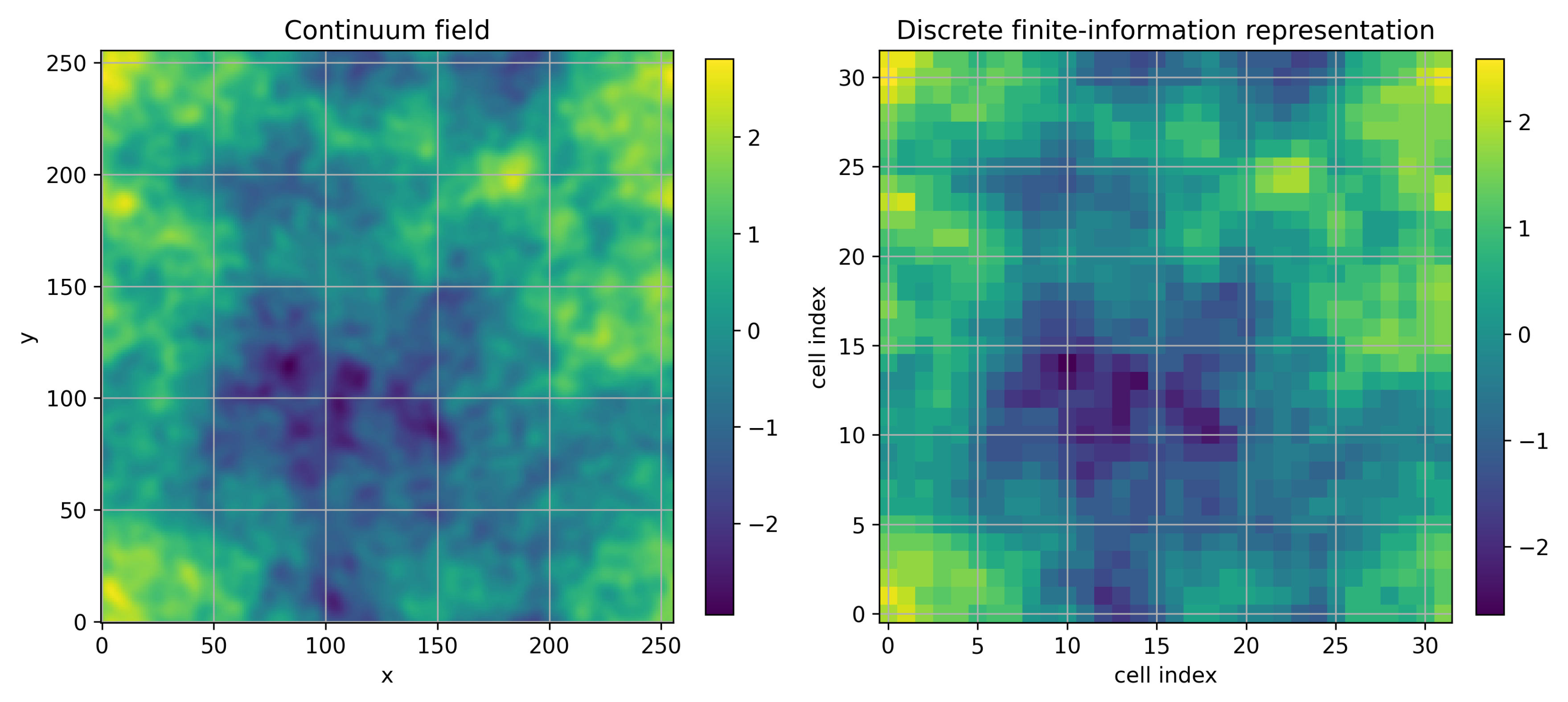
Figure 2.
Root-mean-square deviation between a continuum field and its finite-information representation as a function of coarse-graining resolution. The data are obtained from a numerical experiment based on a Gaussian random field with a physically motivated power spectrum. The observed scaling demonstrates that continuum behavior emerges progressively as resolution increases.
Figure 2.
Root-mean-square deviation between a continuum field and its finite-information representation as a function of coarse-graining resolution. The data are obtained from a numerical experiment based on a Gaussian random field with a physically motivated power spectrum. The observed scaling demonstrates that continuum behavior emerges progressively as resolution increases.
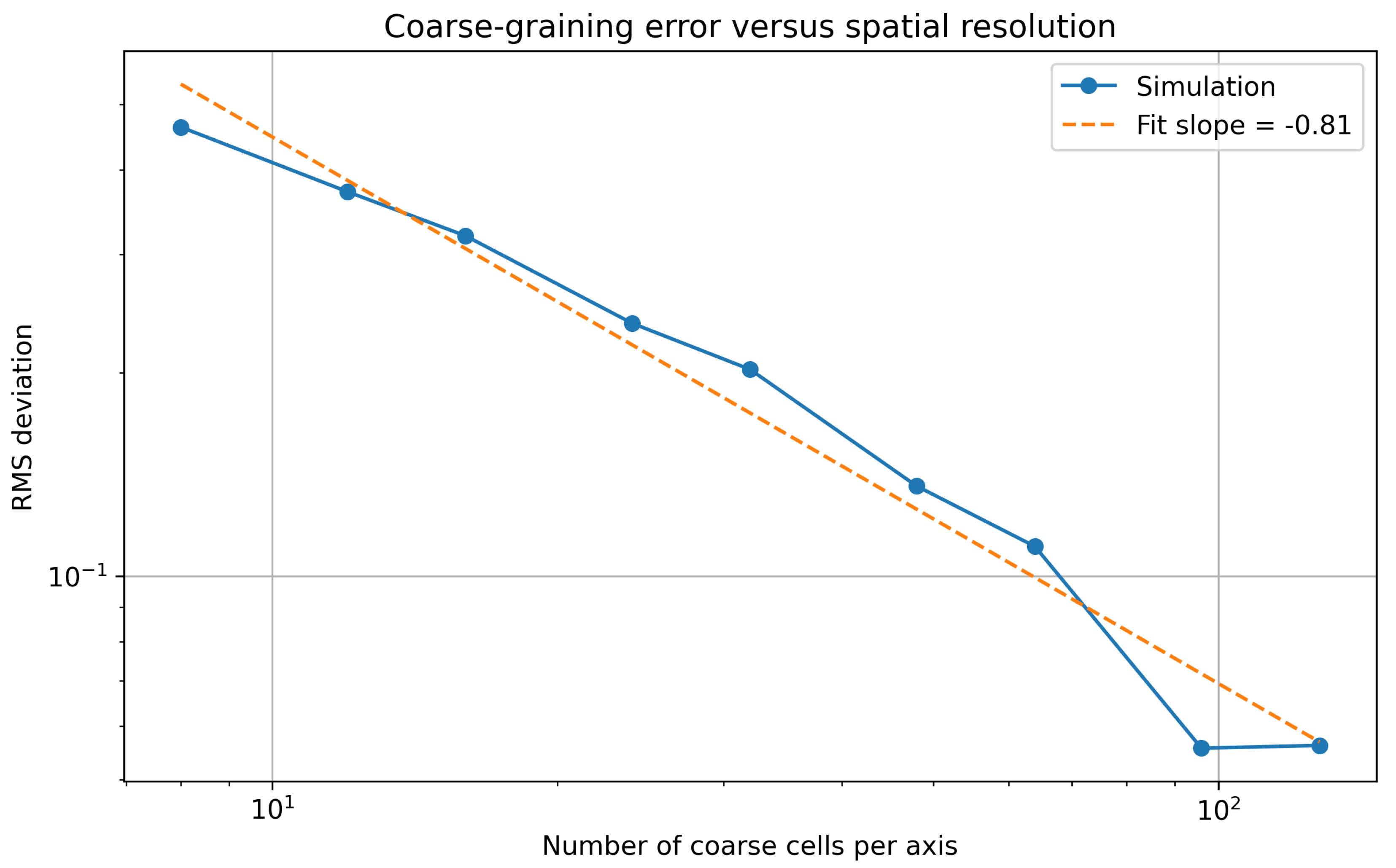
Figure 3.
Root-mean-square deviation between a continuum field and its finite-information representation as a function of effective local information capacity d. The data are obtained from a numerical experiment in which quantization depth is varied at fixed spatial resolution. The observed decrease in deviation with increasing d demonstrates the systematic suppression of finite-information effects and the recovery of continuum behavior in the large-capacity limit.
Figure 3.
Root-mean-square deviation between a continuum field and its finite-information representation as a function of effective local information capacity d. The data are obtained from a numerical experiment in which quantization depth is varied at fixed spatial resolution. The observed decrease in deviation with increasing d demonstrates the systematic suppression of finite-information effects and the recovery of continuum behavior in the large-capacity limit.
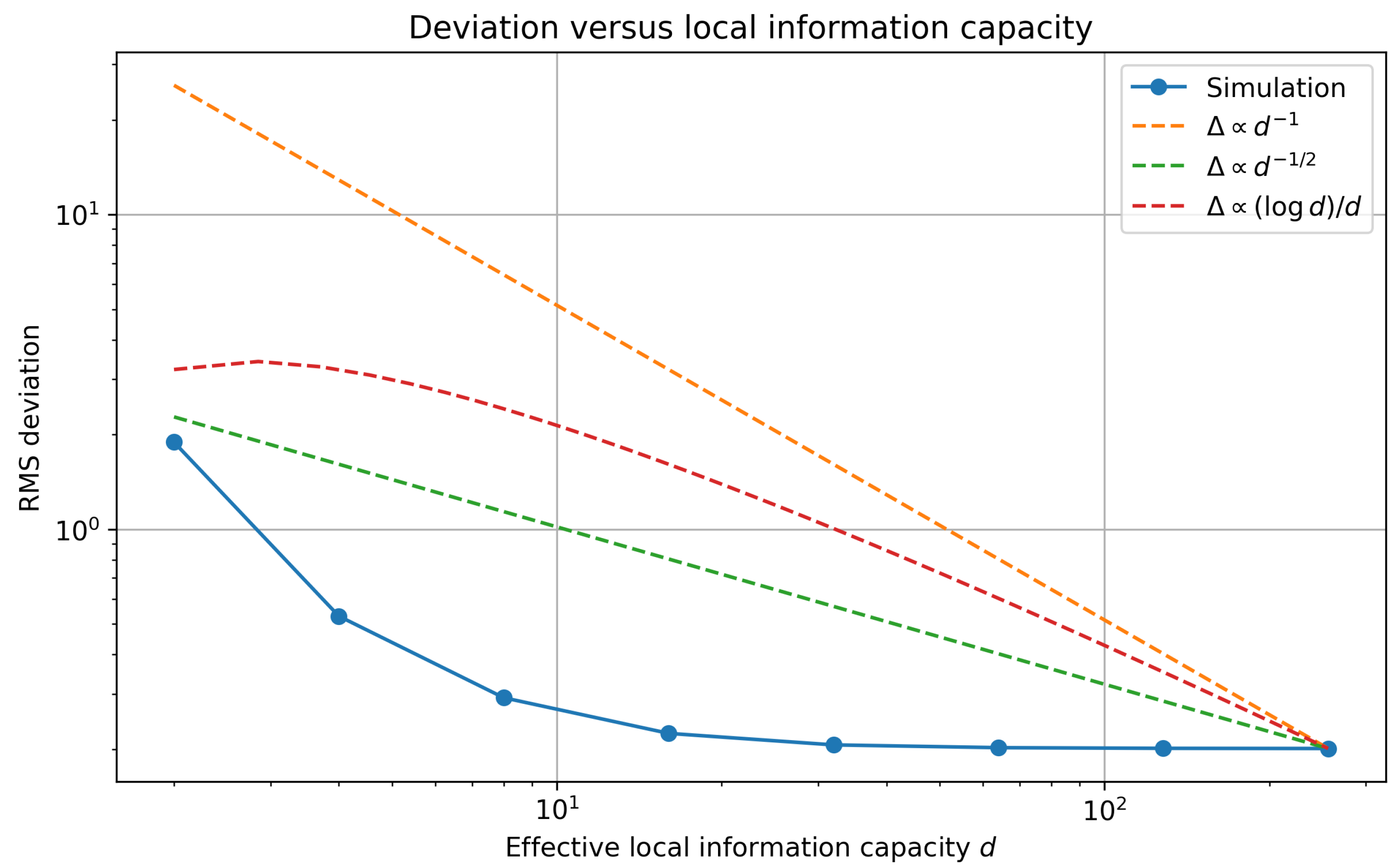
Figure 4.
Schematic visualization of a coarse-grained entropy field and its associated informational flux. The vector field represents the gradient of the entropy distribution, illustrating how spatial variations in information content give rise to effective flows at macroscopic scales.
Figure 4.
Schematic visualization of a coarse-grained entropy field and its associated informational flux. The vector field represents the gradient of the entropy distribution, illustrating how spatial variations in information content give rise to effective flows at macroscopic scales.
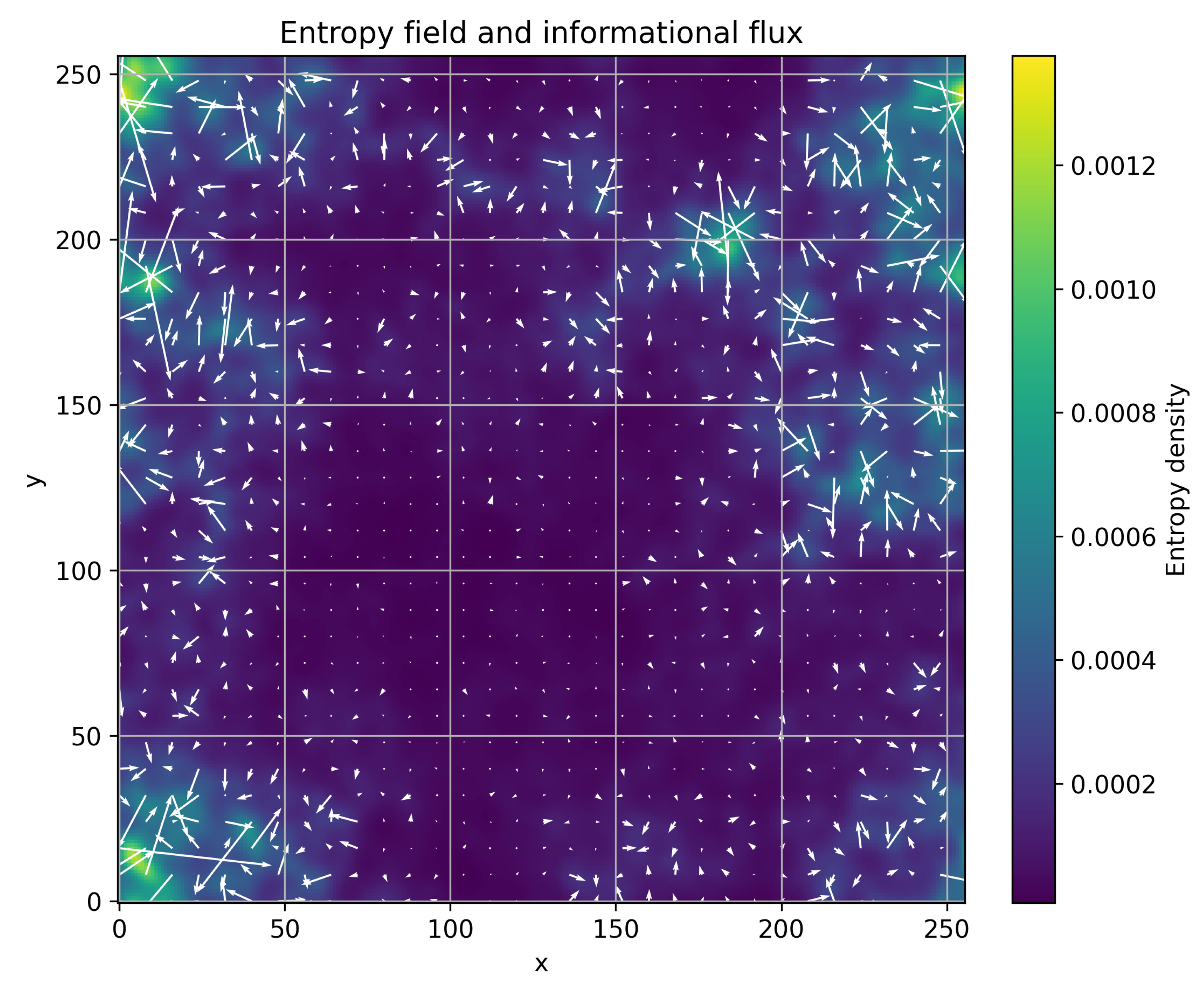
Figure 5.
Entropy profile and corresponding effective source term derived from an NFW-like radial density distribution. The entropy field is constructed from a normalized probability density, and the effective source scales with the square of its gradient. Regions of strong entropy variation generate enhanced effective energy density, illustrating how finite-information structure can act as a gravitational source.
Figure 5.
Entropy profile and corresponding effective source term derived from an NFW-like radial density distribution. The entropy field is constructed from a normalized probability density, and the effective source scales with the square of its gradient. Regions of strong entropy variation generate enhanced effective energy density, illustrating how finite-information structure can act as a gravitational source.
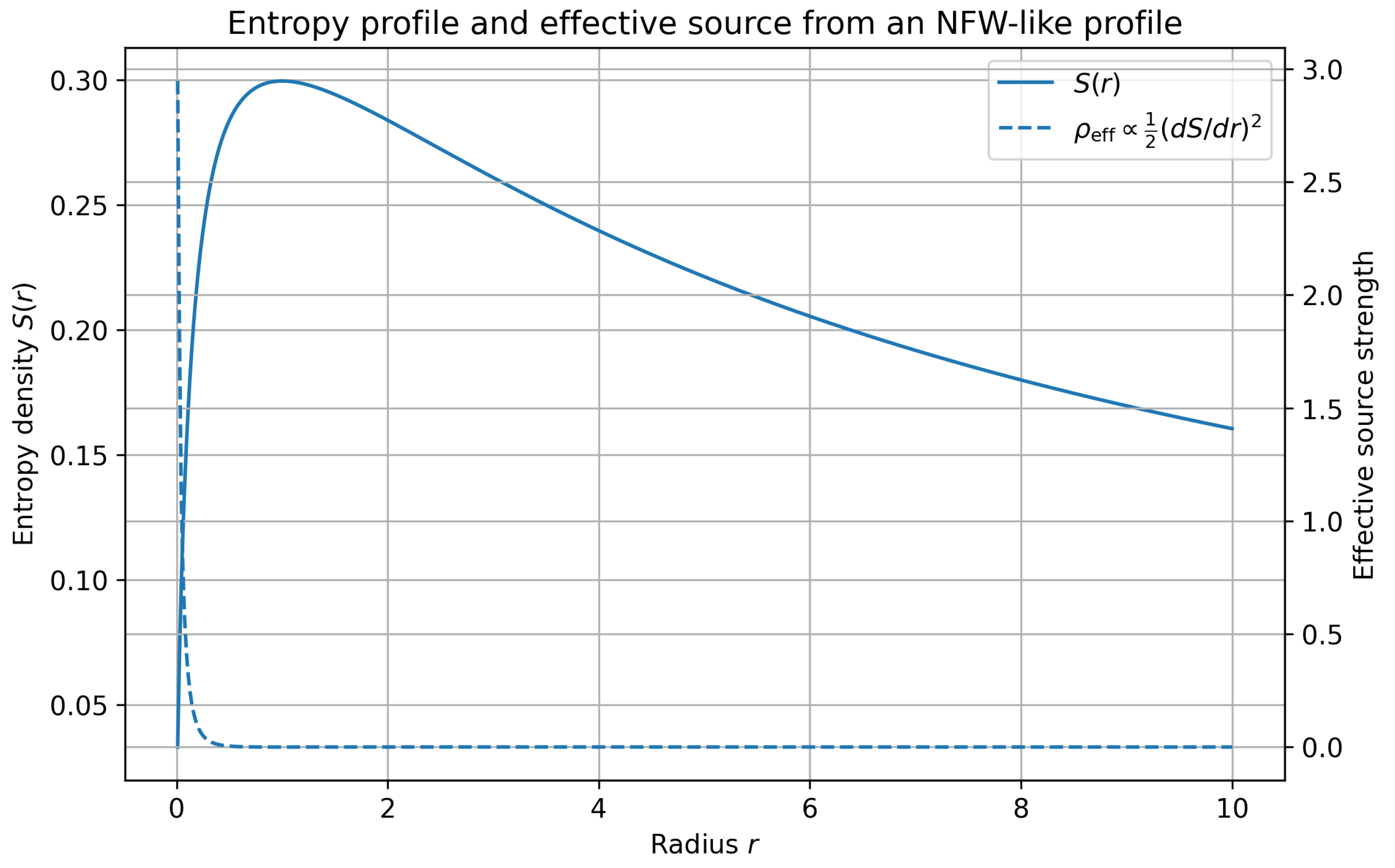
Figure 6.
Dispersion relation obtained from numerical mode evolution of a modified wave equation including higher-order momentum corrections. The recovered frequencies match the theoretical prediction, showing deviations from the linear continuum relation at larger wavenumbers while preserving the standard behavior at low energies.
Figure 6.
Dispersion relation obtained from numerical mode evolution of a modified wave equation including higher-order momentum corrections. The recovered frequencies match the theoretical prediction, showing deviations from the linear continuum relation at larger wavenumbers while preserving the standard behavior at low energies.
Disclaimer/Publisher’s Note: The statements, opinions and data contained in all publications are solely those of the individual author(s) and contributor(s) and not of MDPI and/or the editor(s). MDPI and/or the editor(s) disclaim responsibility for any injury to people or property resulting from any ideas, methods, instructions or products referred to in the content. |
© 2026 by the authors. Licensee MDPI, Basel, Switzerland. This article is an open access article distributed under the terms and conditions of the Creative Commons Attribution (CC BY) license (http://creativecommons.org/licenses/by/4.0/).
Copyright: This open access article is published under a Creative Commons CC BY 4.0 license, which permit the free download, distribution, and reuse, provided that the author and preprint are cited in any reuse.


