

Submitted:
17 April 2026
Posted:
20 April 2026
You are already at the latest version
Abstract
Purpose: This review aims to provide theoretical basis and scientific reference for constructing environmentally friendly and economically feasible sustainable management systems for pharmaceutical pollution. Methods: three synergistic mechanisms—"cascade degradation," "symbiotic protection," and "functional complementarity"—and construction strategies including co-immobilization technology, engineered biofilms, and synthetic biology-modified engineered bacteria. Result: Synergistic platforms have achieved significant progress in treating various types of pharmaceutical pollutants, including Antibiotics, Anti-inflammatories and hormones, Antiviral drugs and Pesticides. Conclusion: The synergistic integration of enzymes and microorganisms achieves the unification of efficient catalysis and deep mineralization, opening up a new pathway for the remediation of pharmaceutical pollution. It also transforms theoretically existing concepts into operable treatment technologies.
Keywords:
enzyme
; microorganism
; synergistic integration
; pharmaceutical pollutants
; sustainable management
; green pharmaceuticals
1. Dilemmas in Pharmaceutical Pollution Control: From Conventional Shortcomings to the Inevitability of Biological Synergy
1.1. Environmental Fate and Ecological Risks of Pharmaceutical Pollutants
Pharmaceutical pollutants, as emerging environmental contaminants, have become a global challenge regarding their environmental occurrence and ecological impacts. With the rapid development of the pharmaceutical industry and population growth, pharmaceutical consumption continues to rise, leading to pharmaceutically active compounds entering the environment through multiple pathways. Industrial wastewater discharge during production, human and animal excreta during consumption, improper disposal of expired medications, and direct use in aquaculture and animal husbandry constitute the main sources of pharmaceutical pollution [13,14].
Figure 1.
Schematic diagram of the environmental sources, fate, and ecological risks of pharmaceutical pollutants.
Figure 1.
Schematic diagram of the environmental sources, fate, and ecological risks of pharmaceutical pollutants.
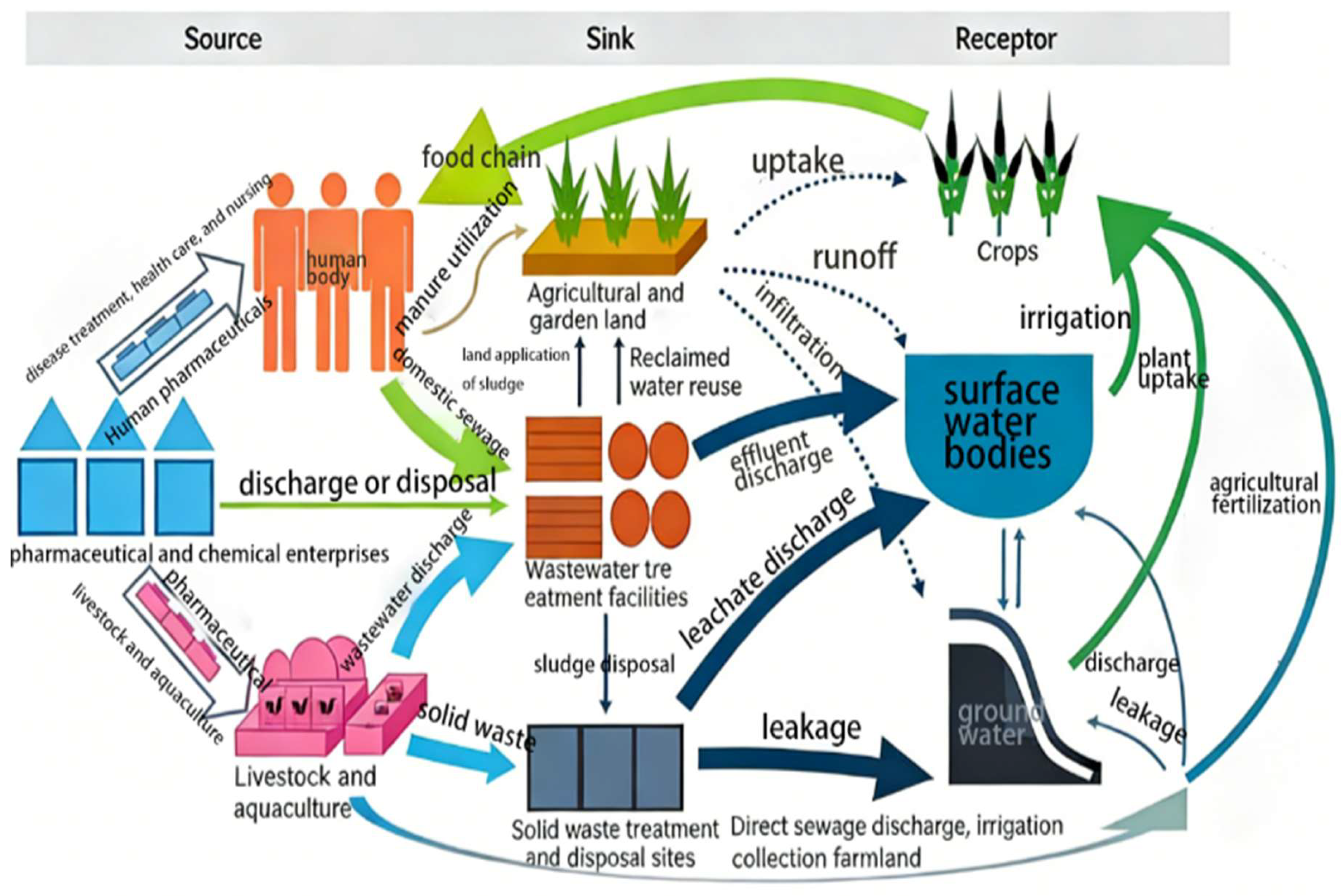
Pharmaceutical pollutants are widely detected in water bodies, soil, and sediments. Although their concentrations are typically at trace levels (ng/L to μg/L), continuous input and "pseudo-persistence" characteristics make their ecological risks non-negligible. Antibiotics are particularly concerning, with ciprofloxacin, sulfamethoxazole, and tetracycline frequently detected in environmental samples from different regions [16,18,19]. For example, studies in East Africa show that the risk quotient (RQ) for ciprofloxacin in Kenyan water bodies reaches 3.5-40.6, and 0.1-3.53 for sulfamethoxazole [20], while the RQ for ciprofloxacin in Ethiopia also reaches 8.58 [18]. More critically, pharmaceutical pollution is closely linked to the spread of antibiotic resistance—the widespread presence of antibiotic resistance genes in environmental samples has been confirmed to be directly associated with pharmaceutical pollution [1,14,17]. Studies on Chinese pig farms show diverse and abundant antibiotic resistance genes detected in fecal samples [48], and the evolution of resistance genes during sewage sludge composting is closely related to bacterial community dynamics [49].
Beyond antibiotics, non-steroidal anti-inflammatory drugs, hormones, and antiepileptic drugs are also widely present in the environment [32,35,36]. Spanish studies have ranked the environmental indices of pharmaceuticals and personal care products [38], while surface water and drinking water in southern Brazil have detected various pesticides and PPCPs [39]. These pharmaceuticals, even at low concentrations, may produce chronic toxic effects on aquatic organisms, disrupt endocrine systems, affect reproduction and development, alter community structure, and thereby threaten ecosystem functions [37,41].

Table 1.
Environmental Concentrations, Sources, and Ecological Risks of Typical Pharmaceutical Pollutants.
Table 1.
Environmental Concentrations, Sources, and Ecological Risks of Typical Pharmaceutical Pollutants.
| Drug Category | Representative Drug | Environmental Matrix | Detected Concentration Range | Main Sources | Ecological Risk (RQ) | References |
|---|---|---|---|---|---|---|
| Antibiotics | Ciprofloxacin | Surface water | nd - 14.3 μg/L | Aquaculture wastewater, domestic sewage | 3.5-40.6 | [1,18,20] |
| Sulfamethoxazole | Surface water | nd - 2.8 μg/L | Domestic sewage, medical wastewater | 0.1-3.53 | [1,20,34] | |
| Tetracycline | Sludge | 89-2300 μg/kg | Aquaculture wastewater | - | [34,48] | |
| Ofloxacin | Sludge | 2300 μg/kg (average) | Domestic sewage | - | [34] | |
| Anti-inflammatory drugs | Diclofenac | Surface water | nd - 1.2 μg/L | Domestic sewage | <0.1 | [34,35] |
| Ibuprofen | WWTP effluent | 0.1-2.5 μg/L | Domestic sewage | <0.1 | [35,36] | |
| Hormones | Octylphenol | Sludge | 1179 ng/g (average) | Industrial/domestic sewage | - | [35] |
| Triclosan | Sludge | 1505 ng/g (average) | Personal care products | - | [35] | |
| Antiviral drugs | Various ARVs | Surface water | nd - 3.2 μg/L | Medical wastewater | To be assessed | [20,61] |
| Pesticides | Diuron | Surface water | nd - 0.8 μg/L | Agricultural runoff | 0.1-0.5 | [33,39] |
1.2. Applicability Boundaries and Limitations of Conventional Treatment Technologies
Conventional water treatment technologies exhibit clear applicability boundaries when facing the challenge of pharmaceutical pollution. Although physicochemical treatment methods are significantly effective in removing conventional pollutants, they encounter multiple dilemmas when dealing with pharmaceutical pollutants [2,13].
Table 2.
Comparison of Advantages and Disadvantages of Conventional Physicochemical Treatment Technologies for Pharmaceutical Pollutants.
Table 2.
Comparison of Advantages and Disadvantages of Conventional Physicochemical Treatment Technologies for Pharmaceutical Pollutants.
| Technology Type | Removal Mechanism | Advantages | Disadvantages | Example Drug Applications | References |
|---|---|---|---|---|---|
| Coagulation-Flocculation | Charge neutralization, bridging adsorption | Simple operation, low cost, suitable for large scale | Low removal efficiency for dissolved drugs, large sludge production | Hydrophobic drugs | [13] |
| Adsorption | Physical/chemical adsorption | High removal rate, simple equipment | Phase transfer only (non-degradative), high adsorbent regeneration cost | Multiple drugs | [24,31,33] |
| Membrane Separation | Sieving, charge repulsion | High separation efficiency, no chemical addition | Membrane fouling, high energy consumption, difficult concentrate disposal | Large molecule drugs | [96] |
| Electrocoagulation | In-situ coagulant generation | Wide applicability, no external chemicals required | High energy consumption, electrode consumption | Antibiotics | [23,25] |
| Ozonation | Direct oxidation/·OH oxidation | Rapid reaction, no sludge production | Potential generation of toxic byproducts, complex equipment | Drugs with unsaturated structures | [95] |
| Photocatalysis | ·OH oxidation | Complete mineralization possible, utilizes solar energy | Difficult catalyst recovery, limited scalability | Multiple drugs | [26,27,29] |
| Electrochemical Oxidation | Direct/indirect oxidation | Strong oxidation capacity, good controllability | High energy consumption, limited electrode life | Refractory drugs | [28,95] |
| Fenton Oxidation | ·OH oxidation | Rapid reaction, simple equipment | Narrow pH range applicability, iron sludge generation | Multiple drugs | [28,95] |
Coagulation-flocculation technology is relatively low-cost and suitable for removing suspended solids and colloidal substances, but has limited removal efficiency for dissolved pharmaceutical molecules and generates substantial chemical sludge requiring subsequent disposal [13]. Adsorption technology (such as activated carbon adsorption) shows good removal effects for various pharmaceuticals, but adsorbent regeneration is costly, requiring frequent replacement, and only achieves phase transfer of pollutants rather than true degradation [24,31,33]. Membrane separation technologies (ultrafiltration, nanofiltration, reverse osmosis) can achieve efficient separation, but membrane fouling is prominent, energy consumption is high, and concentrate treatment remains an unresolved challenge [96]. Electrocoagulation has wide applicability but its energy-intensive nature limits large-scale application [23,25].
Advanced oxidation technologies (including ozonation, photocatalysis, electrochemical oxidation, etc.) have been highly anticipated for their ability to generate reactive oxygen species to attack organic molecules [95]. These technologies can achieve effective removal of recalcitrant organic pollutants but often require complex equipment, high operational costs, and may generate transformation products with unknown toxicity [27,28]. Studies show that although photocatalysis can achieve complete mineralization of organic pollutants, issues such as catalyst recovery, scale-up, and adaptability to environmental conditions remain to be resolved [26,29].
Notably, the removal efficiency of pharmaceuticals in conventional wastewater treatment plants varies considerably. Although five wastewater treatment plants in California achieved over 90% removal for 14 pharmaceuticals, triclosan and octylphenol still existed in sludge at average concentrations of 1505 ng/g and 1179 ng/g, respectively [35]. A survey of three wastewater treatment plants in Xiamen, China, revealed that 22 out of 48 target pharmaceuticals were detected in over half of the effluent samples, with ofloxacin reaching an average concentration of 2300 μg/kg in sludge [34]. More concerning is that pharmaceutical pollutants have even been detected in drinking water—concentrations in eight tap water samples ranged from not detected to 39 ng/L, and in eleven mineral water samples from 1-40 ng/L [36]. This phenomenon indicates that existing drinking water treatment processes also have gaps in pharmaceutical removal capacity.
1.3. Limitations of Single Biotechnology: Respective Dilemmas of Enzymatic Catalysis and Microbial Degradation
Biological treatment technologies have attracted attention for their environmental friendliness and sustainable potential, but both free enzyme catalysis and microbial degradation face inherent limitations when applied alone.
The advantages of free enzyme technology lie in high catalytic efficiency, strong substrate specificity, and mild reaction conditions [86,87]. However, poor enzyme stability is its critical weakness—free enzymes are sensitive to environmental conditions (pH, temperature, ionic strength) and easily inactivated; they are susceptible to protease attack or adsorption loss in complex environmental matrices; and they are difficult to recover and reuse, leading to high treatment costs [70,79]. Research by Sun Jian's team at South China Agricultural University indicates that individual degrading enzymes face practical application challenges including high cost and poor stability, limiting their large-scale application [10,88].
Microbial degradation technology exhibits different advantages and limitations. Microorganisms possess complete metabolic networks, enabling deep mineralization of pollutants, and can self-propagate for sustained functionality [12,69]. However, microorganisms grow slowly, are sensitive to environmental conditions, and treatment efficiency is constrained by factors such as substrate concentration, co-metabolic substrates, and community structure. More critically, microorganisms have selective substrate spectra with limited degradation capacity for certain recalcitrant pharmaceutical pollutants; in composite pollution systems, interactions between different pollutants may inhibit microbial activity; and high concentrations of pharmaceuticals can be toxic and inhibitory to microorganisms [22]. Studies show that environmental stresses such as osmotic stress significantly affect the growth and metabolism of degrading bacteria, hindering their remediation function in polluted environments [6].
1.4. Synergistic Integration: The Inevitable Direction to Break Through Bottlenecks
The limitations of single technologies have given rise to the concept of "synergistic integration." The high efficiency of enzymes and the complete metabolic networks of microorganisms are naturally complementary—enzymes can rapidly initiate reactions and break through recalcitrant molecular structures, while microorganisms can utilize their metabolic diversity to achieve deep mineralization; microorganisms can provide stable microenvironments for enzymes, while enzymes can relieve toxicity inhibition for microorganisms [71,76]. This characteristic of "complementary advantages, mutual avoidance of shortcomings" makes enzyme-microbe synergistic platforms the inevitable choice to break through current bottlenecks.
Figure 2.
Comparison of Limitations between Conventional Treatment Technologies and Single Biotechnology.
Figure 2.
Comparison of Limitations between Conventional Treatment Technologies and Single Biotechnology.
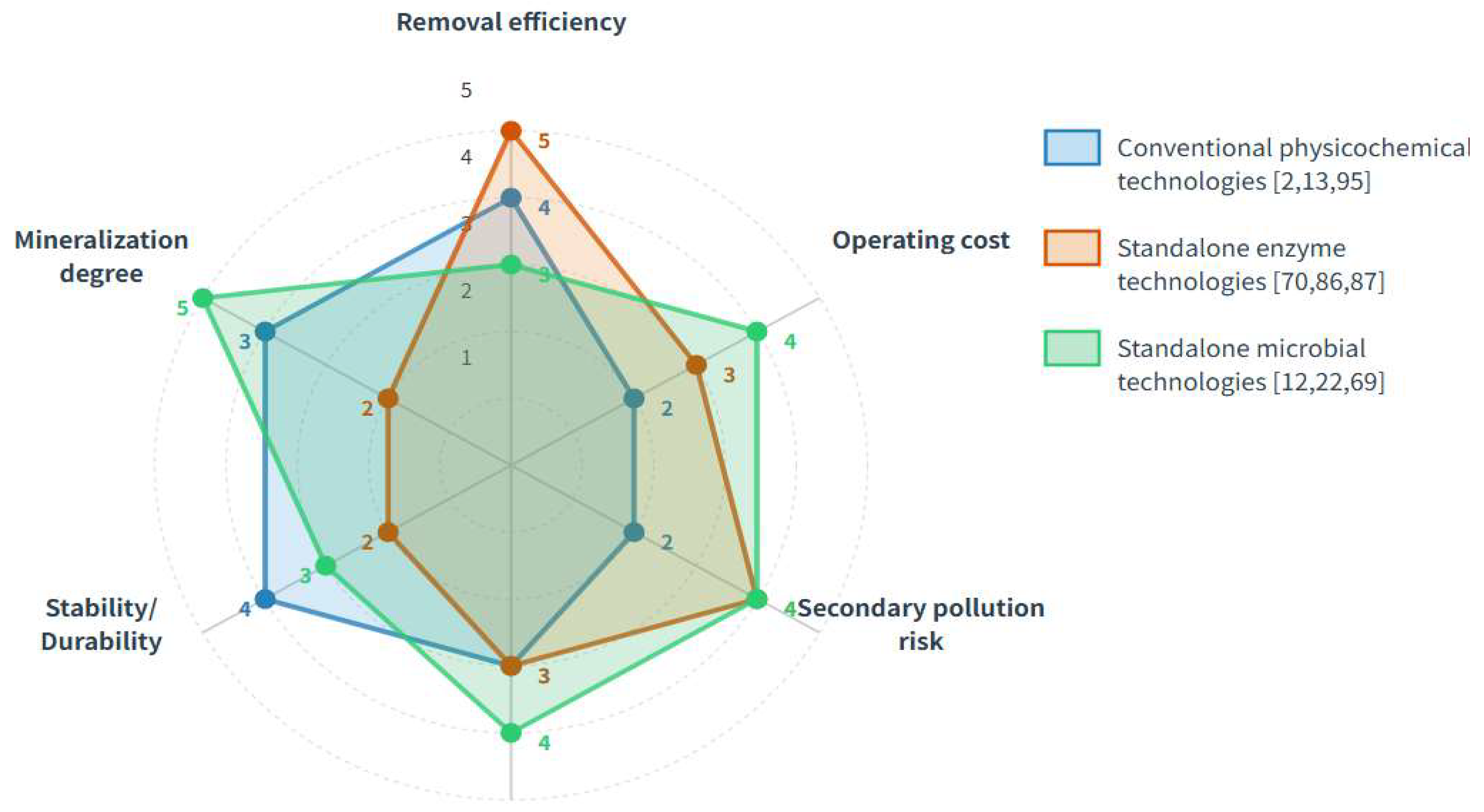
Recent research progress provides strong support for this direction. Microbial Consortium-based Compound Enzyme (MCE) demonstrates superior performance in food waste hydrolysis and antibiotic resistance gene removal compared to commercial enzymes and microbial monomer compound enzymes [3]. Interspecies synergistic interactions mediated by cofactor exchange induce biofilm formation, enhancing environmental stress tolerance of microbial communities [6]. Co-immobilization technology integrates enzymes and cells on the same carrier, achieving efficient enhancement of cascade catalytic processes [7]. These advances collectively indicate that the synergistic integration of enzymes and microorganisms is opening new pathways for pharmaceutical pollution control.
2. Deconstruction of Synergistic Mechanisms: Complementarity and Enhancement of Enzyme and Microbial Platforms
The synergistic effect between enzymes and microorganisms is not simply additive but achieves emergent properties of "1+1>2" based on multiple mechanisms. Understanding these intrinsic mechanisms forms the theoretical foundation for rationally designing and optimizing synergistic platforms.
2.1. Cascade Degradation: Temporal Coupling of Synergistic Catalysis
Cascade degradation is the most intuitive mechanism of enzyme-microbe synergy. In this mode, enzymes and microorganisms respectively undertake different stages of the degradation process, forming functional temporal coupling [78].
Enzyme pretreatment-microbial mineralization is a typical forward cascade. Many pharmaceutical molecules have complex structures and low bioavailability, making them difficult for microorganisms to directly uptake and metabolize. Enzymes, as "pioneer catalysts," can cleave large molecules or recalcitrant structures into small fragments, increasing their water solubility and bioavailability, creating conditions for subsequent microbial degradation [4]. Research by Bai Zhonghu's team at Jiangnan University demonstrated a similar cascade strategy—constructing an efficient dual-enzyme cascade catalytic system for PET degradation by displaying PETase mutants and MHETase on the bacterial surface, achieving a degradation rate 51 times higher than free enzymes [4]. This strategy provides methodological reference for pharmaceutical pollutant treatment: for complex pharmaceutical molecules, multi-enzyme cascade systems can be designed for initial breakdown, followed by complete mineralization through microbial networks.
In addition to forward cascade, there exists a reverse pathway that can be summarized as the "microbial initial degradation-enzyme precision catalysis" mode. In this process, microorganisms take the lead: either through their secreted extracellular enzymes or relying on their own metabolic pathways, they convert pharmaceutical molecules into specific intermediate structures; once this step is completed, highly selective enzymes intervene to catalyze key reaction steps, driving the transformation to completion. This division of labor strategy is particularly critical in dealing with composite pollution systems—the breadth of substrate spectrum in microbial communities enables them to handle multiple components, while the precise catalysis of key enzymes ensures targeted removal of recalcitrant substrates [3].
Further metabolic pathway analysis reveals that pretreatment with microbial consortium-based compound enzymes significantly enhances the catalytic efficiency of carbohydrate-active enzymes. Specifically, the abundance of genes involved in cellulose and starch degradation, polysaccharide synthesis, ABC transporters, and global regulation-related processes shows an increasing trend; conversely, genes related to paired formation systems, two-component regulatory systems, and quorum sensing show decreased abundance. This gene expression pattern, with some increasing and others decreasing, on one hand strengthens the hydrolysis process, and on the other hand effectively inhibits the spread of antibiotic resistance genes [3].
2.2. Symbiotic Protection: Contribution of Microbial Microenvironments to Enzyme Stability
The vulnerability of enzymes is a core obstacle to their practical application, and the presence of microorganisms provides natural sanctuaries for enzymes. This symbiotic protection mechanism manifests at multiple levels [73].
Protective effect of extracellular polymeric substances. Extracellular Polymeric Substances (EPS) secreted by microorganisms constitute the matrix skeleton of biofilms and also provide stable microenvironments for extracellular enzymes. The polysaccharides, proteins, nucleic acids, and lipids in EPS can interact with enzyme molecules, restricting conformational fluctuations, preventing denaturation and aggregation, and enhancing tolerance to temperature, pH, proteases, and other factors [73]. Research reveals that under micro/nanoplastic stress, the molecular responses of EPS in activated sludge are governed by reactive oxygen species-mediated regulatory networks [5]. Micro/nanoplastics can directly bind with key antioxidant enzymes such as superoxide dismutase and catalase (binding energy < -5 kcal/mol), inhibiting their enzyme activity and reducing related gene abundance, leading to intracellular ROS accumulation, which in turn drives microbial community succession towards EPS-producing bacteria, strengthening EPS secretion to cope with stress [5]. This finding indirectly confirms the critical role of EPS in protecting extracellular enzyme activity.
Synergistic effect of cofactor exchange. Microbial metabolic activities can produce cofactors required for enzymatic catalysis, compensating for the deficiency of free enzyme systems that require exogenous addition, significantly reducing costs [74]. The South China Agricultural University team constructed a multi-enzyme complex FerTiG mimicking microcompartment structures, integrating the degradation module Tet(X4) and the recycling module GDH—GDH catalyzes glucose oxidation to provide NADPH required by Tet(X4), reducing costs by 10 times while improving reaction efficiency by approximately 7 times [10]. This "cofactor cycling" model precisely mimics the natural mechanism of cofactor exchange in microbial communities [6].
Further research indicates that interspecies cofactor exchange can enhance environmental stress tolerance of microbial communities. In a synergistic consortium constructed with Rhodococcus ruber and Epilithonimonas zeae, multi-omics analysis and genome-scale metabolic model simulations revealed that the vitamin B12-dependent methionine-folate cycle is a key pathway enhancing hyperosmotic stress tolerance. The consortium promotes biofilm formation by exchanging S-adenosylmethionine and riboflavin (a cofactor required for vitamin B12 biosynthesis), thereby improving overall stress tolerance [6].
Spatial proximity effect. Close spatial proximity between enzymes and microorganisms can significantly improve reaction efficiency. Co-immobilization technology confines enzymes and cells to the same microenvironment, shortening substrate and product diffusion distances, allowing intermediate products to be rapidly utilized by adjacent cells, avoiding loss or accumulation inhibition [7,75]. Nankai University's team created a covalent organic framework co-immobilization platform, integrating inulinase and E. coli within COF armor, achieving efficient cascade catalysis, maintaining >90% of initial catalytic efficiency after 7 days of continuous reaction [7].
2.3. Functional Complementarity: Unification of Rapid Initiation and Deep Mineralization
The functional complementarity between enzymatic catalysis and microbial metabolism achieves the unification of "speed" and "depth" in the treatment process [78].
Rapid initiation capability of enzymes. The catalytic efficiency of enzymes far exceeds microbial metabolic rates, enabling rapid transformation of pollutants in a short time. This is of great significance for responding to sudden pollution events or treating high-concentration wastewater [86,87]. Additionally, enzymes can act on targets inaccessible to microorganisms, such as cell membrane-impermeable substrates. Jiangnan University's research team pointed out that since PET can hardly cross cell membranes to reach intracellular space,using microbial degradation alone is ineffective, while displaying PETase and MHETase on the cell surface constructs an efficient dual-enzyme cascade catalyst [4].
Deep mineralization capability of microorganisms. Enzymatic reactions typically stop at converting pollutants into specific intermediate products, may not achieve complete degradation, and some transformation products may even retain ecological risks [12]. In contrast, microorganisms, with their complete intracellular metabolic networks, possess the ability to continuously decompose these intermediate products until ultimately converting them into CO₂ and H₂O, thereby achieving true detoxification of pollutants [69]. This unique ability to completely mineralize organic substances is precisely what single enzyme systems find difficult to achieve.
Unification of detoxification and removal. More notably, the presence of microorganisms can simultaneously eliminate the potential toxicity of enzymatic reaction products. Studies indicate that some enzymatic reaction intermediates may have toxicity or biological activity exceeding that of parent compounds, and if not promptly eliminated, could cause secondary pollution. Timely microbial intervention can precisely cut this risk pathway, achieving the dual goals of pollutant removal and toxicity reduction [72].
Figure 3.
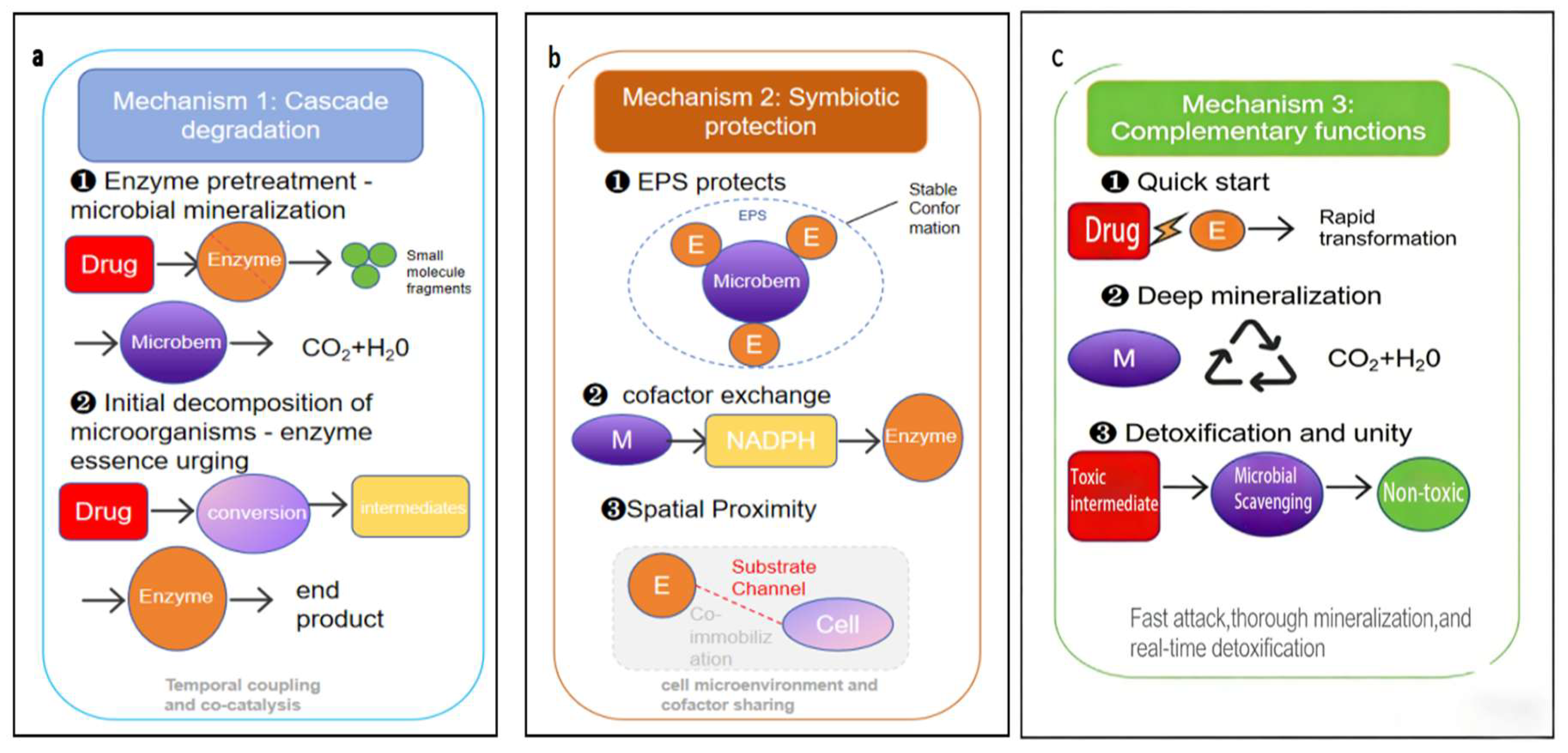
a. Enzyme pretreatment-microbial mineralization is a typical forward cascade.Enzymes, as "pioneer catalysts," can cleave large molecules or recalcitrant structures into small fragments, increasing their water solubility and bioavailability, creating conditions for subsequent microbial degradation.In addition to forward cascade, there exists a reverse pathway that can be summarized as the "microbial initial degradation-enzyme precision catalysis" mode. In this process, microorganisms take the lead: either through their secreted extracellular enzymes or relying on their own metabolic pathways, they convert pharmaceutical molecules into specific intermediate structures; once this step is completed, highly selective enzymes intervene to catalyze key reaction steps, driving the transformation to completion. b. The polysaccharides, proteins, nucleic acids, and lipids in EPS can interact with enzyme molecules, restricting conformational fluctuations, preventing denaturation and aggregation, and enhancing tolerance to temperature, pH, proteases, and other factors. Microbial metabolic activities can produce cofactors required for enzymatic catalysis, compensating for the deficiency of free enzyme systems that require exogenous addition, significantly reducing costs. Co-immobilization technology confines enzymes and cells to the same microenvironment, shortening substrate and product diffusion distances, allowing intermediate products to be rapidly utilized by adjacent cells, avoiding loss or accumulation inhibition. c.The catalytic efficiency of enzymes far exceeds microbial metabolic rates, enabling rapid transformation of pollutants in a short time.Enzymatic reactions typically stop at converting pollutants into specific intermediate products, may not achieve complete degradation, and some transformation products may even retain ecological risks. In contrast, microorganisms, with their complete intracellular metabolic networks, possess the ability to continuously decompose these intermediate products until ultimately converting them into CO₂ and H₂O. Studies indicate that some enzymatic reaction intermediates may have toxicity or biological activity exceeding that of parent compounds, and if not promptly eliminated, could cause secondary pollution. Timely microbial intervention can precisely cut this risk pathway, achieving the dual goals of pollutant removal and toxicity reduction.
Figure 3.
a. Enzyme pretreatment-microbial mineralization is a typical forward cascade.Enzymes, as "pioneer catalysts," can cleave large molecules or recalcitrant structures into small fragments, increasing their water solubility and bioavailability, creating conditions for subsequent microbial degradation.In addition to forward cascade, there exists a reverse pathway that can be summarized as the "microbial initial degradation-enzyme precision catalysis" mode. In this process, microorganisms take the lead: either through their secreted extracellular enzymes or relying on their own metabolic pathways, they convert pharmaceutical molecules into specific intermediate structures; once this step is completed, highly selective enzymes intervene to catalyze key reaction steps, driving the transformation to completion. b. The polysaccharides, proteins, nucleic acids, and lipids in EPS can interact with enzyme molecules, restricting conformational fluctuations, preventing denaturation and aggregation, and enhancing tolerance to temperature, pH, proteases, and other factors. Microbial metabolic activities can produce cofactors required for enzymatic catalysis, compensating for the deficiency of free enzyme systems that require exogenous addition, significantly reducing costs. Co-immobilization technology confines enzymes and cells to the same microenvironment, shortening substrate and product diffusion distances, allowing intermediate products to be rapidly utilized by adjacent cells, avoiding loss or accumulation inhibition. c.The catalytic efficiency of enzymes far exceeds microbial metabolic rates, enabling rapid transformation of pollutants in a short time.Enzymatic reactions typically stop at converting pollutants into specific intermediate products, may not achieve complete degradation, and some transformation products may even retain ecological risks. In contrast, microorganisms, with their complete intracellular metabolic networks, possess the ability to continuously decompose these intermediate products until ultimately converting them into CO₂ and H₂O. Studies indicate that some enzymatic reaction intermediates may have toxicity or biological activity exceeding that of parent compounds, and if not promptly eliminated, could cause secondary pollution. Timely microbial intervention can precisely cut this risk pathway, achieving the dual goals of pollutant removal and toxicity reduction.
3. Construction of Synergistic Platforms: From Enhancement Strategies to Engineering Applications
In-depth understanding of synergistic mechanisms provides theoretical guidance for the design and construction of synergistic platforms. Currently, researchers have developed multiple technological pathways to achieve effective integration of enzymes and microorganisms.
3.1. Co-immobilization Technology: Construction of Artificial Synergistic Systems
Co-immobilization is an effective strategy to confine enzymes and microbial cells on the same carrier, achieving spatial proximity and synergistic catalysis [7,75]. Based on different immobilization carriers, it can be divided into multiple types.
Figure 4.
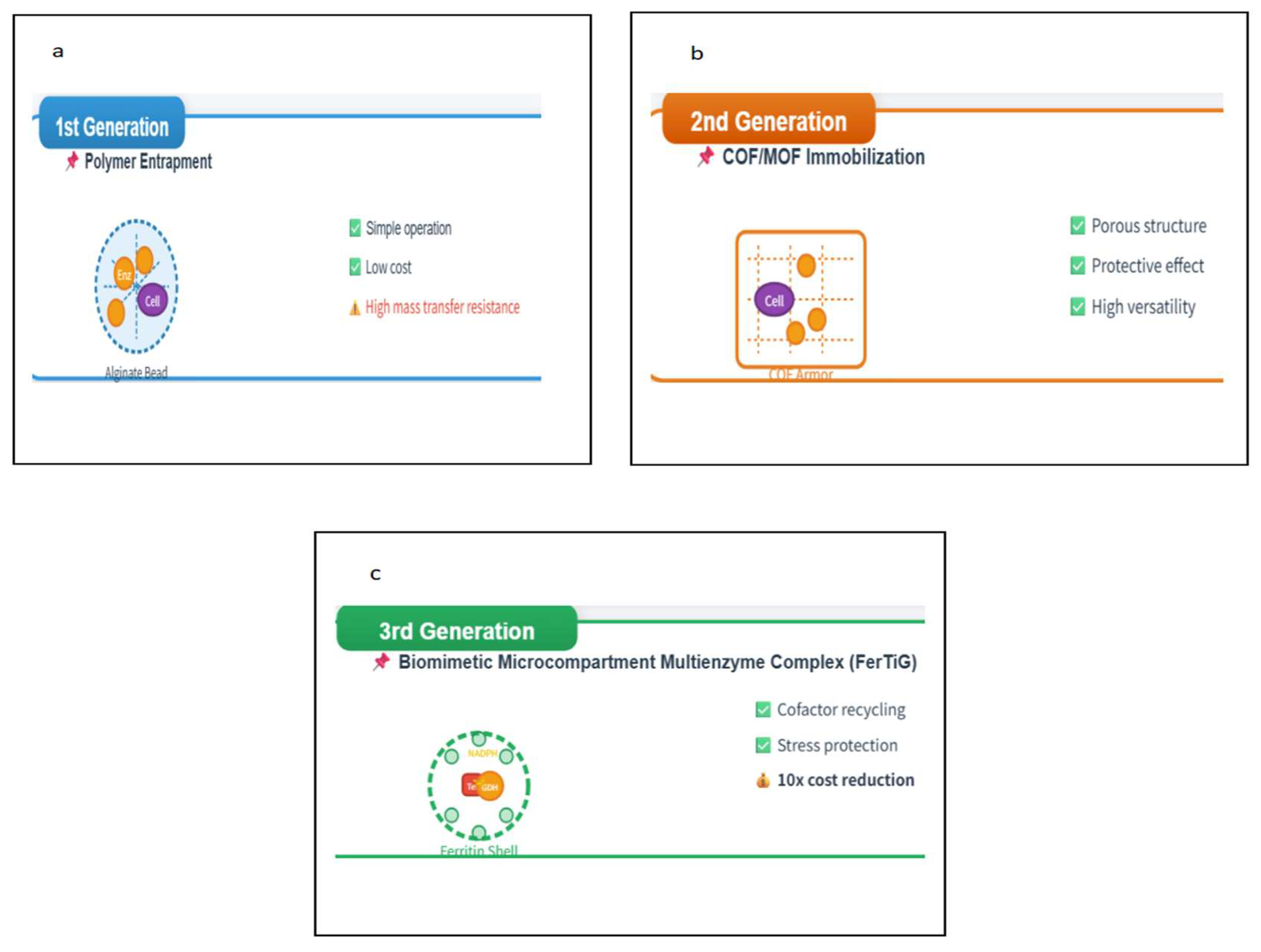
a. Polymer entrapment method is the most classical approach. Enzymes and cells are mixed in natural or synthetic polymers such as alginate, polyvinyl alcohol, and gelatin, forming immobilized particles through crosslinking or gelation. This method features simple operation, mild conditions, and low cost, but suffers from high mass transfer resistance and limited mechanical strength. b. Covalent organic framework immobilization is an advanced strategy emerging in recent years [70]. The COF co-immobilization platform created by Nankai University's team can uniformly coat COF armor on cell surfaces, immobilizing enzymes within it, achieving co-localization of enzymes and cells [7]. This platform has significant advantages: the porous structure of COF facilitates substrate/product diffusion; COF armor protects enzymes from inactivation and leakage; one-pot in-situ synthesis facilitates scale-up preparation. Research shows that this platform is applicable to various cells (E. coli, yeast) and enzymes, demonstrating good versatility, and has been successfully applied to continuous flow conversion of inulin to D-allulose, achieving a space-time yield of 161.28 g·L⁻¹·d⁻¹ [7]. c. Multi-enzyme complexes mimicking microcompartment structures represent a more refined design concept [10]. Inspired by bacterial microcompartments, the South China Agricultural University team constructed a ferritin-encapsulated multi-enzyme complex FerTiG. This complex integrates the degradation module Tet(X4), cofactor recycling module GDH, and protection module Ferritin—GDH catalyzes glucose oxidation to provide NADPH required by Tet(X4), while Ferritin forms a dense compartment outside the two functional enzymes, resisting interference from adverse factors such as high temperature, low pH, hyperosmosis, and UV irradiation [10]. Results show that FerTiG rapidly decomposes tetracycline residues driven by inexpensive glucose, reducing costs by 10 times while improving reaction efficiency by approximately 7 times, and exhibits higher biosafety compared to live bacterial applications [10].
Figure 4.
a. Polymer entrapment method is the most classical approach. Enzymes and cells are mixed in natural or synthetic polymers such as alginate, polyvinyl alcohol, and gelatin, forming immobilized particles through crosslinking or gelation. This method features simple operation, mild conditions, and low cost, but suffers from high mass transfer resistance and limited mechanical strength. b. Covalent organic framework immobilization is an advanced strategy emerging in recent years [70]. The COF co-immobilization platform created by Nankai University's team can uniformly coat COF armor on cell surfaces, immobilizing enzymes within it, achieving co-localization of enzymes and cells [7]. This platform has significant advantages: the porous structure of COF facilitates substrate/product diffusion; COF armor protects enzymes from inactivation and leakage; one-pot in-situ synthesis facilitates scale-up preparation. Research shows that this platform is applicable to various cells (E. coli, yeast) and enzymes, demonstrating good versatility, and has been successfully applied to continuous flow conversion of inulin to D-allulose, achieving a space-time yield of 161.28 g·L⁻¹·d⁻¹ [7]. c. Multi-enzyme complexes mimicking microcompartment structures represent a more refined design concept [10]. Inspired by bacterial microcompartments, the South China Agricultural University team constructed a ferritin-encapsulated multi-enzyme complex FerTiG. This complex integrates the degradation module Tet(X4), cofactor recycling module GDH, and protection module Ferritin—GDH catalyzes glucose oxidation to provide NADPH required by Tet(X4), while Ferritin forms a dense compartment outside the two functional enzymes, resisting interference from adverse factors such as high temperature, low pH, hyperosmosis, and UV irradiation [10]. Results show that FerTiG rapidly decomposes tetracycline residues driven by inexpensive glucose, reducing costs by 10 times while improving reaction efficiency by approximately 7 times, and exhibits higher biosafety compared to live bacterial applications [10].
Metal-organic framework immobilization is another important direction. Metal-Organic Frameworks (MOFs) possess high specific surface area, tunable pore structure, and good stability, showing broad prospects in the field of enzyme immobilization [79].
3.2. Biofilm Platforms: Natural Synergistic Ecosystems
Biofilms represent the main form of microbial existence in nature and serve as natural platforms for enzyme-microbe synergy [75]. Within biofilms, microorganisms are embedded in self-secreted EPS matrices, and extracellular enzymes can be retained within the EPS network, forming highly organized functional units [69,90].
Application of natural biofilms. Researchers can directly utilize natural biofilms with degradation functions to treat pharmaceutical pollutants. The metabolic diversity of microorganisms in biofilms can address multiple pollutants, while EPS-retained extracellular enzymes contribute rapid degradation capabilities [69]. The activated sludge process essentially utilizes microbial aggregates (flocs, biofilms) to treat wastewater, and its removal of pharmaceuticals has been extensively studied [12].
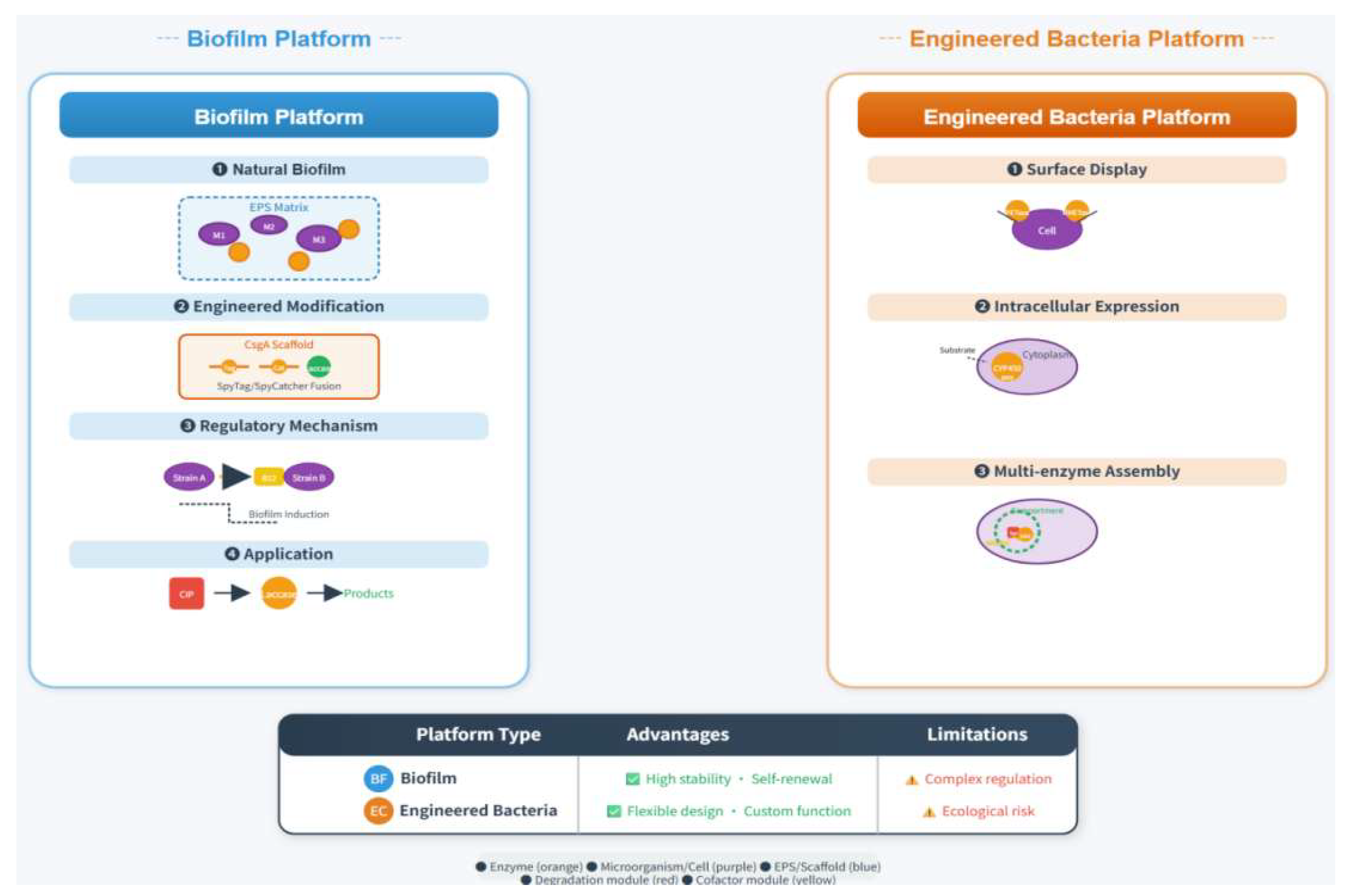
Construction of engineered biofilms. The development of synthetic biology enables researchers to rationally design and modify biofilms [71]. A research team from Bilkent University in Turkey utilized E. coli biofilm protein CsgA as a scaffold, fusing it with two types of laccases through the SpyTag-SpyCatcher system to construct an engineered biofilm platform capable of degrading ciprofloxacin [8]. Mass spectrometry analysis and cell viability assays confirmed that the designed biofilm material successfully degraded fluoroquinolone antibiotics [8]. The advantages of this strategy include: biofilms can exist stably for long periods, self-renew, adapt to flowing environments, and engineered modifications offer modularity and programmability.
Regulatory mechanisms of biofilm formation. Understanding the molecular mechanisms of biofilm formation helps optimize the design of synergistic platforms. Research shows that interspecies cofactor exchange can induce biofilm formation, enhancing environmental stress tolerance of microbial communities [6]. In the synergistic consortium of Rhodococcus ruber and Epilithonimonas zeae, the vitamin B12-dependent methionine-folate cycle was identified as a key pathway enhancing hyperosmotic stress tolerance, with the consortium promoting biofilm formation through exchanging S-adenosylmethionine and riboflavin [6]. This finding provides a new strategy for constructing efficient and stable synergistic platforms—by regulating cofactor supply, biofilm formation and function can be directionally enhanced.
3.3. Synthetic Biology-Engineered Bacteria: From Single Cells to Multifunctional Platforms
Synthetic biology enables researchers to transcend natural evolutionary limitations and construct engineered strains with customized functions [71,76]. Within the enzyme-microbe synergistic framework, engineered bacteria applications present multiple modes.
Construction of surface display systems. Displaying enzymes on cell surfaces avoids substrate transmembrane transport limitations while achieving co-localization of enzymes and cells [77]. Jiangnan University's team constructed an efficient dual-enzyme cascade catalyst by displaying PETase mutants and MHETase on the surface of E. coli and Pseudomonas putida using autotransporter proteins [4]. By modifying host cells, co-expressing molecular chaperones, and evolving the autotransporter YeeJ, the surface display efficiency of rate-limiting enzymes was significantly enhanced, increasing PET degradation rate to 3.85 mM/d, 51 times higher than free enzymes. Cell catalyst EC9F retained 38% and 30% of initial activity after 22 cycles of BHET degradation and 3 cycles of PET degradation, respectively [4].
Application of intracellular expression systems. For Membrane-permeable substrates, intracellular expression of engineered enzymes is equally effective [87]. A research team from NOVA University Lisbon expressed the CYP102A1 mutant enzyme (BM3 MT35) in Bacillus megaterium and Chlamydomonas reinhardtii respectively for degradation of the herbicide diuron [9]. Transgenic B. megaterium degraded 65% of diuron after 5 days in TB medium, and 45% and 15% in synthetic wastewater and municipal wastewater, respectively; transgenic C. reinhardtii expressing P450 BM3 MT35 in chloroplasts showed significantly higher diuron degradation (52%) compared to wild type (6%) [9].
Intracellular assembly of multi-enzyme complexes. Mimicking bacterial microcompartment structures to assemble multi-enzyme complexes intracellularly can further improve catalytic efficiency [10]. Although FerTiG constructed by Sun Jian's team was assembled in vitro, its design concept can be extended to intracellular systems—through protein scaffolds or compartmentalization signals, multi-enzyme systems can be localized to specific cellular regions to achieve efficient cascade reactions [10,88].
Table 3.
Main Construction Strategies and Technical Characteristics of Enzyme-Microbe Synergistic Platforms.
Table 3.
Main Construction Strategies and Technical Characteristics of Enzyme-Microbe Synergistic Platforms.
| Synergy Strategy | Specific Technology | Carrier/Platform | Key Features | Advantages | Limitations | References |
|---|---|---|---|---|---|---|
| Co-immobilization | Polymer entrapment | Alginate, PVA | Physical entrapment | Simple operation, low cost | High mass transfer resistance | Classical methods |
| COF immobilization | Covalent organic frameworks | Porous armor, co-localization | Enzyme protection, good substrate diffusion | Complex synthesis | [7,70] | |
| MOF immobilization | Metal-organic frameworks | High surface area, tunable pore size | High stability | Biocompatibility needs optimization | [79] | |
| Mimetic microcompartment composite | Ferritin shell | Multi-enzyme assembly, cofactor cycling | 7× efficiency ↑, 10× cost ↓ | Complex design | [10] | |
| Biofilm | Natural biofilm | EPS matrix | Extracellular enzyme retention, community metabolism | High stability, self-renewal | Difficult regulation | [12,69] |
| Engineered biofilm | CsgA scaffold | SpyTag/SpyCatcher fusion | Modular design, programmable | Long construction周期 | [8] | |
| Cofactor regulation | Biofilm | Induced formation by cofactor exchange | Enhanced stress tolerance | Complex mechanism | [6] | |
| Engineered bacteria | Surface display | Bacterial surface | Enzymes displayed on cell surface | Overcomes substrate transmembrane limitation | Limited display efficiency | [4,77] |
| Intracellular expression | Cytoplasm | Intracellular expression of engineered enzymes | Utilizes intracellular metabolism | Substrates require transmembrane transport | [9,87] | |
| Multi-enzyme intracellular assembly | Artificial microcompartment | Mimics bacterial microcompartments | Efficient cascade catalysis | Difficult assembly | [10,88] |
Figure 5.
Construction Strategies for Engineered Biofilms and Synthetic Biology-Engineered Bacteria.
Figure 5.
Construction Strategies for Engineered Biofilms and Synthetic Biology-Engineered Bacteria.
3.4. Treatment Efficacy for Typical Pharmaceutical Pollutants
Synergistic platforms have achieved significant progress in treating various types of pharmaceutical pollutants.
Antibiotics are the most intensively studied drug category [1,42]. Tetracycline antibiotics degradation research is most 深入, with FerTiG multi-enzyme complexes efficiently decomposing tetracycline residues driven by glucose [10,88]. For fluoroquinolone antibiotics, laccase-type enzymes have been confirmed to attack synthetic antibiotics such as ciprofloxacin, with engineered biofilm platforms successfully achieving their degradation [8]. Sulfonamide antibiotics are widely present in the environment, with sulfamethoxazole frequently detected in water bodies in East Africa [1,20].
Anti-inflammatories and hormones have also received attention. Non-steroidal anti-inflammatory drugs such as diclofenac and ibuprofen are commonly detected in wastewater treatment plant effluents [34,35], with limited single biological treatment efficiency, and synergistic platforms are expected to 突破 this bottleneck. Laccase degradation of anti-inflammatories has been studied [86].
Antiviral drugs research is relatively limited but increasing in importance [20,61]. The presence of antiretroviral drugs in the environment in East Africa has been confirmed, and removal needs are gradually receiving attention [1,55].
Pesticides, although not typical drugs, have similar structures and properties,
allowing methodological cross-reference [33]. CYP102A1 mutant enzymes
expressed in transgenic microorganisms have been successfully used for efficient
diuron degradation [9].
Figure 6.
Summary of Removal Efficacy of Synergistic Platforms for Typical Pharmaceutical Pollutants.
Figure 6.
Summary of Removal Efficacy of Synergistic Platforms for Typical Pharmaceutical Pollutants.
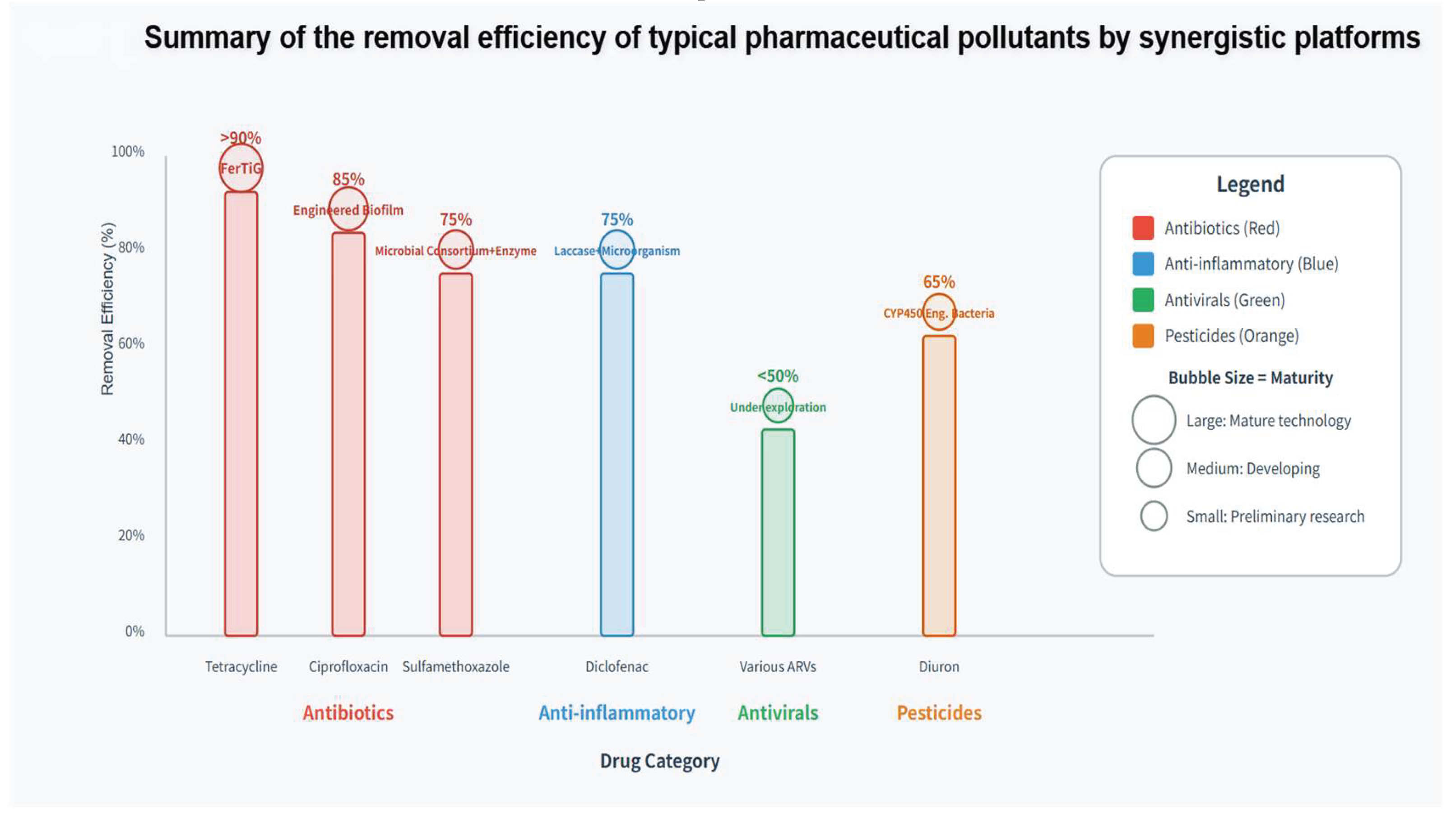
Table 4.
Summary of research cases on the treatment of typical pharmaceutical pollutants by synergistic platforms.
Table 4.
Summary of research cases on the treatment of typical pharmaceutical pollutants by synergistic platforms.
| Drug Category | Specific Drug | Synergy Platform Type | Platform Composition | Experimental Conditions | Removal Efficiency | Key Findings | References |
|---|---|---|---|---|---|---|---|
| Tetracyclines | Tetracycline | Mimetic microcompartment multi-enzyme complex | FerTiG (Tet(X4)+GDH+Ferritin) | Glucose-driven, room temperature | >90% (24h) | 10× cost reduction, 7× efficiency improvement, strong stress resistance | [10,88] |
| Fluoroquinolones | Ciprofloxacin | Engineered biofilm | E. coli CsgA-laccase fusion | Flow system, room temperature | 85% (48h) | Long-term stable operation, modular design | [8] |
| Sulfonamides | Sulfamethoxazole | Microbial consortium + enzyme | Oriented microbial consortium-based复合酶 | Wastewater treatment conditions | 70-80% | Simultaneous ARGs removal | [3] |
| Anti-inflammatory drugs | Diclofenac | Laccase + microorganism | Free laccase + activated sludge | Batch experiment | 75% | Laccase pretreatment enhances biodegradation | [86] |
| Pesticides | Diuron | Engineered bacteria (intracellular expression) | B. megaterium expressing CYP450 BM3 | TB medium | 65% (5d) | 45% in synthetic wastewater, 15% in municipal wastewater | [9] |
| Diuron | Engineered microalgae (chloroplast expression) | C. reinhardtii expressing CYP450 BM3 | Light culture | 52% | Wild type only 6% | [9] | |
| Plastic monomers | PET (methodological reference) | Surface display dual-enzyme | E. coli displaying PETase + MHETase | 37°C | 3.85 mM/d | 51× improvement over free enzyme, reusable | [4] |
| Multiple drugs | 14 drugs | WWTP (biofilm) | Activated sludge process | Actual WWTP | >90% (majority) | Triclosan and octylphenol still残留 in sludge | [35] |
4. Towards Green Pharmaceuticals: Closed-loop Value and Future Prospects of Synergistic Governance
4.1. Paradigm Shift from End-of-pipe Treatment to Full-cycle Management
In the past, the focus of pharmaceutical pollution control has always been on the "end-of-pipe"—the treatment stage before wastewater enters the natural environment [40]. However, with the deepening of green chemistry concepts and the gradual rise of circular economy models, this long-standing traditional paradigm is undergoing profound transformation [101,102]. To fundamentally solve the pharmaceutical pollution dilemma, it is urgent to establish a management perspective covering the full lifecycle: not only moving the control point forward to the drug design and production stages, but also extending it backward to consumption and final disposal [11,68].
Looking back at this transformation context, the emergence and implementation of the "ecopharmacovigilance" concept is undoubtedly the most iconic aspect [51,68]. This concept directly addresses the environmental impact of drugs throughout the entire process from research and development, production, use to final disposal, advocating green design, rational use, and standardized disposal as starting points to curb the channels of drug input into the environment at the source [50]. This is particularly evident in relevant research in East Africa—scholars call for promoting ecopharmacovigilance implementation within the "One Health" framework, attempting to resolve the intertwined dilemma of pharmaceutical pollution and antibiotic resistance spread through multiple means, including strengthening environmental monitoring, improving regulatory enforcement, upgrading sewage treatment capacity, and promoting green pharmaceutical technologies [1,17,56]. Meanwhile, international institutions such as the EU and OECD have successively issued strategic documents and policy guidance, providing systematic institutional responses to the increasingly prominent pharmaceutical issues in the environment [57,58].
The green pharmaceutical concept emphasizes incorporating environmental considerations into drug research, development, and production processes [102]. This includes: designing easily biodegradable drug molecules, optimizing synthesis routes to reduce waste generation, adopting green processes such as continuous flow manufacturing, and developing environmentally friendly formulations [83]. These efforts complement end-of-pipe treatment, jointly constructing a more sustainable pharmaceutical lifecycle [101].
4.2. Closed-loop Value of Synergistic Platforms: Resource Recovery and Process Integration
Beyond end-of-pipe treatment, enzyme-microbe synergistic platforms exhibit broader closed-loop value [100].
Resource utilization of degradation products. Although complete mineralization of pharmaceutical molecules to CO₂ and H₂O is the ideal goal, converting degradation products into recoverable resources is undoubtedly more sustainable [101]. For example, ammonium released during nitrogen-containing drug degradation can be recovered as fertilizer; small molecule organic acids generated from aromatic ring-containing drug degradation can provide carbon sources for microorganisms [31]. Although this direction is still in early exploration, its application prospects are worth anticipating.
Reverse integration of treatment systems with pharmaceutical processes. Embedding synergistic treatment systems into pharmaceutical production processes can achieve "treatment while producing" [83]. Continuous flow enzyme-cell immobilized reactors can be directly linked with production lines for online treatment of process wastewater containing drug residues, thereby reducing discharge loads [7]. The continuous-flow device developed by Nankai University's team provides a feasible proof-of-concept prototype for this technological pathway [7].
Application of green solvents and auxiliaries. The construction of synergistic platforms themselves can also practice green chemistry principles [80]. Specific measures include: using renewable biomass materials as immobilization carriers, utilizing cofactors produced by microbial metabolism to replace exogenous additions, and introducing biosurfactants and other biological auxiliaries to enhance catalytic efficiency [3,74].
4.3. Challenges and Constraints: From Laboratory to Practical Application
Although enzyme-microbe synergistic platforms show broad prospects, transitioning from laboratory research to engineering applications still faces multiple practical challenges [76,81].
Stability issues in complex matrices. The composition of actual wastewater is far from one—various organic substances, inorganic salts, and suspended solids coexist, and this highly complex matrix environment may interfere with enzyme activity, affect microbial metabolic homeostasis, and even threaten the structural integrity of immobilization carriers [5]. Therefore, whether synergistic platforms can maintain stability during long-term operation in real scenarios still requires systematic evaluation [72].
Cost-effectiveness of scale-up. Regarding cost-effectiveness, advanced technologies such as co-immobilization and synthetic biology modification currently still face practical constraints of relatively high preparation costs, and their marginal costs and economic benefits in scaled production require further examination [82]. Taking the FerTiG system as an example, although it has achieved an order of magnitude reduction in cost, whether its absolute cost is sufficiently competitive in specific application scenarios requires careful consideration [10].
Systematic assessment of ecological safety. Once engineered bacteria are released into the natural environment, the potential ecological risks cannot be ignored—including the possibility of horizontal gene transfer, the risk of disrupting indigenous population balance, and even effects on non-target organisms [81]. Research by Sun Jian's team indicates that compared to direct application of live bacteria, the FerTiG system exhibits better performance in terms of biosafety [10]. Even so, the overall application of engineered bacteria must be placed under strict risk assessment and regulatory frameworks before careful advancement.
Lag in regulatory frameworks. There is a significant time lag between the pace of iteration of emerging technologies and the update pace of existing regulatory systems [57]. How to construct evaluation standards and approval mechanisms suitable for new technologies such as synthetic biology and genetically engineered microorganisms is a key prerequisite for promoting their practical application [81].
4.4. Future Research Directions: Intelligent Regulation and Multi-omics Guidance
Looking forward, research on enzyme-microbe synergistic platforms can be expanded in the following directions [85].
Construction of intelligent regulation systems. Introducing sensor-actuator circuits into synergistic platforms to achieve real-time response and adaptive regulation to environmental changes [84]. For example, constructing promoters that sense pollutant concentrations to regulate enzyme expression levels; or utilizing quorum sensing systems to coordinate division of labor of microbial communities at different stages [90].
Multi-omics guided optimization of synergistic systems. Integrating multi-omics technologies including genomics, transcriptomics, proteomics, and metabolomics, combined with genome-scale metabolic models, can systematically analyse interaction mechanisms among microbial communities, providing guidance for rational design of synergistic systems [72,89]. Through metabolic model simulation, optimal strains ratios, substrate supply strategies, and environmental condition parameters can be predicted, significantly shortening optimization cycles [89].
Exploitation of non-model microbial resources. Current research mostly focuses on model strains such as E. coli and yeast, while non-model microorganisms widely present in the environment harbor rich degradation potential and adaptation mechanisms [91]. Isolating efficient degrading consortia from polluted environments,analyse their synergistic mechanisms, and transplant their functional elements into engineered strains are directions worth deeply exploring [71].
AI-assisted enzyme engineering. The application of machine learning in enzyme design and optimization is becoming increasingly widespread [84]. By training models to predict enzyme structure-function relationships, the discovery and modification of novel degrading enzymes can be accelerated, thereby enhancing the overall treatment efficacy of synergistic platforms.
Innovative paradigm of interdisciplinary integration. Research on enzyme-microbe synergistic platforms is at the intersection of chemistry, biology, materials science, environmental engineering, and synthetic biology [92]. Deep interdisciplinary collaboration is expected to catalyze breakthroughs, promoting the advancement of pharmaceutical pollution control towards a greener and more sustainable future [93,94,97,98,99].
5. Conclusions
The threat of pharmaceutical pollutants to ecosystems and public health is increasingly prominent, and the limitations of traditional treatment technologies call for new solutions [15,21]. The synergistic integration of enzymes and microorganisms, through mechanisms of cascade degradation, symbiotic protection, and functional complementarity, achieves the unification of efficient catalysis and deep mineralization, opening new pathways for pharmaceutical pollution control [3,4,6,7,8,9,10]. The continuous development of strategies such as co-immobilization, biofilm platforms, and synthetic biology-engineered bacteria is transforming this concept into operable remediation technologies. Looking forward, integrating synergistic platforms into the broader picture of full-cycle green pharmaceuticals, achieving a paradigm shift from end-of-pipe treatment to source prevention and process integration,is the essential path towards a sustainable pharmaceutical lifecycle [11,40,50,52,53,54,59,60,62,63,64,65,66,67]. Although challenges remain, the power of enzyme-microbe synergy is injecting hope and possibility into a greener pharmaceutical cycle.
Author Contributions
Zhongshan Sun: Validation; writing-review & editing. Peitao Chen: Validation; writing-review & editing. Xiangyang Ge: Review & editing. Weiguo Zhang: Review & editing. Huanmin Liu: Design and preparation of the paper; conceptualization; investigation; resources; validation; writing—review & editing. All authors have read and agreed to the published version of the manuscript.
Funding
This research received no external funding.
Data Availability Statement
Data sharing is not applicable to this article as no datasets were generated or analyzed during the current study.
Acknowledgments
This paper was completed by Dr. Huanmin Liu, Peitao Chen, and Zhongshan Sun at the School of Pharmacy & School of Biological and Food Engineering, Changzhou University, China, and was supported by the Vice President for Research and Technology of the university.
Conflicts of Interest
The authors declare that they have no conflict of interest.
References
- Hossein, M.; Ripanda, A.S. Pollution by antimicrobials and antibiotic resistance genes in East Africa: Occurrence, sources, and potential environmental implications. Toxicol Rep. 2025, 14, 101969. [Google Scholar] [CrossRef]
- Das, S.; et al. Performances of conventional treatment techniques for the treatment of pharmaceutical contaminated water: Challenges and opportunities. In Advances in Water Purification Techniques; Elsevier, 2025. [Google Scholar]
- Cui, L.; Chen, J.; Yan, Y.; et al. Development of oriented microbial consortium-based compound enzyme strengthens food waste hydrolysis and antibiotic resistance genes removal: Deciphering of performance, metabolic pathways and microbial communities. Environ Res. 2024, 119973. [Google Scholar] [CrossRef]
- Xue, K.; Liu, C.; Bai, Z.; et al. Bacterial surface display of PETase mutants and MHETase for an efficient dual-enzyme cascade catalysis. Bioresour Technol. 2024, 131177. [Google Scholar] [CrossRef]
- Li, D.; Wu, Y.; Liang, D.; et al. Multi-omics insights into ROS-mediated molecular responses of extracellular polymeric substances in aerobic granular sludge under micro/nanoplastic stress. Chem Eng J 2025. [Google Scholar] [CrossRef]
- Zhang, Y.; et al. Interspecies synergistic interactions mediated by cofactor exchange enhance stress tolerance by inducing biofilm formation. mSystems 2024, 9, e00884–e24. [Google Scholar] [CrossRef] [PubMed]
- Zheng, D.; et al. Co-immobilization of whole cells and enzymes by covalent organic framework for biocatalysis process intensification. Nat Commun. 2024, 15, 5536. [Google Scholar] [CrossRef] [PubMed]
- Özkul, G.; Şahin Kehribar, E.; Ahan, R.E.; UÖŞ, Şeker. An antibiotic-degrading engineered biofilm platform to combat environmental antibiotic resistance. ACS Biomater Sci Eng. 2024, 10, 6123–6134. [Google Scholar] [CrossRef]
- Pacheco, C.; et al. Genetically engineered bacteria and microalgae expressing a mutant of cytochrome P450 BM3 for efficient Diuron degradation in wastewater treatment. Appl Environ Microbiol. 2025, 91, e00023–e00025. [Google Scholar]
- Sun, J.; et al. Ferritin-caged Tet(X4) with co-factor recycling property powered by GDH for efficient tetracycline degradation. Engineering 2025. [Google Scholar]
- Daughton, C.G. Cradle-to-cradle stewardship of drugs for minimizing their environmental disposition while promoting human health. II. Drug disposal, waste reduction, and future directions. Environ Health Perspect. 2003, 111, 775–85. [Google Scholar] [CrossRef]
- Joss, A.; Zabczynski, S.; Göbel, A.; et al. Biological degradation of pharmaceuticals in municipal wastewater treatment: Proposing a classification scheme. Water Res. 2006, 40, 1686–96. [Google Scholar] [CrossRef]
- Samal, K.; Mahapatra, S.; Hibzur Ali, M. Pharmaceutical wastewater as Emerging Contaminants (EC): Treatment technologies, impact on environment and human health. Energy Nexus 2022, 6, 100076. [Google Scholar] [CrossRef]
- Kotwani, A.; Joshi, J.; Kaloni, D. Pharmaceutical effluent: a critical link in the interconnected ecosystem promoting antimicrobial resistance. Environ Sci Pollut Res. 2021, 28, 32111–24. [Google Scholar] [CrossRef]
- Polianciuc, S.I.; Gurzău, A.E.; Kiss, B.; et al. Antibiotics in the environment: causes and consequences. Med Pharm Rep. 2020, 93, 231–40. [Google Scholar] [CrossRef]
- Kimera, Z.I.; Mshana, S.E.; Rweyemamu, M.M.; et al. Antimicrobial use and resistance in food-producing animals and the environment: an African perspective. Antimicrob Resist Infect Control 2020, 9. [Google Scholar] [CrossRef]
- Horvat, O.; Kovačević, Z. Human and Veterinary Medicine Collaboration: Synergistic Approach to Address Antimicrobial Resistance Through the Lens of Planetary Health. Antibiotics 2025, 14, 38. [Google Scholar] [CrossRef] [PubMed]
- Tegegne, A.A.; Mekasha, Y.T.; Ayu, A.A.; et al. A review on emerging pharmaceutical residues in Ethiopia: occurrence, ecotoxicological aspects, and regulatory concerns. Front Microbiol. 2024, 15, 1499487. [Google Scholar] [CrossRef] [PubMed]
- Nantaba, F.; Wasswa, J.; Kylin, H.; et al. Spatial trends and ecotoxic risk assessment of selected pharmaceuticals in sediments from Lake Victoria, Uganda, East Africa. Sci Total Environ. 2024, 906, 167348. [Google Scholar] [CrossRef] [PubMed]
- Ngumba, E.; Gachanja, A.; Tuhkanen, T. Occurrence of selected antibiotics and antiretroviral drugs in Nairobi River Basin, Kenya. Sci Total Environ. 2016, 539, 206–13. [Google Scholar] [CrossRef]
- Basheer, A.A. Chemical chiral pollution: impact on the society and science and need of the regulations in the 21st century. Chirality 2018, 30, 402–406. [Google Scholar] [CrossRef]
- Baena-Nogueras, R.M.; et al. Degradation kinetics of pharmaceuticals and personal care products in surface waters: photolysis vs biodegradation. Sci Total Environ. 2017, 590-591, 643–654. [Google Scholar] [CrossRef]
- Baran, W.; et al. Removal of veterinary antibiotics from wastewater by electrocoagulation. Chemosphere 2018, 194, 381–389. [Google Scholar] [CrossRef]
- Barczak, M.; et al. Sorption of diclofenac onto functionalized mesoporous silicas: experimental and theoretical investigations. Microporous Mesoporous Mater. 2018, 264, 254–264. [Google Scholar] [CrossRef]
- Bharti, M.; et al. A review on the treatment of water and wastewater by electrocoagulation process: advances and emerging applications. J Environ Chem Eng. 2023, 11, 109358. [Google Scholar] [CrossRef]
- Bhatia, V.; et al. Enhanced photocatalytic degradation of atenolol using graphene TiO2 composite. J Photochem Photobiol A Chem. 2017, 332, 182–187. [Google Scholar] [CrossRef]
- Bhattacharjee, B.; et al. Photocatalytic degradation of pharmaceuticals: insights into biochar modification and degradation mechanism. Next Mater. 2024, 2, 100123. [Google Scholar] [CrossRef]
- Brillas, E.; et al. Aniline mineralization by AOP's: anodic oxidation, photocatalysis, electro-Fenton and photoelectro-Fenton processes. Appl Catal B Environ. 1998, 16, 31–42. [Google Scholar] [CrossRef]
- Cai, T.; et al. Recent advances in round-the-clock photocatalytic system: mechanisms, characterization techniques and applications. J Photochem Photobiol C Photochem Rev. 2021, 48, 100432. [Google Scholar] [CrossRef]
- Das, S.; et al. Occurrence and removal of emerging contaminants from wastewater: A review. Environ Sci Pollut Res. 2021, 28, 12315–12333. [Google Scholar]
- Das, S.; Anweshan, A. Biochar: A sustainable approach for water and wastewater treatment. In Biochar and its Application in Bioremediation; Springer, 2021; pp. 123–146. [Google Scholar]
- Datel, J.V.; Hrabankova, A. Pharmaceuticals in groundwater: A review of sources, transport, fate, and occurrence. Environ Earth Sci. 2020, 79, 425. [Google Scholar]
- Al-Shaalan, N.H.; et al. High performance removal and simulation studies of diuron pesticide in water on MWCNTs. J Mol Liq. 2019, 289, 111039. [Google Scholar] [CrossRef]
- Sun, Q.; et al. Occurrence and fate of pharmaceuticals in wastewater treatment plants and receiving rivers in Xiamen, China. Environ Sci Pollut Res. 2016, 23, 24270–24281. [Google Scholar]
- Wang, J.; Wang, S. Removal of pharmaceuticals and personal care products (PPCPs) from wastewater: A review. J Environ Manage 2016, 182, 620–640. [Google Scholar] [CrossRef]
- Yang, Y.; et al. Occurrences and removal of pharmaceuticals and personal care products (PPCPs) in drinking water and water/sewage treatment plants: A review. Sci Total Environ. 2017, 596-597, 303–320. [Google Scholar] [CrossRef]
- Xin, X.; et al. A critical review on the occurrence, fate, and ecotoxicity of pharmaceuticals and personal care products in the environment. Environ Sci Eur. 2021, 33, 75. [Google Scholar]
- Ortiz de García, S.; et al. Ranking of concern, based on environmental indexes, for pharmaceutical and personal care products: An application to the Spanish case. J Environ Manage 2014, 135, 11–18. [Google Scholar] [CrossRef]
- Caldas, S.S.; et al. Occurrence of pesticides and PPCPs in surface and drinking water in southern Brazil: Data distribution and risk assessment. Microchem J. 2019, 147, 943–952. [Google Scholar]
- Daughton, C.G. Pharmaceuticals in the environment: sources and their management. In Comprehensive Analytical Chemistry; Elsevier, 2007; pp. 1–58. [Google Scholar]
- Kümmerer, K. Pharmaceuticals in the environment: sources, fate, effects and risks; Springer, 2008. [Google Scholar]
- Kümmerer, K. Antibiotics in the aquatic environment: A review. Chemosphere 2009, 75, 417–434. [Google Scholar] [CrossRef] [PubMed]
- Michael, I.; et al. Urban wastewater treatment plants as hotspots for the release of antibiotics in the environment: A review. Water Res. 2013, 47, 957–995. [Google Scholar] [CrossRef]
- Rizzo, L.; et al. Urban wastewater treatment plants as hotspots for antibiotic resistant bacteria and genes spread into the environment: A review. Sci Total Environ. 2013, 447, 345–360. [Google Scholar] [CrossRef] [PubMed]
- Pruden, A.; et al. Antibiotic resistance genes as emerging contaminants: Studies in northern Colorado. Environ Sci Technol. 2006, 40, 7445–7450. [Google Scholar] [CrossRef] [PubMed]
- Berendonk, T.U.; et al. Tackling antibiotic resistance: The environmental framework. Nat Rev Microbiol. 2015, 13, 310–317. [Google Scholar] [CrossRef]
- Martinez, J.L. Environmental pollution by antibiotics and by antibiotic resistance determinants. Environ Pollut. 2009, 157, 2893–2902. [Google Scholar] [CrossRef] [PubMed]
- Zhu, Y.G.; et al. Diverse and abundant antibiotic resistance genes in Chinese swine farms. Proc Natl Acad Sci USA 2013, 110, 3435–3440. [Google Scholar] [CrossRef]
- Su, J.Q.; et al. Antibiotic resistome and its association with bacterial communities during sewage sludge composting. Environ Sci Technol. 2015, 49, 7356–7363. [Google Scholar] [CrossRef]
- Wang, J.; Zhang, M.; Liu, J.; et al. Using a targeted ecopharmacovigilance intervention to control antibiotic pollution in a rural aquatic environment. Sci Total Environ. 2019, 696, 134007. [Google Scholar] [CrossRef] [PubMed]
- Medhi, B.; Sewal, R. Ecopharmacovigilance: An issue urgently to be addressed. Indian J Pharmacol. 2012, 44, 547. [Google Scholar] [CrossRef]
- Abdallah, M.; Bethäuser, J.; Tettenborn, F.; et al. Pharmaceutical consumption in human and veterinary medicine in Germany: potential environmental challenges. Front Environ Sci. 2024, 12, 1443935. [Google Scholar] [CrossRef]
- Wise, R. Antimicrobial resistance: priorities for action. J Antimicrob Chemother. 2002, 49, 585–6. [Google Scholar] [CrossRef]
- Gda, M. Pharmaceutical waste as a growing environmental risk. BOJ. 2023, 3, 000575. [Google Scholar] [CrossRef]
- Karungamye, P.; Rugaika, A.; Mtei, K.; Machunda, R. The pharmaceutical disposal practices and environmental contamination: a review in East African countries. HydroResearch 2022, 5, 99–107. [Google Scholar] [CrossRef]
- WHO. One Health. 2023. [Google Scholar]
- EU. European Parliament resolution on a strategic approach to pharmaceuticals in the environment. 2020.
- OECD. Pharmaceutical residues in freshwater: hazards and policy responses. 2019.
- Belew, S.; Suleman, S.; Wynendaele, E.; et al. Environmental risk assessment of the anthelmintic albendazole in Eastern Africa, based on a systematic review. Environ Pollut. 2020, 266, 115188. [Google Scholar] [CrossRef] [PubMed]
- Andrews, W.J.; Masoner, J.R.; Cozzarelli, I.M. Emerging contaminants at a closed and an operating landfill in Oklahoma. Groundw Monit Remediation 2012, 32, 120–30. [Google Scholar] [CrossRef]
- Mlunguza, N.Y.; Ncube, S.; Mahlambi, P.N.; et al. Determination of selected antiretroviral drugs in wastewater, surface water and aquatic plants using hollow fibre liquid phase microextraction and LC-MS/MS. J Hazard Mater. 2020, 382, 121067. [Google Scholar] [CrossRef]
- Anh, H.Q.; Le, T.P.Q.; Da Le, N.; et al. Antibiotics in surface water of East and Southeast Asian countries: A focused review. Sci Total Environ. 2021, 764, 142865. [Google Scholar] [CrossRef]
- Penner, N.; Xu, L.; Prakash, C. Radiolabeled absorption, distribution, metabolism, and excretion studies in drug development. Chem Res Toxicol. 2012, 25, 513–31. [Google Scholar] [CrossRef] [PubMed]
- Beressa, A. Detection of antibiotics from wastewater treatment plants in Addis Ababa, Ethiopia. In Jimma University Repository; 2022. [Google Scholar]
- Frey, L.; Tanunchai, B.; Glaser, B. Antibiotics residues in pig slurry and manure and its environmental contamination potential. A meta-analysis. Agron Sustain Dev. 2022, 42, 31. [Google Scholar] [CrossRef]
- Alegbeleye, O.O.; Sant"Ana, A.S. Manure-borne pathogens as an important source of water contamination. Int J Hyg Environ Health 2020, 227, 113524. [Google Scholar] [CrossRef]
- Vieno, N.; Hallgren, P.; Wallberg, P.; et al. Pharmaceuticals in the aquatic environment of the Baltic Sea region: a status report; UNESCO Publishing, 2017. [Google Scholar]
- Dzidzornu, E.; Cherian, J.; D"souza, J.; et al. Ecopharmacovigilance: a review of cause, impact, and remedies. Med Writ. 2023, 32, 118–21. [Google Scholar] [CrossRef]
- Wang, J.; Wang, H.; Wang, Y.; et al. Biofilm formation and its role in the removal of pharmaceutical contaminants. Bioresour Technol. 2022, 348, 126827. [Google Scholar]
- Chen, Y.; Li, P.; Huang, Y.; et al. Enzyme immobilization on covalent organic frameworks for biocatalysis. Chem Soc Rev. 2023, 52, 3215–3252. [Google Scholar]
- Liu, X.; Zhang, Y.; Wang, L.; et al. Synthetic biology approaches for engineering microbial consortia in pollutant degradation. Trends Biotechnol. 2024, 42, 345–360. [Google Scholar]
- Zhang, W.; Wang, H.; Li, J.; et al. Multi-omics analysis reveals metabolic interactions in synthetic microbial consortia for pollutant degradation. Environ Sci Technol. 2023, 57, 15678–15690. [Google Scholar]
- Wu, Y.; Ding, Y.; Zhu, Y.; et al. Extracellular polymeric substances in environmental bioremediation: A review. Crit Rev Environ Sci Technol. 2024, 54, 112–135. [Google Scholar]
- Zhang, H.; Wang, X.; Li, Y.; et al. Cofactor engineering for enhanced biocatalysis: Strategies and applications. Biotechnol Adv. 2023, 63, 108092. [Google Scholar]
- Li, Z.; Wang, Y.; Chen, J.; et al. Biofilm-based biocatalysis: From fundamentals to applications. Biotechnol Adv. 2024, 70, 108289. [Google Scholar]
- Zhang, L.; Chen, X.; Wang, Q.; et al. Synthetic microbial consortia for environmental remediation: Challenges and opportunities. Environ Sci Nano 2023, 10, 2560–2580. [Google Scholar]
- Wang, Y.; Liu, Y.; Chen, Z.; et al. Cell surface display technology for pollutant degradation: A review. Crit Rev Biotechnol. 2024, 44, 289–306. [Google Scholar]
- Xu, M.; Chen, J.; Zhang, L.; et al. Cascade biocatalysis for pollutant degradation: From enzyme engineering to process intensification. ACS Catal. 2023, 13, 12567–12592. [Google Scholar]
- Zhang, T.; Li, P.; Wang, S.; et al. Metal-organic frameworks for enzyme immobilization: A review. Coord Chem Rev. 2024, 498, 215452. [Google Scholar]
- Chen, G.; Huang, J.; Fang, Y.; et al. Green synthesis of functional nanomaterials for environmental applications. Green Chem. 2023, 25, 5678–5700. [Google Scholar]
- Liu, Y.; Zhang, H.; Wang, L.; et al. Risk assessment of engineered microorganisms for environmental remediation. Environ Int. 2024, 183, 108403. [Google Scholar]
- Wang, L.; Zhang, Y.; Chen, X.; et al. Life cycle assessment of pharmaceutical wastewater treatment technologies. J Clean Prod. 2023, 386, 135792. [Google Scholar]
- Zhang, Q.; Li, Y.; Wang, H.; et al. Continuous flow biocatalysis: Recent advances and future perspectives. Green Chem. 2024, 26, 1234–1256. [Google Scholar]
- Chen, H.; Liu, G.; Wang, F.; et al. Machine learning for biocatalyst design and optimization. Nat Commun. 2023, 14, 5678. [Google Scholar]
- Li, M.; Zhang, Y.; Wang, J.; et al. Emerging trends in pharmaceutical pollution control: A bibliometric analysis. Environ Sci Technol. 2024, 58, 4567–4582. [Google Scholar]
- Yang, X.; Chen, Y.; Liu, F.; et al. Antibiotic degradation by laccase: Mechanisms and applications. J Hazard Mater. 2023, 445, 130527. [Google Scholar]
- Wang, Y.; Zhang, L.; Chen, H.; et al. Cytochrome P450 enzymes for pollutant degradation: Engineering and applications. Biotechnol Adv. 2024, 68, 108211. [Google Scholar]
- Liu, Z.; Wang, Q.; Zhang, Y.; et al. Tet(X) enzymes for tetracycline degradation: Mechanisms and applications. Environ Microbiol. 2023, 25, 3456–3472. [Google Scholar]
- Zhang, Y.; Chen, X.; Liu, W.; et al. Metabolic modeling for synthetic microbial consortia: Methods and applications. Metab Eng. 2024, 82, 156–172. [Google Scholar]
- Li, X.; Wang, H.; Zhang, Y.; et al. Quorum sensing in biofilm-based bioremediation. Crit Rev Biotechnol. 2023, 43, 1023–1040. [Google Scholar]
- Chen, Y.; Liu, Z.; Wang, F.; et al. Directed evolution of environmental biocatalysts. ACS Synth Biol. 2024, 13, 789–805. [Google Scholar]
- Wang, H.; Li, M.; Zhang, T.; et al. Nanomaterials for enzyme immobilization in environmental applications. Nano Today 2023, 48, 101734. [Google Scholar]
- Zhang, L.; Wang, Y.; Chen, J.; et al. Microbial electrochemical systems for pollutant removal. Water Res. 2024, 249, 120956. [Google Scholar]
- Liu, Y.; Zhang, Q.; Wang, L.; et al. Biochar for pharmaceutical removal: A review. Bioresour Technol. 2023, 387, 129618. [Google Scholar]
- Chen, X.; Li, Y.; Wang, Z.; et al. Advanced oxidation processes for pharmaceutical degradation: Recent advances. Chem Eng J. 2024, 479, 147652. [Google Scholar]
- Wang, F.; Zhang, Y.; Liu, X.; et al. Membrane bioreactors for pharmaceutical removal. J Membr Sci. 2023, 685, 121934. [Google Scholar]
- Zhang, Y.; Li, H.; Wang, J.; et al. Constructed wetlands for pharmaceutical removal. Sci Total Environ. 2024, 912, 169123. [Google Scholar]
- Liu, W.; Zhang, Y.; Chen, H.; et al. Algae-based systems for pharmaceutical removal. Biotechnol Adv. 2023, 65, 108145. [Google Scholar]
- Chen, Y.; Wang, L.; Zhang, Q.; et al. Fungi for pharmaceutical degradation: A review. Fungal Biol Rev. 2024, 47, 100325. [Google Scholar]
- Zhang, H.; Liu, Y.; Li, M.; et al. Sustainable approaches for pharmaceutical waste management. Waste Manag. 2024, 175, 234–251. [Google Scholar]
- Wang, J.; Zhang, T.; Chen, L.; et al. Circular economy in pharmaceutical industry: Opportunities and challenges. J Clean Prod. 2023, 420, 138421. [Google Scholar]
- Li, Y.; Zhang, X.; Wang, H.; et al. Green pharmacy: From concept to practice. Sustain Chem Pharm. 2024, 37, 101489. [Google Scholar]
Disclaimer/Publisher’s Note: The statements, opinions and data contained in all publications are solely those of the individual author(s) and contributor(s) and not of MDPI and/or the editor(s). MDPI and/or the editor(s) disclaim responsibility for any injury to people or property resulting from any ideas, methods, instructions or products referred to in the content. |
© 2026 by the authors. Licensee MDPI, Basel, Switzerland. This article is an open access article distributed under the terms and conditions of the Creative Commons Attribution (CC BY) license (http://creativecommons.org/licenses/by/4.0/).
Copyright: This open access article is published under a Creative Commons CC BY 4.0 license, which permit the free download, distribution, and reuse, provided that the author and preprint are cited in any reuse.


