

Submitted:
17 April 2026
Posted:
20 April 2026
You are already at the latest version
Abstract
Background: Receptor status may change during metastatic progression, potentially altering therapeutic decisions and outcomes. The aim of this study was to determine ER, PR, and HER2 changes in thoracic metastases [pleura, lung, lymph node, pericardium, chest wall] of breast cancer and to evaluate their impact on survival. Methods: Data of 46 women who underwent interventional procedure for thoracic metastasis of breast cancer and had available ER/PR/HER2 assessment in both primary and corresponding metastatic tissues were retrospectively analyzed. Post-metastasis survival was calculated from the date of histopathological confirmation of metastatic disease. The associations of primary breast cancer receptor status, metastatic receptor status, and receptor conversion at metastasis with survival outcomes were investigated. Results: The pleura was the most common metastatic site [54,3%]. In primary tumors, ER, PR, and HER2 positivity rates were 87%, 63%, and 21%, respectively, whereas in metastatic tissues they were 69.6%, 45.7%, and 25.6%. ER loss was observed in 17.4% of cases, with no gain detected. PR loss occurred in 23.9% and gain in 6.5%, while HER2 loss and gain were observed in 7.0% and 11.6% of cases, respectively. Univariate analysis identified pleural metastasis [HR = 3,442, p = 0,017], ER negativity in metastatic tissue [HR = 3,306, p = 0,008], PR negativity in metastatic tissue [HR = 2,793, p = 0,037], and ER loss [HR = 3,095, p = 0,022] as adverse prognostic factors. In multivariate analysis, pleural metastasis [HR = 4,424, p = 0,009] and ER loss [HR = 3,669, p = 0,010] remained independent predictors of poor survival. No significant association was found between HER2 status and survival. Conclusion: ER loss and pleural metastasis are independent adverse prognostic factors in thoracic metastases of breast cancer. Re-evaluation of receptor status in metastatic disease is crucial for optimal treatment selection and prognostic assessment.
Keywords:
breast cancer
; metastasis
; pleura
; pleural effusion
; receptor conversion
; estrogen receptor
; progesterone receptor
1. Introduction
Metastatic disease is considered the leading cause of cancer-related mortality in breast cancer [1]. Accumulating evidence indicates that receptor discordance between primary and metastatic tumors may significantly affect survival outcomes. Although receptor loss has consistently been associated with adverse prognosis, receptor positivity [ER, PR, HER2] differing from that of the primary tumor may also be detected, and such differences may allow modifications in systemic therapy, potentially leading to improved survival outcomes [2,3,4]. Accordingly, current guidelines recommend biopsy of metastatic lesions and reassessment of receptor status to optimize treatment strategies in metastatic breast cancer [2,5,6,7].
A consistent finding across studies is that receptor alterations in metastatic disease most frequently manifest as hormone receptor [ER, HR] loss, which is strongly associated with poorer survival outcomes [1,8,9]. Equally emphasized in the literature is the clinical importance of reassessing receptor status in metastatic lesions and incorporating these findings into therapeutic decision-making [5,7,10].
While previous studies have investigated receptor discordance in distant metastases irrespective of organ involvement, as well as in selected organ-specific metastases [e.g., liver, bone, brain], data focusing specifically on thoracic metastases remain limited. The present study was designed to evaluate receptor profile alterations in thoracic metastases of breast cancer, to stratify patients according to receptor status and direction of conversion, to comparatively assess their impact on survival, and to identify receptor patterns associated with more favorable survival outcomes.
2. Materials and Methods
In this single-center retrospective study, hospital records of 72 patients across all age groups who underwent surgical intervention for thoracic metastases of breast cancer between January 2020, and December 2024 were reviewed. Ethical approval for the study was obtained from the T.C. Istanbul Medipol University Non-Interventional Clinical Research Ethics Committee [Approval No: 976; Date: 14.08.2025]. Survival analyses were conducted using follow-up data updated through July 2025. Receptor profiles and patterns of receptor conversion were categorized and analyzed to determine their association with post-metastasis survival. The impact of primary tumor receptor status, metastatic receptor status, and receptor discordance on survival outcomes was statistically assessed.
Inclusion criteria were prior diagnosis of breast cancer and surgical management of thoracic metastasis, female sex, and documented receptor evaluation in both primary and metastatic pathology specimens. Thoracic specimens included pleura, pleural effusion, pericardium, pericardial effusion, mediastinal lymph nodes, chest wall, and lung tissue. Exclusion criteria comprised: male sex, unavailable primary tumor pathology, unavailable metastatic pathology, surgery-related in-hospital mortality, absence of ER, PR, or HER2 receptor status in pathology reports, and incomplete clinical records.
Of 72 eligible patients, 1 was excluded for male sex and 25 for incomplete records or unavailable primary pathology data. The final study consisted of 46 patients. HER2 status could not be determined by immunohistochemistry [IHC] in 3 cases, and no additional confirmatory testing was performed; therefore, HER2 analyses were conducted in 43 patients.
Statistical Analysis
All statistical analyses were performed using IBM SPSS Statistics version 25.0 [IBM Corporation, Armonk, NY, USA]. Post-metastasis survival was defined as the interval between the date of histopathological confirmation of thoracic metastasis and the date of death or last follow-up. Overall survival rates, including 6-month, 1-year, and 2-year cumulative survival, as well as mean estimated survival time, were calculated using the Kaplan–Meier method and presented with 95% confidence intervals [CIs]. The effects of pleural metastasis and PR and HER2 conversion to positivity on survival were evaluated using the log-rank test. Univariate and multivariate analyses were performed using Cox proportional hazards regression models. Hazard ratios [HRs], 95% confidence intervals [CIs], and Wald statistics were calculated. Differences in receptor status distributions between primary breast tumors and corresponding metastatic tissues were assessed using the McNemar test. A p-value < 0.05 was considered statistically significant.
3. Results
Demographic characteristics and the distribution of thoracic metastatic sites were evaluated. The mean age of the patients was 51.6 ± 13.0 years, with a range of 26–81 years. The most common sites of thoracic metastasis of breast cancer were the pleura [54.3%], followed by the lung [19.6%], lymph nodes [10.9%], pericardium [10.9%], and chest wall [4.3%] [Table 1].
The median follow-up time after thoracic metastasis was 18 months [range, 1–67 months]. At the end of the study period, 26 patients [56.5%] were alive, and 20 patients [43.5%] were deceased. According to Kaplan–Meier survival analysis, the 6-month cumulative survival rate was 0.761, whereas the 1- and 2-year cumulative survival rates were 0.673 and 0.539, respectively. The mean estimated overall survival was 40.2 months, with a 95% confidence interval [CI] of 31.4–49.0 months [Figure 1].
In the primary breast cancer tissue, ER was positive in 87% of patients, PR in 63%, and HER2 in 21%. In the thoracic metastases, ER was positive in 69.6% of patients, PR in 45.7%, and HER2 in 25.6% [Figure 2].
Hormone receptor positivity was observed less frequently in metastatic tissue compared to primary tumors, whereas HER2 positivity was more frequent in metastatic tissue. A statistically significant difference in ER positivity was found between metastatic and primary tumor tissues [p = 0.008]. PR positivity showed a borderline difference [p = 0.057]. No significant difference was observed for HER2 status between the two groups [p = 0.727] [Figure 2].
Receptor Changes in Metastatic Tissue
The direction of receptor conversion from primary tumor tissue to metastatic tissue [positive to negative, negative to positive, or no change] was evaluated. ER conversion from positive to negative was observed in 17.4% of cases, whereas no negative-to-positive conversion was detected. PR conversion from positive to negative occurred in 23.9% of cases, while negative-to-positive conversion was observed in 6.5%. HER2 conversion from positive to negative was identified in 7.0% of cases, and negative-to-positive conversion in 11.6% [Figure 2].
These findings suggest that receptor loss, particularly of hormone receptors, is common during the metastatic process. In addition, new receptor positivity may emerge in approximately 10% of cases.
Survival Analysis According to Metastatic Site
Cumulative survival was markedly lower from the early period in patients with pleural metastasis. In cases with non-pleural metastases, the 6-month, 1-year, and 2-year survival rates were 85.7%, 85.7%, and 73.5%, respectively, with a mean overall survival of 52.7 months [95% CI: 41.8–63.6]. In contrast, patients with pleural metastasis had survival rates of 68.0%, 51.7%, and 37.6% at 6 months, 1 year, and 2 years, respectively, and a mean overall survival of 29.0 months [95% CI: 17.6–40.4]. The difference between the groups was statistically significant [log-rank = 6.653; p = 0.010] [Figure 3].
Survival Analysis After Thoracic Metastasis
Univariate Cox Regression Analysis
Among metastatic sites, pleural involvement was identified as a significant predictor of mortality following thoracic metastasis. Age, non-pleural metastatic sites, and primary tumor receptor status were not significantly associated with survival [p > 0.05]. Pleural metastasis was associated with a 3.4-fold increased risk of death compared to other metastatic sites [HR = 3.442, 95% CI: 1.242–9.536, p = 0.017].
ER negativity [HR = 3.306, p = 0.008] and PR negativity [HR = 2.793, p = 0.037] in metastatis were significantly associated with increased mortality, whereas HER2 status was not [p = 0.988]. Loss of ER positivity during metastatic progression independently predicted worse survival [HR = 3.095, p = 0.022]. No significant association was observed for PR or HER2 conversion [p > 0.05] [Table 2].
Multivariate Cox Regression Analysis
In multivariate analysis, pleural metastasis independently predicted worse survival after thoracic metastasis [HR = 4.424, 95% CI: 1.461–13.395, p = 0.009]. ER negativity in metastatic tissue showed a borderline association with increased mortality [HR = 3.198, p = 0.051].
Loss of ER positivity in the metastatic tissue independently increased mortality risk [HR = 3.669, 95% CI: 1.362–9.885, p = 0.010]. After inclusion of ER conversion in the model, pleural metastasis remained an independent predictor of death [HR = 3.238, 95% CI: 1.125–9.324, p = 0.029] [Table 3].
When the impact of receptor gain on survival was evaluated, no comparison could be performed for ER, as no cases demonstrated conversion from negative to positive status. For PR, the “conversion to positive” subgroup was limited in size [n = 3], with 6-month, 1-year, and 2-year survival rates of 100%. However, the difference between groups was not statistically significant [log-rank = 2.062, p = 0.151]. In HER2, patients with conversion to positive status had survival rates of 60.0% at all time points, with a mean overall survival of 27.6 months [95% CI: 10.0–45.2]. In contrast, the remaining group [HER2 conversion to negative status or no change] had 6-month, 1-year, and 2-year survival rates of 81.6%, 71.0%, and 58.5%, respectively, with a mean overall survival of 43.3 months [95% CI: 34.0–52.6]. No statistically significant difference was observed between the groups [log-rank = 0.183, p = 0.688].
4. Discussion
Receptor discordance in breast cancer metastases has long been recognized, and large series published particularly after 2010s have demonstrated the association between receptor conversion and clinical outcomes, highlighting the importance of metastatic biopsy [11]. The primary hypothesis of our study was to prove receptor profiles in thoracic metastases of breast cancer may differ from those of the primary tumor, with receptor conversion to positive in favor of the metastasis, potentially leading to modification of systemic therapy—the mainstay of treatment—and ultimately improving patient survival. Contrary to expectations, receptor alterations were predominantly characterized by loss of receptor expression rather than gain. Moreover, even in cases where receptor conversion resulted in newly acquired positivity, this change did not translate into a survival benefit.
In our study, no cases of ER conversion to positive status were observed; therefore, survival analysis for ER gain could not be performed. PR conversion to positive was detected in three patients, and HER2 conversion to positive in five patients. Neither PR nor HER2 gain was associated with a significant survival advantage. In contrast, the literature suggests that in cases demonstrating ER or PR gain at metastasis or recurrence, the initiation of appropriate endocrine therapy may lead to improved survival outcomes [12,13].
In some studies, HER2 gain in the metastatic setting has been emphasized as identifying a subgroup of patients who may benefit from anti-HER2–targeted therapy. In a pilot study including 13 patients, Francis et al. reported HER2 conversion from negative in the primary tumor to positive in metastatic tissue in seven cases, supporting this hypothesis [14]. Similarly, Niikura et al., by demonstrating an association between HER2 loss and poorer survival, highlighted the potential role of HER2 status changes in guiding treatment decisions, underscoring that metastatic biopsies may serve not only for diagnostic confirmation but also for therapeutic guidance and avoidance of unnecessary toxicity and overtreatment [15]. Conversely, there are studies which studies have reported no significant association between HER2 conversion and survival outcomes [16,17]. In an organ-specific cohort focusing on breast cancer liver metastases, Sundén et al. suggested that improved survival observed in patients with HER2 gain might be attributable to access to anti-HER2 therapies [18]. In our study, neither HER2 gain nor loss was significantly associated with survival.
In a single-center retrospective cohort study published in October 2025, Yoshino et al. evaluated 33 patients who developed lung metastases from breast cancer and underwent sampling or resection. The authors reported that anti-HER2 therapy was initiated in cases demonstrating HER2 gain, even at low expression levels. Although no statistically significant survival advantage was demonstrated, the overall interpretation of the study was that subtype conversion between primary and metastatic lesions may enable more personalized treatment strategies [19].
When the association between metastatic site and survival was examined, pleural metastasis emerged as an independent risk factor in both univariate and multivariate analyses. Pleural effusion represents the most common presentation of pleural involvement in breast cancer [20]. As with other malignancies, pleural metastasis in breast cancer—particularly when associated with malignant pleural effusion—is generally linked to poor prognosis [21,22]. However, despite the overall unfavorable prognostic implications of pleural metastases, Light has suggested that breast cancer effusions are associated with a more favorable survival rate, when thy are estrogen receptor positive and the cells show a morula clustering pattern on cytology [23].
Loss of ER expression was identified as a poor prognostic factor in our study. Consistent with our findings, the literature indicates that hormone receptor loss in metastatic disease is associated with worse survival outcomes. While some studies have evaluated ER and PR loss separately, the multicenter real-world ESME cohorts assessed hormone receptor status collectively [ER and/or PR]. Grinda et al. reported that hormone receptor loss in metastatic disease was associated with adverse survival [17]. Deluche et al. reported a median overall survival of 39.5 months and attributed improvements in 5-year survival rates compared to earlier periods primarily to advances in HER2-targeted therapies [24].
In a meta-analysis, Aurilio et al. demonstrated that ER/PR loss in the metastatic setting was associated with reduced effectiveness of endocrine therapy [25]. Similarly, Shiino et al. showed that patients experiencing receptor loss had significantly poorer overall survival, suggesting that receptor loss during metastatic progression may reflect increased tumor aggressiveness and represent a key mechanism underlying resistance to endocrine therapy [9]. In earlier studies, Dowling et al. also associated receptor discordance with worse survival, attributing this effect to the absence of appropriately targeted treatment [26].
Limitatons
The main limitations of our study are its retrospective design, single-center setting, and limited sample size. In addition, the fact that initial interventions were performed at different institutions and at different time points introduces heterogeneity in diagnostic, surgical, and histopathological techniques, thereby reducing standardization and potentially affecting data reliability. The effective sample size was reduced to approximately two thirds of the initially identified population, primarily due to missing records and limited access to complete data. Owing to incomplete documentation, analyses stratified by histological subtype could not be performed. Furthermore, the small number of cases and events in non-pleural metastatic sites limited the statistical power for subgroup analyses. The lack of information regarding stage at initial diagnosis, treatments administered after diagnosis, and the nature of surgical resection [when performed] precluded assessment of local disease control. The study evaluated overall survival [OS] only; cancer-specific survival and progression-free survival [PFS] were not assessed, preventing cause-specific mortality analyses.
5. Conclusion
Receptor profiles in thoracic metastases of breast cancer may differ from those of the primary tumor and should therefore be reassessed in the metastatic setting. Receptor conversion has the potential to influence treatment selection and may also carry prognostic implications. In particular, loss of ER expression may limit the effectiveness of endocrine therapy and necessitate consideration of alternative therapeutic strategies. The relatively frequent observation of HER2 gain is clinically relevant, as it may identify patients who could benefit from anti-HER2–directed therapies.
From a clinical perspective, pleural involvement was independently associated with a more aggressive clinical course, suggesting that this subgroup may require closer surveillance and optimized treatment strategies. Overall, our findings identify ER loss and the presence of pleural metastasis as independent adverse prognostic factors in metastatic breast cancer with thoracic involvement. Receptor status should be re-evaluated in cases of metastatic disease. Given the potential association of pleural metastasis with poorer outcomes, early multidisciplinary evaluation, closer follow-up, and timely consideration of symptom-directed local control strategies may be warranted.
Future studies employing prospective, multicenter designs are essential to strengthen causal inference. Comprehensive data collection—including stage at initial diagnosis, menopausal status, histological subtype, immunohistochemical characteristics [receptor status, Ki-67 index], molecular subtype, treatments administered after primary diagnosis [surgery, endocrine therapy, radiotherapy, systemic therapies], degree of local disease control, and disease-free survival—would allow more robust modeling of prognostic factors. Larger prospective cohorts with sufficient event numbers are needed to clarify the potential survival impact of receptor gain. Moreover, comparative analyses of site-specific [pleura, lung, lymph node, pericardium, chest wall] receptor conversion patterns and site-specific survival outcomes in larger series would help determine any differences. The association between disease-free interval and receptor discordance remains inconclusive in the current literature and requires well-designed prospective evaluation.
Author Contributions
Conceptualization, Aybiyçe Elif Silpağar Güner and Eyüp Halit Yardımcı; Methodology, Aybiyçe Elif Silpağar Güner and Eyüp Halit Yardımcı; Data curation, Aybiyçe Elif Silpağar Güner and Eyüp Halit Yardımcı; Writing – original draft, Aybiyçe Elif Silpağar Güner and Eyüp Halit Yardımcı; Writing – review & editing, Aybiyçe Elif Silpağar Güner and Eyüp Halit Yardımcı; Supervision, Eyüp Halit Yardımcı and Mehmet Yıldırım; Project administration, Aybiyçe Elif Silpağar Güner and Eyüp Halit Yardımcı. All authors have read and agreed to the published version of the manuscript.
Funding
This research received no external funding.
Institutional Review Board Statement
Ethical approval for the study was obtained from the T.C. Istanbul Medipol University Non-Interventional Clinical Research Ethics Committee [Approval No: 976, date: August 14, 2025].
Data Availability Statement
The original contributions presented in this study are included in the article. Further inquiries can be directed to the corresponding author[s].
Conflicts of Interest
The authors declare no conflict of interest.
References
- Yi, Z.B.; Yu, P.; Zhang, S.; Wang, W.N.; Han, Y.Q.; Ouyang, Q.C.; et al. Profile and outcome of receptor conversion in breast cancer metastases: a nation-wide multicenter epidemiological study. Int J Cancer 2021, 148[3], 692–701. [Google Scholar] [CrossRef]
- Van Poznak, C.; Somerfield, M.R.; Bast, R.C.; Cristofanilli, M.; Goetz, M.P.; Gonzalez-Angulo, A.M.; et al. Use of biomarkers to guide decisions on systemic therapy for women with metastatic breast cancer: American Society of Clinical Oncology clinical practice guideline. J Clin Oncol. 2015, 33[24], 2695–704. [Google Scholar] [CrossRef] [PubMed]
- Lu, Y.; Tong, Y.; Chen, X.; Shen, K. Association of biomarker discrepancy and treatment decision, disease outcome in recurrent/metastatic breast cancer patients. Front Oncol. 2021, 11, 638619. [Google Scholar] [CrossRef]
- McAnena, P.F.; McGuire, A.; Ramli, A.; Curran, C.; Malone, C.; McLaughlin, R.; et al. Breast cancer subtype discordance: impact on post-recurrence survival and potential treatment options. BMC Cancer 2018, 18[1], 203. [Google Scholar] [CrossRef]
- National Comprehensive Cancer Network. NCCN Clinical Practice Guidelines in Oncology: Breast Cancer. Version 1. 2026. Available online: https://www.nccn.org/professionals/physician_gls/pdf/breast.pdf.
- Cardoso, F.; Senkus, E.; Costa, A.; Papadopoulos, E.; Aapro, M.; André, F.; et al. ESO-ESMO International Consensus Guidelines for Advanced Breast Cancer [ABC 4]. Ann Oncol. 2018, 29[8], 1634–57. [Google Scholar] [CrossRef] [PubMed]
- Cazzaniga, M.E.; Pronzato, P.; Amoroso, D.; Arpino, G.; Atzori, F.; Beano, A.; et al. Survival outcomes of luminal metastatic breast cancer patients according to changes in molecular subtype at re-biopsy: insights from the GIM-13-AMBRA study. Cancers [Basel]. 2025, 17[10], 1715. [Google Scholar] [CrossRef] [PubMed]
- Lindstrom, L.S.; Karlsson, E.; Wilking, U.M.; et al. Clinically used breast cancer markers such as estrogen receptor, progesterone receptor, and human epidermal growth factor receptor 2 are unstable throughout tumor progression. J Clin Oncol. 2012, 30, 2601–2608. [Google Scholar] [CrossRef]
- Shiino, S.; Ball, G.; Syed, B.M.; Kurozumi, S.; Green, A.R.; Tsuda, H.; et al. Prognostic significance of receptor expression discordance between primary and recurrent breast cancers: a meta-analysis. Breast Cancer Res Treat 2022, 191[1], 1–14. [Google Scholar] [CrossRef]
- Duffy, M.J.; Harbeck, N.; Nap, M.; Molina, R.; Nicolini, A.; Senkus, E.; et al. Clinical use of biomarkers in breast cancer: Updated guidelines from the European Group on Tumor Markers [EGTM]. Eur J Cancer 2017, 75, 284–98. [Google Scholar] [CrossRef]
- Amir, E.; Miller, N.; Geddie, W.; et al. Prospective study evaluating the impact of tissue confirmation of metastatic disease in patients with breast cancer. J Clin Oncol. 2012, 30, 587–592. [Google Scholar] [CrossRef]
- Zhao, W.; Sun, L.; Dong, G.; Wang, X.; Jia, Y.; Tong, Z. Receptor conversion impacts outcomes of different molecular subtypes of primary breast cancer. Ther Adv Med Oncol. 2021, 13, 17588359211012982. [Google Scholar] [CrossRef]
- Shen, J.; Xu, L.; Shi, J.; Zhao, L.; Shi, S.; Feng, J.; et al. Prognostic Value and Influence of Receptor Conversion on Treatment Regimen in Metastatic Breast Cancer at the First Time of Recurrence. Oncol Res Treat 2020, 43[11], 620–7. [Google Scholar] [CrossRef] [PubMed]
- Francis, I.M.; Alath, P.; George, S.S.; Jaragh, M.; Al Jassar, A.; Kapila, K. Metastatic breast carcinoma in pleural fluid: Correlation of receptor and HER2 status with the primary carcinoma-a pilot study. Diagn Cytopathol 2016, 44[12], 980–6. [Google Scholar] [CrossRef] [PubMed]
- Niikura, N.; Liu, J.; Hayashi, N.; et al. Loss of human epidermal growth factor receptor 2 [HER2] expression in metastatic sites of HER2-overexpressing primary breast tumors. J Clin Oncol. 2012, 30, 593–599. [Google Scholar] [CrossRef]
- Schrijver, W.; Suijkerbuijk, K.P.M.; van Gils, C.H.; van der Wall, E.; Moelans, C.B.; van Diest, P.J. Receptor conversion in distant breast cancer metastases: a systematic review and meta-analysis. J Natl Cancer Inst. 2018, 110, 568–580. [Google Scholar] [CrossRef]
- Grinda, T.; Joyon, N.; Lusque, A.; Lefevre, S.; Arnould, L.; Penault-Llorca, F.; et al. Phenotypic discordance between primary and metastatic breast cancer in the large-scale real-life multicenter French ESME cohort. NPJ Breast Cancer 2021, 7[1], 41. [Google Scholar] [CrossRef]
- Sundén, M.; Norgren, S.; Lundqvist, R.; Andersson, A.; Sund, M.; Hemmingsson, O. Receptor conversion and survival in breast cancer liver metastases. Breast Cancer Res. 2023, 25[1], 105. [Google Scholar] [CrossRef] [PubMed]
- Yoshino, R.; Takahashi, K.; Hatanaka, N.; et al. Analysis of prognostic factors after pulmonary resection for metastatic breast cancer: a 23-year single-institution retrospective study. Gen Thorac Cardiovasc Surg 2025. [Google Scholar] [CrossRef]
- Connolly, J.E., Jr.; Erasmus, J.J.; Patz, E.F., Jr. Thoracic manifestations of breast carcinoma: metastatic disease and complications of treatment. Clin Radiol. 1999, 54[8], 487–94. [Google Scholar] [CrossRef]
- Butow, P.N.; Coates, A.S.; Dunn, S.M. Psychosocial predictors of survival: metastatic breast cancer. Ann Oncol. 2000, 11[4], 469–74. [Google Scholar] [CrossRef]
- Li, S.; Li, C.; Shao, W.; Liu, X.; Sun, L.; Yu, Z. Survival analysis and prognosis of patients with breast cancer with pleural metastasis. Front Oncol. 2023, 13, 1104246. [Google Scholar] [CrossRef] [PubMed]
- Light, R.W. Malignant pleural and pericardial effusions. In Sabiston & Spencer Surgery of the Chest, 10th ed.; Sellke, F.W., Rutherford, R.B., Brunicardi, F.C., Eds.; Elsevier: Philadelphia, 2024; pp. 554–66. [Google Scholar]
- Deluche, E.; Antoine, A.; Bachelot, T.; Lardy-Cleaud, A.; Dieras, V.; Brain, E.; et al. Contemporary outcomes of metastatic breast cancer among 22,000 women from the multicentre ESME cohort 2008-2016. Eur J Cancer 2020, 129, 60–70. [Google Scholar] [CrossRef]
- Aurilio, G.; Disalvatore, D.; Pruneri, G.; Bagnardi, V.; Viale, G.; Curigliano, G.; et al. A meta-analysis of oestrogen receptor, progesterone receptor and human epidermal growth factor receptor 2 discordance between primary breast cancer and metastases. Eur J Cancer 2014, 50[2], 277–89. [Google Scholar] [CrossRef] [PubMed]
- Dowling, G.P.; Keelan, S.; Cosgrove, N.S.; Daly, G.R.; Giblin, K.; Toomey, S.; et al. Receptor discordance in metastatic breast cancer: a review of clinical and genetic subtype alterations from primary to metastatic disease. Breast Cancer Res Treat. 2024, 207[3], 471–6. [Google Scholar] [CrossRef] [PubMed]
Figure 1.
Kaplan–Meier Survival Curve After Thoracic Metastasis.
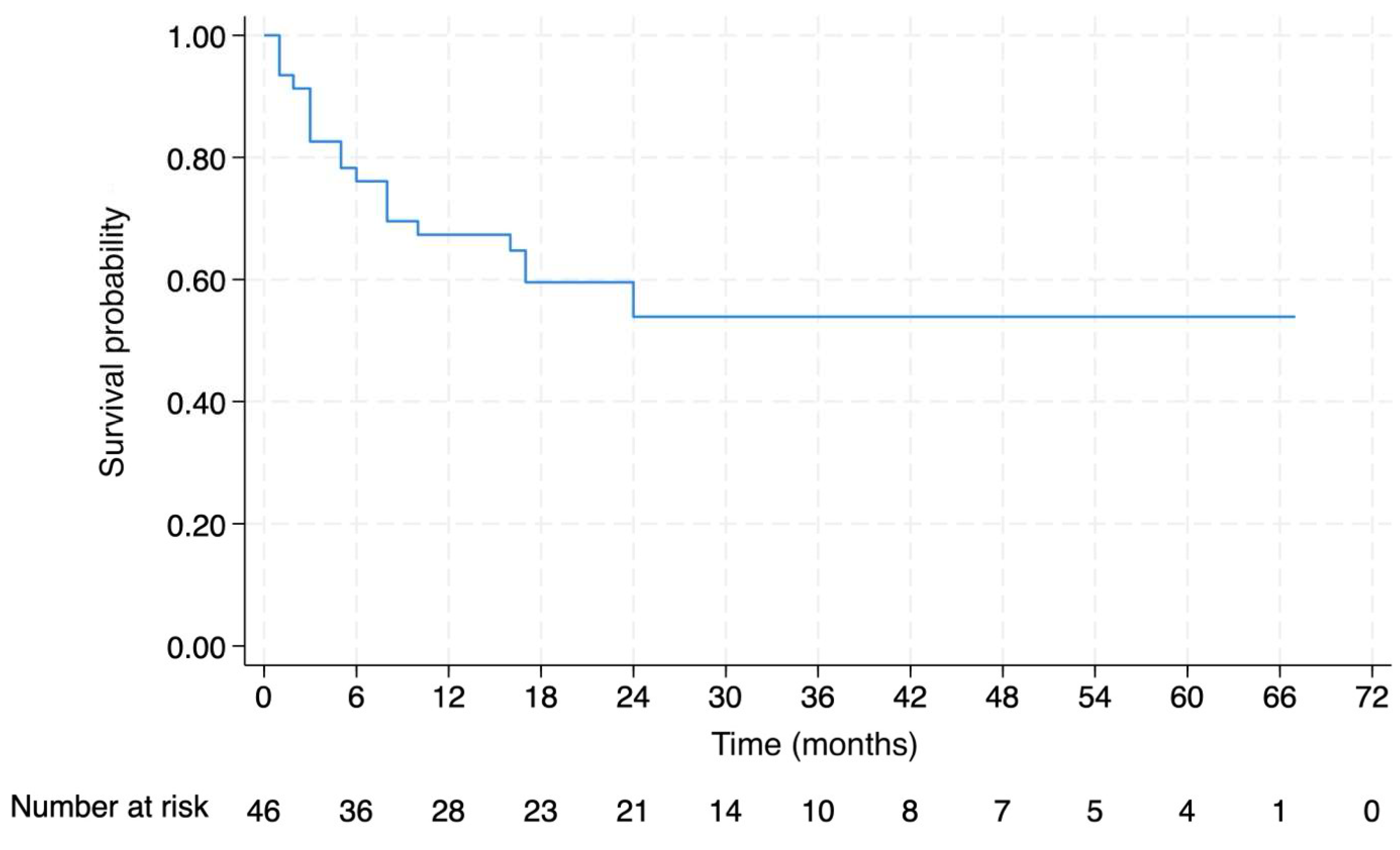
Figure 2.
Distribution and Changes in ER, PR, and HER2 Status Between Primary Breast Tumors and Corresponding Metastases.
Figure 2.
Distribution and Changes in ER, PR, and HER2 Status Between Primary Breast Tumors and Corresponding Metastases.
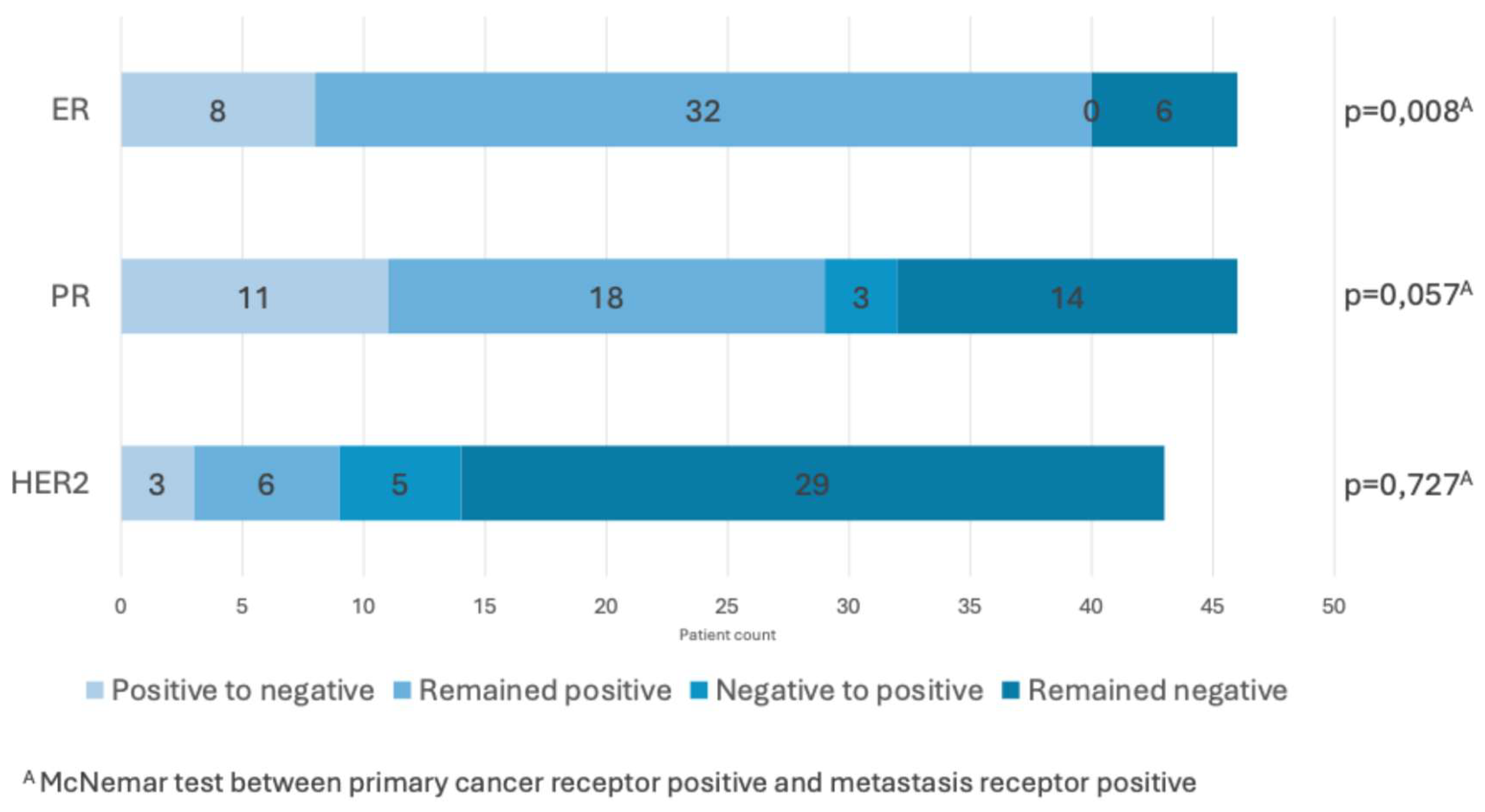
Figure 3.
Kaplan–Meier Survival Curves By Metastatic Site [Pleural Vs. Other].
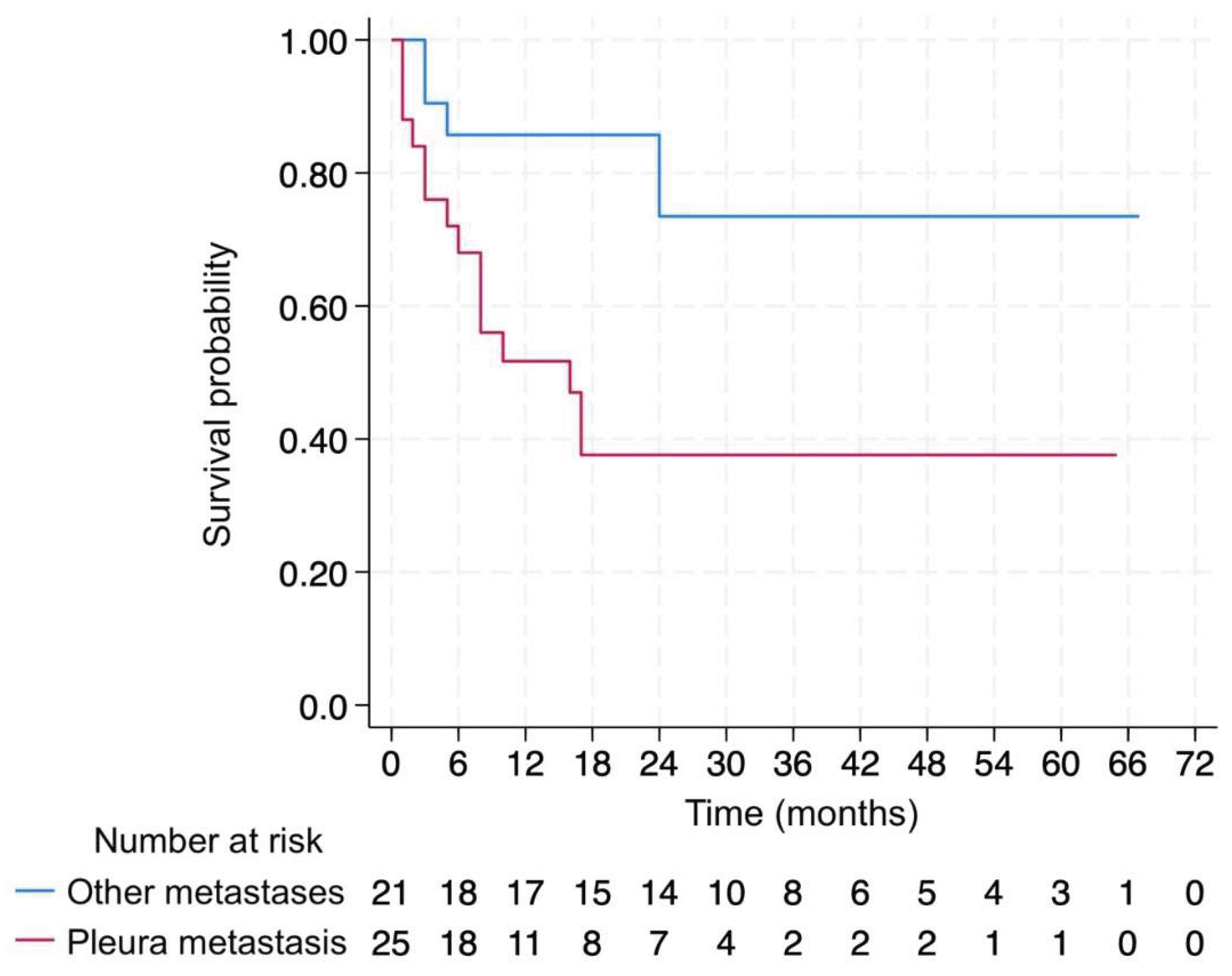

Table 1.
Demographic and Clinical Characteristics of the Patients Included in the Study.
| n=46 | |
| Age at diagnosis [years] | 51.6±13.0 |
| Age range at diagnosis [years] | 26–81 |
| Specimen | |
| Pleura | 25 [54.3%] |
| Lung | 9 [19.6%] |
| Lymph node | 5 [10.9%] |
| Pericardium | 5 [10.9%] |
| Chest wall | 2 [4.3%] |
| Vital status after thoracic metastasis | |
| Alive | 26 [56.5%] |
| Deceased | 20 [43.5%] |
| Follow-up duration after thoracic metastasis [months] | 18 [1–67] |
Table 2.
Univariate Cox Proportional Hazards Models Evaluating Survival After Thoracic Metastasis Based on Metastatic Receptor Status and Receptor Conversion Patterns.
Table 2.
Univariate Cox Proportional Hazards Models Evaluating Survival After Thoracic Metastasis Based on Metastatic Receptor Status and Receptor Conversion Patterns.
| HR [95% CI] | Wald | p-value | |
| Metastasis | |||
| ER negative | 3.306 [1.365–8.011] | 7.014 | 0.008 |
| PR negative | 2.793 [1.065–7.324] | 4.363 | 0.037 |
| HER2 negative | 0.992 [0.322–3.053] | 0.001 | 0.988 |
| Receptor conversion [Metastatic vs primary] | |||
| ER conversion to negative | 3.095 [1.181–8.111] | 5.282 | 0.022 |
| PR conversion to negative | 1.968 [0.751–5.163] | 1.895 | 0.169 |
| HER2 conversion to negative | 0.656 [0.087–4.958] | 0.167 | 0.683 |
HR: Hazard ratio, CI: Confidence interval.
Table 3.
Multivariate Cox Proportional Hazards Analysis of Receptor Conversion and Survival After Thoracic Metastasis.
Table 3.
Multivariate Cox Proportional Hazards Analysis of Receptor Conversion and Survival After Thoracic Metastasis.
| HR [95% CI] | Wald | p-value | |
| Age at diagnosis | 1.020 [0.981–1.062] | 1.016 | 0.313 |
| Pleural metastasis | 3.238 [1.125–9.324] | 4.743 | 0.029 |
| ER conversion to negative | 3.669 [1.362–9.885] | 6.606 | 0.010 |
HR: Hazard ratio, CI: Confidence interval.
Disclaimer/Publisher’s Note: The statements, opinions and data contained in all publications are solely those of the individual author(s) and contributor(s) and not of MDPI and/or the editor(s). MDPI and/or the editor(s) disclaim responsibility for any injury to people or property resulting from any ideas, methods, instructions or products referred to in the content. |
© 2026 by the authors. Licensee MDPI, Basel, Switzerland. This article is an open access article distributed under the terms and conditions of the Creative Commons Attribution (CC BY) license (http://creativecommons.org/licenses/by/4.0/).
Copyright: This open access article is published under a Creative Commons CC BY 4.0 license, which permit the free download, distribution, and reuse, provided that the author and preprint are cited in any reuse.


