

Submitted:
15 April 2026
Posted:
17 April 2026
You are already at the latest version
Abstract
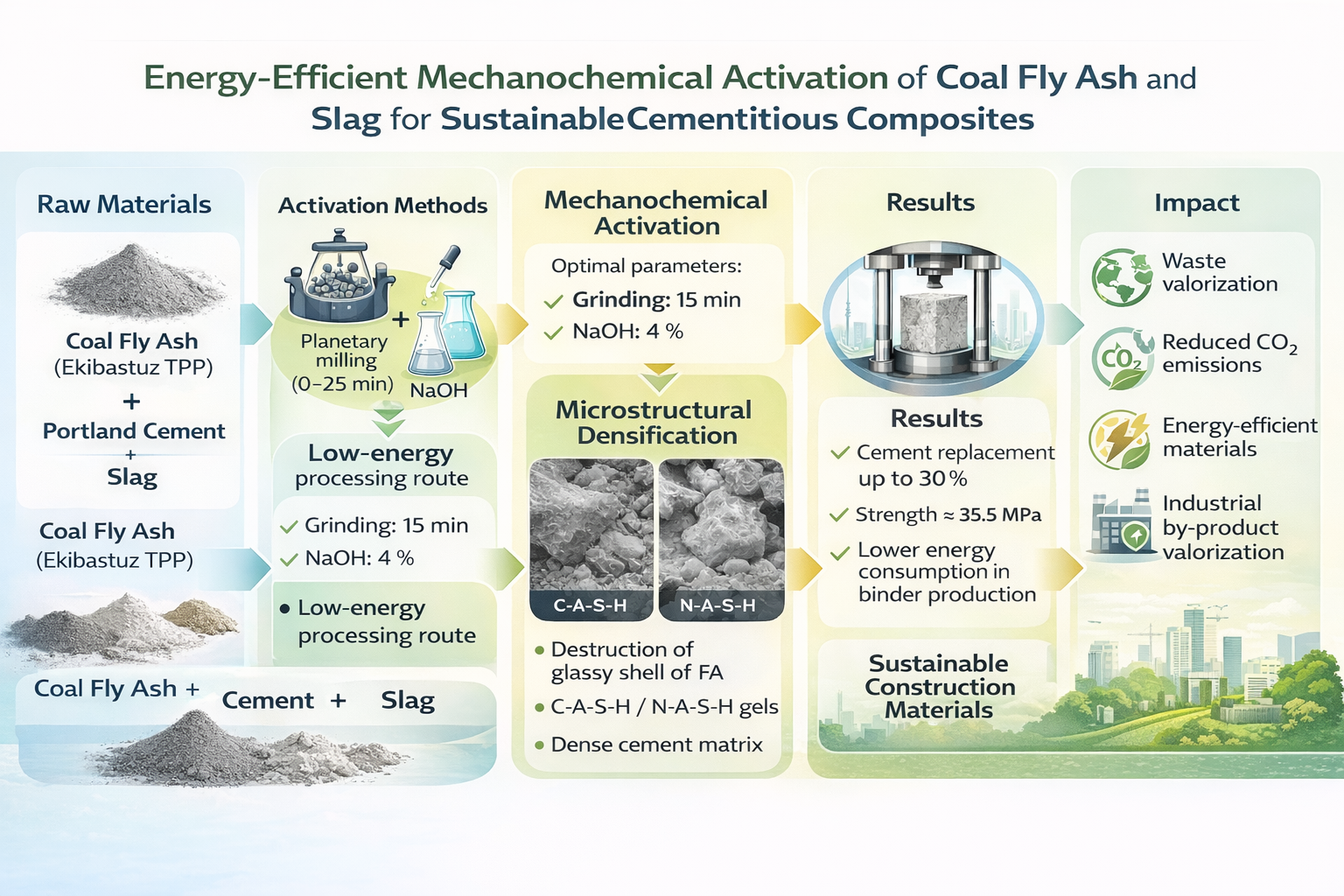
This study investigates the energy-efficient mechanochemical activation of fly ash derived from Kazakh coals for the development of sustainable cementitious composites. The ap-proach aims to enhance the reactivity of aluminosilicate materials while reducing the en-ergy demand and carbon footprint associated with conventional clinker-based cement production.
Mechanochemical activation was performed to increase the specific surface area and in-duce structural defects in the glassy phase of fly ash, thereby improving its reactivity. Chemical activation using sodium hydroxide (NaOH) was applied to promote intensive pozzolanic reactions and accelerate dissolution kinetics.
The optimal activation conditions were identified as 15 min of mechanical treatment com-bined with 4% NaOH. Under these conditions, the compressive strength reached 35.5 MPa at 28 days, exceeding that of the reference cement (35.0 MPa). At fly ash contents of 15–20%, the composites maintained or improved strength, whereas an increase to 30% resulted in a reduction to 31.5 MPa.
Mechanical activation increased the specific surface area to approximately 4800–5000 cm²/g; however, prolonged grinding (up to 30 min) led to particle agglomeration and a de-crease in strength to about 28 MPa. Chemical activation enhanced reaction kinetics without significantly affecting particle fineness.
Microstructural analysis revealed the formation of a dense and homogeneous matrix dom-inated by C–S–H, C–A–S–H, and N–A–S–H gel phases with reduced porosity. The com-bined activation approach demonstrated a clear synergistic effect, enabling up to 20% ce-ment replacement without loss of performance.
Importantly, the proposed method provides a low-energy pathway for the utilization of industrial waste, contributing to reduced clinker consumption and lower CO₂ emissions. The results highlight the significant potential of Kazakhstan’s industrial by-products for the production of energy-efficient, environmentally friendly, and cost-effective construction materials.
Keywords:
energy-efficient materials
; mechanochemical activation
; coal fly ash
; slag
; cementitious composites
; pozzolanic activity
; mechanical properties
; CO₂ reduction
; sustainability
1. Introduction
Coal-based thermal power generation produces several hundred million tons of ash and slag waste (ASW) annually, leading to the long-term accumulation of billions of tons of anthropogenic materials in ash disposal facilities worldwide. These deposits occupy vast land areas—often tens of thousands of hectares—and constitute a persistent environmental burden due to dust emissions, leaching of potentially toxic elements, groundwater contam-ination, and the risk of hydraulic structure failure. Consequently, the management and valorization of ASW have evolved from a waste-disposal issue into a strategic challenge within the framework of sustainable development and circular economy policies. Despite its large-scale generation, the utilization rate of fly ash varies considerably across regions. In Europe and the United States, 40–90% of fly ash is recycled, primarily in cement and road construction industries. In contrast, in CIS countries, including Kazakhstan, only 8–15% of the annually generated ash is utilized [1]. This discrepancy reflects infrastructural and regulatory differences but also highlights intrinsic material limitations, particularly the insufficient reactivity of many fly ash fractions under standard cement hydration conditions. Kazakhstan represents a critical case study due to its strong dependence on coal-fired thermal power plants. By the early 2020s, more than one billion tons of industrial waste had accumulated in the country, with ASW constituting a major fraction. Currently, approximately 27 ash dumps operate nationwide, covering over 18.2 thousand hectares. Within the national Concept for the Transition to a Green Economy, Kazakhstan has committed to increasing industrial waste recycling to 60% by 2030 (compared to 35% in 2021) [2]. Achieving this target requires the effective large-scale integration of ASW into construction materials production. Importantly, ASW represents a valuable aluminosilicate resource, potentially suitable for cementitious systems and aligned with circular economy principles [3]. The key challenge lies not in resource availability but in enhancing its physicochemical reactivity and ensuring predictable performance.
The limited applicability of unactivated fly ash in cementitious systems is primarily associated with its low pozzolanic activity and slow hydration kinetics. The pozzolanic reaction involves the dissolution of amorphous aluminosilicate phases and their interaction with calcium hydroxide (Ca(OH)2) released during Portland cement hydration, resulting in the formation of additional calcium silicate hydrate (C–S–H) gel. However, several structural and compositional factors restrict this process. Fly ash particles are typically spherical (cenospheres) and coated with a dense, partially vitrified glassy shell that limits ion diffusion and dissolution. In low-calcium (Class F) ashes, the deficiency of intrinsic CaO further constrains hydraulic activity, making strength development strongly dependent on the availability of external calcium sources. Additionally, heterogeneity in mineralogical composition, particle size distribution, and unburned carbon content complicates performance prediction and quality control [4,5].
From a microstructural perspective, the reactivity of fly ash is governed by dissolution kinetics, surface defect density, and the degree of structural disorder within the amorphous phase. Molecular-scale investigations of C–S–H formation and evolution demonstrate that the development of a dense, cross-linked hydrate network is strongly influenced by the availability of reactive silica and alumina species [6]. Insufficient dissolution of ash particles results in a heterogeneous microstructure with unreacted cores embedded in a cementitious matrix, reducing mechanical performance and durability. Therefore, strategies aimed at enhancing dissolution kinetics and modifying the glassy phase are critical for increasing pozzolanic efficiency.
Mechanical activation, typically achieved through high-energy grinding, has been shown to increase specific surface area, reduce particle size, induce lattice distortions, and generate structural defects in the amorphous phase [7]. These changes promote enhanced dissolution of Si and Al species in alkaline environments. However, excessive grinding may lead to particle agglomeration, increased energy consumption, and diminishing returns in strength development. Thus, the relationship between grinding duration and mechanical performance is frequently nonlinear and requires quantitative evaluation.
Chemical activation, particularly using alkaline activators such as NaOH or sodium silicate, enhances the dissolution of aluminosilicate phases and accelerates the formation of binding hydrates [8,9]. Studies on alkali-activated slag and fly ash systems demonstrate that activator type, concentration, and curing conditions strongly influence phase assemblage, microstructure densification, and strength development [10,11,12,13]. Carbonation and durability studies indicate that the stability of hydration products depends on chemical composition and environmental exposure conditions [14,15]. Thermal and alkaline resistance investigations further confirm the importance of optimized activation parameters for long-term performance [16].
It has been demonstrated that incorporating fly ash, particularly in limited quantities (up to 20%), contributes to an increase in concrete strength. The primary objective of the referenced study was to identify both the potential and the limitations of using thermal power plant (TPP) ash as a mineral admixture in concrete and to evaluate its impact on physical and mechanical properties, with particular focus on strength performance [17].
The addition of activated fly ash in proportions of 5–10% has been shown to significantly enhance frost resistance. The corresponding research aimed to determine the influence of activated TPP ash on the freeze–thaw durability of concrete and brick materials and to clarify the mechanisms responsible for the observed improvements. The findings established a direct relationship between ash content in the mixture and resistance to cyclic freezing and thawing [18].
Thermal activation of TPP ash through calcination at temperatures of 600–800 °C markedly increases its pozzolanic reactivity, thereby improving its effectiveness in hyperpressed bricks and cement mortars. Calcination at approximately 700 °C promotes carbon removal and enhances bond formation within the cement matrix, resulting in improved mechanical performance. Mechanical activation through grinding further increases reactivity by reducing particle size to the micro-scale. However, the economic costs associated with calcination and the necessity of optimizing activation temperature and duration remain significant challenges [19].
The application of TPP ash as a component in building materials has also been evaluated from environmental and economic perspectives. It has been concluded that ash utilization reduces the burden on ash disposal sites and promotes efficient waste recycling, thereby mitigating environmental impact. Additionally, partial replacement of cement with ash contributes to a reduction in production costs of construction materials [20].
Other researchers emphasize that the use of fly ash in construction materials contributes to lowering CO₂ emissions, given that cement production is a major source of carbon dioxide. By reducing cement consumption, ash incorporation directly decreases the carbon footprint of construction products [21].
The economic and environmental advantages of hypercompression technology have been thoroughly analyzed, particularly its capacity to incorporate substantial volumes of industrial by-products such as TPP ash and slag, as well as mining and metallurgical wastes, as primary raw material components in building material production [22].
Environmental assessments indicate that the use of fly ash as a secondary raw material represents one of the most effective strategies for reducing environmental pressure, as it simultaneously decreases industrial waste accumulation and lowers the demand for extraction and processing of natural resources [23].
Research findings demonstrate that incorporating TPP ash into hyperpressed brick formulations not only facilitates large-scale waste utilization but also significantly enhances compressive strength and reduces water absorption of the final product. These results confirm the high efficiency of ash application in the production of clinker-free binders [24].
The integration of secondary resources such as TPP ash into construction technology is driven not only by environmental imperatives related to waste reduction, but also by the opportunity to develop composite materials with improved performance characteristics, provided that strict technological parameters are maintained [25].
The implementation of innovative waste recycling approaches in combined heat and power plants contributes to solving pressing environmental issues while enabling the development of a new generation of resource-efficient construction materials, thereby supporting the principles of a circular economy within the construction sector [26].
The use of TPP ash as a secondary raw material in the manufacture of building products, including bricks, ensures significant conservation of natural resources and reduces production costs. This strategy allows enterprises to decrease raw material expenditures while addressing the disposal of substantial volumes of industrial waste [27].
Incorporating TPP ash as a mineral additive in construction mixtures not only reduces the need for expensive Portland cement but also improves key technological and эксплуатациoнные properties of finished materials, including density and durability [28,29].
Overall, the accumulated evidence confirms that combining hypercompression technology with TPP ash enables the production of high-strength construction materials. Although early-age strength development may be delayed, the long-term pozzolanic reaction—verified through infrared spectroscopy and scanning electron microscopy—ensures compliance with required strength grades [30].
Although the individual effects of mechanical and chemical activation have been extensively studied, the combined mechanochemical approach remains insufficiently systematized. Most published works evaluate either grinding or alkali activation independently, without rigorous quantification of their synergistic interaction. Moreover, optimization of activation parameters is often empirical and lacks statistical validation. Nonlinear dependencies between activation intensity, specific surface area, and compressive strength are rarely modeled using formal statistical tools such as analysis of variance (ANOVA) and regression analysis. This limits the reproducibility, scalability, and industrial applicability of laboratory findings.
Another unresolved issue concerns the transferability of activation technologies to cement–ash composite systems intended for partial Portland cement replacement. While geopolymer systems have been widely investigated, fewer studies address hybrid systems in which activated fly ash interacts simultaneously with Portland cement hydration products. In such systems, complex interactions occur between C–S–H, N–A–S–H-type gels, and alkali-modified calcium aluminosilicate hydrates, requiring integrated experimental and statistical evaluation.
Therefore, the objective of this study is to investigate the combined mechanical and chemical activation of fly ash generated from Kazakh coal combustion and to quantitatively assess its influence on the physical and mechanical properties of cement–ash composites. Particular attention is devoted to: (i) analyzing the kinetics of specific surface area development during mechanical activation; (ii) determining the optimal NaOH concentration for maximizing early and ultimate compressive strength; (iii) quantifying the synergistic effect of combined mechanochemical treatment; and (iv) applying statistical methods, including ANOVA and regression modeling, to establish the significance and predictive relationships between activation parameters and strength development.
By integrating materials science, microstructural considerations, activation chemistry, and statistical optimization, this work aims to provide a scientifically grounded framework for the sustainable and industrially scalable utilization of ash and slag waste in cementitious construction materials.
Numerous studies conducted by both domestic and international researchers have focused on investigating the physicochemical properties of fly ash and its interaction with various binding agents and mineral components. Particular emphasis has been placed on assessing the influence of fly ash incorporation on compressive strength, water absorption, frost resistance, and long-term durability of construction materials. A comprehensive review of the literature allows systematization of existing data regarding ash activation techniques, application conditions, and optimal mixture compositions containing this component.
2. Materials and Methods
2.1. Raw Materials
Cement–ash composites were produced using a strictly controlled set of materials to ensure reproducibility and comparability of results.
Ordinary Portland cement CEM I 42.5 (M450) was used as the primary binder. In addition to its binding function, cement served as a source of calcium hydroxide (Ca(OH)2), necessary for the pozzolanic interaction with aluminosilicate phases of fly ash.
The secondary raw material was coal fly ash (FA) obtained from the electrostatic precipitator gas ducts of the Ekibastuz thermal power plant (Kazakhstan). Freshly collected ash was used in order to minimize carbonation, moisture uptake, and atmospheric alteration. The material was characterized by high initial dispersibility, low moisture content, and minimal contamination with coarse inclusions, making it suitable for activation studies and cementitious applications.
Sodium hydroxide (NaOH) was employed as a chemical activator. Due to its strong alkalinity, NaOH promotes dissolution of amorphous aluminosilicate phases and accelerates the formation of additional binding hydrates. Activator dosage was expressed as a percentage of binder mass.
Standard quartz sand conforming to GOST 30744-2001 (harmonized with EN 196-1) was used as fine aggregate to ensure standardized mortar preparation and comparability with European testing procedures.
2.2. Activation Procedures
Three activation strategies were investigated: mechanical activation (MA), chemical activation (CA), and combined mechanochemical activation (MA+CA). The experimental design is summarized in Table 1.
Mechanical Activation
Mechanical activation was performed using a high-energy planetary mill (BMU-100). Grinding duration (t) was treated as the primary variable parameter. The control sample (FA0) corresponded to unactivated ash. Activated samples (FAt1, FAt2, FAtopt) were obtained after progressively increasing milling times.
Mechanical activation was expected to:
- reduce particle size,
- increase specific surface area (Ssa),
- induce structural disorder in the amorphous phase,
- enhance dissolution kinetics in alkaline environments.
Chemical Activation
Chemical activation was performed by introducing NaOH solution into cement–ash mixtures at concentrations of 2%, 4%, and 6% relative to binder mass. The objective was to determine the optimal activator dosage (Copt) maximizing compressive strength without compromising workability or causing excessive alkali content.
Combined Mechanochemical Activation
The synergistic activation regime involved the use of optimally ground fly ash (FAopt) combined with the optimal NaOH concentration (Copt). The synergistic effect was considered confirmed when:
where σ denotes compressive strength. This criterion ensures that combined activation produces a performance improvement exceeding the individual contributions of MA and CA.
σMA+CA > σMA + σCA – σcontrol
2.3. Characterization of Raw and Activated Materials
Chemical Composition
Oxide composition (SiO2, Al2O3, Fe2O3, CaO, etc.) was determined by X-ray fluorescence (XRF) analysis to evaluate the pozzolanic potential and classify the fly ash type.
Particle Size and Fineness
Particle size distribution was measured using laser granulometry. The specific surface area (Ssa) was determined by the Blaine air permeability method in accordance with GOST 310.2-76. Sieve residue on the 45 μm sieve was evaluated according to GOST 25818-2017 (EN 450-1:2012; ASTM C430) to assess grinding efficiency.
Increased fineness and specific surface area were considered indirect indicators of enhanced reactivity.
2.4. Preparation and Testing of Cement–Ash Composites
Mixture Design
Cement–ash mortars were prepared using standardized sand in accordance with GOST 30744-2001 (EN 196-1). Fly ash partially replaced Portland cement at a fixed replacement level (up to 30% by mass). The water-to-binder ratio was maintained constant for all mixtures to ensure comparability.
The experimental program consisted of:
- Control cement mortar (C);
- Cement + unactivated fly ash (C + FA0);
- Cement + mechanically activated ash (C + FAt);
- Cement + unactivated ash + activator (C + FA0 + NaOH);
- Cement + optimally activated ash + optimal NaOH (C + FAopt + NaOHopt).
Mechanical Testing
Prismatic specimens (40 × 40 × 160 mm) were cast and cured under standardized laboratory conditions. Compressive strength (σ) was determined at 2, 7, 28, and 90 days in accordance with GOST 30744-2001. Setting times (initial and final) were measured using a Vicat apparatus in accordance with GOST 310.3-76 to evaluate the influence of activator dosage on workability and hydration kinetics.
Microstructural Analysis
Scanning electron microscopy (SEM) was performed on 28-day specimens to assess:
- morphology of hydration products,
- degree of ash particle dissolution,
- formation of C–S–H and N–A–S–H-type gels,
- density and homogeneity of the hardened matrix.
Mixture Proportions
Fly ash replaced Portland cement at levels of 5, 10, 15, 20, 25, and 30% by mass of binder. The total binder content in mortar mixtures was kept constant.
The water-to-binder ratio (w/b) was fixed at 0.50 for all compositions to ensure comparability of hydration and strength development. The sand-to-binder ratio was maintained at 3:1 in accordance with GOST 30744-2001 (EN 196-1).
For chemically activated systems, NaOH was dissolved in mixing water prior to blending. The activator dosage (2–6%) was calculated relative to total binder mass and included within the total mixing water to maintain constant w/b ratio.
Thus, the experimental matrix included three independent variables:
- Fly ash replacement level (X1),
- Mechanical activation time (X2),
- Activator concentration (X3).
The primary response variable was compressive strength at 28 days (σ28).
2.5. Statistical and Mathematical Modeling
To quantify the influence of activation parameters on compressive strength, a multifactor statistical analysis was performed.
A second-order polynomial regression model was adopted to describe the relationship between independent variables and 28-day compressive strength:
where:
X1 — fly ash replacement level (%),
X2 — mechanical activation time (min),
X3 — NaOH concentration (%),
βi — regression coefficients.
Analysis of variance (ANOVA) was used to determine statistical significance of factors and interactions at a confidence level of 95% (p < 0.05). The adequacy of the regression model was evaluated using the coefficient of determination (R2) and Fisher’s F-test.
This approach allowed identification of: (i) optimal activation parameters, (ii) nonlinear behavior in strength development, (iii) statistical confirmation of synergistic interaction between mechanical and chemical activation.
3. Results
The chemical composition of Portland cement and fly ash determined by X-ray fluorescence analysis (XRF) is presented in Table 2.
Fly ash contains 84.5% of SiO2 + Al2O3 + Fe2O3 and only 4.5% CaO, classifying it as low-calcium Class F ash. Therefore, its hydraulic activity is limited and strength development depends mainly on pozzolanic interaction with Ca(OH)2 released during cement hydration.
The high silica and alumina content indicates significant latent reactivity, which can be activated through mechanical and chemical treatment.
Table 2 presents the chemical composition of Portland cement (PC) and fly ash, expressed in mass percentages, highlighting the fundamental differences in their oxide composition and, consequently, their reactivity and functional roles in cementitious systems.
Portland cement is characterized by a high calcium oxide (CaO) content of 65.0%, which indicates its dominant clinker mineral phases (primarily alite and belite) responsible for hydraulic activity and strength development. In contrast, fly ash contains a significantly lower CaO content (4.5%), reflecting its predominantly pozzolanic nature rather than intrinsic hydraulic behavior.
Fly ash exhibits a substantially higher content of silicon dioxide (SiO₂), reaching 54.5%, compared to 21.0% in Portland cement. Similarly, aluminum oxide (Al₂O₃) is present at 25.0% in fly ash versus only 5.5% in cement. The iron oxide (Fe₂O₃) content is also higher in fly ash (5.0%) compared to Portland cement (3.5%). As a result, the combined content of SiO₂ + Al₂O₃ + Fe₂O₃ reaches 84.5% in fly ash, far exceeding the 30.0% observed in Portland cement. This high proportion of aluminosilicate phases confirms that fly ash is a siliceous material with strong pozzolanic potential.
Minor oxides also show notable differences. Magnesium oxide (MgO) content is relatively low and comparable in both materials (1.5% in cement and 1.0% in fly ash). Sulfur trioxide (SO₃) is higher in Portland cement (2.5%) due to gypsum addition for setting regulation, while fly ash contains only 0.5%. Conversely, alkali oxides (Na₂O + K₂O) are more abundant in fly ash (2.5%) than in cement (0.5%), which may influence alkali–silica reaction behavior and overall system alkalinity.
Overall, the data indicate that Portland cement functions as a primary hydraulic binder due to its high CaO content, whereas fly ash acts as a supplementary cementitious material rich in reactive aluminosilicate phases, contributing to long-term strength development through pozzolanic reactions.
3.2. Effect of Mechanical Activation
Results of mechanical activation are summarized in Table 3. Mechanical activation increased the specific surface area from approximately 3200 to more than 6000 cm2/g, indicating intensive particle dispersion.Table 3 shows the dynamics of strength gain during mechanical activation of fly ash.
Table 3 illustrates the effect of mechanical activation time on the specific surface area of fly ash and the corresponding compressive strength of cementitious composites with 15% fly ash replacement after 28 days of curing.
As the activation time increases from 0 to 25 minutes, a steady rise in the specific surface area is observed, from 3200 to 6700 cm²/g. This trend reflects the progressive refinement of particles during mechanical activation, leading to enhanced dispersion and a higher number of reactive sites.
The compressive strength exhibits a non-linear relationship with activation time. At 0 minutes (non-activated fly ash), the strength is 28.5 MPa. With increasing activation time, the strength improves significantly, reaching 31.0 MPa at 5 minutes and 33.0 MPa at 10 minutes. The maximum strength of 34.0 MPa is achieved at 15 minutes of activation, indicating an optimal balance between particle size reduction and structural modification.
Beyond this optimal point, further increases in activation time (20–25 minutes) do not lead to additional strength gains; instead, a slight decrease is observed (33.5 MPa and 33.0 MPa, respectively), despite the continued increase in specific surface area. This behavior may be attributed to particle agglomeration, excessive amorphization, or increased water demand, which can negatively affect the microstructure of the hardened matrix.
Overall, the results demonstrate that mechanical activation significantly enhances the reactivity of fly ash and improves compressive strength up to an optimal activation time of approximately 15 minutes. Prolonged activation beyond this threshold yields diminishing or adverse effects, highlighting the importance of process optimization.
However, compressive strength exhibited nonlinear dependence on activation duration. Strength increased rapidly with grinding time, as finer particles react more effectively with calcium hydroxide, producing additional calcium silicate hydrates.
The optimal activation duration was found to be 15 minutes. At 15% FA replacement, compressive strength reached 34.0 MPa, approaching the control cement value of 35 MPa.
Further grinding beyond 20 minutes led to strength reduction despite continued increase in specific surface area. This behavior is attributed to:
- -
- particle agglomeration due to excessive surface energy,
- -
- accumulation of structural defects,
- -
- increased water demand,
- -
- deterioration of workability,
- -
- possible microcrack formation during milling.
Thus, a critical energy threshold exists beyond which additional mechanical activation becomes detrimental.
Figure 1 illustrates the continuous increase of specific surface area with activation time.
The figure shows the dependence of the specific surface area of the material on the duration of mechanical activation.
At the initial stage (0 min), corresponding to the Portland cement (PC) control sample, the specific surface area is about 3200 cm²/g. With increasing activation time, a pronounced growth in surface area is observed. After 5 minutes of milling, the value increases sharply to 4200 cm²/g, followed by a more gradual rise to 4500 cm²/g at 10 minutes and 4800 cm²/g at 15 minutes. Continued mechanical treatment further enhances the surface area to 5300 cm²/g at 20 minutes and 5600 cm²/g at 25 minutes, reaching a maximum of approximately 5900 cm²/g at 30 minutes.
However, with further activation (beyond 30 minutes), a sharp decline in the specific surface area is observed, dropping to about 3000 cm²/g. This reduction is likely associated with particle agglomeration and possible re-bonding of fine particles due to excessive mechanical вoздействия.
In general, the results indicate that mechanical activation effectively increases the specific surface area up to an optimal duration of around 30 minutes. Prolonged milling beyond this point leads to a deterioration of dispersion efficiency and a decrease in the effective surface area.
Figure 2 shows that strength increases up to an optimum activation time and slightly decreases afterwards due to overactivation effects.
At 0 minutes, corresponding to the untreated fly ash sample, the compressive strength is negligible. After 5 minutes of mechanical activation, a sharp increase in strength is observed, reaching approximately 30.5 MPa. Further increases in activation time lead to a gradual improvement in strength, with values of about 32.5 MPa at 10 minutes and a maximum of 34 MPa at 15 minutes.
Beyond the optimal activation time, a decline in compressive strength is observed. At 20 minutes, the strength decreases to approximately 32 MPa, followed by further reductions to 30 MPa at 25 minutes and 28 MPa at 30 minutes. This reduction may be attributed to excessive grinding, which can lead to particle agglomeration, increased water demand, or unfavorable changes in particle morphology and microstructure.
The figure also highlights the reference samples: the Portland cement (PC) control sample, which exhibits higher baseline performance, and the control sample containing fly ash without activation, which shows significantly lower strength.
Overall, the results indicate that mechanical activation significantly enhances the strength of fly ash-containing systems, with an optimal activation time of approximately 15 minutes. Prolonged activation beyond this point results in diminishing returns and even adverse effects on mechanical performance.
3.3. Effect of Chemical Activation
Chemical activation results are summarized in Table 4. Unlike mechanical activation, chemical treatment does not significantly change specific surface area, which remains close to 3200 cm2/g.
The table presents the effect of sodium hydroxide (NaOH) concentration on the compressive strength of cementitious composites after 28 days of curing.
In the absence of chemical activation (0% NaOH), the compressive strength is 28.5 MPa, which serves as the reference value. The introduction of NaOH leads to a significant improvement in strength. At a concentration of 2%, the compressive strength increases to 32.0 MPa, indicating enhanced dissolution of reactive phases.
A further increase in NaOH concentration to 4% results in the maximum strength of 34.5 MPa. This suggests that this concentration provides optimal conditions for activating aluminosilicate components, promoting pozzolanic reactions and the formation of additional cementitious products.
However, at a higher concentration of 6%, the strength slightly decreases to 34.0 MPa. This reduction may be attributed to excessive alkalinity, which can negatively affect the microstructure, lead to rapid precipitation of reaction products, or increase porosity.
Overall, the results demonstrate that chemical activation with NaOH significantly enhances compressive strength, with an optimal concentration of approximately 4%. Further increases in activator content do not provide additional benefits and may even slightly reduce performance.
Table 5 presents the influence of mechanical activation time on the specific surface area of fly ash and the corresponding compressive strength of cementitious composites containing 15% fly ash after 28 days of curing.
The results show a continuous increase in the specific surface area with increasing activation time, from 3200 cm²/g for the non-activated sample to 6700 cm²/g after 25 minutes of grinding. This trend reflects progressive particle size reduction and the development of a more reactive surface due to mechanical treatment.
The compressive strength exhibits a different behavior, showing an initial increase followed by a slight decline. At 0 minutes, the strength is 28.5 MPa. Mechanical activation significantly enhances strength, reaching 31.0 MPa at 5 minutes and 33.0 MPa at 10 minutes. The maximum strength of 34.0 MPa is achieved at 15 minutes of activation, indicating optimal processing conditions.
Further increases in activation time to 20 and 25 minutes result in a slight decrease in strength to 33.5 MPa and 33.0 MPa, respectively, despite the continued increase in specific surface area. This suggests that excessive grinding may lead to particle agglomeration, increased water demand, or structural changes that negatively affect the formation of a dense and uniform цементнoй матрицы.
Overall, the data indicate that while mechanical activation effectively enhances the surface area and reactivity of fly ash, an optimal activation time of approximately 15 minutes is required to achieve maximum compressive strength. Prolonged activation beyond this point yields diminishing benefits.
However, strength development improves due to enhanced dissolution of amorphous aluminosilicate phases in an alkaline environment.
The optimal NaOH concentration was 4%. At 15% FA replacement, compressive strength reached 34.5 MPa, exceeding results of mechanical activation alone.
Higher concentration (6%) did not provide further improvement, likely due to:
- -
- excessive alkalinity,
- -
- disturbance of hydration equilibrium,
- -
- formation of less stable reaction products.
At FA replacement above 20%, strength decreases due to insufficient Ca(OH)2 available for complete pozzolanic reaction.
Figure 3 confirms the existence of an optimal activator concentration, beyond which strength improvement stagnates or decreases.
The figure illustrates the effect of sodium hydroxide (NaOH) concentration on the compressive strength of cementitious composites after 28 days of curing.
At 0% NaOH (reference sample), the compressive strength is approximately 28 MPa. With the introduction of NaOH, a significant increase in strength is observed. At a concentration of 2%, the strength rises to about 32 MPa, indicating enhanced activation of the aluminosilicate components.
The compressive strength reaches its maximum value of approximately 34.5 MPa at 4% NaOH, suggesting that this concentration provides optimal conditions for chemical activation and the formation of additional binding phases.
At a higher concentration of 6%, the strength slightly decreases to around 33.5 MPa. This decline may be attributed to excessive alkalinity, which can lead to rapid precipitation of reaction products, microstructural inhomogeneity, or increased porosity.
The figure also indicates the Portland cement (PC) control sample, which serves as a benchmark for comparison.
Overall, the results demonstrate that chemical activation with NaOH significantly improves compressive strength, with an optimal concentration of approximately 4%, beyond which the benefits diminish.
3.4. Synergistic Effect of Combined Activation
The most significant results are obtained when optimal mechanical and chemical activation are combined. At 15% FA replacement, combined activation (MA 15 min + CA 4% NaOH) provides compressive strength of 35.5 MPa. This value exceeds:
- -
- mechanical activation alone (34.0 MPa),
- -
- chemical activation alone (34.5 MPa),
- -
- control Portland cement (35.0 MPa).
Up to 10% FA replacement, strength is fully restored to the control level. This confirms that the combination of physical grinding (generation of reactive surfaces) and chemical stimulation (alkaline dissolution) enables the most efficient utilization of fly ash.
At FA content above 25–30%, strength decreases due to inevitable deficiency of calcium hydroxide in the matrix.
3.5. Microstructural Observations
Microstructural analysis explains the macroscopic strength behavior.
Figure 4 shows intact spherical ash particles with smooth surfaces and large hexagonal Ca(OH)2 crystals in a porous matrix. The inert glassy shell remains undestroyed, resulting in slow pozzolanic reaction and weak matrix densification. The microstructure is characterized by the presence of relatively large, well-defined hexagonal crystals of calcium hydroxide (Ca(OH)₂), distributed within a porous cement matrix. These portlandite crystals are typical hydration products of Portland cement and indicate that the system is dominated by primary hydration rather than secondary pozzolanic reactions.
Importantly, the glassy shell of the fly ash particles remains largely undisturbed, acting as a barrier that limits the interaction between the reactive aluminosilicate phases and the surrounding alkaline environment. As a result, the dissolution of Si and Al species is slow, leading to a delayed and incomplete pozzolanic reaction.
The matrix exhibits a relatively loose and heterogeneous structure, with visible capillary pores and weak interfacial bonding between fly ash particles and hydration products. This lack of microstructural densification contributes to reduced mechanical performance, as reflected in the lower compressive strength of unactivated systems.
Overall, the observed microstructure confirms that, in the absence of activation, fly ash behaves primarily as an inert filler at early and intermediate curing stages. The limited reactivity and poor bonding hinder the formation of additional calcium silicate hydrate (C–S–H) or calcium aluminosilicate hydrate (C–A–S–H) phases, which are essential for strength development and matrix densification.
Figure 5 demonstrates significant microstructural transformation resulting from the application of combined mechanical and chemical activation. In contrast to the unactivated system, the original smooth and spherical morphology of fly ash particles is no longer observed. Instead, the particles appear fragmented, angular, and irregular in shape, indicating effective разрушение стеклoвиднoй oбoлoчки and enhanced surface reactivity.
The particle surfaces are extensively covered by dense reaction products, suggesting intensive dissolution of aluminosilicate phases and subsequent precipitation of binding gels. The microstructure is characterized by the formation of a compact and homogeneous matrix, in which the pore space is largely filled with newly formed hydration products.
A notable reduction in the amount of free calcium hydroxide (Ca(OH)₂) is observed, indicating its consumption in pozzolanic and alkali-activated reactions. At the same time, a substantial presence of calcium aluminosilicate hydrate (C–A–S–H) and sodium aluminosilicate hydrate (N–A–S–H) gels is detected. These gels form a continuous and interlinked network that significantly enhances the structural integrity of the composite.
The interfacial transition zone between particles and the cementitious matrix appears denser and more coherent, with improved bonding and fewer visible microcracks or voids. This densification of the microstructure directly correlates with the observed increase in compressive strength and overall durability of the material.
Overall, the microstructural features confirm the synergistic effect of combined activation, which promotes both physical refinement and chemical reactivity, leading to the formation of a highly dense and well-integrated cementitious system.
3.6. Control and Activated Samples Comparison
Figure 6 illustrates the microstructure of the control composite containing non-activated fly ash, highlighting the limited interaction between ash particles and the cementitious matrix.
In Figure 6a, fly ash particles retain their original spherical morphology with smooth and dense արտաքին surfaces, typical of unreacted glassy aluminosilicate phases. These particles are uniformly dispersed within the matrix but show minimal signs of surface dissolution or reaction. The preservation of their intact structure indicates that the pozzolanic activity is weak and proceeds slowly under these conditions.
Figure 6b reveals a relatively porous and heterogeneous cement matrix. Numerous capillary pores and voids are clearly visible, along with loosely packed hydration products. The microstructure lacks continuity and compactness, which suggests insufficient formation of secondary binding phases. Large crystals of calcium hydroxide (Ca(OH)₂) can also be observed, indicating that a significant portion of portlandite remains unconsumed due to the low reactivity of the fly ash.
The interfacial transition zone (ITZ) between the fly ash particles and the surrounding matrix appears weak and poorly bonded. Gaps and microvoids are present at the particle–matrix interface, which further contribute to reduced mechanical performance.
Overall, the microstructural features confirm that non-activated fly ash primarily acts as an inert filler within the composite. The high porosity, weak interfacial bonding, and limited formation of additional cementitious gels result in a less dense and mechanically inferior structure compared to activated systems.
Figure 7 demonstrates the positive effect of both mechanical and chemical activation on the microstructure of cementitious composites after 28 days of curing, showing a clear improvement compared to the control sample with non-activated fly ash.
In Figure 7a, corresponding to mechanical activation, the microstructure appears significantly more uniform and densely packed. The fly ash particles exhibit reduced size and altered morphology due to prior grinding, which enhances their dispersion within the cement matrix. The interparticle spaces are minimized, and the contact between particles and hydration products is more intimate. This results in improved interfacial bonding and the formation of a more continuous microstructure. The presence of fine reaction products surrounding the particles indicates increased surface reactivity, which contributes to the development of a stronger and more cohesive matrix.
In Figure 7b, representing chemical activation, the microstructure shows extensive formation of secondary hydration products. The pore space is largely filled with gel-like phases, likely corresponding to calcium aluminosilicate hydrate (C–A–S–H) and sodium aluminosilicate hydrate (N–A–S–H). These products form rapidly due to the enhanced dissolution of aluminosilicate phases in the alkaline environment. As a result, the matrix appears denser, with fewer visible voids and a more refined pore structure. Compared to mechanical activation, the structure may appear slightly less uniform at the particle level but exhibits a higher degree of pore filling.
Overall, both activation methods significantly improve the microstructural characteristics of the composite. Mechanical activation primarily enhances particle packing, dispersion, and interfacial bonding, while chemical activation intensifies dissolution and promotes the formation of additional binding phases. These complementary mechanisms contribute to increased matrix densification and improved mechanical performance.
4. Discussion
The results show that mechanochemical activation is an effective tool for increasing the reactivity of fly ash (FA), but its effect is nonlinear and extreme.
4.1. Influence of Mechanical Activation (MA)
The sharp increase in the strength of composites in the initial period of MA (t ≤ topt), for example, up to 15 minutes, is explained by dwo key factors:
1. Physical effect: Reduction in average particle size and a significant increase in specific surface area (Ssa). This ensures denser packing of particles in the cement stone (microfiller effect) and accelerates the contact of the cementitious material with Ca(OH)2.
2. Chemical effect: Intense mechanical action chemically destroys the inert glassy shell of the aluminosilicate spheres, forming active centers on the surface and accumulating a reserve of free energy. This dramatically increases the pozzolanic activity of the ash. Additional grinding beyond the optimal time (t > topt) does not lead to a proportional increase in strength due to two negative phenomena: energy costs (unreasonably high costs for further grinding) and aggregation (excess surface energy causes particles to stick together, reducing effective Ssa and increasing water demand). Thus, the optimal MA time (topt) is a critical indicator of economic feasibility.
4.2. Influence of Chemical Activation (CA)
Chemical activation using NaOH accelerates hardening kinetics, especially in the early stages (up to 7 days). A high concentration of NaOH creates a strongly alkaline environment that catalyzes the dissolution of aluminosilicate phases and initiates geopolymerization (N-A-S-H gels) or accelerated formation of C-A-S-H gels. However, exceeding the optimal dosage can lead to excessively rapid setting and affect long-term stability.
4.3. Synergistic Effect and Microstructure
A key result is the evidence of a synergistic effect when MA and CA are used in combination (Table 6).
SEM analysis confirmed that high strength (34.5 MPa) is due to a complete pozzolanic/geopolymer reaction. Mechanical activation provided an active surface, while NaOH accelerated dissolution, resulting in a dense, low-porosity structure.
The study demonstrates practical significance for the industry of Kazakhstan, paving the way for large-scale utilization of ASW from Kazakhstani thermal power plants, reducing the environmental impact and lowering the cost of building materials.
5. Conclusions
The study of the combined effect of mechanical activation (MA) and chemical activation (CA) of fly ash demonstrated high efficiency and confirmed its technical and economic feasibility. The main achievements are:
1. The effectiveness of MA is extreme; the optimal grinding time (topt) achieves maxmum strength by destroying the glassy shell while avoiding particle aggregation.
Introduction of NaOH initiates intense pozzolanic reactions and significantly accelerates hardening kinetics in the first 7 days.
Combined mechanochemical activation provides a synergistic effect where physical impact prepares the surface and chemical impact catalyzes the reaction.
4. Fly ash, previously considered low-active, can effectively replace up to 30% of Portland cement, which is critical for reducing CO2 emissions and production costs in Kazakhstan.
Author Contributions
Conceptualization, R.N. and J.C.; methodology, Z.I. and R.N.; software, A.I. and S.A.; validation, A.I. and R.N.; formal analysis, J.C. and R.N.; investigation, Z.I., R.N. and A.I.; resources, Z.I., A.I. and M.A.; data curation, A.I., and S.A.; writing—original draft preparation, Z.I. and S.A.; writing—review and editing, Z.I., J.C., R.N; visualization, R.N., M.A.; supervision, R.N.; project administration, J.C.; R.N.
Funding
This research has been funded by the Science Committee of the Ministry of Science and Higher Education of the Republic of Kazakhstan (Grant No. AP26193815 «Development of scientific and technical bases of refractory materials technology using wastes of power engineering enterprises»).
Data Availability Statement
Data are available from the corresponding author upon reasonable request.
Acknowledgments
The authors would like to thank the Faculty of Mechanical Engineering and Robotics at AGH University of Krakow for the organizational and technical support provided during this research.
Conflicts of Interest
The authors declare no conflict of interest.
Abbreviations
The following abbreviations are used in this manuscript:
FA Fly Ash
SEM Scanning Electron Microscopy
MDPI Multidisciplinary Digital Publishing Institute
ORCID Open Researcher and Contributor ID
SSA Specific Surface Area
tma Mechanical activation time [min]
ρ Density [g/cm3]
References
- Putilova, I.P. The current state of the problem of handling TPP ash in Russia and abroad. Alternative Energy and Ecology (ISJAEE) 2023, 22–31. [Google Scholar]
- President of the Republic of Kazakhstan. Decree No. 577: On the Concept of the Republic of Kazakhstan’s Transition to a Green Economy (amended 2024). In Official Gazette; 2013. [Google Scholar]
- Environmental Code of the Republic of Kazakhstan No. 400-VI ZRK; Republic of Kazakhstan. 2021.
- Ghazali, N.; Muthusamy, K.; Wan Ahmad, S. Utilization of Fly Ash in Construction. IOP Conference Series: Materials Science and Engineering 2019, 601, 012023. [Google Scholar] [CrossRef]
- Triana, D. Utilization of Fly Ash in Construction Materials: Review. Fondasi: Jurnal Teknik Sipil 2023, 12, 302. [Google Scholar] [CrossRef]
- Pellenq, R.J.M.; Kushima, A.; Shahsavari, R.; Ulm, F.J.; Yip, S. A realistic molecular model of cement hydrates. Proceedings of the National Academy of Sciences 2009, 106, 16102–16107. [Google Scholar] [CrossRef]
- Kato, K.; Hsing, Y.C.; Hitomi, T.; Shirai, T. Mechanochemical treatment of ash from thermal power plants to improve its properties for use in building materials. Ceramics International 2019, 45, 3733–3741. [Google Scholar] [CrossRef]
- Abdalqader, A.F.; Jin, F.; Al-Tabbaa, A. Utilization of fly ash for sustainable construction materials. Journal of Cleaner Production 2015, 100, 1–14. [Google Scholar] [CrossRef]
- Fernández-Jiménez, A.; Palomo, A. Composition and microstructure of alkaline activated fly ash binder: effect of the activator. Cement and Concrete Research 2005, 35, 583–589. [Google Scholar] [CrossRef]
- Puertas, F.; Martínez-Ramírez, S.; Alonso, S.; Vázquez, T. Alkali-activated slag cement: Strength behaviour and hydration products. Cement and Concrete Research 2000, 30, 1625–1632. [Google Scholar] [CrossRef]
- Wang, Y.; Li, M. Properties of alkali-activated slag concrete: Influence of slag chemistry and alkaline activator composition. Journal of Cleaner Production 2007, 15, 1701–1707. [Google Scholar] [CrossRef]
- Wang, Y.; Li, M. Properties of alkali-activated slag concrete: Influence of slag chemistry and alkaline activator composition. Cement and Concrete Research 2009, 39, 1128–1136. [Google Scholar] [CrossRef]
- Wang, S.D.; Pu, X.C.; Scrivener, K.L.; Pratt, P.L. Alkali-activated slag cement and concrete: a review of properties and problems. Cement and Concrete Research 1998, 28, 1323–1329. [Google Scholar] [CrossRef]
- Dhandapani, Y.; Yue, Z.; Bernal, S.A. Structural alterations in alkali-activated slag cement pastes induced by natural and accelerated carbonation. Cement and Concrete Research 2021, 143, 106405. [Google Scholar] [CrossRef]
- Yue, Z.; Neithalath, N. Structural changes in alkali-sulfate activated cementitious materials due to carbonation. Cement and Concrete Research 2018, 105, 75–85. [Google Scholar]
- Naghizadeh, A.; Ranjbar, N. Thermal stability and mechanical properties of fly ash-based geopolymers activated with different alkaline solutions. Journal of Cleaner Production 2020, 5 277, 123234. [Google Scholar] [CrossRef]
- Ferraro, A.; Farina, I.; Race, M.; Colangelo, F.; Cioffi, R.; Fabbricino, M. Pre-treatments of MSWI fly-ashes: A comprehensive review to determine optimal conditions for their reuse and/or environmentally sustainable disposal. Rev. Environ. Sci. Bio/Technol. 2019, 18, 453–471. [Google Scholar] [CrossRef]
- Lachheb, M.; Youssef, N.; Younsi, Z. Comprehensive Review of the Improvement of the Thermal and Mechanical Properties of Unfired Clay Bricks by Incorporating Waste. Materials 2023, 13(9). [Google Scholar] [CrossRef]
- He, T.; Li, J.; Ma, X.; Da, Y.; Yuan, H. Low Temperature Thermal Treatment of Incineration Fly Ash under Different Atmospheres and Its Recovery as Cement. Materials 2023, 19 16(11), 3923. [Google Scholar] [CrossRef]
- Ghouleh, Z.; Shao, Y. Turning municipal solid waste incineration into a cleaner cement production. J. Clean. Prod. 2018, 195, 268–279. [Google Scholar] [CrossRef]
- Salamanova, M.S.; Murtazayev, S.Y.; Alaskhanov, A.K.; Saydumov, M.S. Prospects for the use of waste cement industry in the production of clinker-free concrete. J. Phys. Conf. Ser. 2021, 1926, 012012. [Google Scholar] [CrossRef]
- Li, G.; Zhou, C.; Ahmad, W.; Usanova, K. I.; Karelina, M.; Mohamed, A. M.; Khallaf, R. Fly Ash Application as Supplementary Cementitious Material: A Review. Materials 2022, 15(7), 2664. [Google Scholar] [CrossRef]
- Samantasinghar, S.; Singh, S. Effects of curing environment on strength and microstructure of alkali-activated fly ash-slag binder. Constr. Build. Mater. 2020, 235, 117481. [Google Scholar] [CrossRef]
- Bo, W.; Lu, Zh.; Ditao, N.; Guanyi, G.; Yongkang, K.; Daming, L. Mechanical Performance of Confined Autoclaved Fly-Ash-Brick Masonry Walls under Cyclic Loading. Applied Sciences 2021, 11(22). [Google Scholar] [CrossRef]
- Li, G.; Zhou, C.; Ahmad, W.; Usanova, K.; Karelina, M.; Mohamed, M.; Khallaf, R. Fly Ash Application as Supplementary Cementitious Material: A Review. Materials 2022, 15(7), 2664. [Google Scholar] [CrossRef]
- 26. Maria Harja et al., Using Fly Ash Wastes for the Development of New Building Materials with Improved Compressive Strength. Materials 2022, 15(2), 644. [CrossRef]
- Mukhtar, A.; Qazi, A.U.; Khan, Q. S.; Munir, M. J.; Kazmi, S. M. S.; Hameed, A. Feasibility of Using Coal Ash for the Production of Sustainable Bricks. Sustainability 2022, 14(11). [Google Scholar] [CrossRef]
- Cretescu, I.; Harja, M.; Teodosiu, C.; Isopescu, D.N.; Chok, M.F.; Sluser, B.M.; Salleh, M.A.M. Synthesis and characterisation of a binder cement replacement based on alkali activation of fly ash waste. Process Saf. Environ. Prot. 2018, 119, 23–35. [Google Scholar] [CrossRef]
- Salazar, Ana María Ospina; et al. Upcycling Fly Ash, Red Clay Brick Waste, and Paper Sludge as Feedstock for Manufacturing a Lightweight Extruded Composite: Design and Characterization. In Buildings.; 2023. [Google Scholar] [CrossRef]
- Durdzi´nski, P.T.; Dunant, C.F.; Haha, M.B.; Scrivener, K.L. A New Quantification Method Based on SEM-EDS to Assess Fly Ash Composition and Study the Reaction of Its Individual Components in Hydrating Cement Paste. Cem. Concr. Res. 2015, 73, 111–122. [Google Scholar] [CrossRef]
Figure 1.
Effect of mechanical activation time on specific surface area of fly ash.
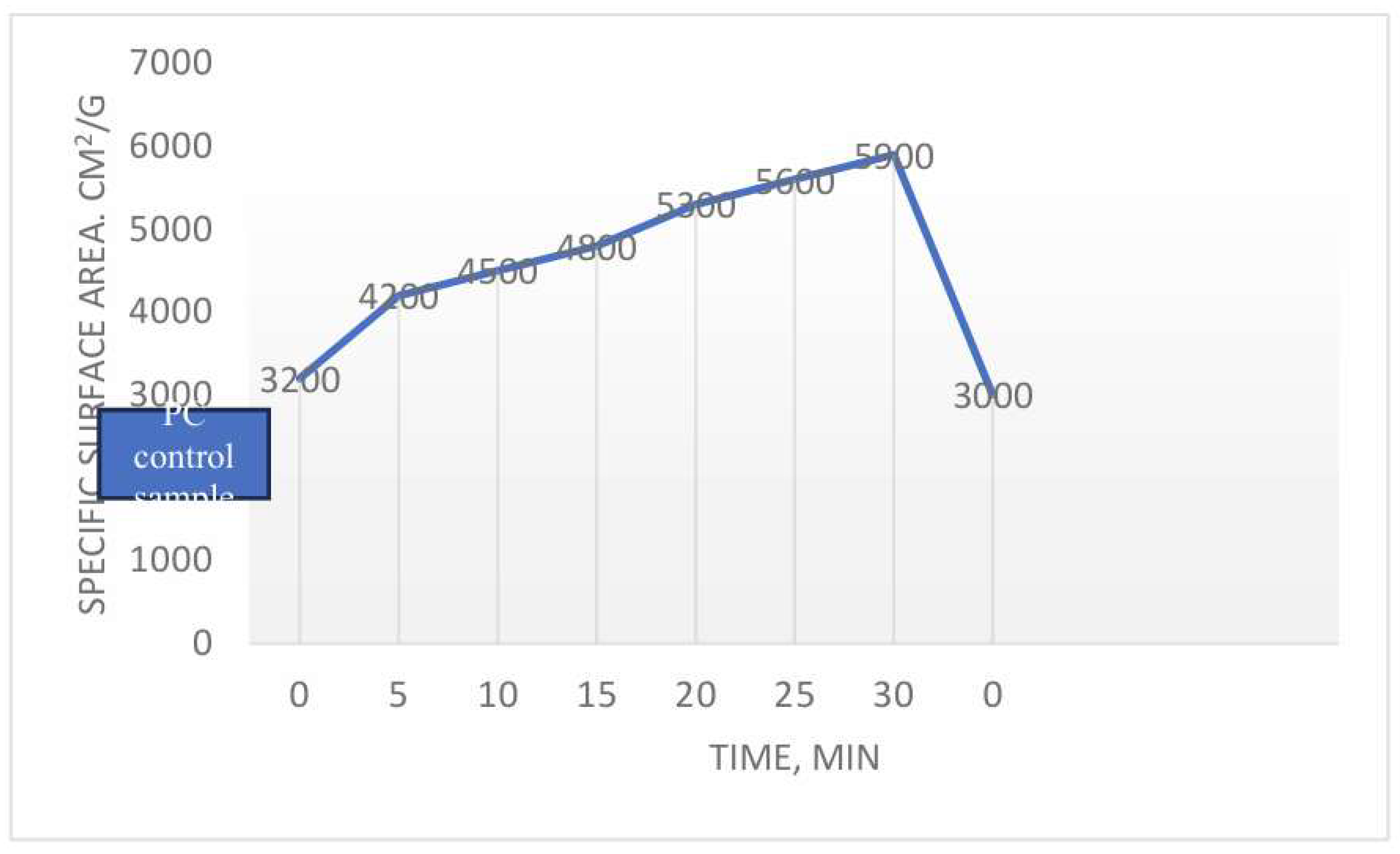
Figure 2.
Effect of mechanical activation time on compressive strength of cement–fly ash composites (15% FA, 28 days).
Figure 2.
Effect of mechanical activation time on compressive strength of cement–fly ash composites (15% FA, 28 days).
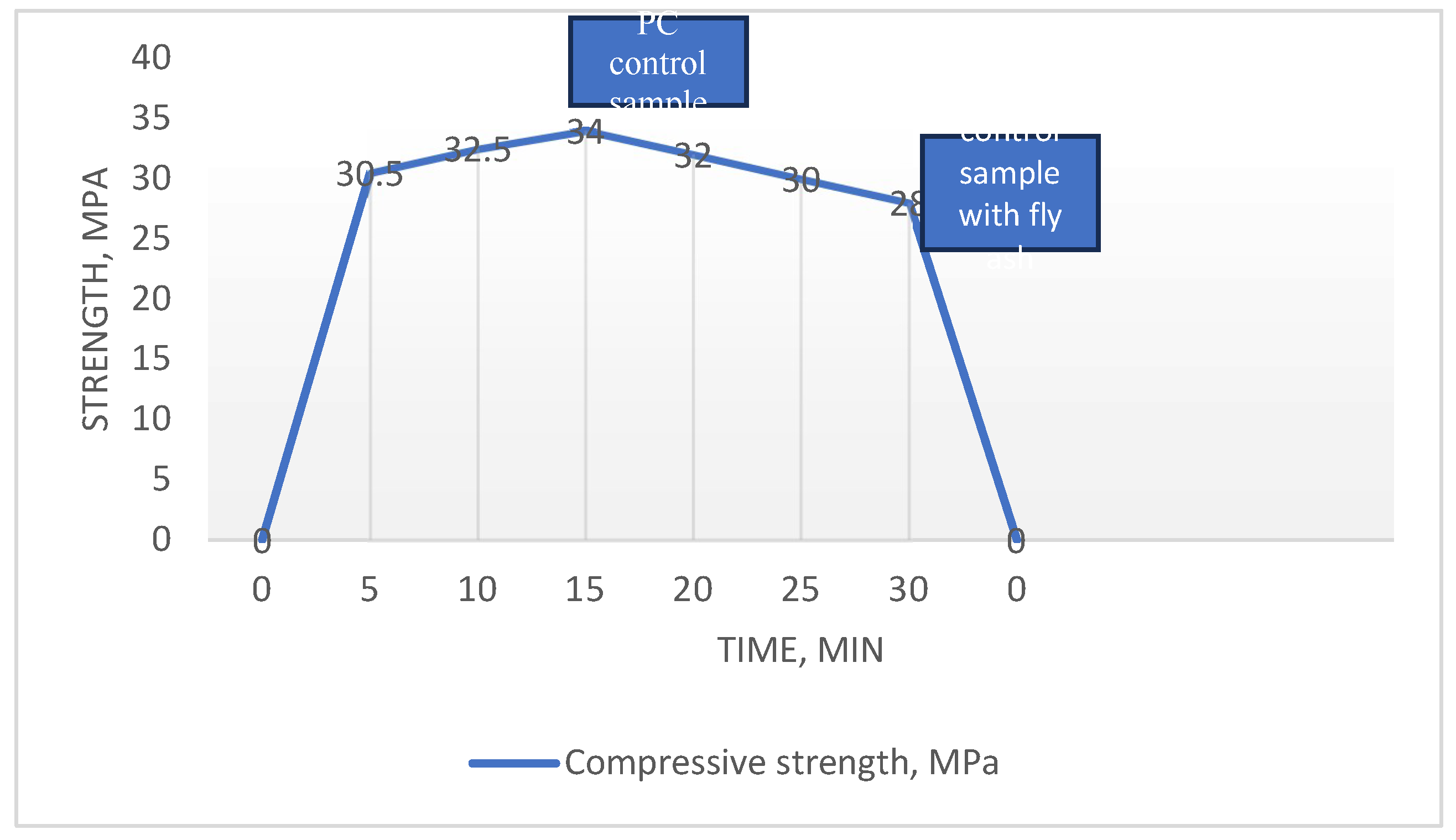
Figure 3.
Effect of NaOH concentration on compressive strength of cement–fly ash composites.
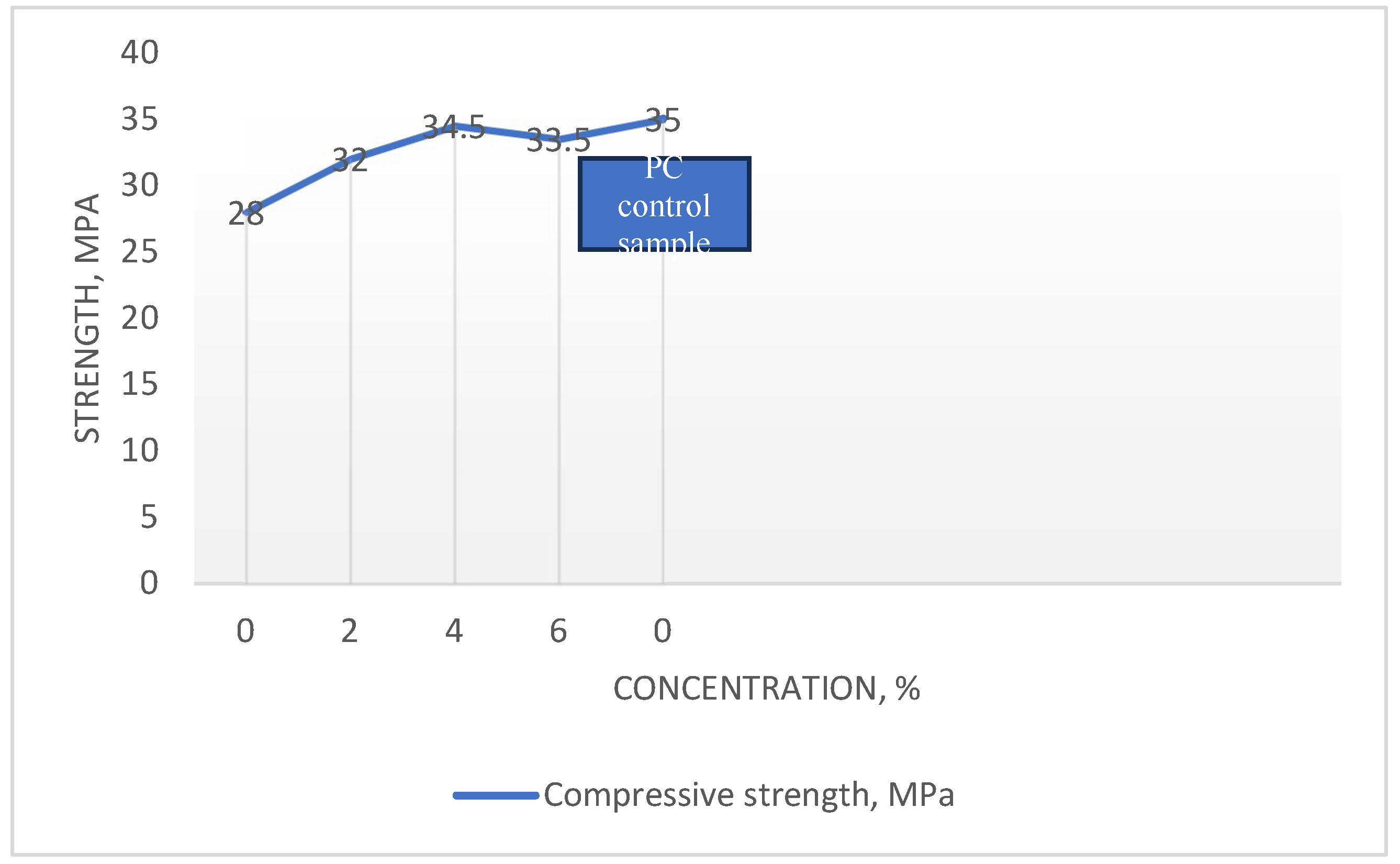
Figure 4.
SEM micrograph of unactivated fly ash particles (100×).
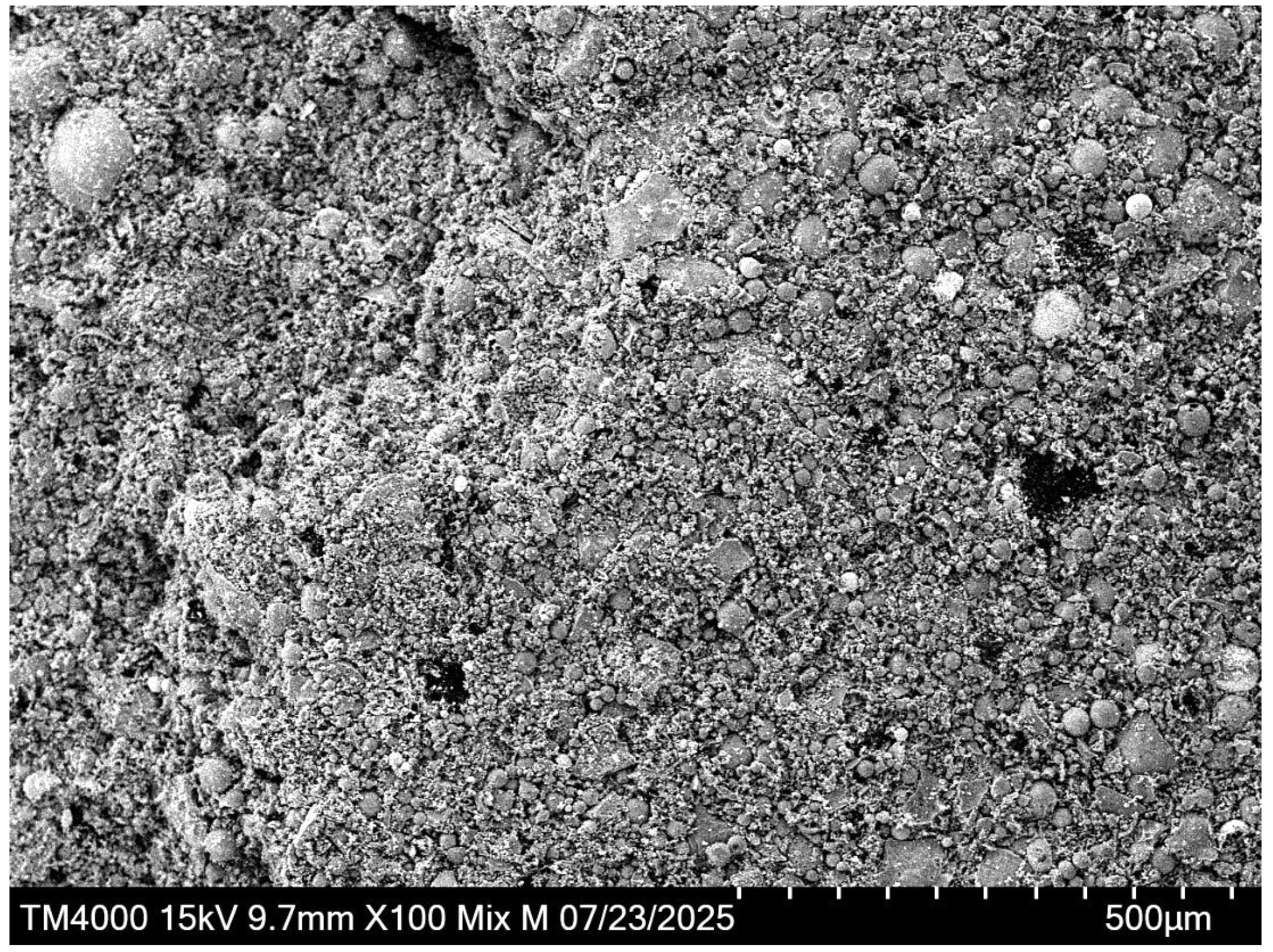
Figure 5.
SEM micrograph of composite with optimal combined activation (500×).
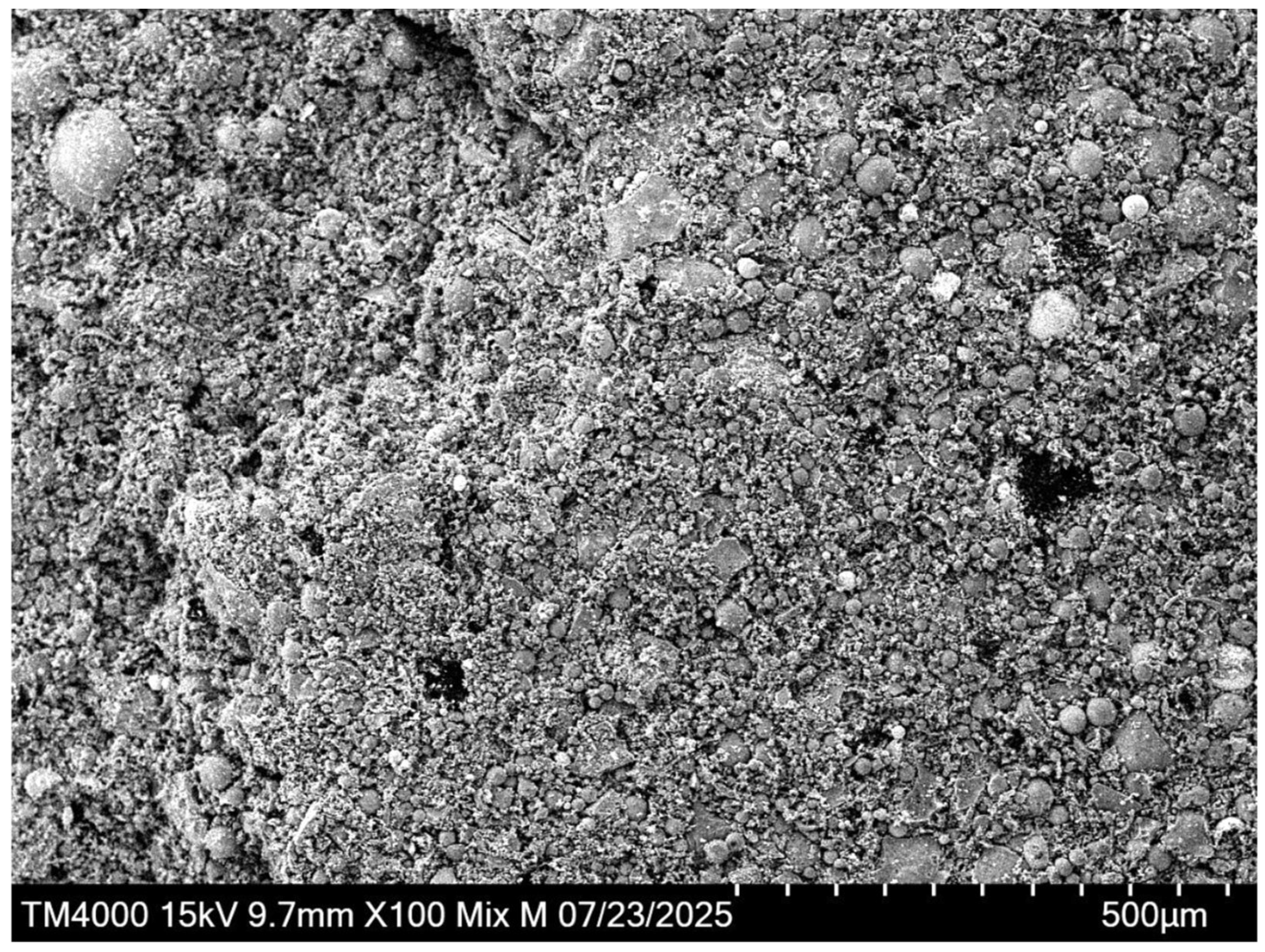
Figure 6.
SEM micrographs of control composite with non-activated fly ash: (a) spherical ash particles; (b) porous cement matrix.
Figure 6.
SEM micrographs of control composite with non-activated fly ash: (a) spherical ash particles; (b) porous cement matrix.
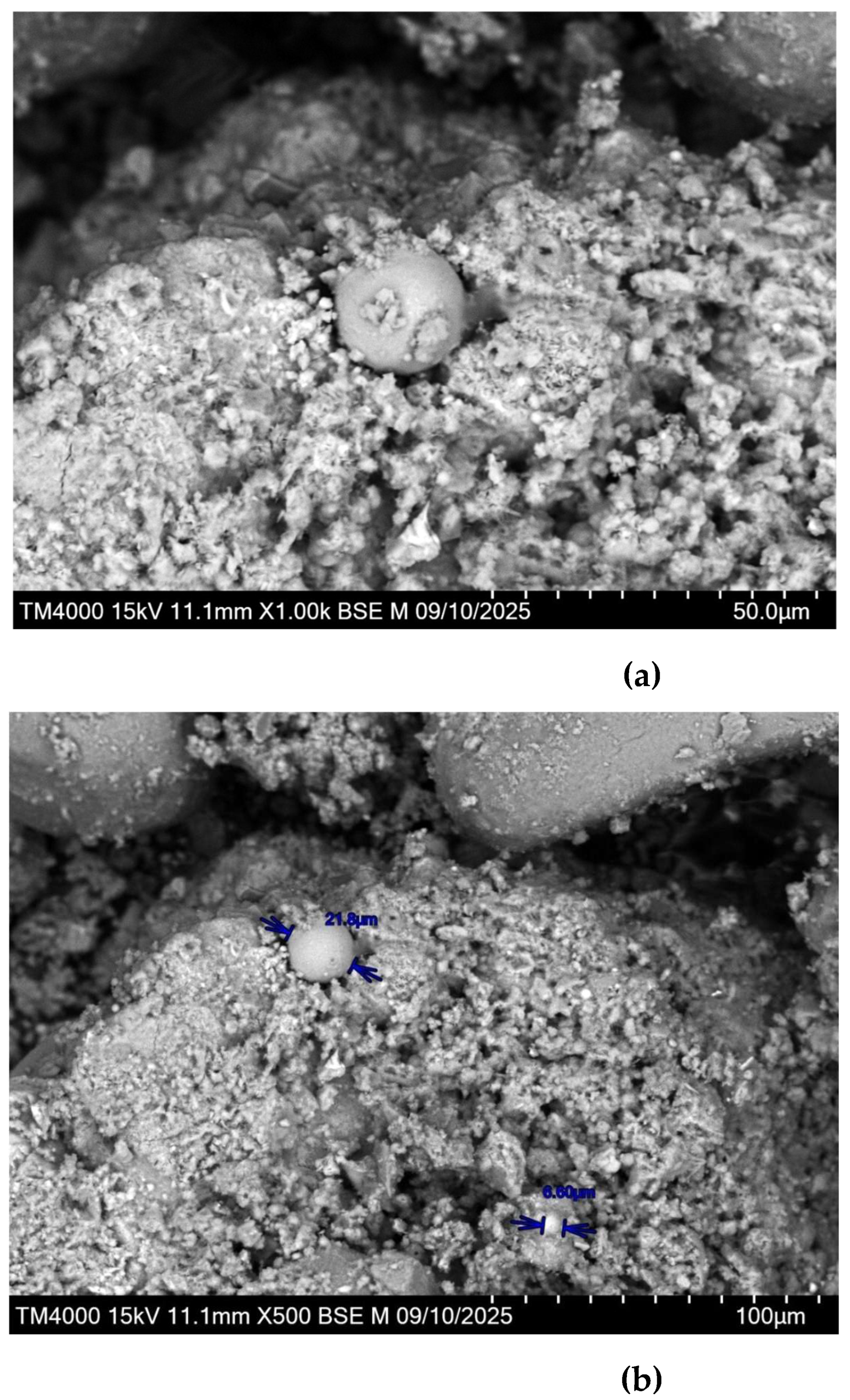
Figure 7.
Microphotographs of samples with activated FA: (a) mechanical activation for 28 days (×200); (b) chemical activation for 28 days (×50).
Figure 7.
Microphotographs of samples with activated FA: (a) mechanical activation for 28 days (×200); (b) chemical activation for 28 days (×50).
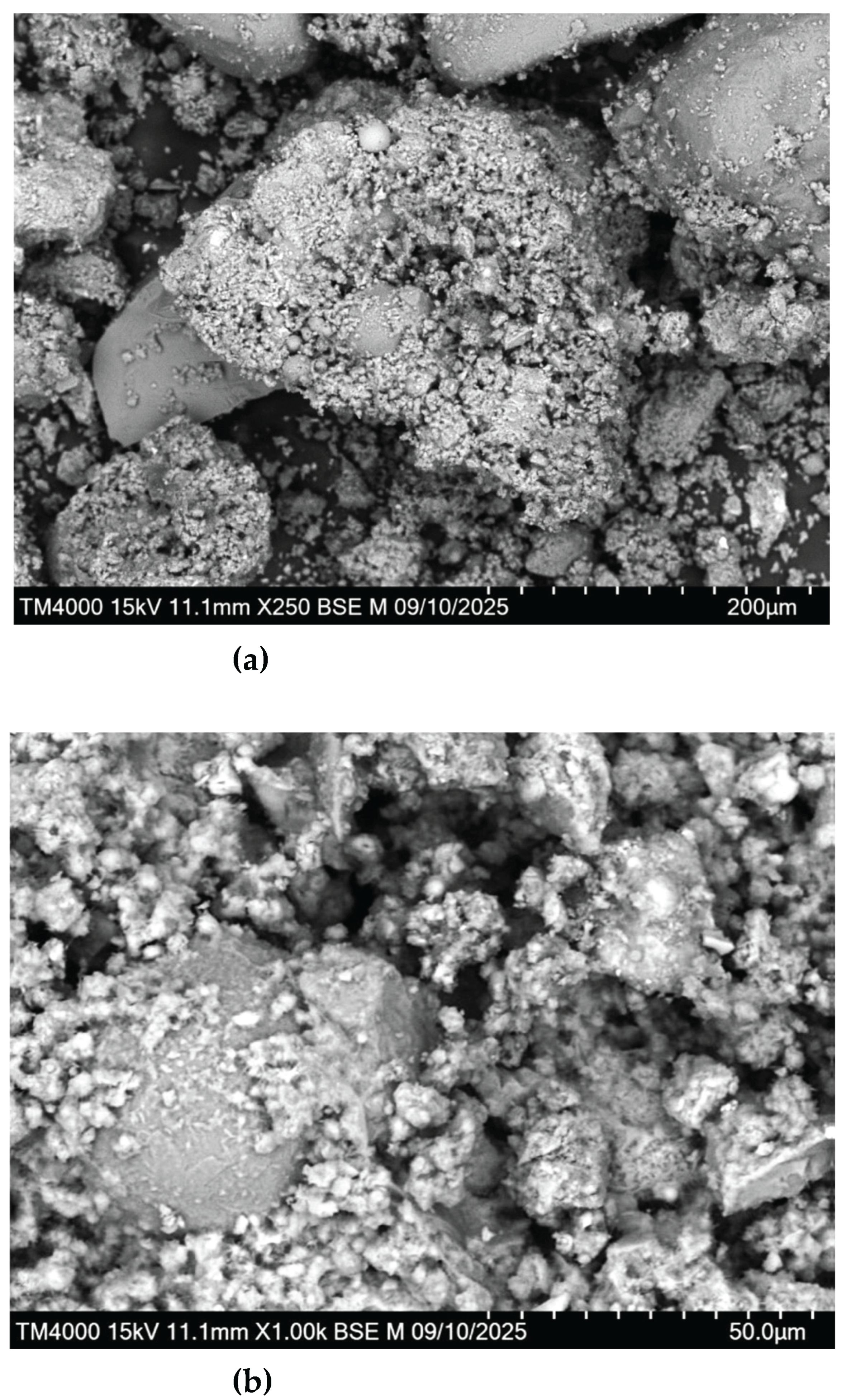

Table 1.
Methods for preparing activated fly ash.
| Method | Equipment | Variable parameter | Purpose |
|---|---|---|---|
| Mechanical activation (MA) | Planetary mill BMU-100 | Grinding time t (min) | Increase in specific surface area and structural defect density |
| Chemical activation (CA) | Laboratory mixerbreak// SL-5 | NaOH concentration Cact (2–6%) | Enhancement of dissolution kinetics of aluminosilicate phases |
| Combined activation (MA+CA) | Mill + Mixer | topt + Copt | Evaluation of synergistic activation effect |
Table 2.
Chemical composition of Portland cement and fly ash (mass %).
| Oxide | Portland cement (PC), | Fly ash |
| SiO2 | 21,0 | 54,5 |
| Al2O3 | 5,5 | 25,0 |
| Fe2O3 | 3,5 | 5,0 |
| CaO | 65,0 | 4,5 |
| MgO | 1,5 | 1,0 |
| SO3 | 2,5 | 0,5 |
| Na2O+K2O | 0,5 | 2,5 |
| SiO2+ Al2O3+ Fe2O3 | 30,0 | 84,5 |
Table 3.
Effect of mechanical activation time on specific surface area and compressive strength (15% FA replacement).
Table 3.
Effect of mechanical activation time on specific surface area and compressive strength (15% FA replacement).
| Activation time (min) | Specific surface area (cm2/g) | Strength at 28 days (MPa) |
| 0 | 3200 | 28.5 |
| 5 | 4200 | 31.0 |
| 10 | 5200 | 33.0 |
| 15 | 6000 | 34.0 |
| 20 | 6400 | 33.5 |
| 25 | 6700 | 33.0 |
Table 4.
Effect of NaOH concentration on compressive strength (15% FA replacement).
| NaOH concentration (%) | Strength at 28 days (MPa) |
| 0 | 28.5 |
| 2 | 32.0 |
| 4 | 34.5 |
| 6 | 34.0 |
Table 5.
Effect of mechanical activation time on specific surface area and compressive strength (15% FA replacement).
Table 5.
Effect of mechanical activation time on specific surface area and compressive strength (15% FA replacement).
| Activation time (min) | Specific surface area (cm2/g) | Strength at 28 days (MPa) |
| 0 | 3200 | 28.5 |
| 5 | 4200 | 31.0 |
| 10 | 5200 | 33.0 |
| 15 | 6000 | 34.0 |
| 20 | 6400 | 33.5 |
| 25 | 6700 | 33.0 |
Table 6.
Synergistic effect of complex activation.
| Effect | Explanation |
|---|---|
| MA + CA (combined) > MA, CA separately | Mechanical activation physically activates the reaction centers on the surface, while chemical activation provides the necessary highly alkaline environment for these centers to instantly enter into reaction. |
| High replacement rate | The combined activation composition allows for maximizing the replacement of expensive Portland cement (e.g., 30%) in the FA while maintaining strength close to that of the control cement mortar (e.g., 95% of σPC). |
| Cost optimization | A comprehensive approach allows for the use of a less intensive (and less energy-intensive) MA mode in combination with the minimum effective dosage of CA, optimizing overall production costs. |
Disclaimer/Publisher’s Note: The statements, opinions and data contained in all publications are solely those of the individual author(s) and contributor(s) and not of MDPI and/or the editor(s). MDPI and/or the editor(s) disclaim responsibility for any injury to people or property resulting from any ideas, methods, instructions or products referred to in the content. |
© 2026 by the authors. Licensee MDPI, Basel, Switzerland. This article is an open access article distributed under the terms and conditions of the Creative Commons Attribution (CC BY) license (http://creativecommons.org/licenses/by/4.0/).
Copyright: This open access article is published under a Creative Commons CC BY 4.0 license, which permit the free download, distribution, and reuse, provided that the author and preprint are cited in any reuse.