

Submitted:
16 April 2026
Posted:
17 April 2026
You are already at the latest version
Abstract
Overhead sports place high demands on the shoulder complex, making warm-up specificity relevant for acute readiness. This randomized controlled pilot trial compared the immediate effects of a shoulder-specific warm-up with a habitual routine in 24 youth competitive overhead athletes (14–20 years), allocated to an experimental group (EG = 12) and a standard warm-up group (SWG = 12). Outcome measures were collected before and immediately after warm-up and included shoulder flexion range of motion (ROM), handgrip strength, Closed Kinetic Chain Upper Extremity Stability (CKCUES) performance, and post-warm-up Rating of Perceived Exertion (RPE; Borg CR-10). A significant group-by-time interaction was found for right shoulder flexion ROM (p = 0.003, η²p = 0.346), with a significant increase in the EG from baseline to post-test (p = 0.008). No significant effects were observed for left shoulder flexion ROM, handgrip strength, or CKCUES performance. Post-warm-up RPE was significantly higher in the EG than in the SWG (p = 0.041). These preliminary findings support the practical value of more targeted warm-up strategies in overhead sports, while larger longitudinal studies are needed to confirm their broader functional relevance.
Keywords:
overhead athletes
; youth athletes
; shoulder warm-up
; upper extremity performance
; handgrip strength
; CKCUES
1. Introduction
In sports characterized by repeated overhead actions (such as water polo, weightlifting, rhythmic gymnastics, and shot put), shoulder efficiency does not depend solely on joint range of motion (ROM), but rather emerges from the coordinated interaction between strength, neuromuscular control, and movement perception [1]. In this contexts, the athlete’s ability to stabilize the scapulohumeral joint at ranges of maximal mechanical load represents a fundamental factor for both performance and injury prevention [2]. Although many preparation and prevention protocols include shoulder mobility and strengthening exercises, these are often relegated to the final phases of the training session, thereby reducing their potential immediate impact on sport-specific performance [3,4,5]. A more integrated approach, which considers the body as a dynamic and interconnected system, is grounded in the principles of biotensegrity, according to which movement arises from the balance between tensile continuity and compressive discontinuity within a single functional network [6]. This perspective emphasizes that the quality of motor performance is determined not only by the physical properties of body segments but also by how the athlete perceives, anticipates, and organizes movement. Within this framework, strength and mobility should not be viewed as separate capacities but rather as complementary components of a unified motor strategy integrating structure, function, and perception [7]. Today, the contemporary sports landscape is characterized by increasing specialization even among young athletes. This trend highlights the need for scientific research to develop increasingly specific, innovative, and long-term sustainable tools capable of supporting athletes not only in the immediate expression of performance but also in building developmental pathways that minimize injury risk [8]. In this context, the warm-up represents a low-cost intervention, performed daily and capable of exerting a meaningful impact on joint and neuromuscular function [9]. However, the literature to date reports heterogeneous findings regarding its effectiveness, likely due to differences in exercise and innovative tool selection, specificity, and intended training objectives [10]. Accordingly, there is a need to propose a targeted warm-up protocol rather than a generic whole-body activation approach, one that is consistent with the biomechanical demands of overhead sports and integrated from both physical and perceptual perspectives [11]. The rationale underlying our approach is that improving the athlete’s ability to remain strong and stable even in complex or less frequently used joint positions may facilitate force expression (defined as the application of force to an external object), expand functional ROM, and contribute to reducing the risk of joint overload [12,13,14]. From a perceptual standpoint, recognizing the role of subjective sensations, e.g. assessed by tools such as the Rating of Perceived Exertion (RPE) scale, may help to better understand motor adaptation, particularly in young competitive athletes who often possess a refined body awareness of sport-specific gestures [15,16]. In light of these considerations, the present pilot study aimed to compare the effects of an active warm-up based on mobility and strength exercises specific to the scapulohumeral joint with those of a traditional warm-up, evaluating changes in ROM, neuromuscular control, and movement perception in young overhead competitive athletes. The objective is to provide an innovative and integrated perspective aligned with the needs of the modern athlete and to contribute to the evolution of warm-up protocols from a long-term performance and injury-prevention standpoint
2. Materials and Methods
2.1. Study Design
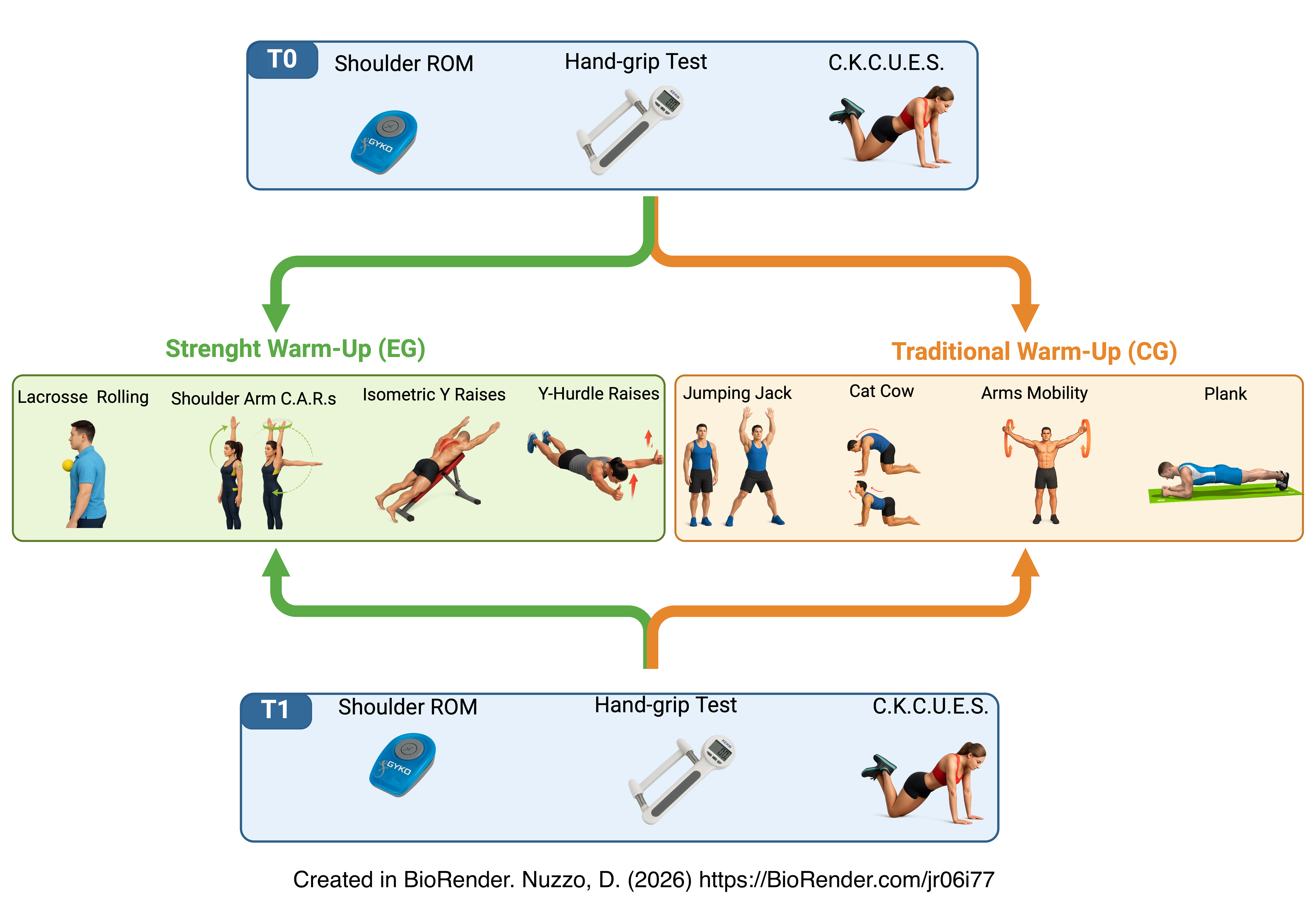
This study was conducted as a randomized controlled pilot trial. Participants were randomly assigned to a standard warm-up group (SWG), which performed their usual warm-up routine, and to an experimental group (EG), which completed the shoulder-specific warm-up protocol developed by the investigators. Outcome measures were collected at two time points: at baseline, before the warm-up (T0), and immediately after warm-up (T1). This pre-post approach was used to assess the immediate responses to the warm-up and to identify short-term changes in joint mobility, neuromuscular control, and perceptual responses [17]. All assessments were conducted in the training environment where the athletes normally practice, in order to preserve ecological validity and minimize potential environmental influences. Testing was completed within a single session on the same day for each participant. The study design was chosen to reflect real-world training practice and to examine whether a targeted, shoulder-focused warm-up, compared with a habitual routine, could acutely enhance shoulder readiness for performance [18]. The underlying rationale was that a more specific warm-up may facilitate greater neuromuscular activation and joint preparedness, thereby supporting the execution of sport-specific movements in overhead sports [19].
2.2. Participants
A total of 24 youth competitive athletes (8 male,16 female) voluntarily participated in this pilot study. Participants were randomly allocated to the SWG (n = 12), performing their habitual warm-up routine and the EG (n = 12), performing the strength- and mobility-based warm-up protocol proposed by the investigators. This was done randomly via the Wheel of Names software. All athletes were actively competing at an agonistic level and were training regularly at the time of data collection.
All athletes were actively competing at an agonistic level and were training regularly at the time of data collection.
Inclusion criteria were: (a) competitive athletic status; (b) age between 14 and 20 years; and (c) absence of current or recent upper-limb injuries, with specific reference to the shoulder complex. All participants were injury-free at the time of assessment, particularly with respect to the scapulohumeral joint. Written informed consent was obtained from the parents or legal guardians of all participants under 18 years of age prior to study participation.
The study was conducted according to the Declaration of Helsinki and was approved by the ethics committee of the University of Palermo 1, (Approval No. 325/2025), Department of Psychological, Educational and Movement Sciences, University of Palermo.
Anthropometric characteristics of the participants (age, height, and body mass) are reported as mean ± standard deviation in Table 1.
2.3. Assessment
All assessments were carried out in the athletes’ usual training facilities at Palermo Sport & Performance and A.S.D. Azzurra Palermo, Italy. Conducting the evaluations in a familiar environment was intended to limit context-related influences on sensorimotor control and to obtain measurements that more accurately reflect the athletes’ true performance capacity. Upon arrival, participants performed assessments at T0 using a fixed and standardized sequence: the Gyko inertial system (Microgate, Bolzano, Italy) was initially used to assess scapulohumeral joint range of motion. This was followed by the Handgrip strength test (KERN MAP Version 1.2 08/2012, Hand Grip Dynamometer) and, subsequently, by the Closed Kinetic Chain Upper Extremity Stability Test (CKCUES) [20,21,22]. Perceived exertion was assessed using the Borg CR-10 category-ratio scale (0-10). Participants were familiarized with the scale anchors and asked to rate their perceived effort immediately after completion of the warm-up protocol. In the present study, the Borg CR-10 score was used as an indicator of the internal load and perceived activation associated (e.g., perceived activation, satisfaction, and sense of shoulder freedom) with the preparatory stimulus [23,24].
After completion of the T0 assessments, participants-previously allocated to either the EG or SWG group performed their respective warm-up protocols. The EG completed the strength-based warm-up, whereas the SWG carried out their habitual warm-up routine. Immediately afterward, all participants performed the T1 assessment in the same order as at baseline. A detailed overview of the assessment tools, measured variables, and their intended purpose is provided in Table 2.
2.4. Warm-Up Protocols
2.4.1. Strength-Based Warm-Up
The strength-based warm-up protocol was administered to the EG following a predefined and progressive sequence aimed at preparing the shoulder complex for overhead demands. Exercises were performed in the order reported in Table 3, and each exercise had to be completed before progressing to the next. The protocol began with self-myofascial release using a lacrosse ball applied to the pectoral region [25,26]. This initial phase was included to facilitate shoulder flexion mobility and to improve tissue readiness before subsequent movements and testing. Following myofascial release, athletes performed shoulder Controlled Articular Rotations (CARs). CARs consist of active, controlled, end-range rotational movements executed through the largest pain-free range of motion [27,28]. This exercise was included to promote active shoulder mobility, motor control, and joint awareness, supporting optimal scapulohumeral mechanics. The warm-up then progressed to Y-hurdle raises performed in a prone position on a bench inclined at 45°. From this position, athletes raised their arms in a Y-shaped pattern with the elbows extended, focusing on slow and controlled arm elevation. This exercise was included to enhance scapulohumeral control during shoulder elevation, with particular emphasis on the coordinated activation of the lower trapezius and serratus anterior. These muscles play a key role in optimizing scapular mechanics during overhead movements [29]. As the final exercise, the Y isometric hold was performed in a supine position. This exercise shared the same biomechanical objectives as the Y-hurdle raises but was executed isometrically. Athletes maintained the Y-shaped arm position while focusing on scapular retraction, upward rotation, and posterior tilt, minimizing compensatory movements [30]. The inclusion of an isometric contraction was intended to reinforce neuromuscular control and scapular stabilization at a joint position relevant to overhead activities [31,32].
All specific details regarding exercise volume, duration, and sequencing of the warm-up protocol are reported in Table 3.
2.4.2. Traditional Warm-Up
Participants assigned to the SWG performed their habitual warm-up routine, which reflected the exercises they typically use before regular training sessions. This approach was adopted to preserve and provide a realistic comparison with common practice. The traditional warm-up consisted of general activation and mobility exercises and was not specifically designed to target shoulder strength or scapular control [33]. Exercises were performed in the same order and manner routinely adopted by the athletes prior to training. A general overview of the exercises included in the traditional warm-up is reported in Table 4.
2.5. Statistical Analysis
Data are presented as mean ± standard deviation (SD). The normality of data distribution was assessed using the Shapiro-Wilk test. For each outcome measure, a ANOVA (2x2) was performed, with group as the between-subjects factor and time (T0 vs. T1) as the within-subjects factor. When significant effects were detected in the ANOVA, Bonferroni-adjusted post hoc comparisons were performed. Effect sizes were reported as partial eta squared (η²p). Statistical significance was set at p < 0.05. Borg CR-10 scores were only collected at T1 and were therefore analysed separately. Given the ordinal nature of the scale, differences between groups were assessed using the Mann-Whitney U test. Statistical analyses were performed using Jamovi software (version 2.3.21.0).
3. Results
As shown in Table 5, a significant difference was found in the ANOVA for right shoulder flexion ROM. Bonferroni post hoc analysis indicated a significant increase in the experimental group from T0 to T1 (p=0.008). Whereas no significant difference emerged for the other variables. Borg CR-10 scores, reported in Table 6, were significantly higher in the experimental group at T1 (p=0.041).
4. Discussion
The present pilot study examined the acute effects of a shoulder warm-up focused on strength and mobility, compared with a usual routine, in young competitive athletes engaged in overhead sports. The main finding was a significant improvement in right shoulder flexion ROM in EG after the strength warm-up (p=0.008). No significant effects emerged for handgrip strength or CKCUES performance. Borg CR-10 scores were also higher after the experimental protocol, suggesting a more pronounced perceived internal response to the preparatory stimulus. Overall, these findings indicate that a more shoulder-focused warm-up may produce an acute effect on a specific mobility outcome, while also modifying the athlete’s subjective perception upon entering the subsequent phase of the training session.
The improvement observed in shoulder flexion ROM supports the hypothesis that incorporating controlled mobility exercises, scapular activation, and isometric stabilization into the warm-up may promote more specific preparation of the scapulohumeral complex before performance. This interpretation is in line with recent literature suggesting that warm-up strategies integrating mobility, scapular activation, and muscle engagement may provide more specific preparation of the shoulder complex in overhead athletes [34,35]. At the same time, recent studies have shown that even a single session of stretching or mobility-oriented work can improve range of motion, making the finding observed in the present study plausible within the context of a sport-specific warm-up [36,37].
From an applied perspective, this finding may be of interest because, in overhead sports, the mechanical load imposed on the shoulder complex is high and repetitive [38]. For this reason, the warm-up should not be considered merely a generic phase at the start of the session. Instead, it can be a valuable opportunity to prepare more specifically for the constant stress the nature of the sport subjects the structure to [39,40]. This does not replace strength work, prevention strategies, or strengthening programs planned over the medium to long term, but it may represent an intelligent component within the periodization of accessory training.
In other words, optimising the warm-up means attempting to be more effective and efficient from the beginning of the session [41]. This is particularly important for young athletes, who often accumulate many training hours and for whom the practical sustainability of the proposed intervention is a central issue [42].The recent literature on overhead athletes points in the same direction, highlighting how simple, specific, and low-cost programs may be useful both from a preventive perspective and in terms of shoulder function [43,44].
The absence of significant differences in the CKCUES test and the handgrip test may be plausible. With regard to the CKCUES, this is in fact a more complex test than an isolated measure of mobility, as it simultaneously involves upper-limb dynamic stability, trunk control, coordination, and muscular capacity. It is therefore reasonable to assume that a single exposure to the warm-up was sufficient to modify a specific parameter such as ROM, but not enough to generate equally evident changes in a more complex functional task [45]. This interpretation is also consistent with the most recent literature on the CKCUES, which acknowledges its usefulness and good psychometric properties, while also emphasizing the need to interpret its results in light of the multidimensional nature of the test and its measurement properties [46]. In a sample of already trained young athletes, this aspect may further reduce the likelihood of observing acute changes. A similar interpretation may also be proposed for handgrip strength. Although handgrip is a practical, rapid, and widely used test, it remains a relatively global measure and it may not be sufficiently sensitive in this context to detect subtle acute changes induced by a brief, shoulder-specific warm-up. A recent study recommended caution when interpreting handgrip strength as an indicator of general strength or functional performance, precisely because its associations with other strength measures are heterogeneous across different populations and contexts [47].
In our case, this consideration appears particularly relevant: given that the participants were young but already trained and sport-specific athletes, it is plausible that such a general test was not the most sensitive measure for detecting immediate changes after a single preparatory routine. In line with this caution, a recent study in overhead athletes showed that some differences in scapulohumeral function may not necessarily translate into changes in upper extremity dynamic stability or handgrip strength [48,49].
The Borg CR-10 findings add an important practical element to the interpretation of the present study. In our study, we used a scale to evaluate the athletes' perceived response to the warm-up. The score was then interpreted in relation to the athletes' immediate perceptions of activation, perceived preparedness, and an increased sense of shoulder mobility [50]. Within this framework, the higher values observed after the experimental warm-up do not appear to indicate fatigue severe enough to impair the immediate response to subsequent tests. Rather, they suggest greater perceived involvement and a higher level of readiness for the specific training session. This interpretation appears reasonable also because the higher perceptual response was accompanied by an improvement in ROM and not by a worsening of the other measured outcomes. Furthermore, recent literature continues to support the use of RPE as a valid, simple, and practical tool for monitoring internal load, an aspect that is particularly useful in youth settings, where tools must remain rapid, sustainable, and easily applicable in the field [51]. From a coaching perspective, this point is not secondary. In overhead sports, athletes are accustomed to working extensively on the shoulder complex, and it is by no means obvious that, after a warm-up, they will report a greater sense of freedom of movement and a favorable perception of the work performed [52,53]. Although this aspect was not collected using a separate validated instrument, it remains an interesting applied observation: a warm-up perceived as useful, that makes the athlete feel ready, and that is not experienced as “empty” work, is more likely to be accepted and maintained consistently over time. In this sense, the tested protocol appears to offer an interesting balance between specificity, tolerability, and immediate transferability to daily practice [19,54]. Overall, the present findings support the idea that warm-up design in overhead athletes should go beyond simple general systemic activation and more accurately reflect the mechanical and neuromuscular demands placed on the shoulder complex [55].
5. Conclusions
This pilot study suggests that a shoulder-focused warm-up based on mobility, scapular activation, and isometric stabilization may be useful to acutely improve shoulder flexion ROM in young overhead athletes. In the present sample, the experimental protocol produced a significant improvement in right shoulder flexion, while no significant changes were found in handgrip strength or CKCUES performance. Athletes in the experimental group also reported a higher Borg CR-10 score after the warm-up, indicating a greater perceived response to the preparatory stimulus. Overall, these findings support the idea that, in overhead sports, warm-up routines may be effective when they are specifically designed around shoulder demands rather than based only on general activation. The contribution of this preliminary study does not lie in supporting a generalized improvement in all outcomes after a single session, but rather in showing that a targeted, manageable warm-up that can be easily incorporated into practice may acutely improve a relevant mobility parameter and be accompanied by a meaningful perceptual response in young athletes. For coaches and practitioners, this represents a concrete message: the warm-up is not merely a routine performed before training, but may become a genuinely useful part of preparation if constructed in a specific manner and aligned with the demands of the sport practiced [56,57].
The study also presents practical strengths: it was conducted in a real training setting, focused on a specific athletic population, and combined objective outcomes with a perceptual measure that is relevant to the daily work of coaches. Future studies, with larger samples and longitudinal designs, will need to clarify whether repeated exposure to this type of shoulder-focused warm-up may translate into broader improvements in shoulder function, sport-specific readiness, and long-term load management.
6. Limitations
This study presents some limitations that should be considered when interpreting the findings. First, the relatively small sample size and the acute design of the intervention may limit the generalizability of the results. However, the pilot nature of the study was intended to provide an initial exploratory evaluation of the proposed warm-up strategy in a real-world athletic context.
In addition, although functional performance measures were included, the absence of electromyographic and detailed kinematic analyses prevents a more comprehensive understanding of the neuromuscular mechanisms underlying the observed responses. Finally, the participants were young competitive athletes with relatively high baseline functional levels, which may have reduced the magnitude of short-term observable changes.
Future studies involving larger cohorts, longitudinal designs, and integrated neuromuscular assessments are warranted to further clarify and extend these preliminary findings.
Author Contributions
Author Contributions: Conceptualization, A.P., P.Pro.; methodology, A.P., A.F., D.N. and P.Pic.; formal analysis, M.D, A.B. and R.C.; investigation, A.B., A.A., D.N. and R.C.; resources, G.M., C.C. and A.F.; data curation, A.B. and R.C.; writing & original draft preparation, A.P., A.B. and A.A.; writing & review and editing, A.A., G.M., C.C., D.N., P.Pic. and R.C.; visualization M.D., R.C.; supervision, G.M., P.Pro. and C.C.
Funding
This research received no external funding.
Institutional Review Board Statement
The study was conducted according to the Declaration of Helsinki and was approved by the ethics committee of the University of Palermo 1, (Approval No. 325/2025), Department of Psychological, Educational and Movement Sciences, University of Palermo.
Informed Consent Statement
Informed consent was obtained from all subjects involved in the study.
Data Availability Statement
The data are available on reasonable request from the corresponding author.
Generative AI statement
The authors declare that no Gen AI was utilised in the creation of the manuscript. AI-assisted technologies were employed solely to improve the readability and language of the manuscript. All modifications were carried out under human supervision, with the authors carefully reviewing every change.
Conflicts of Interest
The authors declare no conflicts of interest.
Abbreviations
The following abbreviations are used in this manuscript:
| ROM | Range of Motion |
| RPE | Rating of Perceived Exertion |
| CARs | Controlled Articular Rotations |
| EG | Experimental Group |
| SWG | Standard warm-up group |
| CKCUES | Closed Kinetic Chain Upper Extremity Stability Test |
| SD | Standard Deviation |
| IQR | Interquartile Range |
| T0 | Baseline Assessment |
| T1 | Post-Warm-Up Assessment |
References
- López-Laval I, Sitko S, Cantonero J, Corbi F, Cirer-Sastre R. The Effectiveness of Shoulder Mobility and Strength Programs in Competitive Water-Polo Players. 2022;12(5). [CrossRef]
- Kibler W Ben, Sciascia A. Evaluation and Management of Scapular Dyskinesis in Overhead Athletes. Current Reviews in Musculoskeletal Medicine. 2019. [CrossRef]
- Escalante G, Fine D, Ashworth K, Kolber MJ. Progressive Exercise Strategies to Mitigate Shoulder Injuries Among Weight-Training Participants. Strength Cond J. 2021;43(1). [CrossRef]
- Tahran Ö, Yeşilyaprak SS. Effects of Modified Posterior Shoulder Stretching Exercises on Shoulder Mobility, Pain, and Dysfunction in Patients With Subacromial Impingement Syndrome. Sports Health. 2020;12(2). [CrossRef]
- Parsakia K, Knechtle B, irandoust khadijeh, Taheri M. Strength-Based Therapy: Empowering Athletes’ Self-Efficacy and Life Satisfaction. Health Nexus. 2024;2(2):1–7. [CrossRef]
- Dischiavi SL, Wright AA, Hegedus EJ, Bleakley CM. Biotensegrity and myofascial chains: A global approach to an integrated kinetic chain. Med Hypotheses. 2018;110. [CrossRef]
- Wulf G, Lewthwaite R. Optimizing performance through intrinsic motivation and attention for learning: The OPTIMAL theory of motor learning. Psychon Bull Rev. 2016;23(5). [CrossRef]
- Sugimoto D, Whitney KE, d’Hemecourt PA, Stracciolini A. Youth Sport Specialization: Current Concepts and Clinical Guides. HSS Journal. 2024;20(3). [CrossRef]
- Neves PP, Marques DL, Neiva HP, Alves AR. Acute Effects of Resistance Training Warm-Up and Re-Warm-Up on Dynamic Strength Performance: A Scoping Review. Journal of Science in Sport and Exercise. 2026. [CrossRef]
- Amato A, Petrigna L, Amorim PR dos S, Wenxin X, Musumeci G. Whole-body vibration as an effective sports competition warm-up: a randomized controlled trial in a young and healthy population. Front Physiol. 2026;16. [CrossRef]
- Ramasamy Y, Usman J, Razman R, Wei YM, Towler H, King M. A Systematic Review of the Biomechanical Studies on Shoulder Kinematics in Overhead Sporting Motions: Types of Analysis and Approaches. Applied Sciences (Switzerland). 2023. [CrossRef]
- Lupowitz LG. Comprehensive Approach to Core Training in Sports Physical Therapy: Optimizing Performance and Minimizing Injuries. Int J Sports Phys Ther. 2023;18(4). [CrossRef]
- O’Connor S, McCaffrey N, Whyte EF, Moran KA. Can a Standardized Visual Assessment of Squatting Technique and Core Stability Predict Injury? J Strength Cond Res. 2020;34(1). [CrossRef]
- Amato A, Cortis C, Tropea M, Politi M, Fusco A, Musumeci G. Comparison of the Core Training and Mobility Training Effects on Basketball Athletic Performance in Young Players: A Comparative Experimental Study. Sports. 2025;13(11). [CrossRef]
- Grummt M, Hafermann L, Claussen L, Herrmann C, Wolfarth B. Rating of Perceived Exertion: A Large Cross-Sectional Study Defining Intensity Levels for Individual Physical Activity Recommendations. Sports Med Open. 2024;10(1). [CrossRef]
- Pfeiffer KA, Pivarnik JM, Womack CJ, Reeves MJ, Malina RM. Reliability and validity of the Borg and OMNI rating of perceived exertion scales in adolescent girls. Med Sci Sports Exerc. 2002;34(12). [CrossRef]
- Ylldlz M, Çebi M. Proprioceptive neuromuscular facilitation warm-ups: A key to improved isokinetic performance. Int J Sports Med. 2025;46(6). [CrossRef]
- Needham RA, Morse CI, Degens H. THE ACUTE EFFECT OF DIFFERENT WARM-UP PROTOCOLS ON ANAEROBIC PERFORMANCE IN ELITE YOUTH SOCCER PLAYERS [Internet]. Report. Available from: www.nsca-jscr.org.
- McGowan CJ, Pyne DB, Thompson KG, Rattray B. Warm-Up Strategies for Sport and Exercise: Mechanisms and Applications. Sports Medicine. 2015. [CrossRef]
- Tucci HT, Martins J, Sposito GDC, Camarini PMF, De Oliveira AS. Closed Kinetic Chain Upper Extremity Stability test (CKCUES test): A reliability study in persons with and without shoulder impingement syndrome. BMC Musculoskelet Disord. 2014;15(1). [CrossRef]
- Lee DR, Kim LJ. Reliability and validity of the closed kinetic chain upper extremity stability test. J Phys Ther Sci. 2015;27(4). [CrossRef]
- Thomas E, Gennaro V, Battaglia G, Bellafiore M, Iovane A, Palma A, et al. Upper body strength endurance evaluation: A comparison between the handgrip strength and three body weight tests. Isokinet Exerc Sci. 2021;29(2). [CrossRef]
- Frasie A, Bertrand-Charette M, Compagnat M, Bouyer LJ, Roy JS. Validation of the Borg CR10 Scale for the evaluation of shoulder perceived fatigue during work-related tasks. Appl Ergon. 2024;116. [CrossRef]
- Buckley JP, Borg GAV. Borg’s scales in strength training; from theory to practice in young and older adults. Applied Physiology, Nutrition and Metabolism. 2011;36(5). [CrossRef]
- Pinto G, Di Bartolo L, Scardina A, Nakamura M, Warneke K, Patti A, et al. Acute effects of foam rolling on local and remote range of motion: a myofascial perspective? Research in Sports Medicine. 2025. [CrossRef]
- Dexter RR, Loftis TK, Pettaway AN, Baker RT, May J. THE IMMEDIATE EFFECTS OF A TOTAL MOTION RELEASE® WARM-UP ON ACTIVE ROTATIONAL HIP RANGE OF MOTION IN OVERHEAD ATHLETES. Int J Sports Phys Ther. 2019;14(6). [CrossRef]
- Shim J, Park M, Lee S, Lee M, Kim H. The effects of shoulder stabilization exercise and shoulder isometric resistance exercise on shoulder stability and hand function. J Phys Ther Sci. 2010;22(3). [CrossRef]
- Schory A, Bidinger E, Wolf J, Murray L. A SYSTEMATIC REVIEW OF THE EXERCISES THAT PRODUCE OPTIMAL MUSCLE RATIOS OF THE SCAPULAR STABILIZERS IN NORMAL SHOULDERS. Int J Sports Phys Ther. 2016;11(3).
- Ashworth B, Hogben P, Singh N, Tulloch L, Cohen DD. The Athletic Shoulder (ASH) test: Reliability of a novel upper body isometric strength test in elite rugby players. BMJ Open Sport Exerc Med. 2018;4(1). [CrossRef]
- Hwang BH, Jeon IC. Comparison of scapular muscle activity during Y-raise exercise with isometric adduction in subjects with and without rounded shoulder posture. Physiother Theory Pract. 2025. [CrossRef]
- White CE, Dedrick GS, Apte GG, Sizer PS, Brismée JM. The effect of isometric shoulder internal and external rotation on the acromiohumeral distance. Am J Phys Med Rehabil. 2012;91(3). [CrossRef]
- Kinsella R, Cowan SM, Watson L, Pizzari T. A comparison of isometric, isotonic concentric and isotonic eccentric exercises in the physiotherapy management of subacromial pain syndrome/rotator cuff tendinopathy: Study protocol for a pilot randomised controlled trial. Pilot Feasibility Stud. 2017;3(1). [CrossRef]
- Myburgh GK, Pfeifer CE, Hecht CJ. Warm-ups for Youth Athletes: Making the First 15-Minutes Count. Strength Cond J. 2020;42(6). [CrossRef]
- Alghosi M, Khudhair MA, Sadique K M, Ejlali F, Iranmanesh M, Alimoradi M, et al. Effects of acute static stretching and dynamic warm-up protocols on shoulder function in young adult male athletes with shoulder impingement syndrome: a randomized controlled crossover trial. BMC Musculoskelet Disord. 2025 Dec 1;26(1). PubMed PMID: 41421999. [CrossRef]
- Kim MK, Jeong BC, Yoo KT. The Effect of Shoulder Stabilization Exercise and Core Stabilization Exercise on the Shoulder Height and Respiratory Function in Young Adults with Round Shoulder Posture. Journal of The Korean Society of Physical Medicine. 2023;18(4). [CrossRef]
- Behm DG, Alizadeh S, Daneshjoo A, Anvar SH, Graham A, Zahiri A, et al. Acute Effects of Various Stretching Techniques on Range of Motion: A Systematic Review with Meta-Analysis. Sports Medicine - Open. Springer Science and Business Media Deutschland GmbH; 2023. [CrossRef]
- Longo S, Cè E, Toninelli N, Esposito F, Coratella G. Muscle Stretching: Exploring the Impact of Different Modalities on Maximal Range of Motion and Strength with Practical Recommendations. Sports Medicine - Open. 2025. [CrossRef]
- Howe LP, Blagrove RC. Shoulder function during overhead lifting tasks: Implications for screening athletes. Strength Cond J. 2015;37(5). [CrossRef]
- Tooth C, Gofflot A, Schwartz C, Croisier JL, Beaudart C, Bruyère O, et al. Risk Factors of Overuse Shoulder Injuries in Overhead Athletes: A Systematic Review. Sports Health. 2020. [CrossRef]
- Ben Brahim M, Sal-De-Rellán A, García-Valverde A, Yasin H, Raya-González J. The effect of three different pre-match warm-up structures on male professional soccer players’ physical fitness. PeerJ. 2023;11. [CrossRef]
- Evans JW. Periodized resistance training for enhancing skeletal muscle hypertrophy and strength: A mini-review. Frontiers in Physiology. Frontiers Media S.A.; 2019. [CrossRef]
- Matos N, Winsley RJ. Trainability of young athletes and overtraining. Journal of Sports Science and Medicine. 2007.
- Johansson F, Cools A, Gabbett T, Fernandez-Fernandez J, Skillgate E. Association Between Spikes in External Training Load and Shoulder Injuries in Competitive Adolescent Tennis Players: The SMASH Cohort Study. Sports Health. 2022 Jan 1;14(1):103–10. PubMed PMID: 34693828. [CrossRef]
- Cools AM, Maenhout AG, Vanderstukken F, Declève P, Johansson FR, Borms D. The challenge of the sporting shoulder: From injury prevention through sport-specific rehabilitation toward return to play. Annals of Physical and Rehabilitation Medicine. 2021. [CrossRef]
- Ergezen G, Shahedi A. ACUTE EFFECT OF MYOFASCIAL RELEASE TECHNIQUE ON UPPER EXTREMITY MUSCLE STRENGTH AND PERFORMANCE IN VOLLEYBALL PLAYERS. Gümüşhane Üniversitesi Sağlık Bilimleri Dergisi. 2025;14(1). [CrossRef]
- Sousa T De, Blache Y, Degot M, Rogowski I. Influence of phase and dominance on ground reaction forces and upper extremity muscle activity during the modified-Closed Kinetic Chain Upper Extremity Stability Test. BMC Sports Sci Med Rehabil. 2025;17(1). [CrossRef]
- Szaflik P, Zadoń H, Michnik R, Nowakowska-Lipiec K. Handgrip Strength as an Indicator of Overall Strength and Functional Performance—Systematic Review. Applied Sciences (Switzerland). Multidisciplinary Digital Publishing Institute (MDPI); 2025. [CrossRef]
- Reyhani F, Meftahi N, Rojhani-Shirazi Z. Comparing shoulder proprioception, upper extremity dynamic stability, and hand grip strength in overhead athletes with and without scapular dyskinesis. J Bodyw Mov Ther. 2024 Jul 1;39:304–10.PubMed PMID: 38876643. [CrossRef]
- Hosseinimehr SH, Naderi A, Hosseini SR. Scapulohumeral rhythm, posterior capsule stiffness, shoulder muscle strength and flexibility in young unilateral and bilateral overhead athletes. BMC Musculoskelet Disord. 2025;26(1). [CrossRef]
- Zamunér AR, Moreno MA, Camargo TM, Graetz JP, Rebelo ACS, Tamburús NY, et al. Assessment of subjective perceived exertion at the anaerobic threshold with the Borg CR-10 scale. J Sports Sci Med. 2011;10(1).
- Tillaar R van den, Ball N, Torvik PØ. Relationships Between Effort, Rate of Perceived Exertion, and Readiness During a Warm-Up for High-Speed Sprinting. J Funct Morphol Kinesiol. 2025;10(2). [CrossRef]
- Gharisia O, Lohman E, Daher N, Eldridge A, Shallan A, Jaber H. Effect of a novel stretching technique on shoulder range of motion in overhead athletes with glenohumeral internal rotation deficits: a randomized controlled trial. BMC Musculoskelet Disord. 2021;22(1). [CrossRef]
- Enes A, Mohan AE, Piñero A, Hermann T, Sapuppo M, Coleman M, et al. Warming up to improved performance? Effects of different specific warm-up protocols on neuromuscular performance in trained individuals. Sports Medicine and Health Science. 2025. [CrossRef]
- Washif JA, Beaven CM, Pagaduan J, Lim J, Raja Azidin RMF, Tan E, et al. Current practices of warm-up during strength training and conditioning based on coaching experience. Sport Sci Health. 2025 Jun 1;21(2):1029–41. [CrossRef]
- Baharmast A, Sedaghati P, Ahmadabadi S. The impact of warm-up with the volleyveilig approach on upper extremity function in female volleyball players. Sci Rep. 2025;15(1). [CrossRef]
- Letnar B. STRENGTHENING AND STABILIZATION EXERCISES IN PREVENTION OF SHOULDER INJURIES. / VJEŽBE ZA JAČANJE I STABILIZACIJU U PREVENCIJI POVREDE RAMENA. SportLogia. 2020;16(1).
- Liebenson C, Crenshaw K, Shaw N. Warm-up and training exercises for the overhead athlete. J Bodyw Mov Ther. 2008;12(3). [CrossRef]

Table 1.
Anthropometric characteristics.
| Variable | EG | SWG |
|---|---|---|
| Age (years) | 14.67 ± 1.61 | 15.17 ±1.53 |
| Height (cm) | 159.3 ± 7.08 | 158.9 ± 7.38 |
| Body mass (kg) | 49.58 ± 10.79 | 55.0 ± 12.49 |
Notes: Data are presented as mean ± standard deviation (mean ± SD); Height is reported in centimeters (cm) and body mass in kilograms (kg); EG: experimental group; SWG: standard warm-up group.
Table 2.
Overview of assessment tools, measured variables, and study purposes.
| Instrument | Variable Measured | Purpose | Administration Time |
|---|---|---|---|
| Gyko | Scapulohumeral joint range of motion | Used to quantify scapulohumeral joint flexion before and after the warm-up intervention | T0-T1 |
| Handgrip | Maximal isometric grip strength | Used to assess baseline upper-limb strength and detect acute changes in force expression following the warm-up |
T0-T1 |
| CKCUES | Closed kinetic chain functional test assessing upper-limb performance through the number of hand touches performed within a fixed time interval | Used to evaluate shoulder stability and neuromuscular control before and after the warm-up |
T0-T1 |
|
Borg CR-10 (RPE) |
Perceived exertion score | Used to evaluate internal load experienced by the athlete, as well as the perceived level of activation elicited by the warm-up | T1 |
Note: CKCUES: Closed Kinetic Chain Upper Extremity Stability Test; RPE: Rating of Perceived Exertion; T0: before the warm-up; T1: immediately after warm-up.
Table 3.
Strength- and mobility-based shoulder-focused warm-up protocol.
| Exercise | Rounds | Duration / Reps | Rest |
|---|---|---|---|
| Lacrosse ball release | 3 | 30’’ Each side | No rest |
| Shoulder CARs | 2 | 20 reps (10 forward +10 backward) | 30’’ |
| Y-Hurdle Raises | 2 | 20 reps | 1’ |
| Y Isometric Hold | 3 | 20’’ hold | 20’’ |
Notes: CARs: Controlled Articular Rotations; Rest: Recovery.
Table 4.
Traditional warm-up routine.
| Exercise | Rounds | Duration / Reps | Rest |
|---|---|---|---|
| J.J. | 3 | 20 reps | 30’’ |
| Cat-Cow | 2 | 20 reps | 30’’ |
| Arms Mobility | 2 | 20 reps | 30’’ |
| Plank | 3 | 30’’ hold | 1’ |
Note: J.J: Jumping Jacks; Rest: Recovery.
Table 5.
Shoulder flexion range of motion, handgrip strength, and upper-limb functional performance. (mean ± SD) in the experimental group (EG) and standard warm-up group (SWG) at baseline (T0) and post-warm-up (T1).
Table 5.
Shoulder flexion range of motion, handgrip strength, and upper-limb functional performance. (mean ± SD) in the experimental group (EG) and standard warm-up group (SWG) at baseline (T0) and post-warm-up (T1).
| Parameters | Group | T0 | T1 | F | P | η²p |
|---|---|---|---|---|---|---|
|
S. Flexion L. Degrees (°) |
EG SWG |
168 ± 7.55 161 ± 8.83 |
172 ± 9.18 162 ±18.49 |
2.472 | 0.130 | 0.101 |
|
S. Flexion R. Degrees (°) |
EG SWG |
160 ± 8.74 158 ± 9.91 |
167 ± 9.03 156 ±14.36 |
11.63 | 0.003* | 0.346 |
|
Handgrip L (kg) |
EG SWG |
21.8 ± 4.43 27.8 ±12.57 |
23.3 ± 4.55 31.0 ±10.96 |
0.0715 | 0.792 | 0.003 |
|
Handgrip R (kg) |
EG SWG |
24.2 ± 4.87 30.9 ± 14.85 |
25.2 ± 4.23 34.3 ±12.42 |
2.50 | 0.128 | 0.102 |
|
CKCUES (reps) |
EG SWG |
15.8 ±7.41 18.5 ± 6.76 |
18.0 ± 9.27 22.5 ± 5.57 |
0.0537 | 0.819 | 0.002 |
Notes: Data are presented as mean ± standard deviation; T0: Baseline evaluation; T1: following warm-up protocol;. L: Left; R: Right; S. Flexion: Shoulder flexion; CKCUES: Closed Kinetic Chain Upper Extremity Stability test; F, p, and η²p values refer to the time x group interaction derived from ANOVA; * Statistically significant difference (p ≤ 0.05).
Table 6.
Borg CR-10 perceived exertion (median and IQR) in the experimental group (EG) and standard warm-up group (SWG) at T1.
Table 6.
Borg CR-10 perceived exertion (median and IQR) in the experimental group (EG) and standard warm-up group (SWG) at T1.
| Parameters | Group | T1 | p-value |
|---|---|---|---|
| Borg CR-10 (RPE) | EG | 7.25 (7.0-8.0) | 0.041* |
| SWG | 6.75 (6.0-7.0) |
Notes: Data are presented as median and interquartile range (IQR). T1: post-warm-up assessment. p-value refers to the between-group comparison (Mann-Whitney U test; * Statistically significant difference (p ≤ 0.05).
Disclaimer/Publisher’s Note: The statements, opinions and data contained in all publications are solely those of the individual author(s) and contributor(s) and not of MDPI and/or the editor(s). MDPI and/or the editor(s) disclaim responsibility for any injury to people or property resulting from any ideas, methods, instructions or products referred to in the content. |
© 2026 by the authors. Licensee MDPI, Basel, Switzerland. This article is an open access article distributed under the terms and conditions of the Creative Commons Attribution (CC BY) license (http://creativecommons.org/licenses/by/4.0/).
Copyright: This open access article is published under a Creative Commons CC BY 4.0 license, which permit the free download, distribution, and reuse, provided that the author and preprint are cited in any reuse.


