

Submitted:
16 April 2026
Posted:
20 April 2026
You are already at the latest version
Abstract
Flexible thermoplastic polyurethane (TPU) materials fabricated using fused deposition modeling (FDM) are increasingly used in engineering and biomedical applications where exposure to moisture is unavoidable. However, the relationship between mate-rial hardness, water absorption, diffusion behaviour, and dimensional stability re-mains insufficiently understood and investigated.
In this study, the hygroscopic behaviour of eight commercially available TPU filaments (60A–98A Shore hardness) was systematically investigated. Specimens were produced using FDM 3d printer under controlled processing conditions and immersed in physi-ological solution (0,9% NaCl) for up to 96 h. Water absorption, dimensional changes, and diffusion characteristics were analysed. Diffusion coefficients were determined using the Fickian diffusion model based on the initial stage of water uptake.
The results revealed a clear transition in behaviour between lower- and high-er-hardness materials. Softer TPU materials (60A–85A) exhibited higher water absorp-tion (up to ~1.80%) and a strong linear relationship between hardness and absorption (R² = 0.999). In contrast, higher-hardness materials (89A–98A) showed lower absorp-tion (~1.18–1.42%) and no clear correlation with hardness (R² = 0.4214). Diffusion coef-ficients ranged from 1.06 × 10⁻¹² to 3.40 × 10⁻¹² m²s-1, with no monotonic dependence on hardness. Additionally, no clear correlation between diffusion kinetics and equilibrium absorption or volumetric expansion was observed.
These findings demonstrate that hygroscopic behaviour of FDM-printed TPU materials cannot be reliably predicted based solely on hardness, and that diffusion, absorption, and swelling are governed by different mechanisms. The identified transition from hardness-dependent to structure-controlled behaviour provides new insight for the design and selection of flexible polymer components in moisture-exposed environ-ments, particularly in biomedical applications.
Keywords:
additive manufacturing
; fused deposition modeling (FDM)
; thermoplastic polyurethane (TPU)
; hygroscopic behaviour
; diffusion coefficient
1. Introduction
Additive manufacturing (AM) technologies have significantly transformed modern manufacturing by enabling the production of complex geometries directly from digital models. Among the various AM processes, fused deposition modeling (FDM) has become one of the most widely used techniques due to its accessibility, relatively low cost, and compatibility with a broad range of thermoplastic materials [1,2,3]. In the FDM process, a thermoplastic filament is melted and extruded through a heated nozzle, depositing material layer-by-layer to form a three-dimensional object. This manufacturing approach allows rapid prototyping and production of customized components with complex shapes that would be difficult to achieve using conventional manufacturing methods [1,2].
In recent years, flexible polymer materials have attracted considerable attention in FDM applications. Materials such as thermoplastic polyurethane (TPU), thermoplastic elastomers (TPE), and styrene-ethylene-butylene-styrene (SEBS) exhibit high elasticity, good abrasion resistance, and favourable fatigue properties [4,5]. These characteristics make them particularly suitable for applications requiring flexible or deformable components. Consequently, flexible polymers produced using FDM technology are increasingly used in a variety of fields, including soft robotics, wearable electronics, flexible sensors, and biomedical engineering [6,7].
The biomedical sector represents one of the fastest growing areas for additive manufacturing technologies. FDM-printed polymers are commonly used for the fabrication of anatomical models, surgical planning tools, orthotic devices, and customized medical aids [6,8]. Flexible polymer materials are especially interesting in biomedical applications because their mechanical properties may partially mimic those of soft biological tissues. For example, flexible polymers have been investigated for the fabrication of dental models, soft tissue simulators, and various patient-specific medical devices [6].
However, materials intended for biomedical environments are frequently exposed to moisture or biological fluids. Water absorption may significantly influence the physical and mechanical properties of polymer materials. Hygroscopic behaviour can lead to swelling, dimensional instability, and potential degradation of mechanical properties [9,10,11]. These effects are particularly important for components that must maintain dimensional accuracy and stability during prolonged exposure to humid environments or fluids. In biomedical environments, materials are commonly exposed to physiological fluids rather than pure water; therefore, the use of saline solution enables a more realistic assessment of hygroscopic behaviour under application-relevant conditions.
The hygroscopic behaviour of polymers is influenced by several factors, including their chemical structure, polarity of polymer chains, and degree of crystallinity. Materials containing polar functional groups tend to interact more strongly with water molecules, which can increase moisture absorption [9]. Thermoplastic polyurethanes, for example, contain polar urethane groups that may promote water uptake through hydrogen bonding mechanisms [10]. In contrast, polymers composed predominantly of non-polar hydrocarbon chains, such as SEBS, generally exhibit lower affinity for water and therefore reduced hygroscopicity [5].
In addition to intrinsic material properties, the manufacturing process itself can also influence water absorption behaviour. Components produced using FDM technology possess a layered structure composed of extruded filaments. Imperfect bonding between adjacent layers and the presence of microscopic voids or inter-filament gaps may facilitate fluid penetration into the internal structure of the material [11,12]. As a result, FDM-printed parts may exhibit different hygroscopic behaviour compared with conventionally manufactured polymer components.
Although the mechanical behaviour of FDM-printed polymers has been widely investigated, comparatively fewer studies have examined the hygroscopic properties of flexible polymer materials fabricated using this technology. Understanding the interaction between flexible polymers and moisture is essential for evaluating their long-term stability and suitability for biomedical applications [8,12].
However, despite increasing interest in FDM-printed flexible polymers, a systematic relationship between Shore hardness, diffusion kinetics, water absorption, and dimensional stability has not yet been clearly established, particularly in the context of moisture-exposed and biomedical applications.
Therefore, the aim of this study is to systematically investigate the hygroscopic behaviour of FDM-printed thermoplastic polyurethane (TPU) materials across a wide hardness range. Particular emphasis is placed on analysing the relationship between water absorption, diffusion characteristics, and dimensional stability. Special attention is given to identifying potential transitions in governing mechanisms across different hardness ranges, thereby contributing to a more comprehensive understanding of structure–property relationships in flexible FDM-printed polymers.
2. Materials and Methods
2.1. Materials
Eight commercially available flexible polymer filaments were selected for the experimental investigation (Table 1). The materials consisted primarily of thermoplastic polyurethane (TPU) filaments with Shore hardness values ranging from 60A to 98A, sourced from multiple manufacturers. This selection enabled the analysis of mechanical and hygroscopic behavior across a broad range of material stiffness relevant to FDM applications. The materials were chosen due to their widespread use in additive manufacturing and their potential suitability for flexible biomedical components. All materials were supplied as 1.75 mm diameter filaments and processed following the manufacturers recommendations.
2.2. Specimen Preparation
Test specimens were fabricated using fused deposition modeling (FDM) technology. A desktop FDM 3D printer (Original Prusa i3 MK3S+, Prusa Research a.s., Prague, Czech Republic) was used to produce square specimens with dimensions of 40 × 40 × 2 mm (x × y × s). All specimens were manufactured under comparable processing parameters, following the manufacturers’ recommendations, to ensure consistency between materials (Table 2). For each material, five specimens (n = 5) were produced and subsequently tested.
After printing, the specimens were conditioned and dried in a laboratory oven (Memmert GmbH, Co. KG, Schwabach, Germany; U/UF series) at 55 °C for 24 h to remove residual moisture. The mass of each specimen was then recorded as the initial dry mass (mo). Mass measurements were performed using an analytical balance (KERN & SOHN GmbH, Balingen, Germany) with a readability of ±0.0001 g. All measurements were performed at ambient laboratory conditions (22 ± 1 °C, ambient humidity).
2.3. Hardness Measurements
Shore hardness of the elastomeric materials (TPU) was experimentally determined using a Zorn Stendal DDR durometer in accordance with ISO 868. The measurements were performed prior to immersion in physiological solution. Due to the elastic nature of the materials, the load was maintained for 3–5 s before reading the hardness value. To improve measurement reliability, five measurements were performed at different locations on each specimen, and the average value was reported.
2.4. Hygroscopicity Testing
Hygroscopic behaviour was evaluated by immersing the specimens in physiological saline solution (0.9% NaCl) at room temperature. The solution was selected to simulate a simplified biological environment (Figure 1). The testing procedure was conducted in accordance with ISO 62:2008 (Plastics—Determination of water absorption), which defines standardized methods for evaluating moisture uptake in polymer materials.
Specimens were immersed for predefined time intervals of: 1 hour, 6 hours, 24 hours and 96 hours. After each interval, specimens were removed from the solution, gently dried using paper towels to remove surface liquid, and weighed using an analytical balance.
The percentage of absorbed moisture was calculated using (1):
where:
xi—moisture absorption [%],
mt,i—specimen mass after immersion time [g],
mo—dry mass [g].
2.5. Dimensional Measurements
In addition to mass measurements, specimen dimensions were recorded in order to monitor potential swelling effects. Length (x), width (y), and thickness (s) were measured using a digital caliper (Mitutoyo, Japan; accuracy ±0.01 mm). Surface area and volume were calculated using standard geometric relations.
The surface area and volume of the specimens were calculated using Equations (2) and (3) to monitor the dimensional stability of the samples.
Surface area equation:
where:
A = x × y
A—specimen surface area [mm²],
x—specimen width [mm],
y—specimen length [mm].
Volume equation:
where:
V = A × s
V—specimen volume [mm³],
s—specimen thickness [mm].
2.6. Diffusion Modeling
The diffusion coefficient of water in the investigated TPU materials was estimated based on the initial stage of water absorption, assuming Fickian diffusion behaviour. For a plane sheet geometry, the early-time solution of Fick’s second law can be expressed as (4):
where:
Mt—mass of absorbed substance (e.g., water) at time t [g],
M∞—mass at saturation (equilibrium value) [g],
D—diffusion coefficient, [m2s-1],
t—time, [s]
L—specimen half-thickness [m].
In this study, specimens with a thickness of 2 mm were used, resulting in L=0.001mm.
The diffusion coefficient D was determined from the slope of the linear region of the Mt/M∞ versus √t plot, using data from the initial absorption period (1–6 h). The slope k of this linear relationship is related to the diffusion coefficient as (5):
where:
D—diffusion coefficient, [m2s-1],
k—slope [s-1/2],
L—specimen half-thickness, [m].
All calculations were performed assuming one-dimensional diffusion and uniform material properties. The obtained values of the diffusion coefficient represent an approximation valid for the initial diffusion stage and are used for comparative analysis between materials.
3. Results
3.1. Hardness Results
The measured Shore hardness values of the investigated elastomeric materials ranged from 67.6 ± 0.55 (TPU 60A) to 89.2 ± 0.84 (TPU 98A). A generally increasing trend in measured hardness was observed with increasing nominal TPU grade, indicating consistent material behaviour. However, minor deviations were observed between certain materials, particularly TPU 82A (84.8 ± 0.45) and TPU 85A (83.6 ± 0.55), where the lower nominal grade showed slightly higher hardness, with a similar trend for TPU 92A (88.2 ± 0.84) and TPU 95A (87.8 ± 0.84). This discrepancy can be attributed to differences in material formulation and manufacturing processes among suppliers. Consequently, the materials are ordered in further analysis according to the measured hardness values rather than nominal designations. Additionally, a saturation effect was observed at higher hardness levels (≥90A), where differences between materials became less pronounced. The relatively low standard deviation values confirm good repeatability and reliability of the measurements, although increased variability was observed for TPU 89A, suggesting potential material or process-related inconsistencies (Table 3).
3.2. Higroscopic Behaviour
The water absorption behaviour of the investigated TPU materials revealed a characteristic diffusion-controlled response across the entire hardness range (60A–98A), with a rapid initial uptake followed by a gradual approach to equilibrium (Figure 2a). In the lower hardness group (60A–85A), the absorption kinetics were strongly dependent on material stiffness, with softer materials (60A and 70A) exhibiting faster initial water uptake due to increased chain mobility and free volume. However, these differences diminished over time, with all materials reaching similar equilibrium absorption values (~1.65–1.80%) after 96 h.
Notably, minor deviations were observed between TPU 82A (84.8 ± 0.45) and TPU 85A (83.6 ± 0.55), where the lower nominal grade exhibited slightly higher measured hardness. This discrepancy indicates that nominal hardness designations do not fully reflect the actual material behaviour and may contribute to differences in hygroscopic response.
In contrast, the higher hardness group (89A–98A) demonstrated more uniform absorption kinetics during the initial immersion period, with only minor differences between materials up to 24 h (Figure 2b). However, significant divergence occurred at longer exposure times, where TPU 98A exhibited the highest equilibrium absorption (1.42%), despite its higher nominal hardness. This behaviour suggests that, in higher hardness materials, water absorption is governed predominantly by material composition and microstructural characteristics rather than hardness alone.
Overall, the results indicate a transition in the dominant governing mechanisms from hardness-controlled diffusion in softer TPU materials to structure-controlled absorption in harder TPU grades highlighting the importance of considering both short-term kinetics and long-term equilibrium behaviour when evaluating flexible polymer materials for engineering and biomedical applications.
The water absorption after 96 h revealed a clear distinction between lower- and higher-hardness TPU materials (Figure 3). Softer materials (60A–85A–82A) exhibited higher absorption values (~1.65–1.80%) after 96h, while harder materials (89A–95A) showed significantly lower absorption (~1.18–1.25%). This trend is consistent with increased free volume and chain mobility in softer polymers. However, TPU 98A deviated from this pattern, exhibiting elevated absorption (~1.42%), suggesting that hardness alone is not a sufficient predictor of hygroscopic behaviour.
3.3. Dimensional Stability
The volumetric change after 96 h showed significant variability among the investigated TPU materials and did not directly correlate with water absorption behaviour (Figure 4). The most pronounced expansion was observed for TPU 89A (~8%), despite its moderate water uptake, indicating that swelling behaviour is governed not only by the amount of absorbed water but also by the material’s internal structure. In contrast, TPU 92A exhibited minimal volumetric change (~0.6%), suggesting higher dimensional stability. Softer materials (60A and 82A) showed relatively low expansion (~1.4–1.6%), while TPU 85A and TPU 98A demonstrated increased swelling (~4–4.5%). These results highlight that the interaction between water and polymer microstructure plays a dominant role in dimensional changes, and that water absorption alone cannot be used as a reliable indicator of swelling behaviour.
3.4. Correlation Between Shore Hardness and Water Absorption
The relationship between Shore hardness and water absorption after 96 h was analysed using regression models for two distinct hardness ranges. For the lower hardness group (60A–85A), a strong linear relationship was observed (R² = 0.999), indicating that water absorption increases proportionally with increasing hardness within this range (Figure 5a). The measured data exhibited a consistent monotonic trend with minimal scatter, confirming that Shore hardness can serve as a reliable predictor of hygroscopic behaviour for softer TPU materials.
In contrast, the higher hardness group (89A–98A) demonstrated a markedly weaker correlation (R² = 0.4214), with increased data dispersion and no clear linear dependence between hardness and water absorption (Figure 5b). In particular, TPU 98A exhibited significantly higher absorption compared to other materials within this group, deviating from the general trend. This behaviour indicates that, in higher hardness TPU materials, water absorption is no longer governed primarily by hardness but rather by material-specific factors such as chemical composition and microstructural characteristics.
Overall, the results reveal a transition in the governing mechanisms of water absorption around 85–90 Shore A, shifting from a hardness-dependent regime in softer materials to a structure-dominated regime in harder TPU grades. Consequently, a single regression model is not sufficient to describe the entire hardness range, and separate analytical approaches are required for accurate prediction of hygroscopic behaviour.
3.5. Diffusion Behaviour
The calculated diffusion coefficients of the investigated TPU materials ranged from 1.06 × 10⁻¹² to 3.40 × 10⁻¹² m²s-1, indicating that all materials exhibit comparable diffusion kinetics within the same order of magnitude (Table 4). No clear monotonic relationship between Shore hardness and diffusion coefficient was observed. The highest diffusion coefficient was obtained for TPU 70A, while the lowest value was recorded for TPU 95A, suggesting that diffusion behaviour is governed by material-specific characteristics rather than hardness alone. Furthermore, no clear correlation between the diffusion coefficient and equilibrium water absorption was observed, indicating that diffusion kinetics and equilibrium absorption behaviour are controlled by different mechanisms.
The Mt/M∞ vs √t plots for TPU materials exhibit an approximately linear behaviour in the initial stage (up to 6 h), confirming Fickian diffusion (Figure 6). In the lower-hardness group (60A–85A, Figure 6(a)), more pronounced differences in the initial slopes are observed, indicating a stronger influence of material stiffness on diffusion kinetics. In contrast, the higher-hardness group (89A–98A, Figure 6(b)) shows more uniform behaviour during the early stage of absorption, with smaller differences between materials. Notably, TPU 98A exhibits significantly slower initial uptake compared to other materials, followed by convergence at longer times. These results indicate a transition in diffusion behaviour, from hardness-influenced kinetics in softer TPU materials to structure-dominated behaviour in higher-hardness grades.
4. Discussion
The results of this study indicate that the hygroscopic behaviour of FDM-printed TPU materials is influenced by multiple interacting factors, including material hardness and, likely, material composition and internal structure. Such a multi-factorial response is consistent with the broader understanding that both material-related and process-related parameters influence the performance of additively manufactured polymers [1,2,7,13].
For the lower hardness group (60A–85A), a strong linear relationship between Shore hardness and water absorption was observed, indicating that hardness can serve as a reliable predictor of hygroscopic behaviour within this range. This trend is consistent with the assumption that differences in polymer chain mobility and free volume may contribute to the transport of water molecules in flexible polymer systems [2,7,14].
In contrast, the higher hardness group (89A–98A) exhibited a weak and non-linear relationship between hardness and water absorption. The increased scatter of results, together with the deviation of TPU 98A, indicates that hardness alone is insufficient to describe material behaviour in this regime. These findings suggest that water absorption may be governed predominantly by material-specific characteristics such as chemical composition and microstructural features, including phase morphology and the distribution of hard and soft segments within the TPU structure [2,5,7,14].
A key finding of this study is the absence of a clear correlation between water absorption and volumetric change. For example, TPU 89A exhibited the highest volumetric expansion despite only moderate water uptake, whereas TPU 92A showed minimal dimensional change. This indicates that swelling behaviour is not solely determined by the amount of absorbed water, but is also influenced by the interaction between water molecules and the polymer network. Similar behaviour has been reported in studies on moisture-related ageing and dimensional instability of polymer systems, where absorption capacity and structural response are not directly coupled [8,15,16].
It should be noted that all experiments were conducted at room temperature (22 ± 1 °C), whereas physiological conditions correspond to approximately 37 °C. Since temperature is known to influence diffusion kinetics, the obtained results may underestimate diffusion rates under in vivo conditions, and this aspect should be considered when interpreting the applicability of the results for biomedical use.
Furthermore, the diffusion analysis indicates that transport kinetics and equilibrium behaviour are governed by different mechanisms. Although the calculated diffusion coefficients were of the same order of magnitude (10⁻¹² m²s-1), no clear monotonic relationship with hardness was observed. In addition, only a weak correlation between diffusion coefficient and equilibrium absorption was identified, suggesting that diffusion rate and sorption capacity are not directly coupled. This distinction between transport kinetics and overall uptake is consistent with previous studies on moisture transport in polymeric and additively manufactured systems [8,15,16].
Processing conditions may also contribute to the observed variability between materials. Differences in extrusion temperature and printing parameters can influence interlayer bonding, porosity, and microstructural homogeneity, which in turn affect water diffusion behaviour. In particular, higher extrusion temperatures may improve interlayer adhesion and reduce internal void content, potentially limiting fluid penetration into the material. Although all specimens were produced under comparable conditions following manufacturers’ recommendations, slight variations in optimal processing parameters between materials may have influenced the results. These effects should therefore be interpreted as potential contributing factors rather than directly validated causes. Previous studies have similarly shown that print-related parameters such as infill density, surface texture, orientation, and process-induced internal structure significantly affect the behaviour of additively manufactured polymer components [1,2,10,11,12,13].
The obtained equilibrium water absorption values (~1.18–1.80%) fall within the range reported for FDM-processed TPU and related flexible polymer systems, where moisture uptake typically depends on both material composition and processing conditions [5,7]. Similarly, the calculated diffusion coefficients on the order of 10⁻¹² m²s-1 are consistent with values reported for polymer systems with comparable morphology, where diffusion coefficients typically range between 10⁻¹² and 10⁻¹³ m²s-1 depending on factors such as crystallinity and free volume [8,15,16]. These observations support the applicability of the Fickian diffusion model to the initial stage of water uptake and confirm that the observed transport behaviour is physically consistent with established diffusion mechanisms in polymer materials.
Overall, the present results extend previous studies by demonstrating that the relationship between hardness and hygroscopic behaviour is not uniform across the entire material range. Instead, a transition is observed from hardness-dependent behaviour in softer TPU materials to behaviour that appears to be increasingly governed by material-specific structural characteristics in higher-hardness grades. In contrast to previous studies that typically consider water absorption or diffusion behaviour independently, this work provides a combined analysis of diffusion kinetics, equilibrium absorption, and dimensional stability, demonstrating that these properties are not directly coupled. In this way, the study contributes to a more comprehensive understanding of structure–property relationships in flexible FDM-printed polymers by integrating material-related, process-related, and transport-related effects into a unified framework.
5. Conclusions
This study systematically investigated the hygroscopic behaviour of flexible thermoplastic polyurethane (TPU) materials fabricated using fused deposition modeling (FDM) across a wide range of Shore hardness values.
The results demonstrate that water absorption behaviour in FDM-printed TPU materials is not governed by a single parameter, but rather by a combination of material properties and process-related factors. A clear transition was identified between lower- and higher-hardness materials. In the lower hardness range (60A–85A), a strong linear relationship between Shore hardness and water absorption was observed, indicating that hardness can serve as a reliable predictor of hygroscopic behaviour within this regime. In contrast, in the higher hardness range (89A–98A), this relationship becomes weak and non-linear, suggesting that water absorption is increasingly influenced by material-specific structural characteristics.
The diffusion analysis revealed that all materials exhibit comparable diffusion coefficients within the same order of magnitude (10⁻¹² m²s-1), with no clear monotonic dependence on hardness. Additionally, no direct coupling was observed between diffusion kinetics, equilibrium water absorption, and volumetric change, indicating that these properties are governed by different mechanisms.
The results further highlight the importance of process-induced microstructure in FDM-printed materials. Variations in printing conditions, particularly extrusion temperature and interlayer bonding quality, may influence internal porosity and consequently affect moisture transport behaviour.
Overall, the findings demonstrate that hygroscopic behaviour in flexible TPU materials cannot be reliably predicted based solely on Shore hardness. Instead, a transition from hardness-dependent behaviour to structure-influenced behaviour is observed, emphasizing the need for a multi-parameter approach when evaluating material performance.
These findings provide important insights into the structure–property relationships governing moisture interaction in flexible polymers and have direct implications for the design and selection of materials in moisture-exposed engineering and biomedical applications.
Future research should focus on the direct characterization of material microstructure and its relationship with diffusion behaviour, as well as on the systematic investigation of processing parameters and their influence on moisture transport and long-term material performance.
Author Contributions
Conceptualization: N.Š. and T.K., Methodology: J.H., N.Š. and T.K., Software: T.K., J.H. and D.O., Validation: N.Š. and J.H., Formal Analysis: T.K and N.Š., Investigation: T. K., J.H., N.Š. and D.O., Resources: N.Š. and D.O., Data Curation: J.H., N.Š., T.K. and D.O., Writing—Original Draft Preparation: N.Š. and T.K., Writing—Review and Editing: J.H., T.K. and D.O., Visualization: N.Š. and T.K., Supervision: N.Š., Project Administration: N.Š., Funding Acquisition: N.Š. All authors have read and agreed to the published version of the manuscript.
Funding
This scientific work was funded through an internal research project of the Karlovac University of Applied Sciences entitled: ADAM (Advanced Dental Anatomy Modelling) and the Croatian National Recovery and Resilience Plan 2021–2026 (Class: 602-01/23-01/392; Registration No.: 2133-61-01-23-01), funded by the European Union through the Recovery and Resilience Facilitywithin the NextGenerationEU programme.
Institutional Review Board Statement
Not applicable.
Data Availability Statement
The original contributions presented in this study are included in the article. Further inquiries can be directed to the corresponding author.
Acknowledgments
We like to thank the Karlovac University of Applied Sciences for all the equipment and infrastructure that was at our disposal during this research.
Conflicts of Interest
The authors declare no conflicts of interest.
Abbreviations
The following abbreviations are used in this manuscript:
| TPU | Thermoplastic polyurethane |
| FDM | Fused deposition modeling |
| AM | Additive manufacturing |
| SEBS | Styrene-ethylene-butylene-styrene |
| TPE | Thermoplastic elastomer. |
References
- Brăileanu, P.I.; Mocanu, M.-T.; Dobrescu, T.G.; Pascu, N.E.; Dobrotă, D. Structure and Texture Synergies in Fused Deposition Modeling (FDM) Polymers: A Comparative Evaluation of Tribological and Mechanical Properties. Polymers 2025, 17, 2159. [Google Scholar] [CrossRef] [PubMed]
- Brăileanu, P.I.; Mocanu, M.-T.; Dobrescu, T.G.; Dobrotă, D.; Pascu, N.E. Structure—Property—Performance Relationships in Thermoplastic Polyurethane: Influence of Infill Density and Surface Texture. Polymers 2025, 17, 2716. [Google Scholar] [CrossRef] [PubMed]
- Habiba, R.; Amaro, A.; Trindade, D.; Moura, C.; Silva, R.; Antão, A.; Martins, R.F.; Malça, C.; Branco, R. Comparative Analysis of Impact Strength among Various Polymeric Materials for Orthotic Production. Polymers 2024, 16, 1843. [Google Scholar] [CrossRef] [PubMed]
- Mocerino, D.; Ricciardi, M.R.; Antonucci, V.; Papa, I. Fused Deposition Modelling of Polymeric Auxetic Structures: A Review. Polymers 2023, 15, 1008. [Google Scholar] [CrossRef] [PubMed]
- Alvarez Gómez, M.; Moreno Nieto, D.; Moreno Sánchez, D.; Sanz de León, A.; Molina Rubio, S. Additive Manufacturing of Thermoplastic Polyurethane-Cork Composites for Material Extrusion Technologies. Polymers 2023, 15, 3291. [Google Scholar] [CrossRef] [PubMed]
- Karwasz, A.; Osiński, F.; Kaczmarek, W.; Furmaniak, K.; Rojek, I. The Influence of Polylactic Acid Filament Moisture Content on Dust Emissions in 3D Printing Process. Sensors 2024, 24, 7890. [Google Scholar] [CrossRef] [PubMed]
- Li, S.; Shi, Z.; Wang, Y.; Wang, W.; He, R. The 3D Printing of Flexible Materials: Technologies, Materials, and Challenges. Materials 2025, 18, 5428. [Google Scholar] [CrossRef] [PubMed]
- Wang, Q.; Chen, T.; Wang, X.; Zheng, Y.; Zheng, J.; Song, G.; Liu, S. Recent Progress on Moisture Absorption Aging of Plant Fiber Reinforced Polymer Composites. Polymers 2023, 15, 4121. [Google Scholar] [CrossRef] [PubMed]
- Zheng, H.; Zhu, S.; Chen, L.; Wang, L.; Zhang, H.; Wang, P.; Sun, K.; Wang, H.; Liu, C. 3D Printing Continuous Fiber Reinforced Polymers: A Review of Material Selection, Process, and Mechanics-Function Integration for Targeted Applications. Polymers 2025, 17, 1601. [Google Scholar] [CrossRef] [PubMed]
- Koltsakidis, S.; Tzetzis, D. Review of the Integration of Fused Filament Fabrication with Complementary Methods for Fabricating Hierarchical Porous Polymer Structures. Appl. Sci. 2025, 15, 9703. [Google Scholar] [CrossRef]
- Kaiahara, F.H.; Pizi, E.C.G.; Straioto, F.G.; Galvani, L.D.; Kuga, M.C.; Arrué, T.A.; Junior, A.R.; Só, M.V.R.; Pereira, J.R.; Vidotti, H. Influence of Printing Orientation on the Mechanical Properties of Provisional Polymeric Materials Produced by 3D Printing. Polymers 2025, 17, 265. [Google Scholar] [CrossRef] [PubMed]
- Enriconi, M.; Rodriguez, R.; Araújo, M.; Rocha, J.; García-Martín, R.; Ribeiro, J.; Pisonero, J.; Rodríguez-Martín, M. A Comprehensive Review of Fused Filament Fabrication: Numerical Modeling Approaches and Emerging Trends. Appl. Sci. 2025, 15, 6696. [Google Scholar] [CrossRef]
- Zotti, A.; Paduano, T.; Napolitano, F.; Zuppolini, S.; Zarrelli, M.; Borriello, A. Fused Deposition Modeling of Polymer Composites: Development, Properties and Applications. Polymers 2025, 17, 1054. [Google Scholar] [CrossRef] [PubMed]
- Wilińska, K.; Kozuń, M.; Pezowicz, C. Elastic Properties of Thermoplastic Polyurethane Fabricated Using Multi Jet Fusion Additive Technology. Polymers 2025, 17, 1363. [Google Scholar] [CrossRef] [PubMed]
- Pavlovic, A.; Valzania, L.; Minak, G. Effects of Moisture Absorption on the Mechanical and Fatigue Properties of Natural Fiber Composites: A Review. Polymers 2025, 17. [Google Scholar] [CrossRef] [PubMed]
- Hou, Y.; Panesar, A. The Moisture Absorption of Additively Manufactured Short Carbon Fibre Reinforced Polyamide. Compos. Part A Appl. Sci. Manuf. 2024, 178, 108528. [Google Scholar] [CrossRef]
Figure 1.
A batch of specimens was placed in glass containers filled with physiological solution.
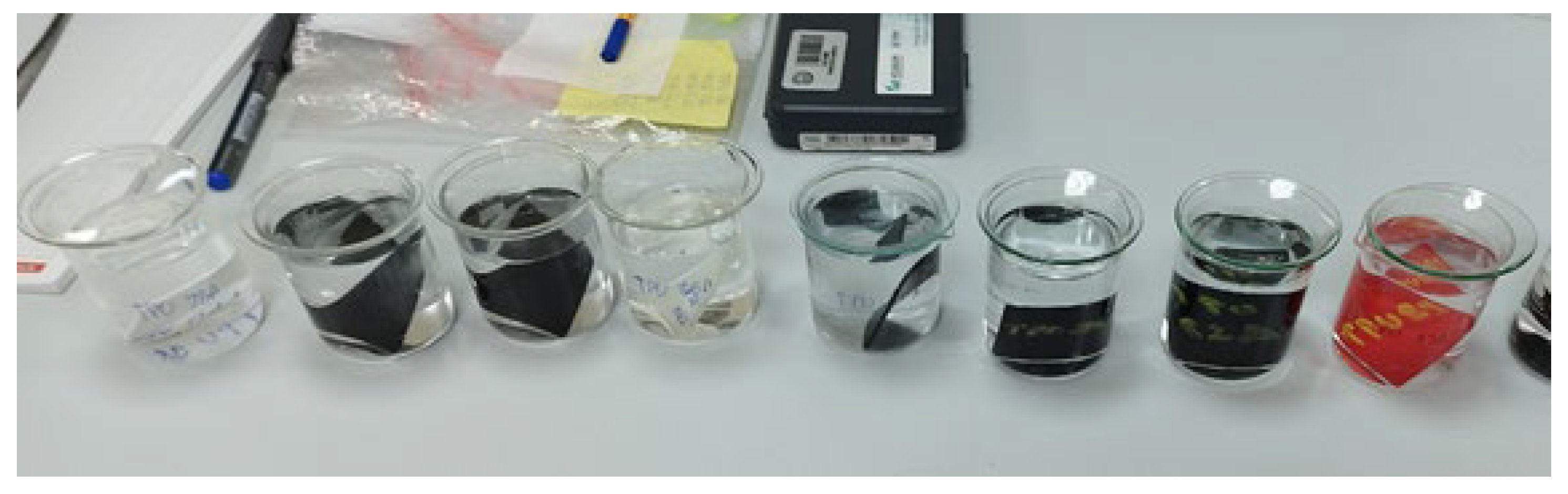
Figure 2.
Water absorption kinetics of TPU materials with different Shore A hardness: (a) 60A–85A and (b) 89A–98A.
Figure 2.
Water absorption kinetics of TPU materials with different Shore A hardness: (a) 60A–85A and (b) 89A–98A.
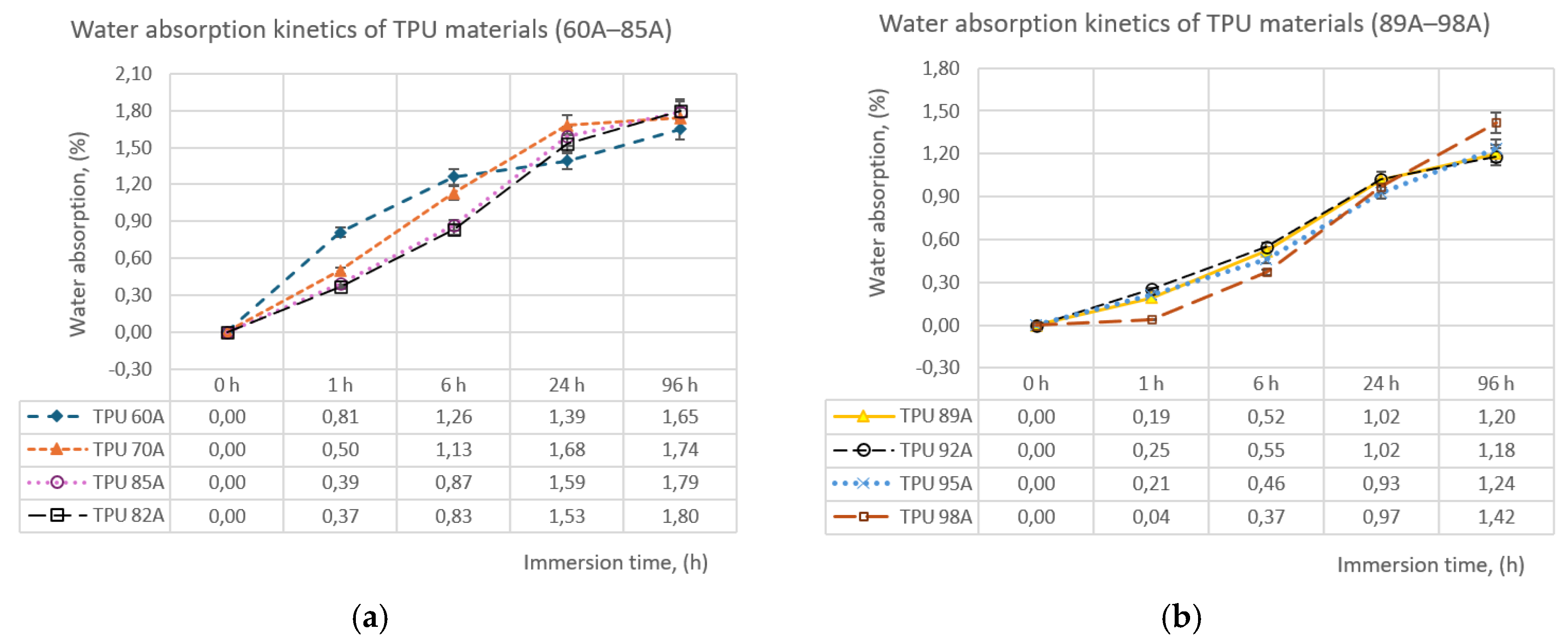
Figure 3.
Water absorption after 96 h of 0,9% NaCl solution immersion.
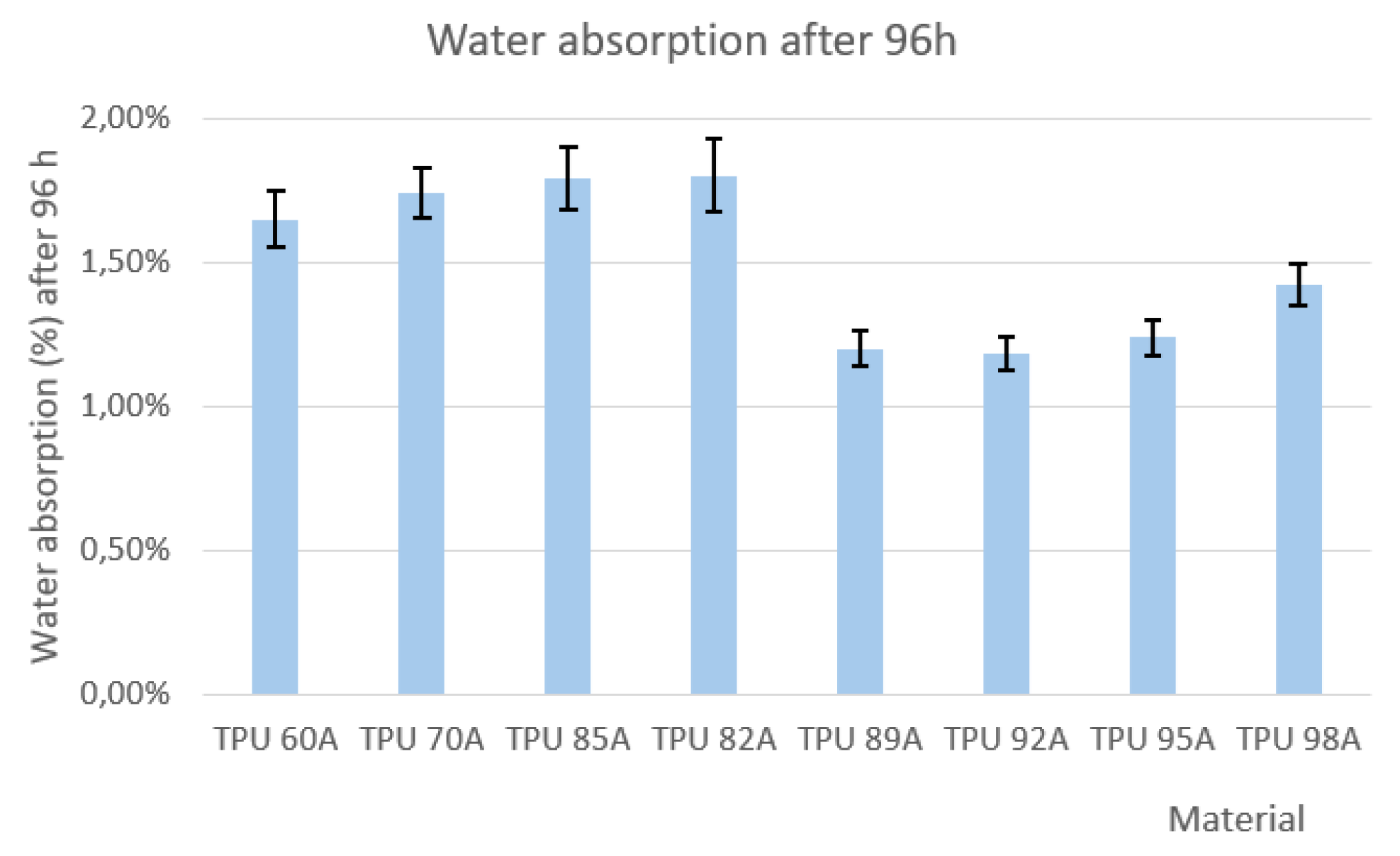
Figure 4.
Volumetric expansion of TPU materials after 96 h of 0,9% NaCl solution immersion.
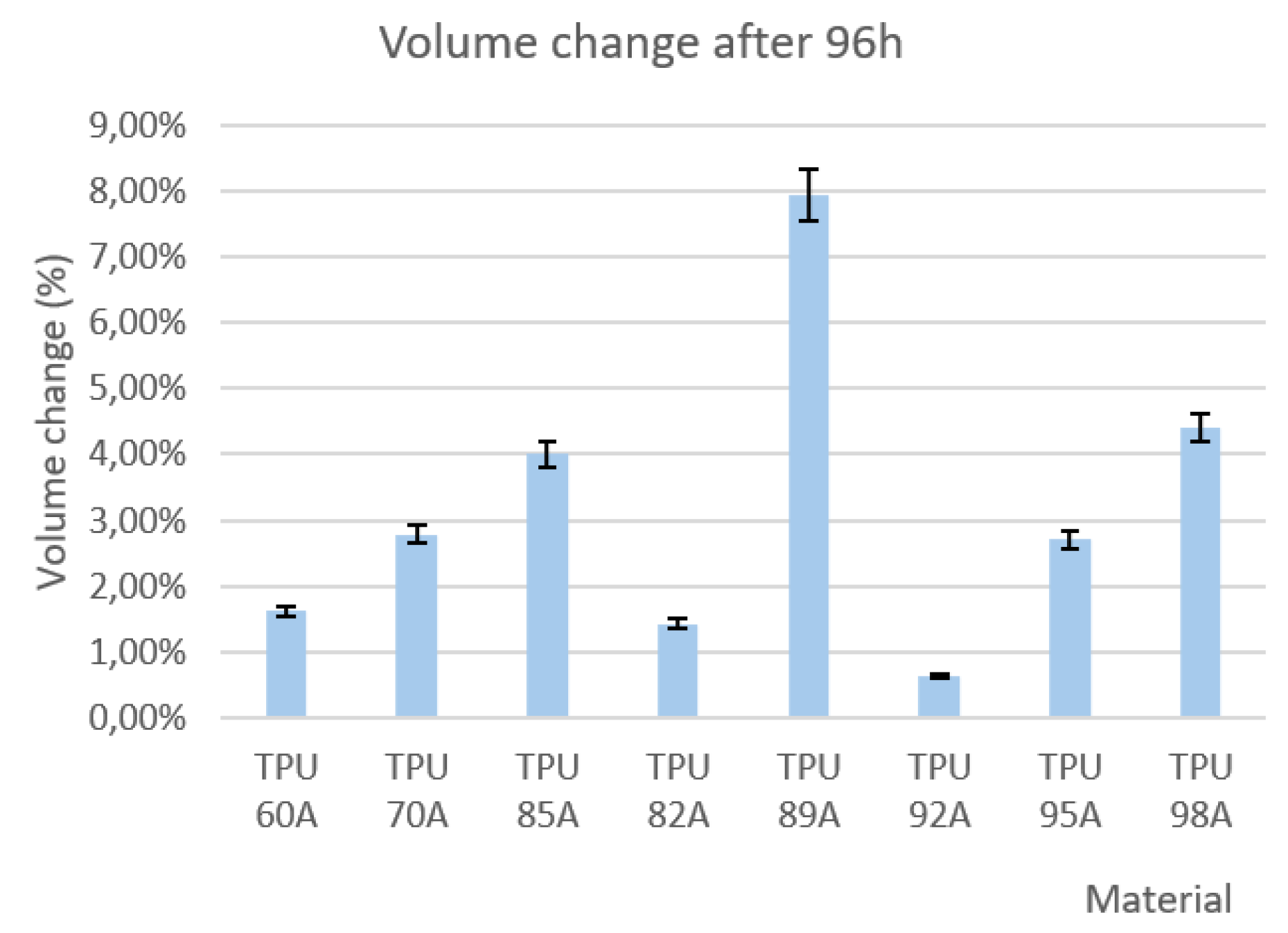
Figure 5.
Relationship between Shore hardness and water absorption after 96 h for TPU materials: (a) lower hardness range (60A–85A), showing a strong linear correlation (R² = 0.999); (b) higher hardness range (89A–98A), showing a weak correlation (R² = 0.4214) and increased data dispersion.
Figure 5.
Relationship between Shore hardness and water absorption after 96 h for TPU materials: (a) lower hardness range (60A–85A), showing a strong linear correlation (R² = 0.999); (b) higher hardness range (89A–98A), showing a weak correlation (R² = 0.4214) and increased data dispersion.
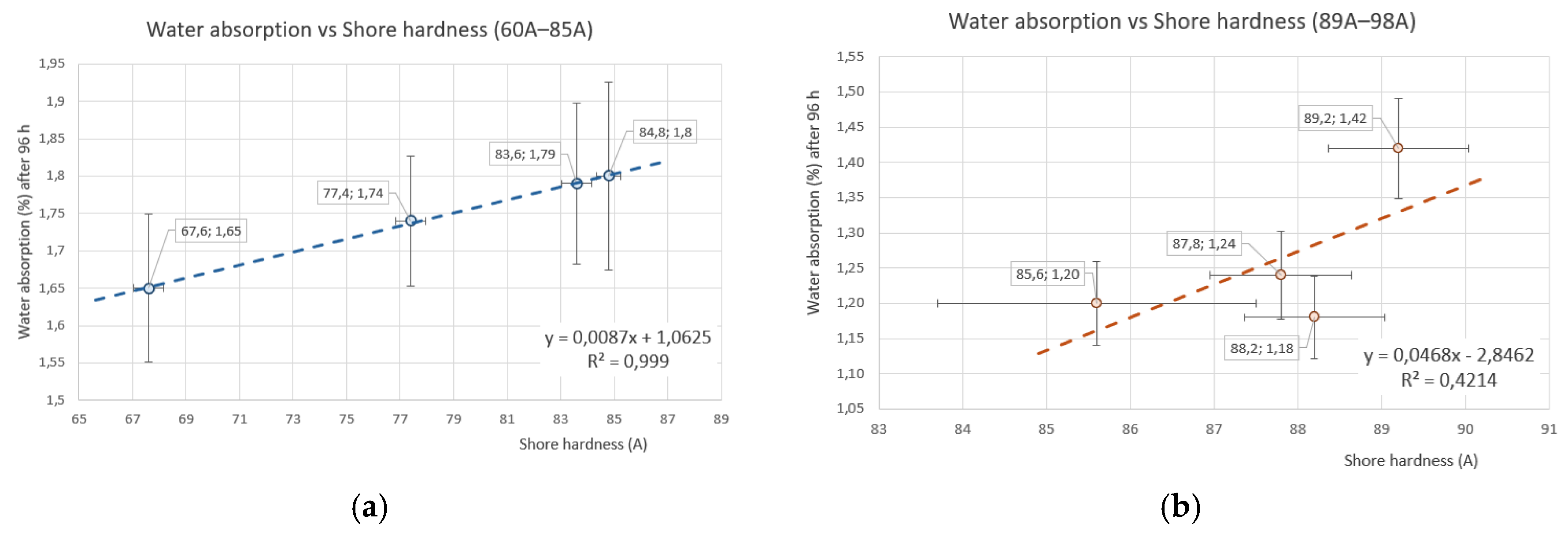
Figure 6.
Water diffusion behaviour of flexible TPU materials described by the Fickian diffusion model: (a) lower hardness range (60A–85A); (b) higher hardness range (89A–98A).
Figure 6.
Water diffusion behaviour of flexible TPU materials described by the Fickian diffusion model: (a) lower hardness range (60A–85A); (b) higher hardness range (89A–98A).
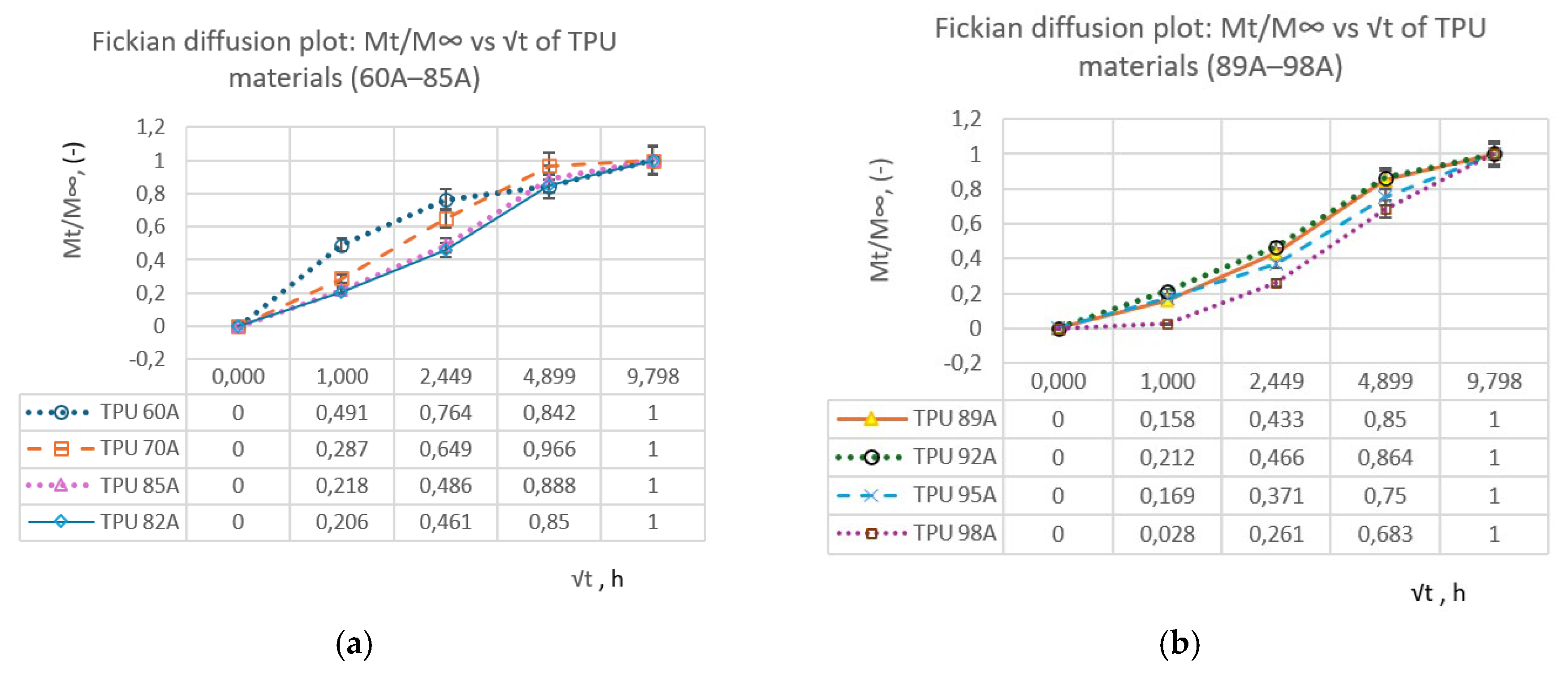

Table 1.
Flexible polymer filaments selected for the experimental investigation.
| Manufacturer | Recreus | Recreus | Recreus | AzureFilm | Plastika Trček | Fillamentum | Elegoo | AzureFilm |
|---|---|---|---|---|---|---|---|---|
| Commercial Name | FilaFlex 60A | FilaFlex 70A | FilaFlex 82A | TPU Flexible 85A | TPU Flexible 89A | Flexfill TPU 92A | TPU 95A | TPU Flexible 98A |
|
Hardness (Shore A) |
60 | 70 | 82 | 85 | 89 | 92 | 95 | 98 |
Table 2.
Printing parameters.
| Material | Layer height | Infill | Infill pattern | Print speed | Nozzle temp (1st layer) | Nozzle temp (other layers) | Bed temperature |
|---|---|---|---|---|---|---|---|
|
Filaflex TPU 60A |
0.2 mm | 100% | rectilinear | 40 mm/s | 225 °C | 238 °C | 50 °C |
|
Filaflex TPU 70A |
0.2 mm | 100% | rectilinear | 40 mm/s | 235 °C | 230 °C | 50 °C |
|
Filaflex TPU 82A |
0.2 mm | 100% | rectilinear | 40 mm/s | 250 °C | 240 °C | 50 °C |
| Azurefilm TPU 85A | 0.2 mm | 100% | rectilinear | 30 mm/s | 240 °C | 240 °C | 50 °C |
|
Plastika Trček TPU 89A |
0.2 mm | 100% | rectilinear | 30 mm/s | 245 °C | 245 °C | 50 °C |
|
Flexfill 92A TPU |
0.2 mm | 100% | rectilinear | 45 mm/s | 245 °C | 248 °C | 50 °C |
|
Elegoo 95A TPU |
0.2 mm | 100% | rectilinear | 45 mm/s | 245 °C | 248 °C | 50 °C |
| Azurefilm 98A TDS | 0.2 mm | 100% | rectilinear | 30 mm/s | 240 °C | 242 °C | 50 °C |
Table 3.
Shore hardness (A) of tested elastomeric materials (mean ± SD, n = 25).
| Material | TPU60A | TPU70A | TPU85A | TPU82A | TPU89A | TPU95A | TPU92A | TPU98A |
|---|---|---|---|---|---|---|---|---|
| Mean (x̄) | 67.6 | 77.4 | 83.6 | 84.8 | 85.6 | 87.8 | 88.2 | 89.2 |
| ± SD | 0.55 | 0.55 | 0.55 | 0.45 | 1.90 | 0.84 | 0.84 | 0.84 |
Table 4.
Water absorption at 96 h and corresponding diffusion coefficients.
| Material | TPU 60A | TPU 70A | TPU 85A | TPU 82A | TPU 89A | TPU 92A | TPU 95A | TPU 98A |
|---|---|---|---|---|---|---|---|---|
| Absorption | 1.65 | 1.74 | 1.79 | 1.80 | 1.20 | 1.18 | 1.24 | 1.42 |
| D, (m²s-1) | 1.93 × 10⁻¹² | 3.40 × 10⁻¹² | 1.87 × 10⁻¹² | 1.70 × 10⁻¹² | 1.96 × 10⁻¹² | 1.68 × 10⁻¹² | 1.06 × 10⁻¹² | 1.40 × 10⁻¹³ |
Absorption—Water absorption at 96 h, M∞ (%), D—Diffusion coefficient, D (m²s-1).
Disclaimer/Publisher’s Note: The statements, opinions and data contained in all publications are solely those of the individual author(s) and contributor(s) and not of MDPI and/or the editor(s). MDPI and/or the editor(s) disclaim responsibility for any injury to people or property resulting from any ideas, methods, instructions or products referred to in the content. |
© 2026 by the authors. Licensee MDPI, Basel, Switzerland. This article is an open access article distributed under the terms and conditions of the Creative Commons Attribution (CC BY) license (http://creativecommons.org/licenses/by/4.0/).
Copyright: This open access article is published under a Creative Commons CC BY 4.0 license, which permit the free download, distribution, and reuse, provided that the author and preprint are cited in any reuse.


