

Submitted:
17 April 2026
Posted:
17 April 2026
You are already at the latest version
Abstract
Mozambique possesses significant natural gas resources. Yet, a vast majority of its population relies on solid biomass for cooking, resulting in detrimental effects on health, livelihoods, and productivity, as well as devastating environmental impacts. Domestic use of these resources could boost energy productivity, security and support sustainable development. We conducted a mixed-methods study involving interviews, descriptive statistics, and a multinomial logistic regression model. For this study, data was gathered from a random survey of 434 households in natural gas-rich peripheries within Northern Inhambane and Maputo City aiming to identify determinants of household energy choice for cooking. The results showed that as the income increases, the odds of choosing electricity, LPG, and biomass increase. Notably, in energy-rich peripheries, the odds of choosing biomass as an alternative fuel to natural gas are reduced by 96.2% when compared to non-energy-rich regions. The urban and more educated dwellers were more likely to switch to electricity and LPG. Energy infrastructure and system-related incidents were key reasons for switching away from natural gas to biomass. Based on these findings and given natural gas’s preference as a transition cooking fuel in energy-rich peripheries, the government should prioritize investment in energy systems, allocate more domestic gas, and promote its use. This effort aims to enhance access to clean cooking and raise public awareness of its health and environmental benefits.
Keywords:
energy-rich peripheries
; cooking energy choice
; natural gas
; multinomial logit
; Mozambique
1. Introduction
The trajectory of human history has been fundamentally determined by energy access, transitions, and use [1,2]. That narrative has yet to fully unfold in most developing countries [3], including those with abundant energy resources, such as Mozambique. The limited access to clean cooking fuel and electricity affects a substantial majority of the population, a global concern addressed in the UN's 2030 Agenda for Sustainable Development Goals (SDG7) [4,5].
Access to energy should be guided by a transition perspective that minimizes detrimental health and environmental impacts and enhances productivity. A US$28 billion annual investment in reliable energy sources, systems, and infrastructure in Africa by 2030 is essential to meet current population growth and energy demand [6]. In 2018, the Mozambican Government launched the “Energia Para Todos—ProEnergia” (energy for all) initiative supported by international donors with an equivalent amount of US$148 million [7]. The initiative aimed only at expanding infrastructures and increasing household connections for electricity access, neglecting the low rates of clean cooking access. When analyzing human rights and access to modern energy, Hesselman [8] found that although international human rights law and protocols have extensively addressed the right to ‘energy services’ and gender perspective, they focused on the ‘right to electricity’, lacked details, and had limited monitoring practices. Gregory and Sovacool [9] showed that investment in energy systems and infrastructures is one of the key impediments to energy access. Additionally, comprehensive development planning [10] is fundamental in transitional geographies.
According to a CEAGE and Winrock International study [11], Mozambique's deforestation and forest degradation rate has risen considerably, with an annual loss of 137,300 hectares. Each year, fuelwood extraction, charcoal production, and use result in approximately 600,000 tCO2e, accounting for 7% of the country's emissions. The national forestry inventory report [12] found that the deforestation rate was at 220,000 hectares per year, and Nogueira Lisboa et al. [13] showed that clean-cutting charcoal accounted for roughly 9%, representing a 2% rise since 2016.
Mozambique possesses abundant natural resources, including renewable and non-renewable resources. However, more than 90 percent of its population relies on solid biomass for cooking [14,15], while 47 percent have no access to electricity [14,16]. Several studies have shown that the use of solid biomass is associated with emissions of harmful household air pollutants with health implications [17,18]. Moreover, the considerable time spent gathering firewood contributes to low productivity in numerous developing countries [19,20]. Studies reveal limited effectiveness and reach of clean biomass cooking initiatives, despite promotional efforts by many donor organizations [21,22]. Hutton et al. [23] suggest that to address the low adoption of solid biomass, the transition to clean and modern cooking fuels (CCE), such as natural gas or liquefied petroleum gas (LPG), is essential and preferable among households [24,25].
Following its 1975 independence, the Mozambican government enacted numerous energy policies and strategies [26,27,28,29,30,31]. The policies aimed to attract foreign direct investment in the energy sector, establishing energy regulatory bodies (CNELEC, INP, and ARENE)[32,33,34], an energy fund (FUNAE)[35], and state-owned energy companies (EDM, HCB, CARBOMOC, ENH, and Petromoc) [36,37,38,39,40]. The policies prompted substantial investment in the exploration and discovery of onshore and offshore gas resources [41,42]. On the other hand, the country depends heavily on imported petroleum products, including LPG for cooking, to meet its energy demands [14,43]. From 1958, Mozambique used to refine on average 14,500 barrels per day of petroleum products from SONAREP Refinery, a private Portuguese-owned refinery, located in Matola, Maputo province [44,45]. The geopolitical developments in the region and fears of sanctions against the South African regime [44] led to a significant reduction in the refinery's output during the early 1970s. Later in the 1970s, following independence, the FRELIMO government's nationalization efforts rendered it inoperative [45,46]. International oil market volatility might cause fuel prices and transport fares to rise. Historically, rising fuel prices in Mozambique and other developing nations of the global south have sparked violent protests and unrest among consumers [47,48].
Several studies have explored household energy use patterns and behaviors by analyzing factors that control the household energy transition from traditional to modern [49,50]. Earlier research focused solely on monetary factors, such as household income and fuel prices, leading to the "energy ladder" theory. This theory suggests that when a household's income and living standards rise, they often switch from traditional, polluting, and inefficient fuels to cleaner, modern, and more efficient alternatives [49,50,51].
The earlier theory failed to account for the prevalence of middle- and high-income households adopting various fuels daily, spanning both upper and lower levels of the energy ladder or transition reversal [52,53]. In some cases, low-income and rural households are unable to access modern and advanced fuels due to higher fuel and stove prices, fuel security concerns, and availability [53,54,55]. The theory was also criticized for being overly simplistic, with detractors claiming it neglected other significant factors related to fuel-staking behavior.
The new theory suggests that the factors controlling household energy transition are not limited to socioeconomic status; they also include household characteristics, demographics, and energy systems [52,56]. Van Der Kroon et al. [57] highlight external factors, such as biophysical, political, and institutional influences, as well as internal opportunities, as crucial determinants of a household's fuel choice. While both hypotheses are acceptable, the “energy stacking” framework provides a more complete and structured approach for evaluating how households behave during an energy transition and pinpointing policy priorities for fuel switching [57], especially in most developing countries, where multiple fuel stacking is evident.
Previous studies have examined the use of local energy for international trade and regional cooperation [58,59], energy justice and planning [10,60], the role of energy systems in transitions [61,62,63,64,65], and the adoption of biomass and improved cookstoves [66,67,68]; research in this field focusing on household choice of cooking energy transition in energy-rich peripheries is limited. Also, much of the research on cooking fuel access in developing countries has centered on either the adoption of imported LPG or issues of gender and health.
In their study, Kerimray et al. [69] observed that energy poverty and fuel stacking were less severe in energy-rich areas compared with other regions. The study highlighted key advantages, including improved energy infrastructure, lower energy costs, and higher earnings.
Energy resource-rich nations and the energy transition nexus have been a subject of recent literature, with particular emphasis on rents and institutional frameworks for low-carbon-intensity energy sources such as electricity [70,71,72]. Although some highlight the positive role of natural gas rents, none have addressed the issue of cooking fuels.
Consequently, the role of domestic natural gas in promoting the transition to clean and efficient cooking is being overlooked. As far as the authors are aware, no prior research has examined how the consumption of locally produced gas affects transitions to and access to CCE in Sub-Saharan Africa (SSA), particularly in Mozambique. Thus, this study aims to contribute to understanding the factors influencing households' and micro and small enterprises' (MSMEs) cooking fuel transitions, using data collected from two provinces (Inhambane and Maputo City) in Mozambique, where locally produced natural gas is a primary cooking fuel for some households.
The research examines households and micro, small, and medium enterprises (MSMEs) in both rural and urban geographies. A qualitative and quantitative analysis of the primary data is used to explain the probability of their choices in the absence of the primary cooking fuel.
The remainder of the paper is structured as follows. Section 2 presents the study’s materials and methodology, including a description of the study area, survey procedures and data, and the empirical models used for analysis. Section 3 presents the results and discussion of the study. While section 4 offers a summary of findings and the resulting policy implications.
2. Materials and Methods
2.1. Study Setting
The study was carried out between September and November 2024 in two provinces currently utilizing domestically produced natural gas as a primary cooking fuel (Figure 1): 1) Inhambane (Govuro, Inhassoro, and Vilanculos districts) with a combined population of 269,781, and 2) Maputo City (KaMpfumo, KaNlhamankulu, and KaMaxaquene districts) with 559,042 residents [73,74,75,76]. Geographically, they are located in the southern region of the country. In addition, all districts in the study sites are located in coastal regions, where 60% of the Mozambican population lives [77].
According to national statistics [78], 27% of households in Inhambane use biomass cookstoves, while only 7% use electric or gas stoves. In contrast, 82% of households in Maputo use biomass cookstoves, compared with 57% using electric or gas cookstoves. Electricity access is much higher in Maputo, at roughly 99% of households, than in Inhambane, where it's just 42% [14]. Furthermore, 93 % of Mozambican households spend an average of 1.5 to 7 hours per week obtaining cooking fuel and 5 to 15 minutes setting up their cookstoves. Maputo city has the lowest percentage, at 64%, while Inhambane is about 95% [79].
Like most other Mozambican spaces, the study area comprises urban, rural, and a transition area called “peri-urban” [80]. Urban and peri-urban spaces are characterized by rapid expansion through self-occupation and informal settlements as a result of ‘benefits of dysfunctionalities’ and poor urban planning [81,82,83]. The expansion of urban and peri-urban areas has outstripped the development of urban services [84]. This also holds true in sparsely populated rural spaces [80,84].
More than half of the economically active population works in the informal sector [79]. This type of vulnerable employment is most prevalent in rural areas (67%), compared with urban and peri-urban areas, which are at 30%. The national statistics showed that Inhambane province had an informal employment rate of 55%, contrasting sharply with Maputo, the capital city, which had the lowest rate at 16%.
2.2. Energy Resources
Around 43% of Mozambique's total area (34 million hectares) is covered by natural forests [85], which provide energy to local communities and the majority of Mozambican households. The forest and biomass resources amount to approximately 1.74 billion cubic meters [86], with an annual biomass production and consumption ranging from 13.8 to 15.8 million tons [87]. This usage accounts for more than 80% of the fuel households use for cooking.
On the other hand, Mozambique possesses recoverable resources of about 130 trillion cubic feet of natural gas and 158 million barrels of oil [88,89], with Inhambane province comprising 4 trillion cubic feet of gas and 11 million barrels of oil, discovered between 1961 and 2003 [89,90]. Current production of energy resources is about 138.8 million BTU of liquefied natural gas (LNG) each year, 1,000 barrels of condensate per day by Coral Sul FLNG [91], by Italian multinational Eni, 192.5 gigajoules (GJ) of natural gas; and 500 thousand barrels of condensate per year [92,93] by South African petrochemical company Sasol, from Inhambane’s Pande, Temane, and Inhassoro fields. The country uses 26.2 GJ (13.6 percent) of this energy, with only 3.1 GJ used for cooking.
Furthermore, Mozambique imports roughly 48,300 metric tons of liquefied petroleum gas (LPG) each year for cooking [14] via the Maputo, Beira, and Nacala ports, which host LPG storage facilities. In Inhambane, LPG cylinders come from the neighboring province of Sofala; thus, the average retail price is about 2.20 US$/kg, 39 percent pricier than that of Maputo and Beira cities at an average of 1.34 US$/kg [94] (at an exchange rate of 64 MZN = 1 US$).
Clean cooking access is estimated at 2.7 percent, with Maputo at 19.1 percent, the highest in the country, and Inhambane averaging 3.5 percent [95].
2.3. Energy Systems and Infrastructures
In contrast to electricity infrastructures and other services, which were inherited from the colonial era [96], city gas infrastructure and systems were planned and constructed from scratch in the post-independence era. The first pipeline system implemented in the country was a small-scale project by the Mozambican National Oil Company (ENH) in the 1990s, as part of its efforts to develop the Pande and Temane gas fields. In 1992, it commenced operations in three districts within Inhambane, near the Pande & Temane gas fields [97]. Natural gas is now used in homes and restaurants for cooking, in industry, and for electricity generation, and the network has expanded to over 670 km [97].
The Maputo pipeline originated from a 25-year petroleum production agreement (PPA) signed in 2000 by Sasol, ENH, Companhia Moçambicana De Hidrocarbenetos (CMH), and the government of Mozambique [98,99]. Among other projects, the agreement involved building an 865 km export ROMPCO pipeline from Temane (Inhassoro District), Mozambique, to Secunda, South Africa [99]. This project commenced in April 2002 and incorporated five gas off-take points located in Temane, Chigubu, Macarretane, Magude, and Ressano Garcia [100]. In 2005, a 100 km natural gas pipeline was extended from Ressano Garcia to Matola, an industrial district of Maputo [59,101]. At first, the gas was limited to industries, transportation, and power generation [101]. By the end of 2013, its reach extended 72 km, including Maputo City and the Marracuene District [59]. A pilot program providing natural gas to households in Maputo city launched in 2018 in the Aeroporto-A neighborhood (in KaNlhamankulu) [102].
As a result of further expansion, more than 4,000 households and MSMEs in Maputo and Inhambane are connected to the natural gas pipeline systems. The study area and its key underlying energy systems are shown in Figure 1.
2.4. Sample Size
The sample size was not predetermined for the study. The study sample comprised 434 households and MSEs (N=434) from two provinces: 66 (15.2%) in Govuro, 110 (25.3%) in Inhassoro, and 139 (32.0%) in Vilanculos (Inhambane Province); and 60 (13.8%) in Nlhamankulu, 25 (5.8%) in KaMpfumo, and 34 (7.8%) in KaMaxaquene (Maputo City).
2.5. Data Collection and Management
A multimethod approach was used to examine clean energy access and consumption patterns in both rural and urban settings, with an emphasis on locally produced natural gas resources. A literature review, in-person interviews, and a survey in the Inhambane and Maputo provinces were employed. Questionnaires and interviews were conducted from September through November of 2024 and in the Portuguese language. This method is beneficial because it allows for the collection of both qualitative and quantitative data, gives participants a voice, improves the validity of the findings, and enables comprehensive analysis of complex phenomena [103,104,105,106].
A questionnaire contained a mix of open and closed questions. This survey was designed to gather input regarding the factors that influence a respondent's choice of primary energy [107,108,109]; in particular: i. demographic) urbanicity and aggregate size; ii. socioeconomic) head of household’s income, education, primary and alternative energy spending; iii. energy systems) incidents or accidents related to energy use; iv. sociocultural) energy stacking; A description of the factors is shown in Table 1. The questionnaire covered a considerable range of subjects, and a portion of the survey data is not pertinent to this publication.
Data was collected using MS Forms online or, if unavailable, using paper questionnaires. Notes were taken to capture responses not addressed by the questionnaire. To conduct the statistical analysis, the data were cleaned, coded, and analyzed with the mlogit package [110] of R’s version 4.5.2 [111]. Coding was crucial for improving the analysis of the quantitative data. [106].
2.6. Analytical Techniques
In this paper, descriptive statistics, cross-tabulation, p-values, and multinomial logistic (MNL) models were employed. We employed descriptive statistics to outline the demographic and socioeconomic traits of the respondents. Additionally, the efficiency of energy systems and the respondent’s perception of energy services were evaluated.
Given that social and behavioral responses are modeled using discrete variables, choices are mutually exclusive; a common way to represent binary events is a dichotomous (dummy) variable [112]. And when dealing with dummy dependent variables, predicted values from linear regression or ordinary least squares (OLS) yield an uneven split between the two categories, with observations tending to fall toward the extremes [112]. OLS models for a dichotomous response pose additional problems of nonlinearity, nonadditivity, nonnormality, and heteroskedasticity [112,113]. As such, we employed logistic models in quantitative analysis. This method is more appropriate for our data [114,115]. In addition, given that our sample size exceeds 100 observations, the risk of conducting significance tests or maximum likelihood (ML) estimation is minimal [116].
Households' decisions regarding cooking fuel, specifically their choice of one type over alternatives like piped natural gas, can be modeled using the Random Utility Model (RUM) [109]. Discrete choice models can be derived from the assumption of households’ utility-maximizing behavior [117]. Consider household head , confronted with fuel alternatives . When a household opts for fuel type out of set if alternatives (natural gas, electricity, LPG, and biomass), he or she derives a utility level of . The function is dependent on observed covariates and unknown factors, . The observed factor is the standard random utility model and can be written as:
In equation 1, denotes alternative-specific constant; , , and are the alternative and choice situation specific covariates for price, incidents and expenditure, respectively, with generic coefficients , and ; and is the individual specific covariates with alternative specific coefficients . Therefore, the above function can be determined as:
Here, represents utility of energy type for households’ choice, is observable covariates and unknown parameters to be estimated, and is a random deviation which contains all the unobserved determinants of the utility.
Depending on households view on each alternative, the alternative is therefore chosen if and if its components are distributed independently, identically distributed (iid) extreme value, then the probability of choosing this alternative can be determined as follows:
2.6. Description of Variables
We investigated the factors driving household fuel choice by examining economic and socio-demographic variables, both with and without consideration of the resource periphery effect. Price and consumption expenditures in monetary terms for energy types such as NG, LPG, electricity, and biomass constitute the economic variables, with natural gas serving as the reference for primary cooking energy. Participants were surveyed, for example, regarding their total household expenditure on natural gas and substitute fuels, denominated in Mozambique meticais. The pricing data for each area was obtained directly from the retail establishments operating in those locations. Any households for which the energy expenditure could not be clearly determined were removed from consideration. Table 1 presents descriptions of outcome and explanatory variables, including sociodemographic and technical-related factors such as gender, age, aggregate size, incidents, and energy stacking.
Some variables in the models are expressed in natural logarithms to achieve normality. Summary statistics of the variables are shown in Table 2.
2.7. Limitations
The study is limited by its focus on understanding fuel choice among households connected to locally produced gas in the northern Inhambane province and Maputo city. Data from households without piped natural gas, as well as from other regions, would have allowed broad cross-comparisons of choice behavior, clean cooking access, and other pertinent factors. While acknowledging the cited limitations, it nonetheless makes a valuable contribution to understanding fuel choice behavior and access to clean cooking in Mozambique and other gas-rich countries.
3. Results and Discussions
The empirical analysis in the study begins with a descriptive analysis, and the extent to which households were influenced by a combination of factors was examined using a chi-squared test, leading to a multinomial logistic regression analysis.
3.1. Descriptive Statistics
3.1.1. Income and Accessibility
Table 3 shows respondents' income groups across rural, peri-urban, and urban areas, with 50.1% in vulnerable and semi-vulnerable groups (i.e., informal businesses, unemployed, and entrepreneurs). The remaining were a non-vulnerable group with a fixed income. Our findings support other studies showing that Mozambique’s labor force is characterized by vulnerable sources of income or a higher level of self-employed workers [118,119].
Furthermore, 91% of respondents thought that fuel prices were accessible or reasonable. Some respondents suggested that the fuel prices, natural gas in particular, should be cheaper because it belongs to the community or is produced locally (“não há razão de ser caro, porque o gás vem da nossa terra”), indicated a male resident in the Vilanculos district. Our interview captured another contested factor: most households residing in Inhambane province pay additional monthly fixed charges or “taxa fixa”, consisting of 318 and 3,000 Meticais (~4.89 and 46.15 $US), imposed by the operator on domestic and commercial consumers, respectively. For some households, these charges often exceed the actual monthly energy expenditure. These charges enable the operator to offset revenue shortfalls [120], especially in an environment with heavily subsidized fuel prices and no price revisions for over twenty years.
3.1.2. Fuel Stacking
Among 434 respondents, 56% switched their fuels and stoves (see Table 3), indicating a high prevalence of cooking fuel stacking, with respondents using additional fuels alongside their primary source. The main fuels were biomass (76.2%), electricity (7%), and LPG (3%). Respondents used electricity only for heating and microwaving food; biomass and PLG fueled both their cooking and heating needs. Refusal by the operator to extend gas lines to additional kitchen areas among MSMEs was the reason to consider LPG as a substitute for city gas. While some faced problems with their gas stoves or payment issues, others had visitors who needed to have their plans adjusted.
A strong rural and peri-urban bias was evident in the survey; 94% of respondents who stacked fuel lived outside urban centers, while only 6% lived in urban areas. Intriguingly, about 80% of participants who perceived the gas price as cheaper or reasonable staked the most, compared with 5% who thought fuel prices were high or very expensive.
Across all spending levels, respondents stacked their fuels. A direct relationship was also observed between the number of aggregates and total expenditure. A parallel trend was observed between aggregate counts and biomass stacking levels.
3.1.2. Security Concerns
Table 3 also indicates that only 18% of the participants in Inhambane and Maputo have security concerns about using gas as their primary cooking fuel. Several participants in the Inhassoro, Govuro, and Vilanculos districts reported that they often experience gas leaks in their neighborhoods, but these have not caused major incidents. However, in Maputo and Beira, a number of fatal LPG gas cylinder explosions have been reported [121,122].
Gas incidents and accidents have also been a concern for many households and residents around developed and developing countries. Because of human error, lack of inspection, and equipment and infrastructure in India, Pakistan, Ghana, and Kenya, it resulted in numerous explosions and human loss [123,124,125,126], while corroded pipes and leaks have been the main causes of explosions, building destruction, injuries, and deaths in the United States, China, Canada, and Great Britain [127,128,129,130]. Regulatory failure has been cited as the main contributor to the gas infrastructure and equipment explosions in Pakistan, and there have been calls for proper regulatory reforms, public awareness, and education [125], and cylinder innovation in Ghana [131] to reduce accidents and promote gas as the best alternative cooking fuel. When analyzing the total number of gas accidents in China, Pang et al. [132] found that from 2012 to 2023, the number of accidents was about 380 to 610 per month. Compared with piped gas, LPG had 43% more explosion-related accidents, 24% more fires, and 70% more asphyxiation and poisoning, while the former had 144% more leakages [132].
3.2. Multinomial Logistic Regression Analysis
The multinomial logistic regression models were used to analyze household fuel choices in Mozambique's energy periphery. The analysis considered four fuel categories: Electricity, NG, LPG, and Biomass, with NG as the reference fuel category.
The models were fitted both with and without accounting for the location effect. Table 4 presents the result of the multinomial logit model without the resource periphery effect. The coefficients indicate the direction of the effects. The probability of a household opting for a specific cooking fuel is interpreted by estimating the predicted probability for all households.
3.2.1. Income
In terms of socio-economic factors, the results revealed that monthly income enhances the use of energy-mix and has a significantly positive effect on fuel choice for all fuels at 1% and 5% levels of significance, indicating that the predicted odds of choosing electricity as an alternative to NG increased by 0.32% with an increase in monthly income (see Table 4). Similarly, for LPG increase by 0.48%, and for biomass, by 0.24%. This suggests that even wealthier households are likely to switch fuels, thereby supporting the energy stacking hypothesis. The results for LPG are similar to those reported by Masera [136] and to studies supporting the energy ladder hypothesis. The research emphasizes the significance of a household's socio-economic status in its decision-making process for cooking energy, particularly within the framework of energy stacking. The energy mix selection, with a substantial proportion of cleaner fuels, remains significantly influenced by household income. The findings reveal that Mozambican households are not consistently progressing up the energy ladder. Instead, some are regressing or reverting to less clean fuel sources, suggesting a reversal of the energy transition.
A country's general economic circumstances can affect changes in energy-related behaviors, with contributing factors such as income, unemployment, and energy prices playing a role [57].
3.2.2. Demographics
The coefficients for demographics are statistically significant at the 5% level for electricity and LPG but are insignificant for biomass (see Table 4). The results showed that, compared to peri-urban and rural areas, the predicted odds of preferring energy other than natural gas are higher by 25.5 for electricity and by 10.3 for LPG in urban areas. A possible explanation is that during the early phases of urban expansion, and given the availability of abundant biomass fuel around cities, urban dwellers predominantly use it for cooking, with little reliance on other sources, such as electricity and LPG [133].
The findings presented in Table 5 demonstrate the same scenario of the relationship between the choice of cooking fuel and its influencing factors, including the energy-rich periphery effect, using the MNL. Additionally, it indicated that the odds of choosing biomass (statistically significant at the 5% level) as an alternative cooking fuel to natural gas were 96.2% lower than in non-energy-rich peripheries. Domestic household fuels produced in Mozambique are relatively lower in the surrounding producing regions, which makes it accessible to lower-income households. The majority of oil- and gas-producing and exporting countries have relatively lower domestic fuel prices, mainly due to subsidies [134,135]. Another explanation may be alternative-specific benefits, such as efficiency. A 46-year-old respondent from Inhassoro indicated that “natural gas is faster than biomass, and because it is extracted here, it’s much cheaper than alternatives.” Furthermore, other respondents linked the use of NG and increased productivity: “You do not need to waste time fetching cooking fuel; you just need to turn on the valve, and you are ready to go”, a female primary school teacher in Vilanculos highlighted.
3.2.3. Education
At a 1% significance level, we found that years of education had a positive effect on cooking energy preference. The odds of choosing electricity as an alternative fuel increased by 45.3% (coefficient of 0.4335), and the odds of choosing LPG increased by 85.7% (coefficient of 0.6188) with a 1-year increase in education, controlling for other predictors (see Table 4 and Table 5). Consequently, households with higher qualifications demonstrate a better understanding of the advantages of cleaner fuels and find it easier to adopt them than less-qualified households, since a lack of technological awareness deters acceptance. This finding corroborates the results on modern fuel preferences [136,137].
In urban settings, a positive and significant correlation is observed between the adoption of clean energy sources (electricity and LPG) and education level. One possible explanation is that people pursuing higher education face a greater opportunity cost with modern fuels, which offer significant time savings [133]. Additionally, individuals with higher levels of education are increasingly aware of the detrimental health consequences associated with cooking with wood and charcoal [52].
3.2.4. Expenditure
The results in Table 4 and Table 5 demonstrate a statistically significant positive correlation between expenditure and all fuels (significance level < 0.01). The findings reveal that households, regardless of their socio-economic status, do not tend to alter their consumption in response to fuel prices. These findings are substantiated by results from Nigeria and Mexico [52,142], which assert that energy goods are a basic necessity.
3.2.5. Infrastructures and Energy Systems
A model excluding demographic and socioeconomic factors was analyzed to understand the effect of alternative-specific variables on decision-making. We found that natural gas-related incidents have a significant positive impact on switching to all fuel alternatives (Table 6). Many respondents indicated that they switched their primary cooking fuel (natural gas) due to incidents involving gas leaks, low gas pressure, and prepayment system issues. A retired male respondent in Vilanculos said that “sometimes, due to low gas pressure during the night period, we are obliged either to cook around 3:00 PM, before everyone is back from work, or switch to other alternatives.” Furthermore, an informal businesswoman in a female-headed household in the Costa de Sol neighborhood in Maputo shared that “the prepayment system is the key reason for temporary disconnection from natural gas and switching to other alternatives”.
Challenges to the current energy infrastructure stem from rapid urban expansion, population growth, and increased energy demand, as the network was originally designed in the 1990s for a smaller consumer base. Additionally, gas transmission networks are susceptible to extreme natural disasters, third-party actions, and operational failures, which risk their integrity and safety [138,139,140]. Thus, to ensure the efficient distribution of natural gas to end-users, adding or upgrading compressor stations in certain areas can help maintain adequate pressure and flow rates throughout the pipeline system. Routine inspections and dynamic maintenance, intelligent monitoring, automation solutions [140,141], servicing of pipeline networks and related systems to ensure safety and sustained operational efficiency.
The factors of gender, household age, and size seem to play little or no role in shaping cooking fuel preferences both within and outside resource peripheries.
3.2.6. Diagnostic Tests
We tested the model for the Property of Independence from Irrelevant Alternatives (IIA) using the Hausman-McFadden IIA test [142]. We reject the null hypothesis of the choices being independent (see Table 7). Although the model exhibits the IIA property, households in this study opted for multiple cooking fuel choices, which may have violated the property or been unrealistic.
4. Conclusions and Policy Implications
This paper analyzed the determinants of households’ cooking energy decision-making in and out of energy resource-rich regions of Mozambique, employing a logistic regression model based on data from 434 households connected to domestically produced natural gas. In addition, the interviewees' remarks validate our empirical findings on coping mechanisms for accessing clean cooking fuel in developing countries. Based on our predictions, we can draw the following conclusions: First, we found that both supply and demand factors shape household fuel choices. On the demand side, variables such as income, spending, education, and geographic location, along with proximity to energy exploitation regions, show a significant correlation with decision-making. On the supply side, we've identified energy systems and related infrastructures as the key drivers of household energy selection. Second, price, gender, age, and household size are not significant determinants of decision-making.
There has been little prior knowledge of household energy transitions in Mozambique's gas-rich peripheries, and this paper makes a useful contribution to filling this knowledge gap. Mozambique can learn valuable policy lessons from nations that have successfully promoted the adoption of clean cooking. While formulating strategies and policies for the promotion of natural gas and other transition cooking fuels, it is recommended that elements of the supply and demand sides, such as socioeconomic, environmental, cultural, demographic, and infrastructural factors, be taken into consideration. For instance, the Kenyan Government [148] identified several key behavioral aspects and communication strategies to boost clean cooking adoption. Among others, it included branding; behavior change strategy; media advocacy to enhance public awareness and understanding of clean cooking; partnerships; special and dedicated events; and the involvement of private sector/industry players in the process. Central government and institutional commitment, subsidies, financial donor support, infrastructure readiness, effective policies, campaigns, and communication strategies, and public response were among the factors contributing to the successful implementation of clean cooking in many developing countries [143,144,145]. Concurrently, households shall be encouraged to transition to sustainable cooking fuels, moving from inefficient, traditional energy to modern, cleaner energy sources by addressing the factors influencing their energy choices. Successfully implementing this strategy could lead to greater public trust and broader adoption of modern energy alternatives in transport and industry. This would result in reduced reliance on forest biomass for cooking energy, better public health, increased productivity, and rapid progress towards the SDG-7 objectives.
Author Contributions
Conceptualization, C.O. and F.I.; methodology, C.O.; software, C.O.; validation, C.O., F.I. and A.W.; formal analysis, C.O., F.I. and A.W; investigation, C.O., F.I. and A.W.; resources, C.O. and F.I.; data curation, C.O.; writing—original draft preparation, C.O.; writing—review and editing, C.O., F.I. and A.W.; visualization, C.O.; supervision, F.I.; project administration, F.I.; funding acquisition, F.I. All authors have read and agreed to the published version of the manuscript.
Funding
This research received no external funding.
Data Availability Statement
The data from this research is accessible and can be provided upon request. Due to granted permissions, the data is not publicly accessible.
Acknowledgments
This work was conducted with the support of JICA’s Kizuna Program. We extend our gratitude to the field assistants, Carlitos Sambo and Bernon Verlopes, for facilitating local access to gas infrastructures and households in three districts of Inhambane. Our thanks are also due to the survey participants who took the time to complete interviews and questionnaires and ENH, EK, and DNHC for the additional information they supplied for this research. We extend our sincere appreciation to Mirzosaid Sultonov for his significant technical contributions to this work.
Conflicts of Interest
The authors declare no conflicts of interest.
Abbreviations
The following abbreviations are used in this manuscript:
| ARENE | Energy Regulatory Authority |
| BTU | British Thermal Unit |
| CCE | Clean Cooking Energy |
| CMH | Mozambique Hydrocarbon Company |
| CNELEC | Mozambique's National Electricity Council |
| DNHC | National Directorate of Hydrocarbons and Fuels |
| EDM | Mozambique Electricity Company |
| EK | ENH - KOGAS Joint Venture Company |
| ENH | Mozambique National Oil Company |
| FLNG | Floating Liquefied Natural Gas |
| FRELIMO | Mozambique Liberation Front |
| FUNAE | National Fund for Energy |
| GJ | Gigajoule |
| INP | Petroleum National Institute |
| JICA | Japan International Cooperation Agency |
| LNG | Liquefied Natural Gas |
| LPG | Liquefied Petroleum Gas |
| MNL | Multinomial Logistic Regression |
| MSMEs | Micro, Small and Medium Enterprises |
| OLS | Ordinary Least Squares |
| ROMPCO | Republic of Mozambique Pipeline Company |
| SDGs | Sustainable Development Goals |
| SMEs | Small and Medium Enterprises |
| SSA | Sub-Saharan Africa |
| tCO2e | Tons of CO2 Equivalent |
References
- World History and Energy. In Encyclopedia of Energy; Elsevier, 2004; pp. 549–561. ISBN 978-0-12-176480-7.
- Environment Agency Quality of the Environment in Japan 1998: Realize Society for the 21st Century Keeping Sound Material Cycle and Harmonious Coexistence with Nature; Japan, 1998.
- EIA Energy Access Outlook 2017: From Poverty to Prosperity. EIA, 2017; p. 144.
- IEA; IRENA; UNSD; World Bank. WHO Tracking SDG7: The Energy Progress Report, 2024; World Bank: Washington DC, 2024; p. 179. [Google Scholar]
- UNECA; AU; AfDB. UNDP 2023 Africa Sustainable Development Report: Accelerating Recovery from the Coronavirus Disease (COVID-19) and the Full Implementation of the 2030 Agenda for Sustainable Development and African Union Agenda 2063 at All Levels; UNECA: Addis Ababa, Ethiopia, 2023; p. 116. [Google Scholar]
- IEA World Energy Outlook 2023. 2023.
- The World Bank Mozambique Energy For All (ProEnergia) 2023.
- Hesselman, M. Human Rights and Access to Modern Energy Services:, University of Groningen; 2023. [Google Scholar]
- Gregory, J.; Sovacool, B.K. The Financial Risks and Barriers to Electricity Infrastructure in Kenya, Tanzania, and Mozambique: A Critical and Systematic Review of the Academic Literature. Energy Policy 2019, 125, 145–153. [Google Scholar] [CrossRef]
- Broto, V.C. Energy Sovereignty and Development Planning: The Case of Maputo, Mozambique. International Development Planning Review 2017, 39. [Google Scholar] [CrossRef]
- CEAGRE; Winrock International Identificação e análise dos agentes e causas directas e indirectas de desmatamento e degradação florestal em Moçambique; CEAGRE: Maputo, MZ, 2016; p. 36.
- MITADER Mozambique’s Forest Reference Emission Level for Reducing Emissions from Deforestation in Natural Forests; Government of Mozambique: Maputo, MZ, 2018; p. 50.
- Nogueira Lisboa, S.; Grinand, C.; Betbeder, J.; Montfort, F.; Blanc, L. Disentangling the Drivers of Deforestation and Forest Degradation in the Miombo Landscape: A Case Study from Mozambique. International Journal of Applied Earth Observation and Geoinformation 2024, 130, 103904. [Google Scholar] [CrossRef]
- MIREME Relatório Estatístico de Energia 2022 – 2023; Estatísticas Oficiais de Moçambique; MIREME: Maputo, MZ, 2024; p. 99.
- EDM Relatório Anual de Estatística 2023. EDM: Maputo, MZ, 2023.
- IEA Africa Energy Outlook 2019 - Overview: Mozambique. IEA 2019, 20.
- WHO Household Air Pollution. Household air pollution 2024.
- Rupakheti, D.; Kim Oanh, N.T.; Rupakheti, M.; Sharma, R.K.; Panday, A.K.; Puppala, S.P.; Lawrence, M.G. Indoor Levels of Black Carbon and Particulate Matters in Relation to Cooking Activities Using Different Cook Stove-Fuels in Rural Nepal. Energy for Sustainable Development 2019, 48, 25–33. [Google Scholar] [CrossRef]
- Behera, B.; Rahut, D.B.; Jeetendra, A.; Ali, A. Household Collection and Use of Biomass Energy Sources in South Asia. Energy 2015, 85, 468–480. [Google Scholar] [CrossRef]
- Kaddu, M.; Senyonga, L.; Sseruyange, J.; Watundu, S.; Ngoma, M.; Turyareeba, D. Fuelwood Exploitation and Schooling of Children from Rural Households in Uganda. Next Research 2025, 2, 100183. [Google Scholar] [CrossRef]
- Matavel, C.E.; Kächele, H.; Hafner, J.M.; Rybak, C.; Uckert, G.; Hoffmann, H.; Kipkulei, H.K.; Massuque, J.; Steinke, J.; Sieber, S. How to Increase Cookstove Adoption? Exploring Cost-Effective Dissemination Techniques in Central Mozambique. Energy Research & Social Science 2023, 100, 103082. [Google Scholar] [CrossRef]
- Nuño, N.; Mäusezahl, D.; Hartinger, S.M.; Riley-Powell, A.R.; Verastegui, H.; Wolf, J.; Muela, J.; Paz-Soldán, V.A. Acceptance and Uptake of Improved Biomass Cookstoves in Peru – Learning from System Level Approaches to Transform Large-Scale Cooking Interventions. Energy Research & Social Science 2023, 97, 102958. [Google Scholar] [CrossRef]
- Hutton, G.; Rehfuess, E.; Tediosi, F. Evaluation of the Costs and Benefits of Interventions to Reduce Indoor Air Pollution. Energy for Sustainable Development 2007, 11, 34–43. [Google Scholar] [CrossRef]
- Sapnken, F.E.; Nna Nna, T.P.; Ewodo-Amougou, M.R.; Stevy Sama, J.M.; Tamba, J.G. Dynamics of Household Cooking Fuel Choices in Cameroon: A Comprehensive Analysis of the Transition from Biomass to LPG. Energy Strategy Reviews 2025, 60, 101788. [Google Scholar] [CrossRef]
- Bawakyillenuo, S.; Agbelie, I.S.K.; Crentsil, A.O.; Danquah, S.K. Preferences of Future Cooking Fuel Types among Urban and Peri-Urban Households in Greater Accra Region of Ghana: Business-as-Usual or Sustainable Pathways? Energy Policy 2025, 199, 114525. [Google Scholar] [CrossRef]
- Conselho de Ministros Resolução. Estratégia de Energia 2000.
- Conselho de Ministros Política Energética. 1989.
- Conselho de Ministros Plano Director do Gás Natural. 2014.
- Assembleia da República Lei n.° 3/2001 de 21 de Fevereiro, Lei de Petróleo; 2001; p. 6.
- Assembleia da República Lei n.o 12/2022, de 11 de Julho, Lei de Electricidade; 2022.
- Conselho de Ministros Estratégia de Conservação e Uso Sustentável da Energia da Biomassa. 2013; p. 31.
- Conselho de Ministros. Decreto n.o 25/2004, de 20 de Agosto; Cria Instituto Nacional de Petróleo - INP. 2004.
- Assembleia da República Lei n.o 11/2017 de 8 de Setembro: Cria a Autoridade Reguladora de Energia. abreviadamente designada por ARENE. 2017.
- Conselho de Ministros Estatuto Orgânico da CNELEC. 2000; p. 35/48.
- Conselho de Ministros Decreto n.o 24/97, de 22 de Julho: Cria o Fundo de Energia; 1997.
- Conselho de Ministros. Decreto n.o 18/81, de 3 de Outubro; Cria a Empresa Nacional Hidrocarbonetos de Moçambique E.E. 1981.
- Conselho de Ministros Decreto n.o 38/77, de 27 de Agosto: Cria Empresa Nacional de Electricidade de Moçambique, E. E. 1977.
- Conselho de Ministros Decreto n.o 22/77, de 1 de Maio; Cria Empresa Nacional de Petróleos de Moçambique, E.E – Petromoc. 1977.
- Conselho de Ministros Decreto n.o11/78, de 11 de Maio: Cria a CARBOMOC E.E. 1978.
- Conselho de Ministros Decreto do Governo n.* 38/84 de 18 de Julho: Acordo entre os Governos da República Portuguesa; da República da África do Sul e da República Popular de Moçambique relativo ao Projecto de Cahora Bassa. assinado na cidade do Cabo em 2 de Maio de 1984., 1984.
- Camba, N. QUADRO DE POLÍTICAS E REGULAÇÃO DE PETRÓLEO E GÁS NATURAL EM MOCAMBIQUE; Maputo, MZ, 2015. [Google Scholar]
- Banco de Moçambique Boletim Anual da Balança de Pagamentos 2023; Publicações e Estudos; Banco de Moçambique: Maputo, MZ, 2023.
- EIA Mozambique - Petroleum and Other Liquids 2025.
- CIA Mozambique. NATIONAL INTELLIGENCE SURVEY 1973.
- Miller, A.R. Multinational Petroleum Corporations and Governments: The Impact of Synergistic Relationships on International Law. Doctoral dissertation, University of Glasgow, 1983. [Google Scholar]
- Dietrich, C.R.W. “The Sustenance of Salisbury” in the Era of Decolonization: The Portuguese Politics of Neutrality and the Rhodesian Oil Embargo, 1965–7. Int. Hist. Rev. 2013, 35, 235–255. [Google Scholar] [CrossRef]
- Oil and Gas in Africa; Oxford University Press: New York, 2009; p. 231.
- Kojima, M. Fossil Fuel Subsidy and Pricing Policies: Recent Developing Country Experience; World Bank: Washington, DC, 2016. [Google Scholar]
- Leach, G. The Energy Transition. Energy Policy 1992, 20, 116–123. [Google Scholar] [CrossRef]
- Fentie, A.; Hassen, S.; Sebsibie, S. Climbing up the ladder: Households’ fuel choice transition for lighting in Ethiopia. Energy Economics 2023, 128, 107162. [Google Scholar] [CrossRef]
- Ado, A.; Darazo, I.R. Determinants of Fuels Stacking Behaviour among Households in Bauchi Metropolis. 2016, 7. [Google Scholar]
- Heltberg, R. Fuel Switching: Evidence from Eight Developing Countries. Energy Economics 2004, 26, 869–887. [Google Scholar] [CrossRef]
- Emodi, N.V.; Haruna, E.U.; Abdu, N.; Aldana Morataya, S.D.; Dioha, M.O.; Abraham-Dukuma, M.C. Urban and Rural Household Energy Transition in Sub-Saharan Africa: Does Spatial Heterogeneity Reveal the Direction of the Transition? Energy Policy 2022, 168, 113118. [Google Scholar] [CrossRef]
- Nshimiyimana, J.P.; Mukeshimana, M.C.; Nshimyimana, E. Tracking the Progress towards Adopting LPG as a Clean Cooking Fuel in Rwanda: User’s Perspective. Energy for Sustainable Development 2024, 80, 101441. [Google Scholar] [CrossRef]
- Yang, A.; Wang, Y. Transition of Household Cooking Energy in China since the 1980s. Energy 2023, 270, 126925. [Google Scholar] [CrossRef]
- Vo, D.H.; Vo, A.T.; Ho, C.M. Understanding the characteristics of the household energy transition in a developing country. Heliyon 2024, 10, e23977. [Google Scholar] [CrossRef]
- Van Der Kroon, B.; Brouwer, R.; Van Beukering, P.J.H. The Energy Ladder: Theoretical Myth or Empirical Truth? Results from a Meta-Analysis. Renewable and Sustainable Energy Reviews 2013, 20, 504–513. [Google Scholar] [CrossRef]
- Johnson, F.X.; Matsika, E. Bio-Energy Trade and Regional Development: The Case of Bio-Ethanol in Southern Africa. Energy for Sustainable Development 2006, 10, 42–53. [Google Scholar] [CrossRef]
- Demierre, J.; Bazilian, M.; Carbajal, J.; Sherpa, S.; Modi, V. Potential for Regional Use of East Africa’s Natural Gas. Applied Energy 2015, 143, 414–436. [Google Scholar] [CrossRef]
- Broto, V.C.; Baptista, I.; Kirshner, J.; Smith, S.; Alves, S.N. Energy Justice and Sustainability Transitions in Mozambique. Applied Energy 2018, 228, 645–655. [Google Scholar] [CrossRef]
- Mahumane, G.; Mulder, P. Expanding versus Greening? Long-Term Energy and Emission Transitions in Mozambique. Energy Policy 2019, 126, 145–156. [Google Scholar] [CrossRef]
- Arthur, M.D.F.S.R.; Zahran, S.; Bucini, G. On the Adoption of Electricity as a Domestic Source by Mozambican Households. Energy Policy 2010, 38, 7235–7249. [Google Scholar] [CrossRef]
- Gebreslassie, M.G.; Cuvilas, C.; Zalengera, C.; To, L.S.; Baptista, I.; Robin, E.; Bekele, G.; Howe, L.; Shenga, C.; Macucule, D.A.; et al. Delivering an Off-Grid Transition to Sustainable Energy in Ethiopia and Mozambique. Energy, Sustainability and Society 2022, 12. [Google Scholar] [CrossRef]
- Baptista, I. Space and Energy Transitions in Sub-Saharan Africa: Understated Historical Connections. Energy Research & Social Science 2018, 36, 30–35. [Google Scholar] [CrossRef]
- Bridge, G.; Bouzarovski, S.; Bradshaw, M.; Eyre, N. Geographies of Energy Transition: Space, Place and the Low-Carbon Economy. Energy Policy 2013, 53, 331–340. [Google Scholar] [CrossRef]
- Mudombi, S.; Nyambane, A.; von Maltitz, G.P.; Gasparatos, A.; Johnson, F.X.; Chenene, M.L.; Attanassov, B. User Perceptions about the Adoption and Use of Ethanol Fuel and Cookstoves in Maputo, Mozambique. Energy for Sustainable Development 2018, 44, 97–108. [Google Scholar] [CrossRef]
- Mekonnen, A.; Beyene, A.; Bluffstone, R.; Gebreegziabher, Z.; Martinsson, P.; Toman, M.; Vieider, F. Do Improved Biomass Cookstoves Reduce Fuelwood Consumption and Carbon Emissions? Evidence from a Field Experiment in Rural Ethiopia. Ecological Economics 2022, 198, 107467. [Google Scholar] [CrossRef]
- Matavel, C.E.; Hoffmann, H.; Kaechele, H.; Löhr, K.; Bonatti, M.; Kipkulei, H.K.; Njoya, H.M.; Massuque, J.; Sieber, S.; Rybak, C. Does Participatory Research Stimulate Sustained Adoption of Energy Technologies? Lessons from Stove Dissemination in Gurué District, Rural Mozambique. Technology in Society 2024, 79, 102722. [Google Scholar] [CrossRef]
- Kerimray, A.; De Miglio, R.; Rojas-Solórzano, L.; Ó Gallachóir, B.P. Causes of Energy Poverty in a Cold and Resource-Rich Country: Evidence from Kazakhstan. Local Environment 2018, 23, 178–197. [Google Scholar] [CrossRef]
- Olaniyi, C.O.; Odhiambo, N.M. Do Natural Resource Rents Aid Renewable Energy Transition in Resource-rich African Countries? The Roles of Institutional Quality and Its Threshold. Natural Resources Forum 2025, 49, 1330–1375. [Google Scholar] [CrossRef]
- Li, R.; Wang, Q.; Yang, Z. Natural Resource Rents and Energy Transition: Overcoming Barriers to Achieve Affordable and Clean Energy (Sustainable Development Goal 7). Sustainable Development 2025, 33, 757–786. [Google Scholar] [CrossRef]
- Ochoa-Correa, D.; Arévalo, P.; Villa-Ávila, E.; Espinoza, J.L.; Jurado, F. Feasible Solutions for Low-Carbon Thermal Electricity Generation and Utilization in Oil-Rich Developing Countries: A Literature Review. Fire 2024, 7, 344. [Google Scholar] [CrossRef]
- Instituto Nacional de Estatística Estatísticas do Distrito de Vilankulo: 2020 - 2024; Instituto Nacional de Estatística: Maputo, MZ, 2024; p. 35.
- Instituto Nacional de Estatística Estatísticas do Distrito de Govuro: 2020 - 2024; Instituto Nacional de Estatística: Maputo, MZ, 2024; p. 36.
- Instituto Nacional de Estatística Estatísticas do Distrito de Inhassoro: 2020-2024; Instituto Nacional de Estatística: Maputo, MZ, 2024; p. 33.
- Instituto Nacional de Estatística Estatísticas dos Distritos da Cidade de Maputo: 2020-2024; Instituto Nacional de Estatística: Maputo, MZ, 2024; p. 50.
- Cities Alliance; ARUP Future Proofing Cities: Mozambique; Cities Alliance: UK, 2016; p. 72.
- Instituto Nacional de Estatística IV Recenseamento Geral da População e Habitação 2017: Resultados Definitivos. Instituto Nacional de Estatística; Maputo, MZ, 2019; p. 214. [Google Scholar]
- Instituto Nacional de Estatística Inquérito sobre o Impacto do Acesso à Energia Sustentável 2022; Instituto Nacional de Estatística: Maputo, MZ, 2023; p. 90.
- Araújo, M.G.M. de The Urban Spaces in Mozambique. GEOUSP Espaço e Tempo (Online) 2003, 7, 165–182. [Google Scholar] [CrossRef]
- Jachnow, Alexander; Keunen, Els; Lunetta, Carolina; Mazzolini, Anna; Brilhante, Ogenis. Urbanization in Mozambique: Assessing Actors, Processes, and Impacts of Urban Growth; Cities Alliance: Brussels, Belgium, 2017; p. 192. [Google Scholar]
- UN Habitat To promote sustainable urbanization in Mozambique as a driver of socio-economic development, climate resilience and peace; UN Habitat: Maputo, MZ, 2023; p. 27.
- Melo, V. de P.; Jenkins, P. Peri-Urban Expansion in the Maputo City Region: Land Access and Middle-Class Advances. Journal of Southern African Studies 2021, 47, 541–565. [Google Scholar] [CrossRef]
- Smith, S.; Monstadt, J.; Otsuki, K. Enabling Equitable Energy Access for Mozambique? Heterogeneous Energy Infrastructures in Maputo’s Growing Urban Periphery. Energy Research & Social Science 2022, 90, 102684. [Google Scholar] [CrossRef]
- Aquino, A.; Lim, C.; Kaechele, K.; Taquidir, M. Notas sobre a Floresta em Moçambique; The World Bank, 2018; p. 34. [Google Scholar]
- Marzoli, A. Inventário Florestal Nacional; Ministry of Agriculture: Maputo, MZ, 2007; p. 109. [Google Scholar]
- Sitoe, A.A.; Mirira, Rui; Tchaúque, Flávia. AVALIAÇÃO DOS NÍVEIS DE CONSUMO DA ENERGIA DE BIOMASSA NAS PROVINCIAS DE TETE, NAMPULA, ZAMBÉZIA, SOFALA, GAZA E MAPUTO; UEM and ME: Maputo, MZ, 2007; p. 50. [Google Scholar]
- Matlava, E. Hydrocarbon Potential of Mozambique; Houston, 2023. [Google Scholar]
- EITI Relatório Independente da Iniciativa de Transparência da Indústria Extractiva - 2022. EITI: Maputo, MZ, 2025.
- ECL; ENH The Petroleum Geology and Hydrocarbon Prospectivity of Mozambique “2000”; ENH: Maputo, 2000; p. 144.
- Eni Eni Fact Book 2024; Eni: Milan, Italy, 2024.
- INP Projectos e Produção 2025.
- MIREME Extractive Industry Statistical Report 2022 - 2023; Estatísticas Oficiais de Moçambique; MIREME: Maputo, MZ, 2024; p. 69.
- ARENE Actualização dos preços dos produtos petrolíferos regulados. 2025.
- MIREME Platform of Universal Access to Energy in Mozambique. Available online: http://sdg7mozambique.org/Landing/Status#ResultCooking (accessed on 19 May 2025).
- Baptista, I. ‘We Live on Estimates’: Everyday Practices of Prepaid Electricity and the Urban Condition in Maputo, Mozambique. Int J Urban Regional Res 2015, 39, 1004–1019. [Google Scholar] [CrossRef]
- ENH PROJECTO DE DISTRIBUIÇÃO DE GÁS DO NORTE DE INHAMBANE. Available online: https://www.enh.co.mz/projecto-de-distribuicao-de-gas-a-norte-de-inhambane/ (accessed on 15 November 2024).
- ACER Projecto de Gás Natural. Desenvolvimento de Campos de Gás de Temane e Pande: Gasoduto Moçambique/Secunda. Vulume 1 de 4: Programa de Planeamento e Implementação do Reassentamento; Sasol: Maputo, MZ, 2003; p. 189. [Google Scholar]
- The World Bank MOZAMBIQUE: Southern Africa Regional Gas Project; The World Bank: Washington DC, 2018; p. 61.
- World Bank Southern Africa Regional Gas Project: Between The Repubic of Mozambique and Republic of South Africa; The World Bank: Washington, DC, 2014.
- MGC About Matola Gas Company. Available online: https://www.mgc.co.mz/en/about-us/our-company/about-matola-gas-company/ (accessed on 28 January 2025).
- ENH Projecto de Distribuição de Gás de Maputo e Marracuene. Available online: https://www.enh.co.mz/projecto-de-distribuicao-de-gas-de-maputo-e-marracuene/ (accessed on 13 February 2025).
- Chaumba, J. The Use and Value of Mixed Methods Research in Social Work. ASW 2013, 14, 307–333. [Google Scholar] [CrossRef] [PubMed]
- Saraswati, P.; Devi, A. Mixed Methods-Research Methodology an Overview. MJNH 2023, 5. [Google Scholar] [CrossRef]
- Venkatesh, Viswanath; Brown, Susan; Sullivan, Yulia. Conducting Mixed-Methods Research: From Classical Social Sciences to the Age of Big Data and Analytics; Virginia Tech Publishing: Blacksburg, VA, 2023; ISBN 978-1-957213-68-2. [Google Scholar]
- Creswell, J.; Fetters, M.; Ivankova, N. Designing A Mixed Methods Study In Primary Care. Annals of family medicine 2004, 2, 7–12. [Google Scholar] [CrossRef] [PubMed]
- Laldjebaev, Murodbek; Sovacool, Benjamin K.; Kassam, Karim-Aly S. Energy Security, Poverty, and Sovereignty: Complex Interlinkages and Compelling Implications. In International energy and poverty: the emerging contours; Routledge studies in energy policy; Guruswamy, L.D., Ed.; Routledge: Abingdon, Oxon, 2016; pp. 97–112. ISBN 978-1-138-79231-9. [Google Scholar]
- Mensah, J.T.; Adu, G. An empirical analysis of household energy choice in Ghana. Renewable and Sustainable Energy Reviews 2015, 51, 1402–1411. [Google Scholar] [CrossRef]
- McFadden, D. The Measurement of Urban Travel Demand. Journal of Public Economics 1974, 3, 303–328. [Google Scholar] [CrossRef]
- Croissant, Y. Estimation of Random Utility Models in R : The Mlogit Package. J. Stat. Soft. 2020, 95, 41. [Google Scholar] [CrossRef]
- R Core Team R: A Language and Environment for Statistical Computing 2025.
- Pampel, F.C. Logistic Regression: A Primer, 2nd ed.; SAGE Publications, 2021. [Google Scholar]
- Wooldridge, J.M. Introductory Econometrics: A Modern Approach; Cengage Learning, 2019; ISBN 978-1-337-55886-0. [Google Scholar]
- Liddell, T.M.; Kruschke, J.K. Analyzing Ordinal Data with Metric Models: What Could Possibly Go Wrong? Journal of Experimental Social Psychology 2018, 79, 328–348. [Google Scholar] [CrossRef]
- Qiao, X. Learning Ordinal Data. WIREs Computational Stats 2015, 7, 341–346. [Google Scholar] [CrossRef]
- Long, J.S. Regression Models for Categorical and Limited Dependent Variables; SAGE, 1997; ISBN 978-0-8039-7374-9. [Google Scholar]
- Train, K.E. Discrete Choice Methods with Simulation, 2nd ed.; Cambridge university press: Cambridge, 2009; ISBN 978-0-521-74738-7. [Google Scholar]
- INE Força de Trabalho. INE. Maputo, MZ, 2023; p. 80.
- Job Series. The World Bank Jobs Diagnostic Mozambique; The World Bank, 2018; p. 71. [Google Scholar]
- Kojima, M.; Bacon, R.; Trimble, C. Political Economy of Power Sector Subsidies: A Review with Reference to Sub-Saharan Africa. World Bank 2014. [Google Scholar] [CrossRef]
- O País Explosão de botija de gás mata em Maputo. In O País; 2019.
- RM Explosão de botijas de gás mata 2 crianças na Beira. RM 2022.
- BBC Ghana Gas Explosion “kills Five” in Accra. BBC. 2016.
- Associated Press Kenya Gas Explosion Kills at Least Three and Injures Hundreds. In The Guardian; 2024.
- Qazi, S.M. LPG Cylinder Explosions: A Call for Urgent Reform. Business Recorder 2024. [Google Scholar]
- Yamini, C.S. Explosion at LPG Refilling Shop Leaves Two Injured in Bengaluru’s Electronics City. Hindustan Times 2024. [Google Scholar]
- Allen, J. Carrollton house explosion caused by gas leaking into sewer line, investigators say. In CBS; 2024. [Google Scholar]
- Booth, R. Fatal Gas Explosion Raises Concerns over Aged Pipes Serving British Homes. In The Guardian; 2022. [Google Scholar]
- Gilmour, L. Corroded Pipe Led to Gas Explosion Which Destroyed House, Report Finds. Independent 2022. [Google Scholar]
- Global Times NE China’s Shenyang Examines Affected Buildings, Allocate 1858 Households after Gas Explosion Killed 5. Global Times 2021.
- CDA Consult Switch over to LPG Fiber Cylinders to Curb Explosion – Energy Expert. In Modern Ghana; 2023.
- Pang, L.; Li, W.; Yang, K.; Meng, L.; Wu, J.; Li, J.; Ma, L.; Chen, S.; Liang, Y. Civil Gas Energy Accidents in China from 2012–2021. Journal of Safety Science and Resilience 2023, 4, 348–357. [Google Scholar] [CrossRef]
- Barnes, D.F.; Krutilla, K.; Hyde, W.F. The Urban Household Energy Transition, 0 ed.; Routledge, 2004; ISBN 978-1-136-52816-3. [Google Scholar]
- Hochman, G.; Zilberman, D. The Political Economy of OPEC. Energy Econ. 2015, 48, 203–216. [Google Scholar] [CrossRef]
- Moghaddam, H.; Wirl, F. Determinants of Oil Price Subsidies in Oil and Gas Exporting Countries. Energy Policy 2018, 122, 409–420. [Google Scholar] [CrossRef]
- Karimu, A.; Mensah, J.T.; Adu, G. Who Adopts LPG as the Main Cooking Fuel and Why? Empirical Evidence on Ghana Based on National Survey. World Development 2016, 85, 43–57. [Google Scholar] [CrossRef]
- Rahut, D.B.; Behera, B.; Ali, A. Patterns and Determinants of Household Use of Fuels for Cooking: Empirical Evidence from Sub-Saharan Africa. Energy 2016, 117, 93–104. [Google Scholar] [CrossRef]
- Natália, K. Security of Pipelines in Natural Gas Distribution Network. Transportation Research Procedia 2019, 40, 1426–1433. [Google Scholar] [CrossRef]
- Sidarto, K.A.; Kania, A.; Mucharam, L.; Darmadi, D.; Widhymarmanto, R.A. Determination of Gas Pressure Distribution in a Pipeline Network Using the Broyden Method. J. Eng. Technol. Sci. 2017, 49, 750–769. [Google Scholar] [CrossRef]
- Zhou, Y.; Fan, J.; Dai, B.; Wu, S.; Wang, R.; Yin, X.; Deng, B.; Zhang, X. Risk Analysis of Urban Low-Pressure Natural Gas Networks Based on Hybrid Dynamic Bayesian Networks. J. Loss Prev. Process Ind. 2025, 96, 105649. [Google Scholar] [CrossRef]
- Shingan, B.; Pujari, M.; Aarya, A.K. Advancing Environmental Safety in City Gas Distribution: Sustainable Solutions and Infrastructure Resilience. Sustainable Resilient Infrastruct. 2026, 11, 55–78. [Google Scholar] [CrossRef]
- Hausman, J.; McFadden, D. Specification Tests for the Multinomial Logit Model. Econometrica 1984, 52, 1219. [Google Scholar] [CrossRef]
- Astuti, S.P.; Day, R.; Emery, S.B. A Successful Fuel Transition? Regulatory Instruments, Markets, and Social Acceptance in the Adoption of Modern LPG Cooking Devices in Indonesia. Energy Research & Social Science 2019, 58, 101248. [Google Scholar] [CrossRef]
- Quinn, A.; Bruce, N.; Puzzolo, E.; Dickinson, K.; Sturke, R.; Jack, D.W.; Mehta, S.; Shankar, A.; Sherr, K.; Rosenthal, J. An Analysis of Efforts to Scale up Clean Household Energy for Cooking around the World. Energy Sustain Dev 2018, 46, 1–10. [Google Scholar] [CrossRef] [PubMed]
- IEA World Energy Outlook 2006. 2007.
Figure 1.
Location for the study sites and energy systems in Mozambique (by Authors, data source: ENH, JICA and ENH-Kogas).
Figure 1.
Location for the study sites and energy systems in Mozambique (by Authors, data source: ENH, JICA and ENH-Kogas).
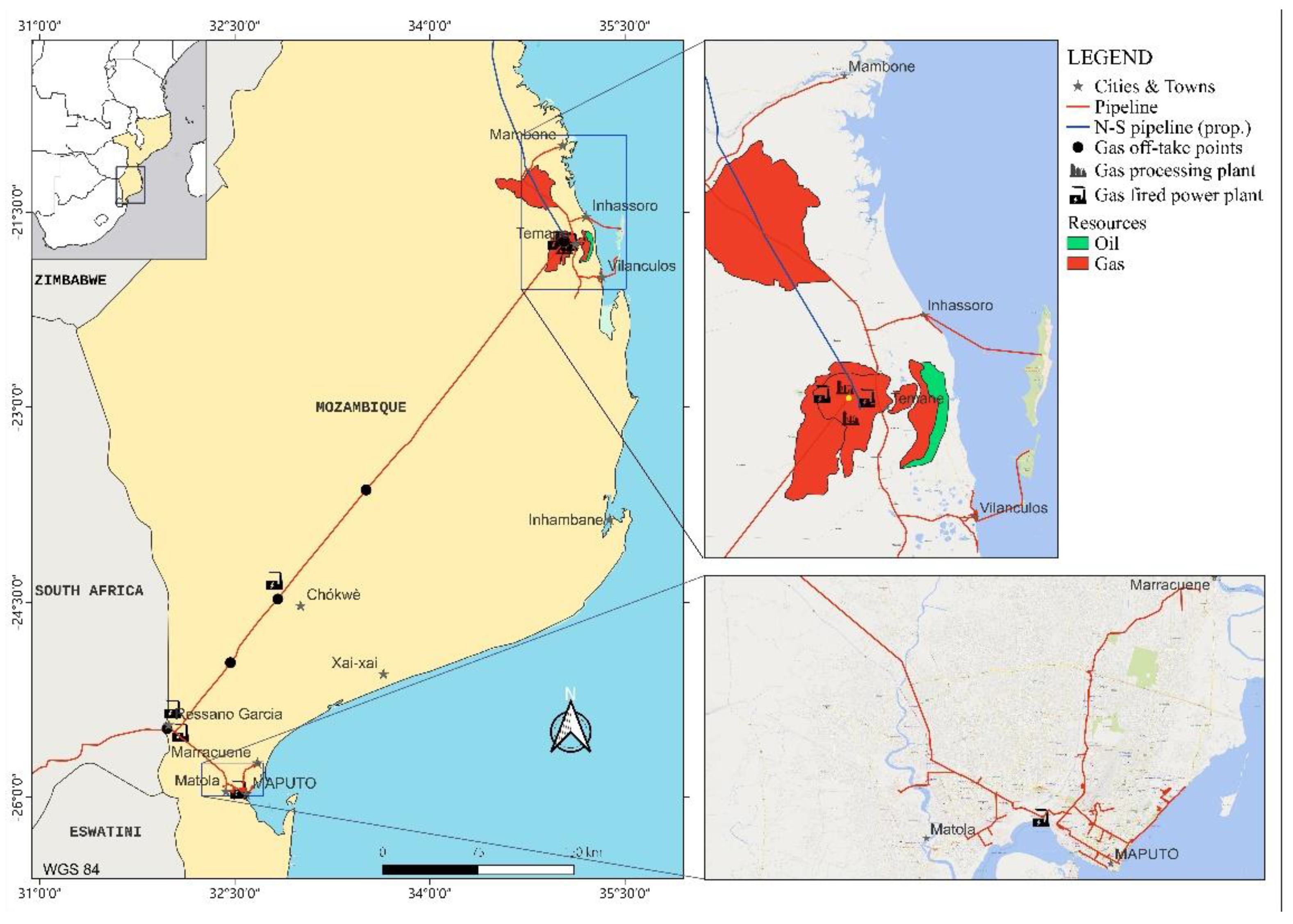

Table 1.
Description of variables.
| Variables | Type | Description |
|---|---|---|
| Dependent variables | ||
| Energy choice | N | Household preferred fuel type; = 1 for natural gas (reference); = 2 for electricity; = 3 for LPG; = 4 for biomass |
| Independent variables | ||
| Fuel price (US$) | C | Price of natural gas, electricity, LPG and biomass per megajoule (MJ) |
| Energy expenditure (US$) | C | Monthly fuel expenditure on natural gas, electricity, LPG and biomass |
| Accidents report | B | If an accident or incident occurred; = 1 if occurred |
| Monthly income (US$) | C | Households’ monthly income |
| Location | B | |
| Province | Household situated province: Inhambane or Maputo | |
| Urbanicity | Household situated location; = 1 for urban | |
| Resource periphery | Household situated location; = 1 for resource periphery | |
| Head gender | B | Gender of household’s head; =1 for male |
| Head Age | C | Age of household or business owner |
| Head Education | N | Years of education of household’s head or business owner |
| Aggregate size | N | Total number of household members |
| Fuel stacking | B | Household primary fuel stacking; = 1 if stacked |
| NG affordability | B | Price of natural gas Compared to other alternatives; = 1 if cheaper |
| NG fears | B | Fear of natural gas; = 1 if feared |
Notes: C: continuous; L: logic; B: binary, N: nominal.
Table 2.
Summary statistics.
| Variables | Mean | Sd | Min |
|---|---|---|---|
| Dependent variables | |||
| Energy choice | 3.41 | 1.10 | 1.00 |
| Independent variables | |||
| Fuel price (US$) | |||
| NG | 0.015 | 0.022 | 0.002 |
| Electricity | 0.052 | 0.006 | 0.051 |
| LPG | 0.081 | 0.012 | 0.062 |
| Biomass | 0.036 | 0.026 | 0.013 |
| Energy expenditure (US$) | |||
| NG | 17.82 | 40.47 | 5.00 |
| Electricity | 0.41 | 3.32 | 0.00 |
| LPG | 0.026 | 0.37 | 0.00 |
| Biomass | 8.65 | 27.26 | 0.00 |
| Accidents | 0.28 | 0.45 | 0.00 |
| Monthly income (US$) | 415.73 | 259.65 | 78.12 |
| Location | |||
| Urbanicity | 0.41 | 0.49 | 0.00 |
| Resource periphery | 0.73 | 0.45 | 0.00 |
| Head gender | 0.56 | 0.50 | 0.00 |
| Head Age | 42.88 | 10.79 | 20.00 |
| Head Education | 12.44 | 2.87 | 7.00 |
| Aggregate size | 4.08 | 1.87 | 0.00 |
Note: Price as of November 2025; 1 US$ = 64 MZN.
Table 3.
Demographics of households.
| Variable | Province | Urbanicity | Total | ||||
|---|---|---|---|---|---|---|---|
| Inhambane | Maputo | Urban | Peri-urban | Rural | |||
| Gender | |||||||
| Male | 59.0 | 48.7 | 48.0 | 50.6 | 67.3 | 244 | |
| Female | 41.0 | 51.3 | 52.0 | 49.4 | 32.7 | 190 | |
| District | |||||||
| Govuro | 21.0 | - | 0.0 | 0.8 | 42.7 | 66 | |
| Inhassoro | 34.9 | - | 0.0 | 34.0 | 14.7 | 110 | |
| Vilankulos | 44.1 | - | 0.0 | 29.0 | 42.7 | 139 | |
| KaMaxaquene | - | 28.6 | 0.0 | 13.1 | 0.0 | 34 | |
| KaMpfumo | - | 21.0 | 100.0 | 0.0 | 0.0 | 25 | |
| Nlhamankulu | - | 50.4 | 0.0 | 23.2 | 0.0 | 60 | |
| Resource periphery (1 = yes) | 100.0 | 0.0 | 0.0 | 52.4 | 47.6 | 315 | |
| Employment status | |||||||
| Business | 8.4 | 0.0 | 0.0 | 4.3 | 10.1 | 26 | |
| Entrepreneur | 8.1 | 2.5 | 4.0 | 6.7 | 6.7 | 28 | |
| Civil Servant | 29.1 | 12.6 | 28.0 | 20.9 | 30.2 | 105 | |
| Private Worker | 18.1 | 21.8 | 24.0 | 21.3 | 14.8 | 82 | |
| Informal business | 27.8 | 37.8 | 24.0 | 30.7 | 31.5 | 131 | |
| Retired | 1.3 | 12.6 | 20.0 | 4.3 | 2.0 | 19 | |
| Unemployed | 7.1 | 12.6 | 0.0 | 11.8 | 4.7 | 37 | |
| Aggregate size | |||||||
| Small (1 to 2) | 20.3 | 21.0 | 32.0 | 20.1 | 19.3 | 89 | |
| Medium (3 to 4) | 29.2 | 46.2 | 44.0 | 34.3 | 31.4 | 147 | |
| Large (5 and more) | 45.6 | 50.5 | 24.0 | 45.6 | 49.3 | 198 | |
| Fuel stacking (1 = stacked) | 50.2 | 72.3 | 6.1 | 64.4 | 29.5 | 244 | |
| Incidents report (1 = occurred) | 75.6 | 63.9 | 5.1 | 60.8 | 34.1 | 314 | |
| NG Affordability (1 = cheaper) | 92.6 | 87.3 | 5.6 | 60.9 | 33.5 | 340 | |
| NG fears (1 = feared) | 15.9 | 22.7 | 3.9 | 71.4 | 24.7 | 77 |
Note: Authors estimates.
Table 4.
Determinants of household cooking energy choice for multinomial logit estimation without resource periphery effect.
Table 4.
Determinants of household cooking energy choice for multinomial logit estimation without resource periphery effect.
| Variables | Dependent variable | ||
|---|---|---|---|
| Electricity | LPG | Biomass | |
| Log (Price) | 0.4604*** (0.0976) |
0.4604*** (0.0976) |
0.4604*** (0.0976) |
| Incidents | 1.1501 (0.3903) |
1.1501 (0.3903) |
1.1501 (0.3903) |
| Expenditure | 1.1783*** (0.0327) |
1.1783*** (0.0327) |
1.1783*** (0.0327) |
| Monthly income | 1.0031* (0.0017) |
1.0048** (0.0020) |
1.0024** (0.0011) |
| Location (urban =1) | 25.4911** (29.5085) |
10.2960* (12.6599) |
1.1566 (0.4510) |
| Head gender (male=1) | 0.9939 (0.6090) |
0.3845 (0.3130) |
0.5914 (0.1910) |
| Head Age | 0.9904 (0.0274) |
0.9268 (0.0439) |
1.0018 (0.0154) |
| Head Education | 1.5755** (0.3113) |
1.8883** (0.6092) |
0.9037 (0.0768) |
| Aggregate size | 1.0889 (0.2144) |
1.1726 (0.2941) |
1.0952 (0.1060) |
| Observations | 403 | ||
| McFadden's R2 | 0.311 | ||
| Log Likelihood | -214.321 | ||
| AIC | 476.642 | ||
Source: Authors’ estimation using survey data. Note: The dependent variable is energy type; natural gas is taken as the reference category. Coefficients are evaluated at the mean. Standard errors are shown in parentheses. *** p < 0.01, ** p < 0.05, * p < 0.1
Table 5.
Determinants of household cooking energy choice for multinomial logit estimation with resource periphery effect.
Table 5.
Determinants of household cooking energy choice for multinomial logit estimation with resource periphery effect.
| Dependent variable | |||
|---|---|---|---|
| Variables | |||
| Electricity | LPG | Biomass | |
| Log (Price) | -0.1996 (0.5834) |
-0.1996 (0.5834) |
-0.1996 (0.5834) |
| Incidents | 0.0875 (0.3432) |
0.0875 (0.3432) |
0.0875 (0.3432) |
| Expenditure | 0.2023*** (0.0335) |
0.2023*** (0.0335) |
0.2023*** (0.0335) |
| Monthly income | 0.0032* (0.0017) |
0.0048** (0.0020) |
0.0024** (0.0012) |
| Location | |||
| Urban | 3.4988*** (1.1830) |
3.1273** (1.2740) |
-0.7017 (0.4669) |
| Resource periphery | 2.4890 (2.2770) |
-1.9457 (2.5328) |
-3.2604** (1.6152) |
| Head gender (male=1) | -0.0651 (0.6197) |
-0.8761 (0.7913) |
-0.5185 (0.3290) |
| Head Age | -0.0047 (0.0284) |
-0.0684 (0.0472) |
0.0016 (0.0158) |
| Head Education | 0.4335** (0.1982) |
0.6188* (0.3180) |
-0.1273 (0.0870) |
| Aggregate size | 0.0556 (0.1989) |
0.1012 (0.2526) |
0.0960 (0.0989) |
| Observations | 403 | ||
| McFadden's R2 | 0.334 | ||
| Log Likelihood | -206.928 | ||
| AIC | 467.855 | ||
Source: Authors’ estimation using survey data. Note: Dependent variable is energy type; piped gas is taken as reference category. Coefficients are evaluated at the mean. Standard errors are shown in parentheses. *** p < 0.01, ** p < 0.05, * p < 0.1
Table 6.
Determinants of household cooking energy choice for conditional logit estimation.
| Variables | Estimates |
|---|---|
| Price | -17.1747*** (4.6136) |
| Incidents | 0.7067** (0.3311) |
| Expenditure | 0.0042* (0.0024) |
| Observations | 434 |
| McFadden's R2 | 0.032 |
| Log Likelihood | -334.872 |
| AIC | 681.745 |
Source: Authors’ estimation using survey data. Note: Dependent variable is energy type; piped gas is taken as the reference category. Coefficients are evaluated at the mean. Standard errors are shown in parentheses. *** p < 0.01, ** p < 0.05, * p < 0.1.
Table 7.
Model diagnostic tests for homoscedasticity.
| Df | Chisq | Pr(>Chisq) | |
|---|---|---|---|
| Measure of fit for the models | |||
| Wald test | 3 | 10.645 | 0.01381** |
| Linear hypothesis test | 3 | 10.645 | 0.01381** |
| Score test | 3 | 16.924 | < 0.001*** |
| Likelihood Ratio test | 6 | 58.592 | <0.000 *** |
| Hausman-McFadden of IIA assumption |
19 | 8.9247 | 1 |
Note: Authors’ estimation; *** p < 0.01, ** p < 0.05, * p < 0.1.
Disclaimer/Publisher’s Note: The statements, opinions and data contained in all publications are solely those of the individual author(s) and contributor(s) and not of MDPI and/or the editor(s). MDPI and/or the editor(s) disclaim responsibility for any injury to people or property resulting from any ideas, methods, instructions or products referred to in the content. |
© 2026 by the authors. Licensee MDPI, Basel, Switzerland. This article is an open access article distributed under the terms and conditions of the Creative Commons Attribution (CC BY) license (http://creativecommons.org/licenses/by/4.0/).
Copyright: This open access article is published under a Creative Commons CC BY 4.0 license, which permit the free download, distribution, and reuse, provided that the author and preprint are cited in any reuse.


