

Submitted:
16 April 2026
Posted:
17 April 2026
You are already at the latest version
Abstract
This study investigated the effects of three irrigation regimes (120, 90, and 75 L plant⁻¹ day⁻¹) on the postharvest morphometric, physicochemical, colorimetric, and nutraceutical attributes of Actinidia chinensis (Planch.) cv. Gold3 grown under Mediterranean conditions. Fruit morphometry was not influenced by irrigation level, as fresh weight, polar and equatorial diameters, and weight loss showed no significant differences among treatments. In contrast, several qualitative traits responded sensitively to water availability after cold storage. Reduced irrigation increased flesh firmness by 33–37%, enhanced total soluble solids by 4–6%, and elevated titratable acidity by 4–7%, resulting in a slightly lower TSS/TA ratio. Dry matter content also increased under reduced irrigation, with the lowest water supply producing values 8–13% higher than the fully irrigated control. Colorimetric parameters were modulated by irrigation level, with reduced water availability decreasing L, b, Chroma, and Hue° (2–9%) and increasing a* (20–35%), indicating a shift toward less bright and less yellow pulp coloration. From a nutraceutical perspective, total antioxidant capacity increased by 17–20% under re-duced irrigation, whereas total phenolic content remained unchanged. Principal Component Analysis revealed a dominant quality related axis integrating compositional, structural, and colorimetric traits, while morphological variables contributed minimally to overall variance. These findings demonstrate that moderate irrigation reduction enhances several desirable postharvest attributes without compromising fruit size or commercial morphology, supporting the adoption of controlled deficit irrigation as a sustainable strategy to improve kiwifruit quality in Mediterranean environments.
Keywords:
irrigation management
; nutraceutical traits
; pulp color
; fruit physiology
1. Introduction
Water availability is one of the most influential environmental factors shaping productivity, physiological performance, and fruit quality in horticultural crops. Deficit irrigation strategies, including regulated deficit irrigation (RDI), have been widely implemented to optimize water use efficiency (WUE) while maintaining or improving fruit quality under water-limited conditions. These approaches apply irrigation below full crop evapotranspiration (ETc) during phenological stages that are less sensitive to water stress [1]. RDI has been shown to enhance WUE and reduce water waste while preserving or even improving crop quality in several horticultural systems, particularly in woody perennials and fruit crops, by imposing controlled water deficits tailored to specific developmental phases [2,3]. Over recent decades, climate change has intensified water scarcity across major horticultural regions, especially in Mediterranean and temperate climates, due to more frequent and severe droughts, altered rainfall patterns, and increased evaporative demand [4]. Under these conditions, efficient irrigation management is essential to sustain productivity and fruit quality while conserving limited water resources. Fruit trees are particularly sensitive to soil water availability because of their high transpiration rates and relatively shallow root systems. Water deficits can trigger complex physiological responses, including stomatal regulation, hydraulic adjustments, and metabolic reprogramming, that collectively influence growth and quality outcomes [5,6]. In kiwifruit (Actinidia spp.), water stress affects gas exchange, carbohydrate partitioning, and fruit physiology, with consequences for key quality traits such as soluble solids concentration (SSC), titratable acidity (TA), and dry matter content [7,8,9]. Classic studies demonstrated that withholding irrigation late in the season can markedly increase soluble carbohydrate concentration without negatively affecting firmness or storability, and that these quality responses persist during postharvest storage [10,11,12]. More recent physiological research confirms that Actinidia chinensis is highly responsive to changes in soil water potential, with prolonged deficits reducing gas exchange and vegetative growth, underscoring the importance of irrigation timing and magnitude [9,13]. Mediterranean environments, characterized by hot, dry summers and irregular rainfall, place additional pressure on irrigation resources and require optimized water management to sustain profitable production. Moderate deficit irrigation strategies are increasingly adopted to balance water conservation with fruit quality objectives; however, their influence on postharvest quality dynamics remains insufficiently understood. While numerous studies have examined the effects of irrigation regimes on yield and harvest-time quality, fewer have evaluated how preharvest water restriction affects fruit behavior during cold storage, particularly in high-yielding and commercially important cultivars such as ‘Gold3’ [14,15]. Recent work on A. chinensis has shown that late-season RDI can enhance intrinsic WUE, soluble solids content, and sensory attributes without compromising yield or commercial quality. For instance, short-term RDI applied during late ripening increased intrinsic WUE and improved fruit quality while maintaining firmness and yield in cv. Soreli [3]. Similarly, deficit drip irrigation under rain-shelter cultivation improved firmness, SSC, TA, and water productivity without adverse effects on yield [12]. These findings highlight the potential of RDI as a sustainable strategy to conserve water while maintaining or enhancing fruit quality in kiwifruit production systems. +Understanding whether moderate preharvest irrigation reduction induces physiological changes that influence postharvest storage behavior and quality evolution is therefore essential. In this context, the present study evaluated the effects of controlled water deficit on A. chinensis cv. ‘Gold3’, assessing how differentiated irrigation volumes affect morphometric, physicochemical, colorimetric, and nutraceutical parameters, with particular attention to quality changes emerging during postharvest cold storage.
2. Materials and Methods
2.1. Experimental Site and Irrigation Treatments
The experiment was conducted during the 2024–2025 biennium in the Gioia Tauro Plain (Reggio Calabria, Italy), within the municipality of Polistena, an area highly suited to Actinidia cultivation (Adornato Farm; 38°25'14.9"N, 16°01'56.9"E). The study focused on Actinidia chinensis (Planch.) cv. Gold3. The orchard was established in 2015, with vines trained to a pergola system and spaced 4 m within rows and 5 m between rows (500 vines ha⁻¹). A male-to-female ratio of 1:7 was adopted using the pollinizer ‘Bélen’. Standard cultural practices, including bud load regulation and winter and summer pruning, were applied. Irrigation was supplied through an overhead sprinkler system operating daily from late April to late October.
2.2. Climatic and Pedological Characterization
According to the Köppen–Geiger classification, the study area corresponds to a Mediterranean climate (Csa), characterized by winter-concentrated precipitation and hot, dry summers. Soil characteristics were obtained from the Soil Map of Calabria (ARSAC) and classified within Pedological Subsystem 3.2 for the municipality of Polistena. Mean reference evapotranspiration (ET₀) from April to October averaged 4.93 mm day⁻¹ in 2025 and 4.84 mm day⁻¹ in 2024, while mean vapor pressure deficit (VPD) for the same period was 0.68 kPa. The highest mean maximum temperature occurred in July (32 °C), and rainfall was mainly concentrated during autumn and winter. Meteorological data were recorded using an on-farm weather station connected to the WinEnet agrometeorological network (METOS Italia S.r.l., Bolzano, Italy), providing continuous measurements of temperature, relative humidity, solar radiation, wind speed, and rainfall.
2.3. Irrigation Treatments, Crop Evapotranspiration Estimation and Fruit Sampling
Ten vines per irrigation treatment were selected based on comparable vegetative development and fruit load. Three irrigation regimes were applied: 120, 90, and 75 L plant⁻¹ day⁻¹. The 120 L treatment represented standard farm practice, whereas the other two levels were imposed as reduced-water regimes. Crop evapotranspiration (ETc) was estimated for July, August, and September using a crop coefficient (Kc) of 1.15, following FAO guidelines [1]. Average ETc values were 7.14 mm day⁻¹ in July, 6.31 mm day⁻¹ in August, and 4.77 mm day⁻¹ in September. Irrigation volumes corresponded to 80%, 60%, and 50% of ETc in July; 100%, 80%, and 60% in August; and 110%, 85%, and 70% in September.
2.4. Fruit Selection and Storage
At harvest (second decade of October; 164 DAFB), yield per vine and morpho-biometric parameters were recorded on 100 randomly collected fruits per treatment. Quality attributes were measured on half of each sample, while the remaining fruits were stored at 4 °C for 60 days under daily air renewal. After storage, fruits were reweighed and analyzed to assess postharvest changes.
2.4.1. Fresh Weight
Fresh weight (FW) was measured using an analytical balance (Precisa BJ 610C) and expressed in grams.
2.4.2. Polar and Equatorial Diameters
Polar diameter (PD) and equatorial diameter (ED) were measured using a precision digital caliper. These measurements were used to calculate the equatorial ratio (minimum/maximum ED), relative length (RL; PD/mean ED), and fruit symmetry index (ratio between the two equatorial diameters).
2.4.3. Flesh Firmness
Flesh firmness (FF), expressed in kg cm⁻², was measured on two opposite sides of 30 fruits per treatment using a penetrometer (PCE FM200, PCE Instruments, UK) equipped with an 8 mm probe.
2.4.4. Colorimetric Analysis
Pulp color was assessed in the CIELab color space (CIE, 1976) using a tristimulus colorimeter (Minolta CM-700d) with an 8 mm aperture. The instrument was calibrated with a white reference plate. Measurements were taken at two orthogonal points in the equatorial region under illuminant D65 (6504 K) and a 10° observation angle. Chroma (C) and hue angle (h°) were calculated as:
2.4.5. Total Soluble Solids (TSS)
TSS (°Brix) was measured using a temperature-compensated digital refractometer (Atago PAL-1, Tokyo, Japan) on juice extracted from opposite calyx ends of 30 fruits per treatment.
2.4.6. Titratable Acidity and pH
Titratable acidity (TA) and pH were determined using a potentiometric titrator (Titralab AT1000, HACH, Colorado, USA). A 10 mL aliquot of pulp was titrated with 0.5 N NaOH to the endpoint. Potassium hydrogen phthalate was used as the primary standard. TA was expressed as % citric acid. The TSS/TA ratio was calculated accordingly.
2.4.7. Dry Matter Content
Dry matter content (DMC) was determined by oven-drying samples at 105 °C (Binder EED240, Tuttlingen, Germany) until constant weight. DMC (%) was calculated as:
2.5. Total Polyphenols and Antioxidant Capacity
Pulp samples were homogenized using an Ultraturrax blender (20,000 rpm; T25 Basic, IKA Werke, Germany). Total polyphenol content (TPC) and total antioxidant capacity (TAC) were quantified using a Lambda 35 spectrophotometer (PerkinElmer, Waltham, MA, USA). TPC (mg gallic acid equivalents g⁻¹ FW) was determined using the Folin–Ciocalteu method [16]. TAC was measured using the modified TEAC assay and expressed as mmol Trolox equivalents g⁻¹ FW [17]. Both hydrophilic and lipophilic fractions were included [18].
2.6. Statistical Analysis
Statistical analyses were performed using SPSS v.22.0 (IBM Corp., Armonk, NY). A two-way ANOVA was applied to evaluate the effects of treatment (T), year (Y), and their interaction (T × Y). Tukey’s HSD test was used for post-hoc comparisons. Principal Component Analysis (PCA) was conducted using XLSTAT 14.0 (Addinsoft, Paris, France).
3. Results
The data reported in Table 1 show that irrigation regime did not significantly affect fresh weight or the main morphometric traits of cold-stored Actinidia chinensis cv. Gold3 fruits.
Although a slight reduction in all variables was observed with decreasing irrigation volume (from treatment A to C), these differences were not statistically significant. At harvest, fresh weight ranged from 102.0 g in treatment A to 95.0 g in treatment C, indicating that the imposed water deficit did not substantially limit fruit growth. After storage, fruit weight decreased slightly across all treatments, and weight loss remained low and comparable (approximately 2–3 g), suggesting that preharvest irrigation level had minimal influence on postharvest water loss. Morphometric parameters followed similar trends. Polar diameter decreased from 62.40 mm (A) to 58.20 mm (C), and equatorial diameter from 58.10 mm to 54.20 mm, without significant differences. Relative length (1.05–1.06) and equatorial ratio (0.94–0.96) also remained stable, confirming that fruit shape and symmetry were unaffected by irrigation regime. No significant effects of year (Y) or treatment × year interaction (T × Y) were detected for any morphometric variable. In contrast, irrigation regime significantly influenced several postharvest quality attributes (Table 2).
Flesh firmness was lower in treatment A (1.50 kg cm⁻²) than in treatments B and C (2.00 and 2.05 kg cm⁻²). Total soluble solids increased from 12.50 °Brix (A) to 13.20 °Brix (C), while titratable acidity rose from 13.5 to 14.5 g L⁻¹. The TSS/TA ratio was similar in treatments A and B (0.93) but slightly lower in treatment C (0.91). Dry matter content increased significantly under reduced irrigation, ranging from 18.31% (A) to 19.88% (C), with intermediate values in treatment B (19.12%). Colorimetric parameters were also affected by irrigation level (Table 3).
Lightness (L) decreased from 73.5 (A) to 71.8 (C), while a increased from −5.94 to −3.74. The b* coordinate declined from 33.69 to 31.08, and chroma decreased from 34.2 to 31.3. Hue angle (h°) decreased from 100.11° to 96.88°, indicating a shift toward slightly darker and less yellow pulp. No significant effects of year or T × Y interaction were observed. Total antioxidant capacity (TAC) increased significantly under reduced irrigation (Table 4), with values of 47.31, 53.78, and 55.36 μmol Trolox g⁻¹ FW in treatments A, B, and C, respectively. Total phenolic content (TPC) did not differ significantly among treatments (96.53–99.31 mg GAE 100 g⁻¹ FW), and no year or interaction effects were detected.
Principal Component Analysis revealed a coherent multivariate structure (Figure 1). The first principal component captured the main covariation pattern, with strong positive loadings for fruit size (FW, ED, PD), color attributes (L, chroma), compositional traits (TSS, TSS/TA, DMC), and bioactive compounds (TPC, TAC). This component represented a major gradient associated with fruit maturity and internal quality. The second component was primarily driven by titratable acidity and specific color variables (h°, b), indicating a secondary source of variation. The spatial distribution of treatments A, B, and C reflected these patterns, with separation along PC1 corresponding to differences in maturity-related traits and separation along PC2 reflecting subtler differences in acidity and chromatic characteristics.
4. Discussion
The results of this study demonstrate that irrigation availability selectively influenced the postharvest quality traits of Actinidia chinensis cv. Gold3, whereas fruit morphometric characteristics remained largely unaffected. No significant differences were observed in fresh weight, weight loss, or fruit dimensions across irrigation treatments, indicating that fruit growth was not impaired by reduced water supply. This stability likely reflects the timing of irrigation differentiation, which was applied when fruits had already reached approximately 80% of their final volume. Similar responses have been reported in kiwifruit and other fleshy fruits, where moderate late-season water deficits do not significantly alter fruit size [9]. In contrast, several qualitative attributes were strongly influenced by irrigation regime, particularly after cold storage. Fruits from deficit-irrigated treatments (B and C) exhibited higher flesh firmness than those from fully irrigated vines, suggesting slower softening and greater structural integrity during storage. These responses may be associated with reduced activity of cell wall–degrading enzymes and delayed pectin solubilization, processes well documented in kiwifruit softening. Ripening in Actinidia spp. involves coordinated modifications of cell wall polysaccharides, including pectin and hemicellulose, and differential activities of polygalacturonase, pectin methylesterase, and β-galactosidase, all of which contribute to firmness loss [19,20,21,22]. Reduced irrigation may therefore attenuate these enzymatic processes, resulting in firmer fruit after storage. These structural changes were accompanied by higher total soluble solids and dry matter content under reduced irrigation, indicating a concentration effect due to lower water availability rather than increased absolute accumulation of solutes. Such concentration effects are widely reported under moderate water deficits, where reduced water supply decreases dilution of soluble sugars and other metabolites in fruit tissues [23,24,25,26,27]. Titratable acidity was maintained or slightly increased under reduced irrigation, suggesting that organic acid metabolism was not negatively affected. This is consistent with previous findings showing that deficit irrigation applied during the maturation stage can lead to higher TA levels in kiwifruit without detrimental effects on fruit yield or size [12]. Colorimetric parameters also responded to irrigation level. Fruits from deficit treatments showed lower lightness (L), chroma, and hue angle, together with higher (less negative) a values, indicating darker pulp with reduced green and yellow components and a slight shift toward warmer tones. These changes may reflect modulation of pigment metabolism, particularly carotenoids, which are sensitive to environmental conditions and developmental cues [28,29,30,31]. Although these variations did not compromise commercial acceptability, they demonstrate that irrigation management can modulate fruit visual quality independently of size. From a nutraceutical perspective, total antioxidant capacity (TAC) increased under reduced irrigation, whereas total phenolic content (TPC) remained largely unchanged. The enhancement of TAC after cold storage, despite similar levels at harvest, suggests that postharvest metabolic activity plays a key role. Fruits with higher dry matter and soluble solids likely contained a more concentrated pool of antioxidant-related compounds, and storage conditions may have further promoted their activation or transformation, resulting in increased antioxidant activity [3,32]. Principal Component Analysis (PCA) further supported these findings, revealing a coherent multivariate structure in which key quality traits responded consistently to irrigation regime. The first principal component was associated with fruit composition and postharvest quality traits, including firmness, soluble solids, dry matter content, color parameters, and antioxidant capacity, reflecting a coordinated physiological response. The second component was primarily associated with titratable acidity and hue angle, indicating a secondary source of variability linked to metabolic and pigment-related processes. Multivariate analyses such as PCA have been successfully applied to integrate multiple quality traits and identify major sources of variability in response to irrigation and management practices [13,33].
5. Conclusions
This study demonstrates that moderate reductions in irrigation supply can effectively enhance multiple postharvest quality attributes of Actinidia chinensis cv. Gold3 without compromising fruit morphometry. Across two seasons, fruit size, shape, and weight remained stable under all irrigation regimes, indicating that the species is capable of buffering moderate fluctuations in water availability through physiological regulation. In contrast, key qualitative and nutraceutical traits were highly responsive to irrigation level. Fruits from deficit-irrigated treatments exhibited higher flesh firmness, elevated soluble solids, greater titratable acidity, and increased dry matter content after storage, reflecting the physiological effects of mild water limitation, including reduced dilution, enhanced solute concentration, and improved tissue structural integrity. Colorimetric changes, characterized by lower lightness and reduced yellow intensity, further suggest that water availability can modulate pigment dynamics during storage. Total antioxidant capacity increased significantly under reduced irrigation, whereas total phenolic content remained largely unchanged, indicating that moderate water limitation can stimulate antioxidant potential without affecting phenolic accumulation. Multivariate analysis confirmed these patterns, revealing a dominant quality-related gradient integrating compositional, structural, and colorimetric traits, with acidity and hue contributing only marginally. This coherence highlights the coordinated physiological response of fruit to irrigation availability and underscores the central role of maturity-related attributes in defining postharvest quality. Overall, controlled irrigation reduction represents a viable and sustainable strategy to improve postharvest quality in yellow-fleshed kiwifruit. Moderate deficit irrigation enhances firmness, compositional richness, and antioxidant capacity while maintaining desirable fruit morphometry and reducing water use, making it particularly suitable for Mediterranean environments where water scarcity is a critical constraint.
Author Contributions
G.G., F.G., A.D.; experimental set up, G.G., A.D. and N.D.; data collection M.A.; data analysis, G.G., A.D. and V.B.; statistical analysis, G.G. and A.D.; writing-original draft preparation, G.G. and A.D.; writing-review and editing, G.G. and A.D.; supervision, G.G. and A.D. All authors have read and agreed to the published version of the manuscript.
Funding
Research within the scope of the OCM Operational Program of AOP ELLE ESSE 2023-2029 EU Reg. 2021/2115 art. 50 operational programs for the fruit and vegetable sector Owner of the ELLESSE AOP research project. Project title: Research and development on the influence of water management on “Kiwifruit Vine Decline Syndrome.”
Conflicts of Interest
The authors declare no conflicts of interest.
References
- Allen, R.G.; Pereira, L.S.; Raes, D.; Smith, M. Crop Evapotranspiration—Guidelines for Computing Crop Water Requirements; FAO Irrigation and Drainage Paper No. 56; FAO: Rome, Italy, 1998. [Google Scholar]
- Yang, S.; Chen, Q.; Qian, J.; Li, J.; Lin, X.; Liu, Z.; Fan, N.; Ma, W. Determination of Dry Matter Content of Kiwifruit before Harvest Based on Hyperspectral Imaging. Agriengineering 2024, 6, 1–14. [Google Scholar] [CrossRef]
- Calderón-Orellana, A.; Calderón-Orellana, M.; Atenas, C.; Contreras, C.; Aburto, F.; Alvear, T.; Antileo-Mellado, S. Late Water Deficits Improve Intrinsic Water Use Efficiency, Fruit Maturity, and Acceptability in Yellow-Fleshed Kiwifruit cv. Soreli. Plants 2025, 14, 2843. [Google Scholar] [CrossRef] [PubMed]
- Vicente-Serrano, S.M.; Peña-Angulo, D.; Beguería, S.; Domínguez-Castro, F.; Tomás-Burguera, M.; Noguera, I.; Gimeno-Sotelo, L.; El Kenawy, A. Global Drought Trends and Future Projections. Philos. Trans. R. Soc. A 2022, 380, 20210285. [Google Scholar] [CrossRef] [PubMed]
- Dietz, K.J.; Zörb, C.; Geilfus, C.M. Drought and Crop Yield. Plant Biol. 2021, 23, 881–893. [Google Scholar] [CrossRef]
- Liu, X.; Gao, T.; Liu, C.; Mao, K.; Gong, X.; Li, C.; Ma, F. Fruit Crops Combating Drought: Physiological Responses and Regulatory Pathways. Plant Physiol. 2023, 192, 1768–1784. [Google Scholar] [CrossRef]
- Burdon, J.; McLeod, D.; Lallu, N.; Gamble, J.; Petley, M.; Gunson, A. Consumer Evaluation of “Hayward” Kiwifruit of Different At-Harvest Dry Matter Contents. Postharvest Biol. Technol. 2004, 34, 245–255. [Google Scholar] [CrossRef]
- Mills, T.M.; Li, J.; Behboudian, M.H. Physiological Responses of Gold Kiwifruit to Water Deficit. J. Am. Soc. Hortic. Sci. 2009, 134, 677–683. [Google Scholar] [CrossRef]
- Fernandes, R.D.M.; Venturi, M.; Giovannini, A.; Morandi, B. Kiwifruit Ecophysiological Adaptations under Moderate and Severe Deficit Irrigation. Sci. Hortic. 2025, 347, 114193. [Google Scholar] [CrossRef]
- Miller, S.A.; Smith, G.S.; Boldingh, H.L.; Johansson, A. Effects of Water Stress on Fruit Quality Attributes of Kiwifruit. Ann. Bot. 1998, 81, 73–81. [Google Scholar] [CrossRef]
- Nora, L.; Dalmazo, G.O.; Nora, F.R.; Rombaldi, C.V. Controlled Water Stress to Improve Fruit and Vegetable Postharvest Quality. In Water Stress; InTech: Rijeka, Croatia, 2012; pp. 59–72. [Google Scholar]
- Zheng, S.; Jiang, S.; Cui, N.; Zhao, L.; Gong, D.; Wang, Y.; Wu, Z.; Liu, Q. Deficit Drip Irrigation Improves Kiwifruit Quality and Water Productivity under Rain-Shelter Cultivation. Agric. Water Manag. 2023, 289, 108530. [Google Scholar] [CrossRef]
- Baldi, E.; Pastore, C.; Chiarelli, G.; Quartieri, M.; Spinelli, F.; Toselli, M. Molecular Responses to Drought and Waterlogging Stresses of Kiwifruit Potted Vines. Horticulturae 2024, 10, 834. [Google Scholar] [CrossRef]
- Baldi, E.; Quartieri, M.; Larocca, G.N.; Golfarelli, M.; Francia, M.; Giovanelli, J.; Xylogiannis, E.; Toselli, M. Smart Irrigation System for Precision Water Management: Effect on Yield and Fruit Quality of Yellow-Fleshed Kiwifruit. In Precision Agriculture ’23; Wageningen Academic Publishers: Wageningen, The Netherlands, 2023; pp. 59–66. [Google Scholar] [CrossRef]
- Čereković, S.; Popović, V.; Jovanović, M.; Marković, T.; Savić, D. Understanding the Response of Fruit Crops to Drought Stress and Irrigation Needs under Climate Change Conditions. AgroReS 2025 – Book of Proceedings. [CrossRef]
- Redgwell, R.J.; Melton, L.D. Changes to Pectic and Hemicellulosic Polysaccharides during Ripening of Kiwifruit. Acta Hortic. 1992, 297, 627–634. [Google Scholar] [CrossRef]
- Gallego, P.P.; Zarra, I. Changes in Cell Wall Composition and Water-Soluble Polysaccharides during Kiwifruit Development. Ann. Bot. 1997, 79, 695–701. [Google Scholar] [CrossRef]
- Li, X.; Nakagawa, N.; Nevins, D.J.; Sakurai, N. Changes in the Cell Wall Polysaccharides of Outer Pericarp Tissues of Kiwifruit during Development. Plant Physiol. Biochem. 2006, 44, 115–124. [Google Scholar] [CrossRef] [PubMed]
- Fullerton, C.G.; Prakash, R.; Ninan, A.S.; Atkinson, R.G.; Schaffer, R.J.; Hallett, I.C.; Schröder, R. Fruit from Two Kiwifruit Genotypes with Contrasting Softening Rates Show Differences in the Xyloglucan and Pectin Domains of the Cell Wall. Front. Plant Sci. 2020, 11, 964. [Google Scholar] [CrossRef]
- Fereres, E.; Soriano, M.A. Deficit Irrigation for Reducing Agricultural Water Use. J. Exp. Bot. 2007, 58, 147–159. [Google Scholar] [CrossRef]
- Lagos, L.O.; Lama, W.; Hirzel, J.; Souto, C.; Lillo, M. Regulated Deficit Irrigation Evaluation on Kiwi Production. Agrociencia 2017, 51, 359–372. [Google Scholar]
- Gullo, G.; Dattola, A.; Vonella, V.; Zappia, R. Effects of Photoselective Colour Nets on the Vegetative, Productive, and Qualitative Behaviour of Kiwifruit. J. Berry Res. 2021, 11, 1–19. [Google Scholar] [CrossRef]
- Dattola, A.; Accardo, A.; Zappia, R.; Gullo, G.A.M. Fruit Variation in Yellow-Fleshed Actinidia chinensis Plants Grown in Southern Italy as a Function of Shoot Type. Agriculture 2024, 14, 1335. [Google Scholar] [CrossRef]
- Gullo, G.; Barbera, S.; Cannizzaro, A.; Scarano, M.; Larocca, F.; Branca, V.; Dattola, A. Differences in Vegetative, Productive, and Physiological Behaviors in Actinidia chinensis cv. Gold3 as a Function of Cane Type. Plants 2025, 14, 2199. [Google Scholar] [CrossRef]
- Montefiori, M.; McGhie, T.K.; Hallett, I.C.; Costa, G. Changes in Pigments and Plastid Ultrastructure during Ripening of Green- and Yellow-Fleshed Kiwifruit. Sci. Hortic. 2009, 119, 377–387. [Google Scholar] [CrossRef]
- Ampomah-Dwamena, C.; McGhie, T.; Wibisono, R.; Montefiori, M.; Hellens, R.P.; Allan, A.C. The Kiwifruit Lycopene Beta-Cyclase Plays a Significant Role in Carotenoid Accumulation. J. Exp. Bot. 2009, 60, 3765–3779. [Google Scholar] [CrossRef]
- Ampomah-Dwamena, C.; Tomes, S.; Thrimawithana, A.H.; Elborough, C.; Bhargava, N.; Rebstock, R.; Sutherland, P.; Ireland, H.; Allan, A.; Espley, R.V. Overexpression of PSY1 Increases Fruit Skin and Flesh Carotenoid Content. Front. Plant Sci. 2022, 13, 967143. [Google Scholar] [CrossRef]
- Bhargava, A.; Ampomah-Dwamena, C. Comparative Transcriptomic and Plastid Development Analysis Sheds Light on Differential Carotenoid Accumulation in Kiwifruit Flesh. Front. Plant Sci. 2023, 14, 1213086. [Google Scholar] [CrossRef]
- Lembo, M.; Ferrara, E.; Cice, D.; Forniti, R.; Eramo, V.; Petriccione, M.; Botondi, R. Effect of Plant Water Deficit Irrigation on the Postharvest Nutritional Quality Parameters and Antioxidant Pathway of ‘Soreli’ Kiwifruits. Foods 2026, 15, 520. [Google Scholar] [CrossRef]
- Yang, B.; Fu, P.; Lu, J.; Ma, F.; Sun, X.; Fang, Y. Regulated Deficit Irrigation: An Effective Way to Solve the Shortage of Agricultural Water for Horticulture. Stress Biol. 2022, 2. [Google Scholar] [CrossRef]
Figure 1.
Principal Component Analysis (PCA) biplot showing the distribution of samples from the three irrigation treatments (A, B, C) and the contribution of physicochemical and colorimetric variables to the first two principal component.
Figure 1.
Principal Component Analysis (PCA) biplot showing the distribution of samples from the three irrigation treatments (A, B, C) and the contribution of physicochemical and colorimetric variables to the first two principal component.
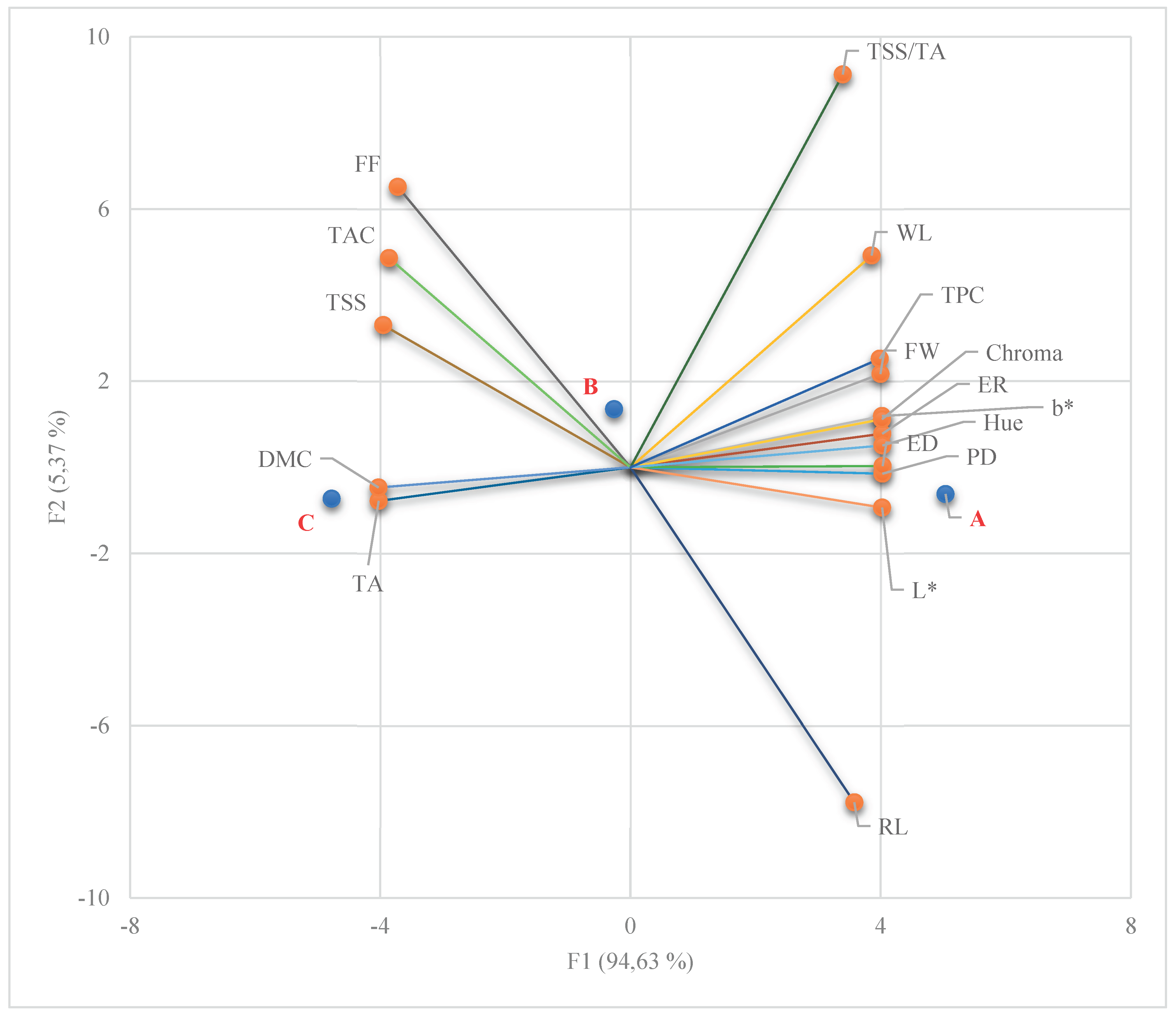

Table 1.
Mean fresh weight (FW) and morphometric indices of cold-stored fruits of Actinidia chinensis (Planch.) cv. Gold3 subjected to three irrigation treatments (A = 120 L plant⁻¹ day⁻¹; B = 90 L plant⁻¹ day⁻¹; C = 75 L plant⁻¹ day⁻¹). Values represent fresh weight (FW), weight loss (WL), polar diameter (PD), equatorial diameter (ED), relative length (RL), and equatorial ratio (ER).
Table 1.
Mean fresh weight (FW) and morphometric indices of cold-stored fruits of Actinidia chinensis (Planch.) cv. Gold3 subjected to three irrigation treatments (A = 120 L plant⁻¹ day⁻¹; B = 90 L plant⁻¹ day⁻¹; C = 75 L plant⁻¹ day⁻¹). Values represent fresh weight (FW), weight loss (WL), polar diameter (PD), equatorial diameter (ED), relative length (RL), and equatorial ratio (ER).
| Irrigation treatment | FW g |
WL g |
PD mm |
ED mm |
RL | ER |
|---|---|---|---|---|---|---|
| A | 102.00±3.10ns | 98.90±1.33ns | 62.40±1.25ns | 58.10±1.10ns | 1.06±0.02ns | 0.96±0.01ns |
| B | 99.00±2.80 | 97.03±2.33 | 60.10±1.20 | 56.00±1.05 | 1.05±0.04 | 0.95±0.02 |
| C | 95.00±3.40 | 92.22±1.75 | 58.20±1.30 | 54.20±1.15 | 1.05±0.03 | 0.94±0.04 |
| T | ns | ns | ns | ns | ns | ns |
| Y | ns | ns | ns | ns | ns | ns |
| TxY | ns | ns | ns | ns | ns | ns |
Different lowercase letters within a column indicate significant differences among treatments (Tukey’s test, p ≤ 0.05). “ns” = Non-significant. T = Treatment effect; Y = year effect; T × Y = interaction effect. Significance levels: * p ≤ 0.05.
Table 2.
Flesh firmness (FF), total soluble solids (TSS), titratable acidity (TA), TSS/TA ratio, and dry matter content (DMC) of cold-stored fruits of Actinidia chinensis (Planch.) cv. Gold3 under three irrigation treatments (A = 120 L plant⁻¹ day⁻¹; B = 90 L plant⁻¹ day⁻¹; C = 75 L plant⁻¹ day⁻¹).
Table 2.
Flesh firmness (FF), total soluble solids (TSS), titratable acidity (TA), TSS/TA ratio, and dry matter content (DMC) of cold-stored fruits of Actinidia chinensis (Planch.) cv. Gold3 under three irrigation treatments (A = 120 L plant⁻¹ day⁻¹; B = 90 L plant⁻¹ day⁻¹; C = 75 L plant⁻¹ day⁻¹).
| Irrigation treatment | FF Kg cm⁻² |
TSS °Brix |
TA g L⁻¹ citric acid |
TSS/TA | DMC (%) |
|---|---|---|---|---|---|
| A | 1.50±0.12b | 12.50±0.25b | 13.5±0.30b | 0.93 ± 0.04a | 18.31±0.08b |
| B | 2.00±0.10a | 13.00±0.20a | 14.0±0.25a | 0.93 ± 0.03a | 19.12±0.04ab |
| C | 2.05±0.11a | 13.20±0.22a | 14.5±0.20a | 0.91 ± 0.03b | 19.88±0.07a |
| T | * | * | * | * | * |
| Y | ns | ns | ns | ns | ns |
| TxY | ns | ns | ns | ns | ns |
Different lowercase letters within a column indicate significant differences among treatments (Tukey’s test, p ≤ 0.05). “ns” = Non-significant. T = Treatment effect; Y = year effect; T × Y = interaction effect. Significance levels: * p ≤ 0.05.
Table 3.
Colorimetric parameters (L, a, b, Chroma, and hue angle h°) of cold-stored fruits of Actinidia chinensis (Planch.) cv. Gold3 subjected to three irrigation treatments (A = 120 L plant⁻¹ day⁻¹; B = 90 L plant⁻¹ day⁻¹; C = 75 L plant⁻¹ day⁻¹).
Table 3.
Colorimetric parameters (L, a, b, Chroma, and hue angle h°) of cold-stored fruits of Actinidia chinensis (Planch.) cv. Gold3 subjected to three irrigation treatments (A = 120 L plant⁻¹ day⁻¹; B = 90 L plant⁻¹ day⁻¹; C = 75 L plant⁻¹ day⁻¹).
| Irrigation treatment | L* | a* | b* | Chroma | h° |
|---|---|---|---|---|---|
| A | 73.5±1.0a | −5.94±0.3b | 33.69±0.9a | 34.2±1.0a | 100.11±0.2a |
| B | 72.5±1.1ab | −4.82±0.3ab | 32.44±1.0ab | 32.8±1.0ab | 98.45±0.3ab |
| C | 71.8±1.2b | −3.74±0.4a | 31.08±1.1b | 31.3±1.1b | 96.88±1.4b |
| T | * | * | * | * | * |
| Y | ns | ns | ns | ns | ns |
| TxY | ns | ns | ns | ns | ns |
Different lowercase letters within a column indicate significant differences among treatments (Tukey’s test, p ≤ 0.05). “ns” = Non-significant. T = Treatment effect; Y = year effect; T × Y = interaction effect. Significance levels: * p ≤ 0.05.
Table 4.
Total antioxidant capacity (TAC) and total phenolic content (TPC) of cold-stored fruits of Actinidia chinensis (Planch.) cv. Gold3 subjected to three irrigation treatments (A = 120 L plant⁻¹ day⁻¹; B = 90 L plant⁻¹ day⁻¹; C = 75 L plant⁻¹ day⁻¹).
Table 4.
Total antioxidant capacity (TAC) and total phenolic content (TPC) of cold-stored fruits of Actinidia chinensis (Planch.) cv. Gold3 subjected to three irrigation treatments (A = 120 L plant⁻¹ day⁻¹; B = 90 L plant⁻¹ day⁻¹; C = 75 L plant⁻¹ day⁻¹).
| Irrigation treatment | TAC (μmol Trolox g FW⁻¹) |
TPC (mg GAE/100 g FW) |
|---|---|---|
| A | 47.31±0.20b | 99.31±2.55ns |
| B | 53.78±1.25ab | 98.17±1.79 |
| C | 55.36±1.33a | 96.53±1.55 |
| T | * | ns |
| Y | ns | ns |
| TxY | ns | ns |
Different lowercase letters within a column indicate significant differences among treatments (Tukey’s test, p ≤ 0.05). “ns” = Non-significant. T = Treatment effect; Y = year effect; T × Y = interaction effect. Significance levels: * p ≤ 0.05.
Disclaimer/Publisher’s Note: The statements, opinions and data contained in all publications are solely those of the individual author(s) and contributor(s) and not of MDPI and/or the editor(s). MDPI and/or the editor(s) disclaim responsibility for any injury to people or property resulting from any ideas, methods, instructions or products referred to in the content. |
© 2026 by the authors. Licensee MDPI, Basel, Switzerland. This article is an open access article distributed under the terms and conditions of the Creative Commons Attribution (CC BY) license (http://creativecommons.org/licenses/by/4.0/).
Copyright: This open access article is published under a Creative Commons CC BY 4.0 license, which permit the free download, distribution, and reuse, provided that the author and preprint are cited in any reuse.


