

Submitted:
16 April 2026
Posted:
17 April 2026
You are already at the latest version
Abstract
In the wake of the Fifth Industrial Revolution, artificial intelligence (AI) has become a disruptive force in architectural design processes. One AI technique is text-to-image, which generates visual representations from textual descriptions. This research questions how architects and students organise the text-to-image prompts. Unfortunately, AI images have neglected the basic principles of architectural theories. The problem explored here is whether AI-generated images truly reflect architectural theory or replicate styles without deep understanding. This research, therefore, aims to propose a chart of semantic textual models, including keywords of theories of architecture, to organise the text-to-image prompts. To achieve this aim, the article followed scientific methodology, began with a literature review, and then analysed previous readings that highlighted this gap and proposed solutions. Through three AI platforms, the research followed an experimental method, injecting five architectural theories into AI prompts to compare images before and after. As a result, the images (after) became more realistic, expressing more clearly the trend's characteristics, and conveying symbolic meanings. The conclusion is that AI architectural images must have a maestro to organise prompts. This maestro is the 'Theory of Architecture', which is expected to bridge the gap between AI's ultimate imagination and the authentic principles of design trends.
Keywords:
theory of architecture
; artificial intelligence
; text-to-image prompt
; design
1. Introduction
Architectural design is undergoing disruptive changes, such as the impact of artificial intelligence and the relevance of social media, which are usually investigated and analysed as distinct phenomena [1]. Artificial intelligence (AI) is currently reshaping the architectural discourse, offering tools that challenge conventional design approaches while expanding creative possibilities. Historically, architecture has evolved through a balance of artistic vision, engineering principles, and cultural significance [2]. Within the onslaught of the Fifth Industrial Revolution, generative AI has become a critical tool for decision-making, which invaded multiple disciplines [3].
With the spread of AI applications and allowing endless architectural solutions, the process of image production became metaphorically like an unstoppable horse and perhaps became difficult to control by architects. This aligns with the perspective of the author Nick Bostrom, who asks: What happens when machines surpass humans in general intelligence? According to him, if machine brains surpassed human brains in general intelligence, then the new superintelligence could become extremely potent—possibly uncontrollable [4]. However, the rise of AI-powered generative design, particularly text-to-image models, has introduced a new paradigm where machines assist in producing architectural forms based on textual descriptions [5]. This shift raises critical questions regarding creativity, authorship, and the theoretical depth of AI-generated designs. Unlike traditional design methods that rely on direct human intervention, AI operates through complex algorithms trained on vast datasets of architectural precedents. Tools like DALL·E and Midjourney can generate intricate architectural visuals, but their reliance on pre-existing data raises concerns about originality [6]. While these technologies offer architects a new medium for exploring unconventional forms, critics argue they risk favouring stylistic replication over meaningful architectural innovation [7]. AI-generated outputs may resemble established architectural movements, yet they often lack the conceptual depth rooted in historical and cultural discourse. A key limitation of AI in architecture is its inability to independently interpret the deeper cultural, social, and philosophical narratives that shape the built environment [8]. Since AI models generate designs by identifying patterns from past works, they may reinforce existing design norms rather than foster true innovation. To mitigate this, architects must actively engage with AI outputs, refining and contextualising them within theoretical and practical frameworks. Despite these concerns, AI presents valuable opportunities when used as a complement to human creativity rather than a replacement. AI can streamline the design process by automating repetitive tasks and generating diverse iterations, allowing architects to focus on refining spatial compositions and material strategies [9]. When used thoughtfully, AI serves as a tool that enhances architectural exploration rather than diminishing the role of human-driven design.
This study aims to examine how AI-generated designs engage with architectural theory critically. By exploring the implications of AI in design processes, this research seeks to establish a framework that enables architects to integrate AI responsibly. Rather than viewing AI as a substitute for human intuition, this paper positions it as an evolving tool that, when carefully guided, can enrich architectural creativity while preserving the intellectual and cultural depth of the discipline.
1.1. Problem Definition
The central problem explored in this research is whether AI-generated images authentically embody the principles of architectural theory or merely replicate visual styles without engaging in deeper conceptual, intellectual, or philosophical understanding [9]. As text-to-image AI technologies advance, they demonstrate remarkable proficiency in producing visually compelling architectural representations. However, their reliance on existing datasets and patterns raises critical concerns about their capacity to engage with the theoretical and creative foundations of architecture [10,11]. The following diagram, seen in Figure 1, highlights the seven patterns of AI.
This study investigates whether AI serves as a bridge, fostering a meaningful connection between computational design and architectural thought, or if it inadvertently widens the gap by prioritising superficial aesthetics over substantive theoretical engagement [8]. By examining the intersection of AI and architectural theory, the research seeks to determine whether these technologies can meaningfully contribute to the discipline by supporting innovation and intellectual rigour, or if they risk reducing architectural creativity to a process of stylistic replication, thereby undermining the theoretical depth that defines architectural practice. Ultimately, this inquiry aims to provide insights into how AI can be responsibly integrated into architectural workflows, ensuring it complements rather than compromises the discipline’s foundational principles.
The core problem lies in determining whether AI-generated images authentically reflect architectural theory and creativity or merely replicate visual styles, thereby risking the erosion of the discipline’s intellectual and theoretical foundations.
1.2. Research Aim
The aim, therefore, is to provide architects and students with a chart of semantic textual models that imply keywords of theories of architecture, to organise text-to-image prompts. The point is to represent the closest architectural images to the authentic theories and trends
1.3. Research Hypothesis
The study hypothesises that using certain keywords, borrowed from / inspired by the characteristics of the architectural theories, in AI text-to-image prompts can improve the quality of the AI-generated architectural images. In this context, AI-generated imagery will be expected not only to serve as a valid extension of architectural theory, enabling rapid visual exploration of concepts, but also to pose challenges regarding originality, authorship, and the depth of theoretical understanding.
2. Literature Review on Using AI in Architecture
The literature review explores how text-to-image models are changing architectural design and how architectural theory connects with artificial intelligence (AI). This section provides a basis for comprehending AI’s function in establishing or expanding the connection between computational creativity and architectural ideas by analysing definitions, origins, types, principles, historical contexts and similar examples.
2.1. Definition of Artificial Intelligence
According to De Zúñiga, Goyanesd, and Durotoye, artificial intelligence (AI) can be defined as the tangible real-world capability of non-human machines or artificial entities to perform task-solve, communicate, interact, and act logically as it occurs with biological humans. It may accomplish: i) performing tasks, ii) making decisions, and iii) making predictions [12]. AI defines itself as a branch of computer science that simulates human cognitive functions such as learning, problem-solving, and creativity. AI has emerged from the field of ‘Deep learning’. This field enables multiple processing layers to learn representations of data with diverse levels of abstraction. It has improved the state-of-the-art speech recognition, visual object recognition, object detection, etc. Deep learning uses algorithms to indicate how a machine should change its parameters in processes of improvement. Deep learning has brought about breakthroughs in processing images, video, speech and audio [13]. In architecture, AI is utilised to enhance computational design, automate repetitive processes, and generate design alternatives based on predefined parameters. Generative AI, a subset of AI, employs algorithms to create numerous design iterations, assisting architects in discovering innovative solutions [14]. This technology enables rapid exploration of conceptual ideas, aiding in visualisation and early-stage design development. However, debates persist regarding its theoretical depth, originality, and ability to integrate functional, cultural, and contextual considerations. Fei-Fei Li emphasises that AI is not a substitute for human intelligence; it is a tool to amplify human creativity and ingenuity.
2.2. Evolution of Artificial Intelligence
The field of Artificial Intelligence (AI) was formally established in 1956 during the Dartmouth Conference, organised by John McCarthy, Marvin Minsky, Nathaniel Rochester, and Claude Shannon. This event is widely regarded as the foundation of AI as an academic discipline [15]. In 1950, British mathematician Alan Turing introduced the concept of machine intelligence in his groundbreaking paper Computing Machinery and Intelligence. Turing proposed the Turing Test, a benchmark for assessing a machine’s ability to exhibit intelligent behaviour indistinguishable from human responses [16]. The past decade has seen rapid advancements in deep learning, natural language processing, and their applications in architecture. AI-driven tools such as DALL·E, Midjourney, and Stable Diffusion have revolutionised conceptual design by enabling the generation of innovative forms from textual prompts. Additionally, AI-based parametric design tools are now integral to architectural workflows, automating processes like material optimisation and energy modelling [17]. AI’s role in enhancing sustainability has also been pivotal. Recent developments include AI systems that model energy efficiency, predict building lifespans, and support the creation of environmentally responsive designs [9]. The following timeline, seen in Figure 2, represents the evolution of AI.
2.3. Historical Background of Using AI in Architecture
AI began to enter the field of architecture in the 1960s, then crossed several phases as follows:
- The Foundation of AI in Design (1960s): The origins of AI-driven architectural tools can be traced back to the creation of Sketchpad by Ivan Sutherland in the 1960s. This software laid the groundwork for digital drafting and computer-aided design (CAD) [19].
- The Rise of Digital Tools (1980s): By the 1980s, architectural firms started incorporating Building Information Modelling (BIM), enhancing the precision of planning, visualisation, and documentation [20].
- Early Computational Design (2000s): The introduction of parametric modelling software, such as Grasshopper for Rhino, revolutionised digital architecture by allowing complex geometries and automated design processes [10].
- AI-Powered Generative Design (2010s): The 2010s witnessed the growth of machine learning algorithms in architecture. Autodesk’s Dreamcatcher was one of the first AI-driven design tools to generate architectural solutions based on functional and material constraints [21].
- AI in Contemporary Architecture (2020s–Present): Today, AI is integrated into various aspects of architecture, from site analysis to sustainable material selection. Leading firms such as Zaha Hadid Architects utilise AI-driven tools to enhance design efficiency and sustainability [22].
AI in architecture has evolved from early computational tools to advanced generative design and parametric modelling, enhancing efficiency, sustainability, and innovation. Understanding these developments helps architects make informed decisions in a technology-driven era. At the forefront of AI-driven design in architecture, various programs have shaped the field, including Sketchpad, BIM, Grasshopper for Rhino, Autodesk Dreamcatcher and advanced AI tools used by firms like Zaha Hadid Architects, each contributing uniquely to the evolution of architectural practice. Modern AI programs are revolutionising architectural design by enhancing creativity and efficiency. Tools like Midjourney, DALL·E, and Stable Diffusion generate conceptual visuals from text prompts, while Spacemaker AI and Hypar optimise site analysis and generative design. These programs are reshaping the architectural process with innovative solutions.
2.4. Key Applications of AI in Architecture
AI is transforming architecture by enhancing creativity, efficiency, and problem-solving. Here are the key applications of AI in architecture:
- Generative Design: AI algorithms generate multiple design options based on given constraints (e.g., site conditions, materials, sustainability goals). Example: Autodesk’s Dreamcatcher and Midjourney generate optimised architectural forms.
- Text-to-Image AI for Architectural Visualisation: AI tools like DALL·E, Midjourney, and Stable Diffusion create concept images from text prompts, helping architects visualise ideas quickly [23]. Useful for early-stage design exploration, mood boards, and client presentations.
- Parametric and Algorithmic Design: AI-powered tools like Grasshopper (Rhino), Houdini, and Dynamo help create complex, adaptive forms by analysing data. Used in Zaha Hadid’s fluid architecture and smart urban planning.
- AI for Sustainable and Smart Design: AI analyses environmental data (sun path, wind flow, thermal efficiency) to optimise energy use. Example: AI-driven climate-responsive facades adjust based on temperature and light.
- Construction and Robotics: AI-powered robots handle repetitive construction tasks, reducing waste and increasing speed. Example: AI-driven 3D printing for housing (ICON, WASP).
- AI in Urban Planning: AI processes big data (traffic, population growth, land use) to optimise city planning. Example: Google’s DeepMind and Sidewalk Labs use AI for smart cities.
- AI for Heritage and Restoration: AI reconstructs lost historical buildings using generative modelling. Example: AI-assisted restoration of Notre Dame Cathedral.
AI is revolutionising architecture, but architects must balance its potential with creativity and ethical considerations. It’s not replacing architects—it’s a powerful tool to enhance innovation and efficiency.
2.5. Approaches to Generating AI Architectural Images
The use of artificial intelligence (AI) in generating architectural images has introduced innovative approaches that enhance creativity and streamline the design process. These methods enable architects to explore and visualise their ideas in novel ways, transforming conceptual designs into tangible representations. The most prominent approaches are:
2.5.1. Text to Image
This method is where AI models generate detailed architectural visuals based on written prompts. By inputting descriptive text, architects can quickly generate images that reflect the key features and design elements of their envisioned space. This approach allows for an immediate visualisation of concepts from textual descriptions, enabling a faster and more intuitive design process [24].
2.5.2. Plan to 3D
This method involves transforming architectural floor plans into 2D renderings or visualisations. AI-driven software interprets a given floor plan and translates it into a two-dimensional image that provides a clearer understanding of how the design will appear in real space. This method helps architects visualise layouts and spatial relationships more effectively before moving on to more detailed models or physical prototypes [25].
2.5.3. Text to Movie
This technology takes AI a step further by generating dynamic architectural visuals, simulating movement and time to create immersive videos or animations. This technique allows architects to explore how spaces evolve, providing a deeper understanding of how users might interact with the environment. By producing a moving sequence, this approach offers a more immersive experience, demonstrating not only static design but also spatial flows, lighting, and atmosphere [26].
2.5.4. Sketch to Perspective
This method uses AI to convert simple hand-drawn sketches into detailed, perspective-driven 3D models. By transforming rudimentary sketches into three-dimensional visualisations, this method enables architects to quickly iterate and refine spatial concepts. The AI software can generate a more realistic representation of a design, offering enhanced depth, proportion, and context that elevate the overall design presentation [27].
2.6. Previous Readings on the Gaps and Proposed Solutions
In this section, the paper reviews a set of readings, including books, book chapters, and recently published papers in high-ranking journals. This review aims to recognise the authors’ worries, solutions, and recommendations.
The book ‘Architecture in the Age of Artificial Intelligence: An Introduction to AI for architects,’ authored by Neil Leach, examines how AI is changing architectural practice and theory. Leach acknowledged AI as an effective tool that may enhance human creativity and productivity. He warns against total dependence on technology, stressing the necessity for architects to engage critically with AI and consider its ethical implications. Leach advises architects to integrate technology into the design process with consideration [9]. The current study aligns with this book’s perspective that total dependence on technology may lead to uncontrollable chaos in AI architectural image analysis.
The book ‘Diffusions in Architecture: Artificial Intelligence and Image Generators,’ authored by Matias del Campo, examines how AI and architectural design interact, with a focus on diffusion models and picture-generating tools. It explores how design processes, concept development, and architectural visualisation are evolving through AI-driven techniques, such as machine learning and neural networks. This book investigates the effects of AI on form-finding, material research, and spatial organisation. It highlights the potential advantages of AI in architecture, as well as its ethical drawbacks, including flaws in training data, the risk of uniform aesthetics, and the potential elimination of human originality [28]. The current study agrees with the view that AI and image generators are catalysts for new architectural concepts rather than merely instruments for efficiency. To provide significant, contextually aware architectural solutions, the future of AI in architecture rests on striking a balance between automated and human-driven design intent.
The book ‘Artificial Intelligence in the Age of Artificial Intelligence’ questions how AI will transform architecture. How can we conceptualise AI in the context of architecture? The authors discuss different positions for understanding the shift provoked by AI in terms of operations, theories, and performative users of the medium. They explain how AI is used in architecture through philosophers who reflect on its impact on our ways of thinking and conceptualising the world, and through scientists who elucidate the foundations and potential of AI for architecture [29]. The current study agrees with this view that AI can open new horizons for promising design ideas, stemming from philosophers’ and scientists’ endless design solutions.
The book ‘Machine Visions: Exploring the Potential of Text-to-Image and Image-to-Image AI Generation as a tool in the early stages of Architectural Design,’ authored by Da Veiga and Longhi, delves into the impact of AI, particularly AI-generated images, on architectural design processes. According to the authors, AI enhances creativity by providing diverse design possibilities. The authors propose integrating AI as a complementary design tool in architectural practice. They advocate the originality of architects’ intuition and their responsibility for the design outcome [30]. The current study agrees with the authors that the architect should control the entire design process and can improve the quality of architectural images by making adaptations while writing the AI prompts.
The book chapter ‘The Vision of Artificial Intelligence: The Text-to-Image Algorithm for Contemporary Architecture,’ authored by Zerlenga and Iaderosa, examines the use of AI in architectural design. The authors consider AI as a design support mechanism that can reduce material waste and simplify communication among the different domains in the process. The authors highlight the visual construction of architectural design as an AI mathematical algorithm. This chapter aims to implement algorithms in exploring the aesthetic and housing needs of people and the role of AI that designers must assume in this context [31]. The current study aligns with this chapter that AI algorithms may introduce a new dimension of aesthetics and meet people’s daily needs.
The book chapter ‘Reverse Designing: A New Approach on Architectural Design using Generative AI,’ authored by Giuseppe Ridolfi, introduces a new possible approach to architectural design using AI, where the traditional design sequence—from concept to detailed development—is reversed in a process called Reverse Designing. Through applying this approach, the designer starts with high-fidelity visualisations and then works backwards to the canonical development of technical drawings [32]. The current study adopts a similar approach, which does not depend on the traditional design sequence—from concept to detailed development—rather, it injects keywords and characteristics of architectural theories and trends into the AI prompts to generate high-quality architectural images, expressing features closer to reality.
The book chapter ‘Artificial Intelligence (AI) in Architecture and Design,’ authored by Abdulsalam Shema and Halima Abdulmalik, explores how AI is reshaping architecture and urban design, pushing the limits of what is possible. It delves into the intersection of technology and creativity, discovers how AI is integrated into design processes, and even re-imagines the concept of infinity in architecture. This chapter offers a comprehensive guide to the transformative power of AI in shaping the built environment, illustrated with multiple examples [33]. The current study aligns with this chapter by adopting innovative AI solutions to generate conceptual design processes.
The paper ‘The Connectionist Turn: How Contemporary Generative AI Reshapes Architectural Rationality,’ published in Architecture 2025, authored by Sheng-Yang Huang, examines how connectionist AI reshapes architectural rationality. The authors discovered that representation shifts from symbolic abstraction to probabilistic, feature-based latent descriptions. Individual cognition changed to collective, data-inferred structures. Type and style become distributions of similarity rather than fixed classifications, redefining the architect’s role from form creator to dataset curator and model output translator. This paper introduces an epistemic perspective based on correlation and probabilistic reasoning [34]. The current study agrees with this paper that the architect’s role has radically changed from being a form creator to a dataset composer, an analyst of prompt text, and an experimenter with AI alternatives.
The paper ‘Generative AI Applications in Architecture, Engineering, and Construction: Trends, Implications for Practice, Education & Imperatives for Upskilling—A Review,’ published in Architecture 2024, authored by Damilola Onatayo et al., investigates the current discourse of generative AI and its applications in architecture and construction. AI promotes personalised education and efficient project management. To benefit from AI’s potential, implications require ongoing professional growth, formal education, and hands-on training. This opens the door for accessible, adaptable learning environments and sustainable, intelligent infrastructure, fostering efficiency and creativity in both domains [35]. The current study agrees with this paper that architectural practice should have new laws and regulations to organise the use of AI in the design process. It also emphasises that the design curriculum in architectural education should be altered to integrate AI in design with consideration.
The paper ‘Building Geometry Generation Example Applying GPT Models,’ published in Architecture 2025, authored by Zsolt Ercsey and Tamás Storcz, views that the large language models (LLMs) opened new horizons for integrating AI into architectural design processes. This paper suggests applying generative AI to solve compositional problems. It tested the use of AI to solve the building geometries of a modular house structure. Using versions of ChatGPT and a hybrid model, the authors demonstrated a successful synergy between LLM-driven code generation and domain-specific corrections. The findings suggest that, while LLMs alone are insufficient for precise combinatorial tasks, hybrid systems combining classical and AI techniques hold great promise for supporting architectural problem-solving, including building geometry generation [36]. The current study agrees with this paper that AI applications may propose effective solutions for compositional problems.
The paper ‘Future Illiteracies—Architectural Epistemology and Artificial Intelligence,’ published in Architecture 2025, authored by Mustapha El-Moussaoui, explains that in the age of AI, architectural practice faces a paradox of advantage and repetitive standardisation. This paper warns the architectural community of the increasing reliance on AI outputs that may lead architecture to become a spectacle of repetition—just a shuffling of data that neither innovates nor progresses in creative depth. This paper explores the role of data in AI systems, investigating the datasets that form AI’s generative capabilities and the implications for architectural practice. The authors are worried that when architects approach AI passively, without engaging their own creativity, they may become passive users imprisoned in an endless loop of horizontal expansion without growth. This paper claims to implement AI in design processes in conjunction with human creativity. Only through this intricate relationship can architects avoid the trap of passive, standardised design and unlock the true potential of AI. [37]. The current study has the same worries. The hypothesis agrees that using AI in design must be controlled by human creativity, especially if considering ‘Theory of Architecture’ as the maestro of text prompts.
The paper ‘Shaping Architecture with Generative Artificial Intelligence: Deep Learning Models in Architectural Design Workflow,’ published in Architecture 2025, authored by Socrates Yiannoudes, envisions a booming transformation in architectural design due to AI integration; its potential for professional workflow is yet unclear. This paper synthesised peer-reviewed work from 2015 to 2025 to assess how GenAI methods align with architectural practice. It analysed 42 studies that met eligibility criteria after structured screening and selection. Its methodology was based on a rubric: Output Representation Type, Pipeline Integration, Workflow Standardisation, Tool Readiness, and Technical Skillset. Results indicate that most outputs are raster images or non-editable objects. Workflow pipelines are fragmented with manual hand-offs. These findings refer to an obvious gap between experimentation with ideation-aided-by-AI and the reality and formality of CAD/BIM-centred delivery. This paper explains that the shift of GenAI from prototypes to mainstream architectural design practice requires covering cultural issues, not just crossing technical barriers [38]. The current study aligns with this paper; using AI in architectural practice requires covering aspects, such as professional scepticism and reliability concerns, as well as ecosystem challenges of data sharing, authorship, and liability.
The paper ‘Integrative Analysis of Text-to-Image AI Systems in Architectural Design Education: Pedagogical Innovations and Creative Design Implications,’ published in the Journal of Architecture & Urbanism 2024, authored by Nuno Montenegro, concludes the potential of text-to-image AI systems in architectural design education, stressing the value of textual inputs in producing meaningful architectural concepts, which may foster creative exploration. It emphasises the necessity of a well-rounded strategy that incorporates AI with conventional techniques like manual sketching and BIM modelling to guarantee that students have both technological skills and the ability to interpret information creatively. These initiatives will aid in maximising AI’s potential to influence architectural practice and education in future [39]. The current study agrees that AI use in architectural design education must be organised, gathering AI techniques with students’ creativity. This human interference and continuous adaptation to AI text-to-image prompts may effectively raise the quality of the image outcome.
The paper ‘AI for conceptual architecture: Reflections on designing with text-to-text, text-to-image, and image-to-image generators,’ published in Frontiers of Architectural Research Journal 2024, authored by Anca-Simona Horvath and Panagiota Pouliou, investigated the five main schools for machine learning: symbolists, who try to bridge the gaps in our current knowledge; connectionists, who try to duplicate or reverse-engineer the human brain’s functioning; evolutionists, who model learning by using evolution; Bayesians, who try to methodically reduce uncertainty; and analogists, who look for patterns by contrasting new information with what has already been learned. They derived that early architectural design ideation can be improved by generative machine learning methods, especially when they reveal patterns in art and architectural history that could otherwise go overlooked. Although designers can benefit from working with AI datasets, the lengthy curation, automation, and re-curation processes emphasise the necessity of easily available, architecturally relevant datasets to facilitate study [40]. The current study agrees that AI machine learning can support early architectural design ideation when recalling sources of art, history, and other domains in generating the initial design concept.
The paper ‘AI-aided Design? Text-to-image Processes for Architectural Design,’ published in Diségno—Biannual Journal of the UID 2023, authored by Matteo Flavio Mancini and Sofia Menconero, highlighted the advantages and disadvantages of text-to-image AI in architectural representation. High-speed image production, graphic method flexibility, and coherence with prompts are some of the main benefits. On the contrary, drawbacks are accuracy problems, possible cultural biases, copyright issues, and the inadequacy of technical documentation. While human intelligence is excellent at developing completely new notions and adaptable AI outcomes. Early-stage design collaboration between AI and human intelligence stimulates creativity but also poses authorship issues, pointing to a move towards shared authorship in digital architectural processes [41]. The current study emphasises AI’s lack of accuracy, cultural divergence, and copyright issues. These drawbacks can be limited if there is continuous human control.
The paper ‘Exploring the Potentials of Artificial Intelligence Image Generators for Educating the History of Architecture,’ published in Heritage Journal 2024, authored by Mohamed W. Fareed, Ali Bou Nassif, and Eslam Nofal, investigated how AI image generators can be included in History of Architecture education as an additional resource instead of replacing conventional techniques. These systems convert written descriptions into visually appropriate imagery using natural language processing and common-sense reasoning. Recent developments allow AI to comprehend descriptions and produce more realistic representations. AI-generated imagery, which makes use of contemporary tools, provides new insights into past architectural styles by recreating them for modern settings or speculating on how they could change in the future [42]. The current study agrees with this paper in emphasising the necessity of using AI to improve the teaching methods of theoretical courses, such as Theory of Architecture and History of Architecture. AI can support students with detailed descriptions of the characteristics of architectural trends, styles, and patterns. Teaching these courses using AI techniques can witness a radical change in architectural education.
The paper ‘Generative AI models for different steps in architectural design: A literature review,’ published in Frontiers of Architectural Research Journal 2025, authored by Chengyuan Li et al., examined the developments and uses of AI in architectural design, emphasising important technologies including foundation models, diffusion models (DMs), and GANs. To optimise activities like conceptual design, 3D modelling, and floor plan production, the paper covers the development of generative AI in architecture from picture generation to 3D models and video creation. According to the authors, future developments will concentrate on customisation, real-time editing, and combining performance optimisation with environmental guidelines and construction laws [43]. The current study agrees with the authors that the use of AI in architectural design processes in future can be adaptable, including an environmental guide.
The paper ‘Exploring the Role of Text-to-Image AI in Concept Generation,’ published in the conference proceedings of the International Conference on Engineering Design (ICED23), Bordeaux, France, 24-28 July 2023, authored by Brisco, Hay, and Dhami, investigated the application of AI for text-to-image in engineering design, particularly for concept selection. The purpose was to figure out how designers view the potential of text-to-image AI systems for creating visuals for design concepts. The participants, who were student teams, recommended a criteria-based review for concept selection and proposed enhancements to AI systems, including 3D capabilities, higher realism, and crisper visuals. They advised against utilising AI graphics as final concepts but rather as sources of aesthetic inspiration [44]. The current study agrees that generating AI text-to-image must have criteria for concept selection to get high-quality images, very close to reality.
These previous readings agree on the necessity of human interference in generating AI text-to-image. This interference must reflect creativity and the capability to adapt, develop, and criticise.
3. Monitoring the Current Anatomy of AI Text-to-Image Prompts
The previous sections traced the definitions, evolution, key applications, approaches, and previous readings of AI in architecture. This study concentrates on the text-to-image approach as an important generator for design conceptual modes. Currently, software applications compete in generating the highest quality AI-powered architectural images. In this context, architects and students usually blame AI applications for generating inaccurate, fictional, or irrational images, but did they ask themselves: Did I write the proper textual description in the text-to-image prompt? To monitor the current situation, the paper should elaborate first on the meaning of ‘AI text-to-image prompt,’ clarify the fields that can use them, and then recognise their textual components, particularly in architecture.
3.1. Definition of AI Text-to-Image Prompt
Based on two published papers, ‘AI text-to-image prompt’ can be defined as a written input that includes language descriptions, keywords, or specific modifiers, which direct a generative model (such as Stable Diffusion or Midjourney) to produce a visual representation [45,46]. The diagram in Figure 3 shows the elements of text-to-image prompts, as defined in this section. Every word is an algorithm, decoded by Natural Language Processing (NLP), giving computers the ability to read, comprehend, and imitate human language [6].
3.2. Fields That Can Use the AI Text-to-Image Prompts
The AI text-to-image prompts can be used in several fields, as shown in Figure 4.
AI applications can be employed in generating conceptual modes using text-to-image prompts in these fields. The current study focuses only on their use in architecture. Applications of text-to-image generation in architecture are during the early design phase. It can support architects in generating concepts from written descriptions, visualising building plans, layouts, sections, elevations, and perspectives, and creating 3D models in a very short time [6].
3.3. Components of AI Text-to-Image Prompts in Architecture
Many scholars, programmers, and experimenters make efforts to determine the proper textual components that should be written in the AI text-to-image prompts to obtain a high-quality outcome. Text-to-image creation requires translating verbal descriptions into aesthetically realistic and semantically meaningful images automatically [47].
In their paper, ‘AI-aided Design? Text-to-image Processes for Architectural Design/AI-aided Design?’ Mancini and Menconero explain that text-to-image prompts are based on three different graphic inputs: two external perspective views of a 3D volumetric model and an interior shot sketch intentionally lacking the required characteristics, except for a few words needed for spatial definition and framing. These graphic inputs incorporate the general morphological setting into the generative process, while textual inputs describe the desired graphic techniques and any architectural features related to materials, context, and additional stylistic characteristics needed to be included. The authors’ experiments demonstrate the flexibility of AI in re-creating diverse graphic techniques, ranging from pencil drawings to coloured pencils to watercolours. AI’s additions of textures, perforations, and materials contribute to the advancement of ideation [41].
In her paper, ‘Generative Text-to-Image Models in Architectural Design: A Study on Relationship of Language, Architectural Quality and Creativity,’ Emel C. Akyıldız determines four essential components of the AI text-to-image prompts as shown in Table 1.
According to Akyıldız, the proper synthesis of text-to-image prompts should comprise the architectural style, volume and shape, identification of materials and surfaces, and a certain architect to follow [48]. She proposes specific keywords to be written in the prompts, as shown in the table. The current study agrees with Akyıldız’s synthesis, but despite these valid components, there are still missing components such as: context, climatic conditions, topography, number of floors, building dimensions, site building regulations, area, colours, time of the shot (day/night/sunset/sunshine), sustainable features, landscape elements, and the most important—as this research hypothesis—the basic keywords of the required architectural theory to follow.
In her paper, ‘Anatomy of a Prompt: A Semiotic System of Text-to-Image Gen AI,’ Hao Vo suggests using Saussure’s Semiotic Theory while writing the text-to-image prompts. According to her, architects should utilise the AI text-to-image prompt as a tool for translating their architectural vocabularies into precise visual outputs, using more specialised signifiers rather than general key terms like ‘building’ and ‘design’ to ensure that the generated images align with both conceptual and disciplinary nuances [49]. Goyal, Khattar, Dhruv, Hombal, and Ramappa1 agree with Vo’s point of view in their paper ‘Advancements in Text-to-Image Generation: A Comparative Study of Model Architectures, Datasets, and Performance Metrics.’ They confirm that there is a need for future research to explore how to improve the semantic understanding of text for generating more accurate images [47].
The current research agrees with the previous studies; thus, it presents the ‘Theories of Architecture’ as effective sources for design ideas, which can enrich text-to-image prompts. This research hypothesises that ‘Theory of Architecture’ is the secret source that can control and organise the AI text-to-image prompts.
4. Theory of Architecture as an Organiser of Ideas
This section presents an overview of ‘Theory of Architecture’ as a solid theoretical foundation, valid to be an essential component in the text of prompts.
4.1. Definition of ‘Theory of Architecture’
References define ‘Theory of Architecture’ as the systematic study of principles, concepts, and methodologies that guide design and architectural practice and discourse. It includes the analysis of architectural phenomena, historical precedents, design languages, and political, social, cultural, and economic contexts. In their book chapter ‘Philosophy of Architecture,’ Illies and Ray define ‘Theory of Architecture’ as a reflection of philosophical ideas; the concerns and questions that move people at a certain time, as much as their visions and worldviews, are mirrored in their buildings. The building became a manifestation of an architectural theory [50].
“Architecture theory is a practice of mediation. In its strongest form, mediation is the production of relationships between formal analyses of a work of architecture and its socio-cultural ground or context, but in such a way as to show the work of architecture as having autonomous force.”Said by Michael Hays [51].
4.2. Origin of ‘Theory of Architecture’
The term ‘Theory of Architecture’ originated from the Latin term ‘Ratiocinatio’ was first used by the Roman architect Vitruvius to differentiate intellectual from practical knowledge in architecture. It has come to signify the total basis for judging the merits of buildings or building projects. The foundational principles of architectural theory are attributed to Vitruvius, who emphasised durability, utility, and beauty in design. These concepts have been revisited in contemporary scholarship, highlighting their enduring relevance [52]. During the Renaissance Age, figures such as Leon Battista Alberti expanded these ideas, integrating mathematical precision and humanistic values into architectural theory. Contemporary analyses still explore Alberti’s contributions and their impact on modern design philosophies [53]. In the 19th century, theorists like John Ruskin emphasised morality and craftsmanship in architecture, inspiring movements that advocated for authenticity in design [54]. Modern discussions examine how Ruskin’s ideas have been interpreted and applied in current architectural practices. The 20th century introduced significant shifts with pioneers, such as Le Corbusier, who promoted functionalism and modern materials. Recent studies still analyse Le Corbusier’s influence on contemporary architectural styles [55]. In the past decade, architectural theory has increasingly focused on sustainability, digital innovation, and AI integration. These developments reflect a shift toward addressing environmental and technological challenges while maintaining ties to foundational principles. Tools such as parametric design software have allowed architects to conceptualise complex forms and improve design efficiency [56].
4.2. Founders of ‘Theory of Architecture’
Several influential architects, theorists, and philosophers have shaped architectural theories. Each contributes unique perspectives to the field. Table 2 presents the prominent theorists and philosophers in the history of architecture, distributed across five periods.
For example, Le Corbusier emphasised the integration of technology and socio-economic progress in architecture, advocating for modernist principles in the early 20th century. The New Traditional (postmodern) movement, represented by architects such as Michael Graves, Léon Krier, Robert Stern, and Abdel-Wahed El-Wakil, James Stirling promoted a revival of classical design elements, resisting modernist trends [62]. Charles Jencks provided an extensive analysis of contemporary architectural theories, documenting various movements and ideologies. These architects and theorists have contributed significantly to the ongoing evolution of architectural discourse [63].
4.3. Evolution and Characteristics of ‘Theory of Architecture’ in the 20th and 21st Centuries
This section provides a brief overview of the most prominent architectural theories that emerged in the 20th and 21st centuries and concludes the essential keywords based on their characteristics. In this review, the study can not ignore the evolutionary tree of the 20th-century architectural theories and trends, shown in Figure 5, prepared by Charles Jencks and the equivalent tree of the 21st-century architectural theories and trends, shown in Figure 6, prepared by Maged Youssef [64,65].
Among the theories and trends that emerged in the 20th and 21st centuries, the study prefers to review only ten theories (6 from the 20th century and 4 from the 21st century), shown in Table 3 and Table 4, as a solid platform valid for this study and later, other scholars can conduct future research, driving keywords from the characteristics of other theories.
Based on the previous two tables, the study can derive keywords from (the theory title, its founder’s name, its follower-architects, exemplars’ titles, and, most importantly, the characteristics). These components are hypothesised to improve the quality and credibility of AI-powered architectural images when added systematically to the AI text-to-image prompts. These components of ‘Theory of Architecture’ target organising the ideas of the text-to-image prompts.
5. Suggesting Parameters of the Text-to-Image Prompt
After presenting this theoretical foundation, the study may conclude a framework synthesising the parameters/components of AI text-to-image prompts, after considering the inputs of the ‘Theory of Architecture.’ Table 5 shows this framework, which will be used in the next section of the paper.
6. Methods and Materials
This study is the fruit of the scientific marriage between two domains, ‘Theory of Architecture’ and ‘AI-Aided Design.’ Thus, it follows three research methods:
- i.
- Experimental method
- ii.
- Analytical method
- iii.
- Comparative analytical method
These methods were undertaken on one project typology (constant), using three different AI web-based platforms (constants): Nano Banana, ChatGPT Images, and OpenArt. The paper experimented with five architectural theories (variables) injected into the text-to-image prompts (variables) to design this project. Table 6 clarifies the selection criteria of the project typology, the three AI platforms, and the five architectural theories.
The study obtained different visual results when writing the same prompt into the three AI web-based platforms. The point of these visual experiments is to analyse the outcomes and compare images before and after to evaluate the quality. The method to illustrate these outcomes is by introducing the written text-to-image prompt first, presenting the results of the visual experiments, and then analysing the differences between images (before and after). The materials used for these AI visual experiments were a personal laptop, three web-based AI platforms, and the text-to-image prompts. These experiments were conducted in February and March 2026, using the parameters mentioned in Table 5. The next part presents the results of the visual experiments.
7. Results of the AI Visual Experiments
The following points present the results of the AI visual experiments:
7.1. Results of AI Text-to-Image, When Adding the Keywords of the ‘Theory of Minimalism’
The written prompt was:
- “It’s required to design a museum of civilisation in Lebanon, tackling the theme of ‘Conserving Civilisation Identity.’ The design conveys the features of the Phoenician-Lebanese civilisation on its facades. The design comprises geometries of two rectangular prisms, a cone, two cylinders, and a cube of the entrance. These geometries are indoor spaces designed in a functional composition. The outside materials on their facades are fair-face concrete and a few areas of glass windows. The design follows the Minimalism Style. The colour is grey on its facades. This museum is in a historical urban fabric, approaching the Mediterranean Sea. The site has smooth winds, average humidity, and high temperatures in the summer months. The site has a clear topography, with 10 m difference in levels and contour lines. The museum has three floors for the two rectangular prisms and two floors for the conic form, and only one floor for the other spaces. The height of this building is 25 metres; its width is 60 metres. The heights of the masses are not equal. There is a clear hierarchy in the heights of the masses. Some roofs are flat, others are sloped. The approximate building area is 2500 square metres, and the total site area is 10,000 square metres. This museum consists of 5 zones, each zone includes four different halls, designed on a narrative setting. Each zone presents a story timeline of a specific era, and each zone has clear circulation and is easy for visitors to navigate. There is a wide entrance with a ticketing area, a locker room, a café and a rest area. There is another zone dedicated to services, which is not accessible to visitors; it consists of 5 workshops, 3 laboratories, and two storage rooms. Another required space is an auditorium accommodating 300 persons. The mass of this auditorium is required to be seen clearly on the second floor. There is a required parking area for 100 cars, 25 of them can be overground, and 75 cars are required to park in the basement. There is a need for a parking lot for two buses for tourists. The required shot is a bird-eye-view perspective at the sunset, with dim lights reflected on the narrow glass slots on facades. The expected capacity of this museum is to be visited by 3000 visitors per day. The sustainable features required for design are solar panels, which could be installed on parts of the roof, and a few kinetic louvres could be designed within the windows of the museum. The design of this museum is integrated with landscape greenery elements, with courtyards that have trees and grass. The design must follow the Theory of Minimalism and follow the philosophy of Less is More, which was founded by the architect Mies van der Rohe. The design needs to be like the design language of the Japanese architect Tadao Ando, concentrating on the use of Fair-face concrete and basic geometries. The design is like the museums of this architect, such as the Museum of Wood, the Museum of Water, the Museum of Design Sight in Japan, and his Museum in Vitra Campus in Weil am Rhein, South Germany. The required characteristics of design must follow the characteristics of the ‘Theory of Minimalism.’ It should define the true essence of the architectural elements, remove the unwanted details, and design plain levels without ornaments or decorations. The design has crystal facades with a minimum number of mullions. The structural details are hidden. The design represents the architecture of silence and the concept of meditation with nature, giving a sense of meditation with nature. The design should express the symbolism of silence and unification with nature.”
The results of the prompt in ‘Nano Banana’ platform are shown in Figure 7.
The results of the prompt in ‘ChatGPT Images’ platform are shown in Figure 8.
The results of the prompt in ‘OpenArt’ platform are shown in Figure 9.
7.2. Results of AI Text-to-Image, When Adding the Keywords of the ‘Theory of Minimalism’
The written prompt was:
- “It’s required to design a museum of civilisation in Lebanon, tackling the theme of ‘Conserving Civilisation Identity.’ The design conveys the features of the Phoenician-Lebanese civilisation on its facades. The design comprises geometries of two rectangular prisms, a cone, two cylinders, and a cube of the entrance. These geometries are indoor spaces designed in a functional composition. The outside materials on their facades are fair-face concrete and a few areas of glass windows. The design follows the Brutalism Style. The colour is grey on its facades. This museum is in a historical urban fabric, approaching the Mediterranean Sea. The site has smooth winds, average humidity, and high temperatures in the summer months. The site has a clear topography, with 10 m difference in levels and contour lines. The museum has three floors for the two rectangular prisms and two floors for the conic form, and only one floor for the other spaces. The height of this building is 25 metres; its width is 60 metres. The heights of the masses are not equal. There is a clear hierarchy in the heights of the masses. Some roofs are flat, others are sloped. The approximate building area is 2500 square metres, and the total site area is 10,000 square metres. This museum consists of 5 zones, each zone includes four different halls, designed on a narrative setting. Each zone presents a story timeline of a specific era, and each zone has clear circulation and is easy for visitors to navigate. There is a wide entrance with a ticketing area, a locker room, a café and a rest area. There is another zone dedicated to services, which is not accessible to visitors; it consists of 5 workshops, 3 laboratories, and two storage rooms. Another required space is an auditorium accommodating 300 persons. The mass of this auditorium is required to be seen clearly on the second floor. There is a required parking area for 100 cars, 25 of them can be overground, and 75 cars are required to park in the basement. There is a need for a parking lot for two buses for tourists. The required shot is a bird-eye-view perspective at the sunset, with dim lights reflected on the narrow glass slots on facades. The expected capacity of this museum is to be visited by 3000 visitors per day. The sustainable features required for design are solar panels, which could be installed on parts of the roof, and a few kinetic louvres could be designed within the windows of the museum. The design of this museum is integrated with landscape greenery elements, with courtyards that have trees and grass. The design must follow the Theory of Brutalism, founded by Alison and Peter Smithson, using raw concrete surfaces, massive block-like structures, and materials in their natural, ‘rough’ appearance and for their unpretentious honesty. Using raw material, especially raw concrete, staring at reality without any veils, purified from all ornaments, and observing the naked and uncontaminated beauty of nature. The required design is needed to imitate the design language of the architect Fritz Wotruba in his design of the Church of the Most Holy Trinity, Vienna, Austria.
The results of the prompt in ‘Nano Banana’ platform are shown in Figure 10.
The results of the prompt in ‘ChatGPT Images’ platform are shown in Figure 11.
The results of the prompt in ‘OpenArt’ platform are shown in Figure 12.
7.3. Results of AI Text-to-Image, When Adding the Keywords of the ‘Theory of Deconstructivism’
The written prompt was:
- “It’s required to design a museum of civilisation in Lebanon, tackling the theme of ‘Conserving Civilisation Identity.’ The design conveys the features of the Phoenician-Lebanese civilisation on its facades. The design comprises geometries of two rectangular prisms, an inverted cone, two cylinders, and a broken cube of the entrance. These geometries are indoor spaces connected with a white grid of steel structure. The materials on their facades are GRC, metal sheets, and a few areas of glass windows. The design follows the Deconstructivism Style. The colour is mostly grey, and partially white and dark red on its facades. This museum is in a historical urban fabric, approaching the Mediterranean Sea. The site has a Mediterranean climate. The site has a clear topography, with 10 m difference in levels and contour lines. The museum has three floors for the two rectangular prisms and two floors for the inverted conic form, and only one floor for the other spaces. The height of this building is 25 metres; its width is 60 metres. The heights of the masses are not equal. Roofs are sloped. There is a clear hierarchy in the heights of the masses. The approximate building area is 2500 square metres, and the total site area is 10,000 square metres. This museum consists of 5 zones, each with 4 halls, designed around a narrative setting. Each zone presents a story timeline of a specific era, and each zone has clear circulation and is easy for visitors to navigate. There is a wide entrance with a ticketing area, a locker room, a café and a rest area. There is another zone dedicated to services that is not accessible to visitors; it comprises 5 workshops, 3 laboratories, and 2 storage rooms. Another required space is an auditorium accommodating 300 people. The mass of this auditorium is required to be seen clearly on the second floor. There is a required parking area for 100 cars, 25 of them can be overground, and 75 cars are required to park in the basement. There is a need for a parking lot for two buses for tourists. The required shot is a bird-eye-view perspective at the sunset, with dim lights reflected on the narrow glass slots on facades. The expected capacity of this museum is to be visited by 3000 visitors per day. The sustainable features required for design are solar panels, which could be installed on parts of the roof, and a few kinetic louvres could be designed within the windows of the museum. The design of this museum is integrated with landscape greenery elements, with courtyards that have trees and grass. The design must follow the Theory of Deconstructivism, founded by Jacques Derrida. The design needs to be like the design language of the American architect Peter Eisenman. The design of this museum imitates the design of the Wexner Centre of Visual Arts in Ohio. The design is characterised by form fragmentation, sense of disorientation, instability, discontinuity of form, broken shapes, dynamic and disordered composition, alienation & reconciliation, multi-layering, twisting, distorted, and irrational shapes, recalling opposites in the same building, dislocation from surroundings, using slots not windows, sloped floors, narrow spaces, juxtaposition, it is overall (anti- humanistic architecture). The project looks like an aesthetic piece of sculpture.
The results of the prompt in ‘Nano Banana’ platform are shown in Figure 13.
The results of the prompt in ‘ChatGPT Images’ platform are shown in Figure 14.
The results of the prompt in ‘OpenArt’ platform are shown in Figure 15.
7.4. Results of AI Text-to-Image, When Adding the Keywords of the ‘Theory of Decarbonising Environment’
The written prompt was:
- It’s required to design a museum of civilisation in Lebanon, tackling the theme of ‘Conserving Civilisation Identity.’ The design conveys the features of the Phoenician-Lebanese civilisation on its facades. The design comprises geometries of two rectangular prisms, an inverted cone, two cylinders, and a cubic entrance. These geometries are indoor spaces connected with a white grid of steel structure. The materials on their facades are White marble panels, metal sheets, and a few areas of glass windows. The design follows the Green Building Style. The colour is mostly grey, and partially white and dark orange on its facades. This museum is in a historical urban fabric, approaching the Mediterranean Sea. The site has a Mediterranean climate. The site has a clear topography, with 10 m difference in levels and contour lines. The museum has three floors for the two rectangular prisms and two floors for the inverted conic form, and only one floor for the other spaces. The height of this building is 25 metres; its width is 60 metres. The heights of the masses are not equal. Roofs are sloped. There is a clear hierarchy in the heights of the masses. The approximate building area is 2500 square metres, and the total site area is 10,000 square metres. This museum consists of 5 zones, each with 4 halls, designed around a narrative setting. Each zone presents a story timeline of a specific era, and each zone has clear circulation and is easy for visitors to navigate. There is a wide entrance with a ticketing area, a locker room, a café and a rest area. There is another zone dedicated to services that is not accessible to visitors; it comprises 5 workshops, 3 laboratories, and 2 storage rooms. Another required space is an auditorium accommodating 300 persons. The mass of this auditorium is required to be seen clearly on the second floor. There is a required parking area for 100 cars, 25 of them can be overground, and 75 cars are required to park in the basement. There is a need for a parking lot for two buses for tourists. The required shot is a bird-eye-view perspective at the sunset, with dim lights reflected on the narrow glass slots on facades. The expected capacity of this museum is to be visited by 3000 visitors per day. The sustainable features required for design are solar panels, which could be installed on parts of the roof, and a few kinetic louvres could be designed within the windows of the museum. The design of this museum is integrated with landscape greenery elements, with courtyards that have trees and grass. The design must follow the Theory of De-Carbonising Environment, founded and recommended by RIBA, UIA, and UN. The design needs to be like the design language of the Dutch Architecture Office MVRDV. The design of this museum is required to imitate the projects of MVRDV, such as Portlantis Exhibition Centre and Het Nieuwe Institute in Rotterdam. The design also follows ‘Form follows Energy Theory,’ founded by Brian Cody. The design is characterised by sustainability, low-carbon materials, renewable energy, clean sources of energy, cradle to cradle philosophy, eco-design, interactive façade, green design, eco-conscious, integration with nature, biophilic design, passive design, recycling & upcycling, sustainable materials, net zero energy buildings, vertical forests, biodegradable materials, ecosystem design, solar façade, BREEAM / LEED, environmental solutions, UN Sustainable Development Goals, environmental justice, landscape & society.
The results of the prompt in ‘Nano Banana’ platform are shown in Figure 16.
The results of the prompt in ‘ChatGPT Images’ platform are shown in Figure 17.
The results of the prompt in ‘OpenArt’ platform are shown in Figure 18.
7.5. Results of AI Text-to-Image, When Adding the Keywords of the ‘Theory of Parametricism’
The written prompt was:
- It’s required to design a museum of civilisation in Lebanon, tackling the theme of ‘Conserving Civilisation Identity.’ The design conveys the features of the Phoenician-Lebanese civilisation on its facades. The design comprises fluid and futuristic forms, including two rectangular prisms, a vertical space, two fluid cylinders, and a semi-spherical entrance. These geometries are indoor spaces connected together. The materials on their facades are Aluminium panels and a few areas of glass windows, supported by vertical wooden louvres. The design follows the Parametric Style. The colour is mostly grey, and partially white, brown, and dark orange on its facades. This museum is in a historical urban fabric, approaching the Mediterranean Sea. The site has a Mediterranean climate. The site has a clear topography, with 10 m difference in levels and contour lines. The museum has three floors for the two rectangular prisms and two floors for the inverted conic form, and only one floor for the other spaces. The height of this building is 25 metres; its width is 60 metres. The heights of the masses are not equal. Some roofs are stepped, and others are flat, and others are sloped. There is a clear hierarchy in the heights of the masses. The approximate building area is 2500 square metres, and the total site area is 10,000 square metres. This museum consists of 5 zones, each with 4 halls, designed around a narrative setting. Each zone presents a story timeline of a specific era, and each zone has clear circulation and is easy for visitors to navigate. There is a wide entrance with a ticketing area, a locker room, a café and a rest area. There is another zone dedicated to services that is not accessible to visitors; it comprises 5 workshops, 3 laboratories, and 2 storage rooms. Another required space is an auditorium accommodating 300 persons. The mass of this auditorium is required to be seen clearly on the second floor. There is a required parking area for 100 cars, 25 of them can be overground, and 75 cars are required to park in the basement. There is a need for a parking lot for two buses for tourists. The required shot is a bird-eye-view perspective at the sunset, with dim lights reflected on the narrow glass slots on facades. The expected capacity of this museum is to be visited by 3000 visitors per day. The sustainable features required for design are solar panels, which could be installed on parts of the roof, and a few kinetic louvres could be designed within the windows of the museum. The design of this museum is integrated with landscape greenery elements, with courtyards that have trees and grass. The design must follow the Theory of Parametricism, founded by Patrik Schumacher and Achim Menges. The design needs to be like the design language of the Architect Zaha Hadid. The design of this museum is required to imitate the projects of Zaha Hadid, such as The London Aquatics Centre, The Beeah Headquarters in Sharjah, UAE, and King Abdullah Petroleum Studies and Research Centre (KAPSARC) in Riyadh, KSA. The design is characterised by integrating computational tools such as parametric design, generative modelling, and algorithm-based architectural forms, often drawing inspiration from organic and biomorphic structures, cyberspace architecture, hypersurface architecture, hybrid architecture, blobitecture, biomorphic design, computational design, immersive technology, virtual reality (VR), augmented reality (AR), digital design & fabrication, parametric design (creating flexible, adaptive, and fluid forms that respond to environmental and programmatic conditions, characterised by continuous variation and complexity in the design process), parametricism & natural materials, architecture of smart buildings, AI-aided design, metaverse architecture (evolving interface between humans, digital systems, and spatial computing), prefabricated & 3D printed buildings, neuro-architecture & human-centric design, post-human era, robotics, cyborgs, co-design, homo technologicus.
The results of the prompt in ‘Nano Banana’ platform are shown in Figure 19.
The results of the prompt in ‘ChatGPT Images’ platform are shown in Figure 20.
The results of the prompt in ‘Open Art’ platform are shown in Figure 21.
In the previous section, the research used generative artificial intelligence (GenAI) to generate architectural images by three AI platforms (Nano Banana, ChatGPT Images, and OpenArt).
8. Analysis and Discussions
Through observations and comparative analysis of the previous AI visual experiments, some points can be figured out as follows:
- ○
- To achieve the desired image, the platform user should conduct several trials to select the best option. In the previous AI experiments, the author achieved these visual outcomes after conducting five trials per image.
- ○
- The AI experiments proved the validity of the research hypothesis. On the three AI platforms (Nano Banana, ChatGPT Images, and OpenArt), the image outcome became higher quality, more detailed, and more accurate after adding the keywords of ‘Theory of Architecture’ to the text-to-image prompt.
- ○
- One of the important notes is the rich details seen in the basic parameters, such as geometry, surfaces, materials, context, and lighting, when adding the keywords of ‘Theory of Architecture’. In this case, the AI generation of images not only turns a text into an image as a literal transformation, but it also articulates a dimension of innovation.
- ○
- It has been found that the image quality in ChatGPT Images and OpenArt was of higher quality and with more details than Nano Banana. Note: The AI experiments were conducted using the basic versions of these platforms. Perhaps, when using newer versions that can achieve higher quality in all three of them.
- ○
- In addition to the selected platforms, there are other AI platforms also effective in generating images, such as Midjourney, StableDiffusion, or Canva. Figure 22 presents the Canva outcome, writing the same prompt and adding the keywords of the ‘Theory of Deconstructivism’ to the text-to-image prompt.
The analysis of these experiments can be recapitulated through the evaluation shown in Table 7.
The results of these AI visual experiments, processed by the author, can be compared to the paper of Han Yeol Baek and Jung Hoon Kim, ‘Utilisation of Image-generating AI in the Architectural Design Process: Focusing on the Comprehension and Expressiveness of ‘Sketch-to-image’ Input-based Image-generating AI,’ when they conducted similar visual results. They used five AI web-based platforms (fabrie, Rerender AI, mnml.ai, LookX AI, and PromeAI) to generate images depending on image-to-image prompts. This previous study examined trials to create AI outcomes, using simple descriptions and an image or sketch to demonstrate distinct functionalities and features [25]. The current study generates images using text-to-image prompts. This text is written based on official scientific references and the user’s knowledge, innovation, and imagination. In their paper, ‘AI-aided Design? Text-to-image Processes for Architectural Design,’ Mancini and Menconero conducted other visual experiments using the AI web-based platforms (DALL-E2, Midjourney, and StableDiffusion). Mancini and Menconero praised the high generation speed, image quality, and the flexibility of reproducing graphic techniques, but they lampooned the AI limitations in terms of representation accuracy and the legitimacy of the copyright of methods [41]. The results of the current study agree with the previous paper in the privilege of high generation speed and giving the total freedom to the user in trying multiple trials in flexibility until reaching the proper outcome.
In Figure 23, the discussion can achieve the research aim by proposing a chart of semantic textual models, implying ‘Theory of Architecture’ keywords. This chart is expected to guide architects and students in using AI platforms in the most effective way to represent the closest architectural images to authentic theories and trends. The best time to use this chart is in the initial design phase while conducting conceptual modes.
The proposed textual models in this chart are flexible. Every architect or student can modify, edit, add, and remove parts according to his/her needs. This chart presented the most prominent architectural theories and their preferred keywords to be added to the text-to-image prompts, but this does not mean that they are all the theories. There are other theories can be tested and examined. This chart is expected to be a new contribution to knowledge / added value in the field of ‘Theory of Architecture’ and ‘AI-aided-Design.’ The paper experimented the keywords of this chart only on three AI platforms, it will be useful to try experimenting them on other platforms to make more tests. Figure 22 was an additional trial on Canva platform, and it proved its successful validity, thus it is recommended to conduct more experiments on different platforms.
9. Conclusions
AI image generation should not be used to generate the final output of a project; rather, its maximum benefit is effectively realised when used in the early design phase. Its purpose is to provide the architect with a helpful visualisation as a guide, drawing up a preliminary roadmap that organises architectural thought and articulates a preliminary picture of what the project might ultimately become. AI platforms compete to generate architectural images, drawings, and videos for annual or monthly subscriptions. This research paper warns against the risk of financial exploitation and the dangers of unknowingly paying subscriptions to multiple platforms. Architects and students must be well-informed about the nature and capabilities of each platform to ensure they invest their time, effort, and money wisely. Several factors contribute to variations in the output of text-to-image prompts, such as the written input, the platform used and its version, the platform’s level of sophistication, whether the text is accompanied by a reference image or not, and the required image size.
The research hypothesis was proven: Writing semantic text implying keywords of ‘Theory of Architecture’ within text-to-image prompts clearly contributes to producing higher-quality images with more authentic and realistic expressions. However, it should be noted that some platforms prefer concise descriptions over lengthy texts; therefore, the focus should be on writing parameters of the architectural theory to ensure the final product achieves the desired image. This study is not concerned with the technicalities used in AI platforms nor the details of the encoding process; rather, it focuses on the importance of ‘Theory of Architecture’ as a human value that modifies, develops, and organises thought, and sets limits on the unlimited solutions in AI cyberspace.
The theory of architecture has been founded and implemented by philosophers, pioneers, and thousands of architects worldwide. It encompasses values, ideologies, and architectural features that carry both tangible and intangible dimensions, touching upon cultural, social, and historical aspects. Consequently, incorporating architectural theory as a fundamental component in text-to-image prompts imbues it with a human spirit, something AI currently lacks and desperately needs. The paper suggests that future research is required to explore how to program AI platforms to accommodate longer text, allowing for greater detail and precision in architectural theory, which would ultimately result in higher image quality. Other future research may explore the potential of injecting the keywords of ‘Theory of Architecture’ in the text-to-movie prompts to produce movies with a high level of detail.
The added value of this paper is the proposed chart, which is expected to serve as a guide for architects and students, directing them on how to write the text properly, following an architectural theory to be manifested in the AI visual outcome. Metaphorically, the ‘Theory of Architecture’ will be the hidden MAESTRO that organises, coordinates, and harmonises the text-to-image prompts to produce innovative images, like an emotionally sensitive symphony.
Supplementary Materials
The following supporting information can be downloaded at the website of this paper posted on Preprints.org. The AI visual experiments, conducted in this paper, are not available on public. They were conducted on the personal accounts of the author on the AI platforms.
Funding
This research received no external funding.
Institutional Review Board Statement
Not applicable, because the study did not involve humans or animals.
Data Availability Statement
The results of AI visual experiments were generated on the personal accounts of the author on three different AI web-based platforms. This data is unavailable due to privacy.
Acknowledgments
To all theorists, critics, and historians, I thank you with passion. You made a serious effort in monitoring, tracing, and theorising the ‘Theory of Architecture’ throughout history. Currently, with the new zeitgeist and the new era variables, ‘Theory of Architecture’ has not vanished; it will be the hidden generator organising the AI architectural images. And to the spirit of the—passed away—American theorist Charles Jencks, I gift you this work to know that the precious line of your ‘Theory of Architecture Books’ has not been cut.
Conflicts of Interest
The authors declare no conflicts of interest.
References
- Deregibus, C. The Key Role of Keywords in Architectural Design: A Systemic Framework. Architecture 2025, 5(2), 32. [CrossRef]
- Steenson, M. W. Architectural Intelligence: How Designers and Architects Created the Digital Landscape; MIT Press: Boston, Massachusetts, USA, 2017.
- Albashrawi, M. Generative AI for decision-making: A multidisciplinary perspective. Journal of Innovation & Knowledge 2025, 10(4), 100751. [CrossRef]
- Bostrom, N. Superintelligence: Paths, Dangers, Strategies. Oxford University Press: London, England, UK, 2016.
- Muntañola, J. et al. Artificial intelligence and architectural design: an introduction. University of Polytechnic de Catalina—Barcelona, Spain, 2022.
- Yıldırım, E. Text-to-Image Generation A.I. in Architecture. In Art and Architecture: Theory, Practice and Experience, 1st ed.; Kozlu, H. H.; Livre de Lyon, France, 2022; pp. 97-118.
- Agkathidis, A.; Hudert, M.; Medel-Vera, C. (eds). Architecture in the AI Era for Research, Practice, and Pedagogy. Springer, Singapore, 2026.
- Carpo, M. The Second Digital Turn: Design Beyond Intelligence (Writing Architecture). The MIT Press, Boston, Massachusetts, USA, 2017.
- Leach, N. Architecture in the Age of Artificial Intelligence: An Introduction to AI for Architects. Bloomsbury Visual Arts, Bloomsbury, London Borough of Camden, London, England, UK, 2021.
- Caetano, I.; Santos, L.; Leitão, A. Computational design in architecture: Defining parametric, generative, and algorithmic design. Frontiers of Architectural Research 2020, 9(2) 287-300. [CrossRef]
- Radford, A. et al. Learning Transferable Visual Models from Natural Language Supervision. In the Proceedings of the 38th International Conference on Machine Learning, PMLR 139, Online Event, 18-24 July 2021.
- Gil de Zúñiga, H.; Goyanes, M.; Durotoye, T. A Scholarly Definition of Artificial Intelligence (AI): Advancing AI as a Conceptual Framework in Communication Research. Political Communication 2024, 41(2), 317–334. [CrossRef]
- LeCun, Y.; Bengio, Y.; Hinton, G. Deep learning. Nature 2015, 521, 436–444. [CrossRef]
- AIA Baltimore—Transforming Architecture: The Current Applications of AI in the Industry. Available online: https://www.baltimorearchitecturefoundation.org/2023-11-06/transforming-architecture-the-current-applications-of-ai-in-the-industry/ (accessed on 01 March 2026).
- Norvig, P.; Russell, S. Artificial intelligence: A modern approach. Pearson, New York, USA, 2021.
- Goodfellow, I.; Bengio, Y.; Courville, A. Deep Learning (Adaptive Computation and Machine Learning series). The MIT Press, Massachusetts, Boston, USA, 2016.
- Menges, A.; Wortmann, T. Synthesising Artificial Intelligence and Physical Performance. Architectural Design 2022, 92(3), 94-99. [CrossRef]
- GeeksforGeeks—History of AI. Available online: https://www.geeksforgeeks.org/artificial-intelligence/evolution-of-ai/ (accessed on 01 March 2026).
- Koder.ai—Ivan Sutherland’s Sketchpad: Birth of Interactive Graphics. Available online: https://koder.ai/blog/ivan-sutherland-sketchpad-origin-interactive-graphics-cad-ui-tools (accessed on 13 February 2026).
- Eastman, C. BIM Handbook: A Guide to Building Information Modeling for Owners, Managers, Designers, Engineers and Contractors, 2nd Edition, Wiley, London, England, UK, 2011.
- Kolarevic, B. Architecture in the Digital Age: Design and Manufacturing. Nexus Network Journal 2004, 6(2), 131–134. [CrossRef]
- Hafza, Y. AI in Architecture: Application, Ethics, and Future. Posted by the website: ParametricArchitecture, on August 28, 2024. Available online: https://parametric-architecture.com/ai-in-architecture/?srsltid=AfmBOorZKfk-i6x8l8UQpX-GmdZeawM-DQrk_Ru4SLuBv4814kjcZXly (accessed on 25 January 2026).
- Yussuf, R. O.; Asfour, O. S. Applications of artificial intelligence for energy efficiency throughout the building lifecycle: An overview. Energy and Buildings 2024, Vol. 305, 113903. [CrossRef]
- Ramzan, S. et al. Text-to-Image Generation Using Deep Learning. Engineering Proceedings of the 7th International Electrical Engineering Conference (IEEC 2022), Karachi, Pakistan, 25–26 March 2022, 20(1), 16. [CrossRef]
- Baek, H. Y.; Kim, J. H. Utilization of Image-generating AI in the Architectural Design Process: Focusing on the Comprehension and Expressiveness of ‘Sketch-to-image’ Input-based Image-generating AI. Sensors and Materials 2025, 37(6), 2607–2629. [CrossRef]
- Jan, M. T. et al. Text-to-video generators: a comprehensive survey. Journal of Big Data 2025, Vol. 12, Article No. 253, pp. 1-33. [CrossRef]
- Donnici, G.; Galiè, G.; Frizziero, L. Rethinking Sketching: Integrating Hand Drawings, Digital Tools, and AI in Modern Design. Designs 2025, 9, 119. [CrossRef]
- Del Campo, M. Diffusions in Architecture: Artificial Intelligence and Image Generators. Wiley, London, England, UK, 2024.
- Gerber, A.; Franck, O. A.; Mieskes, M. (eds). Architectural Intelligence in the Age of Artificial Intelligence. Transcript (Independent Academic Publisher), Architekturen, Zurich, Switzerland, 2025.
- Da Veiga, B.; Longhi, F. Machine Visions: Exploring the Potential of Text-to-Image and Image-to-Image AI Generation as a Tool in the Early Stages of Architectural Design. Perkins&Will Innovation Incubator: São Paulo, Brazil, 2023.
- Zerlenga, O.; Iaderosa, R. The Vision of Artificial Intelligence. The Text-to-Image Algorithm for Contemporary Architecture. In Contemporary Heritage Lexicon, Bartolomei, C., Ippolito, A., Vizioli, S.H.T. (eds). Springer Tracts in Civil Engineering. Springer, Berlin, Germany. pp 147–172. [CrossRef]
- Ridolfi, G. Reverse Designing: A New Approach on Architectural Design using Generative AI. In Render First | Design Later—How Artificial Intelligence Reshapes Architecture, 1st ed.; Andreini, L., Giorgi, L., Ridolfi, G.; Forma Edizioni Publisher: Florence, Italy, 2025; pp. 27-49.
- Shema, A.; Abdulmalik, H. Artificial Intelligence (AI) in Architecture and Design. In AI-Driven Architecture: Pioneering the Digital Frontier, Husain, H. R.; Alanya University, Alanya, Turkey, 2024; pp. 145-186. [CrossRef]
- Huang, S. The Connectionist Turn: How Contemporary Generative AI Reshapes Architectural Rationality. Architecture 2025, 5(4), 132. [CrossRef]
- Onatayo, D. et al. Generative AI Applications in Architecture, Engineering, and Construction: Trends, Implications for Practice, Education & Imperatives for Upskilling—A Review. Architecture 2024, 4(4), 877-902. [CrossRef]
- Ercsey, Z.; Storcz, T. Building Geometry Generation Example Applying GPT Models. Architecture 2025, 5(3), 79. [CrossRef]
- El-Moussaoui, M. Future Illiteracies—Architectural Epistemology and Artificial Intelligence. Architecture 2025, 5(3), 53. [CrossRef]
- Yiannoudes, S. Shaping Architecture with Generative Artificial Intelligence: Deep Learning Models in Architectural Design Workflow. Architecture 2025, 5(4), 94. [CrossRef]
- Montenegro, N. Integrative analysis of Text-to-Image AI systems in architectural design education: pedagogical innovations and creative design implications. Journal of Architecture and Urbanism 2024, 48(2), 109–124. [CrossRef]
- Horvath, A. S.; Pouliou, P. AI for conceptual architecture: Reflections on designing with text-to-text, text-to-image, and image-to-image generators. Frontiers of Architectural Research 2024, Volume 13, Issue 3, pp. 593-612. [CrossRef]
- Mancini, M. F.; Menconero, S. AI-aided Design? Text-to-image Processes for Architectural Design/AI-aided Design? Diségno 2023, No. 13, 57–70. [CrossRef]
- Fareed, M. W.; Nassif, A.; Nofal, E. Exploring the Potentials of Artificial Intelligence Image Generators for Educating the History of Architecture. Heritage 2024, 7(3), 1727-1753. [CrossRef]
- Li, H. et al. Generative AI models for different steps in architectural design: A literature review. Frontiers of Architectural Research 2025, 14(3), 759-783. [CrossRef]
- Brisco, R.; Hay, L.; Dhami, S. Exploring the Role of Text-to-Image AI in Concept Generation. Proceedings of the Design Society 2023, Vol. 3, pp. 1835-1844. [CrossRef]
- Nassim Dehouche, N.; Dehouche, K. What’s in a text-to-image prompt? The potential of stable diffusion in visual arts education. Heliyon 2023, 9(6), 1-12. [CrossRef]
- Herath, S. et al. Design principles for text-to-image generative artificial intelligence creativity support tools for visual design. European Journal of Information Systems 2026, 1–26. [CrossRef]
- Goyal, T. et al., Advancements in Text-to-Image Generation: A Comparative Study of Model Architectures, Datasets, and Performance Metrics. In the ACI’23 Workshop on Advances in Computational Intelligence at ICAIDS 2023, December 29-30, 2023, Hyderabad, India.
- Akyıldız, E. C. Generative Text-to-Image Models in Architectural Design: A Study on Relationship of Language, Architectural Quality and Creativity. ICONTECH International Journal of Surveys, Engineering, Technology 2023, 7(3), 12-26. [CrossRef]
- Vo, H. Anatomy of a Prompt: A Semiotic System of Text-to-Image Gen AI. Diségno 2025, No. 16, 255–264. [CrossRef]
- Illies, C.; Ray, N. Philosophy of Architecture, In Handbook of the Philosophy of Science, Philosophy of Technology and Engineering Sciences, Meijers, A. North-Holland, 2009, pp 1199-1256.
- Hays, K. M. Architecture Theory since 1968. The MIT Press, Massachusetts, Boston, USA, 2000.
- Bianco, L. Architecture, Engineering and Building Science: The Contemporary Relevance of Vitruvius’s De Architectura. Sustainability 2023, 15, 4150. [CrossRef]
- Nakamura, T. An Aspect of Renaissance Mathematics revealed in a Study of the Theory of Human Proportion. Civilisation 2016, No.21, 23-28.
- Ruskin, J. The Seven Lamps of Architecture, revised ed., Dover Publications, New York, USA, 1989.
- Sun, D. Analysis on Formation of the Design Philosophy of Le Corbusier. In Advances in Social Science, Education and Humanities Research—The proceedings of the 3rd International Conference on Contemporary Education, Social Sciences and Humanities (ICCESSH 2018), Moscow, Russia on April 25-27, 2018. [CrossRef]
- Vermesan, V.; Flueckiger, U. P. Intelligent, parametrically sustainable architectural design. In the Proceedings of the 6th International Conference on Harmonisation between Architecture and Nature (ARC 2016)—WIT Transactions on The Built Environment 161, University of Alicante, Spain, 13—15 July 2016. [CrossRef]
- Le Corbusier. The Modulor: A harmonious measure to the human scale universally applicable to architecture and mechanics. 2nd ed., Harvard University Press, Cambridge, MA, USA, 1958.
- Norberg-Schulz, C. Meaning in Western Architecture. Rizzoli, New York, USA, 1980.
- Lefebvre, H. The Production of Space. 1st ed., Wiley-Blackwell, London, UK, 1992.
- Migayrou, F.; Simonot, B.; Brayer, M. Archilab: Radical Experiments in Global Architecture. Thames & Hudson, London, UK, 2001.
- Cody, B. Form Follows Energy: Using natural forces to maximize performance. Birkhäuser, Basel, Switzerland, 2017.
- Haddad, E. G. The Contested Territory of Architectural Theory. Routledge, London, England, UK, 2022.
- Gërmizaj, V. Contemporary Architectural Theory. Nolan Jazimreg, Independent publisher, 2024.
- Jencks C. The new Paradigm in Architecture: The Language of Post-modernism. Yale University Press, Yale, USA, 2002.
- Youssef, M. Theorising the Contemporary Architectural Trends in the context of the 21st century variables. Frontiers of Architectural Research 2025, (In-Press). [CrossRef]
- Mallgrave, H. F. Modern Architectural Theory: A Historical Survey, 1673–1968. Cambridge University Press, Cambridge, UK, 2009.
- Youssef, M. Language of Minimalism in Architecture. Journal of Engineering and Applied Science 2014, 61(5), 413-435.
- Altun, D. A. Brutalism Now: Rethinking Brutalism in Contemporary World Architecture. Arts 2016, 5, 3. [CrossRef]
- Macdonald, A. J. High Tech Architecture: A Style Reconsidered. The Crowood Press, Marlborough, UK, 2019.
- Jencks, C. Critical Modernism—Where is Post-modernism Going? Wiley, London, UK, 2007.
- Jencks, C. The Story of Post-Modernism: Five Decades of the Ironic, Iconic and Critical in Architecture. Wiley. London, UK, 2011.
- Forty, A. Words and Buildings: A Vocabulary of Modern Architecture. Thames & Hudson, London, UK, 2000.
- Youssef, M., Architecture and Metaphor. Beirut Arab University Press, distributed by Stephan Library, Beirut, Lebanon, 2016.
- Wigley, M. The Architecture of Deconstruction: Derrida’s Haunt. The MIT Press, Massachusetts, Boston, USA, 1995.
- Johns, A. et al., The way ahead: An introduction to the new RIBA education and professional development framework and an overview of its key components. RIBA, UK, 2020.
- Lin, Y., et al. Carbon-neutral building conceptual evolution, research advancement, and practical application: a systematic review. Frontiers of Architectural Research 2026, 15(1), 306-332. [CrossRef]
- Eliason, M. Building for People: Designing Liveable, Affordable, Low-Carbon Communities. Island Press, Washington, USA, 2024.
- Fu, I., et al. Low-Carbon-Oriented Design: Principles and Practices (Sustainable Urban Design). Springer, Berlin, Germany, 2025.
- Pitcher, G. Architects Have ‘Key Role’ in Reducing Emissions, RIBA President Says. RIBA Architects Journal, 2023.
- Singh, N.; Sharma, R.L.; Yadav, K. Sustainable development by carbon emission reduction and its quantification: an overview of current methods and best practices. Asian Journal of Civil Engineering 2023, 24, 3797–3822. [CrossRef]
- Ghosn, F. et al. Applying Metamorphosis Philosophy to Revive the Abandoned Buildings. Architecture and Planning Journal 2022, 28(1), 1-17. [CrossRef]
- Contreras, J. F. Architectural Metamorphosis: Space, Matter, and Media from the 1970s to the Second Digital Turn. 130-137. An essay published on the link: https://arodes.hes-so.ch/record/12934/files/Fernandez%20Contreras%20Javier_2023_Architectural%20metamorphosis%20space%20matter%20.pdf. Access date: 25 March 2026.
- Ferreira, C. Metamorphosis: Architecture and Fiction. In Creation, Transformation and Metamorphosis, 1st ed.; Ming-Kong, M. S.; Monteiro, M. D.; Neto, M. J. P. Eds.; CRC Press: London, UK, 2025; Vol. 3, pp. 245–249.
- Serafin, A. Creation, transformation, metamorphosis, and the simulated destructive mechanisms of architectural expression: The Viennese case. In Creation, Transformation and Metamorphosis, 1st ed.; Ming-Kong, M. S.; Monteiro, M. D.; Neto, M. J. P. Eds.; CRC Press: London, UK, 2025; Volume 3, pp. 58–63.
- Kershaw, T. Climate Change Resilience in the Urban Environment. Iop Publishing Ltd., Bristol, UK, 2025.
- Anchliya, S.; Chaurasia, A. Latest construction techniques adopted in disaster-resilient architecture. International Journal of Scientific Research in Engineering and Management 2024, 8(4), 1-5. [CrossRef]
- Mazzetto, S., et al., Promoting sustainable communities through affordable housing. A case study of Beirut, Lebanon. Front. Sustain. Cities 2024, 6, 1-12. [CrossRef]
- Butt, A.N.; Salama, A.M.; Rigoni, C. Agile by Design: Embracing Resilient Built Environment Principles in Architectural and Urban Pedagogy. Architecture 2025, 5, 45. [CrossRef]
- Berger, M. et al. Resilience and Adaptability, Birkhäuser, Basel, Switzerland, 2014.
- Košir, M. Climate Adaptability of Buildings: Bioclimatic Design in the Light of Climate Change, Springer, Berlin, Germany, 2026.
- Trogal, K. et al. Architecture and Resilience: Interdisciplinary Dialogues, Routledge, London, UK, 2018.
- Youns, A.M.; Grchev, K. A Historical and Critical Assessment of Parametricism as an Architectural Style in the 21st Century. Buildings 2024, 14, 2656. [CrossRef]
- Picon, A. The materiality of architecture, between the rise of the Digital Age and the advent of the Anthropocene. Perspectives in Architecture and Urbanism 2024, 1(2), 100019. [CrossRef]
- Boztas, C.; Ghadafi, E.; Ibrahim, R. Metaverse Architectures: A Comprehensive Systematic Review of Definitions and Frameworks. Future Internet 2025, 17, 283. [CrossRef]
- Schumacher, P. Parametricism 2.0: Rethinking Architecture’s Agenda for the 21st Century (Architectural Design). Academy Press, London, UK, 2016.
- Warwick, K. Homo Technologicus: Threat or Opportunity? Philosophies 2016, 1, 199-208. [CrossRef]
- Lang, J.; Moleski, W. Functionalism Revisited—Architectural Theory and Practice and the Behavioural Sciences. Routledge, London, UK, 2010. [CrossRef]
- Abdulzaher, M. A. A.; Jian, T.; Youssef, M. Effect of memory on the contemporary architectural design concept. Ain Shams Engineering Journal 2023, 14(5), 101979. [CrossRef]
- Keve, E. Architecting the final frontiers of the most extreme environments: development and research in orbital, lunar, and Martian environments from the perspective of outer space architecture. In Homes Beyond Earth—a Guide to Adaptive Outer Space Architecture. Ronya Publication Centre, Rome, 2024.
Figure 1.
The seven patterns of AI. Source: [11].
Figure 1.
The seven patterns of AI. Source: [11].
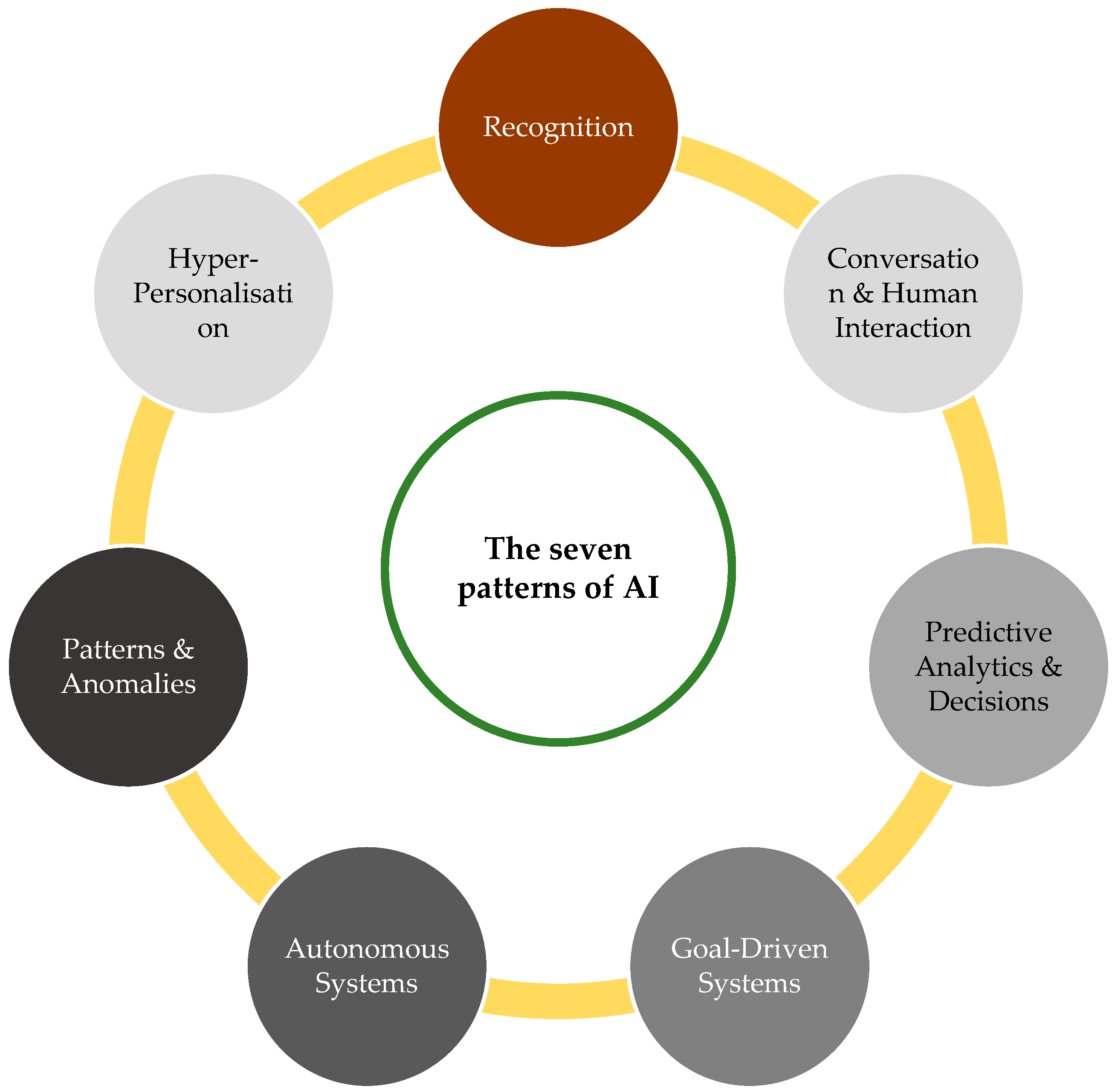
Figure 2.
Timeline of the evolution of artificial intelligence, showcasing key milestones from Turing’s proposal of the Turing Test in 1950 to advancements in AI in 2021. Source: GeeksforGeeks, Sanchhaya Education Private Limited [18].
Figure 2.
Timeline of the evolution of artificial intelligence, showcasing key milestones from Turing’s proposal of the Turing Test in 1950 to advancements in AI in 2021. Source: GeeksforGeeks, Sanchhaya Education Private Limited [18].
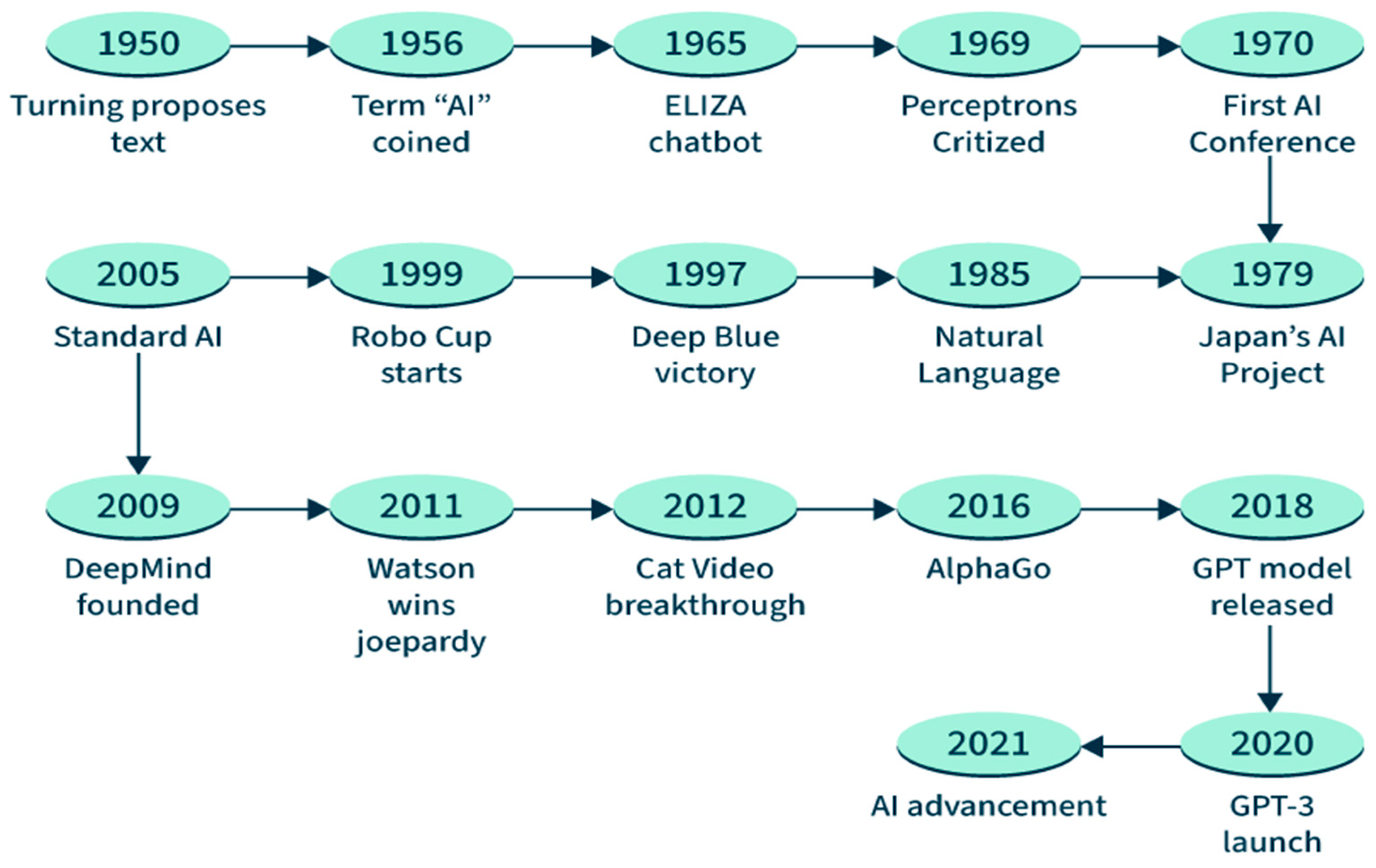
Figure 3.
A diagram showing the simple elements of AI text-to-image prompts.

Figure 4.
Fields that can use AI text-to-image prompts.
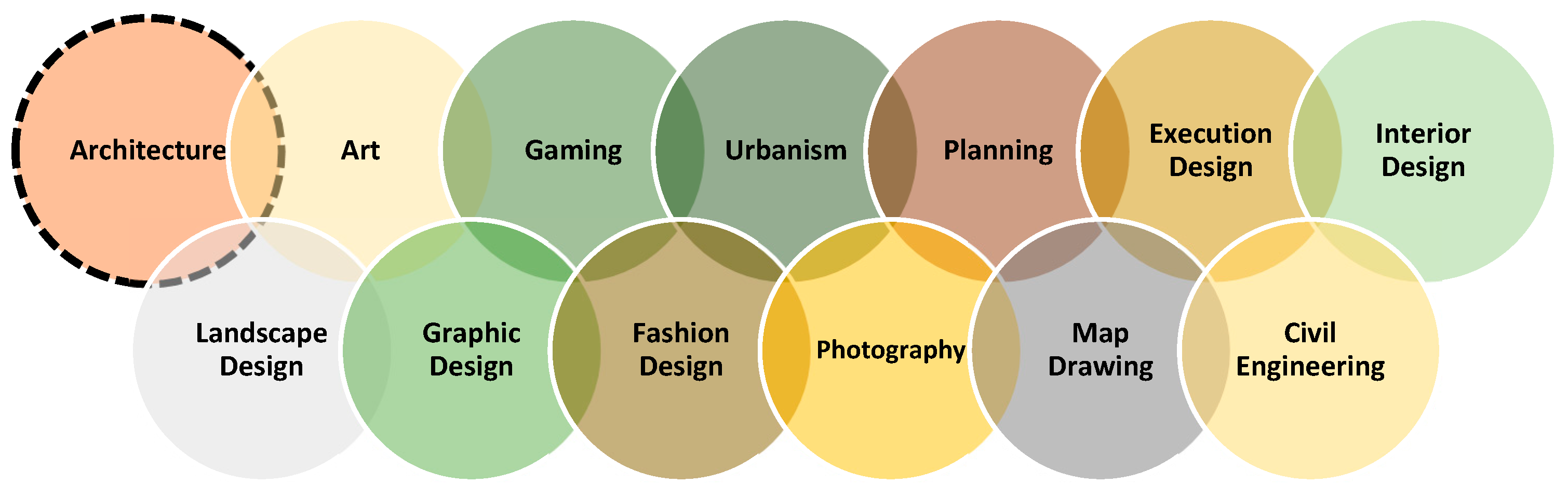
Figure 5.
The Evolutionary Tree of the 20th-century architectural theories and trends [64].
Figure 5.
The Evolutionary Tree of the 20th-century architectural theories and trends [64].
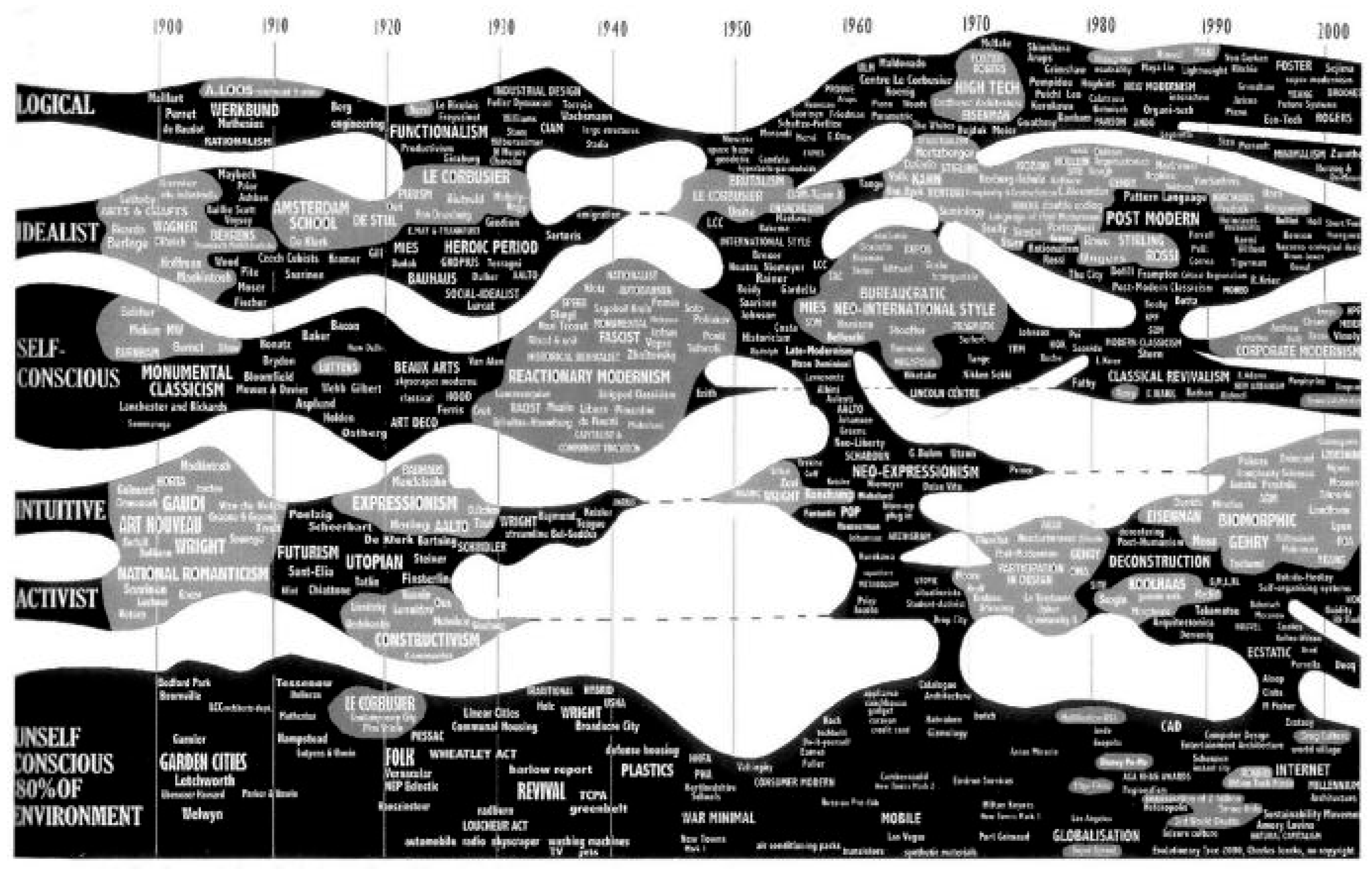
Figure 6.
The Evolutionary Tree of the 21st-century architectural theories and trends [65].
Figure 6.
The Evolutionary Tree of the 21st-century architectural theories and trends [65].
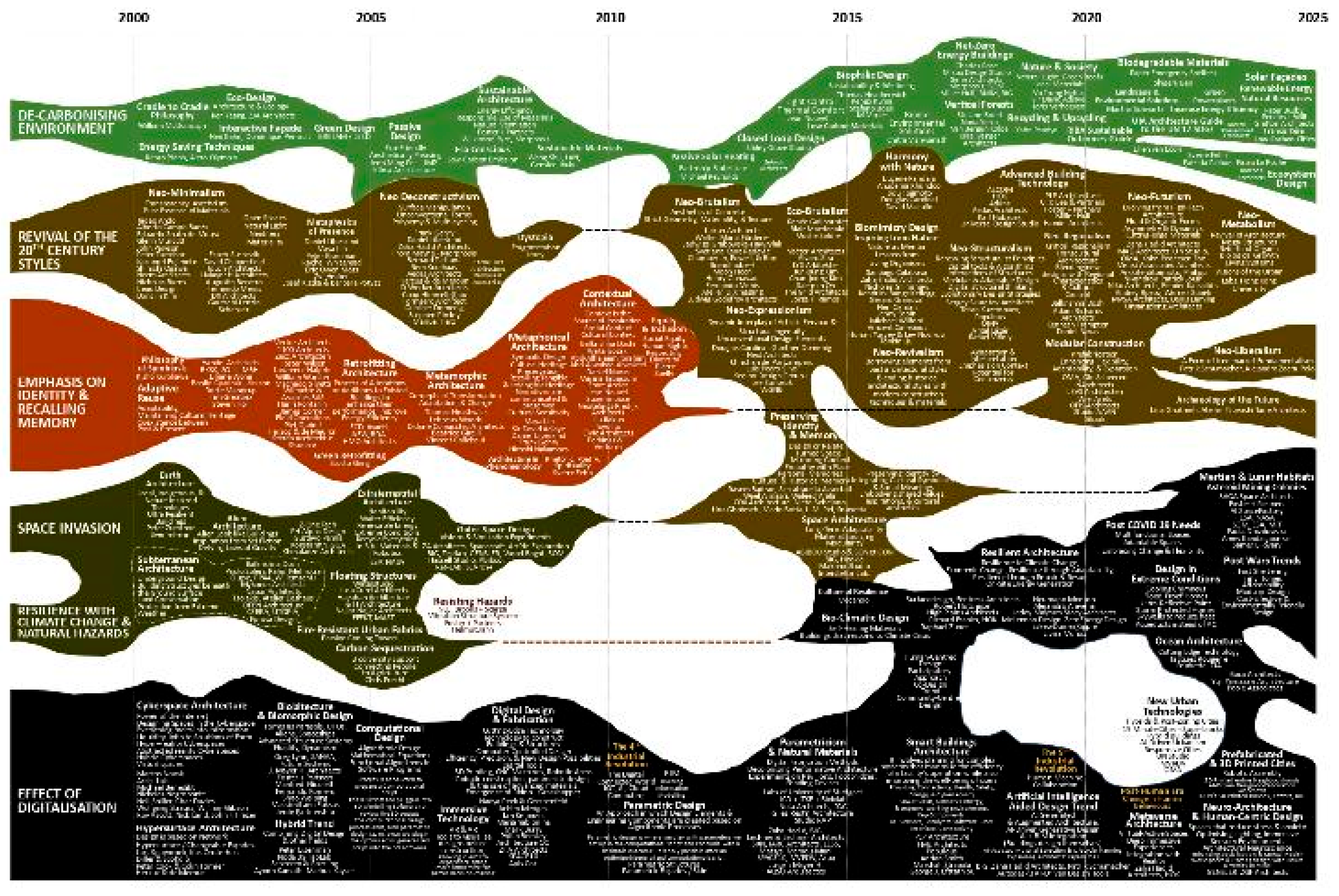
Figure 7.
Nano Banana visual outcome when adding the keywords of ‘Theory of Minimalism’ to the text-to-image prompt: (a) Before; (b) After adding the keywords of this theory.
Figure 7.
Nano Banana visual outcome when adding the keywords of ‘Theory of Minimalism’ to the text-to-image prompt: (a) Before; (b) After adding the keywords of this theory.
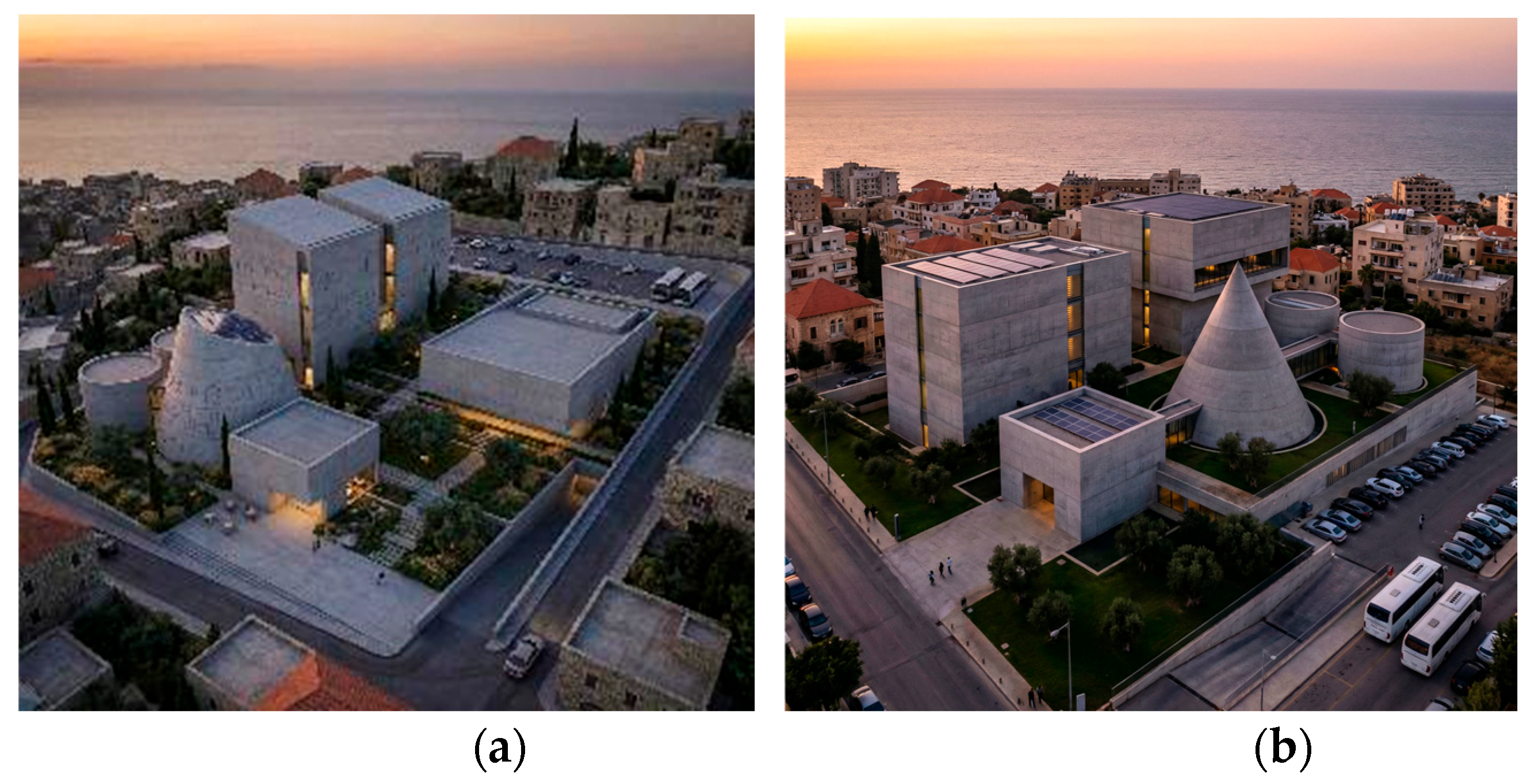
Figure 8.
ChatGPT Images visual outcome when adding the keywords of ‘Theory of Minimalism’ to the text-to-image prompt: (a) Before; (b) After adding the keywords of this theory.
Figure 8.
ChatGPT Images visual outcome when adding the keywords of ‘Theory of Minimalism’ to the text-to-image prompt: (a) Before; (b) After adding the keywords of this theory.
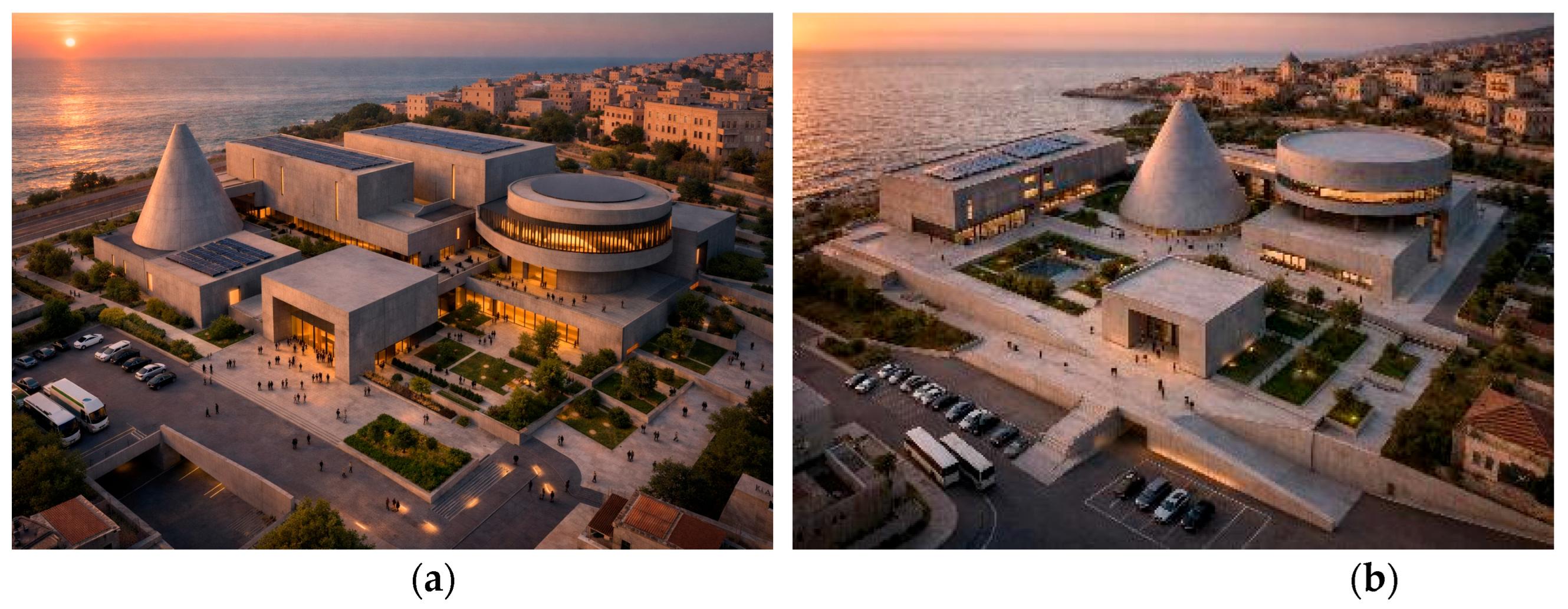
Figure 9.
OpenArt visual outcome when adding the keywords of ‘Theory of Minimalism’ to the text-to-image prompt: (a) Before; (b) After adding the keywords of this theory.
Figure 9.
OpenArt visual outcome when adding the keywords of ‘Theory of Minimalism’ to the text-to-image prompt: (a) Before; (b) After adding the keywords of this theory.
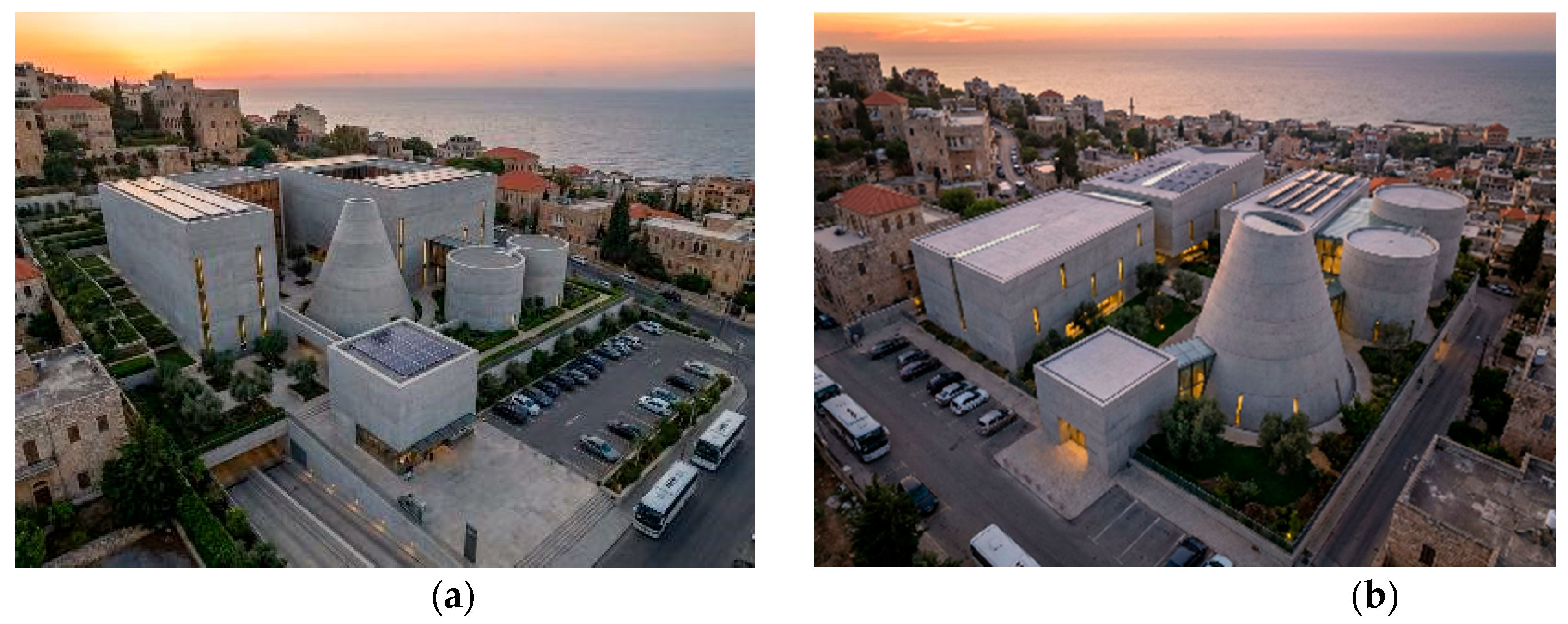
Figure 10.
Nano Banana visual outcome when adding the keywords of ‘Theory of Brutalism’ to the text-to-image prompt: (a) Before; (b) After adding the keywords of this theory.
Figure 10.
Nano Banana visual outcome when adding the keywords of ‘Theory of Brutalism’ to the text-to-image prompt: (a) Before; (b) After adding the keywords of this theory.
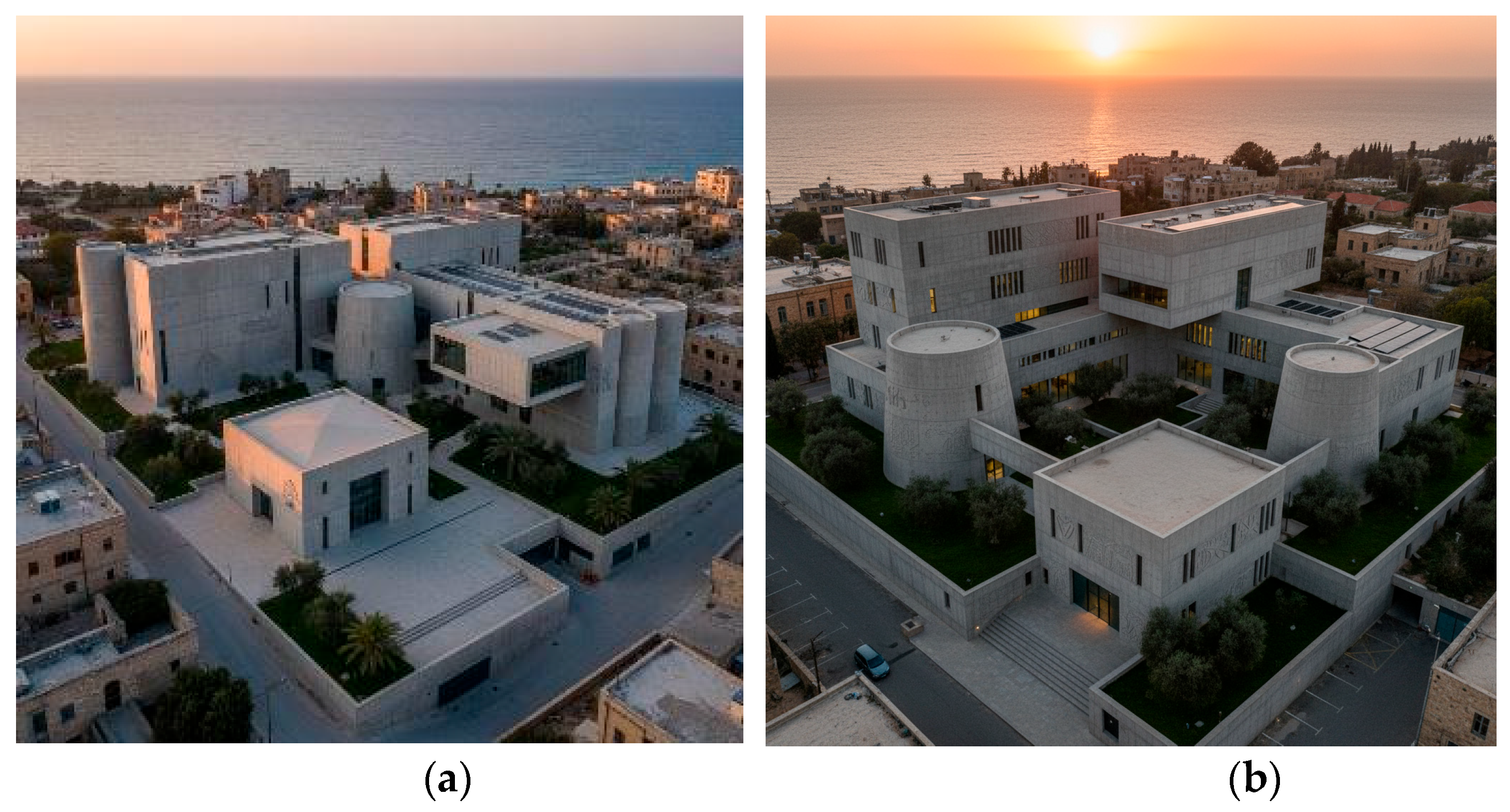
Figure 11.
ChatGPT Images visual outcome when adding the keywords of ‘Theory of Brutalism’ to the text-to-image prompt: (a) Before; (b) After adding the keywords of this theory.
Figure 11.
ChatGPT Images visual outcome when adding the keywords of ‘Theory of Brutalism’ to the text-to-image prompt: (a) Before; (b) After adding the keywords of this theory.
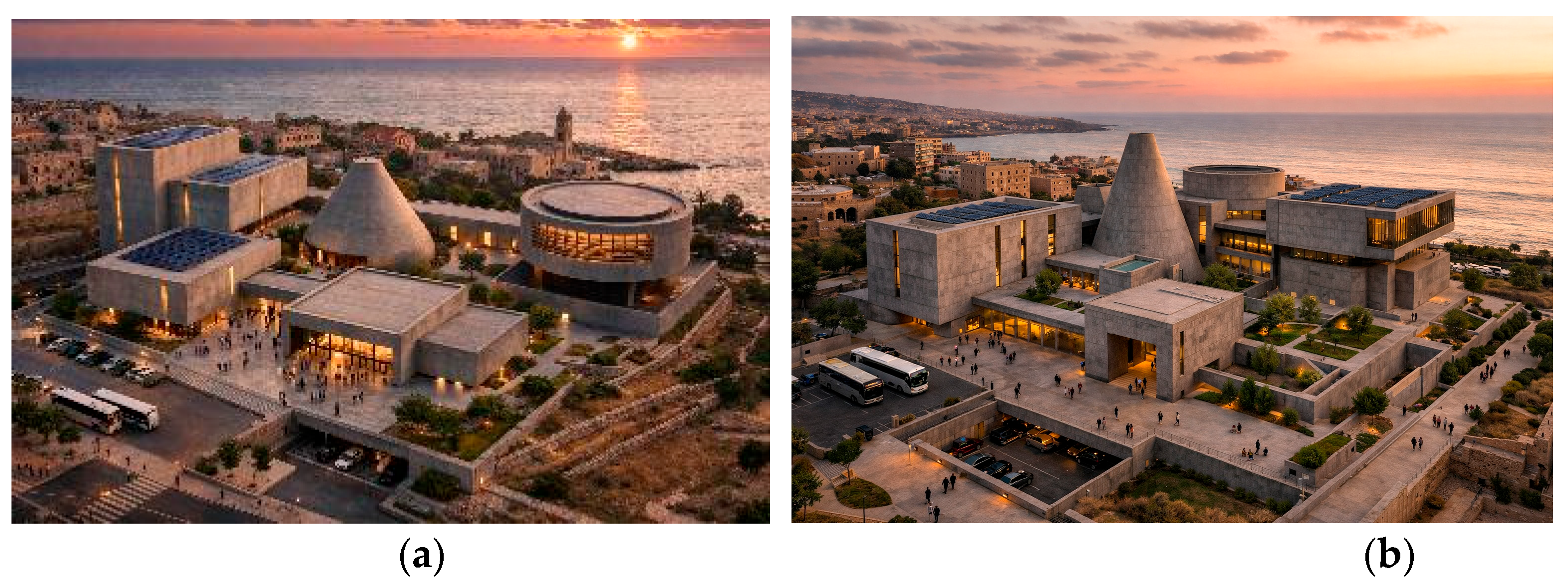
Figure 12.
OpenArt visual outcome when adding the keywords of ‘Theory of Brutalism’ to the text-to-image prompt: (a) Before; (b) After adding the keywords of this theory.
Figure 12.
OpenArt visual outcome when adding the keywords of ‘Theory of Brutalism’ to the text-to-image prompt: (a) Before; (b) After adding the keywords of this theory.
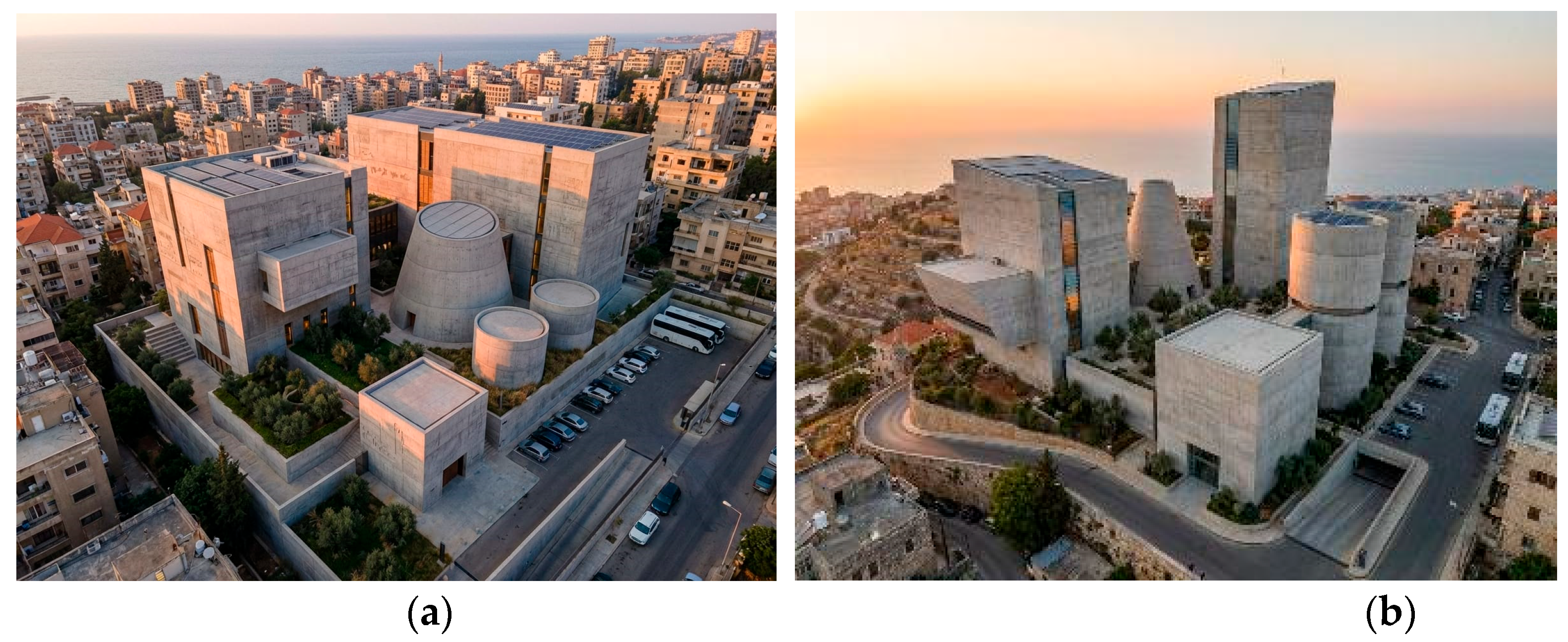
Figure 13.
Nano Banana visual outcome when adding the keywords of ‘Theory of Deconstructivism’ to the text-to-image prompt: (a) Before; (b) After adding the keywords of this theory.
Figure 13.
Nano Banana visual outcome when adding the keywords of ‘Theory of Deconstructivism’ to the text-to-image prompt: (a) Before; (b) After adding the keywords of this theory.
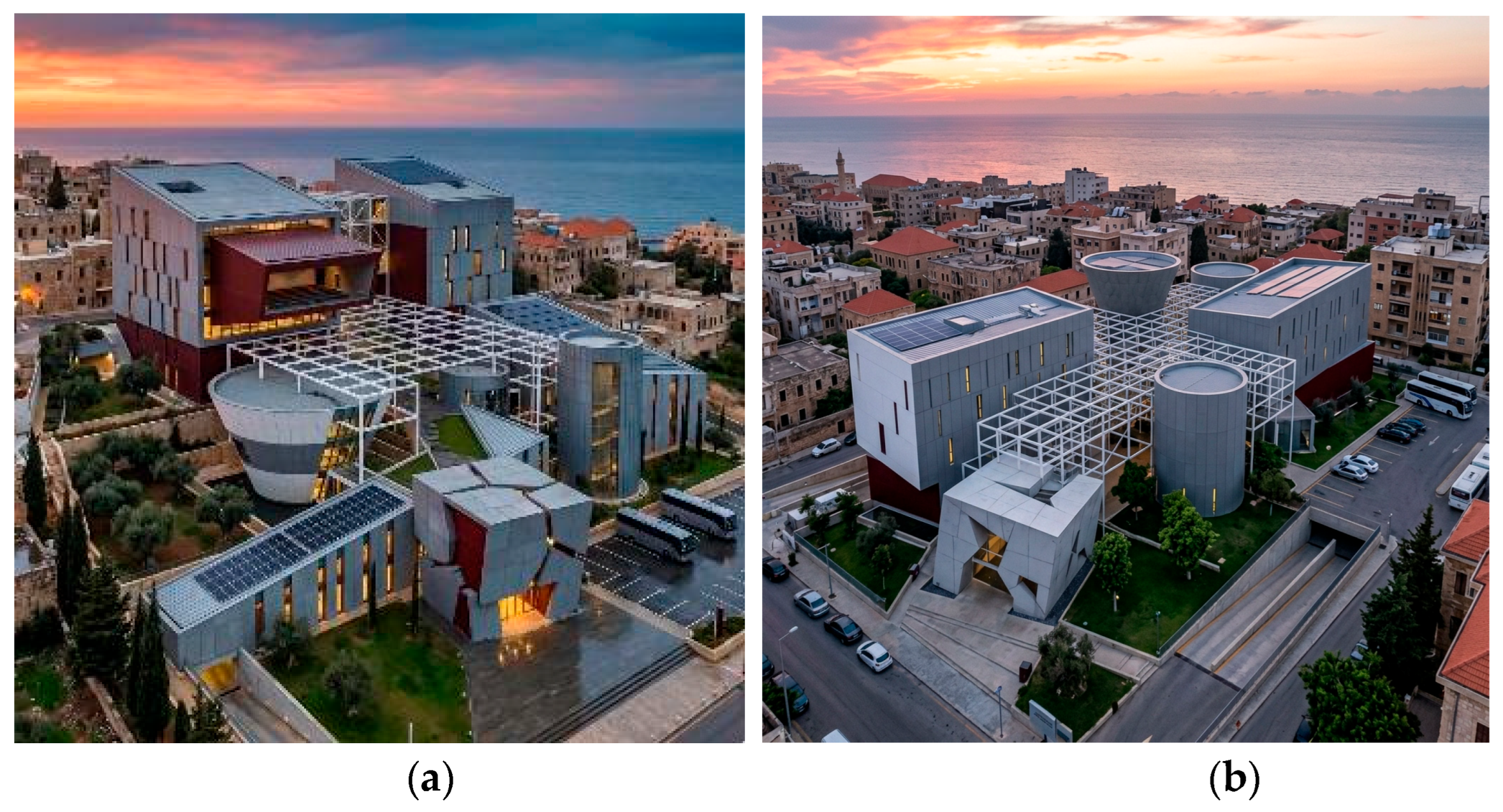
Figure 14.
ChatGPT Images visual outcome when adding the keywords of ‘Theory of Deconstructivism’ to the text-to-image prompt: (a) Before; (b) After adding the keywords of this theory.
Figure 14.
ChatGPT Images visual outcome when adding the keywords of ‘Theory of Deconstructivism’ to the text-to-image prompt: (a) Before; (b) After adding the keywords of this theory.
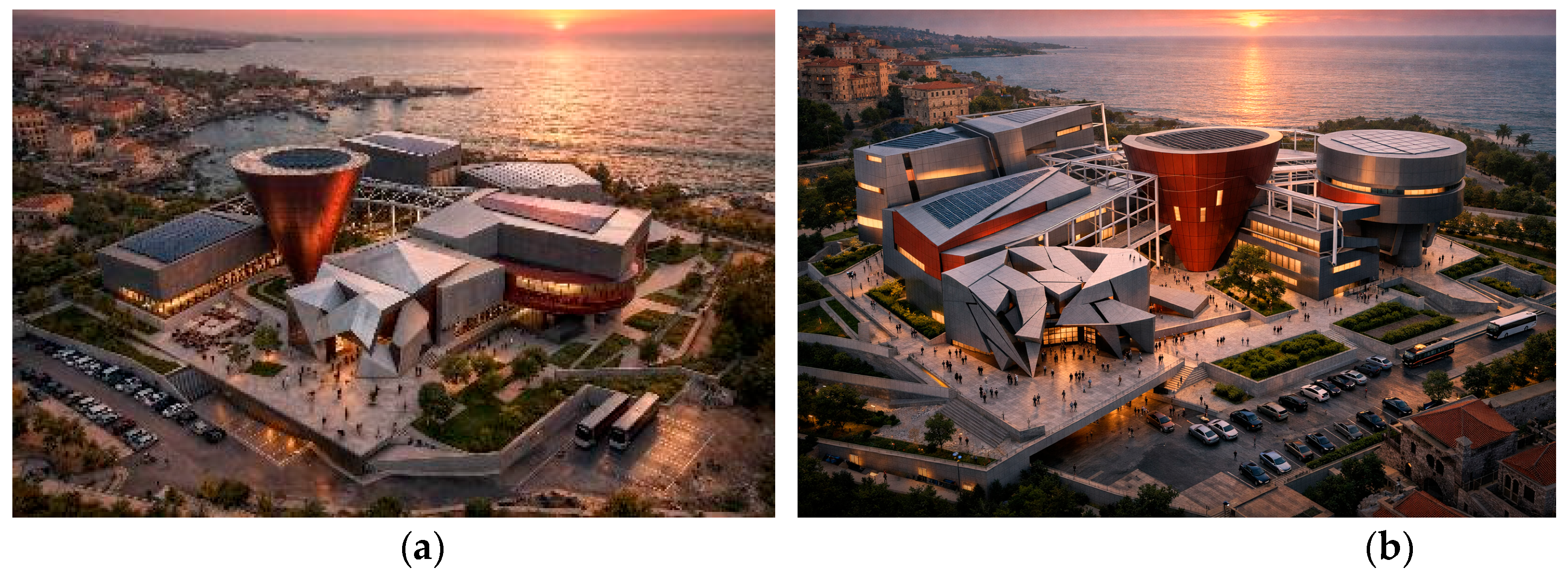
Figure 15.
OpenArt visual outcome when adding the keywords of ‘Theory of Deconstructivism’ to the text-to-image prompt: (a) Before; (b) After adding the keywords of this theory.
Figure 15.
OpenArt visual outcome when adding the keywords of ‘Theory of Deconstructivism’ to the text-to-image prompt: (a) Before; (b) After adding the keywords of this theory.
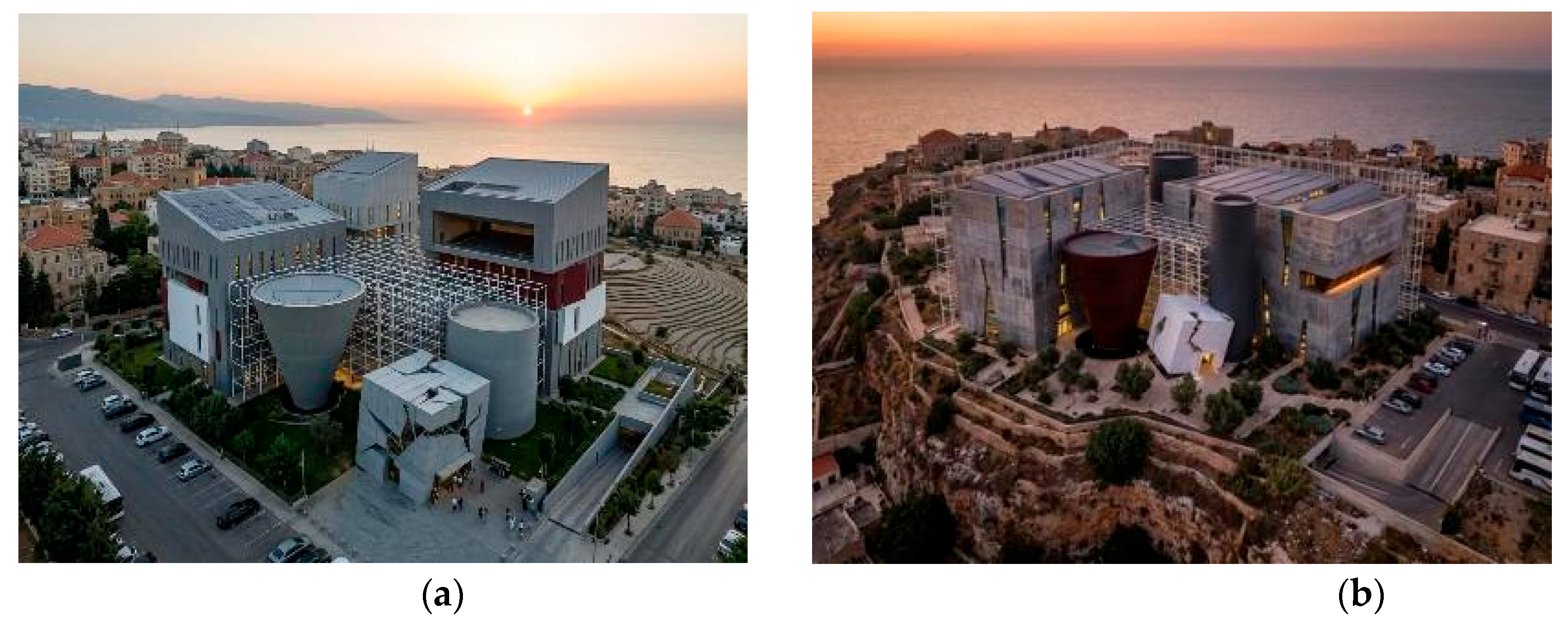
Figure 16.
Nano Banana visual outcome when adding the keywords of ‘Theory of Decarbonising Environment’ to the text-to-image prompt: (a) Before; (b) After adding the keywords of this theory.
Figure 16.
Nano Banana visual outcome when adding the keywords of ‘Theory of Decarbonising Environment’ to the text-to-image prompt: (a) Before; (b) After adding the keywords of this theory.
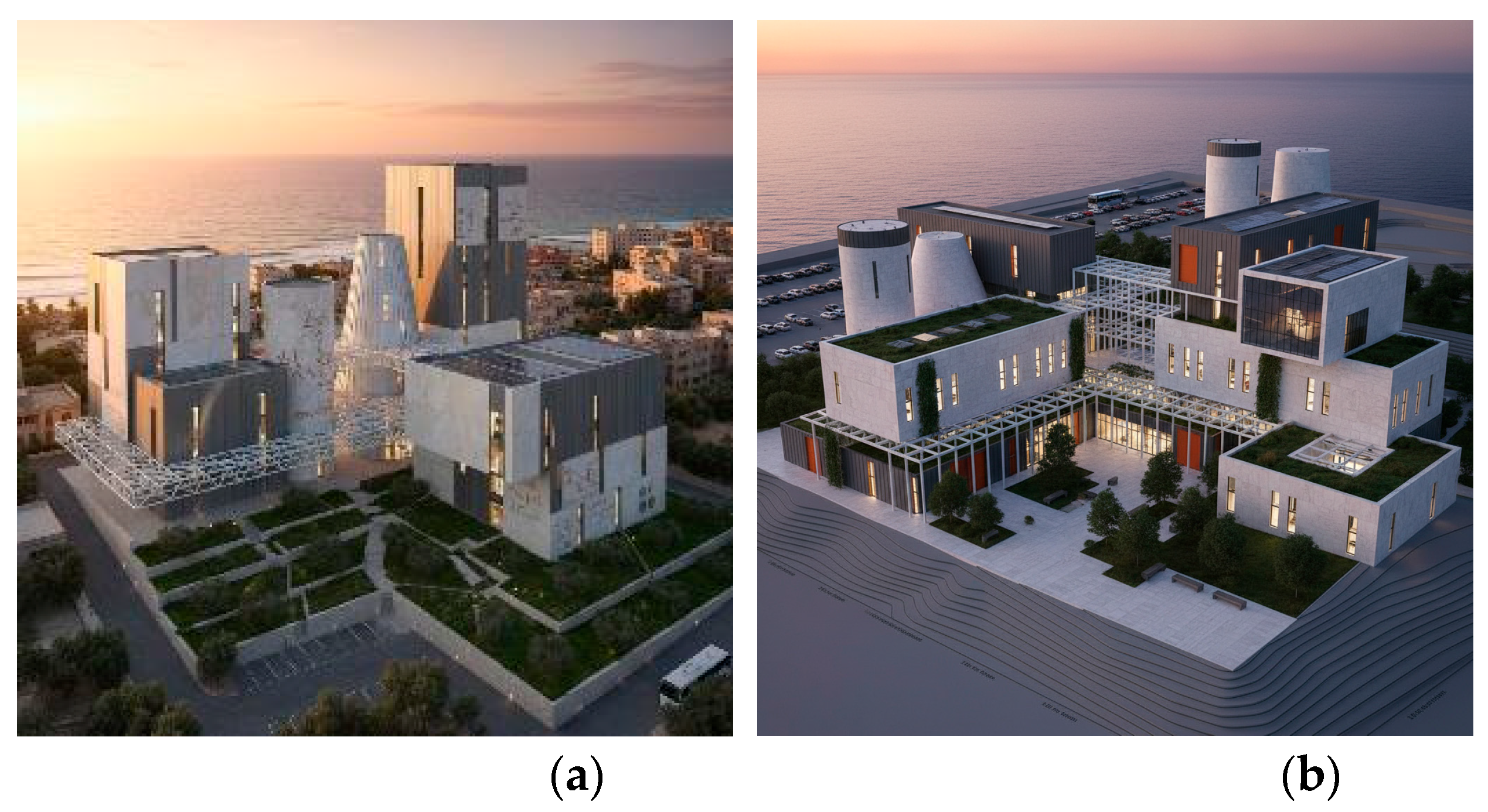
Figure 17.
ChatGPT Images visual outcome when adding the keywords of ‘Theory of Decarbonising Environment’ to the text-to-image prompt: (a) Before; (b) After adding the keywords of this theory.
Figure 17.
ChatGPT Images visual outcome when adding the keywords of ‘Theory of Decarbonising Environment’ to the text-to-image prompt: (a) Before; (b) After adding the keywords of this theory.
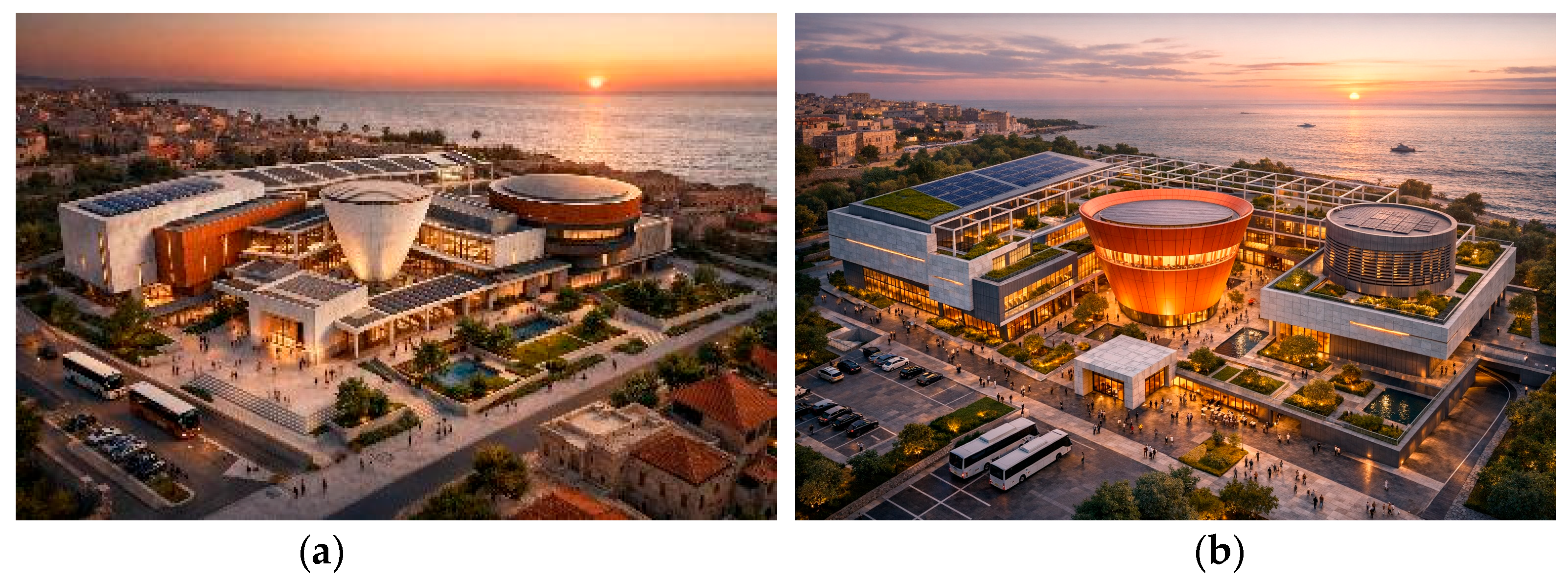
Figure 18.
OpenArt visual outcome when adding the keywords of ‘Theory of Decarbonising Environment’ to the text-to-image prompt: (a) Before; (b) After adding the keywords of this theory.
Figure 18.
OpenArt visual outcome when adding the keywords of ‘Theory of Decarbonising Environment’ to the text-to-image prompt: (a) Before; (b) After adding the keywords of this theory.
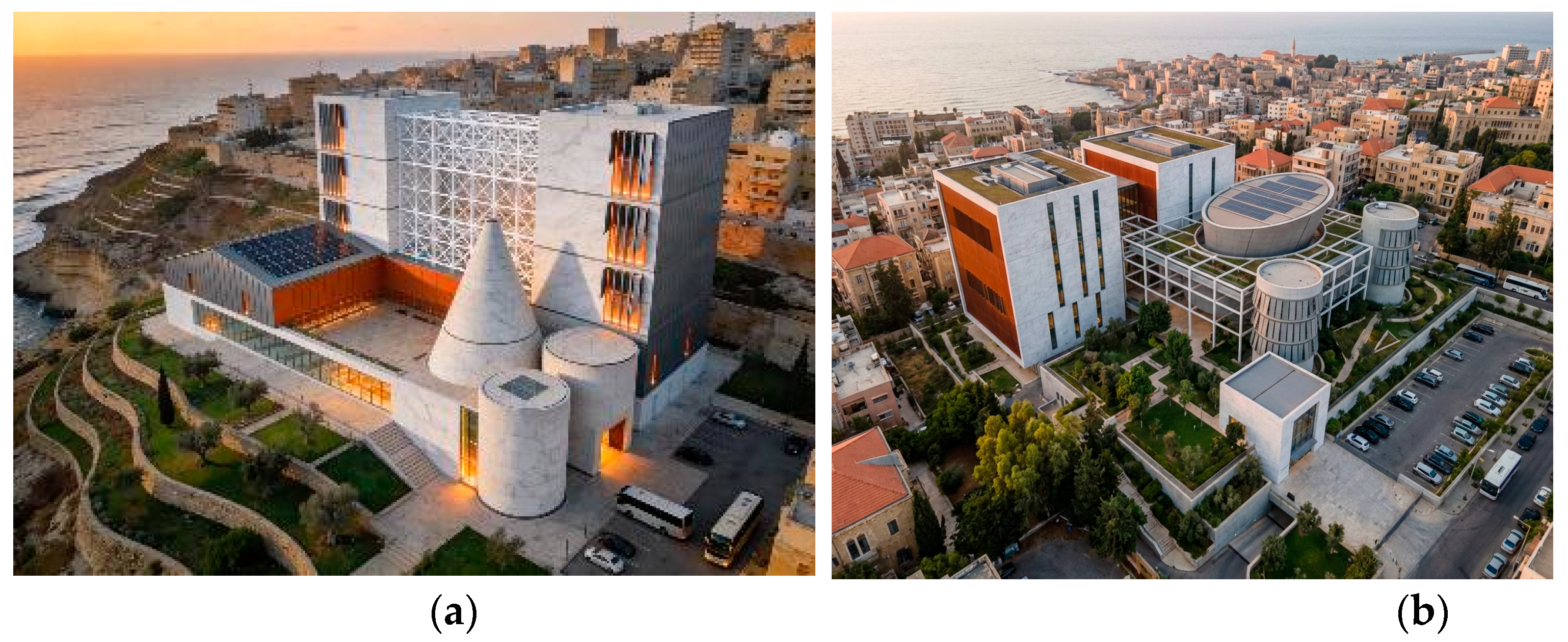
Figure 19.
Nano Banana visual outcome when adding the keywords of ‘Theory of Parametricism’ to the text-to-image prompt: (a) Before; (b) After adding the keywords of this theory.
Figure 19.
Nano Banana visual outcome when adding the keywords of ‘Theory of Parametricism’ to the text-to-image prompt: (a) Before; (b) After adding the keywords of this theory.
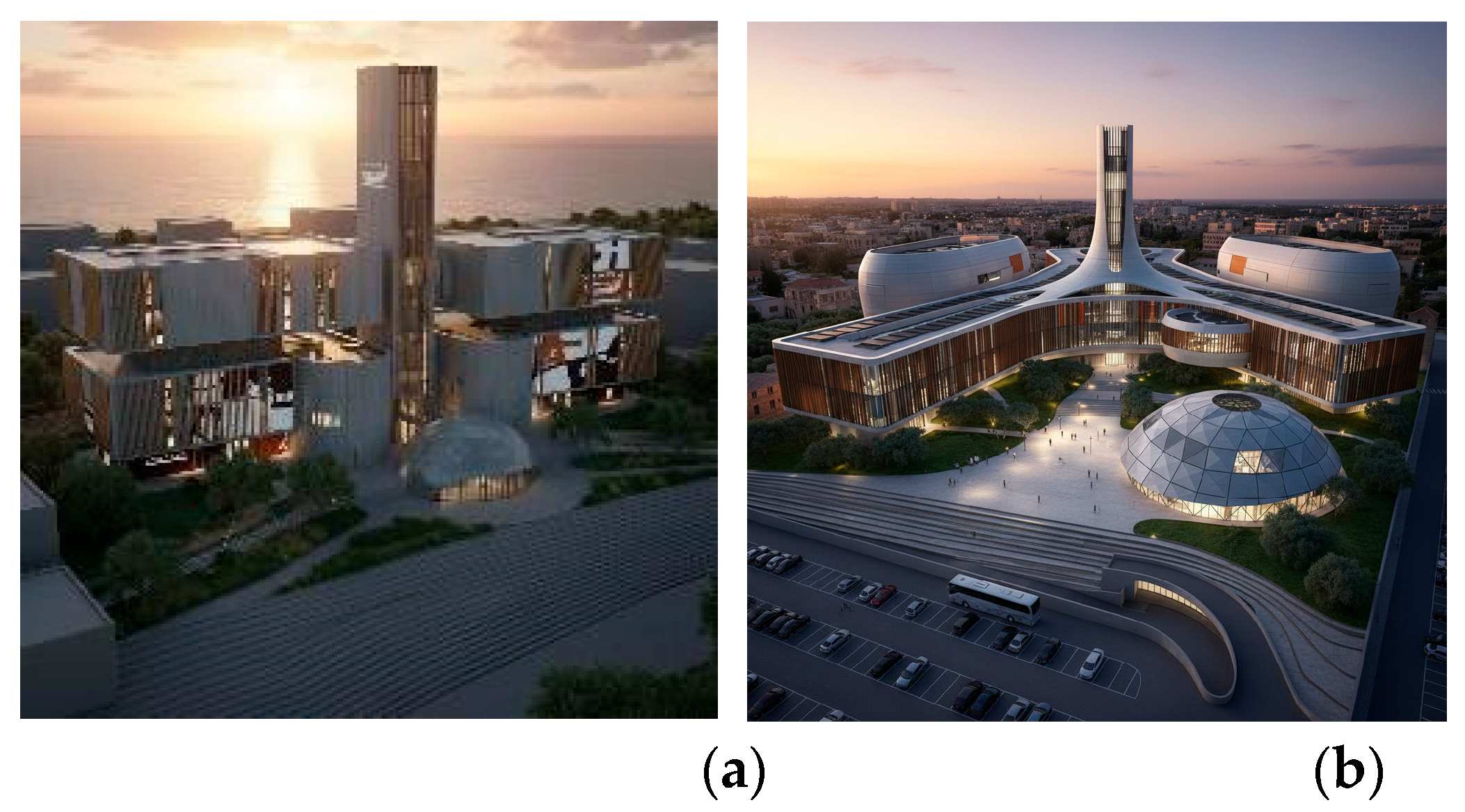
Figure 20.
ChatGPT Images visual outcome when adding the keywords of ‘Theory of Parametricism’ to the text-to-image prompt: (a) Before; (b) After adding the keywords of this theory.
Figure 20.
ChatGPT Images visual outcome when adding the keywords of ‘Theory of Parametricism’ to the text-to-image prompt: (a) Before; (b) After adding the keywords of this theory.
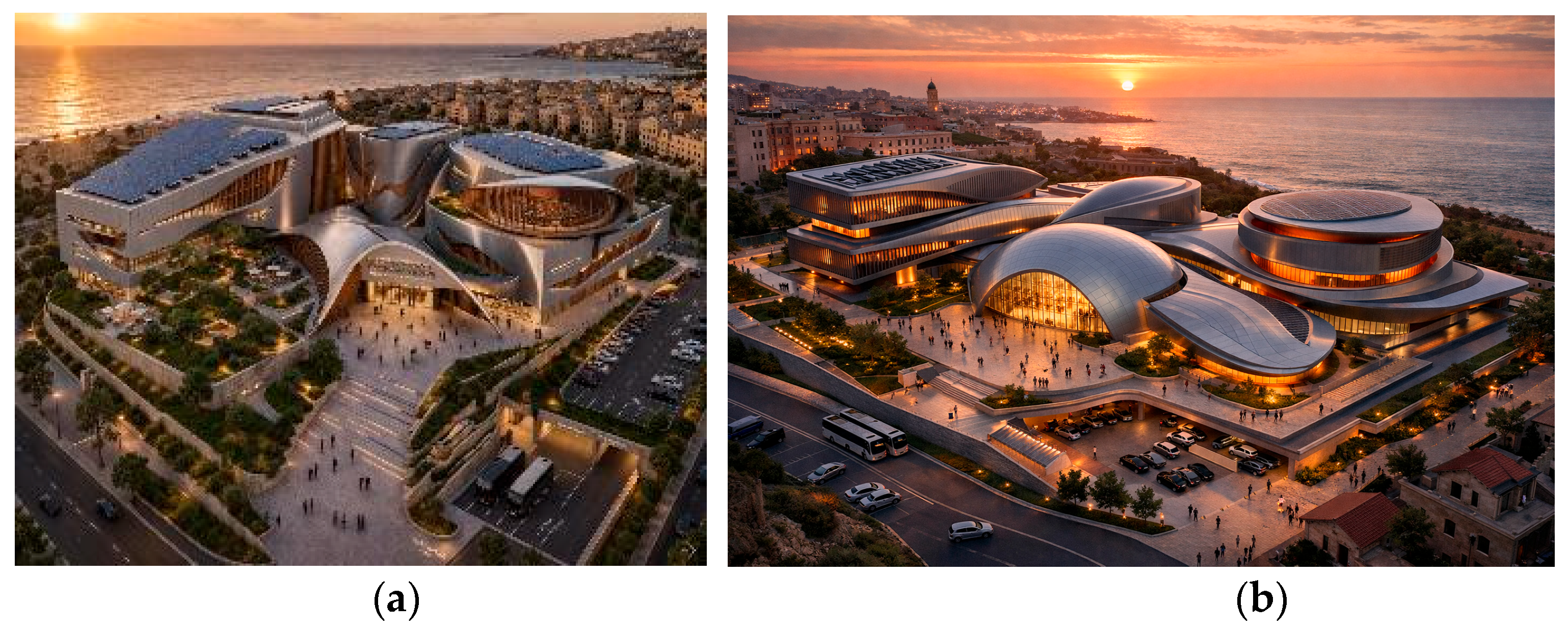
Figure 21.
OpenArt visual outcome when adding the keywords of ‘Theory of Parametricism’ to the text-to-image prompt: (a) Before; (b) After adding the keywords of this theory.
Figure 21.
OpenArt visual outcome when adding the keywords of ‘Theory of Parametricism’ to the text-to-image prompt: (a) Before; (b) After adding the keywords of this theory.
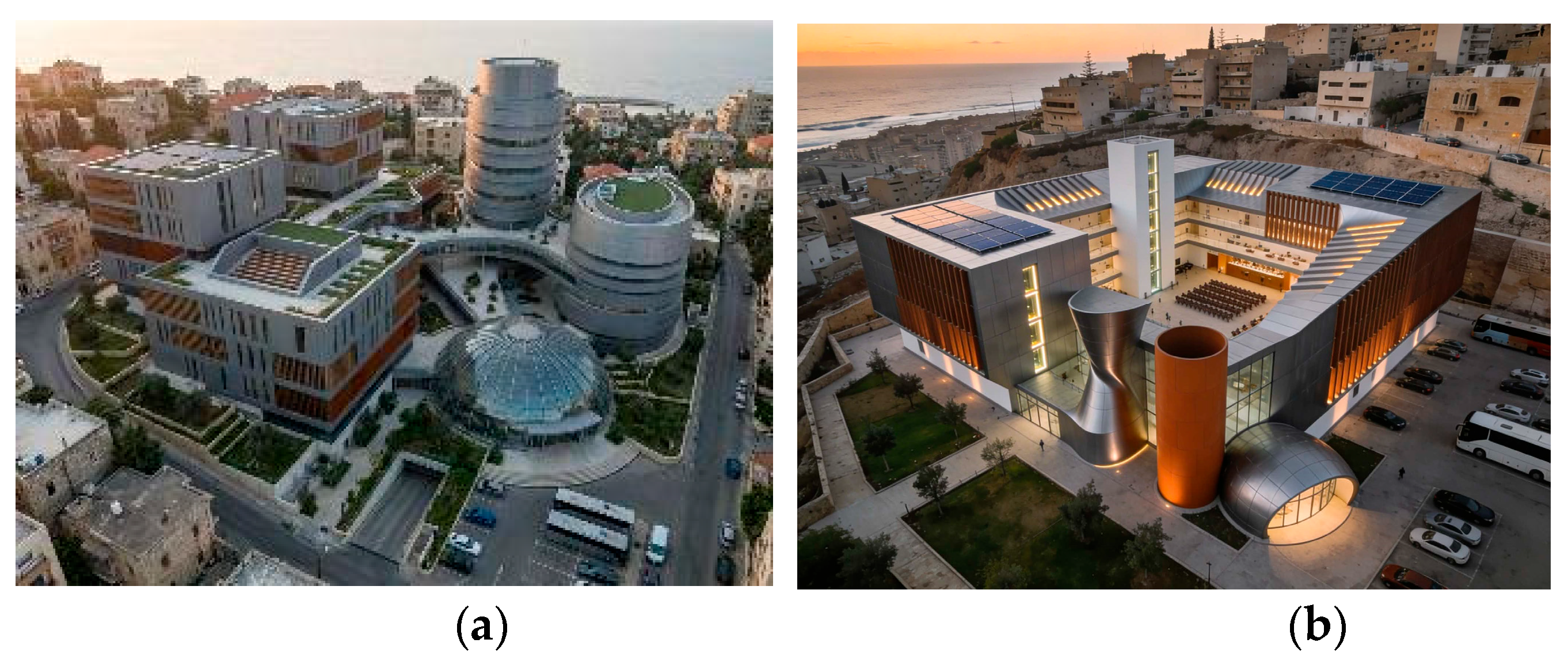
Figure 22.
Canva visual outcome when adding the keywords of ‘Theory of Deconstructivism’ to the text-to-image prompt.
Figure 22.
Canva visual outcome when adding the keywords of ‘Theory of Deconstructivism’ to the text-to-image prompt.
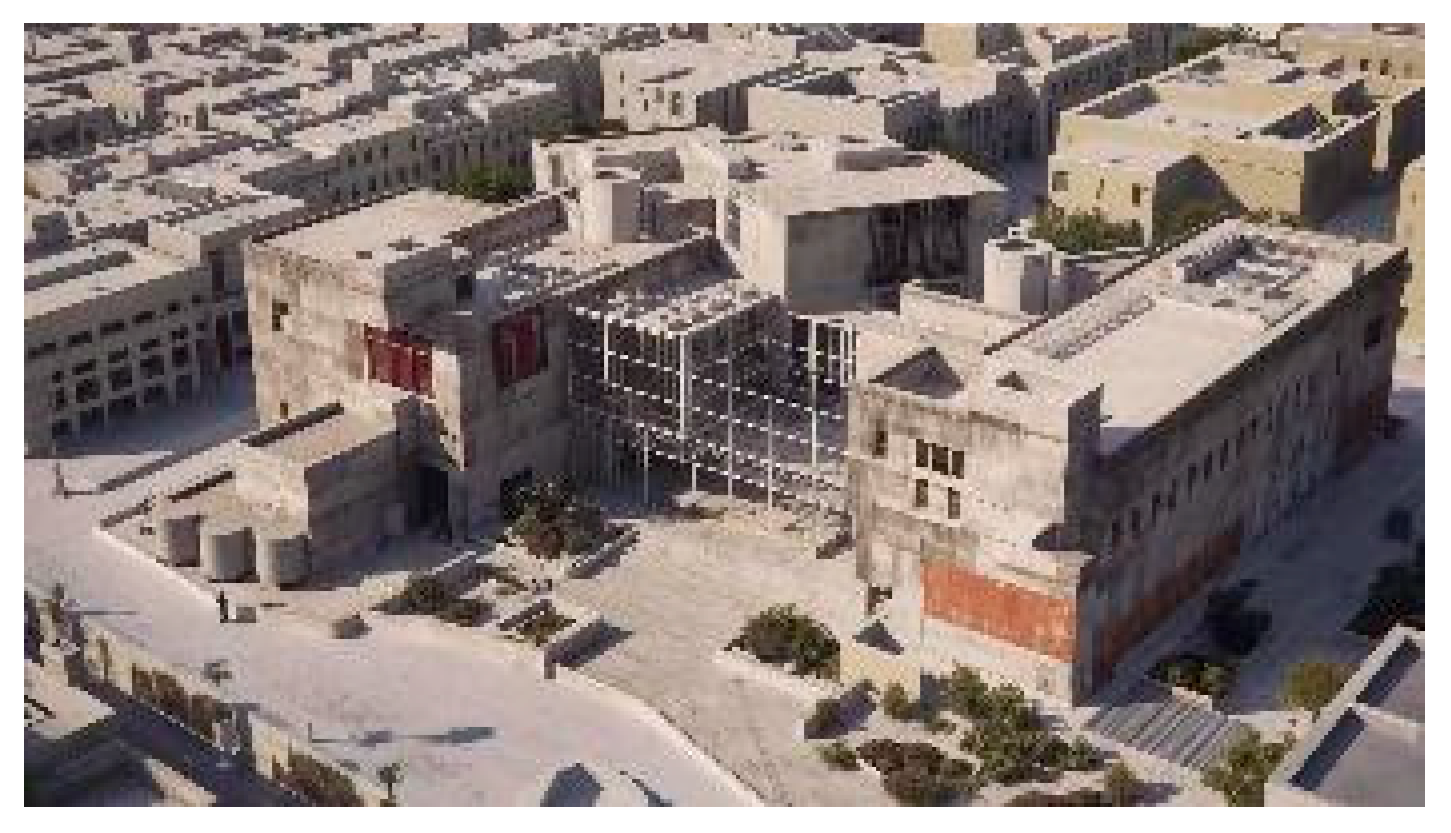
Figure 23.
Semantic textual models chart, implying the keywords of ‘Theory of Architecture’ to be an essential input, used in the AI text-to-image prompts for better results. The presented theories are the most prominent architectural theories in the 20th and 21st century. (This chart is proposed and prepared by the author).
Figure 23.
Semantic textual models chart, implying the keywords of ‘Theory of Architecture’ to be an essential input, used in the AI text-to-image prompts for better results. The presented theories are the most prominent architectural theories in the 20th and 21st century. (This chart is proposed and prepared by the author).
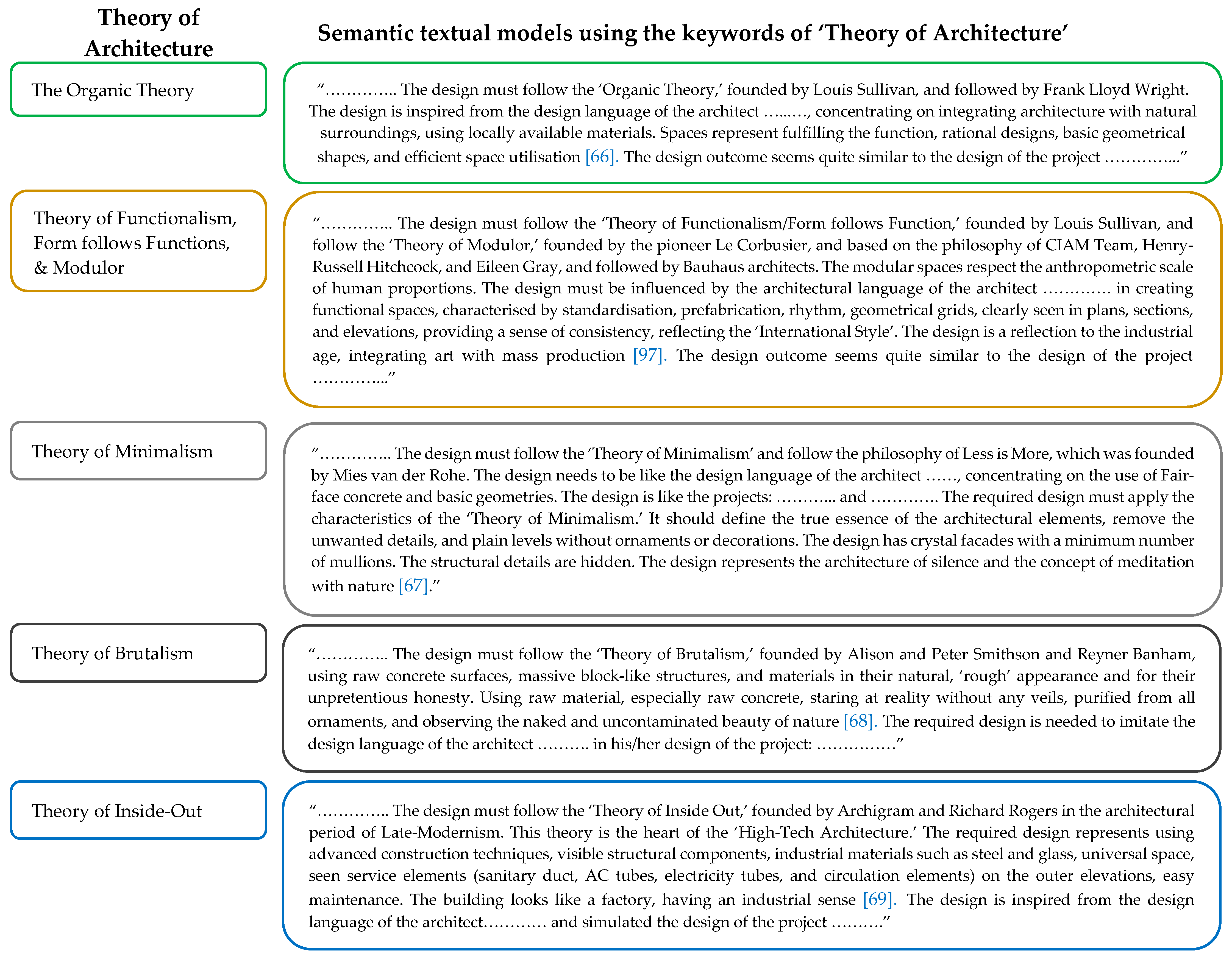
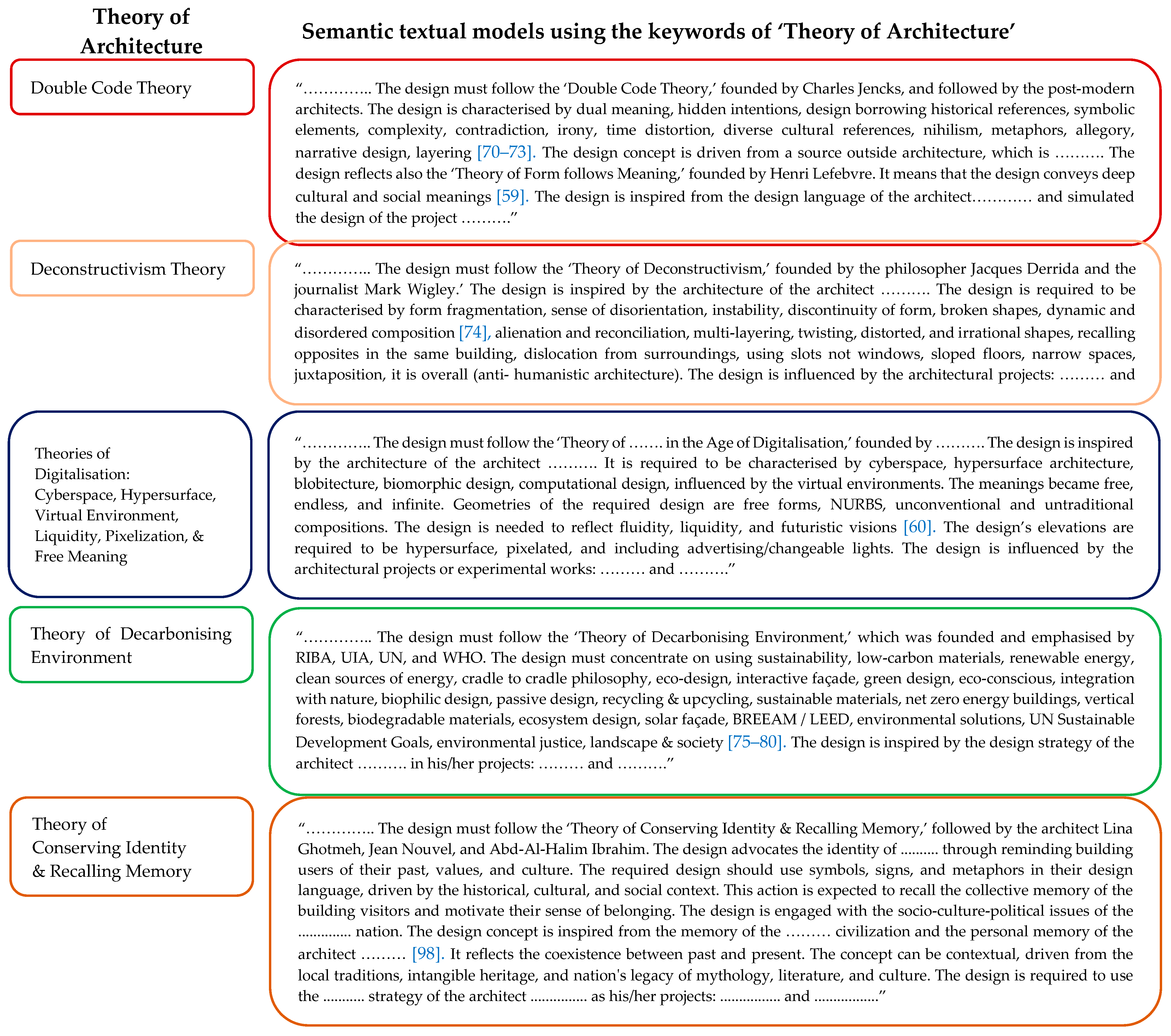
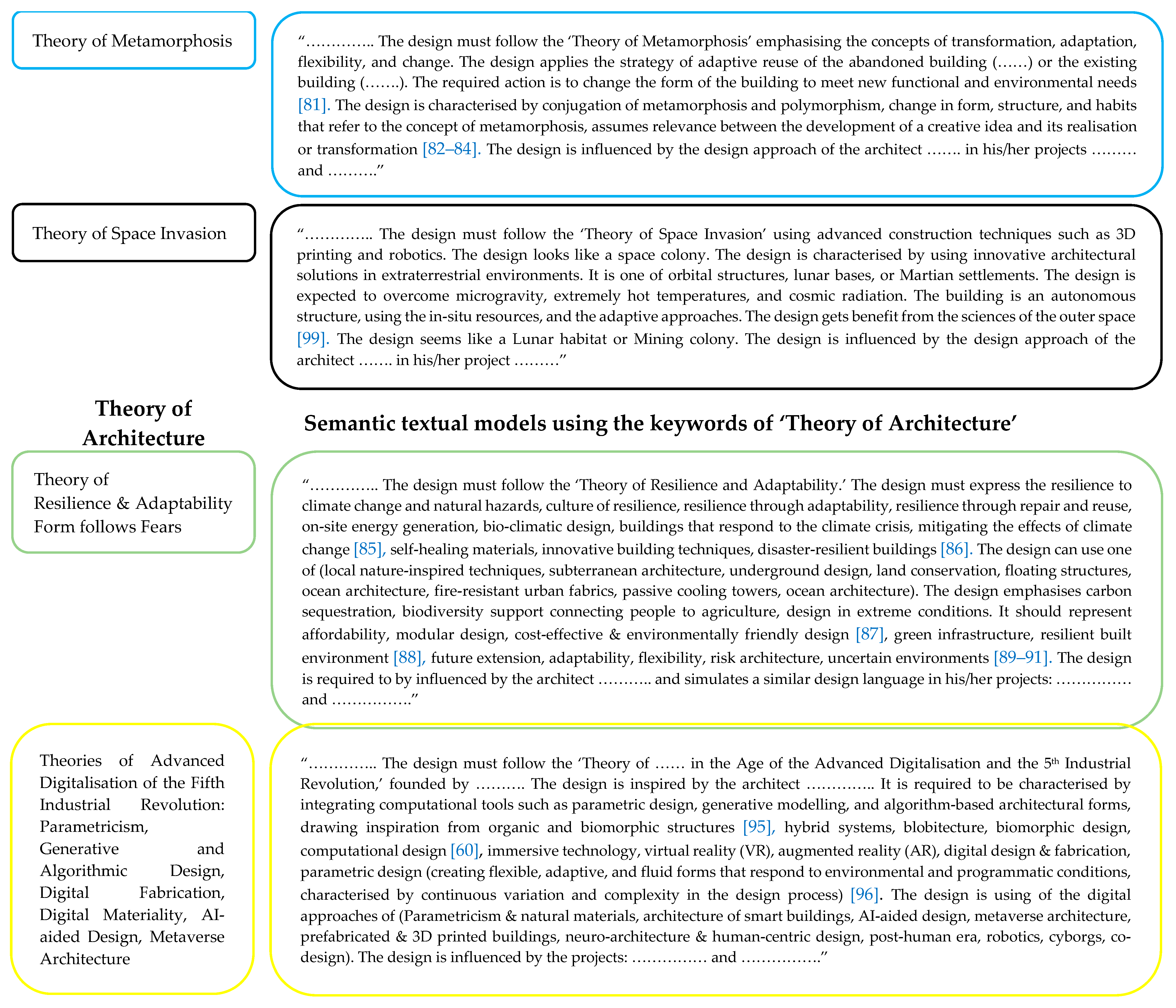

Table 1.
Akyıldız’s textual components of AI text-to-image prompts in architecture [48].
Table 1.
Akyıldız’s textual components of AI text-to-image prompts in architecture [48].
| Architectural Style | Volume and Shape | Material and Surface | Architect |
| Parametric / Futuristic / High-Tech / Contemporary / Bionic / Scandinavian / Japanese / Persian / Brutalist / Blobitecture / Modern | Organic / Cave-like/excavated / Biomorphic / Modular / Fluid / Floating/hanging / Cubic | Ice / Snow / Rocky / Stacked / Rough stone / Stucco / Corten steel / Glass / Concrete / Reflected crystal / Perforated / Voronoi cells pattern / Inflatable membrane / Wood / Translucent / Steel / Ripped / Wool / Mesh / Ceramic | SANAA / Oki Sato / Daniel Libeskind / Zaha Hadid / Frank Gehry / Antonio Gaudí / Oscar Niemeyer / Neri Oxman / Alireza Taghaboni / Simon Velez / Le Corbusier / Enric Miralles |
Table 2.
The most prominent theorists and philosophers in the history of architecture and their remarkable architectural theories [51,52,57,58,59,60,61].
| Classical, Renaissance Age, 15th, 16th, 17th, & 18th Centuries | Enlightenment and 19th Century Theory |
Modernism and Functionalism (Late 19th—Mid-20th Century) | Postmodernism and Contemporary Theory (Last 3 Decades of the 20th Century) | Contemporary Theories of the 21st Century |
| Vitruvius (Theory of Strength, Function, & Beauty) Abbot Suger Alberti Palladio Bernini Borromini Ledoux Boullée |
Marc-Antoine Laugier Friedrich W. von Erdmannsdorff John Ruskin Viollet-le-Duc Auguste Choisy Gottfried Semper Immanuel Kant G.W.F. Hegel Arthur Schopenhauer |
Louis Sullivan (Form follows Function) Adolf Loos Frank Lloyd Wright Walter Gropius CIAM Team Le Corbusier (Theory of Modulor) Lewis Mumford Helena Blavatsky Mies van der Rohe (Theory of Minimalism) Louis Kahn Edmund Husserl Martin Heidegger Christian N. Schulz (Theory of Phenomenology) Marion Mahony Griffin Ludwig Wittgenstein Henry-Russell Hitchcock and Eileen Gray (Theory of International Style) Juhani Pallasmaa Anne-Catrin Schultz |
Robert Venturi Aldo Rossi Manfredo Tafuri Archigram Alvar Aalto Peter Banham Charles Jencks (Double Code Theory) Kenneth Frampton Michel Foucault Jacques Derrida (Theory of Deconstructivism) Mark Wigley Léon Krier Henri Lefebvre (Form follows Meaning) Dennis Sharp Michael Hays Joseph Rykwert Amos Rapoport Colin Rowe Jane Jacobs Hassan Fathy James Steele Christopher Alexander Rem Koolhaas Peter Eisenman Bernard Tschumi Kisho Kurokawa Fumihiko Maki Alberto Pérez-Gómez Umberto Eco Gilles Deleuze Denise Scott Brown Herbert Muschamp Philip Jodidio Marcos Novak (Theory of Liquidity) Aaron Betsky Roger Scruton |
Zaha Hadid Abd-Al-Halim Ibrahim Patrik Schumacher Bernard Stiegler Paul Guyer Anthony Vidler Moshe Safdie Mark Foster Gage Cruz Garcia Greg Lynn Nigel Coates Mohsen Mostafavi Francis Kéré Brian Cody (Form follows Energy) Marina Tabassum Bjarke Ingels Norman Foster Ali A. Alraouf Ashraf Salama Lina Ghotmeh Yasmeen Lari Farshid Moussavi Neri Oxman Hassler & Kohler Rolf Hughes Gensler (Form follows Responsibility) Alan Johns Simon Allford Muyiwa Oki Chris Williamson Achim Menges Nan Ellin (Form follows Fears) |
Table 3.
The prominent architectural theories in the 20th century.
| Theory of Architecture | Founders of the Theory | Architects followed the Theory | Exemplars | Characteristics (Valid as sources of keywords) |
|---|---|---|---|---|
| The Organic Approach and Form follows Function Theory | Louis Sullivan | Louis Sullivan Frank Lloyd Wright Alvar Aalto Rudolf Steiner Walter Gropius Hugo Häring Eero Saarinen |
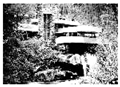 The Fallingwater House, Pennsylvania, USA |
Integrating architecture with natural surroundings, using locally available materials, architectural spaces concentrate on fulfilling the function, rational designs, basic geometrical shapes, and efficient space utilisation [66] |
|
Minimalism Theory (Less is More Philosophy) |
Mies van der Rohe |
Mies van der Rohe Tadao Ando Luis Barragán Alberto Campo Baeza John Pawson Kazuo Shinohara Peter Zumthor |
 The German Pavilion, Barcelona, Spain |
It strips away the unwanted details and defines the true essence of any given architectural element. Simplicity, monochromic colour palettes, reduction of decorative elements, crystal façades, minimum number of mullions, transparency, plane levels, hidden structural details Architecture of silence, meditation, awe, and (Less is More) [67] |
| Brutalism Theory | Alison and Peter Smithson & Reyner Banham |
Le Corbusier Alison and Peter Smithson Marcel Breuer Paul Rudolph Louis Kahn Ernő Goldfinger Fritz Wotruba Denys Lasdun |
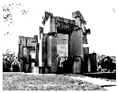 Church of the Most Holy Trinity, Vienna, Austria Church of the Most Holy Trinity, Vienna, Austria |
Raw concrete surfaces, massive block-like structures, using materials in their natural, ‘rough’ appearance and for their unpretentious honesty. Using raw material, especially raw concrete, staring at reality without any veils, purified from all ornaments, and observing the naked and uncontaminated beauty of nature [68] |
|
Inside Out Theory (High-Tech) |
Archigram & Richard Rogers |
Norman Foster Richard Rogers Renzo Piano Nicholas Grimshaw Michael Hopkins. Helmut Jahn |
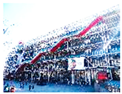 George Pompidou George PompidouCentre, Paris, France |
Advanced construction techniques, visible structural components, using industrial materials such as steel and glass, universal space, seen service elements (sanitary duct, AC tubes, electricity tubes, vertical and horizontal circulation) on the outer elevations, easy maintenance, building looks like a factory, having an industrial sense [69] |
| Double Code Theory | Charles Jencks |
Robert Venturi James Strilign Charles Moore Aldo Rossi Carlo Scarpa Charles Correa Monta Mozuna Aldo van Eyck Stanley Tigerman Robert Stern Ricardo Bofill Hans Hollein |
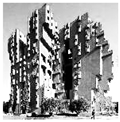 Walden 7, Barcelona, Spain |
Dual meaning, hidden intentions, design borrowing historical references, using symbolic elements, complexity, contradiction, irony, time distortion, diverse cultural references, nihilism, metaphors, allegory, narrative design, layering, sources outside architecture, such as history, memories, semiotics, myths, religion, art, and science fiction [70,71,72,73] |
|
Deconstruction Theory (The Fold Theory) |
Jacques Derrida Mark Wigley Gilles Deleuze |
Frank Gehry Daniel Libeskind Peter Eisenman Bernard Tschumi Zaha Hadid Coop Himmelb(l)au Rem Koolhaas Herzog & de Meuron Zvi Hecker Thom Mayne |
 Parc de la Villette, Paris, France |
Form fragmentation, sense of disorientation, instability, discontinuity of form, broken shapes, dynamic and disordered composition [74], alienation & reconciliation, multi-layering, twisting, distorted, and irrational shapes, recalling opposites in the same building, dislocation from surroundings, using slots not windows, sloped floors, narrow spaces, juxtaposition, it is overall (anti- humanistic architecture) |
Table 4.
The prominent architectural theories in the 21st century.
| Theory of Architecture | Founders of the Theory | Architects followed the Theory | Exemplars |
Characteristics (Valid as sources of keywords) |
|
De-Carbonising Environemnt Theory ‘Form follows Energy’ Theory [61] |
RIBA UIA UN Charles David Keeling Brian Cody |
Foster + Partners William McDonough Renzo Piano Alero Olympio Ned Kahn Dominique Perrault Wilkinson Eyre Gensler David Adjaye Gafton Architects Francis Kéré David Chipperfield MVRDV Ken Yeang |
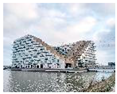 Sluishuis Housing Block, Amsterdam, Netherlands Sluishuis Housing Block, Amsterdam, Netherlands |
Sustainability, low-carbon materials, renewable energy, clean sources of energy, cradle to cradle philosophy, eco-design, interactive façade, green design, eco-conscious, integration with nature, biophilic design, passive design, recycling & upcycling, sustainable materials, net zero energy buildings, vertical forests, biodegradable materials, ecosystem design, solar façade, BREEAM / LEED, environmental solutions, UN Sustainable Development Goals, environmental justice, landscape & society [75,76,77,78,79,80] |
|
Theory of Metamorphosis |
Franz Kafka Aldo van Eyck Pancho Guedes Lebbeus Woods |
Heatherwick Studio Lebbeus Woods Didonè Comacchio Architects Beatrice Girelli Vincent Callebaut |
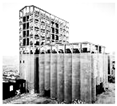 Zeitz Museum of Contemporary Art, Zeitz Museum of Contemporary Art, Cape Town, South Africa |
It emphasises the concepts of transformation, adaptation, flexibility, and change. It is usually used for adaptive reuse projects where abandoned or existing buildings are changed to meet new functional and environmental needs [81] Conjugation of metamorphosis and polymorphism, the changes in form, structure, and habits that refer to the concept of metamorphosis, assume particular relevance between the development of a creative idea and its realisation or transformation [82,83,84] |
| Theory of Resilience and Adaptability | Edward Mazria Nader Khalili Andrés Duany Elizabeth Plater-Zyberk |
Éric Daniel-Lacombe Foster + Partners Peter Zumthor Sverre Fehn Mykonos Architects Napur Architects Tsolakis Atelier Deshaus OPEN Architecture CEBRA UTOPIA Furuya Design MAST Water-Studio Luca Curci Architects Haeahan Architecture & H Architecture Najjar Najjar Architects FFEKT Jacques Rougerie Snøhetta ZJA Chris Precht Mecanoo Alejandro Aravena Leddy Maytum Stacy Architects McLennan Design ZeroEnergy Design HOK Richard Franko |
 Land on Water Floating Compound (Units are under construction) Land on Water Floating Compound (Units are under construction) |
Resilience to climate change and natural hazards, culture of resilience, resilience through adaptability, resilience through repair and reuse, on-site energy generation, bio-climatic design, buildings that respond to the climate crisis, mitigating the effects of climate change [85], self-healing materials, innovative building techniques, disaster-resilient buildings [86], earth architecture, local nature-inspired techniques, subterranean architecture, underground design, land conservation, floating structures, ocean architecture, fire-resistant urban fabrics, passive cooling towers, ocean architecture, carbon sequestration, biodiversity support connecting people to agriculture, vibration structure system, design in extreme conditions, post-war trends, fast sheltering, tiny homes, affordability, modular design, cost-effective & environmentally friendly design [87], green infrastructure, resilient built environment [88], future extension, adaptability, flexibility, post-COVID-19 architectural needs (work & live in the same place, isolation rooms, clean rooms), risk architecture, uncertain environments [89,90,91] |
| Continue … Table 4 | ||||
| Theory of Architecture | Founders of the Theory | Architects followed the Theory | Exemplars |
Characteristics (Valid as sources of keywords) |
|
Digital Architecture Theories Theory of Parametricism [92] Generative and Algorithmic Design, Digital Fabrication Digital Materiality [93] Theory of AI-aided design Theory of Metaverse in Architecture [94] |
Nicholas Negroponte Cedric Price Marvin Minsky Stanislas Chaillou Marcos Novak Behrokh Khoshnevis Enrico Dini Gramazio & Kohler (ETH Zurich) Achim Menges Association for Robots in Architecture (Sigrid Brell-Cokcan and Johannes Braumann) Patrik Schumacher |
Greg Lynn Marcos Novak Lars Spuybroek Zaha Hadid Patrik Schumacher BIG Lechner & Lechner Architects 3XN IARC Architects LESS, Matsys Mamou-Mani SPACE10 Kengo Kuma MVRDV Arup Jürgen Mayer H. AQSO Arquitectos Labs of the University of Stuttgart ICD + ITKE + BioMat Achim Menges Giles Restin Architecture Studio RAP HOK GENSLER |
 V&A Museum of Design, Dundee, Scotland, UK V&A Museum of Design, Dundee, Scotland, UK |
It integrates computational tools such as parametric design, generative modelling, and algorithm-based architectural forms, often drawing inspiration from organic and biomorphic structures [10], cyberspace architecture, hypersurface architecture, hybrid architecture, blobitecture, biomorphic design, computational design [60], immersive technology, virtual reality (VR), augmented reality (AR), digital design & fabrication, parametric design (creating flexible, adaptive, and fluid forms that respond to environmental and programmatic conditions, characterised by continuous variation and complexity in the design process) [95], parametricism & natural materials, architecture of smart buildings, AI-aided design, metaverse architecture (evolving interface between humans, digital systems, and spatial computing) [94], prefabricated & 3D printed buildings, neuro-architecture & human-centric design, post-human era, robotics, cyborgs, co-design, homo technologicus [96] |
Table 5.
Framework of the parameters that should be written in the AI text-to-image prompt.
| Subject | Description | Theory of Architecture | |||
|---|---|---|---|---|---|
| Design Theme | Building Typology | Volume & Shape | Materials & Surface (Texture) | Architectural Style / Trend | The Theory Title |
| Colours | Context & Surrounding Land-Use | Climatic Conditions | Its Founder’s Name | ||
| Topography | Number of Floors | Building Dimensions & Area | Its Follower-Architect (whom the user may seek to design similarly) | ||
| Required spaces (design program) | Features in Elevations | Angle of the shot (Human/Ant/Bird Eye Perspective | Exemplar’s Title (if required) | ||
| Lighting & Time of the Shot | Expected capacity of building users | Sustainable Features & Landscape |
Characteristics of the Theory | ||
Table 6.
Criteria of selection.
| The selected project typology | A Museum of Civilisation | Why?
|
| The selected three AI web-based platforms | Nano Banana, ChatGPT Images, and OpenArt | Why?
|
| The selected five architectural theories for injection | Theory of Minimalism Theory of Brutalism Theory of Deconstruction Theory of De-Carbonising Environment Theory of Parametricism |
Why?
|
Table 7.
Evaluation of the AI image quality parameters (before/after), adding the components of ‘Theory of Architecture’.
Table 7.
Evaluation of the AI image quality parameters (before/after), adding the components of ‘Theory of Architecture’.
| × | This parameter was not achieved or misunderstood | √ | Average achieved as texted | √√ | Achieved explicitly as texted with innovation | ||||||||||
|
AI Text-to-Image Prompt |
The three AI web-based platforms / Evaluation of the Image quality parameters | ||||||||||||||
| Nano Banana | ChatGPT Images | OpenArt | |||||||||||||
| Subject | Description (Basic Parameters) |
Theory of Architecture | Subject | Description (Basic Parameters) |
Theory of Architecture | Subject | Description (Basic Parameters) |
Theory of Architecture | |||||||
| Adding the Theory of Minimalism |
Before | √ | √ | √ | √ | √ | × | √ | √ | √ | |||||
| After | √ | √ | √√ | √ | √√ | √√ | √ | √√ | √√ | ||||||
| Adding the Theory of Brutalism |
Before | √ | √ | √ | × | √ | √ | √ | √ | × | |||||
| After | √ | √√ | √√ | √ | √√ | √√ | √ | √√ | √√ | ||||||
| Adding the Theory of Deconstructivism | Before | √ | √√ | √ | √ | √√ | √ | √ | √ | √ | |||||
| After | √ | √√ | √ | √ | √√ | √√ | √ | √√ | √√ | ||||||
| Adding Theory of Decarbonising Env. | Before | × | √ | √ | √ | √ | √ | × | × | × | |||||
| After | × | √ | √ | √ | √√ | √√ | √√ | √√ | √√ | ||||||
|
Adding the Theory of Parametricism |
Before | × | √ | × | √ | √ | √ | × | √ | × | |||||
| After | × | √√ | √√ | √√ | √√ | √√ | × | √√ | √√ | ||||||
Disclaimer/Publisher’s Note: The statements, opinions and data contained in all publications are solely those of the individual author(s) and contributor(s) and not of MDPI and/or the editor(s). MDPI and/or the editor(s) disclaim responsibility for any injury to people or property resulting from any ideas, methods, instructions or products referred to in the content. |
© 2026 by the authors. Licensee MDPI, Basel, Switzerland. This article is an open access article distributed under the terms and conditions of the Creative Commons Attribution (CC BY) license (http://creativecommons.org/licenses/by/4.0/).
Copyright: This open access article is published under a Creative Commons CC BY 4.0 license, which permit the free download, distribution, and reuse, provided that the author and preprint are cited in any reuse.


