
Submitted:
12 May 2026
Posted:
12 May 2026
You are already at the latest version
Abstract
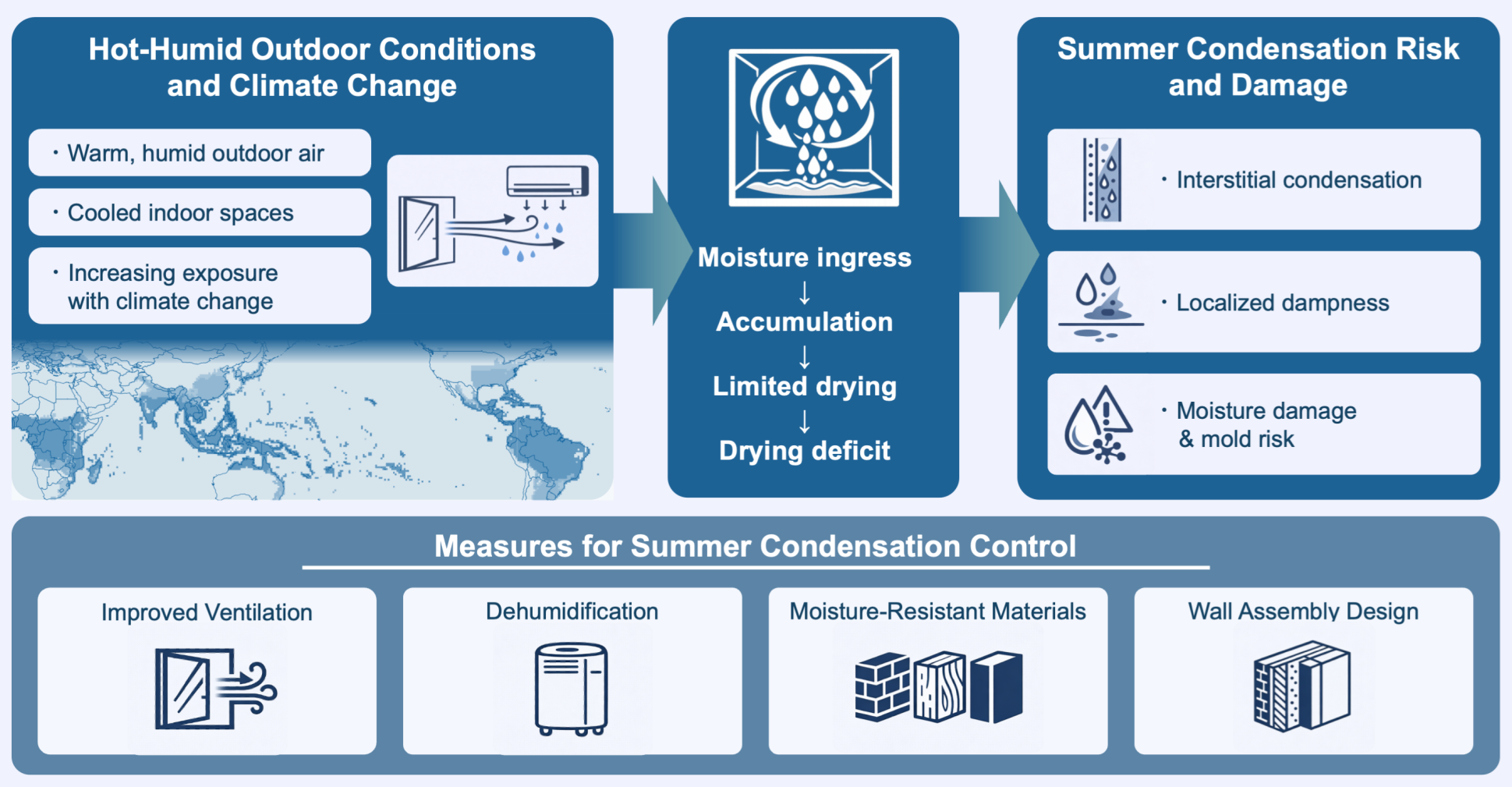
Moisture damage in buildings has conventionally been discussed mainly in relation to winter condensation in cold climates. In hot-humid buildings, however, deterioration develops under different boundary conditions, including persistently warm and humid outdoor air, frequent rainfall, air-conditioning operation, air leakage, and limited drying after wetting. Climate change is increasing atmospheric moisture loading and weakening nighttime recovery. These changes make hot-humid moisture risks more consequential not only in established hot-humid regions, but also in regions shifting toward more persistently humid climates. This review examines moisture damage in hot-humid buildings as a coupled problem linking climate change, building-envelope moisture response, risk assessment, microbial implications, and building adaptation. Representative scenarios include biological contamination on exterior surfaces, summer condensation and moisture accumulation within envelope assemblies, localized dampness at indoor surfaces and behind furniture, moisture stagnation in semi-enclosed spaces, and material deterioration or performance loss. These phenomena are interpreted not as isolated defects, but as manifestations of drying deficit. The review discusses climatic drivers, building-physics mechanisms, and major moisture and mold risk indices, including the Fungal Index (FI), the VTT Mold Index, isopleth-based approaches, Mold Resistance Design (MRD), and the Dose-Response Simple Isopleth for Mold (DR-SIM). It also highlights implications for envelope design, retrofit, ventilation, dehumidification, and operation. Overall, moisture damage in hot-humid buildings is best understood as the outcome of climate-driven drying deficit.
Keywords:
hot-humid buildings
; moisture damage
; drying deficit
; building envelope
; summer condensation
; mold risk assessment
Copyright: This open access article is published under a Creative Commons CC BY 4.0 license, which permit the free download, distribution, and reuse, provided that the author and preprint are cited in any reuse.


