
Submitted:
17 April 2026
Posted:
17 April 2026
You are already at the latest version
Abstract
Moisture damage in buildings has conventionally been discussed mainly in relation to winter condensation in cold climates. In hot-humid buildings, however, deterioration develops under different boundary conditions, including persistently warm and humid outdoor air, frequent rainfall, air-conditioning operation, air leakage, and limited drying after wetting. As climate change increases atmospheric moisture loading and weakens nighttime recovery, these conditions are becoming more consequential not only in established hot-humid regions but also in regions shifting toward more persistently humid climates. This review examines moisture damage in hot-humid buildings as a coupled problem linking climate change, building-envelope moisture response, risk assessment, microbial implications, and building adaptation. Representative scenarios include biological contamination on exterior surfaces, summer condensation and moisture accumulation within envelope assemblies, localized dampness at indoor surfaces and behind furniture, and moisture stagnation in semi-enclosed spaces. These phenomena are interpreted not as isolated defects, but as manifestations of drying deficit. The review discusses climatic drivers, building-physics mechanisms, and major moisture and mold risk indices, including the Fungal Index, VTT Mold Index, IBP-type approaches, MRD, and DR-SIM. It also highlights implications for envelope design, retrofit, ventilation, dehumidification, and operation. Overall, moisture damage in hot-humid buildings is best understood as the outcome of climate-driven drying deficit.
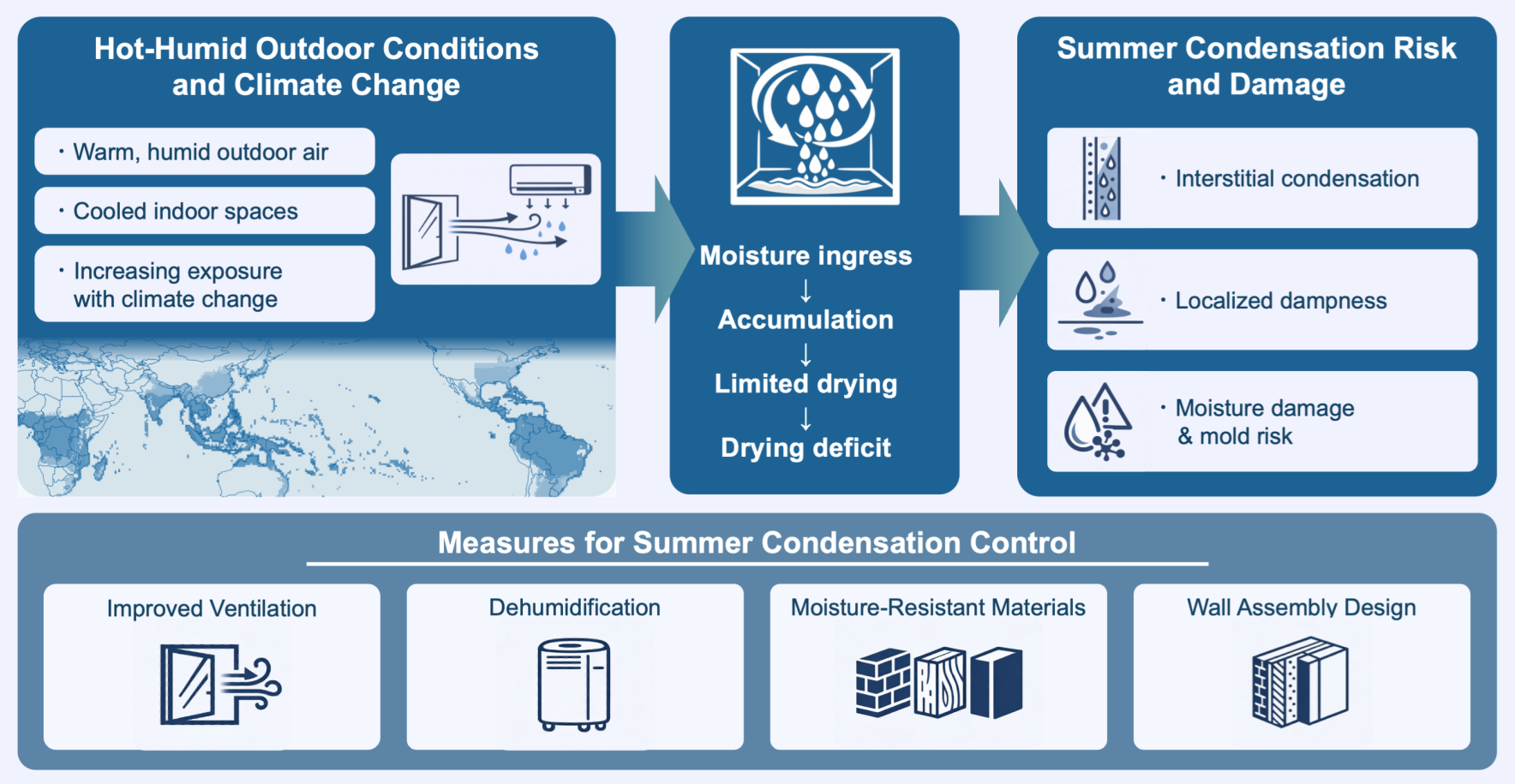
Keywords:
hot-humid buildings
; moisture damage
; drying deficit
; building envelope
; summer condensation
; mold risk assessment
1. Problem Setting and Knowledge Gap
Moisture damage in buildings has traditionally been framed mainly in relation to winter condensation, inadequate insulation, and cold-climate hygrothermal failure. In hot-humid regions, however, moisture damage emerges under a different combination of boundary conditions. Persistently warm and humid outdoor air, frequent rainfall, cooling-based operation, air leakage, and limited post-wetting recovery act together to maintain dampness at building surfaces, within envelope assemblies, and in concealed spaces. As climate change intensifies atmospheric moisture loading and weakens nighttime drying, these conditions are becoming increasingly important not only in long-established hot-humid buildings but also in regions shifting toward more persistently humid climates [1,2,3].
From a building-science perspective, the central issue is not humid climate alone, but how persistent moisture loading interacts with building-envelope design, cooling-dependent operation, and limited drying capacity. In this review, the term hot-humid regions refers primarily to climates corresponding to Köppen-Geiger Cfa and Cwa conditions, while also emphasizing their building-environmental meaning. The essential issue is not temperature alone, but the coexistence of high moisture loading and chronically weak drying potential [1,2,3]. Under such conditions, building parts repeatedly exposed to rainfall, humid outdoor air, leakage-driven moisture transport, or cooling-related temperature depression may remain damp between wetting events. Moisture damage therefore develops not simply because wetting occurs, but because drying after wetting is insufficient.
This issue cannot be explained by climate alone. Traditional architecture in hot-humid regions often incorporated passive climatic responses such as natural ventilation, open plans, solar shading, lightweight construction, and envelope systems compatible with frequent drying [4,5]. By contrast, much of the modern building stock increasingly relies on industrialized materials, low-permeance interior finishes, closed spatial layouts, and air-conditioning-dependent operation, thereby altering the compatibility between buildings and climate [4,5]. At the same time, the spread of air conditioning has been essential for thermal comfort and health protection, but has also changed indoor-outdoor temperature and humidity relationships, surface temperature distributions, window-opening behavior, and airflow patterns within dwellings [6,7,8].
Several research streams are directly relevant to this problem. The first is building-physics research on heat, air, and moisture transfer in envelopes, including vapor diffusion, air leakage, rain wetting, capillary transport, sorption, and drying [9,10]. The second is the development of moisture and mold risk indicators, including FI, the VTT Mold Index, IBP-type approaches, MRD, and DR-SIM, which are widely used for design comparison and post-processing of measured or simulated conditions [11,12,13,14,15,16,17,18,19,20,21]. The third is indoor microbiology research, in which cultivation-based methods have increasingly been complemented by qPCR and sequencing-based approaches that quantify microbial load and community structure on surfaces, in dust, and in indoor air [22,23,24,25]. The major research streams relevant to moisture damage in hot-humid buildings, and their positioning in this review, are summarized in Table S1.
Together, these research streams have shown that moisture damage is not only a water-related problem, but also a coupled problem involving materials, building operation, microbial persistence, and exposure. Nevertheless, these areas have often developed in parallel rather than as a unified framework. Climate-related humidification, envelope moisture transport, microbial accumulation, and operational control are still often discussed separately. As a result, there is still a lack of an integrated review that organizes moisture damage in hot-humid buildings as a coupled chain linking climatic change, drying deficit, envelope response, risk indicators, microbial implications, and building adaptation.
Several knowledge gaps follow from this fragmentation. First, although climate science has documented increasing atmospheric moisture, rising dew-point and wet-bulb temperatures, and more frequent humid extremes, relatively few reviews have examined how these changes translate into reduced drying potential and chronic dampness in buildings [1,2,3]. Second, previous studies have often treated moisture damage either as a climatic problem or as a matter of envelope performance, while paying less attention to the role of modernization, cooling dependence, and changing living practices [4,5,6,7,8]. Third, building-physics research and microbiological research remain insufficiently connected, even though surface microclimate, wetness duration, and moisture persistence are central to both [11,12,13,14,15,22,23]. Fourth, the applicability limits of existing moisture and mold risk indices under persistently humid conditions have not yet been systematically compared [11,12,13,14,15,26,27]. Finally, research findings are still not translated sufficiently into integrated implications for envelope design, retrofit, and operation in hot-humid buildings [9,10,28,29].
Accordingly, the objective of this review is to provide an integrated framework for understanding moisture damage in hot-humid buildings and in regions shifting toward more humid conditions. Rather than treating moisture damage as a simple consequence of warm climates or as a series of isolated defects, this review repositions it as the manifestation of drying deficit under changing climatic conditions and changing building-climate compatibility. The review therefore aims to connect climate drivers, envelope behavior, moisture-risk indicators, microbial processes, exposure relevance, and building adaptation within a single conceptual structure. The overall conceptual framework of this review, linking climatic change, drying deficit, envelope response, risk assessment, microbial implications, and building adaptation, is illustrated in Figure 1.
2. Representative Moisture-Damage Scenarios in Hot-Humid Buildings
Moisture damage in hot-humid buildings does not take a single form. Instead, it develops through different combinations of humid outdoor air, rainfall, cooling, leakage, surface wetting, and limited drying after wetting. Whereas winter condensation in cold climates is typically explained by vapor migration from the indoor side toward colder layers of the assembly, moisture damage in hot-humid buildings often involves moisture intrusion from the exterior side, locally cooled surfaces generated by air conditioning, concealed moisture accumulation, and incomplete recovery between wetting events [9,28,29,30,31].
A defining feature of hot-humid climates is therefore that moisture damage depends not only on whether wetting occurs, but also on whether the affected building part can dry before the next wetting event. Exterior biological contamination, summer condensation within envelope assemblies, local indoor dampness, and moisture stagnation in concealed or semi-enclosed spaces should thus be interpreted not as unrelated phenomena, but as different manifestations of insufficient drying.
2.1. Biological Contamination on Exterior Wall and Roof Surfaces
Exterior wall and roof surfaces in hot-humid buildings are repeatedly exposed to rainfall, humid outdoor air, dew formation, and weak nocturnal drying. Under such conditions, biological contamination by algae, fungi, and bacteria may develop even in the absence of obvious rainwater leakage into the indoor environment. In many cases, prolonged surface wetness alone is sufficient to sustain discoloration, streaking, visible fouling, and gradual deterioration of surface materials or finishes [30,31].
This type of damage is especially significant because it provides one of the clearest outward signs of incompatibility between envelope response and climate. Surface orientation, solar exposure, coating systems, thermal mass, and surface finish affect not only how easily a surface becomes wet, but also how effectively it can dry [30,31]. Exterior biological contamination should therefore be regarded not merely as an aesthetic issue, but as an indicator of chronically weak drying potential at the building-climate interface.
2.2. Summer Condensation and Moisture Accumulation Within Envelope Assemblies
One of the most characteristic moisture problems in hot-humid buildings is moisture accumulation within walls or roofs during the cooling season. Humid outdoor air may enter assemblies through vapor diffusion, air leakage, or rain-related wetting, and then encounter relatively cool layers created by air conditioning. Under such conditions, condensation or prolonged high material moisture content may develop within the assembly, especially when drying is restricted by impermeable interior finishes or poorly ventilated layers [9,28,29].
This scenario is particularly important because it may progress invisibly. Unlike exterior surface discoloration, concealed moisture accumulation may continue without obvious visual signs while thermal performance declines, materials deteriorate, and conditions favorable to fungal growth emerge within the assembly. Summer condensation in hot-humid buildings should therefore be understood not simply as a condensation event, but as a hidden and potentially cumulative risk linked to cooling-based operation under humid exterior boundary conditions [28,29].
2.3. Local Dampness at Indoor Surfaces and Behind Furniture
Even when room-average temperature and relative humidity appear acceptable, local dampness may still develop at floor corners, wall-adjacent zones, inside closets, behind furniture, near windows, and around supply air outlets. These locations may experience prolonged high surface relative humidity or thin-film condensation because of locally reduced air circulation, cooling-related surface temperature depression, thermal discontinuities, or furniture placement that inhibits convective recovery [7,28].
This type of moisture damage is particularly important because it shows that moisture safety cannot be judged from room-average conditions alone. Buildings may appear thermally controlled at the room scale while still allowing localized dampness to persist at the microclimatic scale relevant to microbial growth. Local indoor dampness in hot-humid buildings therefore reflects the combined effects of climate conditions, cooling, thermal response, airflow limitation, and patterns of furnishing and occupancy.
2.4. Moisture Stagnation in Semi-Enclosed Spaces
Semi-enclosed spaces such as attics, crawl spaces, ceiling voids, service shafts, and cavities behind assemblies may also become persistent reservoirs of moisture in hot-humid buildings. In these locations, humid outdoor air, residual construction moisture, rainwater intrusion, leakage-driven transport, and local temperature depression around ducts or pipes may combine to sustain high-humidity conditions that are not represented by average indoor measurements [10,29].
This scenario is important because it can remain unnoticed for long periods while concealed wetting, material degradation, and microbial source formation progress in hidden zones. In buildings with cooled indoor spaces, the problem may be intensified when high-dew-point air reaches locally cooled surfaces within concealed spaces. Semi-enclosed spaces in hot-humid buildings should therefore be regarded not merely as ancillary zones, but as locations where moisture may accumulate, persist, and later contribute to broader building or exposure problems [10,29].
2.5. Common Structure Across Scenarios
Although the four scenarios described above differ in appearance, they share a common physical structure. Moisture damage becomes chronic not simply because wetting occurs, but because drying is insufficient afterward. Rainfall, humid outdoor air, cooling, leakage, and surface wetting may each act as moisture sources, yet these develop into significant moisture damage primarily when dampness is not removed before the next wetting event [28,29,30].
In this sense, moisture damage in hot-humid buildings should not be framed simply as a problem of moisture intrusion. Rather, it should be understood as a family of phenomena that emerge in different parts of buildings under conditions of drying deficit. Exterior biological contamination, concealed summer condensation, local indoor dampness, and moisture stagnation in semi-enclosed spaces may appear distinct, but all are underpinned by the same imbalance between moisture supply and drying capacity. This common perspective provides the basis for the following chapters, which discuss climatic drivers, building-physics mechanisms, and the interpretation of moisture-risk indicators. The representative moisture-damage scenarios discussed above, together with their typical locations, governing mechanisms, major signs, and practical implications, are summarized in Table 1.
3. Climatic Drivers and Building-Relevant Drying Deficit
To understand moisture damage in hot-humid buildings, it is necessary to consider not only building specifications and operation, but also the climatic conditions that govern wetting and post-wetting recovery. Buildings in such regions have long been exposed to warm and humid summer air, frequent rainfall, and short drying periods. In recent decades, however, these background conditions have been further intensified by rising air temperatures, increasing atmospheric moisture content, higher dew-point and wet-bulb temperatures, and weaker nocturnal cooling [1,2,3,26]. From the perspective of building moisture damage, the central issue is therefore not warming alone, but the increasing tendency for moisture loading and limited drying to occur together.
In hot-humid regions, moisture damage develops not simply because buildings become wet, but because the time and driving force available for drying are reduced. If temperature rises while air remains relatively dry, drying potential may still remain substantial. In contrast, when higher temperature is accompanied by higher atmospheric moisture content, wet surfaces and moisture-laden materials are less able to recover after rain, leakage, or adsorption. Climate change therefore acts not only to increase moisture loading on buildings, but also to intensify the drying deficit that underlies chronic dampness.
3.1. Climatic Characteristics That Intensify Drying Deficit
From a climatological perspective, hot-humid conditions are often represented using Köppen-Geiger classes such as Cfa and Cwa [1,32]. For building moisture damage, however, climate labels alone are not sufficient. More relevant variables include outdoor vapor pressure, dew-point temperature, wet-bulb temperature, the duration of high-humidity periods, and the frequency with which wetting events are followed by only limited drying. These climatic characteristics are more directly connected to whether wetted materials and surfaces can return toward safer moisture states. The main climatic indicators relevant to moisture damage and drying deficit in hot-humid buildings are summarized in Table S2.
The IPCC Sixth Assessment Report has documented unequivocal anthropogenic warming and intensification of the hydrological cycle, including changes in humidity-related extremes [4]. Willett et al. further developed long-term datasets of humidity-related variables, including vapor pressure, dew-point temperature, and wet-bulb temperature, which are directly relevant to the moisture boundary conditions acting on buildings [2]. For building performance, the important issue is that high temperature and high humidity increasingly occur together. Under these conditions, the vapor-pressure difference that would otherwise promote drying becomes smaller, and materials that have taken up moisture are less able to release it.
Dew-point temperature is especially important because it indicates how close air is to saturation and therefore how small the evaporation driving force may become at wet building surfaces [2]. Representative-city trends further support this interpretation. As shown in Figure 2, summer mean dew-point temperature remains high under present-day conditions and increases further under future climate projections in representative cities, indicating progressively reduced drying potential [33]. When outdoor dew-point temperature is high, the ability of exterior surfaces, claddings, and moisture-buffering materials to dry is reduced.
Wet-bulb temperature is also relevant, not only as an indicator of human heat stress, but as a building-relevant measure of latent cooling load and the practical difficulty of dehumidification. When outdoor wet-bulb temperature is high, ventilation and outdoor-air introduction are less likely to support drying and may instead increase latent moisture loading [2,3].
3.2. Nighttime Recovery Limitation and Repeated Wetting
Another major climatic feature relevant to moisture damage in hot-humid regions is limited nighttime recovery. Urban climate research has long shown that nocturnal cooling is often weakened in urbanized environments, and that heat-island intensity tends to be particularly pronounced at night [22,23,26,27]. For buildings, this means that moisture acquired during the day through rainfall, surface adsorption, or leakage may not be dissipated sufficiently before the next day begins.
This issue is important because moisture damage is governed not only by individual wetting events, but by whether drying between events is sufficient. If nighttime air temperature remains high and dew-point temperature also stays elevated, surfaces and assemblies that become wet during the day may begin the following day from an already damp condition. Repeated carryover of residual moisture thus becomes more likely. In hot-humid regions, this process helps explain the persistence of exterior biological contamination, concealed moisture accumulation, local indoor dampness, and chronic wetting in semi-enclosed spaces.
From a building-environment perspective, weakened nighttime drying should therefore be regarded not merely as a secondary climatic characteristic, but as one of the key processes through which hot-humid climates promote chronic moisture damage. What matters is not only the occurrence of rainfall or humid episodes, but also the shrinking opportunity for recovery afterward.
3.3. Expansion of Hot-Humid Risk Zones
Under future climate conditions, hot-humid risk is expected to intensify not only within regions that are already hot-humid, but also in surrounding regions that have not historically been designed for such conditions. High-resolution Köppen-Geiger maps indicate that climate-zone boundaries are not fixed and that humid-hot conditions may expand geographically under future scenarios [1,32]. From the perspective of building science, this means that moisture-damage vulnerability may increasingly emerge in buildings whose envelopes, systems, and operation were not originally intended for persistent humid loading and limited drying.
The significance of this expansion is not simply that climate zones shift, but that existing building stocks may become mismatched to their changing climatic context. Buildings designed under assumptions of more effective drying, lower dew-point conditions, or less sustained latent load may become progressively more vulnerable as humid exposure intensifies. This issue also has a social dimension. When gridded climate classifications are overlaid with population datasets, the potential number of people living in moisture-risk zones increases markedly from 2000 to 2020 and further toward 2050 [24,25,26,32,34,35]. The global distribution of hot-humid and humidification-related moisture-risk zones, together with the associated increase in population exposure, is shown in Figure 3.
Accordingly, the study of moisture damage in hot-humid regions should not be limited to present-day subtropical or tropical settings alone. It is equally relevant to regions that are moving toward more persistently humid conditions and in which existing buildings may increasingly experience moisture problems not anticipated in their original design context.
4. Moisture Transport, Accumulation, and Limited Drying in Building Envelopes
To understand how climatic conditions are translated into moisture damage in buildings, it is necessary to examine the physical mechanisms through which moisture enters, moves within, accumulates in, and is released from building envelopes. In hot-humid buildings, humid outdoor air, rainfall, cooling, air leakage, and moisture storage within materials act together to shift the moisture balance toward the wet side [9,10,28,36]. The key issue is therefore not only whether moisture enters the envelope, but whether the moisture that enters can subsequently leave it. Figure 4 summarizes the major transport and storage mechanisms through which moisture enters, accumulates in, and is released from building envelopes.
In cold climates, moisture damage has often been framed in terms of vapor migration from the indoor side toward colder layers during winter. In hot-humid buildings, by contrast, the dominant patterns may be reversed or more complex. Moisture may enter from the exterior side under high outdoor vapor pressure, while cooling lowers temperatures near the interior side and thereby promotes condensation or prolonged high relative humidity within the assembly [28,29,36]. Under such conditions, even modest wetting may become problematic when drying is chronically weak.
4.1. Moisture Entry and Accumulation Under Hot-Humid Boundary Conditions
A useful way to understand envelope moisture behavior in hot-humid buildings is to consider the balance between moisture supply and drying capacity [10]. Moisture supply may come from humid outdoor air, rain penetration, leakage-driven convection, capillary redistribution, or adsorption into porous materials. Drying capacity depends on the outdoor and indoor boundary conditions, material permeability, drainage paths, ventilation pathways, and the temperature and vapor-pressure gradients acting across the assembly.
Moisture damage becomes chronic when moisture supply repeatedly exceeds the capacity of the building part to dry. This balance-based perspective is especially important in hot-humid climates because the external conditions that support drying are often weakened by high outdoor humidity, frequent rain, and warm nights. As a result, moisture accumulation should not be understood simply as the outcome of isolated failures such as leakage or condensation, but as the cumulative result of repeated wetting under limited recovery conditions.
4.2. Major Transport Mechanisms
Moisture behavior in building envelopes can be understood through four major processes: vapor diffusion, airflow-related moisture transport through leakage, liquid transport, and sorption/storage in materials [9,10,36]. These processes do not act independently. In hot-humid environments, they often overlap and interact, especially when drying remains limited for extended periods.
Vapor diffusion occurs in response to vapor-pressure gradients. Under hot-humid summer conditions, outdoor vapor pressure often exceeds indoor vapor pressure, particularly when indoor spaces are cooled. This may drive moisture inward rather than outward, in contrast to the conventional winter pattern emphasized in cold-climate condensation control [28,36]. Under these conditions, vapor-control strategies imported directly from cold climates may become problematic if they restrict inward drying.
Air leakage may transport substantially larger amounts of moisture than diffusion and is often a critical pathway in hot-humid buildings [9]. Even small leakage paths may carry moisture-laden outdoor air into wall cavities, attic zones, crawl spaces, or service spaces. This becomes especially important when cooled indoor spaces are under negative pressure, since humid outdoor air is then readily drawn inward through cracks, penetrations, and interfaces. Localized hidden moisture loading may therefore occur even when overall thermal performance appears adequate.
Liquid transport includes rain wetting, minor rainwater penetration, capillary transport, and retained water at surfaces or interfaces [10,36]. In hot-humid buildings, rainfall events are frequent and may recur before drying is complete. Repeated small-scale rewetting can therefore sustain chronically high moisture content even without dramatic leakage events. For this reason, moisture safety depends not only on preventing water entry, but also on providing drainage and recovery pathways once wetting occurs.
Sorption and moisture storage in porous materials further affect both short-term fluctuations and long-term accumulation [10,36]. Moisture-buffering behavior may moderate indoor humidity over short timescales, but when high humidity persists and drying is limited, the same materials may function as reservoirs that retain moisture over long periods. In hot-humid climates, the role of sorptive materials must therefore be evaluated in relation to their actual drying opportunities and their position within the envelope.
4.3. Drying Limitation as the Governing Principle
The central physical issue in hot-humid moisture damage is not moisture entry alone, but limited drying potential. Drying is governed by vapor-pressure difference, temperature, airflow, radiation, material permeability, drainage, and ventilation pathways [10,28,36]. In many temperate climates, periodic dry conditions allow wetted assemblies to recover at least partially. In hot-humid climates, however, high absolute humidity, high dew-point temperature, frequent rainfall, and weak nighttime cooling often reduce the strength and duration of drying conditions.
This means that moisture problems in hot-humid buildings are best interpreted as failures of recovery rather than only failures of exclusion. A wall, roof, or surface may tolerate a certain amount of wetting if sufficient drying follows. The same wetting load may become problematic if recovery is blocked by climate conditions, impermeable finishes, concealed geometry, or weak airflow. This perspective is important because it shifts the discussion from isolated defect events toward a more general building-physics understanding of chronic dampness.
4.4. Cooling, Ventilation, and Pressure-Related Moisture Loading
Cooling, ventilation, and pressure control play a particularly important role in hot-humid buildings because they shape where moisture risk becomes concentrated. Cooling lowers temperatures near the indoor side and may create locally cool surfaces within envelopes, behind furniture, around ducts, or near supply outlets [10,28]. When moisture from humid outdoor air reaches such surfaces, prolonged high surface RH or condensation may occur.
Ventilation in hot-humid buildings has a dual character. It is necessary for indoor air quality, yet it may also introduce moisture when outdoor air has high absolute humidity [10,28]. The assumption that greater ventilation automatically improves moisture safety does not hold under such conditions. What matters is not ventilation rate alone, but when ventilation occurs, under what outdoor conditions, and whether latent load is controlled through dehumidification.
Pressure differences and leakage pathways further complicate this issue. If indoor spaces are cooled and operate under negative pressure, humid outdoor air may be drawn into wall cavities, attics, crawl spaces, or service zones [9]. Moisture risk therefore depends not only on vapor resistance, but also on airtightness continuity, pressure control, and the interaction between planned ventilation and unintended airflow paths.
Taken together, these mechanisms show that moisture accumulation in hot-humid envelopes rarely results from a single process. Rather, it emerges from the combined action of diffusion, leakage, liquid transport, sorption, and insufficient drying under boundary conditions shaped by humid climate and cooling-dependent building operation.
5. Moisture and Mold Risk Assessment in Hot-Humid Buildings
Because hot-humid buildings are frequently exposed to persistently elevated humidity and limited drying, moisture-damage risk cannot easily be judged from experience alone. Quantitative indices derived from time histories of temperature, relative humidity, and surface conditions have therefore been widely used for design comparison, performance evaluation, and post-processing of measured or simulated conditions [11,12,13,14,15,16,17,18,19,20,21]. These methods provide a useful means of interpreting hazardous environmental conditions, even when direct microbiological measurements are not available.
At the same time, it is important to recognize that most moisture and mold risk indices do not represent microbial quantity itself. Rather, they indicate environmental suitability for growth or moisture-related hazard. This distinction becomes especially important in hot-humid climates, where high humidity may persist for long periods and where many indices tend to remain on the high-risk side, saturate, or lose discriminatory power [11,12,13,14,15,18,19]. The central question is therefore not simply which index is most accurate, but what each index represents and how it should be interpreted under persistently humid conditions.
5.1. Categories of Assessment Methods
Moisture-damage assessment methods may be grouped broadly into threshold-based approaches, empirical growth-index approaches, isopleth- or germination-based approaches, cumulative and recovery-sensitive approaches, and probabilistic approaches [11,12,13,14,15,16,17,18,19,20,21,37]. These groups differ in what their outputs mean and in how useful they are under different climatic conditions.
Threshold-based methods evaluate the duration for which conditions exceed critical limits, such as high RH, condensation occurrence, or time of wetness. Their advantage lies in their clarity, but in hot-humid buildings they often remain in the risky range for long periods and therefore offer limited discrimination once critical conditions have been exceeded.
Empirical growth-index approaches, including FI and the VTT Mold Index, express risk as a continuous index derived from temperature and humidity histories [11,12,16,17,20,21]. These methods are useful because they allow comparative interpretation rather than a simple binary judgment. However, under persistent humid exposure, they may remain chronically high or saturate.
Isopleth-based approaches, such as IBP-type models, define combinations of temperature and relative humidity at which growth becomes possible [15,19]. These are particularly useful for identifying growth-permissive regions on the temperature-humidity plane but are less effective on their own for representing long-term accumulation and recovery under chronic moisture stress.
Cumulative and recovery-sensitive approaches, including MRD and DR-SIM, attempt to incorporate not only humidity exposure but also drying and delays in renewed growth after drying [13,14]. These are conceptually closer to the structure of hot-humid moisture problems, yet they still assume that some meaningful drying occurs. Probabilistic approaches are promising in principle because they address uncertainty explicitly, but their practical application in hot-humid contexts remains limited by data availability [18]. The major moisture and mold risk assessment methods discussed in this review, together with their main outputs, strengths, and interpretive limitations under hot-humid conditions, are compared in Table 2.
5.2. Characteristics and Positioning of Fungal Index and the VTT Mold Index
FI is an empirical index developed in Japanese indoor environmental research to express the favorability of an environment for fungal growth based on temperature and relative humidity history [16,20,21]. A notable strength of FI is its sensitivity to transient humid episodes and condensation-related conditions, which makes it useful in residential contexts where short-term humid spikes are important. However, FI does not explicitly account for material type or fungal species, and in hot-humid climates it may remain persistently high, thereby functioning more as a warning-type indicator than a fine comparative metric.
The VTT Mold Index is a semi-empirical approach derived from the work of Hukka, Viitanen, and colleagues [11,12,17]. It represents mold growth stage on a scale from 0 to 6 while incorporating temperature, relative humidity, and to some extent material sensitivity. Compared with FI, it offers a more structured representation of growth stage and material response. At the same time, because it was developed in the context of building envelopes that generally experience some degree of drying, its discriminatory power may also decrease under persistently humid hot-humid conditions where the index may reach high levels relatively early.
Both FI and the VTT Mold Index therefore remain useful in hot-humid buildings, but their outputs should be read carefully. High values do not necessarily provide a nuanced ranking of alternatives once chronic humidity dominates. Instead, they often indicate that the environment has shifted into a regime where drying is already insufficient and where environmental hazard is persistent. Figure 5 presents an example time series showing how field-measured surface temperature and surface relative humidity can be interpreted using representative moisture and mold risk indices.
5.3. Significance of IBP, MRD, DR-SIM, and Probabilistic Approaches
IBP-type models are valuable because they clarify the boundary at which fungal germination or growth becomes possible [15,19]. Their conceptual clarity makes them useful for identifying whether instantaneous conditions have entered growth-permissive regions. However, they are less suited on their own to describing cumulative burden or the practical consequences of repeated wetting under weak recovery.
MRD and DR-SIM are more directly relevant to hot-humid conditions because they attempt to integrate cumulative exposure and some form of recovery process [13,14]. In this sense, they move closer to the actual problem structure of drying deficit. Nevertheless, even these approaches generally assume that drying interrupts or modifies risk development to a meaningful degree. When drying is consistently weak, their outputs may still remain persistently elevated and may become less able to distinguish among similarly humid conditions.
Probabilistic approaches offer theoretical advantages because they can incorporate uncertainty and variability in material resistance and environmental loading [18]. However, they require extensive supporting data, and hot-humid-specific datasets suitable for robust probabilistic modeling remain limited. Their significance currently lies more in conceptual promise than in routine practical application.
5.4. Shared Applicability Limits Under Hot-Humid Conditions
Although FI, VTT, IBP, MRD, and DR-SIM differ in formulation and output type, they share a common interpretive challenge in hot-humid environments. Because humid exposure is sustained and drying is weak, many models tend to remain on the wet or high-risk side [11,12,13,14,15,17,18,19]. This is useful for signaling that hazardous conditions exist, but it may reduce resolution when the purpose is to compare subtle design alternatives or operational differences.
Importantly, these high outputs should not simply be dismissed as model failure. In many cases, they reflect the fact that the climatic and operational assumptions underlying the models—especially the implicit assumption that some recovery will occur—are themselves weakened in hot-humid buildings. Under these circumstances, model outputs should be interpreted not only as predictions of growth, but also as indicators of the severity of drying deficit.
5.5. How Moisture/Mold Risk Indices Should Be Interpreted
At least three points are important when interpreting moisture and mold risk indices in hot-humid buildings. First, it is necessary to distinguish whether a model output mainly represents threshold exceedance, growth stage, cumulative hazard, or probability of occurrence. Second, persistent high values or saturation should be understood as reduced discriminatory power under chronic humidity, rather than only as methodological defects. Third, these indices should not be treated as final evidence on their own, but should be interpreted together with microbial measurements, material response, and exposure relevance.
In this sense, moisture and mold risk indices remain valuable in hot-humid assessment, but primarily as comparative and interpretive tools. Their greatest usefulness lies not in providing a single definitive answer, but in helping to characterize how hazardous environmental conditions are formed, sustained, and limited by drying deficit.
6. From Hygrothermal Hazard to Microbial Load and Exposure
Moisture and mold risk indices describe conditions that are favorable for microbial growth, but they do not directly represent the amount of microbial material actually present on surfaces or the degree to which occupants are exposed. The pathway linking hygrothermal conditions, microbial accumulation, and exposure is conceptually illustrated in Figure 6. This distinction is fundamental in hot-humid buildings, where environmental hazard may remain high for long periods, while actual microbial accumulation and exposure are shaped additionally by deposition, retention, resuspension, cleaning, material properties, and airflow patterns [22,23,24,25].
Accordingly, moisture damage in hot-humid buildings should be understood through multiple connected but non-equivalent layers: hygrothermal indicators describe environmental suitability; surface microbial load describes accumulation and persistence; community structure describes ecological response to environmental history; and airborne concentration and transport relate more directly to exposure. These layers are linked, but they are not interchangeable.
6.1. Sources and Persistence of Indoor Microorganisms
Indoor microorganisms do not arise from a single source. They are influenced by outdoor air, ventilation pathways, occupants, pets, clothing, settled dust, and growth or persistence on interior surfaces [22,23,24]. In hot-humid buildings, these influences are further modified by the coexistence of humid outdoor boundary conditions, cooling, localized dampness, and limited recovery after wetting.
Microorganisms detected on indoor surfaces do not necessarily indicate only in situ growth. They may also include deposited spores, cell fragments, and DNA residues remaining from past wet periods [22,25]. Surface microbial load should therefore be interpreted as an accumulated record shaped by deposition, persistence, and removal, rather than as a direct snapshot of current environmental conditions alone.
6.2. Why Hygrothermal Indicators and Microbial Measurements Do Not Coincide
Hygrothermal indicators and microbial measurements do not necessarily coincide because they represent different aspects of the moisture-damage process. Hygrothermal indices describe whether the environment is favorable for initiation or persistence, whereas microbial measurements reflect what remains on a surface after deposition, growth, death, decomposition, cleaning, and resuspension have all taken place.
At least five factors are particularly important. First, airborne deposition may increase surface DNA or particle count even when growth does not occur locally. Second, time-history effects matter because DNA and residues may remain after favorable conditions have passed. Third, material properties influence settlement, moisture retention, and persistence. Fourth, local microclimate often differs from room-average conditions. Fifth, operation and maintenance—including cooling pattern, airflow, ventilation, window opening, and cleaning frequency—strongly affect what remains on surfaces and what becomes airborne again [22,23,24,25].
For these reasons, there may be cases in which hygrothermal indices are high but microbial quantity does not increase proportionally, as well as cases in which microbial load remains elevated after environmental indices have declined. This mismatch should not be interpreted simply as model failure. Rather, it reflects the layered structure of the problem. A comparison between physical indicators and microbial measurements in hot-humid buildings is provided in Table S3.
6.3. Community Structure as an Ecological Response Layer
In hot-humid environments, moisture-related microbial problems may appear not only as increased quantity, but also as shifts in community structure. Persistent humid conditions may favor taxa that are less competitive in drier environments, while differences in building openness, ventilation pathway, cooling dependence, and surface conditions may influence which communities are repeatedly introduced, retained, or selected.
Community-structure analysis is therefore useful not merely for identifying which microorganisms are present, but for interpreting the environmental history and operational conditions that have shaped the observed assemblage. At the same time, caution is necessary when linking such differences directly to health outcomes, since causal relationships between specific hot-humid community shifts and health effects remain limited. In this review, community structure is therefore positioned primarily as an intermediate ecological response layer rather than as a direct exposure metric.
6.4. Moisture Damage from the Perspective of Exposure
Moisture damage matters not only because it affects materials and microbial persistence, but also because occupants may be exposed to spores, fragments, cells, and metabolites derived from damp or contaminated surfaces [12,22,23,24,25]. This exposure relevance is consistent with health-oriented reviews showing that damp indoor environments are associated with increased risk of respiratory symptoms and related adverse outcomes, even when the responsible microbial pathways are not reducible to a single measured indicator [38,39]. Even here, however, the amount present on a surface is not the same as the amount inhaled. Exposure depends on resuspension, airflow, human movement, filtration, and the connection between microbial sources and occupied zones.
This point is particularly important in hot-humid buildings, where cooling-dependent operation may alter airflow fields, create stagnant zones, and change the transport pathways between hidden sources and occupied spaces. Some concealed damp zones may remain poorly connected to breathing zones, while other surfaces—such as floors, filters, or locations near supply airflow—may contribute more directly to airborne exposure. Moisture-damage assessment in hot-humid buildings therefore requires not only building physics and microbiology, but also an exposure-oriented perspective on how material from damp sources moves toward occupants.
6.5. A Hierarchical Interpretation Framework
Based on the above, moisture damage in hot-humid buildings can be interpreted hierarchically across at least four levels:
(1) hygrothermal hazard, represented by moisture or mold risk indicators;
(2) surface microbial load, represented by DNA or cultivable counts;
(3) community structure, representing ecological response to environmental history; and
(4) airborne concentration and transport, representing exposure potential.
These layers are complementary rather than competing. The goal is not to reduce them to a single metric, but to interpret how drying deficit, localized dampness, microbial persistence, and exposure are linked across space and time. This layered framework is especially important in hot-humid buildings, where sustained environmental suitability does not necessarily translate linearly into microbial load or exposure, but nevertheless creates the conditions under which both may become important.
7. Implications for Envelope Design, Retrofit, and Building Operation
The preceding discussion makes clear that moisture control in hot-humid buildings cannot be reduced to isolated condensation checks or to single-component improvements. Moisture loading, hidden accumulation, local dampness, and microbial persistence emerge through the interaction of climate, envelope configuration, cooling, ventilation, pressure differences, and operation [28,29,40]. Effective moisture control therefore requires integrated building adaptation rather than fragmented countermeasures.
In hot-humid buildings, the key objective is not simply to prevent moisture entry, but to secure drying after wetting while avoiding moisture trapping. This perspective has implications for envelope design, material selection, ventilation strategy, cooling and dehumidification operation, and retrofit practice.
7.1. Envelope Design
Envelope design should address rain control, drainage, airtightness, vapor permeability, and drying pathways as an integrated system [28,29,40]. In addition to minimizing water entry through interfaces, penetrations, and openings, assemblies should be designed so that any moisture that does enter can drain and dry. This is especially important in hot-humid climates, where repeated small-scale wetting may accumulate if recovery is weak.
Cold-climate vapor-control logic should not be transferred directly without modification. Strong interior vapor retarders or low-permeance interior finishes may help suppress winter moisture migration in cold climates, but in hot-humid buildings they may restrict inward drying and increase the likelihood of moisture trapping [28,29]. Envelope design should therefore be based on realistic moisture-entry pathways and available drying directions rather than one-way assumptions about vapor control.
7.2. Material Selection
Material selection in hot-humid buildings should consider not only thermal or sorptive properties, but also long-term moisture retention, drying behavior, and susceptibility to biological contamination. Materials with high moisture-buffering capacity may moderate short-term fluctuations, yet under persistently humid conditions they may also retain moisture and sustain favorable conditions for microbial persistence.
This means that material performance should be evaluated in context. The same material may behave differently depending on its position within the assembly, the direction in which it can dry, the local airflow field, and whether it is located near surfaces prone to prolonged wetting. Material choice in hot-humid buildings is therefore a question of climate compatibility rather than intrinsic hygric capacity alone.
7.3. Ventilation Strategy
Ventilation in hot-humid buildings must be understood simultaneously as an air-quality strategy and as a pathway for moisture entry [10,28]. This caution is particularly important in hot-humid climates, where outdoor-air introduction and unbalanced airflow may increase latent moisture loading rather than improve moisture safety, especially in buildings already affected by duct leakage or pressure-driven infiltration [41]. It is therefore not sufficient simply to provide the required ventilation rate. It is also necessary to consider the humidity conditions of the outdoor air, the pathways through which moisture enters, and the degree to which ventilation is coupled with latent-load control.
Planned ventilation and uncontrolled leakage should be distinguished clearly. Planned ventilation can be designed and managed, whereas leakage may deliver humid air directly to vulnerable hidden locations. Pressure control is also important, because cooled indoor spaces operating under excessive negative pressure may draw moisture-laden outdoor air into wall cavities, attics, or service spaces. Ventilation design in hot-humid buildings should therefore be integrated with airtightness, pressure control, and dehumidification rather than considered independently.
7.4. Cooling and Dehumidification Operation
Cooling in hot-humid climates should be understood not only as sensible heat removal, but as moisture control. Even when indoor temperature is acceptable, local dampness and condensation risk may remain high if relative humidity, dew point, or local surface cooling are not well managed [12,28]. Cooling strategy should therefore address both latent load and the distribution of surface temperatures.
Particularly important is the avoidance of localized low-temperature surfaces in poorly ventilated areas such as behind furniture, in closets, near floor edges, or around ducts and supply outlets. In practical terms, this means that cooling and dehumidification should be coordinated, airflow should be sufficiently distributed, and control targets should include humidity-related variables rather than temperature alone.
7.5. Retrofit Implications
Retrofit practice may intensify moisture risk if thermal upgrading changes the moisture balance of the building without adequate attention to drying pathways [28,29,40]. Added insulation, improved windows, tighter envelopes, or altered system operation may unintentionally create new locations of lowered surface temperature, changed vapor-resistance distribution, or concealed moisture stagnation.
Retrofit planning in hot-humid buildings should therefore evaluate rain exposure, drainage, leakage routes, concealed spaces, cooling operation, and realistic drying directions together. Higher thermal performance is not inherently problematic; the problem arises when improved thermal control is achieved without corresponding attention to moisture removal and recovery.
7.6. Key Adaptation Principles
Taken together, the discussion above suggests several key principles for hot-humid building adaptation. Moisture-entry pathways should be minimized, but avoidance of moisture trapping is equally important. Drying after wetting should be explicitly secured through drainage, permeability, airflow, or operational control. Ventilation should not be assumed to improve moisture safety automatically under high-dew-point conditions. Latent-load control must be treated as central rather than secondary. Concealed spaces and local low-airflow zones should be regarded as critical risk locations. For practical application, the key issues relevant to envelope design, retrofit, and building operation in hot-humid buildings are summarized in Table 3.
These principles suggest a broader adaptation shift: from temperate-climate moisture design centered on preventing winter condensation, toward hot-humid design centered on avoiding chronic accumulation, securing drying potential, and integrating envelope measures with operational moisture control. In this sense, moisture control guidance for hot-humid buildings should be framed not only around rain exclusion and thermal efficiency, but also around pressure control, moisture release, and the avoidance of chronic moisture trapping during operation [41]. Figure 7 summarizes the broader shift in moisture-control logic required for design and retrofit in hot-humid buildings.
8. Limitations and Future Research Needs
Despite the growing body of relevant work, important limitations remain in current research and assessment frameworks for moisture damage in hot-humid buildings. Climate research, envelope modeling, moisture-risk indicators, microbiological measurements, and practical building design have largely progressed in parallel rather than as an integrated field [1,2,3,12,13,14,15,22,23,25,26]. Yet the essence of moisture damage in hot-humid buildings lies precisely in the coupling among these domains.
8.1. Climate Inputs
Many current assessments still rely on representative weather years or simplified indoor conditions. In hot-humid buildings, however, moisture risk depends not only on air temperature and mean RH, but also on dew-point temperature, high-humidity duration, nighttime recovery, and drying time after rainfall [1,2,3,26]. Future work should therefore focus on translating climate datasets into building-relevant drying-deficit variables rather than relying on conventional general-purpose weather descriptors alone. This need is closely related to the growing discussion on hygrothermal reference years and other moisture-oriented climate inputs for simulation, since conventional weather files do not necessarily represent moisture-severe conditions appropriately. Future work should therefore also address how representative, extreme, or moisture-critical climate years should be selected for hot-humid moisture assessment [42,43].
8.2. Envelope Models and Spatial Locality
Representative-section hygrothermal analysis is useful, but real moisture damage often appears at localized interfaces, behind furniture, in concealed spaces, near penetrations, or around ducts and thermal discontinuities. Future models therefore need not only improved physics, but also better ways of identifying where general transport processes become localized risk in real buildings [5,6,9,10].
8.3. Interpretation of Risk Indices
Although FI, VTT, IBP, MRD, and DR-SIM remain useful, their outputs represent different concepts and may become less discriminating under chronic humidity [12,13,14,15,19,44]. Future work should therefore focus not simply on proposing new indices, but on clarifying how existing indices should be interpreted under different climatic and operational regimes, especially in buildings characterized by persistently weak drying.
8.4. Linkage with Microbial Measurements
Integrated field studies that measure physical conditions, microbial accumulation, and exposure-related metrics together remain limited [22,23,25]. Future research should better synchronize surface temperature, surface RH, wetness duration, DNA, culture-based counts, community structure, and airborne measurements on common spatial and temporal scales. Such studies are essential for testing how well environmental hazard metrics connect to microbial persistence and exposure relevance.
8.5. Surface Microclimate and Wetness Duration
Many moisture-damage processes in hot-humid buildings are governed by local surface conditions rather than room-average air conditions. Yet continuous long-term monitoring of surface RH, surface wetness, and concealed-space moisture conditions is still relatively uncommon. Future work should develop practical methods for diagnosing the locations where moisture damage actually develops, including behind furniture, within closets, in service zones, and in semi-enclosed spaces [12,13,22].
8.6. Integration of Design, Systems, and Operation
Finally, many current approaches still assume standardized operation, whereas real moisture risk depends strongly on window opening, cooling pattern, ventilation timing, furniture placement, maintenance, and dehumidification practice. Future assessment frameworks should therefore move from static specification-based evaluation toward integrated performance-based evaluation that includes design, systems, and operation together.
Taken together, these needs indicate that the next stage of research should not be defined merely by adding detail within separate subfields. Rather, it should focus on building integrated frameworks that connect climatic change, drying deficit, envelope behavior, hazard indicators, microbial response, exposure pathways, and building adaptation.
9. Conclusions
This review has examined representative moisture-damage scenarios, climatic drivers, building-envelope mechanisms, risk indices, microbial implications, and design and operation issues in hot-humid buildings and in regions shifting toward more persistently humid conditions.
The first major conclusion is that moisture damage in hot-humid buildings should be understood not simply as an isolated defect or a discrete condensation event, but as the manifestation of drying deficit. Exterior biological contamination, summer condensation within envelope assemblies, local indoor dampness, and moisture stagnation in concealed spaces may differ in appearance, but all arise from the same underlying imbalance between moisture loading and insufficient recovery after wetting [1,2,3,28,30,31,32,33,45].
The second major conclusion is that this problem cannot be explained by climate alone. Moisture damage in contemporary hot-humid buildings is shaped jointly by changing climatic conditions and by weakened compatibility between buildings and climate resulting from modernization, cooling dependence, altered envelope composition, and changing living practices [3,5,6,7,8].
The third major conclusion is that existing moisture and mold risk indices remain useful, but their interpretation requires caution under hot-humid conditions. FI, the VTT Mold Index, IBP-type approaches, MRD, and DR-SIM all provide valuable information on hazardous environmental conditions, yet many become less discriminating when humidity is chronically high and drying is persistently weak [11,12,13,14,15,16,17,18,19].
The fourth major conclusion is that hygrothermal hazard, microbial load, community structure, and exposure represent different but connected layers of the moisture-damage process. Hygrothermal indices describe environmental suitability, microbial measurements describe accumulation and persistence, and airborne transport is more directly linked to exposure [22,23,24,25]. These layers should therefore be interpreted together rather than reduced to a single metric.
The fifth major conclusion is that effective adaptation in hot-humid buildings requires integrated strategies that combine envelope design, drainage, airtightness, ventilation, pressure control, cooling, dehumidification, and operation. Moisture control in such climates should be redefined not simply as moisture exclusion, but as the management of moisture entry, drying, and recovery under persistently humid boundary conditions [30,31,40].
The practical significance of this review lies in supporting envelope design, retrofit decision-making, and moisture-aware building operation in hot-humid climates. Overall, moisture damage in hot-humid buildings should be understood as a coupled problem linking climate-driven humidification, envelope moisture accumulation, interpretive limits of existing risk indicators, microbial implications, and building adaptation. Future work should therefore move toward integrated frameworks that connect climate inputs, building physics, microbial processes, exposure relevance, and operational control within a common understanding of drying deficit.
Supplementary Materials
The following supporting information can be downloaded at the website of this paper posted on Preprints.org. Table S1: Research streams relevant to moisture damage in hot-humid buildings and the positioning of this review; Table S2: Major climatic indicators relevant to moisture damage in hot-humid buildings; Table S3: Comparison between physical indicators and microbial measurements in hot-humid buildings.
Author Contributions
Conceptualization, M.N.; literature review, M.N.; analysis, M.N.; writing—original draft preparation, M.N.; writing—review and editing, M.N.; visualization, M.N.; project administration, M.N.; funding acquisition, M.N. The author has read and agreed to the published version of the manuscript.
Data Availability Statement
The data presented in this study are available from the author upon reasonable request.
Acknowledgments
This research was supported by JSPS KAKENHI Grant Number 24K07797 and by a research grant from The Kajima Foundation.
Conflicts of Interest
The author declares no conflicts of interest.
References
- Beck, H.E.; Zimmermann, N.E.; McVicar, T.R.; Vergopolan, N.; Berg, A.; Wood, E.F. Present and Future Köppen-Geiger Climate Classification Maps at 1-Km Resolution. Sci. Data 2018, 5, 180214. [Google Scholar] [CrossRef]
- Willett, K.M.; Dunn, R.J.H.; Thorne, P.W.; Bell, S.; de Podesta, M.; Parker, D.E.; Jones, P.D.; Williams, C.N., Jr. HadISDH Land Surface Multi-Variable Humidity and Temperature Record for Climate Monitoring. Clim. Past 2014, 10, 1983–2006. [Google Scholar] [CrossRef]
- Intergovernmental Panel on Climate Change (IPCC) Climate Change 2021 – the Physical Science Basis: Working Group I Contribution to the Sixth Assessment Report of the Intergovernmental Panel on Climate Change; Cambridge University Press: Cambridge, England, 2023; ISBN 9781009157896.
- Pan, Y.; Zhong, W.; Zheng, X.; Xu, H.; Zhang, T. Natural Ventilation in Vernacular Architecture: A Systematic Review of Bioclimatic Ventilation Design and Its Performance Evaluation. Build. Environ. 2024, 253, 111317. [Google Scholar] [CrossRef]
- Toe, D.H.C.; Kubota, T. Comparative Assessment of Vernacular Passive Cooling Techniques for Improving Indoor Thermal Comfort of Modern Terraced Houses in Hot–Humid Climate of Malaysia. Sol. Energy 2015, 114, 229–258. [Google Scholar] [CrossRef]
- Pavanello, F.; De Cian, E.; Davide, M.; Mistry, M.; Cruz, T.; Bezerra, P.; Jagu, D.; Renner, S.; Schaeffer, R.; Lucena, A.F.P. Air-Conditioning and the Adaptation Cooling Deficit in Emerging Economies. Nat. Commun. 2021, 12, 6460. [Google Scholar] [CrossRef]
- Mori, H.; Kubota, T.; Antaryama, I.G.N.; Ekasiwi, S.N.N. Analysis of Window-Opening Patterns and Air Conditioning Usage of Urban Residences in Tropical Southeast Asia. Sustainability 2020, 12, 10650. [Google Scholar] [CrossRef]
- Ekasiwi, S.N.N.; Majid, N.H.A.; Hokoi, S.; Oka, D.; Takagi, N.; Uno, T. Field Survey of Air Conditioner Temperature Settings in Hot, Humid Climates, Part 1: Questionnaire Results on Use of Air Conditioners in Houses during Sleep. J. Asian Archit. Build. Eng. 2013, 12, 141–148. [Google Scholar] [CrossRef]
- Janssens, A.; Hens, H. Interstitial Condensation Due to Air Leakage: A Sensitivity Analysis. J. Therm. Envelope Build. Sci. 2003, 27, 15–29. [Google Scholar] [CrossRef]
- Lstiburek, J. Moisture Control for Buildings. ASHRAE journal 2002, 44, 36–41. [Google Scholar]
- Hukka, A.; Viitanen, H.A. A Mathematical Model of Mould Growth on Wooden Material. Wood Sci. Technol. 1999, 33, 475–485. [Google Scholar] [CrossRef]
- Viitanen, H.; Vinha, J.; Salminen, K.; Ojanen, T.; Peuhkuri, R.; Paajanen, L.; Lähdesmäki, K. Moisture and Bio-Deterioration Risk of Building Materials and Structures. J. Build. Phys. 2010, 33, 201–224. [Google Scholar] [CrossRef]
- Thelandersson, S.; Isaksson, T. Mould Resistance Design (MRD) Model for Evaluation of Risk for Microbial Growth under Varying Climate Conditions. Build. Environ. 2013, 65, 18–25. [Google Scholar] [CrossRef]
- Boardman, C.R.; Glass, S.V.; Lepage, R. Dose-Response Simple Isopleth for Mold (DR SIM): A Dynamic Mold Growth Model for Moisture Risk Assessment. J. Build. Eng. 2023, 68, 106092. [Google Scholar] [CrossRef]
- Sedlbauer, K. Prediction of Mould Fungus Formation on the Surface of and inside Building Components. Fraunhofer Institute for Building Physics 2001.
- Abe, K. Fungal Index Evaluation of Indoor Environments. J.Antibact.Antifung.Agents 2001, 29, 557–566. [Google Scholar]
- Viitanen, H.; Ojanen, T. Improved Model to Predict Mould Growth in Building Materials. 2007. [Google Scholar]
- Pietrzyk, K. A Systemic Approach to Moisture Problems in Buildings for Mould Safety Modelling. Build. Environ. 2015, 86, 50–60. [Google Scholar] [CrossRef]
- Vereecken, E.; Roels, S. Review of Mould Prediction Models and Their Influence on Mould Risk Evaluation. Build. Environ. 2012, 51, 296–310. [Google Scholar] [CrossRef]
- Abe, K. A Method for Numerical Characterization of Indoor Climates by A Biosensor Using A Xerophilic Fungus. Indoor Air 1993, 3, 344–348. [Google Scholar] [CrossRef]
- Abe, K. Comparison of a Measured Fungal Index Determined Using Fungal Growth and a Computed Fungal Index Based on Temperature and Relative Humidity. Indoor Environment: Journal of Society of Indoor Environment, Japan 2006, 9, E23–E30. [Google Scholar] [CrossRef]
- Adams, R.I.; Bateman, A.C.; Bik, H.M.; Meadow, J.F. Microbiota of the Indoor Environment: A Meta-Analysis. Microbiome 2015, 3, 49. [Google Scholar] [CrossRef]
- Meadow, J.F.; Altrichter, A.E.; Kembel, S.W.; Kline, J.; Mhuireach, G.; Moriyama, M.; Northcutt, D.; O’Connor, T.K.; Womack, A.M.; Brown, G.Z.; et al. Indoor Airborne Bacterial Communities Are Influenced by Ventilation, Occupancy, and Outdoor Air Source. Indoor Air 2014, 24, 41–48. [Google Scholar] [CrossRef] [PubMed]
- Prussin, A.J.; Marr, L.C. Sources of Airborne Microorganisms in the Built Environment. Microbiome 2015, 3, 1–10. [Google Scholar] [CrossRef]
- Pitkäranta, M.; Meklin, T.; Hyvärinen, A.; Paulin, L.; Auvinen, P.; Nevalainen, A.; Rintala, H. Analysis of Fungal Flora in Indoor Dust by Ribosomal DNA Sequence Analysis, Quantitative PCR, and Culture. Appl. Environ. Microbiol. 2008, 74, 233–244. [Google Scholar] [CrossRef]
- Hersbach, H.; Bell, B.; Berrisford, P.; Hirahara, S.; Horányi, A.; Muñoz-Sabater, J.; Nicolas, J.; Peubey, C.; Radu, R.; Schepers, D.; et al. The ERA5 Global Reanalysis. Q. J. R. Meteorol. Soc. 2020, 146, 1999–2049. [Google Scholar] [CrossRef]
- Oke, T.R. Boundary Layer Climates, 2nd ed.; Routledge: London, England, 2002; ISBN 9780203407219. [Google Scholar]
- Lstiburek, J.W. Humidity Control in the Humid South. Workshop Proceedings: Bugs, Mold \& Rot II, Building Environment and Thermal Envelope Council, 1993. [Google Scholar]
- Lstiburek, J. Moisture Control for Residential Buildings; Building Science Corporation, 2020. [Google Scholar]
- Johansson, S.; Wadsö, L.; Sandin, K. Estimation of Mould Growth Levels on Rendered Façades Based on Surface Relative Humidity and Surface Temperature Measurements. Build. Environ. 2010, 45, 1153–1160. [Google Scholar] [CrossRef]
- Asmone, A.S.; Chew, M.Y.L. A Study on the Effectiveness of Biological Growth Resistant Coatings on External Building Façade Systems in the Tropics. J. Build. Eng. 2020, 31, 101377. [Google Scholar] [CrossRef]
- Beck, H.E.; McVicar, T.R.; Vergopolan, N.; Berg, A.; Lutsko, N.J.; Dufour, A.; Zeng, Z.; Jiang, X.; van Dijk, A.I.J.M.; Miralles, D.G. High-Resolution (1 Km) Köppen-Geiger Maps for 1901–2099 Based on Constrained CMIP6 Projections. Sci. Data 2023, 10, 724. [Google Scholar] [CrossRef]
- Voldoire, A.; Saint-Martin, D.; Sénési, S.; Decharme, B.; Alias, A.; Chevallier, M.; Colin, J.; Guérémy, J.-F.; Michou, M.; Moine, M.-P.; et al. Evaluation of CMIP6 DECK Experiments with CNRM-CM6-1. J. Adv. Model. Earth Syst. 2019, 11, 2177–2213. [Google Scholar] [CrossRef]
- Center For International Earth Science Information Network-CIESIN-Columbia University Gridded Population of the World, Version 4 (GPWv4): Population Count, Revision 11 2018.
- Jones, B.; ONeill, B.C.; Gao, J. Global 1-Km Downscaled Population Base Year and Projection Grids for the Shared Socioeconomic Pathways (SSPs), Revision 01 2020.
- Künzel, H.M. Simultaneous Heat and Moisture Transport in Building Components; Fraunhofer IRB Verlag: Stuttgart, Germany, 1995; ISBN 9783816741039. [Google Scholar]
- Abe, K. Fungal Index in Dwelling Environments. Journal of the Society of Indoor Environment, Japan 1993.
- Heseltine, E.; Rosen, J. WHO Guidelines for Indoor Air Quality: Dampness and Mould; WHO Regional Office Europe, 2009; ISBN 9789289041683. [Google Scholar]
- Cox-Ganser, J.M. Indoor Dampness and Mould Health Effects - Ongoing Questions on Microbial Exposures and Allergic versus Nonallergic Mechanisms. Clin. Exp. Allergy 2015, 45, 1478–1482. [Google Scholar] [CrossRef]
- Burnett, E.F.P.; Straube, J.F. Building Science for Building Enclosures; John Frederick Straube, 2025; ISBN 9781069338105. [Google Scholar]
- Lstiburek, J. Understanding Ventilation in Hot Humid Climates. Building Science Digest 2006.
- ASHRAE ANSI/ASHRAE Standard 160-2021: Criteria for Moisture-Control Design Analysis in Buildings; ASHRAE, 2021.
- Kim, S.; Zirkelbach, D.; Künzel, H.M. Review of Methods to Create Meteorological Data Suitable for Moisture Control Design by Hygrothermal Building Envelope Simulation. Energies 2023, 16, 3271. [Google Scholar] [CrossRef]
- Anderson, J.; Argall, R.; Creason, H.; Duncan, S.; Dyrelund, A.; Durham, W.; Good, J.; Gudmundsson, O.; Hock, V.; Kugeler, H.; et al. Guide for Resilient Energy Systems Design in Hot and Humid Climates; Zhivov, A., Ed.; Ashrae, 2025; ISBN 9781955516433. [Google Scholar]
Figure 1.
Conceptual framework of moisture damage in hot-humid buildings.
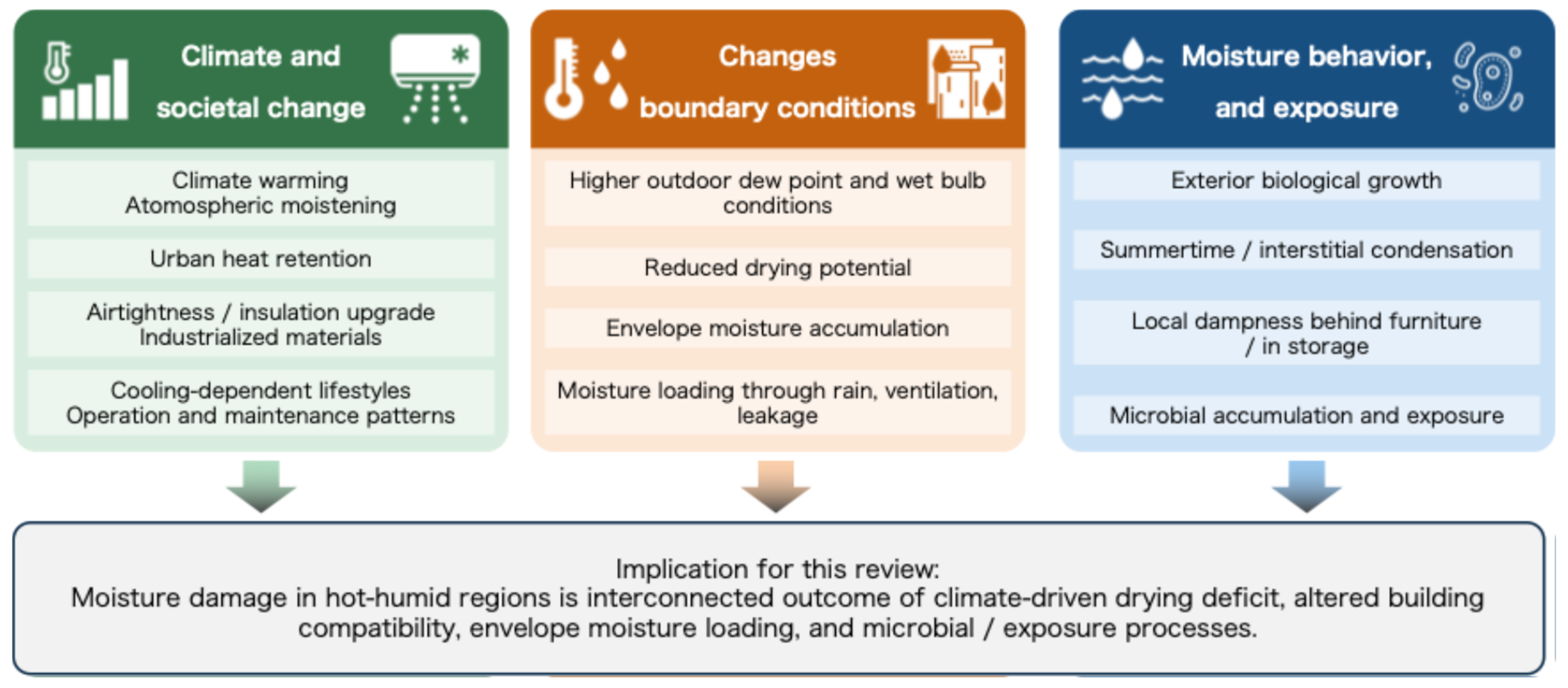
Figure 2.
Time series of summer mean dew-point temperature in representative cities. Note: Present-day values were derived from ERA5 monthly reanalysis using 2 m dew-point temperature, whereas future values were derived from CMIP6 projections using near-surface air temperature and near-surface relative humidity.
Figure 2.
Time series of summer mean dew-point temperature in representative cities. Note: Present-day values were derived from ERA5 monthly reanalysis using 2 m dew-point temperature, whereas future values were derived from CMIP6 projections using near-surface air temperature and near-surface relative humidity.
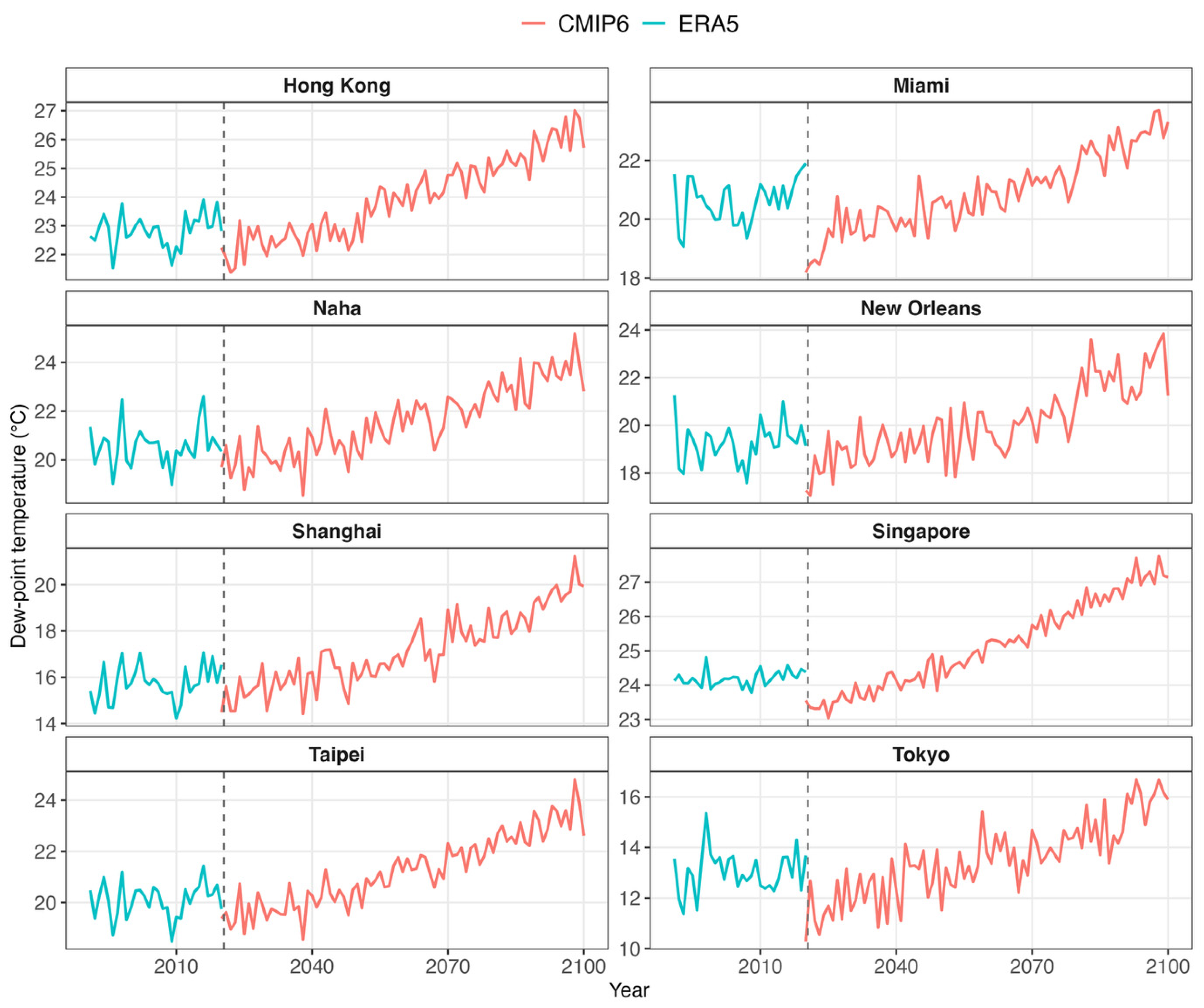
Figure 3.
Global distribution of hot-humid and humidification-related moisture-risk zones and associated population exposure: (a) global distribution of risk categories derived from climate classification; and (b) estimated population exposure in 2000, 2020, and 2050.
Figure 3.
Global distribution of hot-humid and humidification-related moisture-risk zones and associated population exposure: (a) global distribution of risk categories derived from climate classification; and (b) estimated population exposure in 2000, 2020, and 2050.
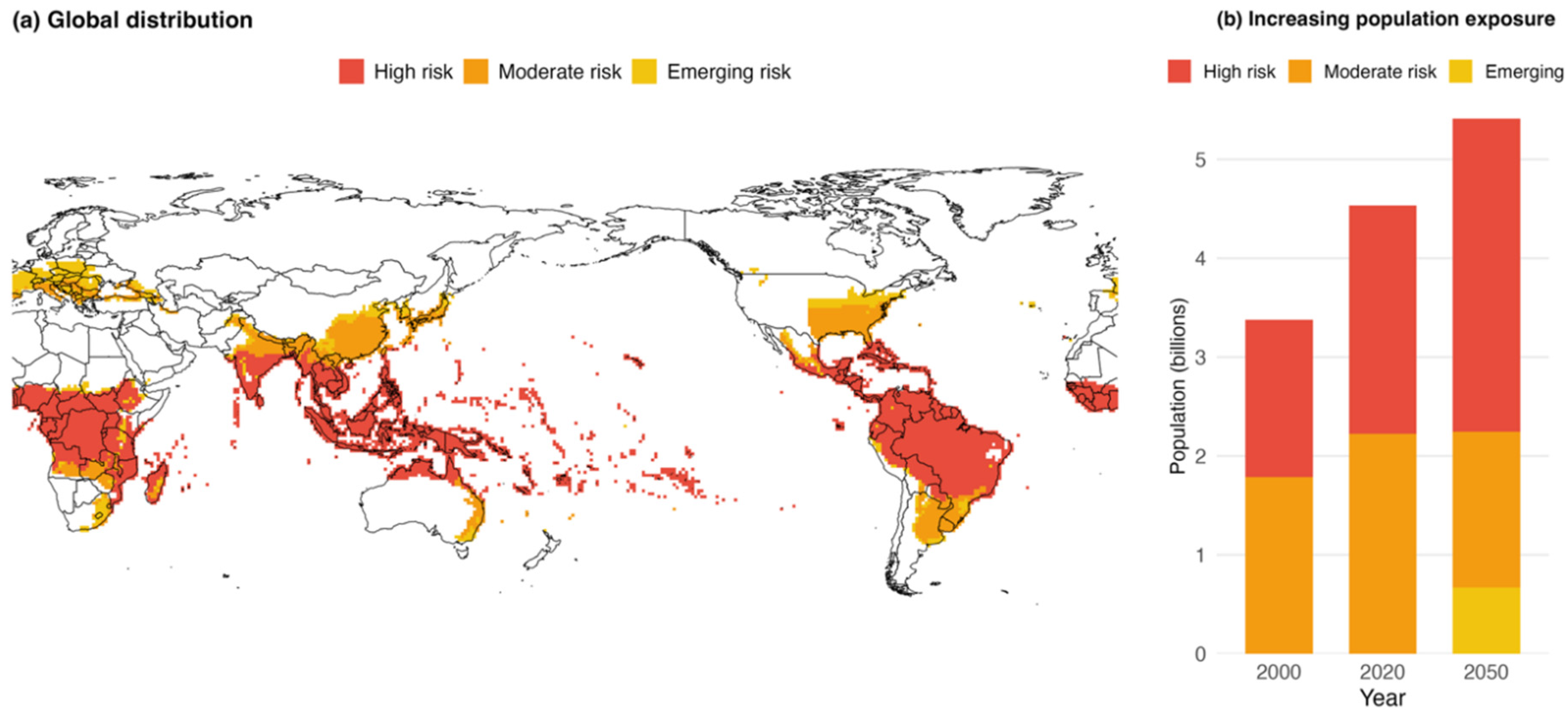
Figure 4.
Major moisture transport and storage mechanisms in building envelopes.
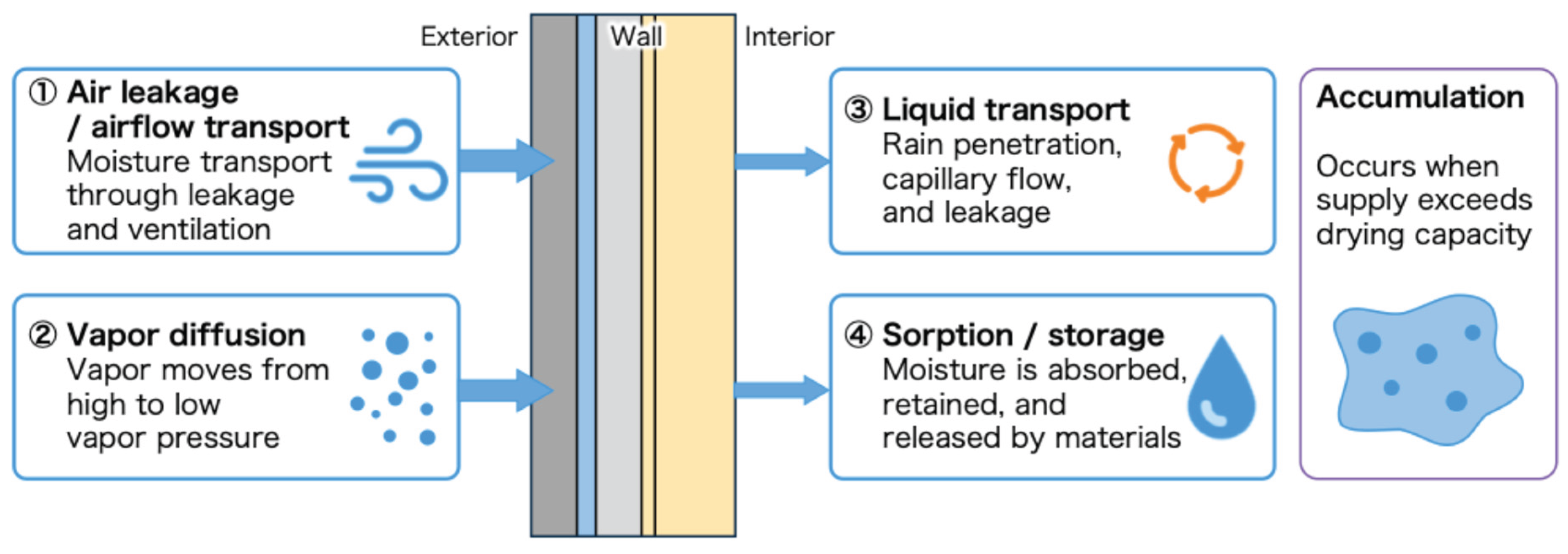
Figure 5.
Example time series of surface hygrothermal conditions and representative moisture/mold risk indices, including threshold exceedance, FI, VTT, DR-SIM, and Sedlbauer-based indicators, calculated from field-measured surface temperature and surface relative humidity.
Figure 5.
Example time series of surface hygrothermal conditions and representative moisture/mold risk indices, including threshold exceedance, FI, VTT, DR-SIM, and Sedlbauer-based indicators, calculated from field-measured surface temperature and surface relative humidity.
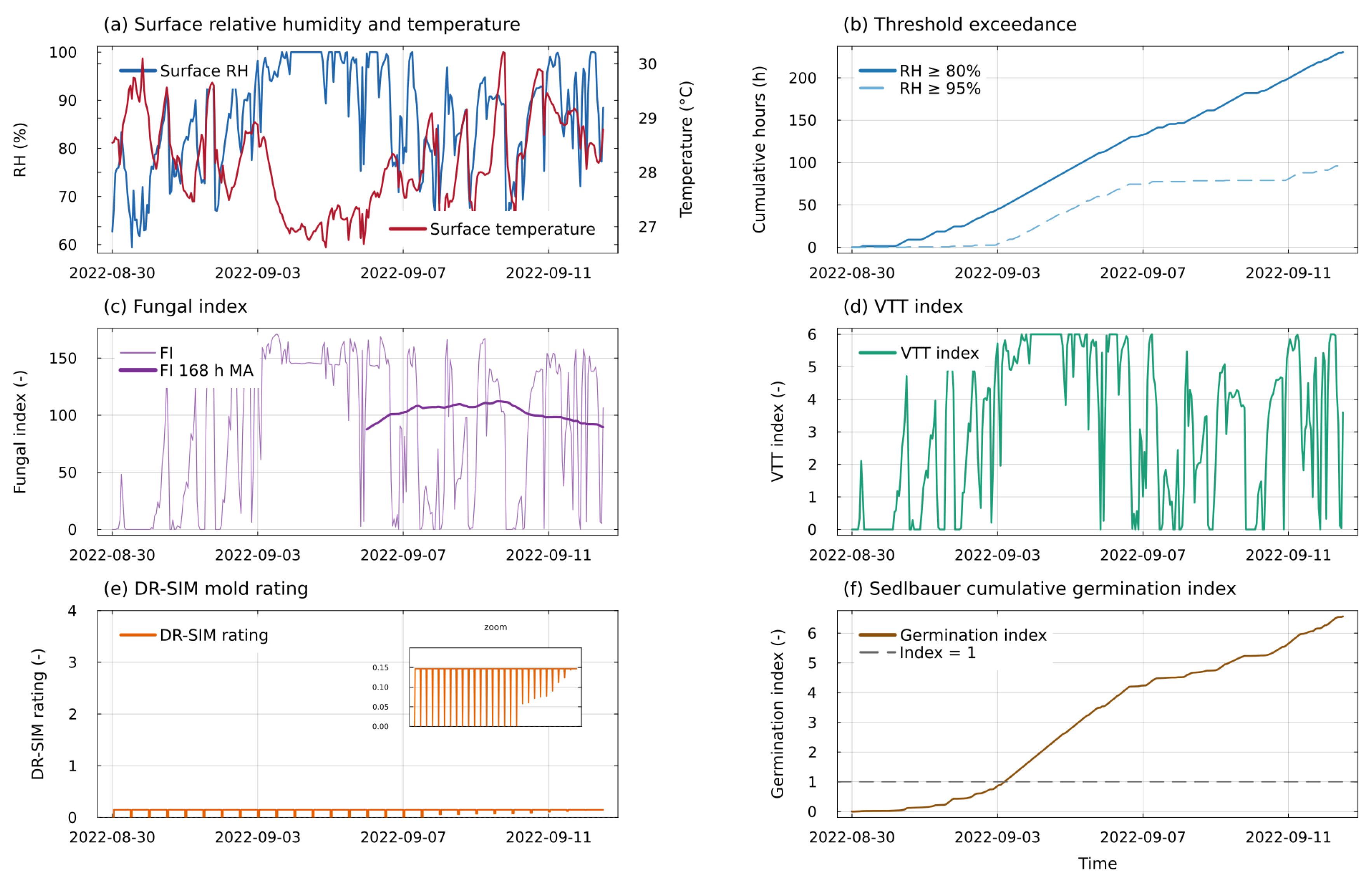
Figure 6.
Pathway from hygrothermal conditions to microbial accumulation and exposure.
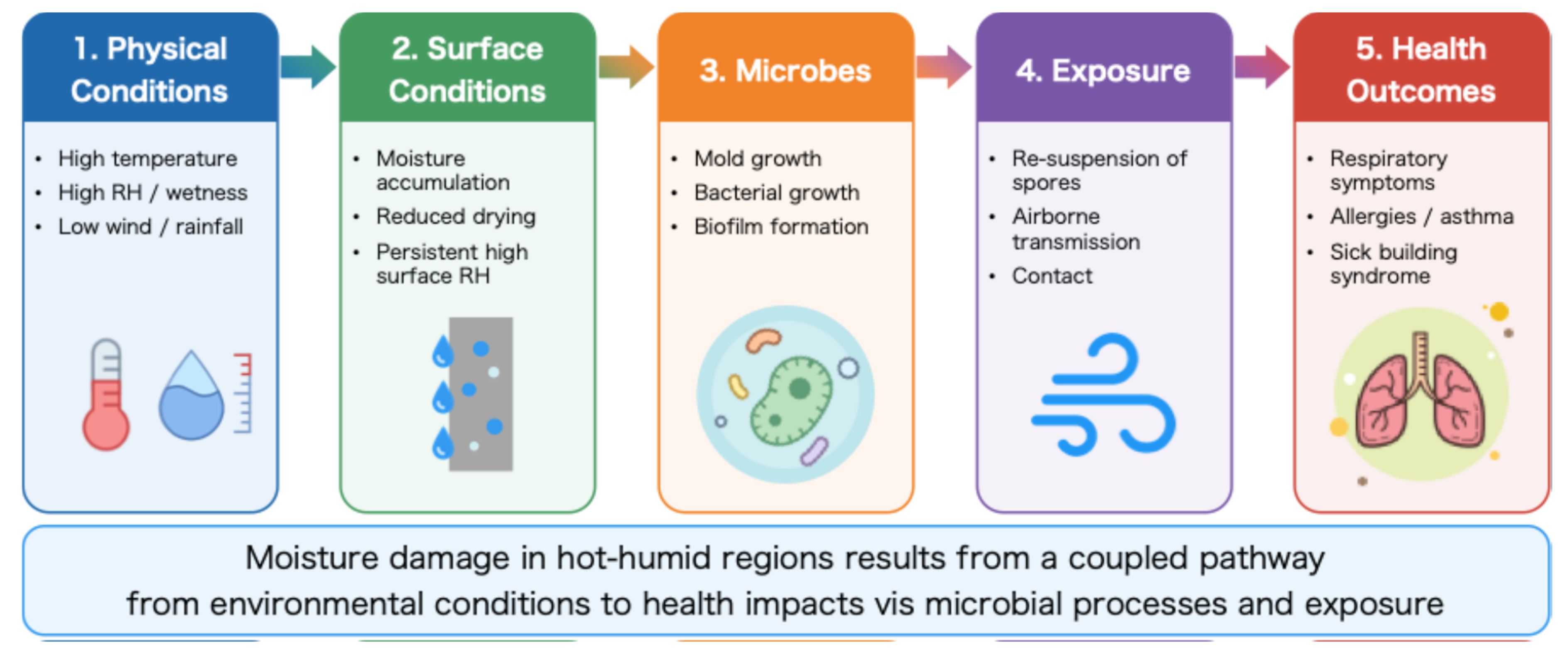
Figure 7.
Shift from temperate to hot-humid moisture design principles.
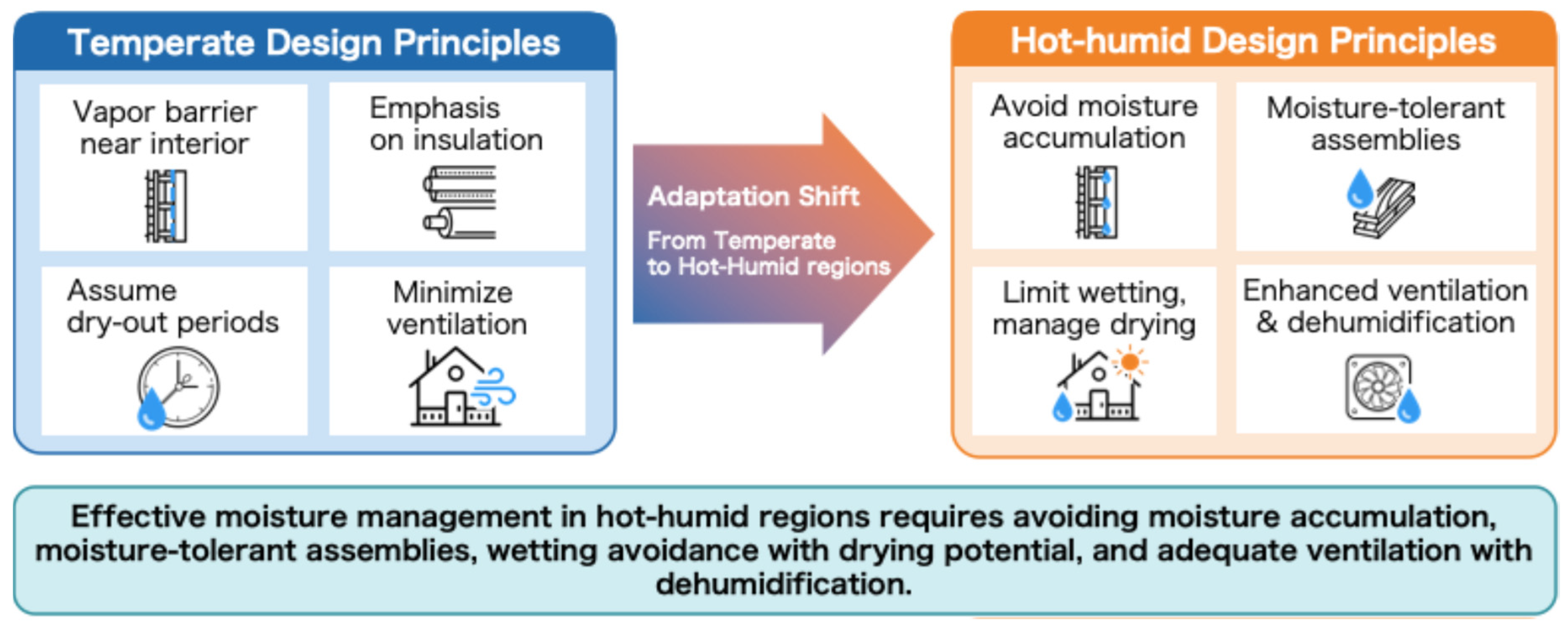

Table 1.
Representative moisture-damage scenarios.
| Scenario | Typical locations | Mechanisms / conditions | Signs / impacts | Implication |
| Exterior biofouling | Exterior walls; roofs; shaded and rain-exposed surfaces | Rain/dew wetting; humid air; delayed drying; warm nights; retentive finishes | Discoloration; staining; streaks; coating deterioration | Indicates insufficient surface drying, not only appearance loss |
| Summer condensation in envelopes | Walls/roofs; insulation; gypsum-board rear side; wood substrates | Inward vapor drive; humid-air leakage; cooled layers; poor drying; high dew point | Often hidden; odor; concealed mold; lower thermal performance; deterioration | Design should address inward loading and limited post-wetting drying |
| Localized surface dampness | Behind furniture; closets; corners; near windows; cooled surfaces | Local cooling; stagnant air; low air speed; humid-air inflow; insufficient dehumidification | Local staining; odor; condensation marks; mold on finishes | Room averages are insufficient; local microclimate is a design target |
| Moisture stagnation in hidden spaces | Attics; crawl spaces; ceiling voids; shafts; hidden cavities | Humid-air stagnation; leakage; residual moisture; pressure differences; poor ventilation | Often hidden; odor; staining; concealed deterioration; microbial source potential |
Table 2.
Major moisture and mold risk assessment methods.
| Method | Output | Strength | Limitation in hot-humid buildings |
| Threshold | Threshold exceedance / duration | Simple; useful for screening and comparison | Limited for growth stage or material response; differences fade under persistent humidity |
| FI | Empirical fungal growth index | Practical in Japanese indoor studies; sensitive to humid spikes | No explicit material/species effect; may stay chronically high |
| VTT | Mold growth stage index | Includes material sensitivity; useful for envelope assessment | Can saturate under sustained humidity; reduced discrimination |
| IBP-type | Growth-permissive condition | Clear temperature-RH growth boundary | Weak treatment of cumulative history and recovery |
| MRD / DR-SIM | Cumulative / dynamic hazard | Better reflects accumulation and recovery | Parameter-sensitive; values may remain persistently high |
| Probabilistic | Probability of occurrence | Incorporates uncertainty and variability | Data-intensive; limited routine application |
Note: These methods represent different concepts and are not directly interchangeable.
Table 3.
Key issues for design, retrofit, and operation.
| Domain | Main issue | Moisture impact | Response |
| Rain control / drainage | Repeated rain exposure and wetting | Exterior contamination; higher envelope moisture; delayed drying | Use assemblies that drain and dry after wetting |
| Airtightness | Humid outdoor air enters through leakage | Localized humidity; hidden envelope wetting | Control leakage paths; coordinate with pressure management |
| Vapor resistance / drying path | One-way drying can trap moisture | Summer condensation; poor recovery; concealed deterioration | Check drying direction and drying paths explicitly |
| Material selection | Moisture-buffering materials may stay wet | Supports microbial settlement and persistence | Assess drying rate and biological susceptibility |
| Ventilation | Ventilation may add moisture | Higher indoor humidity; surface moisture risk | Design with outdoor conditions, latent load, and pressure balance |
| Cooling / dehumidification | Cooling alone may leave humidity unresolved | Micro-condensation; local high RH; mold growth | Address latent load, not only sensible load |
| Hidden spaces | Attics, crawl spaces, and voids retain moisture | Hidden reservoirs of damage and microbial sources | Secure access, ventilation, and moisture-release paths |
| Operation / maintenance | Use, cleaning, and furniture placement affect outcomes | Strong effect on contamination, persistence, and exposure | Consider operation and maintenance from design stage |
Note: Operation includes occupant behavior, system use, maintenance, and spatial arrangement affecting moisture loading and recovery.
Disclaimer/Publisher’s Note: The statements, opinions and data contained in all publications are solely those of the individual author(s) and contributor(s) and not of MDPI and/or the editor(s). MDPI and/or the editor(s) disclaim responsibility for any injury to people or property resulting from any ideas, methods, instructions or products referred to in the content. |
© 2026 by the authors. Licensee MDPI, Basel, Switzerland. This article is an open access article distributed under the terms and conditions of the Creative Commons Attribution (CC BY) license (http://creativecommons.org/licenses/by/4.0/).
Copyright: This open access article is published under a Creative Commons CC BY 4.0 license, which permit the free download, distribution, and reuse, provided that the author and preprint are cited in any reuse.


