

Submitted:
16 April 2026
Posted:
17 April 2026
You are already at the latest version
Abstract
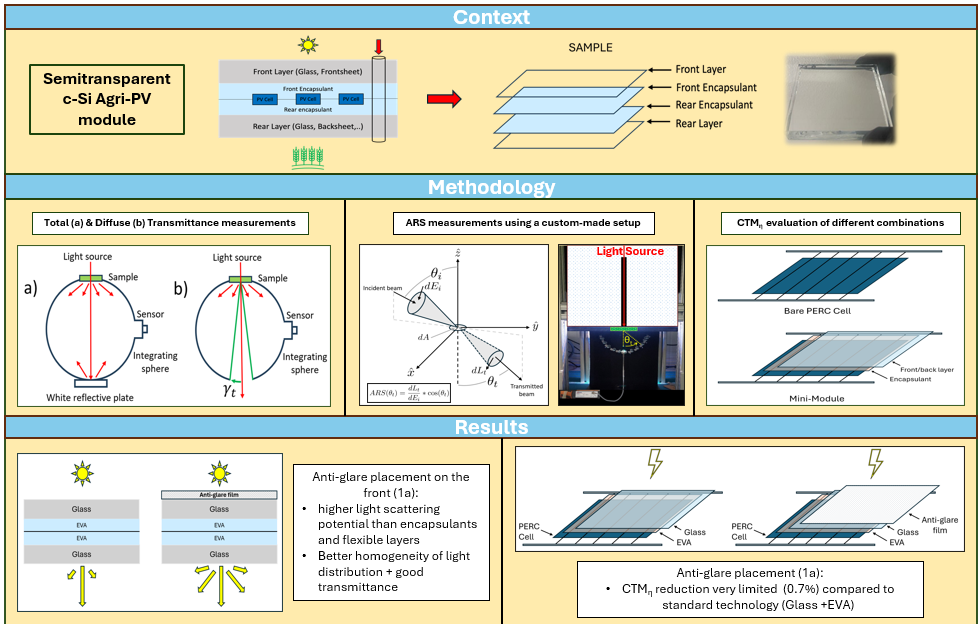
Agrivoltaics (Agri-PV) represents a promising solution to improve land-use efficiency by simultaneously allowing crop growth and photovoltaic (PV) energy generation, with additional benefits for crop production if properly engineered. However, when crystalline silicon (c-Si) PV modules are used for Agri-PV, even in semi-transparent configurations, shading occurs over crops, potentially reducing agricultural yields. Enhancing light diffusion is a key strategy to partially compensate for this effect, as diffuse light is more efficiently utilized by most plants. This study aims at engineering the transparent section of a semi-transparent c-Si PV module, assessing its optical, light-scattering, and efficiency-related properties for Agri-PV applications. The experimental work involved fabricating and testing various transparent stack configurations and mini-module prototypes to evaluate their suitability for Agri-PV integration. Optical characterization using a spectrophotometer revealed that certain stack configurations significantly enhance light diffusion, while maintaining good transmittance values for crops growth. To further analyze angular light scattering, a custom-built setup to measure the Bidirectional Transmittance Distribution Function (BTDF) was developed. The results showed that primarily anti-glare films (AG) and secondarily specific encapsulants (TPO) and flexible layers can effectively improve light distribution, helping to mitigate shading effects. Following AG application, Haze values exceeded 89%, indicating enhanced light diffusion capabilities. The impact of different stacks on module efficiency was also assessed through mini-modules testing. Findings indicate that enhanced light diffusion can be achieved with minimal efficiency losses. Specifically, the application of the AG resulted in a reduction of the Cell-To-Module efficiency ratio (CTMη) of less than 1%. These results confirm that semi-transparent PV modules can be optimized for Agri-PV applications without significantly compromising energy output.
Keywords:
agrivoltaics
; c-Si PV modules
; diffusive properties
; cosine-corrected BTDF
; impact on electric performance
Copyright: This open access article is published under a Creative Commons CC BY 4.0 license, which permit the free download, distribution, and reuse, provided that the author and preprint are cited in any reuse.


