
Submitted:
10 April 2026
Posted:
17 April 2026
You are already at the latest version
Abstract
Construction and demolition waste (CDW) is the largest single waste stream in the European Union by weight (~39% of all EU waste), yet the EU’s circular material use rate stood at only 12.2% in 2024 — less than half its 2030 target. Despite two decades of legislative ambition, the 70% recovery target under Directive 2008/98/EC has not been genuinely achieved: apparent compliance by most Member States conceals widespread downcycling and inconsistent reporting. This review identifies five persistent barrier domains — legal, technical, social, behavioural, and economic — with regulatory fragmentation and secondary material devaluation as the most structurally entrenched. A decisive paradigm shift is observed in recent research, from material characterisation towards systemic circularity, digital demolition frameworks, and governance. Emerging technologies — including AI-powered sorting, Building Information Modelling, Digital Twins, and Digital Product Passports — hold transformative potential, while Design for Deconstruction represents a critical upstream strategy the sector has yet to mainstream. The forthcoming EU Circular Economy Act will introduce legally binding obligations for Member States. The 2026 Strait of Hormuz energy crisis has reframed CDW from an environmental concern into a strategic industrial imperative: as virgin material costs surge, secondary CDW materials offer economic and geopolitical advantage. Future research must prioritise collaborative governance, longitudinal data, and scalable digital solutions.
Keywords:
onstruction and demolition waste
; circular economy
; recycling
; digital technologies
; barriers
1. Introduction
The construction and demolition sector is one of the most resource-intensive activities in the global economy, generating approximately 30% of all solid waste worldwide and consuming an estimated 40% of raw materials extracted annually. Within the European Union, construction and demolition waste (CDW) represents the single largest waste stream by weight, accounting for approximately 39% of all waste generated (Eurostat, 2023). Despite decades of policy ambition, the EU’s circular material use rate stood at only 12.2% — barely half of its 2030 target — and the reported 70% CDW recovery rate masks a reality dominated by low-value downcycling rather than genuine circularity. The persistence of this gap between policy rhetoric and material reality constitutes the central motivation for this review.
The urgency of the challenge has intensified sharply in 2026. The effective closure of the Strait of Hormuz from March 2026, described by the International Energy Agency as “the largest supply disruption in the history of the global oil market” (IEA, 2026), has driven EU energy prices to levels last seen during the 2022 Russian energy crisis. Cement and steel — the two most energy-intensive construction materials — face production surcharges of up to 30%, fundamentally altering the economics of virgin material use. In this context, CDW valorisation is no longer merely an environmental imperative: it has become a matter of energy security, industrial competitiveness, and supply chain resilience.
Simultaneously, the legislative landscape is shifting. The EU Circular Economy Act, expected in Q3 2026, will introduce legally binding obligations on waste management and secondary material markets — a qualitative departure from the non-binding action plans that preceded it. The Ecodesign for Sustainable Products Regulation (ESPR, 2024/1781) has already established the Digital Product Passport as a regulatory requirement, directly operationalising material traceability concepts that the CDW literature has long advocated.
Against this backdrop, a critical and integrated review of the field is timely. The literature on CDW circularity has grown rapidly — from 12 publications in 2008 to over 2,300 in 2020 (Alcalde-Calonge et al., 2022) — but remains fragmented across barrier analysis, technology assessment, and policy evaluation. This paper synthesises these threads into a coherent evidence base. The paper is structured as follows: Section 2 describes the review methodology; Section 3 examines the EU policy trajectory; Section 4 analyses CDW generation and recovery performance; Section 5 systematically reviews the five barrier domains; Section 6 examines digital technologies and design-for-deconstruction frameworks; Section 7 synthesises findings and discusses implications; and Section 8 presents conclusions.
2. Methodology
This study employs a systematic narrative review of the academic literature and grey policy literature on construction and demolition waste (CDW) management and circular economy (CE) adoption in the European Union context. The review was conducted following the methodological principles recommended for systematic literature reviews in the built environment and waste management fields, adapted to the integrative scope of this work.
Literature searches were performed in Scopus using combinations of the following keywords: “construction and demolition waste”, “circular economy”, “CDW recycling”, “CDW management”, “CDW barriers”, “building information modelling”, “digital twin construction”, “design for deconstruction”, “AI sorting waste”, and “digital product passport”. The search was not restricted by geographic area, given the global relevance of many technical and economic barriers, but the analysis and policy discussion are specifically framed around the EU context. Priority was given to peer-reviewed articles published from 2018 onwards, reflecting the accelerated growth of the field following the EU’s first Circular Economy Action Plan. A targeted search was also applied to EU institutional documents (European Commission communications, Eurostat data releases, and legislative texts) and to reports from international organisations (IEA, EEA) relevant to the energy-security dimension introduced in 2026.
Inclusion criteria required publications to address at least one of the following themes: (i) CDW generation data or compositional analysis in the EU; (ii) legislative and policy frameworks governing CDW recovery in the EU; (iii) technical, social, behavioural, legal, or economic barriers to CE adoption in the CDW sector; (iv) digital and emerging technologies applied to CDW management; (v) material flow analysis or quantitative performance assessment of CDW systems. Studies focused exclusively on non-European contexts with no comparative relevance to the EU were excluded, as were opinion pieces without empirical or systematic content.
The review is organised thematically across four analytical layers: (1) the EU policy and governance trajectory for CDW circularity; (2) the empirical state of CDW generation and recovery performance in the EU; (3) a structured synthesis of barrier domains drawing on the typology of Purchase et al. (2021) and extended by subsequent literature; and (4) an assessment of digital and design-based technological innovations. The final section integrates these analytical layers to identify cross-cutting implications for policy, practice, and future research.
3. Circular Economy in the EU Policy Landscape
The Earth’s ecological systems face mounting pressures from habitat degradation, freshwater stress, soil depletion, atmospheric pollution, and unsustainable land conversion (Rockström et al., 2009). Global material throughput now surpasses 100,000 million tonnes per year — around 13 tonnes per capita — with the extraction process itself generating severe environmental damage including forest clearance, topsoil erosion, and contamination of air and water bodies, compounding the biodiversity crisis.
Against this backdrop, the EU has consistently positioned itself as a frontrunner in sustainable resource governance. The Europe 2020 Strategy, anchored by the “Resource Efficient Europe” flagship (COM, 2011), established a framework for systemic economic transformation. The resulting Roadmap to a Resource Efficient Europe (COM, 2011a) details a multi-stakeholder action framework with 2030 milestones, embedded within a coherent policy architecture enabling complementary future measures.
The circular economy, introduced as a structuring concept for smart, sustainable, and inclusive growth (COM, 2014; EC, 2015), has since become central to EU environmental governance. Huysman et al. (2017) define the circular economy concept as calling for open production systems to be replaced by systems that reuse and recycle resources and conserve energy. Applying the 10R circularity ladder of Potting et al. (2017), Morseletto (2020) demonstrated that prevailing CE targets disproportionately favour Recycling (R8) and Recovery (R9) — lower-value strategies — and advocates reorientation towards the R0; R7 range encompassing Rethink, Refuse, Reduce, Reuse, Repair, Refurbish, and Remanufacture.
Through a 13-year bibliometric mapping of CE scholarship, Alcalde-Calonge et al. (2022) documented steep exponential growth — from 12 indexed publications in 2008 to over 2,300 in 2020 — accompanied by a geographic reorientation as European research centres overtook Chinese institutions in output and citation impact. Alberich et al. (2023) found that current frameworks overwhelmingly privilege technological solutions and economic expansion, calling for a repoliticisation of CE discourse that questions dominant growth paradigms and advances sustainability as a non-negotiable constraint.
4. The State of CDW in the European Union
4.1. CDW Generation Trends and Compositional Profile
Within the EU, CDW is not a compositionally homogeneous waste stream. According to Eurostat (2023) and supplementary JRC analyses (Cristóbal-García et al., 2024), the dominant fractions by weight are concrete and masonry rubble (approximately 70% of total CDW mass), followed by asphalt and road planings (15%), metals (10%), wood (3–5%), glass, plastics, and hazardous fractions (together accounting for the remaining share). This compositional skew towards heavy mineral fractions has direct regulatory consequences: the weight-based recovery targets prescribed under Directive 2008/98/EC incentivise recovery of bulk mineral fractions while lighter but environmentally significant streams remain systematically underreported and undermanaged (Galvez-Martos et al., 2018).
The age profile of the EU building stock is a particularly critical determinant: approximately 35% of EU buildings were constructed before 1945 and a further 40% before 1980, meaning a substantial portion predates any modern environmental or material efficiency regulations. The forthcoming large-scale renovation wave driven by the Energy Performance of Buildings Directive (EPBD, 2024) is projected to substantially increase CDW volumes over the 2025-2035 period.
4.2. Recovery Performance and the Limits of Reported Statistics
The EU’s reported CDW recovery rate of approximately 89% is widely cited as evidence of progress towards circular construction, yet this headline figure masks a performance gap of fundamental importance. Iodice et al. (2023) demonstrated that aggregate recovery statistics conflate high-volume, low-value operations — primarily the crushing of concrete and masonry for use as unbound granular fill in road sub-bases — with genuine circular recovery, where secondary materials substitute for primary raw materials at equivalent functional quality. When the analysis is restricted to genuine secondary material substitution in high-value applications, the effective circularity rate is estimated to fall below 30% in most Member States.
Three structural problems undermine the credibility of current reporting. First, the definition of “backfilling” is inconsistently applied across Member States: twelve EU countries classify backfilling as a recovery operation, while fifteen do not (Moschen-Schimek et al., 2023). Second, national CDW generation data rely on construction activity proxies rather than direct measurement. Third, hazardous CDW fractions are frequently excluded from reporting frameworks entirely. These data quality deficiencies allow Member States to report compliance while actual circularity outcomes remain substantially lower, reinforcing a “compliance illusion” that reduces incentives for genuine structural reform.
4.3. Member State Performance Disparities and Material Flow Projections
Zhang et al. (2022) benchmarked CDW management maturity across EU Member States using a composite indicator framework. The analysis reveals a pronounced North-West/South-East performance gradient, with wealthier Member States — notably the Netherlands, Belgium, Denmark, and Germany — demonstrating more advanced waste management systems, higher rates of quality recycling, and greater institutional capacity for enforcement. Bao and Lu (2023) applied Environmental Kuznets Curve analysis to panel data from 27 European economies over 2004-2018, confirming an inverted-U relationship between GDP per capita and construction waste generation.
Material flow projections further underscore the structural insufficiency of current recovery trajectories. Deetman et al. (2020) modelled global material stocks and flows for the residential and service building sectors through 2050, finding that recycled construction materials could satisfy at most 55% of projected demand for key commodities such as copper, timber, and steel under optimistic scenarios. Van Oorschot et al. (2023) demonstrated through spatially-resolved Material Flow Analysis of the Dutch building stock that material-related emissions will become increasingly central to net-zero pathways and cannot be deferred to later decades.
5. Barriers to Circular Economy Adoption in CDW Management
Galvez-Martos et al. (2018) took issue with the Directive’s reliance on aggregate weight-based metrics, arguing that this approach incentivises prioritisation of heavy mineral fractions at the expense of lighter waste streams. Modelling future material availability through 2050, Deetman et al. (2020) found that recycled construction materials could satisfy at most 55% of projected demand for key commodities — confirming that supply-side limits compound the regulatory compliance gap.
A systematic literature review by Purchase et al. (2021) mapped the landscape of impediments to CE integration in the C&D waste sector, grouping them into five overarching categories encompassing legal, technical, social, behavioural, and economic dimensions. The study revealed that governance deficiencies, complex permitting requirements, technological shortfalls, inconsistent quality standards, limited information access, and high upfront costs represent the most structurally significant obstacles.
Drawing on survey data from 220 Malaysian construction practitioners, Mohammed et al. (2022) applied partial least squares structural equation modelling (PLS-SEM) to assess how policy levers shape waste management outcomes. Contrary to common assumptions, regulatory instruments showed limited capacity to mediate the relationship between generation practices and sustainable outcomes. The authors argued that the most effective pathway to improved industry performance lies in source reduction.
Oluleye et al. (2022) applied a PRISMA-guided review in combination with Interpretive Structural Modeling to identify 33 impediments to CE adoption within the built construction sector, structured across seven interrelated clusters. The systems-thinking lens of the study demonstrated that these barriers do not operate in isolation but form interconnected networks, such that addressing foundational constraints can generate cascading improvements across the system.
6. Digital Technologies and Smart Demolition Frameworks
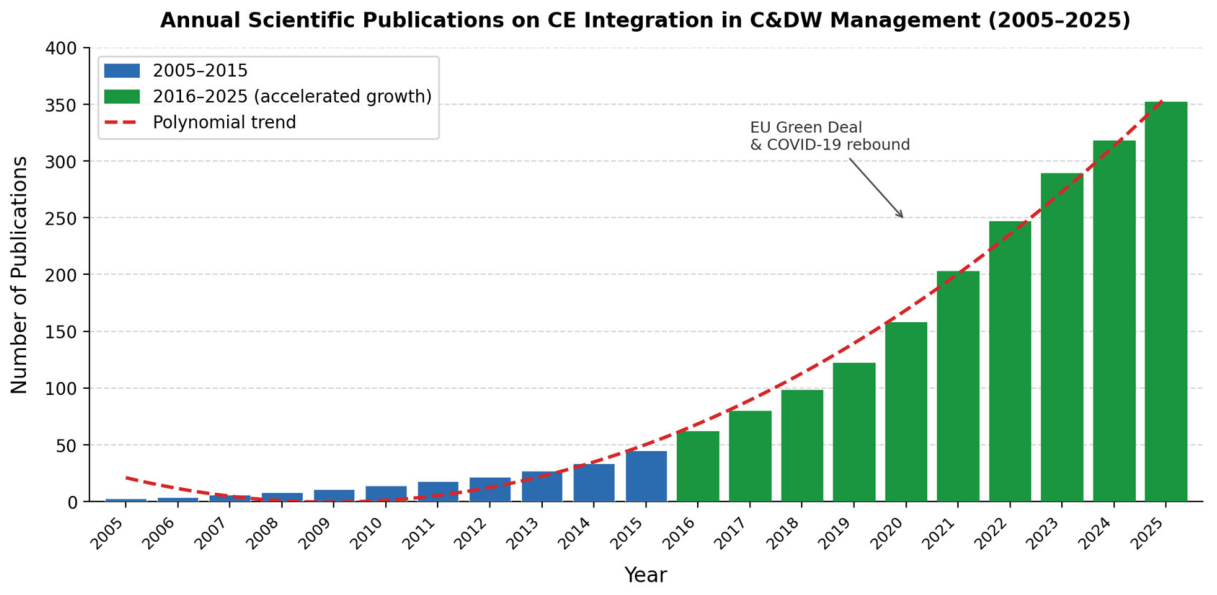
A systematic bibliometric review of Scopus-indexed literature by Elshaboury et al. (2022) retrieved 996 publications on CDW management across the two-decade span from 2001 to 2021. The corpus analysis documents a marked acceleration in publication output from 2006 onwards, driven by growing multidisciplinary engagement spanning engineering, environmental science, economics, and policy studies across diverse national contexts.
Conducting a scientometric analysis of CDW research trajectories, Nawaz et al. (2023) mapped four underserved knowledge frontiers. The most critical concerns governance architecture: the institutional complexity of construction waste administration requires coordinated, consensus-based mechanisms spanning public authorities, private contractors, and civil society. The psychosocial dimensions of individual behaviour within recycling organisations are similarly underdeveloped, with most studies addressing aggregate material flows rather than the normative and motivational factors governing practitioner decisions.
Figure 1.
Annual scientific publications on CE integration in C&DW management (2005-2025). Source: Hasibuan et al. (2025).
Figure 1.
Annual scientific publications on CE integration in C&DW management (2005-2025). Source: Hasibuan et al. (2025).
Silva et al. (2026), in a comprehensive review of 8,906 Scopus documents identified a decisive paradigm shift in CDW research: the strategic focus has transitioned from the physical and mechanical characterization of recycled materials towards sustainability, climate resilience, and higher-value applications. Their review examines the role of Building Information Modeling (BIM), Artificial Intelligence (AI), and advanced pre-treatment processes — including carbonation and alkaline activation — in improving material properties and enabling circular valorization pathways.
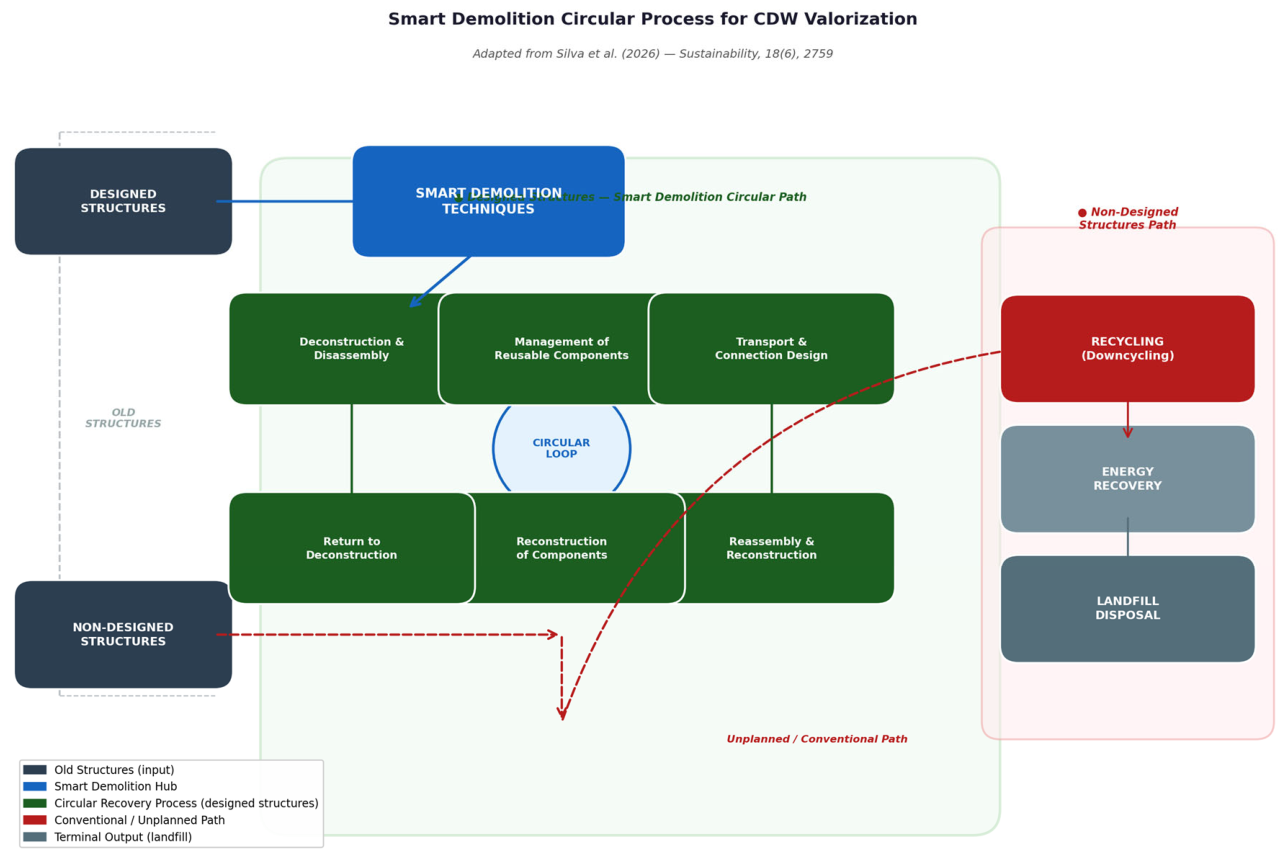
Silva et al. (2026) propose a smart demolition circular framework contrasting two trajectories for end-of-life buildings: a planned circular path — deconstruction and disassembly, reusable component management, transport and connection design, reconstruction, and reassembly — versus the conventional unplanned path leading to downcycling or landfill. Their central conclusion mirrors that of this review: while technical feasibility is well established, the transition to low-carbon resilient construction remains constrained by the absence of standardized environmental metrics and insufficient regulatory incentives.
Figure 2.
Keyword co-occurrence network for CE integration in C&DW management (2005-2025). Source: Adapted from Hasibuan et al. (2025), Scopus bibliometric analysis (VOSviewer).
Figure 2.
Keyword co-occurrence network for CE integration in C&DW management (2005-2025). Source: Adapted from Hasibuan et al. (2025), Scopus bibliometric analysis (VOSviewer).
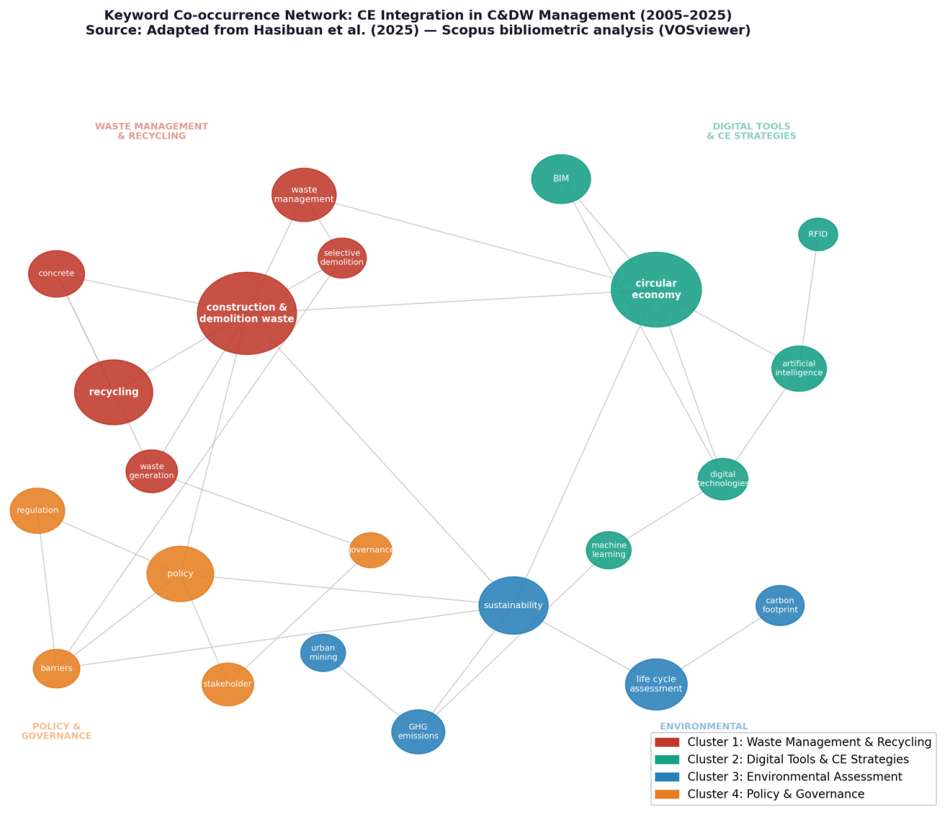
Zhu and Feng (2025) identified nine major research topics in CDW circularity, including materials reuse, waste quantification, and emerging digital tools. Abd Elnasser et al. (2025), using structural equation modelling with 384 construction industry stakeholders, identified ten critical barriers to CE adoption in CDW management — including fragmented supply chains, lack of standardized practices, and regulatory inconsistencies — confirming that these challenges persist across geographies and national contexts.
Figure 3.
Smart demolition circular process for CDW valorization, contrasting the designed structures circular path with the conventional unplanned path. Source: Adapted from Silva et al. (2026) — Sustainability, 18(6), 2759.
Figure 3.
Smart demolition circular process for CDW valorization, contrasting the designed structures circular path with the conventional unplanned path. Source: Adapted from Silva et al. (2026) — Sustainability, 18(6), 2759.
7. Discussion
7.1. Key Findings and Interpretations
The synthesis of the reviewed literature across the five analytical domains of this paper converges on a set of interconnected findings that have significant implications for both research and practice. First, the gap between reported recovery performance and genuine circularity is the most fundamental empirical problem in the field. The EU’s reported 89% CDW recovery rate represents a statistical artefact rather than a circularity achievement: it is constructed from heterogeneous national methodologies, includes large volumes of low-grade backfilling, and excludes a substantial share of hazardous and lighter material fractions.
Second, the five barrier domains identified by Purchase et al. (2021) and confirmed by subsequent literature (Oluleye et al., 2022; Abd Elnasser et al., 2025) are not independent: they form a mutually reinforcing system in which regulatory fragmentation reduces market confidence in secondary materials, which in turn depresses investment in sorting technology, which perpetuates low-quality recovery, which reinforces regulatory inertia. Breaking this systemic lock-in requires coordinated and simultaneous intervention across multiple barrier domains.
Third, the paradigm shift documented by Silva et al. (2026) — from material characterisation towards systemic, digital, and governance-oriented research — reflects an important and appropriate reorientation of the field. The technical feasibility of CDW recycling is no longer in question for the dominant mineral fractions; the binding constraints are now organisational, institutional, and economic. This finding aligns with the critique of Alberich et al. (2023), who argue that the CE policy discourse in the EU has over-privileged technological solutions at the expense of structural and governance reforms.
7.2. Policy and Practice Implications
The geopolitical context of early 2026 has injected new urgency into the CDW circularity agenda. The effective closure of the Strait of Hormuz from 2 March 2026 has caused EU gas benchmark prices (Dutch TTF) to nearly double to over 60/MWh by mid-March, while the European Commission has estimated an additional 13 billion burden on fossil fuel imports (Euronews, 2026). For the construction sector, the implications are structural: cement and steel production are among the most energy-intensive industrial processes, and cost surcharges of up to 30% imposed by manufacturers are already propagating through supply chains.
Four priority implications for policy emerge from the review. First, the EU Circular Economy Act must reform recovery reporting: only genuine substitution of primary raw materials by secondary CDW materials should count towards circularity targets, with backfilling operations reported separately and not credited towards the 70% recovery benchmark. Second, the pronounced performance disparities across Member States reinforce the case for differentiated, context-sensitive policy instruments rather than uniform pan-European mandates. Third, the integration of Digital Product Passports (mandated under ESPR 2024/1781) with pre-demolition audit requirements represents the most tractable near-term pathway for improving material traceability and secondary market confidence. Fourth, fiscal instruments — including landfill taxes, aggregate levies, and procurement mandates for recycled content in public construction — are essential complements to regulatory standards.
For construction industry practitioners, the implications are equally significant. Design for Deconstruction (DfD) principles need to be embedded in project briefs and building regulations as standard practice rather than voluntary best practice. Material-as-a-service and lease-based business models that retain manufacturer responsibility for end-of-life recovery represent promising alternative pathways, particularly for high-embodied-energy components such as structural steel and technical equipment. AI-powered sorting systems and digital demolition planning tools require targeted public support for adoption by small and medium-sized enterprises.
7.3. Limitations and Future Research Directions
Several limitations of this review warrant acknowledgement. As a systematic narrative review, it synthesises findings from heterogeneous studies using different methodological approaches — survey-based, bibliometric, modelling, and case-study research — which limits the extent to which findings can be directly compared or aggregated. The geographic focus on the EU means that valuable lessons from advanced CDW governance systems in countries such as Japan, South Korea, and Singapore have not been systematically incorporated.
Future research should prioritise five underserved domains identified across the review: (1) longitudinal empirical studies on the actual circularity outcomes of CDW management interventions; (2) governance models for multi-stakeholder coordination in CDW circularity; (3) psychosocial and organisational drivers of contractor behaviour in waste segregation and material recovery; (4) scalable economic models for regional CDW circularity hubs; and (5) integration studies that assess the combined impact of digital technologies (BIM, AI sorting, Digital Twins, DPPs) when deployed as a system rather than in isolation.

Table 1.
Synthesis of barrier domains to CE adoption in CDW management: key obstacles, principal references, and recommended strategies.
Table 1.
Synthesis of barrier domains to CE adoption in CDW management: key obstacles, principal references, and recommended strategies.
| Barrier Domain | Key Obstacles | Key References | Recommended Strategies |
|---|---|---|---|
| Legal / Regulatory | Regulatory fragmentation across MS; weight-based targets masking downcycling; absence of harmonised end-of-waste criteria; permitting complexity | Purchase et al. (2021); Gálvez-Martos et al. (2018); Moschen-Schimek et al. (2023); Abd Elnasser et al. (2025) | Harmonise EU reporting definitions; adopt material-fraction-specific targets; accelerate end-of-waste criteria under CEA (Q3 2026) |
| Technical | Limited on-site sorting infrastructure; quality discrepancies of secondary materials; lack of standardised environmental metrics; insufficient pre-demolition auditing | Purchase et al. (2021); Silva et al. (2026); Nawaz et al. (2023); Pristerà et al. (2024) | Scale AI-powered sorting and digital material passports (DPP/ESPR); mandate pre-demolition audits; promote Design for Deconstruction (DfD) |
| Social / Cultural | Low awareness of CE among design professionals and contractors; absence of CE education; resistance to specification of secondary materials | Purchase et al. (2021); Oluleye et al. (2022); Frontiers Built Environ. (2025) | Integrate CE principles into construction education; demonstrate reuse feasibility through pilot projects; build stakeholder capacity |
| Behavioural | Psychological and organisational resistance to change; misalignment between individual incentives and systemic circularity goals; short-termism in procurement | Mohammed et al. (2022); Nawaz et al. (2023); Abd Elnasser et al. (2025) | Align procurement incentives with lifecycle value; develop circular business models (Product-as-a-Service); use behavioural nudges in regulation |
| Economic | Price gap between virgin and secondary materials; high initial costs of circular infrastructure; fragmented secondary material markets; limited financial incentives | Cristóbal-García et al. (2024); Zhang et al. (2023); Deetman et al. (2020); Bao & Lu (2023) | Introduce carbon pricing for virgin aggregates; establish trans-regional circularity hubs (CEA); provide fiscal incentives for recycling infrastructure |
8. Conclusions
The transition towards a circular economy in the construction and demolition waste sector remains one of the most pressing sustainability challenges of our time. This review highlights that, despite significant policy efforts and growing scholarly attention, substantial barriers continue to obstruct the effective implementation of CE principles in CDW management. The reported EU CDW recovery rate stands at approximately 89% — superficially well above the 70% target set by the Waste Framework Directive 2008/98/EC — yet this figure is profoundly misleading. Life-cycle analyses of individual CDW fractions confirm that the vast majority of this recovery comprises downcycling into low-value aggregates, backfilling, or other operations that yield minimal environmental benefit.
Digital technologies, including Artificial Intelligence, Building Information Modeling, and digital material passports, hold transformative potential for CDW quantification, sorting, and traceability throughout the building lifecycle. The ongoing 2026 Strait of Hormuz energy crisis has fundamentally reframed the CDW agenda: as energy costs surge and virgin material supply chains tighten, recycled CDW materials have become strategically competitive. The crisis underscores that circular construction is no longer solely an environmental strategy — it is a matter of energy security and industrial resilience.
The EU Circular Economy Act, with its legislative proposal expected in Q3 2026, represents the most significant regulatory opportunity to date. Unlike its predecessor, the Act will be legally binding, introducing harmonised end-of-waste criteria for CDW material fractions, recycled-content targets, and enforceable reporting frameworks. Future research must prioritise scalable technological solutions, region-specific governance models, and robust longitudinal data collection to support evidence-based policy-making in this field.
Author Contributions
Conceptualization, F.P.-T.; Methodology, F.P.-T.; Investigation, F.P.-T., Y.D. and X.-Y.Z.; Writing—original draft preparation, F.P.-T.; Writing—review and editing, Y.D. and X.-Y.Z.; Supervision, F.P.-T. All authors have read and agreed to the published version of the manuscript.
Funding
This research was supported by FCT-Fundação para Ciência e Tecnologia within the scope of the project CEECIND/00609/2018.
Institutional Review Board Statement
Not applicable.
Informed Consent Statement
Not applicable.
Data Availability Statement
No new data were created or analysed in this study. Data sharing is not applicable to this article.
Conflicts of Interest
The authors declare no conflicts of interest.
References
- Abd Elnasser, A.; Abdelshakor, M.; Ehab, A. Circular economy transition barriers in the construction and demolition sector. PLoS ONE 2025, 20, e0338631. [Google Scholar]
- Alberich, J.P.; Pansera, M.; Hartley, S. Understanding the EU’s circular economy policies through futures of circularity. J. Clean. Prod. 2023, 385, 135723. [Google Scholar] [CrossRef]
- Alcalde-Calonge, A.; Sáez-Martínez, F.J.; Ruiz-Palomino, P. Evolution of research on circular economy and related trends and topics. A thirteen-year review. Ecol. Inform. 2022, 70, 101716. [Google Scholar] [CrossRef]
- Bao, Z.; Lu, W. Applicability of the environmental Kuznets curve to construction waste management: A panel analysis of 27 European economies. Resour. Conserv. Recycl. 2023, 188, 106667. [Google Scholar] [CrossRef]
- Cristóbal-García, J.; Caro, D.; Foster, G.; Pristerà, G.; Gallo, F.; Tonini, D. Techno-economic and environmental assessment of construction and demolition waste management in the European Union; JRC Publications Repository, 2024. [Google Scholar]
- COM. Final. A Resource Efficient Europe — Flagship Initiative under the Europe 2020 Strategy; European Commission: Brussels, 2011. [Google Scholar]
- COM. 571 Final/2. Roadmap to a Resource Efficient Europe; European Commission: Brussels, 2011a. [Google Scholar]
- Final; COM. Towards a circular economy: A zero waste programme for Europe; European Commission: Brussels, 2014. [Google Scholar]
- EC (European Commission). Closing the Loop — An EU Action Plan for the Circular Economy; European Commission: Brussels, 2015. [Google Scholar]
- European Commission. Urban mining and the forthcoming Circular Economy Act; European Commission: Brussels, 2025. [Google Scholar]
- Elshaboury, N.; Al-Sakkaf, A.; Mohammed Abdelkader, E.; Alfalah, G. Construction and demolition waste management research: A science mapping analysis. Int. J. Environ. Res. Public Health 2022, 19, 4496. [Google Scholar] [CrossRef]
- Deetman, S.; Marinova, S.; van der Voet, E.; van Vuuren, D.P.; Edelenbosch, O.; Heijungs, R. Modelling global material stocks and flows for residential and service sector buildings towards 2050. J. Clean. Prod. 2020, 245, 118658. [Google Scholar] [CrossRef]
- Dziedzic, R.; Pondicherry, P.; Dziedzic, M. Review of national policy instruments motivating circular construction. Resour. Conserv. Recycl. 2025, 215, 108053. [Google Scholar] [CrossRef]
- Eurostat. Waste Statistics; European Commission: Luxembourg, 2023. [Google Scholar]
- Gálvez-Martos, J.L.; Styles, D.; Schoenberger, H.; Zeschmar-Lahl, B. Construction and demolition waste best management practice in Europe. Resour. Conserv. Recycl. 2018, 136, 166–178. [Google Scholar] [CrossRef]
- Hasibuan, G.C.R.; Al Fath, M.T.; Yusof, N.; Dewi, R.A.; Syafridon, G.G.A.; Jaya, I.; Anas, M.R.; Syahrizal. Integrating circular economy into construction and demolition waste management: A bibliometric review. Dev. Built Environ. 2025, 22, 100662. [Google Scholar]
- Huysman, S.; Debaveye, S.; Schaubroeck, T.; De Meester, S.; Ardente, F.; Mathieux, F.; Dewulf, J. The recyclability benefit rate of closed-loop and open-loop systems: A case study on plastic recycling in Flanders. Resour. Conserv. Recycl. 2017, 122, 53–60. [Google Scholar] [CrossRef]
- Kabirifar, K.; Mojtahedi, M.; Wang, C.; Tam, V.W. Construction and demolition waste management contributing factors coupled with reduce, reuse, and recycle strategies for effective waste management: A review. J. Clean. Prod. 2020, 263, 121265. [Google Scholar] [CrossRef]
- Iodice, S.; Garbarino, E.; Cerrani, G.; Schiavon, M. Environmental and socio-economic effects of construction and demolition waste recycling in the European Union. Sci. Total Environ. 2023, 902, 165994. [Google Scholar]
- Jaoude, A.; Srour, I. A Methodology to Develop Master Plans for Construction and Demolition Waste Management. Proceedings of the Construction Research Congress 2024, ASCE, 66–75. [Google Scholar]
- Lima, A.; et al. Current trends and challenges in construction and demolition waste recycling. Resour. Conserv. Recycl. Adv. 2025, 100367. [Google Scholar]
- Mohammed, M.; Shafiq, N.; Al-Mekhlafi, A.B.A.; Rashed, E.F.; Khalil, M.H.; Zawawi, N.A.; Sadis, A.M. The mediating role of policy-related factors in the relationship between practice of waste generation and sustainable construction waste minimisation: PLS-SEM. Sustainability 2022, 14, 656. [Google Scholar] [CrossRef]
- Morseletto, P. Targets for a circular economy. Resour. Conserv. Recycl. 2020, 153, 104553. [Google Scholar] [CrossRef]
- Moschen-Schimek, J.; Kasper, T.; Huber-Humer, M. Critical review of the recovery rates of construction and demolition waste in the European Union. Waste Manag. 2023, 167, 150–164. [Google Scholar] [CrossRef]
- Nawaz, A.; Chen, J.; Su, X. Exploring the trends in construction and demolition waste (C&DW) research: A scientometric analysis approach. Sustain. Energy Technol. Assess. 2023, 55, 102953. [Google Scholar]
- Oluleye, B.I.; Chan, D.W.; Antwi-Afari, P. Adopting Artificial Intelligence for enhancing the implementation of systemic circularity in the construction industry: A critical review. Sustain. Prod. Consum. 2023, 35, 509–524. [Google Scholar] [CrossRef]
- Oluleye, B.I.; Chan, D.W.; Olawumi, T.O. Barriers to circular economy adoption and concomitant implementation strategies in building construction and demolition waste management: A PRISMA and interpretive structural modeling approach. Habitat Int. 2022, 126, 102615. [Google Scholar] [CrossRef]
- Handbook of Advances in Alkali-activated Concrete; Pacheco-Torgal, F., Chindaprasirt, P., Ozbakkaloglu, T., Eds.; Woodhead Publishing, 2021. [Google Scholar]
- Advances in Construction and Demolition Waste Recycling; Pacheco-Torgal, F., Colangelo, F., Tuladhar, R., Ding, Y., Eds.; Woodhead Publishing, 2020. [Google Scholar]
- Pristerà, G.; Foster, G.; Caro, D.; Tonini, D. Taxonomy of design for deconstruction options to enable circular economy in buildings. Resour. Environ. Sustain. 2024, 15, 100141. [Google Scholar] [CrossRef]
- Purchase, C.K.; Al Zulayq, D.M.; O’Brien, B.T.; Kowalewski, M.J.; Berenjian, A.; Tarighaleslami, A.H.; Seifan, M. Circular economy of construction and demolition waste: A literature review on lessons, challenges, and benefits. Materials 2021, 15, 76. [Google Scholar] [CrossRef]
- Shahidi Hamedani, S.; Hamedani, S.S.; Aslam, S. Advancing the circular economy in construction through circular business models. Front. Built Environ. 2025, 11, 1629769. [Google Scholar] [CrossRef]
- Silva, R.; et al. Advances in Circular Valorization of Construction and Demolition Waste (CDW) Toward Low-Carbon and Resilient Construction: A Comprehensive Review. Sustainability 2026, 18, 2759. [Google Scholar] [CrossRef]
- van Oorschot, J.; Sprecher, B.; Rijken, B.; Witteveen, P.; Blok, M.; Schouten, N.; van der Voet, E. Toward a low-carbon and circular building sector: Building strategies and urbanization pathways for the Netherlands. J. Ind. Ecol. 2023, 27, 535–547. [Google Scholar] [CrossRef]
- Zhang, N.; Konyalioglu, A.K.; Duan, H.; Feng, H.; Li, H. The impact of innovative technologies in construction activities on concrete debris recycling in China: a system dynamics-based analysis. Environ. Dev. Sustain. 2023, 1–26. [Google Scholar] [CrossRef]
- Zhang, C.; Hu, M.; Di Maio, F.; Sprecher, B.; Yang, X.; Tukker, A. An overview of the waste hierarchy framework for analyzing the circularity in construction and demolition waste management in Europe. Sci. Total Environ. 2022, 803, 149892. [Google Scholar] [CrossRef] [PubMed]
- Zhu, S.; Feng, H. Circular Economy Solutions for Construction and Demolition Waste: A Comprehensive Review and Sustainable Perspectives. Lect. Notes Civ. Eng. 2025, 697, 319–335. [Google Scholar]
Disclaimer/Publisher’s Note: The statements, opinions and data contained in all publications are solely those of the individual author(s) and contributor(s) and not of MDPI and/or the editor(s). MDPI and/or the editor(s) disclaim responsibility for any injury to people or property resulting from any ideas, methods, instructions or products referred to in the content. |
© 2026 by the authors. Licensee MDPI, Basel, Switzerland. This article is an open access article distributed under the terms and conditions of the Creative Commons Attribution (CC BY) license (http://creativecommons.org/licenses/by/4.0/).
Copyright: This open access article is published under a Creative Commons CC BY 4.0 license, which permit the free download, distribution, and reuse, provided that the author and preprint are cited in any reuse.


