
Submitted:
16 April 2026
Posted:
17 April 2026
You are already at the latest version
Abstract
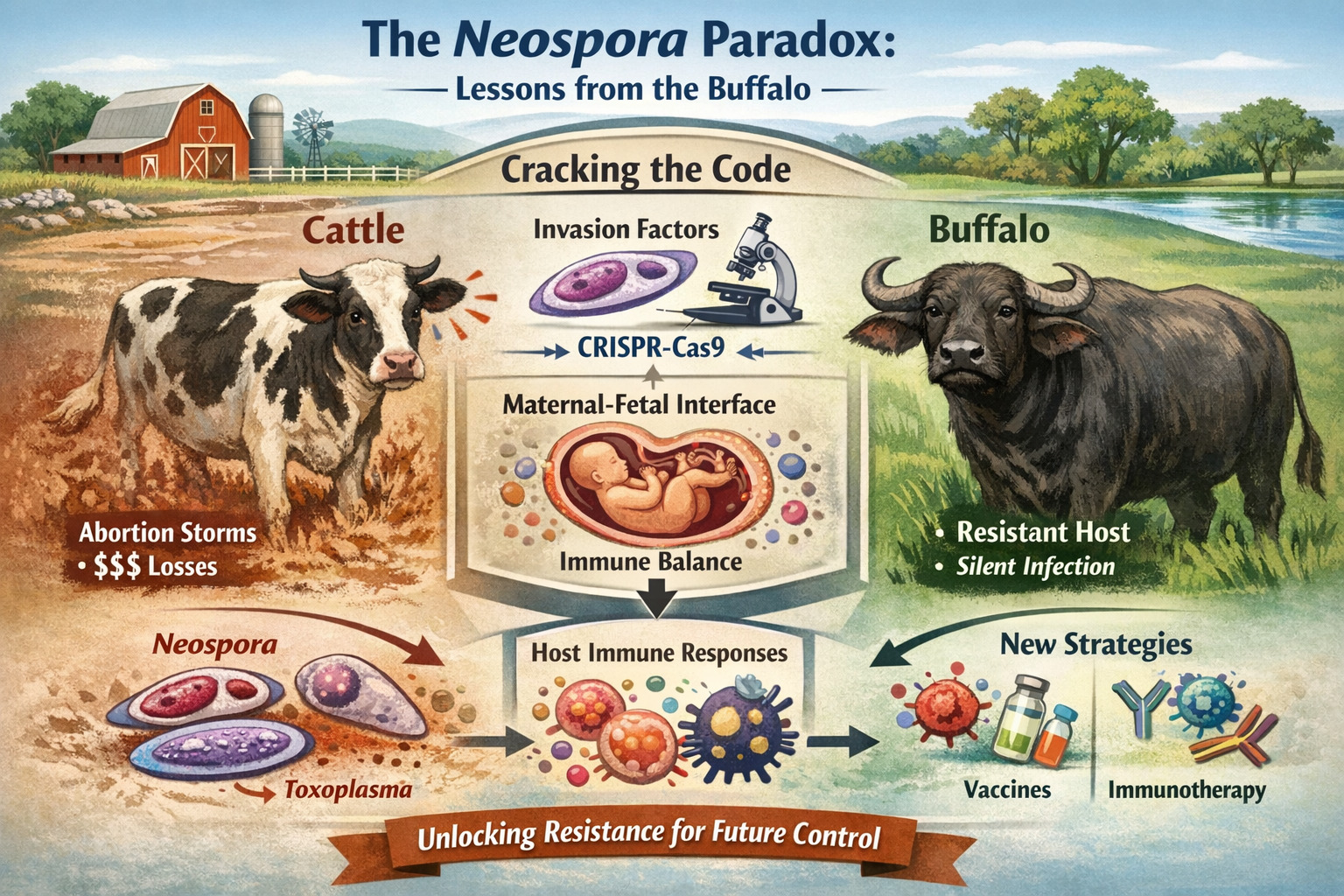
Neospora caninum is a master of reproductive disruption, causing devastating abortion storms in cattle and inflicting annual billion-dollar losses on the global livestock industry. Yet, in water buffaloes (Bubalus bubalis)—a phylogenetically close relative often raised in the same environments—the same parasite often takes on a different role: a silently persisting infection with significantly lower rates of clinical abortion. This review inverts the traditional narrative. Instead of focusing solely on the susceptible host (cattle), we argue that the key to unlocking next-generation control strategies lies in understanding the resistant host (buffalo). By dissecting this “Neospora paradox,” we explore the cut-ting-edge molecular and immunological crosstalk that dictates pregnancy outcomes. We journey from the parasite’s sophisticated arsenal of invasion proteins, revealed by CRISPR-Cas9 screens, to the maternal–fetal interface, where the battle between immune tolerance and parasite control is won or lost. We further examine the intriguing rela-tionship between N. caninum and its similar Toxoplasma gondii, revealing how differential host immune recognition determines infection outcomes. Ultimately, we propose that deciphering the buffalo’s successful equilibrium with N. caninum could illuminate novel pathways for vaccines and immunotherapeutic strategies, transforming the management of neosporosis worldwide.
Keywords:
Neospora caninum
; cattle
; buffalo
; abortion
; vaccine
; Toxoplasma gondii
Copyright: This open access article is published under a Creative Commons CC BY 4.0 license, which permit the free download, distribution, and reuse, provided that the author and preprint are cited in any reuse.


