

Submitted:
15 April 2026
Posted:
17 April 2026
You are already at the latest version
Abstract
Candida albicans is an opportunistic fungal pathogen of clinical relevance, and plant-derived antifungal agents have attracted interest because of rising resistance to conventional drugs. This study evaluated the in vitro antifungal activity of Mespilodaphne quixos (Lam.) Rohwer essential oil (EO) against C. albicans, modelled its concentration-dependent response using a one-factor response surface methodology (RSM) design, and investigated the interactions of its constituents with selected fungal targets by molecular docking. Freshly collected leaves were subjected to steam distillation, and the EO was characterised by GC/MS. Antifungal activity was determined using the Kirby–Bauer disc diffusion method. A one-factor RSM design was applied to model inhibition halo diameter as a function of EO concentration. Besides, 22 identified compounds were docked against 14-α-demethylase, Δ(14)-sterol reductase, and exo-β-(1,3)-glucanase. The EO was mainly composed of (E)-cinnamaldehyde (47.2%), caryophyllene (10.8%), and α-humulene (5.37%). The EO reached an inhibitory capacity of 87.3% relative to ketoconazole. The quadratic model showed good predictive performance. Molecular docking revealed favourable affinities for several sesquiterpenes: α-copaene showed the best interaction profile against 14-α-demethylase and Δ(14)-sterol reductase, whereas α-guaiene and spathulenol performed best against exo-β-(1,3)-glucanase. These findings provide preliminary in vitro and in silico evidence supporting the antifungal activity of M. quixos EO.
Keywords:
Mespilodaphne quixos
; Candida albicans
; essential oil
; antifungal
; response surface methodology
; molecular docking
1. Introduction
In recent decades, infections due to Candida albicans have increased to the point that the World Health Organization (WHO) has named it as a “critical priority pathogen” and studies aimed at combating its spread have necessarily increased, considering that this human pathogen is one of the leading causes of invasive candidiasis and deaths in immunocompromised patients. The search for effective therapeutic approaches depends on various factors, such as interactions with the immune system, antifungal resistance and the biological characteristics of C. albicans itself. Considering the different hygienic-sanitary conditions and the efficiency of the hospital systems, it is estimated that the mortality associated with invasive candidiasis can occur in a range that includes 40% to 75%. At a global level, it has been calculated that approximately 250-700,000 systemic infections occur each year, of which 50-100,000 are fatal [1,2].
The main virulence factors in candidiasis depend on the pathogen’s ability to adhere and create a biofilm, which mimics the penetration of antifungal drugs. The ability to produce enzymes, phenotypic variability and drug-resistance activities complete the pathogen’s defence mechanisms. C. albicans can therefore proliferate on the skin, in the gastrointestinal tract and on oral and vaginal mucous membranes. The therapeutic approach to candidiasis requires the administration of synthetic antimycotics (itraconazole, clotrimazole, fluconazole and ketoconazole), but numerous studies have investigated the integration of these treatments with substances of plant origin, such as essential oils (EOs) and hydrolates, which have been shown to be effective in assisting pharmacological treatments [3,4,5].
EOs and other plant derivatives appear to be effective against clinical strains of C. albicans, boosting the immune system and inhibiting the formation and expansion of C. albicans biofilm [6,7]. Finally, there are studies on the anti-candida efficacy of individual essential oil components (e.g., eugenol and citral) and there is research showing a synergistic effect in combination with antibiotics [8,9].
With this in mind, the present study focuses on in vitro the antifungal activity of the EO of Mespilodaphne quixos (Lam.) Rohwer (Syn. This taxon has been the focus of research pertaining to its essential oil and merits further scrutiny concerning both its phytochemical characterization and its biological properties [10,11,12]. Ocotea quixos (Lam.) Kosterm) against C. albicans. M. quixos belongs to the Lauraceae family, which comprises 55 genera and is widespread throughout the planet [13]. M. quixos is a native tree present in the Andean and the Amazon regions of Ecuador and is commonly called “Ishpink” or “hispingo” as well as “canelo” or “canela del oriente”. The last two names derive from the fact that various botanical parts of the species have an aroma similar to that of the species Cinnamomum verum J.Presl, whose common name in Spanish is precisely “canela”. The essential oil can be extracted from the bark, leaves and calyxes and have been studies for its antimicrobial, antioxidant, anti-inflammatory and larvicidal activity [11,12,14].
In recent years, several experimental, statistical, and in silico tools have been applied to evaluate and predict biological responses associated with natural products and their bioactive constituents [15,16]. Among these approaches, response surface methodology (RSM) and molecular docking are particularly relevant in the context of antifungal research [17]. RSM has been widely used to model the effect of experimental conditions, optimize treatment factors, and predict biological performance [18]. Molecular docking, in turn, has been extensively applied to estimate the interactions between bioactive compounds and specific molecular targets, thus providing mechanistic support for experimentally observed biological effects [19]. Building on this approach, the integration of in vitro evidence with computational frameworks has been applied in analogous studies to support the biological relevance of natural compounds as antifungal candidates against C. albicans [20,21], underscoring the relevance of combined experimental–computational strategies in the early characterization of bioactive plant extracts.
Thus, the aim of this study evaluated the in vitro antifungal activity of M. quixos (Lam.) Rohwer essential oil (EO) against C. albicans, modelled its concentration-dependent response using a one-factor RSM design, and investigated the interactions of its constituents with selected fungal targets by molecular docking.
2. Results
2.1. Extraction Yield of EO from M. quixos
The essential oil from fresh M. quixos leaves was obtained by steam distillation. The oil was characterised by a pale-yellow colour and with a strong fragrance. The yield was 0.32 mL/100g (v/w, fresh weight), calculated based on the fresh weight of the plant material. This value corresponds to the average of multiple independent extractions carried out under the same operating conditions.
2.2. Chemical Characterisation of the EO Obtained from M. quixos
The GC/MS analysis of the EO obtained from M. quixos revealed a total of 22 compounds, accounting for approximately 99.99% of the total chromatogram area (Figure 1). The identification of compounds was carried out by comparing their retention times and mass spectral data with entries from the Wiley library.
The chemical profile of M. quixos EO was characterized by the predominance of phenylpropanoid derivatives, mainly represented by (E)-cinnamaldehyde (47.2%), followed by methyl cinnamate (4.63%), (E)-cinnamyl acetate (1.16%), benzenepropanal (0.81%), (Z)-cinnamaldehyde (0.61%), and cis-isomethyleugenol (0.58%). Sesquiterpenes constituted the most diverse chemical group, including major components such as caryophyllene (10.8%), α-humulene (5.37%), 14-hydroxycaryophyllene (2.98%), α-copaene (1.93%), and bicyclogermacrene (1.33%), together with other minor hydrocarbon and oxygenated sesquiterpenes. Monoterpenes were represented mainly by α-pinene (9.63%) and β-pinene (7.08%), with lower proportions of β-terpinyl acetate (1.36%) and α-terpineol (0.31%). Overall, these results indicate that the of M. quixos EO is defined by a phenylpropanoid-rich profile accompanied by a chemically diverse sesquiterpene fraction. The complete list of identified compounds, including retention times and relative percentages, is presented in Table 1.
This chemical diversity highlights the complex phytochemical profile of M. quixos EO, characterised by a predominance of phenylpropanoids and a broad array of terpenoids. The coexistence of structurally diverse metabolites may contribute to a broad-spectrum mechanism of action, supporting the potential of this essential oil for subsequent bioactivity evaluations.
2.3. Chemical Characterisation of the EO Obtained from M. quixos
The antifungal activity of M. quixos EO against C. albicans was assessed by the Kirby–Bauer disc diffusion method. The predicted inhibition halo diameters were in close agreement with the experimental measurements, indicating a good fit of the model to the observed data. The observed and predicted values for each experimental run are presented in Table 2.
The inhibition halos obtained in the experimental design ranged from 5.00 mm to 17.0 mm (Table 2), reflecting a proportional increase with increasing concentration of M. quixos EO. For the lowest concentrations (20 µL/mL), the inhibition halos were 5.5 ± 0.5 mm, indicating low antifungal activity. At 260 µL/mL and above, more consistent responses were observed, with an average of 12.7 ± 0.2 mm, indicating an improvement in inhibitory capacity. The highest inhibition was achieved at a concentration of 500 µL/mL, with a maximum value of 17.0 mm (Run 9, Table 2) and a mean of 16.0 ± 1.0 mm overall for this concentration. The inhibition halos for the lowest and highest concentrations tested, as well as the positive control, is shown in Figure 2.
These results demonstrate the antifungal potential of the essential oil against C. albicans and justify its inclusion in further validation and therapeutic application studies.
2.4. Modelling of Antifungal Properties of M. quixos EO
The results of the ANOVA (Table 3) for the quadratic model showed that both the overall model and each of its terms were significant, indicating a strong statistical relationship between the concentration of the essential oil and the inhibition halo generated against C. albicans. The non-significant Lack of Fit (p = 0.3201) suggests that deviations between observed and predicted values are attributable to experimental error rather than model inadequacy. In addition, the corrected total sum of squares (Cor Total = 206) reflects the total variability in the response, providing a basis for assessing the model’s capacity to explain the dispersion observed in the experimental data. These findings support the suitability of the quadratic model for accurately representing the system under study.
Regarding model fit, the coefficient of determination (R2) was 0.978, with an adjusted R2 of 0.974 and a predicted R2 of 0.961 values that indicate an excellent explanatory capacity of the model and a high consistency between fitting and predictive ability. The difference between the adjusted and predicted R2 values was less than 0.2, indicating strong internal agreement. Moreover, the residual standard deviation was 0.615 and the model’s coefficient of variation was 5.29%, demonstrating the precision of the estimates.
Figure 3 shows the relationship between the concentration of M. quixos EO and the inhibition halo diameter, calculated using the fitted quadratic model. The curve shows a non-linear behaviour, with an upward trend that begins to stabilize around 400 µL/mL, reaching a maximum inhibitory effect of approximately 16 mm. This behaviour indicates that increasing the concentration of essential oil improves the antifungal activity up to an inhibition value at which further increases do not produce significant improvements in the response variable.
The model accurately predicts the observed values across the entire experimental range (20–500 µL/mL), confirming its usefulness as a tool for estimating antifungal response as a function of concentration. The final quadratic equation, expressed in real units, allows for the estimation of the inhibition halo (Y) in mm based on the essential oil concentration (A) in µL/mL, and can be expressed as follows.
Y=4.60+0.03773×A-0.00003×A2
2.5. Molecular Docking and Interaction Network Analysis
Molecular docking was performed for the 22 compounds identified in the essential oil of M. quixos against three fungal targets:14-α-demethylase, Δ(14)-sterol reductase, and exo-β-(1,3)-glucanase. Binding energies ranged from -5.8 to -8.2 kcal/mol across all ligand-target combinations, and the corresponding affinity values are summarized in Table 4.
Among the essential oil constituents, α-copaene showed the most favourable binding energy toward 14-α-demethylase (-7.9 kcal/mol) and Δ(14)-sterol reductase (-7.1 kcal/mol), whereas α-guaiene and spathulenol recorded the most favourable values against exo-β-(1,3)-glucanase (-8.2 kcal/mol). Nevertheless, ketoconazole showed more favourable binding energies for all three evaluated targets, with values of -10.8 kcal/mol for 14-α-demethylase, -9.5 kcal/mol for Δ(14)-sterol reductase, and -9.2 kcal/mol for exo-β-(1,3)-glucanase. The binding poses and interaction patterns of the selected compounds are presented in the corresponding figures.
As shown in Figure 4, α-copaene and β-copaene shared a common interaction pattern within the binding site of 14-α-demethylase, the ligands were accommodated within the hydrophobic cavity of the active site, adopting conformations that maximize steric complementarity as depicted in Figure 4. Both compounds showed contacts binding contacts with non-polar residues L87, P230, F233, and F380. In addition, α-copaene interacted with Y64 and H377, whereas β-copaene showed additional contacts with L88 and K90. These results indicated similar binding modes for both compounds within the active site of 14-α-demethylase.
Analysis of the docking poses for Δ(14)-sterol reductase showed different interaction patterns for α-copaene and spathulenol. α-Copaene established contacts primarily through hydrophobic interactions with residues E189, Y229, Y233, H236, V240, F300, and R301. Spathulenol, however, exhibited a dual interaction profile, while the molecule maintained extensive hydrophobic packing involving Y245, H248, A251, V252, F312, D363, and R395, it additionally formed two conventional hydrogen bonds with N316 and R313 at distances of 2.82 Å and 3.04 Å, respectively. These results revealed a differential arrangement and stabilization strategy of both compounds within the binding cavity of Δ(14)-sterol reductase (Figure 5).
For exo-β-(1,3)-glucanase, the computational analysis revealed different interaction patterns for α-guaiene and spathulenol. In the case of α-guaiene, the ligand mainly formed hydrophobic contacts with residues F182, N184, E230, F296, L342, N343, and R350, with a stronger contribution from F182, F296, and L342. Spathulenol, on the other hand, showed a more diverse interaction pattern. Along with hydrophobic packing against aromatic residues such as F182, Y293, F267, and F296, it also interacted with N184, E230, E330, and L342. A hydrogen bond was identified between its hydroxyl group and N184, with a distance of 2.85 Å, which could contribute to local stabilization of the complex. Both ligands were located within the active site and shared several non-polar anchoring residues. However, the additional interactions involving polar residues in spathulenol suggest a slightly stronger stabilization within the binding pocket. Taken together, these results indicate that ligand binding may suggest a potential interference with substrate access to the catalytic region (Figure 6).
The molecular docking results showed that several sesquiterpenes from the essential oil of M. quixos exhibited favourable binding affinities toward the three fungal targets evaluated. α-Copaene showed the most favourable interaction profile against 14-α-demethylase and Δ(14)-sterol reductase, whereas α-guaiene and spathulenol stood out against exo-β-(1,3)-glucanase. Overall, these findings provide preliminary in silico support for the possible contribution of these compounds to the antifungal activity observed experimentally.
3. Discussion
The essential oil yield obtained from fresh leaves of M. quixos (0.32 mL/100 g fresh weight) was slightly higher than the 0.24% reported by Arteaga-Crespo et al. [21] for M. quixos. A study performed by Gilardoni et al. [10] mentioned a weight-based yields of 1.52%. The yield reported for the present research was lower than the 0.37, 0.51, and 0.96 mL/100 g values reported for Ocotea leptobotra (Ruiz & Pav.) Mez, Ocotea puberula (Rich.) Nees, and Ocotea odorifera (Vell.) Rohwer, respectively, by Gil et al. [23] and Mezzomo et al. [24], all belonging to the same family (Lauraceae). These differences in yield can be attributed to various factors, including genetic variability among species, agroecological cultivation conditions, the physiological state of the plants at the time of harvest, and specific distillation parameters such as process duration and steam flow rate [25,26]. Additionally, in the case of M. quixos, the relatively low yield may be related to a lower concentration of volatile compounds in fresh leaves, as other studies have reported higher essential oil yields when leaves were subjected to drying treatments prior to extraction [27].
The chemical diversity observed, with 22 identified compounds belonging to different structural groups, reflects the metabolic complexity within the Lauraceae family. Discrepancies in the chemical profile of the essential oil are evident in the literature; while Gilardoni et al. [10] reported a prevalence of (E)-cinnamyl acetate (46.0–50.4%), Sosa et al. [11] found (E)-methyl cinnamate to be the major component, albeit at a lower concentration (19.3%).
The chemical profile identified in the essential oil of M. quixos presents distinctive features that set it apart from other species within the Lauraceae family, including those historically grouped under the genus Ocotea. Most species within this taxonomic group are characterised by volatile profiles dominated by monoterpenes and sesquiterpenes, as reported for O. leptobotra [23], O. puberula [24,28], and O. odorifera [29], where compounds such as β-caryophyllene, germacrene D, and α-humulene constitute the main component. However, other species within the Lauraceae family, such as those belonging to the genus Cinnamomum, have also been reported to possess volatile profiles dominated by phenylpropanoids. In a study conducted by Rawat et al. [30], the essential oil of Cinnamomum tamala (Buch.-Ham.) T.Nees & C.H.Eberm. was found to contain (E)-cinnamaldehyde (21.04%) and (E)-cinnamyl acetate (54.49%) as major components similar to the behaviour of the results of this study.
This type of differentiation in chemical composition has been documented even within the same species. For instance, in a study conducted by Saha et al. [31] on essential oils extracted from C. verum collected in different geographical regions of India, markedly distinct chemical profiles were observed. The essential oils from leaves collected in Kharagpur exhibited a profile dominated by phenylpropanoids (81.98%), whereas those from Mamit were characterised by a predominance of monoterpenoids (48.42%), with eugenol and linalool as the principal compounds, respectively. Despite the absence of significant structural differences in the secretory tissues, the variation in chemical composition enabled the classification of these populations into distinct chemotypes. The study concluded that environmental and geographical factors can significantly influence the phytochemical profile of species within the Lauraceae family, which could also help explain the unique chemical composition of M. quixos. These findings highlight the importance of chemotaxonomic and ecological factors when evaluating essential oil profiles. The compositional uniqueness of M. quixos, characterized by its phenylpropanoid-rich profile, reinforces the need for further investigations aimed at understanding the ecological drivers and biosynthetic pathways.
The antifungal activity of M. quixos EO against C. albicans exhibited a behaviour characterised by an increase in the inhibition halo diameter proportional to the rising concentration of the oil. A previous study performed by Sosa et al. [11] showed a MIC value of 273.69 µg/mL. This pattern is consistent with that reported in other in vitro studies of essential oils, where the accumulation of bioactive compounds in the medium inhibits the growth of the pathogenic fungus [32,33]. Furthermore, a slight tendency towards stabilisation was observed at concentrations above 400 µL/mL, suggesting a possible saturation threshold in the inhibitory capacity of the essential oil. This phenomenon could be related to the saturation of specific target sites, either at the membrane level or in enzymatic systems of C. albicans, thus limiting the inhibitory efficacy once a critical concentration of the oil’s main active compounds is reached [34,35].
The inhibitory capacity of M. quixos EO reached 87.3% relative to ketoconazole, indicating a substantial anticandidal effect under the experimental conditions of this study. This comparison is relevant because ketoconazole remains a standard azole reference in antifungal susceptibility assays against Candida spp., and prior evidence suggests that its activity may be potentiated in association with natural phenolic compounds [36]. Although cross-study comparisons must be interpreted with caution due to differences in assay design, strain susceptibility, and response criteria, this result places M. quixos EO within the range of biologically active plant-derived oils reported against C. albicans.
In this regard, essential oil from Origanum majorana L. exhibited marked activity against both planktonic and biofilm-forming C. albicans, with IC50 and IC90 values ≤ 0.5 µg/mL and strong inhibition of germ-tube formation, whereas Eugenia uniflora L. oil required substantially higher concentrations and showed indifferent or antagonistic interactions with fluconazole [33,37]. Against this background, the activity recorded for M. quixos EO reinforces its relevance as a promising Amazonian source of anticandidal metabolites and provides a coherent basis for relating the observed biological response to its chemical composition.
However, the antifungal activity depends on both the presence and the concentration of bioactive compounds in the essential oil [38]. In the case of M. quixos EO, this activity could be attributed to the high proportion of phenylpropanoids, among which (E)-cinnamaldehyde was identified as the most abundant component. This compound has been widely documented for its ability to alter the permeability of the plasma membrane and organelles, as well as to disrupt the energy metabolism of pathogenic fungi, compromising their structural integrity and causing the loss of essential intracellular components [39,40,41]. In addition, it has been suggested that (E)-cinnamaldehyde interferes with key metabolic pathways, such as ergosterol biosynthesis and oxidative enzyme activity. Its inhibitory effect against Aspergillus niger DTZ-12 has also been reported to be significantly stronger than that of other common antifungal agents such as eugenol, carvacrol, and linalool [42]. On the other hand, the presence of sesquiterpenes such as caryophyllene, α-humulene and humulene epoxide II could also contribute synergistically to the inhibitory effect, by inducing oxidative stress or altering cell membrane-associated functions [43]. The phytochemical composition of M. quixos EO therefore suggests a multifactorial effect, with different mechanisms of action acting in a complementary manner to inhibit C. albicans growth, which may explain the high relative efficacy observed in this study.
Nevertheless, it should be noted that these evaluations were conducted under in vitro conditions; therefore, further studies should validate these findings in more complex models that reflect biological activity under real physiological conditions, as well as explore possible synergistic mechanisms with conventional antifungal agents.
On the other hand, the quadratic model employed adequately described the relationship between the concentration of M. quixos EO and the antifungal response against C. albicans. This behaviour is common in biological systems, as increasing the concentration of an active agent may lead to saturation thresholds or points of maximum inhibition, resulting in a parabolic or curvilinear response [37]. The quadratic model has been widely used in studies evaluating the efficacy of natural compounds, including essential oils, plant extracts, or pure metabolites, where the chemical complexity of the matrix can induce non-linear responses against pathogenic microorganisms [44,45,46].
The high values of R2, adjusted R2, and predicted R2 obtained in this study support the statistical robustness of the applied quadratic model. The closeness among these coefficients indicates that the model not only fits the observed experimental data well but also exhibits reliable predictive capacity within the evaluated range. The minimal difference between the adjusted and predicted values demonstrates that the inclusion of the quadratic term significantly contributed to the model’s fit without compromising its stability [47].
The developed quadratic model constitutes a practical tool for accurately estimating the concentrations of M. quixos EO that produce an inhibitory effect against C. albicans, without the need for additional experimental trials within the evaluated range [38]. This predictive capability is particularly valuable during the formulation stages of biofungicides, where it is essential to optimise the effective dose while minimising raw material usage. Furthermore, the model may serve as a basis for the design of factorial studies or validation experiments that incorporate additional factors, such as fungal strain type or variable environmental conditions [48]. Although the model has demonstrated robustness within the established experimental framework, it would be advisable to assess its performance under other biological conditions or against different Candida strains and other phytopathogens, in order to broaden its applicability and confirm its predictive value in wider contexts [49].
The molecular docking results provided a plausible structural basis to explain the antifungal activity observed at the experimental level. In this context, the interaction patterns identified across the evaluated complexes are largely governed by the intrinsic physicochemical properties of the ligands. As expected, the sesquiterpene hydrocarbons α-copaene, β-copaene, and α-guaiene lack heteroatoms, which inherently limits their ability to establish strong directional interactions such as hydrogen bonds. As a result, their binding behaviour is predominantly governed by non-specific forces, particularly London dispersion and hydrophobic contacts within non-polar regions of the target proteins.
This preference for hydrophobic packing becomes particularly evident in lanosterol 14-α-demethylase (CYP51), where docking poses suggest that both copaene isomers (α-copaene and β-copaene) can be accommodated within a predominantly hydrophobic cavity, in which their rigid polycyclic structures favour close packing against aromatic and aliphatic residues, including phenylalanine (F), tyrosine (Y), and leucine (L) (Figure 4). Stabilization appears to arise primarily from dispersion forces and steric complementarity, rather than from specific anchoring interactions. This behaviour is consistent with previously reported binding modes of non-polar terpenes within CYP51 and aligns with the antifungal relevance of this enzyme as a key component of ergosterol biosynthesis [17,50].
A different interaction pattern emerges when considering Δ(14)-sterol reductase and exo-β-(1,3)-glucanase. Here, even minor structural modifications appear to influence ligand recognition in a more noticeable way. While α-copaene and α-guaiene maintain interaction profiles dominated by dispersion forces, spathulenol introduces an additional level of complexity due to the presence of a hydroxyl group.
For Δ(14)-sterol reductase, the binding pattern showed more pronounced differences between α-copaene and spathulenol (Figure 5). While α-copaene appears to rely predominantly on hydrophobic contacts within an aromatic-rich environment, the presence of a hydroxyl group in spathulenol introduces an additional interaction component. This functional group may facilitate localized polar contacts, including hydrogen bonding with residues such as R313 and N316. This feature likely contributes to a more defined binding arrangement in which hydrophobic packing is complemented by strategically positioned polar interactions. A similar behaviour has been reported in molecular dynamics studies, where the hydroxyl group of spathulenol was associated with increased conformational stability of the ligand–protein complex A similar behaviour has been reported in molecular dynamics studies, where the hydroxyl group of spathulenol was associated with increased conformational stability of the ligand-protein complex [51].
The exo-β-(1,3)-glucanase models reflect a comparable trend The hydrocarbon α-guaiene appears to interact primarily through dispersion-driven contacts, whereas spathulenol may achieve additional conformational stabilization through polar interactions involving residues such as N184 (Figure 6) [52]. These findings reinforce the idea that subtle structural differences among sesquiterpenes can translate into meaningful variations in their interaction profiles, in agreement with what was described by Khan et al. [53] for other plant-derived sesquiterpenes. These results suggest that several sesquiterpenes from the essential oil may collectively contribute to the antifungal effect through interactions with relevant molecular targets of C. albicans. However, these observations should be considered as preliminary mechanistic insights rather than direct evidence of enzymatic inhibition.
Despite these structurally favourable arrangements, it is important to acknowledge that docking scoring functions provide only approximate estimates and may not fully capture the dynamic behaviour of protein–ligand systems or the influence of solvent effects [54,55]. Considering these limitations, the interaction patterns observed in this study suggest a multi-target mode of action rather than strong inhibition of a single enzyme. Instead, the data support a scenario in which moderate but complementary interactions occur across different proteins involved in key physiological processes of C. albicans. In this context, α-copaene appears to preferentially interact with 14-α-demethylase and Δ(14)-sterol reductase, whereas α-guaiene and spathulenol show a comparatively better fit within the active site of exo-β-(1,3)-glucanase. This distribution of interactions supports the idea that the antifungal activity of the essential oil may arise from the combined effect of multiple sesquiterpenes acting simultaneously across different biological pathways, rather than from a single dominant compound in C. albicans. From a drug design perspective, these naturally occurring scaffolds may represent valuable starting points for the development of optimized antifungal agents, particularly within strategies that aim to exploit multi-target pharmacological effects [56].
4. Materials and Methods
4.1. Samples
The leaves of M. quixos were collected during the early morning hours in December 2024. The samples were obtained from ten spatially separated adult trees located on the main campus of the Universidad Estatal Amazónica in Puyo, Pastaza Province, Ecuador (1°28’00.1’’ S, 77°59’49.0’’ W). Sampling was conducted following a random design to ensure the representativeness of the samples. Botanical identification was carried out with the assistance of Dr. Diego Gutiérrez del Pozo at the Herbarium of the Universidad Estatal Amazónica (ECUAMZ).
4.2. EO Extraction
The essential oil from M. quixos leaves was extracted using the steam distillation. Fresh leaves were placed in a FIGMAY laboratory-scale essential oil extractor (model: FIGMAY S.R.L. laboratory scale, Córdoba, Argentina), following the procedure reported by Berrú et al. [57]. The distillation process was maintained with a continuous steam flow until the oil volume readings remained consistent. To ensure an adequate amount of essential oil, multiple extractions were conducted. The extracted oil was then treated with anhydrous sodium sulphate to eliminate residual moisture, filtered, and stored in sealed vials at 4 °C, avoiding light exposure.
4.3. Gas Chromatography – Mass Spectrometry (GC/MS) Analysis
The essential oil from fresh M. quixos leaves was analysed using gas chromatography-mass spectrometry (GC/MS) following the method described by Berrú et al. [57], with slight modifications. In brief, 250 µL of M. quixos EO were added to a 5 mL flask and volumetrically diluted with HPLC-grade hexane. A 1 µL volume of the diluted sample was injected into the system. Before analysis, the samples were filtered using a hydrophilic Millipore needle microfilter (PTFE, Luer) with dimensions of 13 mm/25 mm and a membrane pore size of 0.22/0.45/1.2 µm. A Shimadzu model QP2020 NX (Shimadzu Europe, Duisburg, Germany) equipped with a split-splitless injector and an AOC-20i autosampler was used for the analysis. The capillary column characteristics included fused silica from Thermo Scientific (Thermo Fisher Scientific, Waltham, MA, USA), with a length of 30 m × 0.32 mm I.D. × 0.5 µm. The oven temperature was programmed at 50 °C for 4 min, followed by a 10 °C/min increase until reaching 220 °C, maintaining this temperature for 2 min. The carrier gas was helium (99.99%) with a mobile phase flow rate of 1.10 mL/min, a linear velocity of 40 cm/s, a purge flow of 3.00 mL/min, and a split ratio of 25:1. The obtained mass spectra were verified using the Wiley library installed in the equipment software (John Wiley & Sons, Hoboken, NJ, USA), applying a spectral similarity threshold of 80% or higher.
4.4. Antifungal Screening
The microorganism C. albicans (ATCC 10231) was used to determinate the antifungal activity of the EO from M. quixos leaves. The strain was purchased from Medibac Laboratories in Guayaquil, Ecuador, and stored at -80 °C in the microbiology laboratory of the Universidad Estatal Amazónica until needed.
The C. albicans strain was reactivated by incubating it in sealed test tubes containing potato dextrose agar (PDA, BD Bioxon®) at a concentration of 39 g/L in water. The incubation was carried out at 30 °C for 48 h, in corresponding with the procedures described by Feldman et al. [58]. Then the strain was diluted in Sabouraud’s dextrose broth at a concentration of 30 g/L until a suspension with a turbidity of 0.5 on the McFarland scale was obtained, corresponding to a concentration of 1.5 × 10⁸ CFU/mL [59]. The absorbance of the McFarland standard and the microbial suspension was determined at 625 nm using a Lambda 25 UV/VIS spectrophotometer (Perkin Elmer, Waltham, MA, USA). The measurement process continued until the concentration of the microbial suspension was equivalent to the McFarland 0.5 standard.4.5. Determination of the inhibitory effect of the M. quixos EO.
4.5. Determination of the Inhibitory Effect of the M. quixos EO
The antifungal properties of M. quixos EO against C. albicans were assessed using the Kirby-Bauer disk diffusion method [60]. Sterile 5 mm filter paper discs impregnated with different concentrations of the essential oil were gently positioned at uniform distances from the edges of Petri dishes containing potato dextrose agar (PDA) previously inoculated. A 2% ketoconazole cream was used as the positive control. The diameters of the inhibition zones were measured through the centre of each disc after incubation at 37 °C for 48 h. All experiments were conducted in triplicate to ensure the reproducibility of the results.
4.6. Design of Experiments and Model Fitting
In the experimental design, One-Factor RSM was applied using Design Expert software, version 12 (Minneapolis, MN, USA). For the configuration of experimental points, I-optimal design and Point Exchange were selected. The design included: required model points (3), replicate points (5), lack-of-fit points (5) and additional centre points (2), for a total of 15 experimental runs. The concentration range of M. quixos EO evaluated in the model was from 20 µL/mL to 500 µL/mL. The diameter of the inhibition zone was used as the response variable. Model fitting was conducted using a second-order quadratic equation, expressed as follows:
where Y represents the inhibition halo diameter (mm), X the concentration of the essential oil (μL/mL), β0 is the independent term, β1 and β2 are the linear and quadratic regression coefficients, respectively, and ε is the error term. ANOVA was performed to assess the statistical significance of the independent variable and its quadratic effect, considering a significance level of p <0.05, ensuring the adequacy of the model in representing the experimental data.
Y=β0+β1X+β2X2+ε
4.7. Molecular Docking Study
The molecular docking study was conducted to investigate the interactions between the bioactive compounds identified in the essential oil of M. quixos and specific target proteins of C. albicans and Candida tropicalis, using the study by Benhniya et al. [61] as a reference. Initially, the three-dimensional crystallographic structures of the target enzymes 14-α-demethylase (CYP51) (PDB ID: 5TZ1; resolution: 2.00 Å) [62], Δ(14)-sterol reductase (PDB ID: 4QUV; resolution: 2.74 Å) [63] and exo-β-(1,3)-glucanase (PDB ID: 1EQC; resolution: 1.85 Å) [64]. The crystallographic structures were downloaded from the Protein Data Bank (https://www.rcsb.org; accessed on 17 October 2025) in .pdb format.
Protein preparation was performed using UCSF Chimera v1.19 (University of California, San Francisco, USA) [65]. All non-essential components, such as water molecules, exogenous ligands, and irrelevant ions, were removed. The coordinates of the active site for each protein were identified based on the position of the co-crystallised ligand present in the original structures. Subsequently, AutoDockTools v1.5.7 (The Scripps Research Institute, La Jolla, CA, USA) [66] was used to complete receptor preparation. Polar hydrogens and Kollman partial charges were added, and the structures were saved in .pdbqt format, compatible with the AutoDock Vina calculation engine [67].
The 22 compounds identified in the essential oil of M. quixos by GC/MS were prepared as ligands, together with ketoconazole, which was used as the reference compound. The compound structures were obtained from PubChem (https://pubchem.ncbi.nlm.nih.gov/, accessed on 25 October 2025) and optimised using the MMFF94 force field in Avogadro v1.2.0 (Open Chemistry Project, Pittsburgh, PA, USA). The optimised molecules were saved in .mol2 format [68]. Subsequently, the files were processed in AutoDockTools v1.5.7, where polar hydrogens were added, Gasteiger charges were assigned, and rotatable carbons were defined. Finally, the ligands were saved in .pdbqt format for subsequent molecular docking analysis.
To validate the methodology, the molecular redocking approach was applied to the three target proteins using their native ligands: castanospermine (CTS; 1EQC), NADPH dihydro-nicotinamide-adenine-dinucleotide phosphate (NDP; 4QUV) and protoporphyrin IX containing Fe (HEM; 5TZ1). The same preparation procedure and calculation parameters described above were applied to all ligands. A validation criterion of root mean square deviation (RMSD) < 3 Å was used, calculated using VMD v2.0 (University of Illinois at Urbana–Champaign, IL, USA) [69]. See Supplementary material S1.
Finally, computational modelling studies were carried out to generate the binding complex and predict the binding affinities between the natural compounds and selected enzymatic receptors. Rigid-receptor molecular docking calculations were performed for each system using AutoDock Vina v1.2.0 (The Scripps Research Institute, La Jolla, CA, USA) [67]. The coordinates and dimensions of the grid box were carefully defined around the known catalytic cavities to encompass the entire binding pocket, allowing the ligands unrestricted exploration of the active site.
The coordinates of the active site and grid box dimensions were as follows: X = 34.75; Y = 36.65; Z = 56.21; size = 20 × 20 × 20 (1EQC), X = –21.30; Y = –9.16; Z = 26.43; size = 30 × 30 × 30 (4QUV), and X = 64.16; Y = 71.32; Z = 2.71; size = 34 × 30 × 32 (5TZ1). The exhaustiveness parameter was set to 16, and the number of docking modes was fixed at 9 for all calculations.
The selection of the best-docked conformations was fundamentally based on the most negative binding energy scores (expressed in kcal/mol) and the physical feasibility of the intermolecular contacts. Finally, to thoroughly analyse the structural basis of the binding affinity, spatial interaction diagrams were generated using UCSF Chimera [65] and LigPlot+ [70] to map the key interacting residues, hydrophobic contacts, and structural stabilization mechanisms within the binding pockets.
5. Conclusions
The essential oil of M. quixos showed relevant antifungal activity against C. albicans under in vitro conditions, reaching an inhibitory capacity of 87.3% relative to ketoconazole. Chemical characterization revealed a profile dominated by phenylpropanoids, with (E)-cinnamaldehyde as the major component, accompanied by an important fraction of monoterpenes and sesquiterpenes. The quadratic model obtained adequately described the relationship between essential oil concentration and inhibition halo diameter against C. albicans, with high goodness-of-fit and predictive capacity. In this sense, the developed model constitutes a useful basis for future optimization and formulation stages. Molecular docking analysis provided complementary in silico evidence for interpreting the antifungal activity observed experimentally. The results suggest that the antifungal contribution of M. quixos EO does not depend exclusively on its major compound, but may also involve the participation of several sesquiterpenes with affinity toward different fungal targets. This interpretation was reinforced by the agreement between the in vitro and in silico results, since ketoconazole showed both a greater experimental antifungal response and more favourable binding energies than the compounds identified in the essential oil. Even so, the interaction profiles of α-copaene, α-guaiene, and spathulenol provide preliminary mechanistic support for explaining the antifungal activity of the EO. The results obtained support the potential of M. quixos EO as a promising natural source of anticandidal compounds. However, additional studies in more complex biological models are required to confirm its efficacy, clarify its mechanisms of action, and explore possible synergistic effects with conventional antifungal agents.
Supplementary Materials
The following supporting information can be downloaded at the website of this paper posted on Preprints.org, Supplementary Materials S1: Validation of the molecular docking protocol by redocking the native ligands of 1EQC, 4QUV, and 5TZ1.
Author Contributions
Conceptualization, R.A.-N., Y.A.-C. and Y.G.-Q.; methodology, Y.A.-C., R.A.-N., Y.V.-L., M.M.C.G. and J.L.R.B.; formal analysis, R.A.-N., M.M.C.G. and J.L.R.B.; investigation, Y.A.-C. and Y.G.-Q.; resources, Y.A.-C. and Y.G.-Q.; data curation, R.A.-N., Y.V.-L., J.B.-S. and M.R.; writing—original draft preparation, R.A.-N., Y.V.-L., J.B.-S. and M.R.; writing—review and editing, R.A.-N., Y.V.-L., J.B.-S. and M.R.; visualization, R.A.-N., Y.A.-C. and Y.V.-L.; supervision, R.A.-N., Y.A.-C. and Y.G.-Q. All authors have read and agreed to the published version of the manuscript.
Funding
This research received no external funding.
Institutional Review Board Statement
Not applicable.
Informed Consent Statement
Not applicable.
Data Availability Statement
Additional data supporting the findings of this study are available from the corresponding author upon reasonable request.
Acknowledgments
The authors gratefully acknowledge the Universidad Estatal Amazónica for its institutional and technical support, as well as for access to the laboratory facilities used in this study. The authors also thank Ms. Helen Pugh for her careful proofreading of the manuscript.
Conflicts of Interest
The authors declare no conflicts of interest.
References
- Katsipoulaki, M.; Stappers, M.H.T.; Malavia-Jones, D.; Brunke, S.; Hube, B.; Gow, N.A.R. Candida albicans and Candida glabrata: global priority pathogens. Microbiology and Molecular Biology Reviews 2024, 88, e00021-00023. [Google Scholar] [CrossRef]
- WHO. WHO fungal priority pathogens list to guide research, development and public health action; World Health Organization: Geneva, 2022. [Google Scholar]
- Silva, K.G.d.S.; Nascimento, G.O.d.; Silva, E.E.M.d.; Cabral, L.H.V.; Faria, T.M.R.; Oliveira, J.R.d. Candida albicans: Virulence factors, pathogenesis, and ways to diagnose and control its infection. Research, Society and Development 2024, 13, e6413144781. [Google Scholar] [CrossRef]
- Lee, Y.; Puumala, E.; Robbins, N.; Cowen, L.E. Antifungal Drug Resistance: Molecular Mechanisms in Candida albicans and Beyond. Chemical Reviews 2021, 121, 3390–3411. [Google Scholar] [CrossRef] [PubMed]
- Di Vito, M.; Smolka, A.; Proto, M.R.; Barbanti, L.; Gelmini, F.; Napoli, E.; Bellardi, M.G.; Mattarelli, P.; Beretta, G.; Sanguinetti, M.; et al. Is the Antimicrobial Activity of Hydrolates Lower than That of Essential Oils? Antibiotics 2021, 10, 88. [Google Scholar] [CrossRef]
- Loaiza-Oliva, M.; Arias-Durango, L.; Martínez-Pabón, M.C. The Cytotoxic and Inhibitory Effects of Plant Derivatives on Candida albicans Biofilms: A Scoping Review. Molecules 2023, 28, 130. [Google Scholar] [CrossRef] [PubMed]
- Tullio, V.; Roana, J.; Cavallo, L.; Mandras, N. Immune Defences: A View from the Side of the Essential Oils. Molecules 2023, 28, 435. [Google Scholar] [CrossRef]
- Shahina, Z.; Dahms, T.E.S. A Comparative Review of Eugenol and Citral Anticandidal Mechanisms: Partners in Crimes Against Fungi. Molecules 2024, 29, 5536. [Google Scholar] [CrossRef]
- Bhattacharya, R.; Rolta, R.; Dev, K.; Sourirajan, A. Synergistic potential of essential oils with antibiotics to combat fungal pathogens: Present status and future perspectives. Phytotherapy Research 2021, 35, 6089–6100. [Google Scholar] [CrossRef]
- Gilardoni, G.; Montalván, M.; Vélez, M.; Malagón, O. Chemical and Enantioselective Analysis of the Essential Oils from Different Morphological Structures of Ocotea quixos (Lam.) Kosterm. Plants 2021, 10, 2171. [Google Scholar] [CrossRef] [PubMed]
- Sosa, L.; Espinoza, L.C.; Valarezo, E.; Bozal, N.; Calpena, A.; Fábrega, M.-J.; Baldomà, L.; Rincón, M.; Mallandrich, M. Therapeutic Applications of Essential Oils from Native and Cultivated Ecuadorian Plants: Cutaneous Candidiasis and Dermal Anti-Inflammatory Activity. Molecules 2023, 28, 5903. [Google Scholar] [CrossRef]
- Bermúdez-del Sol, A.; Sarango, G.N.C.; Eduardo, G.C.A.; Sánchez, L.R.B. Characterization and antioxidant activity of the essential oil of Mespilodaphne quixos (Lam.) Rohwer (amazonian cinnamon). Interamerican Journal of Health Sciences 2024, 4, 102–102. [Google Scholar] [CrossRef]
- Trofimov, D.; de Moraes, P.L.R.; Rohwer, J.G. Towards a phylogenetic classification of the Ocotea complex (Lauraceae): classification principles and reinstatement of Mespilodaphne. Botanical Journal of the Linnean Society 2019, 190, 25–50. [Google Scholar] [CrossRef]
- Scalvenzi, L.; Radice, M.; Toma, L.; Severini, F.; Boccolini, D.; Bella, A.; Guerrini, A.; Tacchini, M.; Sacchetti, G.; Chiurato, M.; et al. Larvicidal activity of Ocimum campechianum, Ocotea quixos and Piper aduncum essential oils against Aedes aegypti. Parasite 2019, 26, 23. [Google Scholar] [CrossRef]
- Atanasov, A.G.; Zotchev, S.B.; Dirsch, V.M.; Orhan, I.E.; Banach, M.; Rollinger, J.M.; Barreca, D.; Weckwerth, W.; Bauer, R.; Bayer, E.A.; et al. Natural products in drug discovery: advances and opportunities. Nature Reviews Drug Discovery 2021, 20, 200–216. [Google Scholar] [CrossRef] [PubMed]
- Mali, S.N.; dos Santos, C.B.R.; Campos Rosa, J.; Neves Cruz, J. Editorial: Investigation of the biological properties of natural products using experimental approaches and in silico methods. Frontiers in Chemistry 2024, Volume 12 - 2024. [CrossRef]
- Bohlooli, F.; Sepehri, S.; Razzaghi-Asl, N. Response surface methodology in drug design: A case study on docking analysis of a potent antifungal fluconazole. Computational Biology and Chemistry 2017, 67, 158–173. [Google Scholar] [CrossRef]
- Murcia-Artunduaga, K.S.; Maca, A.V.; Suarez-Collazos, K.; Castañeda, M.d.R. Optimización del efecto antifúngico de extractos de ají (Capsicum frutescens) sobre el crecimiento in vitro de Moniliophthora roreri, causante de la moniliasis en cacao. Acta Agronómica 2023, 72, 188–195. [Google Scholar] [CrossRef]
- Meng, X.-Y.; Zhang, H.-X.; Mezei, M.; Cui, M. Molecular Docking: A Powerful Approach for Structure-Based Drug Discovery. Current Computer-Aided Drug Design 2011, 7, 146–157. [Google Scholar] [CrossRef] [PubMed]
- Abdelaal, Z.; Boya, B.R.; Lee, J.-H.; Lee, J. Targeting Als3 adhesin of clinically relevant Candida species using natural carotenoids: an in-silico study. Molecular Diversity 2026. [Google Scholar] [CrossRef]
- Manjappa, B.; Sharan, S.G.; Prabhu, S.; V, R.S. Targeting morphological transitions in Candida albicans using phytochemicals derived from Capsicum frutescens L. Next Research 2025, 2, 100761. [Google Scholar] [CrossRef]
- Arteaga-Crespo, Y.; Ureta-Leones, D.; García-Quintana, Y.; Montalván, M.; Gilardoni, G.; Malagón, O. Preliminary Predictive Model of Termiticidal and Repellent Activities of Essential Oil Extracted from Ocotea quixos Leaves against Nasutitermes corniger (Isoptera: Termitidae) Using One-Factor Response Surface Methodology Design. Agronomy 2021, 11, 1249. [Google Scholar] [CrossRef]
- Gil, E.; Cuca, L.E.; Delgado, W.A. Chemical composition and antimicrobial activity of the essential o il of the leaves of Ocotea caudata (Nees) Mez (Lauraceae) from Colombia. Boletín Latinoamericano y del Caribe de plantas medicinales y aromáticas 2016, 15, 258–263. [Google Scholar]
- Mezzomo, P.; Sausen, T.L.; Paroul, N.; Roman, S.S.; Mielniczki, A.A.P.; Cansian, R.L. Antifungal activity of Ocotea odorifera (Vell.) Rowher, Ocotea puberula (Rich.) Nees and Cinnamodendron dinisii Schwanke essential oils. bioRxiv 2019, 859272. [Google Scholar] [CrossRef]
- Marčac, N.; Balbino, S.; Tonković, P.; Medved, A.M.; Cegledi, E.; Dragović, S.; Dragović-Uzelac, V.; Repajić, M. Hydrodistillation and Steam Distillation of Fennel Seeds Essential Oil: Parameter Optimization and Application of Cryomilling Pretreatment. Processes 2023, 11, 2354. [Google Scholar] [CrossRef]
- Valarezo, E.; Vullien, A.; Conde-Rojas, D. Variability of the Chemical Composition of the Essential Oil from the Amazonian Ishpingo Species (Ocotea quixos). Molecules 2021, 26, 3961. [Google Scholar] [CrossRef] [PubMed]
- Ghasemi Pirbalouti, A.; Mahdad, E.; Craker, L. Effects of drying methods on qualitative and quantitative properties of essential oil of two basil landraces. Food Chemistry 2013, 141, 2440–2449. [Google Scholar] [CrossRef] [PubMed]
- Rambo, M.A.; Soares, K.D.; Danielli, L.J.; Lana, D.F.D.; Bordignon, S.A.d.L.; Fuentefria, A.M.; Apel, M.A. Biological activities of essential oils from six genotypes of four Ocotea species. Brazilian Journal of Pharmaceutical Sciences 2022, 58. [Google Scholar] [CrossRef]
- Almeida, R.S.; Freitas, P.R.; Araújo, A.C.J.; Alencar Menezes, I.R.; Santos, E.L.; Tintino, S.R.; Moura, T.F.; Filho, J.R.; Ferreira, V.A.; Silva, A.C.A.; et al. GC-MS Profile and Enhancement of Antibiotic Activity by the Essential Oil of Ocotea odorífera and Safrole: Inhibition of Staphylococcus aureus Efflux Pumps. Antibiotics 2020, 9, 247. [Google Scholar] [CrossRef] [PubMed]
- Rawat, A.; Bhatt, D.; Kholiya, S.; Chauhan, A.; Bawankule, D.U.; Chanotiya, C.S.; Padalia, R.C. Comparative Chemical Composition and Acetylcholinesterase (AChE) Inhibitory Potential of Cinnamomum camphora and Cinnamomum tamala. Chemistry & Biodiversity 2023, 20, e202300666. [Google Scholar] [CrossRef]
- Saha, S.; Raktim, B.; Megha, C.; Kumar, H.T.; Mitra, A. Impact of geographical locations on essential oil composition and leaf histochemistry in Cinnamomum verum J. S. Presl. Journal of Essential Oil Bearing Plants 2023, 26, 1546–1562. [Google Scholar] [CrossRef]
- Hurtado, R.; Peltroche, N.; Mauricio, F.; Gallo, W.; Alvítez-Temoche, D.; Vilchez, L.; Mayta-Tovalino, F. Antifungal Efficacy of Four Different Concentrations of the Essential Oil of Cinnamomum zeylanicum (Canela) against Candida albicans: An: In Vitro: Study. Journal of International Society of Preventive and Community Dentistry 2020, 10, 724–730. [Google Scholar] [CrossRef] [PubMed]
- Kaskatepe, B.; Aslan Erdem, S.; Ozturk, S.; Safi Oz, Z.; Subasi, E.; Koyuncu, M.; Vlainić, J.; Kosalec, I. Antifungal and Anti-Virulent Activity of Origanum majorana L. Essential Oil on Candida albicans and In Vivo Toxicity in the Galleria mellonella Larval Model. Molecules 2022, 27, 663. [Google Scholar] [CrossRef] [PubMed]
- Gu, K.; Feng, S.; Zhang, X.; Peng, Y.; Sun, P.; Liu, W.; Wu, Y.; Yu, Y.; Liu, X.; Liu, X.; et al. Deciphering the antifungal mechanism and functional components of cinnamomum cassia essential oil against Candida albicans through integration of network-based metabolomics and pharmacology, the greedy algorithm, and molecular docking. Journal of Ethnopharmacology 2024, 319, 117156. [Google Scholar] [CrossRef]
- Ju, J.; Guo, Y.; Cheng, Y.; Yaoc, W. Analysis of the synergistic antifungal mechanism of small molecular combinations of essential oils at the molecular level. Industrial Crops and Products 2022, 188, 115612. [Google Scholar] [CrossRef]
- Rhimi, W.; Aneke, C.I.; Annoscia, G.; Otranto, D.; Boekhout, T.; Cafarchia, C. Effect of chlorogenic and gallic acids combined with azoles on antifungal susceptibility and virulence of multidrug-resistant Candida spp. and Malassezia furfur isolates. Medical Mycology 2020, 58, 1091–1101. [Google Scholar] [CrossRef]
- dos Santos, J.F.S.; Rocha, J.E.; Bezerra, C.F.; do Nascimento Silva, M.K.; de Matos, Y.M.L.S.; de Freitas, T.S.; dos Santos, A.T.L.; da Cruz, R.P.; Machado, A.J.T.; Rodrigues, T.H.S.; et al. Chemical composition, antifungal activity and potential anti-virulence evaluation of the Eugenia uniflora essential oil against Candida spp. Food Chemistry 2018, 261, 233–239. [Google Scholar] [CrossRef]
- Perić, M.; Rajković, K.; Milić Lemić, A.; Živković, R.; Arsić Arsenijević, V. Development and validation of mathematical models for testing antifungal activity of different essential oils against Candida species. Archives of Oral Biology 2019, 98, 258–264. [Google Scholar] [CrossRef]
- Sun, Q.; Li, J.; Sun, Y.; Chen, Q.; Zhang, L.; Le, T. The antifungal effects of cinnamaldehyde against Aspergillus niger and its application in bread preservation. Food Chemistry 2020, 317, 126405. [Google Scholar] [CrossRef] [PubMed]
- Wang, X.; Wang, B.; Hu, Y.; Zhang, Z.; Zhang, B. Activity-based protein profiling technology reveals malate dehydrogenase as the target protein of cinnamaldehyde against Aspergillus niger. International Journal of Food Microbiology 2024, 417, 110685. [Google Scholar] [CrossRef]
- Huang, F.; Kong, J.; Ju, J.; Zhang, Y.; Guo, Y.; Cheng, Y.; Qian, H.; Xie, Y.; Yao, W. Membrane damage mechanism contributes to inhibition of trans-cinnamaldehyde on Penicillium italicum using Surface-Enhanced Raman Spectroscopy (SERS). Scientific Reports 2019, 9, 490. [Google Scholar] [CrossRef]
- Chen, J.; Wang, H.; Chen, Y.; Zhu, Q.; Wan, J. Inhibitive effect and mechanism of cinnamaldehyde on growth and OTA production of Aspergillus niger in vitro and in dried red chilies. Food Research International 2023, 168, 112794. [Google Scholar] [CrossRef] [PubMed]
- Staton Laws Iii, J.; Smid, S.D. Sesquiterpene-evoked phytochemical toxicity in PC12 neuronal cells reveals a variable degree of oxidative stress and alpha-tocopherol and glutathione-dependent protection. Current Research in Toxicology 2024, 6, 100144. [Google Scholar] [CrossRef]
- Ebadollahi, A.; Taghinezhad, E.; Davari, M. Optimization of the antifungal activity of essential oil isolated from aerial parts of Thymus kotschyanus Boiss & Hohen (Lamiaceae). Journal of Applied Sciences and Environmental Management 2018, 22, 907–910. [Google Scholar] [CrossRef]
- Zhang, J.; Tao, R.; Wang, Y.; Jiang, J.; Chen, Y. Enzyme-assisted deep eutectic solvent extraction of Litsea cubeba essential oil and its anti-Aspergillus flavus activity. LWT 2025, 217, 117292. [Google Scholar] [CrossRef]
- Mou, L.; Lu, Y.; Ma, J.; Shu, S.; Li, J.; Li, G. Preparation of preservation paper containing essential oil microemulsion and its application in maintain the quality of post-harvest peaches. Journal of Stored Products Research 2024, 108, 102388. [Google Scholar] [CrossRef]
- Mohammed, B.S.; Khed, V.C.; Nuruddin, M.F. Rubbercrete mixture optimization using response surface methodology. Journal of Cleaner Production 2018, 171, 1605–1621. [Google Scholar] [CrossRef]
- Pongsumpun, P.; Iwamoto, S.; Siripatrawan, U. Response surface methodology for optimization of cinnamon essential oil nanoemulsion with improved stability and antifungal activity. Ultrasonics Sonochemistry 2020, 60, 104604. [Google Scholar] [CrossRef]
- Yabuuchi, H.; Fujiwara, M.; Shigemoto, A.; Hayashi, K.; Nomura, Y.; Nakashima, M.; Ogusu, T.; Mori, M.; Tokumoto, S.-i.; Miyai, K. Structure-based chemical ontology improves chemometric prediction of antibacterial essential oils. Scientific Reports 2024, 14, 15014. [Google Scholar] [CrossRef]
- Wang, S.; Mandlaa; Sun, Z.; Chen, Z. Antifungal peptide APTs exerts its fungistatic effect against Candida albicans through interaction with lipid rafts. Food Research International 2025, 221, 117561. [Google Scholar] [CrossRef]
- Xiao, H.; Gui, Y.; Li, X.; Dai, W.; Feng, C.; Li, G.; Luo, J. Explore on screening COX-2 inhibitors from the essential oil of Solanum lyratum Thunb. By molecular docking and molecular dynamics simulation. Heliyon 2024, 10, e37652. [Google Scholar] [CrossRef] [PubMed]
- Bezerra, J.J.L.; Alves, J.V.d.O.; Farias de Aguiar, J.C.R.d.O.; da Silva, M.V.; Correia, M.T.d.S.; Navarro, D.M.d.A.F.; de Oliveira, A.F.M. Chemical composition and evaluation of the anti-Candida activity of essential oils of Croton jacobinensis Baill. and its main compound α-pinene: in vitro and in vivo insights. Journal of Ethnopharmacology 2026, 362, 121371. [Google Scholar] [CrossRef]
- Khan, M.A.; Celik, I.; Khan, H.M.; Shahid, M.; Shahzad, A.; Kumar, S.; Ahmed, B. Antibiofilm and anti-quorum sensing activity of Psidium guajava L. leaf extract: In vitro and in silico approach. PLOS ONE 2023, 18, e0295524. [Google Scholar] [CrossRef]
- Velasquez-López, Y.; Tejera, E.; Perez-Castillo, Y. Chapter One - Can docking scoring functions guarantee success in virtual screening? Annual Reports in Medicinal Chemistry 2022, 59, 1–41. [Google Scholar] [CrossRef]
- Warren, G.L.; Andrews, C.W.; Capelli, A.-M.; Clarke, B.; LaLonde, J.; Lambert, M.H.; Lindvall, M.; Nevins, N.; Semus, S.F.; Senger, S.; et al. A Critical Assessment of Docking Programs and Scoring Functions. Journal of Medicinal Chemistry 2006, 49, 5912–5931. [Google Scholar] [CrossRef] [PubMed]
- Fernández-Cabal, J.; Avilés-Betanzos, K.A.; Cauich-Rodríguez, J.V.; Ramírez-Sucre, M.O.; Rodríguez-Buenfil, I.M. Recent Developments in Citrus aurantium L.: An Overview of Bioactive Compounds, Extraction Techniques, and Technological Applications. Processes 2025, 13, 120. [Google Scholar] [CrossRef]
- Berrú, M.B.C.; García, M.C.M.; Re, S.L.S.; Barreto, J.L.R.; Sánchez, L.R.B.; Radice, M.; Manfredini, S.; Abreu-Naranjo, R. In Vitro Evaluation of the Antifungal Properties of Bixa orellana L. Essential Oil from the Ecuadorian Amazon Against Candida albicans (ATCC 10231). Life 2024, 14, 1628. [Google Scholar] [CrossRef] [PubMed]
- Feldman, M.; Sionov, R.V.; Mechoulam, R.; Steinberg, D. Anti-Biofilm Activity of Cannabidiol against Candida albicans. Microorganisms 2021, 9, 441. [Google Scholar] [CrossRef]
- Fothergill, A.W. Antifungal susceptibility testing: clinical laboratory and standards institute (CLSI) methods. In Interactions of yeasts, moulds, and antifungal agents: How to detect resistance; Springer, 2011; pp. 65–74. [Google Scholar]
- Barry, A.L.; Coyle, M.B.; Thornsberry, C.; Gerlach, E.H.; Hawkinson, R.W. Methods of measuring zones of inhibition with the Bauer-Kirby disk susceptibility test. Journal of Clinical Microbiology 1979, 10, 885–889. [Google Scholar] [CrossRef]
- Benhniya, B.; Lakhdar, F.; Charles, K.; Salah, M.; Rezzoum, N.; Pereira, L.; Etahiri, S. Antifungal potential of Pterosiphonia complanata (Clemente) Falkenberg against Candida spp.: Chemical composition and molecular docking insights. Journal of Molecular Structure 2026, 1351, 144265. [Google Scholar] [CrossRef]
- Sagatova, A.A.; Keniya, M.V.; Wilson, R.K.; Monk, B.C.; Tyndall, J.D.A. Structural Insights into Binding of the Antifungal Drug Fluconazole to Saccharomyces cerevisiae Lanosterol 14α-Demethylase. Antimicrobial Agents and Chemotherapy 2015, 59, 4982–4989. [Google Scholar] [CrossRef]
- Li, X.; Roberti, R.; Blobel, G. Structure of an integral membrane sterol reductase from Methylomicrobium alcaliphilum. Nature 2015, 517, 104–107. [Google Scholar] [CrossRef]
- Cutfield, S.M.; Davies, G.J.; Murshudov, G.; Anderson, B.F.; Moody, P.C.E.; Sullivan, P.A.; Cutfield, J.F. The structure of the exo-β-(1,3)-glucanase from Candida albicans in native and bound forms: relationship between a pocket and groove in family 5 glycosyl hydrolases11Edited by I. A. Wilson. Journal of Molecular Biology 1999, 294, 771–783. [Google Scholar] [CrossRef] [PubMed]
- Pettersen, E.F.; Goddard, T.D.; Huang, C.C.; Couch, G.S.; Greenblatt, D.M.; Meng, E.C.; Ferrin, T.E. UCSF Chimera—A visualization system for exploratory research and analysis. Journal of Computational Chemistry 2004, 25, 1605–1612. [Google Scholar] [CrossRef] [PubMed]
- Morris, G.M.; Huey, R.; Lindstrom, W.; Sanner, M.F.; Belew, R.K.; Goodsell, D.S.; Olson, A.J. AutoDock4 and AutoDockTools4: Automated docking with selective receptor flexibility. Journal of Computational Chemistry 2009, 30, 2785–2791. [Google Scholar] [CrossRef]
- Trott, O.; Olson, A.J. AutoDock Vina: Improving the speed and accuracy of docking with a new scoring function, efficient optimization, and multithreading. Journal of Computational Chemistry 2010, 31, 455–461. [Google Scholar] [CrossRef]
- Hanwell, M.D.; Curtis, D.E.; Lonie, D.C.; Vandermeersch, T.; Zurek, E.; Hutchison, G.R. Avogadro: an advanced semantic chemical editor, visualization, and analysis platform. Journal of Cheminformatics 2012, 4, 17. [Google Scholar] [CrossRef]
- Noumi, E.; Snoussi, M.; Bouali, N.; Alshammari, M.M.; Altayb, H.N.; Afzal, M.; De Feo, V. Structure-based virtual screening, molecular docking, and MD simulation studies: An in-silico approach for identifying potential MBL inhibitors. PLoS One 2025, 20, e0324836. [Google Scholar] [CrossRef]
- Laskowski, R.A.; Swindells, M.B. LigPlot+: Multiple Ligand–Protein Interaction Diagrams for Drug Discovery. Journal of Chemical Information and Modeling 2011, 51, 2778–2786. [Google Scholar] [CrossRef] [PubMed]
Figure 1.
Chromatogram of the M. quixos EO.
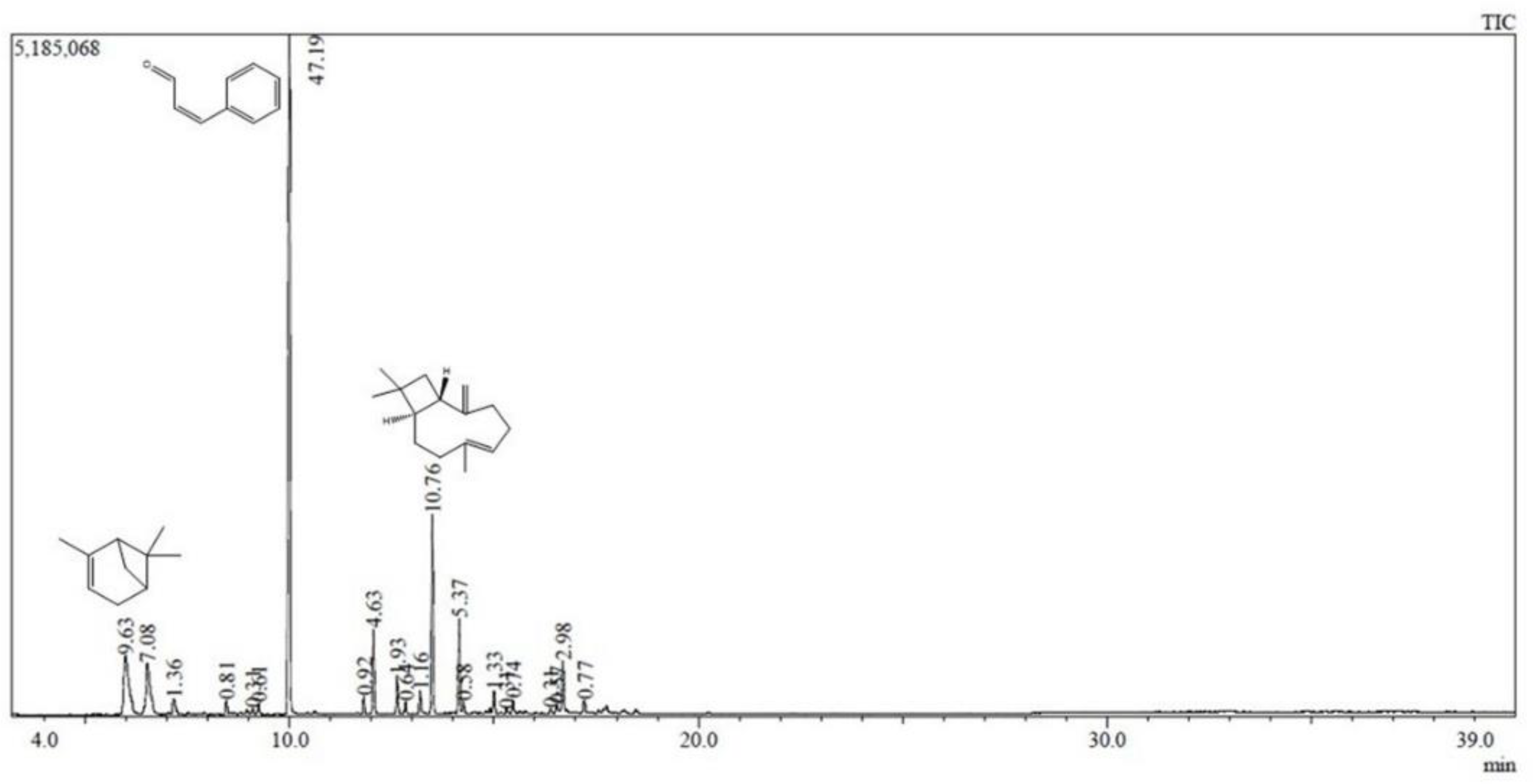
Figure 2.
Inhibition halos of C. albicans observed in the experimental design with M. quixos EO at 20 µL/mL (low concentration), 500 µL/mL (high concentration), and the ketoconazole (positive control).
Figure 2.
Inhibition halos of C. albicans observed in the experimental design with M. quixos EO at 20 µL/mL (low concentration), 500 µL/mL (high concentration), and the ketoconazole (positive control).
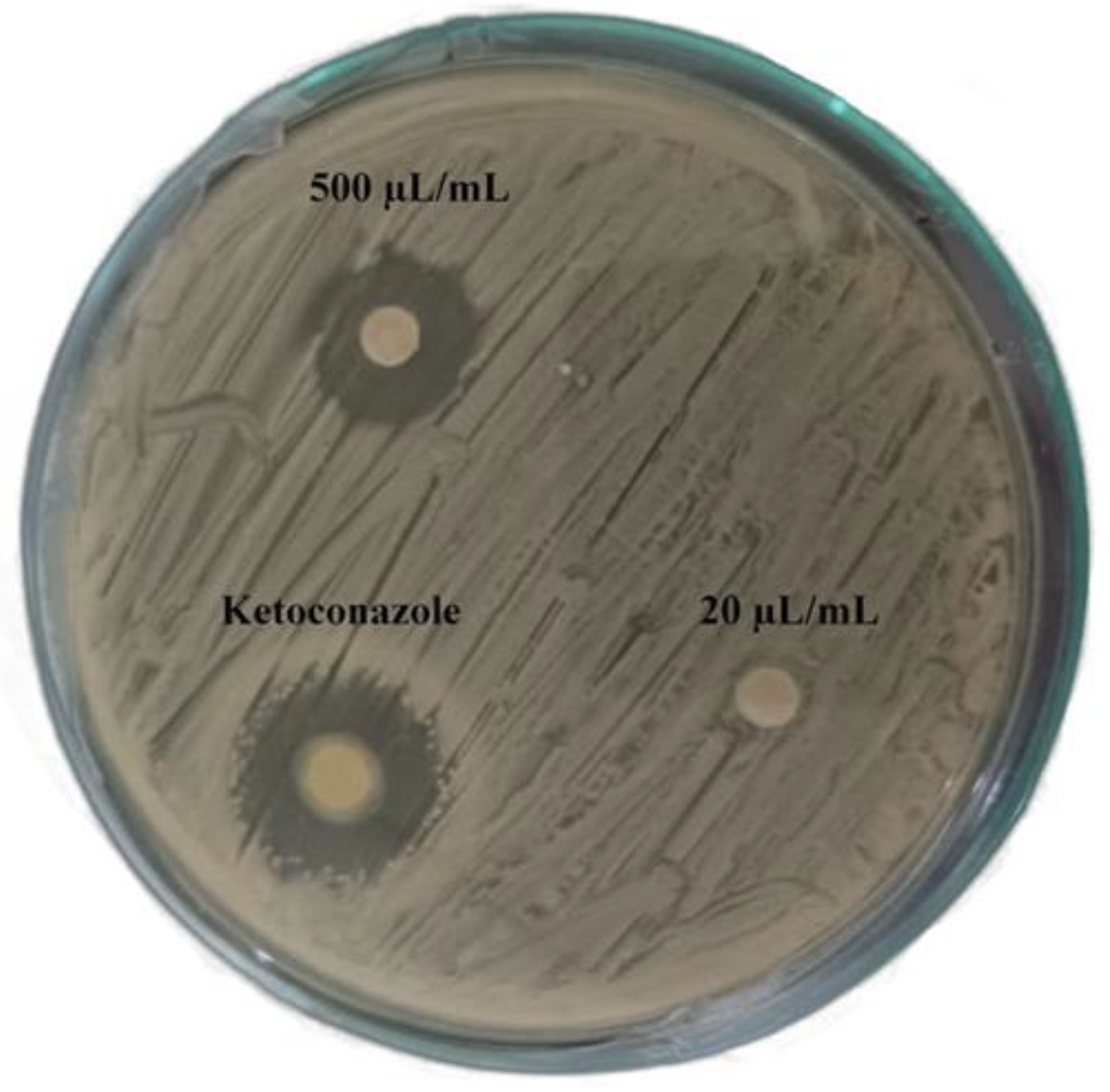
Figure 3.
Model graph for inhibition halo vs. oil concentration sing One-Factor RSM Design.
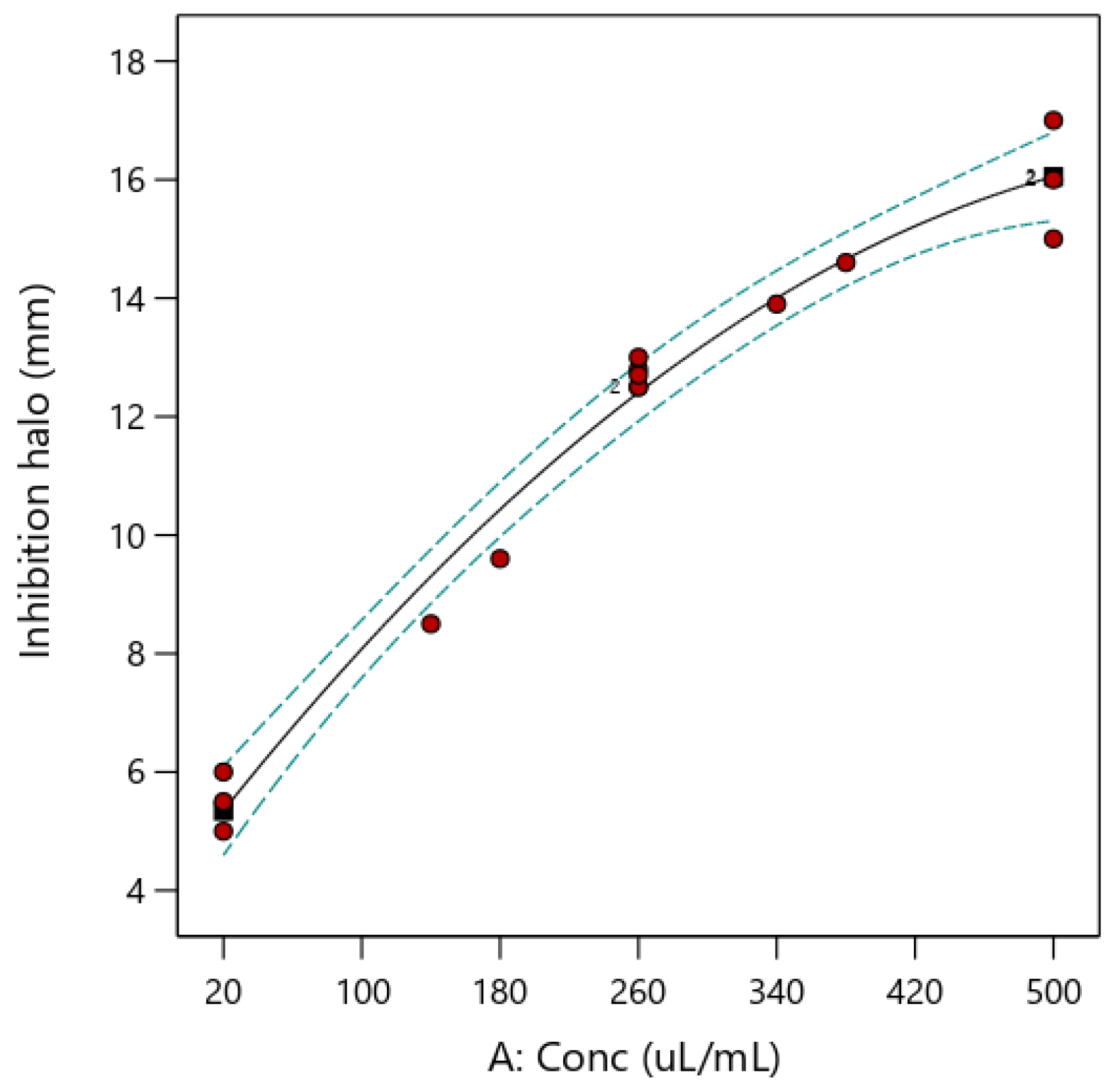
Figure 4.
Binding modes and interaction profiles of α-copaene and β-copaene with 14-α-demethylase (PDB ID: 5TZ1). (A) Interaction profile of α-copaene. (B) Interaction profile of β-copaene, showing stabilization through hydrophobic contacts (red arcs).
Figure 4.
Binding modes and interaction profiles of α-copaene and β-copaene with 14-α-demethylase (PDB ID: 5TZ1). (A) Interaction profile of α-copaene. (B) Interaction profile of β-copaene, showing stabilization through hydrophobic contacts (red arcs).
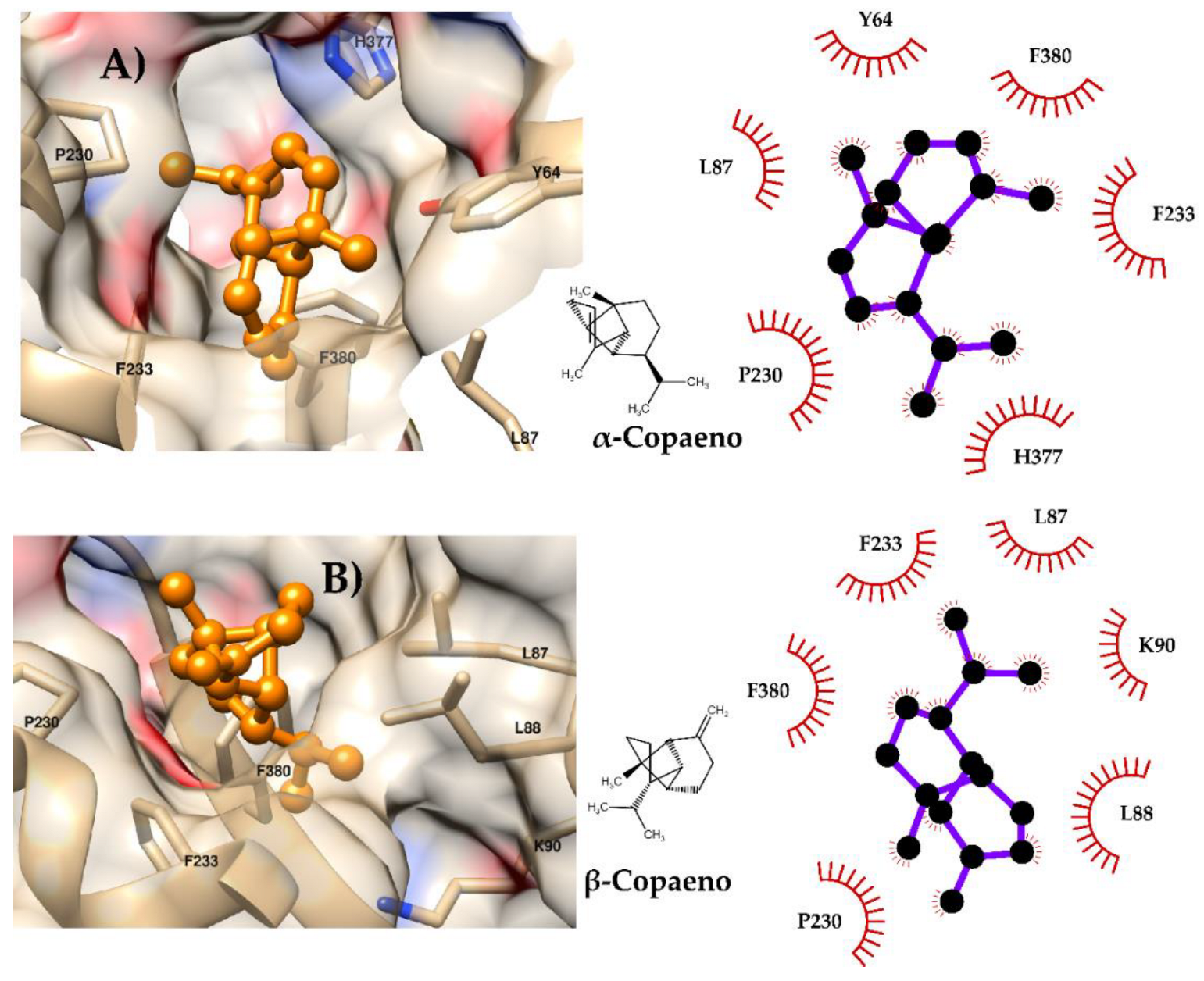
Figure 5.
Binding modes and interactions of α-copaene and spathulenol with Δ(14)-sterol reductase (PDB ID: 4QUV). (A) Interaction profile of α-copaene, showing hydrophobic packing (red arcs). (B) Dual stabilization mechanism of spathulenol, green dashed lines indicate conventional hydrogen bonds.
Figure 5.
Binding modes and interactions of α-copaene and spathulenol with Δ(14)-sterol reductase (PDB ID: 4QUV). (A) Interaction profile of α-copaene, showing hydrophobic packing (red arcs). (B) Dual stabilization mechanism of spathulenol, green dashed lines indicate conventional hydrogen bonds.
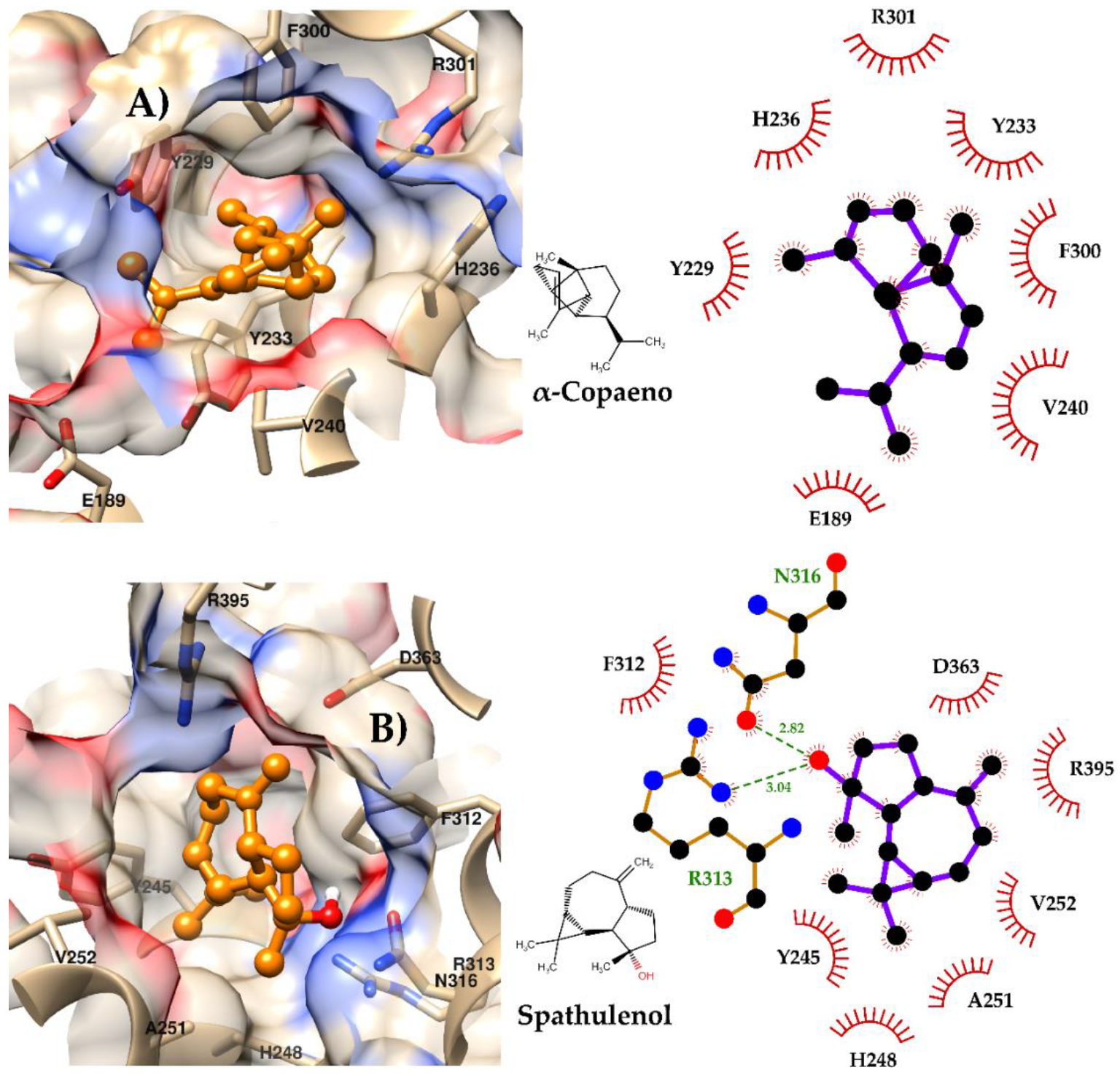
Figure 6.
Binding modes and interactions of α-guaiene and spathulenol with exo-β-(1,3)-glucanase (PDB ID: 1EQC). (A) Interaction map of α-guaiene, stabilized by a network of hydrophobic contacts (red arcs). (B) Binding mode of spathulenol, the green dashed line indicates a conventional hydrogen bond formed at a distance of 2.85 Å.
Figure 6.
Binding modes and interactions of α-guaiene and spathulenol with exo-β-(1,3)-glucanase (PDB ID: 1EQC). (A) Interaction map of α-guaiene, stabilized by a network of hydrophobic contacts (red arcs). (B) Binding mode of spathulenol, the green dashed line indicates a conventional hydrogen bond formed at a distance of 2.85 Å.
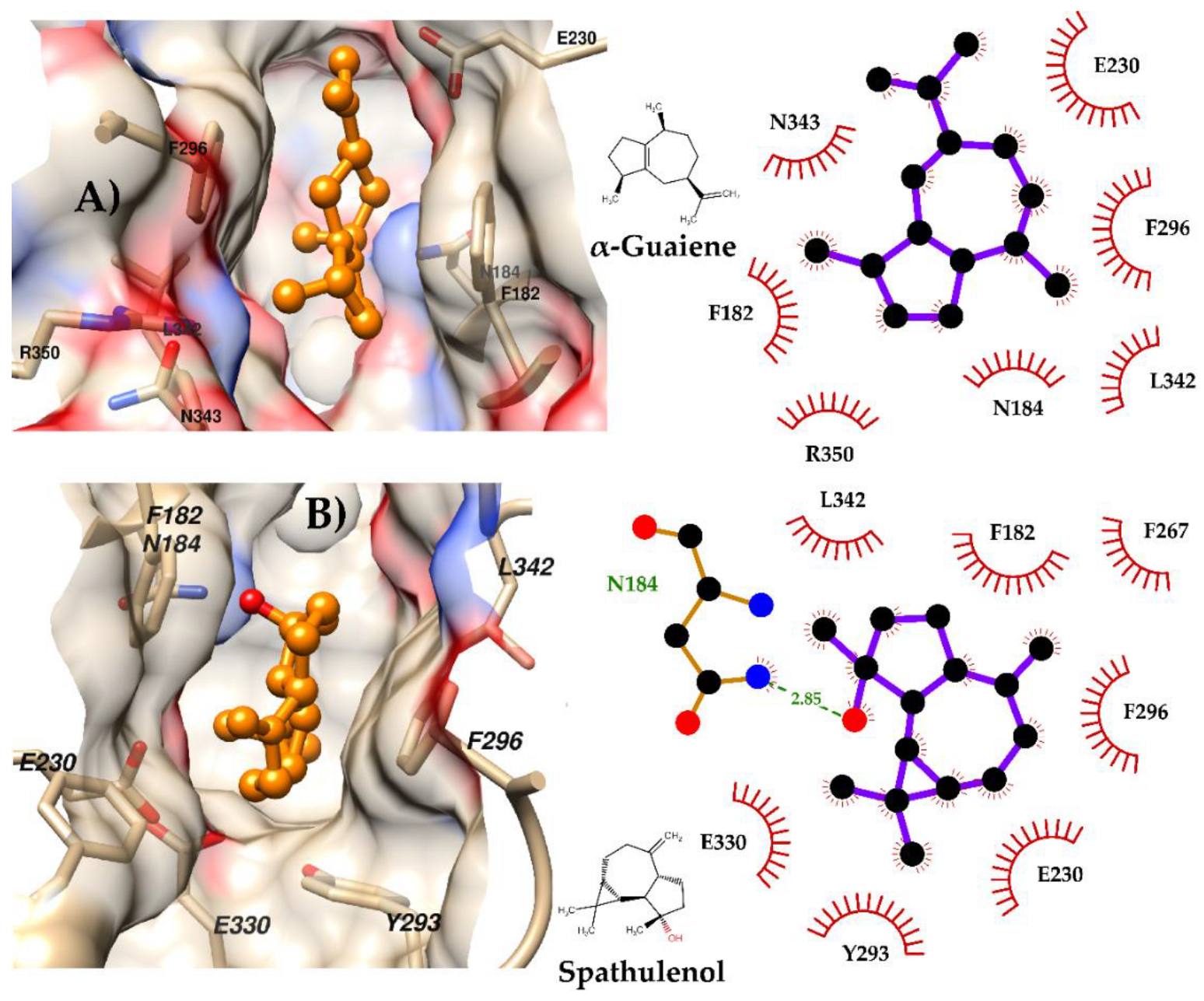

Table 1.
Chemical Composition of the EO Obtained from M. quixos.
| Peak | R.Time | Area% | Name | Chemical class |
|---|---|---|---|---|
| 1 | 5.977 | 9.63 | α-Pinene | Monoterpene |
| 2 | 6.515 | 7.08 | β-Pinene | Monoterpene |
| 3 | 7.162 | 1.36 | β-Terpinyl acetate | Monoterpene ester |
| 4 | 8.447 | 0.81 | Benzenepropanal | Aromatic aldehyde |
| 5 | 9.094 | 0.31 | α-Terpineol | Monoterpene alcohol |
| 6 | 9.237 | 0.61 | (Z)-Cinnamaldehyde | Aromatic aldehyde |
| 7 | 9.995 | 47.20 | (E)-Cinnamaldehyde | Aromatic aldehyde |
| 8 | 11.82 | 0.92 | Elixene | Sesquiterpene |
| 9 | 12.05 | 4.63 | Methyl cinnamate | Aromatic ester |
| 10 | 12.63 | 1.93 | α-Copaene | Sesquiterpene |
| 11 | 12.84 | 0.64 | α-Guaiene | Sesquiterpene |
| 12 | 13.19 | 1.16 | (E)-Cinnamyl acetate | Aromatic ester |
| 13 | 13.49 | 10.80 | Caryophyllene | Sesquiterpene |
| 14 | 14.15 | 5.37 | α-Humulene | Sesquiterpene |
| 15 | 14.26 | 0.58 | cis-Isomethyleugenol | Phenylpropanoid |
| 16 | 15.00 | 1.33 | Bicyclogermacrene | Sesquiterpene |
| 17 | 15.30 | 0.31 | β-Copaene | Sesquiterpene |
| 18 | 15.46 | 0.74 | δ-Cadinene | Sesquiterpene |
| 19 | 16.39 | 0.31 | cis-Caryophyllene | Sesquiterpene |
| 20 | 16.54 | 0.57 | Spathulenol | Sesquiterpenic alcohol |
| 21 | 16.69 | 2.98 | 14-Hydroxycaryophyllene | Sesquiterpenic alcohol |
| 22 | 17.21 | 0.77 | Humulene epoxide II | Sesquiterpenic ether |
Table 2.
Experimental and predicted inhibition halo values for the antifungal activity of M. quixos EO against C. albicans.
Table 2.
Experimental and predicted inhibition halo values for the antifungal activity of M. quixos EO against C. albicans.
| Run | Concentration (µL/mL) | Inhibition halo (mm) |
Predicted Value (mm) |
Build Type |
|---|---|---|---|---|
| 1 | 260 | 12.8 | 12.4 | Replicate |
| 2 | 340 | 13.9 | 14.0 | Model |
| 3 | 260 | 12.5 | 12.4 | Center |
| 4 | 500 | 16.0 | 16.1 | Replicate |
| 5 | 180 | 9.60 | 10.4 | Lack of Fit |
| 6 | 500 | 15.0 | 16.1 | Replicate |
| 7 | 20 | 5.00 | 5.34 | Model |
| 8 | 260 | 13.0 | 12.4 | Replicate |
| 9 | 500 | 17.0 | 16.1 | Model |
| 10 | 20 | 6.00 | 5.34 | Lack of Fit |
| 11 | 20 | 5.50 | 5.34 | Lack of Fit |
| 12 | 260 | 12.7 | 12.4 | Replicate |
| 13 | 260 | 12.5 | 12.4 | Center |
| 14 | 140 | 8.50 | 9.30 | Lack of Fit |
| 15 | 380 | 14.6 | 14.7 | Lack of Fit |
Table 3.
Experimental and predicted inhibition halo values for the antifungal activity of M. quixos EO against C. albicans.
Table 3.
Experimental and predicted inhibition halo values for the antifungal activity of M. quixos EO against C. albicans.
| Source | Sum of Squares | df | Mean Square | F-value | p-value |
|---|---|---|---|---|---|
| Model | 201 | 2 | 101 | 266 | < 0.0001 |
| A-Conc | 192 | 1 | 193 | 509 | < 0.0001 |
| A2 | 9,16 | 1 | 9,16 | 24,2 | 0.0004 |
| Residual | 4,54 | 12 | 0,378 | ||
| Lack of Fit | 1,86 | 4 | 0,465 | 1.39 | 0.320 |
| Pure Error | 2,68 | 8 | 0,335 | ||
| Cor Total | 206 | 14 |
Table 4.
Molecular docking affinities of the compounds identified in the essential oil of M. quixos and ketoconazole against 14-α-demethylase, Δ(14)-sterol reductase, and exo-β-(1,3)-glucanase.
Table 4.
Molecular docking affinities of the compounds identified in the essential oil of M. quixos and ketoconazole against 14-α-demethylase, Δ(14)-sterol reductase, and exo-β-(1,3)-glucanase.
| Protein | |||
|---|---|---|---|
| 14-α-demethylase | Δ(14)-sterol reductase | Exo-β-(1,3)-glucanase | |
| Molecule | Affinity (kcal/mol) | ||
| α-Pinene | -6.0 | -5.9 | -6.3 |
| β-Pinene | -5.8 | -5.7 | -6.3 |
| β-Terpinyl acetate | -6.8 | -5.9 | -7.5 |
| Benzenepropanal | -5.9 | -6.2 | -5.7 |
| α-Terpineol | -6.6 | -6.2 | -6.5 |
| (Z)-Cinnamaldehyde | -6.0 | -6.2 | -6.4 |
| (E)-Cinnamaldehyde | -6.2 | -6.0 | -6.0 |
| Elixene | -7.0 | -6.0 | -7.7 |
| Methyl cinnamate | -6.7 | -6.3 | -6.5 |
| α-Copaene | -7.9 | -7.1 | -8.1 |
| α-Guaiene | -7.3 | -6.8 | -8.2 |
| (E)-Cinnamyl acetate | -7.2 | -6.3 | -7.0 |
| Caryophyllene | -7.1 | -6.8 | -8.0 |
| α-Humulene | -7.2 | -6.4 | -7.7 |
| cis-Isomethyleugenol | -6.3 | -6.2 | -6.4 |
| Bicyclogermacrene | -6.9 | -6.5 | -7.0 |
| β-Copaene | -7.5 | -6.7 | -8.0 |
| δ-Cadinene | -7.0 | -6.8 | -7.7 |
| cis-Caryophyllene | -7.4 | -6.5 | -7.9 |
| Spathulenol | -6.9 | -6.9 | -8.2 |
| 14-Hydroxycaryophyllene | -7.2 | -6.6 | -8.0 |
| Humulene epoxide II | -7.1 | -6.5 | -8.1 |
| Ketoconazole | -10.8 | -9.5 | -9.2 |
Disclaimer/Publisher’s Note: The statements, opinions and data contained in all publications are solely those of the individual author(s) and contributor(s) and not of MDPI and/or the editor(s). MDPI and/or the editor(s) disclaim responsibility for any injury to people or property resulting from any ideas, methods, instructions or products referred to in the content. |
© 2026 by the authors. Licensee MDPI, Basel, Switzerland. This article is an open access article distributed under the terms and conditions of the Creative Commons Attribution (CC BY) license (http://creativecommons.org/licenses/by/4.0/).
Copyright: This open access article is published under a Creative Commons CC BY 4.0 license, which permit the free download, distribution, and reuse, provided that the author and preprint are cited in any reuse.


