
Submitted:
15 April 2026
Posted:
16 April 2026
You are already at the latest version
Abstract
Background/Objectives: Molecular classification has become integral to endometrial cancer (EC) management, with mismatch repair deficiency (dMMR) representing a key biomarker for prognostication, Lynch syndrome screening, and immunotherapy eligibility. However, reported dMMR rates and their associations with histopathological features remain variable. This study aimed to determine the prevalence of dMMR and its correlation with clinicopathological characteristics in early-stage EC. Methods: In this prospective observational cohort study, 93 patients with early-stage EC undergoing primary surgical treatment between September 2022 and December 2025 were included. All patients were managed according to European Society of Gynaecological Oncology (ESGO) guidelines. Immunohistochemistry was performed on formalin-fixed, paraffin-embedded hysterectomy specimens to assess MLH1, PMS2, MSH2, and MSH6 expression. dMMR was defined as complete or subclonal loss of nuclear staining in ≥1 protein, while proficient MMR (pMMR) required preserved (> 90%) expression of all four proteins. Associations between MMR status and histology, grade, lymphovascular space invasion (LVSI), depth of myometrial invasion, FIGO 2023 stage, nodal status, recurrence, and survival were analyzed. Results: Median age was 66 years (range 35–86). Most tumors were endometrioid (86%), 27.9% were grade 3, 44% demonstrated deep myometrial invasion, and 23.6% showed substantial LVSI. dMMR was identified in 41.9% (39/93) of cases. MLH1 (38.0%) and PMS2 (39.8%) loss were most frequent, whereas MSH2 (3.2%) and MSH6 (4.3%) loss was uncommon. dMMR was significantly associated with endometrioid histology (p = 0.03) and deep myometrial invasion (p = 0.011). No significant correlations were observed with tumor grade, LVSI, FIGO stage, nodal involvement, recurrence, or overall survival during follow-up. Conclusions: dMMR was detected in approximately 40% of early-stage ECs and was significantly associated with endometrioid histology and deep myometrial invasion. Routine assessment of MMR status may refine risk stratification and support individualized therapeutic decision-making. Further studies with longer follow-up are warranted to clarify its prognostic impact.
Keywords:
endometrial cancer
; mismatch repair deficiency
; immunohistochemistry
; molecular classification
; myometrial invasion
; histopathology
; Lynch syndrome
1. Introduction
Endometrial cancer (EC), stands as the most prevalent malignancy of female reproductive system in developed countries with a steady incidence rising by ~1–2% annually [1]. Since the 2013 TCGA publication defining the genomic landscape of endometrial carcinoma, EC classification and management have shifted toward a molecular framework [2], now embedded in ESGO/ESTRO/ESP guidelines to refine recurrence-risk and overall survival outcomes. The updated clinical approach increasingly incorporates detection of MMR deficiency or microsatellite instability (MSI) in preoperative biopsies, using immunohistochemistry (IHC) to evaluate loss of MMR proteins [3], with MMRd reported in up to ~30% of ECs [4]. MMRd reflects loss of function of MLH1, PMS2, MSH2, or MSH6, resulting in accumulation of insertions and deletion errors at microsatellites, MSI, and high tumor mutational burden [5]. The majority of MMRd EC, approximately 80-90%, is attributed to a somatic MLH1 promoter hypermethylation causing epigenetic silencing of MLH1 [6,7], whereas a smaller subset (~10%) arises in the context of Lynch syndrome, a hereditary cancer predisposition caused by germline pathogenic variants in MMR genes or, less commonly EPCAM leading to secondary epigenetic inactivation of MSH2 [8,9].
Assessment of MMR status for endometrial cancer patients is characterized by major clinical significance. Potential identification of MMR deficiency may pose the indication of genetic testing in order to identify Lynch syndrome in the patient as well as further familial carriers of relative mutations. Secondly, endometrial cancer patients with MMR deficiency may represent candidates for immunotherapy in advanced stages and in future recurrences as well receiving both pembrolizumab and levatinib, based on results of recently published RCTs [10].
However, the prognostic significance of MMRd on its own in endometrial cancer patients remains controversial. Even if some studies have demonstrated improved survival outcomes among patients harboring MMR-deficient tumors, conflicting data exist in the literature and a definitive consensus has yet to emerge. Furthermore, correlation of MMRd with various clinical and histopathological characteristics has not yet been clarified, highlighting an area for further research especially in the context of increasing but yet recent implementation of molecular profiling in endometrial cancer[11].
Main objective of the present study is to assess the rates of MMR deficiency in endometrial cancer patients as well as define potential correlation with clinical and histopathological characteristics.
2. Materials and Methods
2.1. Study Design
This is a prospective cohort study that was conducted as part of PhD project in Gynaecologic Oncology Unit of 2nd Department of Obstetrics and Gynecology in Ippokrateio Hospital of Thessaloniki from December 2022 to December 2025. Study protocol was reviewed and approved by the Aristotle University Ethics/Bioethics Committee for human research (Protocol No. 9/23.07.2024). Study conduct adhered to Greek legislation (Act 2071/1992, NHS) establishing the National Council of Medical Ethics and Deontology and its guidance for observational research.
2.2. Patient Recruitment, Inclusion and Exclusion Criteria
Patients with early-stage endometrial cancer were recruited, following presurgical clinical and imaging assessment, with histologic confirmation obtained by endometrial biopsy via hysteroscopy. All patients underwent surgical treatment in the Gynaecologic Oncology Unit of our department. The exclusion criteria included history of any another malignancy (gynecologic or non-gynecologic), inability to undergo surgery due to comorbidity, prior radiotherapy or chemotherapy and prior surgical procedures involving organs of the female reproductive tract for any reason. All participating patients provided written informed consent after receiving a clear explanation of the study’s objectives and procedures. Staging was performed according to the 2023 International Federation of Gynecology and Obstetrics (FIGO) classification system. As the gynecologic oncology unit of our department represents a European Society of Gynaecological Oncology (ESGO)-accredited department for gynecologic oncology, all cases treated are discussed pre- and postoperatively in our multidisciplinary tumor board (MTB), with the copresence of gynecologic oncologists, radiation oncologists, medical oncologists, pathologists, and radiologists. Post-surgical uterus specimens were collected of 93 female patients, diagnosed with early-stage endometrial cancer and surgically treated between the years 2022 and 2025.
2.3. Epidemiological, Clinical and Histopathological Characteristics of Patients
Epidemiological parameters assessed included age, body mass index (BMI), race, comorbidities (hypertension, diabetes mellitus, renal failure, heart failure), and obstetric history (parity and mode of birth). Presurgical parameters encompassed indication for intervention (vaginal bleeding or endometrial thickness), histologic type and grade, myometrial invasion (evaluation via MRI), FIGO stage, and risk group (low, intermediate, intermediate-high, high). Postsurgical parameters included histologic type and grade, myometrial invasion, lymphovascular space invasion (LVSI), nodal status based on surgical staging, final FIGO stage and final allocation to a risk group.
2.4. Primary and Secondary Outcomes
Primary outcomes of the study were the proportion of tumor specimens exhibiting negative expression of at least one of MLH1, MSH2, MSH6, and PMS2 proteins, enabling determination of deficient mismatch repair (dMMR) status in the final uterine surgical specimen. Secondary outcomes included correlation of MMR deficiency with histopathological parameters, namely histological subtype, grade, myometrial invasion, nodal status, final FIGO staging and recurrence or death during follow-up period.
2.5. Specimen Processing and Section Preparation
Postoperatively, within 24 hours, hysterectomy specimens were fixed in 10% neutral-buffered formalin and processed routinely. Following macroscopic examination, representative tissue sections were sampled and placed in standard tissue cassettes. Then they underwent procession in an automatic 12-station tissue processor consisting of sequential immersion of them in formalin, graded ethanol solutions (increasing concentrations for dehydration), xylene (for clearing), and molten paraffin (for infiltration). Afterwards, tissue blocks were embedded in paraffin and sectioned at 2.5 μm thickness by a microtome and then were mounted onto positively charged glass slides to enhance tissue adhesion and baked in an oven at 65°C for a minimum of 2 hours to ensure complete adherence and remove excess paraffin.
2.6. Immunohistochemical Staining Protocol
Immunohistochemical analysis was performed using a fully automated LEICA BOND platform equipped with a two-step, biotin-free, polymer-based detection system (BOND POLYMER REFINE DETECTION). Sections were deparaffinized and antigen retrieval was accomplished through a dual-phase protocol: enzymatic digestion with pepsin for 10 minutes at room temperature, followed by heat-induced epitope retrieval using EDTA buffer solution (pH 8.0, BOND EPITOPE RETRIEVAL ER2) at 99°C for 20 minutes. Ready-to-use (RTU) monoclonal antibodies against MLH1, MSH2, MSH6, and PMS2 were applied sequentially to individual sections. The staining protocol consisted of endogenous peroxidase blocking (5 minutes), primary antibody incubation (25-30 minutes at room temperature), three wash cycles, post-primary reagent application (20 minutes), three wash cycles, polymer reagent incubation (20 minutes), three wash cycles, DAB chromogen development (10 minutes for visualization), three final wash cycles, and hematoxylin counterstaining (5 minutes) for nuclear detail. Following completion of the automated protocol, sections underwent manual dehydration through ascending alcohol concentrations, clearing in xylene, and coverslipping using a mounting medium to enable microscopic evaluation.
2.7. Interpretation of MMR Status
Nuclear expression of each MMR protein was evaluated independently. MMR status was classified as deficient (dMMR) when loss of nuclear staining was observed in one or more proteins. Given that MMR proteins function as heterodimers (MLH1/PMS2 and MSH2/MSH6), intact expression required >90% tumor cell positivity for all four proteins. Complete loss (<10% staining) or subclonal expression (10-90% positivity, typically involving MSH6 or the MLH1/PMS2 dimer) was interpreted as dMMR. Proficient MMR (pMMR) was defined as preserved nuclear expression (>90%) of all four proteins [12,13].
2.8. Statistical Analysis
Statistical Package for Social Science 20.0 (SPSS 20.0) was used to conduct statistical analyses. Continuous variables were summarized as mean ± standard deviation or median (min-max) and analyzed using the ANOVA test. Categorical variables were summarized as numbers and percentages. Linear regression was used to identify potential correlation between MMRd and various histopathological parameters. A p-value of <0.05 was considered statistically significant.
3. Results
3.1. Cohort Characteristics
A total of 93 patients were included in this study. The median age of the patients was 66 years (range, 35-86 years). The most common stage was FIGO IA2, which was observed in 29/93 (31.1%) patients, followed by FIGO IB in 15/93 (16.1%) and FIGO IIC (16.1%). The most common tumor type was the endometrioid type, which was observed in 80 (86 %) patients whereas grade 3 was present in 26/93 (27.9%) endometrial cancer patients. Deep myometrial invasion (≥50% myometrial depth) was detected in 41/93 (44%) while substantial LVSI was detected in 23.6% (22/93) of the study cohort (Table 1).
3.2. MMRd Rates
dMMR was observed in 39/93 (41.9%) patients in the study group. The MLH1 and PMS2 proteins were the most frequently aberrant, observed in 35 (38%) and 37 (39.8%) patients, respectively, whereas MSH2 loss observed in 3 (3.2%) and MSH6 in 4 (4.3%) respectively. dMMR was observed in one protein in 1 (2.6%) patient, in two proteins in 35 (92.2%) patients, in three proteins in 2 (5.1%) patients and in four proteins in 1 (2.6%) patient.
3.3. Correlation of MMRd with Histopathological Characteristics
MMRd status was significantly associated with histological subtype (p=.016). Most non-endometrioid tumors were MMR-proficient (12/13, 92.3%), whereas MMR deficiency was more common among endometrioid tumors (34/80, 42.5%). In contrast, MMRd status was not associated with tumor grade (p=.939). No significant correlation was observed between MMRd and LVSI (p=.386), with LVSI positive present in 10/35 MMRd cases (28.6%) compared with 12/58 (20.7%) in non MMRd cases. MMRd status was, however, significantly associated with deep myometrial invasion (p=.009) , which was more frequent in MMRd tumors (62.9%, 22/35) than in MMR-proficient tumors (35.1%, 20/57). Finally, MMRd showed no association with stage (p=.987) as stage distributions were comparable between MMRd and MMR-proficient groups (MMRd: stage-I: 51.4%, stage-ΙΙ: 34.3%, stage-ΙΙΙ 8.6%, stage-IV 5.7% vs MMR-proficient: 48.3%, 37.9%, 8.6%, 5.2%, respectively). No significant correlation was observed with nodal invasion (P=.609) and recurrence (P=.792) (Figure 1). However, there has been observed statistical trend for correlation with overall death possibility (P=.14, 10.5% in MMRd cases vs. 1.8% in MMRp cases) (Figure 2, Table 2).
4. Discussion
The present study reports two main conclusions. First, the overall rate of mismatch repair deficiency (MMRd) was approximately 40%, representing one of the highest rates reported in the published literature. Second, MMRd was found to be significantly correlated with the endometrioid histological subtype and deep myometrial invasion, while no significant correlations were demonstrated with other histopathological parameters.
The mismatch repair (MMR) system aims to identify and repair replication-associated DNA errors in order to preserve genomic fidelity and integrity during DNA replication [14]. This study sought to determine the prevalence of MMRd in tumor cells among patients diagnosed with endometrial cancer and to evaluate its potential correlations with significant histopathological parameters. In our cohort, 41.9% of patients were observed to have MMRd. The most frequently observed losses of MMR protein expression involved MLH1 and PMS2, occurring in 38.0% and 39.8% of patients, respectively, while only one patient (2.6%) demonstrated loss of all four MMR proteins. These rates are consistent with those reported in the existing literature. Indeed, in a cohort study by Kim et al., MMRd status was identified in up to 27% of cases, with MLH1/PMS2 loss being the most frequent pattern (68.2%) [15]. Similarly, in a recent study by Aytekin et al., MMRd was detected in 35.1% of cases, with the most common losses involving MLH1 (28.8%) and PMS2 (27.9%) [16]. In another cohort study by Wang et al., the prevalence of MMRd was 25.2%, with MLH1/PMS2 loss observed in 59.5% of cases [17], while Kato et al. reported an MMRd prevalence of 40%, again with MLH1/PMS2 co-loss being the most frequent pattern [18].
The overall prognosis of MMR-deficient endometrial carcinomas (ECs) falls into an intermediate category. Compared with POLE-mutant ECs, MMR-deficient ECs appear to be more influenced by clinicopathological variables, although not to the same extent as no specific molecular profile (NSMP) ECs [19]. The association between dMMR status and clinicopathological characteristics, as well as the prognostic significance of these factors in MMR-deficient ECs, remains unclear and controversial. For example, while deep myometrial invasion and lymphovascular space invasion (LVSI) significantly worsen the prognosis of MMR-deficient ECs, tumor grade appears to lack independent prognostic value [20]. Histotype may also lack prognostic significance in this molecular subgroup. Instead, MMR deficiency has been consistently associated with an intermediate prognosis across different histotypes, resulting in poorer outcomes in early-stage, low-grade ECs and improved outcomes in non-endometrioid ECs [21,22].
In the present study, MMRd status was found to be significantly correlated with histological type and deep myometrial invasion. In contrast, Kim et al. demonstrated that MMRd status was significantly associated with adverse histopathological features such as grade 3 histology (25.0% vs. 11.9%, p = 0.040) and LVSI (54.8% vs. 25.0%, p = 0.001), with LVSI remaining independently associated with MMRd on multivariable analysis (RR 3.435, 95% CI 1.447–8.157, p = 0.005) [14]. Similarly, in the cohort study by de Freitas et al., MMRd showed statistically significant correlations with two histopathological parameters: endometrioid histology was more frequent in MMRd tumors (87.9% vs. 75.5%, p = 0.008), and LVSI was more common, with multifocal LVSI present in 27.6% versus 16.9% of MMR-proficient tumors (p = 0.025) [23]. Wang et al. also reported a statistically significant association between dMMR and higher tumor grade, with grade 3 tumors being more frequent in dMMR compared with pMMR cases (40.5% vs. 23.3%, p = 0.004) [17]. Conversely, Kato et al. demonstrated significant correlations between dMMR and several histopathological parameters, including histology (endometrioid vs. non-endometrioid, p = 0.01), FIGO stage (I/II vs. III/IV, p = 0.03) and histological grade (grade 1/2 vs. grade 3, p = 0.01) [18]. Lastly, in the retrospective cohort study by Aytekin et al., no statistically significant associations were found between dMMR and histopathology, FIGO 2009 stage, depth of myometrial invasion, or LVSI [16].
MMRd status shows a strong histotype correlation with endometrial carcinoma, being more prevalent in endometrioid tumors. Across large series, endometrioid endometrial carcinoma exhibits MMR deficiency in approximately 25–35% of cases [24], with enrichment in higher-grade tumors—reported in about 39.7% of high-grade versus 24.7% of low-grade endometrioid carcinomas [25]. MMR deficiency is also common in undifferentiated and dedifferentiated carcinomas, with some of the highest reported rates (~40–50%)[26], as well as in mixed ECs containing an endometrioid component (16–66%) [27]. Conversely, its prevalence is lower in clear cell carcinoma (~5–15%, depending on cohort and testing methodology) [28], carcinosarcomas (~5–20%), often reflecting an endometrioid-like epithelial component [29], and is rare in serous endometrial carcinoma, which is most commonly p53-abnormal and MMR-proficient. It should be noted that the coexistence of MMR deficiency and serous morphology raises the possibility of a misclassified endometrioid carcinoma or a mixed tumor rather than true serous endometrial carcinoma [30,31,32].
One limitation of the present study is that MLH1 promoter hypermethylation was not assessed in MMRd cases. MLH1 promoter–hypermethylated endometrial cancer represents a distinct higher-risk subgroup associated with adverse clinical factors such as older age at diagnosis, increased body mass index, higher rates of LVSI, and advanced disease stage. Inclusion of this information would improve risk stratification and facilitate more tailored management strategies. Another limitation is the absence of long-term survival outcomes, reflecting the relatively recent integration of dMMR assessment into routine clinical practice and the resulting lack of mature follow-up data. A notable strength of this study is its prospective design, representing the first such investigation in a Greek population, as well as the relatively large cohort from a single center. Additionally, all surgical procedures were performed by trained gynecologic oncologists, and all specimens were evaluated by dedicated gynecologic pathologists, enhancing procedural consistency and diagnostic reliability. Future studies with longer follow-up and survival endpoints are warranted to better define the prognostic implications of MMR deficiency.
5. Conclusions
In this prospective cohort, dMMR was identified in 41.9% of early-stage endometrial cancers, most commonly due to MLH1/PMS2 loss. dMMR was significantly associated with histological subtype and deep myometrial invasion, but not with tumor grade or LVSI. Routine MMR assessment may improve risk stratification and guide personalized treatment, including immunotherapy. Further studies with longer follow-up are needed to clarify its prognostic significance.
Author Contributions
E.-A.A. was a major contributor to writing the manuscript. C.M.-S., S.P. and T. A. Z. were responsible for the collection of the relevant literature. C.M.-S. and A.A. independently determined the eligibility of the retrieved articles. A.D., N.D., T.V., T.P. and K.D. revised the manuscript critically for important intellectual content. All authors have read and agreed to the published version of the manuscript.
Funding
Tibor A. Zwimpfer is supported by the Margarete und Walter Lichtenstein-Stiftung, Krebsliga beider Basel (KLbB-6352-02-2025), HOLCIM Foundation, Bayer-SGGG grant 2025.
Institutional Review Board Statement
The study protocol was conducted in accordance with the Declaration of Helsinki and reviewed and approved by the Aristotle University Ethics/Bioethics Committee for human research (Protocol No. 9/23.07.2024). Study conduct adhered to Greek legislation (Act 2071/1992, NHS) establishing the National Council of Medical Ethics and Deontology and its guidance for observational research.
Informed Consent Statement
Informed consent was obtained from all subjects involved in the study.
Conflicts of Interest
Tibor A. Zwimpfer reports personal consulting fees from AbbVie that are outside the submitted work. The other authors declare that the research was conducted in the absence of any commercial or financial relationship that could be construed as a potential conflict of interest.
References
- Siegel, R.L.; Kratzer, T.B.; Giaquinto, A.N.; Sung, H.; Jemal, A. Cancer Statistics, 2025. CA. Cancer J. Clin. 2025, 75, 10–45. [Google Scholar] [CrossRef] [PubMed]
- Kandoth, C.; Schultz, N.; Cherniack, A.D.; Akbani, R.; Liu, Y.; Shen, H.; Robertson, A.G.; Pashtan, I.; Shen, R.; et al.; Cancer Genome Atlas Research Network Integrated Genomic Characterization of Endometrial Carcinoma. Nature 2013, 497, 67–73. [Google Scholar] [CrossRef] [PubMed]
- Concin, N.; Matias-Guiu, X.; Vergote, I.; Cibula, D.; Mirza, M.R.; Marnitz, S.; Ledermann, J.; Bosse, T.; Chargari, C.; Fagotti, A.; et al. ESGO/ESTRO/ESP Guidelines for the Management of Patients with Endometrial Carcinoma. Int. J. Gynecol. Cancer Off. J. Int. Gynecol. Cancer Soc. 2021, 31, 12–39. [Google Scholar] [CrossRef] [PubMed]
- Jumaah, A.S.; Al-Haddad, H.S.; Salem, M.M.; McAllister, K.A.; Yasseen, A.A. Mismatch Repair Deficiency and Clinicopathological Characteristics in Endometrial Carcinoma: A Systematic Review and Meta-Analysis. J. Pathol. Transl. Med. 2021, 55, 202–211. [Google Scholar] [CrossRef]
- Santoro, A.; Angelico, G.; Travaglino, A.; Inzani, F.; Arciuolo, D.; Valente, M.; D’Alessandris, N.; Scaglione, G.; Fiorentino, V.; Raffone, A.; et al. New Pathological and Clinical Insights in Endometrial Cancer in View of the Updated ESGO/ESTRO/ESP Guidelines. Cancers 2021, 13, 2623. [Google Scholar] [CrossRef]
- Herman, J.G.; Umar, A.; Polyak, K.; Graff, J.R.; Ahuja, N.; Issa, J.P.; Markowitz, S.; Willson, J.K.; Hamilton, S.R.; Kinzler, K.W.; et al. Incidence and Functional Consequences of hMLH1 Promoter Hypermethylation in Colorectal Carcinoma. Proc. Natl. Acad. Sci. U. S. A. 1998, 95, 6870–6875. [Google Scholar] [CrossRef]
- Boland, C.R.; Koi, M.; Chang, D.K.; Carethers, J.M. The Biochemical Basis of Microsatellite Instability and Abnormal Immunohistochemistry and Clinical Behavior in Lynch Syndrome: From Bench to Bedside. Fam. Cancer 2008, 7, 41–52. [Google Scholar] [CrossRef]
- Ryan, N. a. J.; Glaire, M.A.; Blake, D.; Cabrera-Dandy, M.; Evans, D.G.; Crosbie, E.J. The Proportion of Endometrial Cancers Associated with Lynch Syndrome: A Systematic Review of the Literature and Meta-Analysis. Genet. Med. Off. J. Am. Coll. Med. Genet. 2019, 21, 2167–2180. [Google Scholar] [CrossRef]
- Ligtenberg, M.J.L.; Kuiper, R.P.; Chan, T.L.; Goossens, M.; Hebeda, K.M.; Voorendt, M.; Lee, T.Y.H.; Bodmer, D.; Hoenselaar, E.; Hendriks-Cornelissen, S.J.B.; et al. Heritable Somatic Methylation and Inactivation of MSH2 in Families with Lynch Syndrome Due to Deletion of the 3’ Exons of TACSTD1. Nat. Genet. 2009, 41, 112–117. [Google Scholar] [CrossRef]
- Luchini, C.; Bibeau, F.; Ligtenberg, M.J.L.; Singh, N.; Nottegar, A.; Bosse, T.; Miller, R.; Riaz, N.; Douillard, J.-Y.; Andre, F.; et al. ESMO Recommendations on Microsatellite Instability Testing for Immunotherapy in Cancer, and Its Relationship with PD-1/PD-L1 Expression and Tumour Mutational Burden: A Systematic Review-Based Approach. Ann. Oncol. Off. J. Eur. Soc. Med. Oncol. 2019, 30, 1232–1243. [Google Scholar] [CrossRef]
- Gordhandas, S.; Kahn, R.M.; Gamble, C.; Talukdar, N.; Maddy, B.; Baltich Nelson, B.; Askin, G.; Christos, P.J.; Holcomb, K.; Caputo, T.A.; et al. Clinicopathologic Features of Endometrial Cancer with Mismatch Repair Deficiency. Ecancermedicalscience 2020, 14, 1061. [Google Scholar] [CrossRef]
- Stelloo, E.; Jansen, A.M.L.; Osse, E.M.; Nout, R.A.; Creutzberg, C.L.; Ruano, D.; Church, D.N.; Morreau, H.; Smit, V.T.H.B.M.; van Wezel, T.; et al. Practical Guidance for Mismatch Repair-Deficiency Testing in Endometrial Cancer. Ann. Oncol. Off. J. Eur. Soc. Med. Oncol. 2017, 28, 96–102. [Google Scholar] [CrossRef]
- Wing-Cheuk Wong, R.; Palicelli, A.; Hoang, L.; Singh, N. Interpretation of P16, P53 and Mismatch Repair Protein Immunohistochemistry in Gynaecological Neoplasia. Diagn. Histopathol. 2020, 26, 257–277. [Google Scholar] [CrossRef]
- Li, Z.; Pearlman, A.H.; Hsieh, P. DNA Mismatch Repair and the DNA Damage Response. DNA Repair 2016, 38, 94–101. [Google Scholar] [CrossRef]
- Kim, M.-K.; So, K.A.; Chun, Y.-K.; Kim, Y.H.; Lim, K.T.; Lee, K.H.; Kim, T.J. Clinicopathologic Significance of Mismatch Repair Protein Expression in Endometrioid Endometrial Cancer. Taiwan. J. Obstet. Gynecol. 2023, 62, 724–728. [Google Scholar] [CrossRef]
- Aytekin, O.; Cesur, N.; Gozel, S.; Karsli, S.E.; Tokalioglu, A.A.; Kilic, F.; Cuylan, Z.F.; Selcuk, I.; Comert, G.K.; Erdogan, F.; et al. Mismatch Repair Protein Deficiency and Its Relationship with Clinicopathological Factors in Endometrial Cancer: A Retrospective Study. J. Cancer 2025, 16, 2778–2786. [Google Scholar] [CrossRef]
- Wang, C.; Kuang, W.; Zeng, J.; Ren, Y.; Liu, Q.; Sun, H.; Feng, M.; Liang, D. A Retrospective Study of Consistency between Immunohistochemistry and Polymerase Chain Reaction of Microsatellite Instability in Endometrial Cancer. PeerJ 2023, 11, e15920. [Google Scholar] [CrossRef]
- Kato, M.; Takano, M.; Miyamoto, M.; Sasaki, N.; Goto, T.; Tsuda, H.; Furuya, K. DNA Mismatch Repair-Related Protein Loss as a Prognostic Factor in Endometrial Cancers. J. Gynecol. Oncol. 2015, 26, 40–45. [Google Scholar] [CrossRef]
- Raffone, A.; Travaglino, A.; Mascolo, M.; Carbone, L.; Guida, M.; Insabato, L.; Zullo, F. TCGA Molecular Groups of Endometrial Cancer: Pooled Data about Prognosis. Gynecol. Oncol. 2019, 155, 374–383. [Google Scholar] [CrossRef]
- Pasanen, A.; Loukovaara, M.; Bützow, R. Clinicopathological Significance of Deficient DNA Mismatch Repair and MLH1 Promoter Methylation in Endometrioid Endometrial Carcinoma. Mod. Pathol. Off. J. U. S. Can. Acad. Pathol. Inc 2020, 33, 1443–1452. [Google Scholar] [CrossRef]
- Stelloo, E.; Nout, R.A.; Osse, E.M.; Jürgenliemk-Schulz, I.J.; Jobsen, J.J.; Lutgens, L.C.; van der Steen-Banasik, E.M.; Nijman, H.W.; Putter, H.; Bosse, T.; et al. Improved Risk Assessment by Integrating Molecular and Clinicopathological Factors in Early-Stage Endometrial Cancer-Combined Analysis of the PORTEC Cohorts. Clin. Cancer Res. Off. J. Am. Assoc. Cancer Res. 2016, 22, 4215–4224. [Google Scholar] [CrossRef]
- Segura, S.E.; Pedra Nobre, S.; Hussein, Y.R.; Abu-Rustum, N.R.; Weigelt, B.; Soslow, R.A.; DeLair, D.F. DNA Mismatch Repair-Deficient Endometrial Carcinosarcomas Portend Distinct Clinical, Morphologic, and Molecular Features Compared With Traditional Carcinosarcomas. Am. J. Surg. Pathol. 2020, 44, 1573–1579. [Google Scholar] [CrossRef]
- de Freitas, D.; Aguiar, F.N.; Anton, C.; de Almeida, D.C.; Bacchi, C.E.; Carvalho, J.P.; Carvalho, F.M. Clinicopathological Characteristics of Endometrial Carcinomas According to DNA Mismatch Repair Protein Status. Heliyon 2023, 9, e17495. [Google Scholar] [CrossRef]
- Raffone, A.; Travaglino, A.; Cerbone, M.; Gencarelli, A.; Mollo, A.; Insabato, L.; Zullo, F. Diagnostic Accuracy of Immunohistochemistry for Mismatch Repair Proteins as Surrogate of Microsatellite Instability Molecular Testing in Endometrial Cancer. Pathol. Oncol. Res. POR 2020, 26, 1417–1427. [Google Scholar] [CrossRef]
- Singh, N.; Wong, R.; Tchrakian, N.; Allen, S.-G.; Clarke, B.; Gilks, C.B. Interpretation of Mismatch Repair Protein Expression Using Obsolete Criteria Results in Discrepancies with Microsatellite Instability and Mutational Testing Results. Comment on Hechtman et al. Mod Pathol 2020. Mod. Pathol. Off. J. U. S. Can. Acad. Pathol. Inc 2021, 33 34, 871-879 1031–1032. [Google Scholar] [CrossRef]
- Travaglino, A.; Raffone, A.; Mascolo, M.; Guida, M.; Insabato, L.; Zannoni, G.F.; Zullo, F. TCGA Molecular Subgroups in Endometrial Undifferentiated/Dedifferentiated Carcinoma. Pathol. Oncol. Res. POR 2020, 26, 1411–1416. [Google Scholar] [CrossRef]
- Köbel, M.; Tessier-Cloutier, B.; Leo, J.; Hoang, L.N.; Gilks, C.B.; Soslow, R.A.; Delair, D.; Stewart, C.J.R.; Lee, C.-H. Frequent Mismatch Repair Protein Deficiency in Mixed Endometrioid and Clear Cell Carcinoma of the Endometrium. Int. J. Gynecol. Pathol. Off. J. Int. Soc. Gynecol. Pathol. 2017, 36, 555–561. [Google Scholar] [CrossRef]
- Travaglino, A.; Raffone, A.; Mascolo, M.; Guida, M.; Insabato, L.; Zannoni, G.F.; Zullo, F. Clear Cell Endometrial Carcinoma and the TCGA Classification. Histopathology 2020, 76, 336–338. [Google Scholar] [CrossRef]
- Travaglino, A.; Raffone, A.; Gencarelli, A.; Mollo, A.; Guida, M.; Insabato, L.; Santoro, A.; Zannoni, G.F.; Zullo, F. TCGA Classification of Endometrial Cancer: The Place of Carcinosarcoma. Pathol. Oncol. Res. POR 2020, 26, 2067–2073. [Google Scholar] [CrossRef]
- Conlon, N.; Da Cruz Paula, A.; Ashley, C.W.; Segura, S.; De Brot, L.; da Silva, E.M.; Soslow, R.A.; Weigelt, B.; DeLair, D.F. Endometrial Carcinomas with a “Serous” Component in Young Women Are Enriched for DNA Mismatch Repair Deficiency, Lynch Syndrome, and POLE Exonuclease Domain Mutations. Am. J. Surg. Pathol. 2020, 44, 641–648. [Google Scholar] [CrossRef]
- Soslow, R.A.; Tornos, C.; Park, K.J.; Malpica, A.; Matias-Guiu, X.; Oliva, E.; Parkash, V.; Carlson, J.; McCluggage, W.G.; Gilks, C.B. Endometrial Carcinoma Diagnosis: Use of FIGO Grading and Genomic Subcategories in Clinical Practice: Recommendations of the International Society of Gynecological Pathologists. Int. J. Gynecol. Pathol. Off. J. Int. Soc. Gynecol. Pathol. 2019, 38 Suppl 1, S64–S74. [Google Scholar] [CrossRef]
- Murali, R.; Davidson, B.; Fadare, O.; Carlson, J.A.; Crum, C.P.; Gilks, C.B.; Irving, J.A.; Malpica, A.; Matias-Guiu, X.; McCluggage, W.G.; et al. High-Grade Endometrial Carcinomas: Morphologic and Immunohistochemical Features, Diagnostic Challenges and Recommendations. Int. J. Gynecol. Pathol. Off. J. Int. Soc. Gynecol. Pathol. 2019, 38 Suppl 1, S40–S63. [Google Scholar] [CrossRef]
Figure 1.
Disease-free survival plots for MMRd and MMRp patients.
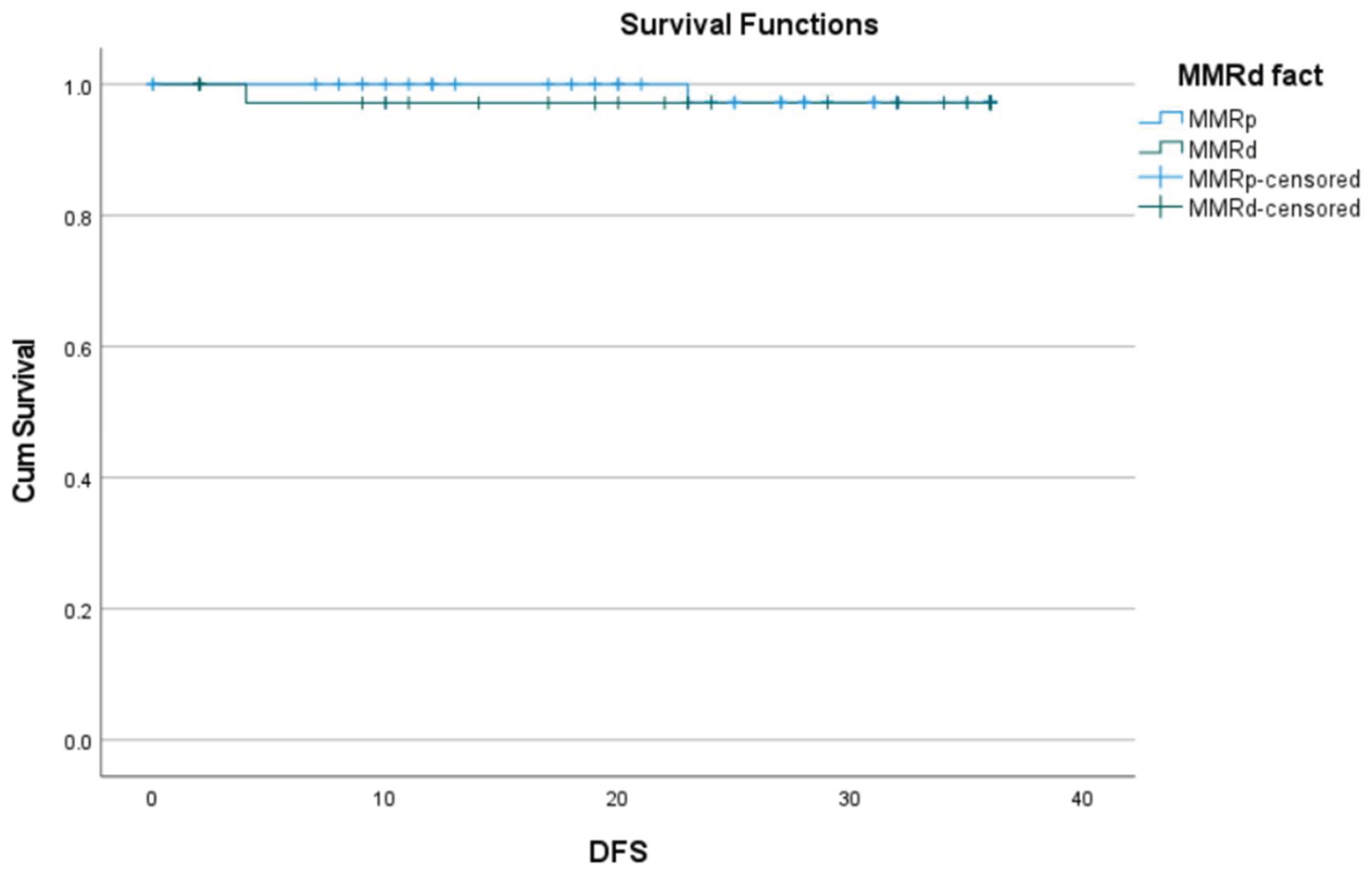
Figure 2.
Overall survival plots for MMRd and MMRp patients.
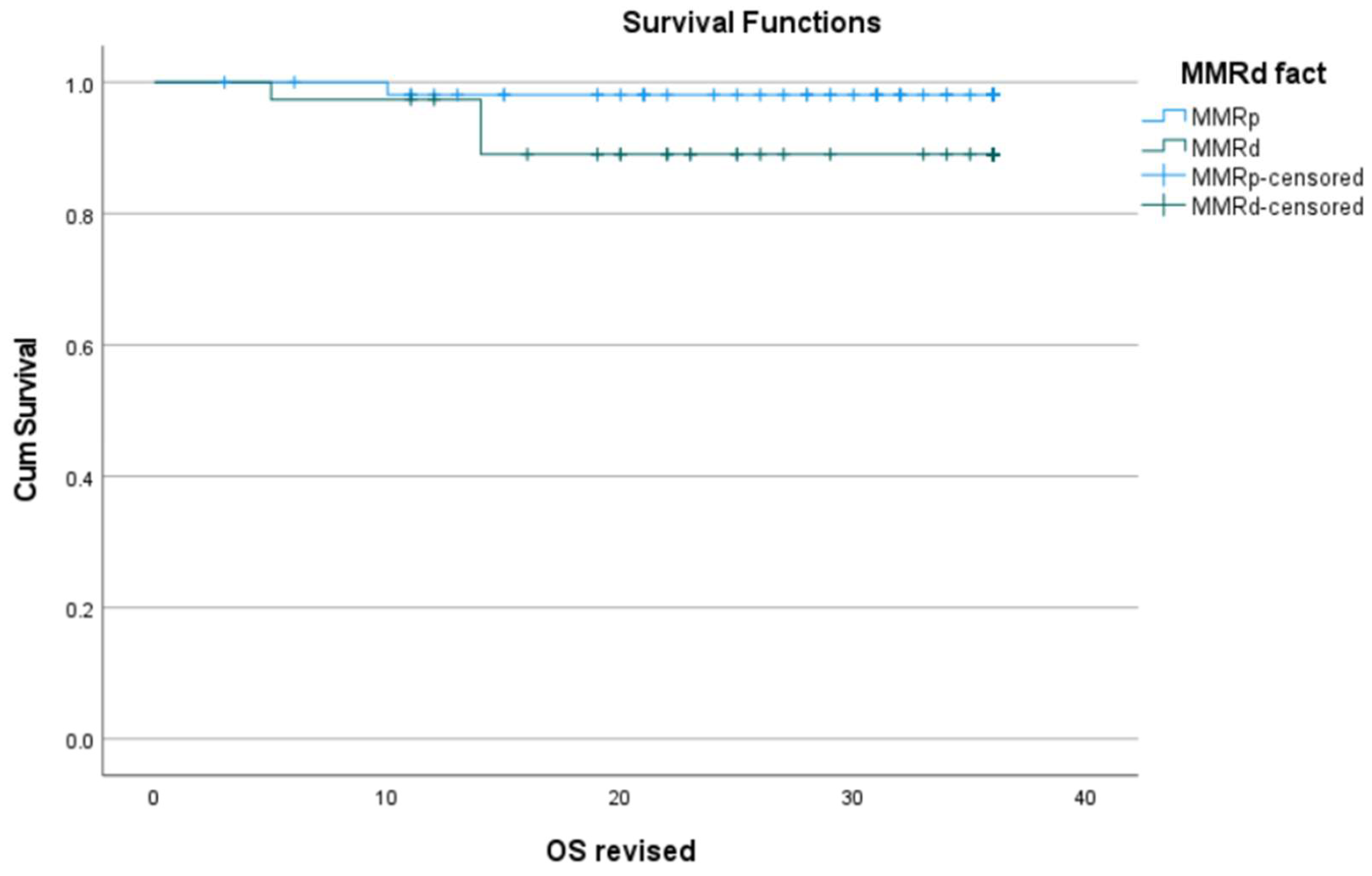

Table 1.
Epidemiological, histopathological and clinical characteristics of patients included in the present study.
Table 1.
Epidemiological, histopathological and clinical characteristics of patients included in the present study.
| Characteristic | Value |
|---|---|
| Age(mean ± SD) | 65.84 ± 11.32 |
| Histopathological Type, n(%) | |
| Endometrioid | 80 (86.0%) |
| Serous | 3 (3.2%) |
| MMMT | 5 (5.4%) |
| Clear cell | 1 (1.1%) |
| Mixed | 4 (4.3%) |
| Myometrial Invasion, n(%) | |
| >50% | 42 (45.2%) |
| <50% | 51 (54.8%) |
| LVSI, n(%) | |
| Yes | 22 (23.7%) |
| No | 71 (76.3%) |
| Grade, n(%) | |
| Low | 66 (71.0%) |
| High | 27 (29.0%) |
| Stage, n(%) | |
| I | 46 (49.5%) |
| II | 34 (36.6%) |
| III | 8 (8.6%) |
| IV | 5 (5.4%) |
| MMRstatus | |
| MMRp ΜΜRd |
54 (58.0%) 39 (42.0%) |
|
Nodal status No Yes |
89 (95.7%) 4 (4.3%) |
|
Recurrence No Yes |
2(2.2%) 91(97.8%) |
|
Death No Yes |
5(5.4%) 88(94.6%) |
Table 2.
Univariate regression between MMR deficiency rates and various histopathological characteristics.
Table 2.
Univariate regression between MMR deficiency rates and various histopathological characteristics.
| Variables | p value |
|---|---|
| Histologic Type | 0.009 |
| Myometrial Invasion | 0.005 |
| Grade | 0.907 |
| LVSI | 0.301 |
| Stage | 0.820 |
| Death | 0.329 |
| Any Nodal Invasion | 0.126 |
| Recurrence | 0.500 |
| Death | 0.15 |
Disclaimer/Publisher’s Note: The statements, opinions and data contained in all publications are solely those of the individual author(s) and contributor(s) and not of MDPI and/or the editor(s). MDPI and/or the editor(s) disclaim responsibility for any injury to people or property resulting from any ideas, methods, instructions or products referred to in the content. |
© 2026 by the authors. Licensee MDPI, Basel, Switzerland. This article is an open access article distributed under the terms and conditions of the Creative Commons Attribution (CC BY) license (http://creativecommons.org/licenses/by/4.0/).
Copyright: This open access article is published under a Creative Commons CC BY 4.0 license, which permit the free download, distribution, and reuse, provided that the author and preprint are cited in any reuse.


