
Submitted:
15 April 2026
Posted:
16 April 2026
You are already at the latest version
Abstract
One of the most frequent reasons why pipeline structures fail is corrosion. Corrosion may occur on the inside, exterior, or even both surfaces of the pipeline, and it is particularly challenging for insulated pipelines. While insulation helps prevent corrosion damage, there is still a potential for corrosion under insulation (CUI). The current inspection methods require removing the insulation layer, which is time-consuming and expensive. In this research, the Pulsed Eddy Current (PEC) method was applied to detect CUI. Several factors affect PEC signals, including sample material thickness, insulation material, insulation material thickness, and coil parameters. Understanding these characteristics is crucial for designing a suitable PEC system. Comparative analysis using eddy current reveals that thicker insulation materials generally result in higher initial signal strength, with the highest values observed for 5mm insulation across all materials. However, as the carbon steel thickness increases, the signal strength consistently decreases for all insulation types. Wood insulation maintains the highest signal strength across all thicknesses, followed by acrylic, which shows higher signal strength than rubber at comparable thicknesses. Overall, increasing the thickness of the carbon steel substrate consistently reduces the signal strength. Based on error analyses, the thickness of samples and insulation should be considered carefully as they impact accuracy.
Keywords:
corrosion under insulation (CUI)
; pulsed eddy current (PEC)
; carbon steel
; material insulations
1. Introduction
In oil and gas, chemical, and other related industries, as well as in the generation of power, pipes are widely utilized for transportation and distribution [1,2,3]. It was noticed that most of these pipes are insulated or coated on metal surfaces. The reason for this insulation is being done is to prevent any damage due to corrosion. Even though such prevention has been done, the chances for corrosion to happen are still there because of the presence of the existing moisture or solid particles which were confined under insulation and it is known as corrosion under insulation also known as CUI [4]. Usually, it takes place at the early stages and may lead to serious damage to the metallic structures. Currently, the inspection works are being done following the rules and regulations which were standardized by the local authority. In order to carry out the inspection work, it was required to remove the insulation first. Doing this is not just time-consuming but also increases the cost as it is required to close down the plants during this process [5,6,7]. Pulsed Eddy Current (PEC), a non-destructive testing (NDT) approach, has potential to be applied to detect CUI. This PEC method enables the inspection works to be done without taking out the coated materials from the pipes and it will benefit as consuming lesser time and cost when compared with the current inspection technique. Utilizing pulsed eddy current, it is feasible to recognise and quantify the occurrence of corrosion as a reduction in the pipe wall thickness [8].
An alternative to the current technique is to use the non-destructive pulsed eddy current method. Some factors affect the PEC signals which are sample material thickness, insulation thickness and insulation material. By understanding these factors, a proper PEC system can be created. The relation between the slopes of the PEC signal amplitude and material thickness will subsequently be determined using the regression method. Using this relationship, the experimental material thickness can be calculated and then compared with the actual thickness. Overall, this non-destructive method has certain factors that affect PEC signals, for example types of insulation, insulation thickness, and sample material thickness. It will be easier to create PEC systems that function satisfactorily in practical applications if we are aware of the consequences of these factors [9]. To calculate wall thickness loss in pipework, pulsed eddy current analyses variations in electromagnetic signals. As schematically depicted in the picture below, pulsed eddy current uses magnetic field sensors and coil sensors to find CUI [9,10]. By creating an eddy current out of an excitation coil inside the area of the chosen objects, a moment magnetic field output can be returned and further gathered by the reception coil. The magnetic field will change if there are any flaws or irregularities. The effectiveness of using a pulsed eddy current on different cladding materials was investigated using a mathematical simulation. The signal fading coefficient and the loss due to pipe wall thickness have been demonstrated.
According to early results, its output signal was stronger whenever the cladding material used to have a higher conductivity. The study also showed that larger signals could be detected when aluminium alloy was used as the coating material rather than stainless steel. In the case of an insulated pipe having stainless steel cladding, it was demonstrated that the observed electromagnetic signal amplitude decreased with increasing pipe wall thickness lost [11,12]. Eddy current technology offers a higher examination efficiency and lower risk of occupational hazards than radiography. The measurement must be carried out by a highly trained operator with the necessary training. Finally, eddy current techniques are insufficient to identify localised corrosion [13,14,15,16]. Figure 1 shows schematic system to generate PEC for CUI detection.
2. Materials and Methods
An experiment will be used to empirically assess the recommended methodology's applicability for estimating a material's thickness from a particular measurement of the PEC signal. In order to sample the signals and record them as raw data, we will build a PEC system then connect it to a PC (Figure 2).
3.1. Testing Materials
Samples used were carbon steel with thickness will be determined in this experiment. Carbon steel is malleable and ductile. despite its low tensile strength and being inexpensive and easy to manufacture, mild steel can have its surface hardness increased by carburization [18]. The composition of this mild steel is presented at Table 1. For this experiment, mild steel with three different thicknesses was used which were 6mm, 8mm, and also 100mm. Each of these mild steel sheets was prepared at the size of 400mm x 400mm.
3.2. Insulation Materials
Four types of insulation materials were used in this experiment which are rubber sheet, plywood, and acrylic. Each of these materials was prepared at the size of 400mm x 400mm. The rubber sheet known as EPDM (ethylene propylene diene monomer) is utilized in a wide variety of products. To a certain extent, EPDM can be blended to achieve certain qualities based on the EPDM polymers available, followed by the processing and curing techniques used. Table 2 shows the mechanical properties of the EPDM rubber.
3.3. Eddy Current Modules
As to set up the experiment, some pieces of equipment were used the probe, DAQ card, coil driver, and a PC with PEC System 5.0 software. Basically, for the identification and evaluation of surface and sub-surface flaws, probes stimulated with single or several frequencies are used. PEC probe will concentrate its strongest magnetic field close to the defect area [19] (Arjun et al., 2014). Data acquisition systems (DAQ) are used to collect data from their immediate environment. Getting data allows for the gathering of specific information about the environment being studied. Data acquisition devices typically connect to numerous sensors that describe the phenomenon being studied. Different types of transducers that generate analog impulses serve as the source of data for data acquisition systems [20] (Abdallah & Elkeelany, 2009).
These data need to be processed, so an analog-to-digital converter transforms the analog signals into a digital format. Basically, in this experiment, the DAQ card serves in a way where the Hall-effect mechanism detects the signal, which will be then transfer to the PC through a DAQ card and sampled at twenty thousand samples per second [15]. Figure 2 below shows the DAQ card used to collect the data. Universal computing system called LabView by National Instruments has a graphical user interface, as well as graphical program code, was the software that was used. It was created for data collection, handling, and display programming. This software receives and interprets the signal which was originally detected by the hall effect sensor and then transferred to the PC using the DAQ card.
3.3. Experimental PEC Probe and Working Principle
The PEC probe is main equipment used in for testing in this project. PEC is a non-destructive testing method that creates a magnetic field using a probe to cause eddy currents in the material being tested. The eddy current-produced secondary magnetic field is detected by the same instrument. An informational signal about the material's characteristics and the presence of flaws is created by the interplay of the primary and secondary magnetic fields. Under insulation, this PEC can find flaws and corrosion. The probe consists of exciter coils, a ferrite core, and a 90 mV/G-sensitive Hall Effect sensor (DRV5053VA). The magnetic flux is concentrated and the outgoing signal of the Hall device is amplified using a ferrite core (Figure 3 and Figure 4). The ferrite core is placed above the hall effect sensor and both the sensor and core are placed at the center of the probe which will be 50mm away from the exciter coils. The exciter coils consist of 200 turns with 6mm thickness. Figure 3 shows a schematic cross-section of the probes used in the thickness detector, Figure 4 illustrates the probes used in PEC, and Figure 5 displays typical data generated from the PEC system.
3. Results and Discussion
Table 3 shows the slope of PEC signal amplitude against the carbon steel thickness without insulation, with acrylic, rubber, and wood insulation.
Comparative analysis of insulation thickness and carbon steel thickness impacts on signal strength reveals several critical trends. Firstly, for all insulation materials, an increase in insulation thickness generally results in higher initial signal strength, with the maximum signal strength consistently observed at 5mm insulation. This trend suggests that thicker insulation more effectively facilitates signal transmission. Analysing the effect of carbon steel thickness on signal strength, we find a clear inverse relationship: as the carbon steel thickness increases from 6mm to 9mm, the signal strength decreases across all insulation types. This consistent trend indicates that thicker carbon steel substrates impede the signal transmission more significantly. When comparing the different insulation materials, wood demonstrates the highest signal strength across all tested thicknesses, outperforming both acrylic and rubber. This indicates that wood may possess better insulating properties or structural characteristics that enhance signal retention. Acrylic, while not as effective as wood, shows a higher signal strength than rubber at comparable thicknesses, suggesting it is a more effective insulating material than rubber in this context. The reduction in signal strength with increasing carbon steel thickness can be attributed to the material's inherent properties, such as electrical conductivity and magnetic permeability, which increase resistance or absorption of the signal, thereby attenuating it more significantly as thickness increases. Carbon steel, being a conductive material, can cause more significant signal loss due to skin effect, where the signal's energy is dissipated within the material as heat. Additionally, thicker carbon steel layers present a greater barrier for the signal to penetrate, leading to increased attenuation. This trend is uniformly observed regardless of the insulation material used, underscoring the dominant influence of carbon steel thickness on signal strength.
3.1. Percentage Error
From the regression graph of the slope against the testing materials were plotted, the equations in relationship to slopes and thickness were able to be found. This equation can be used to determine the thickness of the tested materials with use of the slope which can be found through this experiment. The thickness which is found through the equation will be a bit different from the actual thickness of the carbon steel (Table 4). The percentage error for this experiment is being calculated to know the know how high is the error rate. The equation 1 below shows the formula that were used to calculate the percentage error in this project.
The measurements of carbon steel thickness without insulation show a relatively low percentage error. The percentage error for the 6mm and 7mm thicknesses is below 1%, indicating accurate measurements. However, for the 8mm thickness, the percentage error increases to 2.2763%, suggesting a higher deviation from the actual thickness. The 9mm thickness also shows a moderate percentage error of 1.1544%. When 1mm – 3 mm of acrylic insulation is applied, the percentage errors generally increase compared to the measurements without insulation. For the 6mm and 7mm thicknesses, the errors are around 1.4450% and 1.4729%, respectively. However, the 8mm thickness shows a significant percentage error of 4.5138%, indicating a considerable deviation. The 9mm thickness has a moderate percentage error of 1.4644%.
5. Conclusions
The magnetic flux interacts with the samples, indicating the future potential of PEC as a mode to detect CUI without needing to remove insulation materials. This method offers a low-cost and time-efficient solution for corrosion detection. However, as the thickness of the insulation and carbon steel samples increases, the percentage error also rises, reaching 2.2763% for 8mm thickness, suggesting a higher deviation. Thus, it needs modification for future application to improve sensitivity. Enhancing the accuracy and reliability of PEC under varying insulation and sample thicknesses will be crucial to its successful implementation in industrial settings
References
- Roffey, P.; Davies, E. The generation of corrosion under insulation and stress corrosion cracking due to sulphide stress cracking in an austenitic stainless steel hydrocarbon gas pipeline. Corros. Eng. Sci. Technol. 2022. [Google Scholar] [CrossRef]
- Mohsin, K.; Mokhtar, A.; Tse, P.W. A fuzzy logic method: Predicting corrosion under insulation of piping systems with modelling of CUI 3D surfaces. J. Loss Prev. Process Ind. 2022, 75, 104584. [Google Scholar] [CrossRef]
- Tsai, Y.; Wang, J.; Chien, W.; Wei, C.; Wang, X.; Hsieh, S. A BIM-based approach for predicting corrosion under insulation. Autom. Constr. 2022, 135, 103818. [Google Scholar] [CrossRef]
- TWI Ltd. What is Non-Destructive Testing (NDT)? Methods and Definition. Available online: https://www.twi-global.com/technical-knowledge/faqs/what-is-non-destructive-testing#WhatistheDifferenceBetweenDestructiveandNonDestructiveTesting (accessed on 4 October 2022).
- NACE International. Non-Destructive Examination and Testing Screening Techniques for Corrosion-under-Insulation; NACE International: Houston, TX, USA, 2022. [Google Scholar]
- Wilds, N. Corrosion under insulation. 2022.
- Cao, Q.; Pojtanabuntoeng, T.; Esmaily, M.; Thomas, S.; Brameld, M.; Amer, A.; Birbilis, N. A review of corrosion under insulation: A critical issue in the oil and gas industry. 2022. [Google Scholar] [CrossRef]
- Sophian, A.; Tian, G.; Fan, M. Pulsed eddy current non-destructive testing and evaluation: A review. Chin. J. Mech. Eng. 2017, 30, 500–514. [Google Scholar] [CrossRef]
- Angani, C.S.; Park, D.G.; Kim, C.G.; et al. The pulsed eddy current differential probe to detect a thickness variation in an insulated stainless steel. J. Nondestruct. Eval. 2010, 29, 248–252. [Google Scholar] [CrossRef]
- Demers-Carpentier, V. Corrosion Under Insulation: The 7 Inspection Methods You Must Know About. Available online: https://blog.eddyfi.com/en/corrosion-under-insulation-the-7-inspection-methods-you-must-know-about (accessed on 7 October 2022).
- API RP 583: 2021: Corrosion Under Insulation and Fireproofing. Available online: https://www.bsbedge.com/productdetails/API/APIRP583/apirp583 (accessed on 7 October 2022).
- C795-08—Standard Specification for Thermal Insulation for Use in Contact with Austenitic Stainless Steel. Available online: https://webstore.ansi.org/Standards/ASTM/astmc79508 (accessed on 7 October 2022).
- Cao, Q.; Esmaily, M.; Liu, R.; Birbilis, N.; Thomas, S. Corrosion of mild steel under insulation: The effect of dissolved metal ions. 2022. [Google Scholar] [CrossRef]
- ASTM G189—Standard Guide for Laboratory Simulation of Corrosion under Insulation. Available online: https://www.document-center.com/standards/show/ASTM-G189 (accessed on 7 October 2022).
- Sophian, A.; Tian, G.Y.; Taylor, D.; Rudlin, J. A feature extraction technique based on principal component analysis for pulsed eddy current NDT. NDT E Int. 2003, 36, 37–41. [Google Scholar] [CrossRef]
- Jia, Y.; Udpa, L.; Udpa, S. Effect of insulation material on pulse eddy current testing signals for surface crack detection. J. Appl. Phys. 2017, 121, 053902. [Google Scholar]
- Li, P.; Li, Y.; Li, W.; Wang, W.; Cai, G. Influence of electrical conductivity of insulation material on eddy current testing. Sensors 2018, 18, 1153. [Google Scholar]
- Zhang, J.; Wang, W. The influence of thickness on the amplitude of pulsed eddy current testing. Metals 2017, 7, 463. [Google Scholar]
- Shi, J.; Li, X. Influence of skin effect on pulsed eddy current testing. IEEE Trans. Magn. 2012, 48, 4474–4477. [Google Scholar]
- Li, J.; Zhou, Y.; Cui, Y.; Huang, W. Study on the skin depth effect in pulsed eddy current nondestructive testing. Sensors 2017, 17, 1166 Title of the chapter. In Book Title, 2nd ed.; Author 1, A., Author 2, B., Editor 1, A., Editor 2, B., Eds.; Publisher Location, Country: Publisher, 2007; Volume 3, pp. 154–196. [Google Scholar]
Figure 1.
The Generic configuration of a PEC NDT system [15].
Figure 1.
The Generic configuration of a PEC NDT system [15].
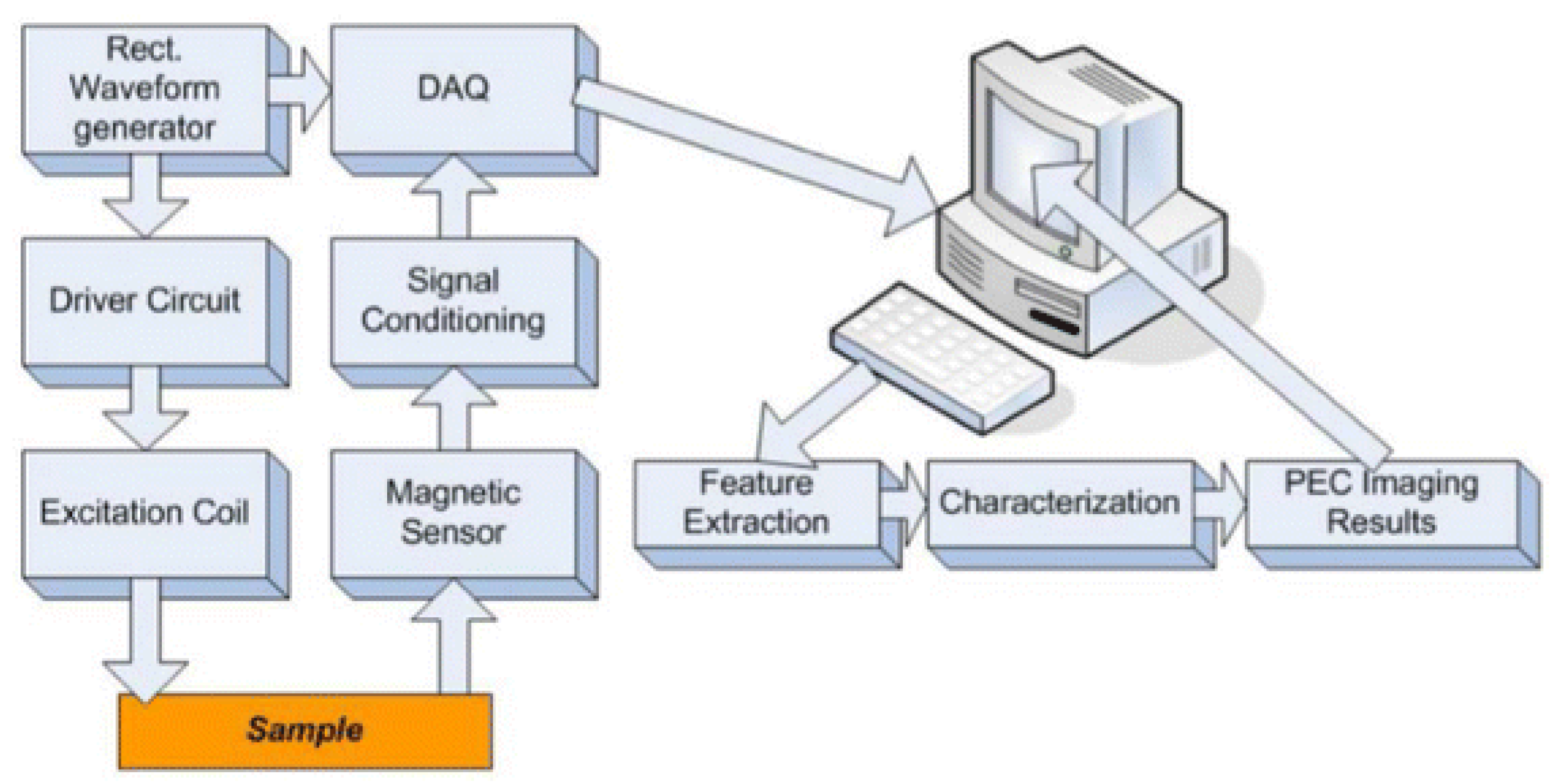
Figure 1.
The block diagram of PEC NDT system [17].
Figure 1.
The block diagram of PEC NDT system [17].
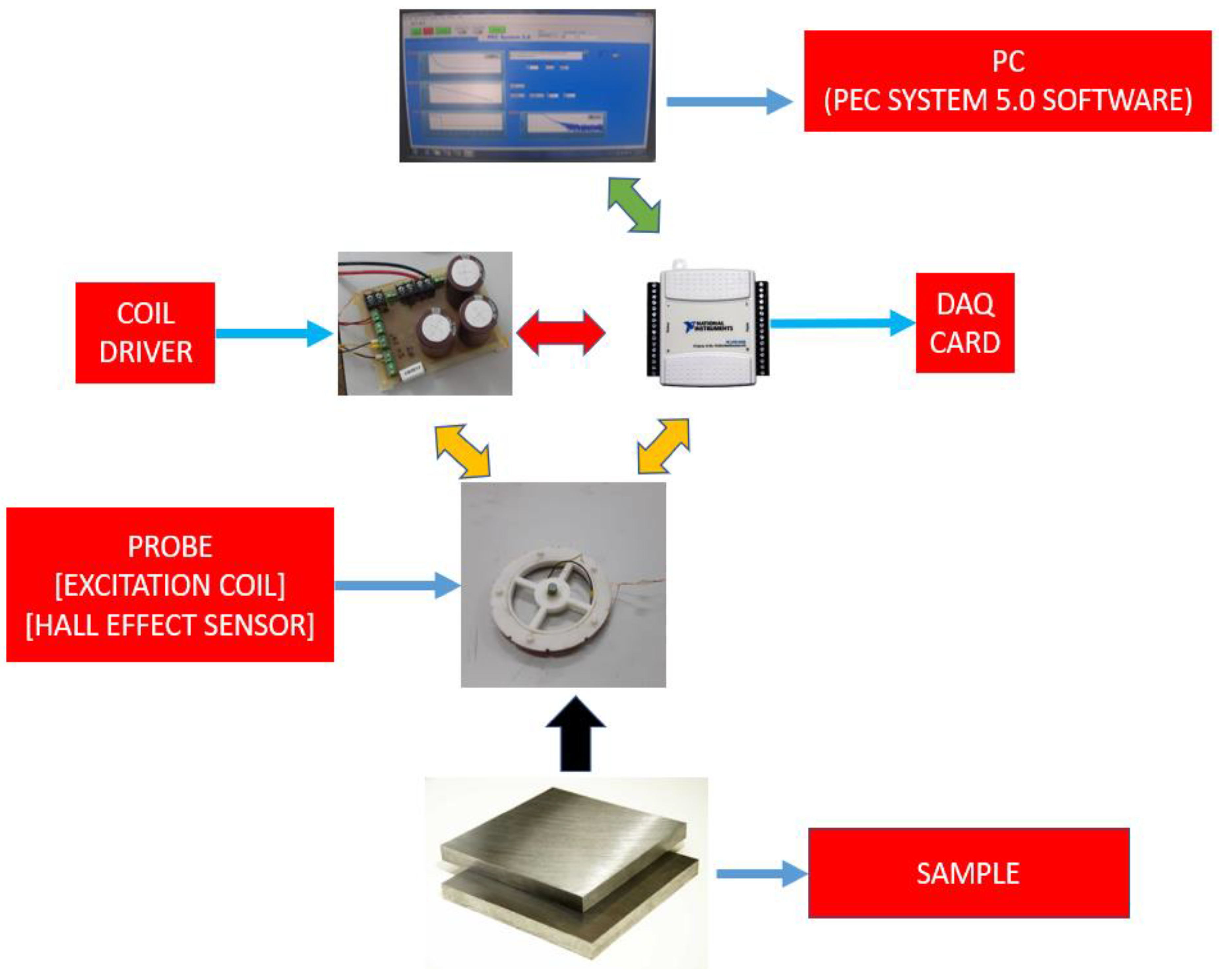
Figure 3.
The schematic of cross section of the probe.
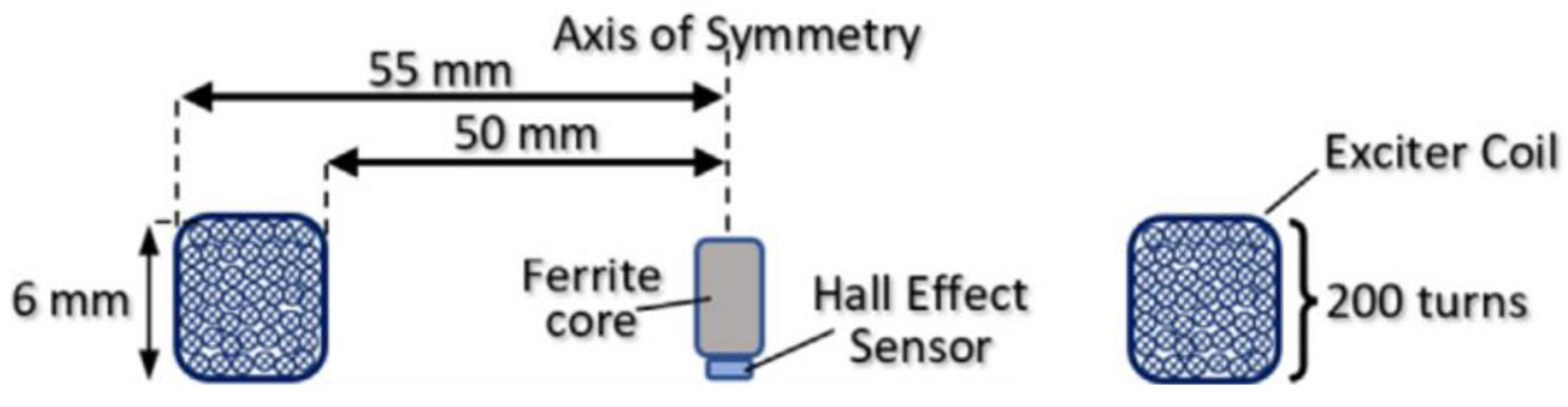
Figure 4.
The PEC probe used in the experiment.
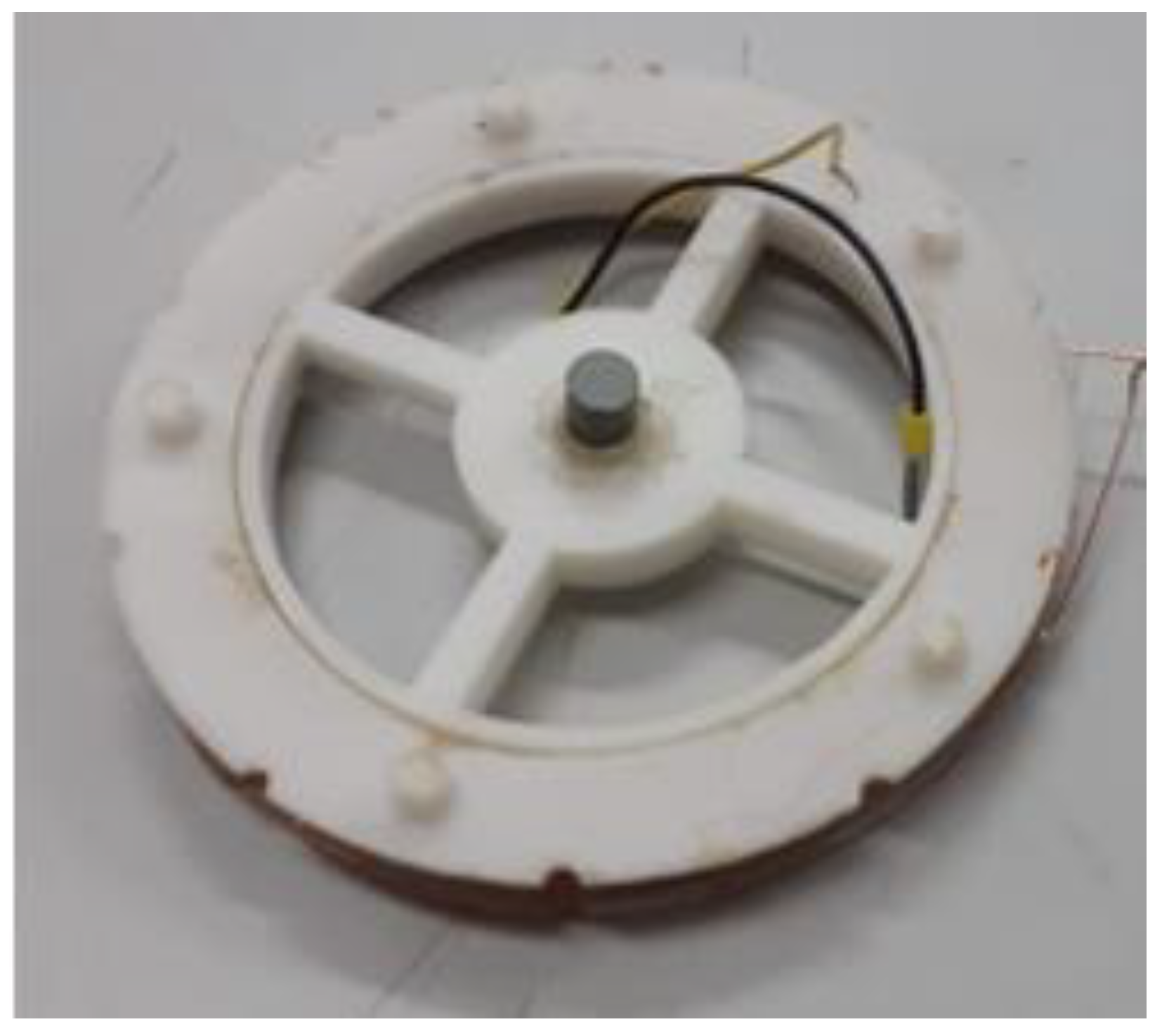
Figure 5.
Typical data analyses obtained from PEC system.
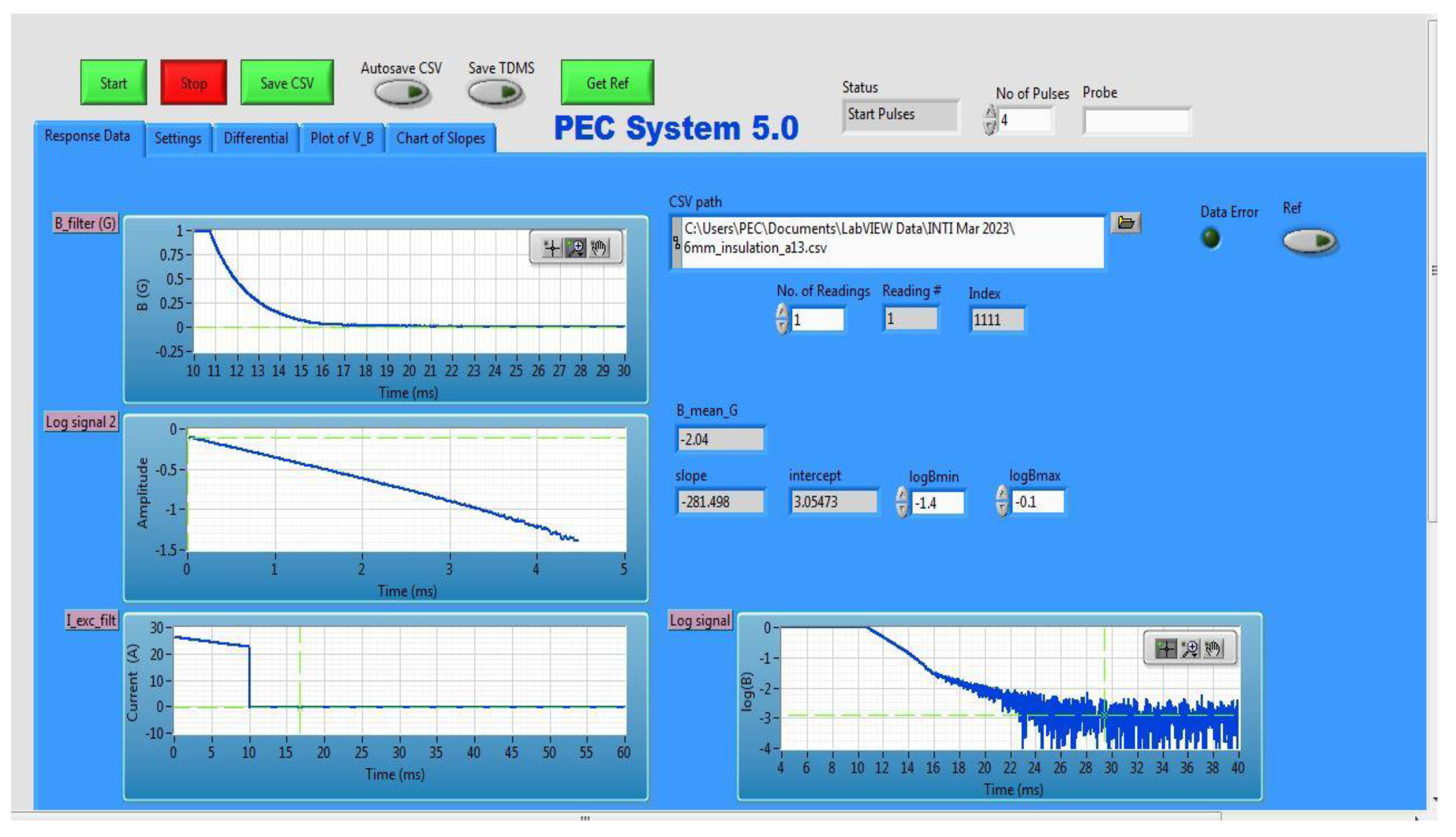

Table 1.
Composition of samples.
| Elements | Compositions (%) |
| Carbon, C | 0.14 - 0.2 |
| Iron, Fe | 98.81 – 99.26 |
| Manganese, Mn | 0.60 - 0.90 |
| Phosphorous, P | ≤ 0.040 |
| Sulphur, S | ≤ 0.050 |
Table 2.
Samples of insulation materials.
| Property | Value |
| Appearance | - |
| Hardness, Shore A | 30–90 |
| Tensile failure stress, ultimate | 17 MPa (500-2500 PSI) |
| Elongation after fracture in % | ≥ 300% |
| Density | Can be compounded from 0.90 to >2.0 g/cm |
Table 3.
Slope of PEC at various samples thickness and insulations materials.
| Types of samples | Thickness of samples | |||
| Insulation Thickness | Carbon Steel 6mm | Carbon Steel 7mm | Carbon Steel 8mm | Carbon Steel 9mm |
| Acrylic 1mm | 281.562 Mv/Ms | 275.731 Mv/Ms | 272.657 Mv/Ms | 264.092 Mv/Ms |
| Acrylic 3mm | 297.235 Mv/Ms | 292.601 Mv/Ms | 284.356 Mv/Ms | 281.819 Mv/Ms |
| Acrylic 5mm | 310.199 Mv/Ms | 310.414 Mv/Ms | 301.119 Mv/Ms | 297.906 Mv/Ms |
| Rubber 1mm | 283.116 Mv/Ms | 276.576 Mv/Ms | 267.914 Mv/Ms | 266.389 Mv/Ms |
| Rubber 3mm | 291.627 Mv/Ms | 284.307 Mv/Ms | 275.468 Mv/Ms | 272.981 Mv/Ms |
| Rubber 5mm | 310.551 Mv/Ms | 304.314 Mv/Ms | 290.873 Mv/Ms | 283.383 Mv/Ms |
| Wood 1mm |
285.913 Mv/Ms | 278.727 Mv/Ms | 264.722 Mv/Ms | 260.977 Mv/Ms |
| Wood 3mm |
299.080 Mv/Ms | 297.547 Mv/Ms | 290.413 Mv/Ms | 285.595 Mv/Ms |
| Wood 5mm |
313.772 Mv/Ms | 307.943 Mv/Ms | 301.97 Mv/Ms | 298.721 Mv/Ms |
Table 4.
Comparison between ECP and manual measurement.
| Without Insulation | ||||
| Actual Carbon Steel Thickness (Mm) | Experimental Carbon Steel Thickness (Mm) | Percentage Error (%) | ||
| 6 | 6.0102 | 0.1700 | ||
| 7 | 6.9371 | 0.8986 | ||
| 8 | 8.1821 | 2.2763 | ||
| 9 | 8.8961 | 1.1544 | ||
| Acrylic Insulation 1mm | ||||
| Actual Carbon Steel Thickness (Mm) | Experimental Carbon Steel Thickness (Mm) | Percentage Error (%) | ||
| 6 | 6.0867 | 1.4450 | ||
| 7 | 7.1031 | 1.4729 | ||
| 8 | 7.6389 | 4.5138 | ||
| 9 | 9.1318 | 1.4644 | ||
| Acrylic Insulation 3mm | ||||
| Actual Carbon Steel Thickness (Mm) | Experimental Carbon Steel Thickness (Mm) | Percentage Error (%) | ||
| 6 | 6.0494 | 0.8233 | ||
| 7 | 6.8696 | 1.8629 | ||
| 8 | 8.3299 | 4.1238 | ||
| 9 | 8.7780 | 2.4667 | ||
Disclaimer/Publisher’s Note: The statements, opinions and data contained in all publications are solely those of the individual author(s) and contributor(s) and not of MDPI and/or the editor(s). MDPI and/or the editor(s) disclaim responsibility for any injury to people or property resulting from any ideas, methods, instructions or products referred to in the content. |
© 2026 by the authors. Licensee MDPI, Basel, Switzerland. This article is an open access article distributed under the terms and conditions of the Creative Commons Attribution (CC BY) license (http://creativecommons.org/licenses/by/4.0/).
Copyright: This open access article is published under a Creative Commons CC BY 4.0 license, which permit the free download, distribution, and reuse, provided that the author and preprint are cited in any reuse.


