

Submitted:
14 April 2026
Posted:
16 April 2026
You are already at the latest version
Abstract
Capsizing, sinking, and flooding accidents occurring in the coastal waters of the Republic of Korea constitute a persistent marine safety concern, accounting for approximately 17% of total fatalities associated with marine accidents. Previous statistical analyses of accident causation have identified key contributing factors such as adverse weather conditions, improper cargo loading, and deficiencies in vessel maintenance; however, the complex interdependencies among these factors have not been sufficiently quantified. To address this limitation, this study proposes a Fuzzy Bayesian Network (FBN) model to systematically evaluate and quantify the risk factors associated with capsizing, sinking, and flooding accidents. A total of 164 adjudicated marine accident cases that occurred in Korean coastal waters over a 10-year period (2015–2024) were analyzed to estimate prior probabilities for six major causal categories. Conditional Probability Tables (CPTs) were derived through a structured Delphi survey conducted with marine safety experts possessing more than 10 years of professional experience. To mitigate the subjectivity inherent in expert judgment, Triangular Fuzzy Numbers (TFNs) and centroid-based defuzzification were applied. Sensitivity analysis identified sea state (SI = 0.0155) and cargo loading condition (SI = 0.0125) as the two most influential factors affecting the probability of capsizing. Scenario analysis further revealed that when adverse weather conditions and improper cargo loading occur simultaneously, the probability of capsizing increases to 39.3%, representing a 5.3 percentage point increase compared to the baseline. In addition, the model demonstrated a close agreement with observed accident outcome distributions, with a Kullback–Leibler (KL) divergence of 0.038, indicating differences within 1.3 percentage points across all outcome categories. The findings of this study provide practical implications for targeted marine safety interventions and the prioritization of regulatory measures in the coastal waters of the Republic of Korea.
Keywords:
Fuzzy Bayesian Network
; marine safety
; marine accident
; Korean coastal waters
; capsizing
; sinking
; risk assessment
1. Introduction
Marine safety is a critical concern for coastal countries with large fishing fleets and active coastal trade routes. The Republic of Korea, with a coastline of 15,297 km and 63,731 registered fishing vessels as of 2024, continues to face persistent challenges related to marine accidents, particularly capsizing, sinking, and flooding incidents [1,2]. These accident types not only result in significant human casualties and economic losses but also impose substantial burdens on government agencies, search and rescue operations, marine insurance systems, and regulatory enforcement bodies.
According to statistical data from adjudicated marine accident reports issued by the Korea Maritime Safety Tribunal (KMST) over the past decade (2015–2024), capsizing, sinking, and flooding accidents accounted for 164 cases (8.7% of total marine accidents), yet contributed disproportionately to human casualties, representing 17% (165 fatalities and missing persons) [3]. Analysis of these reports indicates that key contributing factors include adverse weather conditions, improper cargo loading, vessel equipment failures, navigational errors, and non-compliance with operational regulations. Importantly, these factors rarely act in isolation; rather, marine accidents typically arise from the convergent interaction of multiple causal pathways [4,5].
Conventional analyses of marine accidents in Korea have largely relied on univariate frequency analysis and categorical aggregation of accident causes [3]. While such descriptive approaches provide baseline insights, they are fundamentally limited in capturing probabilistic dependencies and conditional relationships among multiple risk variables. Moreover, classical statistical methods are constrained by data completeness issues, as marine accident reports often contain incomplete event histories, inconsistent causal coding, and missing contextual information.
Bayesian Networks (BNs) provide a principled framework for representing probabilistic causal dependencies through directed acyclic graphs (DAGs), thereby addressing these limitations [6,7]. BN-based approaches have been widely applied in marine risk assessment, including ship collision analysis [8], fire and explosion risk in offshore units [9], and human error modeling in seafaring operations [10]. However, quantifying Conditional Probability Tables (CPTs) remains challenging in data-scarce environments. Fuzzy set theory offers a robust mathematical framework for handling uncertainty and vagueness in expert judgment [11,12], and the integration of fuzzy logic with BNs—referred to as Fuzzy Bayesian Networks (FBNs)—has demonstrated effectiveness in various marine safety applications, such as fire and explosion risk assessment in cargo spaces [13], accident prediction in narrow waterways [14], and resilience analysis in Arctic navigation [15].
Despite these advances, limited research has explicitly applied FBNs to capsizing, sinking, and flooding accidents in Korean coastal waters, particularly with respect to cargo loading conditions and vessel-specific vulnerabilities. To address this gap, this study develops an FBN model based on 164 adjudicated marine accident cases and structured expert elicitation using the Delphi method [16].
The objectives of this study are fourfold: (1) to identify the empirical distribution of causal risk factors; (2) to construct an FBN that captures probabilistic dependencies among identified risk nodes; (3) to quantify CPTs using fuzzy Delphi-based expert judgments with triangular membership functions; and (4) to evaluate model outputs through sensitivity analysis and comparison with observed accident trends.
The remainder of this paper is organized as follows: Section 2 reviews relevant literature; Section 3 presents the research methodology; Section 4 reports the FBN inference and sensitivity analysis results; Section 5 discusses policy implications for marine safety; and Section 6 concludes the study.
2. Literature Review
2.1. BN Applications in Marine Safety
The application of BNs to maritime risk assessment has expanded significantly over the past two decades. Trucco et al. [6] conducted pioneering work by integrating human factors into BN-based maritime risk models, thereby establishing a foundation for incorporating organizational and behavioral variables into probabilistic safety analysis. Hänninen and Kujala [8] further advanced this approach by applying BN modeling to estimate ship collision probabilities in the Gulf of Finland, providing a methodological framework that has since been widely adopted across diverse marine accident contexts.
Building on analyses of major marine accident records, Liu et al. [17] employed a BN model to quantify the causal structure of marine accidents in Chinese coastal waters by considering vessel type, environmental conditions, and operational factors. Their findings indicated that small vessels are particularly vulnerable and that adverse weather conditions are frequently associated with severe accident outcomes. These results are consistent with the patterns observed in the analysis of adjudicated marine accident cases in the coastal waters of the Republic of Korea examined in this study.
2.2. Fuzzy Set Theory and Expert Elicitation in Risk Modeling
The application of fuzzy set theory to risk assessment originates from Zadeh’s foundational work on linguistic variables [11]. Wang [18] further advanced this field by developing a fuzzy rule-based inference framework for ship safety assessment, which subsequently laid the conceptual foundation for the integration of fuzzy logic with BNs.
The Delphi method is a structured approach for achieving expert consensus through iterative rounds of anonymous surveys with controlled feedback [19]. In maritime risk-related studies, Delphi techniques and structured expert judgment have been widely employed for prioritizing safety measures, refining risk factors, and estimating probabilities based on expert knowledge. For instance, Kim and Gausdal [20] combined a modified Delphi method with the Analytic Hierarchy Process (AHP) to derive priorities for safety leadership behaviors in a shipping context, while Yacob and Hassim [21] applied a Delphi-AHP approach to rank causal factors of marine transportation accidents.
Similarly, Lee et al. [22] identified risk factors for marine recreational activities using a modified Delphi method and subsequently constructed a BN by assigning probability values through expert panels. Trucco et al. [6] also utilized expert judgment to quantify CPTs in BN-based maritime transportation risk analysis, particularly in cases where empirical data were limited.
In addition, Delphi-based studies in the maritime domain frequently employ the Content Validity Ratio (CVR) as a criterion for evaluating the relevance of selected items. Yang et al. [23] and Yacob and Hassim [21] incorporated CVR-based validation procedures to refine safety management indicators for port operations and causal factor frameworks for marine transportation accidents, respectively.
2.3. FBN Approaches
Onisawa [24] emphasized the necessity of incorporating fuzzy concepts to address uncertainty in reliability analysis. Building on this foundation, Yazdi and Kabir [25] proposed a risk analysis framework that integrates fuzzy set theory with BNs to effectively account for uncertain failure data and expert knowledge.
In the field of marine safety, FBNs have been widely employed as a quantitative tool for analyzing causal relationships among risk factors by integrating incomplete accident data with expert judgment. Eleye-Datubo et al. [26] applied FBNs to marine and offshore safety assessment, presenting a methodological framework that links linguistic and uncertain inputs to probabilistic risk models. Chen et al. [27] developed an evidence-based FBN using marine accident reports from 2001 to 2020, enabling a systematic analysis of the causal structure of general marine accidents.
Furthermore, Yin et al. [28] quantified accident risks arising from language and communication issues in maritime transportation using an FBN approach, demonstrating that human and communication-related factors can be structurally incorporated into maritime risk models. In a similar context, Göksu et al. [29] applied FBNs to assess ship steering gear failures, identifying root causes and evaluating risk levels under high-risk operational conditions such as berthing, strait navigation, and canal transit.
These studies highlight the methodological strength of FBNs in marine safety analysis, particularly in environments where quantitative data are limited, by enabling the integration of expert judgment with empirical accident evidence.
3. Methodology
3.1. Overall Research Framework
The methodological framework of this study, as illustrated in Figure 1, consists of five sequential stages: (1) collection of accident data and classification of causal factors; (2) design of the FBN structure; (3a) assignment of prior probabilities based on empirical accident records; (3b) quantification of CPTs through fuzzy Delphi-based expert elicitation; (4) probabilistic inference using the FBN; and (5) model validation and sensitivity analysis.
3.2. Fuzzy Set Theory: Mathematical Foundations
3.2.1. Triangular Fuzzy Numbers
A triangular fuzzy number (TFN) is characterized by a triple (a, m, b) where a denotes the lower bound, m the modal value, and b the upper bound, satisfying a ≤ m ≤ b. The membership function is defined as:
where denotes the triangular fuzzy number; is the degree of membership of value x in ; x is the input variable; a and b are the lower and upper bounds of the support, respectively; and m is the modal value at which . Figure 2 illustrates the five TFNs corresponding to the linguistic scale employed in this study. The five linguistic terms and their TFN parameters are defined in Table 1.
3.2.2. Weighted Aggregation of Expert TFNs
Let denote the TFN of expert k, with normalized weight where is the competence score. The expert competency score was assigned on a scale of 1–5, reflecting years of experience, qualification level, and practical expertise in marine accident investigation or ship inspection. The aggregated TFN and defuzzified (centroid) probability, and normalized outcome probability are given by Equations (2)–(4):
where is the weighted aggregate TFN; and are the lower bound, modal value, and upper bound of expert k’s TFN, respectively; is the defuzzified probability obtained via the centroid method; μ(x) is the membership function of the aggregated TFN; , , and denote the lower bound, modal value, and upper bound of , respectively; is the normalized probability of accident outcome i; and is the corresponding defuzzified value prior to normalization. This normalization ensures that the probabilities of the three mutually exclusive outcome states sum to unity.
Figure 3 illustrates the complete three-stage fuzzy elicitation process from individual expert assessments through aggregation to defuzzification.
3.3. FBN Model Structure
3.3.1. Network Topology
The FBN is constructed as a DAG comprising six parent nodes and one target outcome node (Figure 4). The outcome node in this model is defined based on a single “primary accident type” explicitly identified in the adjudication reports of the KMST. Although real-world marine accidents often involve sequential causal processes—such as flooding followed by sinking—the present study models the most severe ultimate outcome to which the risk factors converge. Accordingly, the outcome states are defined within a mutually exclusive discrete space, and the probabilities are normalized to reflect this assumption. The joint probability distribution factorizes as:
where S, C, M, N, R, and Mo denote the six parent nodes representing sea state, cargo loading condition, vessel maintenance status, navigational behavior, regulatory compliance, and mooring condition, respectively; O is the target outcome node taking one of three mutually exclusive states {Capsizing, Sinking, Flooding}; and are the marginal prior probabilities of the respective parent nodes; and is the conditional probability of the outcome node given the joint state of all six parent nodes, as specified in the CPT.
3.3.2. Prior Probability Assignment
The prior probabilities of each parent node were derived from an accident dataset based on 164 adjudicated marine accident cases. Table 2 presents the node definitions, state discretization, and the estimated prior probabilities.
3.4. Delphi Expert Survey and CVR Validation
The Delphi method was applied in two rounds to elicit CPT values from 14 maritime professionals (mean experience ≥ 12 years). The CVR was computed after each Delphi round; the final acceptance threshold reported here is based on the 14 experts who completed the final Delphi round.
where is the number of experts rating the item as ‘High’ or ‘Very High’, and N is total panel size. For N = 14 experts completing the final Delphi round, the minimum CVR for statistical significance at p < 0.05 is 0.51 [30]. Entries failing this threshold were resubmitted for targeted expert review prior to model finalization.
Given the cognitive burden of eliciting full CPTs across all 216 parent configurations, the Delphi survey focused on the 28 representative parent state combinations with the highest accident frequency based on prior data analysis. Remaining configurations were completed using monotonicity-constrained linear interpolation. Monotonicity was defined such that worsening parent node states correspond to non-decreasing probabilities of adverse outcomes.
3.5. Bayesian Inference: Variable Elimination
Given observed evidence e on a subset of parent nodes, let u denote the set of unobserved parent nodes, i.e., u=pa(O)\e. The posterior accident probability is computed by marginalizing the joint distribution over u:
where O is the accident outcome node; o∈{Capsizing, Sinking, Flooding} denotes a specific outcome state; e is the observed evidence on a subset of parent nodes; u=pa(O)\e is the set of unobserved parent nodes over which marginalization is performed; and P(S)∙P(C)∙P(M)∙P(N)∙P(R)∙P(Mo) are the prior probabilities of the six parent nodes, respectively. For the six-node structure with binary/ternary state spaces (total combinations: 3×3×3×2×2×2 = 216), exact inference is computationally tractable without approximation.
3.6. Sensitivity Analysis and Model Validation
The sensitivity index for each parent node is defined as the maximum absolute change in capsizing probability when is fixed at its most adverse state. Model calibration was assessed using the Kullback–Leibler (KL) divergence between the FBN-estimated outcome distribution and the observed accident frequency distribution, as given in Equations (8) and (9):
where is the sensitivity index of parent node ; P(O=Capsizing | =worst) is the posterior capsizing probability when node is fixed at its most adverse state while all other nodes remain marginalized; P(O=Capsizing) is the baseline capsizing probability; is the KL divergence from the observed distribution Q to the model-estimated distribution P; o denotes each accident outcome state (Capsizing, Sinking, or Flooding); is the FBN-estimated probability of outcome o; and is the corresponding observed frequency. A smaller KL divergence value indicates closer agreement between the model output and the empirical distribution.
4. Results
4.1. FBN Model Construction and Expert Elicitation
4.1.1. Network Structure and Expert Panel
The FBN structure was validated by the full expert panel (n = 14 in Round 1; n = 14 completing Round 2). The panel comprised five licensed ship masters and chief officers (mean experience: 18.4 years), three marine accident investigators (mean: 14.2 years), three ship surveyors (mean: 12.7 years), and three maritime safety academics (mean: 16.1 years). Following Round 1, the expert panel endorsed the six-node DAG without structural modification. A minor refinement was made to the Sea State node boundary: the threshold between ‘Low’ and ‘Moderate’ was adjusted from 1.0 m to 1.5 m significant wave height based on expert consensus regarding Korean coastal vessel operational thresholds.
4.1.2. CVR Results
CVR values were computed for all primary CPT entries following Round 2. Table 3 presents results for selected high-priority entries. All entries in the final model achieved CVR > 0.51. Three entries that failed the threshold in Round 2 achieved consensus following targeted expert re-review.
4.2. Baseline Accident Probability Estimation
The baseline accident outcome probabilities, computed by marginalizing over all parent nodes weighted by their empirical prior distributions, are presented in Table 4. The model estimates P(Capsizing) = 34.00%, P(Sinking) = 35.16%, and P(Flooding) = 30.84%. The KL divergence value between the model output and the observed frequency distribution (0.038) indicates that the differences between the FBN estimates and the observed frequencies are within 1.3 percentage points across all outcome categories—capsizing (FBN estimate: 34.00% vs. observed: 33.10%), sinking (35.16% vs. 36.40%), and flooding (30.84% vs. 30.50%). This result suggests that the model adequately reproduces the empirical distribution of accident outcomes.
It should be noted that the baseline outcome probabilities presented in Table 4 do not represent the absolute risk of accident occurrence under normal operating conditions. Rather, they reflect conditional probabilities of capsizing, sinking, or flooding given that a marine accident has already occurred in the coastal waters of the Republic of Korea.
4.3. Sensitivity Analysis
Table 5 and Figure 5 present the OAT sensitivity analysis results. Sea State (S) exhibited the highest sensitivity index (SI = 0.0155), followed by Cargo Loading Condition (C, SI = 0.0125), Navigational Behavior (N, SI = 0.0107), and Regulatory Compliance (R, SI = 0.0104). Vessel Maintenance Status (M) showed the lowest sensitivity index for capsizing outcomes (SI = 0.0052), reflecting its greater mechanistic association with sinking via hull flooding pathways rather than capsizing.
4.4. Scenario Analysis
Table 6 and Figure 6 present the posterior accident probabilities for four representative scenarios. Scenario S1 (adverse weather + improper cargo loading) yields the highest probability of capsizing at 39.3%, representing an increase of 5.3 percentage points compared to the baseline. In Scenario S2 (poor vessel maintenance + negligent navigation), the probability of flooding increases to 32.43%, while sinking remains the dominant outcome among the three categories at 34.58%. This result is consistent with the mechanical linkage between progressive water ingress and equipment-related failures. Scenario S3 (non-compliant operation under calm weather conditions) produces probabilities similar to the baseline, suggesting that regulatory non-compliance alone may have a limited effect on acute risk in the absence of adverse environmental or operational triggers. Scenario S4 (approaching typhoon + unsafe mooring) increases the probabilities of both capsizing and flooding, while the probability of sinking decreases slightly. The combined risk of capsizing and sinking remains high at 68.75%.
Scenario S1 employs C=Imbalanced rather than Overloaded, as cargo imbalance represents the most operationally prevalent form of improper loading identified in the KMST records, whereas overloading reflects a more extreme condition tested in the sensitivity analysis.
5. Discussion
5.1. Interpretation of Key Findings
The identification of adverse weather conditions and improper cargo loading as the two most influential risk nodes is consistent with the dominant causal narratives repeatedly reported in adjudicated marine accident cases in the Republic of Korea and aligns with findings from similar studies on marine accident causation in East Asian coastal waters [17]. Notably, the substantial increase in capsizing probability observed in Scenario S1, where adverse weather and improper cargo loading occur simultaneously, suggests the potential presence of non-additive and synergistic interactions between risk factors. In particular, when static stability (GZ) is reduced due to cargo imbalance, cargo shifting, or free surface effects, severe sea states can further amplify roll motion, thereby increasing the likelihood of stability failure [31,32,33,34]. Such complex interactions are difficult to capture using univariate frequency-based approaches alone.
Furthermore, the relatively higher sensitivity of vessel maintenance conditions with respect to sinking, compared to capsizing, provides meaningful mechanistic insights. This indicates that factors such as hull penetration defects, loss of watertight integrity, inadequate watertight door management, and equipment failures are more likely to contribute to progressive flooding pathways rather than directly inducing acute dynamic instability under rough sea conditions [31,35,36]. These findings suggest that maintenance-focused safety interventions may be more effective in reducing the risk of sinking and flooding accidents than in preventing capsizing events.
5.2. Implications for Maritime Safety Policy
The pronounced importance of cargo loading conditions, particularly in fishing vessels, is underscored by the finding that deck cargo accounts for 33.8% of cargo-related cases based on the present dataset analysis, representing the most dominant loading issue. This highlights the need to enhance safety awareness among fishing vessel masters regarding catch loading practices, as well as to strengthen enforcement by regulatory authorities such as the Coast Guard. The interaction between adverse weather conditions and improper cargo loading identified in Scenario S1 further supports the necessity for revising institutional frameworks to incorporate stability assessments in relation to weather advisories. From a technical perspective, the development of simplified stability assessment tools for small fishing vessels, integrated with real-time meteorological information systems, could serve as an effective measure for accident prevention.
Meanwhile, illegal operational practices—such as failure to undergo mandatory inspections or exceeding passenger capacity (Scenario S3)—may only marginally increase acute risk under favorable conditions; however, they create latent vulnerabilities that can trigger catastrophic outcomes when combined with other contributing factors. This finding carries important implications for enforcement prioritization. Regulatory efforts are likely to achieve greater risk reduction when they target underlying structural conditions that enable persistent non-compliance, such as insufficient inspection coverage, inadequate watchkeeping enforcement, and the incomplete application of stability certification standards for small fishing vessels, rather than relying solely on punitive measures.
5.3. Comparison with Prior Literature
The ranking of risk factors derived from the sensitivity analysis is broadly consistent with findings from related studies on marine accident causation. Liu et al. [17] similarly identified adverse weather conditions and vessel-type-specific vulnerabilities as dominant contributors to marine accidents in Chinese coastal waters using a BN-based approach, a pattern that is replicated in the present study. Chen et al. [27], applying an evidence-based FBN to accident reports compiled by the US National Transportation Safety Board (NTSB), likewise found that heavy weather exerted a relatively higher impact on flooding/foundering accidents compared to other accident types, which is consistent with the high sensitivity index assigned to the Sea State node in the present model.
However, direct quantitative comparison with prior FBN studies is constrained by differences in data sources, geographic scope, accident type classifications, and network structures. The present study is specifically grounded in adjudicated accident records from Korean coastal waters, and its FBN explicitly incorporates regulatory compliance and mooring conditions as structural risk nodes — variables that have been relatively underexplored in existing studies — thereby offering a complementary perspective to prior work. These distinctive features reflect the regulatory and operational characteristics specific to Korean coastal fishing vessel operations, which are not fully captured in existing international FBN studies.
5.4. Limitations and Future Research Directions
This study has several limitations. First, the quantification of the CPTs is based on Delphi judgments from a panel of domain experts, making it difficult to completely eliminate subjectivity. Future work should incorporate more objective probability estimation approaches, such as those based on machine learning algorithms, to further enhance the model.
Second, the absence of longitudinal time-series data prevented the application of dynamic BN modeling to capture temporal variations in the prevalence of risk factors. Third, the discretization of variables into binary and ternary states inevitably results in information loss compared to continuous probability distributions; therefore, future studies should consider hybrid discrete–continuous BN structures.
Fourth, although clear differences exist between the risk profiles of fishing and non-fishing vessels in the dataset, vessel type was not explicitly included as a structural node in the model. Fifth, due to data scarcity, the same accident dataset was used both for prior probability estimation and for model validation based on KL divergence, which constitutes a methodological limitation. Future research should address this issue by incorporating independent out-of-sample datasets and performing cross-validation to rigorously evaluate the model’s generalization capability.
6. Conclusions
This study developed and validated an FBN model for the quantitative risk assessment of capsizing, sinking, and flooding accidents in the coastal waters of the Republic of Korea, based on 164 adjudicated marine accident cases and structured expert elicitation using the Delphi method. The principal findings and contributions are as follows.
First, the proposed FBN successfully integrated empirical prior probabilities derived from accident records with expert judgment-based CPTs, achieving satisfactory agreement with the observed accident outcome distribution (KL divergence = 0.038). Second, sensitivity analysis identified sea state (SI = 0.0155) and cargo loading condition (SI = 0.0125) as the two most influential determinants of capsizing probability, suggesting that interventions targeting cargo loading management should be assigned high priority in marine safety policy for Korean coastal waters. Third, scenario analysis showed that when adverse weather conditions and improper cargo loading occur simultaneously, the probability of capsizing increases to 39.3%, representing a 5.3 percentage point increase relative to the baseline. This finding indicates the potentially synergistic and non-additive nature of interactions among multiple risk factors, which is difficult to capture through univariate analysis alone. Fourth, the fuzzy Delphi-based methodology provides a transparent and reproducible approach for quantifying CPTs under conditions of limited data availability, while the CVR results confirmed robust expert consensus across all items included in the final model.
The proposed FBN framework offers a quantitative decision-support tool for marine safety authorities, vessel operators, and regulatory agencies in prioritizing risk-based safety interventions, conducting pre-departure risk screening, and establishing scenario-based emergency response strategies. Future research should extend this framework by incorporating vessel-type stratification, temporal trend analysis, and integration with real-time operational data streams, thereby enabling the development of a more dynamic and practically applicable maritime risk assessment system.
Author Contributions
Conceptualization, BH.S.; methodology, BH.S.; software, BH.S.; validation, BH.S.; formal analysis, BH.S.; investigation, BH.S.; resources, BH.S.; data curation, BH.S.; writing—original draft preparation, BH.S.; writing—review and editing, BH.S.; visualization, BH.S.; supervision, BH.S.; project administration, BH.S.; funding acquisition, BH.S. The author has read and agreed to the published version of the manuscript.
Funding
This study was supported by the Korea Maritime Transportation Safety Authority through the project “Research on Analysis of Causes of Maritime Accidents and Development of Measures to Prevent Recurrence” (R25TA00312483-00).
Conflicts of Interest
The authors declare no conflict of interest.
References
- Korea Hydrographic and Oceanographic Agency. Coastline Change Survey. Available online: https://www.khoa.go.kr/kcom/cnt/selectContentsPage.do?cntId=31406000 (accessed on 17 March 2026).
- Ministry of Oceans and Fisheries. Marine and Fisheries Statistics. Available online: https://www.mof.go.kr/statPortal/stp/ofs/stl/ztlStatsList.do (accessed on 17 March 2026).
- Korea Maritime Safety Tribunal. Marine Accident Statistics. Available online: https://kmst.go.kr/web/stcAnnualReport.do?menuIdx=126 (accessed on 13 December 2025).
- Rasmussen, J. Risk management in a dynamic society: A modelling problem. Saf. Sci. 1997, 27, 183–213. [Google Scholar] [CrossRef]
- Hollnagel, E. Barriers and Accident Prevention; Ashgate: Aldershot, UK, 2004. [Google Scholar]
- Trucco, P.; Cagno, E.; Ruggeri, F.; Grande, O. A Bayesian Belief Network modelling of organisational factors in risk analysis: A case study in maritime transportation. Reliab. Eng. Syst. Saf. 2008, 93, 845–856. [Google Scholar] [CrossRef]
- Pearl, J. Probabilistic Reasoning in Intelligent Systems; Morgan Kaufmann: San Francisco, CA, USA, 1988. [Google Scholar]
- Hänninen, M.; Kujala, P. Influences of variables on ship collision probability in a Bayesian belief network model. Reliab. Eng. Syst. Saf. 2012, 102, 27–40. [Google Scholar] [CrossRef]
- Bhardwaj, U.; Teixeira, A.P.; Guedes Soares, C.; Ariffin, A.K.; Singh, S.S. Evidence based risk analysis of fire and explosion accident scenarios in FPSOs. Reliab. Eng. Syst. Saf. 2021, 215, 107904. [Google Scholar] [CrossRef]
- Russo, A.; Vojković, L.; Bojic, F.; Mulić, R. The Conditional Probability for Human Error Caused by Fatigue, Stress and Anxiety in Seafaring. J. Mar. Sci. Eng. 2022, 10, 1576. [Google Scholar] [CrossRef]
- Zadeh, L.A. Fuzzy sets. Inf. Control 1965, 8, 338–353. [Google Scholar] [CrossRef]
- Zimmermann, H.-J. Fuzzy Set Theory and Its Applications, 4th ed.; Springer: Dordrecht, The Netherlands, 2001. [Google Scholar]
- Aydin, M.; Akyuz, E.; Boustras, G. A Holistic Safety Assessment for Cargo Holds and Decks Fire & Explosion Risks under Fuzzy Bayesian Network Approach. Saf. Sci. 2024, 176, 106555. [Google Scholar] [CrossRef]
- Yıldız, S.; Uğurlu, Ö; Wang, X.; Loughney, S.; Wang, J. Dynamic Accident Network Model for Predicting Marine Accidents in Narrow Waterways Under Variable Conditions: A Case Study of the Istanbul Strait. J. Mar. Sci. Eng. 2024, 12, 2305. [Google Scholar] [CrossRef]
- Qiao, W.; Ma, X.; Liu, Y.; Lan, H. Resilience Assessment for the Northern Sea Route Based on a Fuzzy Bayesian Network. Appl. Sci. 2021, 11, 3619. [Google Scholar] [CrossRef]
- Korea Maritime Safety Tribunal. Adjudication Decision on Marine Accidents. Available online: https://kmst.go.kr/web/verdictList.do?menuIdx=121 (accessed on 4 May 2025).
- Liu, K.; Yu, Q.; Yuan, Z.; Yang, Z.; Shu, Y. A systematic analysis for maritime accidents causation in Chinese coastal waters using machine learning approaches. Ocean Coast. Manag. 2021, 213, 105859. [Google Scholar] [CrossRef]
- Wang, J. A subjective modelling tool applied to formal ship safety assessment. Ocean Eng. 2000, 27, 1019–1035. [Google Scholar] [CrossRef]
- Dalkey, N.; Helmer, O. An experimental application of the Delphi method to the use of experts. Manag. Sci. 1963, 9, 458–467. [Google Scholar] [CrossRef]
- Kim, T.-E.; Gausdal, A.H. Leading for safety: A weighted safety leadership model in shipping. Reliab. Eng. Syst. Saf. 2017, 165, 458–466. [Google Scholar] [CrossRef]
- Yacob, M.N.; Hassim, M.H. Delphi-AHP based methodology for selecting causal factors of marine transportation accidents. Int. J. Integr. Eng. 2025, 17, 102–113. [Google Scholar] [CrossRef]
- Lee, M.-T.; Chang, Y.-C.; Yang, H.-C.; Lin, Y.-J. Assessing risk associated with recreational activities in coastal areas by using a Bayesian network. Heliyon 2023, 9, e19827. [Google Scholar] [CrossRef]
- Yang, D.-I.; Noh, C.-K.; Baek, I.-H.; Kim, S.-W. A study on the development of evaluation indicators for safety and health management of port facility operators using Delphi. J. Fish. Mar. Sci. Educ. 2025, 37, 120–130. [Google Scholar]
- Onisawa, T. An application of fuzzy concepts to modelling of reliability analysis. Fuzzy Sets Syst. 1990, 37, 267–286. [Google Scholar] [CrossRef]
- Yazdi, M.; Kabir, S. A fuzzy Bayesian network approach for risk analysis in process industries. Process Saf. Environ. Prot. 2017, 111, 507–519. [Google Scholar] [CrossRef]
- Eleye-Datubo, A.G.; Wall, A.; Wang, J. Marine and offshore safety assessment by incorporative risk modeling in a fuzzy-Bayesian network of an induced mass assignment paradigm. Risk Anal. 2008, 28, 95–112. [Google Scholar] [CrossRef]
- Chen, P.; Zhang, Z.; Huang, Y.; Dai, L.; Hu, H. Risk assessment of marine accidents with fuzzy Bayesian networks and causal analysis. Ocean Coast. Manag. 2022, 228, 106323. [Google Scholar] [CrossRef]
- Yin, J.; Khan, R.U.; Afzaal, M.; Nawaz, R.; Shanshan, X.; Jamal, A. A fuzzy Bayesian quantitative risk assessment for language and communication induced accidents in maritime operations. Ocean Coast. Manag. 2024, 259, 107449. [Google Scholar] [CrossRef]
- Göksu, B.; Yüksel, O.; Şakar, C. Risk assessment of the ship steering gear failures using fuzzy-Bayesian networks. Ocean Eng. 2023, 274, 114064. [Google Scholar] [CrossRef]
- Wilson, F.R.; Pan, W.; Schumsky, D.A. Recalculation of the critical values for Lawshe’s content validity ratio. Meas. Eval. Couns. Dev. 2012, 45, 197–210. [Google Scholar] [CrossRef]
- International Maritime Organization. International Code on Intact Stability, 2008 (2008 IS Code); Resolution MSC.267(85); IMO: London, UK, 2008. [Google Scholar]
- Maritime and Coastguard Agency. MSIS 43 Intact Stability; Maritime and Coastguard Agency: London, UK, 2023. [Google Scholar]
- United States Coast Guard. A Best Practices Guide to Fishing Vessel Stability; United States Coast Guard: Washington, DC, USA, 2004. [Google Scholar]
- Maritime New Zealand. Fishing Vessel Stability Guidelines; Maritime New Zealand: Wellington, New Zealand, 2011. [Google Scholar]
- Maritime and Coastguard Agency. MSIS 42 Damage Stability SOLAS 2020 Amendments; Maritime and Coastguard Agency: London, UK, 2023. [Google Scholar]
- Maritime and Coastguard Agency. Chapter 3: Stability Part B (MSIS 27); Maritime and Coastguard Agency: London, UK, 2023. [Google Scholar]
Figure 1.
Overall research framework for FBN-based marine accident risk analysis.
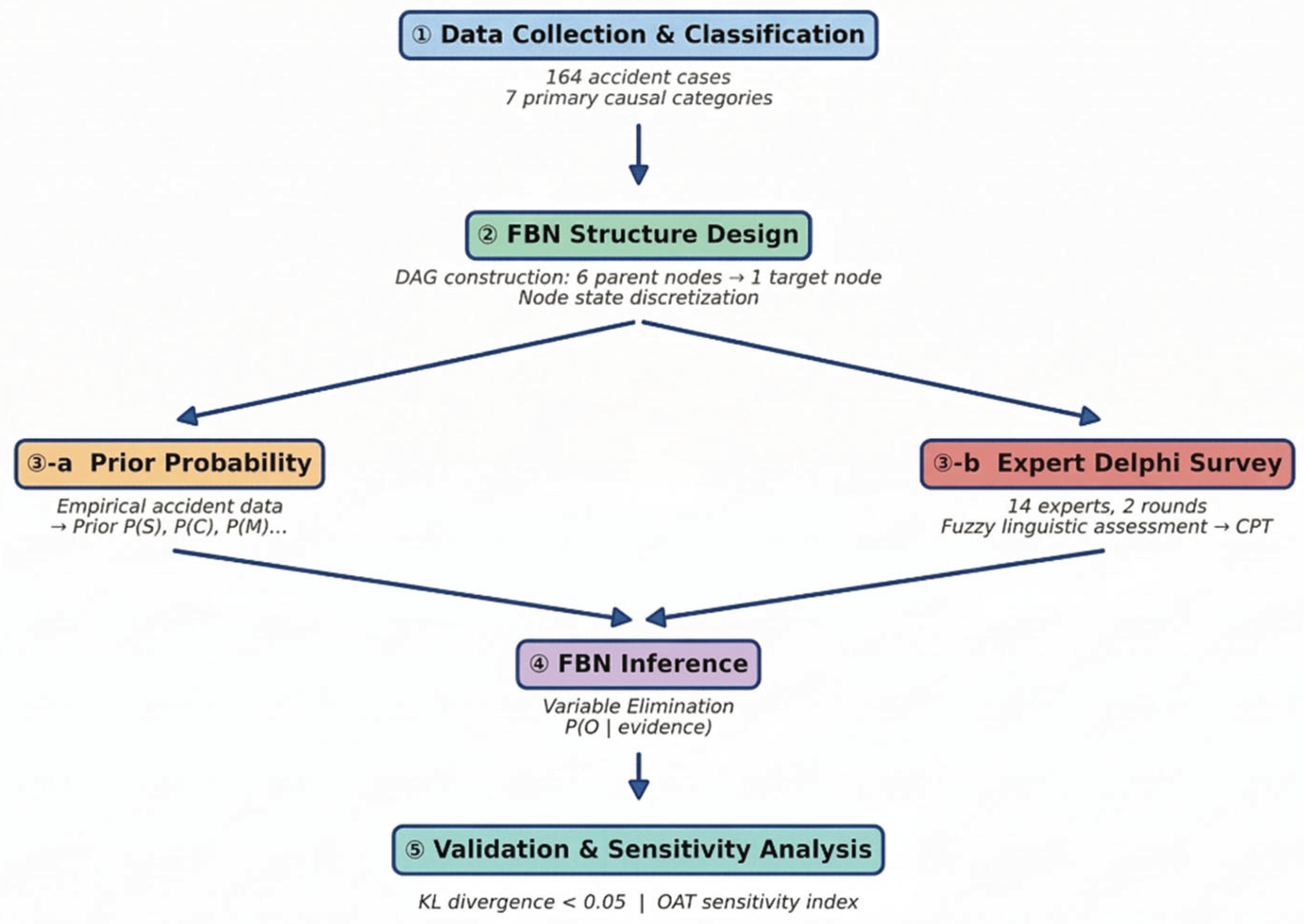
Figure 2.
Triangular fuzzy membership functions for the five-level linguistic probability scale.
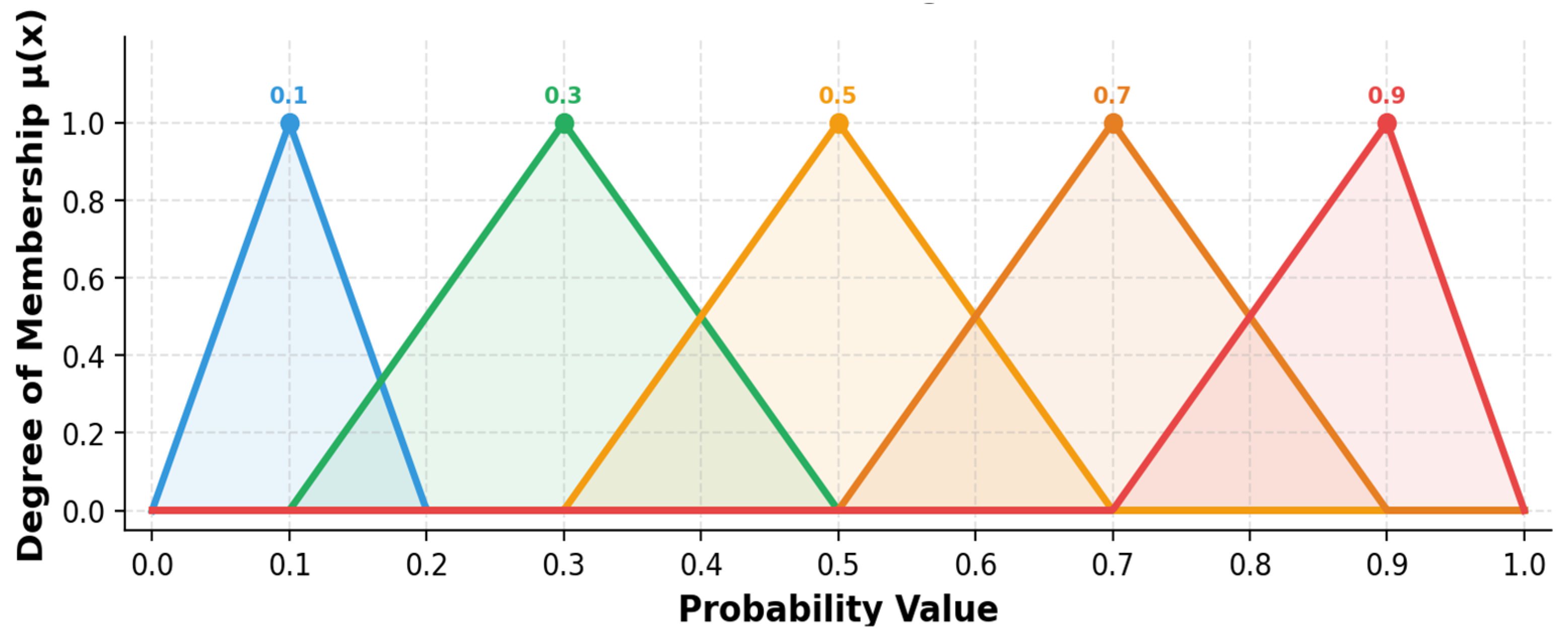
Figure 3.
Fuzzy expert elicitation process: (a) individual expert TFNs, (b) weighted aggregation, and (c) defuzzification via centroid method.
Figure 3.
Fuzzy expert elicitation process: (a) individual expert TFNs, (b) weighted aggregation, and (c) defuzzification via centroid method.
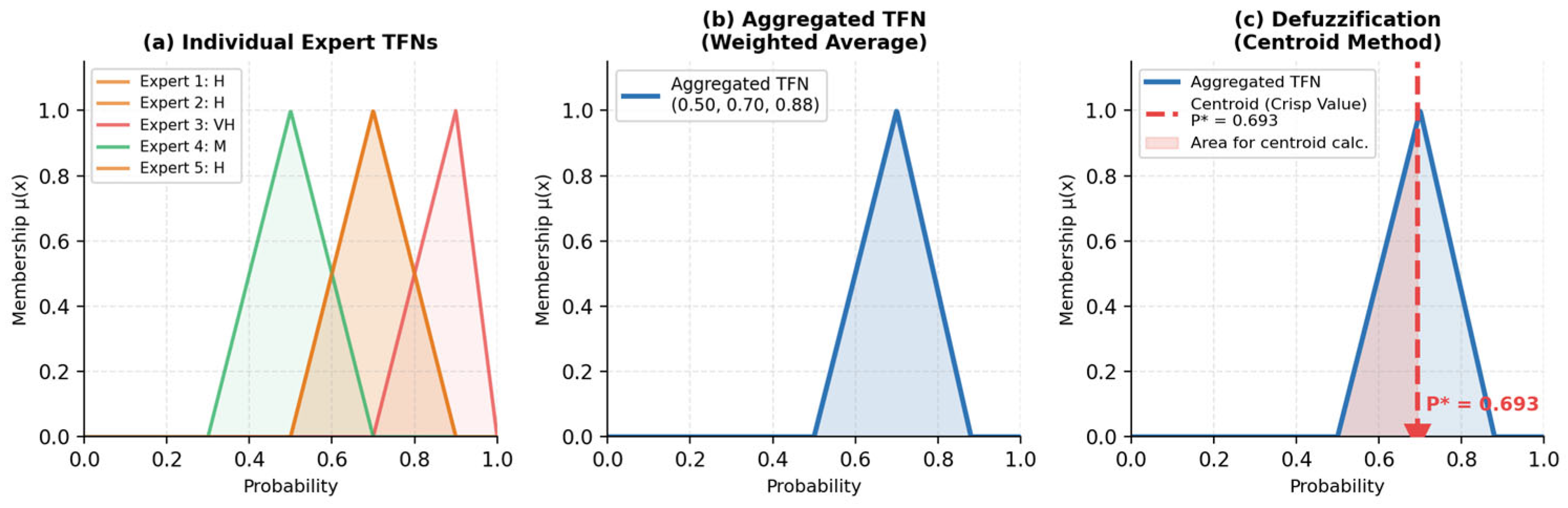
Figure 4.
DAG structure of the proposed FBN model.
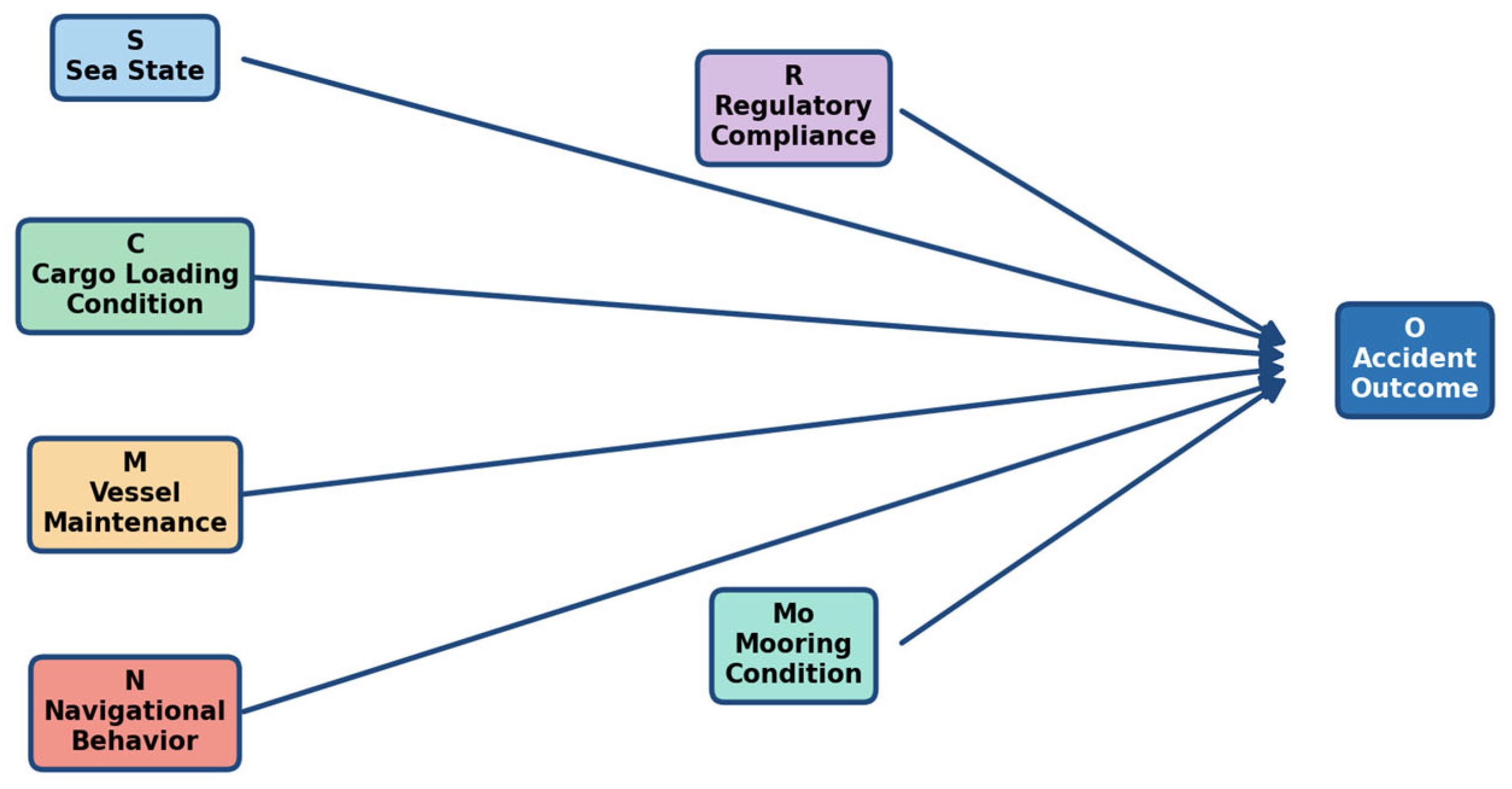
Figure 5.
Sensitivity analysis: capsizing probability change (ΔP) under worst-case node states. Nodes above the 0.01 threshold (dashed line) are identified as high-priority risk factors.
Figure 5.
Sensitivity analysis: capsizing probability change (ΔP) under worst-case node states. Nodes above the 0.01 threshold (dashed line) are identified as high-priority risk factors.
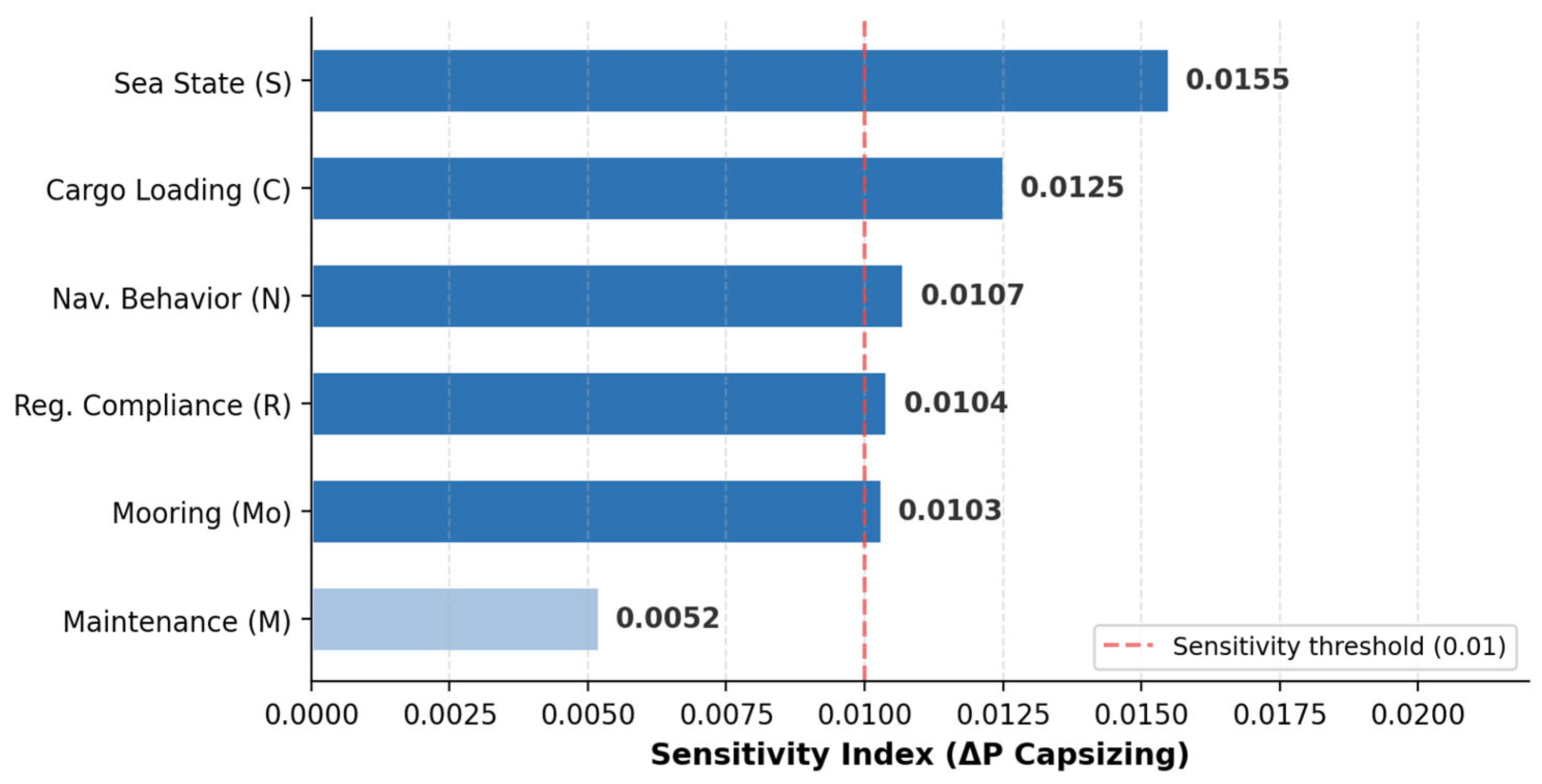
Figure 6.
Posterior accident outcome probabilities across baseline and four risk scenarios. S1 (adverse weather + cargo imbalance) produces the highest capsizing probability (39.3%).
Figure 6.
Posterior accident outcome probabilities across baseline and four risk scenarios. S1 (adverse weather + cargo imbalance) produces the highest capsizing probability (39.3%).
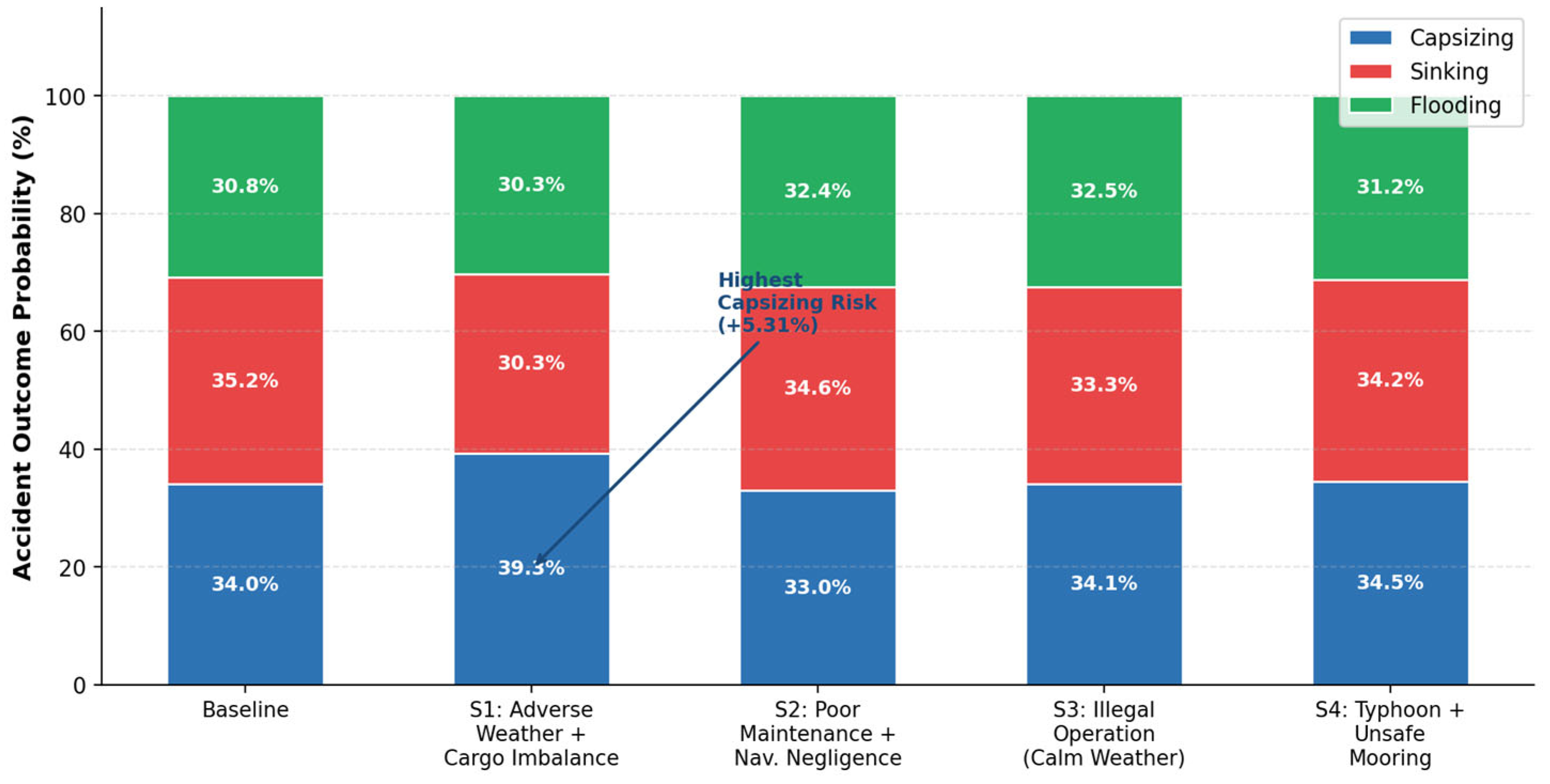

Table 1.
Linguistic scale, TFN parameters, and defuzzified values for expert elicitation.
| Linguistic Term | Abbrev. | TFN (a, m, b) | |
|---|---|---|---|
| Very Low | VL | (0.00, 0.10, 0.20) | 0.100 |
| Low | L | (0.10, 0.30, 0.50) | 0.300 |
| Medium | M | (0.30, 0.50, 0.70) | 0.500 |
| High | H | (0.50, 0.70, 0.90) | 0.700 |
| Very High | VH | (0.70, 0.90, 1.00) | 0.867 |
Table 2.
Node definitions, state discretizations, and prior probability estimates derived from accident data.
Table 2.
Node definitions, state discretizations, and prior probability estimates derived from accident data.
| Node | Variable | States | Prior Probabilities | Basis |
|---|---|---|---|---|
| S | Sea State | Low / Moderate / Severe | 0.372 / 0.376 / 0.252 | Accident record |
| C | Cargo Loading | Normal / Imbalanced / Overloaded | 0.590 / 0.262 / 0.148 | Accident record |
| M | Vessel Maintenance | Good / Deficient / Poor | 0.600 / 0.250 / 0.150 | Accident record |
| N | Nav. Behavior | Careful / Negligent | 0.906 / 0.094 | Accident record |
| R | Reg. Compliance | Compliant / Non-compliant | 0.946 / 0.054 | Accident record |
| Mo | Mooring Condition | Safe / Unsafe | 0.950 / 0.050 | Accident record |
Table 3.
CVR values for selected CPT entries (n = 14 experts). Values shown reflect final round of consensus.
Table 3.
CVR values for selected CPT entries (n = 14 experts). Values shown reflect final round of consensus.
| CPT Entry (Parent Condition →Outcome) |
nE | N | CVR | Accepted |
|---|---|---|---|---|
| S=Severe → P(Capsizing) High | 13 | 14 | 0.86 | ✓ |
| C=Overloaded → P(Capsizing) High | 12 | 14 | 0.71 | ✓ |
| C=Imbalanced → P(Capsizing) High | 11 | 14 | 0.57 | ✓ |
| M=Poor → P(Sinking) High | 12 | 14 | 0.71 | ✓ |
| R=Non-compliant → P(Capsizing) High | 10 | 14 | 0.54 | ✓ |
| Mo=Unsafe + S=Severe → P(Sinking) High | 11 | 14 | 0.57 | ✓ |
Table 4.
Baseline accident outcome probabilities: FBN estimates vs. observed frequencies.
| Accident Outcome | FBN Estimate | Observed Frequency | KL Divergence |
|---|---|---|---|
| Capsizing | 34.00% | 33.10% | — |
| Sinking | 35.16% | 36.40% | — |
| Flooding | 30.84% | 30.50% | — |
| Overall KL Divergence | — | — | 0.038 |
Table 5.
Sensitivity analysis results: capsizing probability change under worst-case node states.
| Rank | Node | Baseline P(Cap.) | Perturbed P(Cap.) | SI (Δ) | Worst State |
|---|---|---|---|---|---|
| #1 | S — Sea State | 0.3400 | 0.3555 | 0.0155 | Severe |
| #2 | C — Cargo Loading | 0.3400 | 0.3525 | 0.0125 | Overloaded |
| #3 | N — Nav. Behavior | 0.3400 | 0.3507 | 0.0107 | Negligent |
| #4 | R — Reg. Compliance | 0.3400 | 0.3504 | 0.0104 | Non-compliant |
| #5 | Mo — Mooring | 0.3400 | 0.3503 | 0.0103 | Unsafe |
| #6 | M — Maintenance | 0.3400 | 0.3452 | 0.0052 | Poor |
Table 6.
Table 6. Posterior accident outcome probabilities under four representative scenarios.
| Scenario | Evidence | P(Capsizing) | P(Sinking) | P(Flooding) |
|---|---|---|---|---|
| Baseline | All nodes marginalized | 34.00% | 35.16% | 30.84% |
| S1: Adverse weather + Cargo imbalance | S=Severe, C=Imbalanced | 39.31% | 30.35% | 30.34% |
| S2: Poor maintenance + Negligent navigation | M=Poor, N=Negligent | 32.99% | 34.58% | 32.43% |
| S3: Illegal operation (calm weather) | R=Non-compliant, S=Low | 34.12% | 33.34% | 32.54% |
| S4: Typhoon approach + Unsafe mooring | S=Severe, Mo=Unsafe | 34.50% | 34.25% | 31.25% |
Disclaimer/Publisher’s Note: The statements, opinions and data contained in all publications are solely those of the individual author(s) and contributor(s) and not of MDPI and/or the editor(s). MDPI and/or the editor(s) disclaim responsibility for any injury to people or property resulting from any ideas, methods, instructions or products referred to in the content. |
© 2026 by the authors. Licensee MDPI, Basel, Switzerland. This article is an open access article distributed under the terms and conditions of the Creative Commons Attribution (CC BY) license (http://creativecommons.org/licenses/by/4.0/).
Copyright: This open access article is published under a Creative Commons CC BY 4.0 license, which permit the free download, distribution, and reuse, provided that the author and preprint are cited in any reuse.