

Submitted:
14 April 2026
Posted:
15 April 2026
You are already at the latest version
Abstract
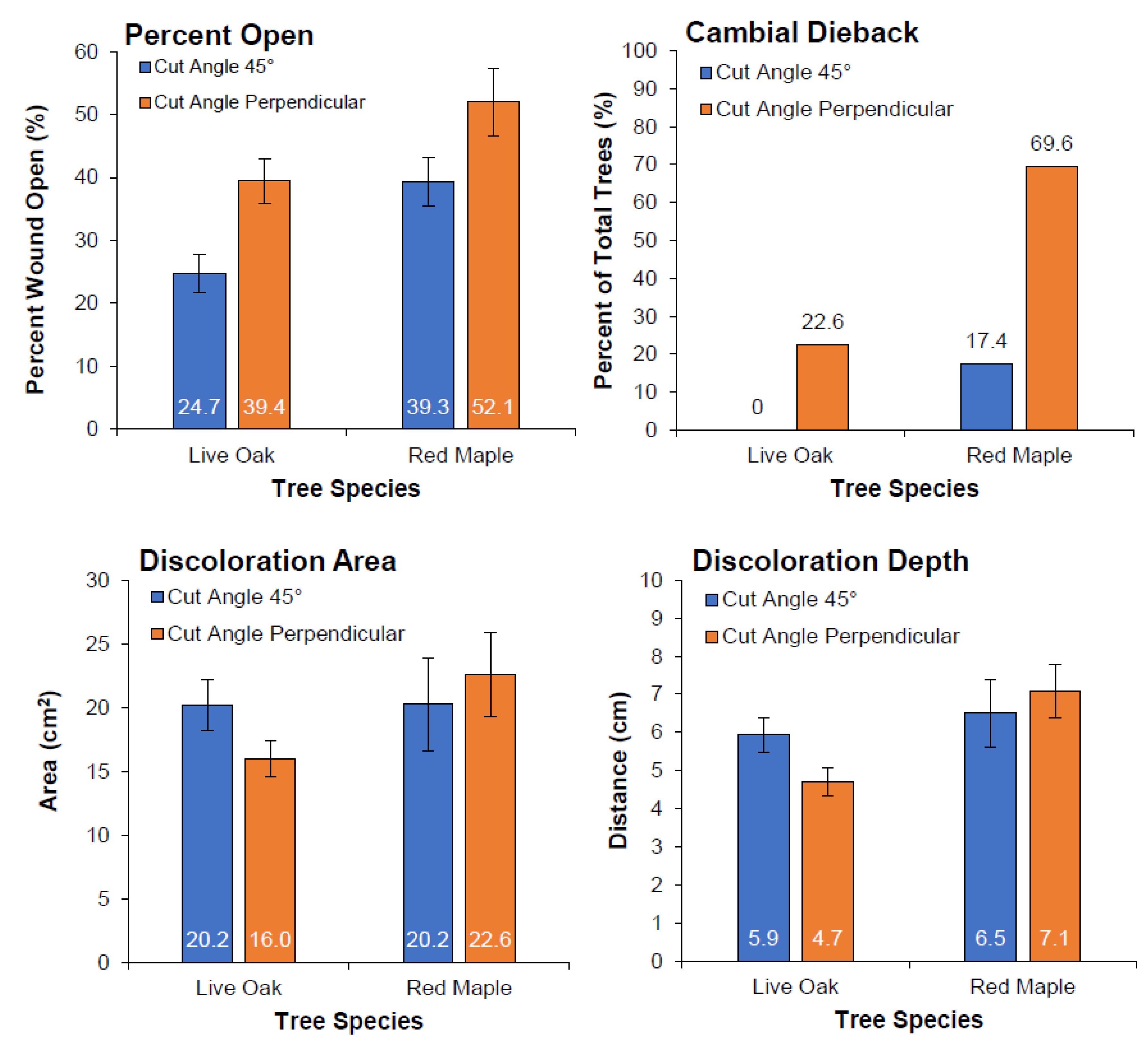
Background: When branches lack a defined collar, arborists are left without a clear target to guide removal pruning. A common recommendation is to cut at a 45° angle from the branch bark ridge. Cutting perpendicular to the branch axis as an alternative would minimize effective wound size, potentially reducing wood dysfunction in the remaining stem. Methods: A total of 92 Acer rubrum L. ‘Florida Flame’ and 102 Quercus virginiana Mill. ‘Highrise’ branches without visible collars were pruned one of two ways: 1.) removal cut angle 45° from the branch bark ridge (45°) or 2.) removal cut angle perpendicular to the branch axis (perpendicular). Three years later, pruned areas were harvested and assessed for wound closure and internal discoloration and decay, controlling for initial branch diameter, branch-to-parent-stem aspect ratio, sprout growth, and branch height. Results: In live oak, branch size and cut method affected the amount and length of discoloration observed. In red maple, discoloration and decay were largely a function of branch size and aspect ratio (i.e., the relative size difference between the removed branch and parent stem). In both species, cambial dieback was more common with perpendicular removal cuts, often negating any initial benefit associated with the smaller wound. Conclusions: When removing branches without a branch collar, we recommend making 45° cuts. Identifying which branches to remove or retain early in a tree’s life is important to avoid large branch removal cuts later.
Keywords:
Introduction
Materials and Methods
Results and Discussion
Initial Removal Cut Size and Aspect Ratio
Type of Removal Cut
Limitations
Conclusion
Acknowledgments
References
- ANSI. ANSI A300 Tree Care Standards; Tree Care Industry of America (TCIA): Manchester NH, 2023. [Google Scholar]
- Clark, J.R.; Matheny, N. The research foundation of tree pruning: A review of the literature. Arboriculture & Urban Forestry 2010, 36(3), 110–120. [Google Scholar] [CrossRef]
- Crawley, M.J. Statistics: An Introduction Using R, 2nd edition; John Wiley & Sons, Ltd.: (UK), 2015; p. 339 p. [Google Scholar]
- Deflorio, G.; Barry, K.M.; Johnson, C.; Mohammed, C.L. The influence of wound location on decay extent in plantation-grown Eucalyptus globulus and Eucalyptus nitens. Forest Ecology and Management 2007, 242(2–3), 353–362. [Google Scholar] [CrossRef]
- Dujesiefken, D.; Liese, W. The CODIT Principle - Implications for Best Practices; International Society of Arboriculture: (IL, USA), 2015. [Google Scholar]
- Dujesiefken, D.; Strobbe, H. The Hamburg Tree Pruning System - A framework for pruning individual trees. Urban Forestry & Urban Greening 2002, 1(2), 75–82. [Google Scholar] [CrossRef]
- Eisner, N.J.; Gilman, E.F.; Grabosky, J.C. Branch morphology impacts compartmentalization of pruning wounds. Journal of Arboriculture 2002, 28(2), 99–105. [Google Scholar] [CrossRef]
- Fox, J.; Weisberg, S. An R Companion to Applied Regression, 3rd edition; Sage: CA, USA, 2019; p. 577 p. [Google Scholar]
- Gilman, E.F. Branch-to-stem diameter ratio affects strength of attachment. Journal of Arboriculture 2003, 29(5), 291–293. [Google Scholar] [CrossRef]
- Gilman, E.F. An Illustrated Guide to Pruning, 3rd edition; Delmar: (NY, USA), 2012; p. 476 p. [Google Scholar]
- Gilman, E.F.; Grabosky, J.C. Branch union morphology affects decay following pruning. Arboriculture & Urban Forestry 2006, 32(2), 74–79. [Google Scholar] [CrossRef]
- Gilman, E.F.; Kempf, B.; Matheny, N.; Clark, J. Structural Pruning: A Guide for the Green Industry; Urban Tree Foundation: (CA, USA), 2013. [Google Scholar]
- Grabosky, J.C.; Gilman, E.F. Response of two oak species to reduction pruning cuts. Arboriculture & Urban Forestry 2007, 33(5), 360–366. [Google Scholar] [CrossRef]
- Green, D.J.; Shortle, W.C.; Shigo, A.L. Compartmentalization of discolored and decayed wood in red maple branch stubs. Forest Science 1981, 27(3), 519–522. [Google Scholar] [CrossRef]
- Hauer, R.J.; Peterson, W.D. Municipal Tree Care and Management in the United States: A 2014 Urban & Community Forestry Census of Tree Activities. In Special Publication 16-1; College of Natural Resources, University of Wisconsin – Stevens Point, 2016; p. 71 pp. [Google Scholar]
- JASP Team. JASP (Version 0.95.3)[Computer software]. 2025. [Google Scholar]
- Lilly, S.J.; Gilman, E.F.; Smiley, E.T. Best Management Practices - Pruning, 3rd Edition; International Society of Arboriculture: Atlanta, GA, 2019; p. 63 pp. [Google Scholar]
- Lonsdale, D. A comparison of ‘target’ pruning, versus flush cuts and stub pruning. Surrey (United Kingdom): Arboricultural Advisory and Information Service. Report No. 116-93-Path. 4 pp; 1993; Available online: https://www.trees.org.uk/Trees.org.uk/files/10/10359940-a5f3-44e9-8d73-8a957f52e58c.pdf.
- Loyd, A.L.; Smiley, E.T.; Fite, K.L. Effects of different amounts of codominant stem subordination on the growth and aesthetics of Acer rubrum ‘October Glory’. Arboriculture & Urban Forestry 2024, 50(6), 414–426. [Google Scholar] [CrossRef]
- Miller, R.W.; Hauer, R.J.; Werner, L.P. Urban Forestry Planning and Managing Urban Greenspaces (3rd Edition); Waveland Press: Long Grove, IL, 2015; p. 560 pp. [Google Scholar]
- Neely, D. Closure of branch pruning wounds with conventional and ‘Shigo’ cuts. Journal of Arboriculture 1988, 14(6), 261–264. [Google Scholar] [CrossRef]
- O’Hara, K.L. Pruning wounds and occlusion: A long-standing conundrum in forestry. Journal of Forestry 2007, 105(3), 131–138. [Google Scholar] [CrossRef]
- Ow, L.F.; Ghosh, S.; Sim, E.K. Mechanical injury and occlusion: An urban, tropical perspective. Urban Forestry & Urban Greening 2013, 12(2), 255–261. [Google Scholar] [CrossRef]
- Purcell, L. Arboricultural Practices: A Science-Based Approach; Waveland Press: Long Grove (IL, USA), 2025; p. 362 p. [Google Scholar]
- Schneider, C.A.; Rasband, W.S.; Eliceiri, K.W. NIH Image to ImageJ: 25 years of image analysis. Nature Methods 2012, 9, 671–675. [Google Scholar] [CrossRef] [PubMed]
- Shigo, A.L. How tree branches are attached to trunks. Canadian Journal Botany 1985, 63, 1391–1401. [Google Scholar] [CrossRef]
- Shigo, A.L. A New Tree Biology and Dictionary: Facts, Photos, and Philosophies on Trees and Their Problems and Proper Care, 2nd ed.; Shigo Trees and Associates LLC: Snohomish (WA, USA), 1986; p. 636 p. [Google Scholar]
- Shigo, A.; McGinnes, E.; Funk, D.; Rogers, N. Internal defects associated with pruned and non-pruned branch stubs in black walnut. U.S. Department of Agriculture, Forest Service, Northeastern Forest Experiment Station: Broomall (PA, USA), 1979; Research Paper No. NE-440. Available online: https://www.fs.usda.gov/ne/newtown_square/publications/research_papers/pdfs/scanned/OCR/ne_rp440.pdf.
- Solomon, D.S.; Shigo, A.L. Discoloration and decay associated with pruning wounds on yellow birch. Forest Science 1976, 22(4), 391–392. [Google Scholar] [CrossRef]
- Wardlaw, T.J.; Neilsen, W.A. Decay and other defects associated with pruned branches of Eucalyptus nitens. Tasforests 1999, 11, 49–57. [Google Scholar]

| Variable Type | Definition | Measurement (unit) |
|---|---|---|
| Explanatory | ||
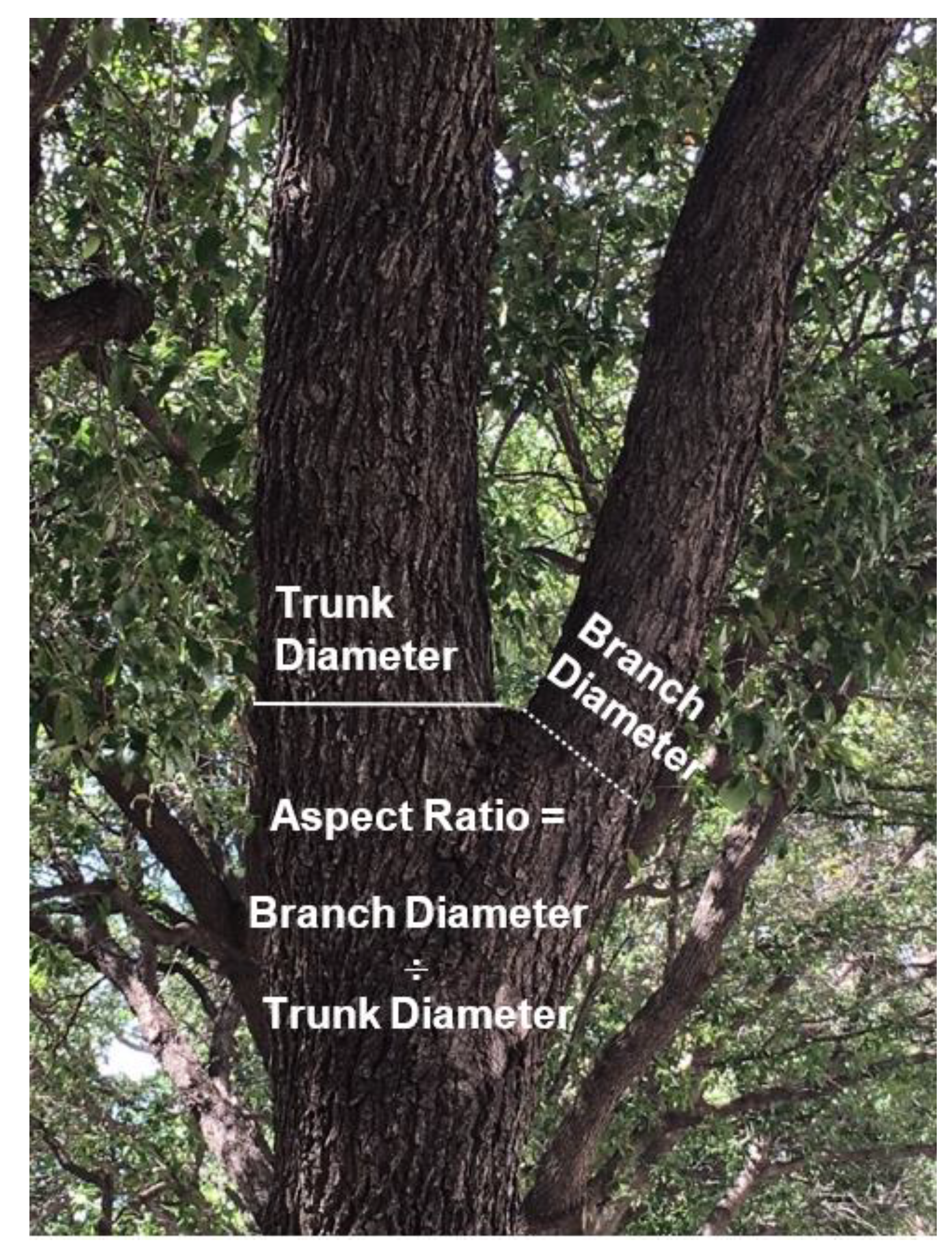
| Aspect ratio | Branch diameter relative to the trunk diameter with both measured immediately above the union. | Ratio (> 0 to 1) |
| Branch diameter | The diameter of a branch just above/beyond the branch union measured at the time of removal. Measured perpendicular to the branch at the time of removal. | Continuous (cm) |
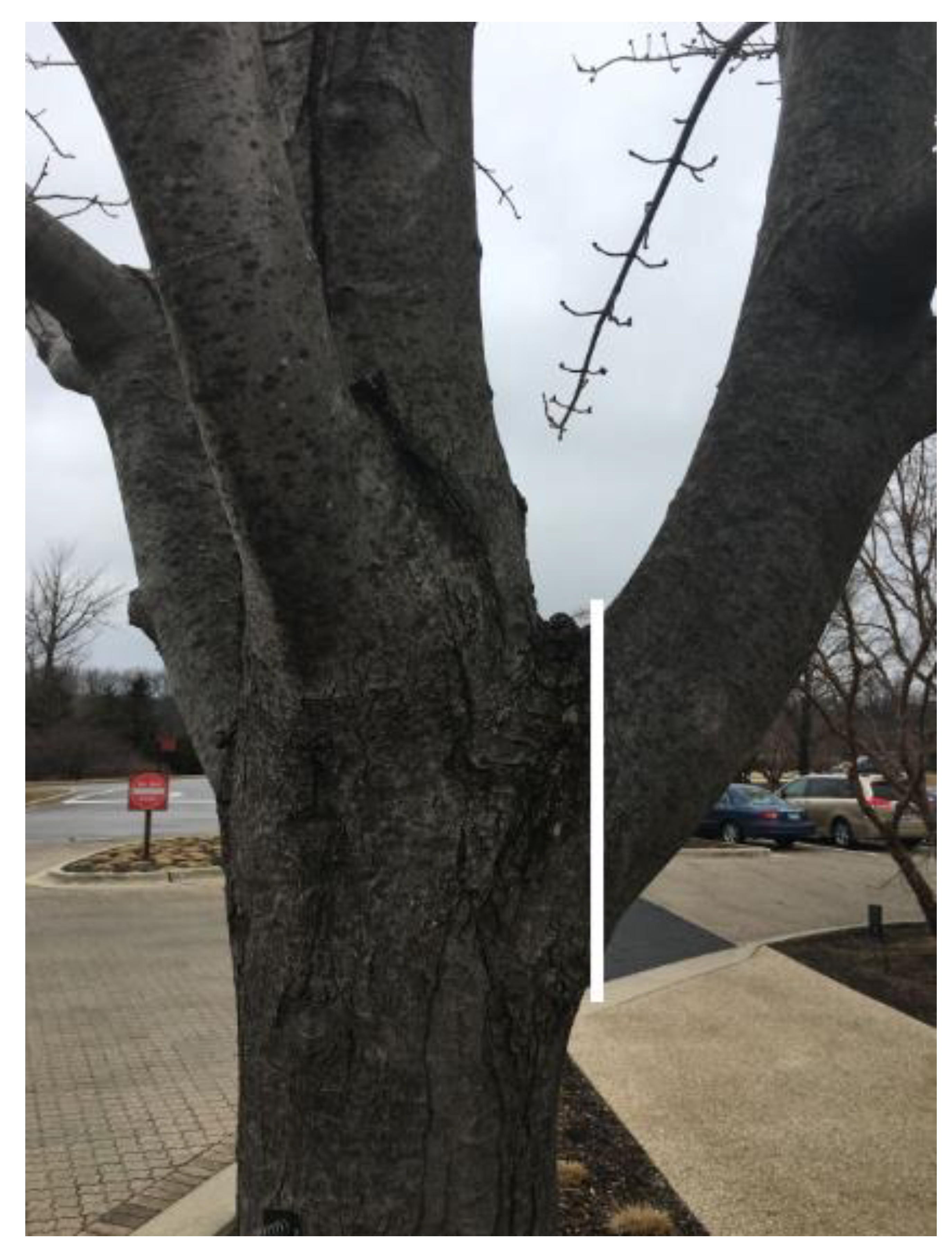
| Branch height | Distance from ground to the apex of the branch union. | Continuous (m) |
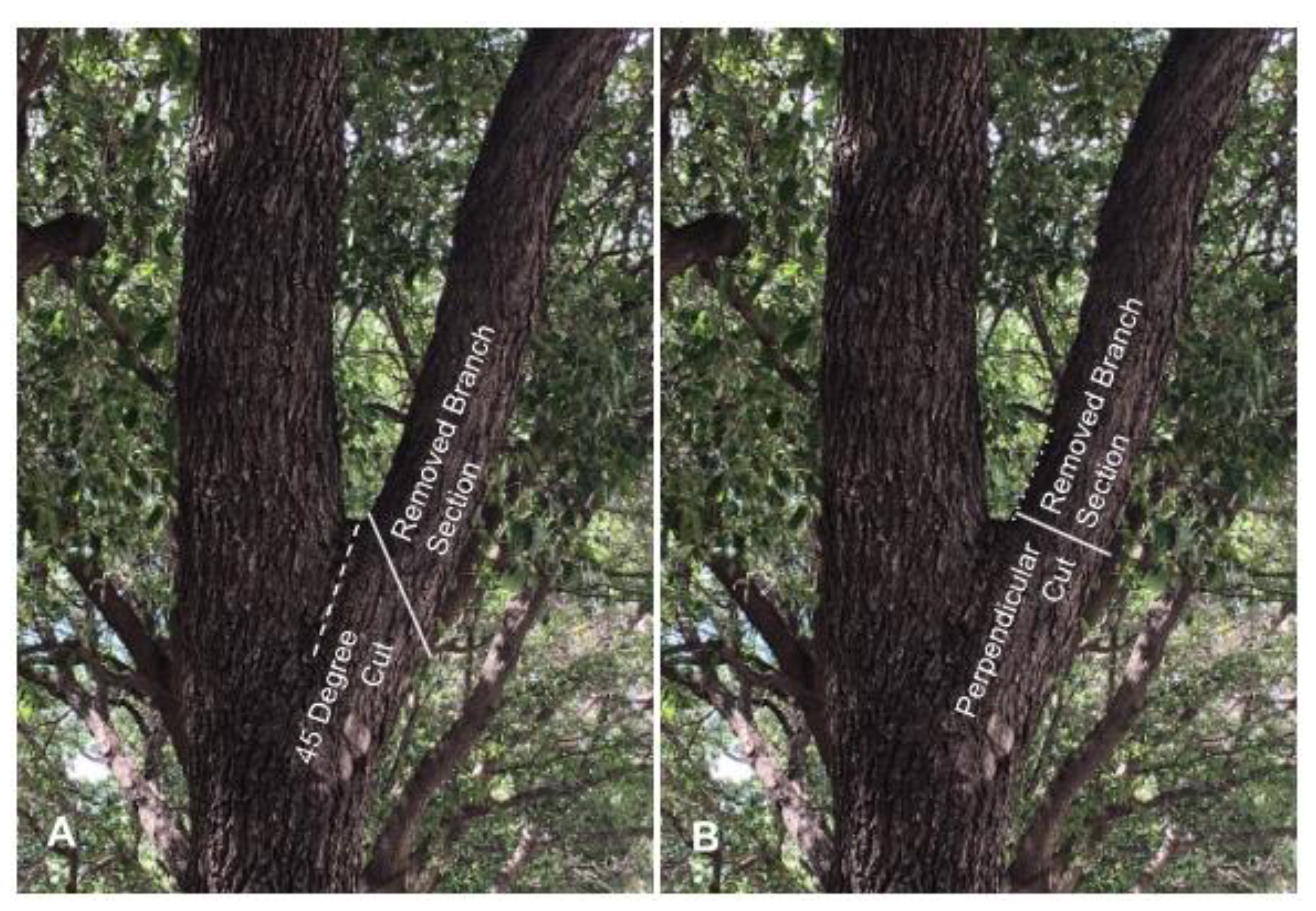
| Treatment | Two removal cut types as: (1) a removal cut made beyond the branch bark ridge (BBR) at the point where the top of the branch made an abrupt turn onto the trunk, with the cut angled at 45° to the BBR; or (2) a removal cut made beyond the BBR at the same point, with the cut perpendicular to the longitudinal axis of the branch, thereby minimizing the cut surface area | Category (45° or perpendicular) |
| Trunk diameter | The diameter of the trunk just above the branch union. | Continuous (cm2) |
| Total sprout cross-sectional area | Sum of the cross-sectional area of the sprouts that originated at the removal cut edge. Diameters were measured at the base of each sprout. | Continuous (cm2) |
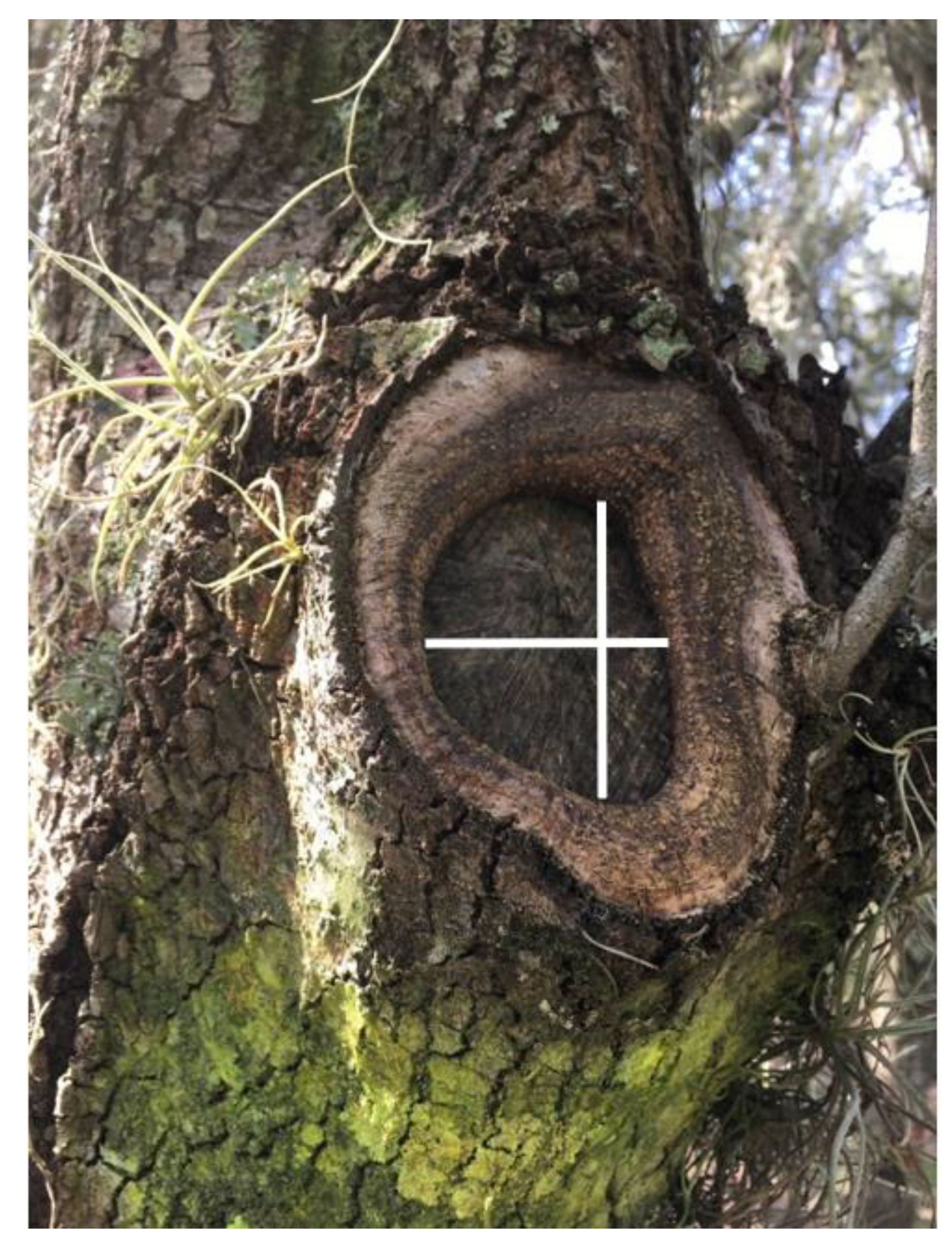
| Wound area | The cross-sectional wound area at the time of removal. | Continuous (cm) |
| Response | ||
| Cambial dieback | The observation of tissue necrosis at the lower margin of the removal cut. | Percent (%) |
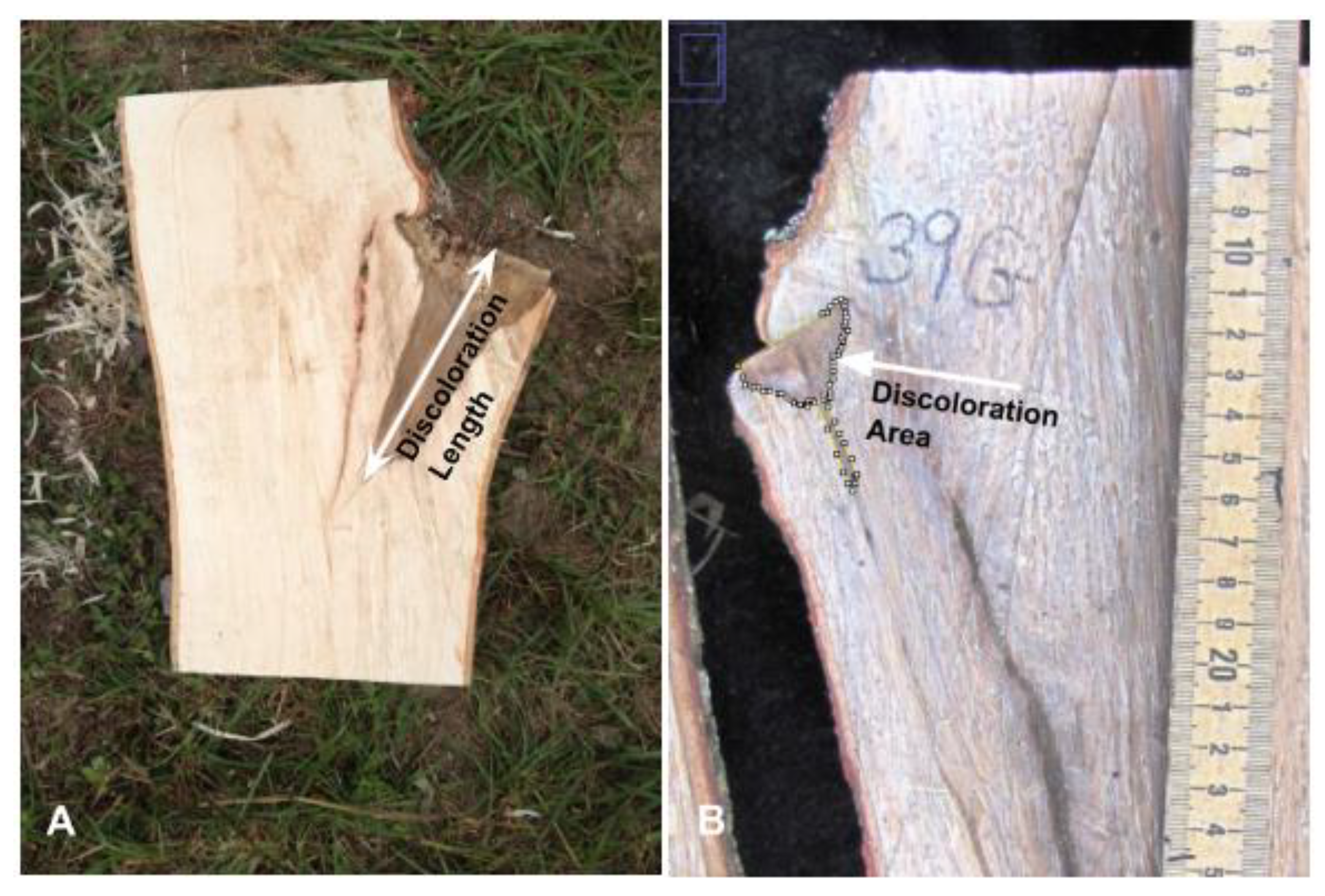
| Discoloration area | The transverse area of visible wood discoloration measured on laterally split trunk and branch sections. | Continuous (cm2) |
| Discoloration length | The maximum length of the extent of discolored wood measured in the digital images of the transverse section. | Continuous (cm) |
| Percent Wound Open | (Cross-sectional area of cut surface remaining open at time of harvest ÷ Initial cut surface area) X 100 | Percent (%) |
| Factor | Coefficient | Standard Error | C.I. Lower | C.I. Upper | P-value |
|---|---|---|---|---|---|
| Discoloration Length (cm)z | |||||
| Intercept | 3.070 | 0.813 | 1.457 | 4.683 | < 0.001 |
| Treatment - 45° cut | 0.106 | 0.509 | -0.903 | 1.115 | 0.835 |
| Wound area (cm2) | 0.074 | 0.012 | 0.051 | 0.098 | < 0.001 |
| Aspect ratio | -3.703 | 2.423 | -8.507 | 1.101 | 0.129 |
| Discoloration Area (cm2)y | |||||
| Intercept | 13.052 | 3.800 | 5.512 | 20.591 | < 0.001 |
| Treatment - 45° cut | -1.356 | 1.309 | -3.954 | 1.242 | 0.303 |
| Wound area (cm2) | 0.101 | 0.065 | -0.029 | 0.231 | 0.125 |
| Aspect ratio | -32.727 | 10.370 | -53.303 | -12.150 | 0.002 |
| Wound area X Aspect ratio | 0.598 | 0.137 | 0.326 | 0.869 | < 0.001 |
| Percent Wound Open (%)x | |||||
| Intercept | 75.586 | 14.085 | 47.651 | 103.520 | < 0.001 |
| Treatment - 45° cut | -18.088 | 4.829 | -27.664 | -8.511 | < 0.001 |
| Wound area (cm2) | -0.294 | 0.242 | -0.774 | 0.186 | 0.227 |
| Aspect ratio | -108.438 | 38.656 | -185.103 | -31.772 | 0.006 |
| Wound area X Aspect Ratio | 1.070 | 0.510 | 0.059 | 2.081 | 0.038 |
| Factor | Coefficient | Standard Error | C.I. Lower | C.I. Upper | P-value |
|---|---|---|---|---|---|
| Discoloration Length (cm)z | |||||
| Intercept | 12.908 | 3.682 | 5.589 | 20.228 | < 0.001 |
| Treatment - 45° cut | -1.878 | 0.787 | -3.442 | -0.314 | 0.019 |
| Wound area (cm2) | -0.237 | 0.113 | -0.461 | -0.013 | 0.039 |
| Aspect ratio | -12.362 | 4.562 | -21.431 | -3.294 | 0.008 |
| Wound area X Aspect ratio | 0.411 | 0.123 | 0.168 | 0.655 | 0.001 |
| Discoloration Area (cm2)y | |||||
| Intercept | 42.983 | 13.832 | 15.476 | 70.490 | 0.003 |
| Treatment - 45° cut | -8.281 | 2.979 | -14.205 | -2.357 | 0.007 |
| Wound area (cm2) | -0.943 | 0.431 | -1.801 | -0.085 | 0.032 |
| Aspect ratio | -49.152 | 17.110 | -83.176 | -15.127 | 0.005 |
| Wound area X Aspect ratio | 1.731 | 0.469 | 0.797 | 2.665 | < 0.001 |
| Percent Wound Open (%)x | |||||
| Intercept | 32.661 | 15.394 | 2.068 | 63.255 | 0.037 |
| Treatment - 45° cut | -19.331 | 5.850 | -30.957 | -7.705 | 0.001 |
| Wound area (cm2) | 0.576 | 0.121 | 0.335 | 0.817 | < 0.001 |
| Aspect Ratio | -1.946 | 22.142 | -45.949 | 42.057 | 0.930 |
| Factor | Coefficient | Standard Error | Odds Ratio | O.R. C.I. Lower | O.R. C.I. Upper | P-value |
|---|---|---|---|---|---|---|
| Intercept | 1.161 | 0.331 | 3.194 | 1.671 | 6.105 | < 0.001 |
| Species | -2.393 | 0.436 | 0.091 | 0.039 | 0.214 | < 0.001 |
| Treatment | -2.724 | 0.466 | 0.066 | 0.026 | 0.164 | < 0.001 |
Disclaimer/Publisher’s Note: The statements, opinions and data contained in all publications are solely those of the individual author(s) and contributor(s) and not of MDPI and/or the editor(s). MDPI and/or the editor(s) disclaim responsibility for any injury to people or property resulting from any ideas, methods, instructions or products referred to in the content. |
© 2026 by the authors. Licensee MDPI, Basel, Switzerland. This article is an open access article distributed under the terms and conditions of the Creative Commons Attribution (CC BY) license (http://creativecommons.org/licenses/by/4.0/).


