
Submitted:
14 April 2026
Posted:
15 April 2026
You are already at the latest version
Abstract
Background Basal cell carcinoma (BCC) represents the most common malignancy worldwide. Although most tumours can be successfully treated with surgical excision, a subset may develop aggressive behaviour characterised by extensive local invasion, repeated recurrences and progression to locally advanced disease. However, the definition of locally advanced basal cell carcinoma (laBCC) remains heterogeneous and largely based on subjective clinical judgement. Objectives To propose a reproducible clinical scoring system aimed at objectively identifying locally advanced basal cell carcinoma and supporting therapeutic decision-making. Methods At the Unit of Plastic and reconstructive surgery and Skin Cancer Unit of IRCCS-Centro di Riferimento Oncologico della Basilicata, Italy we recruited patients with histologically confirmed BCC between 2005 and 2024. A multidimensional clinical scoring system (Fabrizio Score, FS), integrating tumour-related, patient-related and healthcare accessibility parameters, was applied to the study population. Score attribution was independently performed by physicians from the hospital health management service to minimise operator bias. Results Among 3,125 basal cell carcinomas diagnosed during the study period, 1,851 cases were evaluated using the proposed scoring system. A total of 1,627 tumours had an FS < 14 and were treated surgically. Two hundred and eighteen cases (FS 14–16) received neoadjuvant therapy. Only 15 patients (0.8%) were ultimately classified as having truly locally advanced disease and treated with systemic therapy. Conclusions The Fabrizio Score may represent a practical and reproducible clinical tool for the objective identification of locally advanced basal cell carcinoma and may support multidisciplinary therapeutic decision-making. Prospective multicentre validation studies are warranted.
Keywords:
Basal cell carcinoma
; locally advanced basal cell carcinoma
; scoring system
; therapeutic decision-making
1. Introduction
Basal cell carcinoma (BCC) is the most common malignancy worldwide.[¹] Although the majority of tumors are effectively treated with surgery or local therapies, a subset of lesions may progress to Locally Advanced Basal Cell Carcinoma, characterized by extensive local invasion, multiple recurrences, or tumors in anatomically critical areas where surgical excision may lead to significant functional or cosmetic morbidity.
In recent years, the therapeutic landscape of advanced BCC has evolved substantially with the introduction of Hedgehog pathway inhibitors such as Vismodegib and Sonidegib, followed more recently by immunotherapy with Cemiplimab for patients progressing after Hedgehog inhibitor therapy.
Despite these advances, the identification of patients with locally advanced disease remains largely based on clinical judgment. Current guidelines acknowledge multiple factors involved in defining laBCC but do not provide a simple operational tool usable in daily dermatologic practice. [²]
The aim of this work is therefore to propose a simple clinical framework integrating key clinical parameters that may assist clinicians in recognizing basal cell carcinomas likely to represent locally advanced diseases.
Basal cell carcinoma (BCC) accounts for approximately 80% of all non-melanoma skin cancers and represents the most frequently diagnosed malignancy worldwide. The incidence of BCC continues to increase globally, likely because of population ageing and cumulative ultraviolet exposure.
In most cases, BCC can be effectively treated with surgical excision, Mohs micrographic surgery or other local therapies.[3] However, a small proportion of tumors may demonstrate aggressive behavior characterized by extensive local tissue destruction, repeated recurrences or, rarely, metastatic spread.[4] These cases are generally classified as advanced basal cell carcinoma, which includes both locally advanced and metastatic disease.[5]
The therapeutic landscape of advanced BCC has evolved considerably with the introduction of targeted therapies directed at the Hedgehog signaling pathway. Aberrant activation of this pathway is recognized as a key molecular driver in the pathogenesis of BCC.[6] Hedgehog pathway inhibitors such as vismodegib and sonidegib have demonstrated significant clinical efficacy in advanced disease [7,8,9,10,11]
More recently, immunotherapy has emerged as an additional therapeutic option. The PD-1 inhibitor cemiplimab has been approved for patients with advanced BCC who have progressed on or are intolerant of Hedgehog inhibitors.[12]
Despite these advances, an important clinical challenge remains unresolved: the absence of a universally accepted definition of locally advanced basal cell carcinoma.[13]
In routine clinical practice, classification is frequently based on subjective judgement and may vary according to institutional expertise, available resources and multidisciplinary evaluation. [14,15,16,17]
PROMISING EVALUETED STRATEGIES
Novel therapy approaches for advanced BCC have emerged in the last few years and the aberrant signaling of the hedgehog (Hh) pathway is considered the primary driver in the development of basal cell carcinoma (BCC). In the last few years two different Hh signalling inhibitors, vismodegib and sonidegib, have been authorized for advanced BCC therapy. Particularly Sonidegib is approved in UE for the treatment of adults with locally advanced BCC who are not amenable to curative surgery or radiation therapy, vismodegib is indicated for adults with metastatic disease too [18,19].
Vismodegib received approval for the treatment of locally advanced (laBCC) or metastatic basal cell carcinoma (mBCC) based on the findings of the pivotal ERIVANCE and STEVIE phase II trials [18,20].
In ERIVANCE trial 104 patients received oral vismodegib 150 mg once daily until disease progression or intolerable toxicity with an investigator-assessed objective response rate (ORR) of 60.3% for locally advanced (laBCC) and 48.5% for metastatic (mBCC) disease (Table 1) [15,17]. Muscular spasms (71%), alopecia (66%), and dysgeusia (56%) were the most frequent adverse events (AE).
Similar activity and safety outcomes to the ERIVANCE study were shown in STEVIE open-label multicenter trial, which assessed vismodegib 150 mg once daily in 1215 patients with laBCC or mBCC (Table 2). In STEVIE trial, that is the largest trial in the treatment of advanced BCC [21], long-term exposure to vismodegib was not linked to an increase in the incidence or severity of adverse events
Another Hh inhibitor, Sonidegib, is a small molecule antagonist that binds the same SMO's drug-binding pocket of Vismodegib. This drug has higher tissue penetration and longer half-life (29.6 days) than Vismodegib (4-12 days) and with the results of phase II BOLT trial, Sonidegib was approved for laBCC and mBCC treatment. The study compared the two doses 200 mg (the approved dose) and 800 mg once daily showing at the final 42 months analysis an Objective Response Rate (ORR) with lower dose of 56.1% and 7.7% in laBCC and mBCC respectively. The most frequently reported AEs of any grade were muscle spasms (54.4%), alopecia (49.4%), and dysgeusia (44.3%). Grade 3/4 adverse events occurred in 43% of the 200 mg group (compared to 64% in the 800 mg group) [22]. The longest follow-up known for a Hh pathway inhibitor is represented by this analysis and according to these results, sonidegib became a good long-term therapeutic option for individuals with advanced BCC (Table 3) [23].
Nowadays also the immunotherapy became an important alternative to HH inhibitor for the treatment of BCC, and particularly Cemiplimab, a PD-1 antibody, became the first immunotherapy approved for advanced BCC in patients who have failed or are intolerant to Hedgehog Inhibitors. The results from the pivotal Phase 2 study (NCT03132636) reached an Objective Response Rate (ORR) of 31% in laBCC and 22% – 24% in mBCC with a safety profile consistent with other PD-1 inhibitors (Common side effects include fatigue, diarrhea, and pruritus)
The aim of this study was therefore to propose, evaluate and share with international scientific community involved in BCC treatment a novel clinical scoring system, the Fabrizio Score (FS), designed to provide a structured and pragmatic approach for identifying locally advanced basal cell carcinoma and guiding therapeutic decision-making. Infact, although the advent of those promising therapeutical strategies has been very important and useful for laBCC treatment, in recent times there has been much debate on the real and effective definition of locally advanced basal cell carcinoma and for extension on locally advanced skin cancers. When should a BCC be considered locally advanced? Who has the task of evaluating the characteristics that it must have, so that a cutaneous neoplasm can be considered locally advanced? What are the parameters to be taken into consideration, to evaluate in the most objective possible way, whether a neoplasm is locally advanced or not? The need is real, because the different treatment of these neoformations is effective, in relation to their extension, depth and histology. The solution is complicated. Furthermore, from all perspectives from which the pathology of each of our patients can be studied, the solution adopted must be the best and wisest possible, for each of them, regardless of their socioeconomic and cultural status, the place where they live, or the presence or absence of a specialized and adequate hospital center in that location, capable of providing the right treatment. In other words, the same pathology should not be treated differently, medically or surgically, depending on the circumstances outlined above. It is the real treatment that must be adopted for the patient, not the patient who must accept an adaptable treatment. To achieve this goal, the idea was to highlight various multifactorial but objective parameters, capable of truly evaluating a locally advanced BCC, objectively attributing to each parameter an alphanumeric value, easily assessable by any operator, to avoid, as much as possible and in the greatest number of cases, discrepancies in assessment and treatment.
2. Materials and Methods
2.1. Patient Population
A total of 3,125 patients with histologically confirmed basal cell carcinoma diagnosed between January 2005 and December 2024 were analyzed at the Unit of Plastic and Reconstructive Surgery and Skin Cancer Unit of IRCCS – Centro di Riferimento Oncologico della Basilicata, Italy.
Among these, 1,851 cases diagnosed after the introduction of targeted therapies were evaluated using the proposed scoring system.
2.2. Development of the Scoring System
The Fabrizio Score (FS) was developed based on long-term clinical experience in the multidisciplinary management of skin cancer and through consideration of parameters reported in the literature to influence the classification of advanced BCC.[15]
The objective was to develop a practical clinical tool capable of integrating tumour-related variables with patient-specific and healthcare-system factors that may influence treatment selection.
The study parameters:
Based on the pluriannual experiences acquired in the treatment of skin cancers a lot of parameters were evaluated, and the following were taken into consideration to objectively estimate the degree of local extension of these skin tumors:
- Anatomical site of the neoplasm: a tumor can be considered locally advanced in relation to its location. Localization on the face, genitals, perineum and extremities must be considered high risk. At medium risk is localization on the scalp and the remaining parts of the upper or lower limbs. Low risk, locations in anatomical regions that are easier to manage such as the trunk.
- TNM classification in relation to size and diffusion in depth. High risk. T4. Medium risk: T2 – T3. Low risk: Tis, T1.
- Histological variant: The basal-squamous variant must be considered high risk. At medium risk, the micro-nodular or infiltrative variant, or morpheiform with neural invasion. At low risk, the variants, nodular, cystic nodule, adenoid, keratotic, with adnexal differentiation, superficial, pleomorphic, clear cell or signet ring clear cell.
- The presence of a surgical center authorized to treat large skin tumors: to be considered high risk if the patient lives in a location without a surgical department. At medium risk, presence of a peripheral hospital with a surgical department with suitable reconstructive experience. Low Risk, in case of comprehensive cancer center or academic cancer center with on-site presence of a reconstructive unit with recognized experience.
- Patient frailty: calculated according to the Hospital Frailty Risk, high risk, medium risk, low risk conditions.
- Possibility of instrumental evaluation and staging: at high risk if this evaluation is impossible, at medium risk if it is limited due to the absence of advanced radio diagnostics, or absence of nuclear medicine, or due to difficulty in reaching the dedicated site, at low risk if the staging is possible.
- Possibility of carrying out radiotherapy: high risk in case of negative opinion from the patient; at medium risk, even with a positive opinion from the patient, RT cannot be performed, because it has already been performed, or cannot be performed due to the shape and size of the field to be treated, radiodermatitis, objective difficulty in surgical repair of the radio-treated area; low risk, if RT is possible.
- Evaluation of the patient's place of residence: high risk, in case of negative evaluation or impossible patient compliance; medium risk, difficult compliance; low risk, positive compliance.
- Evaluation of the possibility of performing local or systemic neoadjuvant treatment: high risk, negative evaluation; medium risk, difficult but possible assessment; low risk, positive rating. Each of these parameters will be given a score of 3 for the high-risk rating, a score of 2 for the medium risk rating and a score of 1 for the low-risk rating. By adding the various scores, if the result is lower than 14, the neoplasm cannot be objectively indicated as locally advanced, and the patient must be sent for surgical treatment. For a score between 14 and 16, the patient is sent to neoadjuvant treatment; after which a new evaluation is carried out. If it determines a score lower than 14, surgery is performed, otherwise, the patient is sent for medical treatment with a target therapy (TKI, Tyrosine Kinase Inhibitors). Only for a score above 16, we must speak of a locally advanced neoplastic lesion, and the patient is started on treatment with target therapy (TKI, Tyrosine Kinase Inhibitors).
2.3. Scoring System
The FS incorporates the following variables:
- Anatomical location of the tumor
- tumor stage (TNM classification)
- Histological Subtype
- availability of specialized surgical centers
- patient frailty (Hospital Frailty Risk Score)
- availability of staging procedures
- feasibility of radiotherapy
- geographic accessibility to treatment centers
- feasibility of electrochemotherapy or other neoadjuvant treatments
Each parameter is assigned:
- 1 point – low risk
- 2 points – intermediate risk
- 3 points – high risk
| Score | Interpretation | Recommended management |
| <14 | Not locally advanced | Surgical treatment |
| 14–16 | Borderline | Neoadjuvant therapy |
| >16 | Locally advanced | Systemic therapy |
The total score therefore ranges from 9 to 27 points.
The parameters included in the scoring system are summarized in Table 4.
2.4. Interpretation of the Score
The clinical framework was developed through:
• long-term clinical experience in the management of cutaneous oncology patients
• review of literature addressing advanced BCC and systemic therapies
• identification of clinical features associated with difficult-to-treat disease.
To minimize potential bias, score attribution was independently performed by physicians from the hospital health management service rather than by the treating clinicians.
The clinical decision algorithm derived from the FS is illustrated in Figure 1.
3. Results
The proposed clinical framework allows rapid stratification of tumors according to the probability of locally advanced disease.
Lesions with higher scores typically correspond to tumors characterized by large size, repeated recurrences, or anatomical locations where surgical treatment may cause substantial morbidity.
Such cases may benefit from multidisciplinary evaluation and consideration of systemic therapies targeting the Hedgehog pathway.
Between 2005 and 2024, a total of 3,125 basal cell carcinomas were diagnosed and treated at our institution.
Among these, 1,851 cases were evaluated using the Fabrizio Score (FS).
Application of the scoring system produced the following distribution:
- 1,627 cases (87.9%) had FS <14 and were treated surgically
- 218 cases (11.8%) had FS between 14 and 16 and received neoadjuvant therapy
- 6 cases (0.3%) had FS >16 and were directly referred for systemic targeted therapy
Among the 218 patients initially treated with neoadjuvant therapy, tumour downstaging occurred in most cases, allowing 209 patients to subsequently undergo surgical treatment.
Nine patients maintained an FS >16 after reassessment and were therefore referred for systemic therapy.
Overall, 15 patients (0.8%) were ultimately classified as having truly locally advanced disease and treated with systemic therapy.
4. Discussion
Previous studies investigating patients treated with Hedgehog pathway inhibitors have highlighted the difficulty of defining locally advanced diseases and the heterogeneity of patient selection criteria. [24]
Our results suggest that the prevalence of truly locally advanced basal cell carcinoma may be lower than commonly perceived when objective multidisciplinary criteria are applied.
The Fabrizio Score (FS) attempts to address this limitation by integrating tumour-related parameters with patient-specific and healthcare accessibility factors. This multidimensional approach reflects real-world clinical practice, where treatment decisions are influenced not only by tumour biology but also by patient frailty, treatment availability and logistical considerations.
The algorithm derived from the FS (Figure 1) illustrates how the score may guide treatment selection and help standardize therapeutic decision-making. Figures 2a and 2b clearly demonstrate how subjective the definition of locally advanced basal cell carcinoma can be. What might be considered locally advanced by one clinician might not be by another [25,26,27]. This is the goal of this article: to define as objectively as possible the true basal cell carcinoma that should be referred to for targeted therapies. For these reasons, the FS should be considered a pragmatic clinical support tool rather than a replacement for multidisciplinary clinical judgement. However, several limitations should be acknowledged [28,29,30]. The study was conducted at a single tertiary referral center. Furthermore, the proposed scoring system has not yet undergone multicenter validation. Prospective multicenter studies are needed to validate the reproducibility and clinical utility of the proposed scoring system. The therapeutic management of advanced basal cell carcinoma has undergone a profound transformation with the development of targeted therapies such as Vismodegib and Sonidegib, followed by immunotherapy options including Cemiplimab for patients progressing after Hedgehog inhibitor therapy.
However, the practical identification of patients who may benefit from these systemic approaches remains one of the major challenges in dermatologic oncology.
The framework proposed here attempts to simplify this process by integrating several key clinical parameters known to correlate with complex disease:
• tumor size
• anatomical location
• recurrence history
• expected surgical morbidity
• patient-related factors.
Rather than replacing clinical judgment, this tool may serve as a practical support for clinical decision-making, particularly in settings where multidisciplinary discussion may not be immediately available.
Importantly, the score may also facilitate earlier referral of complex cases to specialized centers, potentially improving treatment outcomes.
Future prospective studies will be required to validate the predictive value and reproducibility of this clinical framework.
5. Conclusion
The proposed clinical framework provides a simple and practical method for identifying patients with Locally Advanced Basal-Cell Carcinoma in routine dermatologic practice.
By integrating tumor characteristics, recurrence history, and patient-related factors, this tool may help clinicians recognize complex cases earlier and guide appropriate therapeutic strategies.
Prospective validation will be necessary to confirm its clinical utility.
The results obtained using this multidisciplinary evaluation model suggest that the prevalence of truly locally advanced basal cell carcinoma may be lower than commonly assumed when objective criteria are applied.
The Fabrizio Score (FS) provides a structured and reproducible framework for evaluating tumour characteristics and guiding therapeutic decision-making by integrating clinical, pathological and healthcare accessibility parameters. This scoring system may represent a practical clinical tool for improving the identification and management of patients with locally advanced basal cell carcinoma.
We recognize that the FS, for use by other centers, requires expert consensus, involving surveys and consensus meetings with multiple experts in the field from different countries or at least different centers, and must also be externally validated. This, however, is the reason for our article: the possibility of sharing the FS with other centers and experts to evaluate its reproducibility, discriminatory capacity, and calibration by other experts in a heterogeneous population.
We hope that future prospective, multicenter validation studies can be conducted to validate and, if necessary, improve this clinical and practical scoring system.
Supplementary Materials
The following supporting information can be downloaded at: www.mdpi.com/xxx/s1, Table S1: Score Interpretation and Treatment Algorithm.
Author Contributions
Conceptualization: T.F. Methodology: T.F., M.G., R.C., M.T. Software: M.I., M.G. Validation: T.F. M.T. Formal Analysis: M.G., R.C. Investigation: T.F., M.I. Data curation: R.C., T.F., M.T. Writing-original draft prep.: T.F., R.C. Writing-review and editing: T.F., M.T. Supervision: T.F., M.T. Supervision: T.F. All authors have read and agreed to the published version of the manuscript.
Funding
This research received no external funding.
Institutional Review Board Statement
The study was conducted in accordance with the Declaration of Helsinki and approved by the Scientific Direction of IRCCS-CROB, Rionero in Vulture (protocol code 26/2024 and 21/05/2024 of approval).
Informed Consent Statement
Informed consent was obtained from all subjects involved in the study.
Data Availability Statement
Data are contained within the article and supplementary material enclosed.
Acknowledgments
The authors thank Mr. Vincenzo Verdura, MD, attending plastic surgeon, Unit of Plastic Surgery, University of Foggia, Italy, for conceptual support in this study and the nursing and surgical staff of the Unit of Plastic and Reconstructive Surgery and Skin Cancer Unit of IRCCS – Centro di Riferimento Oncologico della Basilicata, Rionero in Vulture, Italy, for their contribution to patient care.
Conflicts of Interest
The authors declare no conflict of interest.
References
- Rogers, H.W.; Weinstock, M.A.; Harris, A.R.; et al. Incidence estimate of nonmelanoma skin cancer in the United States, 2006. Arch Dermatol. 2010, 146, 283–287. [Google Scholar] [CrossRef] [PubMed]
- Peris, K.; Fargnoli, M.C.; Kaufmann, R.; et al. European consensus-based interdisciplinary guideline for diagnosis and treatment of basal cell carcinoma – update 2023. Eur J Cancer 2023, 192, 113254. [Google Scholar] [CrossRef]
- Alam, M.; Goldberg, L.H.; Silapunt, S.; et al. Delayed treatment and continued growth of non-melanoma skin cancer. J Am Acad Dermatol. 2011, 64, 839–848. [Google Scholar] [CrossRef] [PubMed]
- Chren, M.M.; Linos, E.; Torres, J.S.; et al. Tumor recurrences after treatment of basal cell carcinoma. J Invest Dermatol. 2013, 133, 1188–1196. [Google Scholar] [CrossRef]
- Mohan, S.V.; Chang, A.L. Advanced basal cell carcinoma: epidemiology and therapeutic innovations. Curr Dermatol Rep. 2014, 3, 40–45. [Google Scholar] [CrossRef] [PubMed]
- Goppner, D.; Leverkus, M. Basal cell carcinoma: pathogenesis and targeted therapy. J Skin Cancer 2011, 2011, 650258. [Google Scholar] [CrossRef] [PubMed]
- Basset-Seguin, N.; Hauschild, A.; Kunstfeld, R.; et al. Vismodegib in patients with advanced basal cell carcinoma (STEVIE): a pre-planned interim analysis. Eur J Cancer 2017, 86, 334–348. [Google Scholar] [CrossRef]
- Weinstock, M.A.; Still, J.M. Treatment options for severe basal cell carcinoma. Semin Cutan Med Surg. 2011, 30, S10–S13. [Google Scholar] [CrossRef]
- Fecher, L.A. Systemic therapy for metastatic basal cell carcinoma. Curr Treat Options Oncol. 2013, 14, 237–248. [Google Scholar] [CrossRef]
- Ganti, A.K.; Kessinger, A. Systemic therapy for disseminated basal cell carcinoma. Cancer Treat Rev. 2011, 37, 440–443. [Google Scholar] [CrossRef] [PubMed]
- Gorlin, R.J.; Goltz, R.W. Multiple nevoid basal cell epithelioma syndrome. N Engl J Med. 1960, 262, 908–912. [Google Scholar] [CrossRef]
- Stratigos, A.J.; Sekulic, A.; Peris, K.; et al. Cemiplimab in locally advanced basal cell carcinoma after hedgehog inhibitor therapy. Lancet Oncol. 2021, 22, 848–857. [Google Scholar] [CrossRef]
- Peris, K.; Licitra, L.; Ascierto, P.A.; et al. Identifying locally advanced basal cell carcinoma eligible for treatment with vismodegib: an expert panel consensus. Future Oncol. 2015, 11, 703–712. [Google Scholar] [CrossRef]
- Ally, M.S.; Aasi, S.; Wysong, A.; et al. An investigator-initiated open-label clinical trial of vismodegib as neoadjuvant therapy for high-risk basal cell carcinoma. J Am Acad Dermatol. 2014, 71, 904–911. [Google Scholar] [CrossRef] [PubMed]
- Maciel, P.C.; Veiga-Filho, J.; Carvalho, M.P.; et al. Quality of life after surgical treatment of skin carcinomas. Ann Bras Dermatol. 2014, 89, 594–598. [Google Scholar] [CrossRef]
- Bhutani, T.; Abrouk, M.; Sima, C.S.; et al. Risk of squamous cell carcinoma after vismodegib therapy for basal cell carcinoma. J Am Acad Dermatol. 2017, 77, 713–718. [Google Scholar] [CrossRef]
- Sekulic, A.; Mangold, A.R.; Northfelt, D.W. Targeting the Hedgehog signaling pathway in advanced basal cell carcinoma. Curr Opin Oncol. 2013, 25, 218–223. [Google Scholar] [CrossRef]
- Sekulic, A.; Migden, M.R.; Basset-Seguin, N.; et al. Long-term safety and efficacy of vismodegib in advanced basal cell carcinoma (ERIVANCE BCC). BMC Cancer 2017, 17, 332. [Google Scholar] [CrossRef] [PubMed]
- Sekulic, A.; Migden, M.R.; Oro, A.E.; et al. Efficacy and safety of vismodegib in advanced basal-cell carcinoma. N Engl J Med. 2012, 366, 2171–2179. [Google Scholar] [CrossRef] [PubMed]
- Sekulic, A.; Yoo, S.; Kudchadkar, R.; et al. Real-world treatment patterns in advanced basal cell carcinoma: RegiSONIC registry. PLoS One 2022, 17, e0262151. [Google Scholar] [CrossRef] [PubMed]
- Migden, M.R.; Guminski, A.; Gutzmer, R.; et al. Treatment with two different doses of sonidegib in locally advanced or metastatic basal cell carcinoma (BOLT): a multicentre, randomised, double-blind phase 2 trial. Lancet Oncol. 2015, 16, 716–728. [Google Scholar] [CrossRef] [PubMed]
- Dummer, R.; Guminski, A.; Gutzmer, R.; et al. Long-term efficacy and safety of sonidegib in advanced basal cell carcinoma: 42-month analysis of the BOLT study. Br J Dermatol. 2020, 182, 1369–1378. [Google Scholar] [CrossRef] [PubMed]
- Lewin, J.M.; Carucci, J.A. Advances in the management of basal cell carcinoma. F1000Prime Rep. 2015, 7, 53. [Google Scholar] [CrossRef]
- Mohan, S.V.; Chang, J.; Li, S.; et al. Increased risk of cutaneous squamous cell carcinoma after vismodegib therapy. JAMA Dermatol. 2016, 152, 527–532. [Google Scholar] [CrossRef] [PubMed]
- Bertozzi, N.; Simonacci, F.; Grieco, M.P.; Grignaffini, E.; Raposio, E. Single center evidence for the treatment of basal cell carcinoma of the head and neck. Acta Biomed. 2019, 90(1), 77–82. [Google Scholar]
- Simonacci, F.; Bertozzi, N.; Grieco, M.P.; Grignaffini, E.; Raposio, E. Surgical therapy of cutaneous squamous cell carcinoma: our experience. Acta Biomed. 2018, 89(2), 242–248. [Google Scholar]
- Chen, C.; Chen, Z.J. Reconstruction of the concha of the ear using a postauricular island flap. Plast Reconstr Surg 1990, 86, 569–72. [Google Scholar] [CrossRef]
- Talmi, Y.P.; Horowitz, Z.; Bedrin, L.; et al. Auricular reconstruction with a postauricular myocutaneous island flap: flip–flop flap. Plast Reconstr Surg 1996, 98, 1191–9. [Google Scholar] [CrossRef] [PubMed]
- Cordova, A.; D’Arpa, S.; Pirrello, R.; et al. Retroauricular skin: a flaps bank for ear reconstruction. J Plast Reconstr Aesthet Surg 2008, 61 (suppl 1), S44–51. [Google Scholar] [CrossRef] [PubMed]
- Stiller, M.B.; Gerressen, M.; Modabber, A.; et al. Anteriorly pedicled retroauricular flap for repair of auricular defects. Aesthetic Plast Surg 2012, 36, 623–7. [Google Scholar] [CrossRef] [PubMed]
Figure 1.
Clinical decision algorithm derived from the Fabrizio Score (FS) for therapeutic decision-making in basal cell carcinoma. The score is calculated using the parameters described in Table 1.
Figure 1.
Clinical decision algorithm derived from the Fabrizio Score (FS) for therapeutic decision-making in basal cell carcinoma. The score is calculated using the parameters described in Table 1.
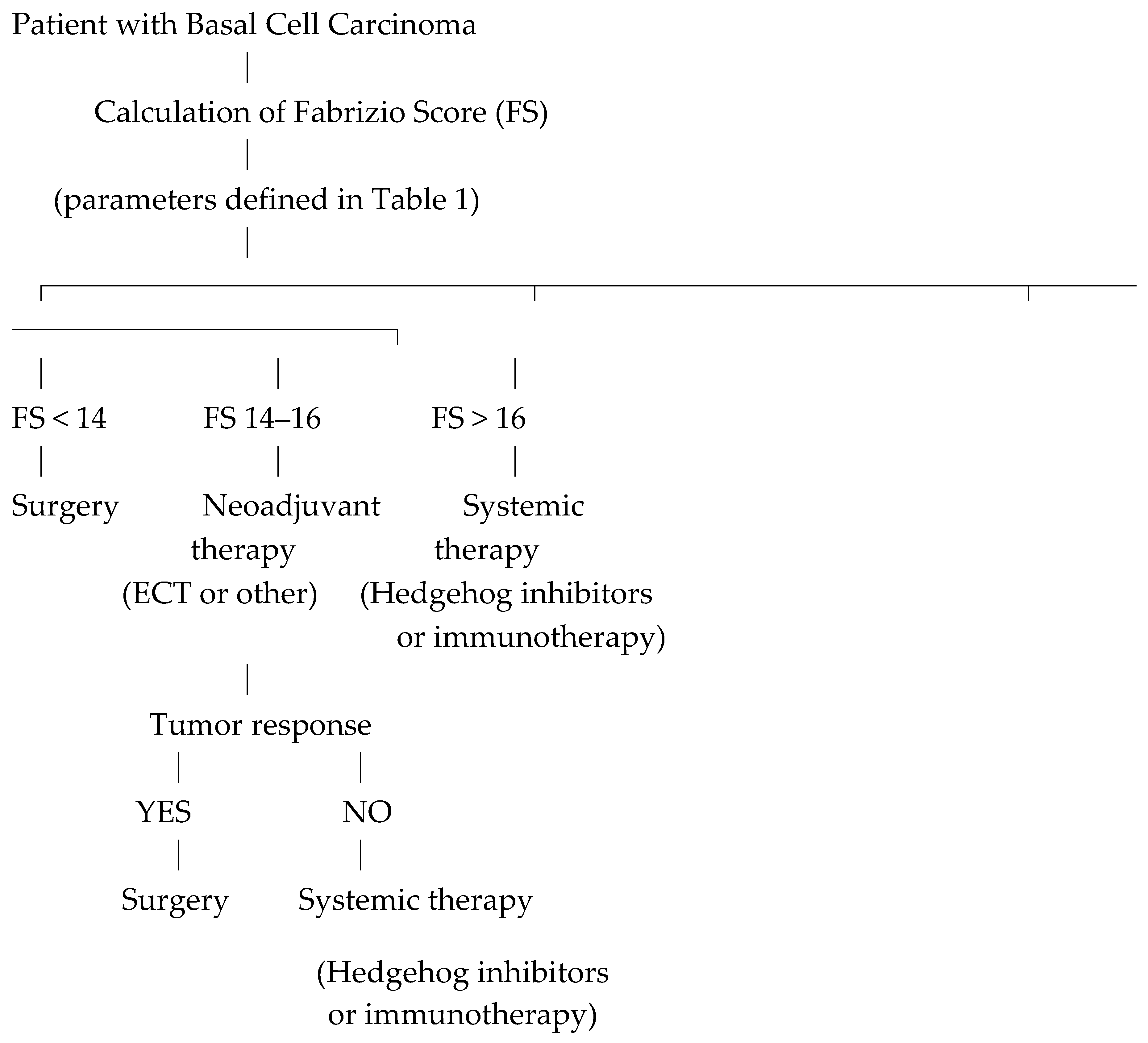
Figure 2.
a: basal cel carcinoma of the mid-face; b: reconstruction of the mid-face with a fascio-cutaneous frontal flap.
Figure 2.
a: basal cel carcinoma of the mid-face; b: reconstruction of the mid-face with a fascio-cutaneous frontal flap.
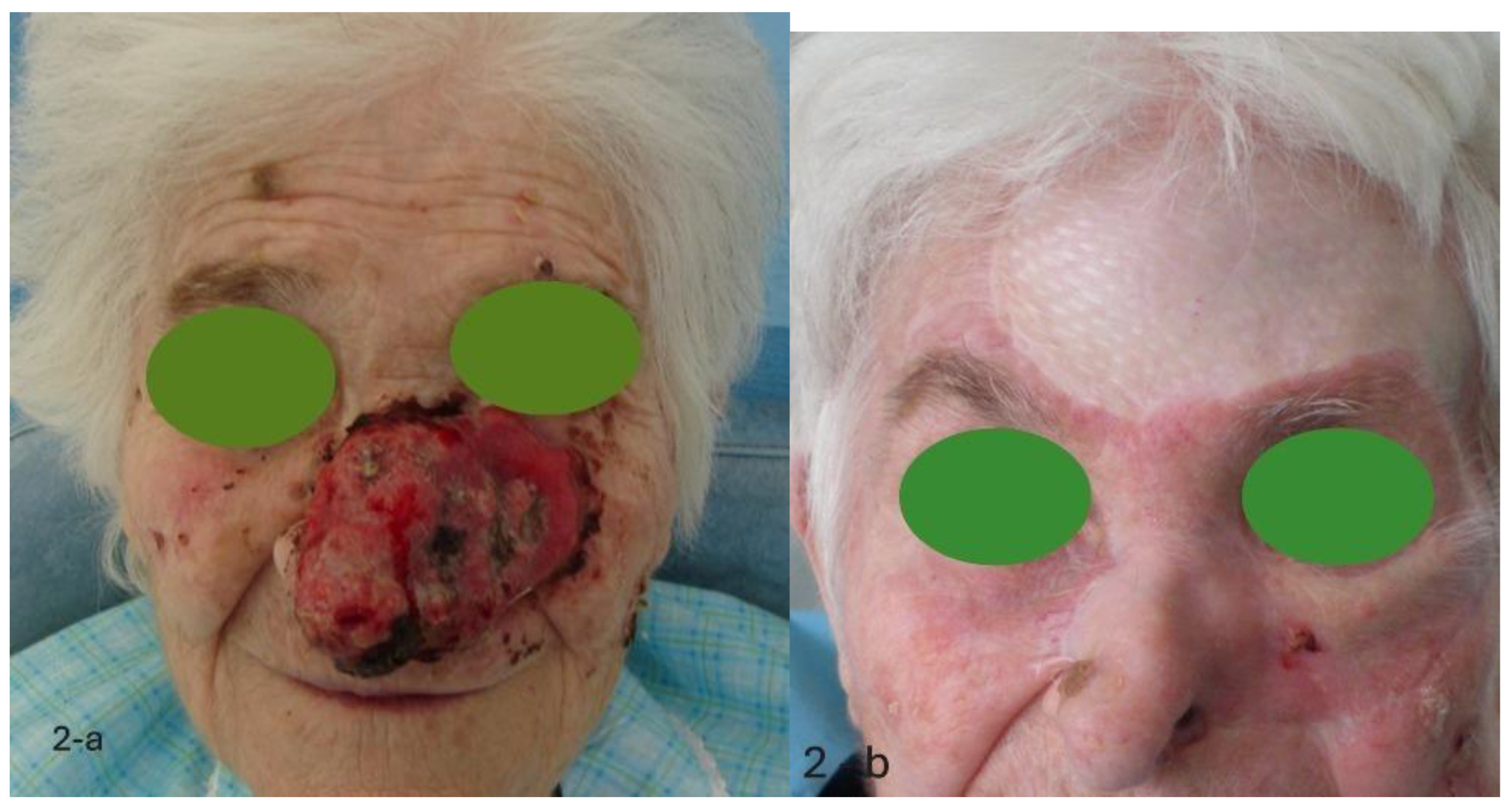

Table 1.
ERIVANCE Trial Results (Investigator Review - Long-term Analysis).
| Outcome Measure | Locally Advanced BCC (laBCC) N= 63 | Metastatic BCC (mBCC) N=33 |
|---|---|---|
| Objective Response Rate (ORR) (95%CI) | 60.3% (47.2-71.7) | 48.5% (30.8-66.2) |
| Complete Response (CR) | 31.7% | 0% |
| Partial Response (PR) | 28.6% | 48.5% |
| Stable Disease (SD) | 14.3% | 45.5% |
| Median Duration of Response (DOR) (95%CI) | 26.2 months (9.0-37.6) | 14.8 months (5.6-17-0) |
| Median Progression-Free Survival (PFS) (95%CI) | 12.9 months (10.2-28.0) | 9.3 months(7.4-16.6) |
| Median Overall Survival (OS) (95%CI) | Not Reached (NE) | 33.4 months (18.1-NE) |
Table 2.
Efficacy of Vismodegib in STEVIE trial.
| Outcome Measure | Locally Advanced BCC (laBCC) N=1132 | Metastatic BCC (mBCC)N=83 |
|---|---|---|
| Objective Response Rate (ORR) (95%CI) | 68.5% (65.66-71.29) | 36.9% (26.63-48.13) |
| Complete Response (CR) | 33.4% | 2.4% |
| Partial Response (PR) | 35.1% | 34.5% |
| Stable Disease (SD) | 21.6% | 51.2% |
| Disease Control Rate (DCR) | 90.1% | 88.1% |
| Median duration of response (DOR) (95%CI) | 23 months (20.4-26.7) | 13.9 months (9.2-NE) |
| Median Progression-Free Survival (PFS) (95%CI) | 23.2 months (21.4-26) | 13.1 months (12.0-17.7) |
Table 3.
Efficacy of sonidegib in BOLT trial. Efficacy outcomes per central review at 42 months.
| laBCC | mBCC | |||
|---|---|---|---|---|
| 200 mg (n = 66) | 800 mg (n = 128) | 200 mg (n = 13) | 800 mg (n = 23) | |
| Objective Response Rate (ORR) (95%CI) | 56% (43–68) | 46·1% (37·2–55·1) | 8 (0·2–36) | 17% (5–39) |
| Complete Response (CR) | 5% (0·9–13) | 1·6 %(0·2–5·5) | 0% (0–25) | 0% (0–15) |
| Disease Control Rate (DCR) | 91% | 82·0% | 92% | 91% |
| Median duration of response (DOR) (95%CI) | 26·1months (NE) | 23·3months (12·2–29·6) | 24·0 (NE) | NE (NE) |
| Median Progression-Free Survival (PFS) ( 95%CI) | 22·1months (NE) | 24·9months (19·2–33·4) | 13·1months (5·6–33·1) | 11·1months (7·3–16·6) |
| TTR, time to tumor response. (95% CI) | 4·0months (3·8–5·6) | 3·8months (3·7–5·5) | 9·2months (NE) | 1·0months (1·0–2·1) |
Table 4.
Fabrizio Score (FS) parameters for the evaluation of locally advanced basal cell carcinoma.
Table 4.
Fabrizio Score (FS) parameters for the evaluation of locally advanced basal cell carcinoma.
| Parameter | Low Risk (1 point) | Medium Risk (2 points) | High Risk (3 points) |
|---|---|---|---|
| Anatomical location of the neoplasm | Easily manageable anatomical areas (trunk) | Anatomical regions with intermediate management difficulty (scalp, upper and lower limbs) | Critical anatomical regions (face, genital area, perineum, extremities) |
| Tumor stage (TNM / EADO classification) | Stage I–IIA (Tis, T1) | Stage IIB (T2–T3) | Stage IIIA–IV (T4) |
| Histological variant | Low-risk variants (nodular, nodulocystic, adenoid, keratotic, superficial, pleomorphic, clear cell, clear cell signet ring, adnexal differentiation) | Variants with high risk of recurrence (micronodular, infiltrative, morphea form, morphea form with perineural invasion) | Basosquamous variant |
| Availability of a surgical center authorized to treat extensive skin neoplasms | University Hospital Unit / Regional Oncology Center / Unit with recognized experience in demolitive and reconstructive surgery | Peripheral hospital with limited reconstructive experience or surgical department not specialized in reconstructive treatment | Absence of a general surgical department |
| Patient frailty (Hospital Frailty Risk Score) | Low frailty conditions | Moderate frailty conditions | Severe frailty conditions |
| Instrumental assessment and staging | Complete staging feasible | Limited staging availability (absence of advanced radiology or nuclear medicine, difficulty accessing referral centers) | Staging not feasible |
| Possibility of performing radiotherapy | Radiotherapy feasible | Radiotherapy not feasible (previous radiotherapy, technical limitations, large treatment field, radiodermatitis, difficulty in reconstruction after irradiation) | Patient refusal |
| Geographic accessibility to treatment center | Positive evaluation | Difficult evaluation | Negative evaluation |
| Feasibility of electrochemotherapy (ECT) or other neoadjuvant treatments | Positive evaluation | Difficult evaluation | Negative evaluation |
Disclaimer/Publisher’s Note: The statements, opinions and data contained in all publications are solely those of the individual author(s) and contributor(s) and not of MDPI and/or the editor(s). MDPI and/or the editor(s) disclaim responsibility for any injury to people or property resulting from any ideas, methods, instructions or products referred to in the content. |
© 2026 by the authors. Licensee MDPI, Basel, Switzerland. This article is an open access article distributed under the terms and conditions of the Creative Commons Attribution (CC BY) license (http://creativecommons.org/licenses/by/4.0/).
Copyright: This open access article is published under a Creative Commons CC BY 4.0 license, which permit the free download, distribution, and reuse, provided that the author and preprint are cited in any reuse.


