
Submitted:
15 April 2026
Posted:
15 April 2026
You are already at the latest version
Abstract
1)Background. Substance use disorders are frequently associated with difficulties in emotion regulation and the use of ineffective coping strategies. 2)Methods. A total of 201 participants undergoing specialized treatment for substance use disorders in Romania completed the Difficulties in Emotion Regulation Scale (DERS) and the Strategic Approach to Coping Scale (SACS). Statistical analyses included independent samples t-tests, Pearson correlations, path analysis, and linear regression. 3)Results. Participants with more severe substance use (history of hospitalization, detoxification treatment, and polysubstance use) exhibited significantly higher levels of emotion regulation difficulties. The Impulse dimension was a significant predictor of antisocial (β = .52) and aggressive coping strategies (β = .46). Assertive action and seeking social support were associated with lower DERS scores. Substance type differentially influenced DERS dimensions. The strongest correlation with the total DERS score was observed for seeking social support. 4)Conclusions. Emotion regulation and coping optimization are key targets in the treatment of substance use disorders, reflecting persistent difficulties in effectively managing emotions despite cognitive awareness. Social support may function as both an adaptive and maladaptive mechanism in this clinical context.
Keywords:
emotional regulation
; substance use
; impulsivity
; coping
; polysubstance use
; severity of substance use
; social support
; aggressive coping
; addiction
1. Introduction
Substance use disorders represent a major global public health problem, being associated with increased rates of morbidity, mortality, and disability, as well as a significant impact on the social and economic functioning of individuals and communities. Data provided by the World Health Organization indicate that these disorders contribute to millions of deaths annually and affect hundreds of millions of people worldwide [1]. Substance use disorders related to alcohol and drugs are frequently accompanied by interpersonal violence and self-harm, representing a global concern due to the high rates of disability, morbidity, and mortality with which they are associated [2].
Recent studies suggest that psychological factors, particularly difficulties in emotion regulation and coping strategies, play a key role in the onset and maintenance of addictive behavior [3,4].
Emotion regulation refers to the individual’s ability to monitor, evaluate, and adjust emotional experiences so that they are managed effectively without compromising personal goals or social relationships [5].
Individuals with substance use disorders frequently exhibit significant difficulties in emotion regulation, manifested through impulsivity, difficulties in maintaining goal-directed behavior, and limited access to effective coping strategies. These difficulties are associated with the severity of substance use and the risk of relapse, suggesting a central role of emotional dysregulation in the course of Substance Use Disorder [6,7].
Coping and emotion regulation strategies are often classified as adaptive or maladaptive, depending on their effects on individual well-being and long-term outcomes. Adaptive coping strategies, such as cognitive reappraisal, problem solving, and seeking social support, reduce stress and support effective functioning. In contrast, maladaptive strategies, such as avoidance, emotional suppression, or substance use to alleviate emotional distress, may lead to negative long-term consequences. However, the effectiveness of a strategy depends on context: what may be maladaptive in one situation can be temporarily useful or adaptive in another [8]. For example, avoiding social contact may prevent exposure to high-risk situations and allow the management of intense emotions, but in other circumstances the same strategy may promote social isolation and the maintenance of stress. Therefore, the assessment of coping strategies and emotion regulation abilities must be context-sensitive in order to distinguish adaptive from potentially maladaptive effects, facilitating the identification of individual profiles among people with substance use disorders and guiding personalized interventions [9].
Theoretical literature explains the link between emotion regulation and substance use through mechanisms of negative reinforcement. Accordingly, individuals who experience intense negative emotions or are unable to tolerate affective distress often resort to substances in order to temporarily reduce these states, thereby reinforcing addictive behavior. This mechanism is supported by empirical findings showing that specific emotion regulation difficulties, such as impaired impulse control or rigidity in coping strategy selection, are associated with more severe substance use patterns, polysubstance use, and relapse [10,11].
Based on theoretical and empirical findings, the present study investigates the relationship between emotion regulation difficulties, coping strategies, and substance use severity in a clinical sample of individuals with substance use disorders. It also examines how these variables are associated with the type of substance used and indicators of consumption severity. The study aims to contribute to the understanding of the psychological mechanisms involved in addiction, with a particular focus on the role of emotion regulation and coping in the maintenance of addictive behavior.
2. Materials & Methods
2.1. Research Questions
- 1)
- To what extent do emotion regulation difficulties differ among drug users according to indicators of substance use severity (hospitalization, detoxification treatment, injection drug use)?
- 2)
- Are there associations between type of substance used, polysubstance use, and emotion regulation difficulties?
- 3)
- Does impulse control deficit predict the use of maladaptive coping strategies, such as aggressive and antisocial action?
- 4)
- To what extent do behavioral coping strategies predict the level of emotion regulation difficulties, particularly impulsivity?
- 5)
- What is the relationship between emotion regulation difficulties and behavioral coping strategies among drug users?
Data were collected from patients who accessed specialized services for the assessment and treatment of substance use within the Integrated Addiction Assistance Program of the National Anti-Drug Agency, the Day Hospital for Drug Dependence of the “Prof. Dr. Alexandru Obregia” Clinical Psychiatric Hospital, and the Assessment and Treatment Center for Young Drug Users “Sf. Stelian”. These institutions provide psychological and psychiatric assessment services, therapeutic interventions (psychotherapy and pharmacological treatment), counseling, and social reintegration programs for individuals with problematic substance use. Participants accessed these services for assessment, treatment, and/or psychosocial support related to substance use.
The inclusion criteria were a minimum age of 18 years and the presence of a diagnosis of mental and behavioural disorders due to psychoactive substance use, confirmed by qualified specialists. Participation was voluntary, based on written informed consent, with confidentiality of data ensured.
The data were collected using a comprehensive questionnaire that included demographic information, health status, social support, sexuality, adverse childhood experiences, as well as standardized instruments: the Strategic Approach to Coping Scale (SACS), and the Difficulties in Emotion Regulation Scale (DERS). Patients were administered the set of questionnaires with the instruction to complete them at home and to return them over the course of the next 1–3 sessions. The questionnaires were thus completed between two visits (interval: 1 day–3 weeks) and subsequently checked for completeness by a clinical psychologist.
Data collection was carried out between 31 January and 30 December 2025. The study was approved by the Ethics Committee of the “Constantin Rădulescu-Motru” Institute of Philosophy and Psychology of the Romanian Academy (No. 450/17.12.2024) and was conducted in accordance with international ethical principles applicable to research involving human subjects, including the Declaration of Helsinki.
The sample included 201 individuals receiving care from specialized medical services for substance use disorders in Bucharest, aged between 18 and 58 years (M = 40.13; SD = 7.54), including 174 men and 27 women. The age at onset of substance use ranged between 11 and 30 years (M = 18.42; SD = 4.32).
The majority of participants (53%) reported onset of substance use before the age of 18; 83% reported injecting drug use, and 71% had been hospitalized for detoxification at least once. Health problems were predominantly associated with heroin use (57%); over 80% of participants were receiving daily methadone maintenance treatment (MMT), and 90% had been diagnosed with at least one psychiatric disorder.
2.2. Assessment of Emotion Regulation Difficulties
The Difficulties in Emotion Regulation Scale (DERS), Romanian version [12], was used to assess clinically relevant difficulties in emotion regulation. The scale consists of 36 items and provides insight into the individual’s capacity to be aware of, understand, accept, and effectively regulate emotions.
The DERS combines the assessment of emotional responses with the measurement of the ability to act in accordance with one’s intentions, regardless of the current emotional state. It was designed to capture complex emotional dysregulation and the use of appropriate situational strategies [13]. This approach makes the DERS a valuable instrument for both research and clinical practice, allowing in-depth assessment of emotion regulation and associated dysfunctions.
The construct has demonstrated stability in factor-analytic studies and relationships with a range of related constructs in the literature, including generalized expectancy regarding the management of negative emotional states, emotional expressivity, and measures of self-destructive behaviors. The questionnaire assesses six dimensions: lack of emotional clarity (CLARITY), lack of emotional awareness (AWARENESS), difficulties in goal-directed behavior (GOALS), impulse control difficulties (IMPULSE), non-acceptance of emotional responses (NONACCEPTANCE), and limited access to emotion regulation strategies (STRATEGIES). Descriptive statistics and internal consistency (Cronbach’s alpha) for the six subscales are presented in Table 1. All scales demonstrated Cronbach’s alpha values greater than 0.70.
2.3. Assessment of Coping Strategies
The Strategic Approach to Coping Scale (SACS) was used to assess behavioral coping strategies. The scale measures how individuals respond to negative situations through active/passive, prosocial/antisocial, and direct/indirect approaches, providing insight into actual coping behavior, in contrast to scales that focus exclusively on thoughts or perceptions.
The SACS model is derived from Hobfoll’s Conservation of Resources (COR) theory[14], which conceptualizes coping as a process of protecting and managing personal and social resources in the face of stress. The instrument assesses the behavioral dimension of stress adaptation and includes 52 items reflecting an individual’s typical responses to stressful situations. The Romanian version of the scale was adapted and validated by Budău and Albu [15]. The SACS identifies nine behavioral coping strategies: assertive action (AA), social joining (SJ), seeking social support (SS), cautious action (CA), instinctive action (IA), avoidance (AV), indirect action (IAc), antisocial action (AS), and aggressive action (AG). Items are rated on a 5-point Likert scale ranging from 1 (Not at all what I would do) to 5 (Definitely what I would do).
For the analyzed sample, internal consistency (Cronbach’s alpha) for the nine coping strategies and descriptive statistics are presented in Table 2. For five of the nine assessed subscales, acceptable internal consistency was observed, with Cronbach’s alpha values greater than 0.70.
3. Results
Several independent-samples t-tests were conducted to compare DERS scores between individuals who reported substance use–related health problems requiring hospitalization and those who did not report such problems. All emotion regulation difficulty scores were higher in the group of individuals who had been hospitalized. Table 3 shows that the hospitalized group obtained significantly higher scores than the non-hospitalized group on the NONACCEPTANCE, GOALS, IMPULSE, and STRATEGIES subscales. Similarly, the total DERS score, calculated as the sum of all 36 items, was significantly higher in the hospitalized group compared to the non-hospitalized group. No significant differences were observed for the AWARENESS and CLARITY subscales.
Similarly, the group of individuals who received specific detoxification treatment (N = 144) was compared with the group of individuals who did not receive such treatment (N = 57).
The total DERS score, calculated as the sum of the 36 items, was significantly higher in the group that received treatment (M = 92.49, SD = 23.50) compared to the group without treatment (M = 79.92, SD = 20.87), t(199) = -3.52, p < .001, with a Cohen’s d of -0.55. Similarly, scores on the NONACCEPTANCE, GOALS, IMPULSE, and STRATEGIES subscales were significantly higher in the group requiring detoxification treatment. Among individuals who reported injection drug use (N = 167), a higher score was observed only on the IMPULSE subscale (M = 15.13, SD = 5.96) compared to the group that did not report injection drug use (N = 34; M = 12.67, SD = 5.09), t(199) = -2.24, p = .026, with a Cohen’s d of -0.42.
Several independent-samples t-tests were conducted to examine the effect of type of substance use on DERS scores, specifically for opioids, cannabis, MDMA (3,4-methylenedioxymethamphetamine), cocaine, NPS (new psychoactive substances), and hallucinogens.
Table 4 shows that type of substance use is associated with higher scores on specific DERS subscales. The opioid user group (N = 179) showed higher scores on IMPULSE; cannabis users (N = 81) on CLARITY; and MDMA users (N = 50) on GOALS compared to non-users. In the case of cocaine users (N = 81), higher scores were observed on GOALS, IMPULSE, and CLARITY, as well as on the total DERS score. For NPS users (N = 57), elevated scores were found on GOALS and IMPULSE compared to non-users. Independent-samples t-tests further indicated that, on four DERS subscales (NONACCEPTANCE, GOALS, IMPULSE, and CLARITY), as well as on the total 36-item DERS score, emotion regulation difficulties were significantly higher in polydrug users (N = 115) compared to single-substance users (N = 86).
No significant differences in DERS scores were found between hallucinogen users (N = 26) and non-users (N = 175).
3.1. Path Analysis
A path analysis was conducted to examine the relationship between emotional dysregulation and maladaptive coping mechanisms. The IMPULSE subscale was selected as the exogenous variable, assessing the tendency toward impulsive action, loss of control, and difficulties in behavioral regulation in the context of intense negative emotions. Correlation analysis indicated significant associations between IMPULSE and the NONACCEPTANCE, GOALS, and STRATEGIES subscales; these variables were therefore included in the model. The endogenous variables were the SACS subscales AS (Antisocial Action) and AG (Aggressive Action), which also showed significant correlations. The analyzed path model is presented in Figure 1.
In the model, the correlation between the error terms (disturbances) d1 and d2 of the endogenous variables AS and AG was also included. This approach was used to account for unexplained covariation, particularly when endogenous variables are influenced by additional factors not included in the model. This specification allowed for a more accurate estimation of the direct effects.
The psychometric performance of the model was acceptable: χ² = 11.57 (p = .072), df = 6, CFI = .99, TLI = .98, RMSEA = .068 (p-close = .26). The regression coefficients were positive and statistically significant: IMPULSE–AS (B = 0.43, β = 0.52, z = 8.66, R² = .273, p < .001) and IMPULSE–AG (B = 0.31, β = 0.46, z = 7.40, R² = .215, p < .001). An increase of one standard deviation in IMPULSE was associated with an increase of 0.52 standard deviations in AS and 0.46 standard deviations in AG, suggesting a significant association between deficits in emotional impulse control and the use of aggressive or antisocial coping strategies.
3.2. Linear Regression Analysis
The linear regression analysis indicated that SACS scores significantly predict DERS scores. Specifically, the IMPULSE subscale score was significantly predicted by the SACS subscales: Assertive Action (AA), Seeking Social Support (SS), Antisocial Action (AS), and Aggressive Action (AG). The regression coefficients are presented in Table 5. The overall model showed R² = .332 and F(4, 196) = 24.35, p < .001. An increase of one point in AS and AG scores was associated with an increase of 0.413 and 0.415 points, respectively, in IMPULSE scores. In contrast, increases of one point in AA and SS scores were associated with decreases of 0.202 and 0.172 points, respectively, in IMPULSE scores (Table 5).
To examine the relationship between emotional difficulties and behavioral coping strategies, Pearson correlations were computed between the total DERS score and the SACS subscales. The analysis revealed statistically significant correlations: higher DERS scores were negatively associated with assertiveness and positively associated with the other coping mechanisms (Table 6).
4. Discussion
4.1. Emotional Regulation Difficulties in Relation to Substance Use Severity (Hospitalization and Need for Detoxification Treatment)
Individuals hospitalized due to substance use showed significantly higher emotional regulation difficulties, particularly in the domains of emotional non-acceptance, impulse control, goal-directed behavior, and access to emotion regulation strategies. In contrast, emotional awareness and clarity did not significantly differentiate between the two groups. The absence of significant differences on the Awareness and Clarity subscales suggests that individuals are able to identify, observe, recognize, differentiate, and understand their own emotions; however, they fail to effectively integrate and regulate them. The results of the present study highlight that interventions should target not only emotional awareness but also the practical application of emotion regulation strategies. The existing literature indicates that third-generation cognitive-behavioral interventions are among the most commonly used approaches in the treatment of addictive disorders, including Acceptance and Commitment Therapy, Dialectical Behavior Therapy, Mindfulness-Based Cognitive Therapy, Metacognitive Therapy, and Compassion-Focused Therapy. These approaches provide tools for emotion regulation, distress tolerance, and the reduction of impulsive or self-destructive behaviors [16,17]. Recent studies show that in substance use, the social environment and peer pressure may amplify difficulties in emotion regulation, even when individuals are aware of their emotions. In addition, guided social support and group-based exercises facilitate the transformation of emotional awareness into emotion regulation skills through social modeling, immediate feedback, and interpersonal validation [18,19].
The present study identified that individuals who required detoxification treatment exhibited significantly higher emotion regulation difficulties, particularly in emotional non-acceptance, impulse control, goal-directed behavior, and access to regulation strategies. In addition, injection drug use was specifically associated with higher levels of impulsivity, indicating an additional risk at the level of behavioral control. These findings support the observations of Garke et al. [20] and Mansueto et al. [21] regarding the central role of emotional dysregulation and impulsivity in the maintenance of addiction, as well as the relevance of these processes as therapeutic targets.
4.2. The Influence of Type of Substance on Emotion Regulation Difficulties
The results of the present study indicated that the type of substance specifically influences emotion regulation difficulties, with certain drugs (particularly cocaine and NPS) being associated with more extensive problems across multiple dimensions. In addition, polydrug use was associated with higher overall levels of emotional difficulties, which is consistent with the findings of Weiss et al. [22] who reported a general association between DERS scores and substance use. These findings are supported by the neurobiological mechanisms described by Stahl [23] providing a solid theoretical basis for understanding how substances affect emotion regulation and impulse control. Substance-specific analyses revealed distinct patterns of emotion regulation difficulties, supporting the observations of Robledo [24]. Opioid users (e.g., morphine, heroin, codeine) showed higher scores on the IMPULSE subscale, suggesting difficulties in controlling impulsive behaviors, likely due to the sedative effects of opioids on inhibition and emotional self-regulation. This finding confirms previous observations regarding the impact of opioids on emotion regulation and behavioral control.
Cannabis users showed higher scores on the CLARITY subscale, indicating emotional confusion, possibly related to the effects of cannabis on emotional processing and interoceptive attention.
Consumers of MDMA (3,4-methylenedioxymethamphetamine, commonly known as ecstasy or molly) showed higher scores on the GOALS subscale, reflecting difficulties in maintaining goal-directed behavior in emotional contexts, associated with the stimulant and empathogenic effects of MDMA.
These results suggest that the type of substance influences specific domains of emotion regulation, which may contribute to the selection of maladaptive coping strategies and the maintenance of substance use. However, in the case of hallucinogen users, the present study did not identify significant differences on the DERS subscales, possibly explained by the variability of the substance’s effects and the relatively small sample size. This indicates the need for further investigations to clarify the specific impact of hallucinogens on emotional regulation.
4.3. Impulsivity, Coping, and Difficulties in Emotional Regulation
The analysis of distance correlations between SACS subscales indicates that maladaptive forms of coping are interconnected, particularly antisocial and aggressive behaviors, suggesting a tendency for their co-occurrence. Likewise, the association between indirect action and antisocial behavior highlights the existence of a dysfunctional coping profile, in which indirect strategies may facilitate antisocial manifestations. The different components of emotional regulation difficulties (emotion acceptance, impulse control, goal-directed behavior, and regulation strategies) are moderately interrelated, both linearly and non-linearly. In other words, when an individual experiences difficulties in one domain (e.g., emotion acceptance), they are likely to encounter difficulties in others as well (e.g., impulse control or the ability to employ effective regulatory strategies). This finding is consistent with previous research by Aldao et al. [25], who demonstrated that maladaptive coping strategies tend to co-occur and reinforce one another, particularly in the context of emotion dysregulation.
The path analysis identified that difficulties in emotional impulse control significantly predict the use of aggressive and antisocial coping behaviors. Moreover, the good model fit indices support the relevance of impulsivity as a central factor in maladaptive behavioral patterns. The results of the linear regression further showed that behavioral coping strategies significantly influence the Impulse subscale of the Difficulties in Emotion Regulation Scale (DERS). Antisocial and aggressive coping strategies are associated with increased impulsivity, whereas assertive approaches and seeking social support are associated with reduced impulsivity, highlighting the central role of coping style in the regulation of impulsive emotional responses among substance users.
The explanation derives from the neurobiology of impulsivity and addiction, which suggests that an imbalance between subcortical brain systems involved in emotional generation (including the amygdala) and cortical systems involved in executive control (the prefrontal cortex) may account for the emotional regulation difficulties and impulsive behaviors observed in substance users [26]. Additionally, studies show that social support influences the prefrontal and limbic circuits involved in emotion regulation, which explains why social coping strategies (such as seeking support) may be associated with reduced impulsivity and improved emotional regulation in vulnerable populations, such as substance users [27]. However, it should be considered that individuals with severe emotional regulation difficulties often seek social support and interpersonal connection, particularly when such support is lacking in family or school environments. In the absence of adequate support, these affective needs may be redirected toward substance-using peer groups, where individuals may experience acceptance but also encounter additional risks that contribute to the maintenance and escalation of substance use. These results are consistent with the literature highlighting the role of interpersonal relationships and emotional vulnerabilities in the development of substance use and violent behaviors during adolescence [28]. Consequently, it is important to build healthy social support networks, providing safe alternatives for connection and emotional support.
4.4. Correlations Between Emotional Regulation Difficulties and Behavioral Coping Strategies
A significant relationship was identified between emotional regulation difficulties, assessed using the Difficulties in Emotion Regulation Scale (DERS), and behavioral coping strategies measured by the SACS. All Pearson correlations between the total DERS score and SACS subscales were moderate in magnitude, indicating that emotional regulation difficulties are closely related to the way substance users apply different behavioral coping strategies, as follows.
The strongest correlation was observed between emotional regulation difficulties and seeking social support. In the context of a clinical sample of substance users, this association does not necessarily reflect adaptive social support, but may instead indicate interpersonal dependency, orientation toward peer groups (including substance-using networks), and an increased need for external emotion regulation. This suggests that, in the case of addiction, social support may function in an ambivalent manner, having both a protective potential and a risk-enhancing role, in line with the literature highlighting the complex influence of the social environment on substance use behaviors [29].
Emotional regulation difficulties were associated with avoidance coping, suggesting substance use as a self-medication strategy for negative emotional states. Individuals with emotional dysregulation may use substances to temporarily alleviate psychological distress, in line with the self-medication hypothesis [30], without addressing the underlying cause. This reduces symptoms in the short term and reinforces repeated use, thereby contributing to the maintenance of addiction.
Emotional regulation difficulties (ERD) were associated with indirect action coping, which involves avoiding direct confrontation with stressful situations and relying on avoidant or ambiguous strategies to manage them. This pattern may facilitate the maintenance of substance use as a substitute method for coping with psychological distress.
ERD were associated with aggressive coping, a mechanism frequently observed during withdrawal periods and in the context of craving among substance users. Gong et.al. [31] reported similar findings, showing that behavioral aggression is a positive predictor of craving levels in individuals with substance dependence, highlighting the importance of psychological and social factors, such as aggression, impulsivity, and life events, in explaining the urgency of use and the maintenance of addiction.
ERD were negatively correlated with assertiveness, reflected in deficits in expressing needs and establishing personal boundaries. These deficits represent significant predictors of vulnerability to substance use, being associated with a higher likelihood of inability to refuse substance use, susceptibility to peer pressure, and difficulties in maintaining abstinence. In this line, Shafie et al. [32]. proposed a drug use prevention module for youth in a high-risk area, integrating assertiveness training, spirituality, and beliefs regarding the harmful effects of substance use, which yielded positive outcomes.
In this context, interpreting coping mechanisms in strictly dichotomous terms, adaptive versus maladaptive, becomes insufficient and requires a more nuanced approach. The same coping strategy may serve different functions depending on the interpersonal context, the stage of addiction, and the individual’s psychological resources. For example, seeking social support may be adaptive in recovery contexts but maladaptive when it involves integration into substance-using networks; avoidance may play a temporary protective emotional role but becomes dysfunctional when it becomes chronic; and aggression may reflect both a deficit in emotion regulation and a reaction to the physiological and psychological distress associated with withdrawal.
Therefore, among substance users, coping should be understood as a functional continuum, where the adaptiveness of strategies depends on context, frequency, and long-term consequences. This underscores the need for personalized interventions focused on developing coping flexibility and emotional regulation skills.
The results should also be interpreted in light of certain study limitations. The sample consisted exclusively of individuals recruited from specialized treatment services in Bucharest, which may limit the generalizability of the findings to other categories of substance users. Data were collected through self-report measures, which may introduce recall bias and social desirability effects. Moreover, the cross-sectional design does not allow for the establishment of clear causal relationships between emotional regulation difficulties, coping strategies, and substance use characteristics. In addition, some SACS subscales showed low internal consistency, warranting caution in the interpretation of certain associations.
5. Conclusions
The present study, conducted on a sample of 201 patients who presented to three specialized medical services in Bucharest, Romania, for assessment and treatment of substance use, highlights that the severity of substance use is directly associated with higher levels of emotional regulation difficulties, particularly in emotion acceptance, impulse control, goal-directed behavior, and the use of adaptive regulation strategies. Participants admitted for detoxification treatment exhibit a significantly more dysfunctional profile compared to other substance users, suggesting that emotional regulation impairments become more pronounced with increasing clinical severity of addiction. In contrast, the awareness and emotional clarity dimensions did not differentiate between groups, suggesting that the main difficulty does not lie in identifying emotions, but rather in the ability to integrate and behaviorally manage them. Injectable drug use is additionally associated with higher levels of impulsivity, indicating an increased risk of behavioral dysfunction in subgroups with more severe forms of substance use.
The differentiated analysis according to substance type reveals specific profiles of emotional regulation impairment. Opiate use is associated with increased impulsivity, while cannabis use is related to reduced emotional clarity. MDMA use is associated with difficulties in maintaining goal-directed behavior in emotional contexts, whereas cocaine and NPS use, as well as polysubstance use, are associated with more extensive global impairment of emotional regulation. Polysubstance use may reflect both greater severity of addiction and repeated attempts at self-regulation through multiple means, in the absence of effective adaptive strategies. From this perspective, polysubstance use can also be interpreted as an indicator of a high-risk clinical profile. These findings suggest that different substances differentially influence emotional regulation mechanisms, contributing to distinct patterns of behavioral vulnerability.
With regard to the relationship between emotional regulation and coping, impulsivity emerges as a central mechanism. Emotional regulation difficulties, particularly those related to impulse control, predict the use of aggressive and antisocial coping strategies, whereas assertive coping strategies and seeking social support are associated with reduced impulsivity. The structural model confirms the role of impulsivity as a linking variable between emotional dysregulation and maladaptive behaviors.
Additionally, emotional regulation difficulties are significantly correlated with all forms of coping analyzed. Avoidance and indirect action are associated with substance use as a strategy for emotion regulation, supporting the self-medication hypothesis. Assertiveness is negatively correlated with emotional difficulties, playing a protective role in maintaining behavioral control.
Overall, the findings indicate that emotional regulation and impulsivity represent central mechanisms in the maintenance of substance use, and that coping strategies operate in a contextual and interdependent manner, better understood along a functional continuum rather than within strictly adaptive or maladaptive categories.
The results have theoretical relevance, indicating that in substance addiction, emotional dysregulation is a differentiated construct dominated by deficits in impulse control, emotion acceptance, and goal-directed behavior, while emotional awareness and clarity remain relatively intact. This supports addiction models centered on executive control dysfunction rather than deficits in emotional recognition.
The findings have practical relevance, supporting the need for interventions focused on reducing impulsivity and modifying dysfunctional coping strategies through structured emotion regulation interventions and training in assertive and supportive coping. These interventions should be tailored according to the severity of substance use and the type of substance involved.
Author Contributions
Conceptualization, C.R.; formal analysis C.R., investigation, methodology, C.R. and R.-A.L.; software and supervision validation, C.R.; writing—original draft, C.R. writing—review and editing, C.R., and R.-A.L. All authors have read and agreed to the published version of the manuscript.
Funding
This research received no external funding.
Institutional Review Board Statement
This study complies with European and national standards for informing participants and processing data in each of the research stages in accordance with the Declaration of Helsinki and approved by the Ethics Committee of the “Constantin Rădulescu-Motru” Institute of Philosophy and Psychology, Romanian Academy, Bucharest (no. 450/17.12.2024).
Informed Consent Statement
Informed consent was obtained from all subjects involved in this study.
Data Availability Statement
Data are available upon reasonable request.
Acknowledgments
These data were collected by Robert-Andrei Lunga within the School of Advanced Studies of the Romanian Academy, “Constantin Rădulescu-Motru” ‘Institute of Philosophy and Psychology, Department of Psychology, Romanian Academy .
Conflicts of Interest
The authors declare no conflicts of interest.
References
- World Health Organization. Over 3 million annual deaths due to alcohol and drug use, majority among men. 25 Jun 2024. Available online: https://www.who.int/news/item/25-06-2024-over-3-million-annual-deaths-due-to-alcohol-and-drug-use-majority-among-men.
- An, J.; Wang González-Roza, Q.; Bai, Z.; et al. Global burden and trend of substance use disorders, self-harm, and interpersonal violence from 1990 to 2021, with projection to 2040. BMC Public Health 2025, 25, 1632. [Google Scholar] [CrossRef]
- González-Roza; Castaño, Y.; Krotter, A.; Salazar-Cedillo, A.; Gervilla, E. Emotional dysregulation in relation to substance use and behavioral addictions: findings from five separate meta-analyses. International Journal of Clinical and Health Psychology 2024, 24(3), 100502. [Google Scholar] [CrossRef]
- Hainagiu, S.M.; Neagu, S.N. Caught in the web—emotional regulation difficulties and internet addiction among Romanian medical and technical university students: a pilot cross-sectional study. Healthcare 2025, 13(19), 2528. [Google Scholar] [CrossRef] [PubMed]
- Stellern, J.; Xiao, K.B.; Grennell, E.; Sanches, M.; Gowin, J.L.; Sloan, M.E. Emotion regulation in substance use disorders: a systematic review and meta-analysis. Addiction 2023, 118(1), 30–47. [Google Scholar] [CrossRef]
- Weiss, N.H.; Bold, K.W.; Sullivan, T.P.; Armeli, S.; Tennen, H. Testing bidirectional associations among emotion regulation strategies and substance use: a daily diary study. Addiction 2017, 112(4), 695–704. [Google Scholar] [CrossRef] [PubMed]
- Lunga, R.A.; Dina, M.M.; Rada, C. The role of executive functions and emotional regulation in substance use: a systematic review. Anthropol Res Stud. 2025, 15, 222–246. [Google Scholar] [CrossRef]
- Hand, L.J.; Paterson, L.M.; Lingford-Hughes, A.R. Re-evaluating our focus in addiction: emotional dysregulation is a critical driver of relapse to drug use. Transl Psychiatry 2024, 14, 467. [Google Scholar] [CrossRef]
- Fischer, R.; Scheunemann, J.; Moritz, S. Coping strategies and subjective well-being: context matters. Journal of Happiness Studies 2021, 22, 3413–3434. [Google Scholar] [CrossRef]
- May, A.C.; Jacobus, J.; Stewart, J.L.; Simmons, A.N.; Paulus, M.P.; Tapert, S.F. Do adolescents use substances to relieve uncomfortable sensations? A preliminary examination of negative reinforcement among adolescent cannabis and alcohol users. Brain Sciences 2020, 10(4), 214. [Google Scholar] [CrossRef]
- Moss, H.B.; Chen, C.M.; Yi, H.Y. Coping motives for alcohol and cannabis use better reflect negative reinforcement: implications for substance use behaviors. Addictive Behaviors Reports 2025, 21, 101500. [Google Scholar] [CrossRef]
- Bostan, C.M.; Zaharia, D.V. Emotional dysregulation—factor structure and consistency in the Romanian version of the Difficulties in Emotion Regulation Scale (DERS). Annals of “Alexandru Ioan Cuza” University of Iași – Psychology Series 2016, 25(2), 57. Available online: https://www.ceeol.com/search/journal-detail?id=537.
- Gratz, K.L.; Roemer, L. Multidimensional assessment of emotion regulation and dysregulation: development, factor structure, and initial validation of the Difficulties in Emotion Regulation Scale. Journal of Psychopathology and Behavioral Assessment 2004, 26, 41–54. [Google Scholar] [CrossRef]
- Hobfoll, S.E. Conservation of resources: a new attempt at conceptualizing stress. American Psychologist 1989, 44(3), 513–524. [Google Scholar] [CrossRef]
- Budău, O.; Albu, M. Scala de Abordare Strategică a Copingului (SACS)[ Strategic Approach to Coping Scale]; Editura ASCR: Cluj-Napoca, Romania, 2010; ISBN 978-606-8244-05-1. [Google Scholar]
- Sequeda, G.; Acosta-López, J.E.; Diaz-Camargo, E.; Torres-Santos, E.A.; López-Ramírez, V.; Rivera-Porras, D. Third-generation therapies for the management of psychoactive substance use in young people: a scoping review. Behavioral Sciences 2024, 14(12), 1192. [Google Scholar] [CrossRef]
- Chrétien, S.; Giroux, I.; Smith, I.; et al. Emotional Regulation in Substance-Related and Addictive Disorders Treatment: A Systematic Review. J Gambl Stud 2025, 17 41, 353–448. [Google Scholar] [CrossRef]
- Torrejón Guirado, M.C.; Baena Jiménez, M.Á; Lima Serrano, M.; de Vries, H.; Mercken, L. The influence of peer’s social networks on adolescent’s cannabis use: a systematic review of longitudinal studies. Frontiers in Psychiatry 2023, 14, 1306439. [Google Scholar] [CrossRef] [PubMed]
- Grecucci, A.; Messina, I.; Amodeo, L.; Lapomarda, G.; Crescentini, C.; Dadomo, H.; Panzeri, M.; Theuninck, A.; Frederickson, J. A dual route model for regulating emotions: comparing models, techniques and biological mechanisms. Front Psychol. 2020, 11, 930. [Google Scholar] [CrossRef]
- Garke, M.Å; Isacsson, N.H.; Sörman, K.; Bjureberg, J.; Hellner, C.; Gratz, K.L.; Berghoff, C.R.; Sinha, R.; Tull, M.T.; Jayaram-Lindström, N. Emotion dysregulation across levels of substance use. Psychiatry Research 2021, 296, 113662. [Google Scholar] [CrossRef] [PubMed]
- Mansueto, G.; Palmieri, S.; Nikčević, A.V.; Caselli, G.; Spada, M.M. The mediating role of emotion dysregulation in the association between impulsivity and severity of substance dependence. Clinical Psychology & Psychotherapy 2026, 33(2), e70250. [Google Scholar] [CrossRef] [PubMed]
- Weiss, N.H.; Kiefer, R.; Goncharenko, S.; Raudales, A.M.; Forkus, S.R.; Schick, M.R.; Contractor, A.A. Emotion regulation and substance use: a meta-analysis. Drug and Alcohol Dependence 2022, 230, 109131. [Google Scholar] [CrossRef]
- Stahl, S.M. Stahl’s essential psychopharmacology: neuroscientific basis and practical applications, 5th ed.; Cambridge University Press: Cambridge, 2021. [Google Scholar]
- Robledo, P. Cannabinoids, opioids and MDMA: neuropsychological interactions related to addiction. Neuroscience & Biobehavioral Reviews 2010, 11(4), 429–439. [Google Scholar] [CrossRef]
- Aldao, A.; Nolen-Hoeksema, S.; Schweizer, S. Emotion-regulation strategies across psychopathology: A meta-analytic review. Clin Psychol Rev. 2010, 30(2), 217–237. [Google Scholar] [CrossRef] [PubMed]
- Kozak, K.; Lucatch, A.M.; Lowe, D.J.E.; Balodis, I.M.; MacKillop, J.; George, T.P. The neurobiology of impulsivity and substance use disorders: implications for treatment. Annals of the New York Academy of Sciences 2019, 1451(1), 71–91. [Google Scholar] [CrossRef]
- Pei, R.; Courtney, A.L.; Ferguson, I.; Brennan, C.; Zaki, J. A neural signature of social support mitigates negative emotion. Scientific Reports 2023, 13, 17293. [Google Scholar] [CrossRef]
- Lunga, R.A.; Rada, C.; Neagu, A.E.; Marinescu, V.; Rodideal, A.A. Substance use and violence in adolescence: emotional and relational dynamics. Anthropol Res Stud. 2026, 16, 1–20. [Google Scholar] [CrossRef]
- Avcı, M. Adolescents’ experiences with substance use: risks, protective factors and interventions. BMC Psychol 2025, 13, 802. [Google Scholar] [CrossRef]
- Muniz, F.B.; Kalina, E.; Patock-Peckham, J.A.; Berberian, S.; Fulop, B.; Williams, J.; Leeman, R.F. A test of the self-medication hypothesis using a latent measurement model: are stress and impaired control over alcohol mediating mechanisms of parenting styles on heavy episodic drinking and alcohol-related problems among university students? Behavioral Sciences 2024, 14(5), 384. [Google Scholar] [CrossRef]
- Gong, H.; Xie, C.; Yu, C.; Sun, N.; Lu, H.; Xie, Y. Psychosocial factors predict the level of substance craving of people with drug addiction: a machine learning approach. International Journal of Environmental Research and Public Health 2021, 18(22), 12175. [Google Scholar] [CrossRef]
- Shafie, A.A.H.; Walid, D.A.; Aziz, A.R.B.A.; Yassin, N.M.; Baharudin, D.F.B.; Othman, K.; Jaladin, R.A.B.M.; Amat, S.; Wahab, S. The effectiveness of a drug abuse prevention module based on self-assertiveness, spirituality and belief in the detriments of drug abuse (MPDASK). Islamic Guidance and Counseling Journal 2023, 6(2). [Google Scholar] [CrossRef]
Figure 1.
Path analysis – Conceptual model.
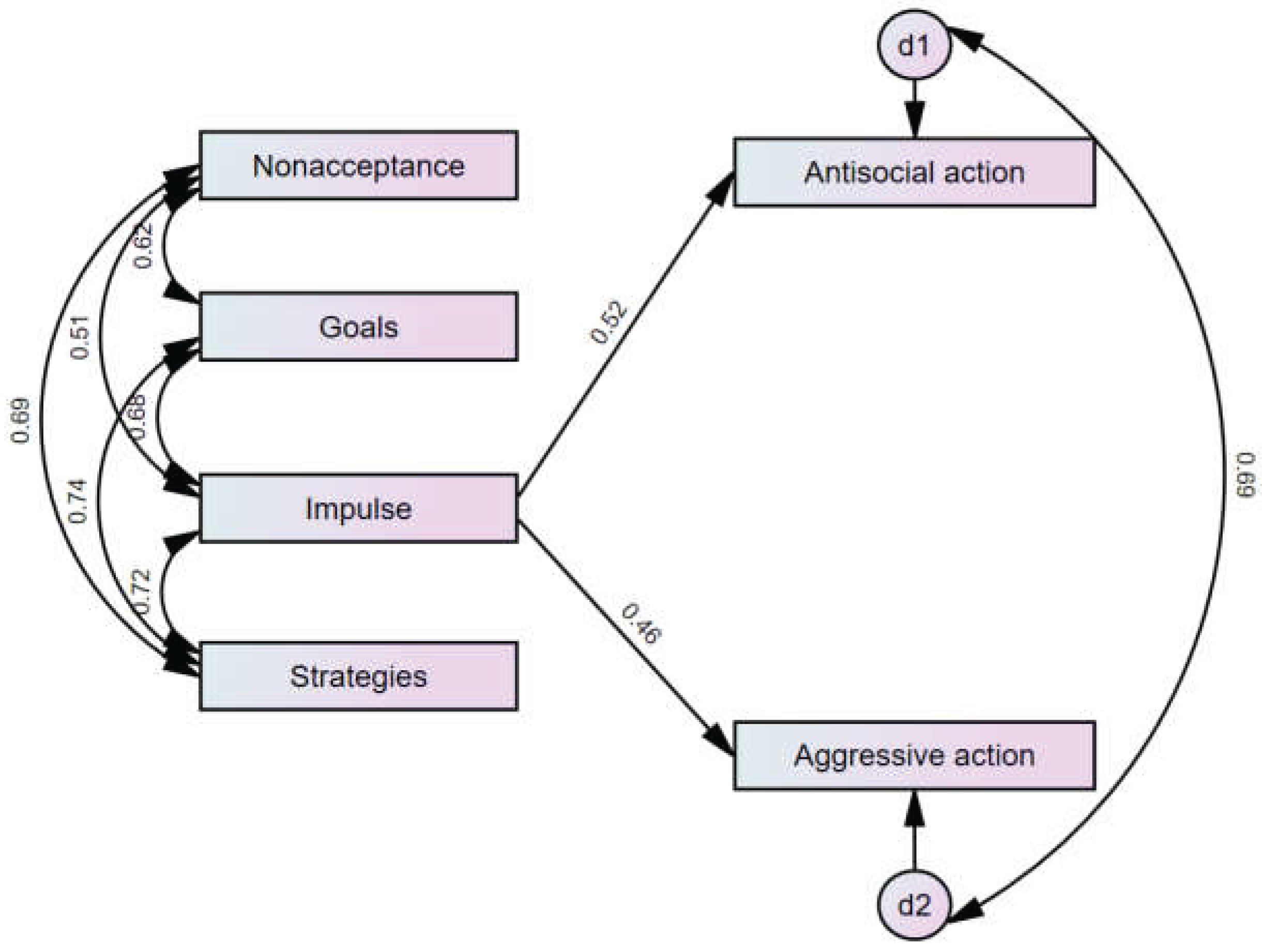

Table 1.
Descriptive statistics and reliability of the Difficulties in Emotion Regulation Scale (DERS).
Table 1.
Descriptive statistics and reliability of the Difficulties in Emotion Regulation Scale (DERS).
| DERS Subscales | Alpha | Items | Mean | Standard Deviation | Median | Variance |
|---|---|---|---|---|---|---|
| Nonacceptance | 0.883 | 6 | 15.62 | 6.12 | 15.00 | 37.51 |
| Goals | 0.798 | 5 | 14.12 | 4.61 | 14.00 | 21.29 |
| Impulse | 0.865 | 6 | 14.72 | 5.89 | 14.00 | 34.70 |
| Awareness | 0.740 | 6 | 14.96 | 4.62 | 15.00 | 21.38 |
| Strategies | 0.866 | 8 | 19.09 | 6.93 | 18.00 | 48.07 |
| Clarity | 0.811 | 5 | 10.42 | 4.18 | 10.00 | 17.46 |
Distance correlation analysis between DERS subscales, which captures both linear and nonlinear dependencies between scores, was conducted using 100 permutations. The results indicated significant moderate correlations between NONACCEPTANCE and GOALS (dCor = .37, p < .001), GOALS and STRATEGIES (dCor = .51, p < .001), IMPULSE and STRATEGIES (dCor = .47, p < .001), NONACCEPTANCE and STRATEGIES (dCor = .44, p < .001), and GOALS and IMPULSE (dCor = .43, p < .001).
Table 2.
SACS Descriptive statistics and reliability of Scala de Abordare Strategică a Coping-ului.
| SACS Subscales | Alpha | Items | Mean | Standard Deviation | Variance |
|---|---|---|---|---|---|
| Assertive action | 0.406 | 9 | 29.31 | 4.929 | 24.296 |
| Social Joining | 0.605 | 5 | 15.18 | 4.232 | 17.908 |
| Seeking social support | 0.757 | 7 | 18.52 | 5.659 | 32.021 |
| Cautious action | 0.665 | 5 | 15.41 | 4.288 | 18.384 |
| Instinctive action | 0.704 | 6 | 20.33 | 5.022 | 25.222 |
| Avoidance | 0.736 | 6 | 16.40 | 5.260 | 27.671 |
| Indirect action | 0.678 | 4 | 10.28 | 3.732 | 13.924 |
| Antisocial action | 0.785 | 5 | 11.88 | 4.867 | 23.686 |
| Aggressive action | 0.710 | 5 | 12.10 | 4.005 | 16.044 |
Distance correlation analysis between SACS subscales, using 100 permutations, indicated significant moderate correlations between Antisocial Action (AS) and Aggressive Action (AG) (dCor = .56, p < .001), and between Indirect Action (IAc) and Antisocial Action (AS) (dCor = .40, p < .001).
Table 3.
Differences in DERS scores between participants with and without hospitalization history.
| Subscale / Total DERS |
Hospitalized group (M ± SD) | Non-hospitalized group (M ± SD) | t | p | Cohen d |
|---|---|---|---|---|---|
| NONACCEPTANCE | 16.61 ± 5.88 | 14.21 ± 6.22 | -2.77 | .006 | -0.39 |
| GOALS | 14.98 ± 4.40 | 12.90 ± 4.66 | -3.22 | .002 | -0.46 |
| IMPULSE | 16.13 ± 6.22 | 12.71 ± 4.73 | -4.22 | < .001 | -0.60 |
| STRATEGIES | 20.40 ± 6.94 | 17.21 ± 6.51 | -3.28 | < .001 | -0.47 |
| AWARENESS | — | — | — | ns | — |
| CLARITY | — | — | — | ns | — |
| Total DERS | 93.81 ± 23.40 | 81.98 ± 21.79 | -3.62 | < .001 | -0.52 |
Table 4.
Differences in DERS dimensions and total scores according to type of substance use.
| Substance | Subscale / Total DERS |
Substance users group (M ± SD) |
Non-users group (M ± SD) |
Difference (t, p, d) |
|---|---|---|---|---|
| Opioids | IMPULSE | 15.13 ± 5.96 | 11.31 ± 3.60 | t=-2.92, p=.004, d=-0.66 |
| Canabis | CLARITY | 11.74 ± 4.24 | 9.52 ± 3.90 | t=-3.81, p<.001, d=-0.54 |
| MDMA | GOALS | 15.24 ± 4.23 | 13.75 ± 4.68 | t=-1.98, p=.048, d=-0.32 |
| Cocaine | GOALS IMPULSE CLARITY Total DERS |
15.03 ± 4.91 15.03 ± 4.91 15.03± 4.91 94.06 ± 24.25 |
13.50 ± 4.31 13.50 ± 4.31 13.50± 4.31 85.46 ± 22.31 |
t=-2.32, p=.021, d=-0.33; Total: t=-2.58, p=.010, d=-0.37 |
| NPS (New Psychoactive Substances) | GOALS IMPULSE | 15.50 ± 4.10 16.40 ± 5.69 |
13.57 ± 4.70 14.05 ± 5.85 |
t=-2.72, p=.007, d=-0.42; t=-2.58, p=.011, d=-0.40 |
Table 5.
Regression coefficients predicting IMPULSE from SACS subscales.
| 95%CI for B | |||||||
|---|---|---|---|---|---|---|---|
| Variable | B | SE | beta | t | p | Lower | Upper |
| (Constant) | 13.89 | 2.409 | 5.770 | <.001 | 9.15 | 18.65 | |
| AA | -.202 | .074 | -.169 | -2.729 | .007 | -.348 | -.056 |
| SS | -.172 | .062 | -.166 | -2.773 | .006 | -.295 | -.050 |
| AS | .413 | .111 | .341 | 3.722 | <.001 | .194 | .632 |
| AG | .415 | .142 | .282 | 2.924 | .004 | .135 | .695 |
Table 6.
Pearson’s correlations between total DERS score and SACS subscales.
| Variable | SACS subscale | r | p | 95% CI (Lower) |
95% CI (Upper) |
|---|---|---|---|---|---|
| DERS | AA (Assertive Action) | -0.307*** | < .001 | -0.427 | -0.176 |
| DERS | AV (Avoidance) | 0.299*** | < .001 | 0.167 | 0.420 |
| DERS | IAc (Indirect Action) | 0.306*** | < .001 | 0.175 | 0.426 |
| DERS | AS (Antisocial Action) | 0.371*** | < .001 | 0.245 | 0.485 |
| DERS | AG (Aggressive Action) | 0.225** | .001 | 0.090 | 0.353 |
** p < .01, *** p < .001.
Disclaimer/Publisher’s Note: The statements, opinions and data contained in all publications are solely those of the individual author(s) and contributor(s) and not of MDPI and/or the editor(s). MDPI and/or the editor(s) disclaim responsibility for any injury to people or property resulting from any ideas, methods, instructions or products referred to in the content. |
© 2026 by the authors. Licensee MDPI, Basel, Switzerland. This article is an open access article distributed under the terms and conditions of the Creative Commons Attribution (CC BY) license (http://creativecommons.org/licenses/by/4.0/).
Copyright: This open access article is published under a Creative Commons CC BY 4.0 license, which permit the free download, distribution, and reuse, provided that the author and preprint are cited in any reuse.


