
Submitted:
14 April 2026
Posted:
15 April 2026
You are already at the latest version
Abstract
Understanding whether the mathematical structure of quantum mechanics is fundamental or emergent remains a central question in the foundations of physics. In particular, the special role played by time in quantum theory, appearing as an external evolution parameter rather than a dynamical observable, suggests that the formalism itself may arise from deeper structural considerations. In this work, we investigate the emergence of quantum mechanical formalism from classical wave dynamics by adopting a dimensional framework in which time is treated as a +1 evolution parameter relative to the dimensions through which physical phenomena (fields or disturbances of a field) propagate and interact. Within this perspective, different fields may evolve with respect to different effective dimensions, while remaining embedded in a common higher-dimensional space, allowing time to acquire a relational and context-dependent role. This means that in our proposed model, time is not a fixed dimension which is experienced the same way for every field or field interaction of any dimensionality. In that sense, time for one physical phenomenon can behave as space for a higher dimensional physical phenomenon, whose time is a different +1 dimension. The central objective of this paper is to determine how a higher-dimensional deterministic field can be consistently represented by a lower-dimensional description that lacks direct access to its full set of evolution parameters and evolves through a spatial (for the higher-dimensional field) dimension. To this end, we introduce a general projection framework in which a higher-dimensional field is mapped to a reduced field through an interaction-based recording process. Crucially, we do not assume the form of this mapping a priori. Instead, we impose the requirement that it preserve the maximum amount of physically accessible information. In particular, we demand the faithful encoding of phase relations, interference structure, and spectral composition, including the relative contributions of different Fourier modes and their superposition. We first demonstrate, within a purely classical 3+1-dimensional wave framework that these constraints severely restrict the admissible form of the reduced description and naturally lead to complex amplitudes, linear superposition, Hilbert space structure, and canonical operator relations. This analysis provides an intuitive and mathematically explicit route to quantum-like descriptions without assuming quantum postulates. We then generalize the construction to a 4+1-dimensional framework, introducing an additional evolution parameter and showing that under the same information-preserving constraints, the Schrödinger equation appears as an effective low-energy description of the reduced dynamics, while a relativistic dispersion relation emerges simultaneously through the encoding of the hidden evolution parameter as an invariant frequency scale. In this way, both quantum mechanical and relativistic structures arise from the same underlying requirement: the consistent and information-preserving representation of higher-dimensional wave propagation in a lower-dimensional observational framework. The results suggest that the formal structure of quantum mechanics need not be postulated a priori, but may instead be understood as the unique mathematical language required to encode the observable remnant of a higher-dimensional deterministic dynamics under strict constraints of symmetry, invariance, and information preservation.
Keywords:
quantum mechanics
; Hilbert space
; measurement problem
; emergent structure
; emergent formalism
; interpretation of quantum mechanics
; relativistic quantum mechanics
; quantum gravity
; Einstein energy relation
; higher dimensions
; operators
; projection
; information preservance
; Klein - Gordon equation
; mass
; emergent time
1. Introduction
Quantum mechanics is one of the most successful physical theories ever formulated, yet its mathematical formalism remains enigmatic in origin. Standard representations take as axioms the existence of complex state vectors in a Hilbert space, linear operators representing observables, and Born’s rule for probabilities. While these postulates yield extraordinarily accurate predictions, they do not explain why nature should be described by such a formal structure, and they leave unresolved conceptual questions about the status of time, measurement, and the relationship to classical physics. This lack of explanatory grounding motivates a broad research program aimed at understanding whether the quantum formalism might itself be emergent from more basic principles rather than fundamental.
The notion of emergence, that higher-level structures or laws arise from more fundamental dynamics under appropriate conditions, has played an important role in physics in contexts as diverse as spontaneous symmetry breaking, classicality from decoherence, and effective field theories. In the foundations of quantum mechanics, emergent approaches seek to derive the Hilbert space structure, operator algebra, and probabilistic interpretation from deeper theoretical or structural constraints. There is a substantial literature exploring those approaches ranging from attempting to derive quantum formalism from axioms rather than postulates [1] and information-theoretic reconstructions [2] to more philosophical reconstruction efforts, supporting the importance of deriving and not assuming quantum structure [3]. Furthermore, there has been substantial work in highlighting the conceptual incompleteness of standard quantum axioms, motivating deeper structural explanations [4,5].
A second, related conceptual issue is the role of time in quantum mechanics. In standard quantum theory, time is treated as an external evolution parameter distinct from spatial coordinates, contrasting sharply with the relativistic treatment of spacetime. This asymmetry has been identified as a central conceptual tension that exacerbates foundational questions [6], yet it has rarely been the focus of constructive attempts to derive the quantum formalism itself. Reconstructions often assume the standard role of time as a background parameter or make information-processing assumptions that implicitly import aspects of the quantum structure they aim to explain. Motivated by this tension, and by the fundamental mathematical distinction between time and spatial variables in the formulation of dynamical laws, particularly in partial differential equations where time parametrizes the evolution of spatial data, we explore a dynamical and dimensional treatment of time to assess whether the formal structure of quantum mechanics can emerge from deterministic higher-dimensional wave dynamics without assuming quantum axioms.
In this article, we propose a new route to the emergence of quantum mechanical formalism based on a reconceptualization of time: time is treated as a +1 evolution parameter relative to the dimensions involved in physical propagation, rather than as a coordinate on an equal footing with space. Within this perspective, different fields may possess different effective dimensionalities, and what functions as time for one system may correspond to a spatial-like parameter in a higher-dimensional description.
Within this framework, the central question we address is the following: given a higher-dimensional deterministic field, how can it be consistently represented by a lower-dimensional description that does not have access to its evolution parameter? Rather than postulating the form of this reduced description, we approach the problem by imposing physically motivated constraints on the mapping between the higher- and lower-dimensional fields. Specifically, we require that the reduced representation preserve the maximum amount of physically accessible information. This includes the faithful encoding of phase relations, interference structure, and spectral composition, as well as the ability to distinguish between configurations that differ in their relative phases or mode content.
We show that these requirements strongly constrain the admissible structure of the reduced description. In particular, real-valued representations are generically insufficient, as they lead to a loss of phase information and collapse physically distinct configurations into indistinguishable ones. By contrast, complex amplitudes emerge as the minimal structure capable of preserving interference and spectral coherence under such a dimensional reduction. From this starting point, we demonstrate that key features of quantum mechanics—including linear superposition, canonical operator relations, and Hilbert space structure—arise naturally as consequences of representation requirements, rather than independent postulates.
Our strategy is to first develop a conceptual construction within a classical 3+1-dimensional wave framework, in which a purely theoretical (not real) lower-dimensional field evolves with respect to one of the spatial coordinates. This example serves to isolate the essential mechanisms by which complex structure and operator algebra emerge when information about an evolution parameter is inaccessible. We then generalize the analysis to a 4+1-dimensional setting, introducing an additional evolution parameter and deriving the effective dynamics of the reduced field. In this context, the Schrödinger equation appears as a low-energy limit of the reduced dynamics, while a relativistic dispersion relation emerges through the encoding of the hidden evolution parameter as an invariant frequency scale.
Crucially, the present approach differs from existing reconstruction programs in that it does not begin with abstract axioms or information-theoretic principles, but with explicit dynamical equations and a well-defined reduction problem. The quantum formalism is not assumed, but arises as the unique structure capable of representing higher-dimensional wave dynamics under constraints of information preservation, symmetry, and consistency of evolution.
Finally, we emphasize that the focus of this work is on the structure of interactions and their consistent representation, rather than on interpretational or observer-dependent aspects. Therefore, we strongly discourage the reader from interpreting and associating any kind of consciousness-based argument with this approach. Furthermore, because time is treated here as a dynamical and relational evolution parameter rather than as a fixed background coordinate, we deliberately refrain from employing Lagrangian or Hamiltonian formalisms. Such frameworks presuppose a globally defined action functional (action cannot be defined without time) and a fixed temporal parameter with respect to which variation and extremization are performed. Since these assumptions are not available a priori within the present framework, our analysis proceeds directly at the level of wave dynamics and evolution equations, which are sufficient for the questions addressed in this work.
2. The Role and Nature of Time Across Physical Theories. Coordinate, Parameter or Emergent Dimension?
Time is one of the most fundamental and yet most mysterious concepts in physics. While it plays a crucial role in every major physical theory, serving as the evolution parameter in classical mechanics and field theory, a fixed background in quantum mechanics, and a coordinate entwined with space in relativity, physicists still do not agree on what time actually is. This Section provides an overview of how time is treated across key physical theories and outlines the conceptual differences introduced by our proposed framework.
In classical physics, time is treated as an absolute, universal parameter that flows independently of physical processes. It appears as an external variable in Newton’s laws, such as in the second law F = m and is the parameter governing the dynamical evolution of a system.
In quantum mechanics, time retains its status as an external parameter and is not represented by an operator; instead, it governs the unitary evolution of the wavefunction through the Schrödinger equation
iℏΨ(x,t) = Ψ(x,t).
In this context:
Time governs the unitary evolution
The Hamiltonian acts on the state, while time is external.
Probabilities evolve with time and gives time-dependent spatial probability density.
3D space is represented by operators (such as the position operator and momentum operator ) acting on the Hilbert space of states, while time remains a parameter and there's no operator . This asymmetry is a major issue in efforts to unify Quantum Mechanics and General Relativity.
In Quantum Field Theory (QFT), the asymmetry mentioned above is resolved by treating space and time symmetrically as classical parameters that label points in spacetime, typically denoted as =(t,x,y,z) where μ=0,1,2,3. The fundamental objects in QFT are not particles, but fields, operator-valued functions defined over spacetime. Lorentz invariance in QFT ensures that time and space enter the theory on equal footing, but neither is quantized, only the fields are operator valued.
In the theory of relativity, time is treated not as an external or absolute parameter but as an integral component of the four-dimensional spacetime manifold. It is represented as the zeroth coordinate, typically written as , where c is the speed of light and t is the coordinate time. Together with the three spatial coordinates , the spacetime point is denoted with μ=0,1,2,3. The spacetime interval between two events is given by the metric:
where is the metric tensor.
In special relativity, this is usually the Minkowski metric = diag (−1,+1,+1,+1), yielding:
This invariant interval replaces the Newtonian notion of absolute time and governs the causal structure of spacetime. In general relativity, the metric becomes a dynamic field that encodes the curvature of spacetime due to the presence of mass and energy. Time thus becomes entangled with space: it curves, dilates, and behaves differently depending on the gravitational field, as described by Einstein's field equations. In this geometric framework, time is not an independent background parameter but a coordinate with physical consequences, shaped by and contributing to the fabric of spacetime.
In higher-dimensional classical field theories, such as Kaluza–Klein theory or those theories involving the Klein–Gordon equation extended to more than four spacetime dimensions, time is typically treated as a distinguished coordinate with a unique signature in the spacetime metric. The fields are defined over a smooth manifold with coordinates = (), where μ=0,1,2,3 includes time , and a=4,5,…,D−1 denotes the additional spatial dimensions. The dynamics are governed by equations such as the higher-dimensional Klein–Gordon equation:
and is the higher-dimensional metric tensor with a Lorentzian signature to distinguish time. Time remains the parameter of evolution, and the metric signature reflects its distinction
These models are classically well-defined using real-valued fields and differential geometry. All quantities (for example: are real valued (complex numbers are not necessary to those theories in contrary to quantum mechanics which can not be described without them) and so are the Euler – Lagrange and field equations with their solutions. However, when transitioning to a quantum description in those theories, quantization is externally imposed through procedures like canonical quantization or path integrals, rather than emerging naturally from the structure of the theory. This highlights a conceptual gap: while time enters the equations through the metric as a coordinate, its role in the quantum formulation is not fundamentally derived but rather treated analogously to lower-dimensional cases.
In our approach time will be modelled as an evolution parameter that governs the dynamics of fields, but unlike traditional treatments, it is not assigned a fixed coordinate position from the outset. Instead, we propose that time emerges as the +1 dimension relative to the dimensional space through which a phenomenon (field or disturbance of this field) propagates. More precisely, for a field defined over a space of dimension d, time is identified with the parameter that generates the evolution of configurations on that space, resulting in an effective description with d + 1 variables. In this sense, time is not introduced as an independent coordinate, but arises as the parameter that completes the description of dynamical evolution.
The reasoning behind this is as follows:
A defining mathematical distinction between time and spatial variables in physical theories arises from the role time plays as an evolution parameter in well-posed dynamical equations. In classical partial differential equations governing physical systems, such as the wave equation, diffusion (heat) equation, and Schrödinger equation, time is singled out as the parameter with respect to which initial data are specified and propagated. In the sense of Hadamard well-posedness, physical evolution is formulated as an initial value problem: given suitable data on a spatial hypersurface at a fixed time, the governing equations determine the system’s state at later (or earlier) times in a unique and stable manner [7,8]. Spatial variables, by contrast, do not generate evolution in this sense; evolution “along” a spatial direction generally lacks a causal interpretation and does not define a comparable generative flow. This distinction is explicit in parabolic equations, where time evolution is intrinsically irreversible, but it also persists in hyperbolic equations, despite their formal symmetry between temporal and spatial derivatives, as emphasized in the classical theory of partial differential equations [8,9]. Even in relativistically invariant formulations, causality, signal propagation, and the domain of dependence are defined with respect to time-ordered evolution rather than spatial displacement. These structural features indicate that time occupies a mathematically privileged role as an evolution parameter in physical laws, rather than merely serving as another coordinate. In this work, we take this distinction seriously by treating time dimensionally as a +1 evolution parameter relative to the dimensions of physical propagation, and we investigate how this treatment constrains the form of effective descriptions accessible to observers.
More specifically, space can be understood as a complete set of values and relations, such as geometric configurations or field distributions defined on a manifold at a given instant, while time serves as the parameter that governs the continuous evolution of these spatial configurations. In this view, the state of a physical system at any given moment corresponds to a point in a spatial configuration space, and time provides the ordering and dynamics that relate these configurations across different instants. Formally, if denotes a spatial hypersurface at time , then the full physical history is a trajectory through the space of configurations {} with time acting as the evolution parameter driving this trajectory. This is the reason we say that time emerges as the +1 dimension. Since space forms a complete set of values and relations, if we consider fields with different dimensionality, meaning fields that all their values and relations can be described in different amounts of dimensions, corresponding to all the necessary degrees of freedom needed to describe them, then it stands to reason that those fields would have a different time dimension. Following that reasoning if we allow these fields to interact with each other or even for one field to be a complete subset of a larger dimensional field then what functions as time for the lower-dimensional field may be embedded within the spatial structure of the higher-dimensional one. In this sense, time for one field can behave as a spatial dimension for another, and the flow of time becomes a relational and dimensional concept, not absolute or universally fixed. This allows for a dynamic, emergent notion of space and time in which dimensional roles are defined by the internal structure and propagation of the physical systems themselves.
This perspective naturally leads to the following question: how can a system whose dynamics are defined with respect to a given evolution parameter be described by an observer or effective theory that does not have access to that parameter? More generally, what are the structural constraints on a reduced description of a higher-dimensional dynamical system when certain variables are inaccessible or integrated out?
In the following Section, we address this question through a minimal construction in which a higher-dimensional wave field is represented by a lower-dimensional field that evolves with respect to a different parameter. By analyzing the requirements for such a representation to preserve physically relevant information, we will show that key features of quantum mechanical formalism arise as necessary consequences of this reduction.
3. A Conceptual 3+1 Dimensional Construction: Classical Fields and Emergent Quantum Structure
We begin by introducing a deliberately simplified and purely conceptual construction within a classical 3+1–dimensional framework. The purpose of this example is not to propose a new physical model, but to isolate, in a controlled setting, the minimal structural ingredients that give rise to quantum-mechanical features. At the end of this Section there will also be a conceptual example of the arguments presented here.
The motivation for including this Section is to build intuition about the way we model the time dimension, how this leads to quantum mechanical formulation when modeling a higher dimensional field in the reference frame of a lower dimensional field and to avoid misconceptions before moving to the main argument in the next Section. Even though we recognize that a lower dimensional field with one of our spatial dimensions as it’s evolution parameter is counter intuitive and purely a mathematical construct, we argue that examining such a case provides insight that outweighs its conceptual limitations.
We start by considering a classical 3+1-dimensional scalar field:
Φ(x,y,z,t) ∈ ℝ
satisfying the classical linear wave equation
At any point in space the value of Φ may be a superposition of waves originating from different spatial sources, different emission times, or both. In full generality, such a field may be written as a superposition of plane waves:
where:
- -
- k is the physical spatial wavevector
- -
- ω is the physical temporal frequency
- -
- the spectral coefficients encode both source location and emission time.
This is nothing more than the Fourier decomposition of the field into plane waves, which is vital if we want to represent a real field where its value at a fixed point varies in time due to:
- propagation delays from different sources,
- different emission times,
- constructive and destructive interference between modes with different (k, )
These phase differences are physically meaningful, as they determine interference patterns and interaction outcomes.
We now consider a lower dimensional field , a 2+1 dimensional field, which evolution depends on one of our spatial dimensions. Let this dimension be the z dimension, but we can take any other dimension or any 3D vector direction within our 3D space as the evolution parameter without any loss of generality. The values of this field in any (x,y) configuration are specified and propagated according to the z value of this field and the field configurations of higher z values are generated by the configurations of this field in lower z values.
To express this more formally, the values of this field are governed by equations which have the following form:
or
We now allow this field to interact with our classical 3+1-dimensional scalar field Φ and the strength of this interaction be proportional only to the scalar values of these fields.
Therefore, according to the interactions of these fields, if the values of the lower dimensional field are known then the values of our classical 3+1-dimensional scalar field Φ can also be found whenever such an interaction takes place.
Then the problem that arises is as follows:
Can we find a way to represent, with the minimum loss of information possible, the possible values and the evolution of the classical 3+1-dimensional scalar field Φ when we know only the values of the interactions of these fields at certain (x,y,z) configurations and the evolution law governing the lower dimensional field ?
The real reason we are considering such a problem will become clear in the next Section. However, some parallels can already be drawn with a realistic and very well known situation where the evolution of a physical object or field is known only by the values of its interactions and the modelling of the evolution of the value can not be done in a fully classical and deterministic way if we want to predict the value of the interaction at a different point.
In other words, we are interested in projecting the classical 3+1-dimensional scalar field Φ into an evolution equation such as (2).
In this setup the recorded field Ψ is defined by a linear, time-insensitive mapping:
where is a real response kernel characterizing the interaction.
Substituting (1) into (3) yields:
where :
- -
- χ = (x,y,z)
- -
- =
Crucially, the explicit time dependence has disappeared. Information about:
- -
- relative emission times
- -
- accumulated temporal phase
- -
- causal ordering
is now encoded only implicitly, through the complex phases of .
We must point out that the recorded field Ψ is not only t-insensitive but it also evolves in the z dimension, therefore it is not the same object as Φ, and its spectral variables need not be related to those of Φ by a simple invertible linear transformation. The crucial point is that this process is not just a change of coordinates in Fourier space. It is a projection-like observation map that removes explicit access to the hidden coordinate τ.
At this stage, it is important to emphasize that the explicit form of the mapping from the higher-dimensional field Φ to the recorded field Ψ is not assumed a priori. The recording process represents an effective projection from a higher-dimensional dynamical system to a lower-dimensional description, and is therefore not uniquely defined.
The objective of the present framework is precisely to determine the admissible structure of this mapping by imposing physically motivated constraints. In particular, we require that the recording preserves the maximum amount of information accessible to the lower-dimensional observer, including phase relations and interference structure, while remaining consistent with the reduced set of observable variables.
As will be shown, these requirements significantly restrict the form of the mapping and lead naturally to the emergence of complex amplitudes, linear superposition, and ultimately a Hilbert space structure for the recorded field.
Suppose now that the recorded field Ψ is required to be real-valued. Then its Fourier coefficients (lets call them must satisfy a reality condition:
where κ and Ω denote the spatial (in x,y space) and evolutionary frequencies (evolution in the z direction) associated with Ψ
As a consequence of Ψ being real-valued, Ψ can be written as:
where χ΄= (x,y)
In this representation:
- -
- phase information is not an intrinsic variable
- -
- it depends on the relative weighting of sine and cosine components
- -
- it is sensitive to the arbitrary choice of origin in z
As a result, distinct external wave configurations, produced by different sources or emission times and leading to different interference patterns in Φ, may map to the same real-valued Ψ. This is because all temporal phase information , is collapsed into the scalar factor To demonstrate that more clearly consider two contributions of the field Φ in the same point in 3D space with identical k but different temporal phases (e.g. emitted at different times or from different sources). Therefore :
Applying the linear, time-insensitive recording map (3)
and assuming a time-symmetric response kernel = , Ψ takes the form:
A cos(kχ) , A cosδ cos(kχ)
Where A =
The superposed field Ψ is therefore:
+ = A cos(kχ)
Then distinct physical situations (δ ≠ 0) may map to identical Ψ values. For example there is no distinction between π/2 and -π/2 phases
This is a serious problem because the mapping
δ cos δ
is many to one and there is no linear real functional that can extract sinδ independently without introducing a second channel or a complex structure.
The recorded field depends only on , rendering it insensitive to phase sign, temporal ordering, and entire equivalence classes of physically distinct wave configurations. In particular, phase shifts , , and yield identical recorded values. This many-to-one mapping implies a fundamental loss of information concerning relative emission times, interference structure, and interaction dynamics. The special cases correspond to maximal information loss, but the non-invertibility is generic and unavoidable for any real-valued, linear, time-insensitive recording.
Thus, a real valued Ψ cannot distinguish physically inequivalent wave configurations.
This loss is not optional. It follows directly from linearity, time-insensitivity, and reality of Ψ. Therefore, a real valued Ψ can not represent the values of a real scalar 3+1 dimensional field Φ, because the phase information is crucial in determining:
- -
- whether interference is constructive or destructive
- -
- how energy is redistributed
- -
- how the field interacts with matter.
Two external wave configurations that differ only in relative temporal phase can exert different forces or deposit different energy, even if their real-valued time-averaged amplitudes coincide.
A real-valued does not constitute a physically faithful representation of an interacting wave field Φ.
Furthermore, a real valued Ψ fails to represent broadband (multi-frequency) wave signals of Φ.
Any localized or interacting wave field necessarily contains a superposition of frequencies:
Φ(x,y,z,t) =
Different frequency components accumulate phase at different rates:
Δφ(ω,t) = ωt
Relative spectral phase is therefore essential for:
- -
- wave packet localization
- -
- dispersion
- -
- interaction dynamics
Under the mapping (3),(4), frequency-dependent phase information is collapsed into the coefficients .
However, when Ψ is constrained to be real-valued:
- -
- relative phase between different frequencies cannot be encoded invariantly
- -
- cross-frequency coherence is lost
- -
- dispersion effects cannot be reconstructed
Consequently, two broadband wave packets with different internal spectral phase (hence different propagation and interaction behavior) may yield identical Ψ.
This is because if we let
Φ = +
A real valued Ψ would yield:
Ψ
which carries no information about relative phase evolution between and Δφ = ( - ) t
Since both and are time insensitive.
Considering the above, we conclude that what is missing from a real valued Ψ is phase information.
In contrast, complex amplitudes provide the minimal structure capable of encoding relative phase information while preserving superposition and translational symmetry.
A field Ψ in the form:
can faithfully encode the physically relevant phase and amplitude information necessary to distinguish interference structures of a real valued 3+1 dimensional field Φ, because the evolution of this field respects a dispersion relation that connects translations in space with translations in time.
Any real-valued solution of the classical wave equation in dimensions can be written as:
Φ(χ,t) = kχ – ω(k)t + δ(k))
with dispersion relation: ω(k) = u
Here:
- -
- A(k) is a real amplitude distribution
- -
- δ(k) is a physically meaningful phase encoding emission time, path length, or source geometry
Since we want to represent Φ with a field Ψ that has no time t information, therefore:
- -
- Temporal oscillations cannot be tracked directly
- -
- Only spatial structure and interference remain observable
We can make use of the dispersion relation in order to relate temporal phase differences to spatial phase shifts:
δ(k) k Δχ
This gives us a way to faithfully relate wave solutions coming from different emission times or from different sources with only the use of 3 dimensional spatial information.
Therefore, a solution in the form of (6) with ℂ can encode the relative phase information of a real field Φ while preserving superposition and translational symmetry because can be written as:
Where:
- -
- represents the strength (amplitude) of the mode
- -
- represents the relative phase
This way if we consider two contributions with identical κ but different phases:
, Then after superposition
Ψ (1 + )
The relative phase :
- -
- is explicitly retained,
- -
- is distinguishable from ,
- -
- controls interference exactly.
Now what remains to examine is how this relative phase δ should be represented, what form should it have and how it is connected to measurable quantities.
To summarize what we have expressed above, because the recorded field Ψ has no information about the time dimension t, only spatial structure and interference are represented by this recorded field Ψ. This can be done faithfully with minimal loss of information by a complex field Ψ in the form of (6) with a complex
Because phase differences correspond to spatial displacements via the dispersion relation, θ(κ,Ω) must encode relative spatial localization information.
Here comes the key physical requirement:
If the underlying wave is translated in 3D space (which also corresponds to the passing of a fixed time interval due to the dispersion relation), the recorded field Ψ must also change accordingly, without altering physical content.
Consider a spatial translation:
(χ΄΄,z΄) (χ΄+ a, z + b)
The field transforms accordingly
Ψ(χ΄,z΄) Ψ(χ΄+ a, z + b)
Using (6)
Ψ(x,y,z) = =
=
With χ΄= (x,y)
After translation
Ψ(χ΄+ a, z + b) =
Thus, translation acts as:
θ(κ,Ω) θ(κ,Ω) + κa - Ωb
This tells us that θ(κ,Ω) shifts linearly with 3D spatial displacement, therefore, its gradient has physical meaning. Furthermore, θ(κ,Ω) has to be smooth if we want to represent 3D wave interactions because non-differentiable phases would produce delocalized, non-interacting fields, which is not what we want to represent.
Define:
X(κ) =
This object has dimensions of length, and transforms as a 2D position
Indeed, under translation:
X(κ) X(κ) + a
Thus, encodes 2D spatial localization of the wave packet
Following that, in spectral space (from Fourier analysis) we can also define:
If we apply it to
=
We get
+ i
And the expectation value becomes:
=
Now consider the action of multiplication by κ in Fourier space
In position space, this corresponds to:
κ - iTherefore, we define the operator:
Which is the generator of 2D spatial translations.
This is not assumed, it follows from Fourier duality.
From (7),(8) on spectral space:
= , =
If we let them act on an arbitrary ( = = i ()
( = =
Therefore:
= =
This is purely a property of Fourier duality
At this point, the canonical structure emerges because:
- -
- Translation symmetry is represented by exponentials.
- -
- Exponentials imply Fourier dual variables.
- -
- Fourier dual variables satisfy multiplication vs differentiation duality.
- -
- Differentiation and multiplication do not commute.
- -
- Their non-commutation is exactly the delta structure.
It was not imposed, quantized or probabilistic. It is a structural property of wave representations.
It is important to note that commutation relations do not only apply for operators and . In fact, for any pair of variables related by continuous translation symmetry and represented through exponential phase factors, multiplication in spectral space and differentiation in conjugate space necessarily generate a canonical commutation relation. Thus, the canonical algebra emerges as a structural consequence of wave-based translation invariance rather than as an independent quantum assumption.
Considering the above, we now have a recorded field in the form:
Ψ(χ΄,z) = (6)
which is a faithful representation of the physical 3+1 dimensional filed Φ that obeys the classical linear wave equation.
We established that the spectral amplitude encodes:
- -
- spatial localization (via phase gradients)
- -
- interference
- -
- translation behavior
But what quantity represents the “amount of field” recorded?
Since Ψ encodes interference structure only, the physically meaningful invariant quantity cannot be the field value itself (which oscillates), but something quadratic in the amplitude.
The only translation-invariant quadratic candidate is:
This is because under the translation (χ΄΄,z΄) (χ΄+ a, z + b) :
Taking the modulus:
Therefore:
is invariant under translations.
No other simple quadratic functional has this property.
Additionally, translating a 3+1 dimensional wave must not change its physical content if we want to have a physically meaningful representation.
This implies that the representation must preserve total intensity.
More generally, if we want to project the underlying system in an equation that evolves in the z dimension, then the mapping must preserve total recorded content.
Therefore:
Without this conservation:
- -
- localization drifts artificially
- -
- spectral weight appears/disappears
- -
- interference structure is not stable
Conservation is not optional. It is required for faithful representation.
In addition to that, we must also define:
- -
- interference between two different configurations
- -
- expectation values of operators
- -
- orthogonality of modes
to have a totally faithful representation.
All these require an inner product.
The natural candidate is:
=
This satisfies:
- -
- conjugate symmetry
- -
- linearity
- -
- positive definiteness
Moreover:
=
Thus, the norm arises from an inner product.
Finally, suppose that the evolution in z is generated by an operator which is defined by:
Then
=
Substituting (10):
Therefore, if (9) should hold then (11) vanishes only if:
=
This means that conservation of norm forces Hermitian generators.
And Hermitian generators imply Unitary evolution.
So:
- -
- Conservation ⇒ Hermiticity
- -
- Hermiticity ⇒ Unitary representation of translations.
This is exactly the mathematical structure of Hilbert space quantum mechanics.
Let us summarize the logical chain that led us here:
- Complex amplitudes are required to encode phase.
- Translation symmetry implies exponential representation.
- Fourier duality gives canonical commutators.
- Faithful representation requires conserved total intensity.
- Conserved quadratic intensity requires an inner product.
- Conservation under evolution requires Hermitian generators.
- Hermitian generators imply unitary transformations.
This is very important because Hilbert Space structure is forced by symmetry and conservation in our framework and is postulated a priori. In other words, in our framework quantum mechanical formalism is derived and not assumed.
We will conclude this Section by giving a conceptual example of the arguments presented above.
In our framework:
- -
- The 3+1 wave Φ exists physically
- -
- The recorded Ψ is a reduced representation which has no information about our time dimension t and its evolution parameter is one of our spatial dimensions.
- -
- The only reason this recorded Ψ can be a faithful representation of Φ is that Φ obeys a dispersion relation which enables us to relate temporal phase differences to spatial phase shifts
- -
- To faithfully encode interference and localization, Ψ must preserve phase and amplitude
- -
- To preserve physical content under translation, total spectral weight must be invariant.
- -
- This invariance mathematically enforces Hilbert structure
Thus, Quantum structure emerges not from probability, but from representation stability under translation symmetry.
To visualize the argument one can draw some parallels with the classical double slit experiment.
In the case of the double slit experiment for light (Fig 1), we know that the Amplitude of the interference pattern for any point on the screen is analogous to + , where , the distances of the slits from the point measured on the screen and [10,11].
Figure 1.
The double slit experiment and how it creates constructive and destructive interferences which have to do with the geometry of the experimental setup.
Figure 1.
The double slit experiment and how it creates constructive and destructive interferences which have to do with the geometry of the experimental setup.
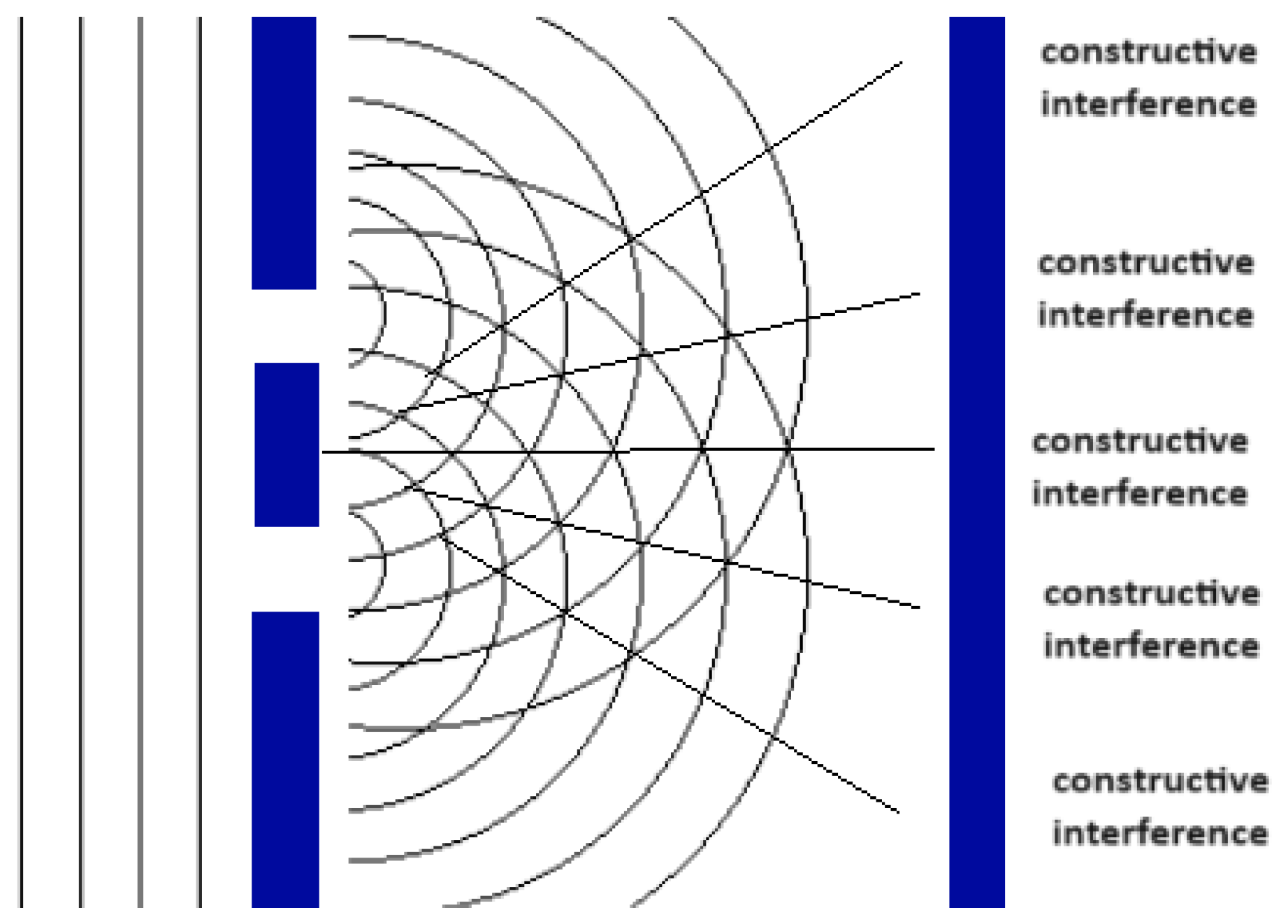
If there was an observer oblivious to the concept of our time (4th dimension) in any point of the screen of the double slit experiment, it would seem to him that the Amplitude of the wave can take many possible values. The only way any conclusion or correlation about the wave and its behavior can arise is with the use of complex numbers. Still some information is lost to the observer (like the exact value of the Amplitude because it oscillates with time, which the observer can’t measure or understand) but at least a great portion of the total information of the system would be accessible (for example if there is a constructive or destructive interference like in the double slit experiment for light). The word observer is chosen here for conceptual reasons only. There is no need for a physical or conscious observer, any recorded interaction of a field that evolves in one of our spatial dimensions with the other spatial dimensions making the plane of the screen will do.
Taking that into account, the observer who can’t understand and measure time would have to make use of complex functions and associate them with observables which the observer can measure and understand such as wavelength λ or energy (if the energy of a wave is proportional to its frequency which is the case for electromagnetic radiation – photons and free fundamental particles). Also, such waves can not be entirely described only by spatial functions (for example ). Using the complex plane gives us a necessary extra degree of freedom, essential for our correlations.
4. The 4+1 Dimensional Case. Quantum Mechanics, the Measurement Problem, Special Relativity and the Schrödinger Equation for the low energy limit
In the previous Section, we showed that when a real scalar 3+1 dimensional wave field Φ is recorded in a field Ψ, which has no information about our time dimension t and its evolution parameter is one of our spatial dimensions, then the Hilbert space formalism of quantum mechanics emerges naturally.
We deliberately chose to begin with a conceptual 3+1 to 2+1 dimensional case in order to avoid any misconceptions that may arise because of our unconventional treatment of the time dimension. Any field has only one time dimension which is its evolutionary parameter. Our proposed model does not support multiple time dimensions for the same field. Time is always the +1 evolutionary parameter relative to spatial dimensions. For a higher dimensional field the time dimension of a lower dimensional field is treated as a spatial dimension and is equivalent to all the other spatial dimensions as far as the evolution of the higher dimensional field is concerned.
From the analysis done in the previous Section, generalizing the arguments presented for higher dimensional fields is straight forward. We can easily follow the same methodology for recording a 4+1 dimensional field in a 3+1 recorded field without any loss of generality and still arrive at the same conclusion. This is something that will be done in this Section, but first we want to present the reader with a reason for why this might be physically important and how from some aspects of our analysis, some features of special relativity can also arise naturally, providing a beautiful connection between quantum mechanics and special relativity.
Having all the above in mind, in the previous Section we did not address some key issues that will provide that connection between quantum mechanics and special relativity.
When we record Φ:
Φ(x,y,z,t) =
With a field Ψ:
Ψ(χ΄,z) =
The recorded field Ψ keeps only:
- -
- the transverse wavevector κ = (
- -
- the recording frequency Ω along z
but it does not explicitly keep:
- -
- -
Therefore, the mapping must eliminate two variables
This can be achieved, as we mentioned in the previous Section, by using the dispersion relation.
Using that dispersion relation, we will show in this Section that we can make the lost degree of freedom reappear as an invariant parameter, assuming Harmonic propagation with constant rate of propagation.
This will make a mass term appear in the lower dimensional field because:
- -
- the recording removes the time dimension
- -
- but the original field satisfies a constraint linking time and space frequencies.
Connecting all the above will provide us with a mass term and a constraint linking time and space frequencies which is equivalent to the complete Einstein energy equation:
when we move to the 4+1 dimensional case.
Having developed all the above mathematical tools we are now ready to proceed to the main argument of this paper.
Considering our framework and how time acts as the +1 evolution parameter relative to the spatial parameters through which a field propagates and interacts, if there was a 4+1 dimensional field, which could interact with a classical 3+1 dimensional field (for example the electromagnetic field if we were to approximate it as fully classical, we will give an explanation for this approximation in the next Section), how would we the 3+1 dimensional observer record that field in our reference frame and what evolution law would govern that field between interactions. Also, if there was an energy exchange between those interactions (which is logical because without one we would not be able to record that field in the first place) how would a change in the propagation characteristics appear in our reference frame and how would that change the variables in that evolution equation?
To state our objective a little more clearly, we are interested in finding a function that evolves in the t dimension and can most accurately describe the evolution of that 4+1 dimensional field between interactions. That function should be able to provide the maximum information available to the 3+1 dimensional observer.
(We will once again denote the higher dimensional field as Φ and the lower dimensional field as Ψ, as we did in Section 3, in order to avoid overcrowding the paper with many different symbols)
Following the same logic as in Section 3, a plane wave solution of that 4+1 dimensional field would have the form:
where:
χ = (x,y,z)
t΄ = at (t has to be converted to units of length by a conversion factor a)
τ is the +1 evolutionary parameter of the field (5th dimension)
A is the angular frequency associated with the τ dimension
In order to convert Φ to a τ-insensitive field Ψ which evolves in the t dimension we once again make use of a linear τ-insensitive recording map in the form of:
Ψ(χ,t) = (13)
where K(τ) is a response kernel describing the interaction between the field Φ and a classical 3+1 dimensional field.
This operation projects the higher-dimensional field onto a τ-insensitive description. As a result, the spectral variables associated with the recorded field will not, in general, coincide with those of the original field, since the role of the coordinate t changes from a spatial coordinate in Φ to the evolution parameter of Ψ
The crucial point is that this process is not just a change of coordinates in Fourier space. It is a projection-like observation map that removes explicit access to the hidden coordinate τ. As a result, the recorded field Ψ is not the same object as Φ, and its spectral variables need not be related to those of Φ by a simple invertible linear transformation.
Substituting (12) to (13) we obtain a Fourier representation of Ψ:
Ψ(χ,t) =
with being a mapping of
=
which should be understood as a re-expansion in the spectral basis natural to Ψ, not as a simple rescaling ω = αΩ. The observed frequency ω is defined by the effective t-evolution of Ψ, whereas Ω parametrizes oscillation along a coordinate that is spatial from the viewpoint of Φ.
Now the phase information associated with τ is contained only implicitly in the complex coefficients .
Exactly as in the 3+1 to 2+1 conceptual construction of the previous Section, a purely real recorded field cannot faithfully preserve relative phase information, because different higher-dimensional configurations with different τ-phase structure can map to the same real-valued output. Therefore, the minimal faithful representation is again a complex field:
Ψ(χ,t) ℂ
This is the first essential quantum-mechanical feature:
The complex character of the recorded field is not imposed as an axiom, but forced by the requirement of preserving interference information under dimensional reduction. The proof of that can be found in Section 3.
At this stage, it is important to emphasize that the explicit form of the mapping from the higher-dimensional field Φ to the recorded field Ψ is not assumed a priori. The recording process represents an effective projection from a higher-dimensional dynamical system to a lower-dimensional description, and is therefore not uniquely defined at the microscopic level.
The objective of the present framework is precisely to determine the admissible structure of this mapping by imposing physically motivated constraints. In particular, we require that the recording preserves the maximum amount of information accessible to the lower-dimensional observer, including phase relations and interference structure, while remaining consistent with the reduced set of observable variables.
As will be shown, these requirements significantly restrict the form of the mapping and lead naturally to the emergence of complex amplitudes, linear superposition, and ultimately a Hilbert space structure for the recorded field.
We will derive the entire Hilbert space formalism later in the paper, but first we should address another issue. One that will connect our framework to special relativity and give us a means to deriving some of quantum mechanics most famous equations.
Suppose a wave of the 4+1 dimension field Φ propagates with a constant rate .
Then because Φ evolves in the τ dimension, the natural wave operator of that field or the equation governing that field should take the form:
= (14)
This is because t behaves as a spatial coordinate of that field (a is the t conversion factor as mentioned before) and all spatial coordinates must be equal.
Take a plane-wave mode of the form:
Φ(χ,t,τ) =
If we assume that Φ has definite harmonic dependence in the hidden evolution coordinate we get:
Φ(χ,t,τ) = (15)
Substituting (14) in (15):
(-) =
or equivalently:
+ + = 0 (16)
From here on we must be very careful.
- -
- Ψ is not the same as φ.
- -
- Ψ is required to evolve in the t dimension and is not the same as Φ without the τ dimension and with different notation.
- -
- Ψ is produced by a time insensitive recording of Φ and does not obey necessarily the same dynamics as Φ.
- -
- Our goal with recording Φ with a field Ψ is to preserve the maximum information possible of how Φ evolves in space (which is tied to its evolution in time due to the dispersion relation) without the evolutionary parameter of Φ.
Given the above we can deduce the form equation (16) takes for Ψ given that it must obey the following physical requirements:
4.1. Requirement A: The Recorded Field Evolves in t
The observed field Ψ(χ,t) must be governed by an equation where t is the evolution parameter. As we mentioned in Section 2 this means that t must be the parameter with respect to which initial data are specified and propagated.
In the sense of Hadamard well-posedness, physical evolution is formulated as an initial value problem: given suitable data on a spatial hypersurface at a fixed time, the governing equations determine the system’s state at later (or earlier) times in a unique and stable manner.
As a consequence, the governing equation should take the form:
= some function involving spatial derivatives of
4.2. Requirement B: The Equation is Linear and Second Order
To match the wave nature of the parent field and to preserve superposition, we want a linear second-order equation
4.3. Requirement C: Isotropy in 3-Space
The spatial derivative enters through
4.4. Requirement D: The Hidden τ-Mode Contributes Only Through Its Spectral Invariant
Then the reduced equation should contain a constant term proportional to (Harmonic propagation in the τ dimension)
4.5. Requirement E: Stable Oscillatory Modes With Positive Rest Energy
This requirement is important if we want our framework to be compatible with our observed reality
If we want the above requirements to hold true then among all linear second-order local equations compatible with these requirements, the most general form and in accordance with (16) is the following:
= - (17)
The parameter a, introduced at the level of Φ to convert the coordinate t into spatial units, does not necessarily appear as a direct rescaling factor between Ω and ω. Instead, it survives in the reduced theory as part of the effective propagation scale , thereby linking the geometry of the higher-dimensional field with the observed relativistic structure.
Inserting a plane wave solution in the form of:
Ψ =
We get:
+ + 0 + + 0
Therefore,
Identifying = c (the speed of light), as it is common in special relativity and in physics in general when we want to convert time units to spatial units, and multiplying (18) with we get :
If we then use the deBroglie relation:
= /λ =
and the Einstein – Planck equation:
E =
which apply to all fundamental particles we get the complete Einstein energy equation:
With a mass term:
m =
We should point out that the sign of the mass term in equation (17) is taken to be minus (-) because if it were positive then we would arrive at a dispersion relation in the form of:
Which for small k values would mean that:
< 0
so ω becomes imaginary. That means instead of oscillatory time evolution we would get exponentially growing or decaying solutions. Such a mode is unstable in the ordinary field-theoretic sense.
The logical chain we used here is as following:
- The 4+1 dimensional field has harmonic dependence in τ:
Φ ∼
- 2.
- Therefore:
Φ = Φ
- 3.
- After reduction, the hidden coordinate contributes a constant mode label.
- 4.
- A constant mode label in a second-order wave equation becomes a mass-like term.
- 5.
- If the reduced field is to have stable relativistic plane waves, that mass-like term must enter with positive sign in Klein–Gordon form.
At this point deriving the Schrödinger equation as the low energy limit of the Klein–Gordon form equation (17) is straightforward.
Equation (17):
= -
Obeys the dispersion relation (19):
Which in the low-momentum regime
Becomes
To isolate the slower dynamical content, we write:
Ψ(χ,t) = = (20)
Where is assumed to vary slowly in time compared with the rest-energy oscillation.
Substituting (20) in (17) we get
Which becomes:
– 2i - = 0 (21)
The low-energy regime means that varies slowly compared with the fast oscillation frequency which means that:
The equation (21) reduces to:
– 2i - = 0 =
If we substitute A with the mass term we derived earlier, we get:
= =
Which is exactly the Schrödinger equation for a free moving particle
An important observation is that ℏ persists in the effective Schrödinger equation despite not being introduced as a fundamental constant at the level of the higher-dimensional dynamics. Instead, it emerges as a conversion factor relating the invariant frequency scale associated with the hidden evolution parameter to the effective mass term in the reduced description. This indicates that ℏ does not need to be postulated a priori but can arise naturally from the dimensional reduction and the associated rescaling between conjugate variables. This provides a structural explanation for its role in quantum mechanics, suggesting that Planck’s constant reflects an emergent scaling between conjugate variables rather than a fundamental quantization postulate. In this view, the canonical quantum structure, including commutation relations, inherits its scale from this emergent conversion, thereby distinguishing the present framework from standard formulations in which ℏ is introduced axiomatically.
Having developed all the mathematical tools above, we are now ready to derive how the commutation structure appears, how the non-commutative structure comes from Fourier duality and translation symmetry and finally how ℏ appears in the commutation relations.
Since we have proven that a real valued field Ψ cannot faithfully encode relative phase information of the higher-dimensional field Φ, the reduced field Ψ must be complex. The next question is: what mathematical form must that phase information take?
Because the reduced description must preserve superposition and translation behavior, as we required above, the elementary modes of the field Ψ may only change by a phase factor under translation since translations must not alter its physical content, only its coordinate description. This is exactly the same logic we used in Section 3.
This means that under a coordinate translation:
(χ,t) (χ+ a, t + b)
an elementary mode of Ψ, , must transform:
=
which does not chance the physical content of and changes it only by a phase factor
Now the translation group is additive, so consistency requires:
=
This is the functional equation for a one-dimensional unitary character of the abelian translation group. Under mild regularity assumptions, its general continuous solution is an exponential function:
=
Therefore, the elementary translation-covariant modes must be of the form:
=
So, the exponential is not an arbitrary ansatz. It is the unique continuous way to encode phase so that:
- -
- superposition is preserved
- -
- translations act linearly
- -
- physical content remains unchanged under translation
Therefore, the crucial point is that translation symmetry acts through phase multiplication:
χ χ + a
=
Consequently, the spectral variable k is the generator of translations in the recorded space. By standard Fourier duality:
k - i
This is a structural consequence of representing the reduced field through translation-covariant wave modes, not a quantum postulate.
Define the position operator and the wave vector operator :
Ψ = Ψ(x) , Ψ = - i Ψ(x)
Then their commutator is
Ψ(x) = – i – i = – i + i + i = i
Hence,
= i
In three dimensions the same argument gives
= i
This is the canonical algebra in dimensionless form. It emerges because:
- -
- the recorded field must preserve phase information
- -
- phase is represented exponentially
- -
- exponential representation implies Fourier conjugacy
- -
- Fourier conjugacy implies multiplication/differentiation duality
- -
- and that duality is non-commutative.
So the commutator is not assumed. It is forced by the structure of faithful reduced wave representation.
At this stage the commutator is purely structural and dimensionless.
We remember that from equation (18), we get that the field Ψ obeys:
And we identified a mass term as:
m =
Equivalently,
=
(We could identify as or and point out that this relation should be necessary if we want to avoid causality problems and faster than light signaling, but we will avoid this for the time being as we don’t want to lose generality of our argument)
At that point, appears as the conversion factor between:
- -
- the hidden invariant frequency scale , and
- -
- the effective mass-energy scale of the reduced theory
is not necessarily part of the initial operator algebra. It emerges when we examine how the spectral translation variable should be converted into the physically observed momentum of the reduced field.
This is because relation (18) and the relativistic energy relation:
are not independent postulates in our framework. They are the unique scale identifications that make the reduced wave dispersion relation coincide with the physical energy-momentum relation.
Therefore, once the physical momentum operator is defined through the emergent scale factor :
- i
the commutator follows immediately and the relationship becomes:
= i
Which is the well-known quantum mechanical relation.
Thus, in the present framework, the canonical commutation relations are not fundamental postulates of microscopic physics, but effective consequences of dimensional reduction. The algebra follows from translation symmetry and Fourier structure, while the appearance of in reflects the emergent rescaling that links the hidden frequency of the higher-dimensional dynamics to the observed mass and momentum scales.
At this point we are ready to derive the full Hilbert space formalism of quantum mechanics by forcing some physical limitations to our model.
The first limitation is as follows:
What quantity represents the “amount of field” recorded and how can we express that two reduced field configurations represent distinguishable or overlapping physical states?
Since Ψ encodes interference structure only, the physically meaningful invariant quantity cannot be the field value itself (which oscillates), but something quadratic in the amplitude. Also, since the physical field content must remain unchanged under translations and under free evolution, the reduced theory must possess a quadratic quantity that is:
- -
- positive,
- -
- additive under superposition in the correct way,
- -
- invariant under symmetry transformations.
The natural candidate is the quadratic form:
=
This quantity is positive and translation-invariant. More generally, it comes from the inner product:
=
This inner product is not arbitrary. It is the unique natural local sesquilinear form compatible with:
- -
- complex superposition,
- -
- positivity,
- -
- translation invariance,
- -
- the interpretation of as the conserved total recorded content.
Therefore, the vector space of reduced fields is promoted to an inner-product space.
Once the inner product exists, all the usual Hilbert-space notions follow naturally.
Because translation eigenmodes form a complete basis, every admissible state may be expanded spectrally.
So the standard machinery of “states + operators + inner products + expectation values” emerges from representation requirements, not from quantum postulates.
4.6. Orthogonality
Two modes are orthogonal when:
= 0
This expresses distinguishability of spectral components.
4.7. Expectation Values
For any linear operator =
This is not yet a probabilistic axiom in our framework. It is the natural scalar quantity extracted from the bilinear form once observables are represented by linear operators.
4.8. Hermiticity
Conservation of total recorded content forces Hermiticity
Now suppose the reduced field evolves according to some linear generator . Therefore:
=
Then the norm evolves as
= +
Substituting = -i :
= -i + i
Thus norm conservation for all requires:
=
That is
So Hermiticity is not assumed. It is forced by the requirement that free evolution preserve total physical content in the reduced theory.
Exactly the same applies to other observable generators.
4.9. Unitary Evolution
It follows automatically. If the generator is Hermitian, the evolution operator is:
U(t) =
and it satisfies
= I
Thus, evolution is unitary.
The logic here is:
preserve recorded content under evolution → Hermitian generator → unitary evolution.
At this point we have all the essential pieces:
- -
- State space: complex vector space of admissible reduced fields
- -
- Inner product: required by invariance and positivity
- -
- Norm: conserved total recorded content
- -
- Operators: generators of symmetries and observables
- -
- Hermitian observables: forced by conservation and real measured values
- -
- Unitary evolution: consequence of Hermitian generators
- -
- Canonical commutators: consequence of Fourier duality and translation symmetry
In this way, the complete Hilbert-space formalism of quantum mechanics emerges in the present framework from the structural requirements imposed by dimensional reduction: complex phase retention, linear superposition, translation covariance, invariant quadratic content, and norm-preserving evolution. The mathematical architecture of quantum theory therefore appears here not as a primitive postulate, but as the unique consistent language for representing the observable remnant of a higher-dimensional deterministic wave dynamics.
The significance of the construction presented in this Section is that the full mathematical structure of quantum mechanics emerges as a necessary consequence of representing a higher-dimensional deterministic wave dynamics within a reduced observational framework, rather than being imposed as a fundamental set of axioms. Starting from a 4+1 dimensional field with harmonic dependence in the hidden evolution parameter, the requirement of preserving phase information, translation invariance, and total recorded content uniquely forces a complex Hilbert-space representation, canonical commutation relations, and unitary evolution. Crucially, the same dimensional reduction that gives rise to this structure also yields a relativistic dispersion relation, with the invariant frequency of the hidden dimension appearing as an effective mass term. In this way, the framework establishes a direct structural link between quantum mechanics and special relativity: both arise from the same underlying wave dynamics, with the relativistic energy-momentum relation and the quantum operator algebra emerging simultaneously rather than independently. This distinguishes the present approach from conventional formulations, in which quantization is introduced axiomatically and relativistic structure is incorporated separately. Here, both are shown to originate from the same underlying requirement: the consistent and information-preserving representation of higher-dimensional propagation in a lower-dimensional observable description.
In this sense, quantum mechanics appears as the unique effective language available to a lower-dimensional observer attempting to describe a higher-dimensional deterministic reality under strict constraints of symmetry, invariance, and information preservation.
Now to conclude this Section, we will tie the analysis above with a conceptual interpretation of the measurement problem in quantum mechanics.
A crucial consequence of the τ–insensitive recording map (13) is that it implicitly assumes that all contributing components of the higher-dimensional field Φ are sampled over a common interval of the hidden evolution parameter τ. More precisely, if Φ admits a spectral decomposition of the form:
=
then the recorded field
Ψ(χ,t) =
preserves interference structure only if all contributing modes evolve over the same τ-domain:
τ ,
Under this condition, relative τ-phases
Δ = ( τ
are well-defined across all components, ensuring that the complex coefficients of Ψ retain full phase coherence. This coherence is precisely what allows a unitary, Hilbert-space description to emerge, as shown in the previous sections.
However, any interaction that constitutes a measurement necessarily disrupts this structure in one of two ways.
First, the measurement process may act as a selective interaction kernel
which effectively samples different components of Φ over different τ-intervals. In this case, relative phases between components are no longer consistently defined, since
Δ = (
with
This leads to a loss of interference terms in Ψ, analogous to decoherence.
Second, measurement generally involves an exchange of energy, which modifies the spectral parameter A associated with the τ-dynamics:
=
Since determines both the effective mass term and the phase evolution in τ, this implies that the post-interaction field no longer belongs to the same dynamical sector. Consequently, the recorded field after interaction cannot be described as a continuation of the same unitary evolution in Ψ.
In both cases, the essential feature is the breakdown of a globally consistent τ-evolution across the contributing components of the field. Within the present framework, this provides a structural interpretation of the quantum measurement problem:
- -
- When no measurement occurs, all components evolve coherently in a common τ-domain, and the reduced field Ψ admits a unitary Hilbert-space description.
- -
- When a measurement occurs, this global τ-consistency is broken, either through selective sampling or dynamical modification of the τ-spectrum, leading to an effectively non-unitary update of Ψ.
Thus, the distinction between unitary evolution and measurement-induced state change is not postulated, but arises naturally from whether the τ-evolution of the underlying higher-dimensional field remains globally coherent or becomes fragmented by interaction.
5. Physical Consistency, Testability, and Directions for Further Investigation
In the previous Sections we established that the mathematical structure of quantum mechanics can emerge as an effective description of a higher-dimensional deterministic wave dynamics under a dimensional reduction in which the observable field lacks access to the hidden evolution parameter. Having derived the Hilbert space structure, canonical commutation relations, and the Schrödinger equation from this framework, it is essential to assess its consistency with established physical theories and to examine whether it leads to empirically testable consequences. In this Section, we address the compatibility of the framework with known quantum-mechanical phenomena, identify potential experimental signatures, and outline directions for further investigation.
The framework developed in this work is fully consistent with the formal structure and empirical predictions of standard quantum mechanics at the level of the reduced description. As shown in the previous Sections, the requirement of preserving phase information, translation invariance, and total recorded content uniquely leads to a complex Hilbert space, linear operators representing observables, canonical commutation relations, and unitary time evolution. Furthermore, the Schrödinger equation emerges as the low-energy limit of the reduced dynamics, with the effective evolution parameter identified with the observable time coordinate. Therefore, the framework does not modify quantum mechanics at the level of observable predictions, but instead provides a structural explanation for why its mathematical formalism is realized in nature.
Despite all these, the reader may still wonder why may this framework be conceptually important and nothing more than a mathematical convenience. The key lies in its explanatory power: rather than imposing quantum or relativistic behaviour through independent axioms or quantization procedures, the framework allows these features to emerge organically from the deeper dynamic structure of our framework and the requirement that the maximum amount of information is preserved. It offers a coherent interpretation of mass, the role of complex numbers and complex functions, commutators, commutation relations, probabilistic behaviour and measurement all in a single framework.
As for the unintuitive behaviour of time in our framework and why such a behaviour is not obvious in our physical reality the following answer may be given. We must recognize that our perception of physical reality arises solely through interactions. All measurable quantities, observations, and physical phenomena are mediated by fields that couple to our sensory apparatus or instruments, most notably the electromagnetic field. If we approximate the disturbances of the electromagnetic field - light – to propagate in three spatial dimensions with time as the fourth, then our entire observational framework is inherently constrained to this dimensionality. However, if these 3+1 dimensional field disturbances interact with higher-dimensional field disturbances, such as 4+1 dimensional waves associated with mass-bearing particles, the resulting interactions can exhibit features that are traditionally attributed to quantum mechanics as our framework suggest. Additionally, that would mean in our framework that massive particles propagate with velocities lower than that of the speed of light therefore the maximum possible velocity (that of light) would also be the speed of causality and information exchange. Furthermore, while atoms themselves and the particles that comprise them are fundamentally quantum mechanical and do not adhere to strict classical 3D geometry, molecules are shaped by electromagnetic interactions (we have taken the electromagnetic field disturbances to be 3 + 1 dimensional), which depend on the relative 3D spatial configuration of atoms. Intermolecular forces, too, are governed by these electromagnetic relationships within three-dimensional space. As a result, the macroscopic structures and forces that define our physical environment emerge in a way that reinforces the appearance of a fundamentally 3-dimensional reality. All the above show that a framework like the one we are proposing would allow the reconstruction of all observable aspects of physical reality within a 3+1-dimensional reference frame, preserving the illusion that time is universally the fourth dimension, even though, at a deeper level, time itself is dynamic and context-dependent.
Furthermore, a key structural element of the framework is the identification of the parameter A, associated with harmonic evolution in the hidden dimension, as an invariant frequency scale that manifests in the reduced theory as an effective mass term. Through the dimensional reduction, this parameter enters the dispersion relation in a manner consistent with the relativistic energy–momentum relation, thereby establishing a direct correspondence between internal frequency and inertial mass. This identification is not merely formal, but is consistent with experimentally observed phenomena in which phase evolution is sensitive to gravitational potentials. A notable example is the gravity-induced quantum interference experiment performed by R. Colella, A. Overhauser, and S. A. Werner (Physical Review Letters 34, 1472 (1975)) [12], in which neutron interferometry revealed a phase shift proportional to the gravitational potential and the particle’s mass. Within the present framework, such results can be interpreted as a manifestation of the coupling between the effective mass term (originating from the hidden frequency A and the spacetime geometry experienced by the reduced field. The observed phase shift arises naturally from the accumulated phase differences associated with propagation in regions of differing gravitational potential, reinforcing the interpretation of mass as a frequency-like parameter and supporting the consistency of the framework with experimentally verified quantum phenomena in gravitational fields.
An additional avenue for potential empirical support arises from experimental observations suggesting non-classical behaviour of temporal quantities in quantum systems. In the present framework, time is not a fundamentally distinct entity, but an emergent evolution parameter whose role depends on the dimensional structure of the underlying field. From the perspective of a higher-dimensional description, what is perceived as time in the reduced system may correspond to a coordinate that is structurally equivalent to spatial dimensions. This opens the possibility that quantities interpreted as “time intervals” in the reduced theory may exhibit behaviour not constrained by classical temporal ordering. In this context, recent experimental work by Daniela Angulo, Kyle Thompson, Vida-Michelle Nixon, Andy Jiao, Howard M. Wiseman, and Aephraim M. Steinberg (arXiv:2409.03680) [13] reports evidence that photons can exhibit effective negative dwell times when traversing an atomic medium. While such results are typically interpreted within the framework of weak measurements and quantum tunnelling times, they are also naturally compatible with the present approach, in which temporal parameters arise from projections of higher-dimensional dynamics. From this viewpoint, negative or anomalous effective time intervals do not imply a violation of causality, but rather reflect the fact that the recorded evolution parameter does not correspond to a fundamental temporal ordering in the underlying dynamics. Consequently, such observations may be interpreted as indirect evidence that time, at the quantum level, does not possess the same ontological status as in classical physics, but instead emerges from a deeper, dimension-dependent structure.
Finally, we will discuss several avenues for further investigation through which the present framework may be extended, including the possibility of establishing connections between presently incompatible theoretical descriptions, such as quantum mechanics and general relativity, and thereby contributing to a more coherent understanding of fundamental physics.
A) Emergence of the metric tensor through restriction of the propagation scale of the higher dimensional wave
A first approach can be made by modelling the 4 dimensional space for the 4+1 dimensional wave (or equivalently the 4 dimensional spacetime for the 3 + 1 dimensional observer) as an anisotropic medium, where the magnitude of the propagation scale (equation (17)) of the 4+1 dimensional wave varies according to the energy distribution inside a certain region. This approach is similar to the approach taken by analogue gravity [14,15], transformation optics [16,17], and even parts of emergent gravity research, with the difference that in our framework mass and energy are not external parameters but emergent quantities and the metric tensor is not imposed but emerges naturally.
In such an approach, we could relate the 3 + 1 stress-energy tensor , which encapsulates the density and flux of energy and momentum in 3 + 1 spacetime, with a tensorial refractive index, which affects the speed of propagation.
Such an equation could take the form:
Where is the tensorial refractive index and is connected to the magnitude of by the relation:
is the direction of propagation.
That would create an effective difference in the propagation characteristics of the reduced field Ψ that could be interpreted as an emergent metric tensor.
relating the metric tensor with the tensorial refractive index, which could in turn connect it with the stress-energy tensor , effectively linking geometry to the density of energy and momentum in 4 dimensional space (or equivalently the density and flux of energy and momentum in the 3D observer’s spacetime).
It is important to note at this point that in this approach since the metric tensor is connected to the tensorial refractive index which depends only on position and the wave’s frequency in the 5th dimension (invariant mass) is unaffected by that tensorial refractive index, the emergent metric tensor is determined only by the background therefore all 4 + 1 dimensional waves propagate through the same refractive structure and see the same emergent geometry. As a result, the geodesic motion of massive wave packets is independent of their rest mass, preserving consistency with the equivalence principle of general relativity.
B) Possible integration of Quantum Mechanics and General Relativity - Quantization of mass
Suppose that in the context of our framework, every 4 + 1 dimensional field experiences a harmonic restoring force, aiming to restore the field to a minimum value. This would produce a net force per unit 4D volume (spacetime volume) acting on 4 + 1 dimensional fields that would take the form:
Assuming the restoring force acts uniformly in all 4D spatial directions, this would produce an isotropic pressure component p(r) in the energy-momentum tensor. This would result in a 4D spatial symmetry, or more specifically in the 3 + 1 dimensional observer’s reference frame in:
- -
- a spherical 3 dimensional space symmetry, where depends only on the radius r =
- -
- a time symmetry where does not depend on the 4th dimension.
Taking the above into account the covariant energy-momentum tensor would have components:
ρ(r) , ρ(r)
Now according to the approach we took above where we expressed a tensorial refractive index:
and a normalized propagation vector:
combining this with the emergent metric tensor above:
we get:
→
Assuming the form of the energy-momentum tensor we expressed above, this equation takes the form:
We now take the wave solution (17) we proposed in Section 4:
= - →
() () = 0
which is analogous to:
() () = 0
Taking into account the 3D spherical symmetry and the time symmetry the system has, the complex solution () would be variable separable and would take the form:
() =
then
() = ()
Therefore, the Klein Gordon equation above produces the radial equation:
This is a nonlinear eigenvalue equation for , because the term acts as a potential that depends on itself and is characteristic of the solution itself.
Exploring the case where ρ(r) decays exponentially with r, which is logical if we take into account the symmetries we imposed earlier
Where α is an arbitrary parameter which can be modified according to our needs
This creates a confining exponential potential in the wave equation, as r → ∞. The potential grows exponentially and the equation becomes:
This is similar in form to an inverted potential barrier. It forces the solution u(r) to decay rapidly as r→∞ , ensuring normalizability.
Only certain values of will satisfy this, therefore only certain values of mass survive. This quantization is not arbitrary, it is mathematically grounded in Sturm–Liouville theory generalized to nonlinear eigenvalue problems, a class of equations well known to yield discrete solutions under appropriate symmetry and boundary constraints. This ultimately leads to quantized mass levels and frequency modes. This means that mass quantization may not need to be postulated externally in our framework but could emerge from the deeper structure of the dynamics of 4 + 1 dimensional fields. Furthermore, discrete values of arising from a Sturm–Liouville-type equation directly imply spatial confinement. The solutions are localized (contained) within regions where the effective potential allows oscillatory behavior. This localization is not optional, it is mathematically required by the nature of the eigenvalue problem.
Key issue that requires clarification: The adoption of the metric tensor with the above components in our approach may raise questions for readers well-versed in the subject. More specifically, since the 4+1 dimensional wave may move in any direction in the 4 dimensional space (or more specifically the unit 4 vector of its trajectory can take any value permitted) why did we take the metric’s elements to be proportional to the 3D radius r, which corresponds to a stationary in 3D 4-vector and then took its product with The answer is that we did that for simplicity and in order to make the result easier to visualize for the average reader. In fact, we could as well take the metric’s elements be:
ρ(ds) , ρ(ds)
and a unit vector that is parallel to the displacement 4-vector
Then, the product becomes equal to ρ(ds) and corresponds to the energy density observed in the frame moving along ds. The key result then would still be the same.
Conceptually the key issue that causes all this misconception is that the restoring force is produced by the disturbance of the field itself, which is always in motion and propagating parallel to the unit vector For this reason we either have to adopt a symmetry or a projection parallel to the displacement 4-vector C) Relativistic Quantum Mechanics and the Dirac Equation
One particularly important direction for further study is the extension of the present framework to relativistic first-order matter equations.
To motivate the emergence of a Dirac-type structure within the present framework, let us first consider a conceptual analogy. Suppose that there exists a field which, from the viewpoint of a 3+1 dimensional observer, acts as the source of an observable field in the same way that charge and current act as the sources of the electromagnetic field. In such a case, the physically relevant quantity is not merely the scalar value of the source field itself, but a density-current structure describing how the corresponding conserved content is distributed and transported. In the general dynamical and relativistic setting the fundamental description of the above is given by a continuity equation, expressing local conservation of the source content. This suggests that if the reduced field in the present framework is to play the role of a physically meaningful source, then it must admit a representation in which a conserved four-current arises naturally. Such a requirement strongly favors a first-order relativistic wave equation, since first-order equations generate conserved currents in a more fundamental way than second-order scalar equations and are therefore the natural setting for a source-like field carrying localized, propagating, and conserved content.
The scalar Klein–Gordon field in Section 4 alone does not provide the full structure required for a localized source carrying an intrinsically directional and conserved current of the type needed to describe matter. This suggests that the second-order operator should be factorized into a product of first-order operators. The requirement of such a factorization is not ad hoc: it is precisely the condition that allows the reduced field to support a linear relativistic evolution law together with a conserved current density.
Within the present framework, the appearance of a first-order operator should be understood as the relativistic refinement of the same structural logic developed in the previous Sections. There, translation covariance and Fourier duality forced the emergence of a non-commutative operator algebra in the reduced description. Here, the further requirement that the reduced field act as a source-like object carrying a conserved relativistic current requires that the Klein–Gordon operator be expressible as the square of a first-order covariant operator. This, in turn, necessitates the introduction of an auxiliary algebraic structure satisfying:
so that plays the role of the Dirac gamma matrices. The reduced field must therefore be promoted from a scalar complex amplitude to a multi-component object Ψ on which the act linearly. The resulting first-order equation:
is then the natural Dirac-type extension of the Klein–Gordon dynamics already obtained in the framework.
Hence, within the present framework, the emergence of a Dirac-type equation is equivalent to the emergence of an internal algebraic structure capable of factorizing the relativistic dispersion relation while supporting a conserved four-current. In this way, the Dirac structure is not introduced independently, but appears as the first-order completion of the reduced relativistic wave equation once one demands both factorization and the existence of a conserved source-like current.
6. Summary
In this work, we have investigated the possibility that the mathematical structure of quantum mechanics arises as an effective description of a higher-dimensional deterministic wave dynamics when time is treated as a +1 evolution parameter relative to the dimensionality of the underlying physical system. Starting from classical wave equations extended in an additional evolution parameter and imposing only the requirement that the reduced description preserve the maximum amount of physically accessible information, we have shown that the core elements of quantum theory emerge as necessary structural features rather than independent postulates.
In particular, we demonstrated that the loss of access to the hidden evolution parameter forces the reduced field to adopt a complex representation in order to preserve phase information. Translation invariance then leads naturally to an exponential mode structure and Fourier duality, from which canonical commutation relations arise as a direct consequence of non-commuting multiplication and differentiation operators. The requirement of preserving total recorded content uniquely selects a quadratic invariant, which induces an inner product and promotes the space of admissible states to a Hilbert space. Conservation of this quantity further constrains the generators of evolution to be Hermitian, thereby leading to unitary dynamics. In this way, the full Hilbert space formalism of quantum mechanics, including complex state vectors, operators, commutation relations, and unitary time evolution emerges from the structural requirements of dimensional reduction and information preservation.
Extending the construction to a 4+1 dimensional setting, we showed that the relativistic dispersion relation arises naturally, with the invariant frequency associated with the hidden evolution parameter appearing as an effective mass term in the reduced theory. The Schrödinger equation was then recovered as the low-energy limit of the corresponding Klein–Gordon-type equation, while the canonical commutation relations acquire their physical scale through the emergence of a conversion factor identified with Planck’s constant. Within this framework, ℏ is not introduced axiomatically, but arises as the scale linking the hidden frequency structure to observable energy and momentum.
Furthermore, we provided a structural interpretation of the quantum measurement problem. In the present approach, unitary evolution corresponds to a regime in which all components of the underlying field evolve coherently over a common interval of the hidden parameter, while measurement interactions disrupt this global coherence, effectively partitioning the system into distinct, mutually exclusive recording channels.
The framework was shown to be consistent with established quantum-mechanical phenomena, including gravitationally induced phase shifts observed in interferometric experiments, which can be interpreted in terms of the coupling between the effective mass term and spacetime structure. Additionally, recent observations of anomalous effective temporal behaviour in quantum systems were discussed as potentially compatible with the view that time is not a fundamental coordinate but an emergent parameter arising from a higher-dimensional dynamics.
In summary, the results presented here suggest that the formalism of quantum mechanics need not be regarded as fundamental, but may instead represent the unique consistent language available to a lower-dimensional observer describing a higher-dimensional deterministic reality under constraints of symmetry, invariance, and information preservation. This perspective not only provides a coherent explanation for the origin of the quantum formalism, but also offers a framework within which its limitations and possible extensions can be systematically explored.
The approach developed in this work differs fundamentally from most existing formulations and reconstruction programs of quantum mechanics in that it does not rely on postulated axioms and quantization procedures to obtain the quantum formalism. Instead, the entire mathematical structure arises as a consequence of representing a higher-dimensional deterministic wave dynamics within a reduced observational framework constrained by symmetry, invariance, and information preservation. In contrast to canonical quantization or axiomatic reconstructions, where the Hilbert space structure and operator algebra are introduced as foundational elements, here they emerge necessarily from the loss of access to the underlying evolution parameter and the requirement of maintaining a consistent and faithful representation of physical interactions. Moreover, by treating time as an emergent, dimension-dependent evolution parameter rather than a fixed background coordinate, the framework avoids the structural asymmetry between time in quantum mechanics and spacetime in general relativity. As a result, it is not intrinsically incompatible with relativistic geometry, but instead provides a setting in which both quantum and relativistic descriptions may arise from a common underlying dynamical structure. In this sense, the significance of the present approach lies not only in reproducing known physical laws, but in offering a unified conceptual foundation in which the origin of quantum formalism and its relationship to spacetime can be understood as part of the same underlying principle.
Author Contributions
The concept of a dynamic time dimension, as described in this paper, its core idea and the framework in which behaves are attributed to the author alone. The same is true for the for the writing of this paper and all its results.
Funding
The author declares that no funds, grants, or other financial support were received for the preparation of this manuscript.
Data Availability Statement
All data generated or analyzed during this study are included in this published article.
Notification
For any use, sharing, adaptation, distribution and reproduction in any media or format, appropriate credit must be given to the author. This applies to this paper, the concept of time behaving dynamically and being modelled as the plus one (+1) dimension relative to the dimensions through which a given phenomenon propagates and interacts, its core idea and the framework in which behaves, as described in this paper.
References
- Hardy, L. Quantum theory from five reasonable axioms. arXiv 2001, arXiv:quant-ph/0101012. [Google Scholar] [CrossRef]
- Chiribella, G.; D’Ariano, G. M.; Perinotti, P. Informational derivation of quantum theory. Physical Review A 2011, 84, 012311. [Google Scholar] [CrossRef]
- Grinbaum, A. Reconstruction of quantum theory. British Journal for the Philosophy of Science 2007, 58, 387–408. [Google Scholar] [CrossRef]
- Bell, J. S. Against ‘measurement’. Physics World 1990, 3, 33–40. [Google Scholar] [CrossRef] [PubMed]
- von Neumann, J. Mathematical Foundations of Quantum Mechanics; Princeton University Press: Princeton, 1955. [Google Scholar]
- Rovelli, C. Forget time. Foundations of Physics 2011, 41, 1475–1490. [Google Scholar] [CrossRef]
- Hadamard, J. Lectures on Cauchy’s Problem in Linear Partial Differential Equations; Yale University Press, 1923. [Google Scholar]
- Courant, R.; Hilbert, D. Methods of Mathematical Physics, Vol. II: Partial Differential Equations; Wiley-Interscience, 1962. [Google Scholar]
- Evans, L. C. Partial Differential Equations, 2nd ed.; American Mathematical Society, 2010. [Google Scholar]
- Newton, R. G. Scattering Theory of Waves and Particles, 2nd ed.; McGraw-Hill: New York, 1982. [Google Scholar]
- Feynman, R. P.; Hibbs, A. R. Quantum Mechanics and Path Integrals; McGraw-Hill: New York, 1965. [Google Scholar]
- Colella, R.; Overhauser, A. W.; Werner, S. A. Observation of Gravitationally Induced Quantum Interference. Phys. Rev. Lett. 1975, 34, 1472. [Google Scholar] [CrossRef]
- Angulo, Daniela; Thompson, Kyle; Nixon, Vida-Michelle; Jiao, Andy; Wiseman, Howard M.; Steinberg1, Aephraim M. Experimental evidence that a photon can spend a negative amount of time in an atom cloud. [CrossRef]
- Smolyaninov, I. I.; Smolyaninova, V. N. Analogue Quantum Gravity in Hyperbolic Metamaterials. Universe 2022, 8(4), 242. [Google Scholar] [CrossRef]
- Smolyaninov, I. I. Analogue gravity in hyperbolic metamaterials. Physical Review A 2013, 88(3), 033843. [Google Scholar] [CrossRef]
- Sun, F.; et al. Transformation Optics: From Classic Theory and Applications to its New Branches. Laser & Photonics Reviews 2017, 11(4), 1700034. [Google Scholar] [CrossRef]
- Philbin, T. G.; Kuklewicz, C.; Robertson, S.; Hill, S.; König, F.; Leonhardt, U. Optical analogues of black-hole horizons. Philosophical Transactions of the Royal Society A: Mathematical, Physical and Engineering Sciences 2008, 366(1877), 1611–1639. [Google Scholar] [CrossRef]
Disclaimer/Publisher’s Note: The statements, opinions and data contained in all publications are solely those of the individual author(s) and contributor(s) and not of MDPI and/or the editor(s). MDPI and/or the editor(s) disclaim responsibility for any injury to people or property resulting from any ideas, methods, instructions or products referred to in the content. |
© 2026 by the authors. Licensee MDPI, Basel, Switzerland. This article is an open access article distributed under the terms and conditions of the Creative Commons Attribution (CC BY) license (http://creativecommons.org/licenses/by/4.0/).
Copyright: This open access article is published under a Creative Commons CC BY 4.0 license, which permit the free download, distribution, and reuse, provided that the author and preprint are cited in any reuse.


