
Submitted:
13 April 2026
Posted:
15 April 2026
You are already at the latest version
Abstract
The development of remote blood pressure (BP) measurement algorithms using remote photoplethysmography (rPPG) has significant limitations, including the small size of publicly available datasets, privacy concerns regarding facial videos, and a lack of diverse, realistic datasets associated with actual BP measurements. To address these challenges, this study aimed to provide comprehensive, simultaneous recordings of participants' faces, along with reference physiological measurements, for 300 adult participants aged 18–65 years. For each imaging session, systolic and diastolic blood pressure and reference heart rate (HR) were recorded using clinical electronic BP monitors in addition to recording illuminance (lux) values for indoor and outdoor environments. The collected data, called CLBP-300, is a crucial resource for developing and evaluating remote vital signs from facial rPPG signals. A sample of videos is publicly available to demonstrate data quality, while academic researchers can access the complete dataset under a strict data use agreement. The data and python code presented in this study are available on https://sites.google.com/view/clbp-300?usp=sharing.
Keywords:
rPPG
; blood pressure
; cuff-less monitoring
; computer vision
; physiological sensing
; video dataset
1. Summary
Cardiovascular diseases remain a major health challenge, necessitating frequent blood pressure monitoring. The World Health Organization (WHO) estimates that 1.4 billion adults aged 30–79 years—33% of this age group—were living with hypertension worldwide in 2024 [1]. The WHO’s second Global Report on Hypertension, to be released in 2025, underscores the urgent need to expand early detection, treatment, and management of hypertension, particularly in primary healthcare settings [2].
Despite this need, traditional blood pressure monitors (mercury, aneroid, or digital) that are placed directly on the patient’s arm or wrist, while accurate, are restrictive and uncomfortable for the patient. Furthermore, these traditional readings are often affected by the examiner’s skill and do not provide continuous data [3,4,5,6]. Remote photoplethysmography (rPPG) offers a promising contactless alternative by detecting minute variations in light absorption across the human skin caused by the volumetric pulsing of blood beneath the epidermis. However, remote rPPG technique faces its own challenges, including sensitivity to subject movement, illumination variations and light reflections, and differences in skin tones [7,8,9]. Furthermore, the field suffers from a scarcity of large-scale, diverse, and publicly available datasets that include simultaneous actual blood pressure measurements [10], along with serious privacy concerns regarding facial video data.
To address these challenges, this study presents the CLBP-300 dataset, a comprehensive resource that includes simultaneous facial recordings and reference physiological measurements from 300 adults with different skin tones captured from different types of cameras (smartphone and DSLR) and at different lighting conditions. This reflects everyday life scenarios and provides the necessary diversity for training and testing AI algorithms to predict vital signs extracted from rPPG signals, yielding a highly stabilized, clinical-grade waveform essential for accurate, contactless blood pressure monitoring.
2. Data Description
This data paper provides videos of adults captured from different camera sensors in inside and outside lighting environments. The collected data includes 300 video recordings (244 males and 56 females) with high-definition resolution. The data folder also contains an excel sheet file providing demographic attributes for each subject (age and gender), ground-truth measurements for Systolic Blood Pressure (SYSBP), Diastolic Blood Pressure (DIABP), and Heart Rate (HR), recorded from two electronic BP monitors (Rossmax and Omron), and ambient light intensity recorded in Lux. In addition, data folder contains a python code to provide rPPG signals extracted from forehead region. The CLBP-300 provides the research community with a diverse set of rPPG data suitable for real-world scenarios. The specification table of the collected data is demonstrated in Table 1.
3. Methods
3.1. Ethics Considerations
The data was collected from about 300 adults aged between 18 to 65 with different skin tones and weights. All videos data were collected from the Electrical Engineering Technical College, Baghdad, Iraq. The data collection followed the principles outlined in the Declaration of Helsinki and received ethical approval from the research committee in the Training and Human Development Centre, Ministry of Health and Environment, Iraq (research protocol number: 1040). Written consent forms were collected from all participants stating that the video data collected was solely for displaying the extraction of biometric facial features and training AI models, and that the names or images of the participants would not be published in the research outputs, and the raw data would only be accessible to authorized researchers under strict data-use agreements.
3.2. rPPG Signals Extraction
The extraction of rPPG signal was carried out using Python program (version 3.11) in the Spyder integrated development environment (IDE) (version 6.1.3) from the Anaconda3-Navigator. The proposed methodology extracts rPPG signals from facial video sequences based multi-stage denoising and extraction techniques, as shown in Figure 1.
The process starts with training a deep-learning-based YOLOv12 model [11] to detect forehead region from the input video and selected the central 60% of the forehead region as main region of interest (ROI) to extract rPPG signal. A spatial patching process is then divided the central ROI into two patches (Left and Right). The raw PPG signals from RGB channels were then obtained by averaging all the pixel values for both right and left patches. These time-series signals were then processed via Canonical Correlation Analysis (CCA) [12] that maximize the spatial correlation between the patches and separate coherent cardiac signals away from unchorent motion noise signal. To address the challenge of non-stationary illumination changes, a blind source separation technique based on Independent Component Analysis (ICA) technique [13] was firstly applied on the extracted signal by decoupling the underlying coherent cardiac signals from environmental light reflections and camera sensor noise, followed by applying Ensemble Empirical Mode Decomposition (EEMD) [14] that decomposes the signal into distinct Intrinsic Mode Functions (IMFs), allowing for the isolation and removal of low-frequency illumination trends and high-frequency noise while preserving the essential rhythmic cardiac signal. Finally, the a zero-phase Butterworth bandpass filter with frequency range from 0.6–4 Hz was applied on the xetracted signal for precise temporal analysis. The sequential physiological signal at each stage of the processing cascade is shown in Figure 2.
It is clear from Figure 2 that the final rPPG signal is a stabilized noiseless rPPG signal that is suitable for advanced cardiovascular monitoring, such as heart rate variability or cuffless blood pressure estimation.
The CLBP-300 dataset allows for the extraction of numerous features from the facial region of the rPPG signals to predict vital signs, such as blood pressure, heart rate, respiration, oxygen saturation SpO2, and other physiological parameters. Time-domain characteristics such as heart rate (bpm) and heart rate variability (HRV) can be applied to these extracted signals as indicators of cardiovascular health. Morphological features, including pulse amplitude, peak systolic pressure, and pulse width (which reflect arterial stiffness and resistance to blood flow), can also be used to estimate blood pressure. Pulse transit time (PTT), the time it takes for a pulse to travel across different facial regions, which is closely related to blood pressure variations, can also be calculated. Additionally, frequency characteristics, such as spectral power density (PSD), can be used to isolate the pulse signal from environmental noise. Because this dataset includes varying illumination levels (lux) and two types of cameras, researchers can also extract signal-to-noise ratio (SNR) characteristics to test the robustness of the algorithm. These diverse characteristics make the CLBP-300 dataset an effective tool for training high-precision medical AI models to extract different vital signs without any contact, which opens the door to many medical and clinical applications.
4. User Notes
- CLBP-300 is designed for AI developers and digital health researchers that trying to build cuff-less BP models using rPPG signal.
- Training any AI models on this data for commercial products requires a separate license from the corresponding author.
- Attempting to identify any person in the videos is strictly prohibited, as is sharing or sending the original video files to anyone else. Also, no face photo allowed to be published, only use graphs (signals), features extraction and table results.
- Any publication, conference proceeding, or report using CLBP-300 must cite this paper: “CLBP-300: A Real-World Video Dataset for Cuff-less Blood Pressure Estimation via rPPG.”
- By using CLBP-300, researchers automatically agree to all terms in the Data Use Agreement (DUA). Any violation will lead to legal action.
Author Contributions
Conceptualization, A.A.-N.; methodology, A.A.-N., M.J. , G.A.K. and M.F.M.; software, A.A.-N.; validation, M.J., M.F.M. and M.S.A.; investigation, A.A.-N., M.J., M.F.M., A.A.-Nk., M.S.A. and J.C.; resources, A.A.-N.; data collection, M.J., M.F.M., G.A.K and M.S.A.; writing—original draft preparation, A.A.-N.; writing—review and editing, A.A.-Nk., M.S.A. and J.C.; visualization, A.A.-N. and J.C; supervision, A.A.-N. and A.A.-Nk; project administration, A.A.-N. and J.C.; funding acquisition, J.C. All authors have read and agreed to the published version of the manuscript.
Funding
This research received no external funding.
Institutional Review Board Statement
The study was conducted in accordance with the Declaration of Helsinki, and approved by the Research Committee in the Training and Human Development Centre, Ministry of Health and Environment, Iraq (Research Protocol Number: 1040).
Informed Consent Statement
Informed consent was obtained from all subjects involved in the study.
Data Availability Statement
The CLBP-300 dataset is available upon request under a Data Use Agreement (DUA), four video samples, dataset specifications and python code are available at https://sites.google.com/view/clbp-300?usp=sharing.
Conflicts of Interest
The authors declare no conflict of interest.
References
- W. H. O. (WHO). “Hypertension,” accessed on 16 March 2026; https://www.who.int/news-room/fact-sheets/detail/hypertension.
- W. H. O. (WHO). “Global report on hypertension 2025: High stakes: Turning evidence into action,” accessed on 16 March 2026; https://www.who.int/publications/i/item/9789240115569.
- Tamura, T.; Huang, M., “Cuffless blood pressure monitor for home and hospital use,” Sensors, vol. 25, no. 3, pp. 640, 2025. [CrossRef]
- Mousavi, S.S.; Reyna, M.A.; Clifford, G.D.; Sameni, R., “A survey on blood pressure measurement technologies: Addressing potential sources of bias,” Sensors, vol. 24, no. 6, pp. 1730, 2024. [CrossRef]
- Al-Naji, A.; Fakhri, A.B.; Mahmood, M.F.; Chahl, J., “Contactless blood pressure estimation system using a computer vision system,” Inventions, vol. 7, no. 3, pp. 84, 2022. [CrossRef]
- Schutte, A.E.; Kollias, A.; Stergiou, G.S., “Blood pressure and its variability: Classic and novel measurement techniques,” Nature Reviews Cardiology, vol. 19, no. 10, pp. 643-654, 2022. [CrossRef]
- Yu, Z.; Li, X.; Zhao, G., “Facial-video-based physiological signal measurement: Recent advances and affective applications,” IEEE Signal Processing Magazine, vol. 38, no. 6, pp. 50-58, 2021. [CrossRef]
- Al-Naji, A.; Mahmood, M.F.; Fakhri, A.B.; Chahl, J., “Computer vision for non-contact blood pressure (BP): Preliminary results.” p. 040012. [CrossRef]
- Premkumar, S.; Hemanth, D.J., “Intelligent remote photoplethysmography-based methods for heart rate estimation from face videos: A survey.” p. 57. [CrossRef]
- Cheng, C.-H.; Chin, J.W.; Wong, K.L.; Chan, T.T.; Lo, H.C.; Pang, K.L.; So, R.; Yan, B., “Remote blood pressure estimation from facial videos using transfer learning: Leveraging PPG to RPPG conversion.” pp. 4225-4236. [CrossRef]
- Tian, Y.; Ye, Q.; Doermann, D., “Yolov12: Attention-centric real-time object detectors,” arXiv preprint arXiv:2502.12524, 2025. [CrossRef]
- Yang, X.; Liu, W.; Liu, W.; Tao, D., “A survey on canonical correlation analysis,” IEEE Transactions on Knowledge and Data Engineering, vol. 33, no. 6, pp. 2349-2368, 2019. [CrossRef]
- Wedekind, D.; Trumpp, A.; Gaetjen, F.; Rasche, S.; Matschke, K.; Malberg, H.; Zaunseder, S., “Assessment of blind source separation techniques for video-based cardiac pulse extraction,” Journal of biomedical optics, vol. 22, no. 3, pp. 035002-035002, 2017. [CrossRef]
- Labunets, L., “Empirical mode decomposition of remote photoplethysmography signals for assessment of heart rate,” Biomedical Engineering, pp. 1-6, 2025. [CrossRef]
Figure 1.
The proposed methodology for extracting rPPG signal.
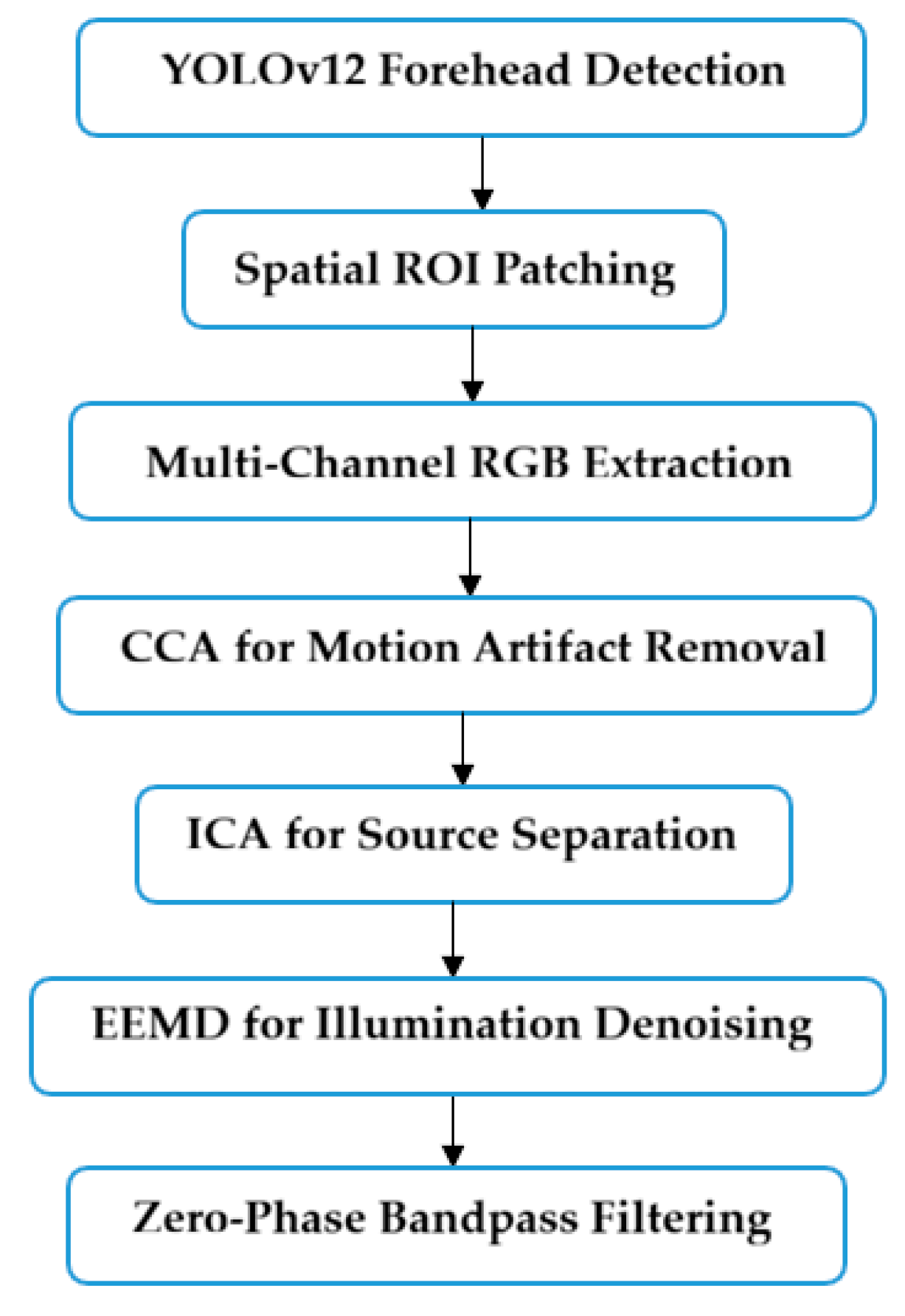
Figure 2.
The visualization of the physiological signals at each stage of the processing.
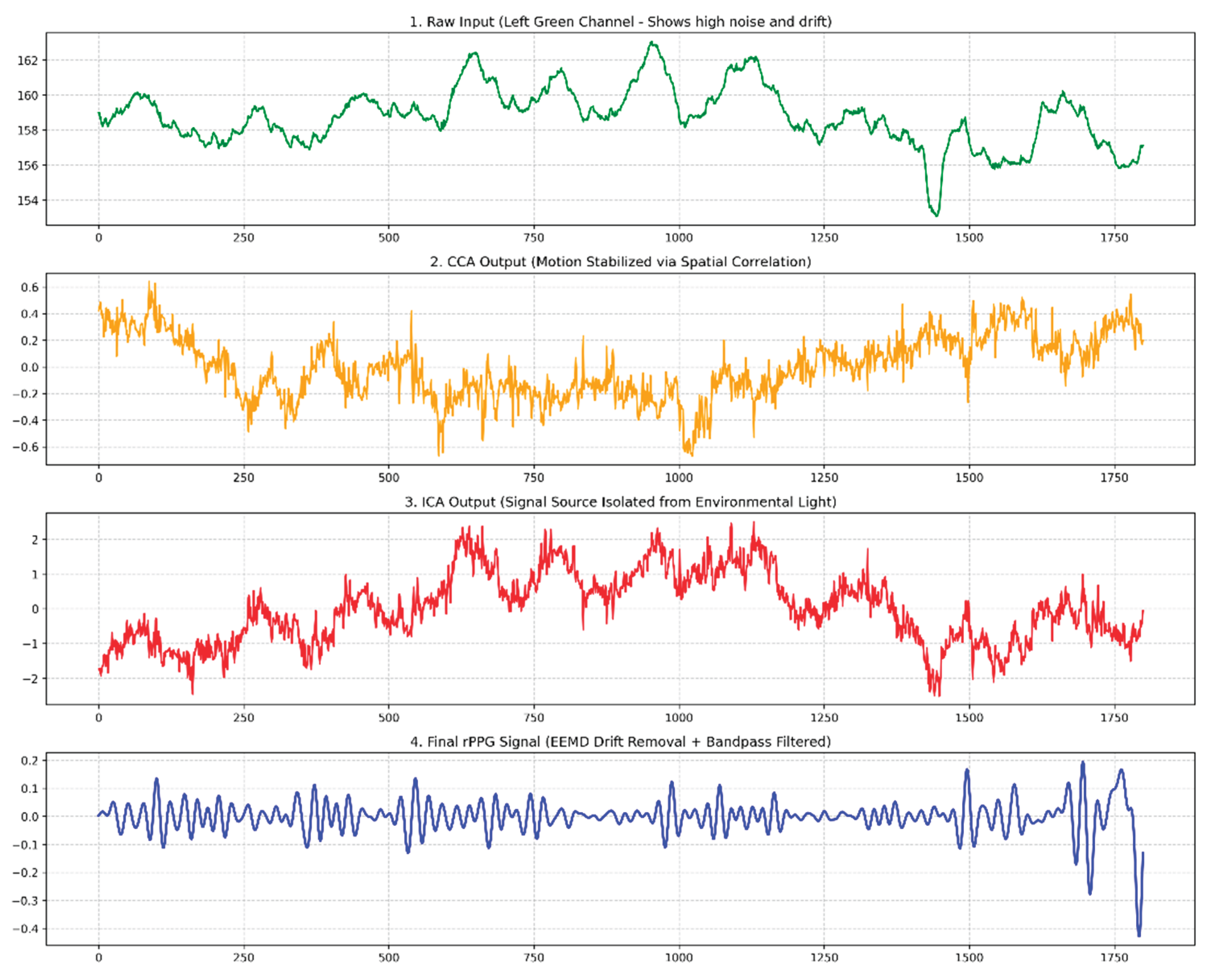

Table 1.
Specification Table.
| Task | Description |
|---|---|
| Acronym | CLBP-300. |
| Beneficiaries | Digital Health Researchers, AI & Computer Vision Developers and Computer Science Researchers. |
| Specific subject area | Digital Health / Health Informatics and AI in Medicine. |
| Total participants | 300 (244 Males, 56 Females) |
| Duration | 30-60 seconds per video. |
| Type of data | Videos and excel sheet providing ground-truth measurements for SYSBP, DIABP, and HR for each recorded video with ambient light intensity recorded in Lux and demographic attributes for each participant (i.e. age and gender). |
| How data were acquired | Videos were captured with an iPhone 16 pro max camera and Nikon D5300 captured at 60 fps. |
| Data format | MOV format. |
| Experimental Setup | Participants were seated at a distance of 0.5 to 1 meters from the cameras. |
| Data accessibility | A sample dataset containing video recordings for three participant is publicly available on Google site at (https://sites.google.com/view/clbp-300?usp=sharing). |
Disclaimer/Publisher’s Note: The statements, opinions and data contained in all publications are solely those of the individual author(s) and contributor(s) and not of MDPI and/or the editor(s). MDPI and/or the editor(s) disclaim responsibility for any injury to people or property resulting from any ideas, methods, instructions or products referred to in the content. |
© 2026 by the authors. Licensee MDPI, Basel, Switzerland. This article is an open access article distributed under the terms and conditions of the Creative Commons Attribution (CC BY) license (http://creativecommons.org/licenses/by/4.0/).
Copyright: This open access article is published under a Creative Commons CC BY 4.0 license, which permit the free download, distribution, and reuse, provided that the author and preprint are cited in any reuse.


