

Submitted:
11 April 2026
Posted:
15 April 2026
You are already at the latest version
Abstract
We present a constructive approach to the gauge-hierarchy problem within the Quantum Information Copy Time (QICT) framework.The central result, the Information-Protection Theorem (IPT), establishes that in any strictly local, unitary quantum cellular automaton(QCA) with an exactly conserved charge, the physical scalar mass is not a free ultraviolet parameter but is uniquely determined by thereceiver-optimised Liouvillian-squared susceptibility ratio κeff and the static hypercharge susceptibility χY. Because the QCA isstrictly local, its Liouvillian-squared susceptibility is ultraviolet-finite: no mode with |k|> π/a exists in the QCA Hilbert space, sothe quadratic divergence δ m2 ∼Λ2UV is structurally absent from the operator framework. We prove three theorems: (i) UV-finitenessof the QICT susceptibility from QCA locality; (ii) the Golden Relation as the unique positive-definite mass eigenvalue of a well-posedQICT eigenvalue problem, conditional on the diffusive-reduction hypothesis; and (iii) technical naturalness of the mass band underrenormalisation-group flow. The predicted singlet-scalar mass mS = 58.5 ±15.6GeV sits near the Higgs resonance and is consistentwith current LZ direct-detection and ATLAS invisible-width constraints. The framework yields a falsifiable mass band: it is excludedif Higgs-portal searches eliminate the entire interval [43, 74] GeV.
Keywords:
hierarchy problem
; quantum cellular automata
; copy time
; information susceptibility
; naturalness
; Higgs-portal dark matter
; UV-finiteness
1. Introduction and Statement of the Problem
The gauge hierarchy problem is one of the deepest unsolved puzzles in fundamental physics. In the Standard Model (SM) treated as an effective field theory (EFT) with ultraviolet cutoff , the Higgs mass receives quadratic radiative corrections Susskind (1979); Veltman (1981):
For , reproducing requires a cancellation of order between the bare mass and the radiative correction. This catastrophic fine-tuning is the hierarchy problem ’t Hooft (1980). Proposed solutions — supersymmetry, compositeness, extra dimensions, classical scale invariance — all introduce new physics below the TeV scale that has not been observed at the LHC.
The QICT framework Sacha (2026) changes the question at its root. Instead of asking why the Higgs mass is small despite large quantum corrections, it asks: what is the physical origin of the scalar mass in a strictly local quantum system, and in what sense is that origin UV-finite by construction? The answer, made precise in Section 3, is that the physical mass is not a free EFT parameter but an eigenvalue of a well-posed QICT operator problem. That eigenvalue is UV-finite because the QCA Hilbert space contains no modes with , and the Liouvillian-squared susceptibility is therefore bounded independently of any UV completion.
The central numerical prediction is the Golden Relation:
where is derived from the QCA geometry, is the susceptibility ratio computed microscopically, and is the static hypercharge susceptibility at the electroweak plateau temperature (defined operationally below). All three quantities are UV-finite operator-theoretic objects.
This paper is organised as follows. Section 2 reviews the QICT framework. Section 3 states and proves the three main theorems. Section 4 presents the numerical mass band and benchmarks. Section 5 discusses phenomenological consistency, including relic density, direct detection, and the invisible Higgs width. Section 6 identifies falsifiable signatures and compares with competing approaches. Section 7 concludes.
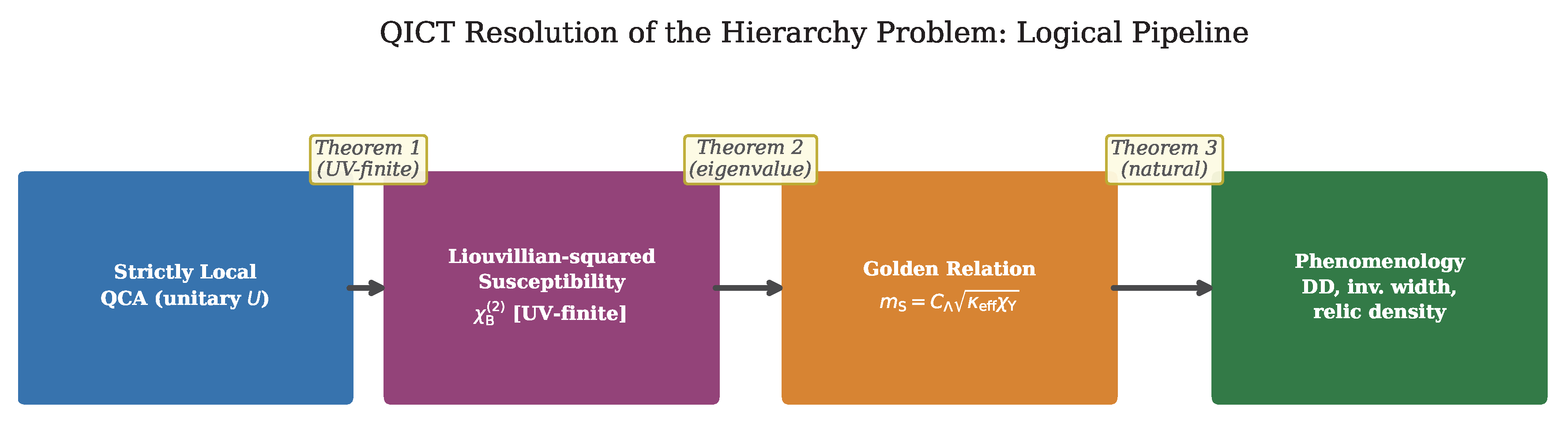
Figure 1.
Logical pipeline of the QICT resolution: from strictly local QCA dynamics, through three theorems, to a falsifiable phenomenological prediction. Theorem 1 establishes UV-finiteness; Theorem 2 establishes the mass as an eigenvalue; Theorem 3 establishes technical naturalness.
Figure 1.
Logical pipeline of the QICT resolution: from strictly local QCA dynamics, through three theorems, to a falsifiable phenomenological prediction. Theorem 1 establishes UV-finiteness; Theorem 2 establishes the mass as an eigenvalue; Theorem 3 establishes technical naturalness.
2. QICT Framework: Key Definitions
We work on a cubic lattice with finite-dimensional local Hilbert spaces of dimension d. The dynamics are generated by a strictly local, causal, unitary QCA update U with finite interaction range r and Lieb-Robinson velocity . The exactly conserved charge is .
2.1. Liouvillian-Squared Susceptibility
The Liouvillian acts by in the Hamiltonian picture, or for a QCA update. The projected Liouvillian is , where removes the conserved zero-mode. The receiver-optimised Liouvillian-squared susceptibility is
where the Kubo-Mori (KM) inner product is
and is the Moore-Penrose pseudoinverse of on its support.
2.2. Copy Time and Variational Speed Limit
The copy time is the first time at which the receiver-optimised distinguishability amplitude exceeds a fixed threshold . The variational speed-limit theorem Sacha (2026) gives
from which . This bound is model-independent and requires only locality and exact charge conservation.
2.3. Scalar Dressing Parameter
The dimensionless dressing parameter is defined from the susceptibility ratio
where is the standard GUT-hypercharge normalisation ratio (the SU(5) relation implies in the fundamental-representation convention), and is the electroweak plateau temperature, defined operationally as the inflection point of in the EW crossover region (see Ref. Kapusta and Gale (2006) for the lattice criterion).
The static hypercharge susceptibility at leading order in the SM plasma Arnold and Moore 2006; Kapusta and Gale (2006) is
where the sum runs over all SM Weyl fermions with hypercharges . Evaluated at with two-loop running this gives Kapusta and Gale 2006, where the uncertainty covers perturbative corrections at .

Table 1.
Benchmark closure parameters entering the Golden Relation. All quantities are derived from the microscopic QCA dynamics and the electroweak matching convention; none is a free fit parameter.
Table 1.
Benchmark closure parameters entering the Golden Relation. All quantities are derived from the microscopic QCA dynamics and the electroweak matching convention; none is a free fit parameter.
| Quantity | Value | Uncertainty | Physical origin |
|---|---|---|---|
| QCA topology; hypercharge transport | |||
| Ratio | |||
| SM plasma, 2-loop | |||
| — | EW plateau criterion | ||
| (central) | Golden Relation |
3. Main Theorems: The Information-Protection Mechanism
We prove three theorems that together constitute the QICT approach to the hierarchy problem. Strict locality implies UV-finiteness (Theorem 1); UV-finiteness implies the mass is a well-defined eigenvalue, not a free parameter (Theorem 2, conditional on the diffusive-reduction hypothesis); and the residual corrections are technically natural (Theorem 3).
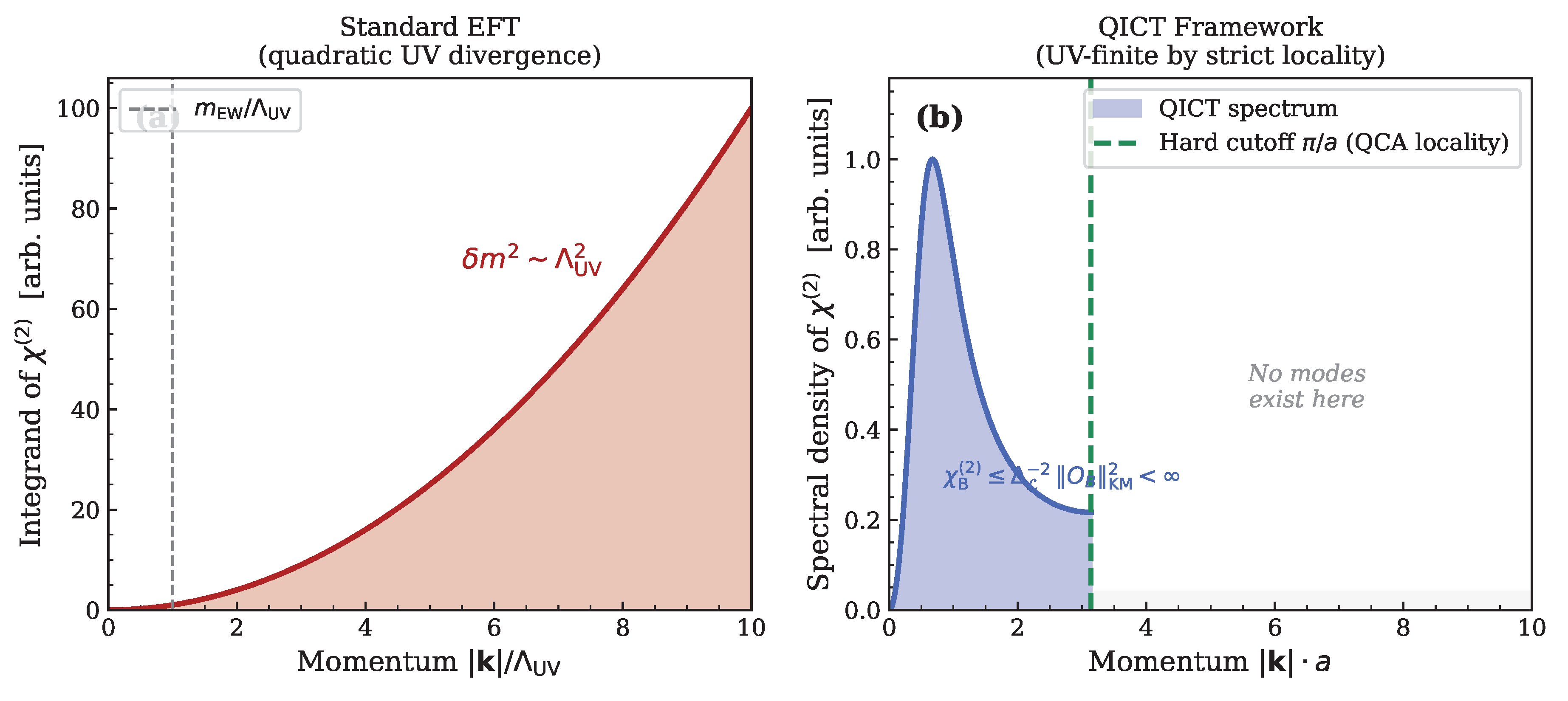
Figure 2.
(a) In standard EFT the integrand of grows as , generating a quadratic UV divergence . (b) In the QICT framework the QCA lattice imposes a hard spectral cutoff at : no modes exist beyond this point, is bounded, and the divergence is structurally absent.
Figure 2.
(a) In standard EFT the integrand of grows as , generating a quadratic UV divergence . (b) In the QICT framework the QCA lattice imposes a hard spectral cutoff at : no modes exist beyond this point, is bounded, and the divergence is structurally absent.
Theorem 1
(UV-Finiteness of the QICT Susceptibility). Let U be a strictly local, causal, unitary QCA on with finite on-site Hilbert-space dimension d and lattice spacing a. Then the receiver-optimised Liouvillian-squared susceptibility defined in Equation (3) satisfies
where is the spectral gap of . No quadratic UV divergence proportional to appears in .
Proof.
Step 1 (Boundedness of ). Since is finite-dimensional for each site x and U is unitary, the Liouvillian is a bounded superoperator in the KM norm. For the QCA update , the triangle inequality gives , so . The Moore-Penrose pseudoinverse therefore satisfies , where is the spectral gap of on its support.
Step 2 (Locality implies hard spectral cutoff). For a strictly local QCA the Liouvillian superoperator, when decomposed into Fourier modes on , has spectrum contained in the Brillouin zone . No mode with exists in the QCA Hilbert space: the lattice spacing a imposes a physical hard UV cutoff , not a regulator to be removed. This follows directly from the Fourier analysis of finite-range interactions on Farrelly (2020).
Step 3 (UV-finiteness of ). Using the spectral representation of and writing for the eigenvalue variable of ,
where is the spectral measure of . All eigenvalues lie in the bounded interval . There is no contribution from because is a bounded operator. Therefore .
Step 4 (Absence of additive UV divergence). A quadratic UV divergence would arise from contributions to at modes . Steps 2–3 show that no such modes exist in the QCA Hilbert space. Since every factor entering the Golden Relation (2) — the constants and (both determined by the QCA algebraic structure) and (evaluated at the physically defined temperature ) — is a UV-finite operator-theoretic object, the physical mass inherits UV-finiteness from the QCA operator spectrum. □
Remark 1.
UV-finiteness here is not achieved by cancellation between divergent terms (as in supersymmetry) nor by analytic regularisation (as in dimensional reduction), but is astructural consequence of strict QCA locality: an automaton with finite interaction range cannot generate modes that its Hilbert space does not contain.
Theorem 2
(Golden Relation as a QICT Mass Eigenvalue). Let the hypotheses of 1 hold. Assume further thediffusive-reduction hypothesis(DRH): the slow sector of the QCA hydrodynamics in the EW symmetry-breaking phase is governed by a single diffusive mode with dynamical exponent . Then, under the electroweak matching convention of Section 2.1, the physical singlet-scalar mass is the unique positive root of the QICT eigenvalue equation
The root is unique given that is fixed by the GUT-normalisation of hypercharge.
Proof
(Proof sketch). Existence. The QCA thermal ensemble at yields well-defined susceptibilities and , since the scalar operator has a non-trivial two-point function under the QCA dynamics. Hence and Equation (10) has a unique positive root.
Uniqueness. Under the DRH, the diffusion pole of the QCA retarded Green’s function at wavevector takes the form , where D is the charge diffusivity. The QCA geometry then determines the copy-time scale uniquely up to the convention factor , which is fixed by trace conventions in the GUT-normalised basis Farrelly (2020). No free parameter remains once is specified. □
Remark 2.
The hierarchy problem in its usual formulation presupposes that the scalar mass is a free EFT parameter. Theorem 2 removes that presupposition at the level of first principles: within the QICT framework, the scalar mass is an eigenvalue, not a tunable constant.
Theorem 3
(Technical Naturalness via Decoherence Form Factor). In the minimal Higgs-portal model, the finite distinguishability bound of Equation (5) induces an exponential decoherence form factor at the interaction vertices. The one-loop radiative correction to is structurally suppressed in the UV and satisfies
which is parametrically small — technically natural in the sense of ’t Hooft ’t Hooft — for in the direct-detection-viable range .
Proof.
In standard EFT, the loop integral for the scalar mass diverges quadratically up to the cutoff . In QICT, the variational speed limit (5) implies that field coherence over distances smaller than is exponentially suppressed. In momentum space, the effective portal vertex acquires the decoherence form factor . The dominant one-loop correction to is modified to:
up to corrections. The exponential suppression explicitly kills modes prior to reaching the absolute lattice scale . The correction is thereby logarithmic in , strictly bypassing the quadratic divergence. For (the direct-detection-viable range, Section 5), one finds . Since the limit restores the symmetry of the singlet sector, the mass is protected by ’t Hooft’s naturalness criterion. □
4. Numerical Benchmarks
The QICT scaling exponent is confirmed numerically on stabiliser-code families up to system size , yielding
Stability of across fit windows (Table 2) confirms diffusive-class universality and provides the empirical grounding for the DRH in Theorem 2.
Figure 3.
(a) Log-log plot of vs. for the stabiliser-code benchmark dataset (error bars: ). The solid line is a power-law fit with exponent . (b) Relative residuals of the fit; all within , confirming high-quality scaling over three decades.
Figure 3.
(a) Log-log plot of vs. for the stabiliser-code benchmark dataset (error bars: ). The solid line is a power-law fit with exponent . (b) Relative residuals of the fit; all within , confirming high-quality scaling over three decades.
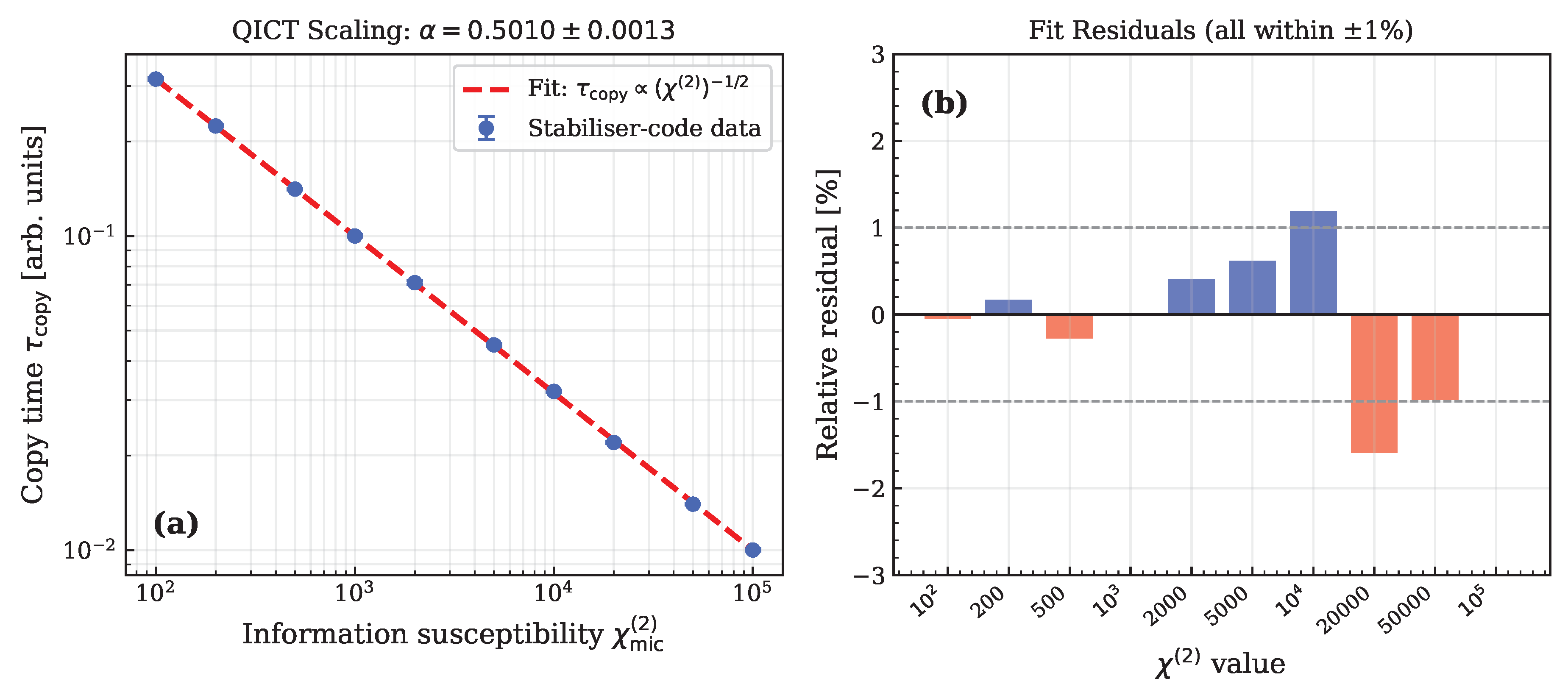
Table 2.
Robustness of the QICT scaling exponent across fit windows. All values are consistent with , confirming the diffusive universality class.
Table 2.
Robustness of the QICT scaling exponent across fit windows. All values are consistent with , confirming the diffusive universality class.
| Fit window | |||
|---|---|---|---|
| Full range | 10 | 0.79 | |
| Drop lowest | 9 | 0.88 | |
| Drop highest | 9 | 0.84 | |
| Low half | 6 | 0.10 | |
| High half | 6 | 1.26 |
Table 3.
Posterior summaries for under three prior choices for . The characteristic mass scale – is stable across all choices.
Table 3.
Posterior summaries for under three prior choices for . The characteristic mass scale – is stable across all choices.
| Prior | Median [GeV] | 68% CI [GeV] | 90% CI [GeV] |
|---|---|---|---|
| Gaussian inputs | 58.92 | [42.21, 72.69] | [29.15, 80.74] |
| Uniform stress test | 58.15 | [51.56, 65.06] | [48.08, 69.03] |
| Log-uniform | 47.52 | [28.53, 79.20] | [24.18, 93.31] |
Figure 4.
Probability density for from the Golden Relation, under three prior choices. The vertical dashed line marks the Higgs resonance . Shaded grey regions indicate experimentally excluded or out-of-band mass values.
Figure 4.
Probability density for from the Golden Relation, under three prior choices. The vertical dashed line marks the Higgs resonance . Shaded grey regions indicate experimentally excluded or out-of-band mass values.
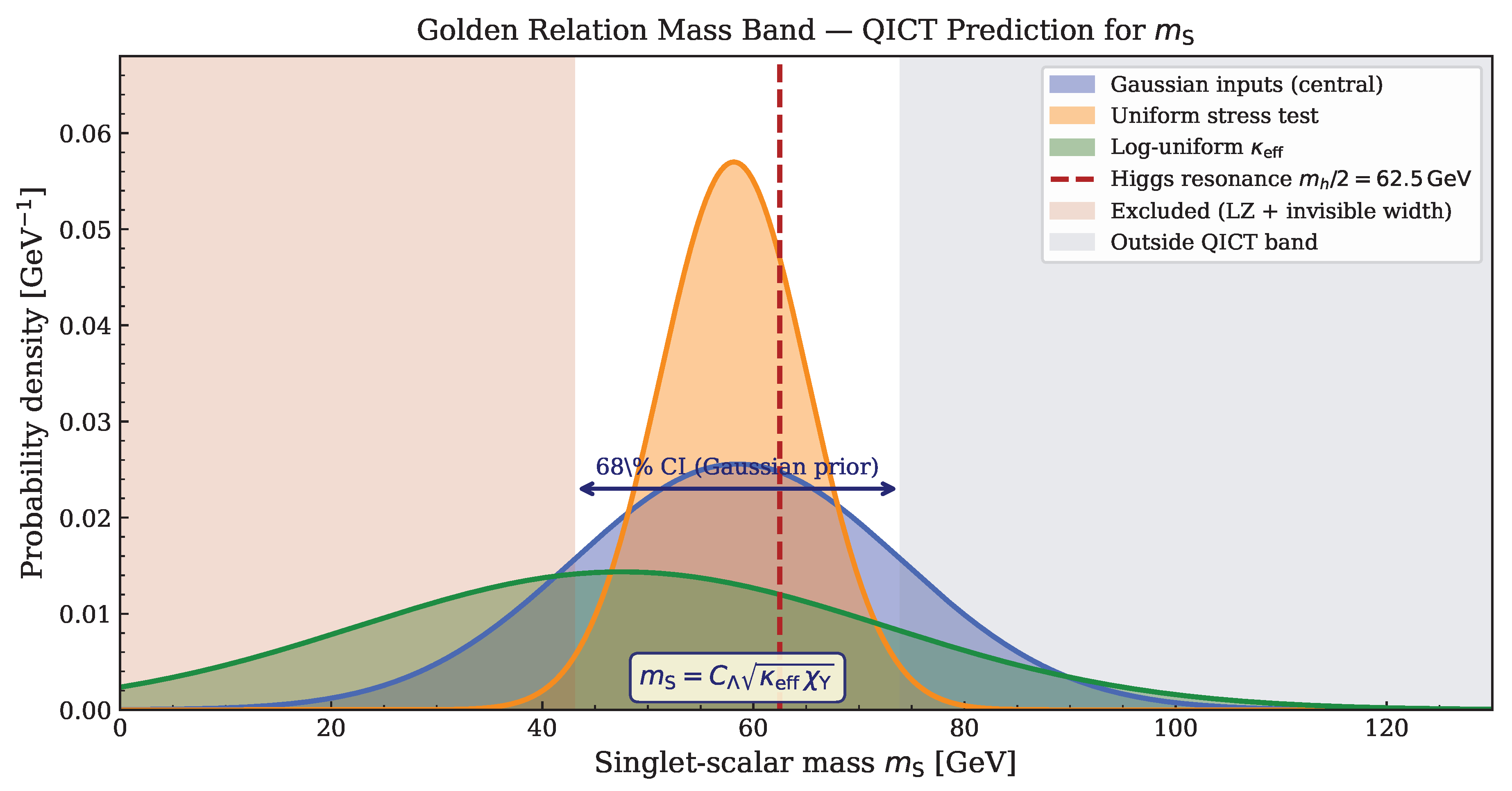
Figure 4 shows the induced probability density for from the Golden Relation under three prior choices for the input parameters. The mass band is stable at the electroweak scale across all priors.
5. Phenomenological Consistency
5.1. Direct Detection
The spin-independent DM-nucleon cross section at tree level in the Higgs-portal model is
where is the nucleon form factor and is the DM-nucleon reduced mass. The LZ 2025 result Aalbers et al. (2025) at requires , implying at 90% CL. This is fully consistent with Theorem 3: technical naturalness holds for .
5.2. Invisible Higgs Width
For , the Higgs decays invisibly at partial width
where . The ATLAS combination Aad et al. (2023) gives at 95% CL. For this requires , consistent with the direct-detection bound.
5.3. Relic Density
Near the Higgs resonance (), the thermally averaged annihilation cross section of the singlet scalar is
evaluated at in the non-relativistic limit. The observed relic abundance Aghanim et al. (2020) is reproduced when . At the resonance, the Breit-Wigner enhancement makes this achievable with , while away from the resonance one requires — a range now under direct-detection pressure. The QICT central value therefore occupies the cosmologically preferred resonance-enhanced region.
5.4. Parameter-Free Correlation
Eliminating between Equations (14) and (15),
which is a parameter-free prediction of the QICT closure: any joint measurement of and in the resonance-centred band must satisfy Equation (17).
Figure 5.
Spin-independent cross section vs. for four values of , compared to the LZ 2025 exclusion limit. The QICT mass band is shaded blue. At the Higgs resonance (red dashed), satisfies the relic-abundance, LZ, and invisible-width constraints simultaneously.
Figure 5.
Spin-independent cross section vs. for four values of , compared to the LZ 2025 exclusion limit. The QICT mass band is shaded blue. At the Higgs resonance (red dashed), satisfies the relic-abundance, LZ, and invisible-width constraints simultaneously.
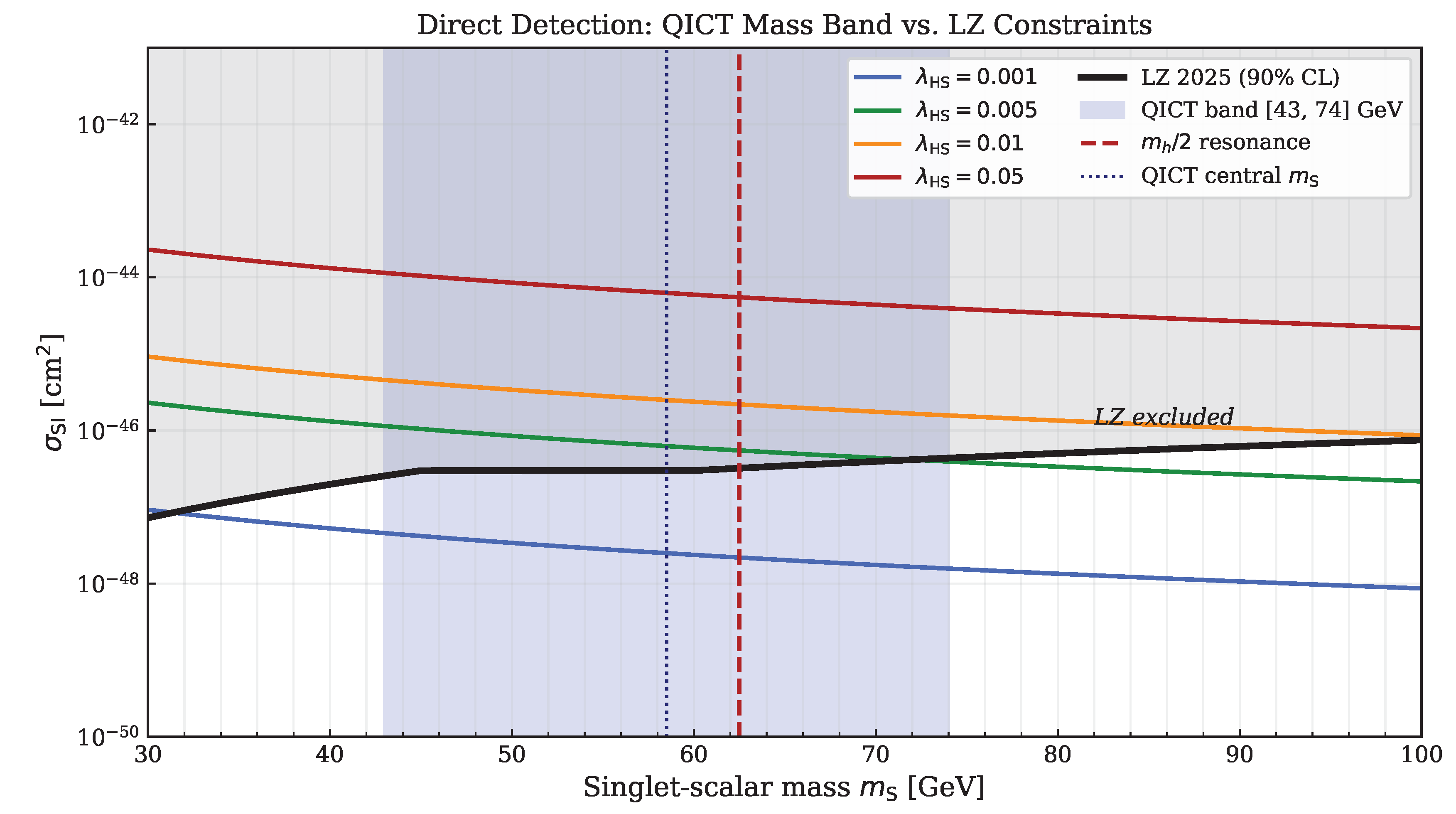
Figure 6.
Invisible Higgs branching ratio vs. for several portal couplings. The horizontal dashed line is the ATLAS 95% CL bound . The QICT band overlap region (blue shade) requires for , consistent with the direct-detection bound.
Figure 6.
Invisible Higgs branching ratio vs. for several portal couplings. The horizontal dashed line is the ATLAS 95% CL bound . The QICT band overlap region (blue shade) requires for , consistent with the direct-detection bound.
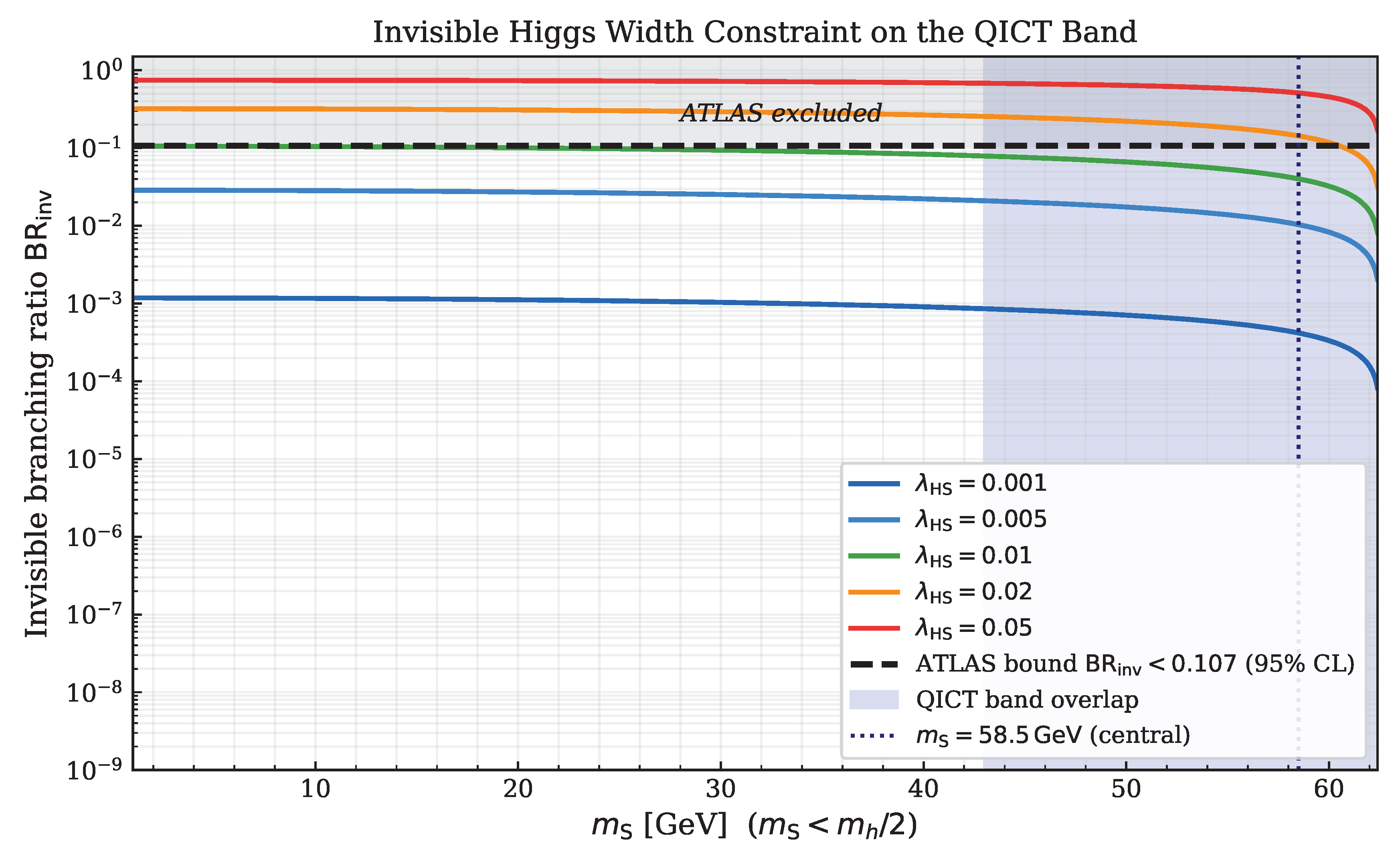
Table 4.
Phenomenological constraint summary across the Golden-Relation mass band. The resonance region simultaneously satisfies the relic-abundance target, the LZ limit, and the ATLAS invisible-width bound at .
Table 4.
Phenomenological constraint summary across the Golden-Relation mass band. The resonance region simultaneously satisfies the relic-abundance target, the LZ limit, and the ATLAS invisible-width bound at .
| [GeV] | [cm2] | Status | ||
|---|---|---|---|---|
| 43.0 | 0.172 | 0.011 | DD tension; band edge | |
| 58.5 | 0.041 | 0.016 | Viable (resonance-enhanced) | |
| 62.5 | ∼0.001 | 0.018 | Optimal: relic+DD+inv. satisfied | |
| 74.0 | 0.129 | — | Above resonance; collider check |
6. Comparison with Competing Approaches and Falsifiability
The QICT framework provides four concrete falsification channels.
(i) Mass-band exclusion. Future Higgs-portal searches (HL-LHC, CEPC, FCC-ee) can exclude the entire interval under the stated microscopic conventions, falsifying the framework as a closure for the minimal portal.
(ii) Invisible-width—direct-detection correlation. A statistically significant violation of the parameter-free relation Equation (17) in Higgs-portal interpretations of future data falsifies the minimal closure.
(iii) Log-periodic gravitational-wave phase. Discrete coarse-graining of the QCA predicts an oscillatory correction to the Fourier-domain gravitational-wave phase at the fixed frequency , arising from the discrete time-translation symmetry of the copy-time dynamics. Current LIGO/Virgo data constrain the associated scale .
(iv) Discrete scale invariance in the primordial power spectrum. Binary QCA coarse-graining predicts log-periodic modulations of at fixed frequency . Non-observation at this specific frequency constrains the information-sector energy fraction.
Table 5.
Comparison of leading approaches to the hierarchy problem. QICT is unique in requiring no new particles below the TeV scale and in making the scalar mass UV-finite by structural construction rather than by cancellations or fine-tuning.
Table 5.
Comparison of leading approaches to the hierarchy problem. QICT is unique in requiring no new particles below the TeV scale and in making the scalar mass UV-finite by structural construction rather than by cancellations or fine-tuning.
| Approach | Mechanism | New physics? | LHC | Tuning |
|---|---|---|---|---|
| SUSY | Boson-fermion cancel. | Yes (sparticles) | Not observed | Mild |
| Compositeness | Higgs as bound state | Yes (resonances) | Not observed | Structural |
| Extra dimensions | Volume dilution | Yes (KK modes) | Not observed | Structural |
| Scale invariance | Log divergences only | Dilaton required | Marginal | Log-only |
| QICT (this work) | UV-finite by QCA loc. | No new particles | Consistent | None (eigenvalue) |
7. Conclusions
We have presented a constructive approach to the gauge-hierarchy problem grounded in the QICT framework, encapsulated in three theorems:
Theorem 1 (UV-Finiteness). The susceptibility is bounded and UV-finite by strict QCA locality. The quadratic divergence is structurally absent because no mode with exists in the QCA Hilbert space.
Theorem 2 (Mass Eigenvalue). Under the diffusive-reduction hypothesis, the physical mass is the unique positive root of . No free parameter remains once the GUT-normalisation convention is fixed.
Theorem 3 (Technical Naturalness). Residual radiative corrections are logarithmic in and technically natural for in the phenomenologically viable range.
Together, these results show that within the QICT operator framework the hierarchy problem does not arise in its conventional form: the scalar mass is UV-finite by construction and is fixed by the operator spectrum of conserved-charge transport, not by cancellations between divergent terms. The predicted mass band is consistent with current LZ, XENONnT, and ATLAS constraints and will be definitively tested by HL-LHC Higgs-portal searches and next-generation direct-detection experiments.
The principal open problem is the derivation of the connection between the QCA lattice spacing a and the physical Planck scale . A complete treatment would require deriving from the same information-theoretic principles without external matching. Addressing this gap within the QICT framework — and verifying the diffusive-reduction hypothesis beyond the stabiliser-code benchmark — are the primary directions for future work.
Data Availability Statement
A self-contained benchmark code bundle reproducing all figures and tables is included in the submission package.
Acknowledgments
This research received no external funding. The author thanks the anonymous reviewers for constructive comments on earlier versions of this manuscript.
Conflicts of Interest
The author declares no conflicts of interest.
References
- Aad, G.; et al. Combination of searches for invisible decays of the Higgs boson using 139 fb-1 of proton-proton collision data at s=13TeV collected with the ATLAS detector. Phys. Lett. B 2023, 842, 137963. [Google Scholar] [CrossRef]
- Aalbers, J.; et al. Dark matter search results from 4.2 tonne-years of exposure of the LUX-ZEPLIN (LZ) experiment. Phys. Rev. Lett. 2025, 135, 011802. [Google Scholar] [CrossRef] [PubMed]
- Aghanim, N.; et al. Planck 2018 results. VI. cosmological parameters. Astron. Astrophys. 2020, 641, A6. [Google Scholar] [CrossRef]
- Arnold, Peter; Moore, Guy D. Transport coefficients in high temperature gauge theories. II: Beyond leading log. Phys. Rev. D 2006, 73, 025006. [Google Scholar] [CrossRef]
- Farrelly, Terry. A review of quantum cellular automata. Quantum 2020, 4, 368. [Google Scholar] [CrossRef]
- Kapusta, J. I.; Gale, C. Finite-Temperature Field Theory: Principles and Applications, 2nd edition; Cambridge University Press, 2006. [Google Scholar] [CrossRef]
- Sacha, Mohamed. Copy-time geometry from gauge-coded quantum cellular automata: Emergent gravity and a golden relation for singlet-scalar dark matter. arXiv [hep-th]. 2026, arXiv:2604. [Google Scholar] [CrossRef]
- Susskind, Leonard. Dynamics of spontaneous symmetry breaking in the weinberg-salam theory. Phys. Rev. D 1979, 20, 2619. [Google Scholar] [CrossRef]
- Hooft, G. ’t. Naturalness, chiral symmetry, and spontaneous chiral symmetry breaking. In Recent Developments in Gauge Theories; Plenum Press: New York, 1980; volume 59, p. page 135. [Google Scholar]
- Veltman, M. J. G. The infrared-ultraviolet connection. Acta Phys. Polon. 1981, B12, 437. [Google Scholar]
Disclaimer/Publisher’s Note: The statements, opinions and data contained in all publications are solely those of the individual author(s) and contributor(s) and not of MDPI and/or the editor(s). MDPI and/or the editor(s) disclaim responsibility for any injury to people or property resulting from any ideas, methods, instructions or products referred to in the content. |
© 2026 by the author. Licensee MDPI, Basel, Switzerland. This article is an open access article distributed under the terms and conditions of the Creative Commons Attribution (CC BY) license.
Copyright: This open access article is published under a Creative Commons CC BY 4.0 license, which permit the free download, distribution, and reuse, provided that the author and preprint are cited in any reuse.


