
Submitted:
14 April 2026
Posted:
15 April 2026
You are already at the latest version
Abstract
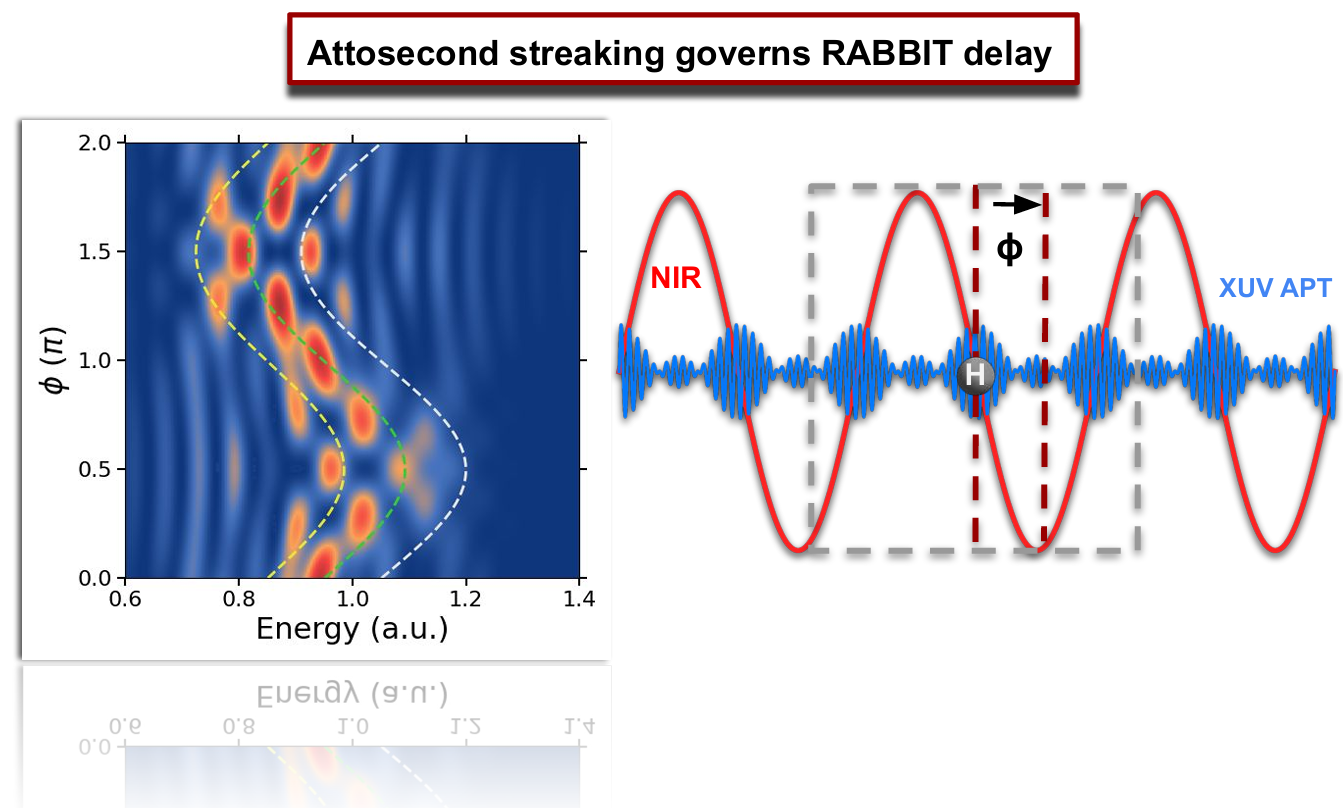
We present a theoretical study focused on the photoelectron spectrum of near-infrared (NIR) laser-driven ionization of hydrogen atoms by attosecond pulse trains composed of several high-order harmonics of the former. We analyze the effects of increasing the intensity of the NIR probe laser to account for the interference of multiple quantum pathways arising from mainbands formed in ionization by the attosecond pulse train within the strong-field approximation (SFA) beyond the commonly used first-order perturbative (in the NIR laser intensity) reconstruction of attosecond beating by interference of two-photon transitions (RABBIT). The structure of the energy bands formed in the photoelectron spectrum is governed by quantum interferences of the photoelectron wave packet released within one optical cycle of the NIR probe laser field –intracycle interference– and by the number of active high harmonic components, leading to higher-order Fourier contributions as a function of the NIR–XUV relative phase delay. Our results demonstrate a significant departure from the standard two-path quantum-interference RABBIT picture, showing that both the phase-dependent oscillations of mainbands and sidebands and the extracted phase delays depend strongly on the probing laser intensity. The predictions of the SFA reveal that the above-threshold ionization bands exhibit systematic splitting and oscillation patterns as a function of the NIR intensity. SFA predictions are compared with results obtained within ab initio solutions of the time-dependent Schrödinger equation (TDSE), showing an excellent agreement, which evidences that the negligible effect of the Coulomb potential of the remaining ion on the escaping photoelectron for high energy above-threshold ionization. These findings provide new insights into attosecond chronoscopy in the strong-field regime.
Keywords:
atomic photoionization
; RABBIT
; non-perturbative theory
; attosecond chronoscopy
; phase delays
; attosecond pulse train
Copyright: This open access article is published under a Creative Commons CC BY 4.0 license, which permit the free download, distribution, and reuse, provided that the author and preprint are cited in any reuse.


