

Submitted:
13 April 2026
Posted:
15 April 2026
You are already at the latest version
Abstract
The pervasive issue of lead contamination in water systems necessitates the development of advanced and sustainable remediation methodologies. Powdered activated carbon synthesized from Pinus roxburghii has been meticulously evaluated as a high-performance capture medium to remove sequestration of lead ions from aqueous systems through batch adsorption studies. These adsorption dynamics were optimized by Response Surface Methodology integrated with Central Composite Design, enabling precise calibration of crucial influential factors such as pH, contact time, and adsorbent dosage. Morphological analysis conducted using Scanning Electron Microscopy confirmed a highly porous structure, while Fourier Transform Infrared Spectroscopy identified functional groups, such as hydroxyl groups coupled with carbonyl groups, which exhibit strong metal affinity. Under optimal conditions, a pH of 8.2, a time of 140 minutes, and an adsorbent dosage of 0.03 g/L resulted in a maximum lead removal efficiency of 99.86%. Validation trials substantiated the reproducibility of the process, yielding a marginally diminished efficiency of 98.62±1.24%. The integration of RSM not only validated the statistical significance of the experimental outcomes but also reinforced the predictive accuracy. This study demonstrates the critical interplay of adsorption parameters and highlights the physicochemical properties of Pinus roxburghii-based activated carbon, emphasizing its potential for advanced water purification processes.
Keywords:
pine fruit
; powdered activated carbon
; lead (Pb)
; adsorption
; response surface methodology
1. Introduction
Lead, an inherent metallic element embedded within the Earth’s lithosphere, predominantly manifests as galena (lead sulfide). Lead is considered a valuable metal due to its versatility and applications in various domains, including construction, batteries, and shielding from radiation [1]. Leads’ ductility, malleability, and corrosion resistance make it a suitable material for constructing water pipes. However, despite its practical advantages, lead is a dangerous neurotoxin that accumulates in soft tissues and bones, causing irreversible neurological disorders and severe haematological conditions in mammals. This toxic element infiltrates terrestrial, atmospheric, and aquatic ecosystems through various anthropogenic and industrial activities [2], including industrial effluents, mining and metallurgical activities, corroded plumbing systems, agricultural runoff, electronic waste mismanagement (E-Waste), geogenic sources, and remobilization from sediments. The alarming implications of lead contamination necessitate stringent regulatory controls, with the World Health Organization (WHO) setting a permissible limit of 0.01 mg/L (10 µg/L), while the Bureau of Indian Standards (BIS) enforces a maximum threshold of 0.05 mg/L (50 µg/L) to prevent its detrimental effects on human health and environmental balance. These pollutants significantly degrade water quality and pose a critical threat to public well-being. Due to its highly toxic nature, removing lead from drinking water is essential for achieving public safety and sustainability goals.
In this endeavour, various advanced remediation technologies are employed in liquid purification strategies, including ion exchange, coagulation, chemical precipitation, membrane filtration, ultrafiltration, electro dialysis, and reverse osmosis [3]. Nevertheless, the deployment of these advanced remediation techniques is fraught with several limitations, such as operational expenditures, chemical expenses, toxic sludge, equipment maintenance, and energy consumption.
However, the adsorption process has become the most popular physicochemical strategy because it is highly effective at removing various pollutants [3]. Adsorption by activated carbon, in particular, applied in the remediation of heavy metals from aqueous solutions, is preponderantly favoured owing to its intricately structured pore framework, extensive adsorption interface, and chemically active functional groups on its surface, which enhance its adsorption efficacy [4]. Activated carbon obtained from natural or agricultural waste materials has gained significant attention due to its renewable nature, abundance, sustainability, and cost-efficiency, making it an eco-friendly and potent solution for environmental applications [5]. The adsorption process relies on multiple parameters, such as the physicochemical attributes of the adsorbent, solution pH, ion concentration, contact time, adsorbent dosage, and the presence of competing ions [6]. Numerous studies have documented the synthesis of activated carbon from diverse biomass sources like coconut shells, banana leaves, rice husks, palm shells, corncobs, almond shells, and used tea leaves [4].
This study investigates the use of Pinus roxburghii (pine cone), an abundant and renewable biomass resource, as an effective adsorbent for the removal of Pb2+ ions from contaminated water [4]. The adsorptive potential of pine cone-derived activated carbon is attributed to the presence of functional groups such as –OH, –C=O, –C–O, and –NH2, which exhibit strong metal-binding affinity [1,7]. Advanced characterization techniques, including Scanning Electron Microscopy (SEM) and Fourier Transform Infrared Spectroscopy (FTIR), were employed to elucidate the structural and functional properties of the adsorbent. Process optimization was performed using Response Surface Methodology (RSM) based on Central Composite Design (CCD) to evaluate the combined effects of pH, contact time, and adsorbent dosage on Pb2+ uptake [8]. The objective of this work was to establish the optimal operational conditions for maximum Pb2+ removal efficiency using pine cone-derived activated carbon.
2. Materials and Methods
2.1. Chemicals and Reagents
Lead nitrate, Pb(NO3)2, of analytical grade, was used to prepare the lead ion stock solution. An accurately weighed quantity of 1.599 g of lead nitrate was dissolved in a small volume of distilled water with continuous stirring to ensure complete dissolution. This solution was then quantitatively transferred to a 1000 mL volumetric flask and diluted up to the mark with distilled water to obtain a stock solution containing 1000 mg/L of lead ions. The preparation was carried out with precision to ensure consistency and reproducibility in further experimental procedures. A working solution of 20 mg/L was prepared by performing an appropriate serial dilution of the stock using distilled water. To achieve precise adjustment of the solution pH, hydrochloric acid (HCl, 37%; Merck Chemicals, India) and sodium hydroxide (NaOH) were systematically applied in controlled proportions to finely regulate the acidity and alkalinity. Furthermore, ethanol (98% purity; RK Scientific, India) was used for the exhaustive purification of activated carbon prior to the desiccation phase, and deionized water was used to preclude contamination.
2.2. Synthesis of Pinus Roxburghii Cone-Derived Activated Carbon (PRCAC)
The study utilized Pinus Roxburghii as the primary adsorbent due to its abundant natural availability. Pine cones were initially washed with deionized water to remove surface contaminants, then dried at 105 °C for 24 hours. The dried material was subsequently sealed for preservation and carbonized in a muffle furnace at 650 °C for 60 minutes. After cooling to room temperature, the carbonized material was granulated into uniform particles (3-5 mm) and impregnated with 0.1 M NaOH in a 1:3 ratio to form a slurry. The slurry was dried at 105 °C until completely dehydrated. Following drying, the sample was activated in a muffle furnace at 800 °C for 1 hour. The NaOH-impregnated carbon was washed thoroughly with dilute acid (0.1 M HCl) and deionized water to remove residual NaOH, repeated 30-35 times until reaching a neutral pH (7-8). Finally, the carbon was subjected to extended thermal treatment at 105 °C for 6 hours to ensure complete drying. The fully dried pine cone material was crushed, and particles retained through a 75 µm sieve were included in subsequent adsorption studies. The overall synthesis scheme is presented in Figure 1.
2.3. Characterization of PRCAC Adsorbent
The surface morphology of the pine cone-derived adsorbent, both before and after the adsorption process, was analyzed using a Scanning Electron Microscope (SEM, Quant FEG 450) to examine structural changes. To identify surface functional groups, Fourier Transform Infrared Spectroscopy (FTIR, Shimadzu IRAffinity-1S) was employed, operating in transmission mode over a wavenumber range of 4000–400 cm−1. For FTIR analysis, samples were prepared by compressing the adsorbent with potassium bromide (KBr) into pellets under standard conditions to ensure accurate spectral readings.
The point of zero charge (pHzc), defined as the pH at which the adsorbent surface has a net zero charge due to a balance between positive and negative surface charges, was determined through a batch equilibrium technique [9]. In this procedure, 0.15 g of the adsorbent was added to 15 mL of sodium chloride (NaCl) solution. The initial pH of the solutions was adjusted across a range of 2 to 10 using either HCl or NaOH, with pH measurements taken using a calibrated pH meter. The prepared samples were then agitated in an orbital shaker at 200 rpm for 24 hours. After the shaking period, the final pH values were recorded. The pHzc was determined by plotting the final pH values against the initial pH values and identifying the point at which the curve intersected the line where final pH equals initial pH, indicating electrostatic equilibrium [10].
2.4. Experimental Methodology
Batch adsorption experiments were conducted to investigate the impact of various experimental parameters on Pb removal efficiency. In each run, 100 mL of Pb solution with a predetermined concentration and pH was placed in a beaker, and the required dose of adsorbent was added according to the RSM-designed experimental conditions. The mixture was then agitated on a tabletop orbital shaker for the time specified in the RSM design, maintaining room temperature throughout. After agitation, the suspension was centrifuged at 6000 rpm for 10 minutes to separate the supernatant. The residual Pb concentration in the supernatant was subsequently determined using a UV–Vis spectrophotometer.
2.5. Process Optimization Using RSM-Based Experimental Design
In this research, CCD was applied inside the methodological framework of RSM to optimize three independent variables: pH, contact time, and adsorbent dosage, which exert a substantial influence on the adsorption dynamics. The experimental design consisted of 20 runs, derived from the mathematical expression N = + 2k + C, where N signifies how many experimental runs, k denotes how many factors, and C represents how many central points. The CCD approach extended a conventional two-level factorial design with additional axial and central points to facilitate the development of second-order polynomial models. Each factor was evaluated across a handful of meticulously defined stages (-α, -1, 0, +1, +α) shown in Table 1, with ±α values ensuring that the extreme points remain within the experimental region, while ±1 coded levels are utilized to delineate the boundaries of the region where the optimal conditions are presumed to reside and the centre point (0) serving as the median between the extremities. This robust design enabled precise optimization of the system while maintaining the experimental feasibility within the defined operable range [11].
The RSM, rooted in the CCD, functions as a statistical approach to analyze and optimize the relationship between experimental factors with the response under predefined criteria. This analytical approach utilizes an advanced polynomial regression equation to decode experimental findings. The predicted response (removal efficiency, %) is represented as R. The equation (1) is expressed as follows;
Here, is the fixed parameter, is the linear parameter, represents the quadratic parameter, is the interaction parameter, and ε is the residual coefficient. The coded individual variables ( and ) represent adjusted experimental factors, such as pH, contact time, and adsorbent dosage, which are pivotal in determining the response. These variables facilitate a comprehensive evaluation of the factors’ individual and combined effects on the predicted outcome [12].
To carry out optimization within the framework of RSM, it is essential to identify the locations of the stationary points where the response surface neither increases nor decreases with respect to small changes in the input variables. This is achieved by determining the conditions under which the gradient of the response function becomes zero, as denoted in Equation (2). In this context, the gradient vector encompasses partial derivatives of the response with respect to each coded variable, and its nullification indicates a potential maximum, minimum, or saddle point on the surface.
To assess the nature of these points, second-order analysis is applied. This involves constructing the Hessian Matrix B, which captures how the function curves in multiple directions as per equation (4): In matrix notation, this condition is expressed as equation (3).
Here, β represents the vector of linear coefficients, and B denotes the matrix comprising second-order and interaction coefficients derived from the model’s polynomial equation. These mathematical expressions form the basis for exploring the multidimensional curvature of the response surface.
In this matrix, the diagonal elements represent the quadratic effects of each factor (e.g., pH, contact time, adsorbent dosage), while the off-diagonal elements signify the interactive effects between pairs of variables. Evaluating the eigenvalues of this matrix allows us to classify the stationary point: if all eigenvalues are positive, the point is a minimum; if all are negative, it is a maximum; and if they vary in sign, the point is a saddle point.
This mathematical process is crucial for RSM because it not only identifies the optimal experimental conditions but also ensures robustness in predictions by accounting for both the main effects and the interactions among variables. By applying this optimization strategy, one can confidently navigate the response surface to locate the best possible combination of experimental parameters that maximizes removal efficiency or any other target response [12].
3. Results and Discussion
3.1. Characterisation of PRCAC
Fourier Transform Infrared Spectroscopy (FTIR) was employed to identify the functional groups associated with pine cone-derived biochar. The spectrum was obtained using an IR-Affinity-1S spectrometer over the range of 4000–400 cm−1, as shown in Figure 2a, where the spectra of raw and NaOH-activated biochar are compared. Distinct absorption peaks correspond to characteristic vibrational modes of functional groups present on the adsorbent surface [13,14]. The broad absorptions in the range of 3620–3871 cm−1 are attributed to O–H stretching, indicating the presence of hydroxyl groups. A distinct peak at 2314 cm−1 corresponds to C≡C or C≡N stretching vibrations, which can form stable coordination complexes with Pb2+ ions. The strong peak observed at 1762 cm−1 is assigned to C=O stretching of carbonyl groups, particularly carboxyl (–COOH), which are known to bind Pb2+ through ligand exchange. Additional peaks at 1532 cm−1 (N–H bending) and 1084 cm−1 (C–O stretching) indicate the presence of amino (–NH2) and ether (–C–O–) functionalities, respectively, both of which contribute to heavy metal immobilization through complexation and electrostatic interactions. The signal at 672 cm−1 corresponds to out-of-plane deformation modes, reflecting specific structural configurations. Furthermore, the presence of aromatic rings in this region suggests possible π-electron interactions with Pb2+ ions. Overall, FTIR results confirm that the pine cone-derived biochar surface is enriched with diverse functional groups, which collectively contribute to its strong affinity for Pb2+ adsorption.
The point of zero charge (pHzc) defines the pH at which the net surface charge of an adsorbent becomes zero, corresponding to electrostatic equilibrium at the solid–liquid interface. The surface charge characteristics of biochar are governed by the protonation or deprotonation of functional groups, which are strongly influenced by the solution pH [15]. At pH values above the pHzc, surface functional groups tend to deprotonate, imparting a net negative charge that favors interaction with cationic species. Conversely, at pH values below the pHzc, protonation prevails, rendering the surface positively charged and more prone to interact with anionic species. For pine cone-derived powdered activated carbon, the experimentally determined pHzc was 7.81 [Figure 2b]. The maximum Pb2+ adsorption was achieved at pH 8.2, slightly above the pHzc, where the adsorbent surface acquires a net negative charge. This condition enhances electrostatic attraction with positively charged Pb2+ ions, thereby maximizing adsorption efficiency [10].
The surface morphology of pine cone-derived carbon materials was examined using Scanning Electron Microscopy (SEM). As shown in Figure 2d, the raw carbon exhibited a structurally complex and heterogeneous surface with irregular textures and scattered microcavities, features that contribute to its initial ability to adsorb heavy metal ions. The SEM imaging was performed under high vacuum (2.92 × 10⁻⁴ Pa) with an accelerating voltage of 20.00 kV, and secondary electrons were detected using an Everhart-Thornley Detector (ETD), ensuring high-resolution visualization of the microstructural attributes [11]. The raw biochar displayed anisotropic fragmentation with irregular and non-uniform surfaces, reflecting its heterogeneous morphology. In contrast, the NaOH-activated carbon [Figure 2c] demonstrated a distinctly porous structure, characterized by dense pore clusters and circular voids. The development of abundant micropores and interconnected pore networks significantly increased the surface area and the number of active sites available for metal ion immobilization [16]. Overall, SEM observations confirmed that NaOH activation enhanced the surface heterogeneity and porosity of pine cone-derived carbon, thereby improving its potential for Pb2+ adsorption.
3.2. Effect of Process Parameters on Lead Sorption
3.2.1. Effect of Solution pH
The pH of an aqueous solution exerts a pivotal influence on the adsorption mechanisms of heavy metal ions by modulating their ionic characteristics and the surface reactivity of the adsorbent material [17]. Figure 3a,d illustrate how pH impacts the efficiency of Pb removal. The analysis reveals that lead removal efficiency is relatively low at acidic pH values and shorter contact durations; the removal efficiency remains relatively limited, likely due to increased hydrogen ion competition and insufficient interaction time between the adsorbent and metal ions. As the pH shifts toward a more alkaline range and the contact time increases, a significant enhancement in Pb removal is observed, reflecting improved surface interaction and greater availability of active sites on the adsorbent. As the pH increased toward slightly alkaline conditions and the contact time was extended, a marked improvement in removal efficiency was observed. This enhancement can be attributed to reduced hydrogen ion interference and prolonged interaction, facilitating better adsorption. The smooth curvature and consistent rise in the response surface confirm the synergistic role of these variables, emphasizing their importance in achieving optimal Pb removal.
3.2.2. Effect of Adsorbent Dose
The adsorbent dosage is a critical metric for assessing adsorption capacity at specified adsorbate concentrations [18]. Figure 3b,e demonstrate how changes in adsorbent dosage influence the effectiveness of Pb removal, emphasizing its vital role in the adsorption process. The response surface clearly indicates that the dosage level is a determining factor in achieving higher removal efficiency. At lower dosage levels and short contact periods, the removal efficiency remains limited due to the insufficient number of available binding sites and restricted interaction between the adsorbent and lead ions. With an increase in adsorbent dosage, the number of active sites rises, leading to improved metal ion capture. An extended contact period further contributes to this by allowing more time for the ions to interact with the adsorbent surface. However, after a certain point, the efficiency may level off or slightly decrease, possibly due to the system reaching equilibrium or partial desorption of the adsorbed ions.
3.2.3. Effect of Contact Time
Contact time is a fundamental determinant in adsorption analyses, providing valuable insight into the duration necessary for efficient elimination of pollutants, since the effectiveness of any process is largely shaped by the time it proceeds, underlining the essential role of contact duration [19]. Figure 3c,f delineate the correlation between contact time and the efficiency of Pb removal. The adsorption performance exhibits a pronounced dependency on both variables. At acidic pH levels and minimal adsorbent loading, the removal efficiency is markedly reduced, which can be ascribed to the dominance of protons competing for active binding sites and the limited availability of sorptive surface area. As the pH moves toward a more alkaline range and the dosage increases, the removal efficiency improves considerably. This enhancement is attributed to the increased density of active functional groups and diminished proton interference, fostering a more favorable environment for lead ion interaction.
3.3. Statistical Analysis of Lead Sorption Optimization
3.3.1. RSM Optimization
The experimental design, developed using Central Composite Design (CCD) integrated with Response Surface Methodology (RSM), comprised 20 systematically planned runs to investigate the interactive effects of three key process parameters, such as pH (X1), contact time (X2), and adsorbent dosage (X3), on Pb2+ removal efficiency. As presented in Table 2, removal efficiency varied from 34.69% to as high as 99.37%, reflecting the strong dependence of adsorption performance on the tested operational conditions [20].
A quadratic regression model (Eq. 5) was formulated to describe Pb2+ removal efficiency (R) as a function of linear, interactive, and quadratic terms of the independent variables:
R=98.57+11.26X1+3.77X2−2.25X3−4.29X1X2+3.18X1X3+3.74X2X3−9.09X12−0.068X22−2.93X32
Positive coefficients (e.g., 11.26X1, 3.77X2) indicate a direct enhancement of adsorption efficiency with increasing pH and contact time, while negative coefficients (e.g., –2.25X3) denote inhibitory effects associated with excessive adsorbent dosage. Interaction terms (–4.29AB, 3.18AC, 3.74BC) highlight synergistic or antagonistic effects between variables, whereas quadratic terms (–9.09A2, –0.068B2, –2.93C2) capture nonlinear dependencies, revealing curvature in response surfaces as variables deviate from central values.
The model exhibited a high coefficient of determination (R2 = 0.9113), indicating strong agreement between experimental and predicted values (Table 3). This correlation was further validated through residual analysis and diagnostic checks. Statistical validation using ANOVA and Fisher’s F-test at a 95% confidence interval confirmed the model’s adequacy and significance [20]. Overall, RSM analysis demonstrated that pH, contact time, and adsorbent dosage interact in a complex yet predictable manner to control Pb2+ removal efficiency, with the model providing a reliable predictive framework for process optimization.
3.3.2. ANOVA Analysis
Analysis of variance (ANOVA) was employed to assess the statistical significance of the quadratic regression model and to partition the variability among the contributing factors. ANOVA serves as a robust tool for evaluating the relative importance of variables, interaction effects, and quadratic terms by quantifying their contributions to response variation. A model is considered statistically significant when associated p-values fall below 0.05, supported by high F-values [21].
Table 3 presents the ANOVA results for Pb2+ adsorption efficiency. The total sum of squares (5373.14) was largely explained by the model (4896.65), with 9 degrees of freedom, resulting in a mean square of 544.07 and an overall F-value of 11.42 at a significance level of p = 0.0004. The high F-value, coupled with a low p-value, confirms the model’s statistical adequacy in describing the adsorption process. Among individual parameters, pH (A) was the most significant factor, exhibiting a high F-value of 42.60 and a p-value < 0.0001. In contrast, contact time (B, p = 0.0536) and adsorbent dosage (C, p = 0.2208) showed comparatively lower contributions. Interaction terms (AB, AC, BC) were not significant (p > 0.1), consistent with their minor influence. Notably, the quadratic effect of pH (A2) was highly significant (p < 0.0001), while B2 and C2 showed weaker contributions (p = 0.9615 and p = 0.0595, respectively). The residual sum of squares was 476.49, and the lack-of-fit test yielded an F-value of 362.02 with p < 0.0001, confirming the model’s explanatory strength [22].
The diagnostic plots further validated model reliability, which compares observed versus predicted Pb2+ removal, showing that most data points cluster along the diagonal line, indicative of high prediction accuracy with minimal deviations [Figure 4a]. The standardized normal probability plot [Figure 4b] showed residuals aligning along the diagonal, confirming normality assumptions. Cook’s distance values remained well below 1, implying a negligible influence of individual observations on the regression model [23].
Residual diagnostics reinforced model robustness. The internally studentized residuals versus run sequence displayed random scattering within ±3 limits, while the normal probability plot [Figure 4b] exhibited residuals closely following the diagonal, affirming independence and normality assumptions. Externally studentized residuals also remained within ±4.14579 limits without systematic patterns, and the corresponding normal plot confirmed conformity to a normal distribution. Collectively, ANOVA, coupled with residual diagnostics, substantiated the statistical significance, reliability, and predictive capability of the quadratic RSM model for Pb2+ adsorption onto pine cone-derived activated carbon.
3.4. Mechanism of Lead Sorption Using PRCAC
The Fourier Transform Infrared Spectroscopy (FTIR) characterization of the sludge was undertaken to assess its feasibility for lead adsorption by identifying functional groups that act as active binding sites. The spectrum exhibited a prominent peak indicative of various functional moieties, with a notable signal at 3460 cm−1, ascribed to O-H vibrational stretching, which is characteristic of hydroxyl groups or adsorbed moisture content. Distinct bands were detected at 2929 cm−1 and 2377 cm−1 were indicative of C-H elongation, reflecting the presence of organic moieties. The band at 1630 cm−1 corresponded to C=O stretching vibrations, signifying the presence of carbonyl functionalities. Additional peaks at 1407 cm−1, 1106 cm−1, and 674 cm−1 were associated with characteristic vibrational modes, potentially indicative of C-H bending and metal-oxygen bonding interactions [24]. These functional groups highlight the sludge’s ability to complex with lead ions, indicating its potential as an effective adsorbent. Nonetheless, definitive confirmation of its efficacy requires further empirical investigation into its adsorption performance and removal efficiency.
During the synthesis and activation of biochar using NaOH, several reactions occur between NaOH and carbon. Initially, NaOH reacts with carbon to yield sodium carbonate and hydrogen gas (Eq. 6). At elevated temperatures, NaOH further interacts with carbon, producing sodium oxide and hydrogen gas (Eq. 7). In addition, carbon can react again with NaOH to form sodium carbonate and hydrogen gas (Eq. 8) [25].
The activation process introduces various functional groups that play key roles in Pb2+ adsorption. Hydroxyl groups interact with lead ions through surface complexation and ion exchange (Eq. 9). Spectroscopic analysis further confirms the molecular framework of the activated material: the distinct band at 2314 cm−1 corresponds to C≡C or C≡N stretching vibrations, which coordinate effectively with Pb2+ ions (Eq. 5). The strong peak at 1762 cm−1 represents C=O stretching of carbonyl groups, particularly carboxyl (–COOH), which bind Pb2+ via ligand exchange (Eq. 10). Additional functional groups also contribute bands at 1532 and 1084 cm−1 are attributed to N–H bending and C–O stretching, respectively, with amino (–NH2) groups forming complexes with Pb2+ and ether (–C–O–) groups aiding immobilization through electrostatic interactions (Eq. 11-13) [26,27].
Furthermore, the signal at 672 cm−1, related to out-of-plane deformation modes, reflects specific structural configurations and highlights the presence of aromatic rings. These aromatic structures promote π-electron interactions with Pb2+. Collectively, these functional groups and structural features enhance the biochar’s ability to adsorb and immobilize heavy metals, demonstrating its effectiveness in removing Pb2+ from aqueous solutions.
3.5. Precision-Optimized Adsorption Dynamics
The optimization framework established ideal conditions at pH 8.2, a contact time of 140 minutes, and an adsorbent dose of 0.03 g/L, culminating in an exceptional Pb removal efficacy of 99.86%. These parameters, meticulously engineered through RSM coupled with CCD, ensure this equilibrium maximizes adsorption synergy while maintaining operational viability. Whereas validation experiments yield is slightly lower efficiency of 98.62±1.24%, confirming reproducibility. The controlled pH facilitated favourable ionic interactions, while the designated contact period and adsorbent proportion ensured optimal lead adherence without surplus usage. The selected pH of 8.2 aligns with the material’s point of zero charge (pHzc = 7.81), creating a favourable electrostatic environment for lead ion sequestration. A 140-minute equilibrium period ensures maximum ion-adsorbent interaction without redundancy, while the dosage threshold prevents excess material utilization. The validated experimental efficiency closely aligns with the predicted optimized value, demonstrating the reliability of the statistical model. The negligible difference suggests that the RSM accurately identified the optimal conditions, confirming the method’s practical applicability in water treatment with minimal variability.
4. Conclusions
This study elucidates the unparalleled potential of powdered activated carbon obtained from Pinus roxburghii (pine cone) as a transformative, eco-sustainable adsorbent for the sequestration of Pb from aqueous environments. Employing the RSM integrated with CCD, key variables such as pH, contact time, and adsorbent dosage were systematically optimized, resulting in a maximum Pb removal efficiency of 99.37%. Sophisticated analytical methodologies, including SEM and FTIR, revealed a highly heterogeneous microstructure and the presence of pivotal functional groups, such as hydroxyl and carbonyl moieties, which significantly enhanced the adsorption affinity and efficacy. Statistical evaluations validated the robustness of the second-order prediction model, demonstrating strong interpretative accuracy (R2 = 0.92). The adsorption process achieved optimal efficiency at a slightly alkaline pH of 8.2, which is close to the material’s point of zero charge (pHzc = 7.81), with extended contact time and calibrated adsorbent dosages, further enhancing performance. This eco-friendly approach underscores the potential of utilizing waste biomass in sustainable water treatment solutions. However, certain limitations were observed, including the need for extensive washing to stabilize the adsorbent’s pH, which could limit its large-scale application, and the regeneration of spent adsorbent remains a concern. The future scope entails investigating cost-effective regeneration methods for Pinus roxburghii-derived activated carbon, thereby reinforcing their impact on sustainable environmental management and public health imperatives.
Author Contributions
Sumit Kumar: Writing, review & editing, Resources, Experiments administration, Investigation, Conceptualization. Chena Tewari: Writing, review & editing, Aditi: Writing, original draft, Validation, Methodology, Investigation, Formal analysis. Aditya Thakur: Experimental Investigation, Data curation. Dharmendra: Writing, review & editing, Supervision, Resources, Funding acquisition.
Data Availability Statement
Data will be made available on request.
Acknowledgments
The authors acknowledge the NIT Hamirpur for providing the lab facilities to carry out the experiments. Chetna Tewari acknowledges the Korea Institute of Science and Technology (KIST), Republic of Korea, for institutional support.
Conflicts of Interest
The authors declare that they have no known competing financial interests or personal relationships that could have appeared to influence the work reported in this paper.
References
- P. Baskaran, M. Abraham, Adsorption of cadmium (Cd) and lead (Pb) using powdered activated carbon derived from Cocos Nucifera waste: A kinetics and equilibrium study for long-term sustainability, Sustain. Energy Technol. Assessments. 53 (2022). [CrossRef]
- I. Rahman, C. Shakhawat, M. Abu, J. Mazumder, A. Al Ahmed, Removal of lead ions ( Pb 2 + ) from water and wastewater : a review on the low - cost adsorbents, Springer International Publishing, 2022. [CrossRef]
- A. Hameed, B.H. Hameed, F.A. Almomani, M. Usman, M.M. Ba, Dynamic simulation of lead ( II ) metal adsorption from water on activated carbons in a packed - bed column, Biomass Convers. Biorefinery. (2024) 8283–8292. [CrossRef]
- P.C. Bhomick, A. Supong, M. Baruah, C. Pongener, Pine Cone biomass as an e ffi cient precursor for the synthesis of activated biocarbon for adsorption of anionic dye from aqueous solution : Isotherm , kinetic , thermodynamic and regeneration studies, Sustain. Chem. Pharm. 10 (2018) 41–49. [CrossRef]
- M.J. Amiri, M. Bahrami, F. Dehkhodaie, Optimization of Hg(II) adsorption on bio-apatite based materials using CCD-RSM design: Characterization and mechanism studies, J. Water Health. 17 (2019) 556–567. [CrossRef]
- S.A. Aliyu, N. Salahudeen, A.A. Rasheed, Adsorptive Removal of Lead ( II ) Pollutants from Wastewater Using Corncob-Activated Carbon, 11 (2024) 1–10.
- A. Dbik, M. El Khomri, Optimization of Methylene Blue Adsorption on Agricultural Solid Waste Using Box – Behnken Design ( BBD ) Combined with Response Surface Methodology ( RSM ) Modeling, 12 (2022) 4567–4583.
- S. Sireesha, U. Upadhyay, I. Sreedhar, Comparative studies of heavy metal removal from aqueous solution using novel biomass and biochar - based adsorbents : characterization , process optimization , and regeneration, Biomass Convers. Biorefinery. (2021). [CrossRef]
- M. Khanal, R. Khanal, A. Bhattarai, Determination of Point Zero Charge (PZC) of Homemade Charcoals of Shorea Robusta (Sakhuwa) and Pinus Roxburghii (Salla), Int. J. Eng. Res. Technol. 9 (2020) 153–155.
- O.C. Iheanacho, J.T. Nwabanne, C.C. Obi, C.A. Igwegbe, C.E. Onu, Adsorptive Dephenolization of Aqueous Solutions Using Thermally Modified Corn Cob : Mechanisms , Point of Zero Charge , and Isosteric Heat Studies, 2023 (2023). [CrossRef]
- P. Huynh, N. Nguyen, H.N. Van, P. Nguyen, Modeling and optimization of biosorption of lead ( II ) ions from aqueous solution onto pine leaves ( Pinus kesiya ) using response surface methodology, 173 (2020) 383–393. [CrossRef]
- M. Bahrami, M.J. Amiri, F. Bagheri, Journal of Environmental Chemical Engineering Optimization of the lead removal from aqueous solution using two starch based adsorbents : Design of experiments using response surface methodology ( RSM ), J. Environ. Chem. Eng. 7 (2019) 102793. [CrossRef]
- L. Pietrelli, I. Francolini, A. Piozzi, M. Sighicelli, I. Silvestro, M. Vocciante, applied sciences Chromium ( III ) Removal from Wastewater by Chitosan Flakes, (2020).
- R. Singh, T. Surjit, S. Katoch, A. Modi, Assessment of pine cone derived activated carbon as an adsorbent in defluoridation, SN Appl. Sci. 2 (2020) 1–12. [CrossRef]
- I.R. Sofi, J. Manzoor, R. Srivastava, Removal Efficiency of Pb(II) from Aqueous Medium by Using Bamboo Leaves Biochar: Adsorption Isotherm, Kinetic and Thermodynamic Study, Environ. Claims J. 0 (2024) 1–21. [CrossRef]
- Y. Asrat, A.T. Adugna, M. Kamaraj, S.M. Beyan, Adsorption Phenomenon of Arundinaria alpina Stem-Based Activated Carbon for the Removal of Lead from Aqueous Solution, 2021 (2021). [CrossRef]
- Z. Javanmirpourshirzadi, F. Zamani, Removal of lead ( II ) from aqueous solutions using β - cyclodextrin functionalized magnetic graphene oxide nanocomposite , performance , and optimization with response surface methodology, J. Nanoparticle Res. 25 (2023) 1–18. [CrossRef]
- M. Jaafar, A. Alatabe, Utilization of low cost adsorbents for the adsorption process of lead ions, 4 (2019).
- A. Tchakounte, I. Lenou, V. Shikuku, L. Kemdjien, J. Dika, C. Kede, RSM-CCD design of volcanic ash / rice husk ash based phosphate geopolymer for crystal violet adsorption : kinetics and isotherms, (2024) 1–16.
- C.C. Futalan, E. Diana, M.F.A. Edang, J.M. Padilla, M.C. Cenia, D.M. Alfeche, Adsorption of Lead from Aqueous Solution Using Activated Carbon Derived from Rice Husk Modified with Lemon Juice, Sustain. 15 (2023) 1–14. [CrossRef]
- C. Kochar, L. Taneja, P.K. Yadav, S.S. Tripathy, RSM-CCD approach for optimization study on effective remediation of lead and cadmium from water using surface-modified water caltrop peel biochar, Biomass Convers. Biorefinery. 14 (2024) 17985–18003. [CrossRef]
- H. Osman, M. Uğurlu, A.İ. Vaizoğullar, M. Atasoy, A.J. Chaudhary, Statistical modeling and optimization of heavy metals (Pb and Cd) adsorption from aqueous solution by synthesis of Fe3O4/SiO2/PAM: isotherm, kinetics, and thermodynamic, Polym. Bull. 81 (2024) 14513–14545. [CrossRef]
- L.P. Lingamdinne, J.R. Koduru, Y.Y. Chang, R.R. Karri, Process optimization and adsorption modeling of Pb(II) on nickel ferrite-reduced graphene oxide nano-composite, J. Mol. Liq. 250 (2018) 202–211. [CrossRef]
- B. van Veenhuyzen, S. Tichapondwa, C. Hörstmann, E. Chirwa, H.G. Brink, High capacity Pb(II) adsorption characteristics onto raw- and chemically activated waste activated sludge, J. Hazard. Mater. 416 (2021). [CrossRef]
- Y. Xia, Y. Jin, J. Qi, H. Chen, G. Chen, Environmental Technology & Innovation Preparation of biomass carbon material based on Fomes fomentarius via alkali activation and its application for the removal of brilliant green in wastewater, Environ. Technol. Innov. 23 (2021) 101659. [CrossRef]
- F. Cherono, N. Mburu, B. Kakoi, Heliyon Adsorption of lead , copper and zinc in a multi-metal aqueous solution by waste rubber tires for the design of single batch adsorber, Heliyon. 7 (2021) e08254. [CrossRef]
- P.S Sahu, R. P. Verma, C. Tewari, N.G. Sahoo, B. Saha, 2022. Environmental application of amine functionalised magnetite nanoparticles grafted graphene oxide chelants. Environmental Science and Pollution Research, 29(57), pp.86485-86498. [CrossRef]
Figure 1.
Flow chart followed for the synthesis of the PRCAC adsorbent.
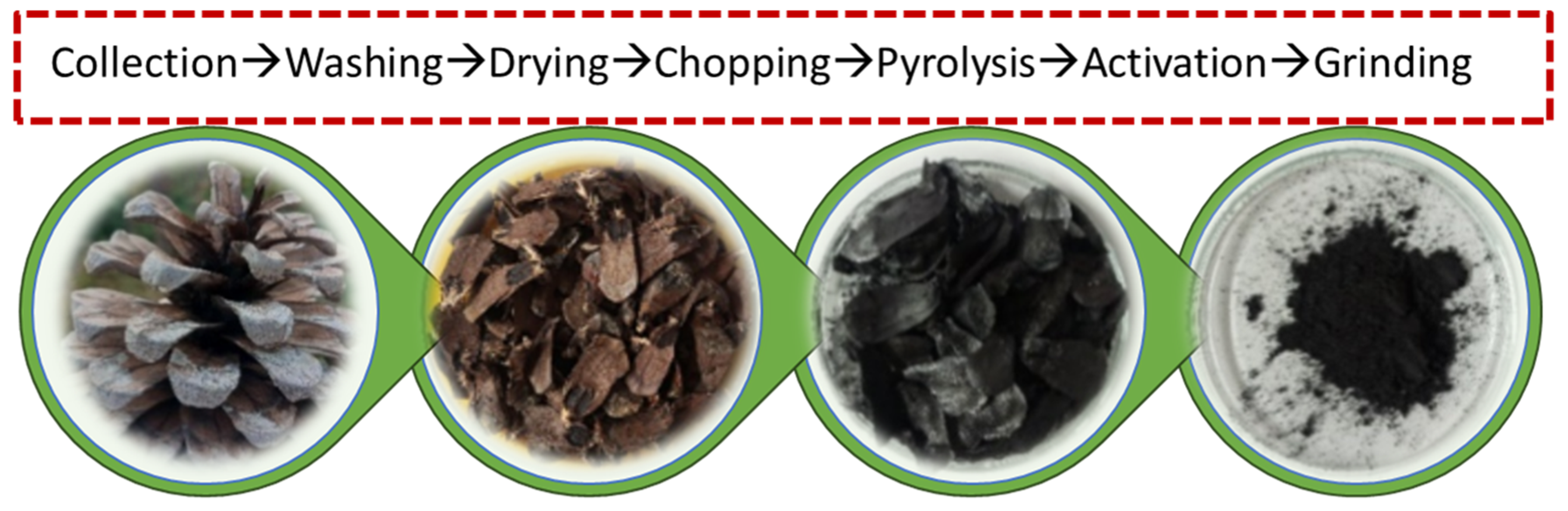
Figure 2.
(a) FTIR spectrum of raw and activated biochar, (b) Point of zero charge plot for activated biochar, (c) size of biochar identification using SEM analysis, and (d) SEM image of biochar synthesised using pine cone waste.
Figure 2.
(a) FTIR spectrum of raw and activated biochar, (b) Point of zero charge plot for activated biochar, (c) size of biochar identification using SEM analysis, and (d) SEM image of biochar synthesised using pine cone waste.
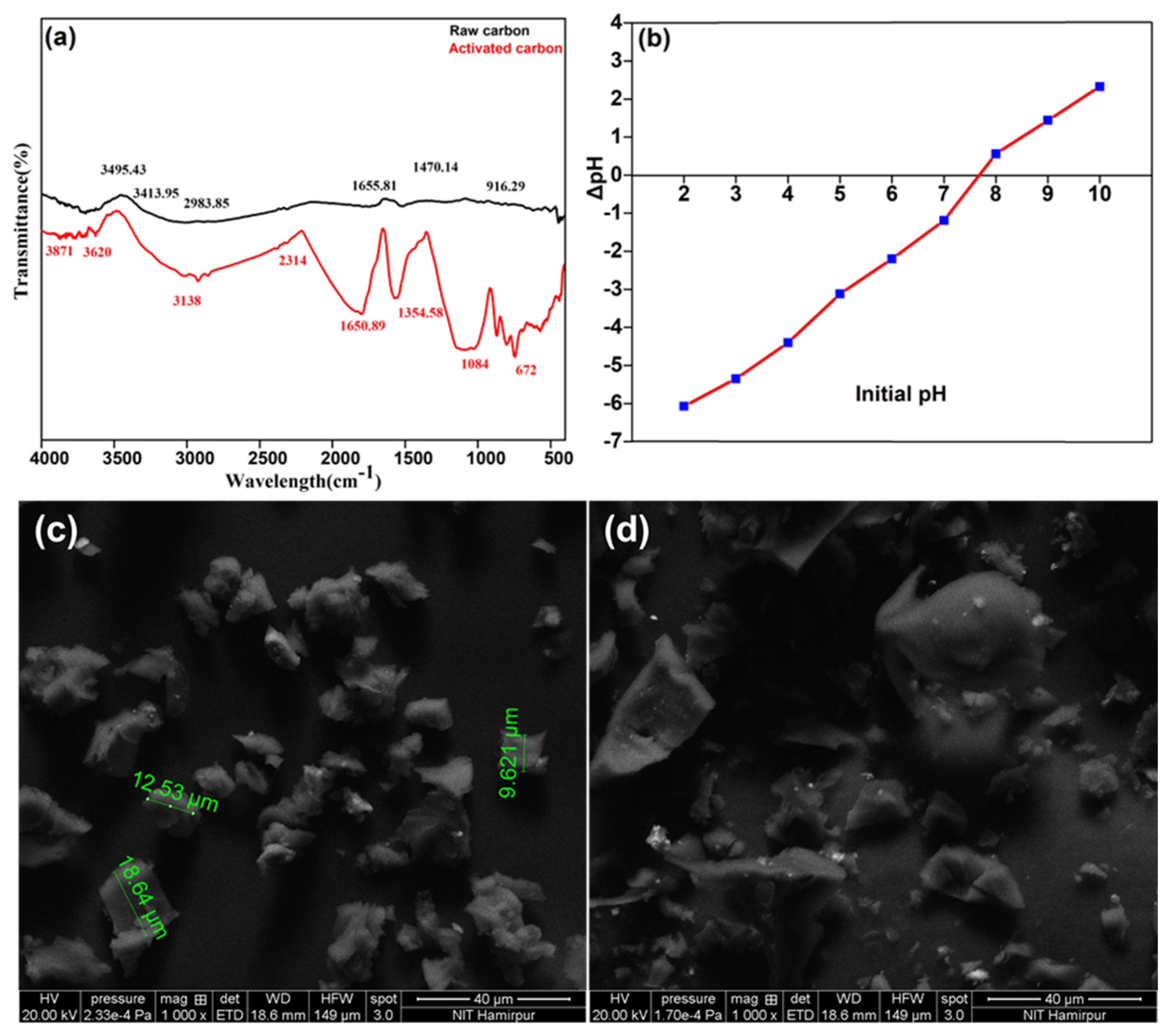
Figure 3.
Three-Dimensional optimization plot and Contour Visualization between (a,d) pH and contact time, (b,e) pH and adsorbent dosage, (c,f) contact time and adsorbent dosage.
Figure 3.
Three-Dimensional optimization plot and Contour Visualization between (a,d) pH and contact time, (b,e) pH and adsorbent dosage, (c,f) contact time and adsorbent dosage.
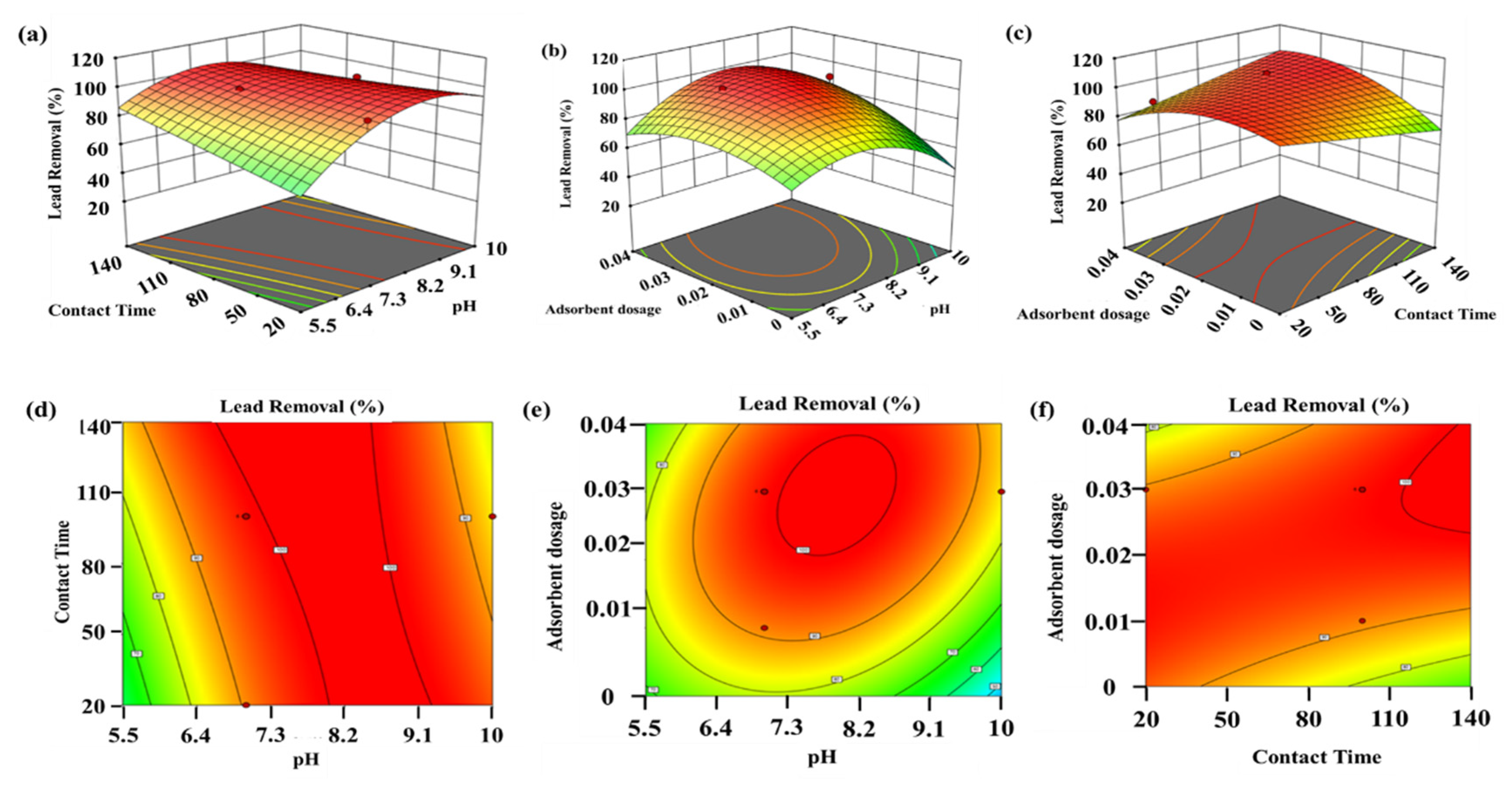
Figure 4.
(a) Comparison of Predicted and Actual Lead (Pb) removal and (b) Assessment of Residuals and Internally Studentized Residuals across Run numbers.
Figure 4.
(a) Comparison of Predicted and Actual Lead (Pb) removal and (b) Assessment of Residuals and Internally Studentized Residuals across Run numbers.
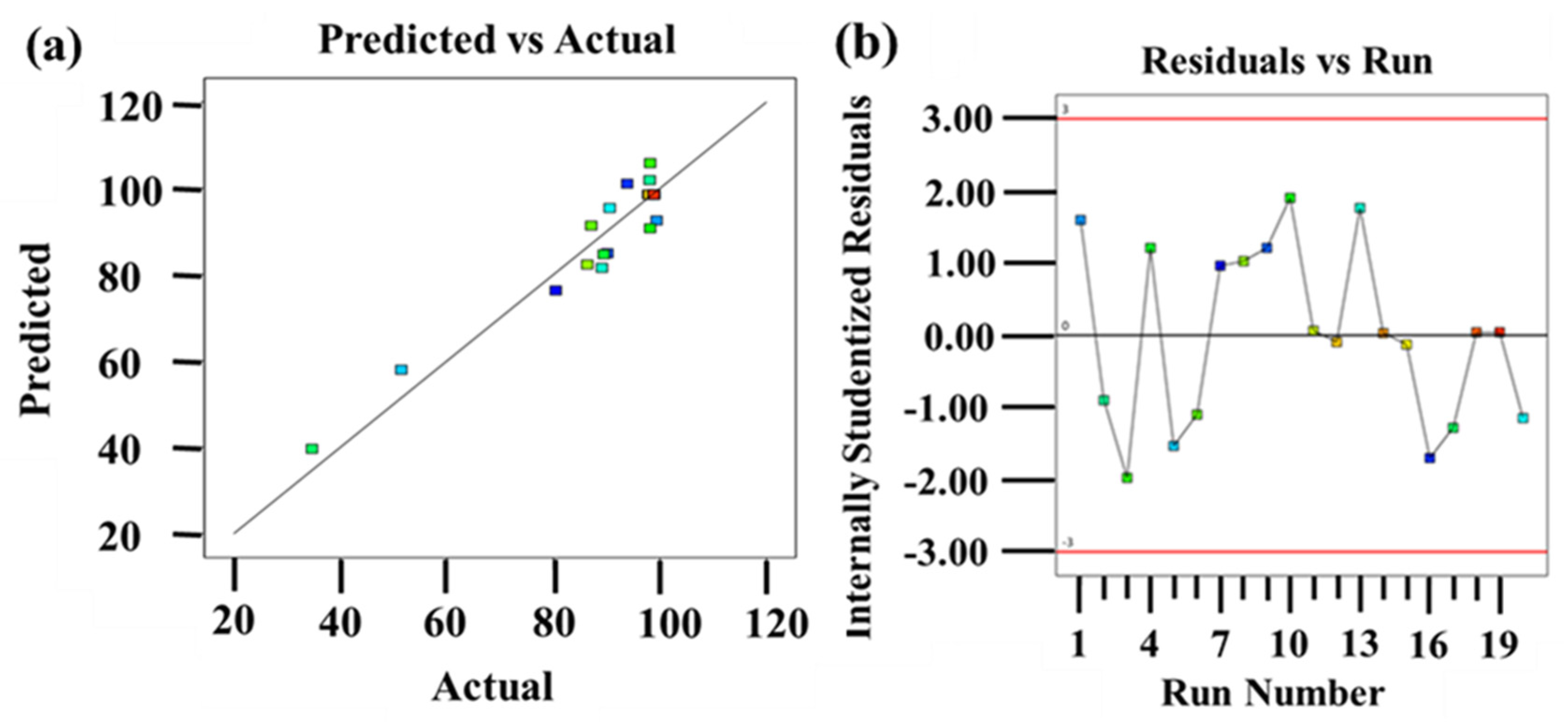

Table 1.
Input parameters for the central composite design optimization studies.
| Variables | Units | Levels (coded values) | ||||
| -α | -1 | 0 | +1 | +α | ||
| X1: pH | - | 4 | 5.5 | 7 | 8.5 | 10 |
| X2: Contact Time | minute | 20 | 60 | 100 | 140 | 180 |
| X3: Adsorbent Dosage | g/L | 0.01 | 0.02 | 0.03 | 0.04 | 0.05 |
Table 2.
RSM-based optimization with observed and predicted lead removal (%) for 20 experimental runs.
Table 2.
RSM-based optimization with observed and predicted lead removal (%) for 20 experimental runs.
| Run | Factors | Lead Removal (%) | |||
| X1 | X2 | X3 | Predicted | Experimental | |
| 1 | 8.5 | 140 | 0.02 | 92.57 | 99.37 |
| 2 | 8.5 | 140 | 0.04 | 101.91 | 98.08 |
| 3 | 7 | 180 | 0.03 | 105.85 | 98.16 |
| 4 | 10 | 100 | 0.03 | 84.74 | 89.45 |
| 5 | 5.5 | 60 | 0.04 | 57.99 | 51.46 |
| 6 | 7 | 100 | 0.01 | 91.38 | 87.1 |
| 7 | 5.5 | 60 | 0.02 | 76.34 | 80.45 |
| 8 | 7 | 100 | 0.05 | 82.36 | 86.36 |
| 9 | 5.5 | 140 | 0.02 | 84.97 | 90.13 |
| 10 | 7 | 20 | 0.03 | 90.75 | 98.16 |
| 11 | 7 | 100 | 0.03 | 98.57 | 98.97 |
| 12 | 7 | 100 | 0.03 | 98.57 | 97.98 |
| 13 | 5.5 | 140 | 0.04 | 81.59 | 89.11 |
| 14 | 7 | 100 | 0.03 | 98.57 | 98.76 |
| 15 | 7 | 100 | 0.03 | 98.57 | 97.77 |
| 16 | 8.5 | 60 | 0.02 | 101.08 | 93.84 |
| 17 | 4 | 100 | 0.03 | 39.68 | 34.69 |
| 18 | 7 | 100 | 0.03 | 98.57 | 98.83 |
| 19 | 7 | 100 | 0.03 | 98.57 | 98.84 |
| 20 | 8.5 | 60 | 0.04 | 95.44 | 90.56 |
Table 3.
Statistical analysis of variance (ANOVA) was used to develop a quadratic model with important statistical parameters.
Table 3.
Statistical analysis of variance (ANOVA) was used to develop a quadratic model with important statistical parameters.
| Source | Sum of Squares | df | Mean Square | F-value | p-value |
| Model | 4896.65 | 9 | 544.07 | 11.42 | 0.0004 |
| X1: pH | 2029.95 | 1 | 2029.95 | 42.60 | <0.0001 |
| X2: Contact Time | 227.86 | 1 | 227.86 | 4.78 | 0.0536 |
| X3: Adsorbent Dosage | 81.27 | 1 | 81.27 | 1.71 | 0.2208 |
| X1X2 | 146.89 | 1 | 146.89 | 3.08 | 0.1096 |
| X1X3 | 80.90 | 1 | 80.90 | 1.70 | 0.2218 |
| X2X3 | 112.20 | 1 | 112.20 | 2.35 | 0.1559 |
| X12 | 2077.82 | 1 | 2077.82 | 43.61 | <0.0001 |
| X22 | 0.1169 | 1 | 0.1169 | 0.0025 | 0.9615 |
| X32 | 215.21 | 1 | 215.21 | 4.52 | 0.0595 |
| Residual | 476.49 | 10 | 47.65 | ||
| Lack of Fit | 475.17 | 5 | 95.03 | 362.02 | <0.0001 |
| Pure Error | 1.31 | 5 | 0.2625 | ||
| Cor Total | 5373.14 | 19 |
*df- degree of freedom.
Disclaimer/Publisher’s Note: The statements, opinions and data contained in all publications are solely those of the individual author(s) and contributor(s) and not of MDPI and/or the editor(s). MDPI and/or the editor(s) disclaim responsibility for any injury to people or property resulting from any ideas, methods, instructions or products referred to in the content. |
© 2026 by the authors. Licensee MDPI, Basel, Switzerland. This article is an open access article distributed under the terms and conditions of the Creative Commons Attribution (CC BY) license (http://creativecommons.org/licenses/by/4.0/).
Copyright: This open access article is published under a Creative Commons CC BY 4.0 license, which permit the free download, distribution, and reuse, provided that the author and preprint are cited in any reuse.


