

Submitted:
13 April 2026
Posted:
15 April 2026
You are already at the latest version
Abstract
Pathological states associated with metabolic stress, such as traumatic brain injury (TBI), hypoxia, ischemic stroke, and migraine, are considered elevated risk factors for developing Alzheimer’s dis-ease (AD). However, the mechanism underlying the effect of these conditions on the progression of AD remains largely unknown. Here we determine how metabolic stress associated with spreading depolarization (SD)—a hallmark of stroke, hypoxia, TBI, and migraine—modulates amyloid β (Aβ42) aggregation kinetics through dynamic changes in extracellular space (ECS). To achieve this, we used ThT fluorescence to determine how the formation of different Aβ42 aggregate species depends on Aβ42 concentrations. Based on this input, we build a multiscale computational framework that integrates volume regulation, including its dependence on neuronal ion homeostasis, and Aβ42 aggregation kinetics. Our model predicts that neuronal swelling during SD acceler-ates aggregation, where the impact of metabolic stress is highly dependent on the timing relative to aggregation progression and the initial monomer concentration. At low monomer concentrations, early SD events promote off-pathway oligomer formation, while at higher concentrations they rapidly drive fibril formation to saturation. In the absence of mature fibrils, recurrent metabolic stress events further amplify oligomer accumulation, whereas pre-existing fibril nuclei suppress oligomer formation at the expense of fibril nucleation and growth. Increasing the intensity of metabolic stress prolongs ECS shrinkage and enhances oligomer formation. These findings reveal a mechanistic link between SD-induced microenvironmental changes and Aβ aggregation dynamics, providing a quantitative framework for understanding how acute brain injury and metabolic stress may contribute to early AD pathogenesis.
Keywords:
Aβ aggregation
; spreading depolarization
; stroke
; TBI
; Alzheimer’s disease
1. Introduction
The onset of amyloid β (Aβ) oligomers and fibrils formation are considered among the earliest molecular events in Alzheimer’s disease (AD) and the main cause of its pathogenesis [1,2,3]. In vivo, Aβ monomers are derived from the sequential cleavage of amyloid precursor protein (APP) by β- and γ- secretases [4,5,6] that occurs in a normal human brain. However, the conditions that initiate and promote the aberrant aggregation of Aβ, specifically in sporadic AD, are poorly understood. In vitro and in vivo experiments have identified a myriad of Aβ aggregate species, ranging from small oligomers to curvilinear and long rigid fibrils under growth conditions varying across three main parameters: local Aβ monomer concentration, ionic strengths, and pH [6,7,8,9,10,11,12,13,14,15,16,17]. Under physiological conditions, these parameters are more likely to vary mildly since robust regulatory mechanisms prevent drastic changes. This limits the likelihood of these parameters reaching a range where the conditions are favorable for aggregation. However, there are pathological brain states caused by metabolic stress and ionic homeostatic imbalance where significant changes in all these three variables are observed.
Metabolic stress and spreading depolarization (SD) locally create aggregation-prone conditions by simultaneously shrinking of the ECS, lowering pH, upregulating Aβ cleaving enzyme (BACE1) activity, and reducing Aβ buffering [18,19,20,21,22]. SD is the electrophysiological event underlying several brain pathologies including traumatic brain injury (TBI), migraine, aneurysmal subarachnoid hemorrhage, intracerebral hemorrhage, hypoxia, and ischemic stroke [23,24,25,26]. Remarkably, all these conditions are also considered elevated risk factors for developing AD [27,28,29]. For example, a history of TBI increases the risk of developing AD by 4.5 to 10 times [30,31,32,33,34,35] and reduces the age of AD onset by several years [36]. Furthermore, strong similarities exist in the regional neurodegeneration patterns associated with mild TBI and AD [37]. There is also evidence that TBI increases the risk of dementia in individuals with the E4 variant of apolipoprotein E genes [38] — the largest known genetic risk factor for sporadic AD.
SD is a depolarization wave sweeping the tissue that raises neuronal membrane potential close to 0 mV. It results in massive ions and water displacements, abolishment of membrane ionic gradients, and a more than 50% drop in local ATP [18,19,24,26,39]. Typically, SD waves are associated with a significant rise in the extracellular K+ from ~3 mM to as high as ~60 mM [14]. Oxygen-glucose deprivation also leads to SD waves, which are accompanied by a rise in the extracellular K+. Similar dramatic changes occur in other extra- and intracellular ion concentrations, glutamate, and pH [26,40,41,42]. The rise in intracellular Na+ and Cl- leads to substantial neuronal and astrocytic swelling [43], and consequently a shrinkage of the ECS from 18-22% to 5-9% of total tissue volume, hence quadrupling the concentrations of all extracellular ions and molecules, including Aβ. In addition, high extracellular K+ causes vasoconstriction that results in hypoxia [18,44,45,46], switching to anaerobic ATP production and accumulation of lactate. This leads to the failure of pH regulating pumps and a drop in pH in the ECS to 6.1 near the ischemic core [40,47,48,49,50,51,52,53,54,55,56]. SD can also occur in clusters that persist for hours, and SD-like conditions may last for extended periods as is usually observed in TBI and recurrent migraines [19,23,27]. Recurrent SD waves may also affect the growth kinetics of pre-existing Aβ aggregates.
In this paper, we focus on how neuronal swelling, and consequently shrinking of the ECS, affect the aggregation kinetics of Aβ42. We combine multiscale modeling with high resolution microscopy to understand the onset and progression of different aggregate forms of Aβ42 in a normal brain during SD and related metabolic stress.
2. Materials and Methods
2.1. Experimental Methods: Oligomer vs. Fibril Formation as Function of Aβ42 Concentration
2.1.1. Aβ42 Solution Preparation
Lyophilized Aβ42 stock was acquired commercially (GL Biochem, Shanghai, China). The lyophilized peptides were dissolved at 2 mg/ml in 500 μL of 100 mM NaOH at pH 13 and injected into an FPLC (Akta Pure, Cytiva, DE) with a Superdex 75 10/300 GL column (GE Healthcare, Chicago, IL, USA), equilibrated against a solution of 35 mM Na2HPO4 at pH 11. The monomer peak was collected and immediately stored on ice. Concentrations of the resulting Aβ42 monomer stock were determined by integrating the UV absorption trace from the FPLC using a molar absorptivity of ε280 = 1470 M−1 cm−1 [38,39]. The typical yield was 1.5 ml of Aβ42 at 40 μM to 80 μM.
2.1.2. Aβ42 Aggregation Kinetics
A series of solutions at pH 7.4 and 150 mM NaCl with Aβ42 concentrations ranging from 2 μM to 50 μM were prepared. Low-binding 1.5 mL microcentrifuge tubes were filled with 500 μL of 35 mM Na2HPO4 buffer and 150 mM NaCl at pH 11. The purified monomer stock was diluted into these tubes. A small amount (<5 μl) of 1 M HEPES buffer at pH 4.5 was added to adjust the final solution pH to 7.4 right before plating. Thioflavin T (ThT) stock solutions (7.5 μL) were added for a final dye concentration of 15 μM. Three wells of a low-binding 96-well half-area microplate (#3881, Corning Life Sciences, Tewksbury, MA) were filled with 150 μL of a given Aβ42/dye mixture. Plates were sealed with polyethylene sealing tape and incubated in a FLUOstar Omega fluorescence plate reader (BMG Labtech, Ortenberg, Germany) at 27 °C. ThT fluorescence was measured at 15 min. intervals (with 3 s of prior shaking) for 1–2 days.
ThT fluorescence was measured using a 448/10 nm excitation and 482/10 nm emission filter pair. Dye/buffer wells without protein served as a control for potential changes in dye fluorescence (bleaching, hydrolysis, etc.) unrelated to protein aggregation.
2.1.3. Data Analysis
Dye traces were exported to Igor data analysis software (Igor 8.0, Wavemetrics, Lake Oswego, OR, USA) for further analysis. By dividing sample fluorescence values F(t) by their corresponding dye/buffer fluorescence at the initial measurement time F(B0), the raw fluorescence data were converted into fractional fluorescence enhancements [F(t)/F(B0)]. Normalized data were exported to Excel and best-fit parameters extracted from fits to the numerical model described below.
2.2. Computational Methods
The model integrates neuronal ion homeostasis and associated volume changes with the kinetics of Aβ42 aggregations in the ECS (Figure 1).
2.2.1. Aβ42 Aggregation Kinetics
For simulating A aggregation, ThT traces representing the formation of fibrils and oligomers were fitted by our previous model [12,13], which is a modified version of the model in [57]. A schematic of the model is shown in Figure 1A, where monomers can form on-pathway fibrils and off-pathway oligomers. The probability of fibrils and/or oligomer formation depends on the initial monomer concentration. Along the on-pathway, monomers () first form primary nuclei ([Yn], n = 5), followed by the growth into fibrils . The concentration of monomers incorporated into the fibers is represented by . The off-pathway aggregates are formed at relatively higher monomer concentration, usually when the monomer concentration exceeds a critical value specific to each amyloidogenic species. Above this threshold, monomers can also form off-pathway globular oligomers via a two-step process. They initially form an intermediate dimer (), where = 2, followed by aggregation into oligomers where represents the maximum number of monomers in the species (we use = 10 in this work). We refer the reader to Ref. [1] for further details about the model.
In addition to changing the parameters to allow fitting the model to our new data, we change the rate equations such that they represent the rate at which the number of different species are changing instead of their concentrations. This change is necessitated by the fact that the volume of the ECS in our simulation is a dynamic variable, which changes as the extra- and intracellular ion concentrations change.
Where N in front of the species indicates their number concentrations. For example, NX1 is the number of monomers whereas [X1] is the concentration of monomers. is the volume of the extracellular space.
Association rate constants are denoted by while dissociation rate constants are given by (Table 1). As shown in the Results section, the parameter representing the secondary nucleation rate varies as a function of the initial monomer concentration and is formulated as
in units of 1/(μM4.s).
2.2.2. Neuronal Model
To model neuronal membrane potential, ion homeostasis, and volume regulation during SD and epileptic seizure, we adopt the formalism developed in our previous work [3].
2.2.3. Modeling Neuronal Membrane Potential
The neuronal membrane potential (V) is modeled as
The Na+, K+, and Cl- currents are formulated by Hodgkin and Huxley type equations:
where , , represents the maximum conductance for ion x, the conductance of leak channels, and the reversal potential for ion x. , , and n are the gating variables of the or K+ channels as in the original Hodgkin Huxley formalism [58]:
Here the voltage-dependent forward () and backward ( rates are given as
The reversal potential of Na+, K+, and Cl- are formulated with Nernst equation
where the subscript and represent the ions in the extra- and intracellular spaces.
2.2.4. Dynamics of Extra- and Intracellular Ion Concentrations
In our model, the concentration of ions in the extra- and intracellular spaces are dynamic. Using the laws of conservation of charge and mass, the rate equations for the number of specific ions can be related to the currents through the channels as
In these expressions, and describe the ATPase flux in the neuron and astrocyte. accounts for lateral diffusion to or from the bath solution (or blood vessel in vivo) and represents uptake by surrounding glia through different K+ channels. converts time from seconds to milliseconds and accounts for the ratio between intracellular and extracellular (and converts current in , with being the surface area of the cell and Faraday’s constant.
The different fluxes incorporated in the model are functions of the intra- and/or extracellular ion concentrations and are given as
where
represents the pump rate, being the maximum Na/K pump rate, and is the oxygen concentration in the tissue.
is the rate of K+ uptake by glia, is the maximum glial K+ buffering strength, and is the O2 concentration in the bath solution. These and other parameters used in the neuronal model are listed in Table 2.
is the diffusion constant of K+ between the bath solution and ECS, with being maximal K+ diffusion constant.
Available O2 concentration in the tissue depends on the consumption by and and exchange with the bath solution. That is,
where is a conversion factor () and is the diffusion rate for O2.
(co-transporter) and ( co-transporter) are electroneutral fluxes that regulate and are directly related to the volume regulation. These fluxes are formulated as
where
regulates the channel activity and and represent the maximum flux through the co-transporters.
2.2.5. Volume Regulation
The effective volume of the cell is as function of the osmotic equilibrium between the intracellular and extracellular media,
where
and
is the sum of extra- and intracellular ions. accounts for the remaining impermeant negatively charged ions, such as proteins and phosphates. and remain constant and were calculated by assuming that the initial osmotic pressure gradient is zero.
Due to changes in the osmotic gradient, the neuronal volume becomes a dynamic variable and can be represented by a first-order differential equation,
As the neuron swells or shrinks, the extracellular volume ( changes accordingly,
where the initial intracellular volume. With volume dynamics included in the model, diffusion of in the ECS is constrained by the volume fraction . That is,
The resulting system of equations was solved numerically in Fortran using RK4 method. Fits to experimental data and plotting was performed in Matlab. Codes reproducing key results in this paper are available on request from the authors and will be archived on the authors website.
3. Results
3.1. Experimental Results: ThT Kinetics of Fibril vs Oligomer Formation by Aβ42
We have previously shown that amyloid aggregation, and Aβ42 aggregation in particular, undergoes a transition from strictly sigmoidal to progressively biphasic ThT kinetics [13,59,60]. The transition to biphasic ThT kinetics is directly correlated with the onset of off-pathway oligomer formation [13]. Here we measured the ThT kinetics of Aβ42 aggregation at five different concentrations of Aβ42 (2, 5, 10, 15 and 30 μM), and under near-physiological conditions (pH 7.4, 150 mM NaCl). These concentrations span the transition from purely sigmoidal to prominently biphasic Aβ42 kinetics. Sample traces of ThT signal using initial monomer concentration of 2 μM, 5 μM, and 10 μM are shown in Figure 2A-C. Given that ThT fluorescence predominantly arises from binding to ordered fibrillar β-sheet structures, we approximate the signal as proportional to fibrillar mass, while treating oligomer-related signal significantly weaker (1% of that of due to fibrils). This assumption is in line with our previous work [12], and results in close fits to the experiments performed at different monomer concentrations.
3.2. Modeling the Aggregation Kinetics of Aβ42
To replicate the kinetics of Aβ42 aggregation, we adopted our previous model developed for the aggregation of an Aβ dimer construct (dimAβ) and hen egg white lysozyme (HewL) [12,13]. However, the aggregation kinetics of dimAβ and HewL is significantly different than the kinetics of monomeric Aβ42 (dimAβ is faster and HewL is slower than monomeric Aβ42). Thus, we allowed some of the parameters to vary to fit the model to our new data. Sample fits to the observed ThT signal are shown in Figure 2A-C, where the black, red, green, and blue line represent ThT signal and the concentration of off-pathway oligomers, on-pathway curvilinear fibrils, and the overall aggregated species, respectively.
This model can reproduce the observed transition from predominantly sigmoidal to biphasic growth as we increase initial monomer concentration. That is, the model predicts an increasingly higher probability for off-pathway oligomers formation as we increase the monomer concentration (Figure 2A-C). However, as we vary the monomer concentration over a wider range, the model results in too rapid an increase in the initial fibril and/or oligomer concentration compared to the observed time traces. As reasoned in our previous work [12,13] and confirmed by experiments [59], the increasing concentration of oligomers decreases the probability of secondary nucleation due to the oligomers decorating the lateral fibril surface. In line with this reasoning, our model predicts that the secondary nucleation rate decreases sharply as increasing monomer concentrations promote rapid oligomer formation (Figure 3D).
3.3. Linking Neuronal Ion Homeostasis and Swelling to the Aggregation Kinetics of Aβ42
Next, we determine how neuronal swelling, and consequently shrinking of the EC, during metabolic stress events such as SD affects Aβ42 aggregation kinetics. In the neuronal model, we simulate a single SD event by raising K+ concentration in the bath solution from 3.5 mM to 26 mM for 12 min. A sample single-cell depolarization event is shown in Figure 3A, where we raise K+ concentration in the bath solution from 3.5 mM to 26 mM for the initial 12 min (0.2 hr) of the simulation, followed by a restoration to a physiological value of 3.5 mM for the rest of the simulation. Note that the neuron recovers from the depolarization before we restore K+ to the physiological value due to the strong activation of Na+/K+-ATPase when [K+]o (Figure 3B) and [Na+]i (not shown) rise as Na+/K+-ATPase increase like a sigmoidal function of both [K+]o and [Na+]i [61,62]. The shuffling of ions across the plasma membrane leads to the swelling of the neuron (Figure 3C), which consequently causes the ECS to shrink by almost 75% (Figure 3D) — in line with experimental observations [14].
As discussed earlier, the aggregation kinetics of Aβ42 strongly depends on initial monomer concentration (and most likely on other small aggregates such as dimers and trimers) (Figure 2). Accordingly, we hypothesize that changes in the extracellular volume (and consequently changes in the concentration of Aβ42 monomers and other aggregates) due to metabolic stress will affect the kinetics of Aβ42. To test this hypothesis, we link the model for the aggregation kinetics of Aβ42 with the neuronal model. Specifically, the concentration of Aβ42 monomers and other aggregate species change as the extracellular volume changes. We expose the neuron to one, two, or three metabolic stress events, beginning at 0 hr, 24 hrs, and 48 hrs, respectively, and each lasting for 12 min. In Figure 4A1-C1, we show results from these simulations using an initial Aβ42 monomer concentration of 1 μM. The first metabolic stress event reduces the onset time of fibril formation, decreases the concentration of intermediate species (dimers) along the off-pathway, but increases the concentration of oligomers (blue lines in Figure 4A1-C1) as compared to the no-metabolic stress scenario (black lines in Figure 4A1-C1). The second metabolic stress event mildly decreases the onset time of fibrils formation with significant reduction in its final concentration (Figure 4A1, red line). While the second event doesn’t affect the peak concentration of the off-pathway intermediate species, it significantly decreases the duration of its rise (Figure 4B1, red line). The loss in the concentration of fibrils and intermediate species mainly results from the rise in the concentration of oligomers (Figure 4C1, red line). The third metabolic stress event, which occurs after the fibril formation has saturated, leads to a temporary rise in the concentration of fibrils, off-pathway dimers, and oligomers but all species return to their free-metabolic stress state as soon as the event is over (green lines in Figure 4A1-C1).
We noticed that once the fibril formation plateaus, the SD event doesn’t have any effect on the kinetics of Aβ42 aggregation (Figure 4A1-C1, green lines). To test this further, we repeated the above simulations for an initial monomer concentration of 5 μM and made the following four observations (Figure 4A2-C2). First, the effect on the fibril formation is significantly more pronounced, which rises and plateaus immediately when the first metabolic stress is applied (Figure 4A2, blue line). Second, the instantaneous concentration of off-pathway dimers is significantly lower as compared to the concentration in the absence of metabolic stress, mainly because the monomers end up in the fibrils very rapidly (Figure 4B2). Third, the concentration of oligomers decreases due to the rapid formation of fibrils (Figure 4C2). Finally, consistent with the above observation, metabolic stress does not affect the aggregation kinetics if applied after the fibril formation saturates.
As discussed above, each SD event increases the concentration of oligomers if the SD event occurs before fibril formation saturates (Figure 4C1). Accordingly, we test whether recurring metabolic stress events would raise the concentration of Aβ42 oligomers if there are negligible fibrils in the ECS. We repeat the simulation in Figure 4A1-C1 using an initial monomer concentration of 0.5 μM where negligible fibrils are observed in the 100 hours of simulation (Figure 4A3). With each consecutive metabolic stress, the concentration of Aβ42 oligomers jumps to a higher value (Figure 4C3). The increase in the oligomer concentration comes at the expense of fibril and off-pathway dimer concentrations (Figure 4B3).
Taken together, these results show that SD has a strong effect on the aggregation kinetics of Aβ42 when applied before the fibril formation plateaus. In the absence of saturating fibrils concentration and low initial monomer concentration, each SD event increases the concentration of oligomers. However, at relatively high initial monomer concentration, the first SD kick starts the formation of fibrils, pushing it to saturating levels rapidly. This comes at the expense of off-pathway dimers and oligomers.
3.4. The Effect of Intensity and Duration of Metabolic Stress on the Aggregation Kinetics of Aβ42
Typically, an SD wave raises extracellular K+ nearly 20 times (to 35-60 mM) from its phycological value of 2.5-3.5 mM. Similar dramatic changes occur in other extra- and intracellular ion concentrations [14,26,40]. The rise in intracellular Na+ and Cl- leads to substantial neuronal swelling [43], and consequently a shrinkage of the ECS, hence quadrupling the concentrations of all extracellular ions and molecules, including Aβ. Similarly, extracellular K+ rises during ictal epileptiform events to 10-12 mM [14]. Accordingly, we vary K+ in the bath from 12 mM to 60 mM to determine how the aggregation kinetics of Aβ42 change as the intensity of the metabolic stress increases. In Figure 5A1 we show one such event where we raise K+ in the bath for 12 minutes (0 hr – 0.2 hr) to 12 mM, 26 mM, 50 mM, or 60 mM from the physiological value of 3.5 mM. Raising K+ in the bath increases the peak value of [K+]o as Na+/K+-ATPase fails to keep up with the high K+ level (Figure 5A1). The rise in [K+]o and other ions (not shown) cause the neuron to swell, leading to a shrinkage of the ECS (Figure 5B1). The duration for which [K+]o stays elevated and the ECS remains shrunk also increase progressively with increasing K+ in the bath as Na+/K+-ATPase takes longer to restore the K+ and Na+ gradients.
Next, we apply four such metabolic stress events (at 0 hr, 24 hrs, 48 hrs, and 72 hrs) of different intensities by raising K+ in the bath for 12 minutes from its physiological value (Figure 5A1, B1). Exposing the neuron to four seizure-like events (raising K+ in the bath to 12 mM during each event) doesn’t have any significant effect on the aggregation kinetics as the time traces of both off-pathway dimers (Figure 5A2) and oligomers (Figure 5B2) remain unchanged. This is clear from the blue lines (seizure-like events) laying on top of the black lines (control with fixed bath K+ of 3.5 mM throughout the simulation). We emphasize that the ~12 mM extracellular K+ used in this simulation is typical of seizure-like events and is much lower than that associated with SD events [63].
As discussed above, increasing bath K+ from 3.5 mM to 26 mM during each event (typical of [K+]o levels during SD associated with migraine aura where the cortex is well perfused) significantly affects the aggregation kinetics where the level of oligomers consistently rises with each stress event (red line in Figure 5B2). The rise in oligomers concentration is linked with a drop in the off-pathway dimers (Figure 5A2). The concentration of oligomers increases further as we increase bath K+ from 3.5mM to 50mM or 60mM during each event, leading to [K+]o values that are typically associated with SD during stroke, ischemia, and traumatic brain injury where the tissue energy is compromised.
3.5. Pre-Existing Nuclei or Off-Pathway Dimers Significantly Accelerate the Aggregation Kinetics of Aβ42
Another question we sought to address was that how do pre-existing aggregates in the ECS influence aggregation kinetics during SD. Specifically, we examined the effect of pre-existing on-pathway nuclei or off-pathway dimers. In these simulations, we first initialized the system with 0.01 μM off-pathway dimers in addition to 0.5 μM monomers. Introducing pre-existing off-pathway dimers without applying metabolic stress increased the dimer concentration but did not promote the formation of fibrils or oligomers (blue lines in Figure 6A–C). Next, we repeated the same simulation while exposing the neuron to four metabolic stress events at 0, 24, 48, and 72 h. Under this condition, the number of fibrils remained essentially unchanged, whereas the number of oligomers increased substantially compared with the scenario in which four metabolic stress events were applied (at 0, 24, 48, and 72 h) without pre-existing off-pathway dimers (red vs. black lines in Figure 6A, 6C, respectively). In contrast, the concentration of off-pathway dimers was initially higher due to the presence of the pre-existing dimers, but over time it converged to levels comparable to those observed in the absence of pre-existing dimers (Figure 6B, red vs black line).
Next, we introduced pre-existing on-pathway nuclei (0.001 μM) in addition to the off-pathway dimers (0.01 μM). Under this protocol, fibril formation was markedly accelerated and reached a plateau immediately following the first SD event. The presence of pre-existing nuclei effectively depleted the off-pathway dimers and suppressed oligomer formation (green lines in Figure 6A–C). This is due to the rapid rate of fibril elongation past the nucleation stage. Finally, we simulated the same initial conditions (0.001 μM on-pathway nuclei and 0.01 μM off-pathway dimers) in the absence of metabolic stress. Even without metabolic stress, fibril concentration rapidly reached saturation (not shown). These results suggest that the presence of pre-existing nuclei alone is sufficient to drive fibril formation to saturation, leaving little or no room for metabolic stress to further exacerbate aggregation.
4. Discussion
In this study, we present a multiscale framework that links neuronal ion dynamics, volume regulation, and amyloid aggregation to investigate how metabolic stress influences the kinetics of Aβ42 aggregation in the ECS. Our results provide mechanistic insight into how SD and related pathological events can create transient but significant shifts in the extracellular microenvironment that alter aggregation kinetics. A central finding of this work is that neuronal swelling during SD leads to substantial shrinkage of the ECS, resulting in a rapid increase in the concentration of Aβ42. This rise in the concentration alone is sufficient to shift aggregation kinetics, promoting earlier onset of aggregation and altering the balance between on-pathway fibril formation and off-pathway oligomerization. Importantly, our results show that the timing of metabolic stress relative to the aggregation trajectory is critical. When SD occurs before fibril formation saturates, it can significantly accelerate aggregation and bias the system toward either oligomer formation or fibrillization, depending on the initial monomer concentration. In contrast, once fibril formation has reached a plateau, metabolic stress has minimal impact on aggregation kinetics, suggesting that the system becomes kinetically trapped in a stable state. This stable state is a direct result of a key assumption in the model, namely that fibrils are stable and irreversible species based on fits to the experimental data.
At low initial monomer concentrations, repeated metabolic stress events lead to a progressive accumulation of off-pathway oligomers. This is particularly significant given the widely recognized neurotoxicity of soluble oligomeric Aβ species. In contrast, at higher monomer concentrations, metabolic stress rapidly drives fibril formation, effectively depleting monomers and suppressing oligomer formation. These findings highlight a nonlinear and concentration-dependent response of the aggregation kinetics to metabolic stress, suggesting that small differences in baseline Aβ42 levels could lead to markedly different pathological outcomes under similar stress conditions.
Another key result from this study is the role of pre-existing small aggregate species in modulating the system’s response to metabolic stress. The presence of off-pathway dimers amplifies oligomer formation during SD, whereas the presence of on-pathway nuclei promotes rapid fibrillization and suppresses oligomer accumulation. These findings emphasize the importance of initial conditions and suggest that even small amounts of pre-existing aggregates can strongly influence disease progression. In particular, the presence of fibril seeds appears to buffer the system against further perturbations, while small oligomeric seeds exacerbate pathological aggregation under stress. This result is of particular importance in situation where clusters of SD events occur, as is usually observed in TBI and recurrent migraines [19,23,27]. Under such scenario the first one or two SD events might promote the formation of smaller species, which then accelerate the formation of oligomers or fibrils by the later SD events. This is something that warrants further investigation in the future.
The intensity and duration of metabolic stress also play a crucial role in promoting aggregation. Increasing extracellular K+ levels—mimicking conditions observed in severe SD associated with stroke or TBI—not only enhances ECS shrinkage but also prolongs its duration. This leads to sustained increases in Aβ42 concentration and a corresponding increase in oligomer formation. In contrast, milder stress conditions, such as those associated with seizure-like activity, have negligible effects on aggregation kinetics. This suggests a threshold-like behavior in which only sufficiently strong metabolic disturbances significantly impact aggregation kinetics.
While the model captures key aspects of Aβ42 aggregation under dynamic extracellular conditions, it is a simplified representation of a very complex reality and has several limitations. First, the current framework does not explicitly include diffusion of Aβ42 species within the ECS. The tortuosity of the ECS and diffusion constraints are themselves altered during swelling, which could further modulate aggregation kinetics [64]. Incorporating spatial diffusion and heterogeneous ECS structure would provide a more complete description of aggregation dynamics. Second, the model does not account for production, clearance, or transport mechanisms of Aβ42, such as release from neurons, uptake by glia, or clearance via perivascular pathways. Hypoxia, ischemia, and TBI have been shown to increase Beta-site APP Cleaving Enzyme 1 (BACE1) expression and activity, resulting in a two to three-fold increase in Aβ production [20,27,28,65,66,67]. Third, astrocytes also swell significantly during SD. Though a single SD event lasts for a few minutes, astrocytes remain swollen for several hours after a SD wave [68], potentially leading to higher Aβ concentration for extended durations. Astrocytic swelling has also been shown to interfere with Aβ clearance, leading to a further increase in Aβ concentration in the ECS [49,68,69,70,71,72]. Fourth, the aggregation kinetics strongly depend on the pH and salt concentrations in a nonlinear method [6,7,8,9,10,11,12,13,14,15]. All these variables change significantly during SD and epileptic seizures [14,18,19,24,26,39,40,41,42]. Finally, while the aggregation model captures key kinetic pathways, more detailed approaches such as kinetic Monte Carlo (KMC) simulations could better resolve stochastic nucleation events and spatial heterogeneity at the microscale. These processes are most likely to interact with the concentration-driven effects described here and are the subject of our future research.
Despite these limitations, our findings provide a unifying framework for understanding how acute metabolic stress events may act as triggers for pathological Aβ aggregation. By linking well-characterized physiological processes—such as ion dysregulation, neuronal swelling, and ECS shrinkage—to aggregation kinetics derived from extensive experimental data, this work bridges a critical gap between cellular physiology and molecular pathology. Importantly, the results suggest that recurrent SD events, as observed in TBI, stroke, and migraine, could serve as repeated perturbations that progressively drive the system toward pathological states. Overall, this study supports the hypothesis that metabolic stress and SD are not merely correlates of neurodegenerative disease but may play a direct mechanistic role in initiating and modulating Aβ aggregation.
References
- Hardy, J.; Selkoe, D.J. The amyloid hypothesis of Alzheimer’s disease: progress and problems on the road to therapeutics. science 2002, 297(5580), 353–356. [Google Scholar] [CrossRef]
- Hardy, J.A.; Higgins, G.A. Alzheimer’s disease: the amyloid cascade hypothesis . Science 1992, 256(5054), 184–185. [Google Scholar] [CrossRef]
- Brisson, C.D.; Andrew, R.D. A neuronal population in hypothalamus that dramatically resists acute ischemic injury compared to neocortex. Journal of Neurophysiology 2012, 108(2), 419–430. [Google Scholar] [CrossRef]
- Glabe, C. Intracellular mechanisms of amyloid accumulation and pathogenesis in Alzheimer’s disease. Journal of Molecular Neuroscience 2001, 17(2), 137–145. [Google Scholar] [CrossRef] [PubMed]
- Cole, S.L.; Vassar, R. The Alzheimer’s disease β-secretase enzyme, BACE1 . Molecular neurodegeneration 2007, 2(1), 1–25. [Google Scholar] [CrossRef]
- Schützmann, M.P. Endo-lysosomal Aβ concentration and pH trigger formation of Aβ oligomers that potently induce Tau missorting. Nature Communications 2021, 12(1), 1–14. [Google Scholar] [CrossRef] [PubMed]
- Stine, W.B. In vitro characterization of conditions for amyloid-β peptide oligomerization and fibrillogenesis. Journal of Biological Chemistry 2003, 278(13), 11612–11622. [Google Scholar] [CrossRef]
- Atwood, C.S. Dramatic aggregation of Alzheimer Aβ by Cu (II) is induced by conditions representing physiological acidosis. Journal of Biological Chemistry 1998, 273(21), 12817–12826. [Google Scholar] [CrossRef] [PubMed]
- Campos-Ramírez, A. Effect of ionic strength on the aggregation kinetics of the amidated amyloid beta peptide Aβ (1-40) in aqueous solutions. Biophysical Chemistry 2017, 228, 98–107. [Google Scholar] [CrossRef]
- Gorman, P.M. Alternate aggregation pathways of the Alzheimer β-amyloid peptide: Aβ association kinetics at endosomal pH. Journal of molecular biology 2003, 325(4), 743–757. [Google Scholar] [CrossRef]
- Silvers, R. Aggregation and fibril structure of AβM01–42 and Aβ1–42 . Biochemistry 2017, 56(36), 4850–4859. [Google Scholar] [CrossRef] [PubMed]
- Perez, C. Mechanism of fibril and soluble oligomer formation in amyloid beta and hen egg white lysozyme proteins. The Journal of Physical Chemistry B 2019, 123(27), 5678–5689. [Google Scholar] [CrossRef] [PubMed]
- Hasecke, F. Origin of metastable oligomers and their effects on amyloid fibril self-assembly. Chemical science 2018, 9(27), 5937–5948. [Google Scholar] [CrossRef]
- Dreier, J.P.; Reiffurth, C. The stroke-migraine depolarization continuum . Neuron 2015, 86(4), 902–922. [Google Scholar] [CrossRef]
- Thapaliya, P. Modeling the heterogeneity of sodium and calcium homeostasis between cortical and hippocampal astrocytes and its impact on bioenergetics. Frontiers in cellular neuroscience 2023, 17, 1035553. [Google Scholar] [CrossRef]
- Meisl, G. Molecular mechanisms of protein aggregation from global fitting of kinetic models. Nature protocols 2016, 11(2), 252–272. [Google Scholar] [CrossRef]
- Cohen, S.I. Proliferation of amyloid-β42 aggregates occurs through a secondary nucleation mechanism . Proceedings of the National Academy of Sciences 2013, 110(24), 9758–9763. [Google Scholar] [CrossRef]
- Ayata, C.; Lauritzen, M. Spreading depression, spreading depolarizations, and the cerebral vasculature. Physiological reviews 2015, 95(3), 953–993. [Google Scholar] [CrossRef] [PubMed]
- Somjen, G.G. Mechanisms of spreading depression and hypoxic spreading depression-like depolarization. Physiological reviews 2001, 81(3), 1065–1096. [Google Scholar] [CrossRef]
- Guglielmotto, M. The up-regulation of BACE1 mediated by hypoxia and ischemic injury: role of oxidative stress and HIF1α. Journal of neurochemistry 2009, 108(4), 1045–1056. [Google Scholar] [CrossRef]
- Gren, M. Blood biomarkers indicate mild neuroaxonal injury and increased amyloid β production after transient hypoxia during breath-hold diving. Brain injury 2016, 30(10), 1226–1230. [Google Scholar] [CrossRef]
- Zhang, X. Hypoxia-inducible factor 1α (HIF-1α)-mediated hypoxia increases BACE1 expression and β-amyloid generation. Journal of Biological Chemistry 2007, 282(15), 10873–10880. [Google Scholar] [CrossRef]
- Kramer, D.R. Cortical spreading depolarization: pathophysiology, implications, and future directions. Journal of Clinical Neuroscience 2016, 24, 22–27. [Google Scholar] [CrossRef] [PubMed]
- Lauritzen, M. Clinical relevance of cortical spreading depression in neurological disorders: migraine, malignant stroke, subarachnoid and intracranial hemorrhage, and traumatic brain injury. Journal of Cerebral Blood Flow & Metabolism 2011, 31(1), 17–35. [Google Scholar]
- Hartings, J.A. The continuum of spreading depolarizations in acute cortical lesion development: examining Leao’s legacy. Journal of Cerebral Blood Flow & Metabolism 2017, 37(5), 1571–1594. [Google Scholar]
- Dreier, J.P. The role of spreading depression, spreading depolarization and spreading ischemia in neurological disease. Nature medicine 2011, 17(4), 439–447. [Google Scholar] [CrossRef] [PubMed]
- Blasko, I. Experimental traumatic brain injury in rats stimulates the expression, production and activity of Alzheimer’s disease β-secretase (BACE-1). Journal of neural transmission 2004, 111(4), 523–536. [Google Scholar] [CrossRef]
- Pluta, R. Sporadic Alzheimer’s disease begins as episodes of brain ischemia and ischemically dysregulated Alzheimer’s disease genes. Molecular neurobiology 2013, 48(3), 500–515. [Google Scholar] [CrossRef]
- Morton, R.E.; John, P.D. St.; Tyas, S.L. Migraine and the risk of all-cause dementia, Alzheimer’s disease, and vascular dementia: A prospective cohort study in community-dwelling older adults. International journal of geriatric psychiatry 2019, 34(11), 1667–1676. [Google Scholar] [CrossRef]
- Roe, C.M. Amyloid imaging and CSF biomarkers in predicting cognitive impairment up to 7.5 years later. Neurology 2013, 80(19), 1784–1791. [Google Scholar] [CrossRef]
- Vos, S.J. Preclinical Alzheimer’s disease and its outcome: a longitudinal cohort study. The Lancet Neurology 2013, 12(10), 957–965. [Google Scholar] [CrossRef]
- Knopman, D. Short-term clinical outcomes for stages of NIA-AA preclinical Alzheimer disease. Neurology 2012, 78(20), 1576–1582. [Google Scholar] [CrossRef] [PubMed]
- Tarawneh, R. Visinin-like protein-1: diagnostic and prognostic biomarker in Alzheimer disease. Annals of neurology 2011, 70(2), 274–285. [Google Scholar] [CrossRef] [PubMed]
- Nordström, A.; Nordström, P. Traumatic brain injury and the risk of dementia diagnosis: A nationwide cohort study. PLoS medicine 2018, 15(1), e1002496. [Google Scholar] [CrossRef]
- Association, A.s. 2022. Available online: https://www.alz.org/alzheimers-dementia/what-is-dementia/related_conditions/traumatic-brain-injury.
- Li, W. Traumatic brain injury and age at onset of cognitive impairment in older adults. Journal of neurology 2016, 263(7), 1280–1285. [Google Scholar] [CrossRef]
- Rostowsky, K.A.; Irimia, A. Acute cognitive impairment after traumatic brain injury predicts the occurrence of brain atrophy patterns similar to those observed in Alzheimer’s disease. GeroScience 2021, 43(4), 2015–2039. [Google Scholar] [CrossRef]
- Association, A.s. Alzheimer’s disease facts and figures. Alzheimer’s & dementia 2019, 15(3), 321–387. [Google Scholar]
- Mies, G.; Paschen, W. Regional changes of blood flow, glucose, and ATP content determined on brain sections during a single passage of spreading depression in rat brain cortex. Experimental neurology 1984, 84(2), 249–258. [Google Scholar] [CrossRef] [PubMed]
- Hansen, A.J.; Zeuthen, T. Extracellular ion concentrations during spreading depression and ischemia in the rat brain cortex. Acta Physiologica Scandinavica 1981, 113(4), 437–445. [Google Scholar] [CrossRef]
- Andrew, R.D. Questioning glutamate excitotoxicity in acute brain damage: the importance of spreading depolarization. Neurocritical care 2022, 37 (Suppl 1), 11–30. [Google Scholar] [CrossRef]
- Andrew, R.D. The critical role of spreading depolarizations in early brain injury: consensus and contention. In Neurocritical Care; 2022; pp. 1–19. [Google Scholar]
- Rungta, R.L. The cellular mechanisms of neuronal swelling underlying cytotoxic edema. Cell 2015, 161(3), 610–621. [Google Scholar] [CrossRef]
- Sonn, J.; Mayevsky, A. Effects of brain oxygenation on metabolic, hemodynamic, ionic and electrical responses to spreading depression in the rat. Brain research 2000, 882(1-2), 212–216. [Google Scholar] [CrossRef]
- Lauritzen, M. Regional cerebral blood flow during cortical spreading depression in rat brain: increased reactive hyperperfusion in low-flow states. Acta Neurologica Scandinavica 1987, 75(1), 1–8. [Google Scholar] [CrossRef] [PubMed]
- Piper, R.D.; Lambert, G.A.; Duckworth, J.W. Cortical blood flow changes during spreading depression in cats . American Journal of Physiology-Heart and Circulatory Physiology 1991, 261(1), H96–H102. [Google Scholar] [CrossRef] [PubMed]
- Jing, J.; Aitken, P.G.; Somjen, G.G. Interstitial volume changes during spreading depression (SD) and SD-like hypoxic depolarization in hippocampal tissue slices. Journal of Neurophysiology 1994, 71(6), 2548–2551. [Google Scholar] [CrossRef]
- Chesler, M. Regulation and modulation of pH in the brain . Physiological reviews 2003, 83(4), 1183–1221. [Google Scholar] [CrossRef]
- Chesler, M. Failure and function of intracellular pH regulation in acute hypoxic-ischemic injury of astrocytes. Glia 2005, 50(4), 398–406. [Google Scholar] [CrossRef]
- Menyhárt, Á. Spreading depolarization remarkably exacerbates ischemia-induced tissue acidosis in the young and aged rat brain. Scientific reports 2017, 7(1), 1–13. [Google Scholar] [CrossRef]
- Rogers, M.L. Simultaneous monitoring of potassium, glucose and lactate during spreading depolarization in the injured human brain–Proof of principle of a novel real-time neurochemical analysis system, continuous online microdialysis. Journal of Cerebral Blood Flow & Metabolism 2017, 37(5), 1883–1895. [Google Scholar]
- Taylor, D.L.; Obrenovitch, T.P.; Symon, L. Changes in extracellular acid-base homeostasis in cerebral ischemia . Neurochemical research 1996, 21(9), 1013–1021. [Google Scholar] [CrossRef]
- Pérez-Pinzón, M.; Tao, L.; Nicholson, C. Extracellular potassium, volume fraction, and tortuosity in rat hippocampal CA1, CA3, and cortical slices during ischemia. Journal of neurophysiology 1995, 74(2), 565–573. [Google Scholar] [CrossRef]
- Song, M.; Yu, S.P. Ionic regulation of cell volume changes and cell death after ischemic stroke. Translational stroke research 2014, 5(1), 17–27. [Google Scholar] [CrossRef] [PubMed]
- Müller, M.; Somjen, G.G. Na+ and K+ concentrations, extra-and intracellular voltages, and the effect of TTX in hypoxic rat hippocampal slices. Journal of neurophysiology 2000, 83(2), 735–745. [Google Scholar] [CrossRef]
- Mutch, W.; Hansen, A. Extracellular pH changes during spreading depression and cerebral ischemia: mechanisms of brain pH regulation. Journal of Cerebral Blood Flow & Metabolism 1984, 4(1), 17–27. [Google Scholar]
- Powers, E.T.; Powers, D.L. Mechanisms of protein fibril formation: nucleated polymerization with competing off-pathway aggregation. Biophysical journal 2008, 94(2), 379–391. [Google Scholar] [CrossRef]
- Hodgkin, A.L.; Huxley, A.F. A quantitative description of membrane current and its application to conduction and excitation in nerve. The Journal of physiology 1952, 117(4), 500. [Google Scholar] [CrossRef]
- Hasecke, F. Protofibril–Fibril Interactions Inhibit Amyloid Fibril Assembly by Obstructing Secondary Nucleation. Angewandte Chemie 2021, 133(6), 3053–3058. [Google Scholar] [CrossRef]
- Miti, T. Stable, metastable, and kinetically trapped amyloid aggregate phases. Biomacromolecules 2015, 16(1), 326–335. [Google Scholar] [CrossRef]
- Larsen, B.R. Glutamate transporter activity promotes enhanced Na+/K+-ATPase-mediated extracellular K+ management during neuronal activity. The Journal of physiology 2016, 594(22), 6627–6641. [Google Scholar] [CrossRef] [PubMed]
- Larsen, B.R. Contributions of the Na+/K+-ATPase, NKCC1, and Kir4. 1 to hippocampal K+ clearance and volume responses. Glia 2014, 62(4), 608–622. [Google Scholar] [CrossRef] [PubMed]
- Wei, Y.; Ullah, G.; Schiff, S.J. Unification of neuronal spikes, seizures, and spreading depression . Journal of Neuroscience 2014, 34(35), 11733–11743. [Google Scholar] [CrossRef]
- Syková, E.; Nicholson, C. Diffusion in brain extracellular space . Physiological reviews 2008, 88(4), 1277–1340. [Google Scholar] [CrossRef]
- Yang, L.-B. Elevated β-secretase expression and enzymatic activity detected in sporadic Alzheimer disease. Nature medicine 2003, 9(1), 3–4. [Google Scholar] [CrossRef]
- Sun, X. Hypoxia facilitates Alzheimer’s disease pathogenesis by up-regulating BACE1 gene expression . Proceedings of the National Academy of Sciences 2006, 103(49), 18727–18732. [Google Scholar] [CrossRef]
- Holsinger, R.D. Increased expression of the amyloid precursor β-secretase in Alzheimer’s disease . Annals of neurology: Official journal of the American neurological association and the child neurology society 2002, 51(6), 783–786. [Google Scholar] [CrossRef] [PubMed]
- Risher, W.C.; Croom, D.; Kirov, S.A. Persistent astroglial swelling accompanies rapid reversible dendritic injury during stroke-induced spreading depolarizations. Glia 2012, 60(11), 1709–1720. [Google Scholar] [CrossRef] [PubMed]
- Ries, M.; Sastre, M. Mechanisms of Aβ clearance and degradation by glial cells . Frontiers in aging neuroscience 2016, 8, 160. [Google Scholar] [CrossRef]
- Liu, C.-C. Astrocytic LRP1 mediates brain Aβ clearance and impacts amyloid deposition. Journal of Neuroscience 2017, 37(15), 4023–4031. [Google Scholar] [CrossRef]
- Durand, D. Unraveling the β-amyloid clearance by astrocytes: Involvement of metabotropic glutamate receptor 3, sAPPα, and class-A scavenger receptor. Neurochemistry International 2019, 131, 104547. [Google Scholar] [CrossRef]
- Sword, J. Evolution of neuronal and astroglial disruption in the peri-contusional cortex of mice revealed by in vivo two-photon imaging. Brain 2013, 136(5), 1446–1461. [Google Scholar] [CrossRef] [PubMed]
Figure 1.
Schematic of the model. A) Kinetics scheme of the aggregation kinetics of Aβ42. Along the on-pathway, in addition to primary nucleation, secondary nucleation contributes to rigid fibrils (RFs) seed formation. Within the on-pathway, 5 monomers associate cooperatively in one step to form a nucleus. Beyond the nucleus, fibril growth ensues, continuing until all monomers are consumed, progressively increasing the size of RFs. The irreversibility of RFs is indicated by the dissociation rate c = 0. The already existing RFs catalyze the formation of new ones through secondary nucleation with a rate constant k2. On the off-pathway, monomers first form the intermediate species (dimers), followed by final globular oligomeric (gOs) species. gOs are metastable, dissolving into monomers that eventually end up in RFs along the on-pathway. B) A schematic of the neuronal model that allows volume of the neuron to change as transmembrane osmolarity changes (red arrows), incorporating energy dependent pumps on both neuron and glia (red bullets), and letting O2 and K diffuse with finite time to the cell (thick gray arrows). Transporters KCC2 (purple) and NKCC1 (yellow) regulate intracellular Cl-. Concentration of various Aβ42 species (same color coding as in panel (A)) change as the ECS changes due to transmembrane osmolarity changes during metabolic stress.
Figure 1.
Schematic of the model. A) Kinetics scheme of the aggregation kinetics of Aβ42. Along the on-pathway, in addition to primary nucleation, secondary nucleation contributes to rigid fibrils (RFs) seed formation. Within the on-pathway, 5 monomers associate cooperatively in one step to form a nucleus. Beyond the nucleus, fibril growth ensues, continuing until all monomers are consumed, progressively increasing the size of RFs. The irreversibility of RFs is indicated by the dissociation rate c = 0. The already existing RFs catalyze the formation of new ones through secondary nucleation with a rate constant k2. On the off-pathway, monomers first form the intermediate species (dimers), followed by final globular oligomeric (gOs) species. gOs are metastable, dissolving into monomers that eventually end up in RFs along the on-pathway. B) A schematic of the neuronal model that allows volume of the neuron to change as transmembrane osmolarity changes (red arrows), incorporating energy dependent pumps on both neuron and glia (red bullets), and letting O2 and K diffuse with finite time to the cell (thick gray arrows). Transporters KCC2 (purple) and NKCC1 (yellow) regulate intracellular Cl-. Concentration of various Aβ42 species (same color coding as in panel (A)) change as the ECS changes due to transmembrane osmolarity changes during metabolic stress.
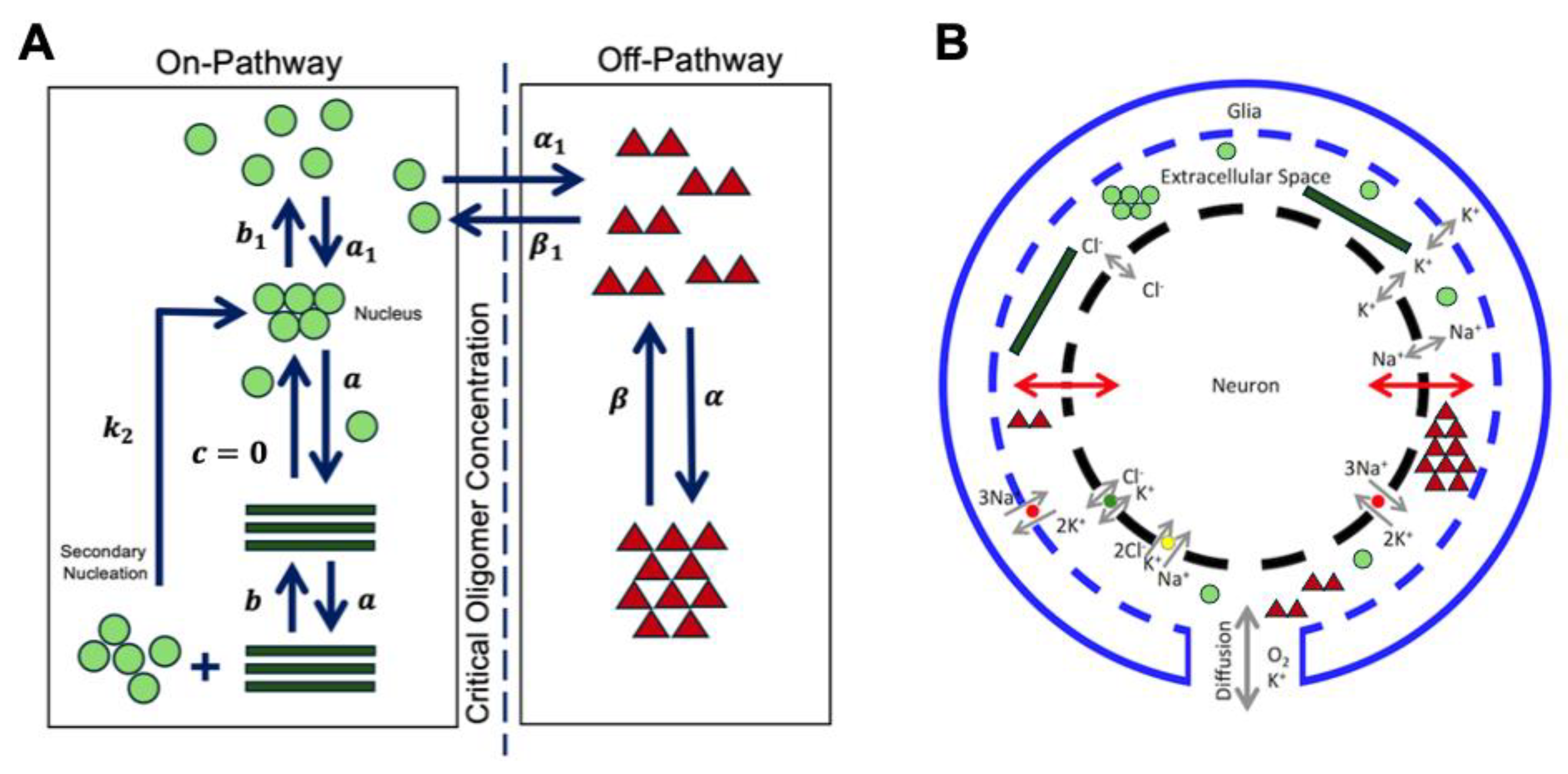
Figure 2.
The model reproduces the observed transition from predominantly sigmoidal to biphasic growth as we increase initial monomer concentration. Sample fits to ThT signal at 2 μM (A), 5 μM (B), and 10 μM (C) where the black, red, green, and blue lines represent experimental data, off-pathway oligomers, on-pathway curvilinear fibrils, and the overall aggregated species, respectively. (D) The rate of secondary nucleation as a function of monomer concentration obtained from model fits to experimental data similar to panels (A) to (C) (black) and its functional form (blue). .
Figure 2.
The model reproduces the observed transition from predominantly sigmoidal to biphasic growth as we increase initial monomer concentration. Sample fits to ThT signal at 2 μM (A), 5 μM (B), and 10 μM (C) where the black, red, green, and blue lines represent experimental data, off-pathway oligomers, on-pathway curvilinear fibrils, and the overall aggregated species, respectively. (D) The rate of secondary nucleation as a function of monomer concentration obtained from model fits to experimental data similar to panels (A) to (C) (black) and its functional form (blue). .
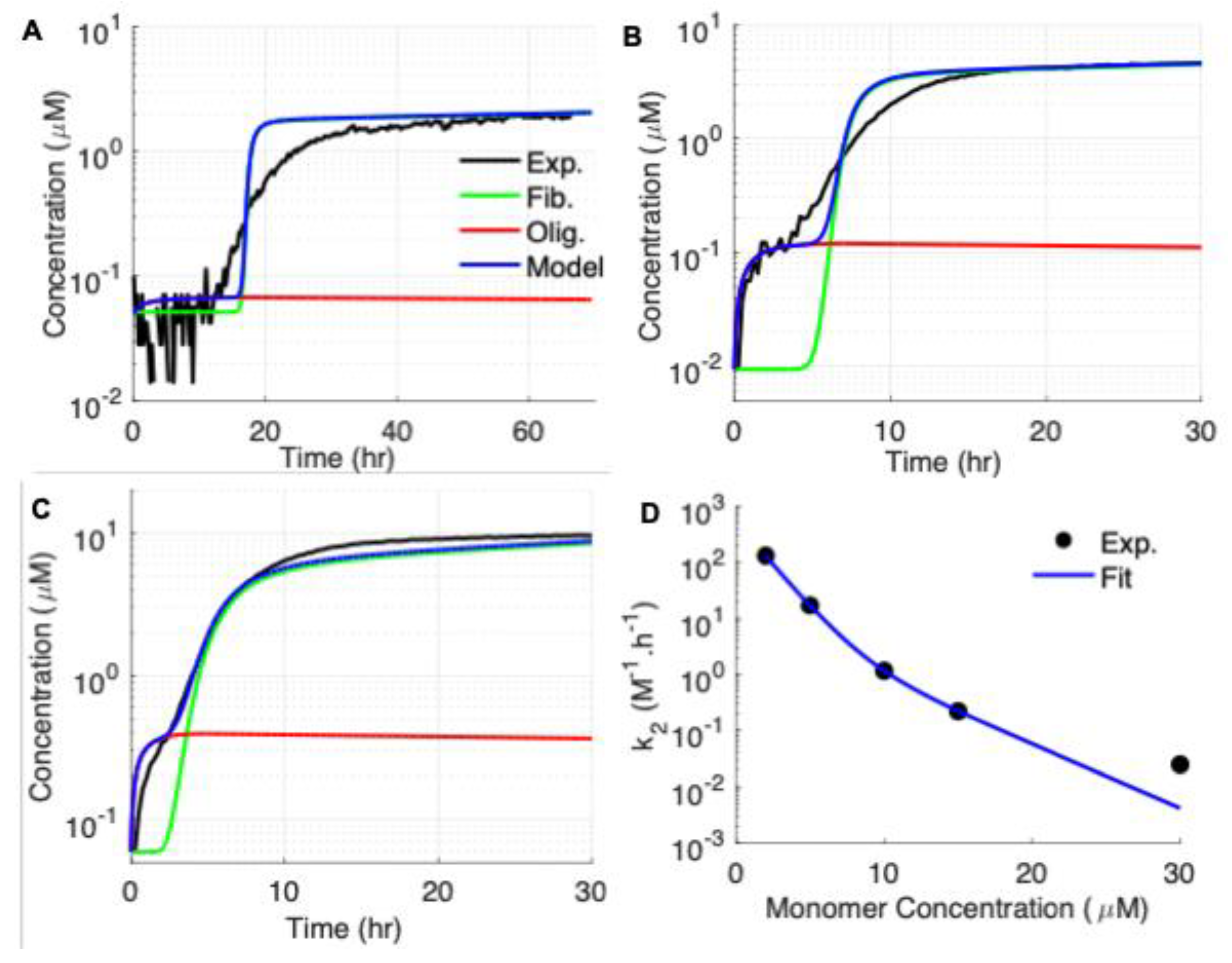
Figure 3.
Changes in neuronal variables during SD. The membrane potential of the neuron is locked into a depolarized state during a SD (A) causing [K+]o to rise (B). The significant changes in K+, Na+, and Cl- in the intra- and extracellular spaces result in the swelling of the neuron (C), which causes the ECS to shrink (D).
Figure 3.
Changes in neuronal variables during SD. The membrane potential of the neuron is locked into a depolarized state during a SD (A) causing [K+]o to rise (B). The significant changes in K+, Na+, and Cl- in the intra- and extracellular spaces result in the swelling of the neuron (C), which causes the ECS to shrink (D).
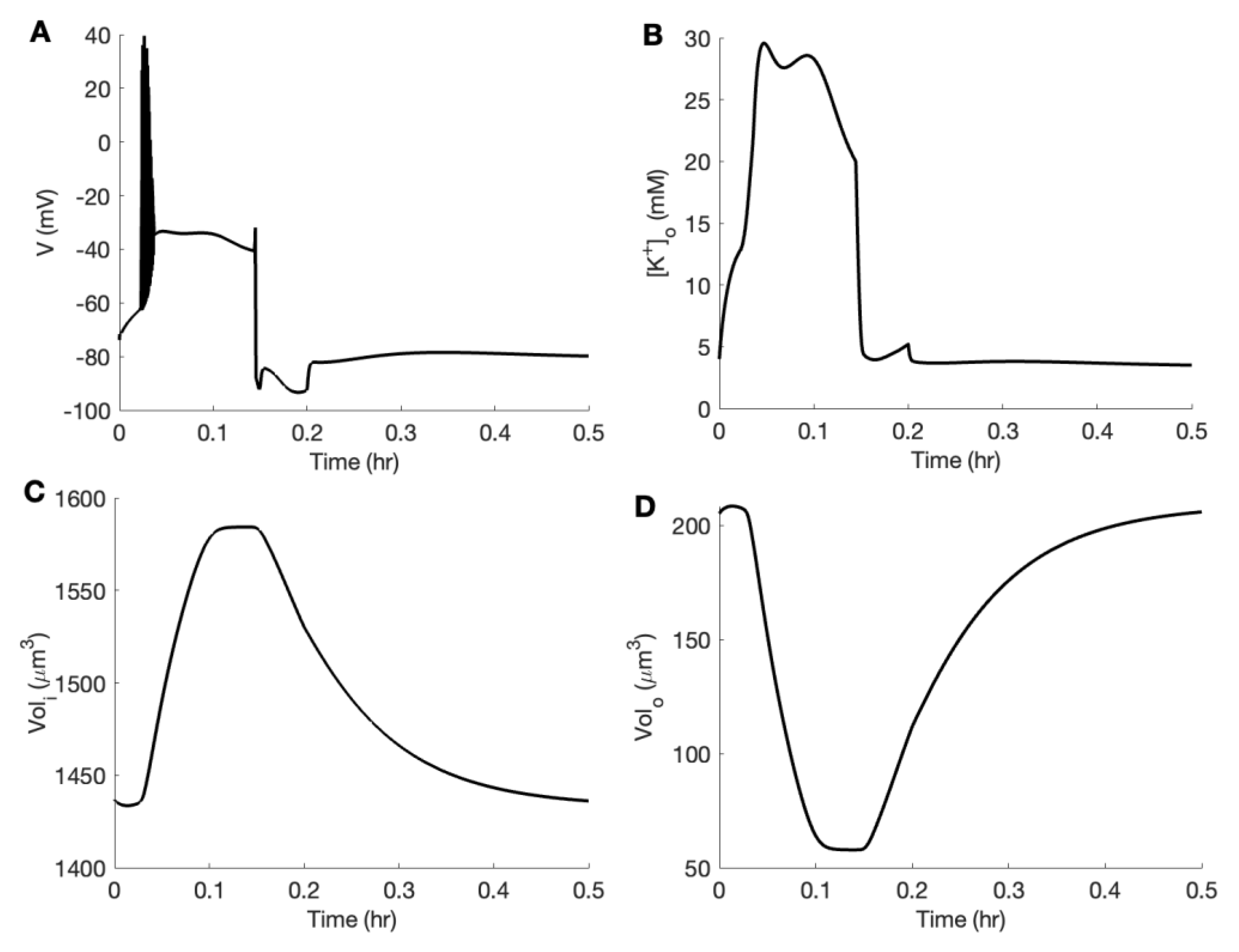
Figure 4.
Figure 4. Changes in the aggregation kinetics of Aβ42 due to SD events. The time-evolution of fibril formation (A), off-pathway intermediate species (dimers) (B), and oligomers (C) with no (black), one (blue), two (red), and three (green) SD events, beginning at 0 hr, 24 hr, and 48 hr, respectively, and each event lasting for 12 min. An initial monomer concentration of 1 μM (A1-C1), 5 μM (A2-C2), and 0.5 μM (A3-C3) was used.
Figure 4.
Figure 4. Changes in the aggregation kinetics of Aβ42 due to SD events. The time-evolution of fibril formation (A), off-pathway intermediate species (dimers) (B), and oligomers (C) with no (black), one (blue), two (red), and three (green) SD events, beginning at 0 hr, 24 hr, and 48 hr, respectively, and each event lasting for 12 min. An initial monomer concentration of 1 μM (A1-C1), 5 μM (A2-C2), and 0.5 μM (A3-C3) was used.
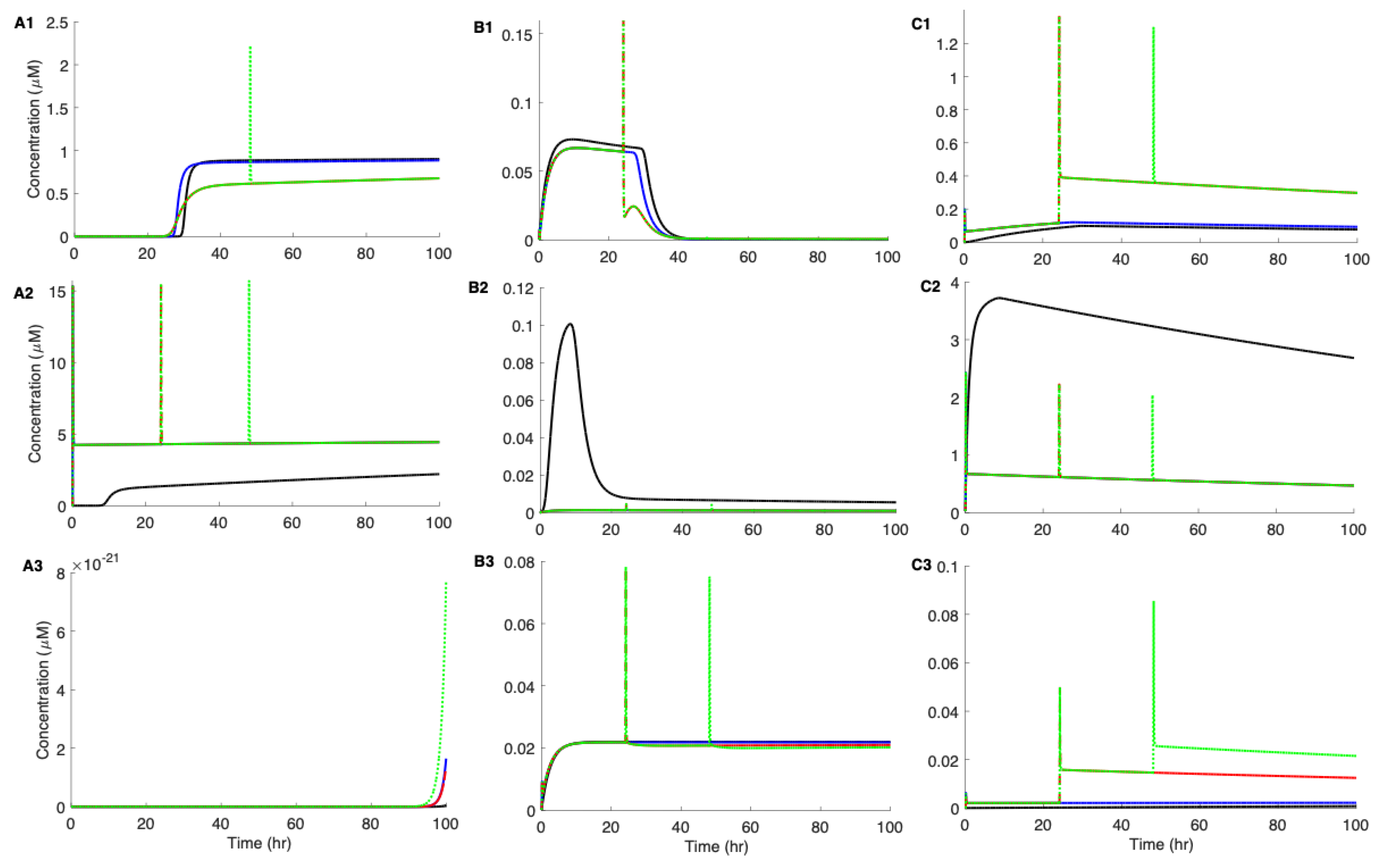
Figure 5.
Increasing the intensity and duration of metabolic stress increases the likelihood of off-pathway aggregation. Changes in [K+]o (A1) and extracellular volume (B1) as we raise K+ in the bath solution from 3.5 mM (black) to 12 mM (blue), 26 mM (red), 50 mM (green), and 60 mM (purple) for 12 minutes (0 to 0.2 hr in the figure). Note that at high K+ in the bath solution, the duration for which [K+]o stays elevated is also longer as Na+/K+-ATPase takes longer to restore normal [K+]o. Off-pathway dimers (A2) and oligomers (B2) when the neuron is exposed to four such metabolic stress events (at 0 hr, 24 hr, 48 hr, and 72 hr), each lasting for 12 minutes. .
Figure 5.
Increasing the intensity and duration of metabolic stress increases the likelihood of off-pathway aggregation. Changes in [K+]o (A1) and extracellular volume (B1) as we raise K+ in the bath solution from 3.5 mM (black) to 12 mM (blue), 26 mM (red), 50 mM (green), and 60 mM (purple) for 12 minutes (0 to 0.2 hr in the figure). Note that at high K+ in the bath solution, the duration for which [K+]o stays elevated is also longer as Na+/K+-ATPase takes longer to restore normal [K+]o. Off-pathway dimers (A2) and oligomers (B2) when the neuron is exposed to four such metabolic stress events (at 0 hr, 24 hr, 48 hr, and 72 hr), each lasting for 12 minutes. .
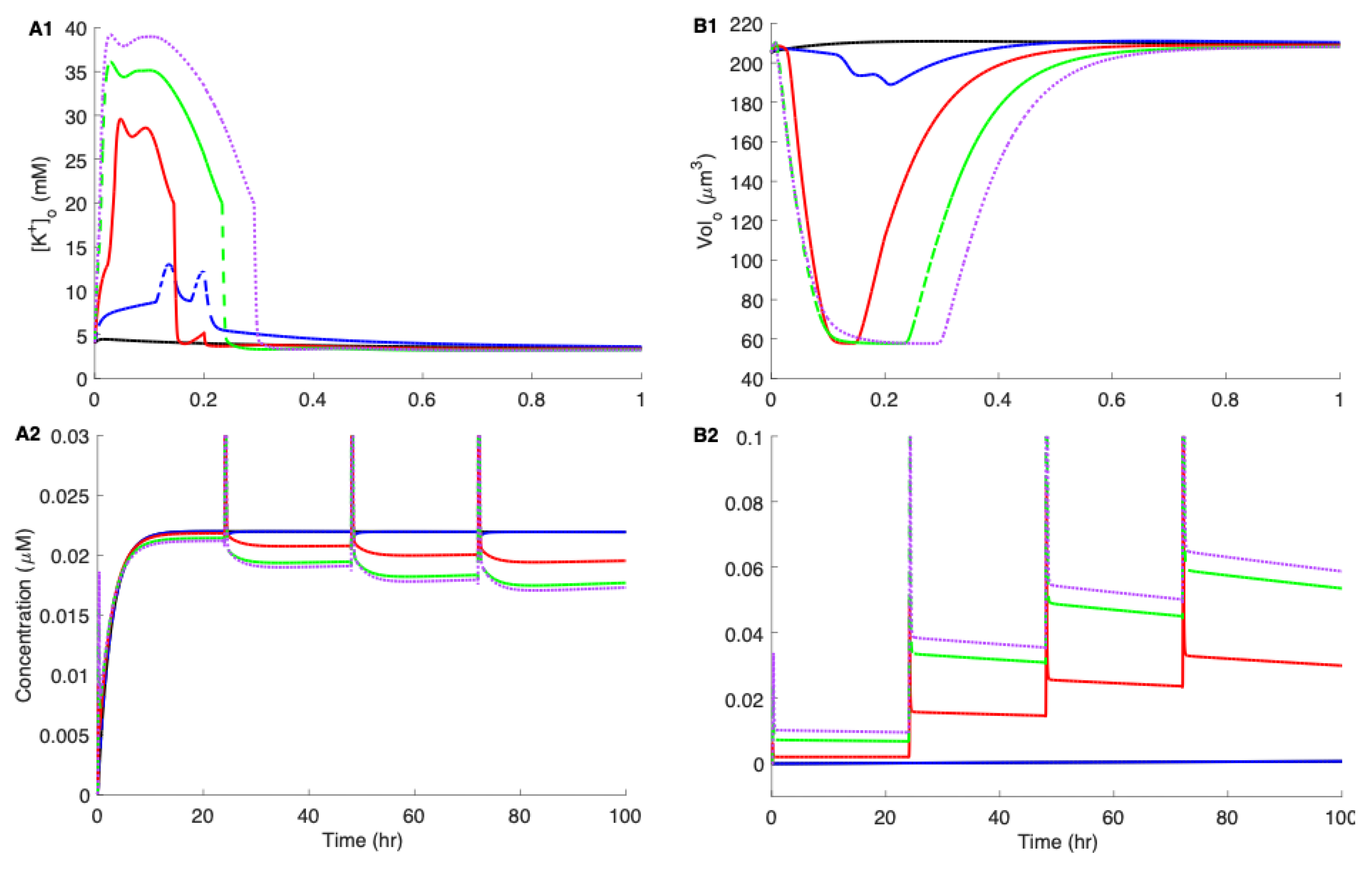
Figure 6.
Pre-existing off-pathway dimers exacerbate the formation of oligomers due to metabolic stress whereas pre-existing on-pathway nuclei promotes the formation of fibrils, suppressing the formation of off-pathway species. Changes in fibril (A), off-pathway dimers (B), and oligomer formation when the neuron is exposed to four SD events without pre-existing dimers or nuclei (black lines), with 0.01μM pre-existing off-pathway dimers (red), with pre-existing 0.01μM off-pathway dimers and 0.001μM on-pathway nuclei (green), and with 0.01μM pre-existing off-pathway dimers but no metabolic stress (blue). An initial monomer concentration of 0.5μM is used and the four metabolic stress events are applied by raising K+ in the bath solution from 3.5mM to 26mM for 12 min at 0hr, 24hr, 48hr, and 72hr.
Figure 6.
Pre-existing off-pathway dimers exacerbate the formation of oligomers due to metabolic stress whereas pre-existing on-pathway nuclei promotes the formation of fibrils, suppressing the formation of off-pathway species. Changes in fibril (A), off-pathway dimers (B), and oligomer formation when the neuron is exposed to four SD events without pre-existing dimers or nuclei (black lines), with 0.01μM pre-existing off-pathway dimers (red), with pre-existing 0.01μM off-pathway dimers and 0.001μM on-pathway nuclei (green), and with 0.01μM pre-existing off-pathway dimers but no metabolic stress (blue). An initial monomer concentration of 0.5μM is used and the four metabolic stress events are applied by raising K+ in the bath solution from 3.5mM to 26mM for 12 min at 0hr, 24hr, 48hr, and 72hr.
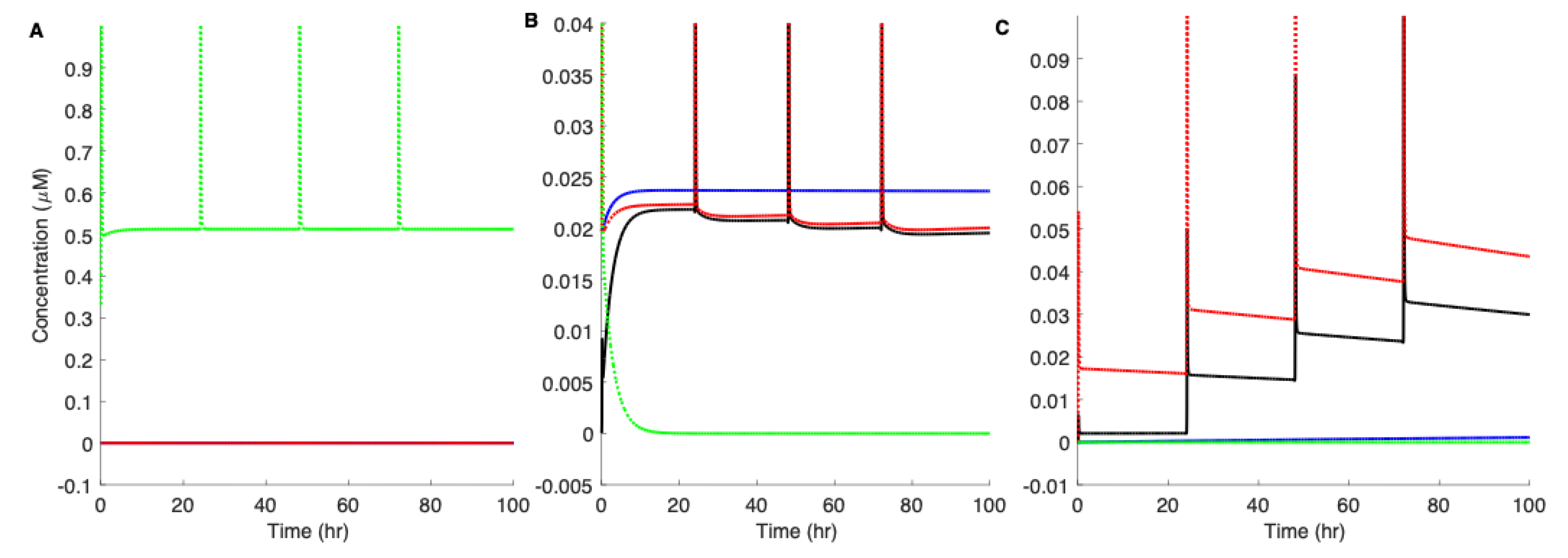

Table 1.
Fitted kinetic rate constants for aggregation model.
| Primary nucleation rate | ||
| Dissociation rate of primary nuclei | ||
| RFs formation rate | ||
| RFs dissociation rate | ||
| Dimer formation rate | ||
| Dimer dissociation rate | ||
| gOs formation rate | ||
| gOs dissociation rate |
Table 2.
Parameters used in the neuron model. Parameter values are taken from our previous work [3].
Table 2.
Parameters used in the neuron model. Parameter values are taken from our previous work [3].
| Membrane capacitance | 1 | |
| Maximal conductance of sodium current | 30 | |
| Maximal conductance of potassium current | 25 | |
| Conductance of leak sodium current | 0.0247 | |
| Conductance of leak potassium current | 0.05 | |
| Conductance of leak chloride current | 0.1 | |
| Ratio of the initial intra-/extracellular volume | 7 | |
| Maximal glial uptake strength of potassium | 5 | |
| Maximal potassium diffusion rate | 0.25 | |
| Normal bath potassium concentration | 3.5 | |
| Oxygen diffusion rate | 0.17 | |
| Conversion factor | 5.3 | |
| Maximal KCC2 cotransporter strength | 0.3 | |
| Maximal NKCC1 cotransporter strength | 0.1 | |
| Normal bath oxygen concentration | 32 | |
| Maximal Na/K pump rate | 0.8 | |
| Sodium concentration in glia | 18 | |
| Intracellular impermeable anions | 132 | |
| Extracellular impermeable anions | 18 |
Disclaimer/Publisher’s Note: The statements, opinions and data contained in all publications are solely those of the individual author(s) and contributor(s) and not of MDPI and/or the editor(s). MDPI and/or the editor(s) disclaim responsibility for any injury to people or property resulting from any ideas, methods, instructions or products referred to in the content. |
© 2026 by the authors. Licensee MDPI, Basel, Switzerland. This article is an open access article distributed under the terms and conditions of the Creative Commons Attribution (CC BY) license (http://creativecommons.org/licenses/by/4.0/).
Copyright: This open access article is published under a Creative Commons CC BY 4.0 license, which permit the free download, distribution, and reuse, provided that the author and preprint are cited in any reuse.


