

Submitted:
13 April 2026
Posted:
15 April 2026
You are already at the latest version
Abstract
Background: Penile squamous cell carcinoma (pSCC) is a global health burden with poor systemic treatment efficacy for advanced disease, relying on pathway-agnostic regimens despite two distinct carcinogenic pathways (HPV-driven vs. HPV-independent). We conducted an integrative review to systematically compare the tumor immune microenvironment (TIME) of HPV-driven and HPV-independent pSCC to guide immunotherapy stratification. Methods: An integrative review of 21 studies, including single-cell/spatial transcriptomics and a Phase II clinical trial, synthesized evidence from over 4,500 pSCC patients published between January 2020 and April 2026. Results: HPV-positive pSCC presents an immunologically active but partially suppressed TIME, defined by significantly higher CD8+ T-cell infiltration and lower immune checkpoint co-expression and exhaustion (e.g., TIGIT). HPV-negative tumors exhibit a broadly immunosuppressive niche marked by elevated PD-L1 prevalence (51.4% pooled), increased regulatory T-cell and M2-macrophage polarization, and multi-checkpoint co-exhaustion (PD-1, TIM-3, LAG-3). PD-L1 overexpression is associated with shorter cancer-specific survival. Clinically, HPV positivity and CD8+ T-cell density independently predicted progression-free survival benefit from atezolizumab. Conclusion: These findings establish HPV status and TIME composition as actionable determinants of immunotherapy benefit. We recommend prospective integration of HPV testing and tumor-infiltrating lymphocyte quantification into future randomized trials to guide patient selection and explore combinatorial checkpoint blockade, particularly for the multi-exhausted HPV-negative disease subset.
Keywords:
penile squamous cell carcinoma
; tumor immune microenvironment
; human papillomavirus
; PD-L1
; tumor-infiltrating lymphocytes
; immune checkpoint inhibitors
; regulatory T cells
; tumor-associated macrophages
; single-cell transcriptomics
2 ChauxLab Institute, Asunción, Paraguay
1. Introduction
Penile squamous cell carcinoma (pSCC) represents more than 95% of all penile malignancies and constitutes a significant global health burden. Annual incidence in high-income countries is below 1 case per 100,000 men; however, rates of 3 to 7 per 100,000 are reported in parts of Sub-Saharan Africa, South America, and South Asia [1]. Marked geographic and socioeconomic disparities reflect differences in access to preventive care, circumcision practices, and high-risk human papillomavirus (hrHPV) vaccination coverage. The five-year survival for metastatic disease remains approximately 50%, and no systemic therapy has demonstrated a survival benefit in a randomized controlled trial [2,3]. This epidemiological and therapeutic context frames pSCC as a neglected malignancy requiring urgent scientific attention.
Two biologically distinct carcinogenic pathways underlie pSCC development. The HPV-dependent pathway, driven predominantly by HPV16, operates through viral oncoprotein-mediated inactivation of the p53 and retinoblastoma tumor suppressor axes [4]. The HPV-independent pathway involves somatic mutations in TP53, CDKN2A, PIK3CA, and NOTCH1, activation of the TERT promoter, and dysregulation of the PI3K/AKT/mTOR and RTK-RAS cascades [5,6]. Despite this mechanistic duality, treatment for advanced pSCC has remained largely pathway-agnostic, relying on platinum-based chemotherapy regimens with modest efficacy. Median overall survival following first-line chemotherapy is only 5.6 months, and 63.3% of patients experience disease recurrence or progression [7].
Recent advances in high-dimensional immune profiling have transformed understanding of the tumor immune microenvironment (TIME) architecture in pSCC. Immunohistochemical cohort studies have characterized the density and spatial distribution of tumor-infiltrating lymphocytes (TILs), regulatory T cells (Tregs), tumor-associated macrophages (TAMs), and immune checkpoint molecules across HPV-stratified cohorts [8,9]. Single-cell RNA sequencing (scRNA-seq) and spatial transcriptomics have provided unprecedented resolution of TIME cellular heterogeneity, revealing pathway-specific differences in T-cell exhaustion states and macrophage polarization [2,10]. The PERICLES phase II trial demonstrated that intratumoral CD3+CD8+ T-cell density and hrHPV positivity predict progression-free survival benefit from atezolizumab [11], establishing proof-of-concept for TIME-guided immunotherapy stratification in pSCC.
The present integrative review aimed to systematically characterize and compare the TIME composition of HPV-driven and HPV-independent pSCC. Specific objectives were: 1) to characterize the density and phenotype of TIL subsets across HPV-stratified cohorts; 2) to describe PD-L1 expression patterns and their prognostic implications; 3) to delineate the role of TAMs and Tregs in each pathway; 4) to analyze expression of alternative immune checkpoints; and 5) to appraise current clinical evidence for checkpoint inhibitor-based immunotherapy.
2. Materials and Methods
2.1. Design and Study Protocol
This study was conducted as an integrative review following the methodological framework of Whittemore and Knafl [12], which accommodates diverse research designs and enables comprehensive synthesis of heterogeneous evidence. Reporting adhered to the Preferred Reporting Items for Systematic Reviews and Meta-Analyses 2020 guidelines [13]. A prospective protocol specifying eligibility criteria, search strategies, and primary outcome domains was developed prior to the search phase. The review question was structured using the population/intervention/comparator/outcome (PICO) framework, with pSCC patients as the population, TIME composition as the exposure, and HPV-positive versus HPV-negative status as the comparator.
2.2. Search Strategy
Systematic searches were performed in four primary electronic databases: PubMed/MEDLINE, the Cochrane Central Register of Controlled Trials, Embase, and Web of Science. The search period extended from January 2020 to April 2026. Search terms were constructed using Medical Subject Headings (MeSH) and free-text equivalents organized into four thematic query sets: 1) tumor immune microenvironment AND penile squamous cell carcinoma AND HPV; 2) PD-L1 OR tumor-infiltrating lymphocytes AND penile cancer AND immunotherapy; 3) HPV carcinogenesis AND TP53 OR CDKN2A AND molecular pathways; and 4) CD8+ T cells OR regulatory T cells OR macrophage polarization AND HPV-associated carcinoma. No language restrictions were applied. The integrity and contextual classification of retrieved references were verified using SCITE.ai as a bibliometric validation tool; this platform was not employed as a source for primary record identification.
2.3. Eligibility Criteria
Studies were eligible if they: 1) enrolled patients with histologically confirmed pSCC; 2) reported data on TIME composition, immune cell quantification, or checkpoint molecule expression; 3) reported HPV status for the overall cohort or a stratified subset; 4) were published between January 2020 and April 2026; and 5) provided sufficient methodological detail for quality appraisal. Studies were excluded if they focused exclusively on non-squamous penile histologies, reported only animal or in vitro data without human correlates, lacked quantitative or phenotypic characterization of immune infiltrates, were non-peer-reviewed conference abstracts, or presented duplicate data from previously included cohorts.
2.4. Study Selection Process
Study selection was conducted in three sequential phases following the PRISMA 2020 flowchart [13]. In the first phase, titles and abstracts of all retrieved records were screened by a single reviewer against predefined eligibility criteria. In the second phase, full texts of potentially eligible records were retrieved and evaluated by the same reviewer against all inclusion and exclusion criteria. In the third phase, reference lists of included studies and relevant systematic reviews were hand-searched to identify additional eligible records. Reasons for exclusion at the full-text stage are documented in the study selection narrative within the Results section.
2.5. Data Extraction
Data were extracted from each included study using a standardized pre-piloted form capturing: bibliographic identifiers; study design and sample size; HPV detection method and prevalence; immune markers quantified and detection platform (immunohistochemistry, flow cytometry, or scRNA-seq); key findings stratified by HPV status; and survival or clinical outcome data when reported. Extraction was performed by a single reviewer. To mitigate the risk of selective or inconsistent extraction, the form was applied systematically to every included study in a single session, and all extracted values were cross-checked against the source text prior to synthesis [14].
2.6. Methodological Quality Assessment
The risk of bias of each included study was evaluated using the tool appropriate to its design. Randomized controlled trials were assessed with the Risk of Bias 2 tool [15]. Observational studies were evaluated with the Risk of Bias in Non-randomized Studies of Interventions (ROBINS-I) tool [14]. Systematic reviews and meta-analyses were appraised using AMSTAR-2. Each study was classified as having low, moderate, or high risk of bias based on domain-level judgments. The detailed domain-by-domain results are presented in Annex 1 (Table A1).
2.7. Evidence Synthesis
Given the substantial clinical and methodological heterogeneity of the included studies — which varied in HPV detection method, immunohistochemical scoring thresholds, antibody panels, and patient populations — meta-analytical pooling of effect estimates was not feasible for the majority of outcomes. A structured narrative synthesis organized findings by immune cell compartment and checkpoint domain. Potential sources of bias, including publication bias favoring positive TIME-immunotherapy associations, heterogeneity in HPV testing methodologies, and the absence of independent reviewer verification in the selection and extraction process, are addressed in the limitations subsection of the Discussion.
3. Results
3.1. Study Selection
The systematic search across PubMed/MEDLINE, Cochrane Central, Embase, and Web of Science identified 487 records for the period January 2020 to April 2026. After removal of 89 duplicates, 398 unique records were screened by title and abstract, of which 341 were excluded for the following reasons: no pSCC population (n = 143), no TIME characterization (n = 98), no HPV data (n = 67), and non-human data or conference abstract only (n = 33). A total of 53 full texts were evaluated for eligibility. Of these, 32 were excluded with documented reasons: equine or veterinary pSCC models without human validation (n = 8), molecular studies without TIME data (n = 7), duplicate reporting on overlapping cohorts (n = 5), insufficient HPV stratification for pathway-specific inference (n = 5), and redundancy with higher-quality included studies without incremental contribution to the synthesis (n = 7). A total of 21 studies were included in the final qualitative synthesis (Figure 1).
3.2. Characteristics of the Included Studies
The 21 included studies comprised more than 4,500 pSCC patients. Geographically, studies originated from Asia (n = 7, 33.3%), Europe (n = 5, 23.8%), multinational settings (n = 4, 19.0%), and North America (n = 4, 19.0%), with one contribution from Africa (n = 1, 4.8%). Study designs encompassed immunohistochemical cohort studies (n = 7, 33.3%), systematic reviews and meta-analyses (n = 4, 19.0%), whole-exome or genomic sequencing studies (n = 4, 19.0%), single-cell or spatial transcriptomic analyses (n = 2, 9.5%), narrative reviews (n = 2, 9.5%), one phase II clinical trial (n = 1, 4.8%), and one case report (n = 1, 4.8%). HPV detection was performed by PCR in most studies, with p16 immunohistochemistry used as a surrogate marker in several cohort studies. Detailed characteristics are summarized in Table 1. Risk of bias was low in 33.3% of studies, moderate in 61.9%, and high in 4.8%, reflecting the inherent constraints of retrospective tissue-based research in a rare malignancy. The detailed domain-by-domain risk of bias evaluation is presented in Appendix A (Table A1).
3.3. Molecular Foundations of Time Divergence: The Two Carcinogenic Pathways
The immune phenotype of pSCC is inseparable from its molecular pathogenesis. In HPV-positive tumors, E6 and E7 oncoproteins degrade p53 and the retinoblastoma protein (pRb), abrogating DNA damage surveillance and driving aberrant proliferation. This mechanism generates stable viral peptide neoantigens recognized by CD8+ cytotoxic T cells, without necessarily accumulating the broad somatic mutation burden characteristic of HPV-independent disease [4,6]. HPV-driven tumors exhibit a mutational signature dominated by APOBEC-related cytosine deamination and carry a significantly lower overall somatic mutational burden compared to HPV-negative counterparts [6].
In HPV-independent pSCC, recurrent somatic driver mutations in TP53 (up to 48%), CDKN2A, NOTCH1, PIK3CA, and FAT1 collectively dismantle tumor suppressor checkpoints [5,16]. TERT promoter mutations occur in 53.6% of penile carcinomas overall and are significantly more frequent in HPV-negative cases (67.6% versus 32.4%; P = 0.048) [17]. PIK3CA activating mutations and NOTCH1 alterations further activate oncogenic signaling and contribute to immune evasion through PD-L1 upregulation downstream of PI3K/AKT/mTOR [18]. Two mutational signatures have been identified in pSCC: an APOBEC-enriched signature associated with significantly worse prognosis (HR = 2.41; 95% CI: 1.11–6.77; P = 0.042) and a mismatch repair–associated signature [6]. These divergent molecular landscapes directly shape the immunological architecture of each tumor subtype.
3.4. Tumor-Infiltrating Lymphocytes: Differential Density and Phenotype by HPV Status
The density and spatial organization of TILs represent the most consistently studied TIME parameter in pSCC. HPV-positive tumors exhibit significantly higher stromal CD8+ T-cell infiltration compared to HPV-negative tumors, a finding replicated across independent cohorts [8,19]. Chu et al. characterized the TIME in pSCC using an immunophenotyping approach integrating PD-1/PD-L1, CTLA-4, Siglec-15, CD8+, Granzyme B+, FOXP3+, and CD163+ markers. Three distinct immunophenotypic clusters were identified: an immune-inflamed phenotype (high CD8+ intratumoral infiltration, high PD-L1), an immune-excluded phenotype (abundant stromal but restricted intratumoral TILs), and an immune-desert phenotype (low TIL density, low PD-L1). HPV-positive tumors were enriched in the immune-inflamed cluster [20].
Hladek et al. quantified TIL density using digital image analysis in 55 pSCC specimens, finding a significant association between higher CD3+ immune cell infiltrate density and lower tumor stage [8]. Basaloid histology — associated with HPV infection — correlated significantly with higher CD8+ T-cell density. Cañete-Portillo et al. [21] analyzed 108 pSCC cases through 528 tissue microarray cores and demonstrated a moderate positive correlation between PD-L1 tumor-cell expression and intratumoral CD8+ T-cell infiltration (r = 0.477; P < 0.001), consistent with the adaptive immune resistance model in which PD-L1 is upregulated by interferon-γ from tumor-reactive CD8+ lymphocytes. The strongest correlation identified was between FOXP3+ stromal lymphocytes and CD8+ stromal T cells (r = 0.717; P < 0.001), indicating co-recruitment of effector and regulatory T cells to the peritumoral stroma [21].
3.5. The PD-1/PD-L1 Axis: Differential Expression and Prognostic Significance
PD-L1 expression constitutes the most extensively studied immune checkpoint feature of pSCC and exhibits a well-documented inverse association with HPV status. The pooled prevalence of PD-L1 positivity across nine retrospective studies encompassing 1,003 patients is 51.4% (95% CI: 42.1–60.8%) [7]. PD-L1 positivity was independently associated with shorter cancer-specific survival (HR = 1.578; 95% CI: 1.227–2.029; I2 = 23.3%), though no significant association with overall survival was identified. Subgroup analysis revealed that the prognostic impact of elevated PD-L1 on cancer-specific survival was significant specifically in Caucasian populations (HR = 1.827; 95% CI: 1.355–2.465; I2 = 0.0%) [7].
A critical finding is the inverse correlation between PD-L1 positivity and HPV status (OR = 0.510; 95% CI: 0.322–0.810; P = 0.003), confirming that HPV-negative tumors are significantly more likely to overexpress PD-L1 [7]. PD-L1 overexpression was further associated with higher tumor stage (pT2–4 versus pT1: OR = 0.480; 95% CI: 0.346–0.667; P = 0.001), higher grade (OR = 0.377; 95% CI: 0.264–0.538; P < 0.001), and lymph node positivity (pN1–3 versus pN0/NX: OR = 0.541; 95% CI: 0.385–0.759; P = 0.001). Müller et al. corroborated these associations in a cohort of 60 pSCC cases, confirming that PD-L1 positivity concentrates in HPV-negative, higher-stage disease [9]. Sangkhamanon et al. reported PD-L1 positivity in 18.6% of 43 pSCC cases using a higher positivity threshold (>25% tumor cell staining), with a significant association with early pathological T stage (P = 0.014), illustrating the threshold-dependence of PD-L1 prevalence estimates across studies [22].
3.6. Regulatory T Cells and Immunosuppressive Macrophages
Beyond the cytotoxic T-cell compartment, the immunosuppressive architecture of pSCC TIME is shaped by FOXP3+ Tregs and alternatively activated (M2-polarized) TAMs. In a prospective cross-sectional cohort of 35 pSCC patients from Zambia, high-grade tumors exhibited significantly higher FOXP3+ cell infiltration (P = 0.02), CD68+ pan-macrophage density (P = 0.01), and CD163+ M2-macrophage infiltration (P = 0.01) compared to low-grade tumors, demonstrating that immunosuppressive TIME remodeling escalates with histological aggressiveness [1]. Concordantly, Chu et al. identified higher FOXP3+ Treg density in HPV-negative immunophenotypic clusters, consistent with a tolerogenic microenvironment actively suppressing CD8+ effector responses in the HPV-independent pathway [20].
Single-cell RNA sequencing by Zhu et al., analyzing 52,980 single cells from 11 treatment-naïve pSCC patients, found that HPV-positive tumors harbored increased mast cell abundance and reduced proliferative macrophage subpopulations compared to HPV-negative tumors [2]. Critically, CD8+ T cells in HPV-positive pSCC expressed lower levels of immune checkpoint molecules, consistent with a less exhausted effector state. Conversely, TIGIT and its cognate ligands were significantly enriched in HPV-negative tumors, establishing an additional layer of immunosuppression in the HPV-independent pathway [2]. These single-cell observations argue that HPV status is not merely a prognostic label but a determinant of TIME cellular composition at single-cell resolution.
3.7. Alternative Immune Checkpoints: TIM-3, LAG-3, and TIGIT
Beyond the PD-1/PD-L1 axis, multiple co-inhibitory checkpoints contribute to T-cell exhaustion in pSCC TIME. In the Mumba et al. [1] cohort, significant correlations were identified between PD-1 and LAG-3 co-expression (ρ = 0.69; P = 0.0001), PD-1 and TIM-3 (ρ = 0.49; P = 0.017), and TIM-3 and LAG-3 (ρ = 0.61; P = 0.001), indicating multi-checkpoint co-exhaustion on TILs. TIM-3 expression was significantly higher in tumors harboring multiple hrHPV co-infections (P = 0.04), implying that viral infection intensity modulates the degree of T-cell exhaustion. PD-L1 expression was significantly higher in HIV-negative compared to HIV-positive participants (P = 0.02), underscoring that co-morbid infections further modulate the checkpoint landscape [1]. TIGIT, identified as enriched in HPV-negative pSCC by scRNA-seq, provides an additional therapeutic target in that pathway subset [2].
3.8. Spatial and Single-Cell Resolution of TIME Architecture
Single-nucleus RNA sequencing combined with Stereo-seq spatial transcriptomics in six pSCC specimens — including two HPV-positive and four HPV-negative cases — identified a spatially distinct tumor subpopulation (Tum_1) located at the tumor-normal boundary, exhibiting enhanced basal-like and stemness features with high LAMC2 expression activating laminin-integrin signaling via ITGA6/ITGB4 to promote invasiveness [10]. In HPV-positive tumors, this Tum_1 subpopulation actively suppressed T-cell and macrophage immune function, establishing an immunosuppressive boundary microenvironment paradoxically within the overall more immunogenic HPV-positive phenotype. This finding introduces nuance to the binary HPV-positive/favorable versus HPV-negative/unfavorable immune model and indicates that even in HPV-driven disease, spatially restricted subpopulations engage active immune evasion [10].
3.9. Clinical Immunotherapy Evidence and Predictive Biomarkers
The PERICLES phase II trial enrolled 32 patients with advanced pSCC receiving atezolizumab (1,200 mg every 3 weeks), with or without radiotherapy. The objective response rate was 16.7% (95% CI: 6–35), including two complete responders (6.7%) and three partial responders (10%), with a median overall survival of 11.3 months (95% CI: 5.5–18.7). The primary endpoint of 1-year progression-free survival (12.5%; 95% CI: 5.0–31.3) was not met; however, exploratory biomarker analyses identified hrHPV positivity (P = 0.003) and high intratumoral CD3+CD8+ T-cell infiltration (P = 0.037) as independent predictors of improved progression-free survival with atezolizumab [11]. These findings establish proof-of-concept for TIME-guided patient selection in pSCC immunotherapy trials.
A recent systematic review of immunotherapy in pSCC reported an overall response rate of 39.4% in the HERCULES trial with pembrolizumab in a selected advanced pSCC cohort, substantially exceeding the PERICLES results and suggesting that biomarker-enriched patient selection — potentially incorporating HPV status, TIL density, and PD-L1 expression — may materially improve immunotherapy efficacy [23]. Case-level evidence further supports that pSCC with high tumor mutational burden and microsatellite instability may achieve dramatic responses to combined PD-1/CTLA-4 blockade [24]. Collectively, these data argue for mandatory HPV testing and TIL quantification as stratification variables in future randomized immunotherapy trials for pSCC.
4. Discussion
This integrative review demonstrates that pSCC harbors two immunologically distinct microenvironmental landscapes that map directly onto its two carcinogenic pathways. HPV-positive pSCC is characterized by higher stromal CD8+ T-cell infiltration, lower immune checkpoint molecule co-expression on cytotoxic lymphocytes, reduced TIGIT signaling, and a mast cell-enriched, less exhausted macrophage profile. HPV-negative pSCC displays substantially higher PD-L1 prevalence (51.4% pooled; 95% CI: 42.1–60.8%), greater Treg abundance, M2 TAM polarization, and multi-checkpoint co-exhaustion on TILs [2,7,20]. These findings are consistent with immunological observations in other HPV-stratified squamous cell carcinomas, including oropharyngeal SCC, where HPV-positive tumors exhibit enhanced immune infiltration relative to HPV-negative counterparts.
The prognostic data complement this mechanistic picture. PD-L1 overexpression independently predicts shorter cancer-specific survival (HR = 1.578), associates with advanced stage and lymph node positivity, and inversely correlates with HPV status — converging on HPV-negative disease as the higher-risk, more immune-evasive subtype [7]. Importantly, spatial transcriptomic analysis reveals that even HPV-positive tumors harbor spatially restricted subpopulations capable of suppressing T-cell and macrophage function at the tumor-normal boundary [10], cautioning against equating HPV positivity with uniform immune responsiveness.
The distinct TIME architectures arise from fundamental differences in antigenic landscape and oncogenic signaling. In HPV-driven pSCC, constitutively expressed E6 and E7 oncoproteins generate stable viral peptide neoantigens driving a sustained CD8+ T-cell response that is comparatively less exhausted than in tumors lacking defined viral antigens [4]. The APOBEC mutational signature enriched in HPV-positive disease generates a distinctive neoantigen profile with potential immunogenic value [6]. In HPV-negative pSCC, the PI3K/AKT/mTOR and EGFR signaling cascades — activated through PIK3CA mutations and EGFR amplification — directly upregulate PD-L1 transcription via STAT3 and NF-κB, mechanistically linking oncogenic pathway activation to immune checkpoint induction [5].
M2 TAM polarization in HPV-negative tumors perpetuates immunosuppressive circuits through secretion of IL-10, TGF-β, and VEGF, which inhibit cytotoxic T-cell function and promote Treg recruitment. The co-expression of PD-1, TIM-3, and LAG-3 on TILs observed in advanced and high-grade pSCC reflects a multi-layered exhaustion phenotype likely resistant to single-checkpoint blockade, providing biological rationale for combinatorial checkpoint inhibition strategies targeting the PD-1/LAG-3 or PD-1/TIM-3 axes [1].
The translational implications of these findings are substantial. The PERICLES trial established that hrHPV positivity and intratumoral CD3+CD8+ T-cell density independently predict progression-free survival benefit from atezolizumab [11]. These findings argue for prospective integration of HPV testing and TIL quantification into eligibility criteria and stratification arms for future pSCC immunotherapy trials. Current international guidelines do not mandate HPV testing in pSCC outside clinical research protocols — a gap that represents an actionable deficiency given the mounting evidence linking HPV status to immunotherapy responsiveness. The International Penile Advanced Cancer Trial (InPACT) provides the collaborative infrastructure needed for TIME-stratified randomized trials [23].
Equity considerations require explicit attention. The highest burden of pSCC falls on men in low- and middle-income countries, where HPV vaccination coverage remains insufficient and advanced disease at presentation is the norm [1]. The Zambian cohort in this review demonstrates that HIV co-infection further modulates PD-L1 expression and checkpoint co-exhaustion, suggesting that therapeutic strategies and biomarker cutoffs developed exclusively in high-income country cohorts may not transfer directly to these populations without independent validation.
Several methodological limitations temper these conclusions. Included immunohistochemical studies relied on heterogeneous HPV detection methods — PCR, p16 IHC, and in situ hybridization — that differ in sensitivity and specificity, potentially introducing HPV status misclassification. Cut-off values for PD-L1 positivity varied across studies (range: >1% to >25%), limiting direct comparability of prevalence estimates. Most included studies were retrospective with limited adjustment for confounders, reflected in the moderate risk of bias ratings in Table A1 [14]. Geographic overrepresentation of European and Asian cohorts constrains generalizability to populations with differing HPV genotype distributions. Publication bias toward positive immune-therapy associations cannot be excluded. A further limitation is the conduct of study selection and data extraction by a single reviewer without independent verification, which increases the risk of inadvertent selection bias and extraction error; this constraint is inherent to the integrative review design when conducted in a single-investigator context. Strengths include application of the Whittemore and Knafl integrative framework [12] permitting synthesis across diverse study designs, and incorporation of single-cell and spatial transcriptomic evidence alongside classical histopathological data.
5. Conclusions
The immune microenvironment of pSCC is profoundly structured by HPV carcinogenic pathway: HPV-positive tumors develop an immunologically active but partially suppressed microenvironment enriched in CD8+ effector T cells with lower checkpoint co-expression, while HPV-negative tumors establish a broadly immunosuppressive niche dominated by PD-L1 overexpression, Tregs, and M2-polarized macrophages. Future research should prioritize prospective validation of HPV status and TIL density as predictive biomarkers in randomized immunotherapy trials, development of combinatorial checkpoint blockade strategies for multi-exhausted HPV-negative disease, and integration of single-cell spatial profiling into biomarker discovery pipelines. Clinicians, trial designers, and oncology policy stakeholders should act on the evidence that HPV status and TIME composition are not merely prognostic labels but actionable determinants of immunotherapy benefit—a recognition with potential to transform outcomes in one of the most understudied solid malignancies in urologic oncology.
Author Contributions
Conceptualization; methodology; investigation; writing—review and editing, A.C.
Funding
This research received no external funding.
Institutional Review Board Statement
Not applicable.
Informed Consent Statement
Not applicable.
Data Availability Statement
Data supporting these findings are available within the article or upon request.
Conflicts of Interest
The author declares no conflict of interest.
Appendix A

Table A1.
Domain-by-domain risk of bias assessment of primary studies with direct citation in the manuscript body.
Table A1.
Domain-by-domain risk of bias assessment of primary studies with direct citation in the manuscript body.
| Study (first author, year) | D1 | D2 | D3 | D4 | D5 | Global judgment | Tool |
|---|---|---|---|---|---|---|---|
| Ahmed et al., 2020 [3] | NI | NI | M | B | M | Moderate | ROBINS-I |
| Baweja & Mar, 2020 [24] | M | NI | NI | B | NI | High | ROBINS-I |
| Cañete-Portillo et al., 2024 [21] | B | B | M | B | M | Moderate | ROBINS-I |
| Cao et al., 2021 [16] | M | M | M | B | M | Moderate | ROBINS-I |
| Chahoud et al., 2021 [6] | B | B | M | B | M | Moderate | ROBINS-I |
| Chu et al., 2020 [20] | B | M | B | B | M | Moderate | ROBINS-I |
| de Vries et al., 2023 [11] | B | B | B | B | B | Low | RoB 2 |
| Hladek et al., 2022 [8] | B | B | B | B | M | Low | ROBINS-I |
| Lü et al., 2022 [7] | B | B | B | B | B | Low | AMSTAR-2 |
| Canto et al., 2022 [18] | B | M | M | B | M | Moderate | ROBINS-I |
| Müller et al., 2021 [9] | B | M | M | B | M | Moderate | ROBINS-I |
| Mumba et al., 2024 [1] | B | M | M | B | M | Moderate | ROBINS-I |
| Ribera-Cortada et al., 2022 [5] | B | B | B | B | B | Low | AMSTAR-2 |
| Sangkhamanon et al., 2023 [22] | M | M | M | B | M | Moderate | ROBINS-I |
| Song et al., 2025 [10] | B | B | M | B | B | Low | ROBINS-I |
| Starita et al., 2022 [17] | B | M | M | B | M | Moderate | ROBINS-I |
| Taghizadeh & Fajković, 2025 [23] | B | B | B | B | B | Low | AMSTAR-2 |
| Tang et al., 2022 [19] | NI | B | M | B | M | Moderate | ROBINS-I |
| Vanthoor et al., 2020 [4] | NI | NI | B | B | B | Moderate | ROBINS-I |
| Winkelmann et al., 2024 [25] | B | M | M | B | M | Moderate | ROBINS-I |
| Zhu et al., 2025 [2] | B | B | B | B | B | Low | ROBINS-I |
Note: Only studies with a direct parenthetical citation in the manuscript body and an evaluable study design are included. For randomized controlled trials (RoB 2): D1 = randomization process; D2 = deviations from intended interventions; D3 = missing outcome data; D4 = measurement of the outcome; D5 = selection of the reported result. For observational studies (ROBINS-I): D1 = confounding; D2 = participant selection; D3 = exposure classification; D4 = deviations from intended interventions; D5 = missing data. For systematic reviews and meta-analyses, AMSTAR-2 was applied for overall methodological rigor. B = low risk; M = moderate risk; A = high risk; NI = not informative (insufficient reporting to assess domain).
References
- Mumba, C; Muhimbe, Z; Mapulanga, V; Kawimbe, M; Mutale, K; Hamasuku, A; et al. The effects of HIV and oncogenic human papillomavirus on the tumor immune microenvironment of penile squamous cell carcinoma. PLoS One [Internet] Available from. 2024, 19, e0300729. [Google Scholar] [CrossRef] [PubMed]
- Zhu, L; Shen, D; Zhou, J; Cheng, C; Xu, Z; Liang, Y; et al. Single-cell transcriptomic profiling reveals distinct tumor microenvironments in HPV-associated penile squamous cell carcinoma. Precis Clin Med [Internet] Available from. 2025, 8, pbaf013. [Google Scholar] [CrossRef] [PubMed]
- Ahmed, ME; Falasiri, S; Hajiran, A; Chahoud, J; Spiess, PE. The immune microenvironment in penile cancer and rationale for immunotherapy. J Clin Med [Internet] 2020, 9, 3334. Available online: https://www.mdpi.com/2077-0383/9/10/3334. [CrossRef] [PubMed]
- Vanthoor, J; Vos, G; Albersen, M. Penile cancer: potential target for immunotherapy? World J Urol [Internet] Available from. 2021, 4 39, 1405–11. [Google Scholar] [CrossRef]
- Ribera-Cortada, I; Guerrero-Pineda, J; Trias, I; Veloza, L; Garcia, A; Marimon, L; et al. Pathogenesis of penile squamous cell carcinoma: Molecular update and systematic review. Int J Mol Sci [Internet] Available from. 2021, 5 23, 251. [Google Scholar] [CrossRef]
- Chahoud, J; Gleber-Netto, FO; McCormick, BZ; Rao, P; Lu, X; Guo, M; et al. Whole-exome sequencing in penile squamous cell carcinoma uncovers novel prognostic categorization and drug targets similar to head and neck squamous cell carcinoma. Clin Cancer Res [Internet] Available from. 2021, 27, 2560–70. [Google Scholar] [CrossRef]
- Lu, Y; Wang, Y; Su, H; Li, H. PD-L1 is associated with the prognosis of penile cancer: A systematic review and meta-analysis. Front Oncol [Internet] Available from. 2022, 7 12, 1013806. [Google Scholar] [CrossRef]
- Hladek, L; Bankov, K; von der Grün, J; Filmann, N; Demes, M; Vallo, S; et al. Tumor-associated immune cell infiltrate density in penile squamous cell carcinomas. Virchows Arch [Internet] Available from. 2022, 8 480, 1159–69. [Google Scholar] [CrossRef]
- Müller, T; Demes, M; Lehn, A; Köllermann, J; Vallo, S; Wild, PJ; et al. The peri- and intratumoral immune cell infiltrate and PD-L1 status in invasive squamous cell carcinomas of the penis. Clin Transl Oncol [Internet] Available from. 2022, 24, 331–41. [Google Scholar] [CrossRef]
- Song, H; Tong, Z; Xie, G; Li, Y; Zhao, Y; Fan, F; et al. Single-cell and spatial transcriptomic profiling of penile squamous cell carcinoma reveals dynamics of tumor differentiation and immune microenvironment. Adv Sci (Weinh) [Internet] Available from. 2025, 10 12, e00216. [Google Scholar] [CrossRef]
- de Vries, HM; Rafael, TS; Gil-Jimenez, A; de Feijter, JM; Bekers, E; van der Laan, E; et al. Atezolizumab with or without radiotherapy for advanced squamous cell carcinoma of the penis (the PERICLES study): A phase II trial. J Clin Oncol [Internet] Available from. 2023, 11 41, 4872–80. [Google Scholar] [CrossRef] [PubMed]
- Whittemore, R; Knafl, K. The integrative review: updated methodology. J Adv Nurs [Internet] Available from. 2005 [cited 2025 Nov 27], 12 52, 546–53. [Google Scholar] [CrossRef] [PubMed]
- Page, MJ; McKenzie, JE; Bossuyt, PM; Boutron, I; Hoffmann, TC; Mulrow, CD; et al. The PRISMA 2020 statement: an updated guideline for reporting systematic reviews. BMJ [Internet] Available from. 2021, 13 372, n71. [Google Scholar] [CrossRef] [PubMed]
- Sterne, JA; Hernán, MA; Reeves, BC; Savović, J; Berkman, ND; Viswanathan, M; et al. ROBINS-I: a tool for assessing risk of bias in non-randomised studies of interventions. BMJ [Internet] Available from. 2016, 14 355, i4919. [Google Scholar] [CrossRef]
- Sterne, JAC; Savović, J; Page, MJ; Elbers, RG; Blencowe, NS; Boutron, I; et al.; 15 RoB 2: a revised tool for assessing risk of bias in randomised trials. BMJ [Internet] Available from. 2019, 366, l4898. [Google Scholar] [CrossRef]
- Cao, J; Yang, C-H; Han, W-Q; Xie, Y; Liu, Z-Z; Jiang, S-S. Correlation between the evolution of somatic alterations during lymphatic metastasis and clinical outcome in penile squamous cell carcinoma. Front Oncol [Internet] Available from. 2021, 16 11, 641869. [Google Scholar] [CrossRef]
- Starita, N; Pezzuto, F; Sarno, S; Losito, NS; Perdonà, S; Buonaguro, L; et al. Mutations in the telomerase reverse transcriptase promoter and PIK3CA gene are common events in penile squamous cell carcinoma of Italian and Ugandan patients. Int J Cancer [Internet] Available from. 2022, 17 150, 1879–88. [Google Scholar] [CrossRef]
- Canto, LM; da Silva, JM; Castelo-Branco, PV; da Silva, IM; Nogueira, L; Fonseca-Alves, CE; et al. Mutational signature and integrative genomic analysis of human Papillomavirus-associated penile squamous cell carcinomas from Latin American patients. Cancers (Basel) [Internet] Available from. 2022, 18 14, 3514. [Google Scholar] [CrossRef]
- Tang, Y; Hu, X; Wu, K; Li, X. Immune landscape and immunotherapy for penile cancer. Front Immunol [Internet] Available from. 2022, 19 13, 1055235. [Google Scholar] [CrossRef]
- Chu, C; Yao, K; Lu, J; Zhang, Y; Chen, K; Lu, J; et al. Immunophenotypes based on the tumor immune microenvironment allow for unsupervised penile cancer patient stratification. Cancers (Basel) [Internet] 2020, 20 12, 1796. Available online: http://www.pubmedcentral.nih.gov/articlerender.fcgi?artid=PMC7407624”. [CrossRef]
- Canete-Portillo, S; Cubilla, AL; Netto, GJ; Chaux, A. Interplay of PD-L1, FOXP3, and CD8 in the immune microenvironment of penile squamous cell carcinoma: Expression profiles and correlations [Internet]. medRxiv Available from. 2024, 21. [Google Scholar] [CrossRef]
- Sangkhamanon, S; Kotano, N; Sirithanaphol, W; Rompsaithong, U; Kiatsopit, P; Sookprasert, A; et al. Programmed death-ligand 1 expression in tumor cells and tumor-infiltrating lymphocytes are associated with depth of tumor invasion in penile cancer. Biomed Rep [Internet] Available from. 2023, 22 19, 44. [Google Scholar] [CrossRef]
- Taghizadeh, H; Fajkovic, H. Immunotherapy in the management of penile cancer-A systematic review. Cancers (Basel) [Internet] Available from. 2025, 23 17, 883. [Google Scholar] [CrossRef]
- Baweja, A; Mar, N. Metastatic penile squamous cell carcinoma with dramatic response to combined checkpoint blockade with ipilimumab and nivolumab. J Oncol Pharm Pract [Internet] Available from. 2021, 24. 27, 212–5. [Google Scholar] [CrossRef]
- Winkelmann, R; Becker, N; Leichner, R; Wild, PJ; Demes, M; Banek, S; et al. Gene expression profiling of the peritumoral immune cell infiltrate of penile squamous cell carcinomas. Int J Mol Sci [Internet] Available from. 2024, 25 25, 12142. [Google Scholar] [CrossRef]
Figure 1.
The PRISMA flowchart of the review.
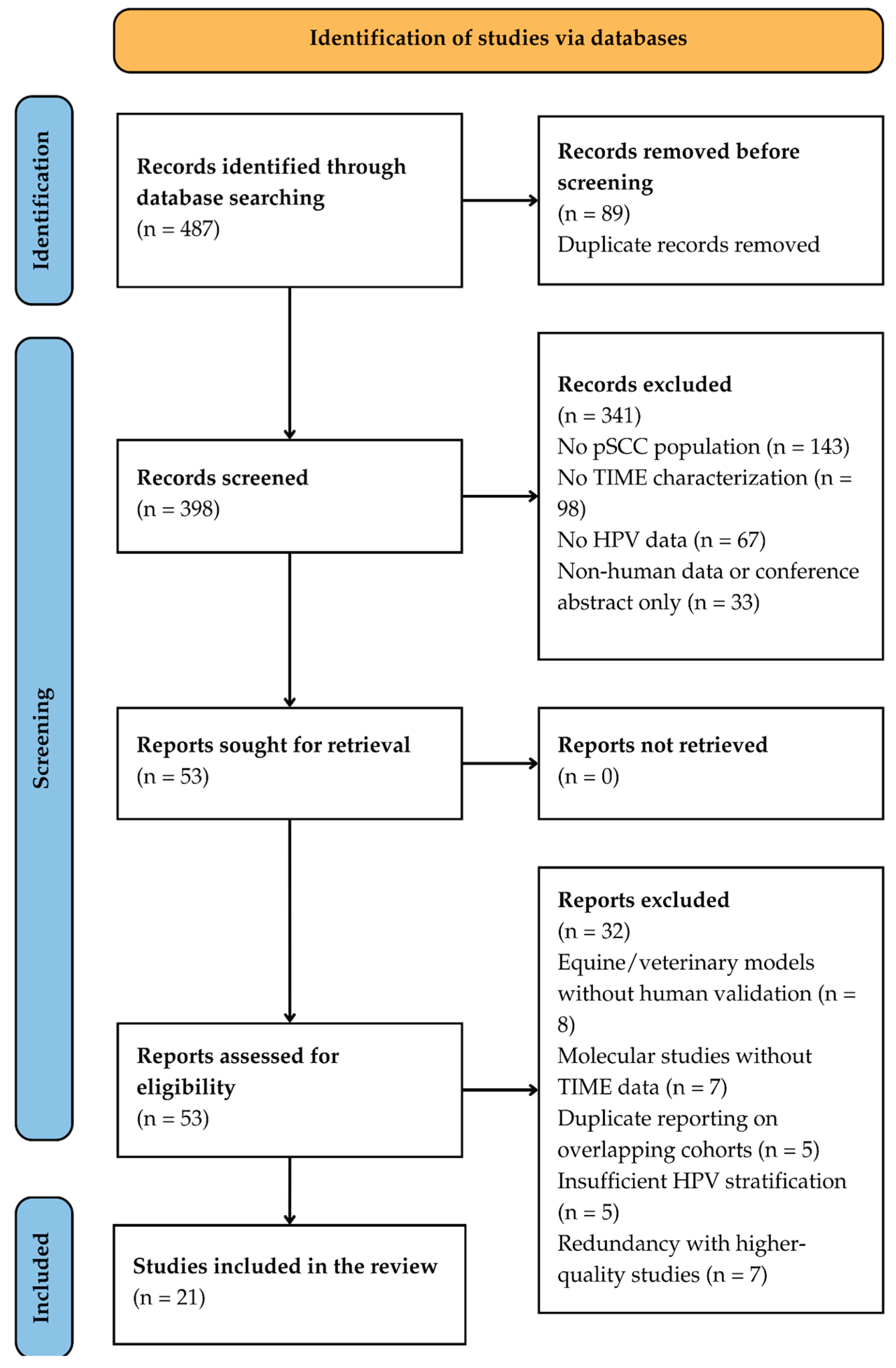
Table 1.
Characteristics of the 21 included studies.
| Characteristic | n (%) or Value | Range/Detail |
|---|---|---|
| Number of included studies | 21 | — |
| Total participants | > 4,500 | — |
| Geographical Distribution | ||
| Asian | 7 (33.3%) | — |
| European | 5 (23.8%) | — |
| Multinational | 4 (19.0%) | — |
| North American | 4 (19.0%) | — |
| African | 1 (4.8%) | — |
| Study Design | ||
| Immunohistochemical cohort study | 7 (33.3%) | Retrospective |
| Systematic review/meta-analysis | 4 (19.0%) | — |
| Whole-exome/genomic sequencing | 4 (19.0%) | — |
| Single-cell/spatial transcriptomics | 2 (9.5%) | — |
| Narrative review | 2 (9.5%) | — |
| Phase II clinical trial | 1 (4.8%) | — |
| Case report | 1 (4.8%) | — |
| TIME Components Evaluated | ||
| TIL subsets (CD3, CD8, CD20) | 14 (66.7%) | Immunohistochemistry |
| PD-L1/PD-1 | 13 (61.9%) | IHC or transcriptomics |
| FOXP3+ Tregs | 5 (23.8%) | IHC or scRNA-seq |
| TAM markers (CD68, CD163) | 4 (19.1%) | IHC or scRNA-seq |
| TIM-3/LAG-3/TIGIT | 3 (14.3%) | IHC or scRNA-seq |
| HPV Detection Method | ||
| PCR (genotyping) | 18 (85.7%) | — |
| p16 immunohistochemistry | 8 (38.1%) | Surrogate marker |
| In situ hybridization | 1 (4.8%) | — |
| Methodological Quality | ||
| Low risk of bias | 7 (33.3%) | — |
| Moderate risk of bias | 13 (61.9%) | — |
| High risk of bias | 1 (4.8%) | — |
| Publication Period | ||
| 2020–2021 | 7 (33.3%) | — |
| 2022–2023 | 8 (38.1%) | — |
| 2024–2026 | 6 (28.6%) | — |
Note: The table describes the 21 studies included in the final qualitative synthesis. Geographical distribution and study design categories are mutually exclusive and each sums to 21 (100%). TIME component categories and HPV detection method categories are non-exclusive: a single study may evaluate multiple immune markers or use more than one HPV detection method; percentages in these rows may therefore exceed 100%. Methodological quality was assessed using RoB 2 (randomized studies), ROBINS-I (observational studies), and AMSTAR-2 (systematic reviews and meta-analyses). Abbreviations: TIL = tumor-infiltrating lymphocyte; TAM = tumor-associated macrophage; TIME = tumor immune microenvironment; IHC = immunohistochemistry; scRNA-seq = single-cell RNA sequencing; PCR = polymerase chain reaction; Treg = regulatory T cell.
Disclaimer/Publisher’s Note: The statements, opinions and data contained in all publications are solely those of the individual author(s) and contributor(s) and not of MDPI and/or the editor(s). MDPI and/or the editor(s) disclaim responsibility for any injury to people or property resulting from any ideas, methods, instructions or products referred to in the content. |
© 2026 by the authors. Licensee MDPI, Basel, Switzerland. This article is an open access article distributed under the terms and conditions of the Creative Commons Attribution (CC BY) license (http://creativecommons.org/licenses/by/4.0/).
Copyright: This open access article is published under a Creative Commons CC BY 4.0 license, which permit the free download, distribution, and reuse, provided that the author and preprint are cited in any reuse.


