
Submitted:
13 April 2026
Posted:
14 April 2026
You are already at the latest version
Abstract
Background/Objectives: Children growing up in families with alcohol-related problems are considered a high-risk group for developmental, emotional, and cognitive difficulties, although this condition is not classified as a clinical diagnosis in DSM-5 or ICD-11. The aim of this study was to develop a neurofunctional profile of such children based on electroencephalographic (EEG) markers, in order to identify indicators of neurodevelopmental risk and explore their potential relevance for pedagogical and social interventions. Methods: The study employed resting-state EEG recordings in children aged 6–10 years from alcohol-affected families and a control group. Quantitative EEG (qEEG) indices were analyzed, including theta–beta ratio (TBR), frontal alpha asymmetry (FAA), temporal beta activity, and beta2 power in parietal regions. Standard preprocessing procedures were applied, and between-group comparisons were conducted using Welch’s t-tests with correction for multiple comparisons. Results: Children from alcohol-affected families exhibited significantly elevated TBR indices (global, frontal, prefrontal, and midline), increased temporal beta activity and SMR composite values, and higher beta2 power in parietal regions. Additionally, reduced alpha power in the prefrontal region (Fp1) was observed. These patterns are consistent with differences in attention, executive functioning, emotional regulation, and stress reactivity. No significant differences were found for frontal alpha asymmetry after correction. Conclusions: The findings indicate the presence of distinct group-level EEG patterns associated with children from alcohol-affected environments. These results may contribute to understanding developmental variability in high-risk populations; however, they should not be interpreted as indicators of individual impairment or causal mechanisms. The study highlights the potential, but still limited, applicability of EEG-based measures in informing educational and social support strategies and underscores the need for further research integrating neurophysiological and environmental perspectives.
Keywords:
neuroeducation
; EEG
; children
; alcohol-affected families
; executive functions
; emotional regulation
; social intervention
1. Introduction
1.1. Neuroprofile as the Basis for Intervention with Children
A neuroprofile is a synthetic representation of an individual’s nervous system functioning across multiple domains, including cognitive, emotional-regulatory, executive, and social processes. It reflects the complex relationships between brain structure and function, behavior, learning, and adaptation to environmental demands [1,2,3].
The construction of a neuroprofile involves the integration of multiple sources of data. These include neuropsychological assessments of cognitive functions such as working memory, attention, executive functions, and processing speed [4,5], as well as neurobiological indicators derived from techniques such as electroencephalography (EEG), functional near-infrared spectroscopy (fNIRS), or functional magnetic resonance imaging (fMRI) [6,7]. Environmental variables influencing brain plasticity, including chronic stress, trauma, emotional deprivation, and instability of the family system, also play a critical role [8,9]. In addition, factors that may modify neural development—such as emotional support, educational interventions, social relationships, and cognitive stimulation—should be taken into account [10,11].
From this perspective, the neuroprofile represents a concept situated at the intersection of diagnostics, education, and intervention, serving as a framework for translating neurobiological knowledge into pedagogical and social practice [3,12]. It enables the analysis of individual patterns of brain functioning and their impact on learning, emotions, and children’s social behavior [1,7].
In the context of children from alcohol-affected families, the neuroprofile may be conceptualized as a multidimensional model integrating neurophysiological data (e.g., EEG markers) with assessments of emotional and social functioning. Such an approach enables early identification of developmental risks and supports the design of targeted pedagogical and social interventions. Importantly, knowledge of an individual neuroprofile allows for the personalization of support strategies in both educational and social domains, particularly by addressing the biological consequences of stress, deprivation, and disrupted attachment relationships [10,13,14].
This approach is consistent with contemporary definitions of social intervention, which encompass coordinated public and private actions aimed at reducing vulnerability, protecting individuals at risk, and facilitating access to essential social resources. The primary goal of these activities is to reduce economic and social vulnerability and to remove barriers to accessing support systems [15].
The individualization of interventions based on neurobiological knowledge may therefore enhance the effectiveness of support strategies and enable more precise responses to the complex needs of children at risk of social exclusion.
1.2. EEG-Based Markers of Disorders in Children from Alcohol-Affected and Abusive Families
In the context of neuropedagogical approaches to social intervention, electroencephalography (EEG) provides valuable markers for identifying neurodevelopmental difficulties in children growing up in high-risk family environments. EEG-based indicators enable the objective assessment of neurofunctional processes related to attention, executive control, emotional regulation, and stress reactivity, thereby offering insight into the biological mechanisms underlying behavioral and cognitive difficulties.
Empirical findings indicate that children from alcohol-affected or abusive families exhibit distinct neurofunctional patterns associated with deficits in self-regulation and adaptive functioning. Studies have shown increased cortical excitability or disinhibition in offspring of individuals with alcohol use disorders, which is associated with impulsivity, reduced inhibitory control, and externalizing behavioral tendencies [16]. Further research using event-related potentials (ERP), particularly NoGo-P3 paradigms, has demonstrated reduced amplitude and altered topography of neural responses linked to response inhibition, suggesting deficits in executive control processes [17]. Subsequent studies have extended these findings, indicating broader motivational–executive dysfunctions and an increased vulnerability to alcohol use disorder (AUD) [18].
Additional evidence highlights the role of neurophysiological dysregulation in other domains. Sleep disturbances have been identified as early indicators of developmental risk and may precede substance use behaviors [19]. Research on children exposed to psychological maltreatment demonstrates impairments in emotional processing and regulation, reflected in altered neural responses to affective stimuli [20]. Differences in frontal alpha asymmetry (FAA) have also been observed, distinguishing resilient individuals from those exhibiting maladaptive outcomes within maltreated populations [21]. Moreover, longitudinal findings suggest that early exposure to trauma is associated with later behavioral problems and increased risk of substance misuse [22].
Taken together, these findings support the view that EEG markers provide a valuable tool for identifying neurodevelopmental risk patterns in children exposed to adverse family environments. Their application in diagnostic and intervention contexts may facilitate early detection and enable the design of targeted, individualized support strategies.
1.3. Long-Term Consequences of the Lack of Intervention in Children from Alcohol-Affected Families
Children raised in alcohol-affected families are at increased risk of a wide range of long-term psycho-pedagogical and health-related consequences. Longitudinal research indicates a higher likelihood of developing substance use disorders, anxiety, and depression in adolescence and adulthood [23]. The Adverse Childhood Experiences (ACE) framework has demonstrated a robust dose–response relationship between the number of early adverse experiences and the risk of both psychological and somatic disorders later in life [24].
Parental alcohol use has also been linked to difficulties in school adaptation and academic functioning during adolescence, as well as to lower educational attainment in adulthood [25,26]. In addition, individuals raised in such environments more frequently experience difficulties in forming and maintaining stable interpersonal relationships [27]. A substantial body of evidence further indicates that childhood maltreatment and neglect significantly increase the risk of depression, anxiety disorders, post-traumatic stress disorder (PTSD), substance use disorders (SUDs), and poor physical health outcomes [28], contributing to long-term social and health inequalities [29].
From a neurodevelopmental perspective, the absence of early and targeted intervention may lead to the consolidation of maladaptive patterns of neural activity. This process can be understood in terms of experience-dependent plasticity, whereby repeated emotional and behavioral states strengthen corresponding neural pathways. At the same time, the capacity for large-scale reorganization of neural circuits decreases with age. This phenomenon is described within the framework of sensitive periods, which emphasizes that the brain’s ability to modify neural networks is greatest in early childhood and gradually declines over time [30,31].
These findings underscore the critical importance of early, targeted interventions aimed at mitigating the negative effects of adverse developmental environments and supporting adaptive neurocognitive and emotional functioning.
EEG profiles of children raised in deprived environments, particularly those exposed to institutional care, consistently show increased power in slow frequency bands (theta) and reduced power in faster bands (alpha and beta). These patterns are commonly interpreted as neurophysiological indicators of delayed cortical maturation and deficits in cognitive and executive functioning. Evidence from the Bucharest Early Intervention Project demonstrates that the absence of early foster care sustains these atypical patterns, whereas timely intervention leads to partial normalization of the EEG spectrum, supporting the hypothesis of a sensitive period for neural plasticity and highlighting the long-term consequences of missed early intervention opportunities [32].
With regard to specific neurophysiological markers, prolonged lack of support is associated with persistently elevated theta–beta ratio (TBR; theta/(beta1 + beta2)) in fronto-central regions, reflecting impairments in attention and executive control. Although behavioral compensation may increase over time, modification of this marker is typically limited without targeted interventions, such as executive function training or neurofeedback. Chronic exposure to family-related stress may also sustain patterns of right-frontal alpha asymmetry (FAA), which are associated with withdrawal tendencies and increased risk of internalizing disorders. Additionally, increased beta-band activity in temporal regions—partly related to sustained muscle tension—may reflect difficulties in regulating arousal levels, further complicating adaptive functioning in the absence of structured intervention [33].
In summary, the lack of early intervention contributes not only to the persistence of immature EEG patterns (increased theta and reduced alpha/beta activity), but also to a reduced capacity for normalization of key neurophysiological markers, such as TBR and FAA, due to age-related declines in neural plasticity. Evidence indicates that early, multicomponent interventions—including foster care placement, self-regulation and executive function training, as well as relational and educational support—can partially reverse these alterations. In contrast, the absence of such interventions increases the risk of long-term impairments in attention, emotional regulation, and learning processes [34].
Overall, insufficient psycho-pedagogical support increases the likelihood that early difficulties in attention, motivation, emotional regulation, and stress reactivity will become consolidated over time. These patterns may subsequently manifest as internalizing or externalizing disorders, lower educational attainment, impaired social functioning, and persistent alterations in EEG or event-related potential (ERP) markers associated with cognitive control, inhibition, and emotional processing. These findings underscore the importance of early, multi-level interventions encompassing family, educational, and healthcare systems in order to effectively alter high-risk developmental trajectories.
2. Materials and Methods
2.1. Participants and Recruitment
The study was conducted in 2022 among primary school children in Lublin (Poland). Participants were recruited in collaboration with school pedagogues, who distributed study invitations to parents. Interested caregivers received detailed information about the study and a consent form. In cases where school staff had knowledge of alcohol-related problems within the family, this information was noted in the screening documentation.
Prior to participation, parents provided written informed consent and completed a health questionnaire to exclude children with neurological disorders or other conditions that could affect EEG recordings.
2.2. Procedure
The experimental procedure consisted of two resting-state conditions:
1. Eyes open (EO): the child remained still and focused on a fixed point for 3 minutes.
2. Eyes closed (EC): the child remained still with eyes closed for 3 minutes.
For the purposes of the present analyses, data from the eyes-open condition were used, as this condition provides higher comparability with existing EEG studies on attention and executive functioning.During recording, contextual variables were documented, including body position, time of day, medication use, sleep quality, handedness, and the presence of behavioral artifacts. EEG data were recorded using a 19-channel system based on the international 10–20 electrode placement (Fp1, Fp2, F3, F4, F7, F8, Fz, C3, C4, Cz, T3/T4, T5/T6, P3, P4, Pz, O1, O2). The reference electrode was placed at mastoids (A1/A2) or Cz. The sampling rate ranged from 500 to 1000 Hz, and electrode impedance was maintained below 5–10 kΩ.
2.3. EEG Measures (Functional Markers)
The study employed a set of quantitative EEG (qEEG) indicators reflecting neurofunctional processes associated with attention, executive control, emotional regulation, and somatic tension. The selection of metrics was integrative and based on established approaches in clinical, neuropsychological, and neurofeedback research.
The classification of these indices as biomarkers follows the BEST (Biomarkers, Endpoints, and other Tools) framework [38], which requires clear definition, validation, and specification of functional roles.
The following markers were analyzed:
- 1)
- Theta–Beta Ratio (TBR)
Defined as θ/(β1 + β2), where θ = 4–7 Hz and β = 13–30 Hz. Elevated TBR is associated with attention deficits and reduced executive control, particularly in fronto-central regions [39,40,41].
- 2)
- Frontal Alpha Asymmetry (FAA)
Calculated as ln(α right) − ln(α left), typically for Fp2–Fp1 or F4–F3 electrode pairs. Negative values are associated with withdrawal tendencies and risk for internalizing problems, whereas positive values reflect approach-related motivation [42,43,44].
- 3)
- Temporal Beta Stress
Defined as mean beta-band power (13–35 Hz) in temporal regions (T3, T4). Increased values may reflect heightened emotional tension, although partial contamination by muscle activity should be considered [45,46,47].
- 4)
- Parietal EMG Tension Index
Based on beta2 power (20–35 Hz) in parietal regions (P3, P4, Pz), reflecting somatic tension and muscular activation [46,47].
- 5)
- SMR Composite Index
A z-score-based composite including temporal beta activity, global theta power, and stress-related symptoms. The index reflects the balance between arousal and relaxation and is grounded in classical SMR research [48,49,50].
A summary of the computational framework is presented in Table 1.
2.4. Data Processing
EEG preprocessing and analysis were conducted using EEGLAB software. Each EEG dataset was linked to a metadata file containing demographic and recording information.
The preprocessing pipeline included:
• channel standardization according to the 10–20 system,
• removal of movement and ocular artifacts,
• high-pass filtering (0.5–1 Hz) and low-pass filtering (40–45 Hz),
• segmentation into 2–4 s epochs,
• selection of ≥120–180 s of artifact-free data per condition.
Absolute and relative power values were computed for the following frequency bands:
• delta (1–3 Hz),
• theta (4–7 Hz),
• alpha (8–12 Hz),
• beta1 (13–20 Hz),
• beta2 (21–30 Hz).
Spectral power was estimated using the Welch method (2 s Hamming window, 50% overlap). Relative power was expressed as the proportion of total power within the 1–40 Hz range.
All analysis scripts and quality control logs were archived in the project repository, with full anonymization of participant data.
2.5. Statistical Analysis
Derived EEG metrics were used to construct neurofunctional profiles of participants. Analyses focused on identifying patterns associated with attention, executive control, emotional regulation, and stress reactivity.
Standardized (z-score) indices were used where appropriate to enable comparison across participants and measures.
3. Results
3.1. Sample Characteristics
The study included two groups of children aged 6–10 years: a clinical group (n = 20) consisting of children from alcohol-affected families and a control group (n = 25) comprising children from non-dysfunctional family environments.
In the clinical group, the distribution of sex was balanced (50% girls, 50% boys), with a mean age of 8.5 years. In the control group, the mean age was 7.84 years, with a slightly higher proportion of boys (52%) than girls (48%).
3.2. Between-Group Differences in EEG Markers
Group differences were analyzed for key EEG markers associated with attention, executive control, motivation, emotional processing, stress, and somatic tension.
Table 2 presents descriptive statistics (means and standard deviations), results of Welch’s t-tests, p-values adjusted using the Benjamini–Hochberg (BH) procedure, and effect sizes (Cohen’s d).
Statistically significant differences (after BH correction) were observed for all markers except Alpha Fp2 and FAA. The largest effect sizes were found for the SMR composite and TBR indices.
3.3. EEG Profile of Children from Alcohol-Affected Families
The pattern of results allows the identification of a consistent neurofunctional profile distinguishing children from alcohol-affected families from controls.
This profile is characterized by:
• elevated TBR indices (global, frontal, prefrontal, and midline), indicating deficits in attentional control and executive functioning;
• increased SMR composite and temporal beta activity, reflecting heightened stress and dysregulated arousal;
• elevated beta2 power in parietal regions, suggesting increased somatic and muscular tension;
• reduced alpha power in the prefrontal region (Fp1), associated with difficulties in emotional regulation;
• increased midline TBR, indicating reduced motivational engagement and task persistence.
These findings are illustrated in Figure 1.
4. Discussion
The present study demonstrates that children from alcohol-affected families exhibit a distinct pattern of neurophysiological differences related to attention, executive control, emotional regulation, and stress processing.
The observed elevation in TBR indices is consistent with previous research linking this marker to attentional deficits and impaired executive functioning [39,40,41,51,52]. Similarly, reduced prefrontal alpha activity may reflect difficulties in emotional regulation, in line with findings from affective neuroscience studies [42,43,44,53].
Increased temporal beta activity and elevated SMR composite values suggest chronic stress and dysregulation of arousal systems, which has been documented in children exposed to adverse environments [45,46,47,54]. These results also align with research indicating that children from alcohol-affected families exhibit impairments in motivational and executive domains [18].
From an applied perspective, these findings support the need for targeted interventions focusing on attention, executive functioning, and emotional regulation. Approaches such as neurofeedback, mindfulness-based training, and executive function interventions may be particularly beneficial in this population. Additionally, interventions addressing stress regulation and somatic tension, including relaxation techniques and body-based therapies, should be considered as part of comprehensive support programs.
Overall, the results highlight the importance of early, multidimensional intervention strategies aimed at mitigating neurodevelopmental risk and supporting adaptive functioning in children exposed to adverse family environments.
5. Conclusions
The present study identified significant group-level differences in EEG markers between children from alcohol-affected families and those from non-dysfunctional environments. These differences were observed primarily in indices related to attention, executive control, emotional regulation, and stress reactivity.
However, the findings should be interpreted with caution. The observed EEG patterns reflect statistical associations at the group level and do not constitute evidence of individual impairment or direct neurobiological mechanisms underlying developmental difficulties. Consequently, causal interpretations are not warranted.
The results highlight the potential relevance of neurophysiological measures for understanding developmental variability in children exposed to adverse family environments. At the same time, the limited number of studies integrating EEG data with educational and social contexts indicates that further research is required before such measures can be reliably translated into practice.
From an applied perspective, the findings support the need for inclusive and non-stigmatizing forms of support that address cognitive, emotional, and social functioning. Interventions should focus on strengthening self-regulation, attention, and adaptive coping, while taking into account individual variability and environmental context.
Neuroeducational perspectives may contribute to a more comprehensive understanding of child development by emphasizing the interaction between biological and environmental factors. Nevertheless, such approaches should complement, rather than replace, established pedagogical, psychological, and social frameworks, and should be applied cautiously to avoid overinterpretation of neuroscientific data or the medicalization of social conditions.
6. Limitations
This study has several limitations that should be considered when interpreting the findings.
First, the relatively small sample size limits the generalizability of the results. Future studies should replicate these analyses in larger and more diverse populations.
Second, the study relied exclusively on EEG data from children and did not incorporate multi-informant perspectives, such as reports from parents, teachers, or social service professionals. Including such data could provide a more comprehensive understanding of children’s functioning across contexts.
Third, no measures of academic performance were included, which limits the ability to directly relate neurophysiological markers to educational outcomes.
Fourth, although efforts were made to control recording conditions, additional covariates—such as sleep quality, medication status, and environmental factors—should be systematically included in future analyses.
Finally, EEG markers should not be interpreted in isolation. In clinical and applied contexts, their interpretation requires integration with psychological assessment, developmental history, and contextual information. Future research should also incorporate more advanced analytical approaches, including robust statistical methods and multivariate modeling, to strengthen the validity of findings.
Author Contributions
Conceptualization, M.Ch. and M.C-B; methodology, M.Ch.; software and validation, M.Ch.; formal analysis, M.Ch.; investigation, M.Ch.; resources, M.C-B.; data curation, M.Ch.; writing—original draft preparation, M.C-B.; writing—review and editing, M.Ch.; visualization, M.Ch.; supervision, M.C-B.; project administration, M.C-B. and M.Ch.
Funding
This research received no external funding.
Institutional Review Board Statement
The study was approved by the University Research Ethics Committee (Ref. No. 219/2019). All procedures were conducted in accordance with the Declaration of Helsinki.
Informed Consent Statement
Informed consent was obtained from all subjects involved in the study
Data Availability Statement
Due to the nature of the health-related data, additional information is available by contacting the authors of the article directly.
Conflicts of Interest
The authors declare no conflicts of interest.
Abbreviations
The following abbreviations are used in this manuscript:
| MDPI | Multidisciplinary Digital Publishing Institute |
| DOAJ | Directory of open access journals |
| TLA | Three letter acronym |
| LD | Linear dichroism |
References
- Tokuhama-Espinosa, T. Neuroeducation: A Review of Theory and Practice; W.W. Norton: New York, NY, USA, 2019.
- Siegel, D.J. The Developing Mind: How Relationships and the Brain Interact to Shape Who We Are, 3rd ed.; Guilford Press: New York, NY, USA, 2020.
- Tokarz, A. Neuropsychologiczne podstawy uczenia się i wychowania; PWN: Warszawa, Poland, 2020.
- Diamond, A. Executive functions. Annu. Rev. Psychol. 2013, 64, 135–168.
- Zelazo, P.D.; Blair, C.B.; Willoughby, M.T. Executive function: Implications for education; NCER Report; National Center for Education Research: Washington, DC, USA, 2016.
- Perry, B.D.; Szalavitz, M. The Boy Who Was Raised as a Dog, 3rd ed.; Basic Books: New York, NY, USA, 2021.
- Immordino-Yang, M.H.; Damasio, A. We feel, therefore we learn. Mind Brain Educ. 2021, 15, 115–123.
- De Bellis, M.D.; Zisk, A. The biological effects of childhood trauma. Child Adolesc. Psychiatr. Clin. N. Am. 2014, 23, 185–222.
- Porges, S.W. The polyvagal theory. Clevel. Clin. J. Med. 2018, 85, S86–S90.
- Black, M.M.; Conway, A. Maternal and child nutrition. Lancet 2018, 391, 243–244.
- Grzybowski, P. Neuroeducation and cognitive development. Educ. Res. Rev. 2023, 38, 100501.
- Chojak, M. Neurodydaktyka w edukacji i wychowaniu; UMCS: Lublin, Poland, 2018.
- Im, H. Neurodevelopment and environmental adversity. Dev. Cogn. Neurosci. 2025, 62, 101250.
- Staton, M.; Leukefeld, C.; Webster, J.M. Substance use and family systems. J. Subst. Abuse Treat. 2024, 156, 108742.
- Helen, J.; Smith, A.; Brown, K. Social interventions and vulnerability reduction. Soc. Policy Adm. 2023, 57, 345–360.
- Rangaswamy, M.; Porjesz, B.; Chorlian, D.B.; Wang, K.; Jones, K.A.; Bauer, L.O.; Rohrbaugh, J.; O’Connor, S.J.; Kuperman, S.; Reich, T.; Begleiter, H. Beta power in the EEG of alcoholics. Biol. Psychiatry 2004, 55, 831–842.
- Kamarajan, C.; Porjesz, B.; Jones, K.A.; Chorlian, D.B.; Padmanabhapillai, A.; Rangaswamy, M.; Stimus, A.T.; Begleiter, H. Spatial-anatomical mapping of NoGo-P3 in offspring of alcoholics. Clin. Neurophysiol. 2005, 116, 1049–1061.
- Kamarajan, C.; Rangaswamy, M.; Manz, N.; Chorlian, D.B.; Pandey, A.K.; Roopesh, B.N.; Porjesz, B. Topography, current density, and neurocognitive correlates of P3 event-related potentials in alcohol use disorder. Brain Sci. 2015, 5, 360–388.
- Tarokh, L.; Carskadon, M.A.; Achermann, P. Developmental changes in brain connectivity assessed using sleep EEG. Sleep Med. Rev. 2009, 13, 203–210.
- Yu, X.; Zhang, L.; Li, Y. Neural correlates of emotional processing in maltreated children. Dev. Cogn. Neurosci. 2025, 63, 101280.
- Curtis, W.J.; Cicchetti, D. Emotion and resilience: Frontal EEG asymmetry in maltreated children. Dev. Psychopathol. 2007, 19, 811–840.
- Meiers, S.J.; et al. Child maltreatment and substance use outcomes. J. Adolesc. Health 2020, 67, 123–130.
- Chassin, L.; Pitts, S.C.; DeLucia, C.; Todd, M. A longitudinal study of children of alcoholics. J. Abnorm. Psychol. 1999, 108, 106–119.
- Felitti, V.J.; Anda, R.F.; Nordenberg, D.; Williamson, D.F.; Spitz, A.M.; Edwards, V.; Koss, M.P.; Marks, J.S. Relationship of childhood abuse and household dysfunction to leading causes of death in adults. Am. J. Prev. Med. 1998, 14, 245–258 (reprint 2019).
- Torvik, F.A.; Rognmo, K. Children of parents with alcohol problems. Soc. Psychiatry Psychiatr. Epidemiol. 2011, 46, 745–753.
- Raitasalo, K.; Holmila, M.; Autti-Rämö, I.; et al. Parental substance use and educational outcomes. Drug Alcohol Rev. 2020, 39, 559–567.
- Kearns-Bodkin, J.N.; Leonard, K.E. Relationship functioning among adult children of alcoholics. J. Stud. Alcohol Drugs 2008, 69, 149–157.
- Norman, R.E.; Byambaa, M.; De, R.; Butchart, A.; Scott, J.; Vos, T. The long-term health consequences of child abuse. PLoS Med. 2012, 9, e1001349.
- Gilbert, R.; Widom, C.S.; Browne, K.; Fergusson, D.; Webb, E.; Janson, S. Burden and consequences of child maltreatment. Lancet 2009, 373, 68–81.
- Hensch, T.K. Critical period regulation. Annu. Rev. Neurosci. 2004, 27, 549–579.
- Hensch, T.K. Critical period plasticity. Nat. Rev. Neurosci. 2005, 6, 877–888.
- Marshall, P.J.; Fox, N.A.; Bucharest Early Intervention Project Core Group. A comparison of the electroencephalogram between institutionalized and community children in Romania. J. Cogn. Neurosci. 2004, 16, 1327–1338.
- Wilkinson, P.O.; Goodyer, I.M.; et al. Frontal alpha asymmetry and stress-related neural regulation in children. Biol. Psychol. 2024, 190, 108600.
- Marshall, P.J.; Reeb, B.C.; Fox, N.A.; Nelson, C.A.; Zeanah, C.H. Effects of early intervention on EEG power in previously institutionalized children. Dev. Psychopathol. 2008, 20, 861–880.
- Chassin, L.; Hussong, A.; Barrera, M.; Molina, B.; Trim, R.; Ritter, J. Adolescent substance use. Dev. Psychopathol. 2016, 28, 795–819.
- Peled, M.; Sacks, M. Neurodevelopment in children from high-risk families. Child Dev. 2018, 89, 156–170.
- Perry, B.D. Neurosequential model of therapeutics. J. Child Adolesc. Trauma 2021, 14, 1–15.
- FDA-NIH Biomarker Working Group. BEST Resource: Biomarkers, EndpointS, and other Tools; FDA-NIH: Silver Spring, MD, USA, 2016.
- Arns, M.; Conners, C.K.; Kraemer, H.C. A decade of EEG Theta/Beta Ratio research. J. Atten. Disord. 2013, 17, 374–383.
- Bussalb, A.; Congedo, M.; Barthélemy, Q.; Ojeda, D. Clinical utility of TBR. Biol. Psychol. 2019, 146, 107734.
- Nezhad, M.; et al. EEG biomarkers of attention. Neurosci. Biobehav. Rev. 2025, 158, 105562.
- Davidson, R.J. Frontal EEG asymmetry and emotion. Psychophysiology 1990, 27, 1–17.
- Coan, J.A.; Allen, J.J.B. Frontal EEG asymmetry. Biol. Psychol. 2004, 67, 7–49.
- Smith, E.E.; et al. Affective neuroscience and EEG markers. Neurosci. Biobehav. Rev. 2016, 68, 555–570.
- Goncharova, I.I.; McFarland, D.J.; Vaughan, T.M.; Wolpaw, J.R. EMG contamination. Clin. Neurophysiol. 2003, 114, 1580–1593.
- Whitham, E.M.; et al. Muscle artifacts in EEG. Clin. Neurophysiol. 2007, 118, 1877–1888.
- Trujillo-Barreto, N.J.; et al. EEG and EMG interaction. Neuroimage 2020, 219, 117048.
- Sterman, M.B.; et al. Sensorimotor rhythm. Electroencephalogr. Clin. Neurophysiol. 1974, 36, 1–7.
- Hammond, D.C. Neurofeedback treatment. J. Neurother. 2011, 15, 305–336.
- Gruzelier, J.H. EEG-neurofeedback for cognition. Neurosci. Biobehav. Rev. 2014, 44, 124–141.
- Snyder, S.M.; Hall, J.R. A meta-analysis of quantitative EEG power. J. Clin. Neurophysiol. 2006, 23, 440–455.
- Loo, S.K.; Makeig, S. Clinical utility of EEG in attention disorders. J. Atten. Disord. 2012, 16, 513–520.
- Thibodeau, R.; Jorgensen, R.S.; Kim, S. Depression, anxiety, and frontal EEG asymmetry. J. Abnorm. Psychol. 2006, 115, 715–729.
- McLaughlin, K.A.; Sheridan, M.A. Beyond cumulative risk. Curr. Dir. Psychol. Sci. 2016, 25, 239–245.
Figure 1.
Summary of group differences.
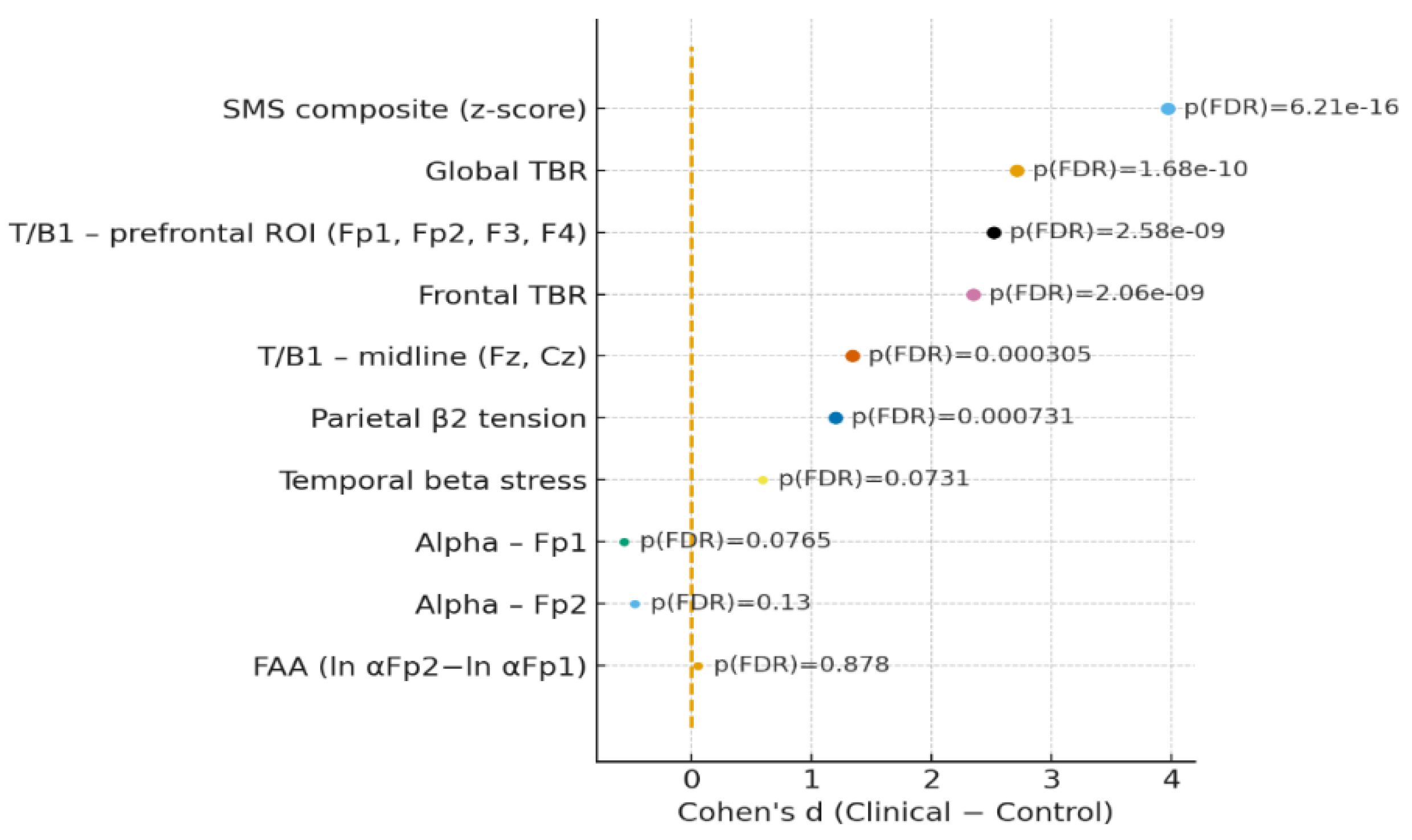

Table 1.
Computational framework used in the present study.
| Metric | Definition | ROI/canal |
| Global TBR | θ/(β1+β2) | mean z 19 canals |
| Frontal TBR | θ/(β1+β2) | Fp1, Fp2, F3, F4, F7, F8, Fz |
| Prefrontal TBR | θ/(β1+β2) | Fp1, Fp2, F3, F4 |
| TBR midline | θ/(β1+β2) | Fz, Cz |
| Frontal Alpha Asymmetry FAA | ln(α right) − ln(α left) | Fp2–Fp1 (± F4–F3) |
| Temporal beta stress | mean(β1+β2) | T3, T4 (≈T7/T8) |
| Parietal EMG tension | β2 | P3, P4, Pz |
| SMR composite | Z (Temporal β stress, global θ, symptoms of stress) | — |
1 on my own.
Table 2.
Group comparisons for EEG markers.
| Marker | M_K | SD_K | M_Z | SD_Z | t | p | d | p_adj |
| SMS composite | 0.814 | 0.438 | -0.651 | 0.374 | 11.891 | 0.0 | 3.6 | 0.000* |
| Frontal TBR | 1.43 | 0.101 | 1.153 | 0.099 | 9.225 | 0.0 | 2.77 | 0.000* |
| Global TBR | 1.367 | 0.068 | 1.189 | 0.065 | 8.905 | 0.0 | 2.68 | 0.000* |
| Prefrontal Theta Beta1 | 2.745 | 0.355 | 1.957 | 0.263 | 8.271 | 0.0 | 2.52 | 0.000* |
| Motivation TBR midline | 2.699 | 0.52 | 2.107 | 0.342 | 4.389 | 0.000 | 1.35 | 0.000* |
| Temporal beta stress | 19.774 | 2.224 | 17.435 | 2.204 | 3.52 | 0.001 | 1.06 | 0.002* |
| Alpha Fp1 | 39.11 | 9.738 | 47.724 | 8.8 | -3.077 | 0.004 | -0.93 | 0.005* |
| Parietal beta2 tension | 15.824 | 2.74 | 13.721 | 2.043 | 2.856 | 0.007 | 0.87 | 0.009* |
| Alpha Fp2 | 42.271 | 7.549 | 46.568 | 7.693 | -1.882 | 0.067 | -0.56 | 0.074 |
| FAA ln | 0.088 | 0.303 | -0.021 | 0.24 | 1.309 | 0.199 | 0.4 | 0.199 |
M_K - Mean of the experimental group; SD_K of the experimental group. M_Z - Mean of the control group; SD_Z of the control group.
Disclaimer/Publisher’s Note: The statements, opinions and data contained in all publications are solely those of the individual author(s) and contributor(s) and not of MDPI and/or the editor(s). MDPI and/or the editor(s) disclaim responsibility for any injury to people or property resulting from any ideas, methods, instructions or products referred to in the content. |
© 2026 by the authors. Licensee MDPI, Basel, Switzerland. This article is an open access article distributed under the terms and conditions of the Creative Commons Attribution (CC BY) license (http://creativecommons.org/licenses/by/4.0/).
Copyright: This open access article is published under a Creative Commons CC BY 4.0 license, which permit the free download, distribution, and reuse, provided that the author and preprint are cited in any reuse.


