

Submitted:
13 April 2026
Posted:
14 April 2026
You are already at the latest version
Abstract
Autophagy, also referred to as the “self-eating machinery”, is a crucial process where organisms maintain intracellular homeostasis through recycling or degrading non-essential and damaged cellular components, especially during starvation conditions. Autophagy is important in numerous biological functions such as cellular differentiation, aging, nutrient sensing, stress response, tissue homeostasis, immunity, and programmed cell death. To induce autophagy, a double-layered membrane structure called “autophagosome” wraps damaged organelles or proteins and transports them to the vacuole or lysosome for degradation. Autophagy is beneficial to organisms, and it should be optimally regulated because elevated or decreased levels are detrimental for survival. To date more than 40 autophagy-related genes (ATGs) have been identified in the budding yeast Saccharomyces cerevisiae, with most having homologs in fungi and higher eukaryotes. Majority of the ATGs in industrial and pathogenic fungal species have been characterized and known to play vital roles in growth, development, and virulence. In this review we provide a comprehensive overview of ATGs in various fungal species and highlight how autophagy is regulated and controls various functions in plant, human, and industrial fungal species.
Keywords:
fungi
; autophagy
; ATGs
; autophagosome
; mitophagy
; golgiphagy
; pexophagy
; antifungals
; TOR
; drug resistance
1. Introduction
Autophagy is an evolutionarily conserved process where cytosolic material including organelles and autophagy-related proteins are sequestered by structures called “autophagosomes” and subsequently delivered to vacuoles as autophagic bodies [1]. Autophagy may be broadly classified into non-selective and selective autophagy based on the type of cellular material that is directed for degradation. Non-selective autophagy also called cargo-independent process is induced under starvation conditions to recycle bulk cytosolic materials [2]. On the other hand, selective autophagy also referred to as cargo-dependent autophagy is independent of starvation to selectively degrade and recycle damaged organelles or proteins and maintain intracellular homoeostasis [3]. While non-selective and selective autophagy processes utilize the same mechanism to form autophagosomes, the latter relies on specific autophagic factors that recognize cargos and membrane components.
In the budding yeast, Saccharomyces cerevisiae, autophagy has been extensively studied and occurs either non-selectively or selectively with at least 40 autophagy-related genes (ATGs) [4]. Proteins related to autophagy from the plant and the human fungal pathogens, and other industrially useful fungi are summarized in Table 1 and Table 2. Briefly, in selective autophagy process the autophagosome formation occurs via the assembly of a pre-autophagosomal structure (PAS), where organelles such as mitochondria (mitophagy), nuclei (nucleophagy), peroxisomes (pexophagy), are encapsulated by a double membrane envelope derived from the endoplasmic reticulum (ER) (Figure 1). Subsequently, the autophagosomes fuse with the vacuoles and autophagic degradation is mediated by vacuolar hydrolytic enzymes [5]. After the membranes of autophagic bodies are broken down by hydrolytic enzymes, degraded products are channeled back to the cytoplasm for reuse in metabolic and biosynthetic pathways [6]. ATG genes that mediate non-selective and selective autophagy are classified into various groups based on their functions in the formation of phagophores and their maturation into autophagosomes [7]. This group includes: the Atg1/ULK complex which comprises Atg1, Atg11, Atg13, Atg17, Atg29, and Atg31, whose function is to scaffold essential sites required for autophagosome initiation at the phagophore. The second group is vital for phagophore expansion, and is a membrane delivery system including Atg2, Atg9, and Atg18. The third group is mainly for vesicle nucleation and is part of the phosphatidylinositol 3-kinase complex (Vps34, Vps15, Vps30/Atg6, and Atg14). Finally, the vesicle expansion group is a ubiquitin-like conjugation system including Atg5, Atg7, Atg10, Atg12, and Atg16.
1.1. Selective Autophagy Mechanisms in Saccharomyces Cerevisiae
In S. cerevisiae the cytoplasm-to-vacuole (Cvt) pathway transports hydrolases, specifically aminopeptidase I (Ape1), from the cytoplasm to the vacuole as part of the selective autophagy mechanism. The Ape1 complex binds to Atg19 receptor to form the Cvt complex, and Atg19 receptor interacts with the adaptor protein Atg11. Atg11 accumulates on PAS by interacting with Atg1 and Atg9. During mitophagy induction the transmembrane mitophagy receptor Atg32 localized on the mitochondrial outer membrane [8,9,10] interacts with Atg11. Atg11 tethers the mitochondria to the PAS for the selective sequestration of the mitochondria by the isolation membrane (Figure 1A). The endoplasmic reticulum-mitochondria encounter structure (ERMES) complex acts as a physical tether between the ER and mitochondria, and aids in expanding the isolation membrane to provide lipid sources from ER and extension of the isolation membrane leading to mitophagosome formation and its eventual fusion with the vacuole for degradation by vacuolar hydrolases.
While the factors participating in the autophagic degradation of nuclear components in other organisms remain largely unknown, S. cerevisiae has a unique nucleophagy transmembrane receptor protein, Atg39, localized on the nuclear envelope [11] (Figure 1B). Atg39 interacts with Atg8 through an Atg8-interacting motif in its N-terminal cytosolic tail and upon nucleophagy induction it binds to Atg8 puncta in an Atg8-dependent manner to form the nucleophagosome [12]. While Atg39 is essential for the selective autophagy of proteins within the outer and inner nuclear membrane, nucleolus, and nucleoplasm [11,12], it is not required for the autophagic degradation of nuclear pore components [13,14,15]. Instead, recent studies have identified nucleoporin Nup159 as an Atg8-binding protein that promotes the autophagic degradation of nuclear pore components [13,14].
The crucial importance of pexophagy in degrading impaired peroxisomes is exemplified by the fact that peroxisomes maintain cellular homeostasis in response to oxidative stress, and play major role in lipid metabolism, including fatty acid β-oxidation [16,17]. In S. cerevisiae, the peroxisomal membrane protein Pex3 acts as a peroxisomal ligand and is central to initiating pexophagy by facilitating the recruitment of the Atg36 receptor protein to the peroxisomal membrane (Figure. 1C). Atg36 binds to the adaptor protein Atg11 and recruits peroxisomal fission complexes containing the dynamin-related GTPases Dnm1 and Vps1 to target peroxisomes, thereby facilitating their sequestration by phagophores [18].
In addition to the above established canonical selective autophagic pathways, a Golgi membrane-dependent intracellular proteolytic process called the Golgi membrane-associated degradation (GOMED) pathway has also been reported [19]. Previously, GOMED was classified as alternative autophagy due to its morphological and functional similarities with canonical autophagy. However, recent studies have shown differences between the two processes in terms of the protein machinery involved and the degraded substrates and their biological roles [20].
1.2. Autophagy Genes Regulate Multiple Processes in Plant Pathogenic Fungi
1.2.1. Magnaporthe Oryzae
Magnaporthe oryzae is a hemibiotrophic ascomycetes filamentous fungus that causes blast disease in rice and other cereals [21]. Autophagy in the rice blast fungus M. oryzae is well documented and has been shown to control various cellular processes including, fungal growth, conidiation, appressoria formation, and pathogenesis. M. oryzae contains a total of 23 autophagy (ATG) genes that are involved in selective and non-selective autophagy and have been identified through genome wide comparison analysis [22]. Loss of function of genes involved in non-selective autophagy such as MoAtg1, MoAtg2, MoAtg3, MoAtg4, MoAtg5, MoAtg6, MoAtg7, MoAtg8, MoAtg9, MoAtg10, MoAtg12, MoAtg13, MoAtg15, MoAtg16, MoAtg17, and MoAtg18 resulted in almost all of the mutant strains showing defect in host plant penetration and were nonpathogenic with the exception of ΔMoAtg13 and ΔMoAtg18 mutant strains that still caused some disease lesions although fewer than the wild-type strains. The loss of virulence in most of these mutant strains was mainly attributed to defects in appressorium function and failure of the mutant strains to colonize the host tissue, indicating a crucial role for autophagy in regulating these processes [22]. In contrast majority of the selective autophagy mutant strains ΔMoAtg11, ΔMoAtg24, ΔMoAtg26, ΔMoAtg27, ΔMoAtg28, and ΔMoAtg29 sporulated and caused disease in the host plants [22]. In fact, due to a blockade in the autophagy process in the ΔMoAtg1 mutant strain, there were fewer lipid droplets present in its conidia which resulted in slower germination rates when compared to the wild-type strain. Also, ΔMoAtg1 mutant appressorium turgor pressure was lower and as a result the appressorium failed to penetrate and cause disease on rice and barley plants [23]. An Atg5 deficient ΔMoAtg5 mutant strain exhibited morphogenetic defects including stunted aerial hyphae, shortened lifespan, and impaired disease-causing processes including attenuated conidiation, delayed conidial germination, and defects in the formation of perithecia, appressoria, and penetration peg [24] (Figure 2). Similarly, the deletion of MoAtg4 drastically impaired aerial hyphae formation, sporulation, delayed conidial germination, perithecia formation, and appressorium formation, reduced appressorium turgor pressure, all resulting in its inability to penetrate the host plant tissue and cause infection [25]. MoAtg8 was highly expressed at conidiation stage with MoAtg8 mutant dramatically attenuated in sporulation [26]. Other studies in rice blast disease where deletion of ATG genes impacted fungal conidiation, and pathogenesis include MoAtg1, MoAtg2, MoAtg9, MoAtg14, and MoAtg24 [27]. In addition to ATG genes, the deletion of a RING finger ubiquitin ligase (E3) MoSnt2 affected autophagy homeostasis resulting in oxidative stress, cell wall integrity defect, impaired conidiation and appressorium development, and cell death ultimately leading to an avirulent phenotype [28].
1.2.2. Colletotrichum spp
Colletotrichum orbiculare (syn. C. lagenarium) is a pathogenic fungus that causes disease in cucumber plants [29]. The CoAtg26 mutant strain formed appressoria, however the appressoria were impaired in host invasion resulting in the loss of virulence [30]. Also, interestingly the autophagic degradation of peroxisomes was significantly delayed in the appressoria of the ∆CoAtg26 mutant strain indicating the importance Atg26 for pexophagy. Furthermore, Takano et al generated a CoAtg8 mutant strain and established a role for CoAtg8 in germination and appressoria development, clearly demonstrating that while CoAtg8-mediated non-selective autophagy is crucial for controlling early stage of infection-related morphogenesis, CoAtg26 mediated pexophagy is important for later stage of host invasion [30].
In Colletotrichum fructicola, the pathogen that causes anthracnose disease on Camellia oleifera transcriptomic analysis showed that histone acetyltransferase CfGcn5 acts as a repressor of autophagy and mediates the expression of several ATG genes [31]. Loss of function of CfGCN5 resulted in the upregulation of majority of ATG genes. Deletion of CfAtg8 and CfAtg9 genes caused defects in mitosis and attenuated appressoria formation, appressoria turgor pressure, and virulence in both the ∆CfAtg8 and ∆CfAtg9 mutant strains indicating their importance for autophagy and pathogenicity [31]. An autophagy defective ΔCfAtg4 mutant strain was severely affected in growth and pathogenesis due to defect in appressoria formation [32]. Introduction of CfAtg810 allele, partially remediated autophagosome formation and autophagic defects in the ΔCfAtg4 mutant strain subsequently restoring growth and pathogenesis defects.
In Colletotrichum scovillei that causes pepper anthracnose disease CsAtg8 is critical for asexual development and virulence of the pathogen [33]. Deletion of CsAtg8 gene resulted in severe defect in sporulation, and the spores were defective in survival, conidial germination, and appressorium formation. Also, the conidia of ΔCsAtg8 mutant strain showed reduced lipid contents and peroxisomal targeting signal PTS1 selectivity. All these defects reduced anthracnose disease severity upon ΔCsAtg8 infection on pepper plants.
In Colletotrichum gloeosporioides the expression of CgAtg16 was higher in the conidia, during germination, appressorium formation, at early infection stage, and highly induced during nutrient starvation [34]. Loss of CgAtg16 significantly reduced autophagosome number, reduced colony growth, decreased sporulation and conidial germination rate, and attenuated appressorium formation ultimately resulting in decreased pathogenicity on rubber tree leaves. These data indicated CgAtg16 mediated autophagy is crucial for C. gloeosporioides growth development and pathogenesis. Lastly, in Colletotrichum higginsianum that causes anthracnose in crucifers prohibitins, ChPhb1 and ChPhb2, were shown to interact with ChAtg24 in mitochondria and required for the proper functioning of mitochondria, mitophagy, and pathogenesis [35].
1.2.3. Fusarium Graminearum
In the head blight disease causing fungus Fusarium graminearum several ATG genes have been characterized and shown to be crucial for development and pathogenicity. For example, FgAtg15 gene that encodes a lipolytic enzyme plays an indispensable role in fungal development. Loss of FgAtg15 resulted in multiple defects in growth rate, conidiation, conidial germination, and aerial hyphae formation [36]. The ∆FgAtg15 mutant strain was avirulent on wheat and could not degrade stored lipid droplets under nutrient starvation indicating impaired autophagy process in the ∆FgAtg15 mutant strain [36]. In a genome wide association study 28 ATG genes were identified in F. graminearum [37]. Deletion of these genes showed that almost all the mutant strains were impaired in virulence on wheat except for Atg27 mutant strain indicating the importance of ATG genes for host infection in F. graminearum. Further analysis indicated that deletion of FgAtg1 and FgAtg5 showed severe defects in autophagy, but these mutant strains could still cause infection on wheat [37]. The remaining strains deleted for other ATG genes were shown to be crucial for conidiation and infection of F. graminearum. Loss of Atg8 function in the ΔFgAtg8 mutant strain resulted in its inability to form autophagic compartments and perithecia structures [38]. The ΔFgAtg8 mutant strain produced fewer spores and fragile aerial hyphae that collapsed within a few days of culturing. Analysis of the collapsed mycelia of the ΔFgAtg8 mutant strain indicated the presence of lipid droplets - an indication of nitrogen starvation or failure of the mutant strain to utilize storage lipids. Furthermore, the capacity of the ΔFgAtg8 to utilize carbon/energy stored in lipid droplets during carbon starvation was compromised. Although the ΔFgAtg8 mutant strain could still infect the wheat plant, it showed defects in host colonization and reduced growth demonstrating that Atg8-dependent autophagy in F. graminearum is crucial for fungal growth and host colonization. A recent study showed that although F. graminearum Atg27 gene has no effect on vegetative growth and conidiation, its deletion resulted in significant reduction in virulence. Upon starvation induction, the ΔFgAtg27 mutant strain had fewer autophagosomes present compared to the wild-type and complemented strain [39], indicating that FgAtg27 is crucial in autophagy through autophagosome formation in F. graminearum.
The relevance of autophagy in growth, development, and pathogenesis of F. graminearum was also analyzed using the autophagy inhibitor wortmannin and an autophagy activator. This study revealed that nitrogen rich conditions, inhibition and/or activation of autophagy significantly reduced mycelial mass, while both autophagy inhibition and/or activation reduced conidiation [40]. Moreover, the toxin contents in wheat medium upon autophagy activation were elevated revealing increased autophagy. Chai et al showed that inhibition of autophagy and mitophagy processes reduced the virulence of F. graminearum, thus providing a new avenue to strategically control plant fungal diseases [40]. Mitophagy selectively eliminates mitochondria an important process of elimination of superfluous proteins or organelles [41].
1.2.4. Ustilago Maydis
Autophagy in the corn smut fungus Ustilago maydis is centered around ATG genes and vacuolar proteases [42,43]. Nadal et al reported that U. maydis Atg1 and Atg8 genes are crucial for autophagy induction and autophagosome assembly. Deletion of both UmAtg1 and UmAtg8 showed UmAtg8 as being indispensable for autophagy-dependent processes. The ΔUmAtg8 mutant strain did not accumulate autophagosomes in the vacuoles during carbon-starvation thus reducing survival rates. Furthermore, the ΔUmAtg8 mutant strain exhibited defects in the budding of haploid sporidia, with the plant gall induction being abolished. While the loss of UmAtg1 resulted in a phenotype similar to UmAtg8 deletion the ΔUmAtg1 mutant strain was slightly less pathogenic than the wild-type strain although teliospore production remained unaffected [42]. UmAtg11 was shown to be involved in mitophagy indicating it is also essential for autophagy [44]. However, the ΔUmAtg11 mutant strain remained unaffected in its ability to cause infection or produce teliospores [45].
Vacuolar protease A and B have also been implicated in the autophagy-dependent response in U. maydis. Soberanes-Gutiérrez et al showed the accumulation of autophagosomes within the vacuoles of U. maydis wild-type strain when incubated in the presence of the serine protease inhibitor PMSF. Moreover, loss of proteinase B and the protease Pep4 genes resulted in spherical bodies accumulating in the ΔUmPep4 mutant strain’s vacuoles, but not in the wild-type strain when incubated in carbon starvation medium indicating the mutant was unable to degrade via autophagosome formation a key step in the autophagy process. This study demonstrated the involvement of both proteinase A and B in the degradation of autophagosome in U. maydis [43].
1.2.5. Botrytis Cinerea
Botrytis cinerea causes grey mold disease in crops such as grapes and beans [46]. B. cinerea BcAtg1 was upregulated under nutrient starvation conditions and loss of BcAtg1 abolished the accumulation of autophagosomes in the vacuoles of nitrogen deficient cells [47]. Vegetative growth, conidiation, sclerotia and appressoria formation, and host tissue penetration were significantly impaired in the ΔBcAtg1 mutant strain. Furthermore, ΔBcAtg1 mutant strain was avirulent on different host plants confirming that autophagy is crucial for growth development and pathogenesis of B. cinerea [47]. BcAtg2, just like BcAtg1, is indispensable for growth, development, and virulence of B. cinerea. Deletion of BcAtg2 blocked autophagy leading to attenuated fungal growth, conidiation, and defect in sclerotia production. Moreover, the ΔBcAtg2 mutant strain failed to form infection structures that infect the host plants [48]. The ubiquitin-like (UBL) protein-activating enzymes BcAtg3 (E2) and BcAtg7 (E1) interact with each other and play important roles in autophagy process in B. cinerea [49]. Deletion of BcAtg3 and BcAtg7 genes impaired autophagy process with both single deletion mutant strains, ΔBcAtg3 and ΔBcAtg7, being defective in mycelial growth, conidiation, sclerotia formation and pathogenesis [49]. Liu et al showed that BcAtg6 is important in the regulation of autophagy and its deletion contributed to defects in mycelial growth, conidiation, and sclerotia formation [50]. In another study the loss of BcAtg4 blocked autophagy and the mutant strain did not produce sclerotia and was significantly reduced in virulence [51]. BcAtg8 directly interacts with BcAtg4. Deletion of BcAtg8 (ΔBcAtg8) blocked autophagy and significantly impaired mycelial growth, conidiation, sclerotia formation, and virulence [52]. In addition, the conidia of the ΔBcAtg8 mutant strain contained fewer lipid droplets, and expression studies revealed that the basal expression levels of the lipid droplet metabolism-related genes in the mutant were significantly different from those in the wild-type strain.
1.2.6. Aspergillus Flavus
Aspergillus flavus is a saprotrophic and pathogenic fungus that causes postharvest infections in many cereal crops by producing toxic secondary metabolites known as mycotoxins or aflatoxins [53]. While autophagy in A. flavus has not been well elucidated, till date only few studies have examined the function of autophagy genes in A. flavus. For example, Geng et al 2024 showed that the A. flavus Atg8 is pivotal for autophagy as deletion of Atg8 gene resulted in significant reduction in conidiation, spore germination, sclerotia formation and drastically impaired mycotoxin production in the ∆Atg8 mutant strain compared to the wild-type strain [54]. The ∆Atg8 mutant strain was defective in autophagy as the hyphae stained with DCFH-DA (Ros detection) emitted significantly brighter green fluorescence relative to the wild-type strain indicating a higher accumulation of reactive oxygen species in the ΔAtg8 autophagy mutant strain. Apart from ATG related genes, type 2 phosphatases Ptc1 and Ptc2 regulate autophagy in A. flavus. Loss of Ptc1 and Ptc2 encoding genes resulted in mutant strains that produced fewer spores both on media and host crops [55]. Also toxin production was severely compromised in the mutant strains with autolysosome formation blocked in the Δptc1, Δptc2, and Δptc1/ptc2 mutants when compared to the wild-type strain and complemented strains indicating the importance of Ptc1 and Ptc2 in the autophagy process in A. flavus.
1.2.7. Sclerotinia Sclerotiorum
In the necrotrophic fungal pathogen Sclerotina sclerotiorum autophagy is implicated in various fungal developmental processes. For instance, ΔSsAtg1 mutant strain failed to accumulate autophagosomes in starved nitrogen cells, did not form sclerotia, and was impaired in growth under nutrient deficiency conditions. Also, ΔSsAtg1 appressoria development and host penetration was impaired which subsequently resulted in the ΔSsAtg1 mutant being avirulent [56]. In another study, six autophagy genes SsAtg1, SsAtg2, SsAtg4, SsAtg5, SsAtg9, and SsAtg26 were deleted and phenotypes analyzed [57]. Only ΔSsAtg26 showed growth defect with the remaining mutants displaying similar growth pattern like the wild-type strain. Several mutants were attenuated in virulence compared with the wild-type strain, however ΔSsatg1 and ΔSsatg26 had strongly reduced virulence compared with other mutants. Moreover, the loss of SsAtg5, SsAtg12, SsAtg13, and SsAtg17 impaired sclerotia development [58]. In another study by Zhang et al, Atg8 was shown to interact with SsNbr1, a homolog of the mammalian autophagy receptor NBR1. This interaction plays a crucial role in the pathogen’s growth and ability to cause disease and was required for autophagy with the Atg8 mutant strain being defective in vegetative growth, sclerotial formation and virulence [59]. These studies indicate autophagy is crucial for S. sclerotiorum development and pathogenesis.

Table 1.
List of autophagy related genes characterized in plant and industrial fungi.
| Gene name | Organism | Growth/Conidiation | Pathogenesis | Reference |
| MoAtg1 | Magnaporthe oryzae | Reduced | Reduced | [23] |
| MoAtg2 | Magnaporthe oryzae | Reduced | Abolished | [22] |
| MoAtg3 | Magnaporthe oryzae | Reduced | Abolished | [22] |
| MoAtg4 | Magnaporthe oryzae | Reduced | Abolished | [22] |
| MoAtg5 | Magnaporthe oryzae | Reduced | Abolished | [22] |
| MoAtg5 | Magnaporthe oryzae | Reduced | Abolished | [22] |
| MoAtg7 | Magnaporthe oryzae | Reduced | Abolished | [22] |
| MoAtg8 | Magnaporthe oryzae | Reduced | Abolished | [22] |
| MoAtg9 | Magnaporthe oryzae | Reduced | Abolished | [27] |
| MoAtg10 | Magnaporthe oryzae | Reduced | Abolished | [22] |
| MoAtg13 | Magnaporthe oryzae | No effect | No effect | [27] |
| MoAtg13 | Magnaporthe oryzae | Reduced | Abolished | [22] |
| MoAtg14 | Magnaporthe oryzae | Reduced | Abolished | [60] |
| CoAtg8 | Colletotrichum orbiculare | Not explained | Abolished | [30] |
| CoAtg26 | Colletotrichum orbiculare | Not explained | Abolished | [30] |
| CfAtg4 | Colletotrichum fructicola | Reduced | Reduced | [32] |
| CfAtg8 | Colletotrichum fructicola | Unknown | Abolished | [31] |
| CfAtg9 | Colletotrichum fructicola | Unknown | Reduced | [31] |
| CsAtg8 | Colletotrichum scovillei | Reduced | Reduced | [33] |
| CgAtg16 | Colletotrichum gloeosporioides | Reduced | Reduced | [34] |
| ChAtg24 | Colletotrichum higginsianum | Reduced | Reduced | [35] |
| FgAtg1 | Fusarium graminearum | Reduced | Reduced | [37] |
| FgAtg2 | Fusarium graminearum | Reduced | Reduced | [37] |
| FgAtg3 | Fusarium graminearum | Reduced | Reduced | [37] |
| FgAtg4 | Fusarium graminearum | Reduced | Reduced | [37] |
| FgAtg5 | Fusarium graminearum | Reduced | No effect | [37] |
| FgAtg6 | Fusarium graminearum | Reduced | Reduced | [37] |
| FgAtg7 | Fusarium graminearum | Reduced | Reduced | [37] |
| FgAtg8 | Fusarium graminearum | Reduced | Reduced | [37] |
| FgAtg9 | Fusarium graminearum | Reduced | Reduced | [37] |
| FgAtg10 | Fusarium graminearum | Reduced | Reduced | [37] |
| FgAtg12 | Fusarium graminearum | Reduced | Reduced | [37] |
| FgAtg14 | Fusarium graminearum | Reduced | Reduced | [37] |
| FgAtg15 | Fusarium graminearum | Reduced | Reduced | [36] |
| FgAtg16 | Fusarium graminearum | Reduced | Reduced | [37] |
| FgAtg17 | Fusarium graminearum | No effect | Reduced | [37] |
| FgAtg18 | Fusarium graminearum | Reduced | Reduced | [37] |
| FgAtg27 | Fusarium graminearum | No effect | No effect | [39] |
| UmAtg1 | Ustilago maydis | No effect | Reduced | [42] |
| UmAtg8 | Ustilago maydis | No effect | Reduced | [42] |
| UmAtg11 | Ustilago maydis | Unknown | No effect | [44,45] |
| BcAtg1 | Botrytis cinerea | Reduced | Reduced | [47,61] |
| BcAtg2 | Botrytis cinerea | Reduced | Abolished | [48] |
| BcAtg3 | Botrytis cinerea | Reduced | Reduced | [49] |
| BcAtg6 | Botrytis cinerea | Reduced | Reduced | [62] |
| BcAtg7 | Botrytis cinerea | Reduced | Reduced | [49] |
| BcAtg8 | Botrytis cinerea | Reduced | Reduced | [49] |
| AfAtg8 | Aspergillus flavus | Reduced | Reduced mycotoxin | [63] |
| AoAtg4 | Aspergillus oryzae | Abolished | NA | [64] |
| AoAtg8 | Aspergillus oryzae | Abolished | NA | [65] |
| AoAtg11 | Aspergillus oryzae | Unknown | NA | [64] |
| AoAtg13 | Aspergillus oryzae | Reduced | NA | [64] |
| AoAtg15 | Aspergillus oryzae | No effect | NA | [66] |
| AoAtg26 | Aspergillus oryzae | Reduced | NA | [67] |
| AnAtg1 | Aspergillus niger | Reduced | NA | [68] |
| AnAtg8 | Aspergillus niger | Reduced | NA | [68] |
| AnAtg17 | Aspergillus niger | No effect | NA | [68] |
| BbAtg1 | Beauveria bassiana | Reduced | Reduced | [69] |
| BdAtg1 | Botryosphaeria dothidea | Reduced | Reduced | [70] |
| BdAtg3 | Botryosphaeria dothidea | Reduced | Reduced | [71] |
| CpAtg4 | Cryphonectria parasitica | Reduced | Reduced | [72] |
| FoAtg3 | Fusarium oxysporum | Reduced | Reduced | [73] |
| FoAtg8 | Fusarium oxysporum | Reduced | Reduced | [74] |
| PsAtg6a | Phytophthora sojae | Reduced | Reduced | [75] |
| PlAtg2 | Peronophythora litchii | Reduced | Reduced | |
| SmAtg12 | Sordaria macrospora | Reduced | Unknown | [76] |
| SsAtg1 | Sclerotinia sclerotiorum | Reduced | Reduced | [57] |
| SsAtg2 | Sclerotinia sclerotiorum | Unknown | Reduced | [57] |
| SsAtg4 | Sclerotinia sclerotiorum | Unknown | Reduced | [57] |
| SsAtg5 | Sclerotinia sclerotiorum | Unknown | Reduced | [57,58] |
| SsAtg9 | Sclerotinia sclerotiorum | Unknown | Reduced | [57] |
| SsAtg12 | Sclerotinia sclerotiorum | Unknown | Reduced | [58] |
| SsAtg17 | Sclerotinia sclerotiorum | Unknown | Reduced | [58] |
| UvAtg7 | Ustilaginoidea virens | Reduced | Reduced | [77,78] |
| UvAtg14 | Ustilaginoidea virens | Reduced | Reduced | [79] |
1.3. Industrially Useful Fungi
1.3.1. Aspergillus Oryzae
Aspergillus oryzae, also known as the koji mold, is an industrially useful fungus utilized to produce enzymes important for fermentation of traditional oriental foods and beverages [80]. Autophagy has been extensively studied in A. oryzae and most of the ATG genes characterized have been shown to be pivotal in fungal growth and development. Kikuma et al showed that AoAtg13, AoAtg4, and AoAtg15 are involved in sporulation as the ΔAoAtg13 mutant strain formed fewer conidiophores and conidia while the ΔAoAtg4 and ΔAoAtg15 mutant strains completely failed to produce conidia [64]. The ΔAoAtg1 mutant strain was defective in aerial hyphae development. The AoAtg13, AoAtg4, and AoAtg15 genes were all shown to be involved in autophagy, for instance the ΔAoAtg13 mutant strain showed reduced accumulation of EGFP–AoAtg8 in the vacuoles, PAS, and autophagosomes while only PAS-like structures were present in the ΔAoAtg4 mutant strain. Also, autophagic bodies were present in the vacuoles of the ΔAoAtg15 mutant strain. In another study the AoAtg26 gene that encodes a sterol glucosyltransferase was shown to be essential for sporulation and aerial hyphae formation. The ΔAoAtg26 mutant strain was defective in the degradation of peroxisomes, mitochondria, and nuclei [67]. Although the deletion of AoATG11 did not significantly affect growth and sporulation in A. oryzae, Tadokoro et al showed that AoAtg11 is involved in mitophagy and pexophagy [66]. Also, Kikuma et al reported that AoAtg8 is crucial for aerial hyphae formation, conidiation, and conidial germination [81]. Visualization of autophagy through the expression of DsRed2-AoAtg8 and EGFP-AoAtg8 fusion proteins showed the absence of fluorescence accumulation in the vacuoles of the ΔAoAtg8 mutant strain under starvation conditions, demonstrating that AoAtg8 is indispensable for autophagy in A. oryzae. Interestingly, the AoAtg8-interacting protein A (AeiA) did not have any effect on colony size, hyphal growth, aerial hyphae formation, conidiation, and sclerotia formation. However, AeiA was shown to be involved in pexophagy by visualizing the expression of EGFP-PTS1 fusion where the number of peroxisomes in the ΔAeiAGPTS1 strain were notably greater compared to the wild-type strain [82]. Another Rab family GTPase, Ypt7, was shown to be important for nucleophagy. Loss of AoYpt7 function led to attenuated growth and resulted in complete loss of conidiation. Furthermore, reduced degradation of the histone H2B protein was noted in the ΔAoYpt7 mutant strain cultured under starvation conditions. Fluorescence and electron microscopic observations revealed the accumulation of autophagosomes and autophagic bodies around the entire nuclei in the ΔAoYpt7 mutant strain but not in the wild-type strain, indicating that AoYpt7 is crucial for nucleophagy in A. oryzae [83].
1.3.2. Aspergillus Niger
Aspergillus niger is a black-spored saprophytic fungi that secretes various substrate-degrading enzymes and organic acids that are valuable for fermentation industry [84]. Transcriptional activation and induction of ATG genes has been demonstrated in A. niger strains that exhibited cryptic growth with empty hyphal compartments under carbon starvation in submerged cultures [68]. Nitsche et al analyzed the phenotypes of A. niger strains deleted for Atg1, Atg8, and Atg17 and confirmed that Atg1 and Atg8 are essential for efficient autophagy. Interestingly, the mutant strains showed differential susceptibility to different kinds of oxidative stressors. Upon carbon starvation in submerged cultures the mitochondrial activity and turnover was blocked in the ΔAtg1 and ΔAtg8 mutant strains indicating the importance of autophagy for organelle turnover and protection against cell stress induced due to starvation. The impact of autophagy on ER stress was studied by deletion of genes associated with ER-associated degradation along with key autophagy genes Atg1 and Atg8 [85]. Interestingly, this study revealed that autophagy does not play any alternative role in the degradation of misfolded proteins due to ER stress. Another important aspect of “acidogenesis” was also studied in the ΔAtg1 and ΔAtg8 mutant strains of A. niger, where both autophagy and acidogenesis are compromised in these mutant strains [86]. It was demonstrated that an autophagy-like state exists throughout the acidogenic stages of fermentation and a block in autophagy pathway negatively impacts citric acid production. Acidogenic growth thus mimics a nutrient-limited condition and an extended autophagy-like state plays crucial role in A. niger physiology.
1.4. Autophagy in Human Fungal Pathogens
1.4.1. Cryptococcus Neoformans
Cryptococcus neoformans causes cryptococcosis in immunosuppressed individuals, especially with compromised immunity due to HIV infection [87]. Several genes related to autophagy have been characterized in C. neoformans. For instance, Hu et al reported the crucial role of Vps34 gene in the autophagy process whereby, Vps34 null mutant was defective in the formation of autophagic vesicles and exhibited attenuated virulence in a murine model [88]. The Atg8 RNAi knockdown mutant strain was also reduced in virulence in a murine model [89]. Oliveira et al established that fewer number of autophagic bodies were formed in the Atg7 mutant in addition to decreased cell viability during nitrogen starvation and reduced pathogenesis in a Galleria mellonella infection model [90]. In another study by Ding et al, Atg1, Atg7, and Atg8 genes were shown to be critical for the maintenance of amino acid levels during nitrogen starvation, contributed to sensitivity to the proteasome inhibitor bortezomib, and were indispensable for C. neoformans virulence in a murine infection [91]. Furthermore, loss of function of the cargo encoding protein aspartyl aminopeptidase-like (Ape4) resulted in the mutant strain that was unable to survive at 37˚C and within the macrophages. The ΔApe4 mutant strain was defective in expressing phospholipase, an important virulence factor, and also defective in capsule formation. The ΔApe4 mutant strain also exhibited higher susceptibility to antifungals and was attenuated in virulence [92].
In addition, Zhao et al generated 22 ATG deletion strains and established that laccase production and growth at 37 °C was significantly reduced in the ΔAtg6 and ΔAtg14-03 mutant strains [93]. The ΔAtg2 and ΔAtg6 strains were highly sensitive to oxidative stress with almost 50% of the mutant strains exhibiting hypersensitivity to osmotic stress (1.5 M NaCl). Majority of the mutant strains including ΔAtg5, ΔAtg6, ΔAtg7, ΔAtg8, ΔAtg9, ΔAtg11, ΔAtg12, ΔAtg14-03, ΔAtg15, ΔAtg16, ΔAtg20, and ΔAtg24 were all attenuated in virulence with ΔAtg6, ΔAtg11, and ΔAtg14-03 being completely nonpathogenic. Upon interrogating the exact roles of ATGs in the autophagy process Zhao et al established a lower autophagic flux following the deletion of Atg1, Atg2, Atg5, Atg7, Atg9, Atg11, Atg12, Atg13, Atg16, and Atg18 genes but the autophagic flux remained unaffected in the Atg6Δ and ΔAtg14 mutant strains confirming that Atg6 and Atg14 are dispensable for autophagy in C. neoformans. Lastly, it was also reported that autophagy was blocked in the ΔAtg4 mutant strain because the ΔAtg4 deletion strain was unable to degrade GFP-Atg8 [94].
1.4.2. Candida Albicans
Candida albicans colonizes the reproductive tract, oral cavity, and gastrointestinal systems. Invasion of C. albicans results in mucosal manifestations such as oral and vaginal thrush [95,96]. The first autophagy study in C. albicans involved the deletion of Atg9 gene, where loss of Atg9 function resulted in a blockade of the autophagic process and cytoplasm-to-vacuole trafficking [97]. The ΔAtg9 mutant strain was highly sensitivity to nitrogen starvation, however, it retained virulence in a murine model infection and remained unaffected in chlamydospore differentiation [97]. Deletion of Atg11 gene resulted in growth defects during nitrogen starvation condition, with the transport and degradation of Atg8 blocked in the ΔAtg11 mutant strain [98]. Cui et al further established impaired autophagy in the ΔAtg11 mutant strain due to suppression of both Csp37 (the indicator of mitophagy) and Lap41 (the indicator for cytoplasm-to-vacuole transport). Yu et al reported autophagosome trafficking or fusion with the vacuole was impaired in the Atg1 deletion background as the mutant strain accumulated more than 50% GFP-Atg8 puncta on the vacuolar membrane under normal versus nitrogen starvation conditions, implying a block in autophagy [99].
Recently, Huang et al reported that interaction of Atg1 with Atg9 led to the activation of autophagy [100]. In addition, the loss of Atg1 and Atg9 decreased biofilm formation, antifungal resistance, mitochondrial membrane potential, and autophagy. The inhibition of TORC1 through rapamycin treatment increased antifungal resistance in the ΔAtg1 and ΔAtg9 mutants and also restored biofilm formation in ΔAtg1 mutant. Involvement of autophagy in C. albicans biofilm formation was also reported by Liu et al where autophagic activities were elevated in matured biofilms but not in premature biofilms [101]. Deletion of Atg13 and Atg27 resulted in drastic reduction of autophagosomes, reduced biofilm formation, and antifungal resistance [101]. The C. albicans vacuole and mitochondria patch protein Vam6 (vCLAMP) is indispensable for autophagy [102]. The Vam6 null mutant exhibited growth defects under nitrogen starvation. Mao et al showed impaired degradation of autophagy markers including Atg8, Lap41, and Csp37 in addition to decreased carboxypeptidase Y activity and vacuolar phospholipase Atg15 levels in the Vam6 mutant strain.
1.4.3. Aspergillus Fumigatus
Aspergillus fumigatus is a devastating filamentous fungus that causes invasive aspergillosis in immunocompromised patients [103]. Unlike in other filamentous fungi, only a few ATG genes have been characterized in A. fumigatus. The ΔAfAtg1 mutant strain failed to grow under acute starvation conditions, and the addition of metal ions such as zinc, iron, manganese, magnesium, and copper remediated the growth defect of ΔAfAtg1 mutant strain confirming the importance of autophagy in fungal metal ion homeostasis. Although sporulation was attenuated in the ΔAfAtg1 deletion strain, the mutant retained its virulence in a murine infection model [104]. By performing A. fumigatus PKA-dependent whole proteome and phosphoproteome analysis, Shwab et al identified 16 autophagy-associated proteins as potential PKA-regulated effectors [105]. Of these 16 autophagy genes identified, Atg8, Atg20 and Atg24 were characterized. Loss of Atg20 and Atg24 significantly reduced growth rate and abolished caspofungin-mediated paradoxical growth. The ΔAtg20 mutant strain was reduced in virulence with approximately 50% mortality rate occurring in murine infection model [105]. This mortality exhibited by ΔAtg24 mimics the mortality observed with the ΔAtg20 mutant strain [106]. These studies demonstrated the role protein kinase A in regulating autophagy and subsequently growth, development, and pathogenesis in A. fumigatus.
Table 2.
List of autophagy related genes characterized in human pathogenic fungi.
| Gene name | Organism | Conidiation | Pathogenesis | Reference |
| CnAtg8 | Cryptococcus neoformans | Unknown | Reduced | [89] |
| CnVps34 | Cryptococcus neoformans | Unknown | Reduced | [89] |
| CnAtg1 | Cryptococcus neoformans | Unknown | Reduced | [91] |
| CnAtg7 | Cryptococcus neoformans | Unknown | Reduced | [90,91] |
| CnAtg8 | Cryptococcus neoformans | Unknown | Reduced | [91] |
| CnAtg5 | Cryptococcus neoformans | Unknown | Reduced | [93] |
| CnAtg6 | Cryptococcus neoformans | Unknown | Abolished | [93] |
| CnAtg7 | Cryptococcus neoformans | Unknown | Reduced | [93] |
| CnAtg8 | Cryptococcus neoformans | Unknown | Reduced | [93] |
| CnAtg9 | Cryptococcus neoformans | Unknown | Reduced | [93] |
| CnAtg11 | Cryptococcus neoformans | Unknown | Abolished | [93] |
| CnAtg12 | Cryptococcus neoformans | Unknown | Reduced | [93] |
| CnAtg14-03 | Cryptococcus neoformans | Unknown | Abolished | [93] |
| CnAtg15 | Cryptococcus neoformans | Unknown | Reduced | [93] |
| CnAtg16 | Cryptococcus neoformans | Unknown | Reduced | [93] |
| CnAtg20 | Cryptococcus neoformans | Unknown | Reduced | [93] |
| CnAtg24 | Cryptococcus neoformans | Unknown | Reduced | [93] |
| CnAtg4 | Cryptococcus neoformans | Unknown | Unknown | [94] |
| CnApe4 | Cryptococcus neoformans | Unknown | Reduced | [92] |
| CaAtg1 | Candida albicans | Unknown | Unknown | [99] |
| CaAtg9 | Candida albicans | Unknown | Normal | [97] |
| CaAtg11 | Candida albicans | Reduced | Reduced | [98] |
| CaAtg13 | Candida albicans | Unknown | Unknown | [101] |
| CaAtg27 | Candida albicans | Unknown | Unknown | [101] |
| AfAtg1 | Aspergillus fumigatus | Reduced | Normal | [104] |
| AfAtg20 | Aspergillus fumigatus | Reduced | Reduced | [105] |
| AfAtg24 | Aspergillus fumigatus | Reduced | Reduced | [106] |
1.5. Multifunctional Roles for Autophagy in Fungi
1.5.1. Autophagy in Nutrient Recycling, Homeostasis, Cellular Differentiation, and Degradation
In addition to controlling the morphogenetic and developmental aspects in various fungal species autophagy also plays a critical role in nutrient recycling pathways in several fungal species. For instance, in M. oryzae when ΔMoAtg1 mutant with blocked autophagy was cultured on nutrient-deficient minimal media including, nitrogen and carbon, the mutant was attenuated in growth when compared to the wild-type strain [23]. Also, the ΔMoAtg8 mutant of M. oryzae was significantly reduced in sporulation, which was restored upon the addition of alternative carbon sources, glucose or sucrose, or glucose-6-phosphate [26,107]. The Aspergillus fumigatus ΔAfAtg1 mutant that was deficient in autophagy exhibited limited growth on nutrient starvation medium (i.e., water-agarose), when compared with the wild-type strain and the complemented strains that exhibited normal growth on the starvation medium [104]. However, when the mutant strain was transferred back to rich medium, growth was restored, indicating that growth defect was due to lack of nutrients.
In addition to nutrient recycling metal ion homeostasis impacts autophagy. For instance, depletion of cations such as zinc, manganese, and iron induces autophagy [104]. These studies offer clear evidence on the role of autophagy-dependent nutrient recycling and metal ion homeostasis in fungal growth and development. In the eukaryotes autophagy serves as the key process for protein degradation, where long-lived proteins and whole damaged or obsolete organelles are degraded [108]. Unlike animals, filamentous fungi lack lysosomes, therefore, vacuoles play similar role in degradation process. In A. oryzae hyphal vacuolation was reported to rapidly increase in the mycelia of A. oryzae under nutrient-starved conditions [109]. In A. fumigatus and M. oryzae autophagic bodies were present in the vacuoles of their respective wild-type strains upon autophagy induction but absent in the ΔAfAtg1 and ΔMoAtg1 mutant strains [23,104]. Lastly, deletion of MoYpt7, the Rab GTPase, and MoMon1, the guanine nucleotide exchange factor for Ypt7 blocked autophagy and altered vacuole assembly and vacuole fusion in the ΔMoMon1 and ΔMoYpt7 deletion strains [110,111]. These studies provide supportive evidence on the role of autophagy in cellular degradation.
Autophagy plays key role in cellular differentiation and mutants blocked in autophagy display various defects in growth and development. In M. oryzae autophagy-deficient ΔMoAtg8 mutant strain was attenuated in sporulation and conidiation being significantly suppressed upon supplementation of exogenous glucose or sucrose, however, appressoria lost the ability to penetrate the plant tissue [26]. Deletion of MgAtg1, MoAtg4, and MoAtg5 resulted in reduced conidiation, impaired germination, reduced appressorium turgor pressure with the appressoria of ΔMoAtg1, ΔMoAtg4, and ΔMoAtg5 mutant strains losing their ability to penetrate the host plant tissue [23,24,25]. Loss of Atg8 function in C. orbiculare led to defects in germination and appressoria development [30]. In B. cinerea deletion of BcAtg1 led to defects in growth, conidiation, sclerotial development, appressoria formation, and penetration [47]. Perithecia formation during sexual reproduction is affected by deletion of autophagy related vacuolar protease (PspA) gene in the plant fungal pathogen Podospora anserina [112]. Autophagy has been shown to cause and prevent cell death in different fungi. For instance in the plant pathogenic fungus M. oryzae deletion of MoAtg14 blocked autophagy and staining of the ΔMoAtg14 mutant strain spores with fluorescein diacetate to verify spore viability showed a high percentage of ΔMoAtg14 mutant cells were still alive compared to the wild-type strain indicating that MoAtg14 contributes to conidial cell death [60]. In addition, the DNA-binding E3 ubiquitin-protein ligase Snt2 deletion M. oryzae affected autophagy homeostasis and fungal cell death with the ΔMoSnt1 compromised development of infection structure, conidiation, oxidative stress tolerance, and cell wall integrity. [28]. Also, in Magnaporthe grisea, autophagy was shown to be indispensable for spore collapse (cell death) during in planta infection [107]. However, in P. anserina autophagy is dispensable for cell death, though it tends to be stimulated during cell death by incompatibility [113]. Moreover, autophagy is linked to autolysis which is natural self-degradation process orchestrated by endogenous hydrolases and prolonged autolysis has been shown to result in cell death [114].
1.5.2. Autophagy in Antifungal Drug Resistance and Response Mechanisms
Antifungal drugs specifically target the key components of the fungal cells, the cell wall and the cell membrane, and compromise their integrity and induce cellular damage [115]. Autophagy can be activated as a protective response to drug stress, degrading damaged cellular components, and mitigating oxidative stress, thereby promoting drug tolerance [116,117]. Due to the established roles for autophagy in fungal stress adaptation, it has recently gained significance in antifungal drug resistance processes. Antifungal drug resistance is a complex process that evolves through multitude of factors resulting in fungal adaptation to antifungal drugs exposure [118]. Enhanced activity of drug efflux systems including membrane transport proteins, overexpression of drug resistance-related genes involved in ergosterol and glucan synthesis, the key components of fungal cell membranes and cell walls respectively, and biofilm formation to counteract the stress imposed by antifungals are the major components operating to induce resistance. For instance, previous studies in the autophagy deficient strains of C. albicans have shown reduced expression of Cdr1 and Mdr1 efflux pump genes indicating the impact of autophagic processes on drug efflux activity [119].
Antifungals induce cellular stress that results in autophagic response. In this regard the azoles (fluconazole, itraconazole), the polyene antibiotic amphotericin B, and the DNA synthesis inhibitor nystatin, have been shown to induce the formation of autophagosomes in C. albicans biofilms [120]. Interestingly, Huang et al. recently showed that a combination of antifungals (amphotericin B or 5-fluorocytosine) with aspirin suppressed biofilm formation by activating autophagy and inhibiting TOR signaling [121]. Strategies to target autophagy-related processes/proteins that are fungal-specific are necessary to overcome the challenges of increasing drug resistance observed with current clinical antifungals including the azoles and echinocandins. Previous studies have shown promise in this direction of designing specific inhibitors to autophagy proteins. During autophagy induced by starvation or rapamycin a selective inhibitor, autophinib, has been established to target Vps34 [122]. Another autophagy modulator, berberine, has been shown to synergize with fluconazole treatment and cause growth inhibition of an azole resistant strain of C. albicans [123].
1.6. Regulation of Autophagy
1.6.1. Kinase-Phosphatase Modules Regulating Autophagy Machinery
Thus far three kinases including TORC1 (TOR kinase), Atg1, and protein kinase A (PKA), have been identified to phosphorylate a set of autophagy related proteins in S. cerevisiae. TOR is a multifunctional Ser/Thr protein kinase regulating cellular growth and development, nutrient acquisition, protein synthesis, and important for nutrient signaling and autophagy. TORC1 phosphorylates S. cerevisiae Atg1, Atg13 and Atg29 proteins. During normal growth conditions active TOR phosphorylates Atg13, which in turn modulates Atg1 activity. However, under nitrogen starvation conditions TOR is inactivated resulting in reduced phosphorylation of Atg13 leading to an increased affinity of Atg13 for Atg1 and stimulates the formation of Atg1–Atg13 complex required for autophagy induction [124,125]. Atg1 also is a Ser/Thr protein kinase and functions downstream of TOR regulating different steps in autophagosome formation. Atg1 is autophosphorylated [126] and has been shown to phosphorylate other autophagy proteins including Atg4, Atg9, Atg13 and Atg29 proteins. For instance, Atg1-dependent phosphorylation of Vps34 is required for robust autophagy activity in S. cerevisiae and Vps34 dependent atg1 phosphorylation was shown to be important for full autophagy activation and cell survival [127]. Similarly, Atg9 was reported to be phosphorylated by Atg1 and this phosphorylation of Atg9 is crucial for regulation of early stages in autophagy through efficient recruitment of Atg8 and Atg18 to the site of autophagosome formation and subsequent expansion of the isolation membrane [128]. Although, Atg1 mediated phosphorylation of Vps34 and Atg9 promotes autophagy process, Sanchez et al showed that phosphorylation of Atg4 by Atg1 blocks autophagy orchestrated by Atg4 [129]. These results demonstrate that Atg1 mediated phosphorylation of autophagy related genes regulates autophagy in a positive and negative manner.
In contrast to S. cerevisiae, not much is known about the kinases regulating the phosphorylation of ATG proteins in filamentous fungi. We have earlier reported PKA-dependent phosphorylation of several autophagy related proteins including ATG proteins Atg20 and Atg24, the vacuolar sorting proteins including Vps1 (VpsA), Vps15, Vps17, Vac8, Vtc4 [105]. Vps1 is a dynamin-like GTPase that plays a critical role in the transport of Atg9 containing vesicles to the pre-autophagosomal structure and its role in pexophagy has also been reported[130]. Vps15 is a regulatory protein of Vps34 and is referred to as a pseudokinase as it does not contain the characteristic catalytic domain residues present in protein kinases. Although Vps15 does not phosphorylate Vps34 it forms a complex with it and is required for Vps34 activity in autophagy. Vac8 is a vacuolar armadillo repeat protein shown to be required for efficient induction of nonselective autophagy in S. cerevisiae. Localization of Vac8 to the vacuole is required for Atg1 initiation complex recruitment and pre-autophagosomal structure assembly at the vacuoles. Vac8 acts as an anchor at the vacuole and binds to Atg13 which forms an assembly hub for the recruitment of the initiation complex. Interestingly, the deletion of Vac8 in S. cerevisiae did completely abolish autophagy but significantly impacted autophagic activity [131]. Vtc4 belongs to the vacuolar transport chaperone complex of proteins that have recently been found to negatively regulate endocytosis and autophagy [132]. In M. oryzae, MoYck1 which encodes casein kinase, a Ser/Thr protein kinase was shown to negatively regulate autophagy process. Loss of Moyck1 function affected growth, conidiation, conidial germination, and appressorium formation and penetration. Examination of GFP-MoAtg8 revealed a faster degradation in the ΔMoyck1 background compared with the wild-type strain. Furthermore, GFP-MoATG8 showed elevated in the ΔMoyck1 background indicating MoYck1 negatively controls autophagy [133]. Type PP2C phosphatases, Ptc2 and Ptc3, have also been shown to regulate autophagy in the yeast through interaction and dephosphorylation of Atg1 complex. Loss of function of these phosphatases inhibits starvation-induced macroautophagy and the cytoplasm-to-vacuole targeting pathway via impairing the assembly of the essential autophagy machinery to the phagophore [134]. Similarly, Kondo et al showed that Cdc14 protein phosphatase plays an important role in the induction of autophagy following starvation and the target of rapamycin complex 1 (TORC1) kinase inactivation through rapid dephosphorylated of Atg13 [135]. Also, Cdc14 was necessary for effective induction of ATG8 and ATG13 expression [135]. These studies clearly demonstrate that autophagy is regulated through phosphorylation and dephosphorylation in fungal species.
1.6.2. Other Effectors Involved in the Regulation of Autophagy
Besides phosphorylation, autophagy is also regulated through acetylation. Sin3, a component of the histone deacetylase complex, was shown as a transcriptional repressor of ATGs. Sin3 thus negatively regulates autophagy induction in M. oryzae [136]. Loss of function of Sin3 resulted in upregulations of ATGs and promoted autophagy. Moreover, Wu et al established that Sin3 negatively regulated the transcription of Atg1, Atg13, and Atg17 through direct occupancy and histone acetylation. During nutrient starvation conditions, the transcription of Sin3 was downregulated, and the reduced occupancy of Sin3 from those ATGs resulted in hyperacetylation and activated their transcription which subsequently promoted autophagy.
In addition, dynamins which are a large superfamily GTPase proteins and function as motor proteins have also shown to be important for autophagy. In M. oryzae MoDnm1 was found to localize in the peroxisomes and mitochondria and is essential for vegetative growth, conidiogenesis, and full pathogenicity [137]. MoDnm1 was also shown to interact with the mitochondrial fission protein MoFis1 and the WD adaptor protein MoMdv1. The importance of MoFis1, MoMdv1 and MoDnm1 complex for autophagy was analyzed by monitoring Pex14 (pexophagy marker), Porin (mitophagy marker), and Atg8 (autophagy marker). Fewer stable Pex14 and porin proteins were observed in the ΔMoDnm1, ΔMoFis1, and ΔMoMdv1 mutant strains relative to the wild-type strain. Furthermore, the expression of Atg8-GFP to visualize autophagic bodies in the background of these three mutations revealed lesser accumulation of autophagic bodies in the lumen of their vacuoles in comparison to the wild-type confirming their roles in autophagy.
2. Summary and Future Prospects
Research on autophagy in fungi has been extensively undertaken in the past two decades following the identification of ATG genes in the yeast (Ohsumi, 2014). Majority of these studies have clearly elucidated the involvement of autophagy processes in fungal development and pathogenicity. In this review, we have broadly reviewed the roles of various ATG genes in a wide variety of fungal species including plant and human pathogenic fungi, and industrially useful fungi. More importantly majority of the ATG genes have a conserved role in different fungal species and can be exploited for antifungal design. Although most of the studies have only evaluated their involvement in fungal development and pathogenesis, events on how autophagy regulates fungal development and pathogenesis and the molecular mechanism involved remain unclear and calls for further investigation, if autophagy has to be exploited for therapeutic purposes.
Acknowledgments
This work was supported in part by grants from the NIH/NIAID (R01 AI179593; R21 AI180334).
References
- Mizushima, N.; Klionsky, D. J. Protein turnover via autophagy: Implications for metabolism. Annu. Rev. Nutr. 2007, 27, 19–40. [Google Scholar] [CrossRef]
- Zaffagnini, G.; Martens, S. Mechanisms of Selective Autophagy. J. Mol. Biol. 2016, 428, 1714–1724. [Google Scholar] [CrossRef]
- Lamark, T.; Johansen, T. Mechanisms of Selective Autophagy. Annual Review of Cell and Developmental Biology Annu. Rev. Cell Dev. Biol. 2021 2026, 32, 33. [Google Scholar] [CrossRef] [PubMed]
- Yamamoto, H. , Z. S. and M. N. , Autophagy genes in biology and disease. Nat. Rev. Genet. 2023, 24, 382–400. [CrossRef]
- Zhu, X. M.; Li, L.; Wu, M.; Liang, S.; Shi, H. Bin; Liu, X. H.; Lin, F. C. Current opinions on autophagy in pathogenicity of fungi. Virulence 2019, 10, 481–489. [Google Scholar] [CrossRef]
- Parzych, K. R.; Klionsky, D. J. Vacuolar hydrolysis and efflux: current knowledge and unanswered questions. Autophagy 2019, 15, 212–227. [Google Scholar] [CrossRef]
- Kraft, C.; Martens, S. Mechanisms and regulation of autophagosome formation. Curr. Opin. Cell Biol. 2012, 24, 496–501. [Google Scholar] [CrossRef]
- Kanki, T.; Wang, K.; Cao, Y.; Baba, M.; Klionsky, D. J. Atg32 Is a Mitochondrial Protein that Confers Selectivity during Mitophagy. Dev. Cell 2009, 17, 98–109. [Google Scholar] [CrossRef]
- Kanki, T.; Klionsky, D. J. Mitophagy in yeast occurs through a selective mechanism. Journal of Biological Chemistry 2008, 283, 32386–32393. [Google Scholar] [CrossRef]
- Innokentev, A.; Kanki, T. Mitophagy in yeast: Molecular mechanism and regulation. Cells 2021, 10. [Google Scholar] [CrossRef]
- Mochida, K.; Oikawa, Y.; Kimura, Y.; Kirisako, H.; Hirano, H.; Ohsumi, Y.; Nakatogawa, H. Receptor-mediated selective autophagy degrades the endoplasmic reticulum and the nucleus. Nature 2015, 522, 359–362. [Google Scholar] [CrossRef]
- Mochida, K.; Otani, T.; Katsumata, Y.; Kirisako, H.; Kakuta, C.; Kotani, T.; Nakatogawa, H. Atg39 links and deforms the outer and inner nuclear membranes in selective autophagy of the nucleus. Journal of Cell Biology 2022, 221. [Google Scholar] [CrossRef]
- Lee, C. W.; Wilfling, F.; Ronchi, P.; Allegretti, M.; Mosalaganti, S.; Jentsch, S.; Beck, M.; Pfander, B. Selective autophagy degrades nuclear pore complexes. Nat. Cell Biol. 2020, 22, 159–166. [Google Scholar] [CrossRef] [PubMed]
- Tomioka, Y.; Kotani, T.; Kirisako, H.; Oikawa, Y.; Kimura, Y.; Hirano, H.; Ohsumi, Y.; Nakatogawa, H. TORC1 inactivation stimulates autophagy of nucleoporin and nuclear pore complexes. Journal of Cell Biology 2020, 219. [Google Scholar] [CrossRef] [PubMed]
- Chandra, S.; Mannino, P. J.; Thaller, D. J.; Ader, N. R.; King, M. C.; Melia, T. J.; Lusk, C. P. Atg39 selectively captures inner nuclear membrane into lumenal vesicles for delivery to the autophagosome. Journal of Cell Biology 2021, 220. [Google Scholar] [CrossRef] [PubMed]
- Wei, X.; Manandhar, L.; Kim, H.; Chhetri, A.; Hwang, J.; Jang, G.; Park, C.; Park, R. Pexophagy and Oxidative Stress: Focus on Peroxisomal Proteins and Reactive Oxygen Species (ROS) Signaling Pathways. Antioxidants 2025, 14. [Google Scholar] [CrossRef]
- Ding, L.; Sun, W.; Balaz, M.; He, A.; Klug, M.; Wieland, S.; Caiazzo, R.; Raverdy, V.; Pattou, F.; Lefebvre, P.; et al. Peroxisomal β-oxidation acts as a sensor for intracellular fatty acids and regulates lipolysis. Nat. Metab. 2021, 3, 1648–1661. [Google Scholar] [CrossRef]
- Liu, X.; Wen, X.; Klionsky, D. J. Endoplasmic Reticulum–Mitochondria Contacts Are Required for Pexophagy in Saccharomyces cerevisiae. Contact 2019, 2. [Google Scholar] [CrossRef]
- Yamaguchi, H.; Arakawa, S.; Kanaseki, T.; Miyatsuka, T.; Fujitani, Y.; Watada, H.; Tsujimoto, Y.; Shimizu, S. Golgi membrane-associated degradation pathway in yeast and mammals. EMBO J. 2016, 35, 1991–2007. [Google Scholar] [CrossRef]
- Noguchi, S.; Shimizu, S. Molecular mechanisms and biological roles of GOMED. FEBS Journal 2022, 289, 7213–7220. [Google Scholar] [CrossRef]
- Wilson, R. A.; Talbot, N. J. Under pressure: Investigating the biology of plant infection by Magnaporthe oryzae. Nat. Rev. Microbiol. 2009, 7, 185–195. [Google Scholar] [CrossRef]
- Kershaw, M. J.; Talbot, N. J.; Briggs, S. P. Genome-wide functional analysis reveals that infection-associated fungal autophagy is necessary for rice blast disease. Proceedings of the National Academy of Sciences 2009, 15, 15967–72. [Google Scholar] [CrossRef]
- Liu, X. H.; Lu, J. P.; Lin, F. C. Autophagy during conidiation, conidial germination and turgor generation in Magnaporthe grisea. Autophagy 2007, 3, 472–473. [Google Scholar] [CrossRef] [PubMed]
- Lu, J. P.; Liu, X. H.; Feng, X. X.; Min, H.; Lin, F. C. An autophagy gene, MgATG5, is required for cell differentiation and pathogenesis in Magnaporthe oryzae. Curr. Genet. 2009, 55, 461–473. [Google Scholar] [CrossRef] [PubMed]
- Liu, T. B.; Liu, X. H.; Lu, J. P.; Zhang, L.; Min, H.; Lin, F. C. The cysteine protease MoAtg4 interacts with MoAtg8 and is required for differentiation and pathogenesis in Magnaporthe oryzae. Autophagy 2010, 6, 74–85. [Google Scholar] [CrossRef] [PubMed]
- Yi, Z. D.; Ramos-Pamplona, M.; Naqvi, N. I. Autophagy-assisted glycogen catabolism regulates asexual differentiation in Magnaporthe oryzae. Autophagy 2009, 5, 33–43. [Google Scholar] [CrossRef]
- Dong, B.; Liu, X. H.; Lu, J. P.; Zhang, F. S.; Gao, H. M.; Wang, H. K.; Lin, F. C. MgAtg9 trafficking in Magnaporthe oryzae. Autophagy 2009, 5, 946–953. [Google Scholar] [CrossRef]
- He, M.; Xu, Y.; Chen, J.; Luo, Y.; Lv, Y.; Su, J.; Kershaw, M. J.; Li, W.; Wang, J.; Yin, J.; et al. MoSnt2-dependent deacetylation of histone H3 mediates MoTor-dependent autophagy and plant infection by the rice blast fungus Magnaporthe oryzae. Autophagy 2018, 14, 1543–1561. [Google Scholar] [CrossRef]
- Kubo, Y.; Takano, Y. Dynamics of infection-related morphogenesis and pathogenesis in Colletotrichum orbiculare. Journal of General Plant Pathology 2013, 79, 233–242. [Google Scholar] [CrossRef]
- Takano, Y.; Asakura, M.; Sakai, Y. Atg26-mediated pexophagy and fungal phytopathogenicity. Autophagy 2009, 5, 1041–1042. [Google Scholar] [CrossRef]
- Zhang, S.; Guo, Y.; Li, S.; Li, H. Histone Acetyltransferase CfGcn5-Mediated Autophagy Governs the Pathogenicity of Colletotrichum fructicola. mBio 2022, 13. [Google Scholar]
- Guo, S.; Zhang, S. The Cysteine Protease CfAtg4 Interacts with CfAtg8 to Govern the Growth, Autophagy and Pathogenicity of Colletotrichum fructicola. Journal of Fungi 2024, 10. [Google Scholar]
- Lee, K. H.; Gumilang, A.; Fu, T.; Kang, S. W.; Kim, K. S. The Autophagy Protein CsATG8 is Involved in Asexual Development and Virulence in the Pepper Anthracnose Fungus Colletotrichum scovillei. Mycobiology 2022, 50, 467–474. [Google Scholar] [CrossRef] [PubMed]
- Cheng, H.; Huang, Z.; Xie, J.; He, E.; Wang, Q.; An, B.; He, C.; Luo, H. The CgATG16 Was Involved in Growth, Development and Virulence Through Autophagy Modulation in the Rubber Tree Anthracnose Fungus Colletotrichum gloeosporioides. Journal of Fungi 2025, 11. [Google Scholar] [CrossRef]
- Yan, Y.; Tang, J.; Yuan, Q.; Liu, C.; Chen, X.; Liu, H.; Huang, J.; Bao, C.; Hsiang, T.; Zheng, L. Mitochondrial prohibitin complex regulates fungal virulence via ATG24-assisted mitophagy. Commun. Biol. 2022, 5. [Google Scholar] [CrossRef]
- Nguyen, L. N.; Bormann, J.; Le, G. T. T.; Stärkel, C.; Olsson, S.; Nosanchuk, J. D.; Giese, H.; Schäfer, W. Autophagy-related lipase FgATG15 of Fusarium graminearum is important for lipid turnover and plant infection. Fungal Genetics and Biology 2011, 48, 217–224. [Google Scholar]
- Lv, W.; Wang, C.; Yang, N.; Que, Y.; Talbot, N. J.; Wang, Z. Genome-wide functional analysis reveals that autophagy is necessary for growth, sporulation, deoxynivalenol production and virulence in Fusarium graminearum. Sci. Rep. 2017, 7. [Google Scholar] [CrossRef]
- Josefsen, L.; Droce, A.; Sondergaard, T. E.; Sørensen, J. L.; Bormann, J.; Schäfer, W.; Giese, H.; Olsson, S. Autophagy provides nutrients for nonassimilating fungal structures and is necessary for plant colonization but not for infection in the necrotrophic plant pathogen Fusarium graminearum. Autophagy 2012, 8, 326–337. [Google Scholar] [CrossRef]
- Wen, Y.; Wang, M.; Liu, X.; Yin, X.; Gong, S.; Yin, J. Deletion of FgAtg27 decreases the pathogenicity of Fusarium graminearum through influence autophagic process. Int. J. Biol. Macromol. 2025, 297, 139818. [Google Scholar] [CrossRef]
- Chai, X.; Liu, Y.; Ma, H.; Wang, S.; Niyitanga, E.; He, C. Effects of Macroautophagy and Mitophagy on the Pathogenicity of Fusarium graminearum. Phytopathology 2022, 112, 1928–1935. [Google Scholar]
- Nieto-Jacobo, F.; Pasch, D.; Basse, C. W. The mitochondrial Dnm1-like fission component is required for lga2-induced mitophagy but dispensable for starvation-induced mitophagy in Ustilago maydis. Eukaryot. Cell 2012, 11, 1154–1166. [Google Scholar] [CrossRef]
- Nadal, M.; Gold, S. E. The autophagy genes Atg8 and Atg1 affect morphogenesis and pathogenicity in Ustilago maydis. Mol. Plant Pathol. 2010, 11, 463–478. [Google Scholar] [CrossRef]
- Soberanes-Gutiérrez, C. V.; Vázquez-Carrada, M.; López-Villegas, E. O.; Vega-Arreguín, J. C.; Villa-Tanaca, L.; Ruiz-Herrera, J.; Valentina Soberanes-Gutiérrez, C. Autophagosomes accumulation in the vacuoles of the fungus Ustilago maydis and the role of proteases in their digestion. FEMS Microbiol. Lett. 2019. [Google Scholar] [CrossRef] [PubMed]
- Nieto-Jacobo, F.; Pasch, D.; Basse, C. W. The mitochondrial Dnm1-like fission component is required for lga2-induced mitophagy but dispensable for starvation-induced mitophagy in Ustilago maydis. Eukaryot. Cell 2012, 11, 1154–1166. [Google Scholar] [CrossRef] [PubMed]
- Wagner-Vogel, G.; Lämmer, F.; Kämper, J.; Basse, C. W. Uniparental mitochondrial DNA inheritance is not affected in Ustilago maydis Δatg11 mutants blocked in mitophagy. BMC Microbiol. 2015, 15. [Google Scholar] [CrossRef] [PubMed]
- Chen, T.; Zhang, Z.; Chen, Y.; Li, B.; Tian, S. Botrytis cinerea. Current Biology 2023, 33, R460–R462. [Google Scholar] [CrossRef]
- Ren, W.; Zhang, Z.; Shao, W.; Yang, Y.; Zhou, M.; Chen, C. The autophagy-related gene BcATG1 is involved in fungal development and pathogenesis in Botrytis cinerea. Mol. Plant Pathol. 2017, 18, 238–248. [Google Scholar] [CrossRef]
- Liu, N.; Lian, S.; Li, B.; Ren, W. The autophagy protein BcAtg2 regulates growth, development and pathogenicity in the gray mold fungus Botrytis cinerea. Phytopathology Research 2022, 4. [Google Scholar] [CrossRef]
- Ren, W.; Sang, C.; Shi, D.; Song, X.; Zhou, M.; Chen, C. Ubiquitin-like activating enzymes BcAtg3 and BcAtg7 participate in development and pathogenesis of Botrytis cinerea. Curr. Genet. 2018, 64, 919–930. [Google Scholar] [CrossRef]
- Liu, N.; Zhou, S.; Li, B.; Ren, W. Involvement of the Autophagy Protein Atg6 in Development and Virulence in the Gray Mold Fungus Botrytis cinerea. Front. Microbiol. 2021, 12. [Google Scholar] [CrossRef]
- Liu, N.; Ren, W.; Li, F.; Chen, C.; Ma, Z. Involvement of the cysteine protease BcAtg4 in development and virulence of Botrytis cinerea. Curr. Genet. 2019, 65, 293–300. [Google Scholar] [CrossRef] [PubMed]
- Ren, W.; Liu, N.; Sang, C.; Shi, D.; Zhou, M.; Chen, C.; Qin, Q.; Chen, W. The autophagy gene BcATG8 regulates the vegetative differentiation and pathogenicity of Botrytis cinerea. Appl. Environ. Microbiol. 2018, 84. [Google Scholar] [CrossRef] [PubMed]
- Klich, M. A. Aspergillus flavus: The major producer of aflatoxin. Mol. Plant Pathol. 2007, 8, 713–722. [Google Scholar] [CrossRef] [PubMed]
- Geng, Q.; Hu, J.; Xu, P.; Sun, T.; Qiu, H.; Wang, S.; Song, F.; Shen, L.; Li, Y.; Liu, M.; et al. The Autophagy-Related Protein ATG8 Orchestrates Asexual Development and AFB1 Biosynthesis in Aspergillus flavus. Journal of Fungi 2024, 10. [Google Scholar] [CrossRef]
- Zhu, Z.; Yang, M.; Yang, G.; Zhang, B.; Cao, X.; Yuan, J.; Ge, F.; Wang, S. PP2C phosphatases Ptc1 and Ptc2 dephosphorylate PGK1 to regulate autophagy and aflatoxin synthesis in the pathogenic fungus Aspergillus flavus. mBio 2023, 14. [Google Scholar] [CrossRef]
- Jiao, W.; Yu, H.; Chen, X.; Xiao, K.; Jia, D.; Wang, F.; Zhang, Y.; Pan, H. The SsAtg1 Activating Autophagy Is Required for Sclerotia Formation and Pathogenicity in Sclerotinia sclerotiorum. Journal of Fungi 2022, 8, 1314. [Google Scholar] [CrossRef]
- Weerasinghe, T.; Li, J.; Chen, X.; Gao, J.; Tian, L.; Xu, Y.; Gong, Y.; Huang, W.; Zhang, Y.; Jiang, L.; et al. Autophagy-Related Proteins (ATGs) Are Differentially Required for Development and Virulence of Sclerotinia sclerotiorum. Journal of Fungi 2025, 11. [Google Scholar] [CrossRef]
- Zhu, G.; Zuo, Q.; Liu, S.; Zheng, P.; Zhang, Y.; Zhang, X.; Rollins, J. A.; Liu, J.; Pan, H. A FOX transcription factor phosphorylated for regulation of autophagy facilitates fruiting body development in Sclerotinia sclerotiorum. New Phytologist 2025, 2683–2701. [Google Scholar] [CrossRef]
- Zhang, H.; Li, Y.; Lai, W.; Huang, K.; Li, Y.; Wang, Z.; Chen, X.; Wang, A. SsATG8 and SsNBR1 mediated-autophagy is required for fungal development, proteasomal stress response and virulence in Sclerotinia sclerotiorum. Fungal Genetics and Biology 2021, 157, 103632. [Google Scholar] [CrossRef]
- Liu, X. H.; Zhao, Y. H.; Zhu, X. M.; Zeng, X. Q.; Huang, L. Y.; Dong, B.; Su, Z. Z.; Wang, Y.; Lu, J. P.; Lin, F. C. Autophagy-related protein MoAtg14 is involved in differentiation, development and pathogenicity in the rice blast fungus Magnaporthe oryzae. Sci. Rep. 2017, 7. [Google Scholar] [CrossRef]
- Zhang, M.; Ma, L.; Lyu, Z.; Trushina, N. K.; Sharon, A. Autophagy and the Mitochondrial Lon1 Protease Are Necessary for Botrytis cinerea Heat Adaptation. Mol. Microbiol. 2025, 124, 358–369. [Google Scholar] [CrossRef]
- Liu, N.; Zhou, S.; Li, B.; Ren, W. Involvement of the Autophagy Protein Atg6 in Development and Virulence in the Gray Mold Fungus Botrytis cinerea. Front. Microbiol. 2021, 12. [Google Scholar] [CrossRef]
- Geng, Q.; Hu, J.; Xu, P.; Sun, T.; Qiu, H.; Wang, S.; Song, F.; Shen, L.; Li, Y.; Liu, M.; et al. The Autophagy-Related Protein ATG8 Orchestrates Asexual Development and AFB1 Biosynthesis in Aspergillus flavus. Journal of Fungi 2024, 10. [Google Scholar] [CrossRef]
- Kikuma, T.; Kitamoto, K. Analysis of autophagy in Aspergillus oryzae by disruption of Aoatg13, Aoatg4, and Aoatg15genes. FEMS Microbiol. Lett. 2011, 316, 61–69. [Google Scholar] [CrossRef] [PubMed]
- Kikuma, T.; Ohneda, M.; Arioka, M.; Kitamoto, K. Functional analysis of the ATG8 homologue Aoatg8 and role of autophagy in differentiation and germination in Aspergillus oryzae. Eukaryot. Cell 2006, 5, 1328–1336. [Google Scholar] [CrossRef]
- Tadokoro, T.; Kikuma, T.; Kitamoto, K. Functional analysis of AoAtg11 in selective autophagy in the filamentous fungus Aspergillus oryzae. Fungal Biol. 2015, 119, 560–567. [Google Scholar] [CrossRef] [PubMed]
- Kikuma, T.; Tadokoro, T.; Maruyama, J. I.; Kitamoto, K. AoAtg26, a putative sterol glucosyltransferase, is required for autophagic degradation of peroxisomes, mitochondria, and nuclei in the filamentous fungus Aspergillus oryzae. Biosci. Biotechnol. Biochem. 2017, 81, 384–395. [Google Scholar] [CrossRef]
- Nitsche, B. M.; Burggraaf-Van Welzen, A. M.; Lamers, G.; Meyer, V.; Ram, A. F. J. Autophagy promotes survival in aging submerged cultures of the filamentous fungus Aspergillus niger. Appl. Microbiol. Biotechnol. 2013, 97, 8205–8218. [Google Scholar] [CrossRef] [PubMed]
- Ying, S. H.; Liu, J.; Chu, X. L.; Xie, X. Q.; Feng, M. G. The autophagy-related genes BbATG1 and BbATG8 have different functions in differentiation, stress resistance and virulence of mycopathogen Beauveria bassiana. Sci. Rep. 2016, 6. [Google Scholar] [CrossRef]
- Liu, N.; Zhu, M.; Zhang, Y.; Wang, Z.; Li, B.; Ren, W. Involvement of the Autophagy Protein Atg1 in Development and Virulence in Botryosphaeria dothidea. Journal of Fungi 2022, 8. [Google Scholar] [CrossRef]
- Han, W.; Han, Y.; Ma, Y.; Yu, G.; Jiang, X.; Yang, Q.; Liu, N.; Wang, C.; Li, B.; Lian, S.; et al. Involvement of the E2-like enzyme Atg3 in fungal development and virulence of Botryosphaeria dothidea. Front. Plant Sci. 2025, 16. [Google Scholar] [CrossRef] [PubMed]
- Li, R.; Zhao, L.; Li, S.; Chen, F.; Qiu, J.; Bai, L.; Chen, B. The Autophagy-Related Gene CpAtg4 Is Required for Fungal Phenotypic Traits, Stress Tolerance, and Virulence in Cryphonectria parasitica. Phytopathology 2022, 112, 299–307. [Google Scholar] [CrossRef] [PubMed]
- Rehman Khalid, A.; Lv, X.; Naeem, M.; Mehmood, K.; Shaheen, H.; Dong, P.; Qiu, D.; Ren, M. Autophagy related gene (ATG3) is a key regulator for cell growth, development, and virulence of Fusarium oxysporum. Genes (Basel). 2019, 10. [Google Scholar]
- Corral-Ramos, C.; Roca, M. G.; Di Pietro, A.; Roncero, M. I. G.; Ruiz-Roldán, C. Autophagy contributes to regulation of nuclear dynamics during vegetative growth and hyphal fusion in Fusarium oxysporum. Autophagy 2015, 11, 131–144. [Google Scholar] [CrossRef]
- Chen, L.; Zhang, X.; Wang, W.; Geng, X.; Shi, Y.; Na, R.; Dou, D.; Li, H. Network and role analysis of autophagy in Phytophthora sojae. Sci. Rep. 2017, 7. [Google Scholar] [CrossRef]
- Werner, A.; Herzog, B.; Frey, S.; Pöggeler, S. Autophagy-associated protein SmATG12 is required for fruiting-body formation in the filamentous ascomycete Sordaria macrospora. PLoS One 2016, 11. [Google Scholar] [CrossRef]
- Yu, J.; He, X.; Xu, C.; Yu, M.; Song, T.; Cao, H.; Pan, X.; Qi, Z.; Du, Y.; Zhang, R.; et al. Autophagy-related protein UvAtg7 contributes to mycelial growth, virulence, asexual reproduction and cell stress response in rice false smut fungus Ustilaginoidea virens. Fungal Genetics and Biology 2022, 159. [Google Scholar] [CrossRef]
- Yu, J.; He, X.; Xu, C.; Yu, M.; Song, T.; Cao, H.; Pan, X.; Qi, Z.; Du, Y.; Zhang, R.; Liang, D. Autophagy-related protein UvAtg7 contributes to mycelial growth, virulence, asexual reproduction and cell stress response in rice false smut fungus Ustilaginoidea virens. Fungal Genetics and Biology 2022, 159, 103668. [Google Scholar] [CrossRef]
- He, X.; Yu, J.; Pan, X.; Cao, H.; Yu, M.; Song, T.; Qi, Z.; Du, Y.; Zhang, R.; Liang, D.; et al. Autophagy-related protein UvAtg14 contributes to mycelial growth, asexual reproduction, virulence and cell stress response in rice false smut fungus Ustilaginoidea virens. Phytopathology Research 2022, 4. [Google Scholar] [CrossRef]
- Kobayashi, T.; Abe, K.; Asai, K.; Gomi, K.; Juvvadi, P. R.; Kato, M.; Kitamoto, K.; Takeuchi, M.; Machida, M. Genomics of Aspergillus oryzae. Biosci. Biotechnol. Biochem. 2007, 71, 646–670. [Google Scholar] [CrossRef]
- Kikuma, T.; Ohneda, M.; Arioka, M.; Kitamoto, K. Functional analysis of the ATG8 homologue Aoatg8 and role of autophagy in differentiation and germination in Aspergillus oryzae. Eukaryot. Cell 2006, 5, 1328–1336. [Google Scholar] [CrossRef]
- Nishio, J.; Takahashi, Y.; Kasahara, M.; Takeda, Y.; Kikuma, T. AeiA is a novel autophagy-related protein that promotes peroxisome degradation by pexophagy in Aspergillus oryzae. FEBS Lett. 2023, 597, 608–617. [Google Scholar] [CrossRef] [PubMed]
- Hashimoto, M.; Kimura, S.; Arioka, M. Nucleophagy in Aspergillus oryzae is Mediated by Autophagosome Formation and Vacuole-Mediated Degradation. Curr. Microbiol. 2024, 81. [Google Scholar] [CrossRef] [PubMed]
- Pel, H. J.; De Winde, J. H.; Archer, D. B.; Dyer, P. S.; Hofmann, G.; Schaap, P. J.; Turner, G.; De Vries, R. P.; Albang, R.; Albermann, K.; et al. Genome sequencing and analysis of the versatile cell factory Aspergillus niger CBS 513. Nat. Biotechnol. 2007, 25, 221–231. [Google Scholar] [CrossRef]
- Burggraaf, A. M.; Ram, A. F. J. Autophagy is dispensable to overcome ER stress in the filamentous fungus Aspergillus niger. Microbiologyopen 2016, 5, 647–658. [Google Scholar] [CrossRef] [PubMed]
- Kaur, B.; Punekar, N. S. Autophagy is important to the acidogenic metabolism of Aspergillus niger. PLoS One 2019, 14. [Google Scholar] [CrossRef]
- Gibson, J. F.; Johnston, S. A. Immunity to Cryptococcus neoformans and C. gattii during cryptococcosis. Fungal Genetics and Biology 2015, 78, 76–86. [Google Scholar] [CrossRef]
- Hu, G.; Hacham, M.; Waterman, S. R.; Panepinto, J.; Shin, S.; Liu, X.; Gibbons, J.; Valyi-Nagy, T.; Obara, K.; Jaffe, H. A.; et al. PI3K signaling of autophagy is required for starvation tolerance and virulence of Cryptococcus neoformans. Journal of Clinical Investigation 2008, 118, 1186–1197. [Google Scholar] [CrossRef]
- Hu, G.; Hacham, M.; Waterman, S. R.; Panepinto, J.; Shin, S.; Liu, X.; Gibbons, J.; Valyi-Nagy, T.; Obara, K.; Jaffe, H. A.; et al. PI3K signaling of autophagy is required for starvation tolerance and virulence of Cryptococcus neoformans. Journal of Clinical Investigation 2008, 118, 1186–1197. [Google Scholar] [CrossRef]
- Oliveira, D. L.; Fonseca, F. L.; Zamith-Miranda, D.; Nimrichter, L.; Rodrigues, J.; Pereira, M. D.; Reuwsaat, J. C. V.; Schrank, A.; Staats, C.; Kmetzsch, L.; et al. The putative autophagy regulator Atg7 affects the physiology and pathogenic mechanisms of Cryptococcus neoformans. Future Microbiol. 2016, 11, 1405–1419. [Google Scholar] [CrossRef]
- Ding, H.; Caza, M.; Dong, Y.; Arif, A. A.; Horianopoulos, L. C.; Hu, G.; Johnson, P.; Kronstad, J. W. ATG genes influence the virulence of Cryptococcus neoformans through contributions beyond core autophagy functions. Infect. Immun. 2018, 86. [Google Scholar] [CrossRef] [PubMed]
- De Assis Gontijo, F.; De Melo, A. T.; Pascon, R. C.; Fernandes, L.; Paes, H. C.; Alspaugh, J. A.; Vallim, M. A. The role of Aspartyl aminopeptidase (Ape4) in Cryptococcus neoformans virulence and authophagy. PLoS One 2017, 12. [Google Scholar]
- Zhao, X.; Feng, W.; Zhu, X.; Li, C.; Ma, X.; Li, X.; Zhu, X.; Wei, D. Conserved Autophagy Pathway Contributes to Stress Tolerance and Virulence and Differentially Controls Autophagic Flux Upon Nutrient Starvation in Cryptococcus neoformans. Front. Microbiol. 2019, 10. [Google Scholar] [CrossRef] [PubMed]
- Roberto, T. N.; Lima, R. F.; Pascon, R. C.; Idnurm, A.; Vallim, M. A. Biological functions of the autophagy-related proteins Atg4 and Atg8 in Cryptococcus neoformans. PLoS One 2020, 15. [Google Scholar] [CrossRef]
- Sobel, J. D. Recurrent vulvovaginal candidiasis. Am. J. Obstet. Gynecol. 2016, 214, 15–21. [Google Scholar] [CrossRef]
- De Repentigny, L.; Lewandowski, D.; Jolicoeur, P. Immunopathogenesis of oropharyngeal candidiasis in human immunodeficiency virus infection. Clin. Microbiol. Rev. 2004, 17, 729–759. [Google Scholar] [CrossRef]
- Palmer, G. E.; Kelly, M. N.; Sturtevant, J. E. Autophagy in the pathogen Candida albicans. Microbiology (N. Y). 2007, 153, 51–58. [Google Scholar] [CrossRef]
- Cui, L.; Zhao, H.; Yin, Y.; Liang, C.; Mao, X.; Liu, Y.; Yu, Q.; Li, M. Function of Atg11 in non-selective autophagy and selective autophagy of Candida albicans. Biochem. Biophys. Res. Commun. 2019, 516, 1152–1158. [Google Scholar] [CrossRef]
- Yu, Q.; Jia, C.; Dong, Y.; Zhang, B.; Xiao, C.; Chen, Y.; Wang, Y.; Li, X.; Wang, L.; Zhang, B.; et al. Candida albicans autophagy, no longer a bystander: Its role in tolerance to ER stress-related antifungal drugs. Fungal Genetics and Biology 2015, 81, 238–249. [Google Scholar] [CrossRef]
- Huang, Y.; Yu, S.; Liu, S.; Zhao, X.; Chen, X.; Wei, X. Autophagy Activated by Atg1 Interacts With Atg9 Promotes Biofilm Formation and Resistance of Candida albicans. J. Basic Microbiol.; 65 2025, e2400603. [Google Scholar] [CrossRef]
- Liu, S.; Jiang, L.; Miao, H.; Lv, Y.; Zhang, Q.; Ma, M.; Duan, W.; Huang, Y.; Wei, X. Autophagy regulation of ATG13 and ATG27 on biofilm formation and antifungal resistance in Candida albicans. Biofouling 38AD, 926–939. [CrossRef] [PubMed]
- Mao, X.; Yang, L.; Yu, D.; Ma, T.; Ma, C.; Wang, J.; Yu, Q.; Li, M. The Vacuole and Mitochondria Patch (vCLAMP) Protein Vam6 is Crucial for Autophagy in Candida albicans. Mycopathologia 2021, 186, 477–486. [Google Scholar] [CrossRef] [PubMed]
- Sugui, J. A.; Kwon-Chung, K. J.; Juvvadi, P. R.; Latgé, J. P.; Steinbach, W. J. Aspergillus fumigatus and related species. Cold Spring Harb. Perspect. Med. 2015, 5. [Google Scholar] [CrossRef] [PubMed]
- Richie, D. L.; Fuller, K. K.; Fortwendel, J.; Miley, M. D.; McCarthy, J. W.; Feldmesser, M.; Rhodes, J. C.; Askew, D. S. Unexpected link between metal ion deficiency and autophagy in Aspergillus fumigatus. Eukaryot. Cell 2007, 6, 2437–2447. [Google Scholar] [CrossRef]
- Shwab, E. K.; Juvvadi, P. R.; Shaheen, S. K.; Allen, J.; Waitt, G.; Soderblom, E. J.; Asfaw, Y. G.; Moseley, M. A.; Steinbach, W. J. Protein Kinase A Regulates Autophagy-Associated Proteins Impacting Growth and Virulence of Aspergillus fumigatus. Journal of Fungi 2022, 8. [Google Scholar] [CrossRef]
- Keats Shwab, E.; Juvvadi, P. R.; Waitt, G.; Shaheen, S.; Allen, J.; Soderblom, E. J.; Bobay, B. G.; Asfaw, Y. G.; Moseley, M. A.; Steinbach, W. J. The protein kinase a-dependent phosphoproteome of the human pathogen Aspergillus fumigatus reveals diverse virulence-associated kinase targets. mBio 2020, 11, 1–22. [Google Scholar]
- Vaneault-Fourrey, C.; Barooah, M.; Egan, M.; Wakley, G.; Talbot, N. J. Autophagic fungal cell death is necessary for infection by the rice blast fungus. Science (1979). 2006, 312, 580–583. [Google Scholar] [CrossRef]
- Klionsky, D. J.; Emr, S. D. Autophagy as a Regulated Pathway of Cellular Degradation; 2000; Vol. 290. [Google Scholar]
- Pollack, J.K.; Li, Z.J.; Marten, M.R. Fungal mycelia show lag time before re-growth on endogenous carbon. Biotechnol. Bioeng. 2008, 458–465. [Google Scholar] [CrossRef]
- Liu, X. H.; Chen, S. M.; Gao, H. M.; Ning, G. A.; Shi, H. Bin; Wang, Y.; Dong, B.; Qi, Y. Y.; Zhang, D. M.; Lu, G. D.; et al. The small GTPase MoYpt7 is required for membrane fusion in autophagy and pathogenicity of Magnaporthe oryzae. Environ. Microbiol. 2015, 17, 4495–4510. [Google Scholar] [CrossRef]
- Pinan-Lucarré, B.; Paoletti, M.; Dementhon, K.; Coulary-Salin, B.; Clavé, C. Autophagy is induced during cell death by incompatibility and is essential for differentiation in the filamentous fungus Podospora anserina. Mol. Microbiol. 2003, 47, 321–333. [Google Scholar] [CrossRef]
- Pinan-Lucarré, B.; Balguerie, A.; Clavé, C. Accelerated cell death in Podospora autophagy mutants. Eukaryot. Cell 2005, 4, 1765–1774. [Google Scholar] [CrossRef] [PubMed]
- White, S.; McIntyre, M.; Berry, D. R.; McNeil, B. The Autolysis of Industrial Filamentous Fungi; 2002 2002, 22(1), 1–4.
- Puumala, E.; Fallah, S.; Robbins, N.; Cowen, L. E. Advancements and challenges in antifungal therapeutic development. Clin. Microbiol. Rev. 2024, 37. [Google Scholar] [CrossRef] [PubMed]
- Bashiri, H.; Tabatabaeian, H. Autophagy: A Potential Therapeutic Target to Tackle Drug Resistance in Multiple Myeloma. Int. J. Mol. Sci. 2023, 24. [Google Scholar] [CrossRef]
- Kroemer, G.; Mariño, G.; Levine, B. Autophagy and the Integrated Stress Response. Mol. Cell 2010, 40, 280–293. [Google Scholar] [CrossRef]
- Perlin, D. S.; Shor, E.; Zhao, Y. Update on Antifungal Drug Resistance. Curr. Clin. Microbiol. Rep. 2015, 2, 84–95. [Google Scholar] [CrossRef]
- Schubert, S.; Barker, K. S.; Znaidi, S.; Schneider, S.; Dierolf, F.; Dunkel, N.; Aïd, M.; Boucher, G.; Rogers, P. D.; Raymond, M.; et al. Regulation of efflux pump expression and drug resistance by the transcription factors Mrr1, Upc2, and Cap1 in Candida albicans. Antimicrob. Agents Chemother. 2011, 55, 2212–2223. [Google Scholar] [CrossRef]
- Shen, J.; Ma, M.; Duan, W.; Huang, Y.; Shi, B.; Wu, Q.; Wei, X. Autophagy Alters the Susceptibility of Candida albicans Biofilms to Antifungal Agents. Microorganisms 2023, 11. [Google Scholar] [CrossRef]
- Huang, Y.; Miao, H.; Lv, Y.; Wang, Y.; Yu, S.; Wei, X. Aspirin Combined with Antifungal Drugs Suppresses Candida albicans Biofilm by Activating Autophagy. J. Microbiol. Biotechnol. 2025, 35. [Google Scholar] [CrossRef]
- Robke, L.; Laraia, L.; Carnero Corrales, M.A.; Konstantinidis, G.; Muroi, M.; Richters, A.; Winzker, M.; Engbring, T.; Tomassi, S.; Watanabe, N.; Osada, H. Phenotypic identification of a novel autophagy inhibitor chemotype targeting lipid kinase VPSAngew. Chem. Int. Ed. 2017, 56, 8153–8157. [Google Scholar] [CrossRef]
- Yang, Z.; Wang, Q.; Ma, K.; Shi, P.; Liu, W.; Huang, Z. Fluconazole inhibits cellular ergosterol synthesis to confer synergism with berberine against yeast cells. J. Glob. Antimicrob. Resist. 2018, 13, 125–130. [Google Scholar] [CrossRef] [PubMed]
- Kamada, Y.; Funakoshi, T.; Shintani, T.; Nagano, K.; Ohsumi, M.; Ohsumi. Tor-mediated induction of autophagy via an Apg1 protein kinase complex. The Journal of Cell. Biol 2000, 150, 1507–13. [Google Scholar] [CrossRef] [PubMed]
- Kamada, Y.; Yoshino, K.; Kondo, C.; Kawamata, T.; Oshiro, N.; Yonezawa, K.; Ohsumi, Y. Tor Directly Controls the Atg1 Kinase Complex To Regulate Autophagy. Mol. Cell. Biol. 2010, 30, 1049–1058. [Google Scholar] [CrossRef] [PubMed]
- Yeh, Y. Y.; Wrasman, K.; Herman, P. K. Autophosphorylation within the Atg1 activation loop is required for both kinase activity and the induction of autophagy in Saccharomyces cerevisiae. Genetics 2010, 185, 871–882. [Google Scholar] [CrossRef]
- Lee, Y.; Kim, B.; Jang, H. S.; Huh, W. K. Atg1-dependent phosphorylation of Vps34 is required for dynamic regulation of the phagophore assembly site and autophagy in Saccharomyces cerevisiae. Autophagy 2023, 19, 2428–2442. [Google Scholar] [CrossRef]
- Papinski, D.; Schuschnig, M.; Reiter, W.; Wilhelm, L.; Barnes, C. A.; Maiolica, A.; Hansmann, I.; Pfaffenwimmer, T.; Kijanska, M.; Stoffel, I.; et al. Early Steps in Autophagy Depend on Direct Phosphorylation of Atg9 by the Atg1 Kinase. Mol. Cell 2014, 53, 471–483. [Google Scholar] [CrossRef]
- Sánchez-Wandelmer, J.; Kriegenburg, F.; Rohringer, S.; Schuschnig, M.; Gómez-Sánchez, R.; Zens, B.; Abreu, S.; Hardenberg, R.; Hollenstein, D.; Gao, J.; et al. Atg4 proteolytic activity can be inhibited by Atg1 phosphorylation. Nat. Commun. 2017, 8. [Google Scholar] [CrossRef]
- Hu, Y.; Reggiori, F. The yeast dynamin-like GTPase Vps1 mediates Atg9 transport to the phagophore assembly site in Saccharomyces cerevisiae. Autophagy Reports 2023, 2. [Google Scholar] [CrossRef]
- Gatica, D.; Wen, X.; Cheong, H.; Klionsky, D. J. Vac8 determines phagophore assembly site vacuolar localization during nitrogen starvation-induced autophagy. Autophagy 2021, 17, 1636–1648. [Google Scholar] [CrossRef]
- Chen, X.; Liang, Y. Vtc4 Promotes the Entry of Phagophores into Vacuoles in the Saccharomyces cerevisiae Snf7 Mutant Cell. Journal of Fungi 2023, 9. [Google Scholar] [CrossRef]
- Shi, H. Bin; Chen, N.; Zhu, X. M.; Su, Z. Z.; Wang, J. Y.; Lu, J. P.; Liu, X. H.; Lin, F. C. The casein kinase MoYck1 regulates development, autophagy, and virulence in the rice blast fungus. Virulence 2019, 10, 719–733. [Google Scholar] [CrossRef]
- Memisoglu, G.; Eapen, V. V.; Yang, Y.; Klionsky, D. J.; Haber, J. E. PP2C phosphatases promote autophagy by dephosphorylation of the Atg1 complex. Proc. Natl. Acad. Sci. U. S. A. 2019, 116, 1613–1620. [Google Scholar] [CrossRef]
- Kondo, A.; Mostofa, M. G.; Miyake, K.; Terasawa, M.; Nafisa, I.; Yeasmin, A. M. S. T.; Waliullah, T. M.; Kanki, T.; Ushimaru, T. Cdc14 Phosphatase Promotes TORC1-Regulated Autophagy in Yeast. J. Mol. Biol. 2018, 430, 1671–1684. [Google Scholar] [CrossRef]
- Wu, Z.; Shi, H.; Li, Y.; Yan, F.; Sun, Z.; Lin, C.; Xu, M.; Lin, F.; Kou, Y.; Tao, Z. Transcriptional Regulation of Autophagy-Related Genes by Sin3 Negatively Modulates Autophagy in Magnaporthe oryzae. Microbiol. Spectr. 2023, 11. [Google Scholar] [CrossRef]
- Zhong, K.; Li, X.; Le, X.; Kong, X.; Zhang, H.; Zheng, X.; Wang, P.; Zhang, Z. MoDnm1 Dynamin Mediating Peroxisomal and Mitochondrial Fission in Complex with MoFis1 and MoMdv1 Is Important for Development of Functional Appressorium in Magnaporthe oryzae. PLoS Pathog. 2016, 12. [Google Scholar] [CrossRef]
- Ohsumi, Y. Historical landmarks of autophagy research. Cell Res. 2014, 24, 9–23. [Google Scholar] [CrossRef]
Figure 1.
(A) Following mitochondrial fission, the mitophagy transmembrane receptor Atg32 localized on the mitochondrial outer membrane interacts with Atg11. Atg11 tethers the mitochondria to the PAS for selective sequestration of mitochondria. The endoplasmic reticulum-mitochondria encounter structure (ERMES) complex acts as a tether between the ER and mitochondria. Extension of the isolation membrane leads to mitophagosome formation and fusion with the vacuole for degradation by vacuolar hydrolases. The degraded products are released for recycling of cellular material. (B) During nucleophagy Atg39 receptor interacts with Atg8 through an Atg8 interacting motif in its N-terminal cytosolic tail and upon nucleophagy induction it binds to Atg8 puncta to form the nucleophagosome destined for degradation of nuclear material. (C) In pexophagy process the peroxisomal membrane protein Pex3 acts as a peroxisomal ligand and recruits the Atg36 receptor protein to the peroxisomal membrane. Atg36 binds to Atg11 and recruits peroxisomal fission complexes containing the dynamin-related GTPases Dnm1 and Vps1 to target peroxisomes, thereby facilitating their sequestration by phagophores. Following pexophagosome formation, fusion with the vacuolar membrane releases peroxisomes into the vacuolar lumen for degradation.
Figure 1.
(A) Following mitochondrial fission, the mitophagy transmembrane receptor Atg32 localized on the mitochondrial outer membrane interacts with Atg11. Atg11 tethers the mitochondria to the PAS for selective sequestration of mitochondria. The endoplasmic reticulum-mitochondria encounter structure (ERMES) complex acts as a tether between the ER and mitochondria. Extension of the isolation membrane leads to mitophagosome formation and fusion with the vacuole for degradation by vacuolar hydrolases. The degraded products are released for recycling of cellular material. (B) During nucleophagy Atg39 receptor interacts with Atg8 through an Atg8 interacting motif in its N-terminal cytosolic tail and upon nucleophagy induction it binds to Atg8 puncta to form the nucleophagosome destined for degradation of nuclear material. (C) In pexophagy process the peroxisomal membrane protein Pex3 acts as a peroxisomal ligand and recruits the Atg36 receptor protein to the peroxisomal membrane. Atg36 binds to Atg11 and recruits peroxisomal fission complexes containing the dynamin-related GTPases Dnm1 and Vps1 to target peroxisomes, thereby facilitating their sequestration by phagophores. Following pexophagosome formation, fusion with the vacuolar membrane releases peroxisomes into the vacuolar lumen for degradation.
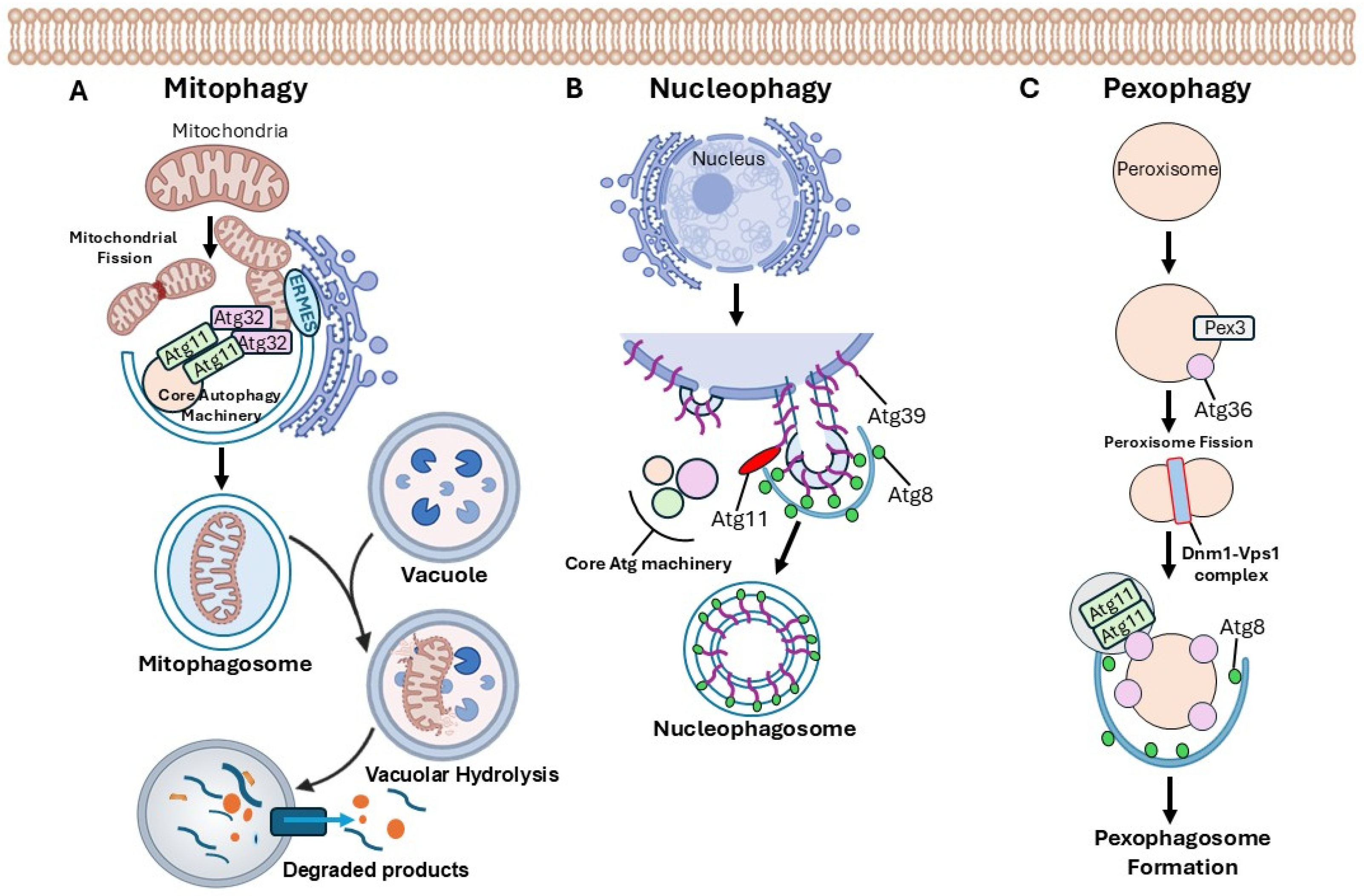
Figure 2.
Schematic diagram shows fungal autophagy process and its multi-functional roles in fungal morphogenetic events and nutrient homeostasis.
Figure 2.
Schematic diagram shows fungal autophagy process and its multi-functional roles in fungal morphogenetic events and nutrient homeostasis.
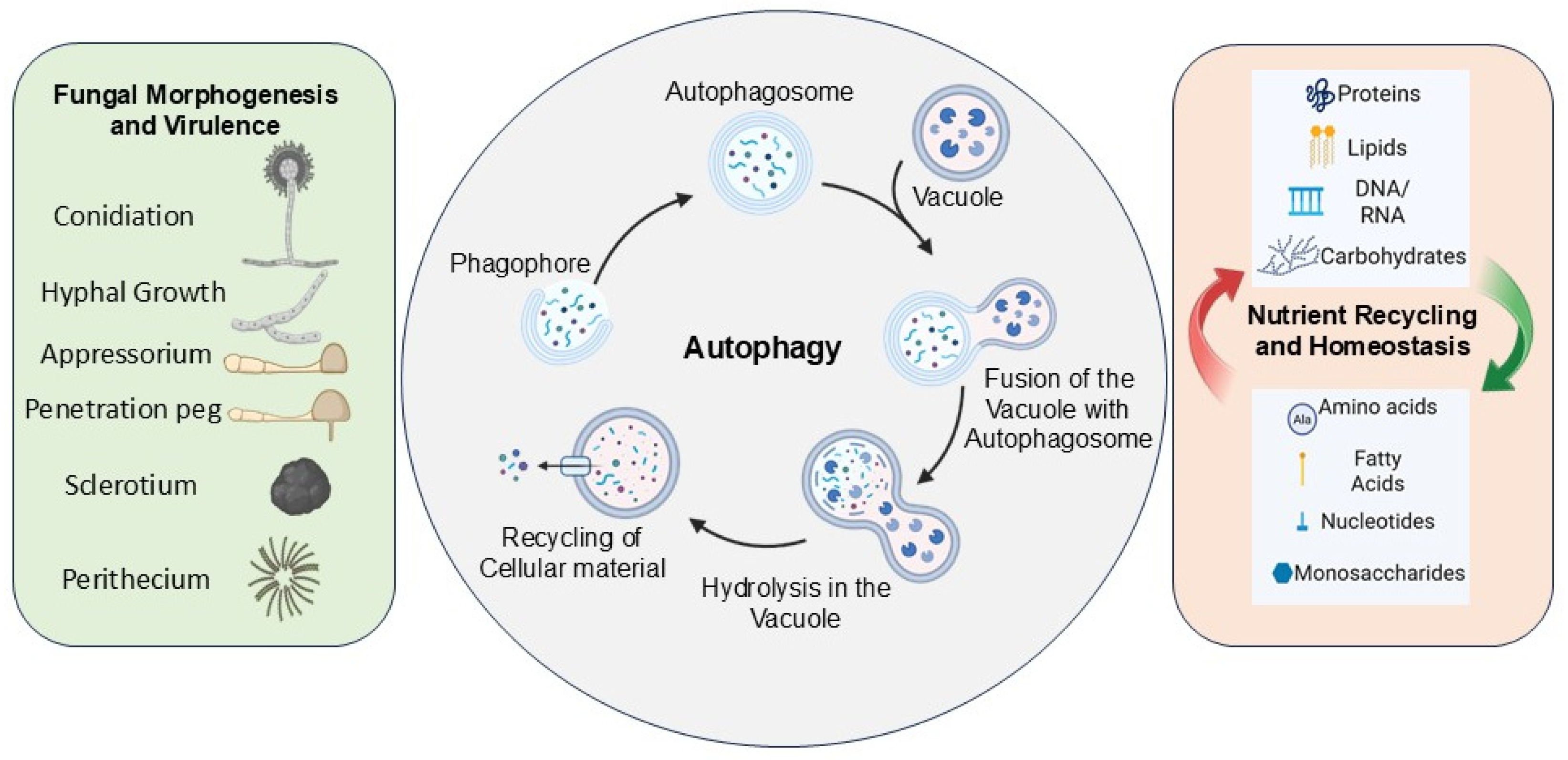
Disclaimer/Publisher’s Note: The statements, opinions and data contained in all publications are solely those of the individual author(s) and contributor(s) and not of MDPI and/or the editor(s). MDPI and/or the editor(s) disclaim responsibility for any injury to people or property resulting from any ideas, methods, instructions or products referred to in the content. |
© 2026 by the authors. Licensee MDPI, Basel, Switzerland. This article is an open access article distributed under the terms and conditions of the Creative Commons Attribution (CC BY) license (http://creativecommons.org/licenses/by/4.0/).
Copyright: This open access article is published under a Creative Commons CC BY 4.0 license, which permit the free download, distribution, and reuse, provided that the author and preprint are cited in any reuse.


