

Submitted:
12 April 2026
Posted:
14 April 2026
You are already at the latest version
Abstract
The construction sector plays a central role in global resource depletion and waste generation, with construction and demolition activities accounting for more than one-third of total waste produced in the European Union. Despite growing interest in circular construction, one of the major barriers to large-scale material reuse is the lack of reliable information on the type, quantity, location, and availability of secondary materials in the urban environment. Existing planning tools rarely integrate material stock information into design and policy decision-making processes. Addressing this gap is essential for implementing circular economy strategies and enabling urban mining practices. This study presents the application of a spatially explicit bottom-up Material Stock Analysis (MSA) to quantify and map the embedded materials within an urban district of Milan. The research results in the creation of a secondary material cadaster and the estimation of material stock. The adopted methodology combines municipal GIS datasets, historical cartography, building archetype classification, and literature-derived material intensity coefficients. The final dataset is re-integrated into a geospatial environment to visualize material distributions and generate material-specific spatial analyses and heat maps. The study intends to support architects, urban designers, planners, and policymakers with decision-support information to guide design strategies, demolition planning, and resource governance at the district and metropolitan scales. The outcome aims at bridging architectural design knowledge with urban-scale material information through a replicable GIS-based workflow.
Keywords:
circular design
; secondary materials
; resource depletion
; material cadaster
; material flow analysis
; bottom-up approach
; building stock
1. Introduction
Between 2000 and 2019, domestic material consumption, defined as the amount of raw materials directly used in production processes within a country, increased by 66 per cent, tripling since the 1970s, to reach 95.1 billion metric tons [1]. At the same time, the spatial footprint of urbanization has continued to expand. According to an analysis of 681 cities, the average built-up area per capita increased from 161 m² per person in 1990 to 169 m² in 2020 [2]. Combined with ongoing demographic trends characterized by both population growth and ageing [3], these dynamics are expected to accelerate construction activity in the coming decades further. Such trends risk undermining the achievement of several Sustainable Development Goals (SDGs) while exacerbating social, economic, and environmental inequalities across both developed and developing countries.
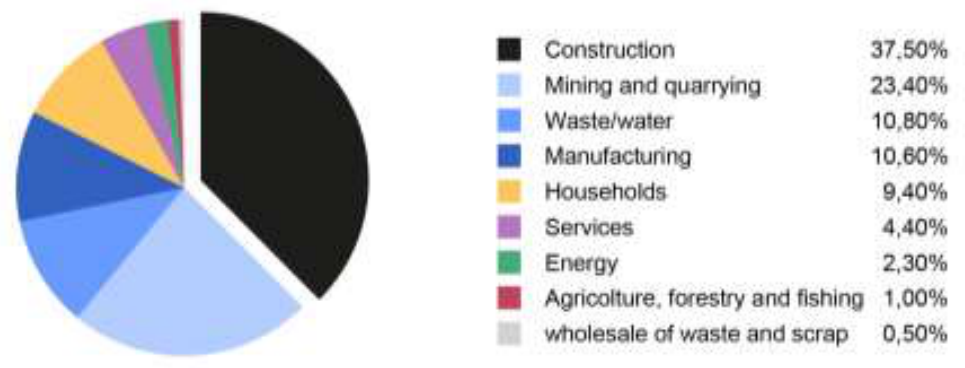
Evidence of the resource pressure generated by the built environment is also reflected in waste statistics. In the European Union, construction and demolition waste (CDW) accounts for more than one third of total waste generation, representing approximately 37.5% by weight of all waste produced [4].
Figure 1.
Waste generation by activity in EU in 2020. Source: Eurostat [4].
Figure 1.
Waste generation by activity in EU in 2020. Source: Eurostat [4].
1.1. Demolition Waste, Urban Mining and Material Reuse
The circular economy aims to reduce material consumption by intervening across the entire value chain [5], limiting the extraction of virgin resources [6] through the reuse and more efficient allocation of existing materials.
At its most practical level, reuse is a waste management strategy that utilizes reclaimed materials or components in their original or near-original form for new purposes, thereby maintaining their economic value and preserving the resources initially invested in their production [7].
Today, urban materials will become tomorrow’s waste, but they could serve as a future resource if their embodied value is recognized and their reuse is reached through urban mining, defined as the systematic reuse of anthropogenic materials from urban areas [8,9,10]. Urban mining encompasses actions and technologies to recover wasted or unused materials, food, water, and energy from cities, exploiting large resource stocks in buildings, infrastructure, and landfills. This approach postulates that cities can generate sufficient secondary resources for large-scale raw material production from inherent material stocks [11].
As stated by Koutamanis et al. [12], urban mining and material reuse require the prior quantification of the material stock to be reclaimed, more than the application and comprehension of better recovery techniques [13]. Therefore, it is necessary to know how much secondary material is available, and - moreover - what type, where, and when it becomes available. This calls for city- or region-wide planning tools: secondary material cadasters [8] are emerging as a key solution. These are geospatial databases that map the distribution of material stock contained in existing buildings. They are the first step to understanding the future availability of secondary materials and implementing the process of reclaiming them.
There are two main methodologies to quantify the material stock embedded in existing buildings: the deductive bottom-up and inductive top-down approaches [14].
The top-down approach builds on the mass-balance principle that the change in the stock is the result of the difference between inflows and outflows of a material over time [15]. This methodology works through a flow-driven approach [16], estimating the material flows entering and leaving the system, as shown in the studies of Marinova et al. [17], Krausmann et al. [18], and Hsiao et al. [19].
On the other hand, the bottom-up process aims to quantify the materials contained within a system by counting its constituent elements. This methodology is driven by information derived from stock inventory: all items containing a specific material are counted and multiplied by the material intensity [20]. Consequently, the data modelling approach is quite labor-intensive, but allows for greater accuracy than the top-down approach, in terms of composition, intensity, and geographic distribution [21].
Due to the large amount of data required, the scope of bottom-up studies is often narrowed down to a smaller geographical scale (city level or below), a specific year, specific materials, and specific stocks’ categories (e.g., many studies occur on residential buildings) [20].
As shown in the systematic review on Building stock mining for a circular economy by Rajaratnam et al. (2023), many bottom-up studies have been developed for different cities: Salford and Wakayama [22], Vienna [23], Melbourne [24,25], Chiclayo [26], Longwu [27], Leiden [28], Tampere [29], Xiamen [30], Shenzhen [31,32], Taipei [33], Vantaa [34], Odense [35,36], Manchester, Leeds and Bradford [37], Salford [38], Esch-sur-Alzette [39], Padua [40], Canberra [41], Ithaca [42], Recife [43], Philadelphia [44,45], Beijing [46], Ostrava and Katowice [47], Gothenburg [48], Sheffield [49].
1.2. Scope and Aim of the Work
As described, Europe and China dominate the geographical application of bottom-up material stock analysis, although not all studies are explicitly oriented towards urban mining applications.
Despite the overall European concentration of studies, Italy remains relatively underrepresented in the literature. This is significant considering the scale and characteristics of its building stock, which is largely privately owned [50] and often characterized by long lifespans and incremental transformations. At the same time, Milan is currently experiencing a renewed phase of urban development and construction activity, leading to increasing material demand.
In this context, the analysis of a Milanese district represents a relevant first application, both to address a geographical gap in the literature and to explore the potential of material stock assessment in the context of ongoing urban transformation. Therefore, this study presents a bottom-up assessment aimed at analyzing and estimating the building material stock of a district in Milan.
The result is the creation of a resource cadaster of the area to map the distribution of a series of building materials that could potentially be reused in new projects. This tool can help architects, designers, planners, and policymakers to be aware of the materials available in the city and implement policies for material reuse and urban mining.
2. Materials and Methods
The bottom-up MSA to estimate the amount and spatial distribution of building materials in the city includes several steps. This section details the overall modelling approach and a description of the steps. Figure 2 illustrates the overall modeling approach that was developed and utilized in this study.
2.1. Boundary, Data Collection, and GIS Modelling
The first step is setting the geographical boundary of analysis, usually consisting of a district or a city. Then, the process foresees the creation of a geo-localized inventory of buildings [35]. This kind of inventory often exists in the form of Geographical Information System (GIS) data, gathered from usually accessible local databases. GIS, as a tool for handling, processing, and analyzing large amounts of geospatial data, allows for high spatial resolution and improved understanding of the physical composition of the built environment stock. The integration of GIS data in the bottom-up approach was developed by Tanikawa and Hashimoto [22], and is now a well-established practice in the panorama of bottom-up studies.
2.1.1. Geometric Data
Then, geometric datasets are extracted from the GIS database: though the type of included information on buildings varies across cities and countries, it is possible to retrieve footprint area and perimeter, height, function, and year of construction for each building. To estimate the total gross floor area, the building footprint is multiplied by the number of floors, which - if this information is not included in the GIS database - are derived from the building’s height divided by the average height of a single story.
2.1.2. Year of Construction
The year of construction must then be identified for each building to define age classes (cohorts). While some GIS databases include this information, others do not. In such cases, construction periods can be reconstructed by incorporating historical sources and cadastral maps.
2.1.3. Material Information
Most GIS databases do not include “bill of material” information, and studies rely on average material intensity coefficients derived from literature and building archetypes, which facilitate the data modeling: the heterogeneous datasets of buildings are homogenized by weighing each archetype by the number of buildings fitting the archetype [51].
2.2. Archetypes
2.3. Material Intensity
The archetypes allow direct translation from geometrical data to material quantities through the definition of Material Intensity (MI), defined as the mass of construction materials per unit of building floor area (e.g. kg/m²), as developed by Gontia et al. [55] and Heeren e Fishman [56]. Each archetype is subdivided into specific elements (e.g., roof, load-bearing walls, etc.). For each element, the Material intensity is identified (through literature, professional knowledge, or redrawing), to calculate for each material (e.g., concrete, timber, steel) the average mass per unit [57].
2.4. Material Stock and Material Cadaster
By merging the GIS database with typological material intensity coefficients, it is possible to calculate the overall material amount of each building material within a given boundary and its spatial distribution, known as a cadaster of secondary materials.
The cadaster enables a granular spatial characterization of the built environment, localizing resource accumulations (e.g., concrete, steel, timber, or bricks). The framework provides important information on materials that can help to set priorities for recovery, design of effective reclamation systems, and recycling logistics [8].
3. Results
The application of the described spatially explicit bottom-up analysis has been in the district of Porta Vittoria in eastern Milan as of 2025. The model relies on georeferenced GIS models, as explained in the previous chapter.
3.1. Boundary
The study area has been delineated to include NIL 26 and a portion of NIL 28 (NIL stands for Nucleo di Identità Locale, an administrative boundary used by the Municipality of Milan), as shown in Figure 3. The selected area covers approximately 283 ha, corresponding to approximately 1,56% of the Municipality of Milan. Despite that, it accounts for about 4% of the overall population and 4,3% of its building stock, indicating a relatively high concentration of urban stock.
The area, selected for the relative homogeneity of its building typologies, can be considered a representative sample of Milan’s urban fabric, making it suitable for testing methodologies related to building stock characterization and secondary material supply assessment.
3.2. Building Surfaces
Geometric data for the area was first sourced from the Milan Municipality geospatial dataset, the most recent and detailed one. After a comparison with other databases (the Lombardy Region Geodatabase [58], the OpenStreetMap open data platform [59], and the TABULA–EUBUCCO [60]) was undertaken to ensure completeness and accuracy.
The GIS model provided by the Municipality of Milan provided the footprint area and height. Therefore, the total gross floor area of each building has been calculated by multiplying each footprint area by the number of stories, which are derived from the height divided by the average height of a single story. The average height depends on the building function, derived from land use information, present in the used database.
3.3. Temporal Classification
A comprehensive age classification for each building has been carried out to set the archetypes according to the different building technologies (Figure 4a). Unfortunately, the Milan Municipality geospatial dataset did not comprise information regarding the construction year for each building, while it comprised all municipal technical maps redacted from 1884 (1884, 1910, 1930, 1946, 1956, 1965, 1972, 1990, 2000, 2006, 2012). Through the manual fusion of the historical raster images with the building geometries, a distinction of the age clusters was conducted, as done by Miatto et al. (2019). This method is sufficiently agile for small geographic boundaries, as the described case-study, but quite demanding for more extensive ones.
3.4. Building Use
In parallel, the use of each building was retrieved and corrected where necessary. Figure 4b shows the prevalence of residential buildings.
3.5. Archetypes
As described, the buildings within the study area have been classified through a GIS-based overlay and comparison of the historical maps. However, the number of historical thresholds (derived from different technical maps) exceeded the meaningful distinctions in construction technology, as described in TABULA and in other technical manuals.
Therefore, archetypes were grouped into broader time periods that better reflect their construction technology: seven residential, seven public offices (school, hospitals, administrative buildings, etc.), seven commercial, and one industrial. The result is shown in Figure 5. Buildings related to transportation, leisure, and religion cover only a minor share of the total built volume of the study area and have therefore been neglected.
An adapted version of the methodology developed by Miatto et al. [61] for the Italian building stock was adopted. The TABULA project, born to classify the energy efficiency of residential building typologies in different European countries [62,63,64], served as the primary reference for defining building technologies. The archetypes have been redrawn in AutoCAD, the drawing environment developed by Autodesk. The definition of these reference plans was informed by a review of historical construction and housing manuals [65,66,67,68,69]. An example of a residential archetype is provided in Figure 6.
The geometric definition of each archetype was parameterized through a set of variables informed by literature sources, calculations from the reference plans, and Italian regulatory requirements. Parameters include story height, window-to-wall ratio (1:10 window-to-floor area), roof pitch (including flat-roof adjustments consistent with TABULA), number of basement stories, building perimeter, structural footprint ratio (computed as the ratio between the plan area occupied by structural elements and the gross floor area: m²/m²), internal partition ratio (m/m²), and number of internal doors.
These variables allow the modelling of individual components (columns, walls, windows, doors, etc.), for which material compositions were assumed to compile a bill of materials and compute average material mass intensities (kg/m²) for each archetype.
3.6. Data Modelling Process
All geometric data have been extracted from the GIS model and exported to a calculation environment (Excel was selected for its accessibility and ease of visualization), where the material stock analysis has been performed. Afterwards, an extensive data-cleaning process was conducted to identify and correct geometric inconsistencies, remove duplicates, and fill in missing information where possible. As a result, the number of valid entries was reduced to 2,276. The above-described process yielded the total volume of embedded materials, as illustrated in Table 1.
An additional material classification was carried out according to the concept of shearing layers introduced by Duffy and later developed by Brand [70]. This framework is particularly useful as it allows a clear interpretation of each material’s role within the building system.
Moreover, it highlights the differing potential for reuse and the variable replacement frequencies associated with each layer, depending on factors such as exposure, renovation, evolving performance, or aesthetic requirements. The distribution of material stock across the shearing layers is presented in Table 2.
3.7. Spatial Distribution
The material quantities obtained for each unique building geometry were subsequently re-imported into QGIS to visualize their spatial distribution and concentration across the study area, as illustrated in Figure 7 for masonry and concrete.
A complementary visualization of the results is provided by material-specific heatmaps, produced for masonry, concrete, wood, metals, and insulation.
Masonry exhibits a distribution that closely reflects the construction-age patterns and well aligns with the historical classification reported in Figure 8a. Buildings closer to the city center are more likely to incorporate masonry components and to present larger volumes. The highlighted area corresponds to a cluster of tall residential buildings (10–13 stories), constructed between 1884 and 1910, with volumes nearly twice those of the surrounding stock.
Concrete shows an opposite pattern. Its spatial distribution is substantially more homogeneous than that of masonry (Figure 8b), perhaps because it is extensively used in underground levels.
By contrast, metals display a more dispersed distribution (Figure 8c). Despite the comparatively small quantities involved, no clear spatial trend emerges, except for higher values in areas associated with former factories and industrial facilities.
Finally, insulation materials largely follow an age-driven distribution: newer buildings, which incorporate greater insulation volumes, are located in the southern portion of the study area (Figure 8d).
4. Discussion
Estimates of building materials stock in cities have been gaining importance in the literature, but the lack of methodological standardization leads to non-easily comparable results [40]. Benchmarking the estimated stock of Porta Vittoria against other studies confirms that the selected area has an above-average material stock per capita (376 t/cap), exceeding most values reported in the literature (Table 3).
The high material stock per capita can be partially explained by the characteristics of the study area (see chapter 1). Compared to the overall Municipality of Milan, the area concentrates a significantly larger share of population and buildings relative to its size, reflecting higher urban density and a more intensive use of built space.
Limitations and Future Outlook
As outlined above, the method requires buildings to be grouped into “archetypes” based on their function and construction period. This forced homogenization overlooks the real heterogeneity of individual structures, leading to systematic errors.
Furthermore, to achieve a reasonable level of approximation without excessive generalization, archetypes are often study-area-dependent, manually extracted from floor plans or technical manuals, which makes it problematic to apply these models at national or continental scales.
An additional limitation concerns the reliability of the input data: cadastral databases and GIS maps may be incomplete or outdated with respect to the actual built environment, particularly in dynamic urban contexts. This issue is especially critical in large and rapidly evolving metropolitan areas, which are at the same time the most resource-rich and analytically interesting targets for urban mining studies. In Milan, for instance, a few buildings constructed after 2015 are not yet recorded in the GIS database.
While accurate, the proposed method is very labor-intensive in terms of manual data entry. Future research directions will therefore focus on automating the process using artificial intelligence, for instance, by means of automated visual recognition of building features such as window openings, façade materials, and public space materials. Such an approach has the potential to significantly reduce the burden of the manual work currently required, while also improving the scalability and transferability of the method across different geographical contexts.
In the present study, a machine learning and image recognition method was initially tested with the aim of automating the temporal categorization of buildings based on raster images of historical maps. However, early-stage experiments delivered limited reliability, leading to a more conservative approach based on the manual integration of historical maps into the GIS database.
5. Conclusions
The study results in the creation of a resource cadaster mapping the distribution of building materials with potential for reuse. This tool provides a knowledge base that can support architects, designers, planners, and policymakers in developing strategies for material reuse and urban mining. It delivers a baseline dataset for a future dynamic material flow model that projects the future availability of building materials over the coming decades.
Despite the limitations and approximations discussed above, the proposed method remains highly flexible, enabling the expansion of the study area through the integration of additional building data. Indeed, a city-wide simulation for Milan is currently underway by the authors. Its objective is to produce a comprehensive, spatially explicit mapping of material stocks at the urban scale, thereby extending the method’s applicability and strengthening its value as a decision-support tool for circular-economy planning at the metropolitan level.
Author Contributions
“Conceptualization, MV, FP and GM; methodology, MV, FP, and GM; formal analysis, IP; investigation, MV; resources, MV, IP; data curation, IP; writing—original draft preparation, MV, IP; writing—review and editing, MV, FP, GM; visualization, MV and IP; supervision, GM and FP. All authors have read and agreed to the published version of the manuscript.” Please turn to the CRediT taxonomy for the term explanation. Authorship must be limited to those who have contributed substantially to the work reported.
Data Availability Statement
The data supporting this study are available from the corresponding author upon reasonable request.
Acknowledgments
The authors would like to thank the students who contributed to the development of this research phase, in particular Giulia Buongiovanni, Martina Auricchio, Elena Sofia Porta, Emilia Vallerga, Valentina Giustinelli, Paolo Rainoldi, and Marco Santi.
Conflicts of Interest
Declare conflicts of interest or state “The authors declare no conflicts of interest.” Authors must identify and declare any personal circumstances or interest that may be perceived as inappropriately influencing the representation or interpretation of reported research results. Any role of the funders in the design of the study; in the collection, analyses or interpretation of data; in the writing of the manuscript; or in the decision to publish the results must be declared in this section. If there is no role, please state “The funders had no role in the design of the study; in the collection, analyses, or interpretation of data; in the writing of the manuscript; or in the decision to publish the results”.
Abbreviations
The following abbreviations are used in this manuscript:
| MSA | Material Stock Analysis MSA |
| CDW | construction and demolition waste |
| GIS | Geographical Information System |
| NIL | Nucleo Identità Locale |
References
- United Nations Department of Economic and Social Affairs The Sustainable Development Goals Report 2023: Special Edition; The Sustainable Development Goals Report; United Nations, 2023; ISBN 978-92-1-002491-4.
- In United Nations Human Settlements Programme Rescuing SDG 11 for a Resilient Urban Planet: SDG 11 Synthesis Report High Level Political Forum 2023; United Nations Human Settlements Programme (UN-Habitat): Nairobi, Kenya, 2023; 2. United Nations Human Settlements Programme Rescuing SDG 11 for a Resilient Urban Planet: SDG 11 Synthesis Report High Level Political Forum 2023; United Nations Human Settlements Programme (UN-Habitat): Nairobi, Kenya, 2023;
- United Nations Department of Economic and Social Affairs - 2022 World Population Prospects 2022: Summary of Result; United Nations: New York, 2022;
- Eurostat Waste Statistics; 2023;
- Göswein, V.; Silvestre, J.D.; Habert, G.; Freire, F. Dynamic Assessment of Construction Materials in Urban Building Stocks: A Critical Review. Environ. Sci. Technol. 2019, 53, 9992–10006. [CrossRef]
- Giljium; Stefan; Lutz; Christian; Jungnitz; Ariane; Bruckner; Martin; Hinterberger; Friedrich Global Dimensions of European Natural Resource Use.; July 9 2008.
- Gorgolewski, M. Resource Salvation: The Architecture of Reuse; John Wiley & Sons, Incorporated, 2017; ISBN 978-1-118-92880-6.
- Brunner, P.H. Urban Mining A Contribution to Reindustrializing the City. J. Ind. Ecol. 2011, 15, 339–341. [CrossRef]
- Cossu, R.; Williams, I.D. Urban Mining: Concepts, Terminology, Challenges. Waste Manag. 2015, 45, 1–3. [CrossRef]
- Johansson, N.; Krook, J.; Eklund, M.; Berglund, B. An Integrated Review of Concepts and Initiatives for Mining the Technosphere: Towards a New Taxonomy. J. Clean. Prod. 2013, 55, 35–44. [CrossRef]
- Gorgolewski, M. The Architecture of Reuse. IOP Conf. Ser. Earth Environ. Sci. 2019, 225, 012030. [CrossRef]
- Koutamanis, A.; Van Reijn, B.; Van Bueren, E. Urban Mining and Buildings: A Review of Possibilities and Limitations. Resour. Conserv. Recycl. 2018, 138, 32–39. [CrossRef]
- Oezdemir, O.; Krause, K.; Hafner, A. Creating a Resource Cadaster—A Case Study of a District in the Rhine-Ruhr Metropolitan Area. Buildings 2017, 7, 45. [CrossRef]
- Augiseau, V.; Barles, S. Studying Construction Materials Flows and Stock: A Review. Resour. Conserv. Recycl. 2017, 123, 153–164. [CrossRef]
- Müller, E.; Hilty, L.M.; Widmer, R.; Schluep, M.; Faulstich, M. Modeling Metal Stocks and Flows: A Review of Dynamic Material Flow Analysis Methods. Environ. Sci. Technol. 2014, 48, 2102–2113. [CrossRef]
- Wiedenhofer, D.; Fishman, T.; Lauk, C.; Haas, W.; Krausmann, F. Integrating Material Stock Dynamics Into Economy-Wide Material Flow Accounting: Concepts, Modelling, and Global Application for 1900–2050. Ecol. Econ. 2019, 156, 121–133. [CrossRef]
- Marinova, S.; Deetman, S.; Van Der Voet, E.; Daioglou, V. Global Construction Materials Database and Stock Analysis of Residential Buildings between 1970-2050. J. Clean. Prod. 2020, 247, 119146. [CrossRef]
- Krausmann, F.; Schandl, H.; Eisenmenger, N.; Giljum, S.; Jackson, T. Material Flow Accounting: Measuring Global Material Use for Sustainable Development. Annu. Rev. Environ. Resour. 2017, 42, 647–675. [CrossRef]
- Hsiao, T.Y.; Huang, Y.T.; Yu, Y.H.; Wernick, I.K. Modeling Materials Flow of Waste Concrete from Construction and Demolition Wastes in Taiwan. Resour. Policy 2002, 28, 39–47. [CrossRef]
- Lanau, M.; Liu, G.; Kral, U.; Wiedenhofer, D.; Keijzer, E.; Yu, C.; Ehlert, C. Taking Stock of Built Environment Stock Studies: Progress and Prospects. Environ. Sci. Technol. 2019, 53, 8499–8515. [CrossRef]
- Luciano, A.; Altamura, P.; Baiani, S.; Cutaia, L. The Building Stock as an Urban Mine: The Case of the Circular Regeneration of Disused Buildings. Sustain. Chem. Pharm. 2023, 33, 101104. [CrossRef]
- Tanikawa, H.; Hashimoto, S. Urban Stock over Time: Spatial Material Stock Analysis Using 4d-GIS. Build. Res. Inf. 2009, 37, 483–502. [CrossRef]
- Kleemann, F.; Lehner, H.; Szczypińska, A.; Lederer, J.; Fellner, J. Using Change Detection Data to Assess Amount and Composition of Demolition Waste from Buildings in Vienna. Resour. Conserv. Recycl. 2017, 123, 37–46. [CrossRef]
- Stephan, A.; Athanassiadis, A. Quantifying and Mapping Embodied Environmental Requirements of Urban Building Stocks. Build. Environ. 2017, 114, 187–202. [CrossRef]
- Stephan, A.; Athanassiadis, A. Towards a More Circular Construction Sector: Estimating and Spatialising Current and Future Non-Structural Material Replacement Flows to Maintain Urban Building Stocks. Resour. Conserv. Recycl. 2018, 129, 248–262. [CrossRef]
- Mesta, C.; Kahhat, R.; Santa-Cruz, S. Geospatial Characterization of Material Stock in the Residential Sector of a Latin-American City. J. Ind. Ecol. 2019, 23, 280–291. [CrossRef]
- Wang, H.; Chen, D.; Duan, H.; Yin, F.; Niu, Y. Characterizing Urban Building Metabolism with a 4D-GIS Model: A Case Study in China. J. Clean. Prod. 2019, 228, 1446–1454. [CrossRef]
- Verhagen, T.J.; Sauer, M.L.; Van Der Voet, E.; Sprecher, B. Matching Demolition and Construction Material Flows, an Urban Mining Case Study. Sustainability 2021, 13, 653. [CrossRef]
- Huuhka, S.; Kolkwitz, M. Stocks and Flows of Buildings: Analysis of Existing, Demolished, and Constructed Buildings in Tampere, Finland, 2000–2018. J. Ind. Ecol. 2021, 25, 948–960. [CrossRef]
- Liu, Y.; Li, J.; Chen, W.; Song, L.; Dai, S. Quantifying Urban Mass Gain and Loss by a GIS-based Material Stocks and Flows Analysis. J. Ind. Ecol. 2022, 26, 1051–1060. [CrossRef]
- Wu, H.; Wang, J.; Duan, H.; Ouyang, L.; Huang, W.; Zuo, J. An Innovative Approach to Managing Demolition Waste via GIS (Geographic Information System): A Case Study in Shenzhen City, China. J. Clean. Prod. 2016, 112, 494–503. [CrossRef]
- Mao, T.; Liu, Y.; Chen, W.-Q.; Li, N.; Dong, N.; Shi, Y. Quantifying Spatiotemporal Dynamics of Urban Building and Material Metabolism by Combining a Random Forest Model and GIS-Based Material Flow Analysis. Front. Earth Sci. 2022, 10, 944865. [CrossRef]
- Cheng, K.-L.; Hsu, S.-C.; Li, W.-M.; Ma, H.-W. Quantifying Potential Anthropogenic Resources of Buildings through Hot Spot Analysis. Resour. Conserv. Recycl. 2018, 133, 10–20. [CrossRef]
- Kolkwitz, M.; Luotonen, E.; Huuhka, S. How Changes in Urban Morphology Translate into Urban Metabolisms of Building Stocks: A Framework for Spatiotemporal Material Flow Analysis and a Case Study. Environ. Plan. B Urban Anal. City Sci. 2023, 50, 1559–1576. [CrossRef]
- Lanau, M.; Liu, G. Developing an Urban Resource Cadaster for Circular Economy: A Case of Odense, Denmark. Environ. Sci. Technol. 2020, 54, 4675–4685. [CrossRef]
- Li, Q.; Gummidi, S.R.B.; Lanau, M.; Yu, B.; Liu, G. Spatiotemporally Explicit Mapping of Built Environment Stocks Reveals Two Centuries of Urban Development in a Fairytale City, Odense, Denmark. Environ. Sci. Technol. 2022, 56, 16369–16381. [CrossRef]
- Ajayebi, A.; Hopkinson, P.; Zhou, K.; Lam, D.; Chen, H.-M.; Wang, Y. Spatiotemporal Model to Quantify Stocks of Building Structural Products for a Prospective Circular Economy. Resour. Conserv. Recycl. 2020, 162, 105026. [CrossRef]
- Ajayebi, A.; Hopkinson, P.; Zhou, K.; Lam, D.; Chen, H.-M.; Wang, Y. Estimation of Structural Steel and Concrete Stocks and Flows at Urban Scale–towards a Prospective Circular Economy. Resour. Conserv. Recycl. 2021, 174, 105821. [CrossRef]
- Mastrucci, A.; Marvuglia, A.; Popovici, E.; Leopold, U.; Benetto, E. Geospatial Characterization of Building Material Stocks for the Life Cycle Assessment of End-of-Life Scenarios at the Urban Scale. Resour. Conserv. Recycl. 2017, 123, 54–66. [CrossRef]
- Miatto, A.; Schandl, H.; Forlin, L.; Ronzani, F.; Borin, P.; Giordano, A.; Tanikawa, H. A Spatial Analysis of Material Stock Accumulation and Demolition Waste Potential of Buildings: A Case Study of Padua. Resour. Conserv. Recycl. 2019, 142, 245–256. [CrossRef]
- Schandl, H.; Marcos-Martinez, R.; Baynes, T.; Yu, Z.; Miatto, A.; Tanikawa, H. A Spatiotemporal Urban Metabolism Model for the Canberra Suburb of Braddon in Australia. J. Clean. Prod. 2020, 265, 121770. [CrossRef]
- Heisel, F.; McGranahan, J.; Ferdinando, J.; Dogan, T. High-Resolution Combined Building Stock and Building Energy Modeling to Evaluate Whole-Life Carbon Emissions and Saving Potentials at the Building and Urban Scale. Resour. Conserv. Recycl. 2022, 177, 106000. [CrossRef]
- Paz, D.H.F. da; Lafayette, K.P.V.; Sobral, M. do C. GIS-Based Planning System for Managing the Flow of Construction and Demolition Waste in Brazil. Waste Manag. Res. 2018, 36, 541–549. [CrossRef]
- Marcellus-Zamora, K.A.; Gallagher, P.M.; Spatari, S.; Tanikawa, H. Estimating Materials Stocked by Land-Use Type in Historic Urban Buildings Using Spatio-Temporal Analytical Tools. J. Ind. Ecol. 2016, 20, 1025–1037. [CrossRef]
- Marcellus-Zamora, K.A.; Gallagher, P.M.; Spatari, S. Can Public Construction and Demolition Data Describe Trends in Building Material Recycling? Observations From Philadelphia. Front. Built Environ. 2020, 6, 131. [CrossRef]
- Chen, C.; Liu, Y. Construction and Demolition Wastes in Beijing: Where They Come from and Where They Go? Waste Manag. Res. 2021, 39, 555–560. [CrossRef]
- Inostroza, L.; Hamstead, Z.; Spyra, M.; Qureshi, S. Beyond Urban–Rural Dichotomies: Measuring Urbanisation Degrees in Central European Landscapes Using the Technomass as an Explicit Indicator. Ecol. Indic. 2019, 96, 466–476. [CrossRef]
- Gontia, P.; Thuvander, L.; Ebrahimi, B.; Vinas, V.; Rosado, L.; Wallbaum, H. Spatial Analysis of Urban Material Stock with Clustering Algorithms: A Northern European Case Study. J. Ind. Ecol. 2019, 23, 1328–1343. [CrossRef]
- Arbabi, H.; Lanau, M.; Li, X.; Meyers, G.; Dai, M.; Mayfield, M.; Densley Tingley, D. A Scalable Data Collection, Characterization, and Accounting Framework for Urban Material Stocks. J. Ind. Ecol. 2022, 26, 58–71. [CrossRef]
- Italy Home Ownership Rate Available online: https://tradingeconomics.com/italy/home-ownership-rate (accessed on 20 March 2026).
- Cutler, A.; Breiman, L. Archetypal Analysis.
- Famuyibo, A.A.; Duffy, A.; Strachan, P. Developing Archetypes for Domestic Dwellings—An Irish Case Study. Energy Build. 2012, 50, 150–157. [CrossRef]
- Mata, É.; Sasic Kalagasidis, A.; Johnsson, F. Building-Stock Aggregation through Archetype Buildings: France, Germany, Spain and the UK. Build. Environ. 2014, 81, 270–282. [CrossRef]
- Österbring, M.; Mata, É.; Thuvander, L.; Mangold, M.; Johnsson, F.; Wallbaum, H. A Differentiated Description of Building-Stocks for a Georeferenced Urban Bottom-up Building-Stock Model. Energy Build. 2016, 120, 78–84. [CrossRef]
- Gontia, P.; Nägeli, C.; Rosado, L.; Kalmykova, Y.; Österbring, M. Material-Intensity Database of Residential Buildings: A Case-Study of Sweden in the International Context. Resour. Conserv. Recycl. 2018, 130, 228–239. [CrossRef]
- Heeren, N.; Fishman, T. A Database Seed for a Community-Driven Material Intensity Research Platform. Sci. Data 2019, 6, 23. [CrossRef]
- Miatto, A.; Schandl, H.; Tanikawa, H. How Important Are Realistic Building Lifespan Assumptions for Material Stock and Demolition Waste Accounts? Resour. Conserv. Recycl. 2017, 122, 143–154. [CrossRef]
- Geoportale della Lombardia Available online: https://www.geoportale.regione.lombardia.it/ricerca (accessed on 20 March 2026).
- OpenStreetMap Available online: https://www.openstreetmap.org/ (accessed on 20 March 2026).
- Milojevic-Dupont, N.; Wagner, F.; Nachtigall, F.; Hu, J.; Brüser, G.B.; Zumwald, M.; Biljecki, F.; Heeren, N.; Kaack, L.H.; Pichler, P.-P.; et al. EUBUCCO v0.1: European Building Stock Characteristics in a Common and Open Database for 200+ Million Individual Buildings. Sci. Data 2023, 10, 147. [CrossRef]
- Miatto, A.; Fasanella, Y.; Mainardi, M.; Borin, P. Correlation between Building Size and Material Intensity in Residential Buildings. Resour. Conserv. Recycl. 2023, 197, 107093. [CrossRef]
- Ballarini, I.; Corgnati, S.P.; Corrado, V. Use of Reference Buildings to Assess the Energy Saving Potentials of the Residential Building Stock: The Experience of TABULA Project. Energy Policy 2014, 68, 273–284. [CrossRef]
- Corrado, V.; Ballarini, I.; Corgnati, S.P. National Scientific Report on the TABULA Activities in Italy.
- Loga, T.; Stein, B.; Diefenbach, N. TABULA Building Typologies in 20 European Countries—Making Energy-Related Features of Residential Building Stocks Comparable. Energy Build. 2016, 132, 4–12. [CrossRef]
- La casa popolare in Lombardia 1903 - 2003: studi e materiali ordinati per la Mostra “La Casa Popolare in Lombardia 1903 - 2003. 100 Anni di Edilizia Residenziale Pubblica in Lombardia” realizzata alla Triennale di Milano ... dall’11 dicembre 2003 al 25 gennaio 2004 e, nel corso del 2004, nelle città di Brescia, Varese, Mantova, Lecco, Lodi e Pavia; Pugliese, R., Ed.; Unicopli: Milano, 2005; ISBN 978-88-400-1068-7.
- In Tipologie edilizie; Tipologie edilizie; Baglioni, A., Ed.; Hoepli: Milano, 2013; ISBN 978-88-203-5863-1.
- Contini, G.; Tirelli, G. Manuale Delle Piante d’abitazione: Dalla Casa Isolata al Quartiere Urbano Secondo Principi Modulari : 3500 Plante Tipizzate, 157 Disegni Originali Di Aplicazioni; Görlich, 1954;
- L’edilizia residenziale; U. Hoepli: Milano, 2005; ISBN 978-88-203-3061-3.
- Manuale dell’architetto; Edizione aggiornata.; Sapere 2000: S.l., 2007; ISBN 978-88-7673-076-4.
- Brand, S. How Buildings Learn: What Happens after They’re Built; A Pengiun book architecture; Penguin Books: New York, NY Toronto London, 1995; ISBN 978-0-14-013996-9.
Figure 2.
Bottom-up methodology.
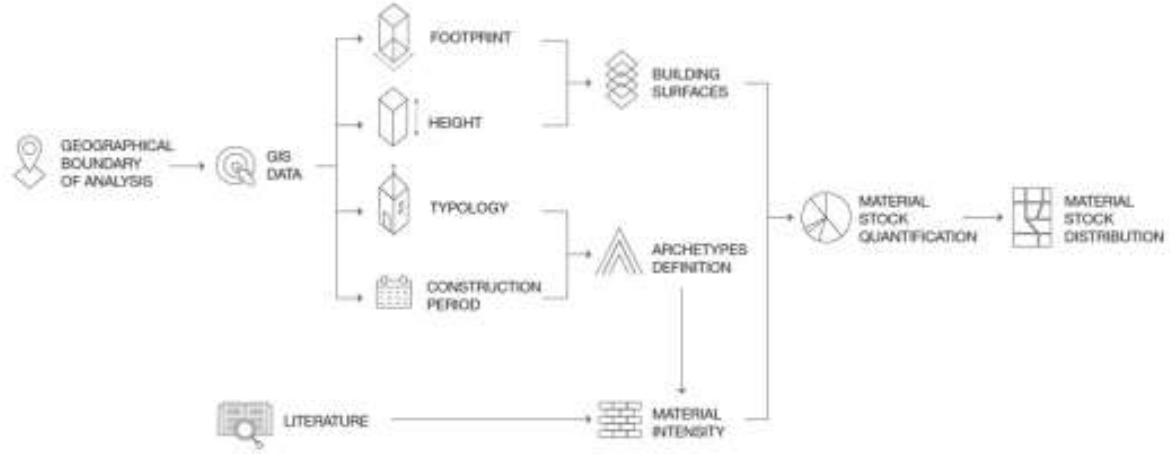
Figure 3.
Location and data of the area of study.
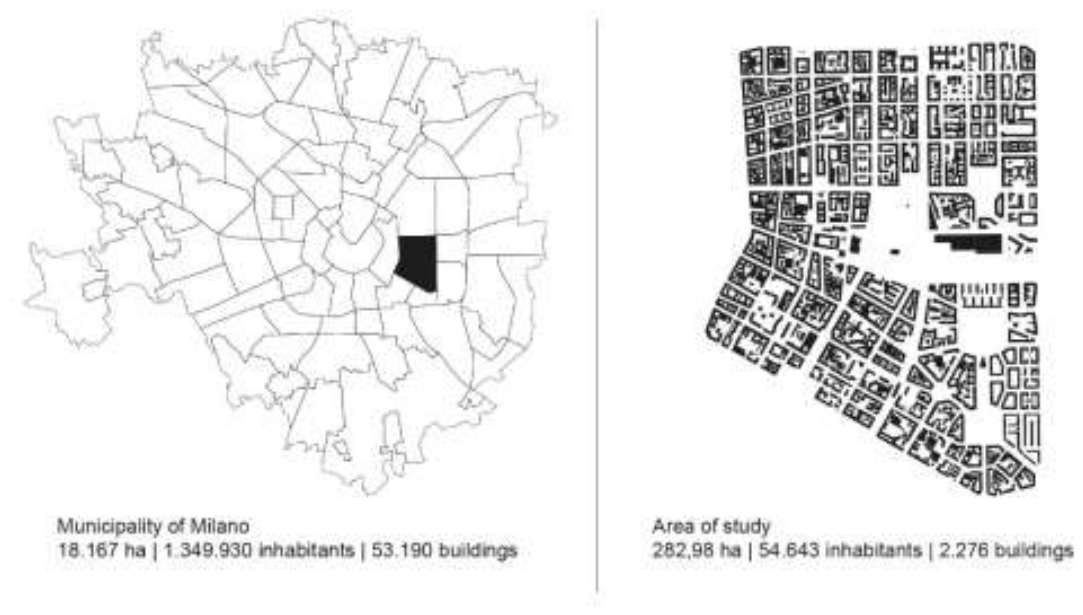
Figure 4.
Spatial distribution of the different cohorts (a) and of the different building uses (b).
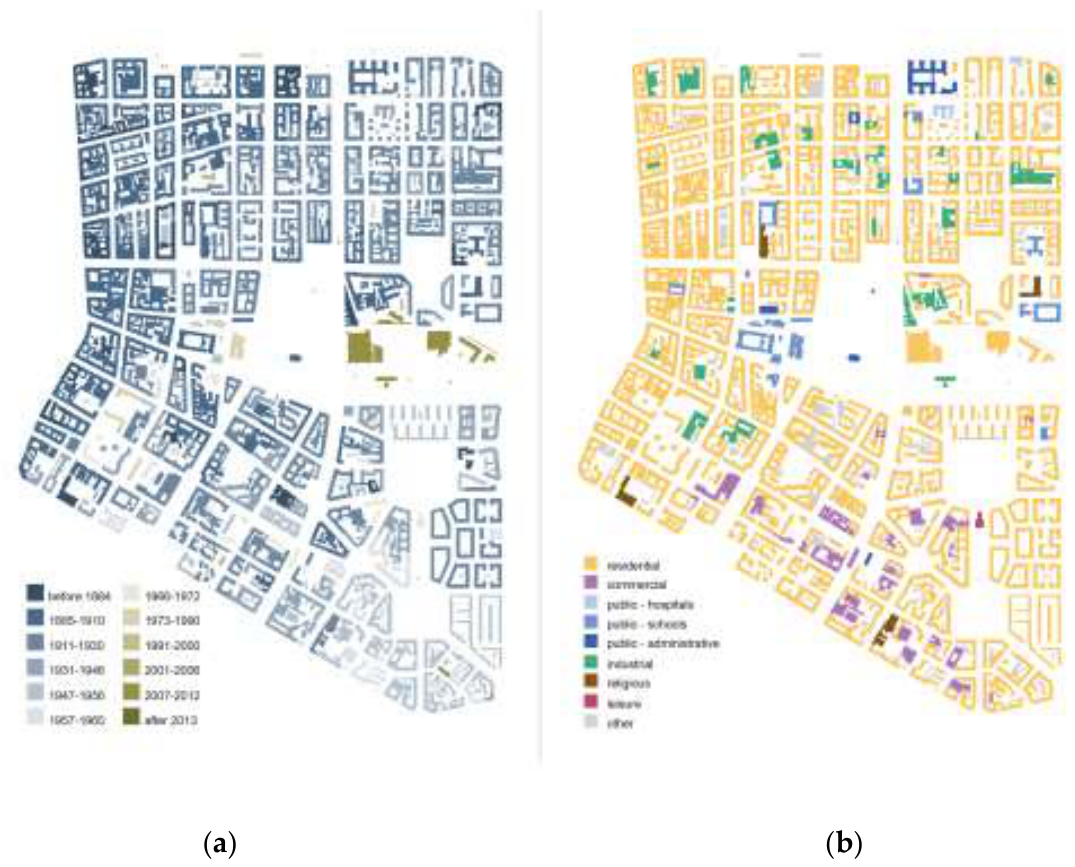
Figure 5.
Grouping of the different building archetypes according to year of construction.
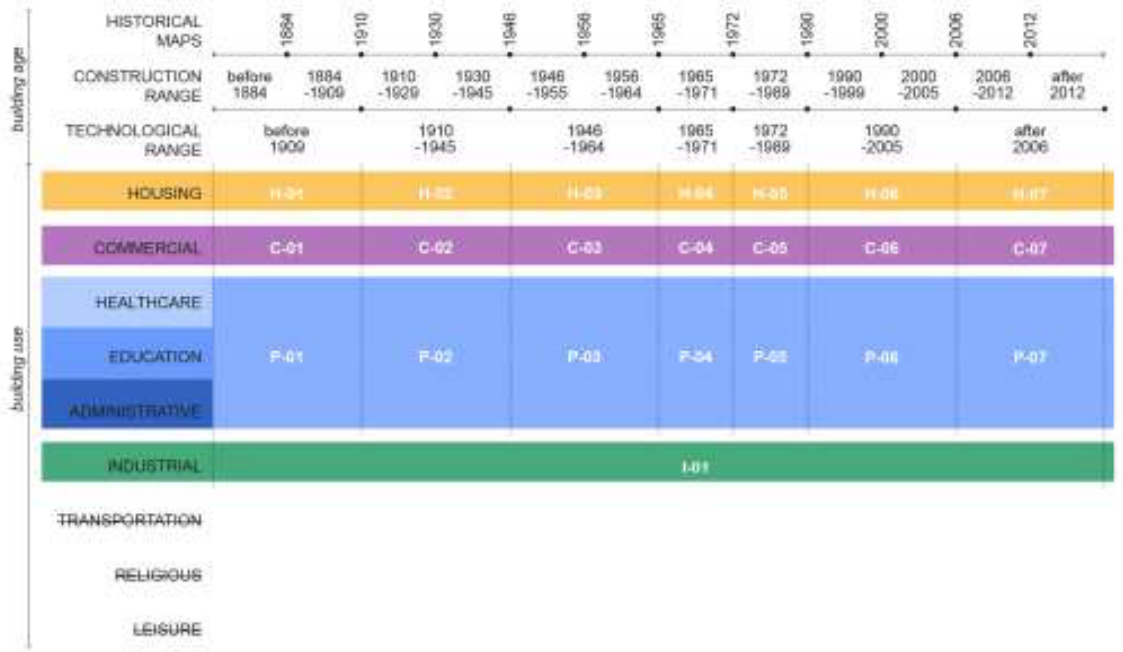
Figure 6.
Characteristics of archetype H-02.
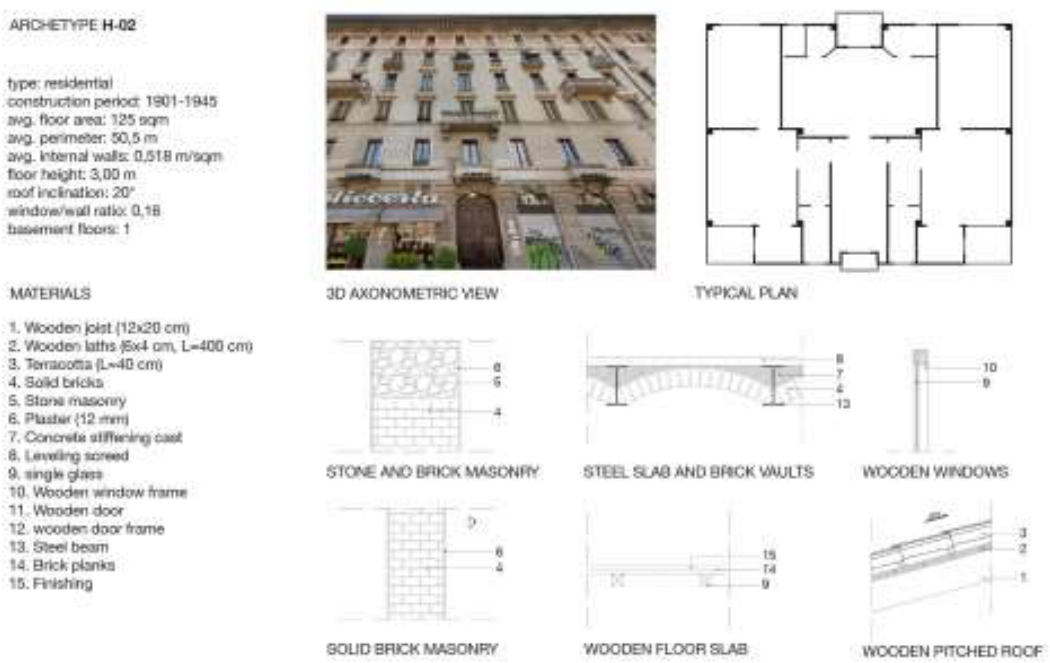
Figure 7.
Spatial distribution of concrete and masonry (thousands of cubic meters).
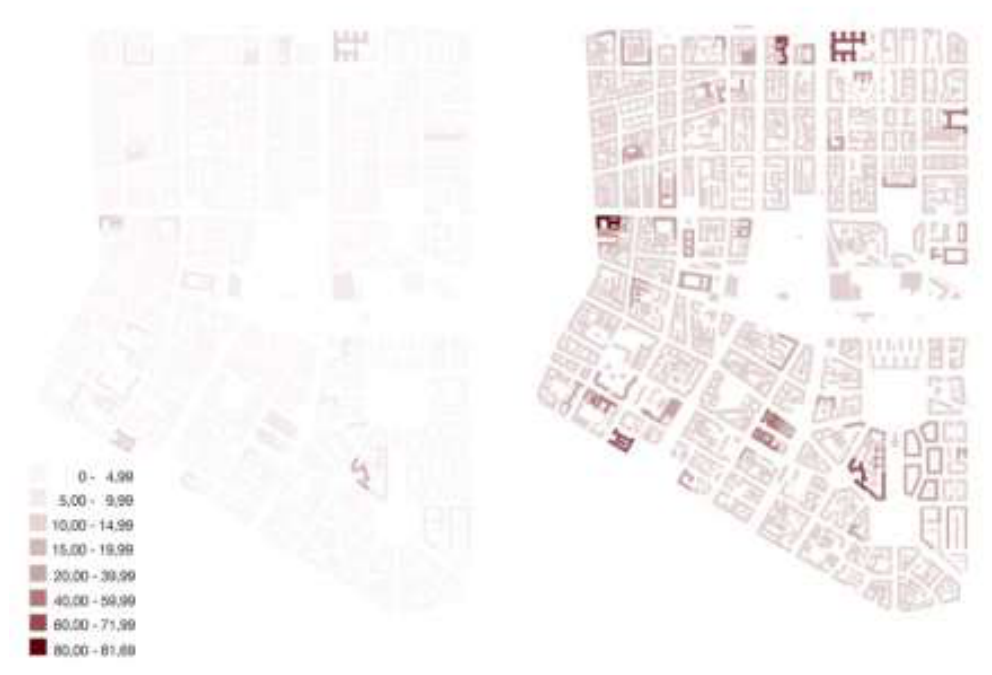
Figure 8.
Heatmap of building materials: masonry (a), concrete (b), metal (c), insulation (d).
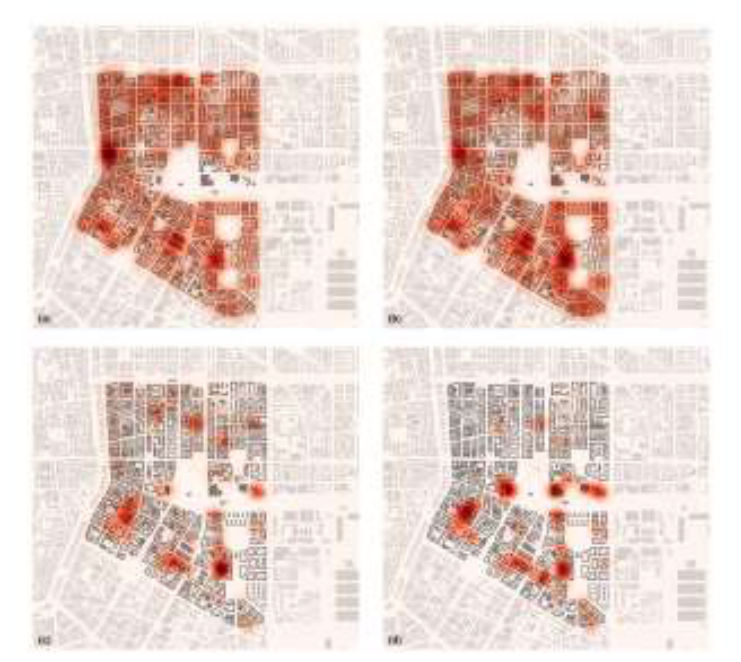

Table 1.
Total volume and mass of embedded materials.
| Material | Volume [m3] | Volume [%] | Weight [ton] | Weight [%] |
| wood | 240 | 2.11% | 194,039 | 1.10% |
| masonry | 8.177 | 72.09% | 11,848,091 | 66.92% |
| metal | 9 | 0.08% | 44,278 | 0.25% |
| glass | 10 | 0.09% | 23,836 | 0.13% |
| ceramic | 0 | 0.00% | 0 | 0.00% |
| textile | 1 | 0.01% | 913 | 0.01% |
| mineral | 1.347 | 11.87% | 2,417,412 | 13.65% |
| polymer | 84 | 0.74% | 6048 | 0.03% |
| composite | 0 | 0.00% | 0 | 0.00% |
| concrete | 1,477 | 13.02% | 3,170,537 | 17.91% |
| Total | 11,343 | 100,00% | 17,705,153 | 100.00% |
Table 2.
Distribution of the overall building stock across Brand’s shearing layers.
| Material | Volume [m3] | Volume [%] | Weight [ton] | Weight [%] |
| Stuff | 0 | 0.00% | 0 | 0.00% |
| Space | 8 | 0.07% | 5,003 | 0.03% |
| Service | 928 | 8.18% | 1,393,703 | 7.87% |
| Structure | 9,073 | 79.99% | 13,897,227 | 78.49% |
| Skin | 1,334 | 11.76% | 2,409,220 | 13.61% |
| Total | 11,343 | 100.00% | 17,705,153 | 100.00% |
| City | Mass per inhabitants [ton/cap] | Scope of the study | Reference |
| Milan Porta Vittoria | 376 (2025) | Buildings | this study |
| Padua | 209 (2007) | Buildings | Miatto et al. (2019) |
| Vienna | 210 (2013) | Buildings | Kleemann et al. (2017) |
| Paris Region | 204 (2013) | Buildings + networks | Augiseau & Kim (2021) |
| Gothenburg | 112 (2016) | Buildings, roads, and pipes | Gontia et al. (2019) |
| Kitchener/Waterloo | 164 (2018) | Buildings, roads, sidewalks | Mollaei et al. (2021) |
| Bochum | 208 - 232 | Buildings | Oezdemir et al. (2017) |
| Taipei | 68 (2014) | Total buildings | Cheng et al. (2018) |
| Thane (India) | 46,1 | Permanent buildings | Sharma et al. (2024) |
| Chiclayo (Peru) | 47 - 55 (2007) | Residential buildings | Mesta et al. (2019) |
| Salford / Manchester | 111 (2004) | Buildings and infrastructure | Tanikawa & Hashimoto (2009) |
| Wakayama | 247 (2004) | Buildings and infrastructure | Tanikawa & Hashimoto (2009) |
| Grenada | 112,4 (2014) | Buildings | Symmes et al. (2020) |
Disclaimer/Publisher’s Note: The statements, opinions and data contained in all publications are solely those of the individual author(s) and contributor(s) and not of MDPI and/or the editor(s). MDPI and/or the editor(s) disclaim responsibility for any injury to people or property resulting from any ideas, methods, instructions or products referred to in the content. |
© 2026 by the authors. Licensee MDPI, Basel, Switzerland. This article is an open access article distributed under the terms and conditions of the Creative Commons Attribution (CC BY) license (http://creativecommons.org/licenses/by/4.0/).
Copyright: This open access article is published under a Creative Commons CC BY 4.0 license, which permit the free download, distribution, and reuse, provided that the author and preprint are cited in any reuse.


