

Submitted:
18 April 2026
Posted:
20 April 2026
Read the latest preprint version here
Abstract
A regular Alena-type visible tensor is shown to carry more geometry than is seen at the level of its relativistic image. In the four-dimensional self-dual setting, the visible tensor is represented by a Hermitian endomorphism of the complex self-dual bundle, and the same field determines the traceless part of the induced metric variable. On the regular locus, defined by positivity, full rank, and simple spectrum, this Hermitian field has three distinct positive eigenvalues and therefore determines a canonical ordered spectral flag. The associated self-dual eigenbasis defines a natural carrier geometry of Urbantke type, but this geometry does not in general coincide with the induced metric branch. A local equivalence is established between regular gauge-sector representations of the visible tensor and regular Alena-Urbantke geometries. In this form, the regular visible sector is organized by spectral data, flag geometry, and an induced tensor sector on the same self-dual bundle. Its natural reduced dynamics is written on the positive Hermitian cone, with kinetic term expressed in a logarithmic carrier variable. This separates common carrier scale, anisotropic spectral motion, and flag motion. On the first symmetry-enhancing boundary stratum, a distinguished local 2+1 reduction appears with residual U(2) x U(1) symmetry and a canonical carrier doublet. The same reduced cone sector also admits a natural amplitude lift: the positive Hermitian field arises as the Gram field of a carrier amplitude, the cone kinetic term is recovered from the Hermitian part of the corresponding multiplicative current, and the complementary anti-Hermitian part carries the orbital and gauge sector.
Keywords:
Lorentzian geometry
; self-dual bundle
; Hermitian endomorphism
; Urbantke geometry
; transition tensor
; Alena Tensor
1. Introduction
The Urbantke construction provides a canonical route from a nondegenerate triple of two-forms to a spacetime metric, or more precisely to its conformal class, and has long been part of the standard toolkit of chiral and BF-type formulations of gravity [1,2]. In particular, it underlies the geometric interpretation of Plebanski-type variables [3,4], remains central in gauge-theoretic formulations of general relativity [5], and continues to appear in more recent extensions of the same chiral framework [6,7]. The present work is not a modification of that construction, but a different use of the same four-dimensional chiral background.
The Alena Tensor is a recently proposed class of energy-momentum tensors and, at present, still lacks a dedicated geometric formulation. In previous works, a dual description of matter-field systems was developed in which the metric tensor is treated not as a fundamental spacetime structure, but as an element of a chosen geometric representation of the system. The original motivation was to establish a smooth link between a curvilinear description compatible with general relativity [8] and a flat-space description, both classical and quantum [9], first in simple dust models [10] and subsequently in systems involving electromagnetic fields [11]. In the generalized setting introduced in [12], an Alena-type transition tensor is related algebraically to a Lorentzian metric variable through (1), with associated scalar invariant . The geometric question is therefore not only how the visible tensor itself should be represented, but also how the induced metric data selected by that relation should be organized.
The starting observation is that the visible tensor may be placed naturally in a curvature-type setting. After complexification and self-dual splitting in four dimensions, its traceless Ricci-type content is read through a Hermitian endomorphism of the complex self-dual bundle [13,14,15]. In this way the problem is placed directly in the standard framework in which self-dual decomposition, spinorial curvature data, and chiral organization are primary [16,17,18,19,20,21]. The visible tensor is then recovered from that Hermitian self-dual block by the canonical representation map , and through (1) the same block determines the traceless part of the metric variable.
The main point to be shown is that the regular visible sector is best understood not as an isolated tensorial construction, but as a reduced chiral geometric sector. Once positivity, full rank, and simple spectrum are imposed, the Hermitian self-dual block carries not only visible tensor data but also an ordered spectral flag and a natural carrier geometry of Urbantke type. At the same time, it fixes only the visible self-dual Ricci-type block of the curvature-type completion. The diagonal Weyl and scalar blocks remain undetermined. The visible Hermitian field is therefore most naturally read as a reduced block of a fuller curvature operator, while the later carrier theory is most naturally read as a reduced carrier sector on the self-dual bundle. On the regular positive locus, the natural reduced kinetic completion is not the ambient flat one on Hermitian endomorphisms, but the intrinsic cone geometry of the positive Hermitian sector.
This point of view places the construction at the intersection of several known geometric frameworks. At the level of curvature, the standard operator decomposition on is used [13,14,15]. At the level of chiral geometry, the resulting self-dual carrier data fit naturally into the Urbantke-Plebanski-BF background [1,3,4,5,22].
At the level of internal organization, a regular Hermitian endomorphism on a complex rank-3 bundle is governed by the standard orbit and flag geometry of Hermitian endomorphisms, with simple spectrum corresponding to a complete ordered flag and spectral degeneracies corresponding to stabilizer enhancement. At the level of the reduced carrier sector, the pair is of gauge-endomorphism type familiar from gauge-Higgs systems, although here it is induced by the self-dual carrier geometry itself rather than imposed as an external internal symmetry sector. In the regular positive phase, its natural kinetic organization is cone-geometric and is written in terms of the logarithmic carrier variable . Related use of chiral and self-dual variables as organizing data has also appeared in twistor-oriented and gauge-theoretic settings [23,24,25,26,27,28,29]. The same background also remains compatible with broader twistor and celestial viewpoints in which distinguished chiral sectors are treated as primary [30,31,32].
The main claims of the paper are therefore modest and structural. First, a regular visible geometric class is isolated, in which the visible tensor and the traceless metric deformation are induced from a Hermitian self-dual block. Second, a local equivalence between regular gauge-sector representations and regular Alena-Urbantke geometries is established. Third, the same regular sector is organized geometrically by an ordered spectral flag, by a carrier Urbantke geometry, and by explicit visible GR-side inequalities. Fourth, the reduced cone carrier sector and its first symmetry-breaking strata are recorded on the same self-dual bundle. No full Standard Model interpretation is claimed. No full parent curvature theory is constructed. What is fixed is the regular visible sector, its natural place in known chiral geometry, and the reduced carrier framework to which it leads. At the amplitude level, the same framework also admits a natural multiplicative refinement: the carrier field separates locally into a positive visible factor and a unitary orbital factor, the corresponding multiplicative current carries a natural Maurer-Cartan curvature, and the projected-out sector is the natural location of the carrier gauge and topological data.
The paper is organized as follows. Section 2 places the visible tensor in the standard curvature-operator and self-dual setting, introduces the Hermitian visible block, and records its relation to known chiral frameworks. Section 3 defines regular Alena-Urbantke geometry, derives the canonical spectral flag, clarifies the role of the carrier Urbantke geometry, and proves the local equivalence theorem. It also records the hidden-curvature completion viewpoint and explains how the reduced carrier potential is naturally induced from a fuller curvature picture. Section 4 then introduces the cone dynamics of the regular carrier-visible sector on and records its basic Euler-Lagrange equations, scale-anisotropy split, and induced visible evolution. Section 5 records the corresponding constant vacua, symmetry-breaking strata, and the distinguished reduction together with its local charge splitting. Section 6 then gives the visible-side dictionary for the regular sector, including the GR-side positivity cone, metric admissibility, and the visible reading of carrier scale and anisotropy. Section 7 finally records the underlying carrier-amplitude lift, the symmetric-space origin of the cone kinetic term, and the vortex and orientation sectors that are lost under reduction to the Hermitian visible block. It also isolates the local polar decomposition of the carrier amplitude, identifies the corresponding Maurer-Cartan curvature as the hidden carrier geometry above the visible Hermitian block, and records the gauge-current and topological content carried by the anti-Hermitian sector.
The resulting picture fits naturally into a broader pattern in which structured internal geometric carriers, spectral data, and operator-valued variables play a primary organizing role [33,34,35,36,37,38]. The present paper is restricted to the visible self-dual sector and its immediate reduced carrier consequences.
2. Geometric Framework: Curvature Operators, Self-Dual Reduction, and the Visible Block
The visible tensor is first placed in the standard four-dimensional curvature-operator setting. Only the local Lorentzian background geometry is used. The self-dual splitting and the block form of curvature are standard [13,14,15,16]; the only nonstandard point is the identification of the visible Alena sector with a Hermitian self-dual block.
The Alena relation is taken in the form
It is therefore natural to associate to the curvature-type tensor
where denotes the Kulkarni-Nomizu product. By construction, is the canonical curvature-type tensor whose traceless Ricci part is determined by [13].
After complexification, the bundle of two-forms splits as
In the corresponding block form of the curvature operator, the diagonal blocks carry the Weyl and scalar data, while the off-diagonal blocks carry the traceless Ricci-type content [13,14,15]. The visible tensor is therefore read, on the self-dual side, through the corresponding self-dual Ricci-type block.
Let
be a finite family of real 2-forms, and let be a real symmetric positive definite matrix on the sector labels. The corresponding traceless symmetric tensor is taken in the form
Let
denote the complex self-dual part of .
Proposition 1.
The tensor (5) may be written in the form
Proof.
The standard self-dual decomposition of a real 2-form is used. In four dimensions, the traceless symmetric Maxwell-type tensor is represented by the Hermitian quadratic form of the self-dual part, equivalently by the corresponding mixed spinor bilinear [14,15]. With the normalization (6), the polarized form is exactly (7). □
Let denote a fixed positive Hermitian metric on , taken as part of the background chiral data associated with the Lorentzian geometry [14,15]. All adjoints, positivity conditions, and orthonormal eigenbases below are taken with respect to .
It is convenient to introduce the polarized Maxwell-type bilinear form
so that (5) may be written as . The self-dual visible block is encoded by the Hermitian endomorphism defined by
Hermiticity and positive semidefiniteness follow directly from (9). Since has complex rank 3, one also has .
A canonical linear map
is then used to pass from Hermitian self-dual data to visible tensor data. Its spinorial meaning is standard [14,15]; a local formula is recorded in Appendix A.1. With this notation,
The Hermitian endomorphism is therefore the self-dual visible Ricci-type block associated with the curvature-type lift of .
Lemma 1.
The map is a real vector bundle isomorphism.
Proof.
By Appendix A.1, one has locally the standard identification , where S is the Weyl spinor bundle. A Hermitian endomorphism of is therefore identified with a Hermitian endomorphism of , equivalently with a mixed spinor object of type symmetric in and in . This is exactly the standard spinorial form of a real traceless symmetric rank-two tensor in four dimensions [14,15]. The local tensor realization is (A3). □
By (1), one also has
Remark 1.
The visible tensor, the traceless metric deformation, and the visible self-dual curvature block are thus all encoded by the same Hermitian endomorphism on . In the standard block decomposition of the curvature operator, only the visible Ricci-type block is fixed in this way; the diagonal Weyl and scalar blocks remain free [13,14,15].
No new self-dual formalism is introduced here. The construction is placed directly in the standard four-dimensional chiral setting used in self-dual gravity, curvature-spinor geometry, and Urbantke-type reconstructions [1,3,4,5,6,7,22]. What is nonstandard is the use of that background to organize the visible Alena sector.
At the level of bundle geometry, the field Q is a Hermitian endomorphism of a complex rank-3 Hermitian bundle. Its local geometry is therefore governed by the standard spectral and orbit structure of Hermitian endomorphisms. In particular, simple spectrum determines a complete ordered flag, while spectral degeneracy corresponds to enhancement of the stabilizer and to reduction of the associated flag type. The same local organization underlies the later carrier symmetry-breaking strata and the reduction.
At the level of chiral geometry, a nondegenerate triple of self-dual two-forms determines an Urbantke conformal structure [1,3,22]. In the present setting this construction is used only on the carrier side. The corresponding role is structural: the regular visible block defines a genuine self-dual carrier geometry, but not the Alena-side metric variable itself.
At the level of gauge theory, the pair appearing later is of the usual gauge-Higgs type on the self-dual carrier bundle. The corresponding interpretation is not imported from an external internal symmetry sector. It is induced by the self-dual carrier geometry itself. This places the later carrier Yang-Mills sector in a standard gauge-theoretic framework while preserving the geometric origin of the visible field.
3. Regular Visible Geometry as a Flag-Geometric Sector
3.1. Regularity and Spectral Organization
Let
Its spectral invariants are written as
The discriminant of the characteristic polynomial of Q is denoted by
Definition 1.
The Hermitian endomorphism Q will be calledregularon U if
holds on U.
Lemma 2.
The regularity condition (16) is equivalent to the statement that Q has three distinct positive eigenvalues
at every point of U.
Proof.
Positivity and nonvanishing determinant imply positivity and full rank. Positivity of the discriminant is equivalent to the absence of repeated roots in the characteristic polynomial. Since Q is Hermitian, all roots are real. Hence (17) follows. □
Remark 2.
The condition (16) singles out the maximally resolved positive full-rank phase of the visible carrier block. In that phase the three spectral channels are positive, distinct, and canonically ordered.
The two elementary approaches to the boundary of the regular locus may also be separated explicitly. One corresponds to loss of full rank, the other to collision of eigenvalues at fixed positive rank; see Figure 1.
Definition 2.
A regular Alena-Urbantke geometry on U is a pair such that
- is regular,
- the visible tensor is defined by
- the Lorentzian symmetric tensor satisfies
Proposition 2.
3.2. Canonical Spectral Flag and Local Normal Form
Let
be the spectral decomposition of a regular Q, with the rank-one spectral projectors corresponding to (17). Define
Then a canonical spectral flag
is obtained.
The regular visible block is therefore organized not only by its spectrum, but also by a complete ordered flag in the self-dual bundle. In standard geometric language, the regular locus is the simple-spectrum stratum in the Hermitian endomorphism bundle, and the corresponding local data are exhausted by the ordered eigenvalue triple together with the induced full flag.
Two regular Hermitian endomorphisms
will be called locally carrier-equivalent if there exists a local unitary bundle automorphism
such that
Proposition 3.
Let Q be regular on U. Then, locally on U, there exists a unitary frame of in which
with as in (17). In particular, the local carrier-equivalence class of Q is determined by the ordered eigenvalue triple together with the induced full spectral flag.
Proof.
By Lemma 2, the spectrum of Q is pointwise simple and positive. Local smoothness of the spectral projectors for simple Hermitian eigenvalues is standard [39]. A local -orthonormal eigenframe may therefore be chosen, and in that frame Q is diagonal with entries . The flag is then exactly the flag determined by the ordered eigenspaces. □
Proposition 4.
A regular Hermitian endomorphism Q on U determines canonically a local section of the full flag bundle of . Conversely, a local Hermitian flag together with three smooth functions determines a unique regular Hermitian endomorphism of the form (24).
Proof.
The first statement follows from the existence and smoothness of the ordered spectral projectors. For the second, the rank-one orthogonal projectors associated with the three ordered flag lines are inserted into (24). Hermiticity, positivity, full rank, and simplicity of the spectrum are immediate. □
Remark 3.
The regular visible sector is therefore a flag-geometric sector internal to the self-dual bundle. Spectral degeneracy corresponds to reduction of flag type and, equivalently, to enhancement of the local stabilizer.
3.3. Carrier Urbantke Geometry and Local Gauge-Sector Equivalence
A regular Hermitian endomorphism on the self-dual bundle determines a regular triple of self-dual two-forms, and hence a natural Urbantke-type chiral geometry on the carrier [1,3,22].
Let be a local -orthonormal eigenbasis corresponding to the ordered eigenvalues (17). Define
Since the eigenvalues are positive and the eigenvectors form a basis, the triple is pointwise linearly independent in . A regular Urbantke-type chiral geometry is therefore determined on the self-dual carrier.
Its role in the present setting is structural.
Proposition 5.
Proof.
The forms are sections of the fixed background self-dual bundle . Since they form a nondegenerate self-dual triple with respect to , the Urbantke construction reconstructs the conformal class attached to that carrier, namely [1,3,22]. The metric variable is instead determined by (19) through . The latter depends on the full Hermitian endomorphism Q, not merely on the self-dual span. □
Definition 3.
Proposition 6.
No regular Hermitian endomorphism Q is Urbantke-compatible in the sense of Definition 3.
Proof.
Remark 4.
The carrier geometry selected by the regular self-dual triple and the Alena metric variable remain distinct on the regular locus. The Urbantke construction is therefore to be read as carrier geometry, not as reconstruction of the Alena-side metric.
Let admit a local gauge-sector representation of the form (5). If the associated Hermitian endomorphism is regular, then (11) and (12) show that defines a regular Alena-Urbantke geometry.
Theorem 1.
Let be a regular Alena-Urbantke geometry on U. Then, locally on U, there exist three real two-forms such that, for
the endomorphism Q admits the rank-one decomposition
where denotes the corresponding Hermitian rank-one endomorphism. Moreover,
where with defined by (8). The reconstruction is local and depends on the local choice of eigenvectors of Q; only Q and the resulting tensor Υ are canonical.
Proof.
Theorem 2.
Let be an open set. The following are locally equivalent:
- (i)
- Υ admits a regular gauge-sector representation, i.e., a representation of the form (5) whose associated Hermitian endomorphism is regular;
- (iI)
- there exists a regular Alena-Urbantke geometry on U in the sense of Definition 2.
Proof.
Remark 5.
Theorem 2 identifies regular Alena-Urbantke geometry as the local geometric form of the regular gauge-sector problem attached to the visible Alena tensor.
3.4. Spectral and Flag Motion of the Regular Visible Sector
The regular visible sector carries not only static spectral data but also a natural local kinematics. Let
be a smooth family which remains regular on a time interval. Then, after local smooth choice of the spectral data, standard perturbation theory for Hermitian operators gives [39]
where are the ordered spectral projectors of Q.
Equation (37) gives a canonical local splitting into spectral variation and flag motion. In this sense, the regular locus is not only a flag-geometric sector but also a sector with a distinguished local spectral-orbit decomposition.
Through (18) and (19), the same splitting induces the corresponding variation of the visible tensor and of the traceless metric deformation. It also anticipates the later reduced carrier dynamics: the spectral part is the one governed by the reduced spectral potential, while the commutator part is associated with carrier mixing and orbit motion.
In particular, the purely commutator evolution
is isospectral and preserves the regular locus so long as the solution exists. The corresponding visible evolution is then
so that the visible tensor changes entirely through flag motion at fixed ordered spectrum. A simple finite-dimensional conjugation model already makes this distinction visible. The ordered spectrum may remain fixed, while the visible tensor changes nontrivially through the motion of the spectral flag; see Figure 2.
3.5. Hidden-Curvature Completion and Reduced Carrier Theory
The visible block Q does not exhaust the curvature-type data. In the standard chiral decomposition of the curvature operator on , the visible self-dual Ricci-type block is only one part of the full object; the diagonal Weyl and scalar blocks remain undetermined [13,14,15].
It is therefore natural to regard the visible Hermitian field as a reduced block of a fuller curvature operator
where are the hidden diagonal blocks and is the Ricci-type off-diagonal block. In the visible self-dual reduction used above, the block is represented by the Hermitian endomorphism Q, with visible tensor data recovered through (18).
At the level of degree counting, this splitting is also natural. The visible Hermitian block carries 9 real degrees of freedom, while the full four-dimensional curvature tensor carries 20. The remaining 11 real degrees of freedom are therefore naturally assigned to the hidden diagonal sector.
The reduced carrier theory is best read as a visible-sector theory obtained after elimination of hidden curvature modes. The purpose of the present subsection is only to record the mechanism; no complete parent action is imposed. Let the hidden diagonal blocks be decomposed into trace and traceless parts,
If the hidden modes are treated as auxiliary at leading order, then the most general local algebraic couplings of lowest order generate, after elimination, an induced visible potential depending only on the spectral invariants of Q. In particular, the trace modes generate combinations built from and , whereas the traceless modes generate combinations built from the traceless parts of Q and .
For Hermitian endomorphisms one has
It follows that the visible potential induced by algebraic hidden-sector elimination is necessarily of the form
The spectral structure used later in the reduced carrier theory is therefore not an additional ansatz. It is the natural invariant form of the visible block after projection of hidden curvature data.
A second consequence is that the reduced visible dynamics is constrained at the level of the potential, not yet at the level of the kinetic term. After hidden-sector elimination, the reduced carrier potential is necessarily of spectral form (43). The corresponding kinetic completion is not fixed by the elimination argument alone. On the regular positive locus, the natural kinetic completion is given later by the cone carrier dynamics of Section 4.
The reduced theory should therefore be read in the following order:
The visible pair is thus interpreted as a reduced carrier sector rather than as an isolated starting point.
If the hidden sector is purely auxiliary, the elimination described above is algebraic, and the reduced carrier theory is local. If the hidden sector carries its own propagating modes, then elimination produces nonlocal kernels and higher-derivative corrections. The local reduced theory is then recovered as the heavy-hidden-sector limit.
In that sense, the carrier theory later written directly on is best interpreted as the local visible-sector reduction of a fuller parent geometry. The present paper remains on the reduced side. The role of the hidden-curvature completion is only to explain why the visible spectral potential and the carrier gauge structure appear in the form recorded below.
4. Cone Dynamics of the Regular Carrier-Visible Sector
The reduced visible sector is naturally carried by the positive Hermitian cone in together with the simple-spectrum condition (16). It is therefore natural to write the kinetic part of the reduced carrier theory not in the ambient flat metric on Hermitian endomorphisms, but in the intrinsic cone metric determined by . In that form the reduced carrier dynamics is organized directly by the geometry of the regular carrier field itself.
At the same time, the visible metric sector remains induced from Q through (19). The purpose of the present section is therefore to record the corresponding cone dynamics, its Euler-Lagrange equations, and the first spectral consequences.
4.1. Reduced Cone Action and the Carrier-Visible Constraint
Let
and let
be a unitary carrier connection on E, with curvature
The reduced cone master action is taken in the form
where are the spectral invariants (14), is as in (19), and is a symmetric Lagrange multiplier. The scalar is treated as a prescribed local branch parameter rather than as an independent dynamical field. It may later be identified with a branch-dependent expression such as , but that identification is not needed for the local cone analysis.
Variation of (48) with respect to gives
This is the carrier-visible bridge in the cone formulation. In particular, the visible metric sector remains induced from Q.
If no independent visible kinetic term is added to (48), variation with respect to forces the traceless part of to vanish. The reduced carrier side is then described by
This is the reduced cone carrier action used below.
The flat ambient-space kinetic model may still be read as a local comparison theory, but on the regular locus the cone kinetic term is the natural one. It is determined directly by the positive Hermitian geometry of the carrier field.
4.2. Cone Euler-Lagrange Equations
It is convenient to introduce
Then the cone kinetic term in (50) is
Using , the variation formulas (A8), and integration by parts, the carrier equation obtained from (50) by variation with respect to Q is
where
Equivalently,
since .
The corresponding carrier gauge equation is obtained from the A-variation. Since , one has
Insertion into the cone kinetic variation and cyclicity of the trace give
with carrier current
The current takes values in the anti-Hermitian carrier gauge algebra.
The cone equation (53) is logarithmic rather than flat. The basic dynamical object is therefore the relative carrier variation , not the ambient linear variation itself.
4.3. Scale Mode and Anisotropic Carrier Motion
The positive cone geometry immediately separates the common carrier scale from the anisotropic spectral data. Since
the trace of (53) gives
Using (42), one obtains
The scalar field is therefore the natural common scale mode of the positive carrier sector.
It is then natural to write
The first term records the common carrier scale, while the traceless part records the anisotropic spectral motion together with the flag-dependent orbit motion.
4.4. Diagonal Cone Sector and Logarithmic Spectral Variables
The cone geometry is particularly transparent on the diagonal sector. Let
and assume . Then
Hence
If
then the diagonal cone sector is written as
and the corresponding Euler-Lagrange equations are
The logarithmic variables (66) therefore linearize the positive carrier cone. Positivity of the eigenvalues is built into the variables themselves.
The common scale mode is
while differences describe the relative anisotropic spectral splitting.
4.5. Flag Motion and Relative Spectral Weights
The cone kinetic term also resolves the orbit part of the regular carrier motion. Let
locally, with unitary and . Define
It is convenient to introduce the Hermitian carrier velocity
Since
the cone kinetic term may be read in the spectral frame of . Using
one obtains
and, for ,
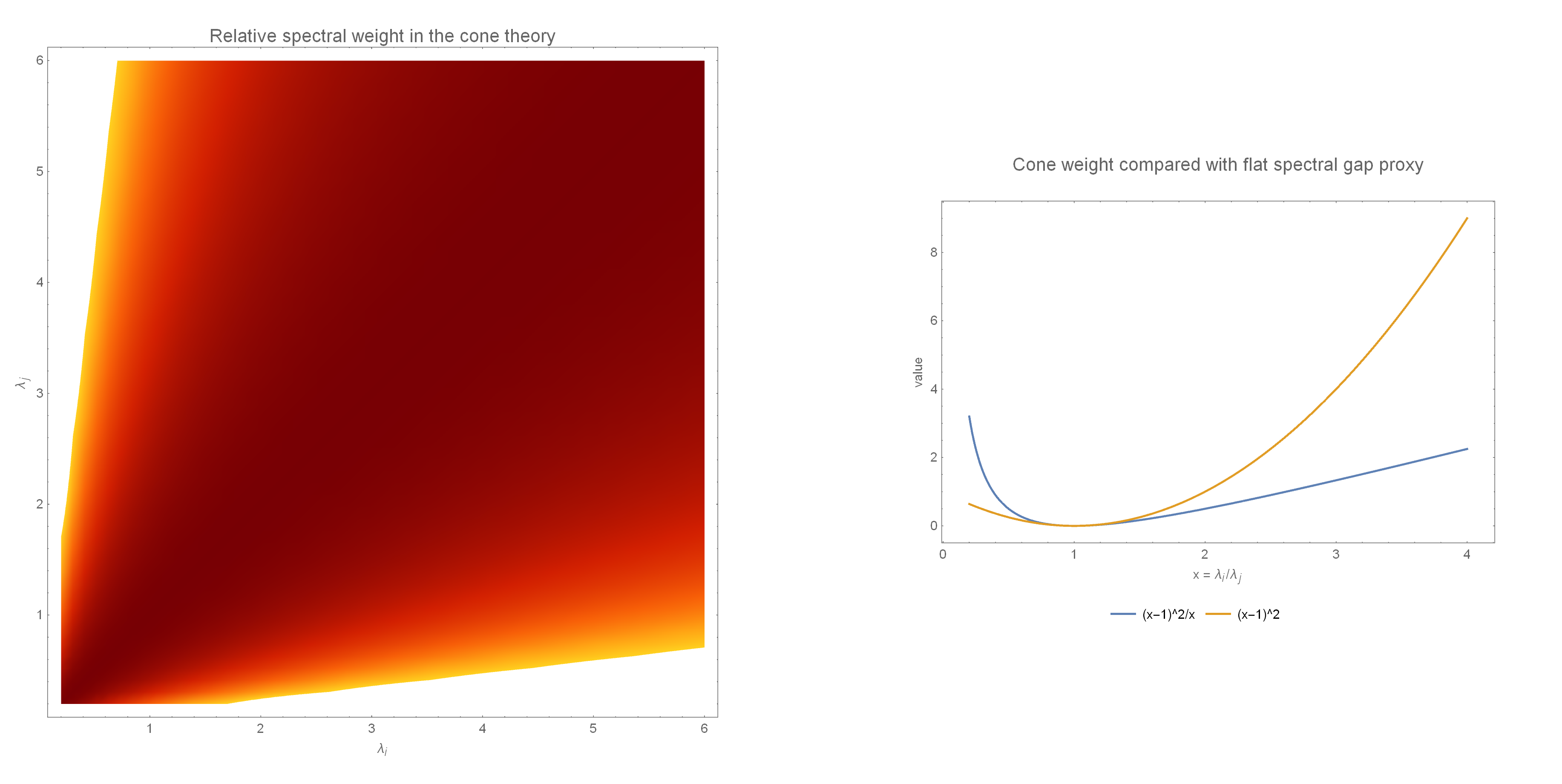
Consequently, the off-diagonal part of the cone kinetic term is weighted by
This weighting may also be visualized directly at the level of the cone kinetic term; see Figure 3. The flag motion is therefore weighted by relative spectral ratios rather than by absolute spectral differences alone. In particular, the isospectral orbit motion becomes increasingly costly as the corresponding channels become strongly separated in scale.
4.6. Barrier Stabilization of the Regular Locus
The cone kinetic term naturally protects the positive full-rank sector, since it becomes singular as . The simple-spectrum part of the regularity condition (16) may then be stabilized independently by a spectral barrier. A convenient local choice is
on the regular locus.
In that form the two boundary mechanisms recorded after Remark 2 are separated dynamically as well. The cone metric controls approach to rank loss, while the discriminant barrier controls approach to spectral collision.
4.7. Induced Visible Evolution
The visible tensor and the induced metric branch are still recovered from (18) and (19). Since is linear, one has
Accordingly, the visible evolution is governed not by an ambient linear carrier velocity, but by the logarithmic carrier current . Through (49), the same current induces the visible metric evolution with respect to the background connection of
The induced visible motion is therefore multiplicative on the carrier side and tensorial on the visible side.
This is the basic dynamic distinction between the cone carrier formulation and a flat ambient-space dynamics on Hermitian endomorphisms. In the cone formulation, the regular visible sector is governed by the intrinsic positive geometry of the carrier field itself.
5. Cone Vacua, Symmetry Strata, and the Distinguished Sector
5.1. Constant Positive Vacua and Stabilizer Strata
The reduced cone theory of Section 4 is now evaluated on constant positive vacua. Let
and assume , . The vacuum equation is then the algebraic critical-point condition
Only the spectral multiplicities matter for the local stabilizer under unitary conjugation.
If the spectrum is simple, one has
This is the generic regular stratum, and the corresponding local breaking is
If two eigenvalues coincide while positivity and full rank are preserved, for example
then
If all three eigenvalues coincide,
then
These are exactly the standard orbit-type strata of Hermitian endomorphisms, read here on the carrier bundle.
Loss of simplicity and loss of rank remain distinct. If while , symmetry is enhanced at fixed carrier rank. If , full rank is lost. The two mechanisms therefore remain geometrically separate in the cone theory as well.
5.2. Mixed Carrier Modes Around a Constant Vacuum
The cone kinetic term modifies the natural weights of the mixed carrier channels. Let
around a constant vacuum as above. To quadratic order, the gauge contribution to is
Insertion into the cone kinetic term gives the mass weights of the mixed carrier gauge modes. In the basis with , one finds
and therefore the cone masses of the mixed carrier gauge modes are
At partial degeneracy (85), the corresponding channels collapse into a common mass,
The cone theory therefore replaces the flat spectral gaps by relative spectral weights. This is the local vacuum counterpart of (77).
5.3. The Distinguished Reduction
On the partially degenerate positive full-rank stratum (85), the carrier bundle decomposes locally as
where is the rank-two eigensubbundle corresponding to the repeated eigenvalue and is the complementary eigenline corresponding to . This lies on the boundary of the regular locus in the strict sense of Definition 1, since the simple-spectrum condition is then relaxed, but positivity and full rank are still retained.
With respect to (94), the carrier connection is written in block form as
where , , and is a complex mixed block. The field Q is perturbed as
with H Hermitian of type , real, and a complex field. The mixed carrier field is therefore naturally a section of
Under the residual symmetry group it transforms by
Thus a canonical carrier doublet is obtained. In a local frame adapted to , it is written as
The local geometric content of the sector is therefore unchanged by the passage from the flat ambient model to the cone theory. What changes is the relative spectral weighting of the corresponding mixed channels.
5.4. Local Charge Splitting
On the splitting (94), the canonical diagonal generator distinguishing the two carrier partners is
The residual abelian block-singlet generator is written locally as
The effective local charge operator is then defined by
with . Since takes values in , its two components carry the induced charges
In particular,
The carrier doublet therefore fixes the unit charge separation, while the residual abelian sector contributes only a common offset. Two distinguished local offsets are obtained immediately:
and
The offset in (102) is not fixed by the induced metric variable. The latter is determined by through (19), whereas the local charge shift depends on the residual abelian generator.
5.5. A Minimal Regular Rotating Cone Background
A single local model already exhibits the main carrier-visible features discussed above. Let
with
Its eigenvalues are
Hence positivity and full rank hold whenever
while regularity is obtained by adjoining as in Definition 1.
By (A5), the corresponding visible tensor is
In particular, a nonzero imaginary off-diagonal Hermitian part of Q produces a mixed time-space visible sector. By (19), one correspondingly has
The same model may also be inspected directly at the level of the visible mixed sector and the regularity diagnostics; in particular, is linear in , while and remain explicit control quantities for the regular branch; see Figure 4. Thus a minimal regular rotating sector is already obtained at the level of a constant Hermitian visible block.
In the cone formulation this background is read as a constant regular point of the positive carrier sector rather than as a separate deformation of the basic dynamics. It illustrates in one step that regularity is compatible with a nontrivial mixed visible sector, that the carrier field need not lie in the real-symmetric subcone, and that the visible tensor and the traceless metric deformation are induced from the same Hermitian block.
6. Visible-Side Dictionary and Metric Admissibility
6.1. Local Inversion and Positivity in Tensor Variables
The explicit local matrix form of recorded in Appendix A.2 may be inverted explicitly, yielding the visible tensor form of the carrier Hermitian block.
Proposition 7.
Work in the standard local self-dual frame of Appendix A.1. Let and write Q as in (A4). Then the carrier coefficients are recovered from the visible tensor by
Proof.
The formulas follow by direct inversion of (A5). □
Proposition 8.
By Proposition 7, the condition is equivalent to nonnegativity of the principal minors of the Hermitian matrix determined by (113)-(115). In particular, the first- and second-order inequalities
are necessary. Full positivity is obtained by adding
Proof.
For a Hermitian matrix, positive semidefiniteness is equivalent to nonnegativity of all principal minors. The stated inequalities are exactly those minors written in tensor variables. □
The visible-side positivity cone therefore represents the carrier positive cone already at the purely algebraic level. Through Section 4, the same cone now also carries the intrinsic cone dynamics of the regular carrier field.
6.2. Diagonal Sector and the Trace-Free Dominant Cone
Let a local Lorentz frame be chosen in which
Proposition 9.
Proof.
Proposition 10.
In the same diagonal setting, one has
Equivalently, the positive carrier cone corresponds exactly to the trace-free diagonal sector satisfying the dominant inequalities.
Proof.
By Proposition 9, is equivalent to for all i. Since , the inequalities imply , hence . The converse is immediate. □
Proposition 11.
In the same diagonal setting, the regularity condition (16) is equivalent to
Proof.
Regularity is equivalent to strict positivity and pairwise distinction of the eigenvalues by Lemma 2. The claim then follows from (124). □
In the cone theory, the same diagonal sector is naturally described by the logarithmic spectral variables (66). The dominant inequalities therefore identify the visible-side image of the positive cone, while the strict dominant inequalities identify the image of its regular simple-spectrum stratum.
6.3. Visible Symmetry Classes from Spectral Multiplicity
Proposition 12.
Let
Then
In particular,
Hence the carrier stratum induces a visible sector with two equal principal pressures and a metric sector with two equal spatial coefficients.
Proposition 13.
Let
Then
so that
Thus the fully degenerate positive carrier stratum corresponds to the isotropic trace-free visible sector.
6.4. Lorentzian Branch and Metric Admissibility
Proposition 14.
Proof.
Corollary 1.
In the same diagonal setting, assume . If
then the induced metric (134) lies on the connected Lorentzian branch.
Proof.
By Proposition 10, the assumption is equivalent to , hence . If (136) holds, then for all i. Proposition 14 then gives the conclusion. □
6.5. Visible Reading of Carrier Scale and Anisotropy
The cone split of Section 4 also admits a direct visible reading on the diagonal sector. By (124) and (66),
Accordingly, the common carrier scale mode (69) is
while the anisotropic cone variables are represented by the pressure ratios
The cone dynamics therefore separates a common carrier scale from the anisotropic visible splitting already on the diagonal GR side.
Theorem 3.
Locally, in the standard self-dual frame of Appendix A.1, the following correspondences hold.
- (i)
- The positive Hermitian carrier cone is represented on the visible side by the semialgebraic cone defined by the principal-minor conditions of Proposition 8.
- (ii)
- In the diagonal trace-free sector, carrier positivity is equivalent to the dominant inequalities (126), and carrier regularity is equivalent to the strict dominant inequalities together with pairwise distinct principal pressures, as in Proposition 11.
- (iii)
- Carrier spectral multiplicities are reflected by visible symmetry classes: the carrier stratum corresponds to two equal principal pressures and two equal spatial metric coefficients, while the fully degenerate positive stratum corresponds to the isotropic radiation sector.
- (iv)
- On the diagonal trace-free dominant cone, the induced metric on the connected Lorentzian branch is controlled by the bound (136).
- (v)
7. Underlying Carrier Amplitudes and Vortex Sectors
7.1. Carrier Amplitude Lift
The cone carrier field may be lifted to a more primitive amplitude field on the same self-dual carrier bundle. Let
and let be a Hermitian complex vector bundle of rank at least 3. Consider a carrier amplitude field
Its Hermitian Gram field is defined by
By construction,
Thus the positive Hermitian cone used in Section 4, Section 5 and Section 6 may be read not as an a priori restriction on Q, but as the image of the carrier amplitude field .
If has full rank, then Q is positive definite. On the regular locus, the additional simple-spectrum condition is therefore a condition on the spectral type of the Gram field (142), not on an independently postulated visible variable. The visible tensor and the induced metric branch are still read from Q through (18) and (19). What changes is only the interpretation: Q is now a secondary amplitude object.
7.2. Symmetric-Space Lift
Let A be a unitary carrier connection on E, and let B be a unitary connection on W. The corresponding covariant derivative of is written as
The ambient flat lift of will not be pursued, since it does not reproduce the cone kinetic structure used in Section 4. The relevant reduced geometry is instead obtained from the multiplicative logarithmic variable
Its Hermitian and anti-Hermitian parts are written as
so that
Proposition 15.
On the invertible locus of Ψ, one has
and therefore
Remark 6.
The cone kinetic term of Section 4 is therefore the Hermitian part of the Maurer-Cartan or symmetric-space lift. In that sense, the positive Hermitian cone is the reduced amplitude geometry associated with the multiplicative carrier field Ψ.
7.3. Minimal Parent Action and Reduced Cone Dynamics
The previous subsection suggests a minimal parent carrier action in which the cone dynamics is generated by the Hermitian part of the logarithmic carrier current. Let
denote the curvature of the left carrier connection on E. A minimal parent action is then taken in the form
where V depends only on , equivalently only on the spectral invariants of Q.
By Proposition 15, the Hermitian term in (153) reproduces, up to the overall normalization factor already fixed there, the cone kinetic term of (50). Thus the cone carrier theory of Section 4 is recovered as the reduced amplitude sector of the parent theory (153). The anti-Hermitian term records the complementary orbit or phase sector, which is invisible at the level of the Gram field Q alone.
In particular, the cone carrier theory may now be read as the reduced Hermitian sector of the multiplicative carrier field:
7.4. Vortex Sectors Above the Visible Block
The previous reduction also clarifies where the topological and oriented sectors may reside. The Hermitian field determines the positive visible block, while the anti-Hermitian current is eliminated by passage to Q, together with the purely orbit or phase data of the carrier amplitude field.
This has two immediate consequences. First, topological sectors should be attached primarily to the carrier amplitude field , or equivalently to its unitary or orbit part in a local amplitude decomposition, rather than to the positive Hermitian field Q alone. Second, two carrier amplitude configurations may differ in their orbit or phase sector while producing the same local Hermitian Gram field Q, hence the same local visible tensor and the same induced metric branch.
In that sense, the visible block Q should be read as an amplitude image of the carrier configuration rather than as a complete carrier state. The same distinction is natural from the point of view of the earlier vortex constructions, where amplitude, phase, and vorticity were already separated at the level of the underlying complex field, and the conserved currents and topological charges were carried by the phase sector rather than by the amplitude alone [8,9,10,11,12].
The geometric implication is that a carrier vortex should not be identified with a special ansatz for Q itself. Rather, a carrier vortex is a class of configurations of whose Hermitian amplitude image Q produces the visible tensor and induced metric branch through (18) and (19). The positive Hermitian cone then records the local visible core of the carrier configuration, while the oriented orbit sector is carried by .
7.5. Induced Visible Geometry and Orientation
Only the Hermitian Gram field enters the visible map, through (18) and (19). The orbit part of the carrier amplitude is not read directly by , but it may still affect the visible sector through the dynamics, because it enters the full parent action (153).
This gives a natural interpretation of oriented carrier backgrounds. The Hermitian field Q controls the positive visible block, while the phase or orbit sector may distinguish inequivalent carrier configurations above the same local visible tensor. If such a sector is organized by a vortex-type or circulation-type carrier background, then the resulting induced visible geometry may distinguish aligned and anti-aligned motion already at the level of the reduced visible response. In that sense, the oriented splitting discussed in the earlier vortex program may be read here as a parent-carrier effect which survives only partially after reduction to the visible Hermitian block [8,9,10,11,12].
The same point also suggests a natural structural comparison with the regularized geometric picture in which the geometry is organized by an underlying probe or amplitude field rather than by a fixed background metric alone. In the present setting, the role of the regularizing or carrier object is not played by a single scalar profile but by the Hermitian Gram field of the carrier amplitude. The visible geometry is then induced from that Gram field through , while the complementary orbit sector remains part of the unreduced carrier description.
The parent amplitude lift changes the status of the reduced cone theory in two ways. First, it clarifies why the cone kinetic term is natural: it is the symmetric-space amplitude reduction of a multiplicative carrier field. Second, it shows where the missing topological data should be sought: not at the level of the positive Hermitian field Q alone, but at the level of the full carrier amplitude field and its orbit current .
This also gives a natural route toward a fuller completion. If the orbit sector is retained explicitly, then the theory remains local on the parent carrier field. If it is eliminated in favor of a reduced theory written only in terms of Q, then nonlocal kernels or memory terms should be expected in general. The corresponding topological analysis should therefore begin with the global and local structure of the carrier amplitude field , and only afterwards be projected to the visible Hermitian sector.
7.6. Polar Decomposition and Separation of Visible and Orbital Sectors
On the positive full-rank locus of (142), the carrier amplitude admits a local polar decomposition
where is positive definite and U is a local unitary bundle isomorphism from W to E. By construction,
The visible Hermitian block is therefore determined entirely by the positive factor H, while the unitary factor U is projected out by passage to Q.
It is convenient to introduce the local fields
Then, by (144) and (145),
Since U is unitary, one has
It follows from (146) and (158) that
and
where and . Thus the Hermitian part of the multiplicative current is determined by the positive carrier factor, whereas the unitary factor enters only through the anti-Hermitian or orbital sector.
The relation with the reduced visible variables is immediate. By (156),
and (148) becomes
Hence the reduced cone sector depends only on the positive factor , while the unitary factor U survives only in the unreduced carrier description. In that sense, the visible tensor and the induced metric branch are insensitive to the local unitary carrier orientation, whereas the full amplitude current is not.
7.7. Maurer-Cartan Curvature and Hidden Carrier Geometry
The multiplicative carrier current introduced in (145) admits a natural curvature form. Let denote the curvature of the left carrier connection on E, including the background chiral connection, and let denote the curvature of the unitary connection on W. Then, on the invertible locus of , the standard identity
gives
It is therefore natural to define the carrier Maurer-Cartan curvature by
Equation (165) shows that measures the relative curvature seen through the carrier amplitude field. If , the corresponding sector is locally of pure Maurer-Cartan type. If , the carrier amplitude detects a nontrivial relative geometry which is not exhausted by the positive Hermitian Gram field alone.
The decomposition (147) and the polar form (158) then separate the hidden carrier geometry into a positive and a unitary part. Writing
one obtains the schematic split
where denotes the covariant exterior derivative determined by . Thus the carrier Maurer-Cartan curvature separates into a part controlled by the positive amplitude sector and a part controlled by the unitary orbital sector.
This point clarifies the relation to the reduced cone theory of Section 4. The reduced field determines the visible block and the induced metric branch through (18) and (19), but it does not determine . The carrier Maurer-Cartan curvature is therefore part of the hidden carrier geometry above the visible Hermitian block. In that sense, the reduced -theory is not only an amplitude reduction, but also a curvature reduction.
7.8. Gauge Currents of the Anti-Hermitian Carrier Sector
The anti-Hermitian part of the multiplicative current is also the natural source of the carrier gauge sector. Let the reduced amplitude action be taken in the form (153), with and as in (146). For a variation of the unitary connections at fixed , one has
Since the connection variations are anti-Hermitian, (169) lies entirely in the anti-Hermitian sector. The Hermitian part of the multiplicative current therefore does not couple directly to connection variations at fixed carrier amplitude.
It follows that the natural carrier gauge currents are
where is the coefficient of the anti-Hermitian kinetic term in (153). If Yang-Mills kinetic terms are added for the left and right unitary connections, then the corresponding Euler-Lagrange equations take the form
Thus the anti-Hermitian carrier sector is the direct source of the carrier gauge dynamics.
In the polar decomposition (155), the currents (170) become
and
In the special case in which is Hermitian, the gauge currents are generated entirely by the unitary carrier factor. The visible Hermitian block and the orbital gauge sector are therefore separated already at the level of the carrier current. This is consistent with the earlier observation that the local charge arithmetic of the carrier sector is not fixed by the induced metric branch; see Section 5.3. It also clarifies, on the unreduced carrier side, why the visible metric data and the orbital or gauge sector need not determine each other.
7.9. Topological Sectors and Carrier Vortices Above the Visible Block
The polar decomposition of the previous subsection also identifies the natural location of the topological sectors. Since depends only on the positive factor H, the unitary factor U may vary nontrivially while leaving the local visible Hermitian block unchanged. The corresponding local orbital current is , and the natural candidate topological data are therefore attached to the unitary carrier sector rather than to Q itself.
At the local level, the relevant structural point is not the existence of a universal invariant built from alone, but the fact that the unitary carrier sector may carry nontrivial holonomy, winding data, or Chern-Simons-type representatives whenever the corresponding dimensional, gauge, and global regularity assumptions are imposed. In particular, standard odd-degree expressions built from and its curvature representative provide the natural local models for such sectors in the same way as in the usual bundle and gauge-theoretic setting [40,41]. Their role here is therefore structural: they indicate that the carrier amplitude field admits topological distinctions which are invisible to the reduced positive Hermitian block.
Accordingly, two carrier configurations may determine the same local field Q, hence the same local visible tensor and the same induced metric branch through (18) and (19), while differing in their unitary carrier class. The corresponding difference is not visible at the level of the reduced Hermitian block, but it remains present in the full multiplicative current and in the Maurer-Cartan curvature (166).
This point gives a direct carrier interpretation of the vortex-oriented sectors discussed in the earlier Alena-tensor program [8,9,10,11,12]. The positive Hermitian field Q records the visible amplitude core of the carrier configuration, whereas the oriented and topological sector is carried by the unitary factor U and its current . In that sense, a carrier vortex is not most naturally identified with a special ansatz for Q itself. It is more naturally identified with a class of amplitude configurations above fixed or slowly varying visible Hermitian data.
The geometric consequence is that the reduced visible block should be read as a local projection of a larger carrier state. The metric variable extracted from (19) and the visible tensor extracted from (18) determine the local positive carrier image, but they do not exhaust the oriented carrier content. The same distinction is also compatible with the broader bundle-theoretic and characteristic-class background relevant for global splitting and topological sectors [40,41,42]. It follows that the natural global classification problem above the visible block is not only spectral, but also topological.
8. Conclusions and Discussion
A regular geometric class has been isolated in which the visible sector of an Alena-type transition tensor is encoded by a positive Hermitian endomorphism of the self-dual bundle of the background Lorentzian geometry. The central structural result is the local equivalence between regular gauge-sector representations and regular Alena-Urbantke geometries. In that formulation, the visible tensor and the traceless part of the metric variable are induced from the same regular self-dual Hermitian datum.
Several hard conclusions follow directly. First, the regular visible sector is organized by a Hermitian self-dual block with simple positive spectrum, and therefore by a canonical ordered spectral flag in . Second, the Urbantke geometry determined by the corresponding self-dual triple is a carrier geometry and not, in general, the Alena-side metric variable selected by (19). Third, the visible self-dual block fixes only the Ricci-type carrier data. The Weyl and scalar blocks of the curvature-type completion remain free. Fourth, the same visible carrier block admits a direct local GR-side reading: carrier positivity is represented by explicit tensor inequalities, the diagonal regular sector coincides with the trace-free dominant cone together with resolved principal pressures, and the first spectral degeneracies are reflected by corresponding visible symmetry classes and metric reductions.
Three consequences seem to deserve particular emphasis. First, the visible tensor is not arbitrary: in the present framework it belongs to the image under of the positive Hermitian cone, which yields explicit algebraic restrictions on the GR side. Second, the carrier Urbantke geometry and the Alena-side metric branch are locally distinct, so the chiral carrier geometry should not be identified with the induced visible metric geometry. Third, global regularity is topologically restrictive, since it requires a global splitting of into Hermitian eigenline bundles. Two further consequences are more programmatic. The spectral potential is most naturally read as the visible remnant of hidden-curvature elimination, which points toward a fuller parent curvature theory. Likewise, the local carrier sector separates charge arithmetic from the induced visible metric data, since inequivalent local charge splittings may occur at fixed visible tensor and metric branch.
The same conclusions acquire a sharper geometric meaning once the visible Hermitian block is placed in known frameworks. On the regular locus, the visible sector is seen to be a flag-geometric sector of the self-dual bundle, with the simple-spectrum condition selecting a complete ordered flag and the first spectral degeneracies corresponding to standard stabilizer enhancement. At the level of chiral geometry, the construction sits naturally in the usual self-dual background associated with the curvature operator, the Urbantke reconstruction, and the Plebanski-BF picture [1,3,4,5,22]. At the level of reduced carrier dynamics, the pair defines a gauge-endomorphism system on the self-dual carrier bundle whose natural regular positive kinetic completion is cone-geometric, with symmetry strata controlled entirely by the spectrum of Q.
The less obvious conclusion is that the visible theory is most naturally read as a reduced one. The spectral potential of the carrier field, when written only in terms of , is not most naturally interpreted as a primary input. Within the present geometric picture, it is most naturally interpreted as the visible remnant of hidden-curvature elimination. The hidden-curvature completion problem therefore ceases to be a side remark and becomes structurally central. In particular, the reduced carrier theory on is naturally interpreted as the visible low-level theory induced by a fuller curvature operator on . On the regular positive locus, its natural kinetic completion is cone-geometric: the basic carrier variable is the logarithmic field , the common carrier scale is governed by , and the orbit part is weighted by relative spectral ratios rather than by absolute spectral gaps alone.
At the same time, the cone kinetic term itself admits a natural amplitude lift. It is the Hermitian or symmetric-space part of a multiplicative carrier field , while the complementary orbital sector is carried by the anti-Hermitian part of the current . Locally, the carrier amplitude separates into a positive factor and a unitary factor, so that the visible Hermitian block is the positive carrier image, while the unitary carrier sector records the projected-out orbital, gauge, and topological data. In the same amplitude language, the multiplicative current carries a natural Maurer-Cartan curvature, so the passage from to is not only an amplitude reduction but also a reduction of hidden carrier geometry.
A second nontrivial consequence concerns the carrier symmetry strata. On the generic regular stratum, the local stabilizer is reduced to . On the partially degenerate positive full-rank boundary stratum, a distinguished local sector is obtained, with residual symmetry and a canonical doublet structure. At that level, the local charge arithmetic recorded in Section 5.3 is fixed only up to a residual abelian offset. The same local doublet geometry therefore supports both lepton-like and quark-like local charge splittings without changing the induced visible tensor or the metric-side deformation. The metric sector and the local carrier charge arithmetic are thus separated already at the geometric level.
A third nontrivial consequence concerns vortex sectors, orientation, and emergent geometry. Once the reduced carrier theory is lifted to an underlying carrier amplitude, the visible Hermitian block Q is seen to record only the reduced positive sector, while the complementary orbital data are carried by the unreduced amplitude field. Topological and oriented sectors should therefore be attached primarily to the carrier amplitude rather than to Q alone. More precisely, the natural local location of those sectors is the unitary carrier factor and its anti-Hermitian current, not the positive Hermitian image. After reduction, a localized carrier configuration is naturally read both as a nontrivial carrier sector and as a localized source of visible tensor and metric deformation. This is compatible with the broader dual description developed in the earlier Alena-tensor program [8,9,10,11,12], where vortex-type and particle-like sectors were already suggested in flat and curved descriptions. It also suggests a natural mechanism by which oriented carrier backgrounds may distinguish aligned and anti-aligned visible motion, thereby producing an induced symmetry splitting at the level of the emergent visible geometry.
Several further directions now become concrete. A first problem is to formulate a genuine parent curvature theory on the full operator , rather than only on the reduced visible pair , and to determine under which conditions the hidden diagonal blocks are auxiliary and under which conditions they propagate. A second problem is to classify hidden-curvature completions compatible with a prescribed regular visible block. A third problem is to determine more explicitly the topology of the regular visible sector by studying the global splitting problem for and its associated characteristic-class obstructions. In that direction, the relevant background is standard and lies close to the geometry of bundle splittings, characteristic classes, and global index-type constraints [40,41,42,43,44]. Connections with the topology and geometry of self-dual and twistor-type structures are also natural [45,46].
A fourth problem is more dynamical. The reduced cone carrier theory suggests a visible-sector effective geometry, but the extent to which that local cone completion remains valid beyond the heavy-hidden-sector regime is not yet known. A fifth problem is more geometric. The first local vortex and orientation sectors suggested by Section 7 should be analyzed explicitly, and the corresponding visible metric and geodesic data should be compared with the effective matter sectors proposed in [12]. A sixth problem is to determine how far the local carrier flag geometry can be pushed toward a more global gauge-theoretic, spinorial, or amplitude-level completion, possibly including fermionic carrier sectors. Related operator-geometric and noncommutative reorganizations of gauge and internal degrees of freedom suggest that such extensions are not unnatural, although no such identification is assumed here [33,35,36,37,38].
In that further work, explicit computational support is already available. A supplementary Mathematica tool, Metric2GaugeAlenaDashboard, together with a sample report generated from it, may be used to inspect concrete metric backgrounds at the level of the visible Hermitian block, the ordered spectrum, regularity and admissibility regions, carrier-channel organization, selected one-dimensional profiles, and local isospectral response. In this sense, the tool may be used as an auxiliary bridge between the structural theory developed here and the case-by-case exploration needed in later metric, defect, and hidden-curvature studies.
A further consequence suggested by the present framework is that the visible tensor and the induced metric branch need not exhaust the local geometric state of the system. Once the carrier field is lifted from the positive Hermitian block Q to the amplitude level , the same visible data may be compatible with inequivalent unitary carrier sectors. In that sense, the reduced gr-side description should be read not as the full carrier geometry, but as its positive Hermitian image. The projected-out sector is then not a negligible remainder. It is the natural location of the orbital, gauge, and topological carrier data.
This also suggests a more structural reading of hidden-curvature completion. The missing sector is not exhausted by the undetermined diagonal blocks of the curvature operator alone. At the amplitude level it is reflected already in the Maurer-Cartan curvature of the multiplicative carrier current. The resulting picture is therefore layered. The visible tensor and the induced metric belong to the reduced positive sector, while the unreduced carrier current retains a broader relative geometry above that block. If such a completion exists globally, the natural classification problem is no longer only spectral and metric, but also orbital and topological.
The main conclusion may therefore be stated in a restrained form. A regular visible sector attached to an Alena-type transition tensor has been placed in a standard chiral geometric framework, identified with a Hermitian self-dual curvature block, organized by a canonical flag geometry, and translated both into a reduced cone carrier sector and into explicit visible GR-side data. On the regular positive locus, the corresponding reduced dynamics is governed by the intrinsic cone geometry of the positive Hermitian sector, with a natural separation of carrier scale, spectral anisotropy, and orbit motion. The same cone geometry also admits a natural underlying amplitude interpretation through the multiplicative carrier field . At that level, the carrier amplitude separates locally into a positive visible factor and a unitary orbital factor, and the full multiplicative current carries both the reduced cone dynamics and the hidden carrier curvature above the visible block. The harder part of the program is thereby not closed but sharpened. What remains is no longer the search for a geometric language for the visible sector, but the construction of the parent theory or theories from which that visible sector should follow.
Supplementary Materials
The following supporting information can be downloaded at the website of this paper posted on Preprints.org.
Funding
Author has no relevant financial or non-financial interests to disclose. Author did not receive support from any organization for the submitted work.
Data Availability Statement
All data, symbolic computations, numerical evaluations, and plotting routines used in this article are contained in the accompanying Mathematica notebooks, provided as supplementary materials.
Use of Artificial Intelligence
Declaration on the use of AI. During the preparation of this manuscript, the author used generative AI tools to assist with language editing, formatting, idea organization, and limited early drafting of selected passages. These tools were not used to generate research data, perform the main analysis, interpret the results, or draw the scientific conclusions. All content included in the manuscript, including citations and factual statements, was reviewed and verified by the author, who takes full responsibility for the final manuscript.
Appendix A. Additional Observations
Appendix A.1. The Representation Map R
On a local spinorial trivialization, the self-dual bundle is identified with , where S is the rank-two complex Weyl spinor bundle [14,15]. A Hermitian endomorphism of is therefore represented by a Hermitian spinor endomorphism
Under the standard identification between Hermitian endomorphisms on and real traceless symmetric rank-two tensors, the representation map is obtained. Equation (A3) is taken as its local definition in a self-dual frame, and the compatibility under change of self-dual basis shows that it defines a global real-linear map
In a local self-dual basis , if , then
Under change of local self-dual basis, the matrix and the basis forms transform compatibly, so the tensor (A3) is unchanged. The formula therefore defines a global real-linear map and matches the normalization used in (7).
Appendix A.2. Local Matrix Form of the Visible Block
In the standard local self-dual frame of Appendix A.1, a general Hermitian visible block is written as
with . The corresponding visible tensor is then given by
This is the local matrix form used in Section 6, Section 5, and Appendix A.3; it also underlies the rotating carrier example discussed in Section 5.
Appendix A.3. Real and Rotating Sectors of the Visible Block
The explicit local formula for shows that the Hermitian visible block splits kinematically into a real sector and a rotating sector. In the standard local self-dual frame, the diagonal part of Q controls the diagonal part of , the real off-diagonal part controls the spatial off-diagonal sector, and the imaginary off-diagonal part controls the mixed time-space sector.
Proposition A1.
In the standard local self-dual frame, let Q be written as in (A4). Then the following are equivalent:
- (i)
- Q is real symmetric;
- (ii)
- for .
Equivalently, the visible tensor has no mixed time-space sector if and only if the Hermitian visible block lies in the real-symmetric subcone of .
Proof.
Remark A1.
The decomposition recorded here is purely kinematical. A physically suggestive interpretation of a mixed visible component is obtained only after an adapted stationary-axisymmetric splitting has been chosen. In that sense, the later rotating carrier examples are of the same kinematical type as the familiar t-ϕ sector of stationary axisymmetric metrics, but no identification with a specific spacetime solution is implied.
Appendix A.4. Variations of the Spectral Invariants
Let Q be a Hermitian endomorphism of , and let be a Hermitian variation. Then the variations of the spectral invariants (14) are
Equivalently, with respect to the fiberwise Hilbert-Schmidt pairing,
These identities are standard and are used in Section 4 when the reduced cone carrier equations are varied.
Appendix A.5. Global Splitting of the Self-Dual Bundle
The main text is local. A global regular visible sector is more restrictive. Let be an oriented four-dimensional Lorentzian manifold for which the complex self-dual bundle is globally defined. Suppose that
is globally regular. Then the ordered spectral projectors are globally defined and smooth, and one obtains
as a decomposition into Hermitian eigenline subbundles.
Proposition A2.
If a global regular Alena-Urbantke geometry exists on , then the complex self-dual bundle admits a global splitting into three Hermitian line subbundles as in (A11).
Proof.
The statement follows directly from the global spectral decomposition of a Hermitian endomorphism with everywhere simple spectrum. □
Remark A2.
The existence problem for a global regular visible sector is therefore reduced, at least at first step, to a bundle-splitting problem for . In particular, the total Chern class must factorize accordingly:
Any obstruction to such a factorization is therefore an obstruction to the existence of a global regular visible sector.
Appendix A.6. Local Spectral-Flag Decomposition of Hermitian Perturbations
Let be a smooth family of regular Hermitian endomorphisms. On a sufficiently small interval, the eigenvalues and spectral projectors may be chosen smoothly. Standard perturbation theory for smooth families of Hermitian operators then gives [39]
The first term is diagonal in the instantaneous spectral basis and changes the ordered spectrum. The second term is off-diagonal and moves the spectral flag.
This decomposition is used in two places. In the geometric classification of the regular visible sector, it provides the intrinsic separation between spectral variation and flag motion. In the reduced cone carrier dynamics, it is reflected in the separation between diagonal spectral fluctuations and mixed carrier modes. The same separation is compatible with invariant-based and connection-based decompositions familiar from related formulations of chiral gravity and constrained gauge systems [47,48,49].
Remark A3.
The geometric content of (A13) is standard once the regular locus is interpreted as the simple-spectrum stratum of Hermitian endomorphisms: the spectrum gives the radial data, while the commutator part gives the infinitesimal motion along the corresponding unitary orbit.
Appendix A.7. A Local Particle-like Interpretation of the 2+1 Carrier Sector
A local particle-like interpretation is suggested by the distinguished carrier sector of Section 5.3. On the partially degenerate positive full-rank stratum (85), the carrier bundle splits as in (94), the mixed carrier field takes the doublet form (99), and its local charge arithmetic is determined by (103). The two offsets recorded in (105) and (106) then suggest local lepton-type and quark-type readings of the same carrier doublet.
In that reading, the component may be identified locally either with an electron-type carrier partner or with a down-type carrier partner, while may be identified with the corresponding neutral or up-type partner. The geometric point is the one already recorded after (106): the charge offset is fixed by the residual abelian generator and not by the induced metric branch. The local charge splitting is therefore a carrier-level datum.
On the same stratum, the visible tensor sector is fixed by (129), and the induced metric is the diagonal branch obtained from (134) after substitution of those visible coefficients. The same local visible tensor and the same induced metric data may therefore be combined with different charge offsets. In that restricted sense, the lepton-type and quark-type readings need not be distinguished by the induced metric data alone.
This interpretation is local and model-level. In the amplitude formulation of Section 7, the more natural carrier object is rather than Q alone. The Hermitian image fixes the visible tensor and the induced metric through (18) and (19), while the complementary orbital sector remains attached to the unreduced carrier amplitude. The particle-like reading is therefore most naturally attached to localized carrier configurations above the visible Hermitian block.
References
- Urbantke, H. On integrability properties of SU(2) Yang–Mills fields. I. Infinitesimal part. Journal of Mathematical Physics 1984, 25, 2321–2324. [Google Scholar] [CrossRef]
- Chruściel, P.T.; Urbantke, H. Thomas-Wigner rotation via Clifford algebras. arXiv 2025, arXiv:2501.14855. [Google Scholar] [CrossRef]
- Plebański, J.F. On the separation of Einsteinian substructures. Journal of Mathematical Physics 1977, 18, 2511–2520. [Google Scholar] [CrossRef]
- Freidel, L.; Speziale, S. On the Relations between Gravity and BF Theories. SIGMA 2012, 8, 032. [Google Scholar] [CrossRef]
- Krasnov, K. A Gauge-Theoretic Approach to Gravity. Proc. R. Soc. A 2012, 468, 2129–2173. [Google Scholar] [CrossRef] [PubMed]
- Gielen, S.; Nash, E. Unimodular Plebański Gravity. Class. Quantum Grav. 2024, 41, 085009. [Google Scholar] [CrossRef]
- Gielen, S.; Nash, E. Canonical analysis of unimodular Plebański gravity. Phys. Rev. D 2025, 111, 044047. [Google Scholar] [CrossRef]
- Ogonowski, P. Proposed method of combining continuum mechanics with Einstein Field Equations. International Journal of Modern Physics D 2023, 32, 2350010. [Google Scholar] [CrossRef]
- Ogonowski, P. Developed method: interactions and their quantum picture. Frontiers in Physics 2023, 11, 1264925. [Google Scholar] [CrossRef]
- Ogonowski, P. Gravitational waves and Higgs-like potential from Alena Tensor. Physica Scripta 2025, 100, 105026. [Google Scholar] [CrossRef]
- Ogonowski, P.; Skindzier, P. Alena Tensor in unification applications. Physica Scripta 2024, 100, 015018. [Google Scholar] [CrossRef]
- Ogonowski, P. The halo effect and quantum vortices. Not so dark with Alena Tensor. Physica Scripta 2026, 101, 155002. [Google Scholar] [CrossRef]
- Besse, A.L. Einstein Manifolds; Classics in Mathematics; Springer-Verlag: Berlin Heidelberg, 2007. [Google Scholar] [CrossRef]
- Penrose, R.; Rindler, W. Spinors and Space-Time; Volume 1: Two-Spinor Calculus and Relativistic Fields; Cambridge University Press: Cambridge, 1984. [Google Scholar] [CrossRef]
- Mason, L.J.; Woodhouse, N.M.J. Integrability, Self-Duality, and Twistor Theory; Oxford University Press: Oxford, 1996. [Google Scholar] [CrossRef]
- Atiyah, M.F.; Hitchin, N.J.; Singer, I.M. Self-duality in four-dimensional Riemannian geometry. Proceedings of the Royal Society of London. Series A 1978, 362, 425–461. [Google Scholar] [CrossRef]
- Penrose, R.; Rindler, W. Spinors and Space-Time; Volume 2: Spinor and Twistor Methods in Space-Time Geometry; Cambridge University Press: Cambridge, 1986. [Google Scholar] [CrossRef]
- Ward, R.S.; Wells, Raymond O., J. Twistor Geometry and Field Theory; Cambridge University Press: Cambridge, 1990. [Google Scholar] [CrossRef]
- Bilge, A.H.; Özdemir, F. The geometry of self-dual two-forms. Journal of Mathematical Physics 1997, 38, 4804–4814. [Google Scholar] [CrossRef]
- Atiyah, M.; Dunajski, M.; Mason, L.J. Twistor Theory at Fifty: From Contour Integrals to Twistor Strings. Proceedings of the Royal Society A 2017, 473, 20170530. [Google Scholar] [CrossRef]
- Adamo, T. Twistor actions for gauge theory and gravity. arXiv 2013, arXiv:1308.2820. [Google Scholar] [CrossRef]
- Krasnov, K. Pure connection action principle for general relativity. Physical Review Letters 2011, 106, 251103. [Google Scholar] [CrossRef]
- Woit, P. Euclidean Twistor Unification. arXiv 2021, arXiv:2104.05099. [Google Scholar] [CrossRef]
- Woit, P. Spacetime is Right-handed. arXiv 2023, arXiv:2311.00608. [Google Scholar] [CrossRef]
- Krasnov, K.; Skvortsov, E. Flat self-dual gravity. Journal of High Energy Physics 2021, 2021, 082. [Google Scholar] [CrossRef]
- Borsten, L.; Jurčo, B.; Kim, H.; Macrelli, T.; Sämann, C.; Wolf, M. Double-copying self-dual Yang-Mills theory to self-dual gravity on twistor space. Journal of High Energy Physics 2023, 2023, 172. [Google Scholar] [CrossRef]
- Herfray, Y.; Krasnov, K.; Skvortsov, E. Higher-spin self-dual Yang-Mills and gravity from the twistor space. Journal of High Energy Physics 2023, 2023, 158. [Google Scholar] [CrossRef]
- Bittleston, R.; Heuveline, S.; Skinner, D. The Celestial Chiral Algebra of Self-Dual Gravity on Eguchi-Hanson Space. Journal of High Energy Physics 2023, 2023, 008. [Google Scholar] [CrossRef]
- Gomes, H. Gauge theory is about the geometry of internal spaces. arXiv 2024, arXiv:2404.10461. [Google Scholar] [CrossRef]
- Pasterski, S.; Shao, S.H.; Strominger, A. Flat Space Amplitudes and Conformal Symmetry of the Celestial Sphere. Physical Review D 2017, 96, 065026. [Google Scholar] [CrossRef]
- Pasterski, S. A Chapter on Celestial Holography. arXiv 2023, arXiv:2310.04932. [Google Scholar] [CrossRef]
- Donnay, L. Celestial Holography: An Asymptotic Symmetry Perspective. Physics Reports 2024, 1073, 1–41. [Google Scholar] [CrossRef]
- Devastato, A.; Kurkov, M.; Lizzi, F. Spectral Noncommutative Geometry, Standard Model and all that. Int. J. Mod. Phys. A 2019, 34, 1930010. [Google Scholar] [CrossRef]
- Czuchry, E.; Gazeau, J.P. Finite-resolution measurement induces topological curvature defects in spacetime. arXiv 2026, arXiv:2601.13491. [Google Scholar] [CrossRef]
- Chamseddine, A.H.; Connes, A.; van Suijlekom, W.D. Noncommutativity and Physics: A Non-Technical Review. European Physical Journal Special Topics 2023, 232, 3581–3588. [Google Scholar] [CrossRef]
- Kupriyanov, V.G.; Szabo, R.J. Symplectic Embeddings, Homotopy Algebras and Almost Poisson Gauge Symmetry. Journal of Physics A: Mathematical and Theoretical 2022, 55, 035201. [Google Scholar] [CrossRef]
- Kupriyanov, V.G.; Kurkov, M.A.; Vitale, P. Lie-Poisson Gauge Theories and κ-Minkowski Electrodynamics. Journal of High Energy Physics 2023, 2023, 200. [Google Scholar] [CrossRef]
- Condeescu, C.; Micu, A. The Gauge Theory of Weyl Group and its Interpretation as Weyl Quadratic Gravity. Classical and Quantum Gravity 2025, 42, 065011. [Google Scholar] [CrossRef]
- Kato, T. Perturbation Theory for Linear Operators; Classics in Mathematics; Springer-Verlag: Berlin Heidelberg, 1995. [Google Scholar] [CrossRef]
- Chern, S.S.; Simons, J. Characteristic Forms and Geometric Invariants. Annals of Mathematics 1974, 99, 48–69. [Google Scholar] [CrossRef]
- Atiyah, M.F.; Patodi, V.K.; Singer, I.M. Spectral Asymmetry and Riemannian Geometry. I. Mathematical Proceedings of the Cambridge Philosophical Society 1975, 77, 43–69. [Google Scholar] [CrossRef]
- Milnor, J.W.; Stasheff, J.D. Characteristic Classes; Princeton University Press: Princeton, NJ, 1974. [Google Scholar] [CrossRef]
- Atiyah, M.F.; Singer, I.M. The Index of Elliptic Operators: III. Annals of Mathematics 1968, 87, 546–604. [Google Scholar] [CrossRef]
- Kobayashi, S.; Nomizu, K. Foundations of Differential Geometry. Volume II; Interscience Publishers: New York, 1969. [Google Scholar]
- LeBrun, C. Anti-Self-Dual Metrics and Kähler Geometry. In Proceedings of the International Congress of Mathematicians; Chatterji, S.D., Ed.; Birkhäuser: Basel, 1995; pp. 498–507. [Google Scholar] [CrossRef]
- Catino, G.; Dameno, D.; Mastrolia, P. Rigidity results for Riemannian twistor spaces under vanishing curvature conditions. Annals of Global Analysis and Geometry 2023, 63, 13. [Google Scholar] [CrossRef]
- Krasnov, K. Formulations of General Relativity: Gravity, Spinors and Differential Forms; Cambridge University Press: Cambridge, 2020. [Google Scholar] [CrossRef]
- Celada, M.; González, D.; Montesinos, M. Plebanski-like action for general relativity and anti-self-dual gravity. Physical Review D 2016, 93, 104058. [Google Scholar] [CrossRef]
- Neiman, Y. Self-dual gravity in de Sitter space: Light-cone ansatz and static-patch scattering. Physical Review D 2024, 109, 024039. [Google Scholar] [CrossRef]
Figure 1.
Two model approaches to the boundary of the regular locus. Left panel: approach to rank loss through . Right panel: approach to eigenvalue collision through . In both cases, , , and the barrier quantity are shown. The two boundary mechanisms are therefore separated explicitly: rank collapse and symmetry-enhancing spectral collision.
Figure 1.
Two model approaches to the boundary of the regular locus. Left panel: approach to rank loss through . Right panel: approach to eigenvalue collision through . In both cases, , , and the barrier quantity are shown. The two boundary mechanisms are therefore separated explicitly: rank collapse and symmetry-enhancing spectral collision.
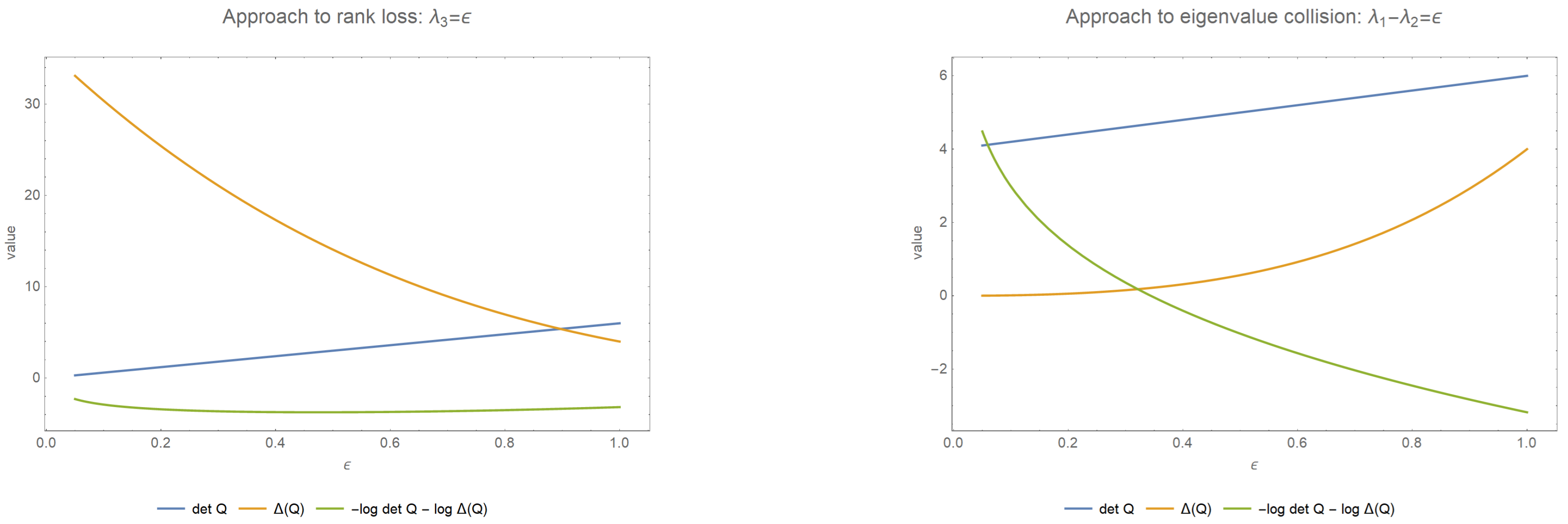
Figure 2.
Flag motion at fixed ordered spectrum in the conjugation model . The first three panels show the visible components , , and . The last panel shows that the spectral invariants , , , and remain constant along the motion. Thus the visible tensor varies nontrivially even though the ordered spectrum is unchanged.
Figure 2.
Flag motion at fixed ordered spectrum in the conjugation model . The first three panels show the visible components , , and . The last panel shows that the spectral invariants , , , and remain constant along the motion. Thus the visible tensor varies nontrivially even though the ordered spectrum is unchanged.
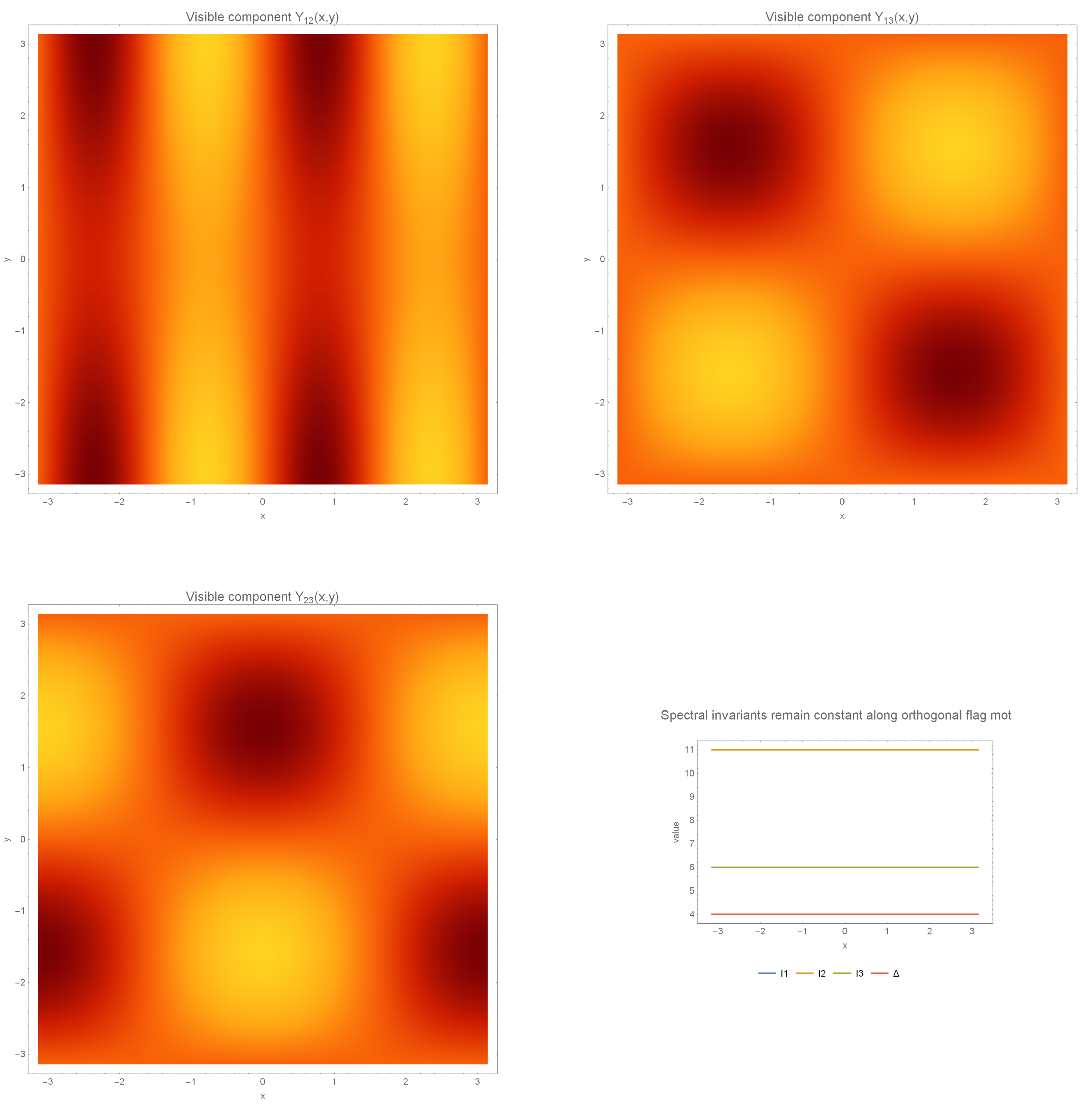
Figure 3.
Relative spectral weight in the cone carrier theory. Left panel: the weight (77) as a function of two positive carrier eigenvalues. Right panel: comparison between the cone weight , with , and the flat gap proxy . The cone weight is controlled by the spectral ratio rather than by the absolute difference alone, and becomes large both for and for . The figure therefore illustrates the intrinsic asymmetry and scale sensitivity of the orbit term in the cone kinetic geometry.
Figure 3.
Relative spectral weight in the cone carrier theory. Left panel: the weight (77) as a function of two positive carrier eigenvalues. Right panel: comparison between the cone weight , with , and the flat gap proxy . The cone weight is controlled by the spectral ratio rather than by the absolute difference alone, and becomes large both for and for . The figure therefore illustrates the intrinsic asymmetry and scale sensitivity of the orbit term in the cone kinetic geometry.
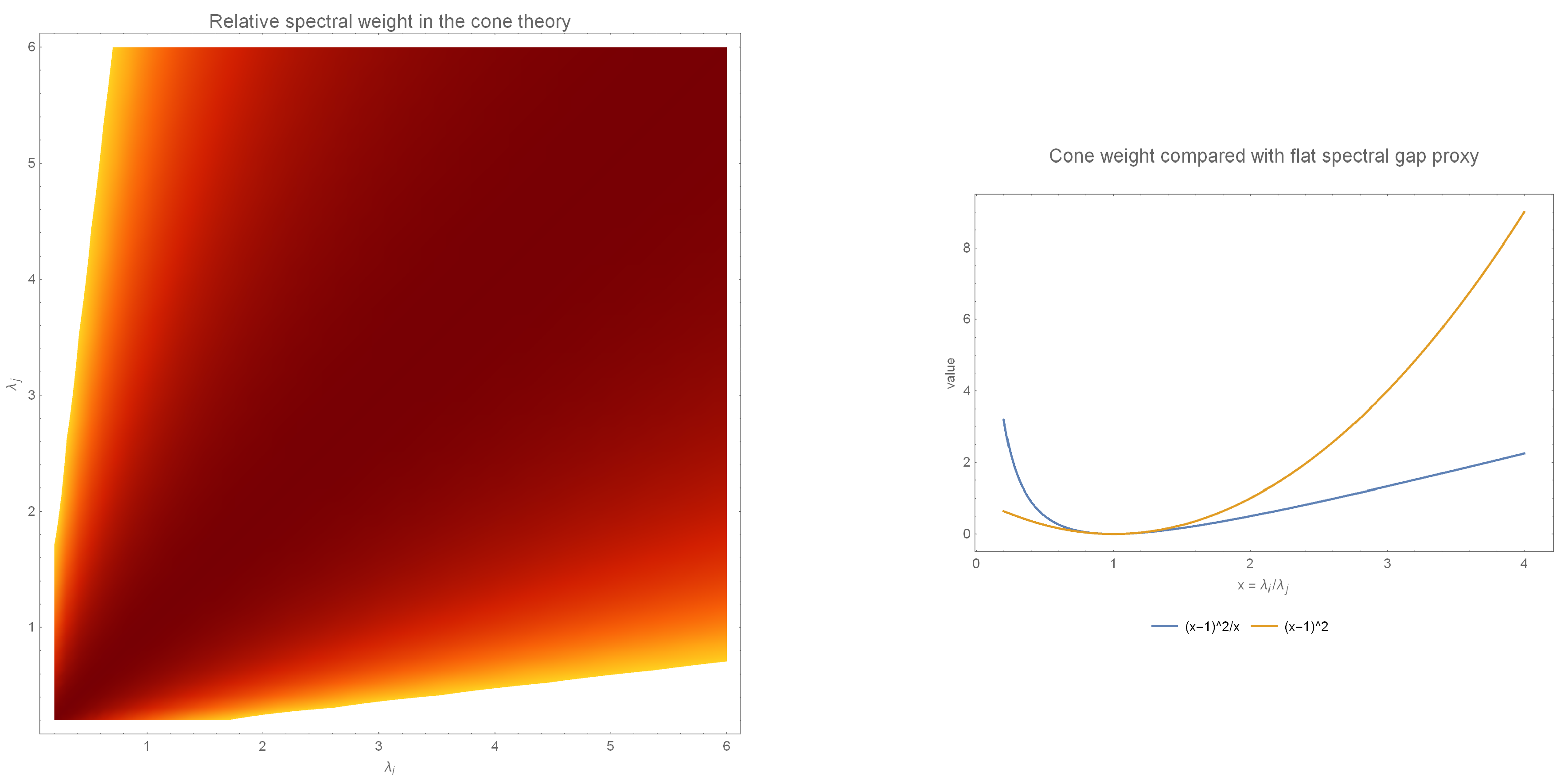
Figure 4.
Minimal regular rotating cone background (107). Left panel: the visible mixed component and the diagonal component as functions of the carrier rotation parameter . Right panel: the determinant and discriminant of . The model illustrates that a nonzero imaginary off-diagonal Hermitian part generates a mixed time-space visible sector while regularity is still controlled by the standard positivity and simple-spectrum conditions.
Figure 4.
Minimal regular rotating cone background (107). Left panel: the visible mixed component and the diagonal component as functions of the carrier rotation parameter . Right panel: the determinant and discriminant of . The model illustrates that a nonzero imaginary off-diagonal Hermitian part generates a mixed time-space visible sector while regularity is still controlled by the standard positivity and simple-spectrum conditions.
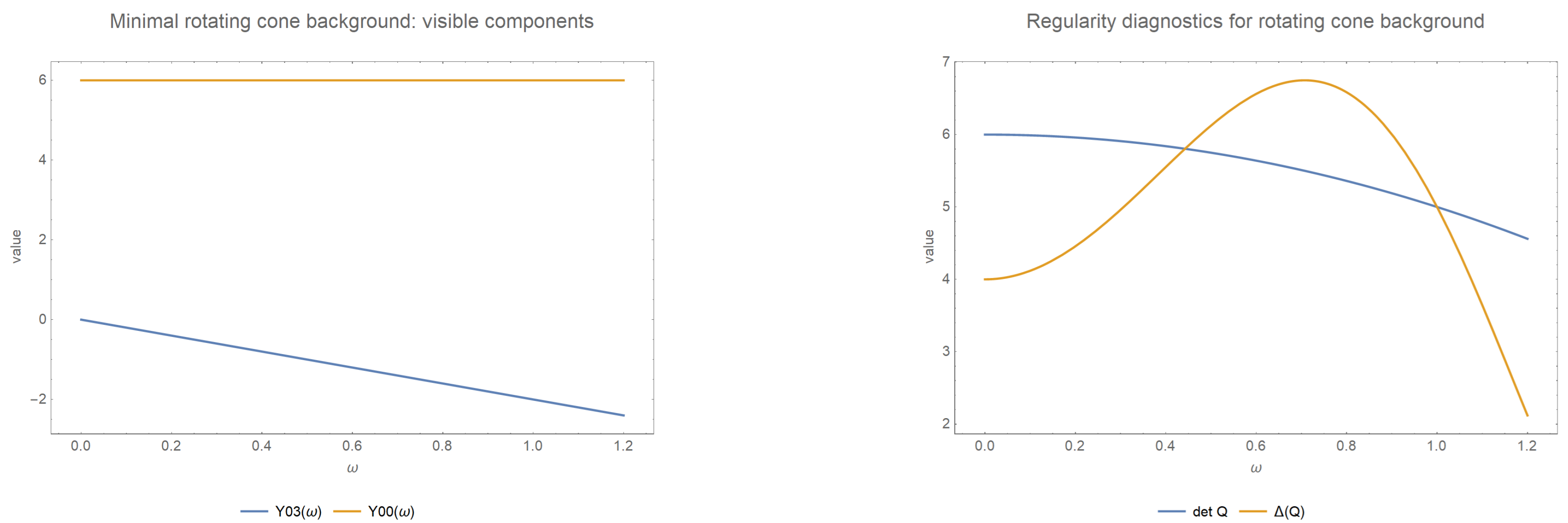
Disclaimer/Publisher’s Note: The statements, opinions and data contained in all publications are solely those of the individual author(s) and contributor(s) and not of MDPI and/or the editor(s). MDPI and/or the editor(s) disclaim responsibility for any injury to people or property resulting from any ideas, methods, instructions or products referred to in the content. |
© 2026 by the authors. Licensee MDPI, Basel, Switzerland. This article is an open access article distributed under the terms and conditions of the Creative Commons Attribution (CC BY) license (http://creativecommons.org/licenses/by/4.0/).
Copyright: This open access article is published under a Creative Commons CC BY 4.0 license, which permit the free download, distribution, and reuse, provided that the author and preprint are cited in any reuse.


