

Submitted:
12 April 2026
Posted:
14 April 2026
You are already at the latest version
Abstract
The blue economy has emerged as a central policy framework for promoting ocean-based economic development while ensuring environmental sustainability. However, the extent to which existing policy frameworks effectively integrate ocean and coastal health into economic decision-making remains limited, reflecting broader challenges in governance, policy coordination, and institutional design. This article examines India’s blue economy through a marine policy lens, focusing on how governance structures, policy instruments, and institutional arrangements shape the treatment of ocean health within economic planning.Using a narrative review approach, this study advances a conceptual reframing of ocean health as economic infrastructure, arguing that ecosystem degradation constitutes a form of infrastructure failure with cascading economic, financial, and social risks. Drawing on interdisciplinary literature and national policy analysis, the paper evaluated sectoral dynamics across fisheries, ports, tourism, and coastal livelihoods, alongside emerging approaches to climate resilience, financial innovation, and marine governance.The analysis identifies key governance challenges, including fragmented institutional mandates, weak policy integration, and limited incorporation of ecological risk into financial and planning systems. These constraints undermine the effectiveness of blue economy strategies and expose ocean-dependent sectors to long-term systemic risk.The paper contributes to marine policy debates by demonstrating that achieving a sustainable blue economy is fundamentally a governance challenge requiring integrated policy frameworks, strengthened institutional coordination, and the incorporation of ecosystem-based risk into decision-making. While grounded in India, the findings offer transferable insights for coastal and ocean-dependent economies seeking to align economic development with long-term ocean sustainability in the Indian-Ocean region.
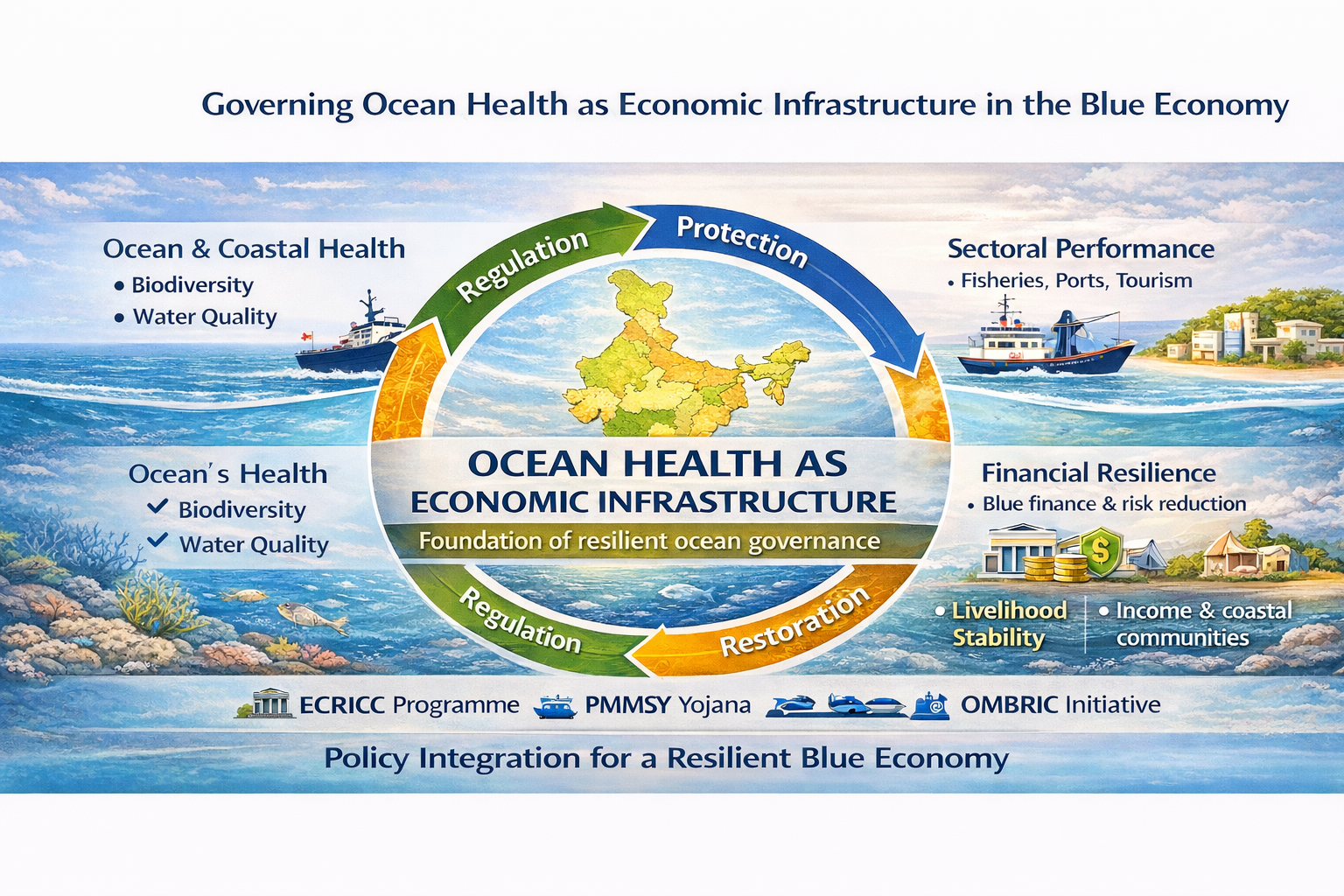
Keywords:
blue economy
; ocean governance
; economic resilience
; ocean health
; marine policy
; coastal governance
; financial risk
1. Introduction
Ocean and coasts underpin global trade, food security, biodiversity and human health, and cultural well-being, contributing an estimated USD 2.5 trillion to the global economy (OECD, 2016). At the same time, marine ecosystems are experiencing accelerated degradation driven be climate change, biodiversity loss, pollution and unsustainable exploitation (IPCC, 2019; Hoegh-Guldberg et al., 2019). These pressures increasingly translate into economic and social risks, particularly for ocean-dependent communities and sectors (Hallegatte et al., 2018; Bennett et al., 2021). However, despite increasing policy attention to the blue economy, the integration of ocean and coastal health into economic decision-making remains uneven and often inadequately governed, reflecting broader challenges in policy coordination and institutional design.
The UN Ocean Decade (2021-2030) responds to these challenges by calling for science-based interdisciplinary solutions that integrate ocean health with economic development, governance reform, and social inclusion (United Nations, 2021). Within this agenda, the blue economy has emerged as a central policy framework. However, emerging scholarship highlights that growth-oriented blue economy strategies often fail to internalize ecological limits, systematic risks and distributional concerns (Silver et al., 2015; Jouffray et al., 2020). As a result, ecosystem degradation continues to generate unaccounted economic and financial risks.
India represents a critical case for examining these challenges. With a coastline exceeding 11000 km and millions dependent on fisheries, ports, tourism, and coastal industries, ocean-based activities are deeply embedded in national development trajectories. While India’s blue economy policy framework articulates strong sustainability intent, the extent to which ocean and coastal health are governed as determinants of economic resilience and welfare remains insufficiently examined. This raises important questions about the effectiveness of policy integration and institutional coordination in managing ocean-dependent development. This review therefore examines how India’s policy framework governs ocean health as a form of economic infrastructure and identifies the institutional and policy gaps that constrain its effective integration into blue economy development.
|
Box 1. Relevance to the UN Ocean Decade The UN Ocean Decade calls for science-based, interdisciplinary solutions that integrate ocean and coastal health with economic development, social well-being, and governance reform (United Nations, 2021). This review responds directly to that mandate by reframing ocean health as economic infrastructure, linking ecosystem conditions to sectoral performance, financial risk, public health and policy design. By synthesizing global evidence across fisheries, ports, tourism, finance, and governance, and by foregrounding community vulnerability and resilience, the analysis advances the Ocean Decade’s emphasis on inclusive, adaptive, and sustainable ocean-based development. While grounded in the Indian context, the conceptual framework and insights are transferable to other coastal and ocean-dependent economies navigating similar transitions towards sustainable blue economy pathways. |
2. Conceptual Framework: Ocean Health as Economic Infrastructure
A growing body of literature conceptualizes ecosystems as natural capital that generates flow of economic value (Costanza et al., 2014; Dasgupta, 2021). Building on this foundation, the present review advances a governance-oriented reframing: ocean and coastal health as economic infrastructure (Fig.1). This perspective shifts the analytical focus from viewing ecosystems as passive environmental assets to recognizing them as active systems that underpin economic stability and policy-relevant risk management.
Like transport system or energy networks, healthy marine ecosystems enable sustainable production, lower systemic risk, and support long-term resilience. For instance, thriving seagrass meadows, coral reefs, mangroves, and saltmarshes provide natural coastal protection, fisheries productivity, and climate regulation, often at lower cost than engineered alternatives (Barbier et al., 2011; Narayan et al., 2017). Conversely, ecosystem degradation generates cascading economic failures, including income volatility, infrastructure damage, rising insurance costs, and public health burdens besides other cascading consequences (Hallegatte et al., 2018; Sumaila et al., 2020).
From a marine policy perspective, this framing implies that ocean governance systems must treat ecosystem health as critical infrastructure requiring coordinated regulatory, financial, and institutional interventions. It aligns with emerging blue economy scholarship that emphasizes risk mitigation, ecosystem resilience, and sustainable resource management over narrow sectoral growth (Bennett et al., 2019; Jouffray et al., 2020). This conceptualization provides a foundation for analyzing how policy instruments and institutional arrangements can better integrate ecological consideration into economic decision-making within blue economy frameworks.
3. India’s Blue Economy Policy Landscape in Global Context
Global blue economy strategies are evolving from extractive growth narratives towards ecosystem-based and equity-oriented approaches (OECD, 2016; Voyer et al., 2018). India’s policy framework reflects this shift, encompassing fisheries, ports, shipping, tourism, offshore, energy and emerging marine technologies. The policy initiatives emphasize the sustainable utilization of marine resources for economic growth, coastal livelihood while ensuring ocean health.
However, from a governance perspective, a policy ambition often exceeds implementation capacity. In India, as in many national contexts, fragmentation across sectoral policies and institutional mandates limits effective integration of ecological consideration into economic planning. Key challenges include the inadequate valuation of ecosystem services, limited incorporation of health and social impacts, and the absence of mechanisms to systematically integrate ecological risk into financial and investment decision-making (UNEP FI, 2019; Jouffray et al., 2020). These gaps highlight the need for stronger policy integration, regulatory coherence, and institutional coordination to operationalize sustainable blue economy objectives. This disconnects between policy design and implementation underscores a broader governance challenge in aligning environmental sustainability with economic decision making in blue economy transitions.
4. Sectoral Dynamics and Ocean Health
4.1. Fisheries and Aquaculture
Globally, fisheries productivity is tightly coupled to ecosystem health and climate variability (FAO, 2020; Free et al., 2019). Failure to integrate ecological thresholds into fisheries management undermines long-term economic returns and food security (Sumaila et al., 2012; Pinsky et al., 2018). India’s experience mirrors these global challenges, particularly in small-scale fisheries, which dominate the sector and are highly vulnerable to climate variability, habitat degradation and resource overexploitation (Bennett et al., 2018).
From a policy perspective, inadequate integration of ecosystem-based management and climate adaptation within fisheries governance frameworks exacerbates livelihood risks and economic instability. Disruption in fisheries systems central to the livelihoods of million can generate cascading impacts on employment, income security, and national nutritional outcomes. These dynamics highlight the need for governance frameworks that incorporate ecological limits, adaptive management, and risk-sensitive policy instruments within fisheries development strategies.
4.2. Ports, Shipping, and Coastal Infrastructure
Ports and shipping are central to global trade, yet coastal infrastructure faces increasing exposure to sea-level rise and extreme climate events (Neumann et al., 2015; Hallegatte et al., 2018). Therefore, without systematically integrating climate and ecosystem risk into infrastructure planning, and investment decisions, countries face escalating adaptation costs, operational disruptions, and the risk of stranded assets: an issue of growing concern in global port economies.
From a marine policy perspective, this underscores the need for regulatory frameworks and planning instruments that incorporate long-term environmental risk into port development and coastal infrastructure strategies. Integrating nature-based solutions and ecosystem protection into infrastructure policy can enhance resilience while reducing long-term economic and fiscal vulnerability.
4.3. Tourism and Coastal Livelihoods
Marine and coastal tourism depends directly on ecosystem quality and human health (Gossling et al., 2012; Spalding et al., 2017). Empirical evidence shows that ignoring carrying capacity and pollution impacts erodes long-term tourism revenues and harms local livelihoods.
From a governance perspective, the absence of effective regulatory mechanisms to manage carrying capacity, pollution, and ecosystem degradation weakens the sustainability of tourism-based economies. Strengthening coastal planning, environmental regulation, and community-based management is therefore essential to ensure that tourism development remains aligned with ecosystem sustainability and long-term economic viability.
These sectoral dynamics collectively demonstrate that degradation of marine ecosystems functions analogously to infrastructure failure, directly affecting productivity, employment stability, and economic performance. From a marine policy perspective, they highlight the need for integrated governance frameworks that align sectoral development with ecosystem health, risk management, and long-term economic resilience.
5. Ocean Health, Community Vulnerability, and Human Well-Being
Scientific literature increasingly demonstrates that ocean degradation has direct and indirect impacts on human health, including reduced nutritional security, exposure to marine pollutants, and heightened vulnerability to climate-related hazards (Golden et al., 2016; Fleming et al., 2019). These risks are disproportionately borne by coastal communities, whose livelihoods and well-being are closely tied to marine ecosystems and who often have limited adaptive capacity. (Bennett et al., 2021).
From a marine policy perspective, these linkages highlight a critical gap in current blue economy frameworks, where health and social impacts are insufficiently integrated into economic planning and decision making. Incorporating ocean health considerations into policy design through ecosystem-based management, risk sensitive planning, and inclusion of health-related indicators can improve the assessment of welfare impacts and strengthen the resilience of vulnerable coastal populations (Whitmee et al., 2015). Failure to incorporate these dimension risks underestimating the socio-economic costs of ocean degradation and undermining the effectiveness of blue economy policies.
6. Financial Innovation, Risk and Resilience
Unsustainable ocean use generates significant material financial risks, including regulatory, physical, market and reputational risks that increasingly affect both public and private investment decisions (UNEP FI, 2019). Despite growing recognition of these risks, their incorporation into marine policy and economic planning remains limited. Emerging financial instruments like blue bunds, resilience insurance, blended finance demonstrate potential to align capital flows with ocean health outcomes and support sustainable blue economy transitions (Sumaila et al., 2021; WEF, 2020).
From a governance perspective, however, the adoption of these instruments remains uneven, including in India, due to regulatory uncertainty, limited institutional capacity, and the absence of standardized frameworks for integrating ecological risk into financial decision-making. While such mechanisms can help address financing gaps for Sustainable Development Goal 14 (SDG14), their effectiveness depends on stronger policy integration, regulatory support, and coordination between environmental and financial governance systems.
7. Governance and Policy Integration
Marine governance research highlights that fragmented institutional frameworks remain a key bottleneck in achieving effective ecosystem management and equitable outcomes (Folke et al., 2005; Osterblom et al., 2017). Such fragmentation often limits policy coherence, weakens coordination across sectors, and constrains the integration of ecological considerations into economic-decision making. Integrated governance frameworks that align ecological sustainability, economic performance, and social inclusion are therefore increasingly recognized as essential for enabling resilient and sustainable blue economy transitions (Bennett et al., 2019).
7.1. Alignment of India’s Key Policy Instruments with the Blue Economy
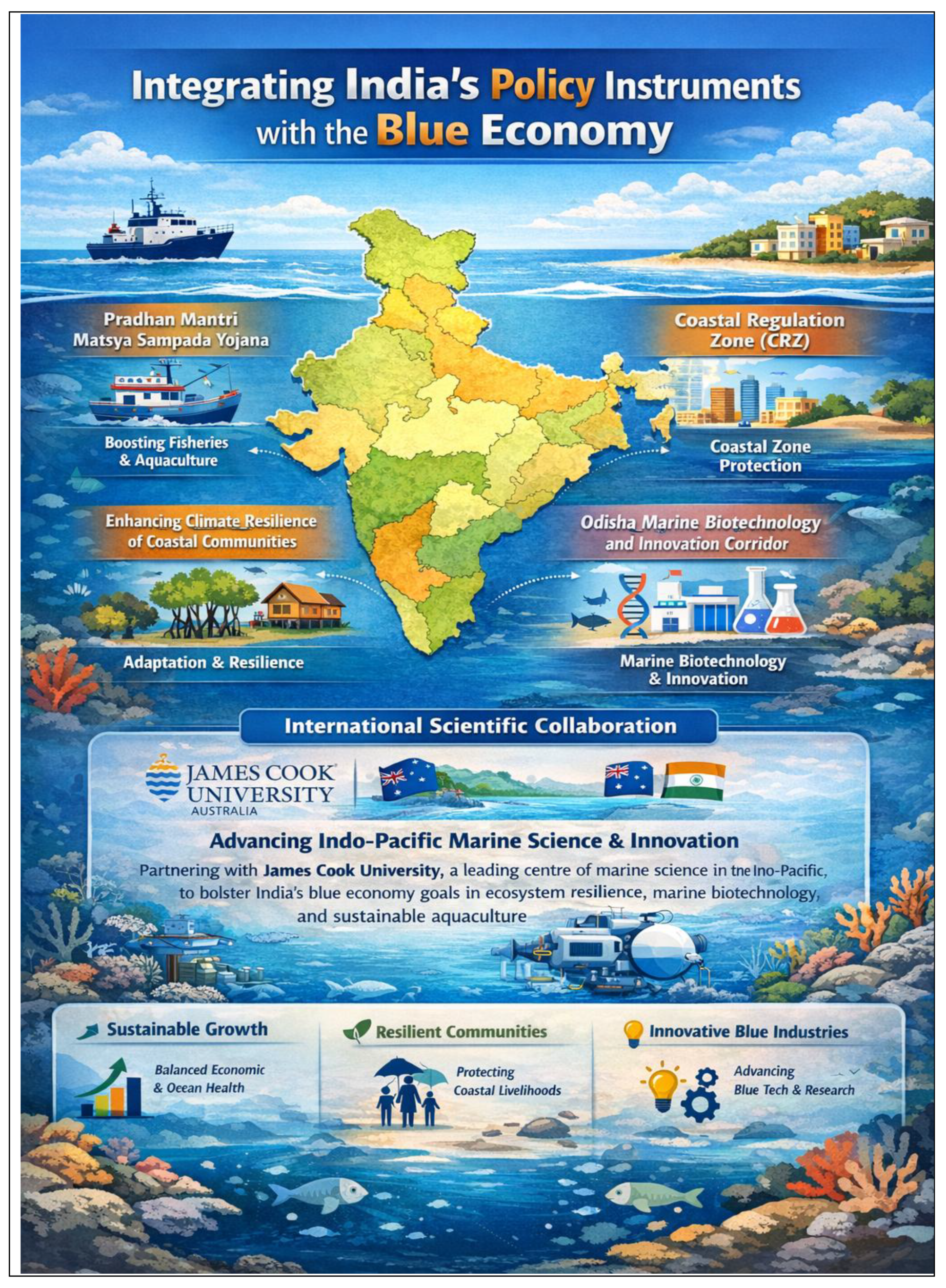
India’s blue economy strategy is supported by a set of climate, conservation, fisheries, and coastal governance policies that, while developed under different mandates, collectively shape the sustainability and resilience of ocean-based economic activities. When viewed through the lens of ocean health as economic infrastructure, these policies can be understood as complementary components of a broader blue economy architecture rather than as isolated sectoral interventions (Fig.2).
7.1.1. Climate Adaptation and System Resilience
The National Action Plan on Climate Change (NAPCC) provides the overarching climate resilience framework within which India’s ocean and coastal economy operate (Government of India, 2008; MoEFCC, 2021). Coastal regions, fisheries, ports, and island systems are among the most climate-exposed elements of the blue economy, facing increasing risks from sea-level rise, extreme weather events, and ocean warming (INCCA, 2010; TERI, 2018). By embedding adaptation and mitigation across multiple national missions, the NAPCC contributes to reducing systemic climate risk to ocean-based sectors, utilizing blue carbon ecosystems as nature-based solutions. Within a blue economy perspective, the NAPCC strengthens the resilience layer of ocean health as economic infrastructure, ensuring that ecosystem-dependent economic activities remain viable under long-term climate stress.
7.1.2. Enhancing Climate Resilience of India’s Coastal Communities (ECRICC)
The ECRICC project represents a critical bridge between national climate policy and community level implementation in India’s coastal zones. Implemented by the Ministry of Environment, Forest and Climate Change in partnership with state governments and international agencies such as UNDP, ECRICC focuses on strengthening adaptive capacity in climate vulnerable coastal districts through ecosystem restoration (ecosystem-based adaptation), climate resilient livelihoods (livelihood diversification), institutional strengthening, and improved early warning and risk management systems (MoEFCC, 2019; World Bank, 2020). This program builds upon broader national climate frameworks under the NAPCC and India’s commitments under the UNFCC (Government of India, 2008, MoEFCC, 2021).
From a blue economy perspective, ECRICC directly addresses the human and social foundations of ocean based economic activity. Coastal communities form the backbone of fisheries, aquaculture, tourism, and port-related services, yet they are disproportionately exposed to climate hazards such as cyclones, coastal erosion, flooding, and salinity intrusion (INCCA, 2010; TERI, 2018). By supporting mangrove, saltmarsh and seagrass restoration, resilient housing, livelihood diversification, and local governance capacity in highly vulnerable regions, ECRICC enhances the ability of coastal populations to sustain participation in blue economy sectors under increasing climatic stress (MoEFCC, 2019).
With the conceptual framework of this review, ECIRCC strengthens the adaptive and social resilience layer of ocean health as economic infrastructure. While physical ecosystems and economic sectors often receive policy attention, the program highlights that failure to invest in community resilience can undermine the productivity and sustainability of ocean-based industries. By embedding adaptation at the community scale, ECRICC aligns closely with the UN Ocean Decade’s emphasis on reducing vulnerability, strengthening inclusive development, and linking ocean and coastal health with human well-being (United Nations, 2021).
7.1.3. Nature-Based Infrastructure and Ecosystem Services
The Mangroves for Future initiative, implemented in India with national and state-level partners, exemplifies the integration of ecosystem protection, sustainable management and restoration with livelihood enhancement (MFF India, 2018). Mangroves function as natural coastal infrastructure and provide storm protection, support fisheries productivity, and contribute to carbon sequestration, delivering economic benefits (Nair et al., 2017; Badola et al., 2020). By linking conservation with income generation for coastal communities, this initiative aligns closely with blue economy objectives. Within the conceptual framework of this review, mangrove conservation represents an investment in natural economic infrastructure that simultaneously enhances resilience, productivity and social inclusion in coastal regions. However, other blue carbon ecosystems (sinks) such as seagrasses, saltmarshes and tidal flats are traditionally overlooked for their blue carbon potential, which also contributes significantly towards livelihood and socioeconomics.
7.1.4. Spatial Governance and Asset Protection
Island Protection Zones (IPZs) notified under India’s coastal regulation framework, govern development in ecologically sensitive and strategically important island territories such as Andaman and Nicobar and Lakshadweep Islands (MoEFCC, 2019). These zones protect coral reefs, lagoons, and coastal ecosystems that underpin fisheries, tourism, and cultural services (Sudhakar et al., 2019). From a blue economy perspective, IPZs function as preventive governance instruments that safeguard high-value ocean assets, reduce environmental degradation, and enhance long-term economic viability in island-based economies.
7.1.5. Sectoral Development and Livelihood Security
The Pradhan Mantri Matsya Sampad Yojana (PMMSY) represents the most direct articulation of blue economy objectives in India’s fisheries sector (Department of Fisheries, 2020). The scheme seeks to enhance fish production, modernize infrastructure, strengthen value chains, and generate employment while promoting sustainability. India’s marine fisheries support over four million livelihoods yet remain vulnerable to stock depletion and climate variability (CMFRI, 2020). While PMMSY emphasizes economic growth and food security, its long-term success depends on integrating ecosystem-based fisheries management and climate adaptation. Within this review’s framework, PMMSY operates at the sectoral performance layer of ocean health as economic infrastructure, translating ecosystem condition into livelihoods and economic outcomes.
7.1.6. Science, Technology and Innovation for Ocean-based Development
The Deep Ocean Mission (DOM) represents India’s most significant investment in advancing ocean science, technology, and innovation as part of its emerging blue economy strategy (MoES, 2021). Led by the Ministry of Earth Sciences, the mission focuses on deep-sea exploration, development of submersible and underwater technologies, ocean observation systems, and sustainable utilization of deep-sea resources. These objectives align closely with the UN Ocean Decade’s emphasis on strengthening the science-policy interface and leveraging technological innovation to support sustainable ocean development.
From a blue economy perspective, the DOM contributes to knowledge and innovation infrastructure, enabling evidence-based decision making across fisheries, climate adaptation, marine spatial planning, and offshore industries. Enhanced deep ocean observation and data systems can improve understanding of climate ocean interactions, hazard forecasting, and ecosystem dynamics, thereby reducing uncertainty and long-term economic risk in ocean-based investments (MoES, 2021; NCPOR, 2022). At the same time, the mission raises important governance considerations related to environmental safeguards, benefit sharing and equitable access to emerging marine technologies.
Within the conceptual framework of this review, the DOM strengthens the enabling infrastructure layer of ocean health as economic infrastructure. By expanding scientific knowledge, technological capacity and monitoring systems, it supports the maintenance and responsible use of ocean ecosystems while enhancing the productivity and resilience of blue economy sectors. Effective integration of the mission’s scientific output into policy, regulatory and financial decision making will be critical to ensuring that technological advancement under the blue economy reinforces, rather than undermines, long-term ocean and coastal sustainability.
7.1.7. Odisha Marine Biotechnology Research and Innovation Corridor (OMBRIC)
The OMBRIC represents a state level landmark initiative launched by Government of Odisha aimed at promoting marine biotechnology, sustainable bio-resource utilization and innovation-driven ocean industries. By linking research institutions, industry and coastal/marine resources, the corridor seeks to diversify the blue economy beyond traditional sectors such as fisheries and tourism through a lab-to-market pipeline. OMBRIC plays an important role in blue economy by supporting industrial upgradation and diversification, enabling high value, low-extraction ocean industries, fostering innovation and strengthening industry competence in pharmaceuticals, nutraceuticals, biomaterials, and aquaculture inputs (Government of Odisha, 2021; DBT, 2020). Therefore, OMBRIC strengthens the innovative and value addition layer of ocean health as economic infrastructure by converting biological knowledge into sustainable economic outputs.
From a blue economy standpoint, OMBRIC addresses a key structural challenge: over-reliance on extractive and low-value ocean activities. By promoting marine biotechnology and innovation, the corridor supports economic diversification and industrial upgrading, enabling higher value generation without proportionally increasing ecological pressure (NITI Aayog, 2022; MoES, 2021). Such innovation-led pathways are increasingly recognized as essential for reconciling economic growth with ocean health under global sustainability agendas (Blasiak et al., 2018; Leary et al., 2009).
Within the conceptual framework advanced in this review, OMBRIC strengthens the innovation and value addition layer of ocean health as economic infrastructure. By transforming biological knowledge into sustainable economic outputs, the corridor enhances returns on ocean stewardship while incentivizing conservation and responsible resource use. At the same time, it raises important governance considerations related to biosafety, intellectual property, benefit-sharing, and equitable access to marine genetic resources; issues that resonate with international debates under the Ocean Decade and evolving global ocean governance frameworks (Blasiak et al., 2018).
7.1.8. International Scientific Collaboration and the Blue Economy
Achieving India’s blue economy ambitions under the UN Ocean Decade requires not only domestic policy coherence but also sustained international scientific collaboration. Partnerships with institutions possessing long-standing expertise in tropical marine systems (e.g., in the Indian Ocean region) are particularly valuable for India’s ocean governance agenda. In this regard, James Cook University (JCU), Australia stands out as one of the leading centers of tropical marine science in the Indo-Pacific region.
Located in northern Australia and proximate to the eastern Indian Ocean, JCU has developed internationally recognized strengths in coral reef ecology, blue carbon ecosystems (mangroves, seagrasses and saltmarshes), marine biodiversity, fisheries science, coastal hazard assessment, and marine biotechnology. Research affiliated with JCU has significantly advanced understanding of coral reef vulnerability under climate change (Hoegh-Guldberg et al., 2007), mass coral bleaching dynamics in tropical oceans (Hughes et al., 2017) and the ecological and economic importance of seagrass systems in sustaining fisheries and coastal stability (Unsworth et al., 2019). These areas of expertise are directly relevant to India’s coral reef systems in Lakshadweep and the Andaman and Nicobar Islands, as well as to mangrove-seagrass dependent coastal regions along the mainland.
For India, collaboration with JCU offers three strategic advantages within the blue economy framework advanced in this review.
First, it strengthens the knowledge infrastructure layer. JCU’s expertise in reef resilience modelling, ecosystem monitoring, ocean-climate interactions, and spatial ecological assessment can enhance India’s efforts under the Deep Ocean Mission and coastal monitoring systems. Such collaboration supports more robust data generation, improved climate risk forecasting, and evidence-based marine spatial planning in the Indian Ocean context.
Second, it reinforces the adaptive governance and community resilience layer. JCU’s experience integrating ecological science with community-based adaption, indigenous coastal governance, and ecosystem-based management provides transferrable lessons for strengthening initiatives such as ECRICC. JCU is currently involved as technical expert with IIT Bhubaneswar under the ECRICC project providing research and capacity-building programs that support improved vulnerability assessments, coastal restoration, nature-based solutions and participatory coastal management approaches.
Third, it advances the innovation and value-addition layer of the blue economy. JCU’s marine biotechnology research including marine natural products discovery, aquaculture sustainability, and bio resource management aligns closely with the objectives of OMBRIC. Structured partnerships, joint-doctoral programs and shared research platforms can accelerate responsible commercialization while maintaining environmental safeguards and compliance with emerging global norms on marine genetic resources.
Importantly, collaboration in the Indo-Pacific region carries geopolitical as well as scientific relevance. As the Indian Ocean emerges as a focal region for climate vulnerability, biodiversity conservation, and blue economy development, transnational scientific partnerships enhance regional stability through shared knowledge, harmonized standards, and coordinated research efforts. Such collaboration aligns directly with the UN Ocean Decade's emphasis on global cooperation, capacity development, and equitable access to ocean science (United Nations, 2021).
Within the conceptual framing of ocean health as economic infrastructure, international collaboration with leading Indo-Pacific marine science institutions such as JCU enhances the scientific, technological, and governance foundations necessary for sustaining resilient and inclusive ocean-based development. By embedding structured international research partnerships within its blue economy strategy, India can strengthen evidence-based policymaking, accelerate innovation, and ensure that economic growth remains anchored in long-term marine ecosystem integrity.
7.1.9. Governance implications for the Blue Economy
Taken together, these policy instruments demonstrate that India already possess many of the institutional building blocks to achieve sustainable blue economy. However, coordination across sectors and governance levels, with mechanisms to integrate ecosystem evaluation, climate risk, health impacts, and final decision making can augment these key initiatives (NITI Aayog, 2020; TERI, 2021). Strengthening coordination among climate policy, ecosystem restoration, spatial planning, and fisheries development is critical for operationalizing ocean health as a core economic asset. Such integration will align directly with the UN Ocean Decade’s emphasis on science-based, inclusive, and resilient governance of ocean and coastal ecosystems.
8. Key Gaps and Emerging Lessons
Despite the breadth of India’s policy architecture and growing alignment with the UN Ocean Decade agenda several structural gaps constrain the transformation of ocean health into recognized economic infrastructure.
First, systematic under-valuation of ocean health persists within policy and planning frameworks. Although ecosystem services are acknowledged, economic planning and public investment systems rarely internalize the full value of coral reefs, mangroves, seagrasses, saltmarshes and other coastal wetlands as protective and productive infrastructure (Costanza et al., 2014; Dasgupta, 2021). Global evidence demonstrates that failure to account for ecosystem services leads to underinvestment in conservation and restoration, increasing long-term economic vulnerability (Barbier et al., 2011; Narayan et al., 2017). As a result, restoration and conservation investments are often treated as environmental expenditure rather than as core economic stabilization measures.
Second, there is limited integration of ecological and health risks into financial decision-making. Climate exposure, biodiversity loss, and pollution risks are insufficiently incorporated into infrastructure appraisal, fisheries modernization schemes, insurance mechanisms, and coastal development financing. Although, international financial assessments increasingly recognize ocean degradation as a material economic risk (UNEP FI, 2019), such risks are rarely embedded within national policy and planning systems. The absence of risk-adjusted economic evaluation, degradation generates hidden fiscal and social liabilities and long-term economic instability (Hallegatte et al., 2018; Jouffray et al., 2020).
Third, equity and vulnerability considerations are unevenly embedded within blue economy governance. While initiatives such as ECRICC and PMMSY address livelihoods and resilience, distributional impacts, gendered vulnerabilities, and adaptive capacity are not consistently integrated across all sectors. Global evidence suggests that blue economy transitions can exacerbate inequality, if justice and inclusiveness are not central to policy design (Bennett et al., 2021). Failure to incorporate these dimensions risks undermining both social and legitimacy and long-term sustainability.
Fourth, fragmented marine governance systems constrain cross-sectoral coordination. Institutional responsibilities remain distributed across multiple ministries and scales, complicating integration across climate adaptation, ecosystem management, fisheries development, spatial regulation, biotechnology innovation, and financial planning. International experience highlights the importance of integrated and adaptive governance frameworks in managing complex social-ecological systems (Folke et al., 2005; Österblom et al., 2017). Although India’s DOM and state-level innovation initiatives demonstrate forward looking ambition, stronger institutional linkages are required to align scientific outputs with regulatory and financial decision-making.
Taken together, these gaps highlight a central marine policy challenge: while India possesses many of the institutional building blocks for a sustainable blue economy, the transition from policy plurality to policy coherence depends on explicitly governing ocean health as economic infrastructure. Without such integration, ecosystem degradation risks undermine economic resilience, public health, and social stability; patterns increasingly observed globally in climate exposed coastal ecosystems like India (IPCC, 2019). Addressing these gaps requires integrated policy frameworks that embed ecological valuation, risk sensitive planning, and inclusive governance within blue economy strategies.
9. Pathways for an Ocean-Decade-Aligned Blue Economy
Aligning India’s blue economy strategy with the UN Ocean-Decade requires moving beyond sectoral sustainability towards integrated policy and governance frameworks. Building on the conceptual framework advanced in this review (Figure 1) and the policy mapping presented in Figure 2, four priority policy pathways emerge.
First, integrate ecosystem and health indicators into economic planning and public policy frameworks. Expanding natural capital accounting and incorporating blue carbon valuation, biodiversity metrics, and vulnerability indicators into development planning can reposition ecosystem protection as a form of economic infrastructure (Dasgupta, 2021; OECD, 2016). Embedding ecosystem services within cost-benefit analysis, public investment decisions, and national accounting systems will strengthen the recognition of ocean health as a core economic asset rather than an external environmental concern.
Second, develop regulatory and financial mechanisms that incorporate ecological risk into decision making. Financial instruments such as blue bonds, resilience bonds, blended finance instruments, and sustainability linked lending demonstrate potential to align capital flows with ocean conservation and climate adaptation objectives (Sumaila et al., 2021; WEF, 2020). However, their effectiveness depends on policy frameworks that integrate climate and biodiversity risk into infrastructure appraisal, insurance systems, and coastal developmental finance. Embedding ecological risk within financial governance can enhance fiscal stability, reduce exposure to stranded assets, and incentivize long-term ecosystem stewardship (UNEP FI, 2019).
Third, strengthen integrated and multi-level marine governance systems. Effective ocean governance requires coordination across climate policy, fisheries management, marine spatial planning, coastal regulation, biotechnology development, and scientific research institutions. International experience highlights the importance of adaptive governance, cross-sectoral coordination, and science-policy integration in managing complex ocean systems (Folke et al., 2005; Bennett et al., 2019). Strengthening institutional coordination mechanisms and enhancing the uptake of scientific knowledge through initiatives such as the DOM and international collaborations, including Indo-Pacific science partnerships, can support more coherent and evidence-based policymaking.
Fourth, embed equity and community resilience within blue economy policy design. Sustainable ocean development depends not only on ecological integrity but also on equitable access to resources, participation in decision-making, and adaptive capacity. Strengthening participatory coastal governance, ecosystem-based adaption, livelihood diversification, and capacity-building can enhance resilience among vulnerable coastal populations (Bennett et al., 2021; United Nations, 2021). Integrating these dimensions into policy frameworks is essential for ensuring socially inclusive and politically legitimate blue economy transitions.
Collectively, these policy pathways address a central marine policy challenge: integrating ecological sustainability, economic development, and social inclusion within coherent governance systems. By explicitly treating ocean and coastal health as economic infrastructure and embedding this perspective across regulatory, financial, and institutional domains India can strengthen the resilience, inclusiveness, and long-term viability of its blue economy while contributing to broader regional stability in the Indo-Pacific.
10. Conclusion
Reframing ocean and coastal health as economic infrastructure addresses a central marine policy challenge: the need to integrate ecological sustainability, economic development, and social inclusion within coherent governance systems. This perspective highlight how ecosystem degradation generates cascading economic, financial, and public health risks, and underscores the importance of embedding ecological consideration within policy, planning, and investment decisions.
The analysis demonstrates that, despite a comprehensive policy architecture, gaps in valuation, risk integration, and institutional coordination continue to limit the effectiveness in India’s blue economy strategy. Addressing these challenges requires integrated policy frameworks that incorporate ecosystem valuation, risk-sensitive financial mechanisms, and cross-sectoral governance approaches, while strengthening the science-policy interface and community-level resilience.
More broadly, this review contributes to marine policy scholarship by advancing the concept of ocean health as economic infrastructure and by demonstrating its relevance for policy design and governance reform. While grounded in India, the findings offer transferable insights for costal and ocean-dependent economies seeking to align blue economy development with long-term sustainability, resilience, and inclusive growth under conditions of increasing environmental and socio-economic change.
References
- Badola, R.; Hussain, S.A.; Mishra, B.K.; Konthoujam, B.; Thapliyal, S.; Dhakate, P.M. An assessment of ecosystem services of mangrove forests in India. Ecosystem Services 2020, 42, 101090. [Google Scholar]
- Barbier, E.B.; Hacker, S.D.; Kennedy, C.; Koch, E.W.; Stier, A.C.; Silliman, B.R. The value of estuarine and coastal ecosystem services. Ecological Monographs 2011, 81(2), 169–193. [Google Scholar] [CrossRef]
- Bennett, N.J.; Blythe, J.; Cisneros-Montemayor, A.M.; Singh, G.; Sumaila, U.R. Just transformations to sustainability. Sustainability Science 2019, 14, 1–16. [Google Scholar] [CrossRef]
- Bennett, N.J.; Cisneros-Montemayor, A.M.; Blythe, J.; Silver, J.J.; Singh, G.; et al. Towards a sustainable and equitable blue economy. Nature Sustainability 2021, 4, 991–1000. [Google Scholar] [CrossRef]
- Blasiak, R.; Jouffray, J.-B.; Wabnitz, C.C.C.; Sundström, E.; Österblom, H. Corporate control and global governance of marine genetic resources. Science Advances 2018, 4(6), eaar5237. [Google Scholar] [CrossRef]
- CMFRI. Marine fisheries census 2016: India; Central Marine Fisheries Research Institute: Kochi, 2021. [Google Scholar]
- Costanza, R.; de Groot, R.; Sutton, P.; van der Ploeg, S.; Anderson; et al. Changes in the global value of ecosystem services. Global Environmental Change 2014, 26, 152–158. [Google Scholar] [CrossRef]
- Dasgupta, P. The economics of biodiversity: The Dasgupta review; HM Treasury: London, 2021. [Google Scholar]
- DBT. Marine biotechnology roadmap for India; Department of Biotechnology, Ministry of Science and Technology, Government of India: New Delhi, 2020. [Google Scholar]
- Department of Fisheries. Pradhan Mantri Matsya Sampada Yojana: Operational guidelines . Ministry of Fisheries, Animal Husbandry and Dairying, Government of India: New Delhi, 2020. [Google Scholar]
- FAO. The state of world fisheries and aquaculture 2020; Food and Agriculture Organization of the United Nations: Rome, 2020. [Google Scholar]
- Fleming, L.E.; Maycock, B.; White, M.P.; Depledge, M.H. Fostering human health through ocean sustainability in the 21st century. People and Nature 2019, 1(3), 276–283. [Google Scholar] [CrossRef]
- Folke, C.; Hahn, T.; Olsson, P.; Norberg, J. Adaptive governance of social–ecological systems. Annual Review of Environment and Resources 2005, 30, 441–473. [Google Scholar] [CrossRef]
- Free, C.M.; Thorson, J.T.; Pinsky, M.L.; Oken, K.L.; Wiedenmann, J.; Jensen, O.P. Impacts of historical warming on marine fisheries production. Science 2019, 363(6430), 979–983. [Google Scholar] [CrossRef]
- Golden, C.D.; Allison, E.H.; Cheung, W.W.L.; Dey, M.M.; Halpern, B.S.; McCauley, D.J.; Smith, M.; Vaitla, B.; Zeller, D.; Myers, S.S. Nutrition: Fish consumption and human health. Nature 2016, 534, 317–320. [Google Scholar] [CrossRef]
- Government of India. National action plan on climate change . Prime Minister’s Council on Climate Change: New Delhi, 2008. [Google Scholar]
- Government of Odisha. Odisha marine biotechnology policy and innovation strategy . Science and Technology Department, Government of Odisha: Bhubaneswar, 2021. [Google Scholar]
- Gössling, S.; Peeters, P.; Hall, C.M.; Ceron, J.P.; Dubois, G.; Lehmann, L.V.; Scott, D. Tourism and water use: Supply, demand and security. Tourism Management 2012, 33(1), 1–15. [Google Scholar] [CrossRef]
- Hallegatte, S.; Rentschler, J.; Rozenberg, J. Lifelines: The resilient infrastructure opportunity; World Bank: Washington, DC, 2018. [Google Scholar]
- Hoegh-Guldberg, O.; Mumby, P.J.; Hooten, A.J.; et al. Coral reefs under rapid climate change and ocean acidification. Science 2007, 318(5857), 1737–1742. [Google Scholar] [CrossRef]
- Hoegh-Guldberg, O.; Northrop, E.; Lubchenco, J. The ocean as a solution to climate change: Five opportunities for action. Frontiers in Marine Science 2019, 6, 289. [Google Scholar]
- Hughes, T.P.; Kerry, J.T.; Álvarez-Noriega, M.; et al. Global warming and recurrent mass bleaching of corals. Nature 2017, 543, 373–377. [Google Scholar] [CrossRef]
- ICAR-CMFRI. Annual report 2020–21; Central Marine Fisheries Research Institute: Kochi, 2021. [Google Scholar]
- INCCA. Climate change and India: A 4×4 assessment . Ministry of Environment and Forests, Government of India: New Delhi, 2010. [Google Scholar]
- IPCC. Special report on the ocean and cryosphere in a changing climate . Intergovernmental Panel on Climate Change, Geneva, 2019. [Google Scholar]
- Jouffray, J.-B.; Blasiak, R.; Norström, A.V.; Österblom, H.; Nyström, M. The blue acceleration: The trajectory of human expansion into the ocean. One Earth 2020, 2(1), 43–54. [Google Scholar] [CrossRef]
- Leary, D.; Vierros, M.; Hamon, G.; Arico, S.; Monagle, C. Marine genetic resources: A review of scientific and commercial interest. Marine Policy 2009, 33(2), 183–194. [Google Scholar] [CrossRef]
- MoEFCC. Enhancing climate resilience of India’s coastal communities (ECRICC): Project document . Ministry of Environment, Forest and Climate Change, Government of India: New Delhi, 2019. [Google Scholar]
- MoEFCC. India’s third biennial update report to the UNFCCC; Ministry of Environment, Forest and Climate Change, Government of India: New Delhi, 2021. [Google Scholar]
- MoES. India’s deep ocean mission: Unlocking the potential of the blue economy; Ministry of Earth Sciences, Government of India: New Delhi, 2021. [Google Scholar]
- Narayan, S.; Beck, M.W.; Wilson, P.; Thomas, C.J.; Guerrero, A.; et al. The effectiveness, costs and coastal protection benefits of natural and nature-based defences. PLOS ONE 2017, 12(5), e0174735. [Google Scholar] [CrossRef]
- Aayog, NITI. Strategy for blue economy: India’s pathway to sustainable growth; Government of India: New Delhi, 2020. [Google Scholar]
- NITI Aayog. Promoting innovation and industrial transformation in India’s blue economy; Government of India: New Delhi, 2022. [Google Scholar]
- OECD. The ocean economy in 2030; Organisation for Economic Co-operation and Development: Paris, 2016. [Google Scholar]
- Österblom, H.; Jouffray, J.-B.; Folke, C.; Crona, B.; Troell, M.; Merrie, A.; Rockström, J. Transnational corporations as keystone actors in marine ecosystems. PLOS ONE 2017, 10(5), e0127533. [Google Scholar] [CrossRef]
- Silver, J.J.; Gray, N.J.; Campbell, L.M.; Fairbanks, L.W.; Gruby, R.L. Blue economy and competing discourses in international oceans governance. Journal of Environment & Development 2015, 24(2), 135–160. [Google Scholar]
- Spalding, M.; Burke, L.; Wood, S.A.; Ashpole, J.; Hutchison, J.; zu Ermgassen, P. Mapping the global value and distribution of coral reef tourism. Marine Policy 2017, 82, 104–113. [Google Scholar] [CrossRef]
- Sudhakar, S.; Menon, H.B.; Raghunathan, C. Coral reef ecosystems of the Andaman and Nicobar Islands: Status and management. Current Science 2019, 116(2), 187–196. [Google Scholar]
- Sumaila, U.R.; Cheung, W.W.L.; Lam, V.W.Y.; Pauly, D.; Herrick, S. Climate change impacts on the biophysics and economics of world fisheries. Nature Climate Change 2011, 1, 449–456. [Google Scholar] [CrossRef]
- Sumaila, U.R.; Skerritt, D.J.; Schuhbauer, A.; Villasante, S.; Cisneros-Montemayor, A.M.; Sinan, H.; Burnside, D. WTO fisheries subsidies negotiations: Updating the analysis. Marine Policy 2021, 124, 104370. [Google Scholar]
- TERI. Coastal climate risk and adaptation in India; The Energy and Resources Institute: New Delhi, 2018. [Google Scholar]
- TERI, MoES; NCPOR. Blue economy: India’s pathway to sustainable, secure and resilient economy; New Delhi, 2021. [Google Scholar]
- UNEP FI. Rising tide: Mapping Ocean finance for a new era; United Nations Environment Programme Finance Initiative: Geneva, 2019. [Google Scholar]
- United Nations. The United Nations decade of ocean science for sustainable development (2021–2030): Implementation plan; UNESCO-IOC: Paris, 2021. [Google Scholar]
- Unsworth, R.K.F.; McKenzie, L.J.; Nordlund, L.M.; Cullen-Unsworth, L.C. Seagrass meadows support global fisheries production. Nature Communications 2019, 10, 4646. [Google Scholar] [CrossRef]
- World Bank. India: Enhancing coastal resilience project appraisal document; World Bank: Washington, DC, 2020. [Google Scholar]
- World Economic Forum. Nature risk rising: Why the crisis engulfing nature matters for business and the economy; Geneva, 2020. [Google Scholar]
Figure 1.
Conceptual framework illustrating ocean and coastal health as economic infrastructure underpinning blue economy performance, financial resilience, and governance outcomes. Degradation of ocean health generates cascading economic and fiscal risks, while effective governance can reinforce ecosystem integrity and long-term resilience through feedback mechanisms. Canva was used to generate the graphical image.
Figure 1.
Conceptual framework illustrating ocean and coastal health as economic infrastructure underpinning blue economy performance, financial resilience, and governance outcomes. Degradation of ocean health generates cascading economic and fiscal risks, while effective governance can reinforce ecosystem integrity and long-term resilience through feedback mechanisms. Canva was used to generate the graphical image.
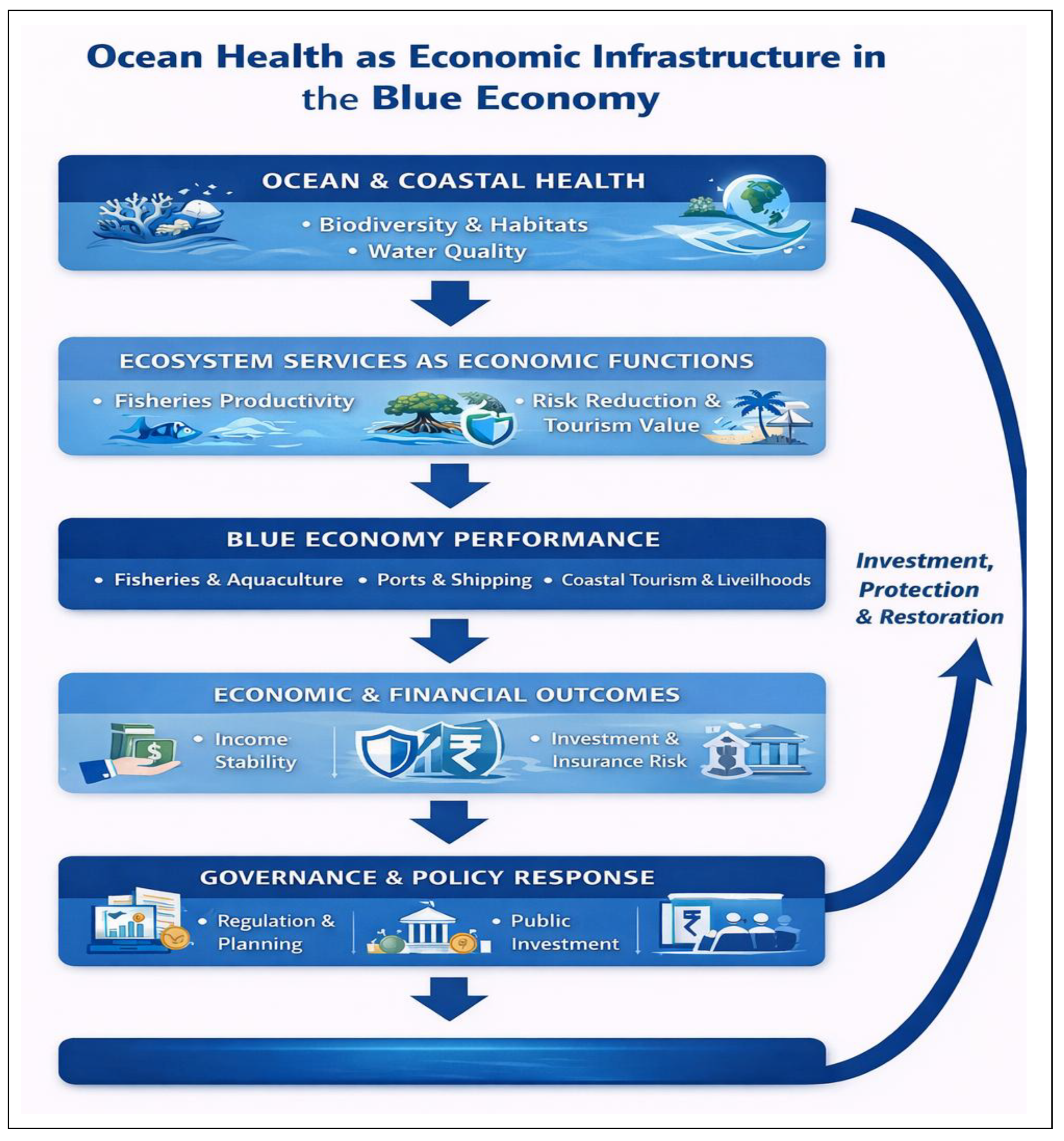
Figure 2.
This figure operationalizes the conceptual framework of ocean and coastal health as economic infrastructure within India’s blue economy. The central map situates key policy instruments across interconnected system layers linking ecosystem integrity, sectoral performance, innovation, and governance. Regulatory and adaption instruments: CRZ/IPZ and ECRICC support ecosystem resilience and community adaptive capacity. PMMSY translates ecological condition into fisheries productivity and livelihood outcomes. The DOM and OMBRIC strengthen knowledge, technology and value addition layers. Arrows imply feedback loops whereby investment, protection, and restoration reinforce ocean health, stabilizing economic performance in alignment with the UN Ocean Decade. JCU is utilized as an example of international collaboration. Canva was used to generate the graphical image.
Figure 2.
This figure operationalizes the conceptual framework of ocean and coastal health as economic infrastructure within India’s blue economy. The central map situates key policy instruments across interconnected system layers linking ecosystem integrity, sectoral performance, innovation, and governance. Regulatory and adaption instruments: CRZ/IPZ and ECRICC support ecosystem resilience and community adaptive capacity. PMMSY translates ecological condition into fisheries productivity and livelihood outcomes. The DOM and OMBRIC strengthen knowledge, technology and value addition layers. Arrows imply feedback loops whereby investment, protection, and restoration reinforce ocean health, stabilizing economic performance in alignment with the UN Ocean Decade. JCU is utilized as an example of international collaboration. Canva was used to generate the graphical image.
Disclaimer/Publisher’s Note: The statements, opinions and data contained in all publications are solely those of the individual author(s) and contributor(s) and not of MDPI and/or the editor(s). MDPI and/or the editor(s) disclaim responsibility for any injury to people or property resulting from any ideas, methods, instructions or products referred to in the content. |
© 2026 by the authors. Licensee MDPI, Basel, Switzerland. This article is an open access article distributed under the terms and conditions of the Creative Commons Attribution (CC BY) license (http://creativecommons.org/licenses/by/4.0/).
Copyright: This open access article is published under a Creative Commons CC BY 4.0 license, which permit the free download, distribution, and reuse, provided that the author and preprint are cited in any reuse.


