

Submitted:
12 April 2026
Posted:
14 April 2026
You are already at the latest version
Abstract
To meet the requirement of the current integrated circuit industry, atomic layer etching (ALE) technology has been broadly studied and developed. By dividing the whole etching process into several independent and self-limiting sub-process, ALE can achieve etching in atomic-level precision and better control in the etching process than traditional continuous etching technology, such as reactive ion etching. In this review, the characteristics of ALE are briefly summarized and five ways to improve the performance of ALE are introduced in detail. Attentionally, the main problem of the industrial application of ALE is how to make the trade-off between the time-consuming and the quality of etching. An improved ALE method with multiple temperature windows is proposed in this paper, which can theoretically shorten the time of each etching cycle in ALE.
Keywords:
atomic layer etching
; temperature windows
1. Introduction
In the integrated circuit process, in order to transfer highly complex circuit patterns to large wafers, it is necessary to realize the addition and subtraction processes of wafer materials with extremely high precision. As a subtractive process for integrated circuits, etching is to remove specified parts of the material without damaging other parts. To date, the feature size of integrated circuits has reached sub-10nm, which requires better etching technology with high selectivity and high accuracy [1,2,3]. In the past 30 years, while developing and learning from atomic layer deposition technology (ALD), scientists have extensively studied and developed atomic layer etching technology (ALE) to achieve etching in atomic-level precision. The entire etching process of ALE is divided into multiple self-limiting independent sub-steps, which can remove the substrate material layer-by-layer on an atomic scale. Isotropic and anisotropic ALE can achieve a high aspect ratio and sharp pattern etching, ensuring uniformity and high selectivity in many current 3D devices, such as FinFet logic devices, NAND flash, nanotubes [2,4]. In addition, ALE can also be combined with atomic layer deposition technology for highly selective deposition to remove materials where is over-deposited[5].
In 1988, Yoder proposed ALE in his research of synthetic diamond films[1]. Since then, the directional ALE has been studied by scientists in detail, who considered ALE as an alternative to a traditional continuous process, such as reactive ion etching (RIE), and the comparison of RIE and ALE is shown in Table 1. Compared with the continuous etching process, ALE has two major advantages. Firstly, it can better control selectivity, etching rate, and directionality[4]. The RIE involves multiple reactions on the substrate material at the same time, and the etching amount increases with time, while atomic layer etching separates multiple reactions. Each reaction in ALE is performed independently. The amount of etching will reach saturation and it is independent with time. When the reaction stops by itself, all the gas in the reaction chamber is removed and the next reaction is to proceed[5]. Secondly, it won’t form thick mixed layers. Unlike the continuous etching method, ALE avoids unlimited reactivity by decoupling the generation and transport of ions, electrons, and neutrals.
2. The Characteristics of ALE
Conceptually, ALE refers to all etching processes that meet the following three conditions [1]:
- (1)
- Periodicity. The entire process operates in cycles. The process in each cycle is the same, and the total amount of material etching can be determined by the number of cycles.
- (2)
- Independence. Each cycle contains independent and continuous sub-steps, as shown in Figure 1.
- (3)
- Self-limitation. At least one sub-step in each cycle meets self-limitation. The total amount of etching in this sub-step can reach saturation over time, which means the reaction can stop by itself, as shown in Figure 2.
According to the etching target pattern, ALE can be divided into two categories.
- (1)
- Isotropic etching (IALE), etching uniformly in all directions. Convert a certain thickness of a single layer of raw material into a volatile substance through a chemical reaction, and then heat it within a certain temperature range to remove the volatile substance.
- (2)
- Anisotropic etching (AALE), uniform etching in the specified direction. Plasma is used to assist chemical reactions so that the raw materials in a specific area are transformed into other solid substances, and then the solid substances are bombarded with ion beams to separate them from the surface of the raw materials. Generally, because AALE uses plasma to accelerate the adsorption reaction, the anisotropic etching rate is much higher than that of isotropic etching.
The entire ALE mainly includes four steps [5].
- (1)
- Preprocessing. To reduce the potential barrier of the substrate surface, so that the reactants can contact the surface of the substrate through physical or chemical adsorption.
- (2)
- Modification. The adsorbed atoms and the atomic layer with a specified thickness on the substrate surface can be transformed into another material layer through a single or multiple chemical reactions that can reach saturation by themselves. The modified layer is much easier to be removed than unmodified material in the next step.
- (3)
- Removal. The final material generated in the previous step desorbs and volatilizes under ion bombardment or heating, without damaging the original material underneath.
- (4)
- Cleaning. After each step of the reaction, the chamber must be purged with N2 to remove all gaseous reactants and prepare for the next reaction cycle.
In this way, the material can be etched layer by layer within the predefined number of cycles. The method that functionally separates the modification and removal into two stages enables more precise control and less damage induced by ions[7].
- 1)
- High precision. It can achieve etching on an atomic-scale precision, with good etching uniformity and small standard deviation;
- 2)
- Strong controllability. Compared with traditional continuous etching, ALE divides the reaction into multiple independent and self-limiting sub-steps, which enhances the ability to control the etching process.
- 3)
- Good uniformity. The same etching effect can be achieved on a batch of wafers, ensuring high fidelity of circuit pattern transfer.
- 4)
- High selectivity. For example, aluminum oxide and hafnium oxide have a selectivity of more than 1000:1 relative to silicon, silicon dioxide, and nitride;
- 5)
- Wide applicability. It can etch metals and metal composites, which is difficult to achieve with traditional RIE.
- 6)
- The reaction conditions for IALE are relatively simple. Compared with AALE, the temperature and pressure is easier to control than plasma;
- 7)
- AALE has good directionality. AALE can be used to etch high-aspect-ratio graphics.
- 1)
- Compared with other etching techniques, ALE requires a longer time and higher cost;
- 2)
- The reaction rate will be different at different depths of the material. Because of the diffusion of reactants and other mechanisms, the concentration of reactants at different depths is different, so the rate of reaction is also different, and finally, the actual etching pattern does not match the design;
- 3)
- The accuracy of AALE is affected by plasma parameters, including plasma exposure time, power, and bias.
- 4)
- IALE is sensitive to temperature, which limits the application of IALE. The upper limit of the adjustable temperature is about 650 °C, and over high temperature may damage the device;
3. Application of ALE on Different Materials
Traditional RIE can be used for some single elements, oxides, compounds and other materials. ALE has greatly expanded this range of etching materials and can perform isotropic and anisotropic etching on metals, alloys [3], metal oxides, and metal compounds[5]. With the help of catalytic reaction mechanism, ALE can even achieve the etching of inert metals [4]. Specific examples of isotropic and anisotropic etching are well summarized in literature [1] and [2]. For the etching effect of ALE on different materials, two criteria can be referred: (1) the changes in the film thickness tested by in situ spectroscopic ellipsometry (SE); (2) the mass change per cycle tested by quartz crystal microbalance (QCM).
For different materials, the specific processing flow and the etching rate of ALE will be different, as shown in Table 2. Take the isotropic etching of silicon as an example[8]. In the modification stage, after the silicon is oxidized to silicon dioxide, the silicon dioxide is fluorinated by HF, and then the trimethylaluminum [TMA, Al(CH3)3] is passed into the coordination reaction with the silicon fluoride to produce a volatile chelate. In the removal stage, the volatile chelate is removed by heating.
Considering IALE and assuming that there are two reactions in the modification stage, and the substrate material is A, the reactions are:
Reaction 1: A(s) + B(g) → C(s),
Reaction 2: C(s) + D(g) → E(g).
The material B that reacts with the surface layer of the substrate should meet two conditions[2,4,8]: (1) enable reaction 1 to occur; (2) enable the reaction product C to have high selectivity with the underlying raw material.
For reaction 1 to occur, the bond energy of reactant B to the substrate atoms should be greater than the bond energy between the substrate atoms. Take the isotropic etching of SiO2 as an example. The first reaction can be fluorinated instead of chlorination. The bond energy of silicon atom with oxygen, fluorine and chlorine atoms is shown in the Table 3. The bond energy of Si-O is 452kJ/mol greater than the bond energy of Si-Cl 381kJ/mol, which means that the Cl atom does not have enough energy to extract silicon from Si-O. In contrast, the bond energy of Si-F is 565kJ/mol greater than the bond energy of Si-O of 452kJ/mol, so HF can react with silicon dioxide.
In the second condition, high selectivity means that the reaction rate of substance D and substance C is much higher than the reaction rate of substance D and substrate A. For example, in thermal ALE, aluminum oxide and hafnium oxide have a selectivity of more than 1000:1 relative to silicon, silicon dioxide, and nitride.
4. The Self-Limiting Mechanism of ALE
Self-restriction is the core feature of ALE technology. Self-limiting means that the amount of reaction in a cycle is fixed and not determined by time, and the reaction will stop by itself. Therefore, ALE can control the total etching amount by controlling the number of cycles [5].
The traditional reactive ion etching technology does not have this self-restriction, and the total amount of etching and the etching time show an approximately positive linear relationship, as shown in Figure 3. The etching amount is controlled by the reaction time. This method is acceptable in the manufacturing process of integrated circuits with large feature sizes, but cannot achieve the manufacturing of integrated circuits below 10 nm. This is because the feature size is too small, even if the time is strictly controlled, the reaction may continue to etch a part of the excess material in a buffer stage, which directly destroys other parts of the device. As for ALE, its self-limitation guarantees that the amount of material etching has nothing to do with the reaction time and the total amount of reactants. When the total amount of single-cycle ALE etching is under control, there is no need to worry about over-etching.
The realization of self-limitation comes from two aspects: physical control and chemical control. In terms of physical control, the adsorption of reactants on the substrate surface will reach saturation, the diffusion depth of reactants on the substrate can be controlled by the gas pressure, and the reaction rate can also be controlled by the chamber temperature[5]. In the removal phase, the energy of the ion beam is limited to only sputtering the reactive layer without contacting the underlying substrate material. In terms of chemical control, the reactant reacts with the surface material of the substrate, and the solid reaction product or reaction intermediate product will cover the surface of the substrate, blocking the contact between the underlying substrate material and the reactant, and the reaction in the covered area is thereby stopped [4].
5. Five Improvement Methods of ALE
Although ALE has advanced in many aspects of etching, to date, some problems still need to be solved to improve the performance of ALE. In this section, five ways to improve ALE are shown in detail.
5.1. Reduce the Preprocessing Time by Lowering the Surface Barrier of the Substrate
The surface barrier of the etched material prevents the reaction from proceeding. Due to the existence of the surface barrier, the reactant molecules need to have enough energy to contact the surface atoms of the substrate, and the amount of the reactant must exceed a certain threshold before the reaction can start. In order to reduce this surface barrier, some catalysts or oxidants, such as oxygen, ozone, HF, and XeF2, can be used to increase the valence of atoms on the surface of the substrate. For example, metal oxides are usually fluorinated with HF, and metals are chlorinated with Cl2 to a higher valence state [1]. The theoretical basis of this method comes from thermodynamics [4]. The higher the valence of the reactants, the lower the Gibbs free energy of the chemical reaction, which is more conducive to the occurrence of the reaction. When the Gibbs free energy is less than 0, the reaction can occur spontaneously.
5.2. Reduce the Roughness of the Material Surface After Etching
Due to the existence of activation barriers and reaction products, etching will cause unevenness on the wafer surface[4]. Ideally, we hope that the reactants can react with the surface material of the substrate, and the reaction product can be flat and compactly covered on the surface of the substrate material. However, because of the activation barrier, the volume of reactants must reach a certain threshold for the reaction to occur. Therefore, before the reaction starts, the reactant atoms will be physically or chemically adsorbed to the surface of the substrate. If the physically adsorbed atoms are not converted into the form of chemical bonds, these atoms will hinder the progress of the reaction, resulting in the “poisoning” of the substrate surface [1]. During the reaction process, when the volume of reactants on the surface of the substrate is consumed under this threshold, the reaction will stop by itself, which causes some raw materials on the surface of the substrate that are not involved in the reaction to undergo the next process. In addition, the intermediate products and final products of the reaction will cover the surface of the base material, hindering the reaction from occurring.
Take the IALE of alumina as an example. Generally, HF is used to convert alumina to aluminum fluoride, and then Sn(acac)2 is used to convert aluminum fluoride to volatile SnF(acac). However, during the reaction, the acac ligand will cover the surface of aluminum fluoride and hinder the reaction. Therefore, HF or H2 plasma is generally used in the process of thermally etching alumina to remove the acac ligand covered on the aluminum fluoride surface to make the reaction continue. Another example is the AALE of AlGaN, and AlO by-products appear when AlGaN is chlorinated with chlorine, which covers the surface of AlGaN and inhibits the progress of the reaction [11]. On the other hand, this covering mechanism also contributes to a certain degree of self-limitation, which requires high-precision control of the plasma to accelerate the reaction and remove the covering while ensuring that the etching reaction proceeds stably.
5.3. To Achieve Better IALE on the Substrate Which Is Covered by Masks
There are two main reasons why ALE cannot achieve perfect isotropy under the mask[5].
- (1)
- To control the reaction area of the substrate, the mask is used to cover part of the substrate material. As shown in Figure 4, When reactant ions are incident, the exposed part of the substrate reacts uniformly, but the substrates on both sides cannot directly receive the reactant. The reactants on both sides indirectly come from the reflective particles in the middle part of the substrate surface. Obviously, the reactant ions received on both sides are far less than the middle part, so the reaction rate on both sides is much slower than the middle part of the substrate surface. Therefore, the ideal IALE cannot be achieved.
- (2)
- The reactant molecules diffuse unevenly at each depth of the substrate. When the surface material is transformed into other substances, its lattice structure changes, which imposes compressive or tensile stress on the lattice structure of the underlying original substrate material, thereby changing the diffusion rate of reactant molecules at various depths.
There may be three ways to solve this problem: (1) Extend the processing time to ensure that the concentration of the reactant has the same level as the surface at each depth of the material; (2) Choose a material that has high selectivity with the reaction product and the substrate, use it as an etching stop layer; (3) Increase the temperature to accelerate the diffusion rate of the substance.
5.4. Use Multiple Temperature Windows to Increase the Etch Rate of ALE and Expand Its Application Range
The current temperature window of ALE is relatively narrow. Each cycle of the ALE process is mainly divided into two processes: adsorption and desorption. The adsorption refers to a chemical reaction between a reactant and a single layer of atoms on the surface of the substrate, and the desorption refers to a single layer of reaction product leaving the surface of the substrate, so as to achieve the purpose of etching the substrate layer by layer. The adsorption rate and desorption rate are closely related to the type of substance and the temperature of the chamber. In a certain temperature range, the requirements for the adsorption rate of the reactant and the desorption rate of the product are not zero, and it can ensure that the ALE can complete the etching task of the material within the allowable time period. Such a temperature window (TW) is generally narrow, as shown in Figure 5(a), the temperature adjustment range is not large, and it also greatly limits the application range of thermal ALE materials. In addition, for some plasma-assisted etching processes, the narrow temperature window also makes the process steps sensitive to high energy. For some reaction system shown in Figure 5(b), where there is no suitable temperature window, there are two ways to improve ALE: (1) Perform a multi-step reaction so that the desorption rate of the final reaction product fits the temperature window of Figure 5(a); (2) The chamber temperature can be changed to a lower temperature Adsorption of reactants is carried out at a lower temperature, and then desorption of products is carried out at higher temperature.
5.5. Shorten the Etching Time of the Entire Etching Process by Introducing a Temperature-Changing Mechanism While Cleaning the Chamber
The entire ALE process takes a long time. An earliest study on silicon ALE reported that a single ALE cycle took over 3 hours [18]and the cycle times for ALE in the laboratory varied from 1 to over 5 min[19,20].
As shown in Figure 6, the time of the ALE process mainly includes the material transporting time ttransport, the material preprocessing time tpre, and the multi-cycle etching time treaction. The material transfer time can be improved by optimizing the process flow and transfer equipment. In terms of material preprocessing, since the linear relationship between the total amount of etching of the material and the number of cycles is not achieved from the beginning, but can only be manifested after multiple cycles of processing, so it takes a period of time for pretreatment. A reasonable explanation for this is that the substrate material has a surface barrier, which will block the reaction of the reactant with the surface material of the substrate. After multiple cycles of processing, the reactants continue to weaken the surface barrier to the point where it can no longer hinder the reaction between the reactants and surface atoms. The pretreatment time of different materials is different, and the total amount of etching usually changes linearly with the cycle after dozens of cycles.
Since the total amount of etching equals the single-cycle etching amount times the number of cycles, the etching time of multiple cycles can be shortened either by increasing the single-cycle etching amount to use fewer cycles or reducing the single-cycle etching time.
To increase the amount of etching in a single cycle, there are two ways to try: (1) increase the pressure to cause the reactants to diffuse into the deeper part of the substrate to react[4]; (2) first use sputtering and other methods to remove the part to be etched, and then the substrate material is totally reacted.
To reduce the single-cycle etching time tcycle, there are three ways to try: (1) increase the reaction speed by changing the reaction temperature; (2) accelerate the reaction by applying plasma in higher energy; (3) use the sub-saturation model to perform the reaction. As shown in Figure 7., in the saturated mode, the total amount of reaction will not increase with the reaction time, and the reaction will stop by itself, while in the subsaturated mode, the total amount of reaction tends to be saturated, but the amount of reaction will continue to increase with time. This sub-saturation mode is often used to reduce the time of the ALE process and is a choice under the trade-off between process cost and etching efficiency.
The reaction rate of thermal ALE is affected by the adsorption and desorption rate of the substance. Consider the adsorption and desorption rates of reactants, reaction intermediates, and products, and see Table 4 for the meanings of symbols.
Ideally, during the reaction process, RA, IA, and PD are very large, and RD, ID, and PA are very small. In the removal phase, RD, ID, and PD are very large, and RA, IA, and PA are very small. These adsorption and desorption rates are deeply affected by temperature. At present, most thermal ALE technologies are etched in a narrow ALE temperature window, and each reaction rate in each cycle is not zero. Although a certain etching effect can be achieved, the overall reaction efficiency is not optimized. If the chamber temperature is allowed to change or multiple spaced temperature windows are allowed, then the adsorption and desorption process of each substance can be carried out at a suitable temperature. Under this assumption, assuming that the temperature T1 of the modification stage is lower than the temperature T2 of the removal stage, then the overall reaction efficiency (W) can be simply expressed as:
𝑊 = [(𝑅𝐴 + 𝐼𝐴 + 𝑃𝐷) − (𝑅𝐷 + 𝐼𝐷 + 𝑃𝐴)]𝑇1 + [(𝑅𝐷 + 𝐼𝐷 + 𝑃𝐷) − (𝑅𝐴 + 𝐼𝐴 + 𝑃𝐴)]𝑇2 .
The reason why such a thermal ALE method with multiple temperature windows can be considered is that after each reaction in an ALE cycle, N2 must be used to purge the gas in the chamber, and the temperature can be adjusted during this time. Specifically, the etching time tcycle of a thermal ALE single cycle of a temperature window consists of N reaction times tri, which includes both modification and removal stage, and the corresponding cleaning time tclean:
N
𝑡𝑐𝑦𝑐𝑙𝑒 = 𝑁 ⋅ 𝑡𝑐𝑙𝑒𝑎𝑛 + ∑ 𝑡𝑟𝑖.
i=1
When multiple temperature windows are used in ALE, the etching time (tnew, cycle) of a single cycle becomes:
N𝑤
𝑡𝑛𝑒𝑤,𝑐𝑦𝑐𝑙𝑒 = 𝑁𝑛𝑒𝑤 ⋅ 𝑡𝑛𝑒𝑤,𝑐𝑙𝑒𝑎𝑛 + ∑ 𝑡𝑛𝑒𝑤,𝑟𝑖.
i=1
Therefore, the constraint problem of using multiple temperature windows to optimize the ALE single-cycle etching time can be expressed as:
maxT1,T2 W,
s.t. T1 < T2, tnew cycle < tcycle.
Due to the reaction is performed at a suitable temperature. This optimization method can theoretically increase the reaction rate of one cycle and reduce the reaction time of a single cycle. However, this optimization method has certain limitations. The optimization space is mainly limited by the category of substances and the upper-temperature limit (650 °C). In addition, from the perspective of substance diffusion, chamber pressure and substance concentration distribution will affect the adsorption and desorption rate of various substances. If the influence of these factors is to be avoided, it is necessary to ensure that the reaction reaches saturation. It’s always infeasible in the actual industrial environment because of the high costs[4]. In any case, the improvement of this multi-temperature window ALE can be considered, verified, and explored.
6. Conclusion
Atomic layer etching can achieve atomic-level precision material removal, and play an important role in the design of integrated circuits with a feature size under 10nm, meeting the etching process requirements for chip miniaturization. Atomic layer etching divides the etching process into multiple independent and self-limiting sub-steps, which can simplify the etching process while enhancing the ability to control the etching rate, material selectivity, and directionality. Since the etching process is self-limiting and the etching amount is fixed, ALE can achieve the etching target of a specified thickness by controlling the number of reaction cycles. With the assistance of plasma, anisotropic ALE can complete the etching of many complex patterns on the substrate material to meet the production needs of many 3D-structured logic devices and memories.
There is still much room for improvement and exploration in atomic layer etching technology. It is not only because it has expanded the range of applicable etching materials on the basis of traditional etching technology, but also because it faces the trade-off problem of cost and efficiency in actual production. The high-precision etching capability of ALE is accompanied by shortcomings such as time-consuming and high cost. In this article, five ways are put forward to improve ALE, including
(1) reducing the substrate surface barrier to reduce the preprocessing time; (2) reducing the surface roughness of the etched material; (3) make IALE achievable under the mask; (4) Use multiple temperature windows to increase the etching rate of ALE and expand the application range of ALE;
(5) shorten the time of the entire etching process by introducing a temperature-changing mechanism while cleaning the chamber.
Although the specific reaction mechanism inside ALE has not been totally understood, there is no doubt that in order to achieve the ideal ALE, the control of physical parameters, such as the flux of gas flow, temperature, pressure, plasma power and bias voltage in the process, must be higher. In order to achieve the ideal uniform etching as much as possible and ensure the flatness of the substrate material surface, ALE still needs further improvement and exploration.
References
- Kanarik, K.J.; et al. Overview of atomic layer etching in the semiconductor industry. Journal of Vacuum Science & Technology A: Vacuum, Surfaces, and Films 2015, 33. [Google Scholar] [CrossRef]
- Fang, C.; Cao, Y.; Wu, D.; Li, A. Thermal atomic layer etching: Mechanism, materials and prospects. Progress in Natural Science: Materials International 2018, 28, 667–675. [Google Scholar] [CrossRef]
- Atomic Layer Etching: Directional. In Encyclopedia of Plasma Technology; 2016; pp. 133–142.
- Sang, X.; Chang, J.P. Physical and chemical effects in directional atomic layer etching. Journal of Physics D: Applied Physics 2020, 53. [Google Scholar] [CrossRef]
- Fischer, A.; Routzahn, A.; George, S.M.; Lill, T. Thermal atomic layer etching: A review. Journal of Vacuum Science & Technology A 2021, 39. [Google Scholar] [CrossRef]
- C. You, C. Mannequin, J. G., T. Chevolleau, and D. C. Development of Atomic Layer Etching (ALEt) for GaN-based materials. In International Workshop on Nitride Semiconductors; 2018.
- Ohba, T.; Yang, W.; Tan, S.; Kanarik, K.J.; Nojiri, K. Atomic layer etching of GaN and AlGaN using directional plasma-enhanced approach. Japanese Journal of Applied Physics 2017, 56. [Google Scholar] [CrossRef]
- Lee, Y.; DuMont, J.W.; George, S.M. Trimethylaluminum as the Metal Precursor for the Atomic Layer Etching of Al2O3 Using Sequential, Self-Limiting Thermal Reactions. Chemistry of Materials 2016, 28, 2994–3003. [Google Scholar] [CrossRef]
- Oh, C.K.; Park, S.D.; Lee, H.C.; Bae, J.W.; Yeom, G.Y. Surface Analysis of Atomic-Layer-Etched Silicon by Chlorine. Electrochemical and Solid-State Letters 2007, 10. [Google Scholar] [CrossRef]
- Abdulagatov, A.; George, S. Thermal Atomic Layer Etching of Silicon Using O2, HF and Al(CH3)3 as the Reactants. Chemistry of Materials 2018, 30. [Google Scholar] [CrossRef]
- Kanarik, K.J.; et al. Predicting synergy in atomic layer etching. Journal of Vacuum Science & Technology A: Vacuum, Surfaces, and Films 2017, 35. [Google Scholar] [CrossRef]
- Lee, Y.; DuMont, J.W.; George, S.M. Atomic Layer Etching of HfO2Using Sequential, Self-Limiting Thermal Reactions with Sn(acac)2and HF. ECS Journal of Solid State Science and Technology 2015, 4, N5013–N5022. [Google Scholar] [CrossRef]
- Shinoda, K.; et al. Self-limiting reactions of ammonium salt in CHF3/O2 downstream plasma for thermal-cyclic atomic layer etching of silicon nitride. Journal of Vacuum Science & Technology A 2019, 37. [Google Scholar] [CrossRef]
- Johnson, N.R.; Hite, J.K.; Mastro, M.A.; Eddy, C.R.; George, S.M. Thermal atomic layer etching of crystalline GaN using sequential exposures of XeF2 and BCl3. Applied Physics Letters 2019, 114. [Google Scholar] [CrossRef]
- Hwang, I.-H.; Cha, H.-Y.; Seo, K.-S. Low-Damage and Self-Limiting (Al)GaN Etching Process through Atomic Layer Etching Using O2 and BCl3 Plasma. Coatings 2021, 11. [Google Scholar] [CrossRef]
- Johnson, N.R.; George, S.M. WO3 and W Thermal Atomic Layer Etching Using “Conversion-Fluorination” and “Oxidation-Conversion-Fluorination” Mechanisms. ACS Appl Mater Interfaces 2017, 9, 34435–34447. [Google Scholar] [CrossRef] [PubMed]
- Park, J.W.; Kim, D.S.; Lee, W.O.; Kim, J.E.; Yeom, G.Y. Atomic layer etching of chrome using ion beams. Nanotechnology 2019, 30, 085303. [Google Scholar] [CrossRef] [PubMed]
- Sakaue, H.; Iseda, S.; Asami, K.; Yamamoto, J.; Hirose, M.; Horiike, Y. Atomic Layer Controlled Digital Etching of Silicon. Japanese Journal of Applied Physics 1990, 29, 2648–2652. [Google Scholar] [CrossRef]
- Donnelly, V.M.; Kornblit, A. Plasma etching: Yesterday, today, and tomorrow. Journal of Vacuum Science & Technology A: Vacuum, Surfaces, and Films 2013, 31. [Google Scholar] [CrossRef]
- Tan, S.; et al. Highly Selective Directional Atomic Layer Etching of Silicon. ECS Journal of Solid State Science and Technology 2015, 4, N5010–N5012. [Google Scholar] [CrossRef]
Figure 1.
The diagram reaction cycles of ALE.
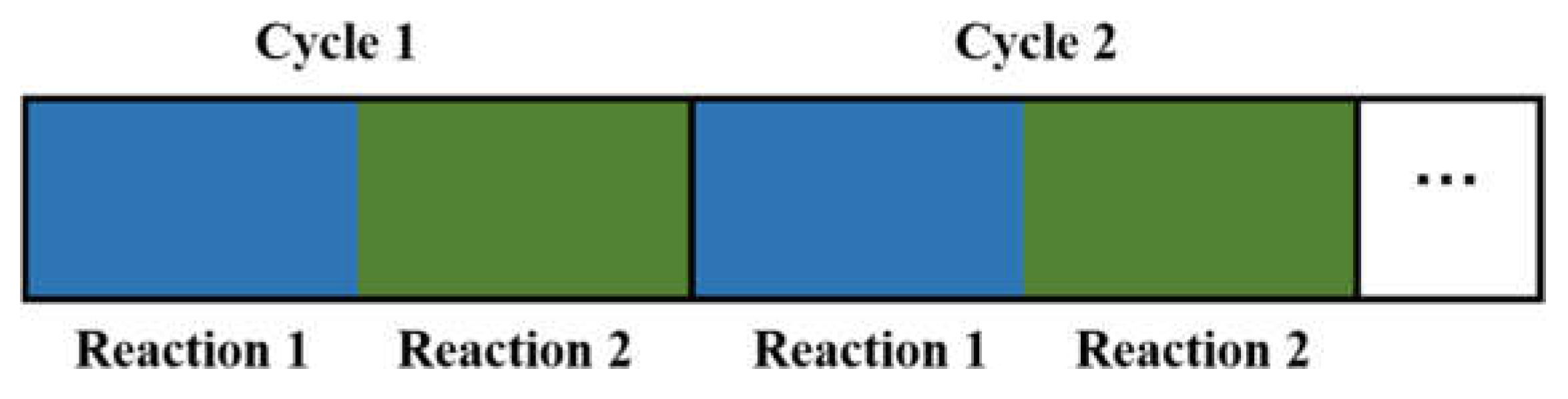
Figure 2.
The Reaction amount of a self-limiting reaction can reach saturation.
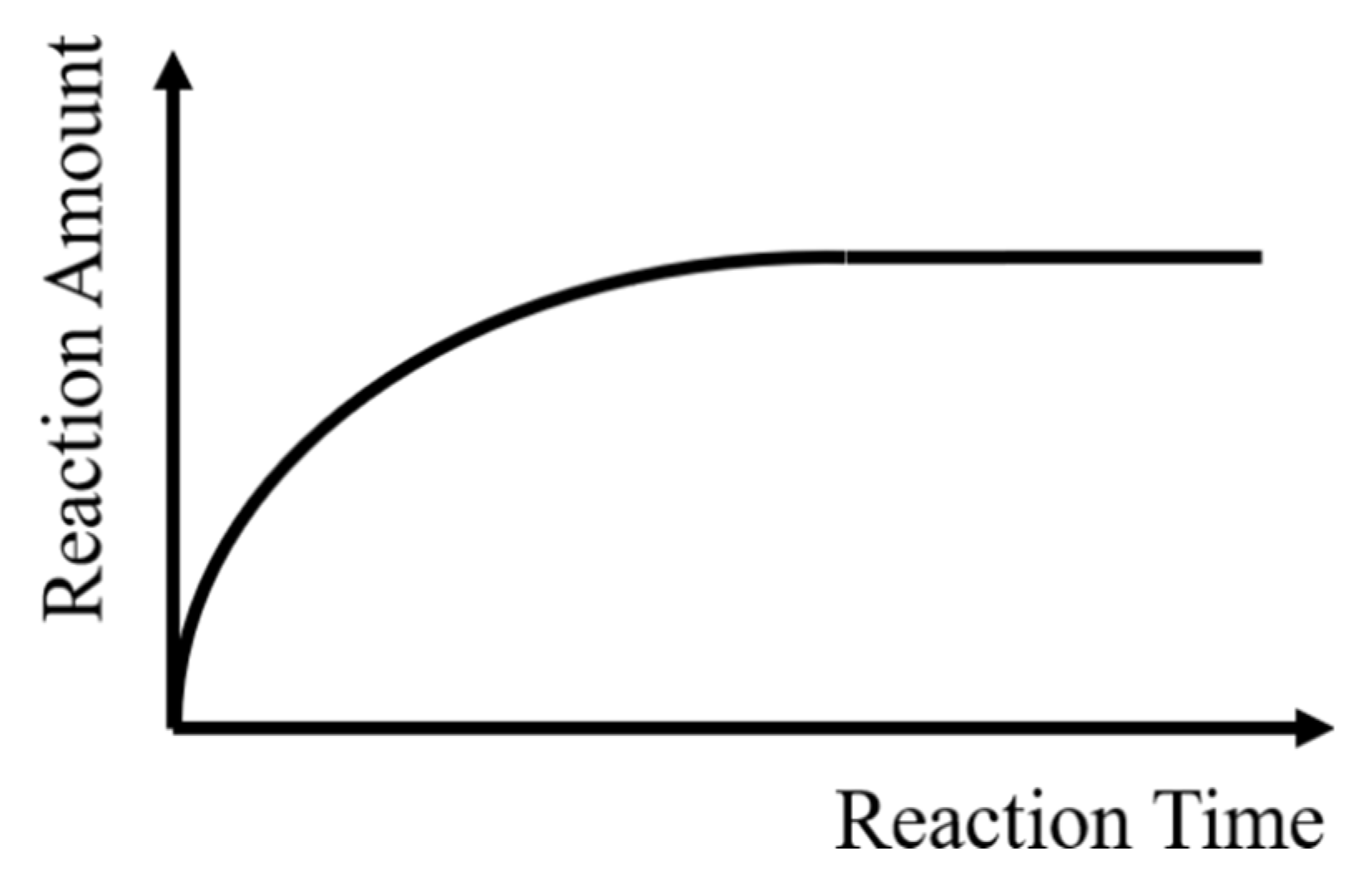
Figure 3.
The comparison of reaction amount versus time between RIE and ALE.
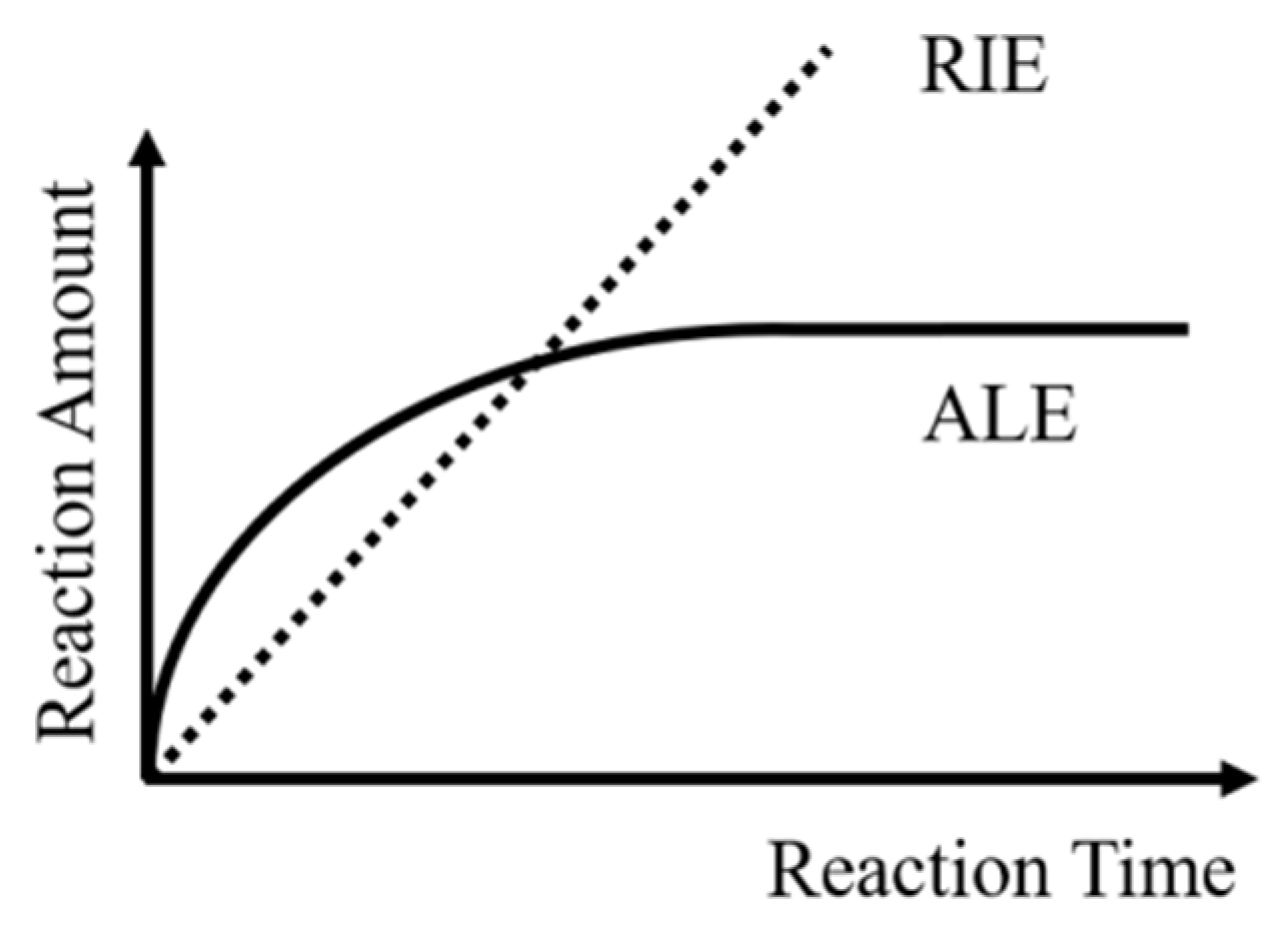
Figure 4.
The comparison between ideal and nonideal IALE.
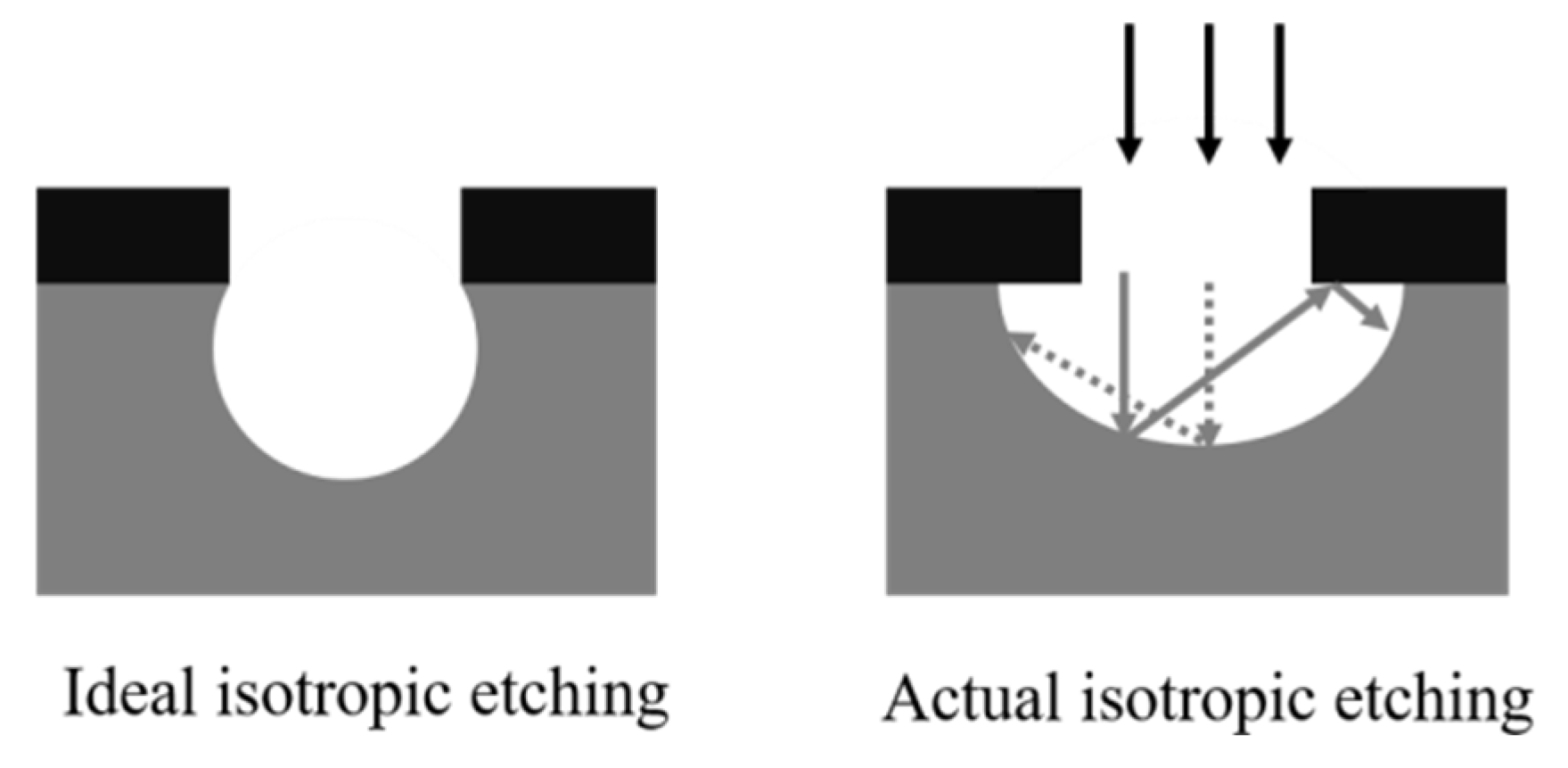
Figure 5.
The temperature windows for different reaction system.
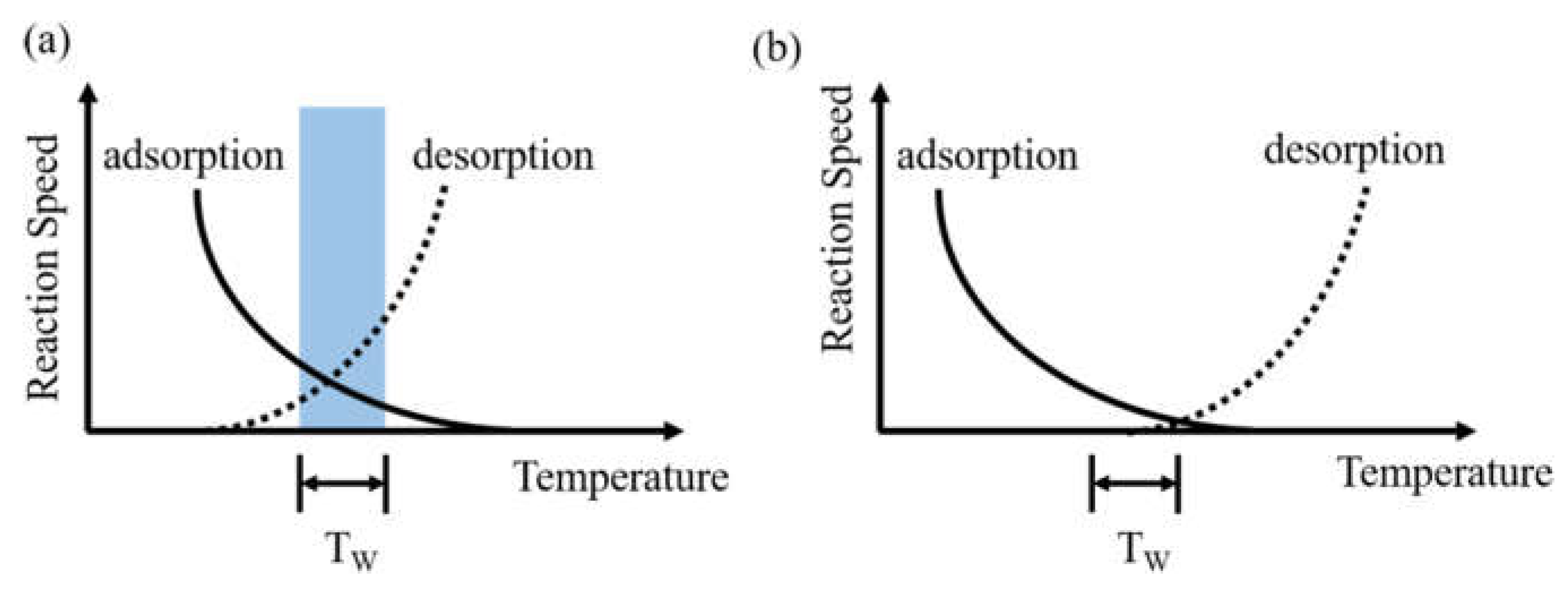
Figure 6.
The time diagram of entire ALE process.

Figure 7.
The comparison between sub-saturation and saturation.
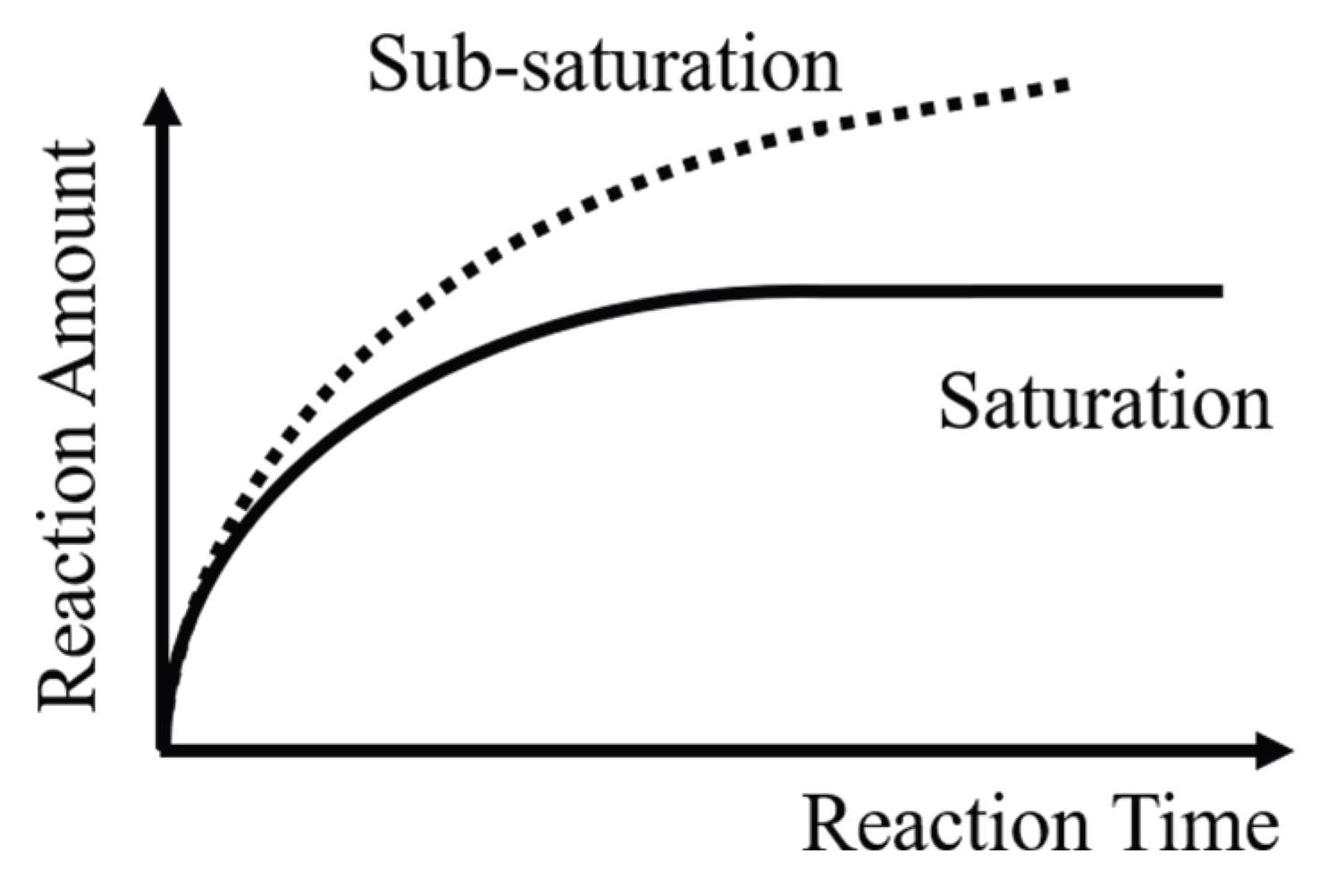

Table 1.
The comparison between RIE and ALE[6].
Table 1.
The comparison between RIE and ALE[6].
| Question | RIE | ALE |
|---|---|---|
| Speed | Fast | Slow |
| Isotropic/anisotropic? | Anisotropic | Both |
| Are chemistry and ion bombardment separated? | No | Yes |
| Is it easy to control desirable species fluxes? | Partially | Yes |
| Is it easy to control surface morphology (Reduce roughness and thick mixed layer)? |
No | Yes |
| Does it depend on the delivery of species (neutrals or ions)? |
Yes | No |
| Can it maintain stoichiometry during directional etching? |
No | Yes |
Table 2.
The process of ALE of different materials.
| Etching | Isotropic | Process Sequence | Best | ref |
|---|---|---|---|---|
| Material | Or | Etching | ||
| Anisotropic | Rate/(Å/c | |||
| ycle) | ||||
| Si | Anisotropic | Chlorination (Cl2) → Ar+ bombardment | 1.36/7 | [1,9] |
| Isotropic | Oxidation(O2) → Fluorination (HF) → Ligand-exchange (TMA) | 0.4 | [10] | |
| Ge | Anisotropic | Chlorination (Cl2) → Ar+ bombardment | 8 | [11] |
| Al2O3 | Isotropic | Fluorination (HF) → Ligand-exchange (TMA) |
0.75 | [8] |
| HfO2 | Isotropic | Ligand-exchange (Sn(acac)2) → Fluorination (HF) | 0.124 | [12] |
| Si3N4 | Isotropic | Oxidation (O2/O3) → Fluorination (HF) → Ligand-exchange (TMA) | 0.47 | [13] |
| GaN | Isotropic | Fluorination (XeF2) → Ligand-exchange (BCl3) | 0.72 | [14] |
| Anisotropic | Chlorination (Cl2) → Ar+ bombardment | 4 | [7,15] | |
| WO3 | Isotropic | Chlorination (BCl3) → Fluorination (HF) | 4.19 | [16] |
| W | Isotropic | Oxidation (O3) → Chlorination (BCl3) → Fluorination (HF) | 2.5 | [16] |
| AlGaN | Anisotropic | Chlorination (BCl3) → Ar+ bombardment | 7 | [7] |
| Cr | Anisotropic | Cl/O radical adsorption → Ar+ bombardment |
1.6 | [17] |
Table 3.
The bond energies between Si, Cl and F.
| Bond | Bong Energy/(kJ/mol) |
|---|---|
| Si-O | 452 |
| Si-Cl | 381 |
| Si-F | 565 |
Table 4.
The explanation of symbols.
| Reactant (R) | Reaction Intermediate (I) |
Product (P) | |
|---|---|---|---|
| Adsorption rate (A) | RA | IA | PA |
| Desorption rate (D) | RD | ID | PD |
Disclaimer/Publisher’s Note: The statements, opinions and data contained in all publications are solely those of the individual author(s) and contributor(s) and not of MDPI and/or the editor(s). MDPI and/or the editor(s) disclaim responsibility for any injury to people or property resulting from any ideas, methods, instructions or products referred to in the content. |
© 2026 by the authors. Licensee MDPI, Basel, Switzerland. This article is an open access article distributed under the terms and conditions of the Creative Commons Attribution (CC BY) license (http://creativecommons.org/licenses/by/4.0/).
Copyright: This open access article is published under a Creative Commons CC BY 4.0 license, which permit the free download, distribution, and reuse, provided that the author and preprint are cited in any reuse.