
Submitted:
13 April 2026
Posted:
14 April 2026
You are already at the latest version
Abstract
Reliable and rapid assessment of meat freshness is essential for food safety and waste reduction throughout the supply chain. This study evaluates a handheld volatile‑sensing device based on a piezoelectrically driven microcantilever functionalized with a biogenic‑amine–selective binder for monitoring spoilage progression in pork cutlets and lamb fillet during refrigerated storage. Pork and lamb samples were assessed from days 1-6 using four complementary indicators: (i) handheld sensor output, (ii) total viable counts (TVC), (iii) sensory evaluation, and (iv) cadaverine concentration. In pork, TVC increased from early-stage levels to approximately 106 CFU/g by day 4 (the safety threshold), accompanied by a marked rise in volatile amines. The handheld sensor detected increasing VOC concentrations, with signals correlating strongly with log₁₀(TVC). In contrast, lamb fillet generated extremely low cadaverine levels throughout storage, insufficient to trigger a measurable sensor response despite microbial proliferation. These findings confirm that microcantilever‑based sensing is well suited for pork freshness evaluation but reveals matrix‑dependent limitations for lamb due to low headspace amine release.
Keywords:
e-nose
; food freshness
1. Introduction
Meat spoilage results from microbial metabolism and biochemical degradation that generate a diverse mixture of volatile organic compounds (VOCs) [1,2,3,4]. While classical microbiological and sensory methods remain the standard for determining freshness, they are either destructive, time-consuming, or subjective. VOC-based detection methods—especially microcantilever electronic noses—offer rapid and non-destructive alternatives by targeting spoilage-related compounds such as cadaverine, putrescine, and various aldehydes, ketones, and sulfur volatiles.
Pork is known to produce substantial levels of biogenic amines during refrigerated storage due to decarboxylase-positive spoilage bacteria, including Enterobacteriaceae [5]. These amines accumulate in the headspace and correlate closely with microbial growth and sensory deterioration. Recent work, including studies using handheld microcantilever systems, has shown strong sensor–microbiology correlations in pork packaged under both atmospheric and modified-atmosphere conditions [6,7,8,9,10,11,12].
In contrast, lamb typically releases a different volatile profile, dominated by aldehydes, short-chain fatty acids, and sulfur volatiles, with biogenic amines often remaining at low levels throughout storage [13,14]. This biochemical divergence means that amine-targeting electronic noses may perform well in pork but not in lamb.
The aim of this study is therefore to determine whether a handheld microcantilever VOC sensor can reliably monitor spoilage in pork cutlets and lamb fillet, and to identify matrix-specific factors affecting its performance.
2. Material and Methods
2.1. Pork and Lamb Samples and Storage
Fresh pork cutlets and lamb fillet samples were purchased from a local retailer on the day of packaging and stored at 4 °C for a total of 6 days until analysis. Measurements were performed on the designated sampling days (sensor readings, microbiological analysis, cadaverine quantification, and sensory evaluation). To preserve representative headspace conditions, samples were opened only at the time of measurement.
2.2. Handheld Microcantilever VOC Sensor
The handheld volatile-sensing system uses a piezoelectrically driven microcantilever to detect spoilage VOCs [22], shown in Figure 1. The multilayer cantilever with an AlN piezoelectric layer enables actuation and real-time resonance monitoring [23]. A microfabricated region hosts a binder with a cyclam-derived transition-metal complex that interacts with biogenic amines (Figure 1a). When exposed to pork or lamb headspace, VOCs adsorb onto the binder, increasing the cantilever’s mass and lowering its resonant frequency in proportion to the volatile concentration, especially of cadaverine and amines (Figure 1b). The frequency shift is converted to an electrical signal by a micro-impedance analyzer on a printed circuit board, part of a handheld unit with a pumping system, electronics, and an infrared temperature sensor. Temperature compensation is automatic, accounting for humidity and temperature changes.
For each measurement, the device nozzle was placed directly onto the surface of the pork or lamb sample, and headspace air was drawn across the cantilever for 60 s (Figure 1c). Resonance-frequency shifts and surface-temperature data were recorded simultaneously. Three technical replicates were collected for each sample on each sampling day during the 6-day storage period.
2.3. Microbiological Analysis
Total viable counts (TVC) were quantified on all sampling days across the 6-day storage period. Approximately 10 g of meat was aseptically excised and processed as described previously. Results were expressed as CFU/g to track spoilage kinetics in pork and lamb during the shorter storage interval.
2.4. Sensory Analysis
Sensory evaluation was performed by a trained panel in a controlled sensory facility. Samples were opened immediately before evaluation to preserve representative odor profiles. Panelists assessed freshness attributes—odor, surface slime, and discoloration—using a standardized 0–10 scoring scale, where a score of higher than 5 was deemed unacceptable for consumption. Odor was always evaluated first, followed by visual description. Assessors scored independently, and borderline cases were discussed to reach a consensus. This approach allowed characterization of the sensory deterioration pathway for both pork and lamb and provided a qualitative reference for interpreting electronic-nose and biochemical data. For evaluation, only the odor characteristic “decaying” was taken to compare with the chemical, microbial, and e-nose methods.
2.5. Cadaverine Quantification
To quantify cadaverine concentrations, analyses were carried out following the same principles described in previous poultry studies using high-sensitivity chromatographic methods. For each sampling day, 3-5 g of meat was collected and placed in a centrifuge PP tube and extracted with HClO4 for further preparation for analyses. Internal standards were used for accurate quantification. This method allowed direct comparison between VOC-based sensor signals and measured cadaverine levels in pork and lamb.
3. Results
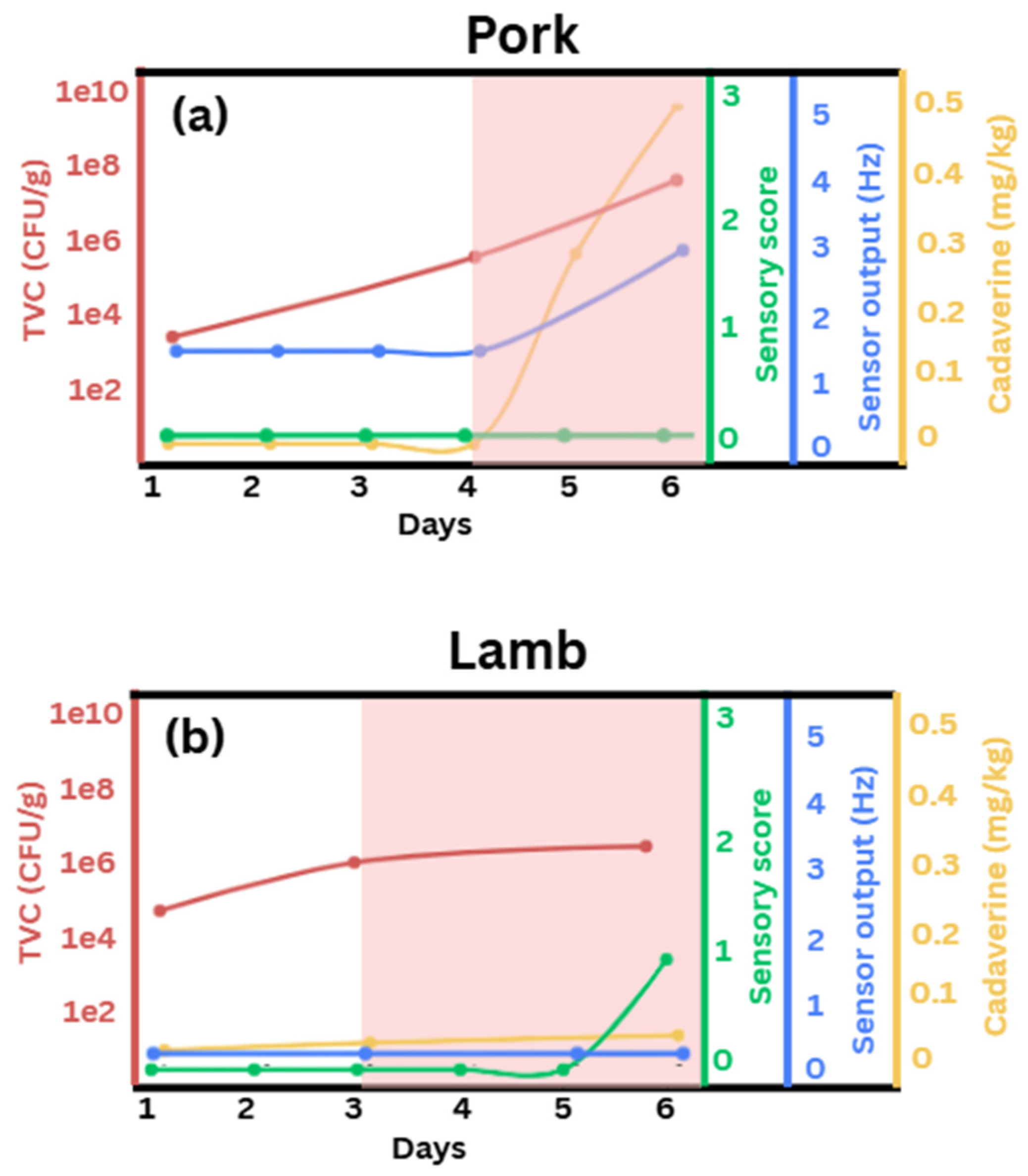
Figure 2 summarizes the evolution of microbiological, chemical, volatile, and sensory indicators in pork and lamb during refrigerated storage. In Figure 2(a), the total viable count (TVC) for pork increases exponentially from day 1 to day 6, crossing the commonly accepted spoilage threshold of ~10⁶ CFU/g at day 4. This microbial proliferation is accompanied by a clear rise in cadaverine content and a corresponding increase in the handheld sensor signal. The sensor output remains close to baseline on days 1 to 4 but begins to rise noticeably by day 4—coinciding with early metabolic activity. Sensory evaluation did not detect any changes in the pork samples, underscoring the need for electronic noses.
The close agreement between TVC, cadaverine concentration, and sensor output suggests that the volatile emissions detected by the microcantilever are tightly linked to microbial metabolism in pork. In contrast, the results for lamb fillet, shown in Figure 2(b), present a markedly different pattern. Although TVC in lamb increases over time, cadaverine concentrations remain very low throughout the entire storage period. As a result, the VOC levels do not reach the handheld sensor’s detection threshold, and no meaningful sensor response is observed. This lack of detectable volatile amines limits the applicability of the microcantilever-based e-nose for lamb freshness assessment and highlights important species-specific differences in spoilage biochemistry.
4. Discussion
The results of this study demonstrate that the handheld microcantilever-based VOC sensor is highly effective for monitoring spoilage progression in pork, but it does not detect spoilage-related volatiles in lamb. In pork, the device successfully captured the early biochemical changes associated with microbial growth, showing a clear increase in sensor output beginning around day 4, coinciding with the rise in both TVC and cadaverine levels. The fact that the sensor response increased before any sensory changes were detected highlights the device’s ability to identify early-stage volatile amine accumulation, offering a practical advantage over traditional sensory assessment.
The strong agreement between TVC, cadaverine concentration, and sensor output in pork indicates that the volatile emissions measured by the microcantilever are directly linked to microbial metabolism. This mirrors previous findings in other amine-producing meat matrices and supports the broader applicability of biogenic-amine-selective microcantilever sensors for real-time freshness assessment in systems where spoilage is dominated by amine-forming bacteria.
In contrast, lamb fillet showed a fundamentally different spoilage profile. Although microbial counts increased during storage, cadaverine concentrations remained extremely low, and the handheld sensor showed no measurable response. This lack of detectable volatile amines highlights the species-specific nature of lamb spoilage, which is driven primarily by volatile compounds outside the biogenic-amine family—such as aldehydes from lipid oxidation, sulfur-containing compounds, and short-chain fatty acids. Because the microcantilever functional layer used here is designed specifically to bind amines, the absence of a sensor response in lamb reflects a biochemical limitation of the sensing strategy rather than a technical failure of the device.
Together, these contrasting patterns underline the importance of considering meat matrix properties, microbial ecology, and dominant volatile pathways when applying VOC-based freshness monitoring technologies. While pork produces sufficient amines to enable reliable detection using a cadaverine-selective sensor, lamb requires different sensing chemistry to capture its primary spoilage volatiles. Future versions of the sensor may benefit from functional layers targeting aldehydes, fatty-acid derivatives, or sulfur compounds to enable spoilage detection across a broader range of meat species.
5. Conclusions
This study demonstrates that a handheld microcantilever-based VOC sensor is a sensitive, rapid, and non-invasive tool for monitoring spoilage progression in pork but does not detect spoilage in lamb. By integrating microbiological, chemical, and sensory measurements, we show that the device accurately reflects the characteristic deterioration pathway of pork. Volatile-amine emissions rise around mid-storage, accompanied by increasing microbial loads, while the handheld sensor captures these biochemical changes even before any sensory alterations are detectable. The strong agreement among sensor output, TVC, and cadaverine concentration underscores the sensor’s suitability for early, objective freshness assessment in pork.
In contrast, lamb fillet released very low concentrations of cadaverine throughout storage, insufficient to trigger a measurable sensor response. This outcome highlights a species-specific limitation of amine-targeting VOC sensors: their performance depends strongly on whether the dominant spoilage pathway produces detectable volatile amines. Lamb spoilage appears to be driven primarily by non-amine volatiles, suggesting that alternative molecular targets—such as aldehydes, sulfur compounds, or short-chain fatty acids—may be required for effective freshness monitoring in this species.
Overall, the findings position handheld microcantilever VOC sensing as a promising approach for improving real-time freshness evaluation and reducing waste in pork products. Future work should expand validation across additional pork cuts and packaging conditions, while also exploring new functional layers capable of detecting the volatile fingerprints characteristic of lamb spoilage. Developing a broader palette of sensor chemistries will be essential for extending microcantilever-based freshness assessment technologies across diverse meat types.
Acknowledgments
This research was funded by the project PRECISE, the European Regional Development Fund Interreg Deutschland-Danmark (Grant number 03-2.3-22 1).
References
- Thamsborg, K.K.M.; Lund, B.W.; Byrne, D.V.; Leisner, J.J.; Alexi, N. Cadaverine as a potential spoilage indicator in skin-packed beef and modified-atmosphere-packed beef. Foods 2023, 12(24), 4489. [Google Scholar] [CrossRef] [PubMed]
- Schirone, M.; Esposito, L.; D’Onofrio, F.; Visciano, P.; Martuscelli, M.; Mastrocola, D.; Paparella, A. Biogenic amines in meat and meat products: A review of the science and future perspectives. Foods 2022, 11(6), 788. [Google Scholar] [CrossRef] [PubMed]
- Miller, K.; Reichert, C.L.; Schmid, M. Biogenic amine detection systems for intelligent packaging concepts: Meat and meat products. Food Reviews International 2023, 39(5), 2543–2567. [Google Scholar] [CrossRef]
- Chmiel, M.; Świder, O.; Padewska, D.; Hać-Szymańczuk, E.; Adamczak, L.; Cegiełka, A.; Florowski, T. Microbial spoilage dynamics, free amino acid profile alterations and biogenic amine accumulation in beef under different packaging systems during extended storage. Applied Sciences 2025, 15(18), 9882. [Google Scholar] [CrossRef]
- Esposito, L.; Mastrocola, D.; Martuscelli, M. Approaching biogenic amines as quality markers in packaged chicken meat. Frontiers in Nutrition 2022, 9, 966790. [Google Scholar] [PubMed]
- Ferrier, P.; Spethmann, Y.; Claussen, B.; Nsubuga, L.; Marcondes, T.L.; Høegh, S.; Heptaskin, T.; Wiechmann, C.; Rubahn, H-G.; de Oliveira Hansen, R. Application of a handheld electronic nose for real-time poultry freshness assessment. Sensing and Bio-Sensing Research 2024, 45, 100685. [Google Scholar] [CrossRef]
- Nsubuga, L.; Duggen, L.; Balzer, F.; Høegh, S.; Marcondes, T.L.; Greenbank, W.; Rubahn, H-G.; de Oliveira Hansen, R. Modeling nonlinear dynamics of functionalization layers: Enhancing gas sensor sensitivity for piezoelectrically driven microcantilever. ACS Sensors 2024, 9(4), 1842–1856. [Google Scholar] [CrossRef] [PubMed]
- Marcondes, T.L.; Nsubuga, L.; Meyer, J.; Eisermann, C.; Blohm, L.; Høegh, S.; Lofink, F.; Rubahn, H-G.; de Oliveira Hansen, R. Surface treatments and functional layer placement: Enhancing repeatability of electronic nose measurements. Surfaces and Interfaces 2025, 56, 105720. [Google Scholar] [CrossRef]
- Nsubuga, L.; Marcondes, T.L.; Høegh, S.; Rubahn, H-G.; de Oliveira Hansen, R. High-sensitivity biogenic amine detection via engineered binder formulation in resonant microcantilever gas sensors: A case study of cadaverine. Biosensors and Bioelectronics: X 2025, 25, 100698. [Google Scholar] [CrossRef]
- Madhubhashini, M.N.; Liyanage, C.P.; Alahakoon, A.U.; Liyanage, R.P. Development of a comprehensive classification model for determining the storage day of frigate tuna for freshness evaluation using a portable electronic nose. International Journal of Food Science and Technology 2024, 59(7), 4672–4679. [Google Scholar] [CrossRef]
- Nsubuga, L.; Duggen, L.; Marcondes, T.L.; Høegh, S.; Lofink, F.; Meyer, J.; Rubahn, H-G.; de Oliveira Hansen, R. Gas adsorption response of piezoelectrically driven microcantilever beam gas sensors: Analytical, numerical and experimental characterizations. Sensors 2023, 23(3), 1093. [Google Scholar] [CrossRef] [PubMed]
- Mamou, D.; Nsubuga, L.; Marcondes, T.L.; Høegh, S.O.; Hvam, J.; Niekiel, F.; Lofink, F.; Rubahn, H-G.; de Oliveira Hansen, R. Surface modification enabling reproducible cantilever functionalization for industrial gas sensors. Sensors 2021, 21(18), 6041. [Google Scholar] [CrossRef] [PubMed]
- Klupsaite, D.; Buckiuniene, V.; Bliznikas, S.; Sidlauskiene, S.; Dauksiene, A.; Klementaviciute, J.; Jurkevicius, A.; Zaborskiene, G.; Bartkiene, E. Impact of Romanov breed lamb gender on carcass traits and meat quality parameters including biogenic amines and malondialdehyde changes during storage. Food Science & Nutrition 2022, 10(6), 1745–1755. [Google Scholar] [CrossRef] [PubMed]
- Triki, M.; Herrero, A.M.; Jiménez-Colmenero, F.; Ruiz-Capillas, C. Quality assessment of fresh meat from several species based on free amino acid and biogenic amine contents during chilled storage. Foods 2018, 7(9), 132. [Google Scholar] [CrossRef] [PubMed]
Figure 1.
Architecture of the handheld microcantilever-based VOC sensing system. (a) Schematic representation of the piezoelectrically driven microcantilever and the functional binder. (b) Upon exposure of the microcantilever to meat VOCs, mass is added to the cantilever, causing a shift in its resonance frequency. (c) Exterior view of the handheld device.
Figure 1.
Architecture of the handheld microcantilever-based VOC sensing system. (a) Schematic representation of the piezoelectrically driven microcantilever and the functional binder. (b) Upon exposure of the microcantilever to meat VOCs, mass is added to the cantilever, causing a shift in its resonance frequency. (c) Exterior view of the handheld device.
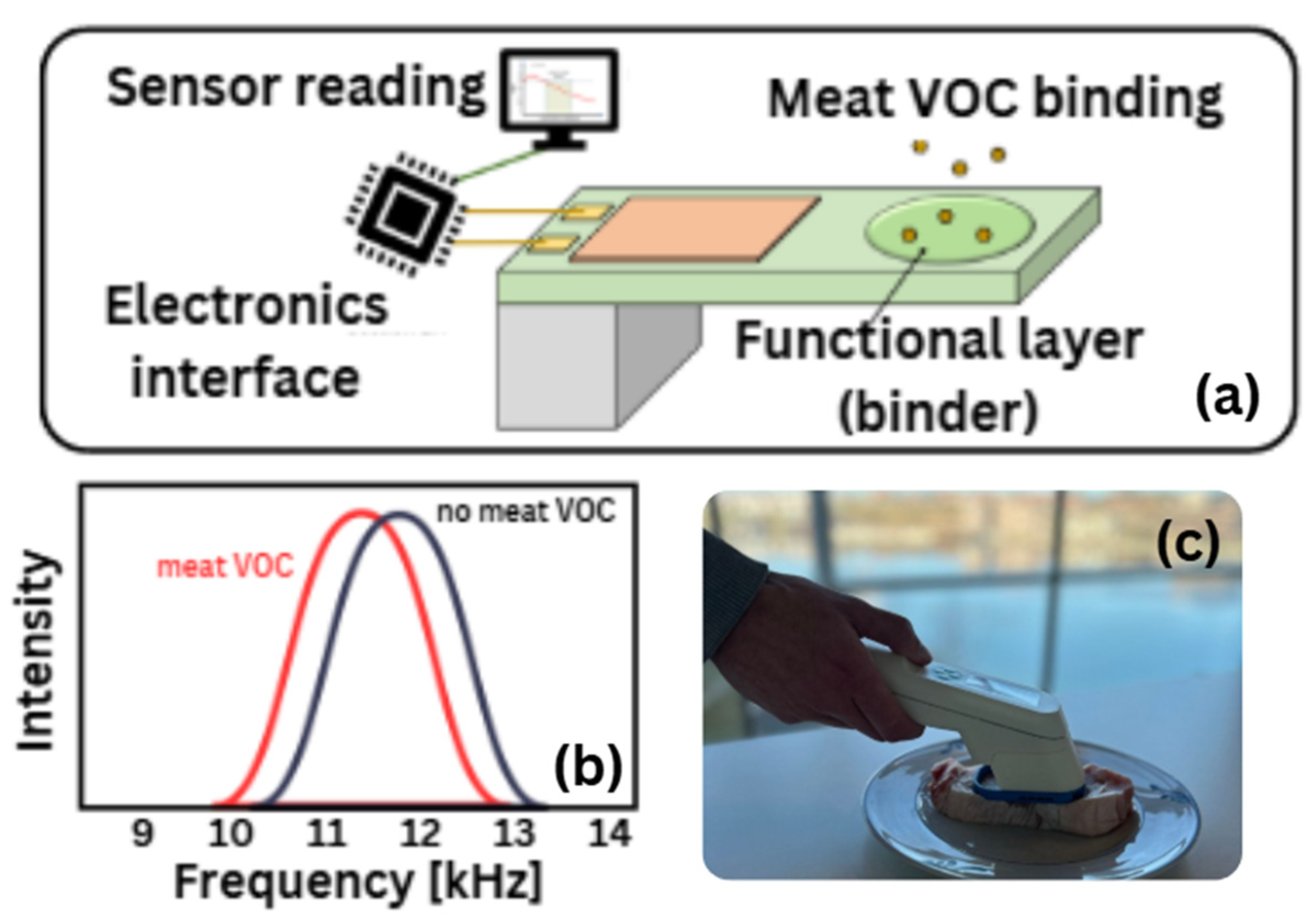
Figure 2.
(a) Total viable counts (TVC, red curve), handheld sensor output (blue curve), cadaverine level (yellow curve), and sensory score (green curve) for pork plotted as a function of storage time (days 1–6). (b) Measurements for lamb, showing low cadaverine counts, which do not trigger a sensor response.
Figure 2.
(a) Total viable counts (TVC, red curve), handheld sensor output (blue curve), cadaverine level (yellow curve), and sensory score (green curve) for pork plotted as a function of storage time (days 1–6). (b) Measurements for lamb, showing low cadaverine counts, which do not trigger a sensor response.
Disclaimer/Publisher’s Note: The statements, opinions and data contained in all publications are solely those of the individual author(s) and contributor(s) and not of MDPI and/or the editor(s). MDPI and/or the editor(s) disclaim responsibility for any injury to people or property resulting from any ideas, methods, instructions or products referred to in the content. |
© 2026 by the authors. Licensee MDPI, Basel, Switzerland. This article is an open access article distributed under the terms and conditions of the Creative Commons Attribution (CC BY) license (http://creativecommons.org/licenses/by/4.0/).
Copyright: This open access article is published under a Creative Commons CC BY 4.0 license, which permit the free download, distribution, and reuse, provided that the author and preprint are cited in any reuse.


