

Submitted:
10 April 2026
Posted:
14 April 2026
You are already at the latest version
Abstract
The increasing penetration of renewable generation and electrified loads introduces non-Gaussian and strongly nonlinear uncertainty in power system operation. Probabilistic power flow (PPF) methods based on Monte Carlo simulation provide accurate uncertainty propagation but remain computationally demanding, while many analytical and approximation-based approaches rely on restrictive distributional assumptions. This letter proposes a Distribution-Matching Likelihood-Free Importance Sampling (DM-LFIS) framework for PPF. The method avoids explicit likelihood construction and posterior sampling, and instead propagates uncertainty by reweighting candidate operating states according to a discrepancy between simulated and observed power injection distributions. Data-driven and physics-informed proposals guided by DC and Newton--Raphson power flow solutions are used to improve sampling efficiency. Numerical results on standard IEEE test systems show that DM-LFIS accurately captures voltage and angle uncertainty with reduced computational cost compared to conventional Monte Carlo-based PPF methods.
Keywords:
probabilistic power flow
; likelihood-free inference
; importance sampling
; renewable energy integration
1. Introduction
The increasing penetration of renewable generation and electrified loads is making power system uncertainty more non-Gaussian and harder to propagate through nonlinear power flow equations. Probabilistic power flow (PPF) is therefore key to quantify operational risk and characterize the variability of voltage magnitudes and phase angles. Conventional Monte Carlo simulation (MCS) remains the reference due to its accuracy, but its computational burden often prevents large-scale or online use [1]. Most PPF techniques can be grouped into simulation-based, analytical, and approximation-based methods [2]. Simulation variants improve efficiency but may still require many power-flow evaluations [3], whereas analytical and approximation approaches reduce cost at the price of linearization or sensitivity to the dimension and shape of the uncertainty space [4,5]. Surrogate, data-driven or likelihood-free models further speed up computations, yet their performance can depend on modeling assumptions or data coverage, which may weaken tail reliability under rare operating conditions [1,5,6,7]. To address these limitations, this letter proposes a Distribution-Matching Likelihood-Free Importance Sampling (DM-LFIS) framework for PPF. Instead of threshold-based accept/reject rules or explicit posterior construction, DM-LFIS assigns importance weights by matching the distributions of simulated and observed power injections, and it uses data-driven and physics-informed proposals (DC and Newton–Raphson guided) to sample efficiently. Notably, DM-LFIS avoids repeated deterministic power flow solutions, which reduces computational burden in large-scale systems. The resulting weighted-resampled ensemble provides accurate voltage and angle marginals with reduced computational effort, while avoiding sensitivity to tolerance tuning under non-Gaussian uncertainty.
2. Distribution-Matching Likelihood-Free Importance Sampling
2.1. Problem Formulation
Let collect bus voltage angles and magnitudes, and let denote uncertain active/reactive injections. The power flow equations are [8]
PPF aims to characterize the uncertainty of induced by uncertainty in .
2.2. Relation to ABC-Based PPF
Likelihood-free PPF methods such as JABC [5] approximate an -posterior by accepting simulated reactive and active powers injections close to observations :
where is computed by using in Eq. (1); and is the discrepancy metric. A smooth alternative replaces the hard indicator () by a kernel [9],
but the resulting distribution remains approximate and depends on discrepancy and bandwidth choices. DM-LFIS avoids accept/reject decisions and instead performs likelihood-free importance sampling driven by distribution matching.
2.3. DM-LFIS: Discrepancy, Weights, and Proposals
Given a candidate state , we simulate injections and compute a distribution-level discrepancy using Parzen-smoothed kernel distances [9],
Importance weights are assigned as
with set to the median of unnormalized discrepancies to obtain a robust, data-adaptive scaling and to mitigate weight degeneracy. To improve efficiency, is defined as a mixture of physics-informed and exploratory proposals, that is,
where and are physics-informed proposals derived from DC and Newton–Raphson power flow solutions, respectively, and is a random-walk component. The coefficients and are mixture weights allocating sampling effort across proposal mechanisms.
2.4. Residual Resampling
From the weighted empirical measure , we obtain an equally weighted ensemble via residual resampling [10]. Each particle gets deterministic copies, and the remaining samples are drawn from residual probabilities
This step reduces Monte Carlo variance relative to multinomial resampling and concentrates samples on distribution-consistent solutions without threshold tuning. The DM-LFIS algorithm can be summarized as follows,
| Algorithm 1: DM-LFIS |
|
1 Sample in (6).
2 Simulate .
4 Residual-resample [10] to obtain .
|
3. Numerical Results and Discussion
The proposed DM-LFIS method is benchmarked against MCS, JABC, and standard ABC using the IEEE 6, 39, and 118-bus test systems under renewable-driven uncertainty. In the 6-bus system, a solar and a wind farm are integrated at nodes 5 and 6, respectively. For the 39-bus system, a solar farm is connected at node 13 and a wind farm at node 2. In the 118-bus system, both solar and wind generation are considered at nodes 3 and 4. Wind speed and solar irradiance are modeled using Weibull and Beta distributions, respectively, with parameters adopted from [5]. All simulations were conducted using a sample size of 1000, consistent with the experimental setup in [5]. For ABC, we have set in all experiments so that an acceptance rate of around was obtained. For JABC, we have used all the parameters set out in [5]. For DM-LFIS, and were used in the physics-informed proposal. MCS was implemented using MATPOWER.1
3.1. Distributional Accuracy of State Variables
In the absence of an analytical ground truth, distributional accuracy is assessed by comparing the marginal distributions of voltage magnitudes and phase angles against MCS results. Figure 1 contrasts the distributions obtained with MCS, ABC, JABC, and the proposed DM-LFIS for the IEEE 6, 39, and 118-bus systems. As shown, standard ABC exhibits pronounced deviations from MCS under non-Gaussian and multimodal uncertainty, while JABC improves agreement but retains noticeable tail bias.
In contrast, DM-LFIS accurately reproduces the voltage and angle marginal distributions obtained by MCS while avoiding explicit deterministic power flow computations. By obviating threshold-based accept/reject mechanisms, the proposed framework eliminates sensitivity to tolerance parameters and demonstrates improved robustness under non-Gaussian uncertainty, particularly in large-scale systems where standard ABC methods tend to discard physically plausible samples.
3.2. Residual Error Analysis
Since an analytical ground-truth solution was unavailable, the accuracy of ABC-based methods and proposed method was assessed by comparing the mean and standard deviation of voltage magnitudes and phase angles against those obtained from MCS, which were used as reference values.2 Table 1 reports the relative errors (RE) of the mean and standard deviation of voltage magnitudes and phase angles obtained using ABC, JABC, and the proposed DM-LFIS framework, with MCS used as reference. Several relevant observations can be drawn when these numerical indicators are jointly interpreted with the distributional results shown in Figure 1.
From Table 1, standard ABC exhibits large RE for angle statistics across all test systems, consistent with the pronounced mismatch observed in the corresponding probability density functions. This behavior confirms the sensitivity of threshold-based ABC to non-Gaussian and multimodal uncertainty, which leads to premature rejection of physically plausible samples. JABC significantly improves mean estimation for both voltages and angles; however, noticeable errors in standard deviation remain for larger systems, particularly for angle variables. While JABC improves mean estimation, Figure 1 shows that noticeable discrepancies remain in the distribution tails. DM-LFIS consistently achieves the lowest mean RE, especially for angles, while maintaining competitive accuracy for voltage magnitudes. Although its standard deviation errors are not always minimal, DM-LFIS provides closer alignment with MCS across the full distribution support. Overall, DM-LFIS offers a robust compromise between accuracy and stability by emphasizing distribution-level matching through likelihood-free importance weighting, avoiding hard rejection and improving robustness under non-Gaussian uncertainty.
3.3. Computational Efficiency
Finally, Table 2 compares the average computation times required by MCS, ABC, JABC, and the proposed DM-LFIS method for the three standard grids.3
Table 2 shows that MCS incurs the highest computational cost due to the large number of power flow solutions required, while ABC also exhibits relatively high runtimes as a consequence of low acceptance rates. JABC achieves the lowest execution times by leveraging Jacobian-based corrections; however, this efficiency is accompanied by residual distributional bias, particularly in the tails for larger systems. The proposed DM-LFIS method consistently outperforms MCS and ABC in terms of computation time, while remaining slightly more expensive than JABC due to the evaluation of distributional discrepancies and resampling. Overall, DM-LFIS offers a favorable trade-off between computational efficiency and distributional accuracy under non-Gaussian uncertainty.
4. Conclusion
This letter presented a Distribution-Matching Likelihood-Free Importance Sampling framework for probabilistic power flow. By avoiding explicit likelihood construction and posterior sampling, the proposed method provides a flexible and computationally efficient approach for uncertainty propagation in power systems with complex, non-Gaussian uncertainties. Future work will explore adaptive proposal strategies and online implementations for real-time operational assessment.
References
- Xu, Y.; Hu, Z.; Mili, L.; Korkali, M.; Chen, X. Probabilistic power flow based on a gaussian process emulator. IEEE Transactions on Power Systems 2020, vol. 35(no. 4), 3278–3281. [Google Scholar] [CrossRef]
- Zhou, G.; Bo, R.; Chien, L.; Zhang, X.; Yang, S.; Su, D. Gpu-accelerated algorithm for online probabilistic power flow. IEEE Transactions on Power Systems 2018, vol. 33(no. 1), 1132–1135. [Google Scholar] [CrossRef]
- Yang, M.; Qiu, G.; Liu, T.; Liu, J.; Liu, K.; Li, Y. Probabilistic power flow based on physics-guided graph neural networks. Electric Power Systems Research 2024, vol. 235, 110864. Available online: https://www.sciencedirect.com/science/article/pii/S0378779624007508. [CrossRef]
- Amid, P.; Crawford, C. A cumulant-tensor-based probabilistic load flow method. IEEE Transactions on Power Systems 2018, vol. 33(no. 5), 5648–5656. [Google Scholar] [CrossRef]
- Zuluaga, C. D.; Álvarez, M. A. Bayesian probabilistic power flow analysis using jacobian approximate bayesian computation. IEEE Transactions on Power Systems 2018, vol. 33(no. 5), 5217–5225. [Google Scholar] [CrossRef]
- Wang, G.; Xin, H.; Wu, D.; Ju, P.; Jiang, X. Data-driven arbitrary polynomial chaos-based probabilistic load flow considering correlated uncertainties. IEEE Transactions on Power Systems 2019, vol. 34(no. 4), 3274–3276. [Google Scholar] [CrossRef]
- Gao, Y.; Xu, X.; Yan, Z.; Wang, H.; Ping, J.; Yang, B.; Guan, X. Analytical probabilistic power flow and global sensitivity analysis of distribution systems based on gaussian mixture model of input-output variables. IEEE Transactions on Power Systems 2024, vol. 39(no. 3), 5283–5296. [Google Scholar] [CrossRef]
- Su, C.-L. Probabilistic load-flow computation using point estimate method. IEEE Transactions on Power Systems 2005, vol. 20(no. 4), 1843–1851. [Google Scholar] [CrossRef]
- Zuluaga, C. D.; Valencia, E. A.; Álvarez, M. A.; Orozco, Á. A. A parzen-based distance between probability measures as an alternative of summary statistics in approximate bayesian computation. In Image Analysis and Processing — ICIAP 2015; Murino, V., Puppo, E., Eds.; Springer International Publishing: Cham, 2015; pp. 50–61. [Google Scholar]
- Doucet, A.; de Freitas, N.; Gordon, N. Sequential Monte Carlo Methods in Practice.; Springer: New York, 2001. [Google Scholar]
| 1 | It is available at http://www.pserc.cornell.edu/matpower/
|
| 2 | Relative errors were computed with respect to the MCS reference using the metrics and [8], where and denote the relative error of the mean and standard deviation, respectively. Here, and were obtained from MCS, while and correspond to the estimates computed by ABC methods and proposed method. |
| 3 | All simulations were conducted on an Intel Core i7 PC with a GHz processor. |
Figure 1.
Probability distributions of selected state variables for the IEEE 6, 39 and 118-bus test systems. The solid red line corresponds to MCS, while the dotted black, blue, and light-blue lines represent the distributions obtained using ABC, JABC, and DM-LFIS, respectively. Left: shows the distribution of for the 6-bus system. Middle: shows the distribution of for the 39-bus system. Right: shows the distribution of for the 118-bus system.
Figure 1.
Probability distributions of selected state variables for the IEEE 6, 39 and 118-bus test systems. The solid red line corresponds to MCS, while the dotted black, blue, and light-blue lines represent the distributions obtained using ABC, JABC, and DM-LFIS, respectively. Left: shows the distribution of for the 6-bus system. Middle: shows the distribution of for the 39-bus system. Right: shows the distribution of for the 118-bus system.
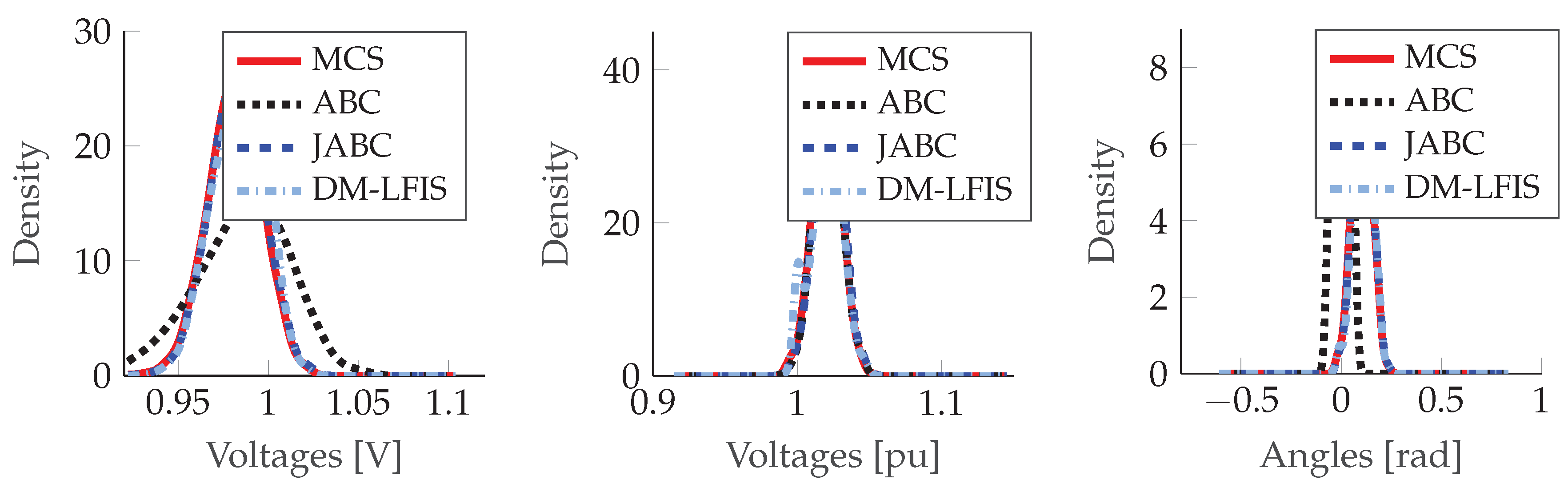

Table 1.
Relative error for voltages and angles using the IEEE 6, 39 and 118-bus test systems
| Method | IEEE 6 | IEEE 39 | IEEE 118 | ||||
|---|---|---|---|---|---|---|---|
| ABC | |||||||
| JABC | 0.0714 | 0.1103 | 0.0236 | ||||
| 0.0348 | 0.1184 | 0.7064 | 0.4557 | 0.0719 | 3.3562 | ||
| DM-LFIS | 0.3022 | 2.6504 | 3.7770 | ||||
Table 2.
Computation time obtained by MCS, JABC, ABC and DM-LFIS, in the solution of the PPF problem using the IEEE 6-bus, 39-bus and 118-bus test system.
Table 2.
Computation time obtained by MCS, JABC, ABC and DM-LFIS, in the solution of the PPF problem using the IEEE 6-bus, 39-bus and 118-bus test system.
| Computation time [s] | MCS | JABC | ABC | DM-LFIS |
|---|---|---|---|---|
| IEEE-6 | 5.2431 | 0.4572 | 17.271 | 4.0863 |
| IEEE-39 | 7.0106 | 1.2812 | 16.671 | 5.4375 |
| IEEE-118 | 9.1253 | 2.5895 | 20.752 | 8.5739 |
Disclaimer/Publisher’s Note: The statements, opinions and data contained in all publications are solely those of the individual author(s) and contributor(s) and not of MDPI and/or the editor(s). MDPI and/or the editor(s) disclaim responsibility for any injury to people or property resulting from any ideas, methods, instructions or products referred to in the content. |
© 2026 by the authors. Licensee MDPI, Basel, Switzerland. This article is an open access article distributed under the terms and conditions of the Creative Commons Attribution (CC BY) license (http://creativecommons.org/licenses/by/4.0/).
Copyright: This open access article is published under a Creative Commons CC BY 4.0 license, which permit the free download, distribution, and reuse, provided that the author and preprint are cited in any reuse.


