

Submitted:
29 March 2026
Posted:
13 April 2026
You are already at the latest version
Abstract
Education for Sustainable Development (ESD) has emerged as a key priority in contemporary education systems, emphasizing the need to equip learners with the knowledge and competencies required to address complex environmental and societal challenges. Mathematics education can play an important role in achieving these goals by enabling students to analyse data, interpret real-world problems, and develop critical thinking skills related to sustainability issues. This study investigates the impact of sustainability-oriented mathematical modelling activities on pre-service primary teachers’ perceptions of integrating sustainability into mathematics education. The study employed a quasi-experimental design involving 68 pre-service primary teachers enrolled in a mathematics education course at a university. Participants engaged in a six-week intervention consisting of modelling activities based on real-world sustainability contexts, including water consumption, energy use, waste management, and sustainable transportation. Data were collected using a pre- and post-intervention questionnaire examining participants’ perceptions of sustainability integration, mathematical modelling, and teaching confidence. Statistical analyses, including reliability analysis, descriptive statistics, paired-sample t-tests, and correlation analysis, were conducted to examine the impact of the intervention. The results indicate significant improvements in participants’ perceptions of sustainability-oriented mathematics teaching and their confidence in designing modelling-based sustainability activities. The findings suggest that mathematical modelling can serve as an effective pedagogical approach for integrating sustainability topics into mathematics education and preparing future teachers to connect mathematical reasoning with real-world environmental challenges. The study contributes to the growing body of research at the intersection of mathematics education, teacher education, and sustainability education by providing empirical evidence on the potential of modelling-based learning for supporting sustainability-oriented teaching practices.
Keywords:
Education for Sustainable Development (ESD)
; mathematical modelling
; sustainability in mathematics education
; pre-service teachers
; teacher education
1. Introduction
Education for Sustainable Development (ESD) has become a central priority in contemporary education, particularly in response to the global challenges outlined in the United Nations 2030 Agenda for Sustainable Development (United Nations, 2015). International frameworks have increasingly emphasized that education should help learners develop the knowledge, values, and competences needed to address environmental, social, and economic challenges in informed and responsible ways (UNESCO, 2017, 2020; Wiek et al., 2011). Within this broader agenda, teacher education plays a particularly important role, since future teachers are expected not only to understand sustainability conceptually but also to translate it into meaningful classroom practice (Dahl, 2019; García-González et al., 2020; Álvarez-Vanegas et al., 2024).
In recent years, growing attention has been given to the place of mathematics education within sustainability-oriented learning. Although sustainability has often been associated more strongly with science or environmental education, current scholarship argues that mathematics education also has a significant role to play in helping learners interpret data, examine patterns, compare alternatives, and make informed judgments about real-world problems (Alsina, 2022; Li, 2025; Makramalla et al., 2025). This perspective is especially relevant in the context of climate change, resource consumption, and socio-ecological decision making, where mathematical reasoning is essential for understanding complex systems and evaluating evidence (Li, 2025). Recent reviews further suggest that sustainability-related work in mathematics education is expanding, but that more empirical and action-oriented studies are still needed (Vásquez et al., 2023; Makramalla et al., 2025).
One promising way to connect mathematics education with sustainability is through mathematical modelling. Modelling has long been understood as a process through which real-world situations are translated into mathematical representations that can be analyzed and interpreted (Borromeo Ferri, 2006; Blum & Borromeo Ferri, 2009; Niss & Blum, 2020). Because modelling engages learners with authentic contexts, assumptions, data, and interpretation, it offers a strong pedagogical bridge between mathematics and sustainability-oriented problem solving. More recent research has also shown that modelling supports interdisciplinary and authentic STEM learning by helping students recognize the role of mathematics in addressing practical problems (Hallström & Schönborn, 2019; Cevikbas et al., 2022; Seebut et al., 2023; Tytler et al., 2023).
At the same time, integrating sustainability into mathematics education is not simply a matter of adding new themes to the curriculum. It also requires teachers to develop the confidence, pedagogical understanding, and professional agency needed to design lessons that meaningfully connect mathematical concepts with sustainability issues (Alsina & Vásquez, 2024). This challenge is particularly important in teacher education. Research has increasingly argued that mathematics teacher education should be reoriented toward sustainable futures and should create opportunities for future teachers to engage with sustainability through innovative and context-based approaches (Helliwell & Ng, 2022; Moreno-Pino et al., 2022; Alsina & Silva-Hormazábal, 2023). Studies have also shown that pre-service teachers often value sustainability in principle, but may feel insufficiently prepared to incorporate it into their actual teaching practice (Dahl, 2019; García-González et al., 2020; Robles Moral, 2021).
Within this context, mathematical modelling appears to be a particularly relevant pedagogical pathway. Recent work has begun to explore how modelling activities can support Education for Sustainable Development in mathematics teacher education, especially by helping pre-service teachers engage with authentic problems and develop more integrated pedagogical perspectives (Borromeo Ferri & Wiegand, 2023; Wiegand & Borromeo Ferri, 2023, 2024). However, despite these important developments, there is still limited empirical research examining how sustainability-oriented modelling interventions influence pre-service primary teachers’ perceptions of sustainability integration in mathematics education, their understanding of modelling, and their confidence in designing sustainability-based mathematics lessons. This gap is important because primary education is a foundational context in which teachers can shape how students perceive mathematics—not only as a school subject, but also as a way of understanding the world.
The present study addresses this gap by examining the effects of a sustainability-oriented mathematical modelling intervention implemented with pre-service primary teachers. Its originality lies in bringing together three domains that are often discussed separately: Education for Sustainable Development, mathematical modelling, and pre-service primary teacher education. While previous research has highlighted the theoretical importance of connecting mathematics education with sustainability (Alsina, 2022; Li, 2025; Makramalla et al., 2025), and other studies have explored modelling in relation to ESD more broadly (Wiegand & Borromeo Ferri, 2023, 2024), fewer studies have provided empirical evidence from an intervention specifically focused on pre-service primary teachers and their instructional readiness.
Accordingly, the purpose of this study was to investigate the impact of sustainability-oriented mathematical modelling activities on pre-service primary teachers’ perceptions of integrating sustainability into mathematics education, their understanding of modelling as a pedagogical approach, and their teaching confidence.
The study was guided by the following research questions:
- How do sustainability-oriented mathematical modelling activities influence pre-service primary teachers’ perceptions of the integration of sustainability in mathematics education?
- To what extent do modelling activities related to sustainability enhance pre-service teachers’ confidence in designing mathematics lessons connected to sustainability issues?
- What relationships exist between sustainability integration, perceptions of mathematical modelling, and teaching confidence?
- How do pre-service teachers perceive the role of mathematical modelling in addressing real-world sustainability challenges within primary mathematics education?
Based on the theoretical framework and the research objectives of the study, a conceptual model was developed to illustrate the relationships among the key constructs examined in this research (Figure 1).
As shown in Figure 1, sustainability integration is hypothesized to influence both mathematical modelling and teaching confidence. In addition, mathematical modelling is expected to play a central role in enhancing teaching confidence, suggesting a potentially mediating relationship between the constructs.
2. Literature Review
2.1. Education for Sustainable Development and Teacher Education
Education for Sustainable Development (ESD) has increasingly been framed as a transformative educational approach that seeks to prepare learners to respond critically and responsibly to complex global challenges. Rather than focusing only on environmental awareness, ESD emphasizes broader competences such as systems thinking, ethical judgment, critical reflection, and future-oriented decision making (UNESCO, 2017, 2020; Wiek et al., 2011). In this sense, ESD is not simply an additional thematic strand in education, but a reorientation of educational purposes and practices toward sustainable futures.
Within this broader agenda, teacher education has become a key area of concern. Teachers are expected to implement sustainability-related goals in subject-specific and pedagogically meaningful ways, yet research suggests that many feel underprepared to do so (Dahl, 2019; García-González et al., 2020). This challenge is especially important in initial teacher education, where future teachers’ beliefs, professional identities, and instructional orientations are still being shaped. Recent studies have highlighted the need for teacher education programs to move beyond declarative knowledge about sustainability and instead support the development of practical and transformative professional competences (Alsina & Mulà, 2019; Dlouhá et al., 2019; Álvarez-Vanegas et al., 2024).
In mathematics teacher education specifically, this challenge is particularly significant. Mathematics is often positioned as a neutral and abstract discipline, which can make sustainability seem external to its aims. However, recent scholarship has argued that mathematics teacher education should explicitly engage with sustainability, not only because mathematics can support the interpretation of real-world problems, but also because future teachers need opportunities to rethink what counts as meaningful mathematical learning in contemporary society (Alsina, 2022; Helliwell & Ng, 2022; Moreno-Pino et al., 2022). From this perspective, sustainability is not something added onto mathematics education, but something that can reshape how mathematics is taught, contextualized, and justified.
2.2. Mathematics Education and Sustainability
The relationship between mathematics education and sustainability has gained increasing attention in recent years. Researchers have argued that mathematics can contribute to sustainability-oriented learning by helping students examine data, identify patterns, compare scenarios, and evaluate claims related to environmental and social issues (Vásquez et al., 2021, 2023; Li, 2025). In an era shaped by climate change, resource scarcity, and socio-ecological uncertainty, mathematical literacy can support learners in making sense of evidence and participating in informed decision making. This positions mathematics education as relevant not only for cognitive development, but also for citizenship and social responsibility.
At the same time, the integration of sustainability into mathematics education remains uneven and theoretically underdeveloped in many contexts. Recent work has shown that while mathematics education has strong potential to address sustainability, this potential is often not fully realized in practice (Makramalla et al., 2025). One reason is that classroom mathematics is still frequently disconnected from authentic socio-ecological issues. Another is that teachers may lack examples, pedagogical models, or confidence for integrating sustainability into subject teaching. Research with future teachers suggests that they often value sustainability but are uncertain about how to connect it to mathematics in concrete and pedagogically coherent ways (Vásquez et al., 2020; García-González et al., 2020; Robles Moral, 2021).
This gap has led to growing calls for mathematics education to be reimagined in relation to sustainable futures. Helliwell and Ng (2022), for example, argue that mathematics teacher education should open up new possibilities for socially and environmentally responsive teaching. Similarly, Li (2025) emphasizes that mathematics education has an important role to play in the era of climate change, particularly when it is connected to STEM and sustainability-oriented problem solving. These perspectives suggest that mathematics education can no longer be understood solely in terms of content mastery, but must also be considered in relation to the kinds of futures it helps learners imagine and build.
2.3. Mathematical Modelling as a Pedagogical Pathway
A key pedagogical approach for linking mathematics education with sustainability is mathematical modelling. Modelling has been defined as the process of translating real-world situations into mathematical representations in order to analyze, interpret, and evaluate them (Borromeo Ferri, 2006; Blum & Borromeo Ferri, 2009; Niss & Blum, 2020). Its educational value lies in the fact that it situates mathematics within meaningful contexts and requires learners to move between the real world and mathematical abstraction. This process includes identifying variables, making assumptions, constructing models, interpreting outcomes, and reflecting on limitations.
The literature on modelling has consistently shown that it supports more authentic and applied forms of mathematical thinking. It encourages learners to see mathematics as a tool for exploring real situations rather than as a purely symbolic exercise. Recent reviews have also emphasized the importance of modelling competences and the need to support their development systematically in educational settings (Cevikbas et al., 2022). From a sustainability perspective, modelling is particularly valuable because many sustainability issues involve uncertainty, complexity, comparison of alternatives, and interpretation of data—all of which align well with modelling processes.
In recent years, modelling has also been linked to integrated STEM and authentic interdisciplinary learning. Hallström and Schönborn (2019) argue that models and modelling are central to meaningful STEM education because they support the connection of concepts across disciplines. Similarly, Seebut et al. (2023) showed that real-world problems can strengthen learners’ awareness of the role of mathematics in STEM. Tytler et al. (2023) further suggest that integrated STEM frameworks can promote engagement in mathematics when learning is connected to relevant and applied contexts. These findings are highly relevant to sustainability education, where interdisciplinary problem solving is often essential.
However, although modelling is widely recognized as promising, it is not automatically transformative. Its impact depends on the kinds of contexts selected, the quality of task design, and the extent to which teachers are able to facilitate reflection and interpretation rather than focusing only on procedural solutions. For this reason, teacher education becomes crucial.
2.4. Pre-Service Teachers and Sustainability-Oriented Modelling
Research at the intersection of sustainability, mathematics education, and pre-service teacher education is still developing, but several recent studies point to important directions. Alsina and Silva-Hormazábal (2023) argue that mathematics teacher education for sustainability can be strengthened through STEAM-oriented approaches that encourage interdisciplinary thinking and real-world engagement. Alsina and Vásquez (2024) further highlight the importance of professional development and teacher agency in mathematics teacher education for sustainability, suggesting that future teachers need both conceptual understanding and confidence to enact such approaches.
Similarly, García-Alonso et al. (2023) examined sustainability competences present in tasks developed by prospective mathematics teachers and found that while pre-service teachers are capable of engaging with sustainability-oriented ideas, the depth and coherence of this integration vary considerably. This suggests that sustainability in mathematics teacher education should not be assumed to develop automatically, but must be intentionally supported through pedagogical design.
Particularly important for the present study is the work of Wiegand and Borromeo Ferri (2023), who showed that mathematical modelling activities can promote pre-service teachers’ professionalism in both STEAM education and Education for Sustainable Development. Their work suggests that modelling provides a productive space for connecting sustainability-related concerns with mathematical thinking and teacher preparation. Related work by Borromeo Ferri and Wiegand (2023) and Wiegand and Borromeo Ferri (2024) further indicates that pre-service teachers face both challenges and opportunities when working with modelling for ESD. While such activities can expand their pedagogical perspectives, they also require support in task design, implementation, and reflection.
These studies are highly relevant because they move beyond general calls for sustainability in education and begin to show how concrete mathematical activities can support teacher learning. Even so, the empirical base remains limited, especially in relation to pre-service primary teachers and intervention-based studies that examine measurable changes in perceptions and teaching confidence.
2.5. Research Gap and Contribution of the Present Study
Taken together, the literature suggests three important points. First, sustainability is increasingly recognized as an important orientation for teacher education and subject pedagogy. Second, mathematics education has strong but still underused potential to contribute to sustainability-oriented learning. Third, mathematical modelling appears to be a particularly suitable pedagogical approach for connecting mathematics with authentic sustainability issues. However, despite this convergence, the field still lacks sufficient empirical research showing how sustainability-oriented modelling influences the preparation of future teachers, especially at the primary level.
Much of the existing literature is conceptual, review-based, or focused on broader secondary or interdisciplinary contexts (Vásquez et al., 2023; Makramalla et al., 2025). Fewer studies have examined structured interventions with pre-service primary teachers that investigate changes in sustainability integration, modelling perception, and teaching confidence. This gap is important because primary teachers often work across subject boundaries and therefore occupy a key position for implementing sustainability-oriented mathematics teaching in early schooling.
The present study addresses this gap by examining the effects of a six-week sustainability-oriented mathematical modelling intervention with pre-service primary teachers. Its contribution lies not only in connecting ESD, mathematical modelling, and teacher education, but also in doing so through an empirical design that allows for the examination of measurable shifts in perceptions and instructional readiness. In this way, the study contributes to the growing effort to move from broad theoretical calls for sustainable futures toward concrete pedagogical practices in mathematics teacher education.
3. Methodology
3.1. Research Design
The present study employed a quasi-experimental pre-test–post-test design to investigate the impact of sustainability-oriented mathematical modelling activities on pre-service primary teachers’ perceptions and teaching confidence. This design is widely used in educational research to evaluate instructional interventions implemented in authentic learning environments where random assignment is not feasible (Creswell, 2013; Herrington & Oliver, 2000).
The study focused on three key constructs:
(a) sustainability integration in mathematics education,
(b) perception of mathematical modelling as a pedagogical approach, and
(c) teaching confidence in designing sustainability-oriented mathematics lessons.
A pre-test questionnaire was administered prior to the intervention, followed by a post-test after the completion of the six-week instructional module. This design enabled the examination of changes in participants’ perceptions and allowed for the assessment of the effectiveness of the intervention.
3.2. Participants
The participants consisted of 68 pre-service primary teachers enrolled in a mathematics education course at a university. All participants were in the final years of their undergraduate studies and had completed foundational coursework in mathematics and pedagogy. However, the majority had limited prior exposure to mathematical modelling and sustainability-oriented teaching approaches.
To provide a clear overview of the sample characteristics, Table 1 presents the demographic distribution of the participants.
As shown in Table 1, the sample consisted predominantly of female participants, which is consistent with trends in primary teacher education. Importantly, most participants had no prior experience with mathematical modelling, indicating that the intervention introduced a novel pedagogical approach. This enhances the validity of examining changes in participants’ perceptions following the intervention.
3.3. Intervention / Procedure
The intervention consisted of a six-week instructional module, integrated into a mathematics education course. Each session lasted approximately 90 minutes and was designed to engage participants in collaborative mathematical modelling activities grounded in real-world sustainability contexts.
Participants worked in small groups and followed the mathematical modelling cycle, including:
- problem identification
- simplification and assumptions
- mathematical representation
- analysis and solution
- interpretation and validation
The modelling activities focused on authentic sustainability issues, such as water consumption, energy use, waste management, and transportation systems. These contexts were selected to promote meaningful engagement and to demonstrate the relevance of mathematics in addressing real-world challenges.
The structure of the intervention is presented in Table 2.
As illustrated in Table 2, the intervention followed a structured progression from introductory concepts to more complex modelling tasks. The use of authentic sustainability contexts allowed participants to connect mathematical reasoning with real-world issues, while the final session emphasized pedagogical application through lesson design. This progression supported both conceptual understanding and the development of teaching competence.
3.4. Instrument
Data were collected using a 12-item Likert-scale questionnaire, with responses ranging from 1 (strongly disagree) to 5 (strongly agree). The instrument was designed to measure three constructs: (a) sustainability integration in mathematics education, (b) perceptions of mathematical modelling, and (c) teaching confidence. The questionnaire items were adapted and contextually reworded on the basis of previous studies in sustainability education, mathematics education, and teacher education, including research on modelling and pre-service teacher preparation (Angel-Cuervo et al., 2024; Schoen & LaVenia, 2019; van Harskamp et al., 2023; Wiegand & Borromeo Ferri, 2023). This process supported the content validity of the instrument and ensured its alignment with the aims of the study.
To provide an overview of the questionnaire structure, Table 3 presents the distribution of items across constructs.
As shown in Table 3, the questionnaire was evenly distributed across the three constructs, ensuring balanced measurement of both cognitive and pedagogical dimensions. This structure allowed for a comprehensive assessment of participants’ perceptions and instructional readiness.
The internal consistency of the instrument was examined using Cronbach’s alpha, yielding a value of α = .88, which indicates high reliability (Field, 2024).
3.5. Data Analysis
Data analysis included both descriptive and inferential statistical procedures. Initially, descriptive statistics (means and standard deviations) were calculated to examine changes in participants’ responses between the pre-test and post-test.
Subsequently, paired-sample t-tests were conducted to determine whether the observed differences were statistically significant. In addition, effect sizes (Cohen’s d) were calculated to assess the magnitude of the changes. Finally, correlation analysis was performed to examine the relationships among the main variables.
4. Results
4.1. Preliminary Analysis
Before conducting the main analyses, the distribution of the data was examined using the Shapiro–Wilk test. The results indicated that scores for the three study variables did not significantly deviate from normality (p > .05), supporting the use of parametric statistical procedures.
These preliminary findings justified the use of descriptive statistics, paired-samples t tests, Pearson correlation analysis, and multiple regression analysis.
4.2. Pre-test and Post-test Comparisons
To examine the impact of the intervention, participants’ pre-test and post-test scores were compared across the three main study variables: sustainability integration, modelling perception, and teaching confidence. Table 4 presents the descriptive and inferential statistics, including means, standard deviations, paired-samples t tests, effect sizes, and confidence intervals.
As shown in Table 5, mean scores increased across all three variables following the intervention. Participants reported stronger perceptions of sustainability integration in mathematics education, more positive views of mathematical modelling as a pedagogical approach, and higher levels of teaching confidence.
The paired-samples t tests confirmed that all differences between pre-test and post-test scores were statistically significant. In addition, the effect sizes were large across all variables, indicating that the intervention had substantial practical significance. Among the three variables, the largest effect was observed for teaching confidence, suggesting that the intervention was particularly effective in strengthening participants’ readiness to design and implement sustainability-oriented mathematics lessons.
4.3. Correlation Analysis
To further examine the relationships among the three study variables, Pearson correlation analysis was conducted. The results are presented in Table 5.
As shown in Table 5, all variables were positively and significantly correlated. Sustainability integration was strongly associated with modelling perception (r = .61, p < .01), indicating that participants who viewed sustainability as more relevant to mathematics education also tended to hold more positive perceptions of modelling. Sustainability integration was also positively related to teaching confidence (r = .58, p < .01), suggesting that stronger beliefs about the value of sustainability in mathematics were linked to greater instructional confidence.
The strongest correlation was found between modelling perception and teaching confidence (r = .64, p < .01). This finding suggests that participants who developed more positive views of mathematical modelling also tended to feel more prepared to teach sustainability-oriented mathematics lessons.
4.4. Regression Analysis
To investigate the predictive relationships among the variables, a multiple regression analysis was conducted. Teaching confidence was entered as the dependent variable, while sustainability integration and modelling perception were entered as predictor variables. The results are presented in Table 6.
As presented in Table 6 both sustainability integration and modelling perception significantly predicted teaching confidence. The model explained 49% of the variance in teaching confidence, indicating substantial explanatory power.
More specifically, modelling perception emerged as the stronger predictor, followed by sustainability integration. This suggests that although both constructs contributed meaningfully to participants’ instructional confidence, the extent to which pre-service teachers valued and understood mathematical modelling played a particularly important role in shaping their sense of preparedness.
4.5. Summary of Findings
Overall, the results provide consistent evidence that the sustainability-oriented mathematical modelling intervention had a significant positive effect on pre-service teachers’ perceptions and instructional confidence. The pre-test and post-test comparisons demonstrated statistically significant improvements across all three variables, with large effect sizes. In addition, the correlation and regression analyses revealed strong and meaningful relationships among sustainability integration, modelling perception, and teaching confidence.
Taken together, these findings suggest that modelling-based sustainability activities can effectively support the integration of sustainability into mathematics education while also strengthening pre-service teachers’ confidence in applying such approaches in future classroom practice.
5. Discussion
The present study examined the impact of sustainability-oriented mathematical modelling activities on pre-service primary teachers’ perceptions of integrating sustainability into mathematics education, their understanding of mathematical modelling as a pedagogical approach, and their teaching confidence. Overall, the findings indicate that the intervention was associated with statistically significant improvements across all three dimensions. However, beyond reporting positive outcomes, it is important to interpret these findings critically and situate them within the broader literature on Education for Sustainable Development (ESD), mathematical modelling, and teacher education (UNESCO, 2017, 2020; United Nations, 2015; Wiek et al., 2011).
A first major finding concerns the significant increase in participants’ perceptions of sustainability integration in mathematics education, which directly addresses the first research question. The results suggest that the intervention helped participants recognize more clearly that mathematics can be used not only for abstract reasoning but also for understanding complex sustainability-related issues. This is consistent with previous research arguing that mathematics education can contribute to sustainability by supporting the interpretation of data, patterns, and societal phenomena, particularly through statistics, probability, and contextualized problem-solving (Alsina, 2022; Alsina & Silva-Hormazábal, 2023; Vásquez et al., 2023; Vásquez et al., 2021). More broadly, these findings are aligned with scholarship emphasizing that sustainability should be embedded across disciplinary teaching rather than treated as an external or add-on topic (Dlouhá et al., 2019; Holst et al., 2024). At the same time, this finding should be interpreted cautiously. The improvement in perceptions does not necessarily mean that participants developed a fully mature or operational understanding of sustainability-oriented mathematics teaching. Rather, the intervention appears to have increased their awareness and openness toward such integration. This is an important step, but it should not be conflated with long-term pedagogical transformation (García-González et al., 2020; Vesterinen & Ratinen, 2024).
The second research question focused on whether modelling activities related to sustainability enhance pre-service teachers’ confidence in designing mathematics lessons connected to sustainability issues. The findings show that teaching confidence demonstrated the largest improvement among the three variables, suggesting that the intervention was particularly effective in strengthening participants’ instructional self-perceptions. This result aligns with studies showing that authentic, practice-based, and professionally meaningful learning experiences can enhance teacher confidence, self-efficacy, and professional agency (Alsina & Vásquez, 2024; Dahl, 2019; Murphy et al., 2020; Wiegand & Borromeo Ferri, 2023). In particular, intervention-based work in ESD and inquiry-oriented teaching has shown that when pre-service or in-service teachers engage with concrete educational design tasks, they tend to report stronger preparedness to teach complex interdisciplinary themes (Murphy et al., 2020; Robles Moral, 2021). Nevertheless, a critical issue emerges here: confidence is not equivalent to competence. Participants may feel more prepared after the intervention, but this does not automatically guarantee that they can design high-quality, developmentally appropriate, and pedagogically coherent lessons in real classroom contexts. In other words, the intervention appears to have supported perceived readiness, but further evidence would be needed to establish whether this confidence translates into actual teaching quality (Angel-Cuervo et al., 2024; Schoen & LaVenia, 2019).
A third important finding concerns participants’ perceptions of mathematical modelling as a pedagogical approach, which relates both to the second and fourth research questions. The intervention appears to have strengthened the view that modelling can connect mathematics to real-world problems in meaningful ways. This finding is theoretically important because one of the longstanding critiques of school mathematics is that it is often experienced as detached from everyday life and societal concerns. In this sense, the present results support the argument that modelling can function as a bridge between disciplinary knowledge and socio-ecological realities (Blum & Borromeo Ferri, 2009; Borromeo Ferri, 2006; Niss & Blum, 2020). Recent studies have similarly emphasized that modelling and problem-based mathematical activity can make mathematics more relevant for addressing societal and environmental issues, especially when situated within integrated STEM or sustainability-focused contexts (Cevikbas et al., 2022; Hallström & Schönborn, 2019; Seebut et al., 2023; Tytler et al., 2023). However, the study also raises a critical pedagogical question: how sustainable is this shift in perception once participants move from university coursework to the constraints of real school environments? Time pressure, curriculum demands, assessment structures, and limited institutional support may all reduce the extent to which such approaches are later implemented. Therefore, while the results are promising, they should be understood as evidence of potential rather than proof of stable long-term pedagogical change (Helliwell & Ng, 2022; Moreno-Pino et al., 2022).
The correlation analysis further addressed the third research question by showing that sustainability integration, modelling perception, and teaching confidence were strongly and positively associated. These relationships suggest that the constructs are conceptually interconnected rather than isolated. Participants who viewed modelling more positively also tended to report stronger teaching confidence and greater openness to sustainability integration. This is a meaningful result because it supports the broader assumption that modelling is not simply an additional classroom technique, but a mechanism through which sustainability can become pedagogically actionable in mathematics education. This interpretation is compatible with theoretical and empirical work arguing that ESD in mathematics depends on pedagogical approaches capable of linking content knowledge, contextual reasoning, and teacher agency (Alsina, 2022; Wiek et al., 2011; Wiegand & Borromeo Ferri, 2024). Even so, the correlational nature of these findings should not be overstated. The relationships are strong, but they do not establish causality. It is possible that participants who were already more open to innovation in teaching responded more positively across all three dimensions. Thus, while the results are theoretically coherent, claims about directional influence should remain measured (Field, 2024).
The regression analysis adds further depth to the discussion by showing that both sustainability integration and modelling perception significantly predicted teaching confidence. This strengthens the interpretation that confidence was not improved in isolation, but in relation to participants’ developing views about mathematics and sustainability. In particular, the relatively stronger predictive contribution of modelling perception suggests that mathematical modelling may play a central pedagogical role in translating sustainability ideas into teachable practice. This is an important contribution of the study, because the literature often discusses sustainability education in broad interdisciplinary terms, but offers fewer empirical examples of how it can be operationalized specifically within mathematics teacher education (García-Alonso et al., 2023; Moreno-Pino et al., 2022; Vásquez et al., 2020). Thus, the present study contributes by not only arguing conceptually for this integration, but by providing empirical evidence that modelling may be one of the most effective mediating pedagogical tools for doing so. This finding is also consistent with recent work suggesting that mathematics education can play a more substantial role in sustainability-oriented curricula when modelling is explicitly positioned as a method for interpreting and acting on complex real-world systems (Li, 2025; Makramalla et al., 2025).
From a broader theoretical perspective, the originality of the study lies in the way it brings together ESD, mathematical modelling, and pre-service primary teacher education within a quantitative intervention framework. Previous research has examined these fields either separately or with a stronger qualitative or conceptual orientation (Alsina & Mulà, 2019; Borromeo Ferri & Wiegand, 2023; Wiegand & Borromeo Ferri, 2024). The present study contributes to the scholarship by showing that a relatively short but focused intervention can produce measurable changes in how future teachers conceptualize the relationship between mathematics and sustainability. This is particularly relevant in primary education, where teaching is often interdisciplinary by nature, yet mathematics is still too rarely framed as a vehicle for socio-ecological understanding (Alsina, 2022; Helliwell & Ng, 2022; Vásquez et al., 2023).
At the same time, a critical discussion must acknowledge the limitations of the evidence. First, the study relies mainly on self-reported questionnaire data, which means that the findings reflect participants’ perceptions rather than direct evidence of enacted teaching practice. This is a common limitation in teacher education research, but it is particularly relevant here because the central constructs of the study—perception, confidence, and integration—are susceptible to socially desirable responses (Angel-Cuervo et al., 2024; van Harskamp et al., 2023). Participants may have responded favorably because the intervention itself foregrounded the value of sustainability and modelling. Second, the study was conducted with a single cohort from one university, which limits generalizability. The findings are promising, but they should not be assumed to apply equally across different institutional, cultural, or curricular contexts (Álvarez-Vanegas et al., 2024; Vesterinen & Ratinen, 2024). Third, while the intervention duration was sufficient to detect short-term changes, it was not long enough to assess whether those changes are sustained over time.
These limitations, however, do not undermine the contribution of the study; rather, they clarify its scope. The present research should be understood as evidence that sustainability-oriented mathematical modelling can function as a productive and measurable intervention in teacher education, especially at the level of perceptions and instructional confidence. Future research should build on this by including longitudinal follow-up, lesson artefact analysis, classroom observations, and implementation data from school placements. Such extensions would allow researchers to determine whether the positive shifts identified here develop into stable pedagogical practices (Herrington & Oliver, 2000; Wiegand & Borromeo Ferri, 2024).
In practical terms, the findings suggest that teacher education programs should not treat sustainability as an external or optional theme, but as something that can be meaningfully embedded in core subject pedagogy. For mathematics education in particular, modelling appears to offer a strong pathway for such integration (Alsina, 2022; Li, 2025; Vásquez et al., 2023). Yet this also implies that teacher education programs need to go beyond awareness-raising and provide repeated opportunities for lesson design, enactment, reflection, and feedback. One-off interventions may initiate change, but sustained professional growth requires structural support within the program (Dlouhá et al., 2019; Holst et al., 2024; Wiek et al., 2011).
In conclusion, the study provides strong evidence that sustainability-oriented mathematical modelling activities can positively influence pre-service primary teachers’ perceptions of sustainability integration, their understanding of modelling, and their teaching confidence. More importantly, the findings suggest that modelling may serve as a pedagogical bridge between mathematical reasoning and sustainability-oriented educational aims (Blum & Borromeo Ferri, 2009; Niss & Blum, 2020; Wiegand & Borromeo Ferri, 2023). However, the discussion also makes clear that these gains should be interpreted as an important beginning rather than a final endpoint. The real challenge for future research and practice is to determine how such perceptual and motivational shifts can be converted into consistent, high-quality classroom implementation.
6. Conclusion
This study showed that sustainability-oriented mathematical modelling can positively influence pre-service primary teachers’ perceptions of sustainability integration in mathematics education, their understanding of modelling as a pedagogical approach, and their teaching confidence. The findings suggest that modelling can function as a practical bridge between mathematics teaching and the aims of Education for Sustainable Development.
A key contribution of the study is that it provides empirical support for integrating sustainability, mathematical modelling, and teacher education within a single instructional framework. In particular, the results indicate that when pre-service teachers engage with real-world sustainability contexts, they are more likely to view mathematics as relevant, interdisciplinary, and pedagogically meaningful.
At the same time, the conclusions should be interpreted with caution. The study captures changes in perceptions and confidence, not direct evidence of long-term classroom implementation. Even so, the findings clearly suggest that sustainability-oriented modelling is a promising approach for strengthening teacher preparation in mathematics education.
Overall, the study supports the inclusion of modelling-based sustainability activities in teacher education programs as a way to prepare future teachers for more relevant, context-based, and socially responsive mathematics teaching.
Appendix
Questionnaire Items by Construct
| Construct | Item Code | Item |
| Sustainability Integration | SI1 | Mathematics can help students understand environmental and sustainability challenges. |
| SI2 | Real-world sustainability problems can be effectively explored through mathematics lessons. | |
| SI3 | Mathematical concepts can be used to analyse sustainability-related data (e.g., energy, water). | |
| SI4 | Sustainability topics should be integrated into mathematics teaching. | |
| Mathematical Modelling Perception | MM1 | Mathematical modelling helps solve real-world problems. |
| MM2 | Modelling supports the understanding of complex real-life situations. | |
| MM3 | Mathematical modelling enhances students’ critical thinking skills. | |
| MM4 | Modelling connects mathematics with real-life applications. | |
| Teaching Confidence | TC1 | I feel confident designing sustainability-based mathematics lessons. |
| TC2 | I can effectively integrate sustainability topics into mathematics teaching. | |
| TC3 | I feel prepared to use mathematical modelling in my future teaching. | |
| TC4 | I can design real-world mathematical activities for my students. | |
| Note. All items were measured on a five-point Likert scale (1 = strongly disagree, 5 = strongly agree). | ||
References
- Angel-Cuervo, Z.-M.; Briceño-Martínez, J.-J.; Bernal-Ballén, A. Validation of a questionnaire to evaluate mathematics teachers’ beliefs about mathematics, teaching, and learning. Eurasia Journal of Mathematics, Science and Technology Education 2024, 20(5), em2435. [Google Scholar] [CrossRef]
- Alsina, Á. Ortega-Sánchez, D., Ed.; On integrating mathematics education and sustainability in teacher training: Why, to what End and How? In Controversial issues and social problems for an integrated disciplinary teaching. Integrated science; Springer, 2022; pp. 9–21. [Google Scholar]
- Alsina, Á.; Silva-Hormazábal, M. Promoting mathematics teacher education for sustainability through a STEAM approach. Avances de Investigación en Educación Matemática 23 2023, 105–125. [Google Scholar] [CrossRef]
- Alsina, Á.; Vásquez, C. Professional development and teacher agency in mathematics teacher education for sustainability. Mathematics Education Research Journal 36 2024, 1–24. [Google Scholar] [CrossRef]
- Álvarez-Vanegas, A.; Rieckmann, M.; Lopera Pérez, M.; Aguirre, P. M. Teaching with a rounder sense of purpose: A survey study on education for sustainable development competences in Latin America. Frontiers in Education 8 2024, Article 1205478. [Google Scholar] [CrossRef]
- Blum, W.; Borromeo Ferri, R. Mathematical modelling: Can it be taught and learnt? Journal of Mathematical Modelling and Application 2009, 1(1), 45–58. [Google Scholar]
- Borromeo Ferri, R. Theoretical and empirical differentiations of phases in the modelling process. ZDM–International Journal on Mathematics Education 38 2006, 86–95. [Google Scholar] [CrossRef]
- Borromeo Ferri, R.; Wiegand, S. Ayalon, M., Koichu, B., Leikin, R., Rubel, L., Tabach, M., Eds.; Teaching education for sustainable development—Challenges and successes of pre-service mathematics teachers. In Proceedings of the 46th conference of the International Group for the Psychology of Mathematics Education; PME 46, University of Haifa, 2023; Vol. 2, pp. 131–138. [Google Scholar]
- Cevikbas, M.; Kaiser, G.; Schukajlow, S. A systematic literature review of the current discussion on mathematical modelling competencies: State-of-the-art developments in conceptualizing, measuring, and fostering. Educational Studies in Mathematics 109 2022, 205–236. [Google Scholar] [CrossRef]
- Creswell, J. W. Qualitative inquiry and research design: Choosing among five approaches; Sage, 2013. [Google Scholar]
- Dahl, T. Prepared to teach for sustainable development? Student teachers’ beliefs in their ability to teach for sustainable development. Sustainability 11 2019, 1993. [Google Scholar] [CrossRef]
- Dlouhá, J.; Heras, R.; Mulà, I.; Salgado, F. P.; Henderson, L. Competences to address SDGs in higher education—A reflection on the equilibrium between systemic and personal approaches to achieve transformative action. Sustainability 11 2019, 3664. [Google Scholar] [CrossRef]
- Field, A. Discovering statistics using IBM SPSS statistics; SAGE Publications Ltd, 2024. [Google Scholar]
- García-Alonso, I..; Sosa-Martín, D.; Trujillo-González, R. Assessing sustainability competencies present in class proposals developed by prospective mathematics teachers. Advances of Research in Mathematics Education 2023, (23), 61–83. [Google Scholar] [CrossRef]
- García-González, E.; Jiménez-Fontana, R.; Azcárate, P. Education for Sustainability and the Sustainable Development Goals: Pre-Service Teachers’ Perceptions and Knowledge. Sustainability 2020, 12(18), 7741. [Google Scholar] [CrossRef]
- García-Alonso, I..; Sosa-Martín, D.; Trujillo-González, R. Evaluating sustainability competencies present in classroom proposals developed by future mathematics teachers. Advances in Research in Mathematics Education 2023, (23), 61–83. [Google Scholar] [CrossRef]
- Hallström, J.; Schönborn, K. J. Models and modelling for authentic STEM education: Reinforcing the argument. International Journal of STEM Education 6 2019, 22. [Google Scholar] [CrossRef]
- Helliwell, T.; Ng, O. L. Imagining possibilities: Innovating mathematics (teacher) education for sustainable futures. Research in Mathematics Education 2022, 24(2), 128–149. [Google Scholar] [CrossRef]
- Herrington, J.; Oliver, R. An Instructional Design Framework for Authentic Learning Environments. Educational Technology Research and Development 2000, 48(3), 23–48. Available online: http://www.jstor.org/stable/30220266. [CrossRef]
- Holst, J.; Singer-Brodowski, M.; Brock, A.; de Haan, G. Monitoring SDG 4.7: Assessing education for sustainable development in policies, curricula, training of educators and student assessment (input-indicator). Sustainable Development 2024, 32(4), 3908–3923. [Google Scholar] [CrossRef]
- Li, H. C. STEM education and sustainability: What role can mathematics education play in the era of climate change? Research in Mathematics Education 2025, 27(2), 291–313. [Google Scholar] [CrossRef]
- Makramalla, M.; Coles, A.; le Roux, K.; Wagner, D. Mathematics education for sustainable futures: A strengths-based survey of the field to invite further research action. Educational Studies in Mathematics 119 2025, 535–556. [Google Scholar] [CrossRef]
- Moreno-Pino, F. M.; Jiménez-Fontana, R.; Domingo, J. M. C.; Goded, P. A. Training in mathematics education from a sustainability perspective: A case study of university teachers’ views. Education Sciences 2022, 12(3), 199. [Google Scholar] [CrossRef]
- Murphy, C.; Smith, G.; Mallon, B.; Redman, E. Teaching about sustainability through inquiry-based science in Irish primary classrooms: the impact of a professional development programme on teacher self-efficacy, competence and pedagogy. Environmental Education Research 2020, 26(8), 1112–1136. [Google Scholar] [CrossRef]
- Niss, M.; Blum, W. The learning and teaching of mathematical modelling; Routledge, 2020. [Google Scholar]
- Robles Moral, F. J. Learning about sustainability and SDG with future primary education teachers in initial training. Social Sciences 10 2021, 409. [Google Scholar] [CrossRef]
- Schoen, R. C.; LaVenia, M. Teacher beliefs about mathematics teaching and learning: Identifying and clarifying three constructs. Cogent Education 2019, 6(1), 1599488. [Google Scholar] [CrossRef]
- Seebut, S.; Wongsason, P.; Jeeruphan, T.; Kim, D. Using packaging material problems to promote student awareness about the role of mathematics in STEM. Eurasia Journal of Mathematics, Science and Technology Education 2023, 19(5), Article em2263. [Google Scholar] [CrossRef] [PubMed]
- Tytler, R.; Anderson, J.; Williams, G. Exploring a framework for integrated STEM: Challenges and benefits for promoting engagement in learning mathematics. ZDM–Mathematics Education 55 2023, 1299–1313. [Google Scholar] [CrossRef]
- UNESCO. Education for sustainable development goals: Learning objectives; UNESCO, 2017; Available online: https://www.unesco.org/en/articles/education-sustainable-development-goals-learning-objectives.
- UNESCO. Education for sustainable development: A roadmap; UNESCO Publishing, 2020; Available online: https://unesdoc.unesco.org/ark:/48223/pf0000374802.
- United Nations. Transforming our world: The 2030 agenda for sustainable development; United Nations, 2015; Available online: https://sdgs.un.org/2030agenda.
- van Harskamp, M.; Knippels, M.-C. P. J.; Boeve-de Pauw, J. N. A.; van Joolingen, W. R. The environmental citizenship opinions questionnaire: A self-assessment tool for secondary students. Frontiers in Education 8 2023, 1182824. [Google Scholar] [CrossRef]
- Vásquez, C.; Alsina, Á.; Seckel, M. J.; García-Alonso, I. Integrating sustainability in mathematics education and statistics education: A systematic review. Eurasia Journal of Mathematics, Science and Technology Education 19 2023, em2357. [Google Scholar] [CrossRef] [PubMed]
- Vásquez, C.; García-Alonso, I.; Seckel, M. J.; Alsina, Á. Education for sustainable development in primary education textbooks—An educational approach from statistical and probabilistic literacy. Sustainability 13 2021, 3115. [Google Scholar] [CrossRef]
- Vásquez, C.; Seckel, M. J.; Alsina, Á. Belief system of future teachers on education for sustainable development in math classes. Uniciencia 34 2020, 1–15. [Google Scholar] [CrossRef]
- Vesterinen, M.; Ratinen, I. Sustainability competences in primary school education – a systematic literature review. Environmental Education Research 2024, 30(1), 56–67. [Google Scholar] [CrossRef]
- Wiegand, S.; Borromeo Ferri, R. Promoting pre-service teachers’ professionalism in STEAM education and education for sustainable development through mathematical modelling activities. ZDM–Mathematics Education 55 2023, 1269–1282. [Google Scholar] [CrossRef]
- Wiegand, S.; Borromeo Ferri, R. Siller, H.-S., Kaiser, G., Geiger, V., Eds.; Teaching and learning of education for sustainable development through modelling activities with an integrative teaching approach. In Researching mathematical modelling education in disruptive/challenging times (ICTMA 20); Springer, 2024; pp. 665–675. [Google Scholar]
- Wiek, A.; Withycombe, L.; Redman, C. L. Key competencies in sustainability: A reference framework for academic program development. Sustainability Science 6 2011, 203–218. [Google Scholar] [CrossRef]
Figure 1.
Conceptual model illustrating the relationships among sustainability integration, mathematical modelling, and teaching confidence.
Figure 1.
Conceptual model illustrating the relationships among sustainability integration, mathematical modelling, and teaching confidence.
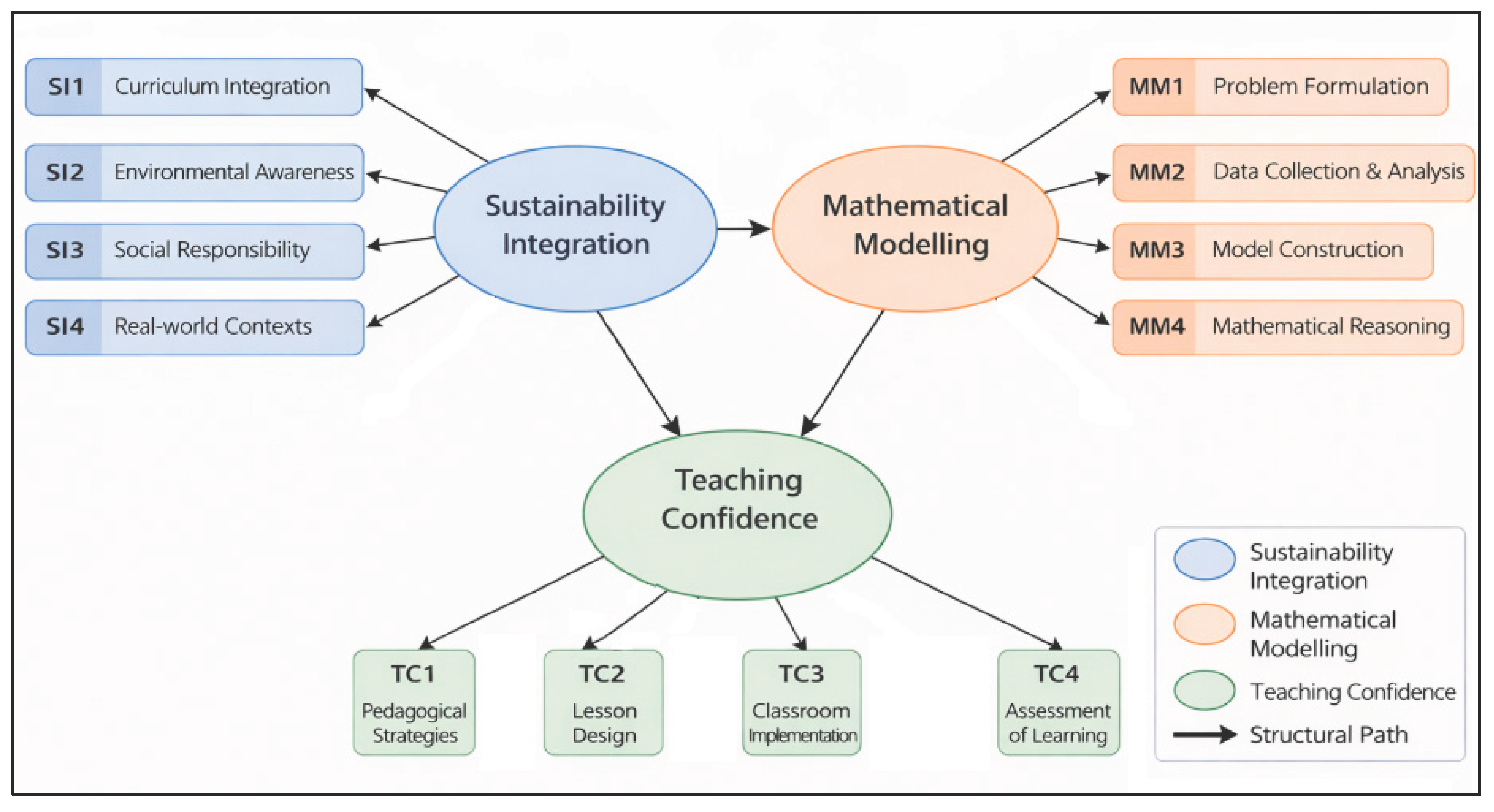

Table 1.
Participant Demographics (N = 68).
| Variable | Category | n | % |
| Gender | Female | 49 | 72.1 |
| Male | 19 | 27.9 | |
| Year of study | 3rd year | 28 | 41.2 |
| 4th year | 40 | 58.8 | |
| Prior modelling experience | Yes | 15 | 22.1 |
| No | 53 | 77.9 |
Note. Percentages are based on the total sample size.
Table 2.
Structure of the Sustainability-Oriented Mathematical Modelling Intervention.
| Week | Sustainability Context | Mathematical Concepts | Modelling Activity |
| 1 | Introduction to sustainability | Data interpretation, percentages | Analysis of sustainability indicators |
| 2 | Water consumption | Ratios, averages | Modelling household water usage |
| 3 | Energy consumption | Graphs, proportional reasoning | Comparison of energy sources |
| 4 | Waste management | Statistics, percentages | Modelling recycling data |
| 5 | Transportation | Rates, comparison | Modelling carbon emissions |
| 6 | Lesson design | Modelling cycle | Designing sustainability-based tasks |
Note. Each session lasted approximately 90 minutes.
Table 3.
Questionnaire Structure.
| Construct | Number of Items | Example Item |
| Sustainability integration | 4 | Mathematics can support sustainability learning |
| Mathematical modelling perception | 4 | Modelling helps solve real-world problems |
| Teaching confidence | 4 | I feel confident designing sustainability-based lessons |
Note. All items were measured on a five-point Likert scale.
Table 4.
Pre-test and Post-test Comparisons of Study Variables (N = 68).
| Variable |
Pre-test M(SD) |
Post-test M(SD) |
t | p | Cohen’s d | 95% CI |
| Sustainability integration | 3.12 (0.72) | 4.05 (0.61) | 6.84 | < .001 | 0.83 | [0.52, 1.14] |
| Modelling perception | 3.25 (0.68) | 4.10 (0.59) | 7.12 | < .001 | 0.89 | [0.58, 1.20] |
| Teaching confidence | 2.95 (0.75) | 3.98 (0.64) | 7.45 | < .001 | 0.91 | [0.60, 1.22] |
Note. M = mean; SD = standard deviation; CI = confidence interval. Paired-samples t tests were conducted to compare pre-test and post-test scores. Cohen’s d values above .80 indicate large effects.
Table 5.
Correlation Matrix of the Main Study Variables.
| Variable | 1 | 2 | 3 |
| 1. Sustainability integration | — | ||
| 2. Modelling perception | .61** | — | |
| 3. Teaching confidence | .58** | .64** | — |
Note. p < .01.
Table 6.
Multiple Regression Analysis Predicting Teaching Confidence.
| Predictor | B | SE B | β | t | p |
| Sustainability integration | 0.31 | 0.08 | .35 | 3.87 | < .001 |
| Modelling perception | 0.38 | 0.07 | .42 | 4.92 | < .001 |
Note. Dependent variable: Teaching confidence. Model summary: R² = .49, F(2, 65) = 31.42, p < .001.
Disclaimer/Publisher’s Note: The statements, opinions and data contained in all publications are solely those of the individual author(s) and contributor(s) and not of MDPI and/or the editor(s). MDPI and/or the editor(s) disclaim responsibility for any injury to people or property resulting from any ideas, methods, instructions or products referred to in the content. |
© 2026 by the authors. Licensee MDPI, Basel, Switzerland. This article is an open access article distributed under the terms and conditions of the Creative Commons Attribution (CC BY) license (http://creativecommons.org/licenses/by/4.0/).
Copyright: This open access article is published under a Creative Commons CC BY 4.0 license, which permit the free download, distribution, and reuse, provided that the author and preprint are cited in any reuse.


