

Submitted:
10 April 2026
Posted:
13 April 2026
Read the latest preprint version here
Abstract
Background: The dendritic cell initiates and directs antigen-specific immunity. Three Nobel Prizes frame the system it controls: Steinman (2011) recognized the dendritic cell as the conductor of adaptive immunity; Allison and Honjo (2018) recognized CTLA-4 and PD-1 as checkpoints restraining effector responses; Sakaguchi, Brunkow, and Ramsdell (2025) recognized that Foxp3-positive regulatory T cells maintain peripheral tolerance. Hypothesis: This article proposes that these discoveries describe a single bidirectional circuit with the dendritic cell as its fulcrum, and that the tolerogenic default observed in aging, cancer, chronic infection, and senescence represents a correctable failure of dendritic cell instruction driven by a specific molecular chain: SASP–STAT3–DNMT–IRF8 silencing. The proposed mechanism is self-reinforcing: senescence-associated secretory phenotype cytokines activate STAT3 in hematopoietic progenitors, STAT3 recruits DNMT1 and DNMT3B to methylate the IRF8 promoter, and IRF8 silencing—locked by a BATF3-dependent bistable switch with no stable intermediate—simultaneously eliminates IL-12 transcription, disarms target cells against apoptosis, collapses genome surveillance, and installs bilateral disarmament across the immune synapse. STAT3 simultaneously drives PD-L1 transcription on tolerogenic dendritic cells and tumor cells, and a fifth biosynthetic lock operates at the metabolic level: mitochondrial depolarization collapses citrate export and secretory pathway capacity, eliminating IL-12 production independently of transcriptional silencing. Four metabolic-epigenetic feedback loops—alpha-ketoglutarate depletion blocking TET demethylases, NAD-plus decline disabling SIRT1 deacetylation of STAT3, SOCS3 promoter methylation removing the STAT3 negative feedback brake, and lactate-derived lysine lactylation driving immunosuppressive gene programs—ensure the tolerogenic default is metabolically as well as epigenetically locked. Proposed correction: The alpha-type-1 polarized dendritic cell, manufactured ex vivo with IFN-gamma and multi-TLR engagement, escapes this architecture because its maturation commitment is made outside the STAT3 field. It initiates a self-amplifying four-phase cascade that progressively restores IRF8 expression across the immune surveillance network and removes the upstream cause through senescent cell clearance. Significance: If correct, this framework implies that many current therapies fail not because targets are wrong, but because they operate downstream of a corrupted instructional system. It redefines the therapeutic target from the effector compartment to the instructor.
Keywords:
dendritic cell
; IRF8
; STAT3
; bilateral disarmament
; IL-12p70
; immunosenescence
; epigenetic reprogramming
; mitochondrial fitness
1. Introduction
Every year, millions of people die from conditions that share a single upstream cause their physicians never measure. The grandmother whose cognition dims is treated by a neurologist. The grandfather whose latent tuberculosis reactivates is treated by an infectious disease specialist. The patient whose pancreatic cancer escapes checkpoint immunotherapy is treated by an oncologist. Each specialist treats the organ. None assesses the instructional state of the immune system that, had it been functioning, would have prevented the disease from developing.
In 1973, Ralph Steinman and Zanvil Cohn identified a rare cell in the peripheral lymphoid organs of mice, constituting only one to two percent of spleen cells, distinguished by continuously extending and retracting tree-like projections (1). They named it the dendritic cell. Over the next two decades, Steinman demonstrated that this cell was 100-fold more potent at initiating immune responses than any other cell in the body. Banchereau and Steinman formalized the paradigm in Nature in 1998: B and T lymphocytes are the mediators of immunity, but their function is under the control of dendritic cells (2). The 2011 Nobel Prize in Physiology or Medicine was awarded to Steinman for his discovery of the dendritic cell and its role in adaptive immunity.
Steinman’s paradigm contained a principle the field has described but not yet fully exploited. Hawiger proved it in vivo in 2001 by delivering antigens directly to DCs: without a maturation stimulus, the result was tolerance; with a maturation stimulus, the result was robust immunity (3). The same cell, the same antigen, opposite outcomes. The dendritic cell does not merely activate the immune system. It makes a binary decision at the point of contact with every cell it encounters: is this cell pathological or is this cell self? This article proposes that the bidirectional discrimination Hawiger demonstrated represents the fundamental organizing principle of adaptive immunity, that its failure explains the tolerogenic default observed across aging, cancer, chronic infection, and senescence, and that a defined ex vivo manufacturing protocol can restore it. This model explains why checkpoint blockade fails in the majority of patients: it releases inhibitory signals on effector T cells that were never properly instructed, directed against target cells that have been armored against the killing mechanisms those T cells would use. It explains why vaccines fail in the elderly: the dendritic cells that should convert antigen exposure into protective immunity have lost the IL-12 program that encodes the instruction. And it explains why no single-target therapy has succeeded against age-related immune decline: the failure is not in one pathway but in the upstream instructor that governs all of them.
2. The Bidirectional Paradigm: Three Nobel Prizes, One Circuit
2.1 The Checkpoint Brake
In 1995, James Allison demonstrated that T cells integrate opposing signals from two receptors that share the same ligands: CD28, which delivers costimulation and drives activation, and CTLA-4, which delivers coinhibition and suppresses it (4). In 1996, Allison showed that blocking CTLA-4 with an antibody caused complete tumor rejection in mice, establishing the founding principle of checkpoint immunotherapy: treat the immune system rather than the tumor (5). Independently, Tasuku Honjo identified PD-1 as a second inhibitory receptor, engaged by PD-L1 expressed on tumor cells and on tolerogenic dendritic cells themselves, delivering a suppressive signal at the effector stage rather than at priming. The 2018 Nobel Prize was awarded to Allison and Honjo for the discovery of cancer therapy by inhibition of negative immune regulation. Both checkpoints trace back to the dendritic cell: CTLA-4 competes for the costimulatory ligands the DC provides, and PD-L1 is upregulated on DCs that have failed to mature. The brake is set at the instructor.
2.2 The Regulatory Enforcer
In the same year Allison published his costimulation paper, Shimon Sakaguchi identified a population of CD4+ T cells constitutively expressing CD25, the IL-2 receptor alpha chain, that actively maintain self-tolerance (6). The CD4+CD25+ population Sakaguchi proved to be regulatory had been first detected five years earlier by Jackson, Blidy, and colleagues, who demonstrated in 1990 that approximately thirty percent of normal CD4+ T cells constitutively express CD25 in a state of quiet readiness, overturning the dogma that this receptor appeared only after activation (22). Sakaguchi later identified Foxp3 as the master transcription factor controlling their development (7). The 2025 Nobel Prize in Physiology or Medicine was awarded to Sakaguchi, Brunkow, and Ramsdell for their discoveries concerning peripheral immune tolerance. Regulatory T cells are the enforcers.
2.3 Convergence on the Dendritic Cell
Allison’s brake and Sakaguchi’s enforcers are not independent systems. They converge on the dendritic cell. Wing demonstrated in 2008 that CTLA-4 is constitutively expressed on Tregs and is essential for their suppressive function (8). Qureshi showed in Science in 2011 that CTLA-4 on Tregs physically captures CD80 and CD86 from the DC surface through trans-endocytosis and degrades them (9). Kennedy extended this in 2022, showing CD86 is the primary sustained target because its low-pH release mechanism enables continuous CTLA-4 recycling (10). The molecule Allison identified as a brake on effector T cells is the primary weapon Sakaguchi’s regulatory T cells use to disarm the dendritic cell. The immune system does not have separate circuits for immunity and tolerance. It has one circuit with one fulcrum. The dendritic cell is the fulcrum. Its maturation state determines which side of the balance prevails.
3. The Tolerogenic Default: The Complete Mechanism
3.1 The Upstream Cause
The aging immune system tilts the balance toward tolerance and holds it there. Senescent cells accumulate with age and secrete the senescence-associated secretory phenotype, a paracrine signal dominated by IL-6, G-CSF, IL-1-beta, PGE2, and TGF-beta (23). These cytokines activate STAT3 in hematopoietic stem cells through JAK1-JAK2/gp130 signaling. Chronic elevated cortisol from the aging hypothalamic-pituitary-adrenal axis activates the glucocorticoid receptor, which forms a convergent signaling architecture with STAT3 through three mechanisms: the glucocorticoid receptor physically co-activates STAT3 at shared target promoters, glucocorticoids suppress SOCS3 expression thereby prolonging STAT3 activation, and STAT3 in turn induces C/EBP-beta which drives emergency myelopoiesis (24). In cDC1s specifically, endogenous glucocorticoids constitutively suppress IL-12 production, and cDC1s uniquely amplify intracellular cortisol through 11-beta-hydroxysteroid dehydrogenase type 1, making the instructor subset most vulnerable to neuroendocrine suppression (109, 110). The bone marrow shifts from balanced hematopoiesis to myeloid-biased output at the expense of lymphoid production, expanding the myeloid-derived suppressor cell compartment while contracting the lymphoid progenitor pool (27). Park and colleagues demonstrated that IL-6 signaling through STAT3 directly regulates in vivo dendritic cell differentiation, producing DCs with impaired capacity for IL-12 secretion and T cell priming (25).
3.2 The Silencing Event
STAT3 performs one molecular event that produces every downstream failure. It directly induces DNMT1 transcription through GAS/SIE elements in the DNMT1 promoter and upregulates DNMT3B, which together methylate the promoter of IRF8 (33, 92). IRF8 is not merely a myeloid lineage factor. It is a single transcription factor deployed across every cell type in the immune surveillance network, whose silencing produces a coordinated multi-system failure that no single-target therapy can address. IFN-gamma is the canonical inducer of IRF8 expression across all cell types (61), and STAT3-mediated DNMT methylation silences all functions simultaneously through a single epigenetic event. Among the STAT3-activating inputs, IL-6 and IL-10 represent the dominant drivers, with other signals amplifying rather than initiating the tolerogenic state. IRF8 operates simultaneously as instructor, executioner, genome guardian, gatekeeper, effector differentiator, danger sensor, tissue sentinel, autophagy director, NK cell orchestrator, and pathogen destroyer.
As the instructor, IRF8 synergistically activates IL-12p35 transcription with IRF1 through a specific ICSBP-response element and is absolutely required for IL-12p40 production (62). IRF8 is also a terminal selector of the cDC1 lineage: it is required not just for initial development but for ongoing cDC1 survival, such that deleting IRF8 in a committed cDC1 induces complete transcriptional, functional, and epigenetic reprogramming into a cDC2 (63). The identity is not a property the cell acquires during development and then maintains passively. It is actively sustained by continuous IRF8 expression.
As the executioner, IRF8 directly controls five independent apoptotic pathways in target cells. It represses BCL-2 transcription through ICSBP-responsive promoter elements, overriding BCR-ABL-mediated chemotherapy resistance (64). It represses FLIP, the caspase-8 inhibitor that blocks both FasL and TRAIL-mediated death; nuclear IRF8 was absent in 92 percent of human soft tissue sarcomas while 99 percent expressed FLIP (65). It regulates acid ceramidase to mediate Fas-dependent apoptosis (66). It directly activates Bax transcription in primary myeloid cells in vivo (67). And it represses PTPN13/Fap-1, the Fas-associated phosphatase that dephosphorylates Fas and inhibits Fas-induced apoptosis (68). IRF8 does not merely sensitize the cell to one form of death. It installs apoptotic competence across every available pathway simultaneously.
As the genome guardian, IRF8 is indispensable for PML expression and nuclear body formation in myeloid cells, and directly activates FANCF transcription, a Fanconi anemia DNA repair gene (30, 31). Without PML bodies, the cell loses its primary platform for DNA damage response, homologous recombination repair, and p53-mediated apoptosis. When STAT3 silences IRF8, it simultaneously removes PML nuclear bodies for genome surveillance, FANCF for DNA repair, and the Fas/Bax pathways for apoptotic clearance of damaged cells.
As the gatekeeper, IRF8 physically interacts with C/EBP-alpha and prevents its binding to chromatin in monocyte-DC progenitors, blocking the neutrophil and MDSC differentiation program (69). When STAT3 silences IRF8, C/EBP-alpha is released to drive MDSC expansion unopposed. DC lineage specification begins at the HSC level through IRF8 expression dose, with FLT3L reinforcing IRF8 upregulation through cell division (70). Breast and pancreatic cancers interrupt IRF8-dependent DC development systemically by producing G-CSF that downregulates IRF8 in bone marrow progenitors (71). The tumors exploit the identical gatekeeper mechanism the SASP exploits: G-CSF activates STAT3, STAT3 suppresses IRF8, and progenitors default to the MDSC fate.
As the effector differentiator, IRF8 integrates T cell receptor and gamma-chain cytokine signaling in CD8+ T cells; IRF8 depletion abrogates the naive-to-effector transition entirely (72). IRF8 also reorganizes three-dimensional chromatin architecture in CD8+ T cells by recruiting CTCF to form active chromosomal loops during the functional exhaustion program, maintaining antitumor activity in chronic antigen environments (73). IRF8 is required on both sides of the immune synapse: in the DC that presents antigen and in the T cell that responds to it.
As the danger sensor, IRF8 physically associates with STING upon DNA damage in a transcription-independent role, serving as a scaffold essential for STING polymerization and TBK1-mediated phosphorylation; IRF8 deficiency blocks DNA damage-induced cellular senescence signaling (74). Without IRF8, damaged cells accumulate DNA damage without activating the danger signals that would mark them for clearance. IRF8 also enables cross-talk between TLR and IFN-gamma signaling pathways through physical interaction with TRAF6, meaning that IRF8 loss simultaneously disables both the detection of pathogen-associated molecular patterns and the amplification of the IFN-gamma response (75).
As the tissue sentinel, IRF8 defines the entire epigenetic landscape of postnatal microglia; IRF8 deletion causes microglia to lose their homeostatic identity and gain disease-associated microglia-like gene expression (76). In gastric epithelial cells, IRF8 promotes IFN-gamma expression, creating an IRF8-IFN-gamma circuit in non-hematopoietic tissue that constitutes a mucosal innate immune mechanism (77). As the autophagy director, IRF8 directly activates genes involved in autophagosome formation and lysosomal fusion; IRF8-deficient macrophages are profoundly deficient in autophagic activity, meaning they cannot process senescent cell debris after efferocytosis (78). As the NK cell orchestrator, IRF8 controls Zbtb32, the master regulator of virus-driven NK cell proliferation, through IL-12/STAT4 signaling (79), and biallelic IRF8 mutations cause familial NK cell deficiency with impaired maturation and cytotoxic function (80). As the pathogen destroyer, IRF8 directly activates Nramp1/SLC11A1, the master gene for intraphagosomal pathogen killing, and its targets are massively enriched for the GBP and IRG families that destroy intracellular pathogen vacuoles and activate inflammasomes (81, 82).
When IRF8 is silenced, all ten functions fail simultaneously from a single epigenetic event. This is not ten separate failures. It is one failure expressed across every cell type in the immune surveillance network.
Ibrahim and colleagues demonstrated the complete chain in a single experimental system: MDSC-derived IL-10 activates STAT3, STAT3 binds DNMT1/DNMT3B promoters, the induced DNMTs methylate the IRF8 promoter, and IRF8 is silenced, with human colorectal carcinomas showing significantly higher DNMT1/DNMT3B and lower IRF8 expression than normal tissue (33). McGough and colleagues demonstrated the epigenetic lock that makes this silencing irreversible under physiological conditions: methylation at the IRF8 promoter recruits MBD1/PIAS1 complexes that block STAT1 transcriptional activity, rendering the locus unresponsive to IFN-gamma even when STAT1 is activated (34). The NFIL3-dependent super-enhancer cascade that normally maintains IRF8 expression is strictly cis-dependent: each enhancer’s activation depends on the prior enhancer on the same chromosome, making the entire cascade vulnerable to upstream perturbation (83). Tumors producing IL-6 systemically elevate C/EBP-beta in common DC progenitors to a point where NFIL3 fails to induce cDC1 specification, collapsing the cascade at its first step. IRF8 autoactivates through a BATF3-dependent super-enhancer (141), creating a bistable system with two stable states: IRF8-high (surveillance, self-maintaining through positive feedback) and IRF8-off (tolerogenic, self-maintaining through STAT3-DNMT silencing). There is no stable intermediate. The transition is a phase transition, not a gradual decline. STAT3 activation itself is graded and dose-dependent, accumulating over years as senescent cells and their SASP cytokines increase with age, chronic infection, or tumor burden. But the IRF8 switch this graded signal feeds is binary: as long as IRF8 remains above the autoactivation threshold, the positive feedback loop sustains it; the moment STAT3-driven DNMT activity pushes methylation past that threshold, the loop collapses and IRF8 flips to off. A slow dimmer drives a sudden toggle.
Committed cDC1s that lose IRF8 below the autoactivation threshold convert entirely into cDC2s, eliminating the DC subset responsible for cross-presentation and IL-12 production. Two complementary mechanisms accelerate this collapse at different developmental stages. In progenitors, IL-6-elevated C/EBP-beta outcompetes NFIL3 at shared DNA binding sites in the Zeb2 enhancer, preventing the NFIL3-ZEB2-ID2 enhancer switch that initiates cDC1 specification and blocking the BATF3 super-enhancer from engaging (111, 112). In already-committed cells, STAT3-driven DNMT activity silences IRF8 directly at the promoter. TET demethylases cannot counteract this silencing because acetylated STAT3 physically escorts DNMT1 to target promoters including IRF8, creating a targeted methylation machine (113), while simultaneously redirecting TET2 to STAT3’s own target gene promoters for demethylation. Once methylation is established, the MBD1/PIAS1 complex provides a physical barrier that excludes both STAT1 and TET enzymes from accessing the locus (34).
The clinical consequence is that a macrophage or DC without IRF8 is alive, metabolically active, and present in the tissue, but functionally deaf and blind to the pathology occurring around it. It cannot sense pathogens through the TLR/NLR apparatus IRF8 controls, cannot process antigens through the MHC machinery IRF8 coordinates, cannot kill through the phagosome maturation pathways IRF8 governs, and cannot recruit help through the chemokines IRF8 induces (32). The cell is present. The perceptual apparatus that would make its presence meaningful has been erased.
Independent experimental evidence now confirms that mitochondrial fitness is a critical determinant of cDC1 function within tumors. You and colleagues identified two metabolically distinct cDC1 subsets in mice using mitochondrial membrane potential and mass markers: a [TMRM/MG]hi population with high oxidative phosphorylation capacity and enhanced antigen presentation, and a [TMRM/MG]lo population with depolarized mitochondria and impaired T cell priming (143). The frequency of the [TMRM/MG]hi subset declined with tumor progression across melanoma, breast cancer, and liver cancer models. The mitochondrial fusion protein OPA1, acting through the transcription factor NRF1, maintained the electron transport chain components required for ATP production in [TMRM/MG]hi cDC1s. When OPA1 was deleted specifically in dendritic cells, cDC1 numbers within tumors were unchanged but their mitochondria depolarized, their antigen presentation capacity collapsed, and antitumor adaptive immunity was impaired (143, 144). The mechanism was precise: reduced OPA1 lowered ATP production, which activated AMP-activated protein kinase (AMPK), triggering autophagy-mediated degradation of MHC class I proteins from the cDC1 surface. This establishes a second layer of antigen presentation failure beyond the IRF8-dependent MHC silencing described above: even in cDC1s that retain some IRF8 expression, mitochondrial depolarization within the tumor microenvironment actively destroys the MHC-I molecules required for cross-presentation to CD8+ T cells. Critically, You and colleagues left unresolved which tumor microenvironment signals drive the mitochondrial depolarization—listing hypoxia, nutrient competition, chronic inflammation, and metabolic by-products as candidates (144). The framework presented here provides the answer: the same SASP-STAT3 paracrine field that silences IRF8 creates the hostile metabolic environment that degrades mitochondrial fitness. STAT3 activation drives metabolic reprogramming toward glycolysis at the expense of oxidative phosphorylation, directly undermining the mitochondrial membrane potential that [TMRM/MG]hi cDC1s require. IRF8 silencing eliminates cDC1 identity itself—converting cDC1s to cDC2s that lack the Mst1/2-maintained oxidative metabolic program Du and colleagues showed is specific to the cDC1 lineage (145)—meaning the epigenetic and metabolic collapses are not parallel events but sequential consequences of the same upstream cause. The mitochondrial depolarization You and colleagues measure is therefore not an independent mechanism but a downstream consequence of the tolerogenic default operating at the metabolic level.
3.3 The Five Locks on IL-12
STAT3 installs five molecular locks on any residual IL-12 production, each operating at a different level of gene expression. Lock 1: STAT3 blocks c-Rel recruitment to the IL-12p40 promoter, preventing transcriptional initiation (54). Lock 2: STAT3 excludes CDK9/P-TEFb from the elongation complex at IL-12p35, halting transcription even when the promoter is nominally accessible (50). Lock 3: IL-6-induced arginase-1 and cathepsin L degrade IL-12 protein post-translationally, destroying whatever IL-12 escapes the transcriptional blockade (35). Lock 4: STAT3 in cooperation with C/EBP-beta suppresses MLL1 through miR-21a, miR-21b, and miR-181b, arresting myeloid maturation entirely and preventing progenitors from reaching the developmental stage at which IL-12 competence could be acquired (56). Lock 5: mitochondrial depolarization within the tumor microenvironment imposes a biosynthetic lock that operates independently of the four transcriptional locks. Du and colleagues demonstrated in Nature that Mst1/2 kinase-maintained oxidative phosphorylation is specifically required for IL-12 expression in CD8-alpha-positive cDC1s; when mitochondrial metabolism collapses, IL-12 production fails even when the chromatin is nominally accessible (145). The mechanism is biosynthetic: Everts and colleagues showed in Nature Immunology that TLR-driven DC activation requires glycolysis-powered citrate export through SLC25A1, conversion to acetyl-CoA by ATP citrate lyase, and de novo fatty acid synthesis that drives massive expansion of ER and Golgi membranes—the rate-limiting step for translation, transport, and secretion of IL-12, IL-6, TNF, CD86, and CD40 (154). The glycolytic inhibitor 2-deoxyglucose reduced IL-12 protein without affecting IL-12 mRNA, demonstrating a post-transcriptional bottleneck at the secretory pathway. When mitochondria depolarize, citrate export collapses and the entire secretory apparatus required for IL-12p70 production shuts down. AMPK activation following ATP depletion simultaneously blocks the glycolytic switch that TLR-stimulated DCs require for this biosynthetic program (146). IL-12p70 is a continuously secreted protein requiring ongoing synthesis and vesicular export, whereas MHC-I is a surface protein with slower turnover; mitochondrial depolarization therefore eliminates IL-12 capacity before it degrades MHC-I presentation. This means the [TMRM/MG]lo cDC1s identified by You and colleagues (143) were not merely failing to present antigen—they were failing to instruct, and every cross-presentation event from a depolarized cDC1 was writing tolerance rather than immunity. Kalinski and colleagues demonstrated the functional consequence as early as 1997: DCs matured in the presence of prostaglandin E2, a STAT3-activating signal enriched in the tumor microenvironment, permanently lose IL-12p70 competence regardless of subsequent stimulation (26). The lock is installed during the maturation window. Once closed, no endogenous signal can reopen it. The positioned nucleosome at the IL-12p35 promoter must be remodeled within the first 24 hours of maturation or the locus is permanently silenced (29).
3.4 Bilateral Disarmament
The same STAT3-DNMT event that silences IRF8 in immune cells simultaneously armors target cells against killing. IRF8 methylation de-represses BCL-2, accumulates FLIP, silences Bax, and de-represses Fap-1, conferring apoptotic resistance through five independent antiapoptotic mechanisms (30, 31). The immune system cannot attack because it has lost IL-12-competent DCs, effector T cell differentiation, and NK cell activation. The target cells cannot be killed because they have gained antiapoptotic armor. A third dimension of disarmament operates at the metabolic level: the tumor microenvironment’s SASP-driven metabolic stress depolarizes mitochondria in surviving cDC1s, activating AMPK-dependent autophagy that degrades MHC class I molecules from the cDC1 surface and eliminates cross-presentation capacity even in cells that have not yet crossed the IRF8 bistable threshold (143, 144). Both sides of the immune synapse are disabled by one epigenetic event, with mitochondrial collapse providing a parallel mechanism of immune-side disarmament. STAT3 adds a further dimension by directly binding the PD-L1 promoter and driving its transcription on both tolerogenic DCs and tumor cells. Wölfle and colleagues demonstrated that STAT3 controls PD-L1 expression on tolerogenic antigen-presenting cells and that blocking STAT3 prevented PD-L1 upregulation (158), a finding confirmed across breast cancer (159) and head and neck squamous cell carcinoma (160). The same upstream signal that silences IRF8 and collapses IL-12 production simultaneously installs the checkpoint ligand that suppresses whatever residual T cell priming survives the instructional deficit. This is bilateral disarmament (Figure 1). It explains why checkpoint blockade fails in the majority of patients: releasing a brake on T cells that were never properly instructed, aimed at target cells that have been armored against the killing mechanisms those T cells would use, addresses neither side of the deficit.
3.5 The Self-Reinforcing Architecture
The tolerogenic default is self-reinforcing because its output maintains its input. Nine inputs feed STAT3 simultaneously: IL-6, IL-10, chronic type I IFN, CD47/SIRP-alpha contact signaling, PGE2, TGF-beta, adenosine, lactate, and CTLA-4 reverse signaling on DCs (95). IL-12-deficient DCs expand Tregs because they deliver antigen without the polarizing signal that would generate effectors. Tregs strip remaining DCs of costimulatory molecules through CTLA-4 trans-endocytosis (9), and CTLA-4 engagement on DCs simultaneously activates STAT3 phosphorylation, which suppresses NF-kB activity and CD80/CD86 transcription (95). This creates a dual mechanism: CTLA-4 physically removes costimulatory molecules while simultaneously activating the STAT3 pathway that prevents their re-expression, directly connecting the regulatory T cell axis to the upstream STAT3 silencing chain. MDSCs expand Tregs through arginase, IDO, TGF-beta, and IL-10 (27). IDO-expressing DCs generate kynurenine that activates AhR in an autocrine maintenance loop. Regulatory B cells produce IL-10 and IL-35, the latter competing directly with IL-12 at the IL-12R-beta-2 receptor. Osteopontin is de-repressed from IRF8 silencing, creating a soluble T cell checkpoint. The Wnt/beta-catenin brake on immune activation is removed, enabling tolerogenic signaling (28). The IRF4/IRF8 balance in B cells shifts toward IRF4 dominance, breaching B cell anergy checkpoints and degrading antibody quality from germinal center maturation to low-affinity plasmablast differentiation (36). NFATc1 is de-repressed, unleashing pathological osteoclastogenesis that further degrades the bone marrow niche (37). A ninth input completes the self-reinforcing architecture: STAT3 induces DNMT1, which methylates the SOCS3 promoter, silencing the negative feedback inhibitor that normally terminates STAT3 signaling within two hours. Once SOCS3 is silenced, transient SASP exposure converts to permanent STAT3 activation. This feed-forward loop has been demonstrated in hematopoietic cells specifically, with SOCS3 methylation rates of 60 percent in AML bone marrow versus zero in remission and controls, and IL-6-induced DNMT1 activity directly mediating SOCS3 promoter hypermethylation in colorectal tissue (114, 115). Two additional metabolic-epigenetic feedback loops reinforce the tolerogenic default at the bioenergetic level. First, the alpha-ketoglutarate trap: TET demethylases, the only enzymes capable of reversing IRF8 promoter methylation, require alpha-ketoglutarate as an obligate cofactor (147). Alpha-ketoglutarate is produced by the mitochondrial TCA cycle. When mitochondria depolarize within the tumor microenvironment, alpha-ketoglutarate production drops while succinate and fumarate—competitive inhibitors of TET enzymes with IC50 values of approximately 550 and 400 micromolar respectively—accumulate (148). Liu and colleagues demonstrated in Nature Immunology that the alpha-ketoglutarate-to-succinate ratio directly controls TET2-dependent epigenetic reprogramming in macrophages (149), and Zhou and colleagues traced the complete chain from mitochondrial respiration through glutaminolysis-derived alpha-ketoglutarate to TET2-mediated DNA hydroxymethylation in myeloid cells (150). While these studies were performed in macrophages rather than cDC1s, indirect evidence supports the same axis in dendritic cells: Ugele and colleagues demonstrated that D-2-hydroxyglutarate and L-2-hydroxyglutarate, both competitive inhibitors of alpha-ketoglutarate-dependent dioxygenases including TET enzymes, significantly inhibited IL-12 secretion by human monocyte-derived dendritic cells (155), and Hammon and colleagues showed D-2-hydroxyglutarate impaired human DC differentiation into a tolerogenic phenotype with reduced MHC-II expression (156). The prediction that mitochondrial depolarization in cDC1s specifically reduces the alpha-ketoglutarate-to-succinate ratio sufficient to impair TET-mediated demethylation at the IRF8 locus is directly testable by metabolomic and hydroxymethylation profiling of sorted [TMRM/MG]hi versus [TMRM/MG]lo cDC1s from the You and colleagues system (143). Second, the NAD-plus/SIRT1 acetylation lock: SIRT1, the NAD-plus-dependent deacetylase that removes the K685 acetylation from STAT3 required for STAT3-DNMT1 complex formation (113), loses activity when NAD-plus declines. Nie and colleagues demonstrated that SIRT1 physically deacetylates STAT3 at K685, and critically showed that resveratrol decreased STAT3 acetylation in wild-type mouse embryonic fibroblasts but not in SIRT1-knockout cells, providing genetic proof that SIRT1 is the obligate deacetylase for this residue (151). Limagne and colleagues confirmed this specifically in immune cells using three pharmacological SIRT1 agonists—resveratrol, metformin, and SRT1720—all of which reduced STAT3 K685 acetylation and Y705 phosphorylation, with all effects abolished in CD4-specific SIRT1-knockout T cells (152). The functional consequence of this axis is already present in the existing literature of this paper: Lee and colleagues demonstrated that resveratrol, acting through SIRT1, disrupted the STAT3-DNMT1 complex and reversed CpG methylation at the SOCS3, CDKN2A, and PTPN6 promoters (113). When mitochondrial oxidative phosphorylation fails, NAD-plus regeneration collapses (153), SIRT1 cannot deacetylate STAT3, and the acetylated STAT3-DNMT1 targeting complex continues to methylate IRF8 and other tumor suppressor promoters unopposed. These two metabolic feedback loops operate in parallel with the SOCS3 feed-forward loop and a fourth reinforcement operating through lactate itself: tumor-derived lactate induces lysine lactylation (Kla), a post-translational histone modification that directly drives immunosuppressive gene expression programs in dendritic cells, as Zhang and colleagues demonstrated through MPC-mediated lactate production driving histone lactylation that suppressed DC maturation and antitumor immunity (161). Sun and colleagues showed that lactate-induced ENSA-K63 lactylation activates STAT3/CCL2 signaling, recruiting tumor-associated macrophages and creating a metabolite-to-epigenetic loop that converges on the same STAT3 hub the other three loops reinforce (162). Together, the SOCS3 loop ensures STAT3 activation is permanent, the NAD-plus/SIRT1 loop ensures STAT3 remains acetylated and complexed with DNMT1, the alpha-ketoglutarate trap ensures TET enzymes cannot reverse whatever methylation is deposited, and the lactylation loop ensures that lactate—already a STAT3 input—simultaneously rewrites the histone code toward immunosuppression. The tolerogenic default is not merely epigenetically locked. It is metabolically locked. No individual DC that has crossed the IRF8 bistable threshold can escape this architecture, because every DC that attempts to mature encounters the paracrine STAT3 field during transit and loses any residual IL-12 capacity. The population retains a diminishing fraction of DCs that have not yet crossed the threshold, explaining why aged individuals mount attenuated but not absent responses to acute infections.
3.6 Five Lines of Convergent Proof
Five independent lines of evidence establish this mechanism as convergent fact rather than hypothesis. First, the defect is environmental, not cellular: Lung and colleagues demonstrated that monocytes from elderly individuals generate DCs with unimpaired morphology, surface markers, and IL-12 production when cultured ex vivo, identical to young counterparts (38). The monocyte is not broken. The STAT3-dominant in vivo environment corrupts the DC during differentiation. Second, STAT3 is the specific cause: Zhou and colleagues demonstrated in Nature in 2025 that the STAT3/STAT5 balance determines DC functional fate, that STAT3 activation is entirely paracrine, and that cDC1-specific STAT3 knockout restored IL-12, MHC, and costimulatory molecules while reducing tumor growth (39). Third, IRF8 silencing through DNMT methylation is the downstream mechanism, as Ibrahim demonstrated in the complete chain from IL-10 through STAT3 through DNMT through IRF8 silencing (33). Fourth, IL-12 deficiency is the specific clinical defect: age-associated decreases in TLR-stimulated DC IL-12 production specifically predicted poor influenza vaccine response (47), and frailty, not chronological age, correlated with decreased IL-12/23 production (48). Fifth, correcting the DC defect alone is sufficient: Zhivaki and colleagues demonstrated in Cell in 2024 that correcting age-associated defects in dendritic cells enabled CD4+ T cells to eradicate established tumors in aged mice, while PD-1 and CTLA-4 checkpoint immunotherapies failed in the same hosts (40).
This model draws a critical distinction from immunosenescence as conventionally understood. Standard models emphasize thymic involution and T cell repertoire contraction. These are real phenomena, but they locate the deficit in the effector compartment. The hypothesis proposed here locates the primary deficit upstream, at the level of dendritic cell instruction. The effector compartment is not exhausted; it is incorrectly instructed. Guo and colleagues confirmed this directly: DC dysfunction in aged mice led to failure of NK cell activation and tumor eradication, but DCs from young mice efficiently activated NK cells from aged mice (49). The effector compartment is intact. It is waiting for correct instruction. Stirewalt and colleagues demonstrated that IRF8 is the only gene with conserved age-associated expression decreases across both human and murine hematopoietic stem and progenitor cells, directly linking IRF8 loss to the myeloid-biased output observed in aging (86). The Phase III DCVax-L data in glioblastoma are consistent: patients with a median age of 56 and maximally immunosuppressive tumor microenvironments showed extended survival following DC vaccination (21). If the deficit were in the effector compartment, DC vaccination in this population should fail. Molony and colleagues demonstrated in Science Signaling in 2017 the most direct evidence for the aging-IRF8 connection: human monocytes from older adults fail to produce IRF8 in response to viral infection, and this IRF8 deficit is the specific cause of age-associated type I IFN impairment (55). Knocking down IRF8 in monocytes from younger adults replicated the IFN defects observed in older adults. Restoring IRF8 expression in older adult monocytes restored IFN responses. The deficit is in IRF8. Its restoration is sufficient for correction. The definitive human genetic proof was provided by Hambleton and colleagues: patients with autosomal dominant IRF8 deficiency showed selective depletion of IL-12-producing myeloid DCs, while patients with autosomal recessive deficiency showed complete absence of monocytes and DCs combined with myeloproliferative syndrome (90). One gene. Two dose-dependent phenotypes. The entire tolerogenic default encoded in a single locus.
4. The Alpha-DC1 as Restored Instructor
4.1 Manufacturing as Chromatin Programming
If the tolerogenic default is an epigenetic state installed during DC maturation, then correcting it requires manufacturing a DC whose maturation occurs outside the epigenetic environment that installs the default. The alpha-type-1 polarized dendritic cell maturation protocol, developed by Kalinski and colleagues at the University of Pittsburgh and Roswell Park Comprehensive Cancer Center, achieves this (11). The patient’s own monocytes are collected by leukapheresis. They carry the patient’s complete HLA repertoire. They are not broken. The defect is environmental, not cellular. The monocytes are placed in a closed-system bioreactor with GM-CSF. This single act severs the cell from every paracrine STAT3 input simultaneously: no IL-6 from senescent cells, no IL-10 from Tregs, no PGE2, no adenosine, no lactate. Without continuous STAT3 input, the STAT5 axis activated by GM-CSF proceeds without competitive inhibition, driving differentiation toward the DC lineage and opening the chromatin landscape at surveillance program enhancers.
The alpha-DC1 maturation cocktail is then applied: IFN-alpha, poly-I:C, TNF-alpha, IL-1-beta, and IFN-gamma, deliberately excluding PGE2 and IL-6 (12). In the next-generation platform enhancement, BCG-derived components are incorporated during the maturation phase (not during monocyte-to-DC differentiation) to activate TLR2, TLR4, TLR9, and NOD2 simultaneously, producing a qualitatively different maturation state than any single TLR agonist (41). Shankar and colleagues demonstrated that IFN-gamma added during BCG-induced DC maturation synergistically upregulates IL-12 while inhibiting IL-10 (42). IFN-gamma induces IRF8 expression through STAT1/IRF1. The timing is critical: Rojas-Canales and colleagues demonstrated that IFN-gamma applied early during monocyte-to-DC differentiation produces tolerogenic DCs with suppressed CD83, CD80, and IL-12p70, while IFN-gamma applied late during maturation produces immunogenic DCs (52). The temporal code explains why: during active differentiation, STAT3 still occupies receptor phosphotyrosine motifs shared with STAT1 (106), and IFN-gamma delivered into this environment is read as a tolerogenic signal because STAT3 sequesters STAT1 away from its target genes. After differentiation completes and STAT3 clears, IFN-gamma arrives into a STAT1-permissive environment where the signal is read as immunogenic. The alpha-DC1 protocol applies IFN-gamma during the maturation phase, after GM-CSF-driven differentiation is complete, ensuring the temporal code reader is clear before the instruction is sent. Because differentiation has already occurred, IRF8 engages the surveillance program rather than a proliferative program. Khateb and colleagues demonstrated that a chromatin priming element in IRF8’s third intron maintains a permissive state in immune cells, overridden when the locus is silenced by STAT3-driven methylation (60). Activation signals drive deSUMOylation through SENP1, switching IRF8 from repressor to activator (43). The manufacturing is halted at a partially mature state where IL-12 production is committed but receptor-mediated antigen uptake through DNGR-1/CLEC9A for cross-presentation, IFN-gamma-upregulated Fc-gamma receptor I (CD64) for opsonized material, and DEC-205 for glycosylated antigens remains operational (11, 13). The sequence is the mechanism: differentiation opens the correct chromatin codebook, IFN-gamma induces IRF8 within it, and activation locks the configuration. The protocol produces DCs with 10- to 100-fold more IL-12p70 than the tolerogenic DCs emergency myelopoiesis generates (12).
Unlike approaches requiring exogenous transcription factor delivery to non-myeloid cells to generate DC-like phenotypes, the alpha-DC1 protocol exploits the endogenous PU.1/IRF8/BATF3 circuit already present in myeloid progenitors. No exogenous gene delivery is involved. The inventive principle is environmental: removing the progenitor from the STAT3 paracrine field before differentiation is complete is sufficient to allow the endogenous chromatin programming system to operate correctly. This principle simultaneously resolves the mitochondrial fitness deficit identified by You and colleagues (143): because the alpha-DC1 differentiates outside the SASP-driven metabolic stress of the tumor microenvironment, its mitochondria maintain the polarized, OPA1-dependent membrane potential and high oxidative phosphorylation capacity that characterize functionally competent [TMRM/MG]hi cDC1s. The ex vivo escape principle thus corrects both the epigenetic defect (IRF8 silencing) and the metabolic defect (mitochondrial depolarization) in a single manufacturing step, producing an instructor cell with intact chromatin programming and the biosynthetic capacity to sustain antigen presentation and IL-12 secretion after reinfusion into the hostile tumor microenvironment. This dual correction cannot be achieved by IFN-gamma signaling alone: Tian and colleagues demonstrated that IFN-gamma enhances oxygen consumption in monocytes through NAMPT-dependent NAD-plus salvage but does not induce mitochondrial biogenesis and actually decreases mitochondrial mass (157). The restoration of mitochondrially fit cDC1s in endogenous tissue therefore depends not on IFN-gamma-driven mitochondrial repair but on the emergence of new IRF8-competent progenitors in Phase 4 of the correction cascade, whose developmental program—executed outside the SASP field following senescent cell clearance—installs both the chromatin state and the metabolic architecture de novo.
4.2 Bidirectional Discrimination Restored
The alpha-DC1 is not an immunogenic weapon pointed at a target. It is a restored instructor with recovered bidirectional capacity. Cells expressing danger signals, stress ligands, and abnormal peptide-MHC complexes receive the attack signal through the T cells the DC instructs. Cells presenting normal self-peptides in the absence of danger signals receive tolerance. Dong and colleagues demonstrated in 2024 that alpha-DC1-educated T cells overexpress DNAM-1 and NKG2D, creating a dual-key selectivity gate: the T cell receptor provides one signal through antigen recognition, and the NK receptors provide a simultaneous co-stimulatory signal through stress ligands on the target (13). Without both signals, the T cell does not activate. IL-12 simultaneously drives NKG2A expression on effector T cells, installing an inhibitory receptor that recognizes HLA-E on healthy tissues, as Fesneau and colleagues demonstrated (44). In NK cells, IL-12 downregulates killer immunoglobulin-like receptors, releasing HLA-I-mediated inhibition and enabling NK-mediated killing of targets that retain MHC class I expression (89). The cytokine that arms the T cell simultaneously prevents it from attacking normal cells. The selectivity is not engineered. It is the built-in regulatory architecture of the IL-12/IFN-gamma axis as evolution designed it. Framed precisely, the dendritic cell functions as a Boolean logic gate programmer. It installs AND gates (TCR engagement plus costimulation must both be satisfied for activation), phagosome-autonomous AND gates (antigen and TLR ligand must co-localize within the same phagosome for MHC-II presentation, as Blander and Medzhitov demonstrated (130)), dual-key AND gates (TCR recognition plus NK receptor stress ligand recognition through DNAM-1/NKG2D), and NOT gates (NKG2A recognizing HLA-E on healthy cells inhibits killing). The tolerogenic default corrupts every gate simultaneously: CTLA-4 trans-endocytosis strips Signal 2, making the activation AND gate permanently unsatisfiable; IRF8 loss disables TLR/NLR sensing, breaking the phagosome-autonomous gate; without IL-12, the dual-key AND gate is never installed; without IL-12, the NKG2A NOT gate is never installed. The alpha-DC1 reinstalls the complete Boolean architecture from a clean copy, explaining why the absence of autoimmune events across more than 1,000 vaccinees reflects correct gate installation rather than insufficient immune activation.
4.3 Breaking the Tolerogenic Loop
The manufactured DC is resistant to the tolerogenic feedback loop that silenced its endogenous counterparts. NF-kB nuclear translocation during manufacturing installs a transcriptional program for costimulatory molecules through positive feedback that continuously replenishes CD80 and CD86 faster than CTLA-4 trans-endocytosis can strip them. Furthermore, the CTLA-4–STAT3 reverse signal that Kowalczyk and colleagues identified (95)—in which Treg CTLA-4 engagement of CD80 simultaneously strips costimulatory molecules and activates the tolerogenic STAT3 pathway in the contacted DC—is rendered ineffective because the alpha-DC1’s IL-12 program was irreversibly locked during ex vivo manufacturing before any CTLA-4 encounter. The signal arrives at a cell whose chromatin state is already committed. The alpha-DC1 breaks the tolerogenic loop at multiple additional points: IL-12p70 directly converts Foxp3-positive Tregs into IFN-gamma-producing Th1 cells (14). IL-12 simultaneously converts regulatory B cells into IFN-gamma-producing effectors through STAT4-driven T-bet induction, with T-bet driving IgG2a class-switching that enhances Fc-gamma receptor cross-presentation in a self-amplifying loop (87). IL-12 reprograms tumor-associated macrophages from immunosuppressive to tumoricidal phenotype within 90 minutes of exposure (88). IFN-gamma kills MDSCs through Bcl2a1 repression and forces surviving MDSCs to differentiate into functional antigen-presenting cells. IFN-gamma suppresses CCL22 while maintaining CXCL9 and CXCL10, reversing the chemokine landscape from suppressor-recruiting to effector-recruiting. Pulsatile IFN-gamma delivery is ensured because the alpha-DC1 is eliminated primarily through perforin-dependent killing by the effector CD8+ T cells it has educated, with Fas contributing as a secondary pathway (96, 97). This creates a proportional feedback timer: the more effectors the DC generates, the faster it is eliminated, constraining IFN-gamma exposure duration. Continuous IFN-gamma exposure induces peak IDO activity at 48 to 96 hours, and once established, IDO is maintained through an autocrine kynurenine/AhR loop independent of continued IFN-gamma (93, 94). The prediction that pulsatile delivery avoids crossing this induction threshold has not been directly tested experimentally but is supported by Harden and colleagues, who demonstrated that IL-12/GM-CSF therapy recruited immunogenic DCs within 24-48 hours but these DCs converted to an IDO-positive tolerogenic phenotype between days 2 and 7 through sustained IFN-gamma exposure (98). The alpha-DC1’s elimination within days prevents this 2-7 day exposure window. A second endogenous brake reinforces this protection: IFN-gamma simultaneously induces iNOS, and nitric oxide inhibits IDO enzymatic activity by binding to the active-site heme iron and promotes proteasomal degradation of IDO protein (116, 117). The relationship is bimodal: low NO concentrations support IDO activity, while high NO concentrations suppress it (118). The supraphysiological IL-12 output of the alpha-DC1 generates an IFN-gamma burst of sufficient magnitude to drive iNOS expression above the threshold where NO transitions from IDO-promoting to IDO-destroying, as demonstrated by the 7-fold iNOS surge observed within 48 hours of intratumoral IL-12 delivery (119). The alpha-DC1 also carries BCG-derived PAMPs that activate TLR2/TLR4/TLR9 in every endogenous DC contacted during the instructional handoff, converting a single injection into a maturation relay that propagates through the endogenous DC network (45).
5. The Cascade: How the Correction Propagates and Persists
5.1 Four Temporal Phases
The alpha-DC1 initiates a self-amplifying cascade that propagates through four temporal phases (Figure 2). In hours, the alpha-DC1 samples the local antigenic landscape through its retained receptor-mediated uptake machinery, then migrates to the draining lymph node via CCR7 and delivers IL-12p70 at supraphysiological levels to T cells and NK cells. IL-12 upregulates IRF8 gene expression in NK and T cells through STAT4 signaling, which promotes epigenetic remodeling of the Irf8 locus (79, 84), operating in parallel with the indirect IL-12→IFN-gamma→STAT1→IRF8 pathway. The redundancy is not accidental: two simultaneous IRF8-restoring mechanisms provide the perturbation strength required to overcome the bistable switch’s hysteresis and push IRF8 above the autoactivation threshold. Simultaneously, it transfers antigen and immunogenic contextual cues to endogenous lymph node-resident cDC1s through synaptic vesicle transfer and CD40L-induced tunneling nanotube networks, which Zaccard and colleagues demonstrated form exclusively in DCs programmed by type 1 immunity mediators (45, 57). What is handed off is not antigen alone but instructional polarity: the endogenous cDC1s upregulate MHC-II and Th1-instructing genes while downregulating Treg-inducing genes. The patient’s disease determines the antigen curriculum. The DC loads neoantigens, senescent cell debris, viral peptides, or mycobacterial components depending on what is physically present at the injection site. Nothing is preselected. Nothing is missed. This handoff requirement is specific to monocyte-derived DC vaccines such as the alpha-DC1; Ferris and colleagues demonstrated that cDC1 vaccines can drive tumor rejection through direct presentation independently of host cDC1 (59). The alpha-DC1 is monocyte-derived, making the Ashour handoff mechanism the operative pathway for its therapeutic effect.
In days, educated T cells with epigenetically stabilized IFN-gamma production traffic systemically. IFN-gamma acts on every cell type it encounters. On endogenous DCs maturing in the periphery, it locks in IL-12 competence at the moment of maturation. On MDSCs, it kills them through Bcl2a1 repression and forces survivors to differentiate into functional antigen-presenting cells. On Tregs, IL-12 converts them to IFN-gamma-producing effectors. On target cells with partial IRF8 methylation, it restores Fas sensitivity, BCL-2 repression, FLIP downregulation, and Bax activation through five apoptotic pathways simultaneously. On target cells with full IRF8 methylation, it demethylates antigen-presenting machinery (TAP-1, TAP-2, LMP-2, LMP-7) for granzyme/perforin killing by the cytotoxic T cells IL-12 has primed. On targets resistant to both pathways, it induces ferroptosis through system xc-minus suppression, as Wang and colleagues demonstrated in Nature (58), a lipid peroxidation mechanism independent of death receptors or antigen presentation. This calibration addresses a critical mechanistic constraint: IFN-gamma cannot restore IRF8 in cells with fully methylated promoters because MBD1/PIAS1 blocks STAT1 transcriptional activity at the methylated locus (34). Cells with full IRF8 methylation are therefore eliminated through three IRF8-independent mechanisms: IFN-gamma-induced ferroptosis via system xc-minus suppression and ACSL4-mediated lipid remodeling (126), granzyme/perforin killing after IFN-gamma demethylates antigen-presenting machinery through IRF1 which remains IFN-gamma-responsive even when IRF8 is silenced (127), and direct CD8+ T cell contact-dependent GPX4 downregulation driving ferroptosis independently of any transcription factor restoration (128). Cells that survive all three mechanisms undergo passive IRF8 demethylation over subsequent cell divisions as DNMT activity ceases following SASP removal, because replication-dependent dilution of oxidized methylcytosines is the primary mechanism of DNA demethylation during immune cell differentiation (129).
In days to weeks, educated T cells reach the bone marrow perivascular niche. IFN-gamma reprograms perivascular DCs from IL-1-beta producers to IL-12 producers and selectively differentiates myeloid-biased HSCs through terminal differentiation while sparing balanced HSCs (46). This selectivity is built into the receptor expression pattern: myeloid-biased HSCs express higher IFN-gamma receptor levels and are specifically activated to differentiate, while lymphoid-balanced HSCs are spared (121). This selectivity has a recently identified molecular basis at the niche level: Matteini and colleagues demonstrated that aging sinusoidal endothelial cells lose Jagged-2 expression, triggering HSC-intrinsic Jagged-2 upregulation and Notch cis-inhibition that locks myeloid-biased expansion independently of cytokine signaling (142). The cascade addresses both the epigenetic lock (IRF8 silencing) and the niche-level lock (Jag2 cis-inhibition) simultaneously, because SASP clearance restores sinusoidal function while IFN-gamma selectively eliminates the cis-inhibited cells. A critical distinction must be noted: the cascade normalizes rather than eliminates STAT3 signaling. STAT3 is required for HSC survival, preventing a deleterious autocrine type I IFN response; STAT3-deficient HSPCs show mitochondrial dysfunction, ROS overproduction, and a rapid aging-like phenotype (122, 123). However, the threshold of STAT3 signaling is critical: STAT3 hyperactivation causes pathological hematopoiesis, while reducing STAT3 to physiological levels restores normal hematopoiesis (124). Senescent cell clearance in Phase 4 removes the SASP that drives pathological STAT3 hyperactivation, allowing STAT3 to return to its protective baseline. Furthermore, STAT5, not STAT3, is the primary driver of HSC self-renewal (125); the cascade's removal of STAT3 hyperactivation shifts the STAT3/STAT5 balance toward STAT5 dominance, favoring balanced self-renewal over myeloid-biased commitment. In weeks to months, new myeloid progenitors emerge with IRF8 expressed because the STAT3-C/EBP-beta emergency signal has been dismantled. The bone marrow factory that was producing tolerogenic DCs and MDSCs now produces functional immune cells. The factory is corrected. Clinical evidence now supports this prediction: Soyano and colleagues demonstrated that intratumoral DC1 delivery in HER2-positive breast cancer patients reduced the burden of metastasis-initiating cells in the bone marrow compared to both untreated patients and those receiving standard neoadjuvant therapy, with DC1-primed CD4+ Th1 cells migrating to the bone marrow to target disseminated cancer cells in an IFN-gamma-dependent manner (139).
5.2 Resolution and Durability
The correction persists because the cascade removes the upstream cause, not merely the downstream consequence. Licensed effectors clear senescent cells. Senescent cell clearance removes the SASP. SASP removal eliminates the IL-6 that was driving STAT3 activation. Without STAT3 input, DNMTs are no longer induced. Without DNMT activity, IRF8 promoter methylation is not maintained through cell divisions. New progenitors emerge with IRF8 expressed. The positive IL-12/IFN-gamma feedback loop becomes self-sustaining. The alpha-DC1 is no longer needed.
Five durability mechanisms operate simultaneously to maintain the corrected state. First, T cell epigenetic memory: IL-12 promotes TET2-mediated DNA demethylation at the IFN-gamma locus in CD8+ T cells (85), actively reversing methylation rather than merely signaling, and this demethylation is maintained by KAT7 acetyltransferase through at least seven cell divisions (18). Second, endogenous DC repolarization: each correctly polarized endogenous DC programs the next generation through the self-sustaining IL-12/IFN-gamma loop. Third, bone marrow niche reprogramming: perivascular DCs converted to IL-12 producers instruct balanced myelopoiesis. Fourth, selective HSC depletion: myeloid-biased HSCs are terminally differentiated by pulsatile IFN-gamma while balanced HSCs repopulate (46). Fifth, SASP source removal: senescent cell clearance eliminates the upstream signal that was driving the entire tolerogenic default. The alpha-DC1 is eliminated within days primarily through perforin-dependent killing by the effectors it educated (96), ensuring pulsatile rather than chronic cytokine delivery. The principle that a single immunotherapy intervention can durably reprogram the HSPC compartment has been demonstrated directly: Daman and colleagues showed in Cancer Cell that BCG colonizes the bone marrow and reprograms HSPCs to produce myeloid progeny that broadly remodel the tumor microenvironment, drive T cell-dependent anti-tumor responses, and synergize with checkpoint blockade (140). The operating system it reinstalled persists because the cause that corrupted it has been removed.
6. Epigenetic Persistence of Immune Reprogramming
Wilson and colleagues recognized in 2005 that DNA methylation encodes T cell lineage commitment through stable, heritable chromatin states that persist through cell division (15). The alpha-DC1 correction exploits this architecture in both directions. STAT3 forms complexes with DNMT1 and HDAC1 that compact chromatin at target gene loci (51), and Smith and colleagues demonstrated that STAT3-dependent NFIL3 repression operates specifically at the IL-12b distal enhancer (53). The alpha-DC1’s IFN-gamma cascade activates STAT1, which recruits CBP to deposit the activating mark H3K27ac at the same loci STAT3 had silenced (16). The same enzymatic machinery writes opposite programs depending on which transcription factor recruits it. The enzyme is shared. The instruction set determines the output.
Three discoveries establish that these marks persist. Ostuni demonstrated in 2013 that IFN-gamma creates latent enhancers with persistent H3K4me1 marks that serve as epigenomic memory (17). Mikulski proved in 2025 that the activating marks H3K14ac and H4K16ac are maintained through at least seven cell divisions by the histone acetyltransferase KAT7 without ongoing transcription (18). Cowley demonstrated in Science in 2026 that the persistence of chromatin changes is determined by CpG dinucleotide density at the modified loci: CpG-rich regions retain epigenetic modifications for the organism’s entire lifespan through a self-reinforcing circuit of DNA demethylation, methylation-sensitive transcription factor recruitment, and histone variant H2A.Z incorporation (19). The genomic locations where the alpha-DC1’s IFN-gamma cascade writes its corrective marks were selected by evolution to retain modifications across cell divisions. The instructor dies. The instruction endures.
7. Platform Architecture and Clinical Evidence
The next-generation DCVax-Direct platform, developed by Northwest Biotherapeutics, manufactures the alpha-DC1 on the EDEN closed-system bioreactor. In a Phase I trial, 149 intratumoral injections across 40 patients produced no dose-limiting toxicities (20). The DCVax-L platform has completed Phase III evaluation in newly diagnosed and recurrent glioblastoma. Liau and colleagues reported in JAMA Oncology in 2023 that DCVax-L extended median overall survival to 19.3 months in the intention-to-treat population, with 13% of patients surviving beyond 5 years (21). These results were achieved in the most immunosuppressive solid tumor microenvironment in oncology, in a patient population where the tolerogenic default is maximally entrenched.
The safety profile across both intratumoral and systemic administration, with no treatment-related autoimmune adverse events across more than 1,000 vaccinees, is not incidental. It is the bidirectional discrimination functioning as designed. The NKG2A brake IL-12 installs on effector T cells prevents killing of HLA-E-expressing healthy cells (44). Perforin-dependent elimination of the alpha-DC1 by educated T cells after cognate interaction ensures pulsatile rather than chronic IFN-gamma delivery (96). The p53/MDM2 threshold calibration ensures each cell’s response parameters match its functional context. Pathological cells receive immunity. Healthy cells receive tolerance. The absence of autoimmune consequences is mechanistic evidence that the 600-million-year-old cooperation program, restored from a clean copy manufactured outside the corrupted environment, operates within the regulatory architecture evolution designed rather than overriding it. A critical distinction must be drawn from the historical experience with systemic recombinant IL-12, which caused lethal toxicity in a Phase II trial when the priming dose was omitted (131). The alpha-DC1 delivers IL-12 through a fundamentally different mechanism: locally at the injection site and draining lymph node, not systemically; pulsatile through perforin-dependent DC elimination, not continuous; and self-limiting through the proportional feedback timer. The DCVax-Direct Phase I safety profile across 149 intratumoral injections confirms this distinction empirically.
8. Discussion
8.1 Summary of the Framework
This article proposes that the tolerogenic default observed across aging, cancer, chronic infection, and senescence is not a collection of independent failures but a single epigenetic state installed by one convergent molecular chain: SASP-derived cytokines activate STAT3, STAT3 induces DNMTs that methylate the IRF8 promoter, and IRF8 silencing collapses the immune surveillance network while simultaneously armoring target cells against the killing mechanisms that network would deploy. The alpha-DC1, manufactured outside the STAT3 paracrine field, arrives with its instructional program irreversibly committed and initiates a self-amplifying cascade that progressively restores IRF8 expression, clears the senescent cells generating the upstream signal, and re-establishes the endogenous IL-12/IFN-gamma feedback loop. While multiple pathways contribute to immune suppression in aging and cancer, the STAT3-DNMT-IRF8 axis is the only identified mechanism that simultaneously explains dysfunction across antigen presentation, effector differentiation, target cell apoptotic resistance, genome surveillance, and intracellular pathogen killing from a single epigenetic event. No competing model accounts for the coordinated failure of all ten IRF8-dependent functions, and no alternative transcription factor has been identified that can substitute for IRF8 in cDC1 development. Any therapeutic strategy that does not restore IL-12-competent dendritic cell instruction cannot resolve this system, because it operates downstream of the primary defect. While this framework integrates multiple established observations into a coherent mechanistic model, experimental validation of the full system-level cascade as a connected sequence remains necessary before therapeutic conclusions can be drawn.
8.2 Limitations
Several limitations of the bilateral disarmament model should be noted. The immune-side deficit (IRF8 silencing disabling DC instruction, effector differentiation, and NK cell activation) and the target-side deficit (IRF8 methylation conferring apoptotic resistance through BCL-2, FLIP, Bax, and Fap-1) are each independently validated, but subsequent work from the Abrams laboratory and others has provided substantial experimental support in single systems. Greeneltch and colleagues demonstrated that IRF8 silencing in tumor cells simultaneously reduced Fas-mediated apoptosis and accelerated in vivo tumor growth specifically through escape from IFN-gamma and FasL-dependent immune killing, with the growth advantage disappearing in IFN-gamma-deficient hosts (99). Hu and colleagues showed that the same IRF8 loss that expanded MDSCs also made them resistant to CTL-mediated elimination through decreased Bax and increased Bcl-xL (100). Mattei and colleagues demonstrated in IRF8-deficient mice that melanoma growth was accompanied by both reduced immune infiltration and suppression of IRF8 expression in the tumor cells themselves, and that 5-azacitidine restored both simultaneously (101). Most recently, Montoya and colleagues showed in glioblastoma that IRF8 delivery to both tumor and myeloid cells was required for survival benefit, with IRF8 restoring tumor suppressor function in cancer cells while reprogramming MDSCs into antigen-presenting cDC1s (102). Yang and colleagues established that IRF8 promoter methylation was the molecular determinant of both apoptotic resistance and metastatic phenotype, and that demethylation restored Fas-mediated killing (103). While a single experiment tracking the complete SASP→STAT3→DNMT→IRF8 chain through both sides of the synapse in one system has not yet been performed, the convergent evidence from these studies—using the same gene, the same epigenetic mechanism, and overlapping experimental systems—is substantially stronger than initially acknowledged. Additionally, Zhu and colleagues demonstrated that autocrine IL-6 activates the STAT3–DNMT axis in myeloid-derived suppressor cells, producing IRF8 promoter hypermethylation that disables the same apoptotic regulators—caspase-3, Bcl-2, Bcl-xL, Bax, and Fas—in the immune compartment (120), the identical effectors that Yang and colleagues demonstrated are dysregulated by IRF8 promoter methylation in the tumor compartment (103). The immune-side study names the target-side effectors. Most recently, Wang and colleagues provided direct experimental proof by administering a bifunctional CpG-STAT3 decoy oligonucleotide to AML mice: a single molecule targeting the shared STAT3-DNMT hub simultaneously upregulated IRF8, downregulated DNMT1 and DNMT3, drove multilineage differentiation of leukemic blasts, and activated T cell-mediated anti-leukemic immunity (138). The bilateral disarmament was reversed in both compartments by one intervention targeting the shared signaling node.
Similarly, while the STAT3-DNMT-IRF8 silencing chain is demonstrated in cancer models (33) and functional IRF8 decline with aging is confirmed in human monocytes (55), direct bisulfite sequencing of the IRF8 promoter across age cohorts in healthy human hematopoietic stem cells has not been published. This measurement represents an immediate experimental priority and would validate the biomarker prediction this framework generates. Additionally, the four-phase cascade model, while consistent with published data on each individual phase, has not been demonstrated as a connected sequence in a single in vivo system. Each phase transition—from alpha-DC1 instruction to systemic IFN-gamma propagation to bone marrow niche reprogramming to SASP source clearance—requires independent experimental validation.
Three additional limitations merit consideration. First, IRF8 is a GWAS-identified susceptibility factor for multiple autoimmune diseases including multiple sclerosis and systemic lupus erythematosus, and IRF8-deficient mice are resistant to experimental autoimmune encephalomyelitis (132). While the alpha-DC1 does not systemically overexpress IRF8 but rather restores the IL-12/IFN-gamma axis which induces IRF8 in a context-dependent manner, and the DCVax safety profile across more than 1,000 vaccinees confirms no treatment-related autoimmune events, patients with active autoimmune conditions represent a population requiring caution in initial trials. Second, the cascade acts primarily on newly primed T cells rather than reversing epigenetic exhaustion in existing tumor-infiltrating lymphocytes, because TOX-driven chromatin remodeling in exhausted CD8+ T cells creates a largely irreversible epigenetic state (133). IL-12 preconditioning prevents exhaustion in naive T cells by reducing PD-1, LAG-3, and TOX expression (134), and IL-12-STAT4 signaling is redirected by prior antigen-receptor signals to promote memory rather than terminal exhaustion (135). The Zhivaki finding that corrected DCs enabled CD4+ T cells to eradicate tumors in aged mice (40) suggests the cascade may bypass the exhausted CD8+ compartment by engaging cytolytic CD4+ effectors. Third, clonal hematopoiesis of indeterminate potential represents a parallel pathway to myeloid bias that the cascade cannot fully correct. CHIP clones with DNMT3A mutations retain intrinsic competitive advantage independent of the SASP (136), and while anti-inflammatory interventions can attenuate TET2-driven clonal expansion (137), DNMT3A clones may persist. Patients with high variant allele frequency CHIP may require combination with targeted CHIP interventions for complete hematopoietic correction.
8.3 Relationship to Existing Paradigms
The framework proposed here is distinct from but compatible with several existing paradigms. The “mature DCs enriched in immunoregulatory molecules” (mregDC) program identified as a conserved regulatory DC state limiting anti-tumor immunity attributed mregDC formation to tumor antigen uptake and AXL/IL-4 signaling. If the present framework is correct, the mregDC phenotype may represent the terminal output of STAT3-driven IRF8 chromatin suppression operating in vivo—not a distinct DC lineage but the functional consequence of the tolerogenic default described here. This interpretation is testable by IRF8 ChIP-seq in sorted mregDCs versus immunogenic cDC1s from the same tumor.
The present framework is also mechanistically distinct from adjuvant-based trained immunity, in which in vivo administration of TLR ligands or BCG epigenetically reprograms mature myeloid cells to enhance innate responses to subsequent challenges. Trained immunity acts on already-formed myeloid cells and operates through H3K4me3 and H3K27ac modifications at innate immune gene promoters without addressing IRF8 promoter methylation as an upstream failure mechanism. The alpha-DC1 approach addresses a different level of the hierarchy: it restores the instructional capacity of the dendritic cell network by manufacturing cells outside the suppressive paracrine field, thereby correcting the upstream epigenetic defect that trained immunity approaches do not target. The two strategies are complementary rather than competing. More broadly, alternative models of immune dysfunction in aging and cancer—including T cell metabolic insufficiency, mitochondrial dysfunction in effector cells, and thymic involution—describe real phenomena within the effector compartment. Recent work by You and colleagues provides striking independent validation of the present framework at the metabolic level: they demonstrated that intratumoral injection of mitochondrially fit [TMRM/MG]hi cDC1s triggered strong antitumor immunity in mice, enhanced by checkpoint inhibitors, and that the mitochondrial fusion protein OPA1 acting through NRF1 was required for cDC1 antigen presentation capacity (143). Molina and Haldar note that these findings pinpoint mitochondrial fitness as an important determinant of therapeutic responsiveness and open opportunities for dendritic cell-targeted therapies (144). The present framework explains the upstream cause that You and colleagues left unresolved: the alpha-DC1 manufactured ex vivo is inherently a [TMRM/MG]hi cell because its differentiation occurs outside the SASP-STAT3 metabolic stress field, with intact IRF8 maintaining cDC1 lineage identity and the Mst1/2-dependent oxidative metabolic program that Du and colleagues showed is specific to the cDC1 subset (145). The mitochondrial depolarization observed in intratumoral cDC1s during tumor progression is predicted by this framework as a downstream consequence of the tolerogenic default. Notably, the OPA1-NRF1 axis operates specifically in cDC1s and not in cDC2s (144), consistent with the cDC1-specific vulnerability to STAT3-driven silencing emphasized throughout this article. These alternative frameworks do not account for the simultaneous loss of antigen presentation, effector differentiation, apoptotic competence in target cells, genome surveillance, and intracellular pathogen killing observed across aging, cancer, and chronic infection. Each of these models addresses one downstream compartment; none can be the root cause. T cell exhaustion describes a real phenotype but is a consequence of failed DC instruction, not its cause: Zhivaki demonstrated that correcting the DC defect alone eradicated tumors in aged mice where checkpoint blockade targeting exhausted T cells failed entirely (40). Metabolic insufficiency in effector cells follows from the loss of IL-12-driven metabolic reprogramming and cannot explain the simultaneous armoring of target cells against apoptosis. Thymic involution reduces repertoire diversity but cannot account for myeloid compartment failure, NK cell dysfunction, loss of tissue sentinel identity in microglia, or collapse of intraphagosomal pathogen killing. The STAT3–DNMT–IRF8 axis is the only identified mechanism that produces coordinated multi-compartment collapse through a single upstream epigenetic event acting on a non-substitutable transcription factor.
A critical nuance concerns the role of STAT3 itself. Germline STAT3 loss-of-function causes hyper-IgE syndrome with severe immunodeficiency, demonstrating that STAT3 is essential for normal immunity. The framework proposed here does not implicate STAT3 per se but specifically sustained STAT3 activation. Braun and colleagues demonstrated that IL-6 and IL-10 both activate the identical STAT3 molecule yet produce opposing transcriptional programs, with the difference encoded entirely in signal duration: artificially truncating STAT3 activation after IL-10 stimulation caused IL-10 to elicit an IL-6-like pro-inflammatory response (105). The immune system reads STAT3 signal duration, not cytokine identity. The SASP corrupts this temporal code by converting transient STAT3 activation (which resolves through SOCS3 feedback within hours) into sustained activation (because the paracrine source never resolves), and it is sustained activation specifically that induces DNMT1 transcription and drives IRF8 promoter methylation. Qing and Stark showed that STAT1 and STAT3 compete for the same receptor phosphotyrosine motifs, with their relative abundance determining how cells respond to the same cytokine (106). The alpha-DC1’s IL-12/IFN-gamma cascade shifts this balance toward STAT1/STAT4 dominance, and its perforin-dependent elimination within days ensures the counter-signal is delivered in a pulsatile temporal pattern that encodes immune activation rather than tolerance. The pulsatile delivery is therefore not merely a safety feature preventing IDO installation—it is the mechanism by which the correct temporal code is written into the endogenous immune network.
8.4 Testable Predictions and Experimental Priorities
The framework generates several testable predictions that would either validate or falsify the model. First, if the SASP-STAT3-DNMT-IRF8 chain operates as described, then STAT3 activation in myeloid progenitors cultured in vitro with SASP cytokines should induce DNMT1/3B, methylate the IRF8 promoter, and produce cells incapable of IL-12 production; culture in STAT3-free conditions should prevent this. This experiment is achievable within a standard laboratory timeframe. Second, IRF8 promoter methylation status in circulating CD14+ monocytes should correlate with clinical immune competence across aging, cancer, and chronic infection cohorts. A translational study performing bisulfite sequencing and ATAC-seq on monocytes from healthy adults, cancer patients, aging individuals, and CHIP carriers would test whether IRF8 chromatin state predicts outcomes including vaccine response, cancer recurrence, and infection susceptibility. Third, the alpha-DC1’s four-phase cascade predicts specific sequential molecular events: IL-12p70 delivery and endogenous DC handoff (hours), systemic IFN-gamma with MDSC depletion and Treg conversion (days), bone marrow perivascular DC reprogramming (weeks), and emergence of IRF8-competent progenitors (months). Each transition is measurable and each must occur for the model to hold.
The framework also predicts that IRF8 promoter methylation could serve as a predictive biomarker for the phase transition from immune competence to the tolerogenic default, identifying patients who have crossed the boundary before disease manifests. A periodic alpha-DC1 administration calibrated to IRF8 methylation status could restore immune competence before the epigenetic silencing deepens beyond the window of reversibility. This prediction is corroborated by Basrai and colleagues, who demonstrated in Nature Communications in 2026 that DNA methylation at epigenetically stable loci becomes increasingly variable with age in blood cells, correlating with cardiovascular disease risk and reduced survival, and that this instability is mechanistically linked to expansion of maladaptive hematopoietic clones (91). This would represent a shift from treating disease after organ-level manifestation to correcting the upstream instructional deficit. Third, and of immediate translational relevance, the framework predicts that STING pathway agonists—currently in multiple clinical trials for cancer immunotherapy—should show preferential efficacy in patients with preserved IRF8 expression. Luo and colleagues demonstrated that IRF8 is required for STING polymerization and TBK1-mediated phosphorylation through a transcription-independent scaffolding function: upon DNA damage, IRF8 is phosphorylated at Serine 151, enabling its physical association with STING (104). If IRF8 is silenced through the STAT3-DNMT pathway described herein, STING agonist administration would be predicted to fail regardless of dose, because the scaffolding protein required for signal transduction is absent. IRF8 promoter methylation status in circulating monocytes could therefore serve as a companion diagnostic for STING agonist patient selection.
8.5 Conclusion
The evidence reviewed here suggests that the dendritic cell is not one component of the immune system but its central instructor, and that the failure of that instruction—driven by a defined and reversible epigenetic chain—may represent a convergent upstream cause across diseases currently treated as unrelated. The alpha-DC1, manufactured outside the environment that installs the failure, offers a proof-of-concept that the tolerogenic default is correctable by restoring the instructor rather than augmenting the effector. If validated, this framework would redefine the therapeutic target across oncology, infectious disease, and aging medicine from the effector compartment to the instructor. Emerging evidence suggests that the STAT3→DNMT→epigenetic silencing chain described here for immune cells operates in parallel across every tissue: in fibroblasts, TGF-beta induces DNMT3A to methylate the SOCS3 promoter, locking sustained STAT3 activation and driving fibrosis across skin, lung, and kidney—and Dees and colleagues demonstrated this lock is reversible by restoring epigenetic control (107). In bone, IRF8 silencing de-represses NFATc1, driving pathological osteoclastogenesis and osteoporosis through the same transcription factor the present framework identifies as the immune master switch (108). In microglia, IRF8 loss converts the brain’s resident immune cells from homeostatic sentinels to disease-associated phenotypes (76). Each tissue has its own version of the same story, but the immune system’s version is upstream of all the others—because the immune system is the quality control apparatus that should clear the senescent cells generating the SASP that drives the entire cascade. When the instructor fails, the source is never removed, and every tissue downstream falls into its own epigenetic trap. Immune failure is not a deficit of effector capacity. It is a failure of instruction.
Figure Legends
Figure 1.
The SASP–STAT3–DNMT–IRF8 silencing chain and bilateral disarmament. Senescence-associated secretory phenotype (SASP) cytokines activate STAT3 in hematopoietic progenitors, inducing DNMT1/DNMT3B to methylate the IRF8 promoter. A BATF3-dependent autoactivation loop creates a bistable switch: once methylation crosses the threshold, IRF8 collapses from the surveillance state to the silenced state with no stable intermediate (141). IRF8 silencing simultaneously collapses ten functions across the immune surveillance network while armoring target cells against immune-mediated killing. The result is bilateral disarmament: neither the immune system nor the target cell retains the molecular capacity for immune-mediated clearance. Nine self-reinforcing inputs lock the system, including a SOCS3 feed-forward loop in which STAT3-induced DNMT1 methylates the SOCS3 promoter to remove the negative feedback brake, converting transient SASP exposure to permanent STAT3 activation. C/EBP-beta outcompetes NFIL3 at the Zeb2 enhancer, blocking new cDC1 specification at the progenitor level. CTLA-4 reverse signaling simultaneously strips costimulatory molecules and activates STAT3 in the contacted DC (95). STAT3 simultaneously drives PD-L1 transcription on tolerogenic DCs and tumor cells, installing the checkpoint ligand that suppresses residual effector function (158). Four metabolic-epigenetic feedback loops (alpha-ketoglutarate trap, NAD+/SIRT1 acetylation lock, SOCS3 feed-forward, and lactate-derived lysine lactylation) ensure the tolerogenic default is metabolically as well as epigenetically locked. Five molecular locks on IL-12 operate at transcriptional initiation, elongation, post-translational, progenitor fate, and biosynthetic levels.
Figure 1.
The SASP–STAT3–DNMT–IRF8 silencing chain and bilateral disarmament. Senescence-associated secretory phenotype (SASP) cytokines activate STAT3 in hematopoietic progenitors, inducing DNMT1/DNMT3B to methylate the IRF8 promoter. A BATF3-dependent autoactivation loop creates a bistable switch: once methylation crosses the threshold, IRF8 collapses from the surveillance state to the silenced state with no stable intermediate (141). IRF8 silencing simultaneously collapses ten functions across the immune surveillance network while armoring target cells against immune-mediated killing. The result is bilateral disarmament: neither the immune system nor the target cell retains the molecular capacity for immune-mediated clearance. Nine self-reinforcing inputs lock the system, including a SOCS3 feed-forward loop in which STAT3-induced DNMT1 methylates the SOCS3 promoter to remove the negative feedback brake, converting transient SASP exposure to permanent STAT3 activation. C/EBP-beta outcompetes NFIL3 at the Zeb2 enhancer, blocking new cDC1 specification at the progenitor level. CTLA-4 reverse signaling simultaneously strips costimulatory molecules and activates STAT3 in the contacted DC (95). STAT3 simultaneously drives PD-L1 transcription on tolerogenic DCs and tumor cells, installing the checkpoint ligand that suppresses residual effector function (158). Four metabolic-epigenetic feedback loops (alpha-ketoglutarate trap, NAD+/SIRT1 acetylation lock, SOCS3 feed-forward, and lactate-derived lysine lactylation) ensure the tolerogenic default is metabolically as well as epigenetically locked. Five molecular locks on IL-12 operate at transcriptional initiation, elongation, post-translational, progenitor fate, and biosynthetic levels.
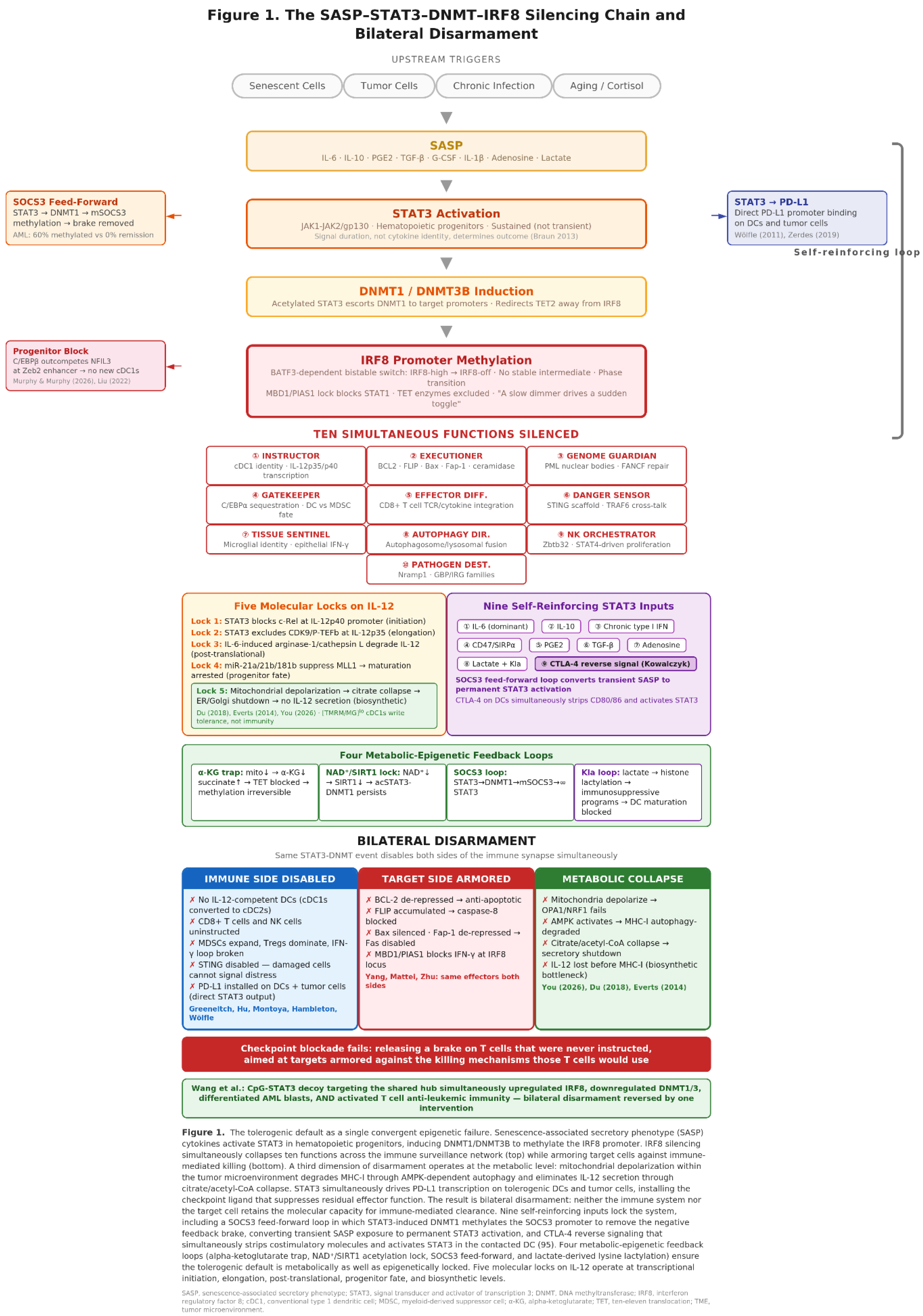
Figure 2.
The alpha-DC1 correction cascade: four temporal phases. The alpha-DC1 is manufactured ex vivo through a three-layer chromatin programming sequence that installs IRF8 in the surveillance codebook outside the STAT3 paracrine field. Upon administration, it initiates a four-phase self-amplifying cascade: IL-12 delivery with dual STAT4/STAT1 IRF8 restoration and immune cell conversion (Phase 1, hours), systemic IFN-gamma-mediated target killing through three parallel pathways calibrated to target methylation state (Phase 2, days), bone marrow niche reprogramming with selective depletion of myeloid-biased HSCs and reversal of Notch Jag2 cis-inhibition (Phase 3, weeks), and emergence of new IRF8-competent progenitors following SASP clearance (Phase 4, months). Five durability mechanisms maintain the corrected state. Intrinsic safety is encoded in the IL-12/IFN-gamma axis: DNAM-1/NKG2D dual-key selectivity, NKG2A brake on healthy cells, and T cell-mediated elimination ensuring pulsatile delivery without IDO installation, reinforced by an iNOS-nitric oxide brake that suppresses IDO enzymatic activity above a bimodal threshold.
Figure 2.
The alpha-DC1 correction cascade: four temporal phases. The alpha-DC1 is manufactured ex vivo through a three-layer chromatin programming sequence that installs IRF8 in the surveillance codebook outside the STAT3 paracrine field. Upon administration, it initiates a four-phase self-amplifying cascade: IL-12 delivery with dual STAT4/STAT1 IRF8 restoration and immune cell conversion (Phase 1, hours), systemic IFN-gamma-mediated target killing through three parallel pathways calibrated to target methylation state (Phase 2, days), bone marrow niche reprogramming with selective depletion of myeloid-biased HSCs and reversal of Notch Jag2 cis-inhibition (Phase 3, weeks), and emergence of new IRF8-competent progenitors following SASP clearance (Phase 4, months). Five durability mechanisms maintain the corrected state. Intrinsic safety is encoded in the IL-12/IFN-gamma axis: DNAM-1/NKG2D dual-key selectivity, NKG2A brake on healthy cells, and T cell-mediated elimination ensuring pulsatile delivery without IDO installation, reinforced by an iNOS-nitric oxide brake that suppresses IDO enzymatic activity above a bimodal threshold.
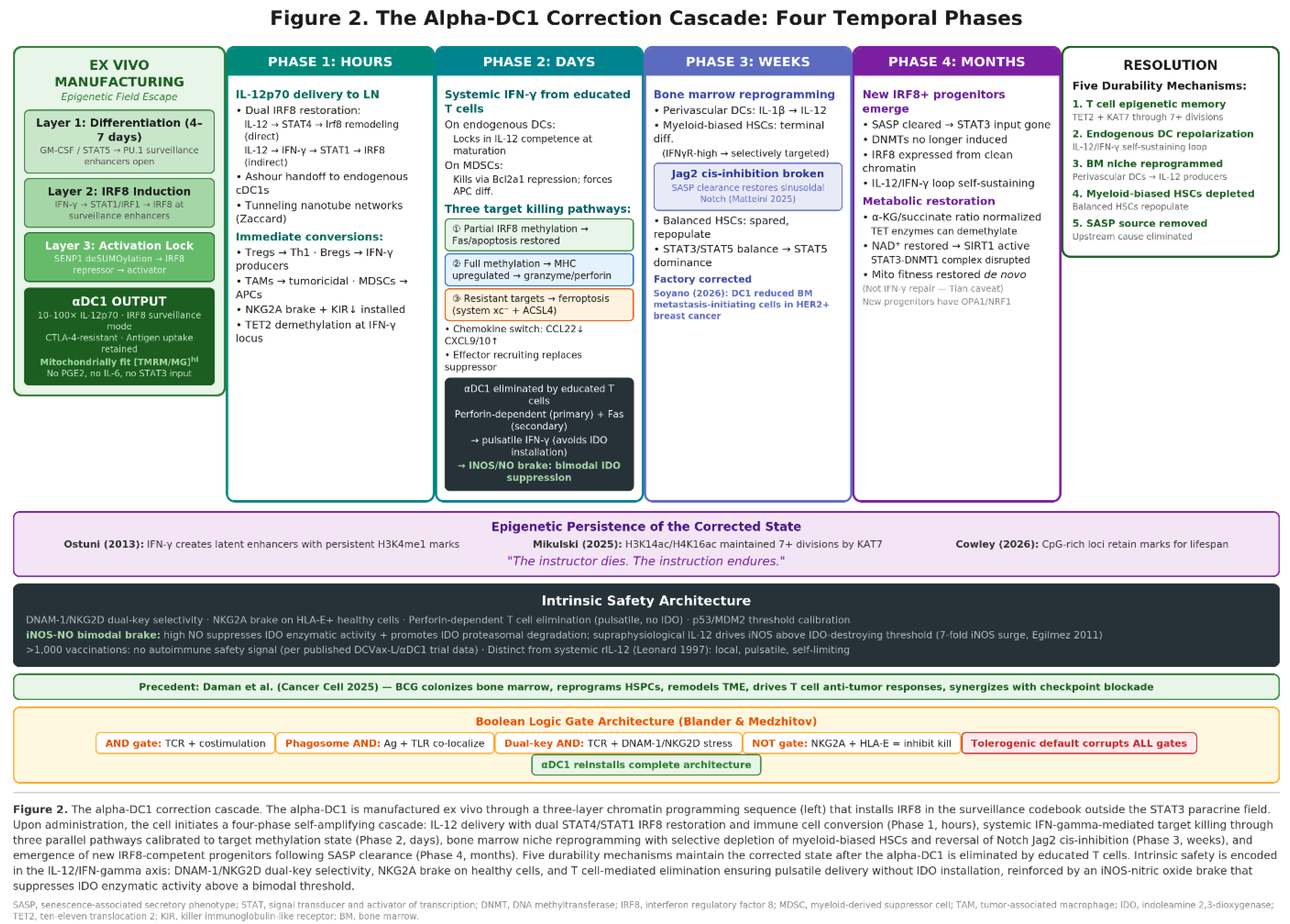
Abbreviations
DC, dendritic cell; alpha-DC1, alpha-type-1 polarized dendritic cell; SASP, senescence-associated secretory phenotype; IRF8, interferon regulatory factor 8; STAT3, signal transducer and activator of transcription 3; DNMT, DNA methyltransferase; MDSC, myeloid-derived suppressor cell; Treg, regulatory T cell; IFN, interferon; IL, interleukin; PGE2, prostaglandin E2; TLR, Toll-like receptor; BCG, Bacillus Calmette-Guerin; HSC, hematopoietic stem cell; cDC1, conventional type 1 dendritic cell; cDC2, conventional type 2 dendritic cell; OPA1, optic atrophy 1; AMPK, AMP-activated protein kinase; NAD+, nicotinamide adenine dinucleotide; SIRT1, sirtuin 1; TET, ten-eleven translocation; α-KG, alpha-ketoglutarate; CHIP, clonal hematopoiesis of indeterminate potential; NRF1, nuclear respiratory factor 1; SOCS3, suppressor of cytokine signaling 3; Kla, lysine lactylation; PD-L1, programmed death-ligand 1; TMRM, tetramethylrhodamine methyl ester.
Data Availability Statement
No datasets were generated or analyzed for this study.
Ethical Statement
This project was exempt from IRB review as it did not qualify as human subject research under federal regulations.
Author Contributions
AC: Conceptualization, Writing – original draft, Writing – review and editing. AB: Writing – review and editing.
Funding
This work received no external funding.
Acknowledgements
During the preparation of this manuscript, the authors used multiple AI-assisted tools for literature search, reference verification, manuscript drafting, and iterative editing: Claude (Anthropic, Claude Opus 4 / Claude Opus 4.6) for research synthesis and manuscript composition; Perplexity (Perplexity AI, Inc.) and OpenEvidence for literature search and reference verification; Gemini (Google, Gemini 2.5 Pro) for supplementary research; Grok (xAI) and ChatGPT (OpenAI, GPT-4o) for cross-validation. All scientific claims, interpretations, and arguments were directed, reviewed, and verified by the authors, who take full responsibility for the accuracy and content of the final published text.
Conflict of Interest Statement
Author AC has filed a provisional patent application covering methods and compositions related to concepts described in this manuscript. AB is affiliated with SaltusBiotech.
References
- Steinman, RM; Cohn, ZA. Identification of a novel cell type in peripheral lymphoid organs of mice. J Exp Med 1973, 137, 1142–1162. [Google Scholar] [CrossRef]
- Banchereau, J; Steinman, RM. Dendritic cells and the control of immunity. Nature 1998, 392, 245–252. [Google Scholar] [CrossRef]
- Hawiger, D; Inaba, K; Dorsett, Y; et al. Dendritic cells induce peripheral T cell unresponsiveness under steady state conditions in vivo. J Exp Med 2001, 194, 769–779. [Google Scholar] [CrossRef]
- Krummel, MF; Allison, JP. CD28 and CTLA-4 have opposing effects on the response of T cells to stimulation. J Exp Med 1995, 182, 459–465. [Google Scholar] [CrossRef]
- Leach, DR; Krummel, MF; Allison, JP. Enhancement of antitumor immunity by CTLA-4 blockade. Science 1996, 271, 1734–1736. [Google Scholar] [CrossRef]
- Sakaguchi, S; Sakaguchi, N; Asano, M; et al. Immunologic self-tolerance maintained by activated T cells expressing IL-2 receptor alpha-chains (CD25). J Immunol 1995, 155, 1151–1164. [Google Scholar] [CrossRef] [PubMed]
- Hori, S; Nomura, T; Sakaguchi, S. Control of regulatory T cell development by the transcription factor Foxp3. Science 2003, 299, 1057–1061. [Google Scholar] [CrossRef]
- Wing, K; Onishi, Y; Prieto-Martin, P; et al. CTLA-4 control over Foxp3+ regulatory T cell function. Science 2008, 322, 271–275. [Google Scholar] [CrossRef]
- Qureshi, OS; Zheng, Y; Nakamura, K; et al. Trans-endocytosis of CD80 and CD86: a molecular basis for the cell-extrinsic function of CTLA-4. Science 2011, 333, 261–263. [Google Scholar] [CrossRef]
- Kennedy, A; Waters, E; Rowshanravan, B; et al. Differences in CD80 and CD86 transendocytosis reveal CD86 as a key target for CTLA-4 immune regulation. Nat Immunol 2022, 23, 1365–1378. [Google Scholar] [CrossRef]
- Mailliard, RB; Wieckowski, E; Muthuswamy, R; et al. Alpha-type-1 polarized dendritic cells: a novel immunization tool with optimized CTL-inducing activity. Cancer Res 2004, 64, 5934–5937. [Google Scholar] [CrossRef]
- Hansen, M; Hjorto, GM; Donia, M; et al. Comparison of clinical grade type 1-polarized and standard matured dendritic cells for cancer immunotherapy. Vaccine 2013, 31, 639–646. [Google Scholar] [CrossRef] [PubMed]
- Dong, H; Obermajer, N; Tsuji, T; et al. Contributions of DNAM-1 and NKG2D to functional activation of human CTLs. Cancer Immunol Res 2024, 12, 339–353. [Google Scholar] [CrossRef]
- Feng, T; Cao, AT; Weaver, CT; et al. Interleukin-12 converts Foxp3+ regulatory T cells to interferon-gamma-producing Foxp3+ T cells that inhibit colitis. Gastroenterology (2011) 140, 2031–2043. [CrossRef]
- Wilson, CB; Makar, KW; Shnyreva, M; et al. DNA methylation and the expanding epigenetics of T cell lineage commitment. Semin Immunol 2005, 17, 105–119. [Google Scholar] [CrossRef]
- Qiao, Y; Giannopoulou, EG; Chan, CH; et al. Synergistic activation of inflammatory cytokine genes by interferon-gamma-induced chromatin remodeling and toll-like receptor signaling. Immunity 2013, 39, 454–469. [Google Scholar] [CrossRef]
- Ostuni, R; Piccolo, V; Barozzi, I; et al. Latent enhancers activated by stimulation in differentiated cells. Cell 2013, 152, 157–171. [Google Scholar] [CrossRef] [PubMed]
- Mikulski, P; Schubert, S; Giesselmann, S; et al. IFN-gamma-induced chromatin memory in human cells is maintained through mitotic divisions by the histone acetyltransferase KAT7. Nat Struct Mol Biol 2025, 32, 512–523. [Google Scholar] [CrossRef]
- Cowley, CJ; Sajjath, SM; Soto-Ugaldi, LF; et al. Distinctive DNA sequence features define epigenetic longevity of inflammatory memory. Science 2026, 391(6792), 1347–1354. [Google Scholar] [CrossRef] [PubMed]
- Subbiah, V; Murthy, R; Hong, DS; et al. Cytokines produced by dendritic cells administered intratumorally correlate with clinical outcome in patients with diverse cancers. Clin Cancer Res 2018, 24, 3845–3856. [Google Scholar] [CrossRef]
- Liau, LM; Ashkan, K; Brem, S; et al. Association of autologous tumor lysate-loaded dendritic cell vaccination with extension of survival among patients with newly diagnosed and recurrent glioblastoma. JAMA Oncol 2023, 9, 112–121. [Google Scholar] [CrossRef]
- Jackson, AL; Matsumoto, H; Janszen, M; et al. Restricted expression of p55 interleukin 2 receptor (CD25) on normal T cells. Clin Immunol Immunopathol 1990, 54, 126–133. [Google Scholar] [CrossRef]
- Coppe, JP; Patil, CK; Rodier, F; et al. Senescence-associated secretory phenotypes reveal cell nonautonomous functions of oncogenic RAS and the p53 tumor suppressor. PLoS Biol 2008, 6, e301. [Google Scholar] [CrossRef]
- Manz, MG; Boettcher, S. Emergency granulopoiesis. Nat Rev Immunol 2014, 14, 302–314. [Google Scholar] [CrossRef] [PubMed]
- Park, SJ; Nakagawa, T; Kitamura, H; et al. IL-6 regulates in vivo dendritic cell differentiation through STAT3 activation. J Immunol 2004, 173, 3844–3854. [Google Scholar] [CrossRef]
- Kalinski, P; Hilkens, CM; Snijders, A; et al. IL-12-deficient dendritic cells, generated in the presence of prostaglandin E2, promote type 2 cytokine production in maturing human naive T helper cells. J Immunol 1997, 159, 28–35. [Google Scholar] [CrossRef]
- Gabrilovich, DI; Nagaraj, S. Myeloid-derived suppressor cells as regulators of the immune system. Nat Rev Immunol 2009, 9, 162–174. [Google Scholar] [CrossRef]
- Spranger, S; Bao, R; Gajewski, TF. Melanoma-intrinsic beta-catenin signalling prevents anti-tumour immunity. Nature 2015, 523, 231–235. [Google Scholar] [CrossRef] [PubMed]
- Goriely, S; Demonte, D; Ziegler-Heitbrock, L; et al. Human IL-12(p35) gene activation involves selective remodeling of a single nucleosome within a region of the promoter containing critical Sp1-binding sites. Blood 2003, 101, 4894–4902. [Google Scholar] [CrossRef] [PubMed]
- Tamura, T; Yanai, H; Savitsky, D; et al. The IRF family transcription factors in immunity and oncogenesis. Annu Rev Immunol 2008, 26, 535–584. [Google Scholar] [CrossRef]
- Salem, S; Salem, D; Gros, P. Role of IRF8 in immune cells functions, protection against infections, and susceptibility to inflammatory diseases. Hum Genet 2020, 139, 707–721. [Google Scholar] [CrossRef]
- Langlais, D; Barreiro, LB; Gros, P. The macrophage IRF8/IRF1 regulome is required for protection against infections and is associated with chronic inflammation. J Exp Med 2016, 213, 585–603. [Google Scholar] [CrossRef]
- Ibrahim, ML; Klement, JD; Lu, C; et al. Myeloid-derived suppressor cells produce IL-10 to elicit DNMT3b-dependent IRF8 silencing to promote colitis-associated colon tumorigenesis. Cell Rep 2018, 25, 3036–3046.e6. [Google Scholar] [CrossRef] [PubMed]
- McGough, JM; Yang, D; Huang, S; et al. DNA methylation represses IFN-gamma-induced and signal transducer and activator of transcription 1-mediated IFN regulatory factor 8 activation in colon carcinoma cells. Mol Cancer Res 2008, 6, 1841–1851. [Google Scholar] [CrossRef] [PubMed]
- Ohno, Y; Kitamura, H; Takahashi, N; et al. IL-6 down-regulates HLA class II expression and IL-12 production of human dendritic cells to impair activation of antigen-specific CD4+ T cells. Cancer Immunol Immunother 2016, 65, 193–204. [Google Scholar] [CrossRef] [PubMed]
- Pathak, S; Ma, S; Shukla, V; et al. A role for IRF8 in B cell anergy. J Immunol 2013, 191, 6222–6230. [Google Scholar] [CrossRef]
- Zhao, B; Takami, M; Yamada, A; et al. Interferon regulatory factor-8 regulates bone metabolism by suppressing osteoclastogenesis. Nat Med 2009, 15, 1066–1071. [Google Scholar] [CrossRef]
- Lung, TL; Saurwein-Teissl, M; Parson, W; et al. Unimpaired dendritic cells can be derived from monocytes in old age and can mobilize residual function in senescent T cells. Vaccine 2000, 18, 1606–1612. [Google Scholar] [CrossRef]
- Zhou, J; Tison, K; Zhou, H; et al. STAT5 and STAT3 balance shapes dendritic cell function and tumour immunity. Nature 2025, 643, 519–528. [Google Scholar] [CrossRef]
- Zhivaki, D; Kennedy, SN; Park, J; et al. Correction of age-associated defects in dendritic cells enables CD4+ T cells to eradicate tumors. Cell 2024, 187, 3888–3903.e18. [Google Scholar] [CrossRef]
- Tsuji, S; Matsumoto, M; Takeuchi, O; et al. Maturation of human dendritic cells by cell wall skeleton of Mycobacterium bovis bacillus Calmette-Guerin: involvement of toll-like receptors. Infect Immun 2000, 68, 6883–6890. [Google Scholar] [CrossRef]
- Shankar, G; Pestano, LA; Bosch, ML. Interferon-gamma added during bacillus Calmette-Guerin induced dendritic cell maturation stimulates potent Th1 immune responses. J Transl Med 2003, 1, 7. [Google Scholar] [CrossRef]
- Chang, TH; Xu, S; Tailor, P; et al. The small ubiquitin-like modifier-deconjugating enzyme sentrin-specific peptidase 1 switches IFN regulatory factor 8 from a repressor to an activator during macrophage activation. J Immunol 2012, 189, 3548–3556. [Google Scholar] [CrossRef]
- Fesneau, O; Theate, I; Caux, C; et al. IL-12 drives NKG2A expression on tumor-reactive CD8+ T cells. Immunity 2024, 57, 1614–1631. [Google Scholar]
- Ashour, D; Arampatzi, P; Pavlovic, V; et al. IL-12 from endogenous cDC1, and not vaccine DC, is required for Th1 induction. J Clin Invest 2020, 130, 3051–3060. [Google Scholar] [CrossRef] [PubMed]
- Matatall, KA; Jeong, M; Chen, S; et al. Chronic infection depletes hematopoietic stem cells through stress-induced terminal differentiation. Cell Rep 2016, 17, 2584–2595. [Google Scholar] [CrossRef] [PubMed]
- Panda, A; Qian, F; Mohanty, S; et al. Age-associated decrease in TLR function in primary human dendritic cells predicts influenza vaccine response. J Immunol 2010, 184, 2518–2527. [Google Scholar] [CrossRef]
- Compte, N; Zouaoui Boudjeltia, K; Vanhaeverbeek, M; et al. Frailty in old age is associated with decreased interleukin-12/23 production in response to toll-like receptor ligation. PLoS One 2013, 8, e65325. [Google Scholar] [CrossRef]
- Guo, Z; Tilburgs, T; Wong, B; et al. Dysfunction of dendritic cells in aged C57BL/6 mice leads to failure of natural killer cell activation and of tumor eradication. Proc Natl Acad Sci U S A 2014, 111, 14199–14204. [Google Scholar] [CrossRef]
- Wagner, AH; Conzelmann, M; Fitzer, F; et al. JAK1/STAT3 activation directly inhibits IL-12 production in dendritic cells by preventing CDK9/P-TEFb recruitment to the p35 promoter. Biochem Pharmacol 2015, 96, 52–64. [Google Scholar] [CrossRef]
- Kim, D; Park, G; Huuhtanen, J; et al. STAT3 activation in large granular lymphocyte leukemia is associated with cytokine signaling and DNA hypermethylation. Leukemia 2021, 35, 3430–3443. [Google Scholar] [CrossRef] [PubMed]
- Rojas-Canales, D; Krishnan, R; Jessup, CF; et al. Early exposure of interferon-gamma inhibits signal transducer and activator of transcription-6 signalling and nuclear factor kappaB activation in a short-term monocyte-derived dendritic cell culture promoting regulatory dendritic cells. Clin Exp Immunol 2012, 167, 447–458. [Google Scholar] [CrossRef]
- Smith, AM; Qualls, JE; O’Brien, K; et al. A distal enhancer in Il12b is the target of transcriptional repression by the STAT3 pathway and requires the basic leucine zipper (B-ZIP) protein NFIL3. J Biol Chem 2011, 286, 23582–23590. [Google Scholar] [CrossRef] [PubMed]
- Hoentjen, F; Sartor, RB; Ozaki, M; et al. STAT3 regulates NF-kappaB recruitment to the IL-12p40 promoter in dendritic cells. Blood 2005, 105, 689–696. [Google Scholar] [CrossRef]
- Molony, RD; Nguyen, JT; Kong, Y; et al. Aging impairs both primary and secondary RIG-I signaling for interferon induction in human monocytes. Sci Signal 2017, 10(509), eaan2392. [Google Scholar] [CrossRef] [PubMed]
- Zhang, Z; Huang, X; Wang, E; et al. Suppression of Mll1-complex by Stat3/Cebpbeta-induced miR-21a/21b/181b maintains the accumulation, homeostasis, and immunosuppressive function of polymorphonuclear myeloid-derived suppressor cells. J Immunol 2020, 204, 3400–3415. [Google Scholar] [CrossRef]
- Zaccard, CR; Watkins, SC; Kalinski, P; et al. CD40L induces functional tunneling nanotube networks exclusively in dendritic cells programmed by mediators of type 1 immunity. J Immunol 2015, 194, 1047–1056. [Google Scholar] [CrossRef]
- Wang, W; Green, M; Choi, JE; et al. CD8+ T cells regulate tumour ferroptosis during cancer immunotherapy. Nature 2019, 569, 270–274. [Google Scholar] [CrossRef]
- Ferris, ST; Ohara, RA; Ou, F; et al. cDC1 vaccines drive tumor rejection by direct presentation independently of host cDC1. Cancer Immunol Res 2022, 10, 920–931. [Google Scholar] [CrossRef]
- Khateb, M; Azriel, A; Levi, BZ. The third intron of IRF8 is a cell-type-specific chromatin priming element during mouse embryonal stem cell differentiation. J Mol Biol 2019, 431, 210–222. [Google Scholar] [CrossRef]
- Politis, AD; Sivo, J; Driggers, PH; et al. Modulation of interferon consensus sequence binding protein mRNA in murine peritoneal macrophages. J Immunol 1992, 148, 801–22429. [Google Scholar] [CrossRef]
- Liu, J; Guan, X; Tamura, T; Ozato, K; Ma, X. Synergistic activation of interleukin-12 p35 gene transcription by interferon regulatory factor-1 and interferon consensus sequence-binding protein. J Biol Chem 2004, 279, 55609–55617. [Google Scholar] [CrossRef] [PubMed]
- Lanca, T; Ungerback, J; Da Silva, C; et al. IRF8 deficiency induces the transcriptional, functional, and epigenetic reprogramming of cDC1 into the cDC2 lineage. Immunity 2022, 55, 1431–1447.e11. [Google Scholar] [CrossRef]
- Burchert, A; Cai, D; Hofbauer, LC; et al. Interferon consensus sequence binding protein (ICSBP; IRF-8) antagonizes BCR/ABL and down-regulates bcl-2. Blood 2004, 103, 3480–3489. [Google Scholar] [CrossRef]
- Yang, D; Thangaraju, M; Green, K; et al. IFN regulatory factor 8 sensitizes soft tissue sarcoma cells to death receptor-initiated apoptosis via repression of FLICE-like protein. Cancer Res 2009, 69, 1080–1088. [Google Scholar] [CrossRef] [PubMed]
- Hu, X; Yang, D; Zimmerman, M; et al. IRF8 regulates acid ceramidase expression to mediate apoptosis and suppresses tumourigenesis. Nat Commun 2011, 2, 1–12. [Google Scholar] [CrossRef]
- Yang, D; Wang, S; Brooks, C; et al. IFN regulatory factor 8 mediates apoptosis in nonhemopoietic tumor cells via regulation of Fas expression. J Immunol 2007, 179, 4775–4782. [Google Scholar] [CrossRef]
- Huang, W; Zhu, C; Wang, H; et al. IRF8 represses PTPN13/FAP-1 expression and sensitizes tumor cells to FAS-mediated apoptosis. Cancer Immunol Res 2015, 3, 73–83. [Google Scholar] [CrossRef]
- Kurotaki, D; Yamamoto, M; Nishiyama, A; et al. IRF8 inhibits C/EBP-alpha activity to restrain mononuclear phagocyte progenitors from differentiating into neutrophils. Nat Commun 2014, 5, 4978. [Google Scholar] [CrossRef]
- Lee, J; Zhou, YJ; Ma, W; et al. Lineage specification of human dendritic cells is marked by IRF8 expression in hematopoietic stem cells and multipotent progenitors. Nat Immunol 2017, 18, 877–888. [Google Scholar] [CrossRef]
- Meyer, MA; Baer, JM; Knolhoff, BL; et al. Breast and pancreatic cancer interrupt IRF8-dependent dendritic cell development to overcome immune surveillance. Nat Commun 2018, 9, 1250. [Google Scholar] [CrossRef]
- Miyagawa, F; Zhang, H; Terunuma, A; et al. Interferon regulatory factor 8 integrates T-cell receptor and cytokine-signaling pathways and drives effector differentiation of CD8 T cells. Proc Natl Acad Sci U S A 2012, 109, 12123–12128. [Google Scholar] [CrossRef]
- Li, R; Wei, K; Sun, Q; et al. Analysis of the three-dimensional genome of exhausted CD8+ T cells reveals a critical role of IRF8 in their differentiation and functions in cancer. Nat Immunol 2025, 26, 2280–2295. [Google Scholar] [CrossRef] [PubMed]
- Luo, W; Zou, Z; Tao, S; et al. IRF8 is associated with STING to modulate DNA damage-induced cellular senescence. Nat Commun 2023, 14, 5504. [Google Scholar] [CrossRef]
- Zhao, J; Kong, HJ; Li, H; et al. IRF-8/interferon (IFN) consensus sequence-binding protein is involved in Toll-like receptor (TLR) signaling and contributes to the cross-talk between TLR and IFN-gamma signaling pathways. J Biol Chem 2006, 281, 10073–10080. [Google Scholar] [CrossRef]
- Saeki, K; Shichino, S; Ueha, S; et al. IRF8 configures enhancer landscape in postnatal microglia and directs microglia specific transcriptional programs. Nat Immunol 2024, 25, 1928–1942. [Google Scholar] [CrossRef]
- Yan, J; Chen, G; Tong, S; et al. IRF8 contributes to mucosal immunity by promoting IFN-gamma expression in gastric epithelial cells. J Cell Biochem 2018, 119, 1274–1281. [Google Scholar]
- Gupta, M; Shin, DM; Ramakrishna, L; et al. IRF8 directs stress-induced autophagy in macrophages and promotes clearance of Listeria monocytogenes. Nat Commun 2015, 6, 6379. [Google Scholar] [CrossRef] [PubMed]
- Adams, NM; Lau, CM; Fan, X; et al. Transcription factor IRF8 orchestrates the adaptive natural killer cell response. Immunity 2018, 48, 1172–1182.e6. [Google Scholar] [CrossRef]
- Mace, EM; Bigley, V; Gunesch, JT; et al. Biallelic mutations in IRF8 impair human NK cell maturation and function. J Clin Invest 2017, 127, 306–320. [Google Scholar] [CrossRef]
- Alter-Koltunoff, M; Goren, S; Nousbeck, J; et al. Innate immunity to intraphagosomal pathogens is mediated by interferon regulatory factor 8 (IRF-8) that stimulates the expression of macrophage-specific Nramp1 through antagonizing repression by c-Myc. J Biol Chem 2008, 283, 2724–2733. [Google Scholar] [CrossRef]
- Marquis, JF; Vachon, V; Bhatt, DL; et al. The IRF-8 regulome includes genome-wide enrichment for GBP and IRG family antimicrobial effectors. Eur J Immunol 2011, 41, 3270–3282. [Google Scholar] [CrossRef]
- Murphy, TL; Murphy, KM. The making of a cDC1: precision programming of progenitor potential. Immunol Rev 2026, 337, e70081. [Google Scholar] [CrossRef]
- Lehtonen, A; Lund, R; Lahesmaa, R; Julkunen, I; Sareneva, T; Matikainen, S. IFN-alpha and IL-12 activate IFN regulatory factor 1 (IRF-1), IRF-4, and IRF-8 gene expression in human NK and T cells. Cytokine 2003, 24, 81–90. [Google Scholar] [CrossRef]
- Zebley, CC; Abdelsamed, HA; Ghoneim, HE; et al. Proinflammatory cytokines promote TET2-mediated DNA demethylation during CD8 T cell effector differentiation. Cell Rep 2021, 37, 109796. [Google Scholar] [CrossRef]
- Stirewalt, DL; Choi, YE; Sharpless, NE; et al. Decreased IRF8 expression found in aging hematopoietic progenitor/stem cells. Leukemia 2009, 23, 391–393. [Google Scholar] [CrossRef] [PubMed]
- Elsner, RA; Smita, S; Engiles, JB; Shlomchik, MJ. Coordinated regulation of extrafollicular B cell responses by IL-12 and IFN-gamma. Immunol Rev 2025, 329, e70027. [Google Scholar] [CrossRef]
- Watkins, SK; Egilmez, NK; Suttles, J; et al. IL-12 rapidly alters the functional profile of tumor-associated and tumor-infiltrating macrophages in vitro and in vivo. J Immunol 2007, 178, 1357–1362. [Google Scholar] [CrossRef] [PubMed]
- Ewen, EM; Pahl, JHW; Miller, M; et al. KIR downregulation by IL-12/15/18 unleashes human NK cells from KIR/HLA-I inhibition and enhances killing of tumor cells. Eur J Immunol 2018, 48, 355–365. [Google Scholar] [CrossRef]
- Hambleton, S; Salem, S; Bustamante, J; et al. IRF8 mutations and human dendritic-cell immunodeficiency. N Engl J Med 2011, 365, 127–138. [Google Scholar] [CrossRef] [PubMed]
- Basrai, S; Nofech-Mozes, I; Detroja, R; et al. Blood-based epigenetic instability linked to human aging and disease. Nat Commun 2026, 17, 2754. [Google Scholar] [CrossRef] [PubMed]
- Zhang, Q; Wang, HY; Woetmann, A; et al. STAT3 induces transcription of the DNA methyltransferase 1 gene (DNMT1) in malignant T lymphocytes. Blood 2006, 108, 1058–1064. [Google Scholar] [CrossRef]
- Li, Q; Harden, JL; Anderson, CD; Egilmez, NK. Tolerogenic phenotype of IFN-gamma-induced IDO+ dendritic cells is maintained via an autocrine IDO-kynurenine/AhR-IDO loop. J Immunol 2016, 197, 962–970. [Google Scholar] [CrossRef]
- Edelstein, MP; Ozaki, Y; Duch, DS. Synergistic effects of phorbol ester and IFN-gamma on the induction of indoleamine 2,3-dioxygenase in THP-1 monocytic leukemia cells. J Immunol 1989, 143, 2969–2973. [Google Scholar] [CrossRef]
- Kowalczyk, A; D’Souza, CA; Zhang, L. Cell-extrinsic CTLA4-mediated regulation of dendritic cell maturation depends on STAT3. Eur J Immunol 2014, 44, 1143–1155. [Google Scholar] [CrossRef]
- Yang, J; Huck, SP; McHugh, RS; Hermans, IF; Ronchese, F. Perforin-dependent elimination of dendritic cells regulates the expansion of antigen-specific CD8+ T cells in vivo. Proc Natl Acad Sci U S A 2006, 103, 147–152. [Google Scholar] [CrossRef] [PubMed]
- Chen, M; Felix, K; Wang, J. Critical role for perforin and Fas-dependent killing of dendritic cells in the control of inflammation. Blood 2012, 119, 127–136. [Google Scholar] [CrossRef]
- Harden, JL; Gu, T; Kilinc, MO; et al. Dichotomous effects of IFN-gamma on dendritic cell function determine the extent of IL-12-driven antitumor T cell immunity. J Immunol 2011, 187, 126–132. [Google Scholar] [CrossRef]
- Greeneltch, KM; Schneider, M; Steinberg, SM; et al. Host immunosurveillance controls tumor growth via IFN regulatory factor-8 dependent mechanisms. Cancer Res 2007, 67, 10406–10416. [Google Scholar] [CrossRef]
- Hu, X; Bardhan, K; Paschall, AV; et al. Deregulation of apoptotic factors Bcl-xL and Bax confers apoptotic resistance to myeloid-derived suppressor cells and contributes to their persistence in cancer. J Biol Chem 2013, 288, 19103–19115. [Google Scholar] [CrossRef] [PubMed]
- Mattei, F; Schiavoni, G; Sestili, P; et al. IRF-8 controls melanoma progression by regulating the cross talk between cancer and immune cells within the tumor microenvironment. Neoplasia 2012, 14, 1223–1235. [Google Scholar] [CrossRef] [PubMed]
- Montoya, M; Collins, SA; Chuntova, P; et al. Interferon regulatory factor 8-driven reprogramming of the immune microenvironment enhances antitumor adaptive immunity and reduces immunosuppression in murine glioblastoma. Neuro-Oncology 2024, 26, 2272–2287. [Google Scholar] [CrossRef]
- Yang, D; Thangaraju, M; Greeneltch, K; et al. Repression of IFN regulatory factor 8 by DNA methylation is a molecular determinant of apoptotic resistance and metastatic phenotype in metastatic tumor cells. Cancer Res 2007, 67, 3301–3309. [Google Scholar] [CrossRef]
- Luo, WW; Tong, Z; Cao, P; et al. Transcription-independent regulation of STING activation and innate immune responses by IRF8 in monocytes. Nat Commun 2022, 13, 4822. [Google Scholar] [CrossRef]
- Braun, DA; Fribourg, M; Sealfon, SC. Cytokine response is determined by duration of receptor and signal transducers and activators of transcription 3 (STAT3) activation. J Biol Chem 2013, 288, 2986–2993. [Google Scholar] [CrossRef]
- Qing, Y; Stark, GR. Alternative activation of STAT1 and STAT3 in response to interferon-gamma. J Biol Chem 2004, 279, 41679–41685. [Google Scholar] [CrossRef] [PubMed]
- Dees, C; Pötter, S; Zhang, Y; et al. TGF-beta-induced epigenetic deregulation of SOCS3 facilitates STAT3 signaling to promote fibrosis. J Clin Invest 2020, 130, 2347–2363. [Google Scholar] [CrossRef]
- Zhao, B; Takami, M; Yamada, A; et al. Interferon regulatory factor-8 regulates bone metabolism by suppressing osteoclastogenesis. Nat Med 2009, 15, 1066–1071. [Google Scholar] [CrossRef]
- Li, CC; Munitic, I; Mittelstadt, PR; et al. Suppression of dendritic cell-derived IL-12 by endogenous glucocorticoids is protective in LPS-induced sepsis. PLoS Biol 2015, 13, e1002269. [Google Scholar] [CrossRef]
- Soulier, A; Blois, SM; Sivakumaran, S; et al. Cell-intrinsic regulation of murine dendritic cell function and survival by prereceptor amplification of glucocorticoid. Blood 2013, 122, 3288–3297. [Google Scholar] [CrossRef] [PubMed]
- Murphy, TL; Murphy, KM. The making of a cDC1: precision programming of progenitor potential. Immunol Rev 2026, 337, e70081. [Google Scholar] [CrossRef] [PubMed]
- Liu, TT; Kim, S; Desai, P; et al. Ablation of cDC2 development by triple mutations within the Zeb2 enhancer. Nature 2022, 607, 142–148. [Google Scholar] [CrossRef]
- Lee, H; Zhang, P; Herrmann, A; et al. Acetylated STAT3 is crucial for methylation of tumor-suppressor gene promoters and inhibition by resveratrol results in demethylation. Proc Natl Acad Sci U S A 2012, 109, 7765–7769. [Google Scholar] [CrossRef] [PubMed]
- Li, Y; Deuring, J; Peppelenbosch, MP; et al. IL-6-induced DNMT1 activity mediates SOCS3 promoter hypermethylation in ulcerative colitis-related colorectal cancer. Carcinogenesis 2012, 33, 1889–1896. [Google Scholar] [CrossRef]
- Zhang, X; Zhang, K; Zhang, J; et al. DNMTs-mediated SOCS3 methylation promotes the occurrence and development of AML. Eur J Haematol 2024, 112, 439–449. [Google Scholar] [CrossRef]
- Thomas, SR; Mohr, D; Stocker, R. Nitric oxide inhibits indoleamine 2,3-dioxygenase activity in interferon-gamma primed mononuclear phagocytes. J Biol Chem 1994, 269, 14457–14464. [Google Scholar] [CrossRef]
- Hucke, C; MacKenzie, CR; Adjogble, KD; et al. Nitric oxide-mediated regulation of gamma interferon-induced bacteriostasis: inhibition and degradation of human indoleamine 2,3-dioxygenase. Infect Immun 2004, 72, 2723–2730. [Google Scholar] [CrossRef]
- López, AS; Alegre, E; Díaz, A; et al. Bimodal effect of nitric oxide in the enzymatic activity of indoleamine 2,3-dioxygenase in human monocytic cells. Immunol Lett 2006, 106, 163–171. [Google Scholar] [CrossRef]
- Egilmez, NK; Harden, JL; Virtuoso, LP; et al. Nitric oxide short-circuits interleukin-12-mediated tumor regression. Cancer Immunol Immunother 2011, 60, 839–845. [Google Scholar] [CrossRef] [PubMed]
- Zhu, J; Huang, X; Yang, G. Autocrine IL6-mediated activation of the STAT3–DNMT axis silences the TNF-alpha–RIP1 necroptosis pathway to sustain survival and accumulation of myeloid-derived suppressor cells. Cancer Res 2020, 80, 3145–3156. [Google Scholar] [CrossRef]
- Matatall, KA; Shen, CC; Challen, GA; King, KY. Type II interferon promotes differentiation of myeloid-biased hematopoietic stem cells. Stem Cells 2014, 32, 3023–3030. [Google Scholar] [CrossRef]
- Patel, B; Zhou, Y; Babcock, RL; et al. STAT3 protects hematopoietic stem cells by preventing activation of a deleterious autocrine type-I interferon response. Leukemia 2024, 38, 1143–1155. [Google Scholar] [CrossRef] [PubMed]
- Mantel, C; Messina-Graham, S; Moh, A; et al. Mouse hematopoietic cell-targeted STAT3 deletion: stem/progenitor cell defects, mitochondrial dysfunction, ROS overproduction, and a rapid aging-like phenotype. Blood 2012, 120, 2589–2599. [Google Scholar] [CrossRef]
- Jenkins, BJ; Roberts, AW; Najdovska, M; Grail, D; Ernst, M. The threshold of gp130-dependent STAT3 signaling is critical for normal regulation of hematopoiesis. Blood 2005, 105, 3512–3520. [Google Scholar] [CrossRef]
- Kato, Y; Iwama, A; Tadokoro, Y; et al. Selective activation of STAT5 unveils its role in stem cell self-renewal in normal and leukemic hematopoiesis. J Exp Med 2005, 202, 169–179. [Google Scholar] [CrossRef]
- Liao, P; Wang, W; Wang, W; et al. CD8+ T cells and fatty acids orchestrate tumor ferroptosis and immunity via ACSL4. Cancer Cell 2022, 40, 365–378.e6. [Google Scholar] [CrossRef] [PubMed]
- Lin, Z; Zou, S; Wen, K. The crosstalk of CD8+ T cells and ferroptosis in cancer. Front Immunol 2023, 14, 1255443. [Google Scholar] [CrossRef]
- Flem-Karlsen, K; Talty, R; McGeary, MK; et al. Cytotoxic CD8+ T cells downregulate GPX4 to promote ferroptosis in melanoma that drives antitumor immunity. Cancer Res 2025. [Google Scholar] [CrossRef]
- Onodera, A; González-Avalos, E; Lio, CJ; et al. Roles of TET and TDG in DNA demethylation in proliferating and non-proliferating immune cells. Genome Biol 2021, 22, 186. [Google Scholar] [CrossRef]
- Blander, JM; Medzhitov, R. Toll-dependent selection of microbial antigens for presentation by dendritic cells. Nature 2006, 440, 808–812. [Google Scholar] [CrossRef] [PubMed]
- Leonard, JP; Sherman, ML; Fisher, GL; et al. Effects of single-dose interleukin-12 exposure on interleukin-12-associated toxicity and interferon-gamma production. Blood 1997, 90, 2541–2548. [Google Scholar] [PubMed]
- Yoshida, Y; Yoshimi, R; Yoshii, H; et al. The transcription factor IRF8 activates integrin-mediated TGF-beta signaling and promotes neuroinflammation. Immunity 2014, 40, 187–198. [Google Scholar] [CrossRef]
- Khan, O; Giles, JR; McDonald, S; et al. TOX transcriptionally and epigenetically programs CD8+ T cell exhaustion. Nature 2019, 571, 211–218. [Google Scholar] [CrossRef] [PubMed]
- Tucker, CG; Mitchell, JS; Martinov, T; et al. Adoptive T cell therapy with IL-12-preconditioned low-avidity T cells prevents exhaustion and results in enhanced T cell activation, enhanced tumor clearance, and decreased risk for autoimmunity. J Immunol 2020, 205, 1449–1460. [Google Scholar] [CrossRef]
- Grassmann, S; Santosa, EK; Kim, H; et al. Stepwise epigenetic signal integration drives adaptive programming of cytotoxic lymphocytes. Immunity 2026. [Google Scholar] [CrossRef]
- Hajishengallis, G; Chavakis, T. Inflammageing and clonal haematopoiesis interplay and their impact on human disease. Nat Rev Mol Cell Biol 2026. [Google Scholar] [CrossRef]
- Mohammadnia, N; Xue, L; Vestjens, LTW; et al. Colchicine and longitudinal dynamics of clonal hematopoiesis: an exploratory substudy of the LoDoCo2 trial. J Am Coll Cardiol (2025) 86, 1983–1996. [CrossRef] [PubMed]
- Wang, D; Kaniowski, D; Jacek, K; et al. Bi-functional CpG-STAT3 decoy oligonucleotide triggers multilineage differentiation of acute myeloid leukemia in mice. Mol Ther Nucleic Acids 2024, 35, 102268. [Google Scholar] [CrossRef]
- Soyano, A; Lee, MC; Han, HS; et al. Intratumoral dendritic cell immunotherapy controls dissemination of metastasis-initiating cancer cells, even in patients with metastatic breast cancer. J Immunother Cancer 2026, 14, e013590. [Google Scholar] [CrossRef]
- Daman, AW; Antonelli, AC; Redelman-Sidi, G; et al. Microbial cancer immunotherapy reprograms hematopoiesis to enhance myeloid-driven anti-tumor immunity. Cancer Cell 2025. [Google Scholar] [CrossRef]
- Grajales-Reyes, GE; Iwata, A; Albring, J; et al. Batf3 maintains autoactivation of Irf8 for commitment of a CD8α+ conventional DC clonogenic progenitor. Nat Immunol 2015, 16, 708–717. [Google Scholar] [CrossRef]
- Matteini, F; Thambyrajah, R; Montserrat-Vazquez, S; et al. A Notch trans-activation to cis-inhibition switch underlies hematopoietic stem cell aging. Blood 2025. [Google Scholar] [CrossRef]
- You, Z; Chi, Y; Wang, L; et al. Mitochondrial fitness controls cDC1-mediated antitumor immunity. Science 2026, 392, eadv6582. [Google Scholar] [CrossRef] [PubMed]
- Molina, IS; Haldar, M. Mitochondria power immunity against cancer. Science 2026, 392, 24–25. [Google Scholar] [CrossRef]
- Du, X; Wen, J; Wang, Y; et al. Hippo/Mst signalling couples metabolic state and immune function of CD8-alpha-positive dendritic cells. Nature 2018, 558, 141–145. [Google Scholar] [CrossRef] [PubMed]
- Krawczyk, CM; Holowka, T; Sun, J; et al. Toll-like receptor-induced changes in glycolytic metabolism regulate dendritic cell activation. Blood 2010, 115, 4742–4749. [Google Scholar] [CrossRef]
- Tahiliani, M; Koh, KP; Shen, Y; et al. Conversion of 5-methylcytosine to 5-hydroxymethylcytosine in mammalian DNA by MLL partner TET1. Science 2009, 324, 930–935. [Google Scholar] [CrossRef]
- Xiao, M; Yang, H; Xu, W; et al. Inhibition of alpha-KG-dependent histone and DNA demethylases by fumarate and succinate that are accumulated in mutations of FH and SDH tumor suppressors. Genes Dev 2012, 26, 1326–1338. [Google Scholar] [CrossRef]
- Liu, PS; Wang, H; Li, X; et al. Alpha-ketoglutarate orchestrates macrophage activation through metabolic and epigenetic reprogramming. Nat Immunol 2017, 18, 985–994. [Google Scholar] [CrossRef] [PubMed]
- Zhou, B; Magana, L; Hong, Z; et al. The angiocrine Rspondin3 instructs interstitial macrophage transition via metabolic-epigenetic reprogramming and resolves inflammatory injury. Nat Immunol 2020, 21, 1430–1443. [Google Scholar] [CrossRef]
- Nie, Y; Erion, DM; Yuan, Z; et al. STAT3 inhibition of gluconeogenesis is downregulated by SirT1. Nat Cell Biol 2009, 11, 492–500. [Google Scholar] [CrossRef]
- Limagne, E; Thibaudin, M; Euvrard, R; et al. Sirtuin-1 activation controls tumor growth by impeding Th17 differentiation via STAT3 deacetylation. Cell Rep 2017, 19, 746–759. [Google Scholar] [CrossRef]
- Gomes, AP; Price, NL; Ling, AJY; et al. Declining NAD+ induces a pseudohypoxic state disrupting nuclear-mitochondrial communication during aging. Cell 2013, 155, 1624–1638. [Google Scholar] [CrossRef] [PubMed]
- Everts, B; Amiel, E; Huang, SC; et al. TLR-driven early glycolytic reprogramming via the kinases TBK1-IKK-epsilon supports the anabolic demands of dendritic cell activation. Nat Immunol 2014, 15, 323–332. [Google Scholar] [CrossRef] [PubMed]
- Ugele, I; Cardenas-Conejo, ZE; Gessner, A; et al. D-2-hydroxyglutarate and L-2-hydroxyglutarate inhibit IL-12 secretion by human monocyte-derived dendritic cells. Int J Mol Sci 2019, 20, 742. [Google Scholar] [CrossRef] [PubMed]
- Hammon, K; Renner, K; Kreutz, M; et al. D-2-hydroxyglutarate supports a tolerogenic phenotype with lowered major histocompatibility class II expression in non-malignant dendritic cells and acute myeloid leukemia cells. Haematologica 2024, 109, 2500–2514. [Google Scholar] [CrossRef]
- Tian, Y; Machado, HB; Bhatt, DL; et al. IFN-gamma regulates NAD+ metabolism to promote the respiratory burst in human monocytes. Blood Adv 2022, 6, 3821–3834. [Google Scholar] [CrossRef]
- Wölfle, SJ; Strebovsky, J; Bartz, H; et al. PD-L1 expression on tolerogenic APCs is controlled by STAT-3. Eur J Immunol 2011, 41, 413–424. [Google Scholar] [CrossRef]
- Zerdes, I; Wallerius, M; Sifakis, EG; et al. STAT3 activity promotes programmed-death ligand 1 expression and suppresses immune responses in breast cancer. Cancers 2019, 11, E1479. [Google Scholar] [CrossRef]
- Bu, LL; Yu, GT; Wu, L; et al. STAT3 induces immunosuppression by upregulating PD-1/PD-L1 in HNSCC. J Dent Res 2017, 96, 1027–1034. [Google Scholar] [CrossRef]
- Zhang, B; Xu, A; Wang, H; et al. MPC-mediated lactate production drives histone lactylation in dendritic cells to affect tumor progression and immunotherapy. Cell Mol Life Sci 2025, 82, 371. [Google Scholar] [CrossRef] [PubMed]
- Sun, K; Zhang, X; Shi, J; et al. Elevated protein lactylation promotes immunosuppressive microenvironment and therapeutic resistance in pancreatic ductal adenocarcinoma. J Clin Invest 2025, 135, e187024. [Google Scholar] [CrossRef] [PubMed]
Disclaimer/Publisher’s Note: The statements, opinions and data contained in all publications are solely those of the individual author(s) and contributor(s) and not of MDPI and/or the editor(s). MDPI and/or the editor(s) disclaim responsibility for any injury to people or property resulting from any ideas, methods, instructions or products referred to in the content. |
© 2026 by the authors. Licensee MDPI, Basel, Switzerland. This article is an open access article distributed under the terms and conditions of the Creative Commons Attribution (CC BY) license (http://creativecommons.org/licenses/by/4.0/).
Copyright: This open access article is published under a Creative Commons CC BY 4.0 license, which permit the free download, distribution, and reuse, provided that the author and preprint are cited in any reuse.


