

Submitted:
12 April 2026
Posted:
14 April 2026
You are already at the latest version
Abstract
Glycemic variability has become a critical predictor of diabetes progression and complications, surpassing traditional single-point measures such as fasting plasma glucose or glycated hemoglobin in capturing dynamic glucose level patterns. Continuous glucose monitoring (CGM) enables a detailed assessment of glycemic variability, which may reveal early dysregulation that is invisible to conventional tests. This study applies functional data analysis to evaluate the effects of a culturally tailored dietary intervention on CGM data from a prediabetic older adult. Over two consecutive weeks, CGM captured baseline glucose dynamics and post-intervention changes. The results indicated significant reductions in both mean glucose levels and variability throughout the intervention, highlighting meaningful changes in glycemic control attributable to culturally tailored dietary interventions. Furthermore, these results underscore the potential of combining CGM with advanced statistical methodologies to improve early detection and guide personalized interventions in the management of prediabetes.
Keywords:
prediabetes
; culturally tailored intervention
; continuous glucose monitoring
; functional data analysis
; glycemic variability
1. Introduction
Diabetes is one of the most prevalent global health concerns and a major cause of morbidity and mortality. Recent assessments from the World Health Organization (WHO) indicate a rapidly growing burden worldwide, with a substantial increase from 200 million in 1990 to 830 million in 2022 [1]. More importantly, more than 44% of people aged 15 and older with diabetes remain undiagnosed, highlighting pervasive gaps in detection and care [2]. Type 2 diabetes mellitus (T2DM) accounts for the vast majority of cases and is strongly associated with excess body weight and insufficient physical activity [3]. When unrecognized or undertreated, diabetes substantially increases the risk of cardiovascular disease, chronic kidney disease, vision loss, lower-limb amputation, and shortens life expectancy, underscoring the need for earlier, more precise surveillance and timely intervention.
Prediabetes denotes an intermediate, actionable stage between normal glucose regulation and T2DM, characterized by blood glucose levels that are elevated but remain below diagnostic thresholds for diabetes. Because prediabetes arises from heterogeneous mechanisms that range from insulin resistance to early defects in insulin secretion, it represents a critical window for early intervention to prevent progression to T2DM and associated cardiovascular complications [4]. Thus, it is important to conduct accurate glycemic monitoring and proactive intervention in the prediabetes stage. Such monitoring and intervention needs are amplified in underserved groups, where cultural and linguistic barriers contribute to heavy burdens. For example, in the United States, the risk of diabetes is 77% higher for African Americans and 55% higher for Latino Americans compared to White Americans [5]. Centers for Disease Control and Prevention (CDC) reported a higher prevalence among several minority groups, including Asian Americans, relative to non-Hispanic Whites [6]. Given the higher diabetes risk, however, relatively few studies have specifically targeted minority populations in addressing prediabetes or T2DM. Recent research has shown that culturally targeted and culturally tailored programs outperform generic approaches in these communities by aligning education and recommendations by employing the native language, integrating cultural dietary preferences, and encouraging family participation and support [7]. Culturally tailored diabetes programs are therefore essential to address inequities and improve outcomes. However, there is currently a lack of thorough research examining the experiences of ethnic minority groups in the United States with culturally tailored interventions for prediabetes and T2DM. And it remains unclear how these minority ethnic groups perceive the culturally tailored diabetes interventions designed for them. Therefore, a comparative study is needed to provide evidence of the effectiveness of culturally tailored diabetes interventions on the stage of prediabetes, such as the changes in mean glucose levels or glycemic variability pre- or post-interventions.
Beyond average glucose, glycemic variability has emerged as a clinically significant predictor of diabetes-related complications. Individuals with similar average glucose can experience markedly different risks of complications depending on the extent of their glycemic variability. Higher variability, particularly when quantified by indices such as the mean amplitude of glycemic excursions (MAGE), has been strongly associated with increased incidence of major adverse cardiac events [8]. Thus, the fluctuation pattern in glucose, captured by glycemic variability, is an effective predictor for mechanisms of injury, such as oxidative stress, inflammation, endothelial dysfunction, thrombosis, and both micro- and macro-vascular complications, beyond what mean levels alone convey [9]. Notably, glucose fluctuations appear to be more damaging than sustained hyperglycemia due to repeated cycles of oxidative stress and endothelial injury. Studies using continuous measurement further show that a substantial fraction of people deemed normoglycemic by conventional screening nonetheless spend measurable time in prediabetic or diabetic ranges during daily life [10]. Collectively, these findings motivate time-resolved assessment and analysis that quantify patterns rather than single points or coarse averages.
With the advancement of digital health technologies, such as wearable devices, continuous glucose monitoring (CGM) provides this temporal resolution by measuring interstitial glucose at frequent intervals, e.g., every 15 minutes, 96 readings/day. CGM trajectories reveal clinically important features, such as postprandial peaks, nocturnal nadirs, and day-to-day variability, that static tests, including glycated hemoglobin (HbA1c), fasting plasma glucose (FPG), and the oral glucose tolerance test (OGTT), cannot capture [11]. CGM data are often summarized by consensus endpoints, such as time in range, mean of daily differences, and coefficient of variation [12]. These summaries oversimplify the glucose analysis by considering each measurement as an independent point while ignoring the overall temporal patterns of the continuously measured glucose. Furthermore, such summary measures provide limited insight into when within the day changes occur, and can be sensitive to measurement errors and missing data.
Real-world CGM records often contain gaps and uneven sampling across days or weeks due to sensor dropouts, adhesion issues, or user behavior. Such irregular spacing over time observations can bias estimation if analyzed with methods that assume complete and regularly spaced data [13,14]. Therefore, analysis must explicitly incorporate methods that account for missingness and irregular timestamps to avoid misleading inferences, particularly in pre/post- intervention comparisons. Recent advances in statistical methods, such as functional data analysis (FDA) [15], have opened up valuable opportunities to gain deeper insights into the complexities of glucose time series data obtained from CGM systems [16,17]. FDA methods were developed to model the glucose time series with a functional HR curve represented by a linear combination of basis functions in lower dimensions, resulting in lower computational costs and dimensional reduction. In addition, the FDA approximates the glucose time series with a smooth curve that evolves, providing a richer understanding of glucose dynamics. The utilization of FDA can introduce greater accuracy and reliability in predicting clinical outcomes or detecting relevant clinical and statistical differences related to glucose fluctuations.
To preserve temporal information while controlling noise, this study adopts FDA, which treats each 24-hour CGM series as a smooth function via basis functions. These functions denoise the signal, alleviate the impact of missing data/ irregular timestamps, and retain glucose trajectory shapes. Based on the estimation of functional mean and variations from FDA, the pre/post- intervention comparisons can be performed by time-localized hypothesis tests, which reveal where within the day an intervention shifts the mean and variability of glucose. Such methods can provide deeper insights into glucose dynamics and allow for robust evaluation of interventions.
In this study, CGM is used to capture patient-specific glucose dynamics before and after a culturally tailored dietary education intervention, and FDA is used to localize the timing and significance of any resulting changes. This combination leverages continuous measurement to reveal dynamic dysglycemia, preserves the informative structure of the glucose curve, and yields interpretable results suitable for decision-making in prediabetes care. This investigation contributes to the expansion of the study on the integration of digital technology in diabetes prevention, highlighting the efficacy of culturally tailored diet education. Moreover, the application of FDA to CGM data demonstrates how detailed statistical methodologies can enhance our understanding of glucose dynamics, setting the foundation for future research and personalized diabetes care.
2. Materials and Methods
2.1. Study Design
As part of the University of Arizona Healthy Aging study [18], a 76-year-old participant of Chinese descent with a history of hypertension and dyslipidemia, and a recent diagnosis of prediabetes, wore a factory-calibrated CGM device (FreeStyle Libre 2; Abbott Laboratories, Chicago, IL, USA) for 14 days to track her blood glucose levels. The protocol comprised two contiguous weeks, i.e., baseline in week 1 and intervention in week 2. Specifically, during the first week of the study, the participant did not receive any instructions on managing her prediabetes. At the beginning of the second week, the participant received carbohydrate-focused education in Mandarin using a pamphlet produced by the NTU Medical Network Health Network (Dr. Wung, should we add citations here?). Materials categorized carbohydrate-containing foods into six major groups and emphasized portion control for dairy products, whole grains/cereals, and fruits. Guidance highlighted that high-fiber vegetables generally have a smaller postprandial impact and provided serving examples familiar to the participant, such as green beans, lychee, papaya, dumpling/wonton wrappers, and powdered milk. Servings were expressed in grams of carbohydrate, such as 15 g per serving for grains, cereals, and fruits, with food-specific serving sizes listed for dairy and other categories. The goal was to facilitate feasible and culturally congruent choices that stabilize postprandial glycemia.
To continuously monitor blood glucose levels, our participant wore a FreeStyle Libre 2 for two weeks. Traditionally, diabetic patients have had to prick their fingers throughout the day to measure their blood glucose levels. In contrast, the Freestyle Libre 2 is an intermittently scanned CGM device that employs a glucose oxidase enzyme system to measure blood glucose levels. This oxidase enzyme system is immobilized on the surface of its electrode, which is inserted under the skin to measure glucose in the interstitial fluid. With the usage of this CGM device, blood glucose levels can be continuously captured while the participant is asleep, allowing one to identify episodes of hyperglycemia and hypoglycemia, which cannot be easily monitored with any traditional glucometers. Glucose measurements were collected by the device approximately every 15 minutes and were exported from its official application, i.e., Libre by Abbott (Abbott Laboratories, Chicago, IL, USA). As is typical for real-world CGM, the data included irregular sampling intervals and occasional missing values due to issues such as sensor misplacement or failure, as illustrated in Figure 1. To alleviate the impact of missing data, irregular timestamps, and noise, FDA-based statistical analysis is introduced in the next section.
2.2. Continuous Glucose Monitoring via Functional Data Analysis
In this paper, glucose time series were assumed to be continuous functions denoted by x (t), where t ∈ [0, Tperiod] is the time, Tperiod represents the time period, such as one day. In this paper, Tperiod = 24 hours because we studied the diurnal glucose pattern of older adults. The continuous glucose data time series x (t) was not directly observable, while a series of glucose values [ti, j, yi, j ] were measured by sensors, where ti, j denotes the jth timestamp on the ith day and yi, j is the corresponding measurements of x (ti, j ); i = 1, 2, 3, ..., M represents the index of days, and M is the total number of days; j = 1, 2, ..., Ni denotes the index of timestamps and Ni denotes the total number of timestamps in which the glucose level is measured on ith day. However, the glucose measurements may be contaminated by errors induced by the imprecision of sensors or adhesion issues, and thus, yi, j can be represented as a summation of the true glucose value x (ti, j ) and measurement error εi, j, as shown in (1), where εi, j is assumed following an i.i.d. Gaussian distribution. To enable the noise removal, basis expansion was employed to model the glucose time series:
where
are the pre-specified basis functions and their corresponding basis coefficients, respectively. P is the total number of basis functions and coefficients. For instance, as illustrated in Figure 1, the raw glucose measurements (black dots) were approximated by a functional glucose curve (magenta curve) that was formed by 12 basis functions, leading to remarkable dimension reduction and noise removal. Furthermore, the estimated functional curve interpolated missingness and irregular timestamps from raw glucose readings, while preserving the underlying diurnal pattern. Φ(t) are pre-defined functions, such as B-spline functions and wavelet functions, and their choices can affect the performance of noise removal and glucose pattern modeling. However, the selection of basis functions was not the focus of this paper, which aimed to provide a flexible method applicable to all different basis functions. In the case of glucose monitoring, B-spline functions were used to model the glucose data because they are widely used in glucose monitoring applications [13,17], and their differentiability conforms to the longitudinal glycemic dynamics.
𝚽(𝑡) = [𝜙1(𝑡), 𝜙2(𝑡), · · · , 𝜙𝑝 (𝑡), · · · , 𝜙𝑃 (𝑡)]𝑇 ,
𝑪 = [𝐶1, 𝐶2, · · · , 𝐶𝑝, · · · , 𝐶𝑃]𝑇 ,
To evaluate the effectiveness of the culturally tailored dietary intervention on the prediabetic older adult, statistical tests were performed to investigate any significant changes in glycemic variability. Based on the FDA, a time-localized hypothesis testing was performed on the basis coefficients, emphasizing the changes in glucose dynamics pre/post-intervention. Specifically, a Wilcoxon rank-sum test was used to test the impact of intervention on mean glucose levels, and a Brown–Forsythe test was performed to assess the changes in glycemic variability. These two hypothesis tests were selected because they are robust to small sample sizes [19], and do not rely on the statistical assumptions such as normality or independence of the glucose measurements. Furthermore, as these tests were performed for the coefficients representing different time periods, this localized hypothesis testing provided an evaluation of glucose changes over time and revealed when changes occur. The results are discussed in the next section.
3. Results
In this section, the results of glucose monitoring by the FDA, as well as the statistical analysis on the impact of culturally tailored dietary intervention on prediabetic patients, will be discussed in this section.
3.1. Continuous Glucose Monitoring via Functional Data Analysis
To demonstrate the effectiveness of glucose modeling by the FDA, raw CGM data for week 1 (baseline) and week 2 (post-intervention) were visualized in Figure 2 as blue and red points, respectively, alongside their functional glucose curves obtained by basis expansion. Although the CGM data exhibit substantially high-frequency fluctuations that obscure the underlying trends, the resulting functional glucose curves provide denoised trajectories that preserve the day-level glycemic patterns.
Using the FDA, each diurnal glucose trajectory was represented as a smooth functional curve parameterized by basis functions with associated coefficients, as shown in Figure 1. These coefficients are robust to measurement noise, missing values, and irregular sampling, and concisely summarize both central tendency (mean glucose level) and dispersion (glycemic variability) [18]. As the boxplots in Figure 3 show, the coefficient distributions for Week 1 (blue) and Week 2 (red) differ in the spread over the diurnal cycle, indicating differences in mean glucose levels and glycemic variability between weeks.
3.2. Pre/Post-Intervention Comparison
To further investigate the effect of culturally tailored dietary intervention, the week-specific mean functional glucose curves were compared, as shown in Figure 4. Week 1 curve (in blue) shows the lowest mean glucose level around 4:00 (sleep-time), and the highest glucose level around 20:00 (dinner-time). In comparison, week 2 exhibits a flatter glucose pattern without extremely low or high mean glucose levels, indicating more stable glycemia after the intervention.
To localize the changes in mean glucose within a day, each 24-hour curve was modeled with 12 B-spline basis functions, with around 2 hours of temporal pattern representation per coefficient. The coefficient distributions between weeks were compared by using one-sided Wilcoxon rank-sum tests. As shown in Table 1, the 2:00 - 4:00 coefficient was significantly higher in week 2 than in week 1 (p-value< 0.05), indicating a mitigation of the nocturnal trough observed at the baseline. Thus, this culturally tailored dietary intervention can improve the extremely low glucose levels from which could lead to danger for prediabetes patients during sleep-time, with statistical significance. To identify the changes in glycemic variability within a day, the one-sided Brown–Forsythe tests were implemented to compare differences in variances of coefficients between the two weeks. From Table 2, a significant reduction in variance during 20:00 - 22:00 was found (p-value< 0.05), indicating a more stable evening glycemic variability after the intervention.
4. Conclusions
This study applies the FDA to evaluate the effects of a culturally tailored dietary intervention on CGM data from a prediabetic older adult from a minority population. Day-level glucose data were represented as smooth curves via basis expansion, which reduced noise, preserved diurnal structure, and limited the impact of data issues, such as missing values and irregular sampling. Based on the estimated basis coefficients, statistical tests were implemented to make coefficient-wise, time-localized inference, enabling formal pre/post-intervention comparisons.
Two consistent effects were identified. First, nocturnal glucose increased during the 02:00–04:00 interval after the intervention, raising the lowest overnight glucose observed at baseline and indicating improved overnight safety. Second, glycemic variability in the 20:00–22:00 interval decreased, consistent with smaller postprandial peaks after the evening meal, and more stable late-evening glucose. These findings align with shifts in the week-specific mean functional curves, demonstrating the value of FDA for revealing when, within the day, an intervention shows its effect.
The use of CGM in non-diabetic and prediabetic populations has grown rapidly, providing insight into glycemic behavior outside traditional diabetes care. Beyond monitoring and treatment of established diabetes, CGM now supports prevention and early detection by revealing postprandial dynamics and nocturnal patterns that single-time-point tests miss. Within this context, this study presents a pioneering perspective on exploring the culturally tailored dietary intervention on CGM data from an FDA standpoint, which quantifies intervention effects with time-of-day resolution while retaining clinical interpretability. The methodology utilized in this study can be extended to other wearables and biosensors (e.g., activity, sleep, heart rate), enabling multimodal, patient-specific assessment and advancing personalized prevention and disease management. This work has limitations, such as a single participant and a two-week observation window. Future studies should apply this framework to larger and more diverse cohorts, extend to other biosensors to support personalized decision-making in prediabetes care.
References
- Diabetes — who . int. Available online: https://www.who.int/news-room/fact-sheets/detail/diabetes? (accessed on 19-10-2025).
- Stafford, L. K.; Gage, A.; Xu, Y. Y. Global, regional, and national cascades of diabetes care. The Lancet Diabetes & Endocrinology 2025. [Google Scholar]
- Galicia-Garcia, U.; Benito-Vicente, A.; Jebari, S. Pathophysiology of type 2 diabetes mellitus. International journal of molecular sciences 2020, vol. 21(no. 17), 6275. [Google Scholar] [CrossRef] [PubMed]
- Echouffo-Tcheugui, J. B.; Perreault, L.; Ji, L.; Dagogo-Jack, S. Diagnosis and management of prediabetes: A review. Jama 2023, vol. 329(no. 14), 1206–1216. [Google Scholar] [CrossRef] [PubMed]
- for Disease Control, C.; Prevention. National diabetes fact sheet: National estimates and general information on diabetes and prediabetes in the united states, 2011. Atlanta, GA: US department of health and human services, centers for disease control and prevention 2011, vol. 201(no. 1), 2568–2569. [Google Scholar]
- CDC Newsroom — archive.cdc.gov . Available online: https:// archive . cdc . gov / www _ cdc _ gov / media / releases/2017/p0718-diabetes-report.html (accessed on 19-10-2025).
- Lagisetty, P. A.; Priyadarshini, S.; Terrell, S. Culturally targeted strategies for diabetes prevention in minority population: A systematic review and framework. The Diabetes Educator 2017, vol. 43(no. 1), 54–77. [Google Scholar] [CrossRef]
- Jung, H. S. Clinical implications of glucose variability: Chronic complications of diabetes. En- docrinology and Metabolism 2015, vol. 30(no. 2), 167–174. [Google Scholar] [CrossRef] [PubMed]
- Huang, L.; Pan, Y.; Zhou, K.; Liu, H.; Zhong, S. Correlation between glycemic variability and diabetic complications: A narrative review. International Journal of General Medicine 2023, 3083–3094. [Google Scholar] [CrossRef] [PubMed]
- Hall, H.; Perelman, D.; Breschi, A. Glucotypes reveal new patterns of glucose dysregulation. PLoS biology 2018, vol. 16(no. 7), e2005143. [Google Scholar] [CrossRef]
- Joseph, J. I. Review of the long-term implantable senseonics continuous glucose monitoring system and other continuous glucose monitoring systems. Journal of Diabetes Science and Technology 2021, vol. 15(no. 1), 167–173. [Google Scholar] [CrossRef] [PubMed]
- Vettoretti, M.; Cappon, G.; Acciaroli, G.; Facchinetti, A.; Sparacino, G. Continuous glucose monitoring: Current use in diabetes management and possible future applications. Journal of diabetes science and technology 2018, vol. 12(no. 5), 1064–1071. [Google Scholar] [CrossRef]
- Gecili, E.; Huang, R.; Khoury, J. C. Functional data analysis and prediction tools for continuous glucose-monitoring studies. Journal of clinical and translational science 2021, vol. 5(no. 1), e51. [Google Scholar] [CrossRef] [PubMed]
- Xia, S.; Nishat, T. A. H.; Jo, H.; Liu, J. Regularized tensor completion for structural health monitoring data imputation. in 2025 11th International Conference on Computing and Artificial Intelligence (ICCAI) 2025, 648–653. [Google Scholar]
- Wang, J.-L.; Chiou, J.-M.; Müller, H.-G. Functional data analysis. Annual Review of Statistics and its application 2016, vol. 3(no. 1), 257–295. [Google Scholar] [CrossRef]
- Matabuena, M.; Pazos-Couselo, M.; Alonso-Sampedro, M.; Fernández-Merino, C.; González- Quintela, A.; Gude, F. Reproducibility of continuous glucose monitoring results under real-life conditions in an adult population: A functional data analysis. Scientific Reports 2023, vol. 13(no. 1), 13 987. [Google Scholar] [CrossRef] [PubMed]
- Yang, Q.; Jiang, M.; Li, C.; Luo, S.; Crowley, M. J.; Shaw, R. J. Predicting health outcomes with intensive longitudinal data collected by mobile health devices: A functional principal component regression approach. BMC Medical Research Methodology 2024, vol. 24(no. 1), 69. [Google Scholar] [CrossRef] [PubMed]
- Xia, S.; Wung, S.-F.; Chen, C.-C.; Coompson, J. L. K.; Roveda, J.; Liu, J. Data-fusion-based quality enhancement for hr measurements collected by wearable sensors. Sensors 2024, vol. 24(no. 10), 2970. [Google Scholar] [CrossRef] [PubMed]
- Xia, S.; Zhang, Y.; Lansey, K.; Liu, J. Penalized spatial-temporal sensor fusion for detecting and localizing bursts in water distribution systems. Information Fusion vol. 117, 102 912, 2025. [CrossRef]
Figure 1.
Illustration of functional modeling of continuous glucose data by basis expansion. Raw sensor readings (black points) contain gaps and irregular sampling (red highlights). The estimated functional glucose curve (solid line), represented by a composite of basis functions (blue dashed curve), yields a denoised, temporally coherent approximation that mitigates missingness and irregular timestamps while preserving the underlying diurnal pattern.
Figure 1.
Illustration of functional modeling of continuous glucose data by basis expansion. Raw sensor readings (black points) contain gaps and irregular sampling (red highlights). The estimated functional glucose curve (solid line), represented by a composite of basis functions (blue dashed curve), yields a denoised, temporally coherent approximation that mitigates missingness and irregular timestamps while preserving the underlying diurnal pattern.
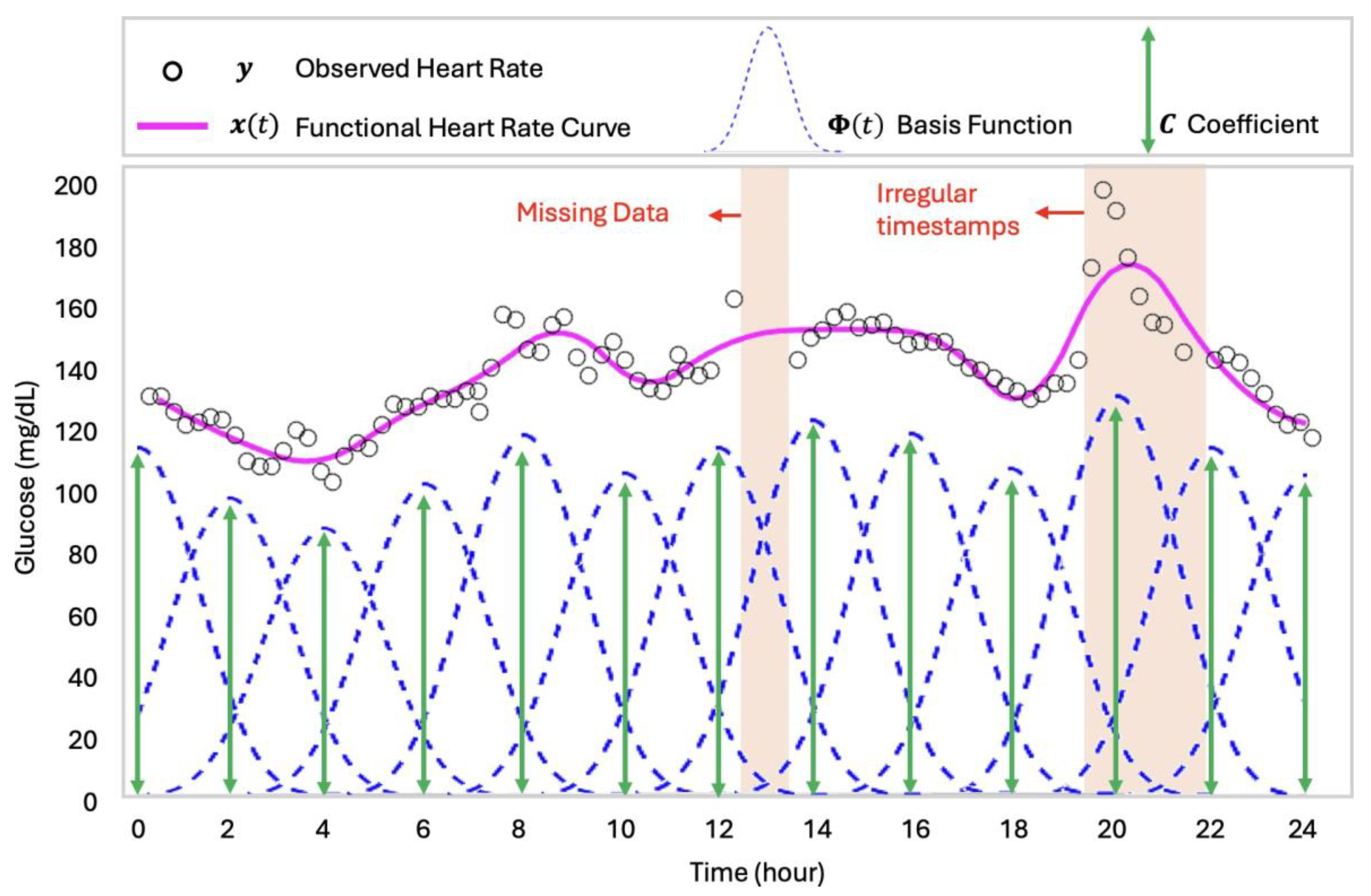
Figure 2.
Glucose data points and diurnal functional curves from week 1 (in blue) and week 2 (in red).
Figure 2.
Glucose data points and diurnal functional curves from week 1 (in blue) and week 2 (in red).
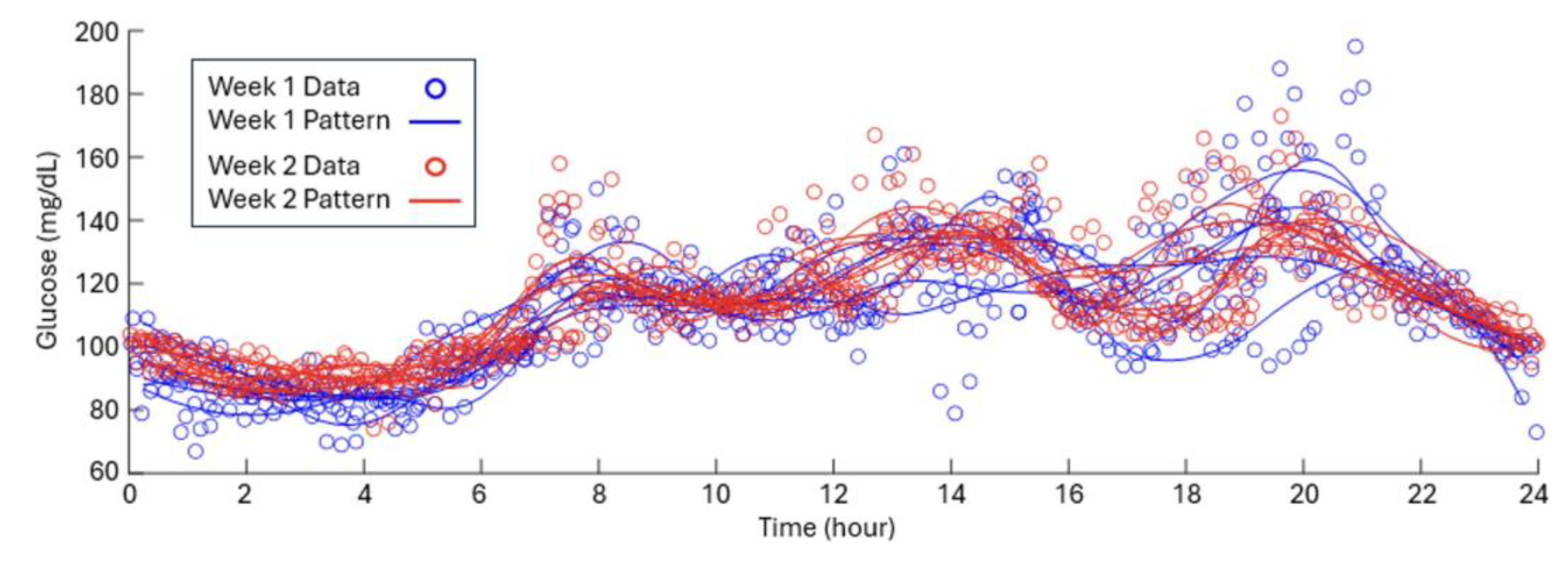
Figure 3.
Boxplot of basis coefficients for glucose data from week 1 (in blue) and week 2 (in red).
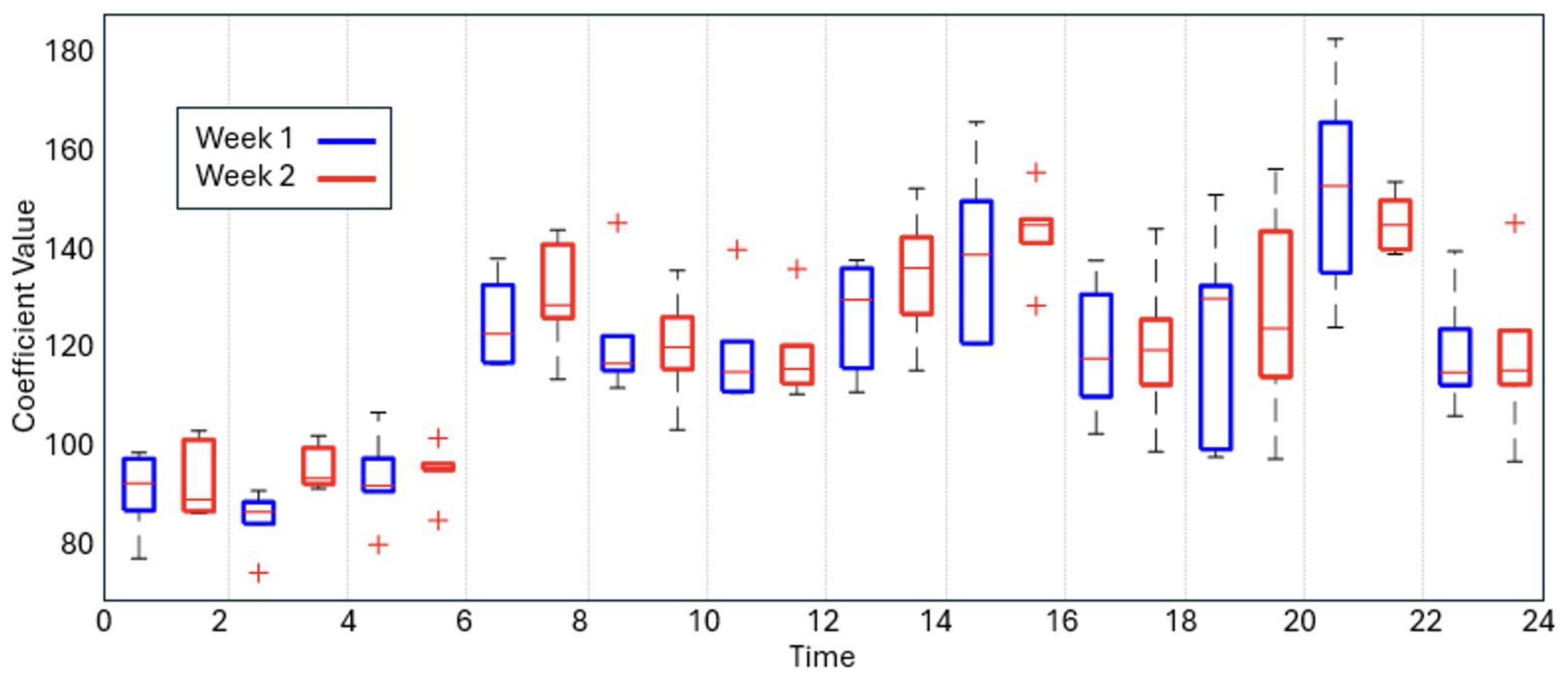
Figure 4.
Averaged functional glucose curve comparison between week 1 (in blue) and week 2 (in red).
Figure 4.
Averaged functional glucose curve comparison between week 1 (in blue) and week 2 (in red).
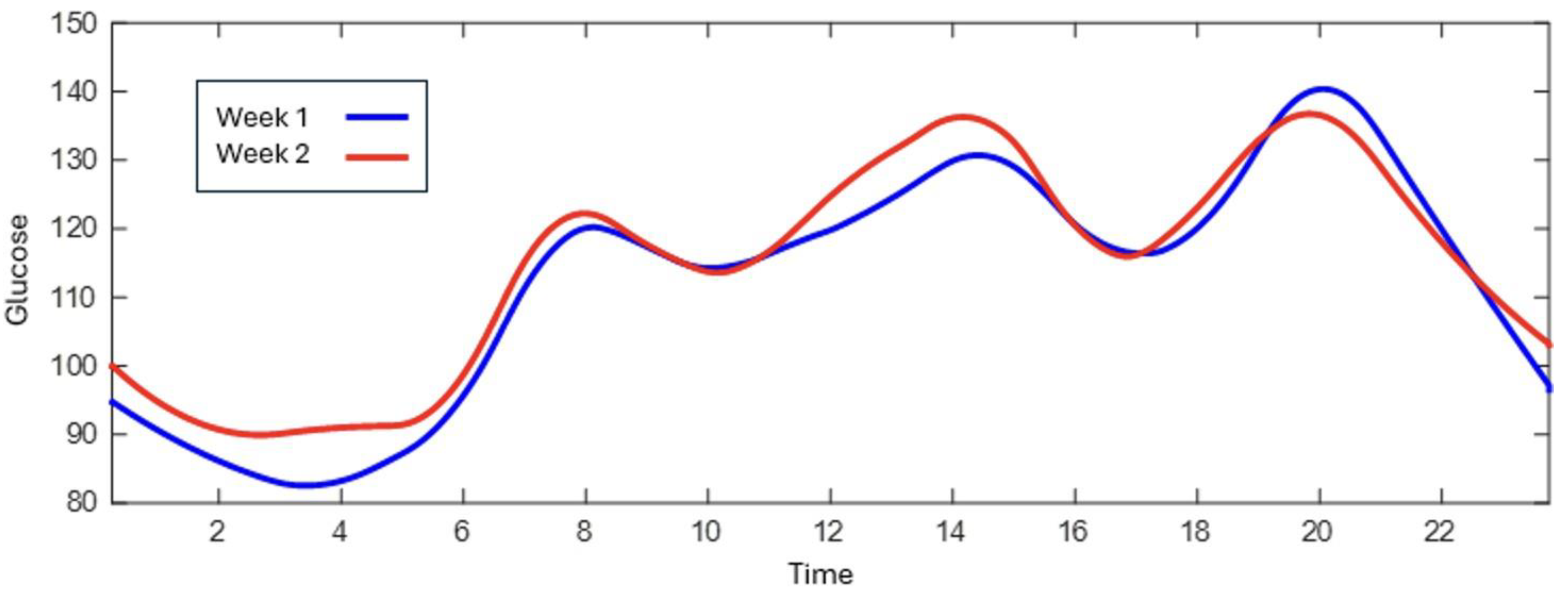

Table 1.
One-sided Wilcoxon rank-sum test for the significance of improvement in mean glucose, and the significant p-value (<0.05) is in bold.
Table 1.
One-sided Wilcoxon rank-sum test for the significance of improvement in mean glucose, and the significant p-value (<0.05) is in bold.
 |
§: H0 stands for the null hypothesis. △: μ1 denotes the median coefficient for functional curves in week 1. ∗: H1 stands for the alternative hypothesis. ⋔: μ2 denotes the median coefficient for functional curves in week 2.
Table 2.
Brown–Forsythe tests for the significance of improvement in glycemic variability, and the significant p-value (<0.05) is in bold.
Table 2.
Brown–Forsythe tests for the significance of improvement in glycemic variability, and the significant p-value (<0.05) is in bold.
 |
§: H0 stands for the null hypothesis. △: v1 denotes the variance of coefficients for functional curves in week 1. ∗: H1 stands for the alternative hypothesis. ⋔: v2 denotes the variance of coefficients for functional curves in week 2.
Disclaimer/Publisher’s Note: The statements, opinions and data contained in all publications are solely those of the individual author(s) and contributor(s) and not of MDPI and/or the editor(s). MDPI and/or the editor(s) disclaim responsibility for any injury to people or property resulting from any ideas, methods, instructions or products referred to in the content. |
© 2026 by the authors. Licensee MDPI, Basel, Switzerland. This article is an open access article distributed under the terms and conditions of the Creative Commons Attribution (CC BY) license.
Copyright: This open access article is published under a Creative Commons CC BY 4.0 license, which permit the free download, distribution, and reuse, provided that the author and preprint are cited in any reuse.


