
Submitted:
13 April 2026
Posted:
14 April 2026
You are already at the latest version
Abstract
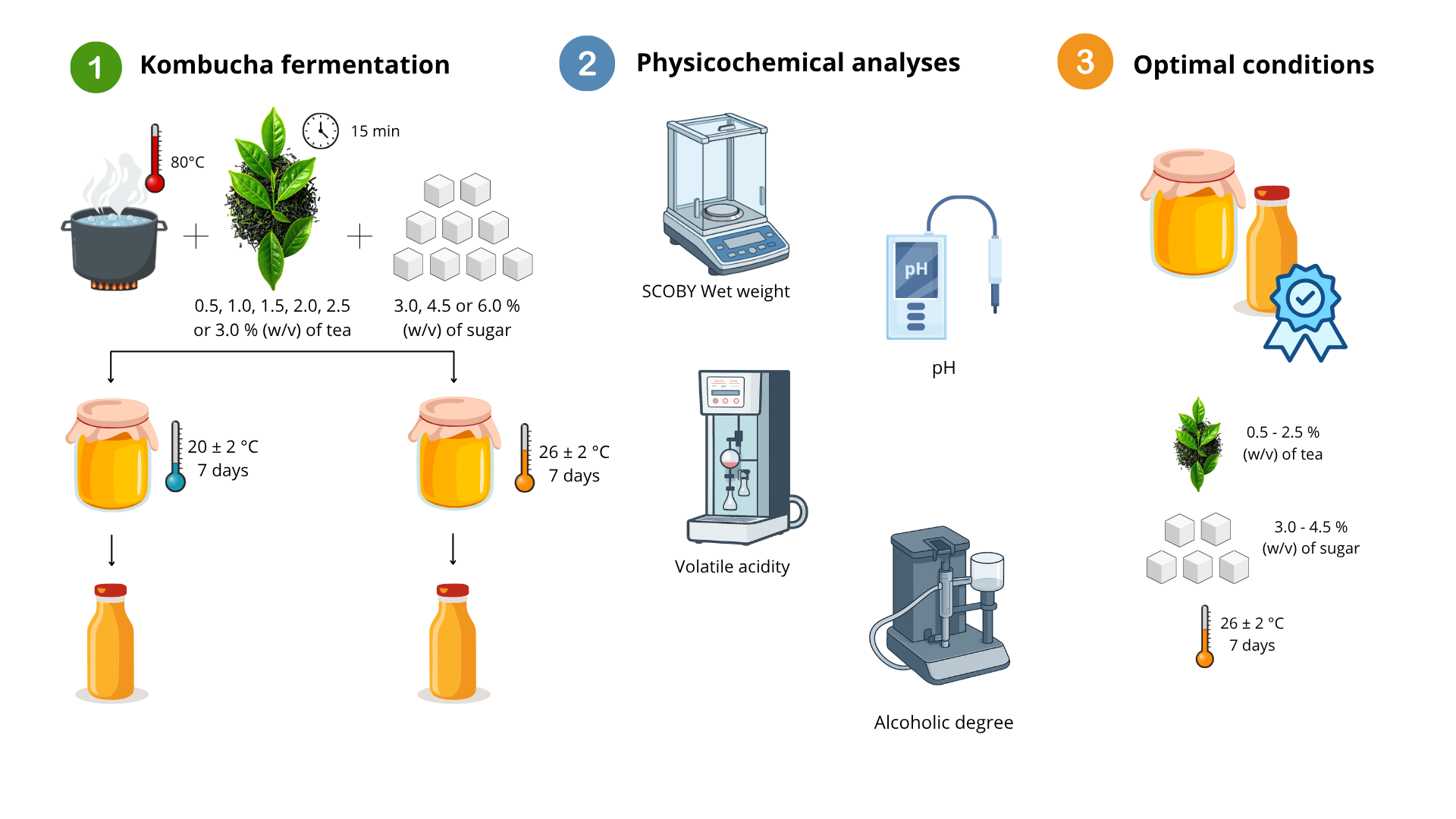
This study aimed to evaluate how specific quantities of green tea and sugar, as well as fermentation temperature, impact variations in kombucha quality parameters. The study used tea quantities ranging from 0.5 to 3.0% w/v, sugar from 3.0 to 6.0% w/v, and fermentation temperatures of 20°C and 26°C. Beverage quality parameters such as pH, volatile acidity, alcohol content, and SCOBY growth were evaluated. At a temperature of 20 ± 2°C, formulations with 6.0% w/v sugar showed no SCOBY growth, and two for-mulations showed volatile acidity above the established maximum limit of 130 mEq L⁻¹. Most formulations had an alcohol content below 0.5% v/v and were classified as non-alcoholic. At 26 ± 2°C, the greatest SCOBY growth occurred, with the highest rec-orded value of 203%. Only two formulations showed an alcohol content above 0.5% v/v, but with values close to the limit. High amounts of sugar do not favor SCOBY growth at either mild or higher temperatures (26°C). Variations in temperature and ingredient quantities influence the production of green tea kombucha that meets safety and quality requirements. These data show the variations in ingredients and temperatures that favor kombucha production, considering its quality and classification.
Keywords:
green tea
; volatile acidity
; alcohol content
; SCOBY
; microbial fermentation
; fermented beverage
Copyright: This open access article is published under a Creative Commons CC BY 4.0 license, which permit the free download, distribution, and reuse, provided that the author and preprint are cited in any reuse.


