

Submitted:
13 April 2026
Posted:
14 April 2026
You are already at the latest version
Abstract
This study aimed to evaluate how specific quantities of green tea and sugar, as well as fermentation temperature, impact variations in kombucha quality parameters. The study used tea quantities ranging from 0.5 to 3.0% w/v, sugar from 3.0 to 6.0% w/v, and fermentation temperatures of 20°C and 26°C. Beverage quality parameters such as pH, volatile acidity, alcohol content, and SCOBY growth were evaluated. At a temperature of 20 ± 2°C, formulations with 6.0% w/v sugar showed no SCOBY growth, and two for-mulations showed volatile acidity above the established maximum limit of 130 mEq L⁻¹. Most formulations had an alcohol content below 0.5% v/v and were classified as non-alcoholic. At 26 ± 2°C, the greatest SCOBY growth occurred, with the highest rec-orded value of 203%. Only two formulations showed an alcohol content above 0.5% v/v, but with values close to the limit. High amounts of sugar do not favor SCOBY growth at either mild or higher temperatures (26°C). Variations in temperature and ingredient quantities influence the production of green tea kombucha that meets safety and quality requirements. These data show the variations in ingredients and temperatures that favor kombucha production, considering its quality and classification.
Keywords:
green tea
; volatile acidity
; alcohol content
; SCOBY
; microbial fermentation
; fermented beverage
1. Introduction
In recent years, a “health consciousness” has grown in society, inspiring changes in eating habits, increasing the preference for the consumption of food that is considered healthy. In this scenario, fermented foods stand out, gaining significant attention due to the beneficial effects associated with their consumption [1]. Kombucha is an Asian-derived beverage produced by fermenting sweetened Camellia sinensis tea using a cellulose biofilm called Symbiotic Culture of Bacteria and Yeast (SCOBY) [2,3], being popular in several countries, such as the USA, China, and Brazil [4]. In the kombucha beverage, it is possible to find phenolic compounds that derive from the tea, including gallic acid [2] and catechin [2], organic acids that are produced during fermentation, notably acetic, gluconic, and glucuronic acids [5]. These bioactive compounds are responsible for the beverage’s beneficial properties, including antioxidant and antimicrobial activity [5].
Brazilian legislation, Normative Instruction No. 41 of September 17, 2019 [6], defines the Standard of Identity and Quality for kombucha. Internationally, Kombucha Brewers International (KBI) [7] provides best-practice guidelines. Both specify essential ingredients: Camellia sinensis, water, sugar, and SCOBY. pH values range from 2.3 to 3.8 [7] and from 2.5 to 4.2 [6]. KBI [7] also recommends fermentation temperatures of 21-32 °C.
Since the substrates used and fermentation conditions influence kombucha production [8], understanding the proportion of ingredients used is crucial. Goh et al. [9] found that high sugar concentrations in the medium inhibit SCOBY growth and, consequently, the fermentation process, underscoring the importance of process control and the appropriate use of ingredients in kombucha production.
Treviso et al. [3] evaluated the influence of temperature (25 °C and 30 °C) on kombucha production using an alternative substrate to green tea (Camellia sinensis), namely yerba mate (Ilex paraguariensis), highlighting that fermentation was faster at higher temperatures. Cohen et al. [10] investigated variation in the effects of sugar content (5.0, 7.5, and 10% w/v) and temperature (20 °C and 30 °C) on the sensory perception and general acceptability of kombuchas. They observed a decrease in pH and an increase in acidity. Samples fermented at 20 °C were most appreciated at each sucrose concentration compared with those fermented at 30 °C. However, the authors did not evaluate the effect of the tea proportions used.
Therefore, this study aimed to investigate the effects of the amount of essential ingredients and room temperature on the preparation of kombucha beverages, and to evaluate their impact on physicochemical parameters and SCOBY growth.
2. Materials and Methods
2.1. Kombucha Preparation
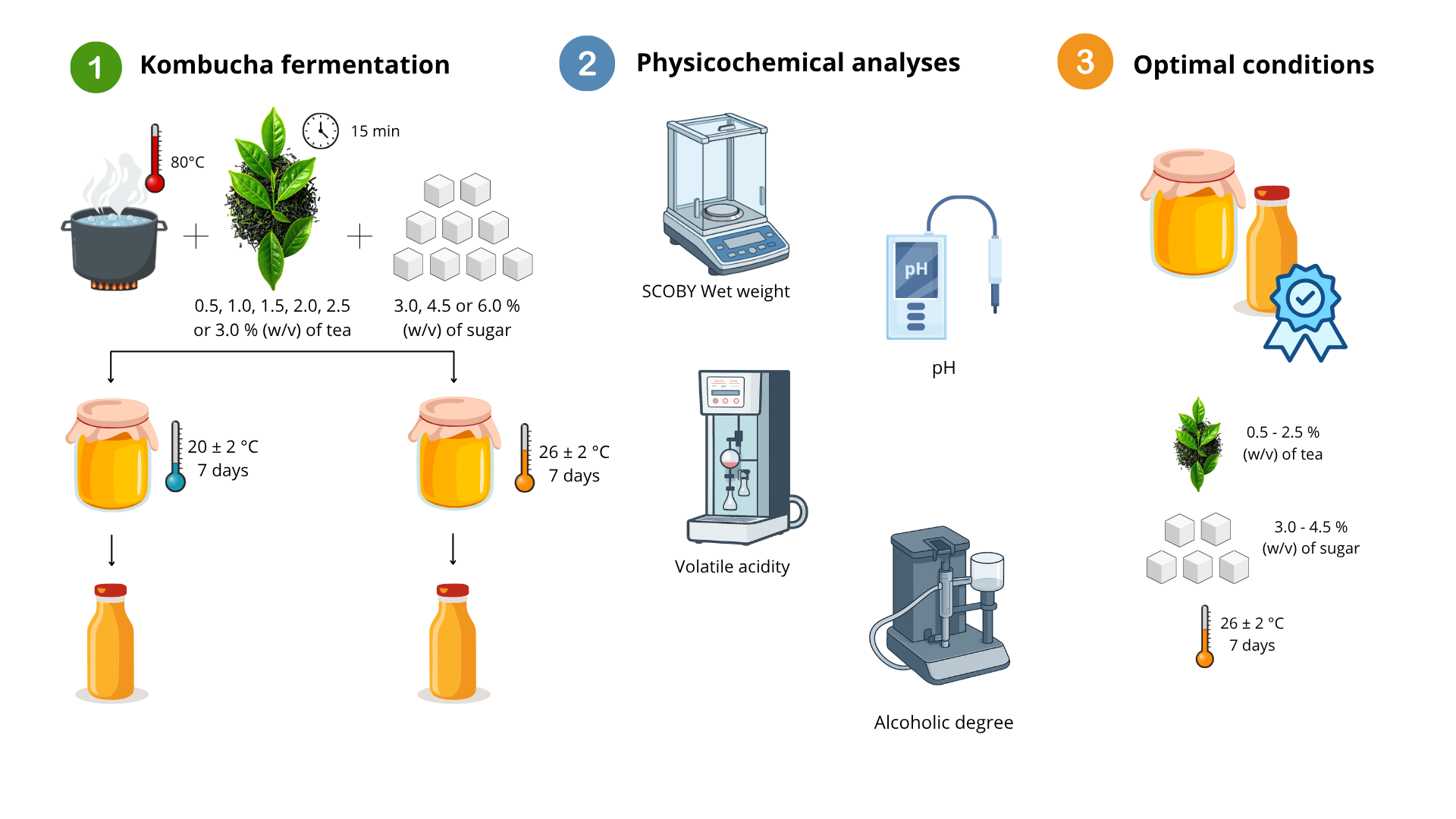
Organic green tea leaves were obtained from an online source (Camellia sinensis, Chá Dō, Yamamotoyama, São Paulo, SP, Brazil), and crystal sugar was obtained from a local source (Salvador, BA, Brazil). The SCOBY was provided from the collection of the own Research Group. Kombucha beverages were made using the procedure described by Saito et al. [11], with some modifications. The green tea was prepared with potable water and dried leaves, which were infused for 15 min. In a glass jar (900 mL), the liquid was filtered with filter paper No. 102 to remove leaves, and the sugar was added and homogenized. The sugar concentrations used were 3.0, 4.5, or 6.0% (w/v), and the tea concentrations were 0.5, 1.0, 1.5, 2.0, 2.5, or 3.0% (w/v). After cooling the liquid to room temperature, a 12.5% (v/v) starter culture (a previously prepared kombucha as the inoculum) and a 12.5% (w/v) SCOBY were added. The containers were covered with a paper towel and left at 20 ± 2 °C or 26 ± 2 °C for 7 days. After fermentation, the kombuchas were transferred to carbonated-beverage-specific polyethylene terephthalate bottles (300 mL) and kept at 4 °C.
2.2. SCOBY Growth
To evaluate SCOBY growth, a wet weight (Marte científica, AD3300, Santa Rita do Sapucaí, MG, Brazil) was measured before and after fermentation. The SCOBY growth was expressed as (%) and obtained according to equation 1:
2.3. pH, Alcohol Content, and Volatile Acidity
The pH was measured using a previously calibrated digital pH meter (Hanna Instruments, HI700601, Woonsocket, RI, USA). Alcohol content was determined using an electronic distiller (Gibertini, Super D.E.E., Novate Milanese, MI, Italy), followed by measurement on a hydrostatic balance, with the results expressed as % v/v. Volatile acidity was determined using the same distiller, then titrated with a standardized 0.1 N sodium hydroxide solution with phenolphthalein as the indicator. The results were expressed in miliequivalent per liter (mEq L⁻¹).
2.4. Data Analysis
The measurements were realized in triplicate, and the results of the analyzed parameters were expressed as means ± standard deviations. The data were analyzed using analysis of variance (ANOVA) with XLSTAT® (versão 2022.4.5, 2023).
3. Results and Discussion
3.1. Kombucha Production at 20 °C ± 2 °C
Temperature control during kombucha production is essential because it influences fermentation, microbial growth, enzymatic activity, and the production of bioactive compounds, including phenolic compounds and organic acids [12]. This study started investigating the fermentation at 20 °C. Table 1 presents the results of SCOBY growth, pH, volatile acidity, and alcohol content for the kombucha formulations fermented through 7 days at 20 ± 2 °C.
At 2.0% (w/v) tea and 3.0% (w/v) sugar, the highest SCOBY growth was observed (Table 1). After inoculating green tea with the starter and initial culture, new cellulose films begin to develop on the surface of the liquid and initial SCOBY [8], indicating that fermentation is underway. Therefore, the growth of SCOBY layers indicates that fermentation is occurring, and their weight can be used as an evaluation parameter for quality or fermentation dynamics.
Unexpectedly, in the formulations with 6.0% (w/v) sugar, submitted to two room temperature conditions, SCOBY growth was not observed (Table 1). The acetic acid bacteria (AAB) are responsible for the growth of the biofilm (SCOBY) [13]. As stated by Goh et al. [9], high substrate (sugar) concentrations in the medium can inhibit AAB growth due to osmotic imbalance and unequal rates of transport and nutrient consumption. Possibly, the greater the amount of sucrose in the tea, the greater the obstacle to the synthesis of bacterial cellulose. In another study on kombucha production with coffee-infusion flavoring, more than 6.0% (w/v) sugar was used without interrupting the fermentation process or causing low SCOBY growth [11]. Given the results, it is suggested that sugar concentration should be analyzed in relation to other ingredients during the fermentative process.
In Brazil, the Standard of Identity and Quality of kombucha established [6] professes pH values range from 2.5 to 4.2, volatile acidity from 30 to 130 mEq L-1, alcohol content up to 0.5% (v/v) for non-alcoholic kombucha and from 0.6 to 8.0% (v/v) for alcoholic kombucha [6]. Kombucha formulations that meet those requirements, established by the Normative, present physicochemical safety for regular consumption and commercialization.
The pH values ranged from 2.89 ± 0.00 to 3.17 ± 0.00 in formulations with 3.0% (w/v) sugar in their composition, from 3.21 ± 0.01 to 3.41± 0.01 with 4.5% (w/v) sugar, and from 3.11 ± 0.01 to 3.24 ± 0.01 with 6.0% (w/v) sugar (Table 1). During kombucha fermentation, acetic acid is the main organic acid produced, increasing the beverage’s acidity and, consequently, decreasing pH values. However, high acetic acid concentrations lower the pH below ideal levels, leading to stress of the medium and reducing SCOBY production [14]. Therefore, controlling this parameter is important to provide quality control in kombucha. The pH values remained from 2.5 to 4.2, the established range for a quality parameter in Brazilian legislation [6]. As stated by Dartora et al. [15], this range does not compromise the microbiological safety of kombucha. Values below 2.5 indicate high acidity, which can negatively affect beverage consumption, while values above 4.2 can compromise microbiological safety. The results obtained also meet the KBI guidelines [7]. Cohen et al. [9] developed black tea kombucha with a pH range of 1.95-2.38, which affects general acceptance, because it is extremely acidic.
Normative Instruction No. 41 [6] establishes that volatile acidity must range from 30 to 130 mEq L-1, however it’s common to find scientific work that showcases the acidity results expressed in percentage of acetic acid, since it is the most abundant acid in kombucha [10,16,17].
Generally, it has been observed that volatile acidity increases with increasing tea concentration (Table 1). The values ranged from 93.52 ± 0.38 mEq L-1 to 127.02 ± 0.63 mEq L-1 in formulations with 3.0% (w/v) sugar, from 38.88 ± 4.06 mEq L-1 to 91.82 ± 0.89 mEq L-1 with 4.5% (w/v) sugar, and from 78.18 ± 0.39 to 135.24 ± 0.29 with 6.0% (w/v) sugar. As explained by Noronha et al. [16], acidity increased during tea fermentation due to the formation of organic acids, including acetic, gluconic, and glucuronic acids, produced by AAB present in the SCOBY. The formulations using 2.5% (w/v) and 3.0% (w/v) tea and 6.0% (w/v) sugar exceeded the limit prescribed by legislation, with volatile acidity values of 130.11 ± 0.64 mEq L-1 and 135.24 ± 0.29 mEq L-1, respectively (Table 1). Dartora et al. [15] reported a volatile acidity of 126.7 ± 2.2 mEq L-1 at 25 °C, within the limits of the Brazilian Normative, after 4 days of fermentation in Camellia sinensis kombucha. From day 7, the formulation showed values above 200.4 ± 22.1 mEq L-1 at the same temperature. Treviso et al. [3] observed that volatile acidity values ranged from 26.9 ± 1.40 to 87.6 ± 5.62 mEq L-1 during 4 days of fermentation at 25 °C and from 26.9 ± 4.22 to 124.4 ± 7.03 in the same period at 30 °C. Even at the highest temperature, the volatile acidity remained within the limits of the identity standard. Nonetheless, the fermentation time impacted volatile acidity concentration, which exceeded the maximum limit, reaching 412.0 mEq L-1 after 7 days of fermentation at 30 °C.
The characteristics of the liquid starter or starter culture used in kombucha production, such as microbial composition and fermentation time, can influence the beverage’s biochemical composition, including acetic acid production [18], and, consequently, its volatile acidity. Therefore, the characterization of the initial liquid starter is an important factor in kombucha fermentation.
In kombucha formulations with up to 3.0% (w/v) sugar, alcohol has not been detected. For the remaining formulations, the concentrations found ranged from 0.14 ± 0.00% to 0.23 ± 0.05% (v/v) (Table 1). The values found classify the kombuchas produced as non-alcoholic, as their alcoholic content presents values below 0.5% (v/v) [6]. Kombucha has commercial appeal as a healthy beverage due to the bioactive compounds in its composition, which are associated with beneficial health effects. Therefore, controlling this parameter is fundamental, since the presence of alcohol in the beverage, even in small amounts, can restrict the consumer base. The production of non-alcoholic beverages may favor consumption for a larger portion of the market.
3.2. Kombucha Production at 26 ± 2 °C
The results for the analyzed parameters of kombucha formulations that went through 7 days of fermentation at 26 °C are shown in Table 2.
SCOBY growth was favored by 26 °C temperature, it was registred increase of 128% in relation to the SCOBY’s initial weight in the formulation with 3.0% (w/v) tea and 3.0% (w/v) sugar, 146% with 2.5% (w/v) tea and 4.5% (w/v) sugar, and 203% with 2.5% (w/v) tea and 6.0% (w/v) sugar (Table 2). The development of new films was favored in formulations with higher tea amounts. The caffeine present in tea may boost the production of new cellulose films [8]. However, tea leaves are rich in polyphenols, which possess antioxidant and antibacterial properties; therefore, high concentrations can inhibit the growth of bacteria responsible for the SCOBY’s development [14]. Although new film production increased, the pattern has not been linear or proportional to the increase in tea and sugar concentration across formulations. Priyadharshini et al. [14] developed a machine learning model to predict SCOBY yield during kombucha fermentation, concluding that fermentation temperature was the parameter that most influences yield.
The pH values ranged from 3.28 ± 0.01 to 3.60 ± 0.00 in the formulations with 3.0% (w/v) sugar, from 3.36 ± 0.01 to 3.56 ± 0.00 with 4.5% (w/v) sugar, and from 3.26 ± 0.01 to 3.58 ± 0.01 with 6.0% (w/v) sugar (Table 2), confirming the kombucha acidity. Compared with the reference Standard, the formulations were within the quality range [6]. Similar results were observed by Noronha et al. [16], who used Camellia sinensis in kombucha production, obtaining a pH of 3.44 after 7 days of fermentation and 3.25 after 10 days.
Volatile acidity did not follow a linear pattern or a proportional increase in tea and sugar concentration across formulations; instead, values fluctuated (Table 2). All formulations were within the 30-130 mEq L-1 range. The smallest values were 31.23 mEq L-1 with 1% (w/v) tea and 94.26 mEq L-1 with 3% (w/v) tea, both with 3% (w/v) sugar (Table 2).
In general, the kombuchas presented low alcoholic content, ranging from 0.13% (v/v) to 0.44% (v/v) (Table 2). Only two formulations presented alcohol content above 0.50% (v/v), those being with 3.0% (w/v) tea and 4.5% (w/v) sugar, with a 0.50% (v/v) alcohol content, and 3.0% (w/v) tea and 6.0% sugar, with a 0.51% (v/v) alcohol content (Table 2), subsequently being classified as alcoholic [6]. Ethanol values were near the limit for classification as non-alcoholic, suggesting the need for adjustments during production, such as reducing fermentation time or using smaller amounts of tea and sugar, to favor the development of low-ethanol beverages. Tea and sugar are the main carbon and nitrogen sources for bacterial and yeast growth [14]. These components are present at higher levels in alcoholic formulations, which can favor their consumption by yeast, leading to sucrose hydrolysis and ethanol production.
Due to the microbial diversity present in SCOBY, a set of physicochemical reactions happens during kombucha fermentation [17]. By the action of the invertase enzyme, yeasts hydrolyze sucrose into glucose and fructose, which will be further used to produce ethanol via glycolysis. In turn, AAB utilizes ethanol as a substrate to produce acetic acid; it also produces new layers of biofilm whilst using glucose to produce gluconic and glucuronic acids. The ethanol produced also stimulates yeasts to hydrolyze more sucrose molecules. This dynamic promotes pH reduction, increases acidity, and decreases sucrose levels [17]. It’s a complex process that requires control of a variety of parameters that influence fermentation, such as the kind of tea utilized, fermentation time, temperature, pH, bacterial and yeast composition of SCOBY [12], and the research of the ideal amount of raw material that will be utilized during kombucha’s production.
4. Conclusions
The 26 °C temperature and high green tea concentrations favored the fermentation process, as evidenced by SCOBY growth, which is produced by acetic-acid bacteria. The combination of temperature and green tea concentration also influenced the alcohol content produced through kombucha fermentation. At a green tea concentration of up to 2.5% (w/v), non-alcoholic kombuchas were obtained at both temperatures studied (20 and 26 °C). The volatile acidity agreed with the Brazilian Normative Instruction and International Recommendations up to 2.0 (% w/v) in tea at 26 °C. Under other conditions, volatile acidity exceeded the limit of 130 mEq L-1 and may be unpalatable. High sugar concentrations (6.0% w/v) did not favor SCOBY growth at 20 °C, suggesting a low fermentation process, possibly due to stress on microorganisms in the fermentation broth. Therefore, the sugar concentration must be studied in closer relation to the other ingredients and fermentation conditions to favor the fermentation process. Knowledge of ingredient and production-condition variations is fundamental to understanding the fermentation dynamics and quality of the kombucha beverage.
Author Contributions
Conceptualization, M.E.D.O.M.; methodology, A.C.A.D.J., J.D.S.D.J., B.F.V., L.D.J.T., L.A.V., and R.D.M.S.F.; formal analysis, A.C.A.D.J., J.D.S.D.J., B.F.V., L.D.J.T., L.A.V.; resources, M.E.D.O.M.; data curation, A.C.A.D.J., J.D.S.D.J., B.F.V., L.D.J.T., L.A.V., and R.D.M.S.F.; writing—original draft preparation, A.C.A.D.J., J.D.S.D.J., B.F.V., L.D.J.T., L.A.V., R.D.M.S.F. and P.C.B.D.A.; writing—review and editing, A.C.A.D.J., P.C.B.D.A., and M.E.D.O.M.; supervision, M.E.D.O.M.; project administration, M.E.D.O.M.; funding acquisition, M.E.D.O.M. All authors have read and agreed to the published version of the manuscript.
Funding
This research was funded by Coordenação de Aperfeiçoamento de Pessoal de Nível Superior (CAPES, Brazil), grant numbers: 88887.214297/2025-00; 88887.137315/2025-00; 88887.008171/2024-00; 88887.915671/2023-00, Universidade Federal da Bahia (UFBA) [with Scientific Initiation scholarships from students Jaqueline Jesus and Beatriz Vieira] and Conselho Nacional de Desenvolvimento Científico e Tecnológico (CNPq, Brazil), grant numbers: 304377/2025-2—research; 402596/2025-0—Universal Project].
Data Availability Statement
The original contributions presented in the study are included in the article; further inquiries can be directed to the corresponding author/s.
Acknowledgments
The authors are grateful to the Laboratório de Bromatologia, to the Laboratório de Análise Sensorial da Faculdade de Farmácia da Universidade Federal da Bahia, and to the Funding Agencies.
Conflicts of Interest
The authors declare no conflicts of interest. The funders had no role in the design of the study; in the collection, analyses, or interpretation of data; in the writing of the manuscript; or in the decision to publish the results.
Abbreviations
The following abbreviations are used in this manuscript:
| SCOBY | Symbiotic Culture of Bacteria and Yeast |
References
- Onsun, B.; Toprak, K.; Sanlier, N. Kombucha Tea: A Functional Beverage and All Its Aspects. Curr. Nutr. Rep. 2025, 14, 69. [Google Scholar] [CrossRef] [PubMed]
- Barbosa, C.D.; Baqueta, M.R.; Santos, W.C.R.; Gomes, D.; Alvarenga, V.O.; Teixeira, P.; Albano, H.; Rosa, C.A.; Valderrama, P.; Lacerda, I.C. Data fusion of UPLC data, NIR spectra and physicochemical parameters with chemometrics as an alternative to evaluating kombucha fermentation. LWT 2020, 133, 109875. [Google Scholar] [CrossRef]
- Treviso, R.L.; Sant’Anna, V.; Fabricio, M.F.; Ayub, M.A.Z.; Brandelli, A.; Hickert, L.R. Time and temperature influence on physicochemical, microbiological, and sensory profiles of yerba mate kombucha. J. Food Sci. Technol. 2024, 1–10. [Google Scholar] [CrossRef] [PubMed]
- Saito, M.S.; Ferreira, R.M.S.; de Jesus, A.C.A.; Mamede, M.E.D.O. Analysis of innovations in kombucha production and the protection of intellectual property. Biotech. Resear. Innov. 2024, 8(2), e2024016. [Google Scholar] [CrossRef]
- Cheepchirasuk, N.; Kaewkod, T.; Suriyaprom, S.; Intachaisri, V.; Ngamsaard, P.; Tragoolpua, Y. Functional Metabolites and Inhibitory Efficacy of Kombucha Beverage on Pathogenic Bacteria, Free Radicals and Inflammation. Sci. Rep. 2025, 15, 19187. [Google Scholar] [CrossRef] [PubMed]
- Brasil. Ministério da Agricultura e Pecuária. Instrução Normativa n° 41, de 17 de Setembro de 2019. Estabelece o Padrão de Identidade e Qualidade da Kombucha em todo o território nacional. Diário Oficial da União, Brasília, 18 de Setembro de 2019. Seção 1. Available online: https://pesquisa.in.gov.br/imprensa/jsp/visualiza/index.jsp?data=18/09/2019&jornal=515&pagina=13&totalArquivos=76 (accessed on 1 February 2026).
- Kombucha Brewers International. Kombucha Code of Practice. Available online: https://kombuchabrewers.org/kombucha-code-of-practice/ (accessed on 1 February 2026).
- Laavanya, D.; Shirkole, S.; Balasubramanian, P. Current challenges, applications and future perspectives of SCOBY cellulose of Kombucha fermentation. J. Clean. Prod. 2021, 295, 126454. [Google Scholar] [CrossRef]
- Goh, W. N.; Rosma, A.; Kaur, B.; Fazilah, A.; Karim, A. A.; Bhat, R. Fermentation of black tea broth (Kombucha): I. Effects of sucrose concentration and fermentation time on the yield of microbial cellulose. Int. Food Res. J. 2012, 19(1). [Google Scholar]
- Cohen, G.; Sela, D.A.; Nolden, A.A. Sucrose Concentration and Fermentation Temperature Impact the Sensory Characteristics and Liking of Kombucha. Foods 2023, 12, 3116. [Google Scholar] [CrossRef] [PubMed]
- Saito, M.S.; dos Santos, W.A.; Mamede, M.E.d.O. Coffee-Flavoured Kombucha: Development, Physicochemical Characterisation, and Sensory Analysis. Fermentation 2024, 10, 334. [Google Scholar] [CrossRef]
- Villarreal-Soto, S.A.; Beaufort, S.; Bouajila, J.; Souchard, J.P.; Taillandier, P. Understanding Kombucha Tea Fermentation: A Review. J. Food Sci. 2018, 83, 580–588. [Google Scholar] [CrossRef] [PubMed]
- Barbosa, C.D.; Costa, I.M.; Santos, W.C.R.; Alvarenga, V.O.; Lacerda, I.C.A.; Simiqueli, G.F. Acetic Acid Bacteria Analysis Using Non-Conventional Culture Media in Kombucha Fermentation. Ensai. e Ciên.: Ciên. Biolo., Agrar. e da Sau. 2023, 27(3), 370–375. [Google Scholar] [CrossRef]
- Priyadharshini, T.; Nageshwari, K.; Vimaladhasan, S.; Prakash, S.P.; Balasubramanian, P. Machine Learning Prediction of SCOBY Cellulose Yield from Kombucha Tea Fermentation. Bioresour. Technol. Rep. 2022, 18, 101027. [Google Scholar] [CrossRef]
- Dartora, B.; Hickert, L. R.; Fabricio, M. F.; Ayub, M. A. Z.; Furlan, J. M.; Wagner, R; Perez, K. J.; Sant’Anna, V. Understanding the effect of fermentation time on physicochemical characteristics, sensory attributes, and volatile compounds in green tea kombucha. Food Res. Int. 2023, 174, 113569. [Google Scholar] [CrossRef] [PubMed]
- Noronha, M.C.D.; Cardoso, R.R.; D’Almeida, C.T.S.; do Carmo, M.A.V.; Azevedo, L.; Maltarollo, V.G.; Ribeiro Júnior, J.I.; Eller, M.R.; Cameron, L.C.; Ferreira, M.S.L.; et al. Black tea kombucha: Physicochemical, microbiological and comprehensive phenolic profile changes during fermentation, and antimalarial activity. Food Chem. 2022, 384, 132515. [Google Scholar] [CrossRef] [PubMed]
- Oliveira, J.T.; da Costa, F.M.; da Silva, T.G.; Simoes, G.D.; Pereira, E.S.; da Costa, P.Q.; Andreazza, R.; Schenkel, P.C.; Pieniz, S. Green tea and kombucha characterization: Phenolic composition, antioxidant capacity and enzymatic inhibition potential. Food Chem. 2023, 408, 135206. [Google Scholar] [CrossRef] [PubMed]
- Azfaralariff, A.; Vohra, B.; Fazry, S; Law, D.; Sairi, F.; Othman, B.A. Effects of starter culture and sweetener on biochemical compounds and microbial diversity of kombucha tea. Sains Malaysiana 2022, 51(11), 3715–3729. [Google Scholar]

Table 1.
Parameters analyzed after 7 days of fermentation at 20 ± 2 °C.
| Parameters | Sugar (% w/v) | |||
|---|---|---|---|---|
| Tea (% w/v) | 3.0 | 4.5 | 6.0 | |
| SCOBY growth (g%) | 0.5 | 9 | 8 | 0 |
| 1.0 | 27 | 7 | 0 | |
| 1.5 | 32 | 17 | 0 | |
| 2.0 | 35 | 20 | 0 | |
| 2.5 | 14 | 18 | 0 | |
| 3.0 | 20 | 8 | 0 | |
| pH | 0.5 | 2.89 ± 0.00eC | 3.32 ± 0.01bA | 3.11 ± 0.01eB |
| 1.0 | 2.97 ± 0.01dC | 3.28 ± 0.02cA | 3.20 ± 0.00bB | |
| 1.5 | 3.02 ± 0.01cC | 3.21 ± 0.01eA | 3.13 ± 0.01dB | |
| 2.0 | 3.03 ± 0.02cC | 3.25 ± 0.01dA | 3.19 ± 0.01bB | |
| 2.5 | 3.09 ± 0.00bC | 3.27 ± 0.00cA | 3.17 ± 0.01cB | |
| 3.0 | 3.17 ± 0.00aC | 3.41 ± 0.01aA | 3.24 ± 0.01aB | |
| Volatile acidity (mEq L-1) | 0.5 | 93.52 ± 0.38dA | 38.88 ± 4.06dC | 78.18 ± 0.39eB |
| 1.0 | 102.55 ± 0.14cA | 63.12 ± 0.00cC | 82.14 ± 6.27eB | |
| 1.5 | 111.51 ± 1.29bA | 91.82 ± 0.89aB | 114.46 ± 0.73dA | |
| 2.0 | 123.83 ± 2.77aA | 89.12 ± 0.67aB | 124.39 ± 1.27cA | |
| 2.5 | 127.02 ± 0.63aA | 90.55 ± 0.81aB | 130.11 ± 0.64bA | |
| 3.0 | 107.46 ± 0.15bB | 75.74 ± 0.76bC | 135.24 ± 0.29aA | |
| Alcohol content (% v/v) | 0.5 | ND | ND | ND |
| 1.0 | ND | ND | 0.23 ± 0.05a | |
| 1.5 | ND | ND | 0.16 ± 0.03b | |
| 2.0 | ND | 0.14 ± 0.00c | ND | |
| 2.5 | ND | 0.22 ± 0.04ª,b | ND | |
| 3.0 | ND | 0.19 ± 0.02b | ND | |
ND = Not detected. The results are expressed as mean ± standard deviation of triplicates. Means followed by different letters, lowercase vertically and uppercase horizontally, indicate significant differences by Tukey’s test (p ≤0.05).
Table 2.
Parameters analyzed after 7 days of fermentation at 26 ± 2 °C.
|
Parameters |
Sugar (% w/v) | |||
|---|---|---|---|---|
| Tea (% w/v) | 3.0 | 4.5 | 6.0 | |
| SCOBY growth (g%) | 0.5 | 10 | 23 | 45 |
| 1.0 | 4 | 21 | 66 | |
| 1.5 | 32 | 31 | 24 | |
| 2.0 | 43 | 93 | 58 | |
| 2.5 | 65 | 146 | 203 | |
| 3.0 | 128 | 19 | 99 | |
| pH | 0.5 | 3.32 ± 0.01eC | 3.36 ± 0.01eB | 3.38 ± 0.01eA |
| 1.0 | 3.50 ± 0.01cA | 3.36 ± 0.00eB | 3.26± 0.01fC | |
| 1.5 | 3.28 ± 0.01fC | 3.40 ± 0.00dB | 3.47 ± 0.00cA | |
| 2.0 | 3.60 ± 0.00aA | 3.50 ± 0.01bC | 3.58 ± 0.01aB | |
| 2.5 | 3.57 ± 0.01bA | 3.44 ± 0.00cB | 3.44 ± 0.01dB | |
| 3.0 | 3.49 ± 0.01dC | 3.56 ± 0.00aA | 3.53 ± 0.01bB | |
| Volatile acidity (mEq L-1) | 0.5 | 38.31 ± 0.28eA | 41.91 ± 0.91eA | 34.42 ± 0.64eB |
| 1.0 | 31.23 ± 0.79fC | 63.54 ± 0.15c,dB | 69.09 ± 6.69bA | |
| 1.5 | 79.83 ± 0.14bA | 66.15 ± 2.52cB | 46.12 ± 0.39dC | |
| 2.0 | 50.96 ± 0.14dB | 59.75 ± 1.62dA | 51.42 ± 0.53cB | |
| 2.5 | 71.68 ± 1.12cB | 83.23 ± 0.77aA | 83.74 ± 0.53aA | |
| 3.0 | 94.26 ± 0.28aA | 71.03 ± 2.26bB | 73.30 ± 0.29bB | |
| Alcohol content (% v/v) | 0.5 | ND | 0.13 ± 0.00e | ND |
| 1.0 | 0.19 ± 0.01c | 0.16 ± 0.01d,e | 0.18 ± 0.01c | |
| 1.5 | 0.16 ± 0.02c | 0.21 ± 0.03d | ND | |
| 2.0 | 0.35 ± 0.05b | 0.26 ± 0.04c,d | 0.23 ± 0.04c | |
| 2.5 | 0.19 ± 0.03c | 0.38 ± 0.04b | 0.43 ± 0.05b | |
| 3.0 | 0.44 ± 0.02a | 0.50 ± 0.06a | 0.51 ± 0.07c | |
ND = Not detected. The results are expressed as mean ± standard deviation of triplicates. Means followed by different letters, lowercase vertically and uppercase horizontally, indicate significant differences by Tukey’s test (p ≤0.05).
Disclaimer/Publisher’s Note: The statements, opinions and data contained in all publications are solely those of the individual author(s) and contributor(s) and not of MDPI and/or the editor(s). MDPI and/or the editor(s) disclaim responsibility for any injury to people or property resulting from any ideas, methods, instructions or products referred to in the content. |
© 2026 by the authors. Licensee MDPI, Basel, Switzerland. This article is an open access article distributed under the terms and conditions of the Creative Commons Attribution (CC BY) license (http://creativecommons.org/licenses/by/4.0/).
Copyright: This open access article is published under a Creative Commons CC BY 4.0 license, which permit the free download, distribution, and reuse, provided that the author and preprint are cited in any reuse.


