

Submitted:
10 April 2026
Posted:
13 April 2026
You are already at the latest version
Abstract
Background. Spleen-preserving (SP) distal pancreatectomy (DP) with splenic vessels resection (SVR) (Warsaw procedure, WP) is an option for treatment of tumors with low-malignant potential. The reverse blood flow through the short gastric arteries (SGA) explains the preservation of the spleen after SVR, but leaves the source of blood supply to the SGAs hidden. The types of blood supply to the spleen after WP and their incidence have not been previously described, nor has the significance of these types for locally advanced pancreatic head cancers (LAPHC) surgery. Aim. To determine the main types of the spleen blood supply after WP, and to assess feasibility and safety of splenic artery (SA) rotation for the organ-preserving surgery of LAPHC. Methods. Retrospective analysis of demographic and perioperative data, including CT scans analysis, overall (OS) and progression-free (PFS) survival after 71 SP DP SVR and 41 SP SVR pancreaticoduodenectomies (PD) and total pancreatectomies (TP) for LAPHC (2007-2025). Results: In 134 SP procedures, SA was resected in 115 cases (71DP, 9 TP, 3 central, 32 PD). Indications for surgery were MCN (41), IPMN (14), CSA(3), NEN(25), SPPN(8), PHDAC(40), sarcoma(1), autoimmune(1), and calculous chronic pancreatitis(1). There were no deaths and ischemia-related splenectomies. Morbidity-31%(n23), Dindo-Clavien (D-C)> 3b-2,8%, POPF grade B-n7(10.6%), splenic infarctions on CT after SVR-n18(23%), with one symptomatic. CT revealed three types of arterial blood supply to the spleen after SPDPSVR: left gastric artery(LGA) type (n50,70,5%), gastro-epyploic arcade (GEA) type(n9,12,5%), and an intermediate type(n12,17%). Spleen- and pancreas tail-preserving SVR pancreatectomies for LAPHC (n41) were accompanied by rotation of the SA to substitute resected SMA(n19) and CHA(n15) for 26 Whipples and 8TPs. There were no ischemic complications. D-C >3-19.5%. Median OS and PFS for PDAC was 35 and 21 months for 29.5 months median follow-up. Conclusion. The main collaterals supplying the spleen after WP are LGA branches (~ 90%). This knowledge with strict adherence to the developed criteria safely preserves the spleen, pancreatic tail and stomach during pancreatectomies with SA resection, including its rotation for substitution of the SMA and CHA in LAPHC.
Keywords:
locally advanced pancreatic cancer
; arterial resection
; Warsaw procedure
; arterial collaterals
; blood flow adaptation
; spleen preservation
; splenic artery resection
Viacheslav Egorov 1,2,*, Soslan Dzigasov 1, Alexey Kolygin 1, Mikhail Vyborniy 1, Grigoriy Bolshakov 1, Roman Petrov 1,3, Pavel Kim 1, Anna Demchenkova 1 and Alexander Sorokin 4
1 Ilyinskaya Hospital, 143421 Moscow, Russia
2 Burnasyan State Research Center of the Federal Medical Biological Agency, 119435 Moscow, Russia
3 Federal State Autonomous Institution «National Medical Research Centre «Treatment and Rehabilitation Centre» of the Ministry of Health of the RF, 125367, Moscow, Russia
4 Department of Mathematical Methods in Economics, Plekhanov Russian University of Economics, 117997 Moscow, Russia
1. Introduction
Almost half a century has passed since spleen-preserving (SP) distal pancreatectomy (DP) with splenic vessel resection (SVR) was described by David Sutherland in 1980 [1], and popularized by Andrew Warshaw [2]. Preservation of the spleen during DP reduces the risks of postoperative complications, postoperative pancreatic fistula, overwhelming postsplenectomy sepsis, increased susceptibility to severe infections, thromboembolic events and certain solid and hematologic malignancies, improves immunologic, hematologic and hemodynamic consequences of these interventions, reduces hospital stay, and decreases readmission rates [3,4,5,6,7,8,9].
The Sutherland-Warshaw method has proven to be safe and effective for the surgical treatment of benign pancreatic diseases and pancreatic tumors with low malignant potential [3,5,10], and, subject to certain conditions, in the treatment of neuroendocrine tumors and pancreatic body ductal adenocarcinoma [10,11,12]. The main area of application of this operation is circumstances that allow spleen preservation for oncological reasons, but do not allow preserving the splenic vessels due to their involvement in the tumor or inflammatory process.
If during SPDP with the splenic vessels preservation (SVP), described by Mallet-Guy [13] and later by Kimura [14], the source of arterial blood supply to the spleen remains the main vessel - the splenic artery (SA). In case of SPDP SVR, the blood supply to the spleen was explained by reverse blood flow through the short gastric arteries (SGAs) [15]. This explanation is beyond doubt, but the question remains unanswered about which collateral(s) deliver(s) blood to the SGAs after excision of the SA.
Despite the large number of publications and meta-analyses comparing the surgical consequences of SPDPs with and without SVR [4,16,17,18,19], the answer to the above question has not been given, although knowledge of the types of collaterals supplying the system of the SGAs and spleen after SA resection allows (1) to make SPDP SVR safer; (2) to prevent splenic ischemia during subsequent surgical interventions; (3) and to provide grounds for the safe performance of spleen-preserving right-sided and total pancreatectomies.
The purpose of this work was to study (1) the types of collateral blood supply to the SGAs and spleen after SPDP SVR; (2) surgical consequences of spleen- and pancreas-preserving pancreatectomies with SVR by assessment of their short- and long-term morbidity; (3) the feasibility and outcomes of using collateral pathways to the system of SGAs for radical and at the same time organ-preserving surgery for locally advanced (LA) pancreatic head cancers (PHCs).
2. Patients and Methods
This study retrospectively analyzed a prospectively maintained database of pancreatic resections performed by the same pancreatic surgical group from 1 December 2007 to 31 December 2025. This study was approved by the Institutional Ethics Board of the Ilyinskaya Hospital, Moscow, Russia (Ethics Committee N°12-02-SA/2021, Ilyinskaya Hospital, Moscow, Russia, May 14, 2021), and performed according to the principles of the Declaration of Helsinki [20], and Strengthening the Reporting of Cohort and case Series Studies in Surgery criteria and has been reported in line with the PROCESS and STROCSS Guideline for case series [21,22], (Files S1-S4.).
One hundred thirty-four consecutive patients underwent spleen-preserving pancreatectomy with (115) and without (19) resection of the splenic vessels for the abovementioned period. Two cohorts after SP SVR pancreatectomies were retrospectively studied separately: patients after 1. distal pancreactomies, and 2. pancreaticoduodenectomies (PDs) and total pancreatectomies (TPs). The concept of resection of the splenic vessels included at least resection of the splenic artery. Pancreatectomies with splenic vein resection and without SA resection, e.g., WATSA [23], were not included in the study.
Demographic and perioperative data of the patients undergoing SP pancreatectomies were retrospectively explored from medical records, follow-up charts, and CT- diagnostic reports. All patients were discussed at multidisciplinary meetings, and all of the procedures were undertaken to perform spleen-, spleen and distal pancreas- or spleen-, distal pancreas- and stomach- preserving procedures. In all the cases of locally advanced PDAC or other malignancies, abdominal MRI, CT, PET-CT, and blood tests for CA 19-9 and CEA were performed 2-3 weeks before surgery to exclude distant metastases.
All patients with PDAC were operated on after chemotherapy. Tumor size delineated in mm was measured on CT before surgery and at pathohistological examination after surgery. Postoperative 90-day complications were graded according to Clavien-Dindo as minor (<Grade 3) or major (>Grade 3) [24]. Postoperative pancreatic fistula (POPF) was defined according to the International Study Group on Pancreatic Fistula classification [25], and post-pancreatectomy hemorrhage (PPH) was determined by guidelines given by the International Study Group of Pancreatic Surgery [26]. Splenic infarctions or abscesses were considered as surgery-related ischemia. Complications, readmissions, and mortality were collated up to 90 days postoperatively. Survival data were collected based on the last CT or MRI results, last visit to the hospital, or follow-up phone calls. Patients who were alive at the time of data collection included in survival analysis after not less than 24 months of follow-up. Overall (OS) and progression-free (PFS) survival are presented for pancreatic ductal adenocarcinoma and were measured from the date of tissue diagnosis until death or unless otherwise specified [27,28].
Chemotherapy. All the patients with PDAC received neoadjuvant chemotherapy with FOLFIRINOX or mFOLFIRINOX regimens. The standard approach for BR PDAC was 6 courses before surgery, and 12 courses for LA PDAC. The number of preoperative courses was increased in cases where there was no decrease in the level of CA 19-9, or, in some cases, if biliary, duodenal or coronary stenting was necessary before surgery.
Three weeks after the end of chemotherapy, the abovementioned examination to exclude distant metastases and tumor restaging was carried out. In the absence of evidence of tumor progression and a significant decrease in the level of CA 19-9, radical surgery was performed 6-10 weeks later. Postoperative chemotherapy for PDAC was either gemcitabine, gemcitabine + abraxane, or mFOLFIRINOX. One FOLFIRINOX (mFOLFIRINOX) cycle was defined as 2 weeks, one gemcitabine-based cycle – as 3 weeks per standard dosing. There were no radiation therapy before and after surgery.
Surgery. During operations for non-malignant tumors and tumors with low malignant potential (NEN, SPPT), the distance between the tumor edge and the pancreatic resection line was as minimal as possible. A negative pancreatic resection margin in all cases was confirmed intraoperatively using a frozen-section biopsy (Intraoperative R0). Resectability was determined by CT data before treatment according to the National Comprehensive Cancer Network guidelines for pancreatic adenocarcinoma. Version 2.2023 [29].
Intraoperative assessment of the viability of the spleen and distal part of the pancreas to decide on the possibility of their preservation in case of resection of the splenic vessels, included clamping of the splenic artery at its origin and in the area of its intended distal transection with subsequent
- puls determination on the remaining distal segment of the splenic artery 15-30 minutes after clamping;
- assessment of changes in the color and consistency of the spleen. Significant darkening and cyanosis, as well as pronounced swelling of the spleen were contraindications for its preservation.
- intraoperative ultrasound for the assessment of intraparenchymal arterial blood flow in the spleen. Detection of arterial blood flow in the splenic parenchyma was considered sufficient to recognize it as viable [30];
- assessment of the retrograde blood flow after removing the clamp from the remaining distal segment of the splenic artery (Video S1. Collateral blood flow test 1);
- If, after clamping both splenic vessels, the spleen acquired a darker color and assessment of its arterial blood flow became difficult, the following technique used. A soft vascular clamp (“bulldog”) occluded one of the terminal (usually the lower pole) arteries of the spleen. If within 15-20 minutes the sector of the spleen supplied though the clamped branch changed color to a darker one (see Figure 1) compared to the rest of the spleen, then the arterial blood flow of the spleen (subject to the above conditions) was considered adequate:
- In case of preservation of the distal pancreas during right-sided pancreatectomy, besides the above steps, an additional transection of the pancreatic stump was performed. When arterial bleeding appeared from the cut surface, and the first four tests were positive, the blood supply to the pancreatic stump was considered sufficient (Video S2. Collateral blood flow test 2).
- A mandatory requirement for performing PD with resection of the splenic artery with its rotation, was (a) a hard pancreas; (b) wide (at least 5 mm) pancreatic tail duct, and removal of the pancreatic body
Point 1 was omitted in minimally invasive interventions due to difficulties in interpreting the result. In all other cases spleen and distal pancreas were preserved only if all tests were positive. In case of negative or questionable test results, we did nor performed spleen- and pancreas-preserving procedures.
During DPs, transection of the gland was carried out with a harmonic scalpel or using a linear endoscopic stapler. In all cases of open surgery, we covered the suture line of the pancreas by the round ligament of the liver. In all cases, abdomen was drained using either passive or active Blake tube.
Computed tomography (CT). Contrast-enhanced CT and CT-angiography (CTA) performed three weeks before or closer to surgery were used for the assessment of (1) the tumor nature; (2) extent of the contact between tumor and vessels [31]; (3) Michels’s type of arterial anatomy [32]. After surgery, CT and CTA were performed on postoperative days 3–30 to assess (1) postoperative complications; (2) collateral ways for the spleen or spleen and distal pancreas blood supply; (3) the presence and volume of splenic infarctions; (4) the presence of gastric/epigastric varices; (5) pre- and postoperative diameters of the left gastric (LGA), right (RGEA) and left gastroepiploic (LGEA) arteries at 10 mm from their origin or immediately before first division
Based on Poiseuile’s law (Q= πΔPr4/8ŋl), for the laminar, one-dimensional, incompressible flow of a Newtonian fluid within a rigid circular tube (a rough approximation for an artery) volumetric flow rate (blood flow intensity, Q, in ml/min) is directly proportional to the pressure difference (ΔP) and the fourth power of the deformed luminal radius, and inversely proportional to viscosity (ŋ) and vessel length [33,34]. Having the viscosity of blood, blood pressure and the length constant before and after surgery, comparison of arterial radii after and before surgery makes it possible to estimate blood flow intensity changes through the measured arterial segment with acceptable accuracy (Qafter/Qbefore). Accuracy of small-diameter blood vessels (from 1 mm) measurements was ensured by applying segmentation of vascular structures and integral metrics method. The level set method was used for blood vessels segmentation, which was performed semiautomatically in two steps: semi-automatic segmentation with fast marching method and final segmentation with geodesic active contours method [33].
Signs of spleen infarction included (1) low-density parenchyma on non-contrast CT scans, (2) no contrast enhancement in arterial and/or venous phases (3) and lesion of more than 1% of the total spleen parenchyma (3D imaging data). The clinical and CT data of the patients presented in [30] were re-evaluated and included in this publication.
For pancreatic malignancy resection margins, including transection and circumferential margins, were categorized according to the Royal College of Pathologists definition and classified as R0 (no residual tumor, distance margin to tumor ≥ 1 mm), R1 (residual tumor, distance margin to tumor < 1 mm), and R2 (residual tumor, macroscopically positive margin) [36].
Examinations to detect diabetes we carried out no earlier than 3-4 months after surgery, after the formation of eating habits using American Diabetes Association criteria for diabetes mellitus. The diagnosis required one of the following laboratory findings: hemoglobin A1c (HbA1c) ≥6.5% (≥48 mmol/L), fasting plasma glucose ≥126 mg/dL (≥7.0 mmol/L), two-hour plasma glucose (2-h PG) ≥200 mg/dL (≥11.1 mmol/L) during glucose tolerance test, and random plasma glucose ≥200 mg/dL (≥11.1 mmol/L) in the presence of classic symptoms of hyperglycemia or hyperglycemic crisis [37].
Statistics
Statistical processing of the study results was carried out using IBM SPSS Statistics 27 (IBM, USA). We used the following methods of descriptive statistics for categorical variables: analysis of frequency distribution tables and constructing conjugacy tables. For quantitative indicators, parametric statistics were used as measures of descriptive statistics: arithmetic average, standard deviation, minimum and maximum value, and distribution quartile for non-parametric statistics. Verification of distributions for normality was carried out using the Shapiro–Wilk test. The results of the analysis are presented using parametric statistics in the form M ± SD (mean and standard deviation) and through non-parametric statistics in the form: of Me [Q1; Q3] (Median and respectively 1 and 3 quarters of the distribution). A comparison of quantitative indicators between groups was performed using a parametric Student’s t-test and the non-parametric Mann–Whitney criterion. The relationship between categorical variables was analyzed using a non-parametric χ 2 -Pearson independence criterion and an accurate Fisher test for 2 × 2 conjugacy tables. The relationship between quantitative indicators was analyzed by constructing the scattering diagram and deriving paired correlation coefficients (parametric Pearson and non-parametric Spearman coefficients). Survival analysis was carried out for overall (OS) and progression-free survival (PFS). The construction of the survival plots was carried out using the Kaplan–Meier method. A comparison of survival in groups was performed using a long-rank criterion. The median survival time is presented as median and 95% confidence interval in months: Ме [95% CI: Me1; Me2]. The critical level of significance was set at p
3. Results
Indications for surgery were tumors with low malignant potential and benign diseases in 93 (69.4%) cases, PDAC and MPNST in the remaining 41 (30.6%) cases. Indications for surgery and types of operations are presented in Table 1.
In accordance with the objectives of the study and the scope of application of the interventions, all operations were divided into two groups: SP distal pancreatectomies and other SP pancreatectomies. There was no postoperative mortality. The follow-up period ranged from 9 months to 19 years.
3.1. Spleen-Preserving Distal Pancreatectomies (SPDP)
SPDP were performed only for benign lesions and tumors with low malignant potential. In all cases the patients’ preoperative physical status was defined as ASA I-II. Table 2 presents indications, perioperative and demographic data, Table 3 - morbidity.
Young women predominated among those operated on. Fifty-five operations were performed openly, 15 – laparoscopically, 13 – robotically-assisted. With a median follow-up of 88 [58,116] months, 4 (5%) patients were lost to follow-up more than 8 years after surgery. Seven patients died 4, 5, 6, 7, 7, 7, and 12 years after surgery, two from unknown causes, the rest from recurrent brain tumor due to VHL, colorectal cancer, ovarian cancer, breast cancer and myocardial infarction
In all nine patients with a bdIPMN, tumors were multiple and localized in all parts of the pancreas. The operation was performed for tumors localized in the body-tail of the gland and showed 2-3 worrisome features [38]. During the follow-up of these patients after surgery, there were no signs of the development of cancer in the head of the gland or other reasons for re-surgery of the pancreas.
During the follow-up after SPDP, sixteen patients underwent abdominal operations without surgical complications: for endometrioid cysts (3), right hemicolectomy, oophorectomy (2), bilateral adrenalectomy (VHL), panhysterectomy, sigmoidectomy, cholecystectomy (3), and kidney resection (VHL). There were no re-operations on the pancreas.
Five patients with NEN had hereditary tumor syndromes: MEN 1 (n3) and VHL (n2). In three of them (2NEN and 1VHL), the tumors were multiple and were located in all parts of the gland. During the observation period, unremoved non-functioning NENs in the head of the pancreas did not require re-surgery due to the small tumor’s size.
In 71 SPDP SVRs (SDC. Results. Table 1), the splenic vein was preserved in eight cases (11%). In the remaining 63 cases, 17.5% of patients developed gastric/epigastric varices of varying degrees as a manifestation of left-sided portal hypertension. This complication resulted in recurrent gastric bleeding only once (1.6%), which required splenectomy after unsuccessful attempts to embolize the branches of the left gastric artery.
The most common complication was pancreatic fistula - 47.5% (including POPF Grade A). In 16 (19%) cases it corresponded to Grade B, due to prolonged drainage (n15) or its re-installation (n1). The incidence of POPF did not differ between the groups with and without SVR.
Late complications occurred in two patients after SPDP SVP, on the background of splenic vein thrombosis, bleeding from esophageal varices once happened, and once, progressive splenomegaly occurred. In both cases, the splenic artery embolization 6 and 12 months after surgery resolved the problem.
Splenic infarctions accounted for 9–35% of splenic volume and occurred in 18 patients after SPDP SVR (25%). All of them were asymptomatic both in the short-and long-term postoperative period.
Postoperative CT revealed three types of arterial blood supply to the spleen after SPDPSVR: left gastric artery (LGA) type when LGA was the main collateral (n51.72%) (Figure 2 A, B), gastro-epyploic arcade (GEA) type (n9, 12.7%) (Figure 3 A, B, C), and an intermediate variant (n11,15.3%) (Figure 4 A, B), when both collateral pathways are determined. The variant of blood supply to the spleen from the SMA system (from a. colica media to the left gastro-epiploic artery) after resection of the splenic vessels (Figure 3B), was found in one patient with GEA type (Table S1. SPD SVR 71).
In the LGA type, the key feature was an open gastro-epiploic (GE) arcade and a significant increase in diameters of the LGA and LGEA, demonstrating a 2.5–36 times increase in the blood flow intensity through the LGA and LGEA (Figure 2 A,B). Minimal changes in volumetric blood flow through the LGA (<4.5 times) were noted when excision of an SA segment was less than 6 cm in length (14 of 16 cases) (Table S1. SPD SVR 71).
The key feature of GEA type was a closed GE arcade with a significant increase in diameters of the RGEA and LGEA, with a slight expansion of the LGA and an undeveloped arterial network running from it to the spleen. The blood flow intensity through the RGEA and LGEA increased 7-38 times. (Figure 3A,B,C).
In the mixed type, the GE arcade was closed, simultaneously with a significant increase in the diameters of LGA, RGEA and LGEA, the blood flow intensity through which increased 4 –26 times (Figure 4 A,B)
The degree of increase in the diameter of the artery (and, consequently, the degree of increase in volumetric blood flow through it) for any type of collateral blood flow was the greater, the smaller the initial diameter of the vessel (Table S1. SPD SVR 71).
3.2. Spleen-Preserving Pancreatectomies with Preservation of the Splenic Vessels, Other than Distal Resections, Were Performed in Seven Cases
Total pancreatectomy (TP) was performed in 6 cases for mdIPMN (once, duodenum-preserving), and once for a neuroendocrine tumor of the head of the pancreas on the background of multiple bdIPMN of the body and tail. Once, center-sparing resection of the pancreas was performed for multiple NENs in VHL syndrome. In the latter case, POPF grade B was noted due to the long-standing drain.
3.3. Spleen-Preserving Pancreatectomies with Resection of the Splenic Vessels, Other than Distal Resections
Central resections were performed in three young women for SPPT (1) and NEN (2) with uneventful short- and long-term postoperative period (Figure 5A,B).
3.4. Spleen-Preserving Pancreatectomies with Resection of the Splenic Artery (Vessels) for Border Line Resectable and Locally Advanced Pancreatic Head Cancers
From December 2013 to December 2025 41 SP pancreaticoduodenectomies (PD) and total pancreatectomies (TP) were performed for LA PHDAC (n40) and MPNST (n1). Table 4 and Table S2. SP TP and PD 41 SVR present perioperative data of this cohort.
* - one patient died of non-oncological reasons, CCI- Charlson comorbidity index, PV –portal vein,. SMV – superior mesenteric vein, PDAC – pancreatic ductal adenocarcinoma, GC – gastric cancer,. NEN-neuroendocrine neoplasm, PD- pancreaticodudenectomy, SA- splenic artery, HA- any hepatic artery(ies), CA-celiac artery, SMA- superior mesenteric artery.
SP TP SVR for pancreatic head cancer was performed because of concomitant mdIPMN and the tumor inseparable from the SA (n2) (Figure 6 A,B.) and fragile pancreatic remnant (n6) in case of SA rotation (Figure 7 A,B).
Three SP PD SVR were done because of inability to separate SA from the tumor (Figure 8 A,B,C).
Twenty eight PDs were performed with splenic artery rotation for LA PHC involving the CHA (n15) and/or SMA (n19) (Figure 9 A,B, and 10 A,B).
In two cases, resection of the celiac trunk and all its branches, including the LGA, not only the spleen and part of the pancreatic tail, but also the stomach were preserved due to revascularization of the splenic artery with an autovenous graft from the left common iliac artery (Figure 11 and Figure 12 A–D). Table 4. presents demographic and perioperative data of patients with locally advanced pancreatic tumors (n41).
In all the cases of BR and LA tumors of the head of the pancreas, after TP and DP SVR the blood supply to the spleen and distal pancreas was preserved due to significant dilatation of the LGA and its branches, which increased the blood flow intensity through the LGA and LGEA from 3 to 33 times (Figure 13).
The physical status of all patients before surgery was defined as ECOG 0 and ASA II. The reason for resection of the splenic vessels without rotation of the splenic artery when performing PD (n3), central (n3) or TP (n2) was the suspicion of tumor involvement of the SA on CT, and the inability to separate it from the tumor at surgery, which in most cases was combined with the spread of the PHDAC to the pancreatic body (n5). The R0 resection level was achieved in 92% of patients, the R1 resection points in all cases were found at the SMA margins.
After SP DP and TP SVR, clinically significant complications developed in 19,5% (Table 5.)
Two patients underwent relaparotomy: one for perforation of a duodenoenteroanastomotic ulcer (POD 17) and one for splenic rupture due to continued thrombosis of the resected splenic vein (POD 12). In one case, narrowing of the hepaticojejunostomy needed dilatation and transhepatic biliary drainage, and in one case, diagnostic angiography for hypocoagulative bleeding was performed.
Ischemic events were limited to five splenic infarctions of less than 10% volume, none of which was clinically significant. Grade B pancreatic fistula, caused by prolonged drainage, occurred in one patients after PD with resection of the SMA (7.4%).
Diabetes mellitus was detected preoperatively in four of 41 patients with LA PHC patients, and developed postoperatively in seven of 31 patients after SPPD SVR (22.6%). In three of these seven cases, the tail of the pancreas was also resected. In four cases, compensation for diabetes was achieved with glucose-lowering tablets, in three - with insulin therapy. There was no significant deterioration in the course of diabetes mellitus identified before surgery.
4. Discussion
Spleen-preservin distal pancreatic resection (SPDP SVR). If after SPDP and other SVP procedures the sources of arterial blood supply to the spleen do not require explanation, for SPDPSVR this issue turned out to be little studied. General considerations regarding the participation of the short gastric arteries[15] in this process required documentation of the sources of blood delivery to these vessels, since previous work explored to a greater extent the potential significance of the existing highways, mainly the LGEA and the gastroepiploic arcade [30,32,39,40]. The present study provides the first analysis of the types of collateral arterial blood supply to the spleen after SPDP SVR and their incidence. It turned out that after SPDP SVR, blood to the SGA most often (72%) is delivered through the branches of the LGA, much less often through the gastro-epyploic arcade (12.7%), and in 15.3% of cases both of these pathways are involved. That is, in 87% of SPDP SVR cases, compensation of the arterial inflow to the spleen occurs due to the LGA and its branches.
From a hemodynamic point of view, after blockade of the main artery, to ensure collateral blood flow, it is more advantageous to increase the diameter of one (single) vessel than to include several vessels with a diameter equal to the original one. The hemodynamic benefit of the sole collateral instead of two or more is well documented [33,34], and this rule works well for LGA and GEA types of blood supply to the spleen. The mixed type is not so easy to explain, but it is possible if we take into account the variants of weak communication between the blood vessels supplying the upper and lower poles of the spleen [32]. Modern CT using the segmentation method [31] makes it possible to accurately determine the diameters of even small arteries and calculate changes in volumetric blood flow when the cross-section of the vessel changes. It is the change in volumetric blood flow, and not its absolute value, that is the indicator that characterizes the ability of collateral vessels to adapt supply in cases of the main line blockage.
The collateral system of all types demonstrated a high adaptive ability to reorganize blood flow: the volumetric blood flow through these arteries was able to increase by 2.5-38 times. Minimal changes in volumetric blood flow through the LGA and its branches in the LGA type were noted when excised segment of SA was less than 6 cm in length. In this case, it is likely that pre-existing collaterals between the proximal and distal segments of the SA are used, in particular, between the LGA and the posterior gastric artery (SDC. Results. Table 1.).
It is interesting that in all three cases of central pancreatectomy with resection of the splenic artery (vessels), despite the preservation of all sources of collateral blood flow, the main collateral was the LGA and its branches (Fig.), although without a significant increase in the diameter of the LGA. This fact once again emphasizes the dominant role of the LGA type collateral pathway and confirms the principle of hemodynamic benefit of the sole collateral instead of two or more.
Knowledge of the types of collateral arterial blood supply to the spleen is important, firstly, to understand the need to preserve all potential collateral routes of its blood supply in SPDP SVR, because It is impossible to determine the type of collateral anatomy before surgery; secondly, to plan subsequent interventions on the pancreas, stomach or colon, because in these cases, the new blood supply to the spleen may be damaged. Given the young age of patients undergoing these surgeries and the long survival period [15,16,17,18,19], the likelihood of new surgery is high and this risk is not theoretical. In the present study, after 16 abdominal surgeries performed years after SPDP SVR, there were no ischemic complications of the spleen. These surgeries included two hemicolectomies, but there were no operations on the pancreas or stomach.
Thirdly, the knowledge that after SPD SVR in almost 90% of cases the main artery supplying the spleen is the left gastric artery, and that the SGA network works well in both directions, became a sufficient basis for us to introduce operations with resection of the splenic vessels and preservation of not only the spleen, but also the distal pancreas and stomach, for locally advanced pancreatic cancers.
Pancreaticodudodenal and total pancreatectomies with splenic vessels (artery) resection for borderline resectable and locally advanced pancreatic tumors
In patients with LA-PDAC with definite response to chemotherapy, surgical resection significantly improves survival compared with continuation of chemotherapy [41], which large surgical series showed [42,43,44,45,46,47,48]. Surgical techniques that provide wide clearance from the tumor borders, a high rate of R0-resections, simplicity and reliability of vascular resections and reconstructions, along with the highest possible organ preservation, acquire special meaning in the conditions of complex surgery of LA PDAC.
The SPDP SVR experience has shown that the spleen can be preserved by excision of a long (up to 100 mm) segment of the splenic artery ((SDC. Results. Table 1.). It turned out that such a fragment of the artery can be safely removed, preserving not only the spleen, but also the tail of the pancreas, supplied by the a. pancreatica magna through the SGA-LGEA system (Figure 5,6, 8-10). We have successfully used this knowledge to preserve the spleen and tail of the pancreas in LA PHDAC to replace the removed segments of the SMA and CHA by rotating the splenic artery around the site of its origin (Figure 5, Figure 6, Figure 7, Figure 8, Figure 9 and Figure 10) before mobilizing the pancreatic tumor, as well as to preserve the stomach by restoring blood flow through the LGEA- SGA system during CA resections. The feasibility of spleen-preserving total pancreatectomy with splenic vessels resection (SPTP SVR) was demonstrated by Sutherland [49] and later by Yang [50]. Yang’s et al. (2018) series of 38 patients with borderline resectable pancreatic cancer was the first example of the systematic use of SPTP SVR in pancreatic cancer surgery. In this work, two splenectomies for malperfusion (5%) confirmed our data on the various pathways of collateral blood supply to the spleen after resection of SA, and the absence of clinically significant ischemic complications (31.4% of asymptomatic splenic infarctions), as well as significant dilation of the LGA after surgery, confirmed the reliability of the main collateral pathway to the SGA and spleen through the LGA and its branches in majority of cases. With a 90-day mortality rate of 5.4%, despite a high R0 resection rate (97.4%) at a median follow-up of 12 months, the median overall (OS) and relapse-free survival (RFS) after SPTP SVR were higher than after conventional TPs (16 and 12 months), but not significantly. At the same time, higher values of the horizontal part of the RFS plot, compared to OS, indicate a relatively high level of non-cancer mortality in the groups of comparison. Overall, the work did not reveal significant differences in the rate of complications and survival after SPTP SVR and standard TP.
In a series of 18 patients with borderline resectable and unresectable (UICC 7) pancreatic cancer (2014), Mizuno, Desaki et al [51,52] first demonstrated the possibility of safe use of PD with splenic artery resection. Ten years later, another series of 40 PDs from Taiwan with short-segment SA resection for resectable and BR PDAC [53] confirmed the safety of such interventions. Both of these series were free of mortality, without ischemic complications, with a major complication rate (D-C >3) of less than 17%, and a rate of postoperative diabetes mellitus of 22% and 30%.
Our series of SP SVR for PHDAC included 5 PDs for BR PDAC (n5) and 36 surgeries for LAPH cancers: 34 procedures with resection and rotation of the SA to replace the SMA or CHA (8 SP TP and 26 SP PD) and two operations with revascularization of the splenic artery to preserve not only the spleen, but also the stomach and pancreatic tail. This series demonstrated the feasibility and safely of radical resections for LA PHC with resection of the CHA or/and SMA along with resection of extended SA fragments while strictly adhering to intraoperative procedure selection criteria. There were no deaths or ischemic complications after these extensive interventions; the only Grade B pancreatic fistula was due to prolonged drainage. Complications requiring relaparotomy were nonspecific to pancreatectomies with arterial resection. The most common complications were diarrhea (42%) and lymphorrhea (29%), although their frequency was not significantly different from that in large series of operations for MR PDAC [41,42,43,44,45,46,47,48].
In PD and TP SVR, we considered the most important condition for spare the spleen and pancreas tail to be the preservation of the LGA, the left inferior phrenic artery and their collaterals, since a significant increase in volumetric blood flow through the LGA in all cases of our series (Figure. 13) definitely indicated that the main collaterals to the spleen and distal pancreas after SPTP and SPPD SVR are LGA and its branches. Similar considerations were presented in works [51,52,53]. The Desaki and Mizuno series included two patients who previously underwent total gastrectomy, and one of whom also underwent splenectomy. The authors reasonably hypothesized that in the absence of an LGA and SA, the posterior epiploc artery (PEA) may be the source of blood supply to the tail of the pancreas, although the data presented did not exclude the involvement of the left inferior phrenic artery. We were unable to assess the value of PEA for preserving the pancreatic tail and spleen during LGA resection, because we could not count on PEA, the anatomy of which is unknown, as well as the possibility of its preservation during resection of the tail of the pancreas. In cases of resection of the LGA (with CA) without possibility of its reconstruction, the entire stomach, pancreatic tail and spleen were preserved by delivering blood to the network of the SGA and LVSA through revascularization of the splenic artery with an autologous vein from the left iliac artery (Figure 11 and Figure 12). Cases of SA revascularization during resection of the CA and LGA have shown that the stomach and tail of the pancreas can be spared by preserving the spleen and the SGA-LGEA network. This tactic has shown to be effective in not only in our observations [54,55], and may change approaches to celiac trunk resections of types 1C, 2A,B and 3B according to the Mayo classification [43].
Rotation (transposition) of the splenic artery. (We prefer the term rotation because it accurately describes the mechanism of movement of the distal end of a transected artery. Transfer of the origin of an artery is also a transposition, and this can create confusion.)
The advantages of SA rotation for SMA or (any) hepatic artery reconstruction are (1) relative ease of execution even when using the method of resection and reconstruction of arteries before mobilization of the pancreas (as we do systematically), (2) a segment of SA up to 9 cm long can be used, which is usually sufficient to replace a fragment of the resected artery, (3) approximately equal diameter of the anastomosed arteries, (4) only a single (5) quick arterial anastomosis with (6) an autogenous artery. The average time for anastomosis with the SA was 21.9±1.5 min and there were no short- or long time artery(ies)-related complications.
For the first time, CA transposition for pancreatic cancer was described by surgeons of Bochum (Germany) in four TPs in 2010 [56] to replace resected CHA. Since then, it was believed that SA rotation was possible and safe only after total pancreatectomy with splenectomy. PD with CA rotation to replace resected CHA was mentioned in an anecdotal report [57]. Our series of 8 SP TP and 31 PD with SA rotation to replace resected CHA and SMA showed that, if a number of prerequisites are met, SA rotation can be performed safely and systematically, not only preserving the spleen but also the pancreatic tail.
Spleen preservation in PDAC makes special sense because meta-analyses and multicenter studies demonstrate that splenectomy is an independent risk factor for shorter overall survival in pancreatic cancer, and spleen-preserving operations are associated with significantly prolonged survival [58].
The average operative time in our series of 560 ± 146 min is average for large series of PE + AR for BR and LA PDAC [41,42,43,44,45,46,47,48], it was 47 minutes less than in the work of Desaki et al. [52], and 260 minutes more than in [53] with greater complexity of procedures for LA pancreatic cancer. The average blood loss of 358 ± 211 ml in our series was comparable to that with standard PD [59], significantly lower than with TP of any type [60], including large series of PE + AR [41,42,43,44,45,46,47,48], almost 5 times lower than in the work of Desaki [52], and 2 times lower than in [53]. Only nine patients required a transfusion of two to six units of red blood cells during surgery.
Surrogate markers of surgical quality (number of lymph nodes removed, rate of R0 resections) were on par with data from large series of surgery for LA PDAC [41,42,43,44,45,46,47,48]. Although the number of lymph nodes removed was approximately the same, the rate of R0 resections in our series was higher than in [52,53] (92% vs 78% vs 55%), probably due to wider clearance during arterial resection and longer neoadjuvant chemotherapy. The median overall and disease-free survival in our series was consistent with current data from large series of PE +AR in LA PDAC [41,42,43,44,45,46,47,48], and was higher than that of [52,53] [35&21 vs 20.9&14.8 vs not reached &14), with a median follow-up of 27m vs 18m [53] vs unspecified [52], despite 88% of patients with LA PDAC in our group.
We believe that not only spleen preservation [58], slight blood loss [59,60], but also an organ preservation [61,62,63] contributed to the survival of our patients. In addition to the benefits of spleen preservation, an important advantage of organ preservation in pancreatectomies with arterial resections for LA PDAC is a chance for higher quality of life, which, in particular, is manifested by the ability of patients to better tolerate postoperative chemotherapy, compared with patients after multivisceral resections.
After multivisceral and arterial resections for pancreatic cancer, more than 33% of patients overall fail to receive adjuvant chemotherapy, primarily due to impaired functional recovery from surgical complications [64]. The concept of preoperative therapy for LA PDAC suggests that “any form of adjuvant therapy is highly unlikely to oncologically salvage patients after such extended resections” [43], although the duration of chemotherapy in this category of patients is an additional factor of prolonging life [44]. Although a recent comparison of TP to PD found that despite TP patients having more comorbidities, longer surgeries (7.2 vs 6 hours), more vascular reconstructions (77% vs 50.8%), and greater blood loss (1200 vs 600 mL), adjuvant chemotherapy initiation rates were similar (66% vs 76%, p=0.156) and completion rates were comparable (69.4% vs 74.1%, p=0.578) in both groups [61], the ability to receive full adjuvant therapy may be lost when there is a combination of conditions, each of which can cause prolonged lymphorrhea and/or refractory diarrhea, such as a combination of total pancreatectomy (which can be different in their complexity [60]), total or subtotal gastrectomy, extensive retroperitoneal dissection and extensive resection or skeletonization of the SMA [41,42,43,44,45,46,47,48,63,64,65,66]. According to large series of PE+AR for BR and LA PDAC, only 21–77% of patients received adjuvant chemotherapy, and less than a half of them completed treatment [41,42,43,44,45,46,47,48,63,64]. In our study, 93% of patients received adjuvant chemotherapy, of which 82% completed it, 13% were in the process of continuing treatment, and only 5% did not complete it, receiving only four courses of gemcitabine.
Preservation of part of the pancreas, especially the distal part, makes a significant contribution to the prevention of diabetes or mitigation of its course after extensive resection of the pancreas for LA PDAC, which not only improves the quality of life, but reduces the risk of tumor progression [67]. The rate of new onset diabetes mellitus of 22.6% in our series was comparable to that (14–24%) after standard PD [67,68,69,70] and differed little from the data of Desaki [52] and Kwon [53] series.
Modern diabetes technologies, including long- and short-acting insulin analogs, continuous glucose monitoring systems, multidisciplinary follow-up, insulin pumps and bihormonal artificial pancreas’ have markedly improved metabolic safety after TP and reduced hypoglycemia compared to conventional diabetes care [71,72]. However, systematic review (2019) of 1536 patients showed that the overall quality of life (QoL) after TP is impaired even for resectable and BR cases, mainly by the impact of diabetes-related morbidity and diarrhea [73,74]. In the context of surgery for LA PDAC, which is much more extensive than standard vein-related resections for BR PDAC, with the same safety and radicality of PD and TP, additional time and actions in the operating room aimed at preserving organs may outweigh the advantages of artificial pancreas systems in the long term (QoL, survival, economical ets.), and this subject is still need to be studied.
Limitations. The study was performed in a single institution, it was retrospective with inherent biases. The study period is long, although approaches to surgery have not changed throughout its entire duration. There are no exact data on the number of intraoperative splenectomies performed during distal pancreatectomies in case of failure to meet the conditions necessary, in our opinion, to preserve the spleen. In this study, there were no operations on the pancreas or stomach months or years after SPDPSVR, which does not allow us to assess the risk of splenic ischemia after these procedures.
5. Conclusions
The present study provides the analysis of the types of collateral arterial blood supply to the spleen after spleen preserving distal pancreatectomies with splenic vessels resection and their incidence. It turned out that blood in the SGA and in the spleen after SPDP SVR most often (72%) enters through the branches of the LGA (LGA type), much less often through the gastro-epyploic arcade (GEA type) (12.7%), and in 15.3% of cases both of these pathways are involved. That is, in 87% of SPDP SVR cases, compensation of arterial inflow to the spleen occurs due to the LGA and its branches. The collateral system, in all its types, demonstrated high adaptability: volumetric blood flow through collateral arteries was able to increase by 2.5-38 times.
Knowledge of the types of collateral arterial blood supply to the spleen is important for (1) understanding the need to preserve all potential collateral routes of its blood supply in SPDP SVR, because It is impossible to determine the type of collateral anatomy before surgery; (2) planning subsequent interventions on the pancreas, stomach or colon, because in these cases, the new blood supply to the spleen may be damaged; (3) introduction of procedures with resection of extended segments of the splenic vessels and preservation of not only the spleen, but also the distal pancreas and stomach in LA PHDAC; (4) the safe use rotation of the splenic artery to replace resected CHA and SMA in LA PHDAC with preservation of not only the spleen, but also the distal pancreas.
The intraoperative criteria used to determine organ viability ensured safe resection of the splenic artery in PD or TP while simultaneously preserving the spleen, distal pancreas and stomach in LA PHDAC involving CA/CHA/SMA.
Methods of using collateral blood flow in both directions through the SA - SGA - LGEA - LGA system are presented, which can be useful for organ-preserving procedures for LA PHDAC, which increases the likelihood of receiving postoperative chemotherapy, and thereby can prolong life.
Survival for LA PHDAC involving the SMA and CHA after organ-preserving pancreatectomies was at least noninferior than after TP with arterial resections.
We hope that our experience will be helpful for pancreatic and general surgeons, and researchers of vascular adaptation.
Supplementary Materials
The following supporting information can be downloaded at the website of this paper posted on Preprints.org: File S1. Report of the Ethics Committee, File S2. Consent, File S3. PROCESS 2023 guidelines checklist, File S4. STROCSS 2024 guidelines checklist, File S5. Statistics. TP and PD for LA PHDAC, Table S1. SPD SVR 71, Table S2. SP TP and PD 41 SVR, Video S1. Collateral blood flow test 1, Video S2 Collateral blood flow test 2..
Author Contributions
Conceptualization, V.E., S.D., and A.S.; methodology, V.E., S.D., P.K., A.S. and: A.D.; formal analysis, V.E., S.D., and A.S.; investigation, V.E., A.S., P.K., R.P., S.D., G.B., A.K., M.V, and A.D.; writing—original draft preparation, V.E., A.S., S.D., P.R., A.K., M.V., and A.D.; writing—review and editing, V.E. and A.S.; visualization, A.K. and A.D.; supervision, V.E.; surgery, V.E., P.K., R.P., S.D., A.K., G.B. and M.V. All authors have read and agreed to the published version of the manuscript.
Funding
This research received no external funding.
Institutional Review Board Statement
This study was conducted in accordance with the Declaration of Helsinki, and approved by the Ilyinskaya Hospital Ethics Committee (protocol #12-02-SA/2021 of 14 May 2021).
Informed Consent Statement
Written informed consent has been obtained from the patient(s) to publish this paper.
Data Availability Statement
The data supporting the reported results can be found in archived datasets of the Ilyinskaya Hospital and the Bakhrushin Brothers Moscow City Hospital. Data are available upon reasonable request to the corresponding author.:.
Acknowledgments
The authors would like to thank Natalia Sergeeevna Starostina for thorough study of CT data before and after spleen-preserving distal pancreatectomies with spleen vessel resection, flawless CT angiograms and multiple double-check measurements of the diameters of the perigastric arteries.
Conflicts of Interest
The authors declare no conflicts of interest.:.
Abbreviations
VBF: = BFI - volumetric blood flow = blood flow intensity.:
References
- Sutherland, DERS; Goetz, FC; Najarian, JS. Living-related donor segmental pancreatectomy for transplantation. Transplant Proc 1980, 12 (Suppl. 2), 19–25. [Google Scholar] [PubMed]
- Warshaw, AL. Conservation of the spleen with distal pancreatectomy. Arch Surg 1988, 123, 550–3. [Google Scholar] [CrossRef]
- Korrel, M; Lof, S; Al Sarireh, B; et al. Short-term outcomes after spleen-preserving minimally invasive distal pancreatectomy with or without preservation of splenic vessels: a pan-European retrospective study in high-volume centers. European consortium on minimally invasive pancreatic surgery (E-MIPS). Ann Surg 2023, 277(1), e119–e125. [Google Scholar] [PubMed]
- He, Z; Qian, D; Hua, J; et al. Clinical comparison of distal pancreatectomy with or without splenectomy: a meta-analysis. PlosOne 2014, 9(3), e91593. [Google Scholar] [CrossRef] [PubMed]
- Timmerhuis, HC; Ngongoni, RF; Jensen, CW; et al. Comparison of spleen-preservation versus splenectomy in minimally invasive distal pancreatectomy. Gastrointest Surg 2023, 27(10), 2166–2176. [Google Scholar] [CrossRef]
- Șandra-Petrescu, F; Tzatzarakis, E; Mansour Basha, M; et al. Impact of spleen preservation on the incidence of postoperative pancreatic fistula after distal pancreatectomy: Is less More? Pancreatology 2022, 22(7), 1013–1019. [Google Scholar] [CrossRef]
- Sun, LM; Chen, HJ; Jeng, LB; et al. Splenectomy and increased subsequent cancer risk: a nationwide population-based cohort study. Am J Surg 210, 243–251. [CrossRef]
- Xu, JL; Tang, CW; Feng, WM; et al. Hematological benefits after spleen-preserving distal pancreatectomy: perioperative and long-term outcome analysis. Hepatogastroenterol 2013, 60, 2103–21069. [Google Scholar]
- Cui, M; Liu, JK; Zheng, B; et al. Dynamic hematological changes in patients undergoing distal pancreatectomy with or without splenectomy: a population-based cohort study. BMC Surg. 2020, 20(1), 265. [Google Scholar] [CrossRef]
- Clément, E; Addeo, P; Sauvanet, A; et al. Benefit of splenectomy in distal pancreatectomy for neuroendocrine tumours: multicentre retrospective study. Collaborators. BJS Open 2025, 9(3), zraf038. [Google Scholar] [CrossRef]
- Codjia, T; Hobeika, C; Platevoet, P; et al. Distal pancreatectomy for body pancreatic ductal adenocarcinoma: Is splenectomy necessary? A propensity score matched study. Ann Surg Oncol 2024, 31(7), 4611–4620. [Google Scholar] [CrossRef] [PubMed]
- Zhou, E; Shi, G; Shi, H; et al. Outcome after spleen- preserving distal pancreatectomy by Warshaw technique for pancreatic body cancer. Ann Hepatobiliary Pancreat Surg 2025, 29(2), 177–186. [Google Scholar] [CrossRef]
- Mallet-Guy, P; Vachon, A. Pancreatites chroniques gauches; Masson & Cie: Paris, 1943. [Google Scholar]
- Kimura, W; Inoue, T; Futakawa, N; et al. Spleen-preserving distal pancreatectomy with conservation of the splenic artery and vein. Surgery 1996, 120, 885–90. [Google Scholar] [CrossRef] [PubMed]
- Ferrone, CR; Konstantinidis, IT; Sahani, DV; et al. Twenty-three years of the Warshaw operation for distal pancreatectomy with preservation of the spleen. Ann Surg 2011, 253, 1136–9. [Google Scholar] [CrossRef] [PubMed]
- Yu, X; Li, H; Jin, C; et al. Splenic vessel preservation versus Warshaw’s technique during spleen-preserving distal pancreatectomy: a meta-analysis and systematic review. Langenbecks Arch Surg 2015, 400(2), 183–91. [Google Scholar] [CrossRef]
- Li, BQ; Qiao, YX; Li, J; et al. Preservation or ligation of splenic vessels during spleen-preserving distal pancreatectomy: a meta-analysis. J Invest Surg 2019, 32(7), 654–669. [Google Scholar] [CrossRef]
- Hang, K; Zhou, L; Liu, H; et al. Splenic vessels preserving versus Warshaw technique in spleen preserving distal pancreatectomy: a systematic review and meta-analysis. Int J Surg 2022, 103, 106686. [Google Scholar] [CrossRef]
- Granieri, S; Bonomi, A; Frassini, S; et al. Kimura’s vs Warshaw’s technique for spleen preserving distal pancreatectomy: a systematic review and meta-analysis of high-quality studies. HPB (Oxford) 2023, 25(6), 614–624. [Google Scholar] [CrossRef]
- World Medical Association. World Medical Association Declaration of Helsinki: ethical principles for medical research involving human subjects. JAMA 2013, 310, 2191–4. [Google Scholar] [CrossRef]
- Mathew, G; Sohrabi, C; Franchi, T; Nicola, M; Kerwan, A; Agha, R; PROCESS Group. Preferred Reporting Of Case Series in Surgery (PROCESS) 2023 guidelines. Int J Surg. 2023, 109(12), 3760–3769. [Google Scholar] [CrossRef]
- Mathew, G; Agha, R. for the STROCSS Group. STROCSS 2021: strengthening the reporting of cohort, cross-sectional and case-control studies in surgery. Int J Surg 2021, 96, 106165. [Google Scholar] [CrossRef] [PubMed]
- Strasberg, SM; Sanchez, LA; Hawkins, WG; et al. Resection of tumors of the neck of the pancreas with venous invasion: the “Whipple at the Splenic Artery (WATSA)” procedure. J Gastrointest Surg 2012, 16(5), 1048–54. [Google Scholar] [CrossRef] [PubMed]
- Dindo, D; Demartines, N; Clavien, PA; et al. Classification of surgical complications: A new proposal with evaluation in a cohort of 6336 patients and results of a survey. Ann Surg 2004, 240, 205–213. [Google Scholar] [CrossRef] [PubMed]
- Bassi, C; Marchegiani, G; Dervenis, C; et al. The 2016 update of the International Study Group (ISGPS) definition and grading of postoperative pancreatic fistula: 11 years after. Surgery 2017, 161, 584–591. [Google Scholar] [CrossRef]
- Wente, MN; Veit, JA; Bassi, C; et al. Postpancreatectomy hemorrhage (PPH) - An International Study Group of pancreatic surgery (ISGPS) definition. Surgery 2007, 142, 20–25. [Google Scholar] [CrossRef]
- Truty, M; Kendrick, M; Nagorney, D; et al. Factors predicting response, perioperative outcomes, and survival following total neoadjuvant therapy for borderline/locally advanced pancreatic cancer. Ann Surg 2021, 273, 341–349. [Google Scholar] [CrossRef]
- Katz, MH; Shi, Q; Ahmad, SA; et al. Preoperative modified FOLFIRINOX treatment followed by capecitabine-based chemoradiation for borderline resectable pancreatic cancer: Alliance for clinical trials in oncology trial A021101. JAMA Surg 2016, 151, e161137. [Google Scholar] [CrossRef]
- National Comprehensive Cancer Network (NCCN) guidelines for pancreatic.
- adenocarcinoma. Version 2. 2023 – June 19, 2023. Available online: https://www.nccn.org/professionals/physician_gls/pdf/pancreatic.pdf (accessed on 16 July 2023).
- Egorov, VI; Yashina, NI; Zhurenkova, TV; et al. Spleen-preserving distal pancreatectomy with resection of the splenic vessels. Should one rely on the short gastric arteries? JOP 2011, 12(5), 445–57. [Google Scholar]
- Yang, HK; Park, MS; Choi, M; et al. Systematic review and meta-analysis of diagnostic performance of CT imaging for assessing resectability of pancreatic ductal adenocarcinoma after neoadjuvant therapy: importance of CT criteria. Abdom Radiol (NY) 2021, 46(11), 5201–5217. [Google Scholar] [CrossRef]
- Michels, NA. Blood supply and anatomy of the upper abdominal organs with a descriptive atlas; Lippincott: Philadelphia, PA, USA, 1955. [Google Scholar]
- Murray, CD. The physiological principle of minimum work. I. The vascular system and the cost of blood volume. Proc Natl Acad Sci, USA 1926, 12, 207–14. [Google Scholar] [CrossRef]
- Zamir, M. Shear forces and blood vessel radii in the cardiovascular system. J Gen Physiol 1977, 69, 449–461. [Google Scholar] [CrossRef]
- Shang, Q. Separation and segmentation of the hepatic vasculature in CT Images. Ph.D. Thesis, Faculty of the Graduate School of Vanderbilt University, Nashville, TN, USA, 2010; p. 113. [Google Scholar]
- Helliwell, T; Woolgar, JA. Standards and minimum datasets for reporting cancers. Minimum dataset for the histopathological reporting of pancreatic, ampulla of Vater and bile duct carcinoma; The Royal College of Pathologists: London, UK, 2002. [Google Scholar]
- Diagnosis and classification of diabetes: standards of care in diabetes. Diabetes Care 2026, 49 (Supplement_1), S27–S49. [CrossRef]
- European evidence-based guidelines on pancreatic cystic neoplasms. European Study Group on Cystic Tumours of the Pancreas Gut 2018, 67(5), 789–804.
- Tomioka, M; Murakami, A; Saito, H; et al. Anatomical and surgical evaluation of gastroepiploic artery. Okajimas Folia Anat Jpn 2016, 92(3–4), 49–52. [Google Scholar] [CrossRef] [PubMed]
- Pasinato, G; Laferté, Q; Pannet, M; et al. Predominant role of the left gastroomental artery in distal pancreatectomy with preservation of the spleen and splenic vessels resection (Warshaw technique): an anatomoradioclinical study. Surg Radiol Anat 2025, 47(1), 209. [Google Scholar] [CrossRef] [PubMed]
- Napoli, N; Ripolli, A; Kauffmann, EF; et al. Survival benefit of surgery versus oncology-only therapy in artery-involving borderline resectable and locally advanced pancreatic cancer. Ann Surg Oncol 2025, 32(13), 9995–10006. [Google Scholar] [CrossRef]
- Bachellier, P; Addeo, P; Paul, C; et al. Prognostic Impact of type of arterial resection on outcomes of pancreatectomy with arterial resection for pancreatic adenocarcinoma. Ann Surg 2025. [Google Scholar] [CrossRef]
- Truty, MJ; Colglazier, JJ; Mendes, BC; et al. En bloc celiac axis resection for pancreatic cancer: Classification of anatomical variants based on tumor extent. J Am Coll Surg 2020, 231, 8–29. [Google Scholar] [CrossRef]
- Truty, M; Kendrick, M; Nagorney, D; et al. Factors predicting response, perioperative outcomes, and survival following total neoadjuvant therapy for borderline/locally advanced pancreatic cancer. Ann Surg 2021, 273, 341–349. [Google Scholar] [CrossRef]
- Napoli, N; Kauffmann, EF; Lombardo, C; et al. Postoperative results, learning curve, and outcomes of pancreatectomy with arterial resection: a single-center retrospective cohort study on 236 procedures. Int J Surg 2024, 110(10), 6111–6125. [Google Scholar] [CrossRef]
- Loos, M; Kester, T; Klaiber, U; et al. Arterial Resection in Pancreatic Cancer Surgery: Effective After a Learning Curve. Ann Surg 2022, 275(4), 759–768. [Google Scholar] [CrossRef] [PubMed]
- Kwon, J; Shin, SH; Yoo, D; et al. Arterial resection during pancreatectomy for pancreatic ductal adenocarcinoma with arterial invasion: A single-center experience with 109 patients. Medicine (Baltimore) 2020, 99(37), e22115. [Google Scholar] [CrossRef] [PubMed]
- Kelvin, L; Khang, D; Ricky, L; et al. Systematic review and meta-analysis of current and novel approaches in the management of borderline resectable and locally advanced Pancreatic Cancer. Cancers 2026, 18(7), 1139. [Google Scholar] [CrossRef]
- Sutherland, DER; Gruessner, RWG; Dunn, DL; et al. Lessons learned from more than 1,000 pancreas transplants at a single institution. Ann Surg 2001, 233, 463–501. [Google Scholar] [CrossRef]
- Yang, F; Jin, C; Warshaw, AL; Mizuno, S; Isaji, S; Ohsawa, I; et al.; Total pancreatectomy for pancreatic malignancy with preservation of the spleen Pancreaticoduodenectomy with resection of the splenic artery and splenectomy for pancreatic double cancers after total gastrectomy. Preservation of the pancreatic function via the blood supply from the posterior epiploic artery: report of a case. J Surg Oncol;Surg Today 2019, 119(6) 42(5), 784-793 482-8. [Google Scholar]
- Desaki, R; Mizuno, S; Tanemura, A; et al. A new surgical technique of pancreaticoduodenectomy with splenic artery resection for ductal adenocarcinoma of the pancreatic head and/or body invading splenic artery: impact of the balance between surgical radicality and QOL to avoid total pancreatectomy. Biomed Res Int 2014, 2014, 219038. [Google Scholar] [CrossRef]
- Kuo, TC; Wu, CH; Chen, BB; et al. Most total pancreatectomies for ductal adenocarcinoma potentially can be replaced by Whipple over the splenic artery: a before and after study. Int J Surg 2024, 110(10), 6461–6469. [Google Scholar] [CrossRef]
- Kimura, Y; Imamura, M; Itoh, T; et al. Conversion pancreaticoduodenectomy with dual arterial reconstructions for locally advanced pancreatic cancer: Case report and literature review. Int J Surg Case Rep 2021, 80, 105692. [Google Scholar] [CrossRef]
- Kondo, S; Ambo, Y; Katoh, H; et al. Middle colic artery-gastroepiploic artery bypass for compromised collateral flow in distal pancreatectomy with celiac artery resection. Hepatogastroenterology 2003, 50(50), 305–7. [Google Scholar]
- Seelig, MH; Belyaev, O; Uhl, WJ. Reconstruction of the common hepatic artery at the time of total pancreatectomy using a splenohepatic bypass. Gastrointest Surg 2010, 14(5), 913–5. [Google Scholar] [CrossRef]
- Hideharu, T; Hisashi, I; Toshiya, H; et al. Splenic artery transposition for hepatic arterial reconstruction in conversion surgery of an initially unresectable, locally advanced pancreatic cancer after gemcitabine/nab-paclitaxel: A case report. International Journal of Surgery Case Reports 2021, 78, 192–196. [Google Scholar]
- Kießler, M; Jäger, C; Mota Reyes, C; et al. A retrospective, multicentric, nationwide analysis of the impact of splenectomy on survival of pancreatic cancer patients. Langenbecks Arch Surg 2024, 410(1), 14. [Google Scholar] [CrossRef] [PubMed]
- Seykora, TF; Ecker, BL; McMillan, MT; et al. The beneficial effects of minimizing blood loss in pancreatoduodenectomy. Ann Surg 2019, 270(1), 147–157. [Google Scholar] [CrossRef] [PubMed]
- Loos, M; Al-Saeedi, M; Hinz, U; et al. Categorization of differing types of total pancreatectomy. JAMA Surg 2022, 157(2), 120–128. [Google Scholar] [CrossRef] [PubMed]
- Rebelo, A; Andersson, B; Bandyopadhyay, SK; et al. Oncologic multivisceral resections involving the pancreas. Int J Surg 2025. [Google Scholar] [CrossRef]
- Kulemann, B; Hoeppner, J; Wittel, U; et al. Perioperative and long-term outcome after standard pancreaticoduodenectomy, additional portal vein and multivisceral resection for pancreatic head cancer. J Gastrointest Surg 2015, 19(3), 438–44. [Google Scholar] [CrossRef]
- Weber, R; Kuehni, FLM; Aeschbacher, P; et al. Initiation and completion of adjuvant chemotherapy after total versus partial pancreaticoduodenectomy for pancreatic cancer. Ann Surg Oncol 2025, 32(13), 10017–10024. [Google Scholar] [CrossRef]
- Stoop, TF; Javed, AA; Oba, A; et al. Pancreatic Cancer. Lancet 2025, 405(10485), 1182–1202. [Google Scholar] [CrossRef]
- Teoule, P; Tombers, K; Rahbari, M; et al. Definition and treatment of superior mesenteric artery revascularization and dissection- associated diarrhea (SMARD syndrome) in Germany]. Chirurg 2022, 93(2), 173–181. [Google Scholar] [CrossRef]
- Loos, M; Mehrabi, A; Ramouz, A; et al. Gastric venous congestion after total pancreatectomy is frequent and dangerous. Ann Surg 2022, 276(6), e896–e904. [Google Scholar] [CrossRef]
- Napoli, N; Kauffmann, E; Cacace, C. Factors predicting survival in patients with locally advanced pancreatic cancer undergoing pancreatectomy with arterial resection. Updates Surg. 2021, 73(1), 233–249. [Google Scholar] [CrossRef]
- Beger, HG; Poch, B; Mayer, B; et al. New Onset of Diabetes and Pancreatic Exocrine Insufficiency After Pancreaticoduodenectomy for Benign and Malignant Tumors: A Systematic Review and Meta-Analysis of Long-Term Results. Ann Surg 2018, 267(2), 259–270. [Google Scholar] [CrossRef] [PubMed]
- Scholten, L; Mungroop, TH; Haijtink, SAL; et al. New-onset diabetes after Pancreatoduodenectomy: A systematic review and meta-analysis. S0039-6060(18)30081-3; Surgery. 2018. [Google Scholar]
- Wu, L; Nahm, CB; Jamieson, NB; et al. Risk factors for development of diabetes mellitus (Type 3c) after partial pancreatectomy: a systematic review. Clin Endocrinol (Oxf) 2020, 92(5), 396–406. [Google Scholar] [CrossRef] [PubMed]
- Gaujoux, S; de Ponthaud, C; Amouyal, C. How new diabetes technology will improve outcomes after total pancreatectomy? Gland Surg 2026, 15(1), 1. [Google Scholar] [CrossRef] [PubMed]
- van Veldhuisen, CL; Latenstein, AEJ; Blauw, H; et al. Bihormonal artificial pancreas with closed-loop glucose control vs current diabetes care after total pancreatectomy: a randomized clinical trial. JAMA Surg 2022, 157(10), 950–957. [Google Scholar] [CrossRef]
- Scholten, L; Stoop, TFR; Chiaro, MD; et al. Systematic review of functional outcome and quality of life after total pancreatectomy. BJS 2019, 106, 1735–46. [Google Scholar] [CrossRef]
- Suto, H; Kamei, K; Kato, H; et al. Diabetic control and nutritional status up to 1 year after total pancreatectomy: a nationwide multicentre prospective study. BJS 2021, 108, e237–8. [Google Scholar] [CrossRef]
Figure 1.
A test to evaluate the arterial blood supply to the spleen after clamping the splenic artery. It is used in cases when clamping of the splenic vein leads to darkening of the spleen, which makes it difficult to assess the adequacy of its arterial blood supply by color change. In these cases, temporary (15-20 minutes) clamping of one of the branches of the terminal splenic arteries leads to a change in the color of its blood supplied area to a darker color compared to the remaining surface of the spleen (as shown in the photo). This means that the arterial blood supply to the spleen is preserved and it can be spared.
Figure 1.
A test to evaluate the arterial blood supply to the spleen after clamping the splenic artery. It is used in cases when clamping of the splenic vein leads to darkening of the spleen, which makes it difficult to assess the adequacy of its arterial blood supply by color change. In these cases, temporary (15-20 minutes) clamping of one of the branches of the terminal splenic arteries leads to a change in the color of its blood supplied area to a darker color compared to the remaining surface of the spleen (as shown in the photo). This means that the arterial blood supply to the spleen is preserved and it can be spared.
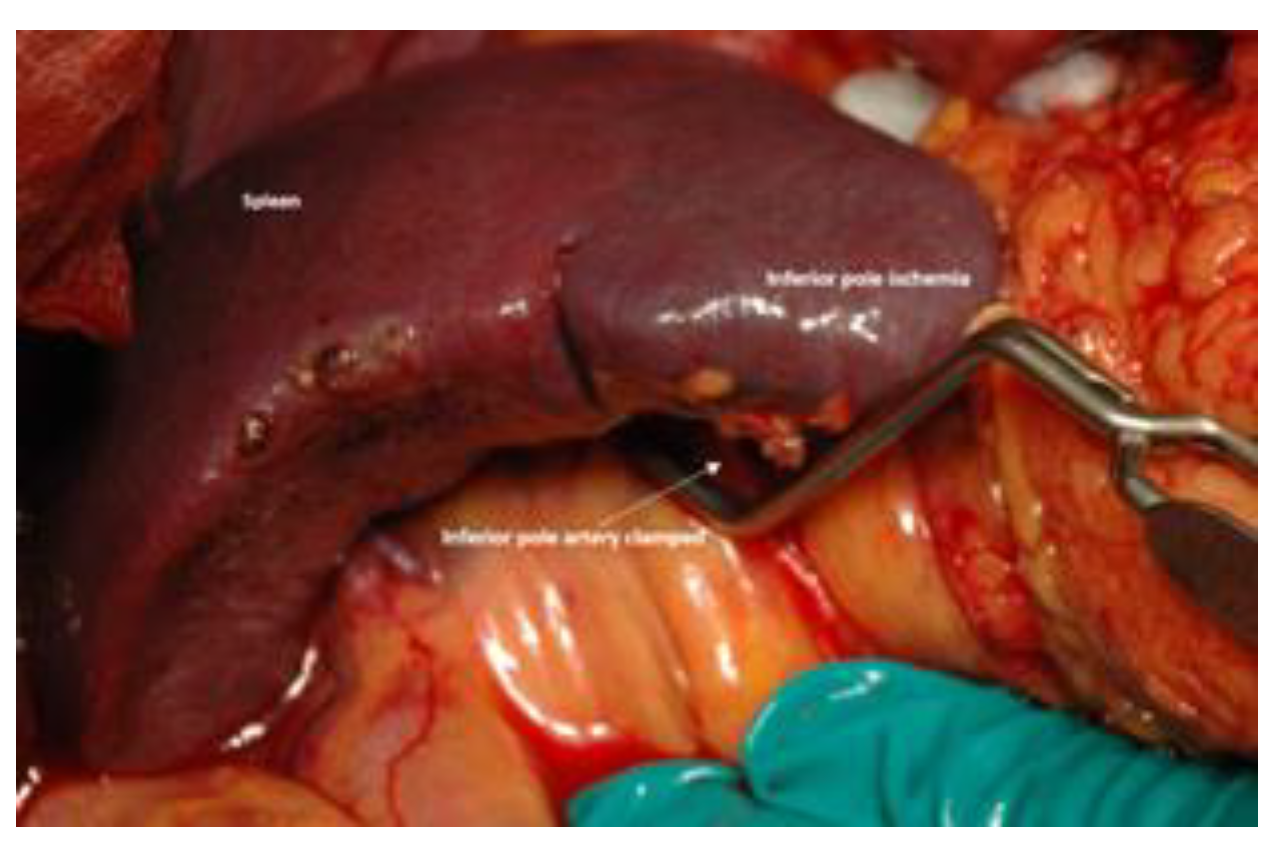
Figure 2.
LGA type of collateral blood supply to the spleen after SPDP SVR. A. CT angiographic (CTA) demonstration of the left gastric artery (LGA) type of blood supply to the spleen after SPDP SVR for mucinous cystadenoma in a 35-year-old woman. The short gastric arteries, and through them, the spleen, receive blood from the branches of the LGA. In this case, the diameter of the LGA after surgery increased 1.9 times, which increased the volumetric blood flow (VBF, Q) through the artery by 13 times. The diameter of the left gastroepiploic artery (LGEA) increased by 2 times, and through it increased by 16 times. The diameter of the right gastroepiploic artery (RGEA) did not change significantly. The trunk of the splenic artery (SA) is fully excised, gastroepiploic arcade was not closed before and after surgery. B. The chart of calculated relative change of blood flow intensity (volumetric flow rate in mL/min, Q) through the LGA, RGEA and LGEA after SP DP. As shown, the blood flow intensity through the LGA can increase 2,5–36 times and LGEA – 4-36 times (with regards to the baseline, i.e., the 1.0 value), which underlines the adaptive ability of the LGA branches and their hemodynamic contribution with this type of collateral blood supply to the spleen. The CTA shows the case #18.
Figure 2.
LGA type of collateral blood supply to the spleen after SPDP SVR. A. CT angiographic (CTA) demonstration of the left gastric artery (LGA) type of blood supply to the spleen after SPDP SVR for mucinous cystadenoma in a 35-year-old woman. The short gastric arteries, and through them, the spleen, receive blood from the branches of the LGA. In this case, the diameter of the LGA after surgery increased 1.9 times, which increased the volumetric blood flow (VBF, Q) through the artery by 13 times. The diameter of the left gastroepiploic artery (LGEA) increased by 2 times, and through it increased by 16 times. The diameter of the right gastroepiploic artery (RGEA) did not change significantly. The trunk of the splenic artery (SA) is fully excised, gastroepiploic arcade was not closed before and after surgery. B. The chart of calculated relative change of blood flow intensity (volumetric flow rate in mL/min, Q) through the LGA, RGEA and LGEA after SP DP. As shown, the blood flow intensity through the LGA can increase 2,5–36 times and LGEA – 4-36 times (with regards to the baseline, i.e., the 1.0 value), which underlines the adaptive ability of the LGA branches and their hemodynamic contribution with this type of collateral blood supply to the spleen. The CTA shows the case #18.
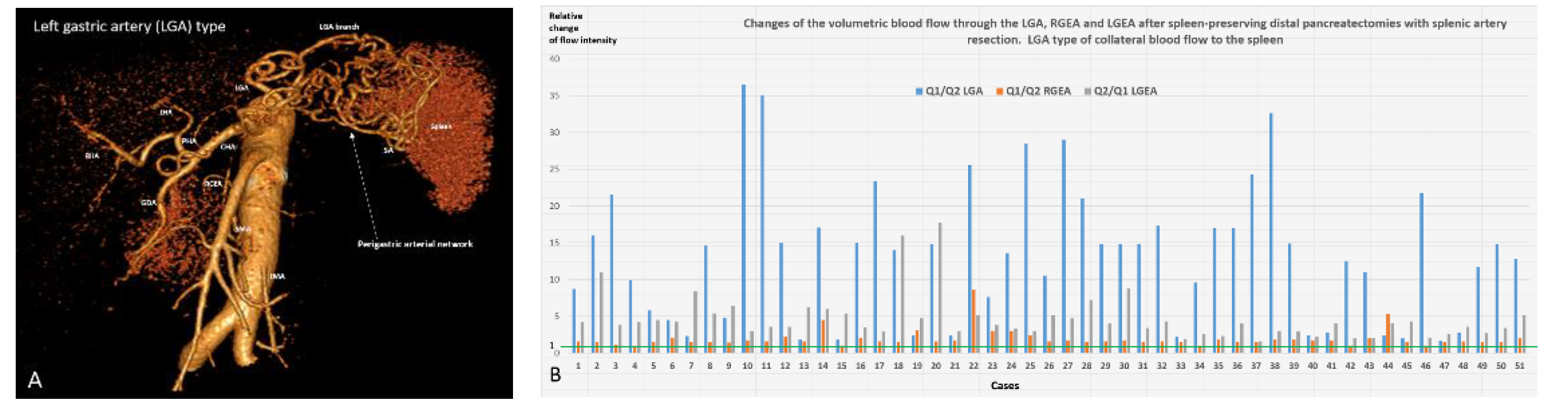
Figure 3.
GEA type of collateral blood supply to the spleen after SPDP SVR. A,B. CTA demonstration of the gastro-epiploic arcade (GEA) type of blood supply to the spleen after SPDP SVR for mucinous cystadenomas in a 25 (A)- and 41 (B)-year-old women. The short gastric arteries, and through them, the spleen, receive blood from the gastro-epiploic arcade. The gastroepiploic arcade, which was open before surgery, now is closed. In case A, the trunk of the SA is fully excised, the diameter of the LGA after surgery increased insignificantly and is half the diameter of the RGEA. In both cases RGEA and LGEA, increased their diameters by two times, increasing the VBF through each artery by 16 times after surgery. In case B, six cm of the SA trunk were excised and RGEA originates from the middle colic artery, which is described but rare variant. C. The chart shows calculated relative change of blood flow intensity (volumetric flow rate in mL/min, Q) through the LGA, RGEA and LGEA after SP DP. As shown, the blood flow intensity through the GEA can increase 8–24 times and LGEA – 7-38 times (with regards to the baseline, i.e., the 1.0 value), which underlines the adaptive ability of the GE arcade and its hemodynamic contribution with this type of collateral blood supply to the spleen. The CTA shows the cases #2 and #5.
Figure 3.
GEA type of collateral blood supply to the spleen after SPDP SVR. A,B. CTA demonstration of the gastro-epiploic arcade (GEA) type of blood supply to the spleen after SPDP SVR for mucinous cystadenomas in a 25 (A)- and 41 (B)-year-old women. The short gastric arteries, and through them, the spleen, receive blood from the gastro-epiploic arcade. The gastroepiploic arcade, which was open before surgery, now is closed. In case A, the trunk of the SA is fully excised, the diameter of the LGA after surgery increased insignificantly and is half the diameter of the RGEA. In both cases RGEA and LGEA, increased their diameters by two times, increasing the VBF through each artery by 16 times after surgery. In case B, six cm of the SA trunk were excised and RGEA originates from the middle colic artery, which is described but rare variant. C. The chart shows calculated relative change of blood flow intensity (volumetric flow rate in mL/min, Q) through the LGA, RGEA and LGEA after SP DP. As shown, the blood flow intensity through the GEA can increase 8–24 times and LGEA – 7-38 times (with regards to the baseline, i.e., the 1.0 value), which underlines the adaptive ability of the GE arcade and its hemodynamic contribution with this type of collateral blood supply to the spleen. The CTA shows the cases #2 and #5.
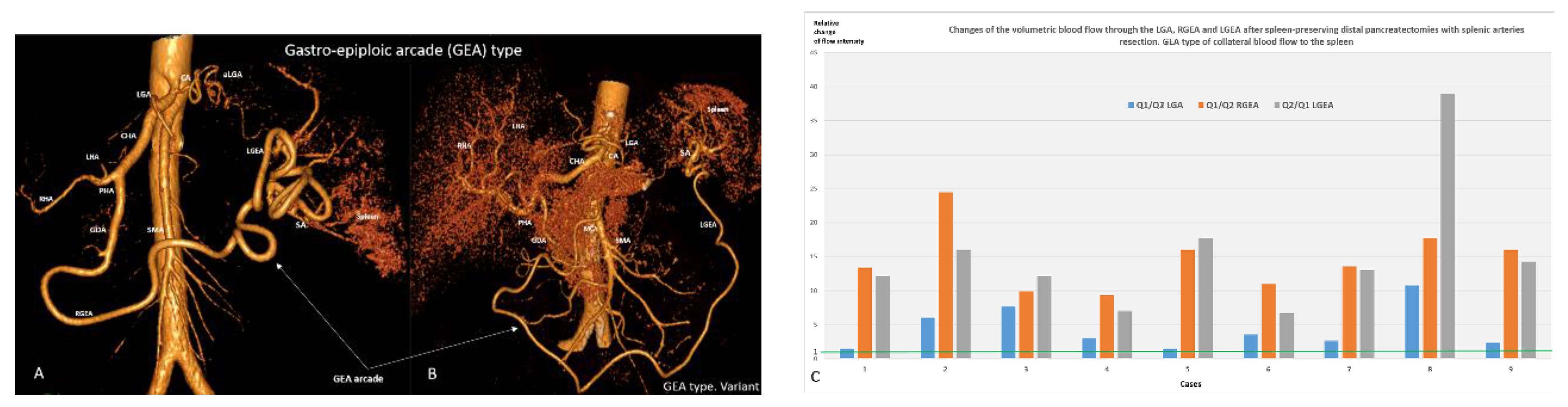
Figure 4.
Mixed type of collateral blood supply to the spleen after SPDP SVR. A. CTA demonstration of the mixed type of blood supply to the spleen after SPDP SVR for mucinous cystadenoma in a 52-year-old woman. The short gastric arteries, and through them, the spleen, receive blood as from the gastro-epiploic arcade, so as from the branches of the LGA. In this case, the diameter of the LGA, RGEA and LGEA after surgery increased significantly (1.5-1.95 times), which means increasing of the VBF through the arteries from 9.4 to 14.5 times. The trunk of the SA was fully excised, the gastroepiploic arcade, which was not closed before surgery, is now closed. B. The chart shows calculated relative change of blood flow intensity (volumetric flow rate in mL/min, Q) through the LGA, RGEA and LGEA after SP DP. As shown, the blood flow intensity through the LGA can increase 8–26 times, RGEA – 7,7-14, and LGEA – 4-21 times (with regards to the baseline, i.e., the 1.0 value), which underlines the adaptive ability of the LGA and GE arcade and their united hemodynamic contribution with this type of collateral blood supply to the spleen. The CTA shows the case #11. Abbreviations for the figure legends: VBF- volumetric blood flow, CA-celiac artery (CT-celiac trunk), SMA-superior mesenteric , SA-splenic , LGA-left gastric , RGEA-right gastro-epiploic, LGEA- left gastro-epiploic, RHA-right hepatic, LHA-left hepatic, GDA- gastroduodenal arteries. SMV- superior mesenteric, IV- intestinal, SV-splenic, LGV-left gastric, RRV- right renal, LRV-left renal, LAV-left adrenal veins. IVC- inferior vena cava.
Figure 4.
Mixed type of collateral blood supply to the spleen after SPDP SVR. A. CTA demonstration of the mixed type of blood supply to the spleen after SPDP SVR for mucinous cystadenoma in a 52-year-old woman. The short gastric arteries, and through them, the spleen, receive blood as from the gastro-epiploic arcade, so as from the branches of the LGA. In this case, the diameter of the LGA, RGEA and LGEA after surgery increased significantly (1.5-1.95 times), which means increasing of the VBF through the arteries from 9.4 to 14.5 times. The trunk of the SA was fully excised, the gastroepiploic arcade, which was not closed before surgery, is now closed. B. The chart shows calculated relative change of blood flow intensity (volumetric flow rate in mL/min, Q) through the LGA, RGEA and LGEA after SP DP. As shown, the blood flow intensity through the LGA can increase 8–26 times, RGEA – 7,7-14, and LGEA – 4-21 times (with regards to the baseline, i.e., the 1.0 value), which underlines the adaptive ability of the LGA and GE arcade and their united hemodynamic contribution with this type of collateral blood supply to the spleen. The CTA shows the case #11. Abbreviations for the figure legends: VBF- volumetric blood flow, CA-celiac artery (CT-celiac trunk), SMA-superior mesenteric , SA-splenic , LGA-left gastric , RGEA-right gastro-epiploic, LGEA- left gastro-epiploic, RHA-right hepatic, LHA-left hepatic, GDA- gastroduodenal arteries. SMV- superior mesenteric, IV- intestinal, SV-splenic, LGV-left gastric, RRV- right renal, LRV-left renal, LAV-left adrenal veins. IVC- inferior vena cava.
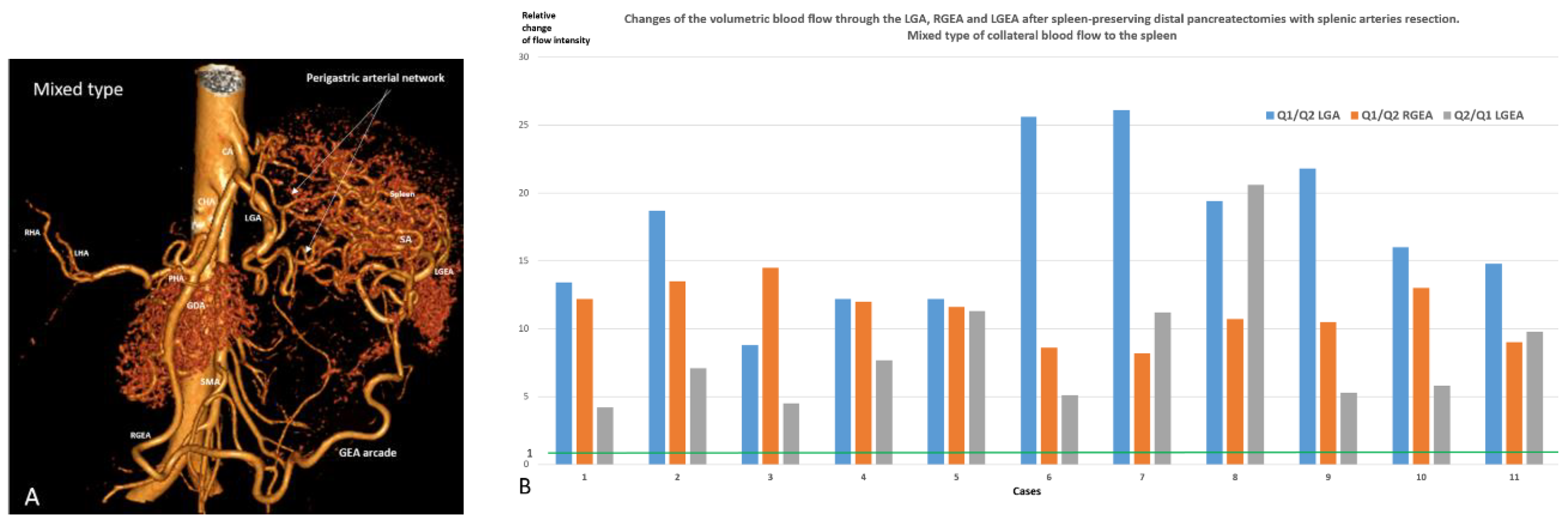
Figure 5.
Spleen-preserving central resection with splenic vessels resection for G2 neuroendocrine tumor in a 41-year-old woman. A- an operating field after completion of the resection stage; B- CTA after surgery, showing the sources of blood supply to the pancreatic tail and spleen from the branches of the LGA, the diameter of which has increased by 2 times, which means increasing of the VBF through the LGA by 16 times. Gastroepiploic arcade was open before and after surgery.
Figure 5.
Spleen-preserving central resection with splenic vessels resection for G2 neuroendocrine tumor in a 41-year-old woman. A- an operating field after completion of the resection stage; B- CTA after surgery, showing the sources of blood supply to the pancreatic tail and spleen from the branches of the LGA, the diameter of which has increased by 2 times, which means increasing of the VBF through the LGA by 16 times. Gastroepiploic arcade was open before and after surgery.
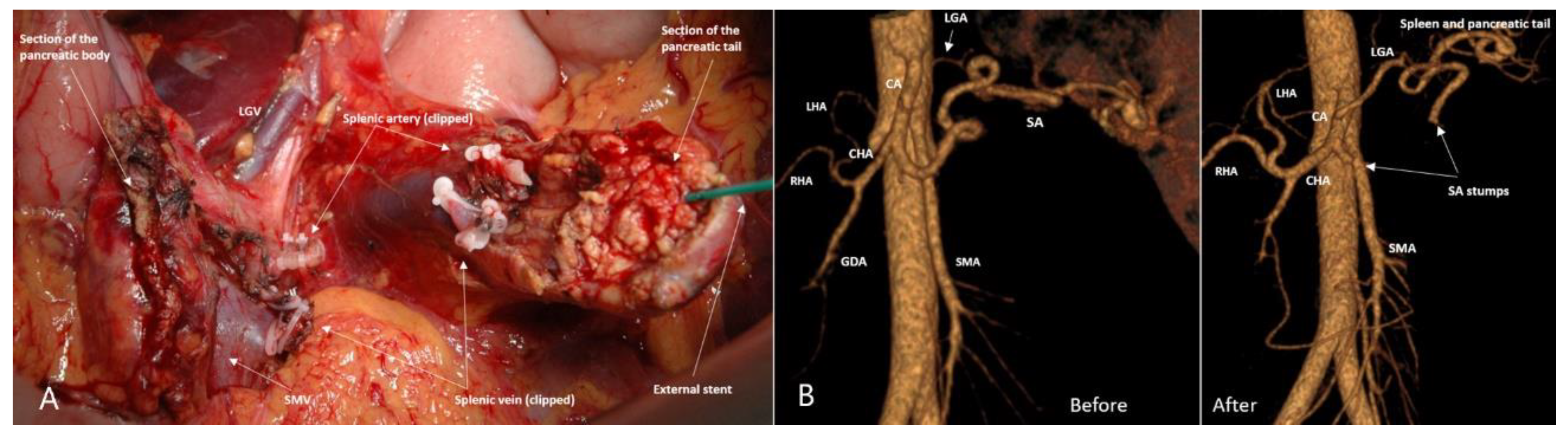
Figure 6.
Total pylorus- and spleen-preserving pancreatectomy with splenic vessels resection for pancreatic head ductal adenocarcinoma (PHDAC) on the background of MD IPMN in a 51-year-old woman. A- an operating field after completion of the resection stage; B- CTA after surgery, showing the sources of blood supply to the spleen from the branches of the LGA, the diameter of which has increased by 1.8 times which means increasing of the VBF through the LGA by 10,5 times.
Figure 6.
Total pylorus- and spleen-preserving pancreatectomy with splenic vessels resection for pancreatic head ductal adenocarcinoma (PHDAC) on the background of MD IPMN in a 51-year-old woman. A- an operating field after completion of the resection stage; B- CTA after surgery, showing the sources of blood supply to the spleen from the branches of the LGA, the diameter of which has increased by 1.8 times which means increasing of the VBF through the LGA by 10,5 times.
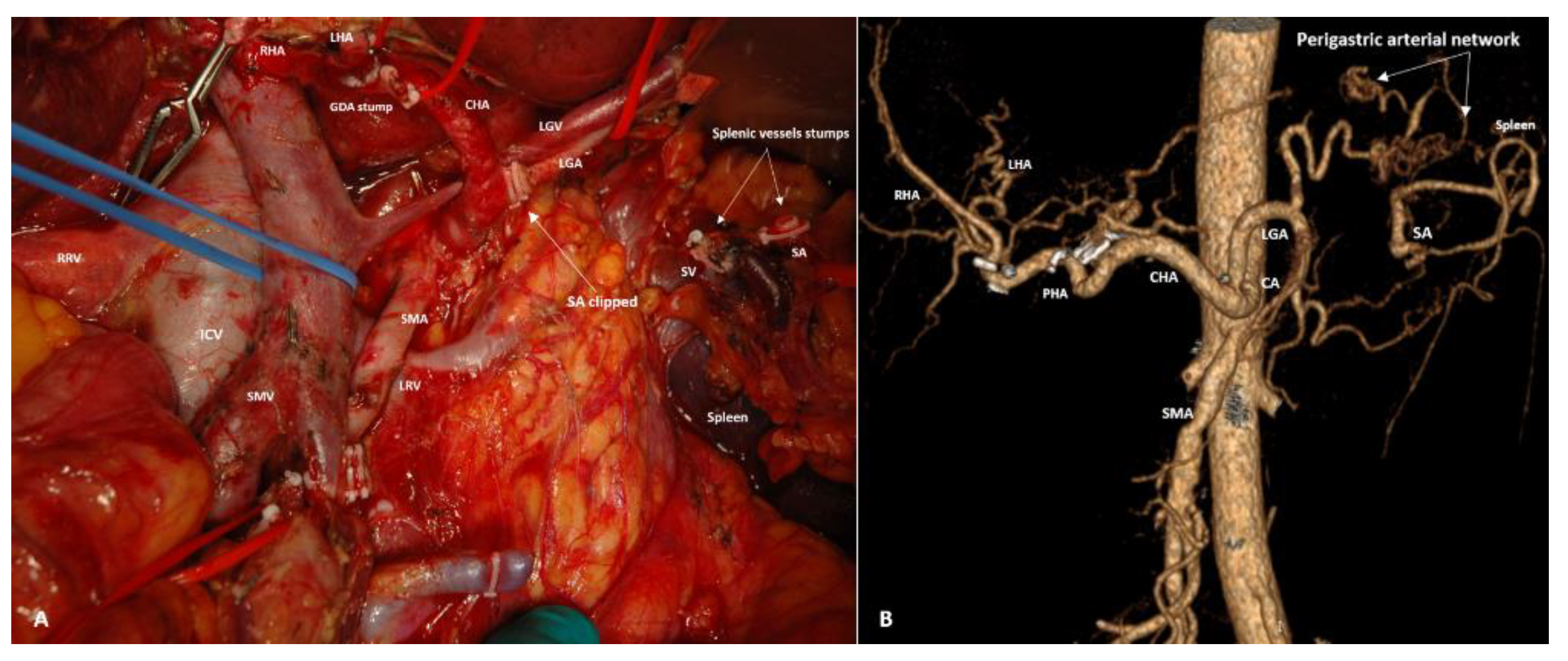
Figure 7.
Total pylorus- and spleen-preserving pancreatectomy with SMA and SMV resection, resection and rotation of the splenic artery (SA) for the substitution of the SMA and SA-SMA anastomosis for LA PHDAC in a 73-year-old man. A. an operating field after completion of the resection stage. Yellow arrow shows the clockwise rotation way of the SA; B,C- CTA before (B) and after (C) surgery, showing the postoperative sources of blood supply to the spleen from the branches of the LGA, the diameter of which has increased by 1,6 times, which means increasing of the VBF through the LGA by 7,4 times.
Figure 7.
Total pylorus- and spleen-preserving pancreatectomy with SMA and SMV resection, resection and rotation of the splenic artery (SA) for the substitution of the SMA and SA-SMA anastomosis for LA PHDAC in a 73-year-old man. A. an operating field after completion of the resection stage. Yellow arrow shows the clockwise rotation way of the SA; B,C- CTA before (B) and after (C) surgery, showing the postoperative sources of blood supply to the spleen from the branches of the LGA, the diameter of which has increased by 1,6 times, which means increasing of the VBF through the LGA by 7,4 times.
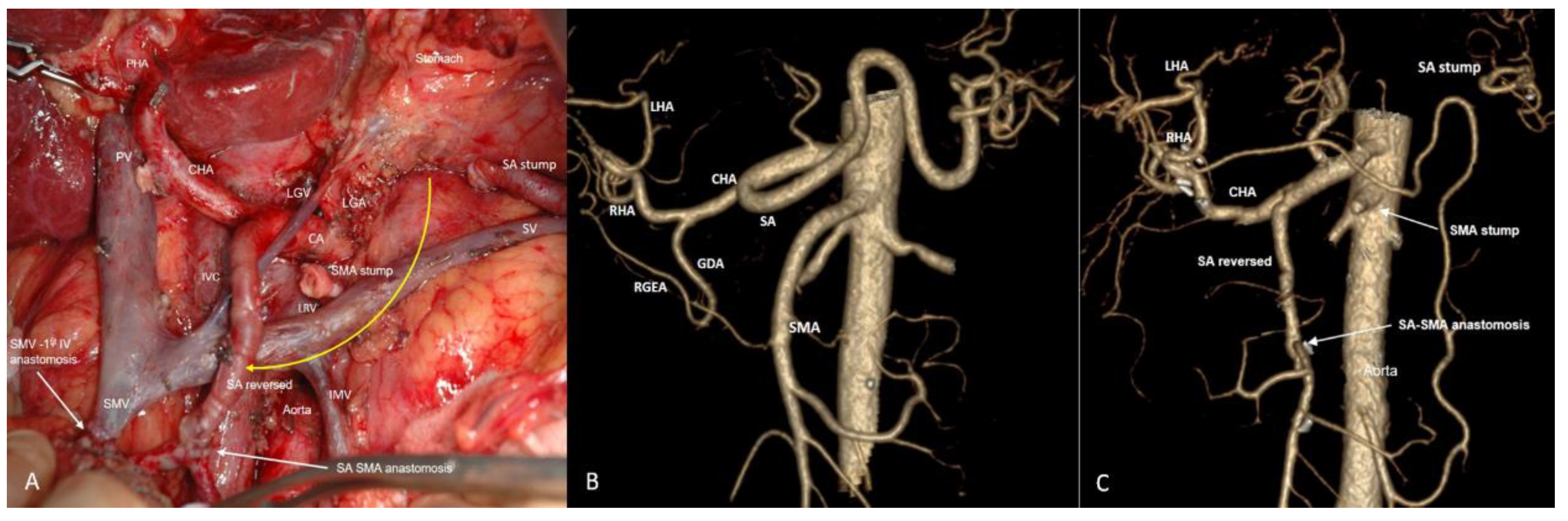
Figure 8.
Pylorus- and spleen-preserving pancreaticoduodenectomy with splenic vessels resection for PHDAC in a 54-year-old woman. A- an operating field after completion of the resection stage; B- CTA after surgery, showing the sources of blood supply to the pancreatic tail and spleen from the branches of the LGA, the diameter of which has increased by 2 times, which means increasing of the VBF through the LGA by 16 times.
Figure 8.
Pylorus- and spleen-preserving pancreaticoduodenectomy with splenic vessels resection for PHDAC in a 54-year-old woman. A- an operating field after completion of the resection stage; B- CTA after surgery, showing the sources of blood supply to the pancreatic tail and spleen from the branches of the LGA, the diameter of which has increased by 2 times, which means increasing of the VBF through the LGA by 16 times.
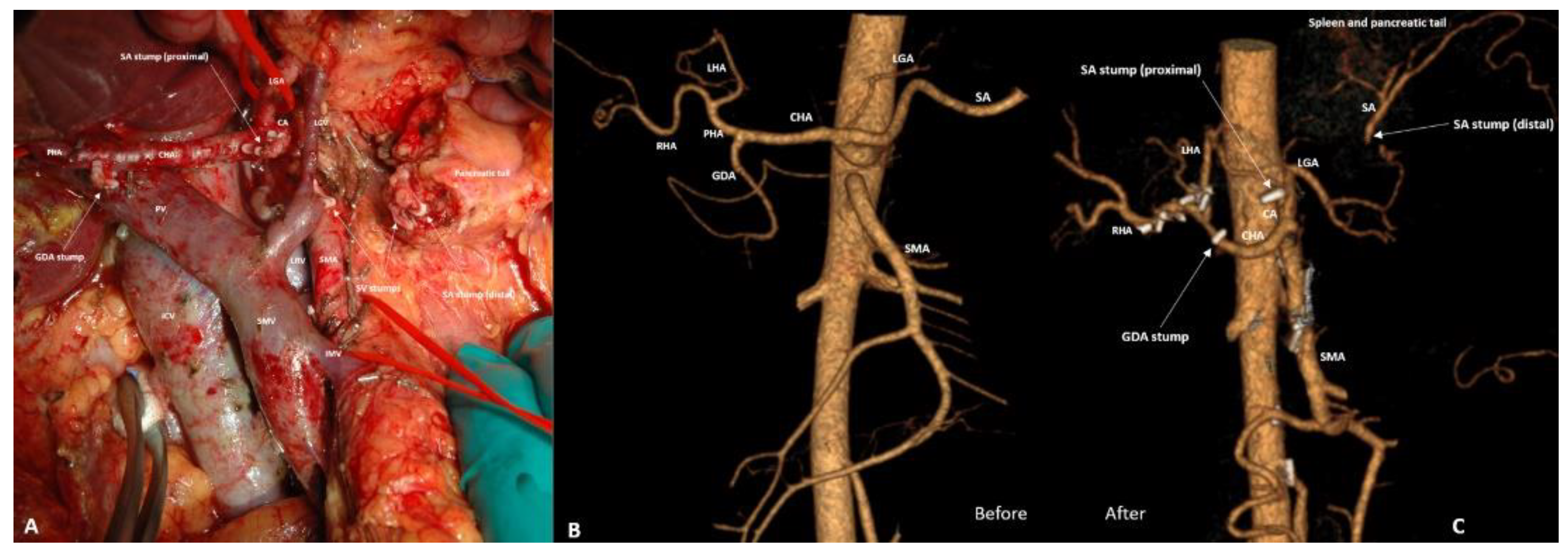
Figure 9.
Pylorus- and spleen-preserving pancreaticoduodenectomy with CHA, SMV and SV resection, resection and rotation of the splenic artery (SA) for the SA-PHA anastomosis for PHDAC with CHA, SMV and SV involvement in a 66-year-old man. A- an operating field after completion of the resection stage. The SA is rotated counterclockwise and anastomosed with proper hepatic artery (PHA), the pancreas is in the yellow circle. B. CTA after surgery, showing the sources of blood supply to the spleen and the pancreatic tail from the branches of the LGA, the diameter of which has increased by 1,5 times, which means increasing of the VBF through the LGA by 5 times.
Figure 9.
Pylorus- and spleen-preserving pancreaticoduodenectomy with CHA, SMV and SV resection, resection and rotation of the splenic artery (SA) for the SA-PHA anastomosis for PHDAC with CHA, SMV and SV involvement in a 66-year-old man. A- an operating field after completion of the resection stage. The SA is rotated counterclockwise and anastomosed with proper hepatic artery (PHA), the pancreas is in the yellow circle. B. CTA after surgery, showing the sources of blood supply to the spleen and the pancreatic tail from the branches of the LGA, the diameter of which has increased by 1,5 times, which means increasing of the VBF through the LGA by 5 times.
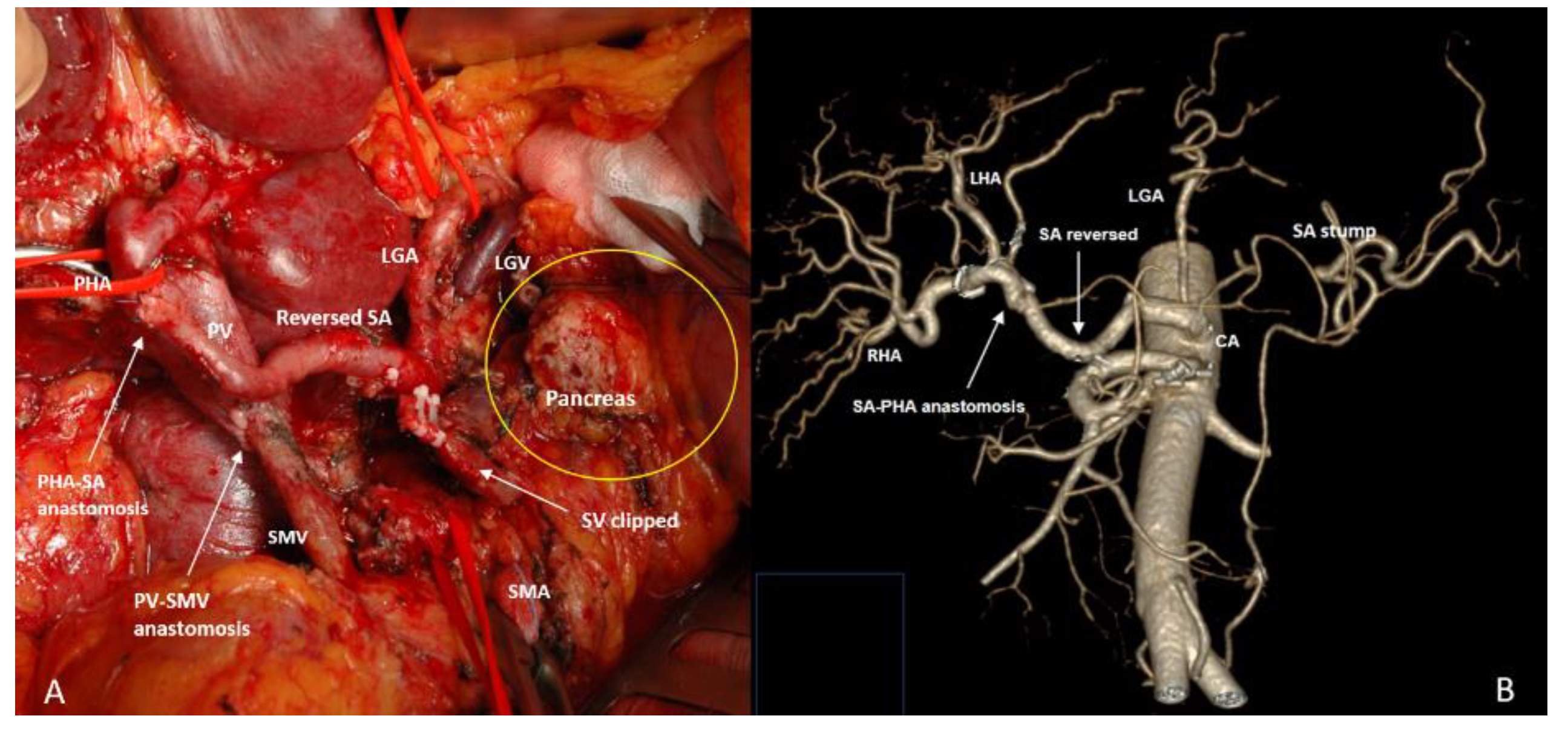
Figure 10.
Spleen-preserving pancreaticoduodenectomy with SMA and SMV resection, resection and rotation of the splenic artery (SA) for the SA-SMA anastomosis for PHDAC with SMA and SMV involvement in a 65-year-old woman. A. an operating field after completion of the resection stage. The SA is rotated clockwise and anastomosed with the SMA. Resection of the posterior wall of the SMV. The SV is pulled down by the blue vessel loop to expose the SMA stump; B. CTA shows the sources of blood supply to the spleen and pancreatic tail from the branches of the LGA after surgery, the diameter of which has increased by 1,8 times (B,C), which means increasing of the VBF through the LGA by 10,5 times.
Figure 10.
Spleen-preserving pancreaticoduodenectomy with SMA and SMV resection, resection and rotation of the splenic artery (SA) for the SA-SMA anastomosis for PHDAC with SMA and SMV involvement in a 65-year-old woman. A. an operating field after completion of the resection stage. The SA is rotated clockwise and anastomosed with the SMA. Resection of the posterior wall of the SMV. The SV is pulled down by the blue vessel loop to expose the SMA stump; B. CTA shows the sources of blood supply to the spleen and pancreatic tail from the branches of the LGA after surgery, the diameter of which has increased by 1,8 times (B,C), which means increasing of the VBF through the LGA by 10,5 times.
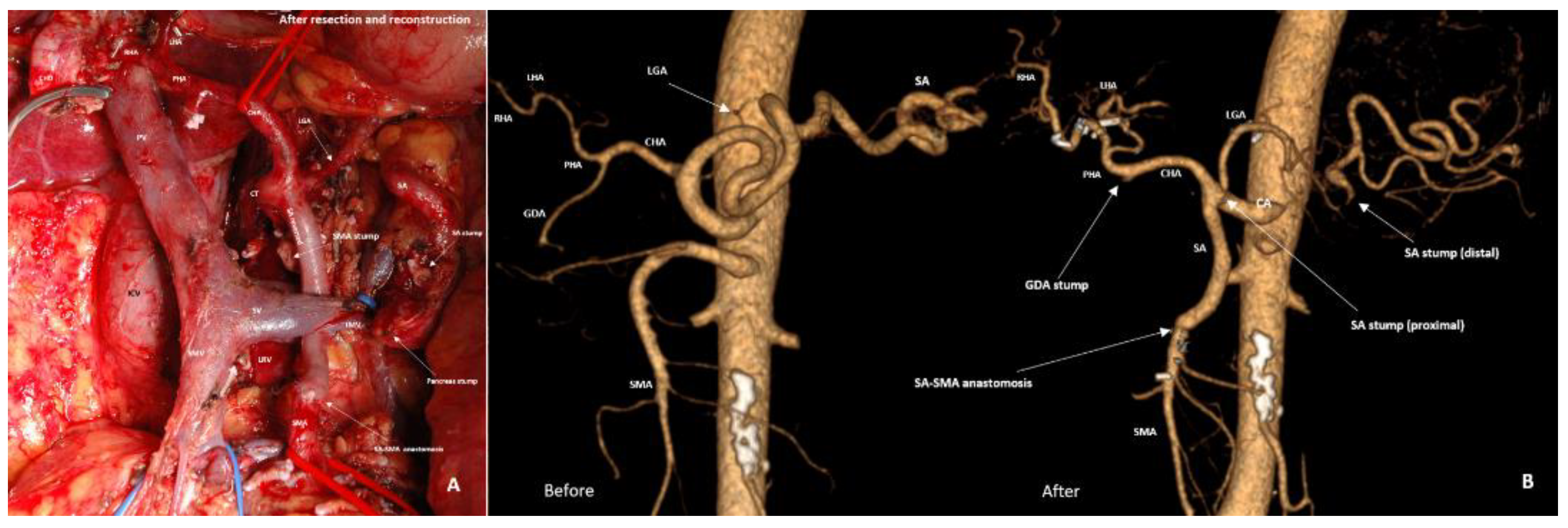
Figure 11.
Recurrent MPNST peritoneo-retroperitoneal removal in a 33-year-old lady. Surgery was associated with stomach- and spleen-preserving total pancreatectomy, right nephr- and adrenalectomy, resection of the CA, SA, LGA, common, proper, left and right hepatic arteries, portal, splenic and inferior cava veins. Cava-caval and SMV-PV synthetic prostheses. Right common iliac to right hepatic artery and left common iliac to splenic artery autovenous prostheses. Spleen and the whole stomach were preserved after resection of the CA with the left and right gastric and RGEA, due to revascularization of the SA remnant, which supplies the SGA-LGEA network. A- a scheme of surgery after reconstruction of blood vessels and gastrointestinal tract: B- an operating field after completion of the resection stage; C,D- CTA before and after surgery, showing the new sources of the spleen and stomach blood supply.
Figure 11.
Recurrent MPNST peritoneo-retroperitoneal removal in a 33-year-old lady. Surgery was associated with stomach- and spleen-preserving total pancreatectomy, right nephr- and adrenalectomy, resection of the CA, SA, LGA, common, proper, left and right hepatic arteries, portal, splenic and inferior cava veins. Cava-caval and SMV-PV synthetic prostheses. Right common iliac to right hepatic artery and left common iliac to splenic artery autovenous prostheses. Spleen and the whole stomach were preserved after resection of the CA with the left and right gastric and RGEA, due to revascularization of the SA remnant, which supplies the SGA-LGEA network. A- a scheme of surgery after reconstruction of blood vessels and gastrointestinal tract: B- an operating field after completion of the resection stage; C,D- CTA before and after surgery, showing the new sources of the spleen and stomach blood supply.
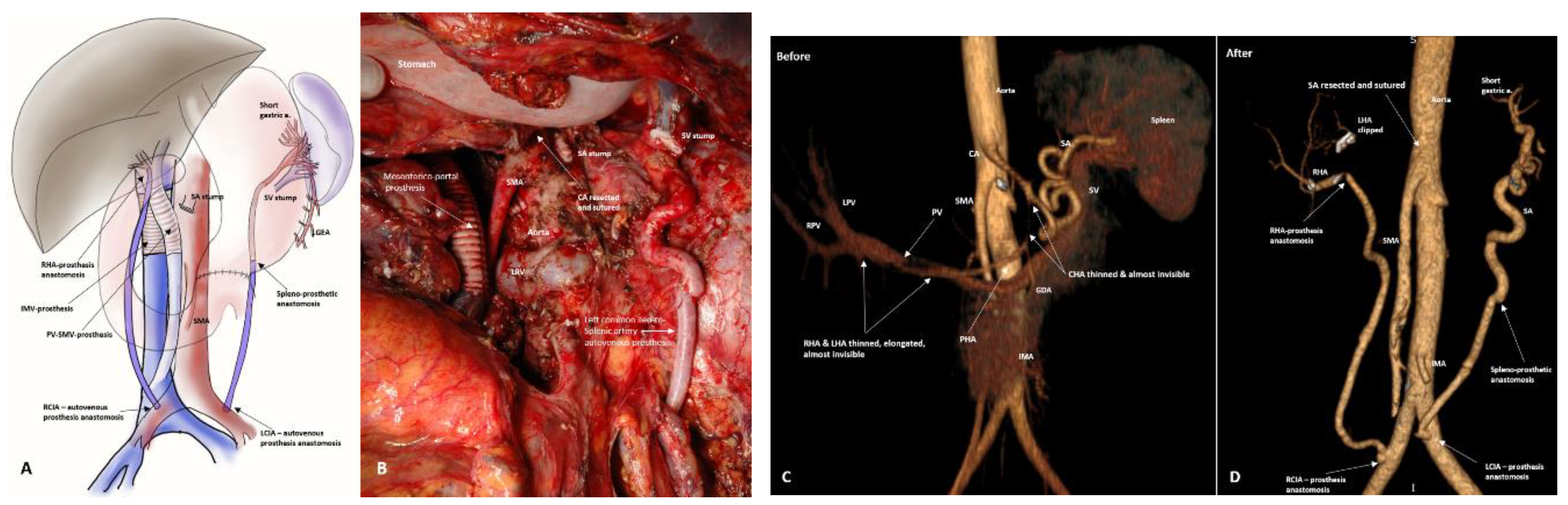
Figure 12.
LA PDAC in 42-year-old lady after 12 courses of FOLFIRINOX. Pancreaticoduodenectomy, SII-III liver segmentectomy with resection of CA, SMA, LGA, SA, right and middle colic, and both hepatic arteries, portal, superior and inferior mesenteric, splenic, left gastric, and left portal veins. Transposition of the SMA into the lower aorta. Arterial right-sided common iliac-to-right hepatic and left-sided common iliac-to-splenic autovein prostheses. Splenorenal venous anastomosis. PV-SMV alloprosthesis. Spleen? Distal pancreas and the whole stomach were preserved after resection of the CA with the left and right gastric and RGEA, due to revascularization of the SA remnant, which supplies the SGA-LGEA network. A- a scheme of surgery after reconstruction of blood vessels and gastrointestinal tract: B- an operating field after completion of the resection stage; C,D- CTA before and after surgery, showing the new sources of the spleen and stomach blood supply.
Figure 12.
LA PDAC in 42-year-old lady after 12 courses of FOLFIRINOX. Pancreaticoduodenectomy, SII-III liver segmentectomy with resection of CA, SMA, LGA, SA, right and middle colic, and both hepatic arteries, portal, superior and inferior mesenteric, splenic, left gastric, and left portal veins. Transposition of the SMA into the lower aorta. Arterial right-sided common iliac-to-right hepatic and left-sided common iliac-to-splenic autovein prostheses. Splenorenal venous anastomosis. PV-SMV alloprosthesis. Spleen? Distal pancreas and the whole stomach were preserved after resection of the CA with the left and right gastric and RGEA, due to revascularization of the SA remnant, which supplies the SGA-LGEA network. A- a scheme of surgery after reconstruction of blood vessels and gastrointestinal tract: B- an operating field after completion of the resection stage; C,D- CTA before and after surgery, showing the new sources of the spleen and stomach blood supply.
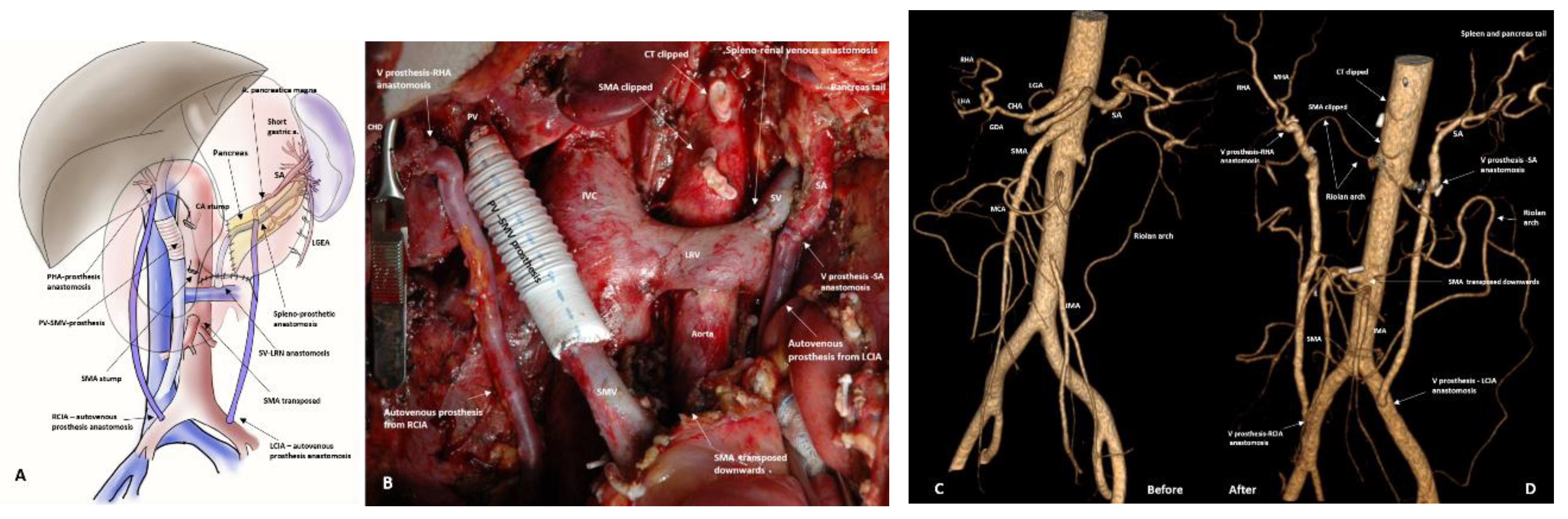
Figure 13.
LGA type of collateral blood supply to the spleen and distal pancreas after total pancreatectomies and pancreaticoduodenectomies with splenic vessels resection. The chart shows calculated relative change of blood flow intensity (volumetric flow rate in mL/min, Q) through the LGA and LGEA after surgery. As shown, the blood flow intensity through the LGA can increase 3,5–26 times and LGEA – 3-33 times (with regards to the baseline, i.e., the 1.0 value), which underlines the adaptive ability of the LGA branches and their hemodynamic contribution to collateral blood supply to the spleen after above mentioned surgery.
Figure 13.
LGA type of collateral blood supply to the spleen and distal pancreas after total pancreatectomies and pancreaticoduodenectomies with splenic vessels resection. The chart shows calculated relative change of blood flow intensity (volumetric flow rate in mL/min, Q) through the LGA and LGEA after surgery. As shown, the blood flow intensity through the LGA can increase 3,5–26 times and LGEA – 3-33 times (with regards to the baseline, i.e., the 1.0 value), which underlines the adaptive ability of the LGA branches and their hemodynamic contribution to collateral blood supply to the spleen after above mentioned surgery.
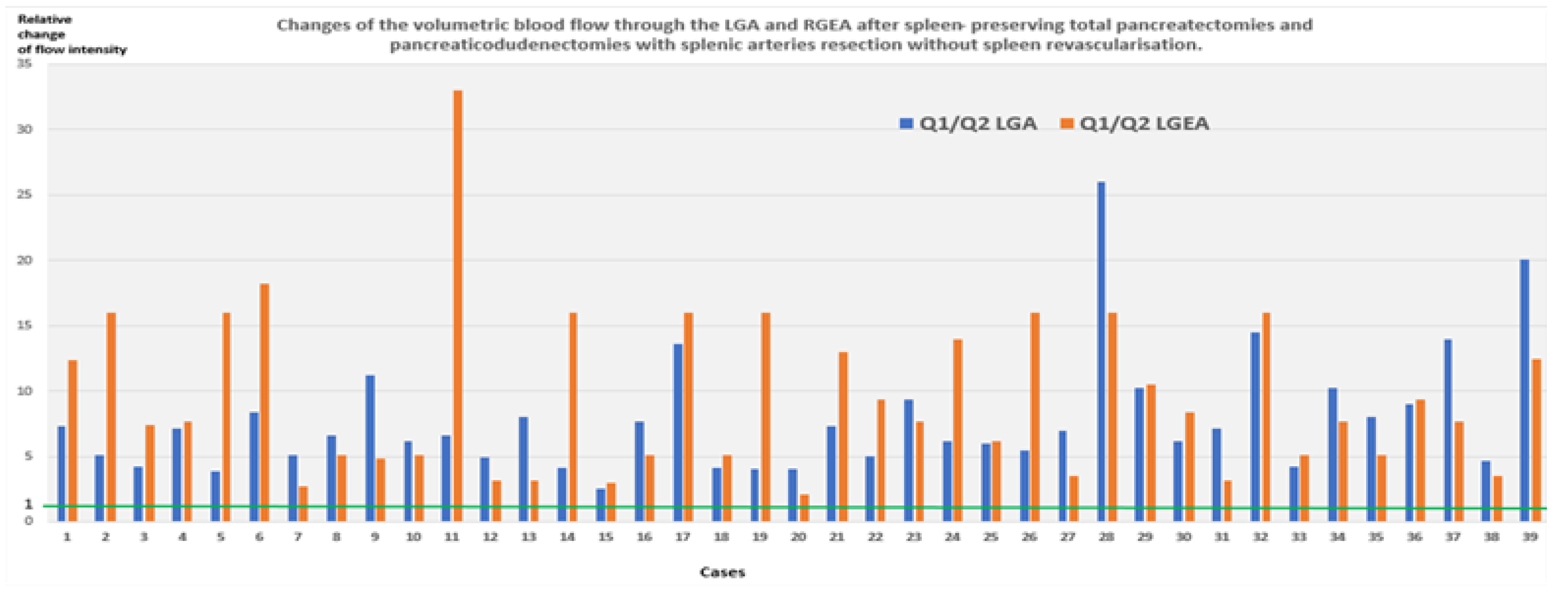
Figure 14.
Overall (A) and progression-free (B) survival after spleen-preserving total pancreatectomies and pancreaticoduodenectomies with splenic vessels resection for BR and LA PDAC.
Figure 14.
Overall (A) and progression-free (B) survival after spleen-preserving total pancreatectomies and pancreaticoduodenectomies with splenic vessels resection for BR and LA PDAC.
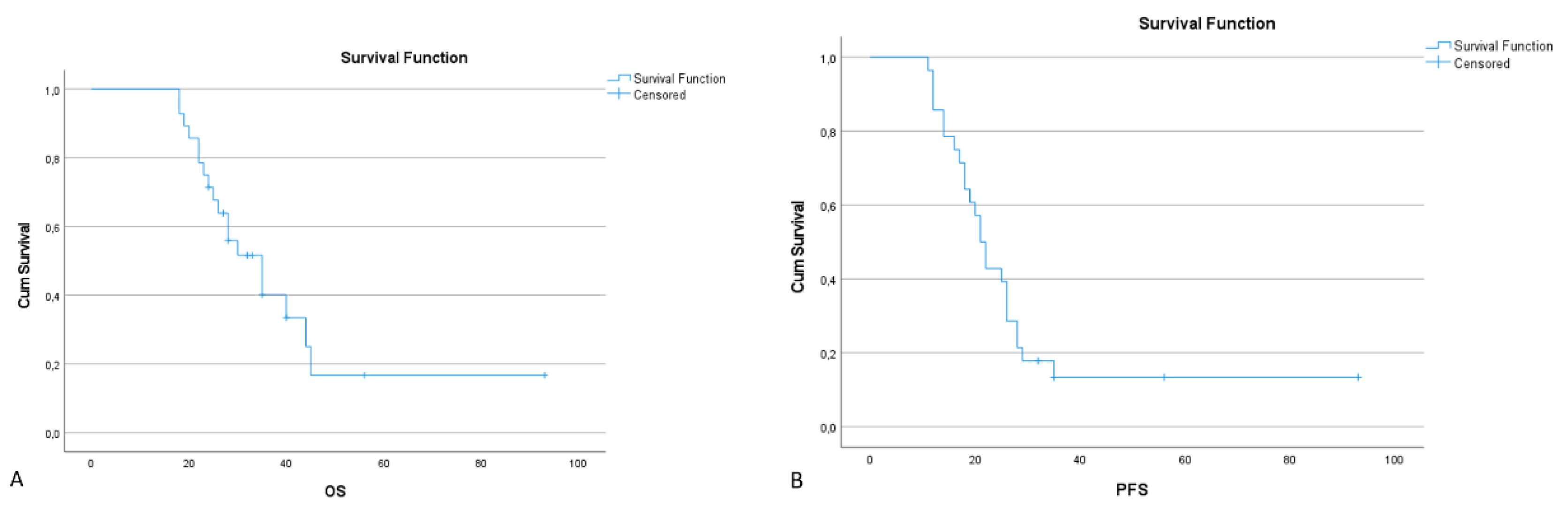

Table 1.
Indications for surgery and types of spleen-preserving pancreatectomies.
| Indications for SP pancreatectomies/Diagnosis | Number | |
|---|---|---|
| 1 | Mucinous cystic neoplasm (MCN) | 41 |
| 2 | Branch duct intraepithelial mucinous neoplasia (bdIPMN) | 9 |
| 3 | Main duct intraepithelial mucinous neoplasia (mdIPMN)* | 10 |
| 4 | Cerous cystic adenoma (CSA) | 3 |
| 5 | Well-differentiated neuroendocrine neoplasms (NEN) | 23 |
| 6 | Solid-pseudopapillary neoplasm (SPPN) | 8 |
| 7 | Chronic calculous pancreatitis (CP) | 1 |
| 8 | Autoimmune pancreatitis (local form) (AIP) | 1 |
| 9 | Malignant peripheral nerve sheath tumor (MPNST) | 1 |
| 10 | BR and LA pancreatic head ductal adenocarcinoma (PHDAC) | 40 |
| Total | 137 | |
| Types of surgery | Number | |
| Spleen-preserving pancreatectomies with splenic vessels preservation (SPPE SVP) | 19 | |
| 1. Distal pancreatectomy (SPDP SVP) | 12 | |
| 2. Total pancreatectomy (TP SVP) | 6 | |
| 3. Center-preserving pancreatectomy with splenic vessels preservation | 1 | |
| Spleen-preserving pancreatectomies with splenic vessels resection (SPPE SPR) | 115 | |
| 1. Distal pancreatectomy (SPDP SVR) | 71 | |
| 2. Central pancreatectomy with splenic vessels resection (CP SVR) | 3 | |
| 3. Total pancreatectomy with splenic vessels resection (TP SVR) | 2 | |
| 4. Total pancreatectomy with SMA resection and splenic artery rotation (TP SAR) | 6 | |
| 5. Total pancreatectomy with HA/CA/LGA resection and splenic artery revascularization. | 1 | |
| 6. Pancreaticoduodenectomy with splenic vessels resection (PD SVR) | 3 | |
| 7. Pancreaticoduodenectomy with SMA or CHA resection and splenic artery rotation (PD SAR) | 28 | |
| 8. Pancreaticoduodenectomy with SMA and CA/HA/LGA resection and splenic artery revascularization. | 1 | |
| Total | 134 | |
*In three cases, PDAC was associated with mdIPMN, in which both diseases were considered.
Table 2.
Spleen-preserving distal pancreatectomies. Patient demographics and perioperative data (n83).
Table 2.
Spleen-preserving distal pancreatectomies. Patient demographics and perioperative data (n83).
| Age (mean ± SD) | 44.23± 13,9 |
|---|---|
| Female gender, n (%) | 61 (76.25%) |
| BMI (mean ± SD) | 22.58±3,2 |
| Tumor size (mean ± SD) (mm) | 61.88±40,0 |
| OP time (min) (mean ± SD) | 208.54±143,6 |
| E blood Loss (ml) (mean ± SD) | 108.05±146 |
| Mean hospital stay (days) | 5.2 ± 0,75 |
| Median F-up time (months) | 88 [58,116] |
Table 3.
Morbidity after spleen-preserving distal pancreatectomies.
| Type of surgery | # | POPF Grade B | D-C ≥ 3 | Spleen infarction (n,%, cr) | Any gastric/ epigastric varices | Late morbidity* | Postop DM |
|---|---|---|---|---|---|---|---|
| SPDPSVR | 71 | 14 (20%) of 33 |
0 | 18 (25%), 0 cr | 11(17.5%) of 63 | 1 | 9 (13%) |
| SPDPSVP | 12 | 2 (22%) of 7 |
1 | 0 | 1 (8%) | 2 | 1 (8%) |
| Total | 83 | 16 (19%) | 1 | 18 (22%), 0 cr | 12 (14.5%) | 3 | 10 (12%) |
SPDPSVR – spleen-preserving distal pancreatectomy with splenic vessels resection, SPDPSVP- spleen-preserving distal pancreatectomy with splenic vessels preservation, *complications which happened months or years after surgery (late bleedings followed by arterial embolization and/or splenectomy), cr- clinically relevant.
Table 4.
Perioperative characteristics of the patients with locally advanced and borderline-resectable pancreatic head cancers who have undergone spleen-, distal pancreas and stomach-preserving pancreatectomies with splenic artery (vessels) resection (n41).
Table 4.
Perioperative characteristics of the patients with locally advanced and borderline-resectable pancreatic head cancers who have undergone spleen-, distal pancreas and stomach-preserving pancreatectomies with splenic artery (vessels) resection (n41).
| Age (years) | 57,8 ± 10.1 (33-73) |
| Gender (m/f) | 18/23 (44%/56%) |
| PDAC/MPNST | 40/1 |
| Neoadjuvant chemotherapy (NACHT) (yes/no) | 41/0 (100%/0) |
| Mean number of NACHT courses | 11.6 ± 2.95 |
| Adjuvant chemotherapy (ACHT) (yes/no) | 38/3 (93%/7%) |
| Completed ACHT, n38 | 31 (82%) |
| Incompleted ACHT. In process/incompleted, n7 | 5/2 (13,5% / 2,5%) |
| Mean number of ACHT courses | 4.43 ± 2,56 |
| CCI – 2/3/4/5/ (score) | 5/19/14/3 (12%/46%/34%/8%) |
| OP time (min.) | 560 ± 146 (195- 1260) |
| Estimated blood loss (ml) | 358 ± 211 (100- 1200) |
| Operative packed RBC transfusion, n (cases) | 9 (22%) |
| No. of packed RBC units transfused, ≥ 2 />2, n | 6/3 |
| PV/SMV resection (yes/no) | 38/3(93%/7%) |
| CA 19-9 before NACHT, U/ml, n40 | 308,7±352 |
| CA 19.9 before surgery, n40 | 49,5±69,6 |
| CA 19-9 decreasing ratio after/before NACHT, n40 | 6,3 |
| Tumor size at pathology (mm), n40 | 34,6±13,3 (0-81) |
| Tumor grade, G1,G2,G3, n40 | 3, 33, 4 (7,5%,82,5, 10%) |
| Contact on CT > 180° with SA, HA/CA, SMA, CA&SMA | 5, 15, 19, 2 (12%, 36,5%, 46,5%, 5%) |
| Arteries resected in addition to SA: HA/CA, SMA, CA&SMA | 15 / 19 / 2 |
| LA tumors (T4)/ BR tumors(T3) | 36/5 |
| Arterial invasion at pathology (yes/no), n40 | 27/14 (66%/34%) |
| PV-SMV invasion at pathology yes/no), n40 | 34/4 (90,5%/9,5%) |
| Perineural invasion (yes/no) (n40) | 34/6 (85%/15%) |
| R0/R1-resection | 38/3 (92,7/7,3%) |
| Number of lymph nodes removed (n40) | 37,6±13 (21-75) |
| Lymph nodes involvement, pN0/pN1/pN2 (n40) | 7/20/13 (17,5%/50%/32,5%) |
| Tumor regression score, 0/1/2/3, n40 | 2,2,14,22 (5%, 5%, 34%, 56%) |
| Pancreatectomy type, n (%): PD/total pancreatectomy | 32/9 (78%/22%) |
| Mean time for anastomosis with the SA (min) | 21,9±1,5 min |
| Recurrence type, n (% total, % all recurrence), n40 | |
| Local | 3 (7.5, 11,5) |
| Peritoneal | 5 (12,5, 19) |
| Distant (liver, lungs, lymph nodes, bone) | 18 (45, 69) |
| Multisite | 8 (20, 30.8) |
| Vital status at last follow-up, n (%) | |
| Alive, with disease | 8 (20) |
| Alive, no evidence of disease | 14 (35) |
| Died | 19 (47.5) * |
Table 5.
Morbidity after spleen-, distal pancreas and tomach-preserving pancreatectomies for locally advanced and borderline resectable pancreatic head cancers with splenic artery (vessels) resection (n41).
Table 5.
Morbidity after spleen-, distal pancreas and tomach-preserving pancreatectomies for locally advanced and borderline resectable pancreatic head cancers with splenic artery (vessels) resection (n41).
| Complications (С-D), <3 / III,IV | 32 / 7,2 (88%/17%, 5%) |
| POPF, Grade B, n32 | 1 (3%) |
| Diarrhea (n) | 17 (42%) |
| Length of stay (days) | 16,4±4,7 (9-29) |
| Lymphorrhea (n) | 12 (29%) |
| cr DGE, Grade 2/3 | 8 / 2 (20%,5%) |
| Postpancreatectomy hemorrhage (n) | 1 (2,4%) |
| Any cr ischemic abdominal complications | 0 |
| Reoperation (n) | 2 (7,5%) |
| Readmission (n) | 7 (17%) |
| Postoperative diabetes mellitus, n31 | 7 (22,6%) |
| Mortality, 90-days | 0 |
C- D – Classification of surgical morbidity by Clavien-Dindo, POPF – postoperative pancreatic fistula, cr-clinically relevant, DGE- delayed gastric emptying.
Disclaimer/Publisher’s Note: The statements, opinions and data contained in all publications are solely those of the individual author(s) and contributor(s) and not of MDPI and/or the editor(s). MDPI and/or the editor(s) disclaim responsibility for any injury to people or property resulting from any ideas, methods, instructions or products referred to in the content. |
© 2026 by the authors. Licensee MDPI, Basel, Switzerland. This article is an open access article distributed under the terms and conditions of the Creative Commons Attribution (CC BY) license (http://creativecommons.org/licenses/by/4.0/).
Copyright: This open access article is published under a Creative Commons CC BY 4.0 license, which permit the free download, distribution, and reuse, provided that the author and preprint are cited in any reuse.


