

Submitted:
09 April 2026
Posted:
13 April 2026
You are already at the latest version
Abstract
Introduction. One of the most common integrated morphological indices used in breast cancer (BC) patients is the Nottingham Prognostic Index (NPI). NPI can only be used after surgical treatment, as its calculation requires information on the status of axillary lymph nodes. Methods. We perform preoperative assessment of the axillary lymph node metastases risk in BC patients using the integrated morphological index – Total Malignancy Score (TMS). The TMS was calculated as the sum of the following parameters: tubule formation; nuclear pleomorphism; mitotic activity; invasive component; lymphoid infiltration; and lymphovascular invasion. The TMS was formed by summing the scores of the aforementioned micromorphological criteria and ranged from 5 to 20. Results. The study included 358 BC patients with a median age of 58.0 years (48.0–65.0). The TMS showed a statistically significant correlation with axillary lymph node metastases (p < 0.001). At the same time, a statistically significant direct moderate correlation was found between the TMS and the number of axillary lymph nodes metastases (r= 0.342; p< 0.001). The study demonstrated that the disease prognosis based on the TMS correlated statistically significantly with the prognosis based on the NPI (p< 0.001). Conclusion. The TMS is not inferior to the NPI in terms of prognostic value, but unlike the latter, it can be used at the preoperative stage. The TMS is a relatively simple, low-cost model for predicting recurrence risk and can be recommended for personalizing BC therapy in routine practice.
Keywords:
breast cancer
; integrated morphological indices
; Nottingham Prognostic Index
; axillary lymph node metastases
; prognosis
1. Introduction
Breast cancer (BC) is the most common type of cancer among women. According to GLOBOCAN data, in 2022, more than 2,308,897 new BC cases were registered globally, accounting for 11.6% of all malignant tumors [1]. In the Russian Federation in 2023, 82,499 new BC cases were identified, with the incidence rate reaching 105.37 cases per 100,000 female population [2]. BC continues to be the leading cause of cancer mortality among women, accounting for 6.9% of all deaths from malignant tumors worldwide and 665,684 deaths per year (GLOBOCAN, 2022) [1]. In the Russian Federation, the mortality rate from BC in 2023 was 23.73 cases per 100,000 female population. Moreover, over the past 10 years, this indicator has decreased by 16.22% [2].
The reduction in mortality and improvement in the quality of life of BC patients are associated, on the one hand, with improvements in early diagnosis, and on the other hand, with the maximum personalization of both surgical and systemic treatment. It is precisely for the personalization of treatment that numerous models for predicting recurrence risk have been developed, including integrated morphological indices.
One of the most common integrated morphological indices used in clinical practice is the Nottingham Prognostic Index (NPI), which is used to assess survival prognosis in BC patients. This index was developed in the 1990s and still retains its clinical significance due to its ease of calculation and high prognostic accuracy [3,4,5,6]. The NPI is an integrated semi-quantitative morphological method for assessing BC prognosis, which integrates three key pathological parameters: primary tumor size, axillary lymph node status, and histological grade. It is widely used in the United Kingdom and Europe. Despite its reliability, the NPI has several important limitations, the main one being that this index can only be calculated after surgical treatment, as information on axillary lymph node status is required. This drawback is absent in the integrated morphological index — the Total Malignancy Score (TMS) — which was developed in Russia by a group of pathologists [7]. The TMS is based on a total semi-quantitative assessment of six main micromorphological features characterizing epithelial tumor malignancy, expressed in points.
Thus, the TMS can be applied during microscopic examination of core-needle biopsy specimens and can predict not only the disease prognosis but also the probability of regional lymph node involvement in BC patients already at the preoperative stage.
The aim of this study was to perform preoperative assessment of the risk of axillary lymph node metastases in breast cancer patients using an integrated morphological index (TMS).
2. Material and Methods
The study included 358 breast cancer (BC) patients who received treatment at the V.I. Kulakov National Medical Research Center for Obstetrics, Gynecology and Perinatology, Moscow, Russian Federation. The main inclusion criteria for patients in the study were: primary operable BC and morphological verification of the diagnosis. The exclusion criteria were: neoadjuvant chemotherapy; other malignant tumors; and the presence of acute inflammatory infectious and non-infectious diseases.
2.1. Histological and Immunohistochemical Examination
The study involved histological and immunohistochemical analyses of biopsy and surgical specimens. Slides were examined using an Olympus BX46 light microscope (Olympus Corp., Japan). Immunohistochemical analysis was performed on a BenchMark ULTRA automated immunostainer (Ventana/Roche) using the following antibodies: estrogen receptor (ER, clone SP1), progesterone receptor (PgR, clone 1E2), Ki-67 (clone MIB-1), and HER2/neu (clone 4B5).
2.2. Integrated Morphological Indices
Integrated morphological indices, namely the Nottingham Prognostic Index (NPI) and the Total Malignancy Score (TMS), were also determined.
The NPI was calculated using the formula:
NPI = G + L + (S × 0.2)
where G is the grade, L is the number of lymph node metastases, and S is the maximum tumor size in millimeters.
Depending on the obtained NPI value, the disease prognosis and survival were assessed according to the criteria listed in Table 1.
2.3. TMS Scoring System
The TMS was evaluated in points and was calculated as the sum of the following parameters: tubule formation; nuclear pleomorphism; mitotic activity; invasive component; lymphoid infiltration; and lymphovascular invasion. The TMS calculation method is described below. The first three parameters (tubule formation; nuclear pleomorphism; mitotic activity) constitute the histological tumor grade, included in the NPI [3]. The TMS additionally includes the nature of the invasive growth, lymphoid infiltration, and lymphovascular invasion.
The nature of invasive growth is assessed by the predominant clusters of invasive cancer structures:
- 1 point – tubular structures;
- 2 points – cribriform structures;
- 3 points – large solid structures;
- 4 points – small solid structures;
- 5 points – discohesive tumor cells.
The degree of lymphohistiocytic infiltration in breast cancer tumor tissue is characterized by the presence of tumor-infiltrating lymphocytes (TILs):
- 3 points – pronounced lymphoid infiltration (TILs > 40%);
- 2 points – moderate lymphoid infiltration (TILs 10% to 40%);
- 1 point – absent or weak lymphoid infiltration (TILs < 10%).
Lymphovascular invasion is determined at 10× microscope magnification:
- 0 points – absence of lymphovascular invasion;
- 1 point – up to 3 emboli in the lymphatic vessels of the stroma in one field of view;
- 2 points – 3 to 10 emboli in one field of view;
- 3 points – more than 10 emboli in one field of view.
The TMS is calculated by summing the scores of the aforementioned micromorphological criteria. Total TMS values range from 5 to 20 points. Based on these scores, tumors are categorized into four groups, each associated with a distinct prognosis (Table 2).
2.4. Statistical Analysis
The study materials were subjected to statistical processing using parametric and nonparametric analysis methods. Data collection, correction, systematization, and visualization of the obtained results were performed using Microsoft Office Excel 2016 spreadsheets. Statistical analysis was carried out using IBM SPSS Statistics version 26 (IBM Corporation). Qualitative characteristics are presented as absolute numbers and percentages (n (%)). The Mann–Whitney U test was used to compare quantitative variables between patient groups; differences were considered statistically significant at p < 0.05. Spearman’s rank correlation coefficient (r) was used to assess correlations between two ranked variables.
3. Results
The median age of the patients was 58.0 years (48.0–65.0) (Table 3). Histological examination of the surgical specimens revealed that the majority of cases were invasive carcinoma of no special type (NST) (n = 243, 67.9%), while lobular carcinoma (n = 54, 15.1%) and special types of carcinoma (n = 61, 17.0%) were less common. Grade 1 tumors (G1) were diagnosed in 49 (13.7%) patients, grade 2 (G2) in 218 (60.9%), and grade 3 (G3) in 91 (25.4%) cases. The tumor was estrogen receptor (ER)-positive in 307 (85.8%) patients and progesterone receptor (PgR)-positive in 265 (74.0%). The median Ki-67 level was 18.0 (12.0–37.0). The most frequently observed subtypes were luminal A (n = 202, 56.4%) and luminal B HER2-negative (n = 89, 24.9%).
All patients were divided into a group without axillary lymph node metastases (LN0) (n = 226, 63.1%) and a group with metastases (LN+) (n = 132, 36.9%). The groups were maximally homogeneous. Differences concerned age and tumor size — the LN+ group included younger patients (p = 0.005) and patients with larger tumor size (p < 0.001). The most significant differences between the groups were demonstrated with respect to the NPI and TMS (p < 0.001).
The median NPI in the overall group was 3.8 (3.3–4.5). In the LN0 group, the median NPI was 3.4 (3.2–4.2), whereas in the LN+ group this value was higher — 4.6 (4.3–5.5). According to the Mann–Whitney U test, the NPI correlated statistically significantly with axillary lymph node status in both groups (p < 0.001). It should be noted that with the mean NPI value in the LN+ group, the majority of patients belonged to the moderate prognosis group. Meanwhile, the median NPI in the LN0 group placed the majority of patients in the good prognosis group.
The median TMS in the overall group was 14.0 points (12.0–15.0). The overall distribution of cases according to the obtained NPI values in the study group is shown in Figure 1. In the LN0 group, the median TMS value was 13.0 points (11.0–15.0), whereas in the LN+ group the median was higher and amounted to 15.0 points (14.0–16.0).
SBS showed a statistically significant correlation with metastatic involvement of axillary lymph nodes (p < 0.001). In all cases with SBS scores of 18–20 points, lymph node metastases were diagnosed. Micrometastases were detected in only two of 358 breast cancer (BC) patients with SBS scores of 9 and 10 points. Notably, in both cases, the tumor size exceeded 2 cm (2.2 cm and 2.5 cm, respectively), and both cases were of the luminal A subtype.
According to Spearman’s correlation coefficient, a statistically significant moderate positive correlation was found between SBS and the number of axillary lymph nodes metastases (r = 0.342; p < 0.001). The number of lymph nodes metastases increased with higher SBS values (Figure 2).
The study demonstrated that disease prognosis based on SBS statistically significantly correlated with prognosis based on NPI (p < 0.001) (Table 4). In a detailed subgroup analysis, it was found that no BC patients from the NPI poor prognosis group (>5.4) fell into the TMS group with a very low metastatic potential (4–9 points). Only one case from the TMS group with a high metastatic potential (18–20 points) fell into the NPI group 2 with a good prognosis (2.4–3.4).
The maximum correlation between the NPI and TMS was observed in patients with axillary lymph node metastases across all four prognostic groups.
4. Discussion
Breast cancer is a heterogeneous disease, and within the same stage, there are individual characteristics of disease progression, both in terms of primary tumor growth rate and the propensity for regional and distant metastasis. This underscores the ongoing search for and development of additional prognostic factors for BC that could help elucidate the features of each tumor to develop a personalized patient management strategy.
Integrated morphological indices are one of the tools for personalizing the treatment of BC patients. Prognostic indices are mathematical models based on statistically significant data on the most important morphological parameters, expressed in points. This method allows for the stratification of patients into groups with favorable, moderate, and unfavorable disease prognoses based on the total score.
The Nottingham Prognostic Index (NPI) is the most widely used index. Despite its ease of calculation and interpretation, the NPI does not account for all prognostically significant parameters. Furthermore, calculating the NPI requires information on axillary lymph node status [5]. This means that this index can only be used after surgical treatment. Due to the limitations of the NPI, enhanced models such as NPI+ have been developed, which incorporate a broader panel of biomarkers and clinicopathological variables to provide even more accurate and individualized risk stratification [4,8].
A new integrated morphological index, the Total Malignancy Score (TMS), has been proposed by Russian pathologists [7]. Unlike the NPI, this index is semi-quantitative and does not require information on axillary lymph node status for its calculation.
Several studies have demonstrated a strong correlation between the TMS and the NPI, as well as with the prognosis of 5-year overall survival in BC patients (p < 0.001) [9]. Furthermore, in one Russian study, univariate correlation analysis showed that the TMS was the only statistically significant clinicomorphological predictor of the presence of disseminated tumor cells in the bone marrow (p = 0.009) [10]. Together with other clinicomorphological criteria, the TMS has predictive value for the administration of adjuvant therapy in BC patients [11].
Thus, the TMS represents a highly informative semi-quantitative method for assessing the degree of differentiation and tumor aggressiveness in BC at the microscopic light-optical level, which can be applied to both biopsy and surgical specimens. This method is relatively simple, low-cost, and requires only adequately prepared hematoxylin and eosin-stained histological sections, making it widely applicable in routine pathology practice.
Funding
The work was carried out with partial financial support for scientific research within the framework of the State Task “Personalization of adjuvant therapy for patients with luminal HER2-negative subtypes of breast cancer using a preoperative hormone sensitivity test” (state registration number in the EGISU NIOKTR system: 124020600031-3).
Authors’ contributions
Conceptualization,V.K., V.R. and L.M.; methodology, V.K. and L.M.; software, V.K.; validation, M.R. and L.M.; formal analysis, V.R., investigation, V.K.; resources, V.K. and L.M.; data curation, V.K and M.R., writing—original draft preparation, V.K. and V.R., supervision, L.A.; funding acquisition, G.S.; review & editing, V.R., L.M. and L.A. All authors have read and agreed to the published version of the manuscript.
Institutional Review Board Statement
The study was conducted in accordance with the Declaration of Helsinki and approved by Ethics Committee of the V.I. Kulakov National Medical Research Center for Obstetrics, Gynecology and Perinatology (Protocol No. 3, March 21, 2024).
Informed Consent Statement
Due to the observational nature of the study and the use of standard-of-care procedures, the requirement for specific informed consent was waived.
Data Availability Statement
Data can be made available on request.
Conflicts of Interest
The authors declare no conflicts of interest.
References
- Bray F, Laversanne M, Sung H, Ferlay J, Siegel RL, Soerjomataram I, et al. Global cancer statistics 2022: GLOBOCAN estimates of incidence and mortality worldwide for 36 cancers in 185 countries. CA Cancer J Clin. 2024;74(3):229–263. [CrossRef]
- Malignant tumors in Russia in 2023 (incidence and mortality). Ed. by A.D. Kaprin, V.V. Starinskiy, A.O. Shakhzadova. Moscow: P.A. Gerzen Moscow Oncology Research Center of Radiology, Ministry of Health of Russia, 2024. 276 p. (In Russian).
- Galea MH, Blamey RW, Elston CE, Ellis IO. The Nottingham Prognostic Index in primary breast cancer. Breast Cancer Res Treat. 1992;22(3):207–219.
- Rakha EA, Soria D, Green AR, Lemetre C, Powe DG, Nolan CC, et al. Nottingham Prognostic Index Plus (NPI+): a modern clinical decision making tool in breast cancer. Br J Cancer. 2014;110(7):1688–1697. [CrossRef]
- Gray E, Donten A, Payne K, Hall PS. Survival estimates stratified by the Nottingham Prognostic Index for early breast cancer: a systematic review and meta-analysis of observational studies. Syst Rev. 2018;7(1):142. [CrossRef]
- Cardoso F, Paluch-Shimon S, Senkus E, Curigliano G, Aapro MS, André F, et al. 5th ESO-ESMO international consensus guidelines for advanced breast cancer (ABC 5). Ann Oncol. 2020;31(12):1623–1649. [CrossRef]
- Kometova VV, Zankin VV, Khairullin RM, Rodionov VV. Method for predicting five-year survival of patients with infiltrating breast cancer by determining the total malignancy score. Russian Federation patent No 2013156541/15. 2015 Apr 10. (In Russian).
- Green AR, Soria D, Stephen J, Powe DG, Nolan CC, Kunkler I, et al. Nottingham Prognostic Index Plus: validation of a clinical decision making tool in breast cancer in an independent series. J Pathol Clin Res. 2016;2(1):32–40. [CrossRef]
- Kometova V, Rodionov V, Rodionova M, Dergunova Y, Panchenko S. New prognostic integrated pathological index in breast cancer patients. Virchows Arch. 2017;471(Suppl 1):PS-01-032.
- Podyacheva OA, Rodionov VV, Tupitsyn NN, Petrov SV, Kometova VV, Sharafutdinov MG. Problems of carcinomyelomatosis in breast cancer patients. Ulyanovsk: Ulyanovsk State University; 2016. 106 p. (In Russian).
- Rodionov VV, Torosyan MK, Kometova VV, Idrisova SR, Bogdasarov AU. Personification of drug therapy for patients with breast cancer based on integrated morphological index and immunohistochemical tumor characteristics. Mod Probl Sci Educ. 2014;(6). Available from: https://science-education.ru/ru/article/view?id=17023. (In Russian).
Figure 1.
Distribution of patients in the overall group according to TMS values.
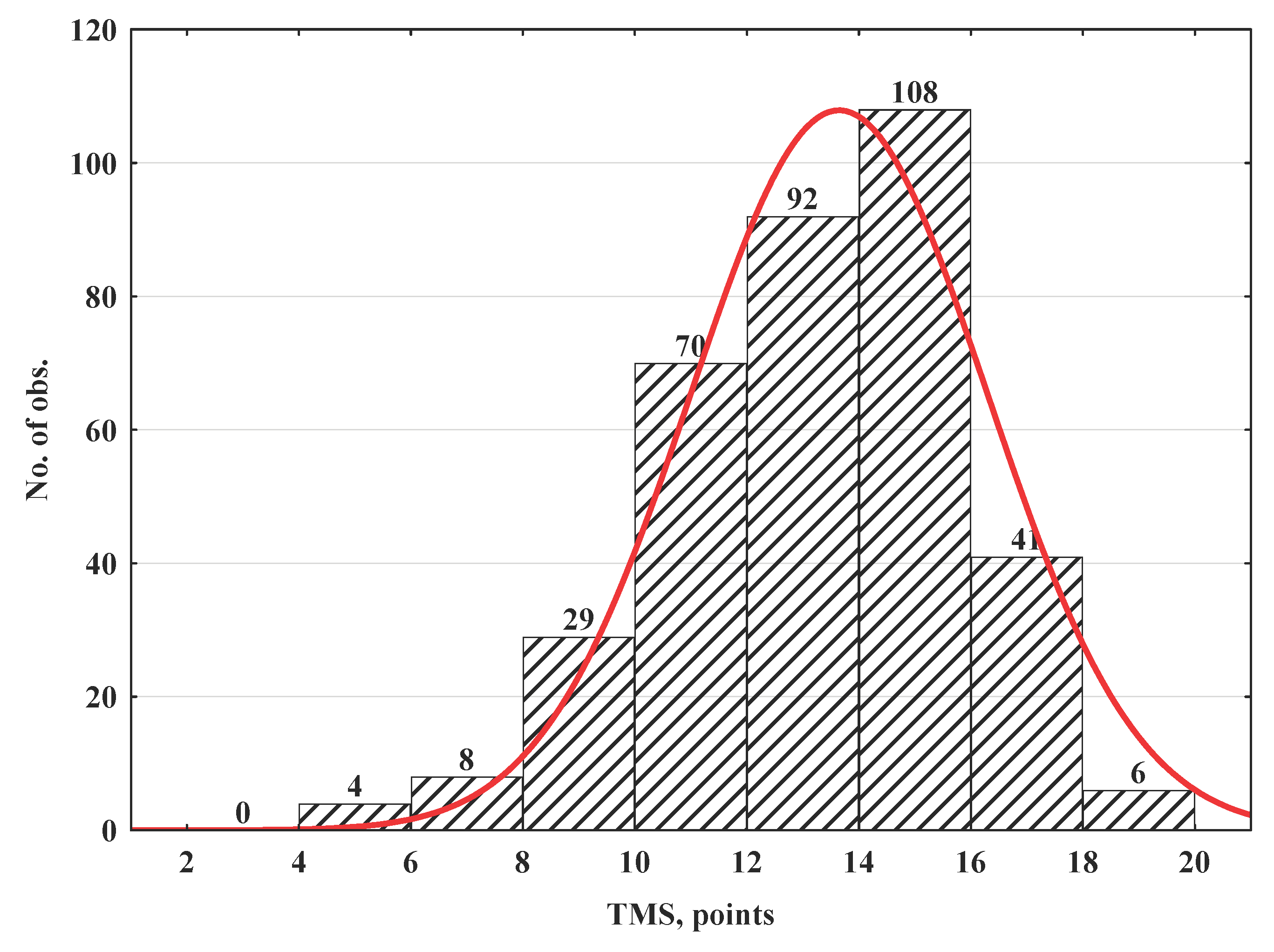
Figure 2.
Correlation between TMS and the number of metastatic axillary lymph nodes.
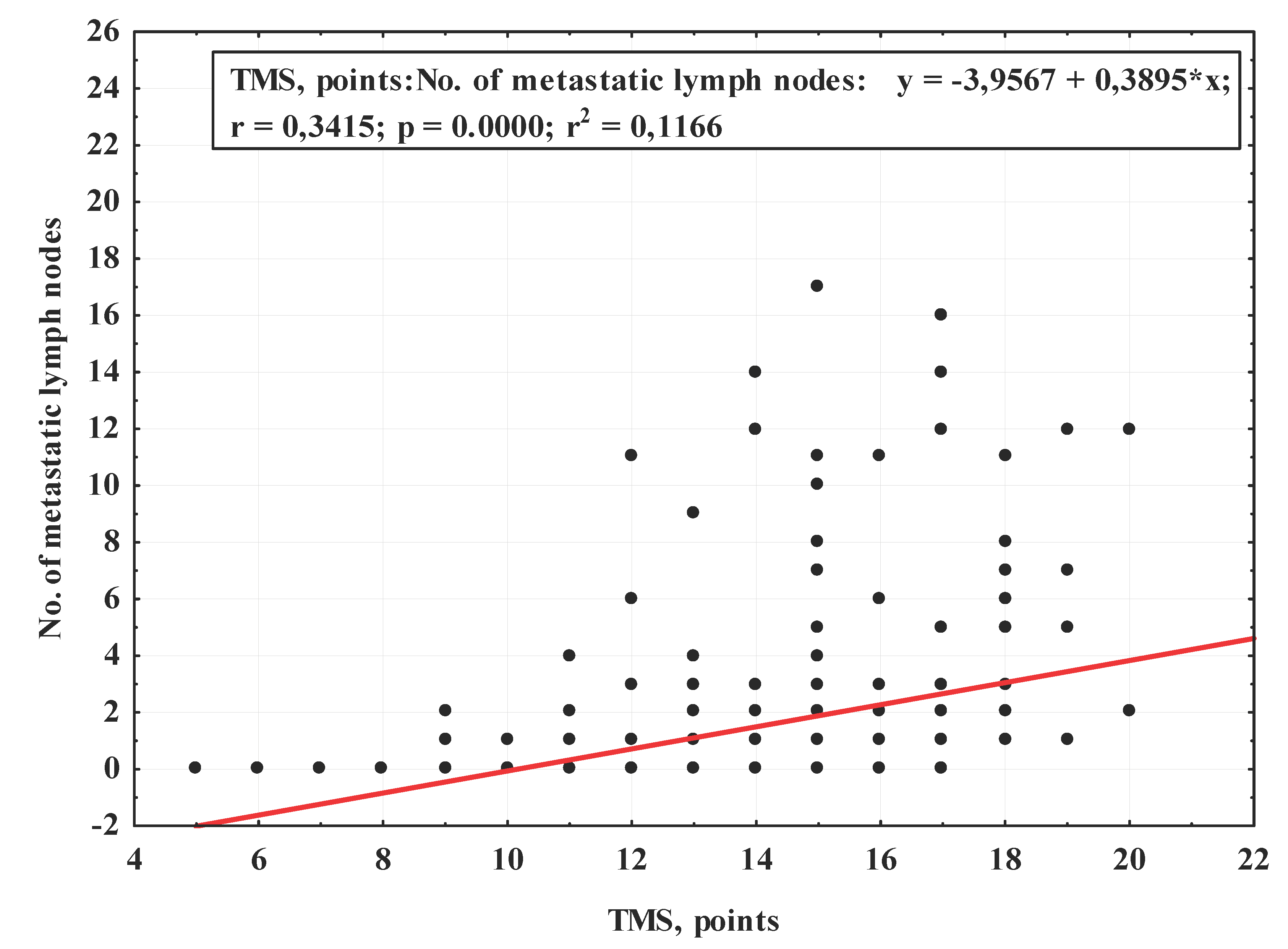

Table 1.
Disease prognosis and patient survival depending on the NPI value.
| NPI value | Prognosis | 5-year survival, % |
| 2.0–2.4 | Excellent | 93 |
| 2.4–3.4 | Good | 85 |
| 3.4–5.4 | Moderate | 70 |
| > 5.4 | Poor | 50 |
Table 2.
Prognosis of malignant epithelial tumors depending on the TMS value.
| TMS, points | Prognosis | Comments |
| 4–9 | Excellent | Tumors that rarely metastasize |
| 10–13 | Good | Predominantly lymphogenous metastasis |
| 14–17 | Moderate | Tendency to lymphogenous as well as hematogenous metastasis |
| 18–20 | Poor | High capacity for lymphogenous and hematogenous metastasis |
Table 3.
Characteristics of patients.
| Characteristic | All patients | Pathological LN0 | Pathological LN+ | P value | |
| Number of patients | 358 | 226 (63.1%) | 132 (36.9%) | ||
| Age, years (median [Q1;Q3]) | 58.0 (48.0‒65.0) | 60.0 (49.0‒66.8) | 56.0 (45.0‒62.2) | 0.005 | |
| Pathological tumor size, cm (median [Q1;Q3]) | 1.8 (1.4‒2.5) | 1.6 (1.2‒2.1) | 2.1 (1.5‒2.9) | <0.001 | |
| Histological type (n,%) | Invasive Carcinoma of No Special Type (NST) | 243 (67.9%) | 146 (64.6%) | 97 (73.4%) | 0.137 |
| Invasive Lobular Carcinoma (ILC) | 54 (15.1%) | 34 (15.0%) | 20 (15.2%) | ||
| Special Types | 61 (17.0%) | 46 (20.4%) | 15 (11.4%) | ||
| Grade (n,%) | 1 | 49 (13.7%) | 34 (15.0%) | 15 (11.4%) | 0,407 |
| 2 | 218 (60.9%) | 139 (61.5%) | 79 (59.8%) | ||
| 3 | 91 (25.4%) | 53 (23.5%) | 38 (28.8%) | ||
| Nottingham Prognostic Index (NPI) (median [Q1;Q3]) | 3.8 (3.3‒4.5) | 3.4 (3.2‒4.2) | 4.6 (4.3‒5.5) | <0.001 | |
| Total malignancy score (TMS), points (median [Q1;Q3]) | 14.0 (12.0‒15.0) | 13.0 (11.0‒15.0) | 15.0 (14.0‒16.0) | <0.001 | |
| ER status (n,%) | 0 | 51 (14.2) | 37 (16.4) | 14 (10.6) | 0.177 |
| >0 | 307 (85.8) | 189 (83.6) | 118 (89.4) | ||
| PgR status (n,%) | 0 | 93 (26.0) | 61 (27.0) | 32 (24.2) | 0.655 |
| >0 | 265 (74.0) | 165 (73) | 100 (75.8) | ||
| HER2 status (n,%) | Not overexpressed | 318 (88.8) | 201 (88.9) | 117 (88.6) | 0.503 |
| Overexpressed | 40 (11.2) | 25 (11.1) | 15 (11.4) | ||
| Ki-67 index, % (median [Q1;Q3]) | 18.0 (12.0‒37.0) | 17.0 (12.0‒37.8) | 22.0 (14.5‒35.0) | 0.559 | |
| Surrogate subtype (n,%) | Luminal А | 202 (56.4) | 130 (57.5) | 72 (54.5) | 0.159 |
| Luminal В HER2 negative | 89 (24.9) | 49 (21.7) | 40 (30.3) | ||
| Luminal В HER2 positive | 18 (5.0) | 11 (4.9) | 7 (5.3) | ||
| Non luminal В HER2 positive | 15 (4.2) | 9 (4.0) | 6 (4.5) | ||
| Triple-negative | 34 (9.5) | 27 (11.9) | 7 (5.3) | ||
Abbreviations: LN, lymph node; ER, estrogen receptor; PgR, progesterone receptor.
Table 4.
Correlation of prognosis based on the TMS and NPI in study groups.
| Groups | LN+ (No=132) | LN0 (No=226) | P value | ||
| NPI | TMS | NPI | TMS | <0.001 | |
| 1 | 1 (0.8%) | 2 (1.5%) | 36 (15.9%) | 27 (11.9%) | |
| 2 | 13 (9.8%) | 17 (12.9%) | 110 (48.7%) | 65 (28.8%) | |
| 3 | 83 (62.9%) | 96 (72.7%) | 79 (35.0%) | 134 (59.3%) | |
| 4 | 35 (26.5%) | 17 (12.9%) | 1 (0.4%) | 0 (0%) | |
Disclaimer/Publisher’s Note: The statements, opinions and data contained in all publications are solely those of the individual author(s) and contributor(s) and not of MDPI and/or the editor(s). MDPI and/or the editor(s) disclaim responsibility for any injury to people or property resulting from any ideas, methods, instructions or products referred to in the content. |
© 2026 by the authors. Licensee MDPI, Basel, Switzerland. This article is an open access article distributed under the terms and conditions of the Creative Commons Attribution (CC BY) license (http://creativecommons.org/licenses/by/4.0/).
Copyright: This open access article is published under a Creative Commons CC BY 4.0 license, which permit the free download, distribution, and reuse, provided that the author and preprint are cited in any reuse.


