

Submitted:
08 April 2026
Posted:
10 April 2026
You are already at the latest version
Abstract
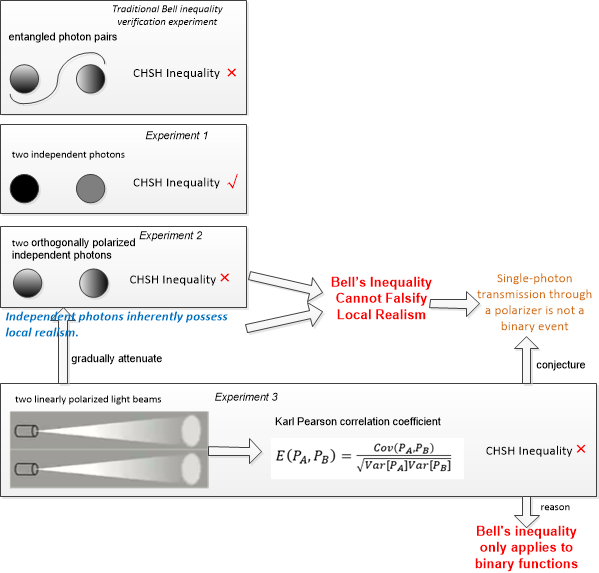
Conventional tests of Bell’s inequality rely on entangled photon pairs. Here, we replace entangled pairs with two independent photons of orthogonal polarization, and demonstrate that Bell’s inequality is still violated. Given the inherent local realism of independent photons, this experiment proves that Bell’s inequality cannot falsify the local realism of photons. We thus conjecture that the violation of Bell’s inequality by entangled photon pairs originates from their orthogonal polarizations, rather than the breakdown of local realism. To interpret this unexpected violation with independent photons, we further substitute the two photons with two monochromatic light beams, and calculate the transmittance correlation through polarizers via Malus’s law and Karl Pearson’s correlation formula. We show that this correlation also defies Bell’s inequality. Retracing the derivation of Bell’s inequality reveals its validity is restricted to binary events, which accounts for the observed violation with light beams. Finally, we propose a thought experiment involving gradual attenuation of light intensity down to the single-photon regime, and hypothesize that single-photon transmission through a polarizer does not constitute a binary event. This hypothesis provides a unified interpretation for both our experimental findings and all canonical Bell inequality tests reported to date.
Keywords:
local realism
; Bell’s inequality
; Malus’s law
; Karl Pearson correlation coefficient formula
1. Introduction
In 1935, Einstein and his collaborators introduced the concept of local realism in their paper “Can quantum-mechanical description of physical reality be considered complete?” [1], aiming to refute the copenhagen interpretation of quantum mechanics [2]. locality refers to the principle that no information can propagate faster than the speed of light, while realism posits that observed objects exist objectively, independent of human subjective measurement. For polarization measurements of entangled photon pairs, the Copenhagen school asserts that the two photons remain in a superposition state prior to measurement, and collapse instantaneously to eigenstates upon measurement of one photon. In contrast, Einstein argued that the polarization states of entangled photon pairs possess realism—their states are fixed at the moment of generation, albeit unknown to observers—and that instantaneous collapse of the distant photon violates locality.
To resolve the conflict between the Copenhagen interpretation and local realism, Bohm proposed the local hidden-variable theory based on de Broglie’s pilot-wave model [3]. This theory posits the existence of undiscovered hidden variables in quantum mechanics that can fully describe the evolution of all observables in a physical system without violating local realism. To experimentally distinguish between quantum mechanics (per the Copenhagen interpretation) and local hidden-variable theories, John Stewart Bell derived the iconic Bell inequality in 1964 [4]. This inequality constrains the correlation of measurement results for specific entangled states under the framework of local hidden-variable theories; experimental violation of the inequality would invalidate such theories and demonstrate that microscopic quantum systems do not obey local realism.
For practical experimental implementation, John Clauser and colleagues developed the CHSH inequality—a modified form of Bell’s inequality—in 1969 [5], which has since become the standard for all Bell-test experiments. The derivation of the CHSH inequality is summarized as follows.
Consider repeated measurements of a continuous hidden-variable parameter, yielding outcome functions A(a,λ) and B(b,λ). Their correlation is expressed as:
where ρ(λ) is the normalized probability density function of λ, satisfying .
Define the parameter s as:
Since the outcome functions A, B, C, D only take values of ±1, the expression simplifies to:
Averaging s over λ yields the bounds:
Substituting Eq. (1) into Eq. (4) gives the CHSH inequality:
where the correlation parameter S is defined as:
Experimental tests of Bell’s inequality were not feasible until the 1970s, and such experiments have evolved through three key phases. In 1972, J. Clauser and S. Freedman performed the first Bell-test experiment [6], demonstrating violation of Bell’s inequality by microscopic quantum systems and invalidating local hidden-variable theories. However, this experiment suffered from two critical loopholes: low detection efficiency and insufficient spatial separation between photons, leaving both the detection efficiency and locality loopholes unclosed.
In 1982, A. Aspect and collaborators conducted the first dynamic Bell-test [7], successfully closing the locality loophole. The experimental setup is illustrated in Figure 1:
The setup consists of a calcium cascade source, two commutators(), four polarizers with distinct orientations(、、、, and four single-photon detectors (P.M.). The polarizer-detector modules on either side are separated by a sufficient distance, with rapid polarization switching to ensure no subluminal communication between the two sides, enforcing strict locality. Entangled photon pairs are generated via calcium atomic cascade radiation, with photons directed to different polarizers by randomly operating commutators.
The experiment confirmed that entangled photon pairs violate the CHSH inequality. In this context, the correlation function E(a,b) in Eqs. (5)-(6) describes the correlation between the transmission probabilities of photon A through polarizer and photon B through polarizer, with analogous definitions for the other three correlation terms.
Despite this advance, the experiment retained a flaw: quasi-periodic (not truly random) polarization switching left the locality loophole partially unclosed [7]. Addressing this, A. Zeilinger and colleagues performed a rigorous Bell test in 1998 using entangled photon pairs generated via type-II parametric down-conversion [8], achieving strict spacelike separation and fully closing the locality loophole.
The above experiments all used entangled photon pairs, but in 2025, Kai Wang et al. conducted the Bell's inequality verification experiment for the first time using coherent state photon pairs instead of entangled photon pairs [9], which also proved that their correlation did not satisfy the Bell's inequality.
All canonical Bell tests to date have employed correlated photon pairs (entangled or coherent) to assess compliance with Bell’s inequality and infer adherence to local realism. A critical unanswered question remains: what outcomes arise if Bell tests are performed using truly independent photons with inherent local realism? If such pairs satisfy Bell’s inequality, it would reinforce the conclusion that entangled/ coherent photon pairs violate local realism; if they violate the inequality, it would break the presumed causal link between Bell inequality violation and breakdown of local realism, meaning Bell-test results cannot falsify local realism in microscopic quantum systems.
To address this, we designed two sequential experiments. Experiment 1 uses two fully uncorrelated, independent photons from separate sources, which satisfy Bell’s inequality. Experiment 2 retains independent photons but prepares them with orthogonal polarizations, yielding clear violation of Bell’s inequality—despite the photons’ inherent local realism. This proves that Bell inequality violation cannot be used to falsify the local realism of photons. Notably, the divergent results of the two experiments stem solely from the orthogonal polarization correlation between photons, a phenomenon incompatible with the canonical Copenhagen interpretation.
To rationalize these results, we designed Experiment 3, replacing single photons with monochromatic light beams. Using Malus’s law (classical wave optics) and the Karl Pearson correlation coefficient (statistical correlation analysis), we calculated the transmittance correlation of the two beams through polarizers, which also violates Bell’s inequality and aligns quantitatively with quantum-mechanical predictions for entangled photon pairs. By combining Experiment 3 with the CHSH derivation, we find that the inequality only applies to discrete binary events, not continuous variables—explaining the observed violation. Finally, we propose a conjecture: single-photon transmission through a polarizer is not a binary (pass/fail) event, but a continuous process describable by a continuous function, unifying the interpretation of all Bell-test experiments.
2. Bell-Test Experiments with Independent Photon Pairs
2.1. Experiment 1: Bell Test with Uncorrelated Independent Photons
The experimental setup for Experiment 1 is identical to Aspect’s setup except for the photon source, as illustrated in Figure 2:
The source comprises two independent single-photon sources (SPS A, SPS B) emitting uncorrelated photons a and b, which exhibit inherent local realism with no mutual interaction. The locality loophole is not closed in this setup, as the independent photons inherently satisfy locality, rendering additional safeguards unnecessary.
To simplify validation, the orientations of polarizers Pol. A, Pol. B, Pol. D, and Pol. C are set to , , , and , respectively—orientations known to yield the maximum CHSH value () in canonical Bell tests, exceeding the classical bound of 2. Violation of the CHSH inequality would be confirmed if the measured S-value exceeds 2 under these orientations.
Across 1000 correlation measurements, Experiment 1 yielded a CHSH value of 1.97, below the classical bound of 2. This confirms that fully independent, uncorrelated photons satisfy Bell’s inequality, consistent with their inherent local realism.
2.2. Experiment 2: Bell Test with Orthogonally Polarized Independent Photons
We modified Experiment 1 to prepare independent photons with orthogonal polarizations, forming the setup for Experiment 2 (Figure 3):
Two key modifications distinguish Experiment 2 from Experiment 1: (i) additional polarizers (Pol. A’, Pol. B’) act as polarizers, with a controller tuning their orientations to maintain orthogonality; (ii) BBO crystals are placed after the polarizers, splitting photons into entangled pairs (a, a’) and (b, b’). Photons a and b follow the original optical path, while a’ and b’ are directed to single-photon detectors for coincidence monitoring.
This design mitigates a critical systematic error: raw independent photons have random polarizations, so one may be blocked by the polarizer while the other transmits, invalidating correlation measurements. Coincidence detection of a’ and b’ ensures only valid photon pairs are included in correlation analysis, eliminating this bias.
During testing, the controller randomly switches the orientations of Pol. A’ and Pol. B’ while preserving their orthogonality, endowing the transmitted independent photons with the same polarization correlation as entangled photon pairs. The polarizer orientations for analysis (Pol. A, Pol. B, Pol. C, Pol. D) match those in Experiment 1.
Across 1000 valid correlation measurements, Experiment 2 yielded a CHSH value of 2.78, clearly exceeding the classical bound of 2 and matching results from canonical entangled-photon Bell tests [7]. This confirms that orthogonally polarized independent photons violate Bell’s inequality—despite their inherent local realism, directly proving that Bell inequality violation cannot falsify photon local realism.
The divergent results of Experiments 1 and 2, despite using identical independent photon sources, stem solely from the orthogonal polarization correlation in Experiment 2. This cannot be explained by the Copenhagen interpretation, as independent photons cannot exist in a shared superposition state.
Combining these results with all prior entangled-photon Bell tests, we conjecture that Bell inequality violation by entangled photon pairs arises not from breakdown of local realism, but exclusively from their orthogonal polarization states. Analogous to a pair of shoes with inherent correlation at manufacture, entangled photons exhibit fixed polarization correlation at generation, with no violation of locality or realism.
3. Interpretation and Conjectures on Bell-Test Results with Independent Photons
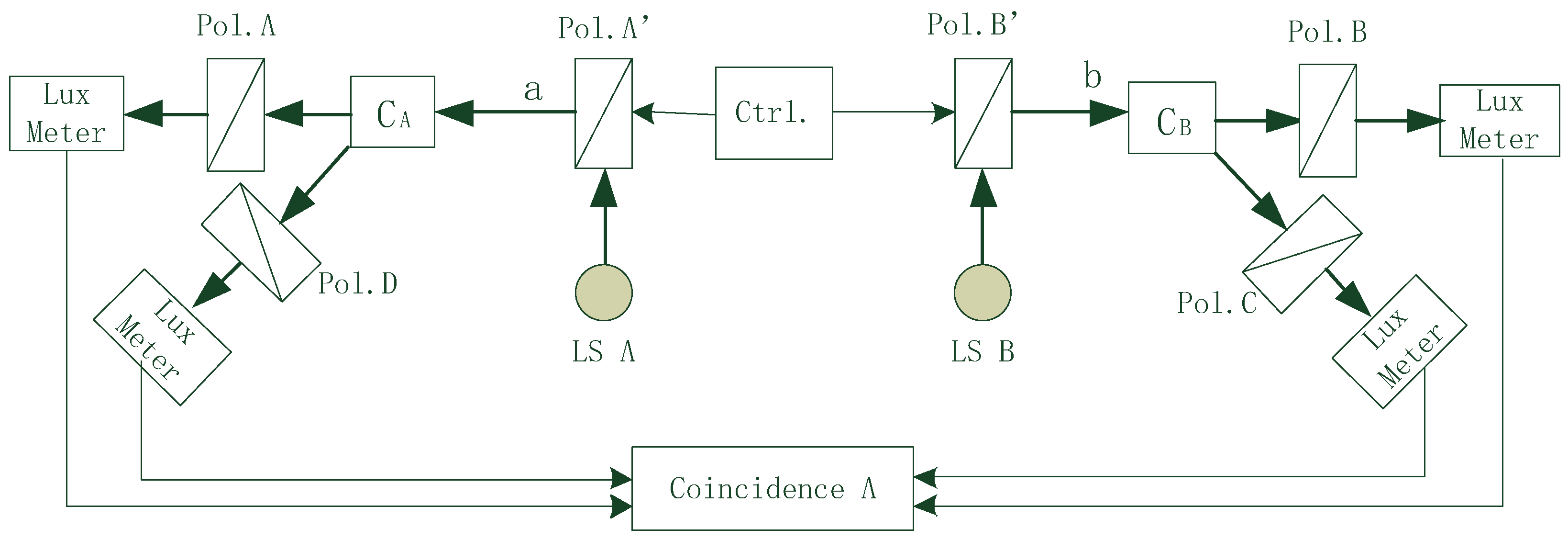
To interpret the results of Experiments 1 and 2, we employ Malus’s law (classical wave optics) and the Karl Pearson correlation coefficient (statistical correlation analysis). Since Malus’s law describes continuous light beams rather than single photons, we further modified the setup to form Experiment 3 (Figure 4):
Experiment 3 differs from Experiment 2 in three key ways: (i) single-photon sources are replaced with monochromatic beam emitters; (ii) single-photon detectors are replaced with photometers to measure light intensity; (iii) coincidence monitoring hardware is removed, as light beams cannot be “blocked” by polarizers in the same manner as single photons.
The intensity of light sources LS A and LS B is matched, with polarizers Pol. A’ and Pol. B’ maintained in orthogonal orientations via the controller. The analysis polarizers (Pol. A, Pol. B, Pol. C, Pol. D) have orientations , , , , respectively. Per Malus’s law, the transmitted light intensity measured by the photometer is:
where denotes the orientation of the analysis polarizer, is the transmitted intensity, S is the source intensity, and is the polarizer orientation.
The transmittance of light through the polarizer pair is derived as:
The correlation between transmittance values of the two beams is quantified using the Karl Pearson correlation coefficient:
where and are the transmittance values of the two beams, is their correlation (range: [[-1,1]), is the covariance, and , are the variances. Substituting Eq. (8) into Eq. (9) yields:
The average transmittance , simplifying Eq. (10) to:
This result demonstrates that the transmittance correlation of the two light beams equals the negative cosine of twice the polarizer angle difference—strikingly consistent with quantum-mechanical predictions for entangled photon pairs [10].
Substituting Eq. (11) into the CHSH inequality (Eq. 5) gives:
This inequality is not universally satisfied: for , , , , the calculated S-value equals , exceeding the classical bound of 2. This confirms that transmittance correlations of uncorrelated light beams also violate Bell’s inequality, consistent with experimental observations in Experiment 3.
The root cause of this violation lies in the derivational constraint of Bell/CHSH inequalities: they only apply to binary outcome functions (±1 values). The transmittance correlation in Eq. (11) is a continuous trigonometric function, not a binary variable, violating the core premise of the CHSH inequality and rendering it inapplicable to continuous optical transmittance data.
This raises a critical question: in Experiment 2, single-photon transmission is conventionally treated as a binary event (1 for transmission, 0 for rejection), yielding ±1 correlation values—why does it still violate the CHSH inequality?
To resolve this, we propose a thought experiment: gradually attenuate the light beam intensity in Experiment 3 from the macroscopic regime to the single-photon level. From the particle perspective, attenuation reduces the photon number density n; as n decreases from infinity to just a few photons, transmission remains a continuous process (not binary), with correlations beyond ±1 values, making the CHSH inequality inapplicable. Classically, single-photon transmission is presumed to be a binary pass/fail event, but Experiment 2 contradicts this. We thus put forward a bold conjecture:
Single-photon transmission through a polarizer is not a binary event, but a continuous process governed by the same correlation function (Eq. 11) as macroscopic light beams.
Notably, Eq. (11) matches the Copenhagen interpretation’s prediction for entangled photon pairs, explaining the alignment between the Copenhagen framework and canonical Bell tests. This conjecture unifies the interpretation of our experiments and all prior Bell-test results.
4. Conclusion
In this work, we first demonstrate that fully independent, uncorrelated photons satisfy Bell’s inequality (Experiment 1), while orthogonally polarized independent photons clearly violate the inequality (Experiment 2)—despite their inherent local realism. This directly proves that Bell inequality violation cannot be used to falsify the local realism of photons.
We further show that replacing single photons with monochromatic light beams (Experiment 3) yields transmittance correlations that also violate Bell’s inequality, quantitatively matching quantum-mechanical predictions for entangled photon pairs, calculated via Malus’s law and the Karl Pearson correlation coefficient.
Retracing the CHSH derivation reveals that the inequality only applies to binary outcome events, not continuous variables—explaining the observed violation in optical beam experiments. We propose a unifying conjecture: single-photon transmission through a polarizer is a continuous, non-binary process, eliminating the discrepancy between classical expectations and experimental Bell-test results.
Future work will focus on realizing the proposed thought experiment: attenuating macroscopic light beams to the few-photon regime and measuring correlation compliance with Bell’s inequality. Additionally, we aim to develop a novel single-photon polarization transmission model to fully rationalize our findings and all canonical Bell-test experiments.
Funding
This research received no external funding.
Data Availability Statement
The original contributions presented in this study are included in the article. Further inquiries can be directed to the corresponding author.
Conflicts of Interest
The authors declare no conflicts of interest.
References
- Einstein, A.; Podolsky, B.; Rosen, N. Can quantum-mechanical description of physical reality be considered complete? Phys. Rev. 1935, 47, 777–780. [Google Scholar] [CrossRef]
- Bohr, N. The Quantum Postulate and the Recent Development of Atomic Theory. Nature 1928, 121, 580–590. [Google Scholar] [CrossRef]
- Bohm, D. A suggested interpretation of the quantum theory in terms of “hidden” variables. I and II. Phys. Rev. 1952, 85, 166–193. [Google Scholar] [CrossRef]
- Bell, J. S. On the Einstein Podolsky Rosen paradox. Physics 1964, 1, 195–200. [Google Scholar] [CrossRef]
- Clauser, J. F.; Horne, M. A.; Shimony, A.; Holt, R. A. Proposed experiment to test local hidden-variable theories. Phys. Rev. Lett. 1969, 23, 880–884. [Google Scholar] [CrossRef]
- Freedman, S. J.; Clauser, J. F. Experimental test of local hidden-variable theories. Phys. Rev. Lett. 1972, 28, 938–941. [Google Scholar] [CrossRef]
- Aspect, A. Proposed experiment to test the non-separability of quantum mechanics. Phys. Rev. 1976, D14, 1944–1951. [Google Scholar]
- Zeilinger, A. Testing Bells inequalities with periodic switching. Phys. Lett. 1986, A118, 1–2. [Google Scholar] [CrossRef]
- Wang, K.; Hou, Z. H.; Qian, K. Y.; Chen, L. Z.; et al. Violation of Bell inequality with unentangled photons. Sci. Adv. 2025, 11, eadr1794. [Google Scholar] [CrossRef] [PubMed]
- Bohm, D. Quantum Theory; Prentice-Hall, 1951. [Google Scholar]
Figure 1.
Schematic of the experimental principle and setup for Aspect’s Bell test.
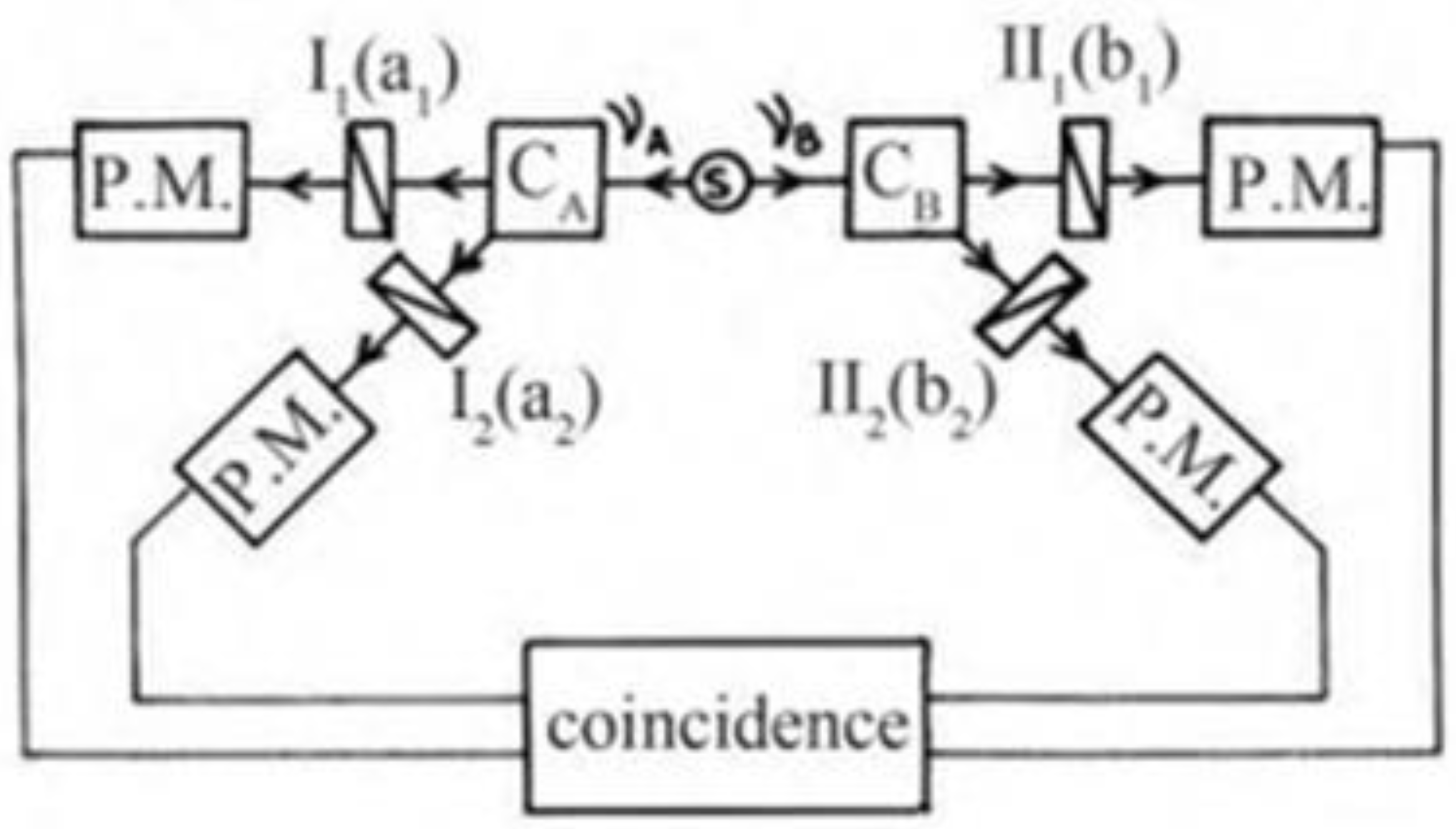
Figure 2.
Schematic of the experimental setup for Bell-test Experiment 1 with independent photons.
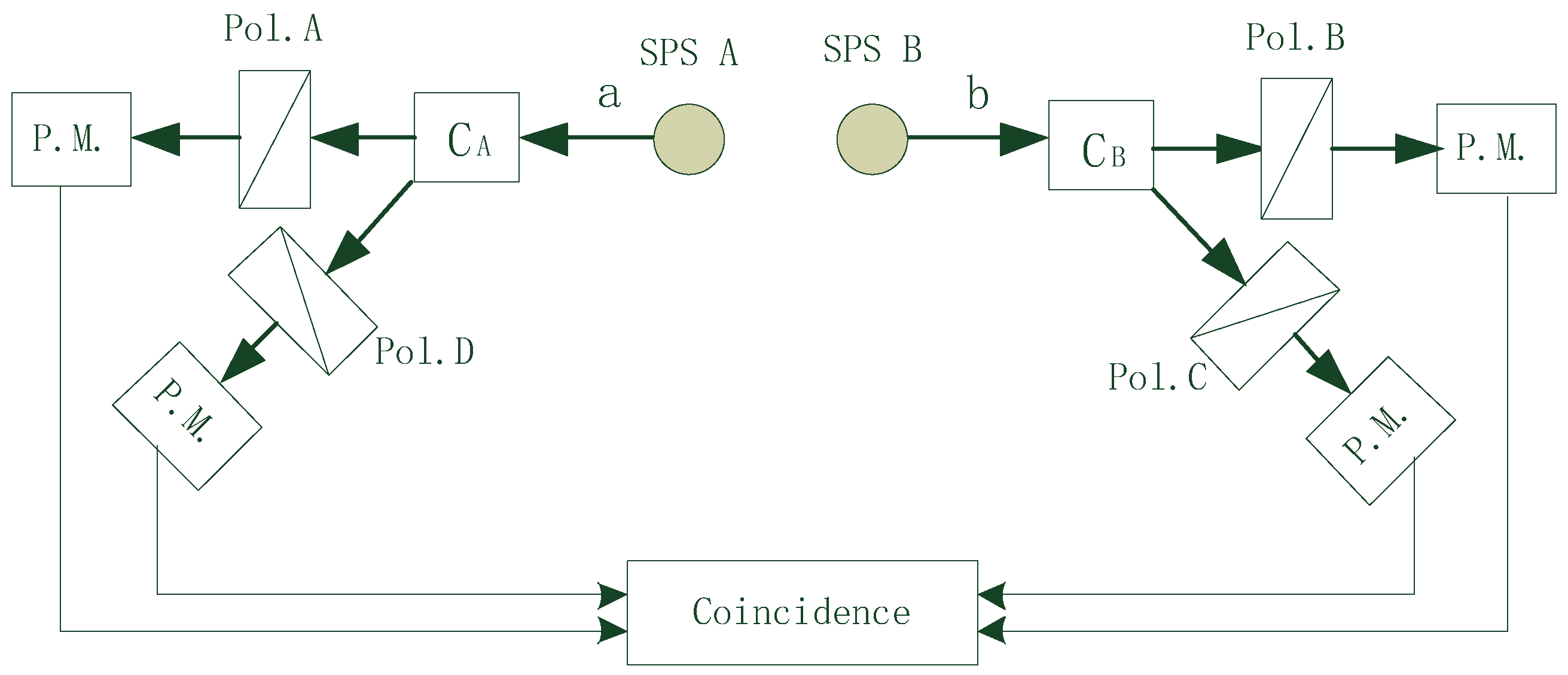
Figure 3.
Schematic of the experimental setup for Bell-test Experiment 2 with orthogonally polarized independent photons.
Figure 3.
Schematic of the experimental setup for Bell-test Experiment 2 with orthogonally polarized independent photons.
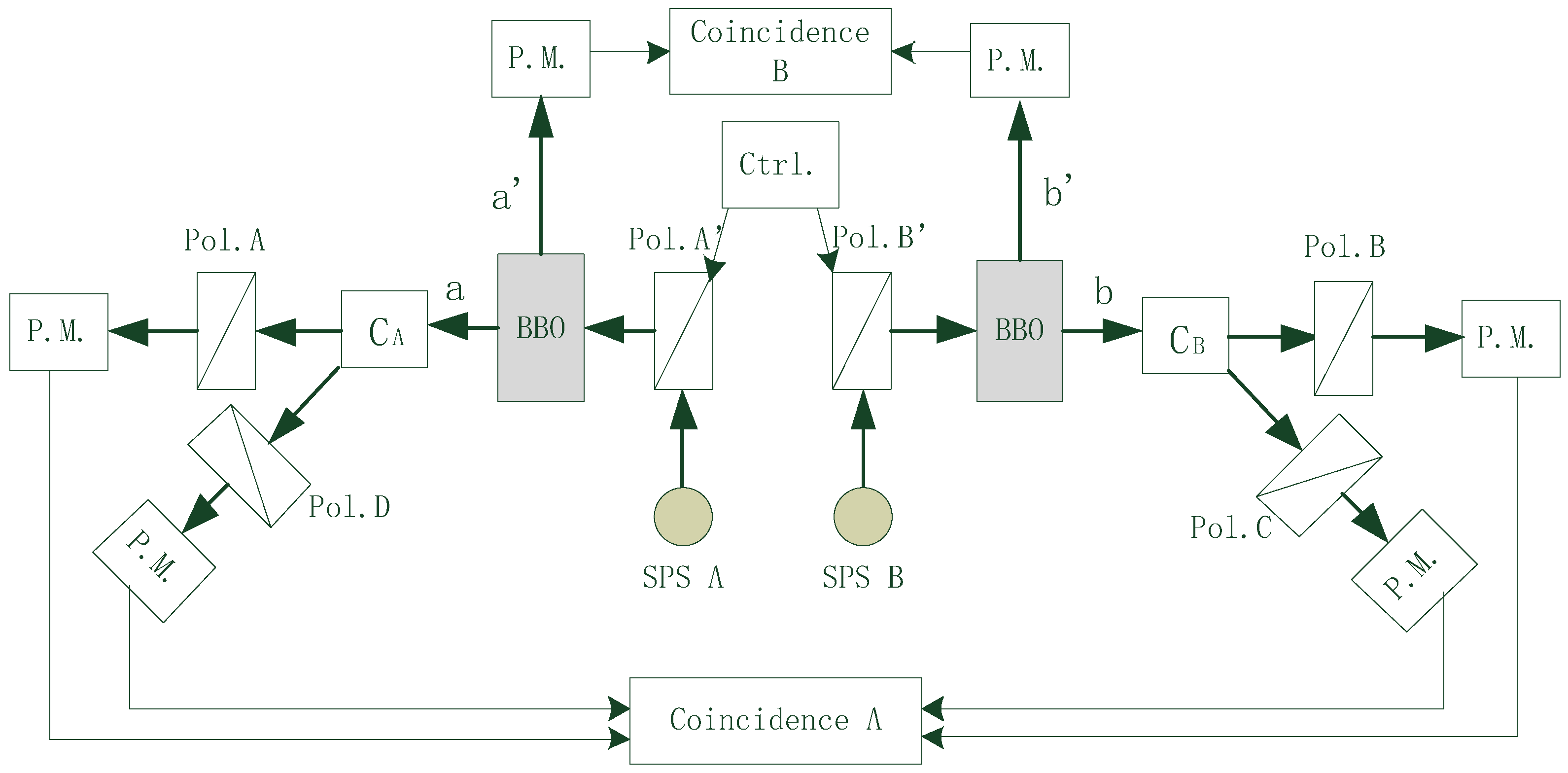
Figure 4.
Schematic of correlation Experiment 3 with monochromatic light beams.
Disclaimer/Publisher’s Note: The statements, opinions and data contained in all publications are solely those of the individual author(s) and contributor(s) and not of MDPI and/or the editor(s). MDPI and/or the editor(s) disclaim responsibility for any injury to people or property resulting from any ideas, methods, instructions or products referred to in the content. |
© 2026 by the authors. Licensee MDPI, Basel, Switzerland. This article is an open access article distributed under the terms and conditions of the Creative Commons Attribution (CC BY) license (http://creativecommons.org/licenses/by/4.0/).
Copyright: This open access article is published under a Creative Commons CC BY 4.0 license, which permit the free download, distribution, and reuse, provided that the author and preprint are cited in any reuse.


