

Submitted:
09 April 2026
Posted:
10 April 2026
You are already at the latest version
Abstract
This observational study evaluated changes in selected performance parameters of 15 new high-speed dental handpieces after eight months of routine clinical use in a routine educational undergraduate environment (two 4h daily clinical shifts, five days per week, with repeated sterilization cycles). All handpieces underwent routine cleaning, lubrication, and autoclave sterilization as instructed. The turbine components from the handpieces were disassembled and examined by stereomicroscopy before and after use, while free-running speed and bur-tube friction grip force were assessed at the same intervals. Two handpieces were no longer operational at follow-up due to ball bearing failure. Among the remaining handpieces, statistically significant reductions were observed in both free-running speed and friction grip force (p < 0.01). Microscopic examination of the rotors revealed surface alterations consistent with corrosion and wear. Within the limitations of this study, routine clinical use over an eight month period was associated with measurable changes in key performance characteristics of high-speed dental handpieces in educational clinical settings.
Keywords:
dental high-speed handpieces
; in service failure analysis
; microscopy
1. Introduction
High-speed air-turbine dental handpieces are precision electromechanical devices that operate at rotational speeds exceeding 300,000 rpm and remain indispensable in restorative and operative dentistry due to their cutting efficiency and clinical versatility [1,2,3]. Their performance depends on the integrity of key mechanical components, including the turbine rotor, ball bearings, and bur-tube friction grip assembly, which collectively determine rotational speed stability, vibration behavior, and operational safety [4].
In contemporary dental practice and dental education settings, high-speed handpieces are subjected to intensive use combined with repeated cleaning, lubrication, and steam sterilization cycles [5]. Current infection control guidelines mandate sterilization of dental handpieces after each clinical use, based on standard precaution principles [6,7,8,9,10]. For this reason, steam autoclave sterilization using vacuum systems is widely accepted as the most effective method for achieving adequate sterilization of internal handpiece components [11,12]. However, repeated thermal and mechanical stress may influence the long-term mechanical performance of handpiece components [12].
As it is already reported, material selection plays a critical role in the durability of high-speed handpieces under such conditions [13]. Handpiece shells are commonly manufactured from brass, stainless steel, or titanium, with titanium alloys offering superior resistance to corrosion and reduced mass compared to conventional materials [14,15,16]. Bearing systems typically incorporate stainless steel, ceramic, or hybrid balls retained within non-metallic cages made of phenolic composites or polyamide-imide materials [17,18,19]. But while phenolic cages exhibit favorable frictional properties, they are susceptible to thermal degradation during repeated autoclaving, whereas polyamideimide materials demonstrate improved thermal stability [17,20,21]. Degradation of bearing components remains a primary cause of high-speed handpiece failure, frequently accompanied by loss of spindle friction grip and increased mechanical resistance [20,22].
Further, performance degradation of high-speed handpieces has been associated with reduced free-running speed, increased bearing resistance, vibration, and noise generation, all of which may compromise cutting efficiency, procedural precision, and operator comfort [23]. Experimental and computational studies have demonstrated that free-running speed and friction grip force are sensitive indicators of turbine and bearing condition, reflecting cumulative mechanical wear and maintenance adequacy [24,25,26,27]. A strong relationship was found between maximum speed and maximum power, and a high relationship between stall torque and power [26]. Loss of adequate friction grip is of particular concern, as it may lead to bur instability or intraoral bur release, posing a potential safety risk during clinical procedures [28].
Although several laboratory-based and long-term clinical investigations have examined handpiece performance, failure modes, and bearing longevity under controlled conditions [5,18,29], limited data are available regarding short- to medium-term performance changes under real-world educational clinic conditions. University dental clinics represent a distinct operational environment characterized by multiple operators, variable clinical techniques, high daily utilization, and frequent sterilization cycles, which may accelerate performance changes compared to private practice settings [22]. Therefore, the aim of this observational study was to evaluate changes in selected performance parameters after routine clinical use in a university dental clinic, focusing on free-running speed, bur-tube friction grip force and rotor structure. The null hypothesis was that routine clinical use under educational conditions would be associated with negligible changes in these performance indicators over time.
2. Materials and Methods
2.1. Study Design and Setting
This study was designed as a prospective observational longitudinal performance evaluation of air-driven, high-speed dental handpieces under routine clinical use in an undergraduate university dental clinic. The approach follows the logic of prior handpiece performance work where devices are assessed at baseline and after defined exposure to simulated or real use/sterilization cycles, with emphasis on clinically relevant functional endpoints such as turbine speed, chuck performance, vibration/noise, and durability [5].
2.2. Handpieces Tested, Clinical Use, Sterilization, and Maintenance Conditions
Fifteen out of 40 air-rotor high-speed dental handpieces (Silent Power Evo 4LK, Castellini SpA, Bologna, Italy), intended to be used at the undergraduate clinic of Dental School, of the National and Kapodistrian University of Athens, were prospectively included in this longitudinal evaluation. The sample size was determined based on availability within the clinical setting and is consistent with similar exploratory studies in the field. No a priori power calculation was performed, and therefore the study should be considered exploratory.
All devices were identified by their serial numbers. Baseline measurements (t0) were obtained prior to clinical deployment. Following baseline assessment, the handpieces were introduced into routine clinical service at the clinics of the undergraduate program of the School of Dentistry. Clinical activity was conducted within a full academic year framework, organized in two daily shifts, from Monday to Friday. The morning shift (08:00-12:00) involved fifth-year undergraduate students while the afternoon shift (13:00-17:00) involved fourth-year students, providing comprehensive dental treatment. Based on this schedule, the handpieces were exposed to approximately 28 weeks of routine clinical use, corresponding to an estimated cumulative exposure of approximately 1120 scheduled clinical hours per handpiece.
Following each clinical session, all handpieces underwent routine cleaning, lubrication, and sterilization procedures according to standard clinical protocols. Lubrication was performed by trained dental assistants as part of the routine disinfection and sterilization workflow. However, lubrication frequency, technique, and quantity were not experimentally standardized or quantitatively recorded, as the study aimed to reflect real-world clinical conditions in an educational setting where such procedures are operator-dependent.
Each device was sterilized in a wrapped condition at 134 °C for 5 min using a steam autoclave (Sterix 24, Medi-Care Solutions, Imola, Italy). All handpieces were subjected to a minimum of 320 use-sterilization cycles, with no internal maintenance, bearing replacement, or component repair during the eight-month observation period.
2.3. Functional Performance Testing and Rotor Surface Characterization Protocol
Turbines were examined at baseline (t0) and after eight months of clinical use (t1). Each handpiece functioned as its own control within a repeated-measures design framework, allowing intra-device comparison of performance indicators before and after cumulative clinical exposure. Functional performance testing included rotational speed and friction grip assessment, whereas the rotor surface characterization protocol was mainly based on stereomicroscopic evaluation.
Free-running rotational speed was measured in revolutions per minute (rpm) using a calibrated digital handpiece tachometer (HPW-2, Micron Corporation, Tokyo, Japan). Measurements were conducted under standardized operating conditions at an air pressure of 2.5 bar, with the optical sensor positioned at a fixed distance of 4 mm from the turbine head. Each measurement was recorded in rpm, and the device was allowed to stabilize prior to acquisition to minimize transient variability. Additionally, the friction grip force of the bur-tube (chuck) assembly was determined using a digital force gauge (PCE-FM200, PCE Instruments, Meschede, Germany). The force required for bur dislodgement was recorded in Newton (N), following standardized insertion of a compatible friction-grip bur according to manufacturer specifications.
2.4. Rotor Surface Characterization
The evaluation of the surface changes in rotor morphology at t0 and t1 was performed under a stereomicroscope (M80, Leica, Wetzlar, Germany) operated in reflection mode. Changes in surface morphology of the impeller blade region were examined with particular attention directed toward identification of corrosion patterns, surface irregularities, localized material loss, micro-scratches, and alterations in reflectivity suggestive of wear or oxidative phenomena. To provide an assessment of rotor material topography and composition, a single representative unused rotor was analyzed using SEM/EDS. This analysis was performed descriptively and was not intended for quantitative comparison or statistical inference. Τhe rotor blades were subjected to scanning electron microscopy/X-ray energy dispersive microanalysis (SEM/EDS). A SEM was used (Quanta 200, FEI, Hilsboro, OR, USA) equipped with an EDS spectrometer (Quantax 200, Bruker, Berlin) with a silicon-drift detector (Flash 10, Bruker, Berlin). The region of interest was imaged employing a secondary electron detector at high vacuum (10-6 Torr), 20 kV accelerating voltage and 90 μA beam current. Then, the specimen was subjected to EDS analysis under the following conditions: 20 kV accelerating voltage, 105 μA bean current, area scan mode (500×500 μm analysis area), 100 s acquisition time and 1% dead-time. Quantification was performed in a standardless mode using ZAF correction by the ESPRIT v.1.9 software (Bruker), with an approximate depth of analysis of 1 μm.
2.5. Statistical Analysis
For the quantitative measurements (running speed and friction force) comparative analyses were performed on complete paired observations (handpieces with valid measurements at both time points). Two handpieces that were non-operational at follow-up (“Off”) due to bearing failure were excluded from paired inferential testing but were reported descriptively as catastrophic failures. For each outcome, within-handpiece change scores (Δ = t1 − t0) were calculated. Normality of the Δ distributions was assessed using the Shapiro–Wilk test and inspection of Q-Q plots. Because change scores did not significantly deviate from normality (p > 0.05), paired-samples t-tests (two-tailed) were used to compare baseline and post-use measurements. Statistical significance was set at α = 0.05 (two-tailed). All analyses were performed using IBM SPSS Statistics for Windows (Version 30.0; IBM Corp., Armonk, NY, USA).
3. Results
3.1. Functional Performance Changes Following Clinical Use
The results of the free-running rotational speed before (t0) and after the eight-month clinical use period (t1) are presented in Table 1. Two devices (13.3 %) were withdrawn from service due to complete bearing ball failure and inability to maintain rotation. These units were excluded from further statistical comparison, as they represented catastrophic mechanical failure rather than progressive performance degradation. Baseline speeds were relatively homogeneous (325,000–340,000 rpm), consistent with standardized turbine performance under controlled pressure. Following clinical exposure, a generalized downward shift in rotational speed was observed. Although some handpieces demonstrated minor reductions, others exhibited pronounced declines exceeding 40,000 rpm relative to baseline yielding a mean reduction of 22,169 rpm (95% CI: −31,220 to −13,118). Normality testing of change scores confirmed no significant deviation from normal distribution (Shapiro–Wilk p > 0.05 for both outcomes). This decline was statistically significant (t(12) = −5.34, p = 1.77 × 10⁻⁴) and demonstrated a large effect size (Cohen’s dz = 1.48). It should be mentioned that the post-use speed distribution displayed greater dispersion compared with baseline, indicating progressive performance variability associated with cumulative operational stress. This corresponds to an average reduction of approximately 6.7% relative to baseline values, indicating a measurable decline in rotational performance that remains below previously reported thresholds associated with functional failure.
3.2. Rotor Surface Characterization
The results of the SEM/EDS analysis of a representative unused rotor is illustrated in Figure 1.
The secondary electron image demonstrated a rather smooth surface with several interconnecting fissures. The EDS analysis indicated the presence of Al, Mo, and Ni as major elements, F at a considerable extent (2.5 wt%) and traces of Si and P. O demonstrated the highest content.
Further, Table 2 presents the individual friction grip force values (N) for each handpiece before and after use. At baseline, bur retention forces were tightly clustered within a narrow range (27.7-30.5 N), indicating high manufacturing consistency and minimal inter-device variability. After clinical use, a marked dispersion of values was observed. Several handpieces exhibited substantial reductions in grip force, with post-use values decreasing to as low as 11.8 N and 12.5 N in certain units. The increased variability at t1 reflects heterogeneous mechanical deterioration among devices. Mean grip retention force decreased after clinical use corresponding to a mean reduction of 9.50 N (95% CI: −12.93 to −6.07). This change was statistically significant (t(12) = −6.03, p = 5.9 × 10⁻⁵) and was associated with a large effect size (Cohen’s dz = 1.67).
The results presented in Table 1 and Table 2 demonstrate not only a statistically significant decline in the quantitative parameters tested but also an increase in inter-device variability and occurrence of mechanical failure within the observation period.
The stereomicroscopic examination revealed evident surface alterations of the rotor blades after eight months of clinical use. Compared with baseline specimens, post-use rotors exhibited widespread surface discoloration consistent with tarnish and/or corrosive changes, along with increased surface irregularities and localized defects. Areas of material degradation were particularly evident along the blade surfaces and near balancing regions. In contrast, baseline rotors demonstrated smoother and more homogeneous surface characteristics. The observed differences between t0 and t1 images indicate a clear shift in surface condition following cumulative clinical exposure.
The wings of post-use rotors (t1) displayed a noticeable increase in surface irregularity relative to baseline condition (t0), characterized by enhanced microtopographic heterogeneity and diminished surface uniformity of the metallic areas (Figure 2).
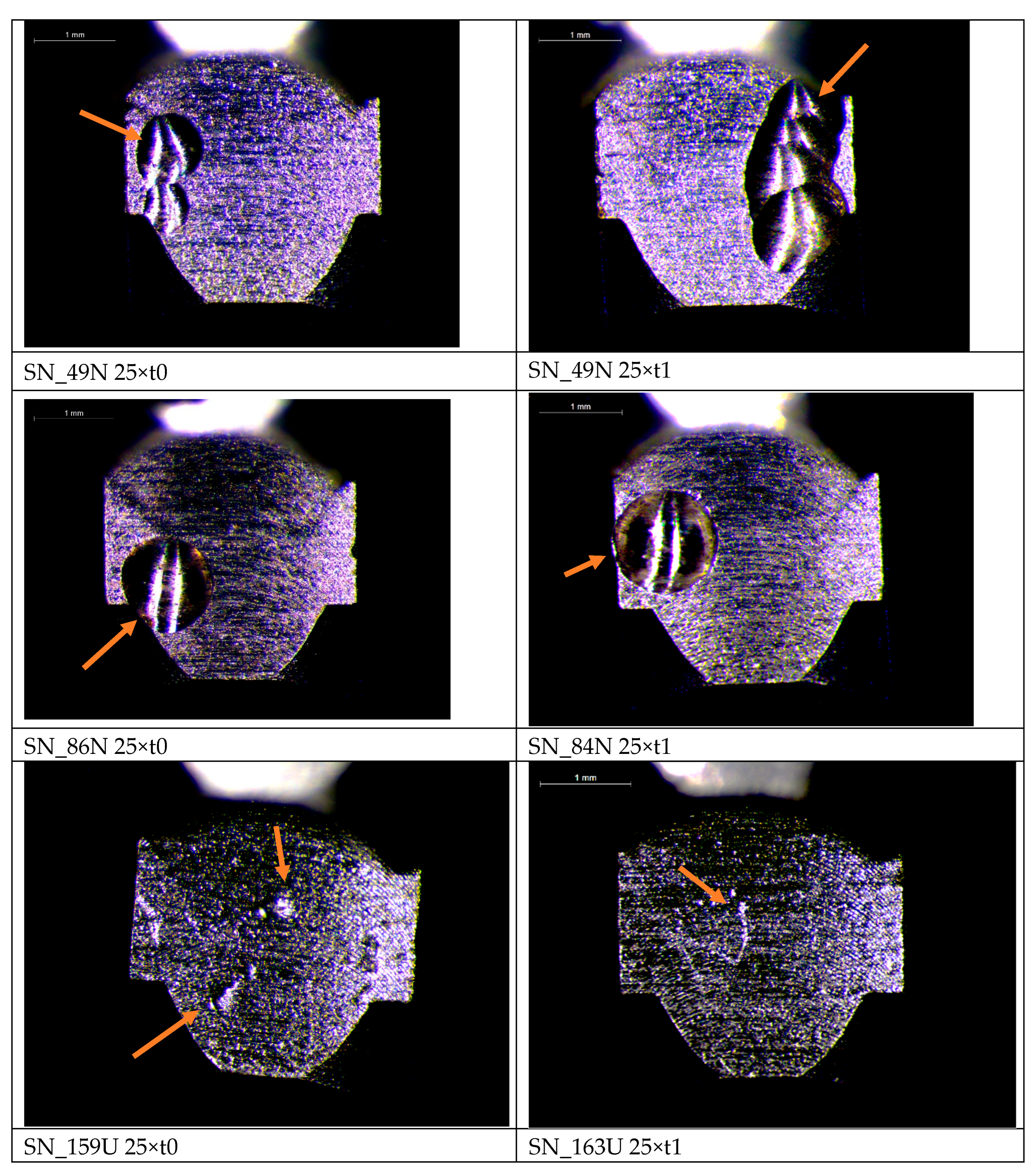
In Figure 3 (t0), localized surface irregularities and discrete indentations are visible on the metallic rotor surface prior to clinical use. These features appear as initial impressions and areas of non-uniform surface texture. The presence of such topographic characteristics at baseline suggests that they are inherent to the manufacturing conditions. However, no definitive conclusion can be drawn regarding whether these represent standard machining artifacts, balancing-related surface modifications, or isolated production imperfections.
Figure 3.
Representative stereomicroscopic images (25× magnification, bar: 1 mm) of turbine rotor wings at baseline (t0) and after eight months of clinical use (t1). Compared with baseline rotors, post-use specimens exhibit evident surface alterations, including increased surface smoothening but with a non-uniform distribution, microtopographic irregularities, areas of material wear across the rotor surfaces.
Figure 3.
Representative stereomicroscopic images (25× magnification, bar: 1 mm) of turbine rotor wings at baseline (t0) and after eight months of clinical use (t1). Compared with baseline rotors, post-use specimens exhibit evident surface alterations, including increased surface smoothening but with a non-uniform distribution, microtopographic irregularities, areas of material wear across the rotor surfaces.
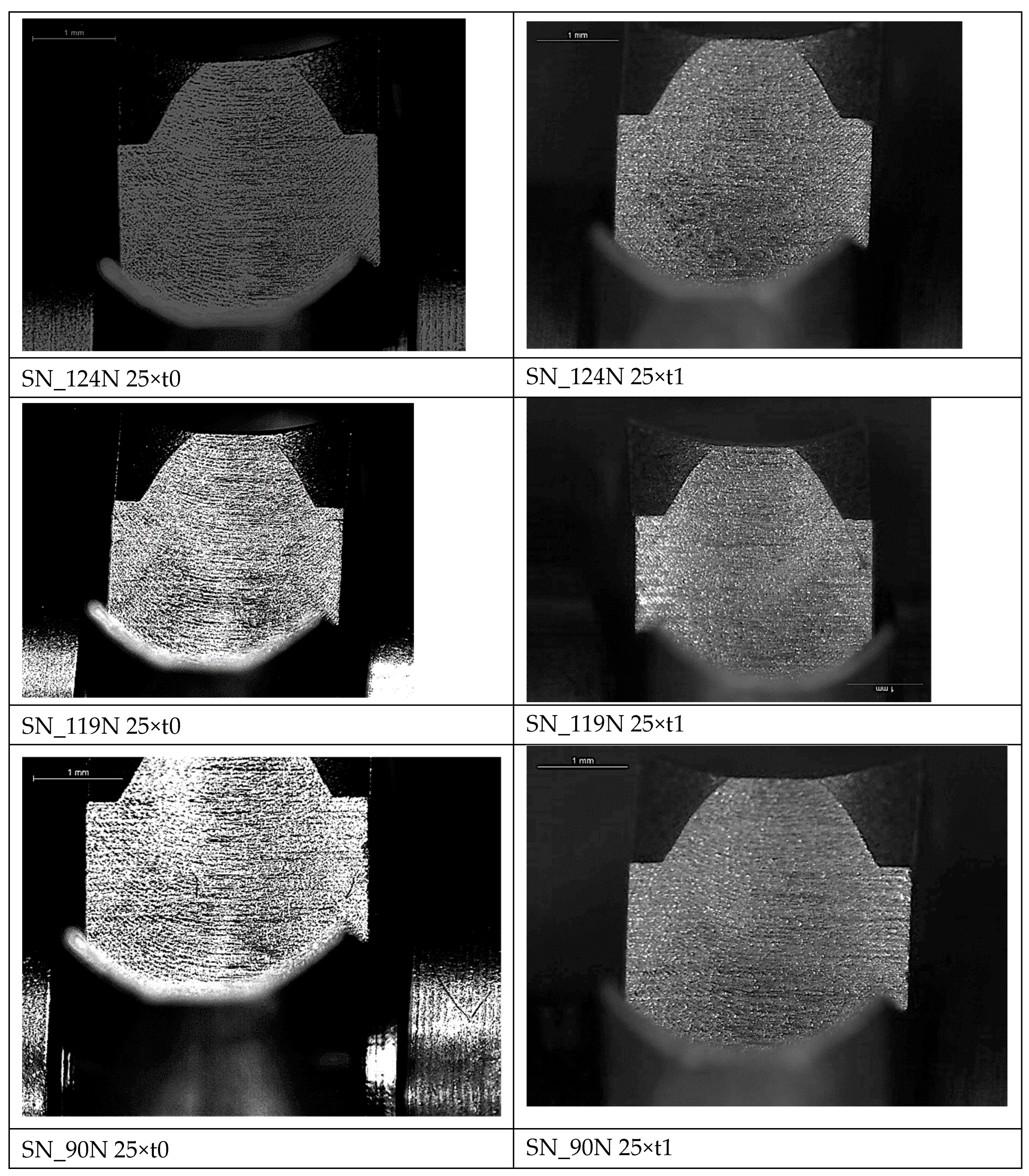
Figure 4.
Representative stereomicroscopic images of turbine rotor surfaces at baseline (t0). Localized surface defects are visible prior to clinical use, including discrete indentations, shallow depressions, and microtopographic irregularities on the metallic rotor surface. These features appear as small impressions and areas of non-uniform surface texture distributed across the rotor surface (indentations, shallow depressions, micro-pits, machining marks, surface impressions). Such defects are consistent with manufacturing-related surface characteristics rather than wear associated with clinical use. Representative defects are indicated by arrows (25×magnification, bar: 1 mm).
Figure 4.
Representative stereomicroscopic images of turbine rotor surfaces at baseline (t0). Localized surface defects are visible prior to clinical use, including discrete indentations, shallow depressions, and microtopographic irregularities on the metallic rotor surface. These features appear as small impressions and areas of non-uniform surface texture distributed across the rotor surface (indentations, shallow depressions, micro-pits, machining marks, surface impressions). Such defects are consistent with manufacturing-related surface characteristics rather than wear associated with clinical use. Representative defects are indicated by arrows (25×magnification, bar: 1 mm).
4. Discussion
The present investigation demonstrates that routine clinical use combined with repeated sterilization cycles is associated with measurable deterioration in the mechanical performance of air-driven turbine handpieces composed of light-weight Al-Mo-Ni alloy blades. Although the reduction in free-running rotational speed observed in the present study did not exceed the 20% functional defect threshold proposed by Brockhurst and Shams (1994) [26], the statistically significant downward shift in speed suggests progressive mechanical aging of the turbine system under routine clinical service conditions. Then performance decline in high-speed dental turbines may be associated with progressive degradation of the internal bearing assembly. As it is reported, air-driven turbines operate at extremely high rotational velocities, frequently exceeding 300,000 rpm, and under such conditions even minor alterations in bearing surface integrity can substantially influence rolling resistance and rotational efficiency [5,18]. Bearing degradation typically manifests as increased frictional resistance, reduced rotational stability, and eventual decline in free-running speed [18], and the statistically significant reduction observed in the present study is consistent with early-stage deterioration of the bearing interface rather than random mechanical fluctuation. In this context, repeated autoclave sterilization may act as an additional contributing factor. High-temperature steam exposure induces repeated thermal expansion and contraction of metallic components, which can promote microstructural fatigue and affect the mechanical stability of bearing assemblies [17]. Experimental evidence indicates that stainless-steel bearing elements exposed to repeated sterilization cycles demonstrate increased susceptibility to corrosion and fatigue phenomena, potentially shortening turbine service life [18], while phenolic bearing retainers may become brittle under thermal cycling, further compromising bearing stability and increasing frictional resistance [17].
The observed reduction in bur friction-grip retention further supports the presence of progressive mechanical degradation within the handpiece assembly. The chuck mechanism is subjected to repeated mechanical stress during routine clinical use due to frequent bur insertion and removal combined with rotational loading, and repeated activation cycles may progressively weaken the clamping mechanism, reducing retention force [30,31,32,33,34]. Although almost all handpieces remained functionally operational in the present study, the observed reduction in retention force may increase the risk of bur instability under clinical conditions, a complication that has been associated with potential patient injury during high-speed instrumentation [28]. Previous findings by Leonard and Charlton (1999) [5], suggest that spindle-chuck integrity may be maintained even after extensive use and sterilization cycles; however, the present results indicate that measurable functional decline may still occur without immediate loss of operability. Moreover, the occurrence of complete bearing failure in two handpieces (approximately 13%) within the eight-month observation period further supports the concept of variable operational durability under clinical conditions. This finding is consistent with previous reports indicating that turbine handpieces frequently require maintenance or repair within the first year of use [35]. Such variability in performance and failure patterns likely reflects the combined influence of multiple interacting factors, including usage intensity, sterilization frequency, lubrication practices, and operator-dependent handling.
Previous clinical and experimental studies further support the role of sterilization and operational stress in accelerating turbine deterioration. Worthington and Martin (1998) reported substantial variability in speed reduction across different handpiece brands following repeated autoclaving [34], while Leonard and Charlton (1999) demonstrated that performance degradation and failure rates increase significantly after extended simulated clinical use and sterilization cycles[5]. Similarly, Wei et al. (2012) showed that autoclaving, particularly when combined with insufficient lubrication and mechanical loading, significantly accelerates bearing failure [18]. These findings collectively suggest that sterilization-related stress, in combination with operational factors, contributes to cumulative performance deterioration over time[36]. However, given the observational design of the present study and the lack of control over key operational variables, including lubrication frequency, operator technique, and applied clinical loading, direct causal relationships cannot be definitively established.
An additional finding of the present study was the alteration of turbine rotor blade geometry following clinical use. Baseline observations demonstrated relatively sharp and well-defined blade apices, whereas post-use blades appeared smoother and more rounded, indicating mild surface wear. Such morphological changes are consistent with micro-erosive processes occurring at the blade tips during prolonged turbine operation. At ultra-high rotational velocities, turbine blades are exposed to sustained high-velocity airflow and repeated micro-particle impacts during tooth preparation, conditions that may progressively attenuate surface asperities and reduce edge definition [37]. Similar surface evolution patterns have been described in high-speed rotating components subjected to cyclic mechanical loading, where repeated micro-contact events lead to gradual smoothing of surface features [38,39]. Although these geometric alterations were relatively subtle, they may have implications for turbine efficiency. Rotor blade morphology plays a key role in converting airflow energy into rotational motion, and even minor deviations in blade geometry may influence local airflow dynamics and energy transfer efficiency at very high rotational speeds [40]. However, as aerodynamic behavior was not directly evaluated in the present study, these interpretations should be considered hypothesis-generating rather than confirmatory.
The educational clinical environment in which this investigation was conducted likely represents a high-intensity operational setting for dental handpieces. In contrast to single-operator private practice, undergraduate clinics involve multiple operators with varying levels of technical experience, potentially introducing variability in loading conditions, activation patterns, and bur handling [5]. In addition, strict adherence to infection-control protocols necessitates sterilization after each use, substantially increasing the frequency of thermal cycling [9]. While essential for patient safety, this repeated exposure may contribute to cumulative material and mechanical stress. Maintenance practices further influence this process, as insufficient lubrication has been shown to accelerate bearing degradation by increasing frictional contact under load [18], and variability in lubrication procedures may contribute to heterogeneous wear patterns among otherwise identical devices. Taken together, these findings support the interpretation that the observed performance changes reflect cumulative real-world operational effects.
In general, the findings of the present study support the concept that dental turbine handpieces undergo progressive mechanical aging during routine clinical service. The combined effects of high rotational speeds, repeated sterilization cycles, mechanical loading during tooth preparation, and variability in handling conditions create a complex operational environment that may gradually compromise turbine performance. The statistically significant reductions in rotational speed and friction-grip retention observed in this study are consistent with early manifestations of this aging process. From a clinical perspective, these findings are relevant because early functional decline may precede catastrophic mechanical failure. Reductions in friction-grip force may increase the risk of bur instability, particularly under high-load conditions, while decreased rotational speed may affect cutting efficiency, prolong procedure time, and potentially influence operator fatigue and workflow. Although almost all devices remained operational, the observed variability suggests that individual units may approach clinically critical thresholds at different rates. We could then suggest that monitoring functional parameters such as free-running speed and bur retention may therefore provide useful indicators of turbine condition and support timely maintenance or replacement decisions in clinical practice. However, due to the observational nature of the present study and the lack of control over key operational variables, direct mechanistic relationships cannot be definitively established. The findings should therefore be interpreted as reflecting cumulative real-world operational effects rather than specific causal pathways.
Several limitations should then be considered when interpreting the present findings. The study was conducted in a single educational clinical environment, where multiple operators with varying levels of experience may introduce variability in handling and loading conditions compared with single-operator settings. The relatively small sample size limits statistical power and generalizability; however, the large effect sizes suggest that the observed changes are not trivial. The eight-month observation period, while sufficient to detect measurable alterations in rotational speed and bur retention, may not capture long-term degradation patterns. In addition, although sterilization cycles were systematically recorded, key operational variables, such as lubrication practices, operator technique, and applied cutting loads, were not standardized and may have influenced device wear. The SEM/EDS analysis was performed on a single representative specimen and should therefore be considered descriptive rather than indicative of population-level material characteristics. Finally, the focus on functional performance parameters limits mechanistic interpretation, and further assessments (e.g., airflow dynamics, vibration behavior, or internal component analysis) would provide a more comprehensive understanding of degradation processes. Despite these limitations, the study provides clinically relevant real-world evidence on the mechanical performance of dental turbine handpieces under routine use and repeated sterilization exposure.
Future research should further investigate the mechanisms underlying turbine performance deterioration under clinical conditions. Continuous monitoring approaches, including real-time vibration and acoustic analysis, may enable early detection of dynamic imbalance prior to measurable reductions in rotational speed. Comparative investigations of bearing materials (e.g., stainless steel, ceramic, hybrid systems) are warranted to assess material-dependent durability under repeated sterilization cycles. In addition, experimental and computational analyses of intra-turbine airflow may clarify the impact of rotor blade morphology on aerodynamic efficiency and rotational performance. Such insights may inform improved turbine design and optimized maintenance strategies.
5. Conclusions
Within the limitations of this study, routine clinical use combined with repeated sterilization cycles was associated with measurable deterioration in the functional performance of air-driven turbine handpieces. A statistically significant reduction in rotational speed and friction-grip retention was observed after eight months of service, accompanied by subtle morphological alterations of rotor blade geometry. These findings indicate progressive mechanical aging of turbine systems under normal clinical conditions. From a practical perspective, monitoring functional parameters such as rotational speed and bur retention may provide early indicators of turbine degradation before catastrophic failure occurs.
Author Contributions
Conceptualization, M.A.; methodology, M.A.; M.D.; software, S.T.; G.C.; validation, M.A., M.D. S.T.; G.C.; and V.S.; formal analysis, S.T.; M.D.; and G.C.; investigation, M.A.; M.D; G.C.; S.T.; and V.S.; resources, M.A., M.D.; and V.S.; data curation, M.A.; G.C.; and M.D.; writing—original draft preparation, M.A.; S.T.; and G.C.; writing-review and editing, M.A.; S.T., M.D.; and G.C; visualization, M.A.; supervision, M.A.; project administration, M.A. All authors have read and agreed to the published version of the manuscript.
Funding
This research received no external funding.
Data Availability Statement
Dataset available on request from the authors.
Conflicts of Interest
The authors declare no conflicts of interest.
References
- Stephens, R. R. The dental handpiece-a history of its development. Aust Dent J 1986, 31, 165–180.
- Dyson, J.E.; Darvell, B.W. The development of the dental high-speed air turbine handpiece. Part 1. Aust Dent J 1993, 38, 49-58.
- Dyson, J.E.; Darvell, B.W. The development of the dental high-speed air turbine handpiece. Part 2. Aust Dent J 1993, 38, 131-43.
- Chen, Y.; Zhang, H.; Li, X.; Xiao, S.; Gu, F.; Shi, Z. Effects of Wear on Lubrication Performance and Vibration Signatures of Rotor System Supported by Hydrodynamic Bearings. Lubricants 2023, 11, 107. [CrossRef]
- Leonard, L.D.; Charlton, D.G. Performance of high-speed dental Handpeces subjected to simulated clinical use and sterilization. J Amer Dent Assoc 1999, 130, 1301-11.
- Lewis, D. L.; Arens, M.; Appleton, S. S.; Nakishima, K.; Ryn, J.; Boe, R. K.; Patrick, J. B.; Watanabe, D. T.; Suziki, M. Cross contamination potential with dental equipment. Lancet 1992, 340, 1252-1254.
- Lewis, D. L. Handpiece sterilisation. J Amer Dent Assoc 1992, 123, 14-15.
- Lewis, D.L.; Boe, R.K. Cross-infection risks associated with current procedures for using high-speed dental handpieces. J Clin Microbiol. 1992,30,401-6. [CrossRef]
- Centers for Disease Control and Prevention. Guidelines for Infection Control in Dental Health-Care Settings — 2003. MMWR 2003, 52, 30.
- Infection Prevention and Control in Dental Practice: Revised version adopted by the General Assembly 27-29 September 2021, Sydney, AustraliaRevised version adopted by the General Assembly: September 2019, San Francisco, United States of AmericaOriginal version adopted by the General Assembly: September 2009, Singapore, Singapore. Int Dent J. 2022 Feb;72(1):16-18. [CrossRef]
- Winter, S. Investigating the steam sterilization of dental handpieces. (Doctoral Dissertation). University of Glasgow. Glascow, United Kingdom, 2016. Available online: https://theses.gla.ac.uk/7057/.
- Sasaki, J.I.; Imazato, S. Autoclave sterilization of dental handpieces: A literature review. J Prosthodont Res 2020, 64, 239-242.
- Wu, S.-X.; Gong, X.; Ni, Y.-Q.; Chen, W.-L.; Wang, C.-Y. Material Removal and Surface Damage in High-Speed Grinding of Enamel. J. Mech. Behav. Biomed. Mater. 2022, 136, 105532. [CrossRef]
- Pegg, J.E.; Lothamer, C.; Rawlinson, J.E. The Air-Driven Dental Unit: Form and Function at a Mechanical Level. J Vet Dent 2019,36, 202-208.
- Williams, G. Anatomy of a handpiece: Understanding handpiece maintenance and repairs. 2021. Available online: https://dentalacademyofce.com/wp-content/uploads/2022/03/Anatomy-of-a-handpiece.pdf (accessed on 11 December 2025).
- Marin, E.; Lanzutti, A. Biomedical Applications of Titanium Alloys: A Comprehensive Review. Materials 2024, 17, 114. [CrossRef]
- Angelini, E. Influence of sterilization on the corrosion resistance of high-speed dental handpieces. Quintessence Int. 1992, 23, 215-22.
- Wei, W.; Dyson, J.E.; Darvell, B.W. Factors Affecting Dental Air-Turbine Handpiece Bearing Failure Oper Dent 2012, 37, E1-12.
- Su, B.; Lu, C.; Li, C. Current Status of Research on Hybrid Ceramic Ball Bearings. Machines 2024, 12, 510. [CrossRef]
- Wei, M.; Dyson, J.E.; Darvell, B.W. Failure analysis of the ball bearings of dental air turbine handpieces. Aust Dent J. 2013, 58, 514-21.
- Dreier, J.; Brütting, C.; Ruckdäschel, H.; Altstädt, V.; Bonten, C. Investigation of the Thermal and Hydrolytic Degradation of Polylactide during Autoclave Foaming. Polymers 2021, 13, 2624. [CrossRef]
- Holliday, R.; Venugopal, S.; Howell, A.; Keys, W. Operator's ability at assessing a high-speed (air turbine) handpiece before use: an audit. Br Dent J 2015, 218, E3.
- Gegauff, A.G.; Rosenstiel, S.F.; Johnston, W.M.; Gangji, R.K. Handpiece degradation associated with performance testing of diamond rotary cutting instruments. Aust Dent J. 1998 Oct;43(5):342-8. PMID: 9848987. [CrossRef]
- Dyson, J.E.; Darvell, B.W. Torque, power and efficiency characterization of dental air turbine handpieces. J Dent 1999, 27, 573-586.
- Dyson, J.E.; Darvell, B.W. Flow and free running speed characterization of dental air turbine handpieces. J Dent 1999,27,465-77. PMID: 10507202. [CrossRef]
- Brockhurst, P.J.; Shams, R. Dynamic measurement of the torque-speed characteristics of dental high speed air turbine handpieces. Aust Dent J 1994, 39, 33-8. PMID: 8185538. [CrossRef]
- Huang, Y.C.; Chen, P.C. Failure Diagnosis for Dental Air Turbine Handpiece with Payload Using Feature Engineering and Temporal Convolution Network. Bioengineering 2024, 11, 555.
- Hunter, T. Dental handpieces: Maintenance, repair, and infection control, 3rd edition. 2021. Available online: https://dentalacademyofce.com/wp-content/uploads/2022/03/2102CEDhun-1.pdf (accessed on 11 December 2025).
- Monagahn, D.M.; Wilson, N.H.; Darvell, B.W. The performance of air-turbine handpieces in general dental practice. Oper Dent. 2005, 30, 16-25.
- Edwardsson, S.; Svensäter, G.; Birkhed, D. Steam sterilization of air turbine dental handpieces. Acta Odontol Scand. 1983, 41, 321-6. PMID: 6362319. [CrossRef]
- Bhandary, N.; Desai, A.; Shetty, Y.B. High speed handpieces. J Int Oral Health. 2014 Feb;6(1):130-2. Epub 2014 Feb 26. PMID: 24653618; PMCID: PMC3959152. https://www.asaphandpiece.com/handpiece-terminology.
- Winter, S.; Smith, A.; Lappin, D.; McDonagh, G.; Kirk, B. Failure of non-vacuum steam sterilization processes for dental handpieces. J Hosp Infect. 2017,97,343-347. PMID: 28903057. Epub 2017 Sep 10. [CrossRef]
- ISO 25178-2; ISO 25178-2:2021. Geometrical product specifications (GPS) — Surface texture: Areal. Part 2: Terms, definitions and surface texture parameters. Edition 2, 2021.
- Worthington, L.; Martin, M.V. An investigation of the effect of repeated autoclaving on the speed of some dental turbines in general dental practice. J Dent. 1998, 26, 75-7.
- Lloyd, L., Burke, F. J. T.; Cheung, S. W. Handpiece asepsis: a survey of the attitudes of dental practitioners, Br Dent J 1995, 178, 23-27.
- Christensen, GJ. The high-speed handpiece dilemma. J Am Dent Assoc. 1999,130,1494-6. PMID: 10570597. [CrossRef]
- Stachowiak, G.W.; Batchelor, A.W. Engineering Tribology, 4th ed.; Butterworth-Heinemann, 2014. https://www.sciencedirect.com/book/9780123970473/engineering-tribology.
- Hutchings, I.M.; Shipway, P. Tribology: Friction and Wear of Engineering Materials, 2nd ed.; Butterworth-Heinemann, 2017. https://www.sciencedirect.com/book/9780081009109/tribology.
- The complete guide to dental handpieces. DD Group. Available online: https://www.ddgroup.com/news/guide-to-dental-handpieces/ (accessed on 11 December 2025).
- White, F.M. Fluid Mechanics, 8th ed.; McGraw-Hill, 2016.
Figure 1.
Secondary electron image of a rotor blade surface (100× magnification, bar: 500 μm) with the corresponding EDS spectrum and the results of elemental analysis.
Figure 1.
Secondary electron image of a rotor blade surface (100× magnification, bar: 500 μm) with the corresponding EDS spectrum and the results of elemental analysis.
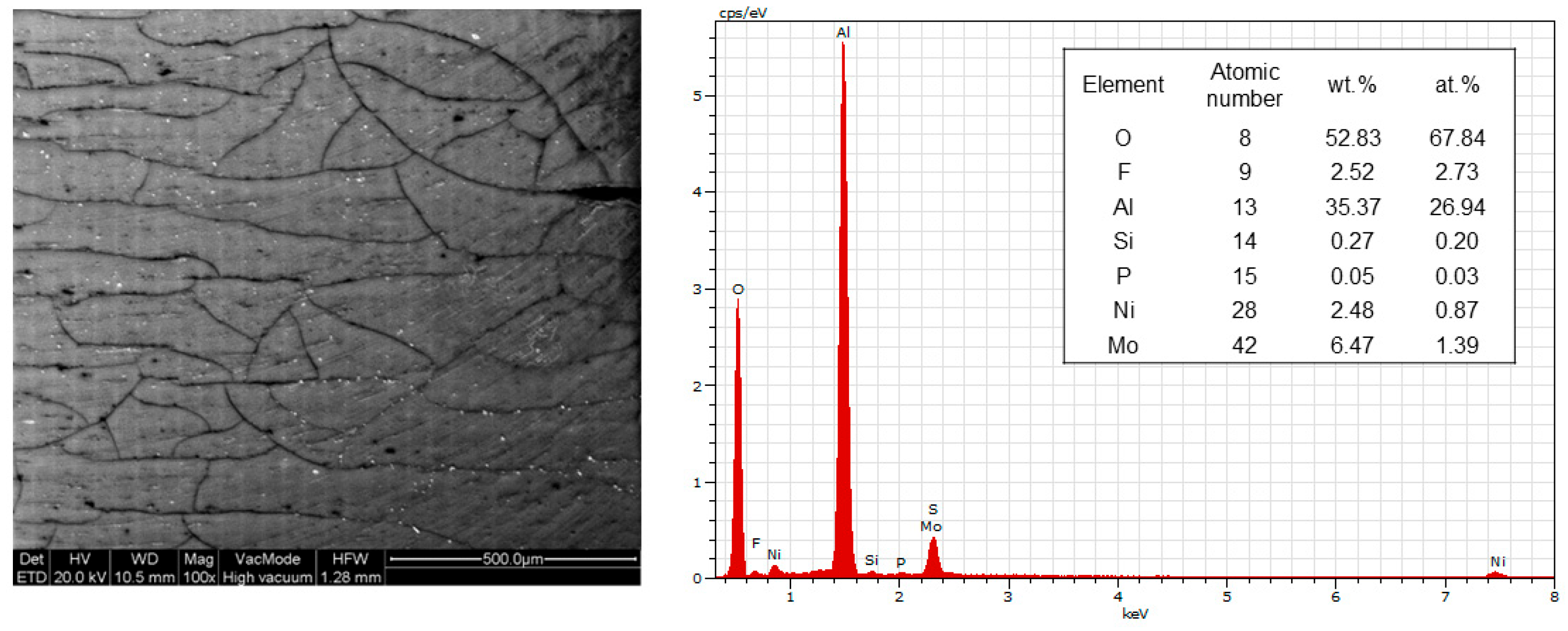
Figure 2.
Representative stereomicroscopic images (7.5× magnification, bar: 5 mm) of turbine rotor blade surfaces at baseline (t0) and after eight months of clinical use (t1). Compared with baseline (t0), post-use rotors (t1) exhibit clear surface deterioration characterized by discoloration compatible with corrosive processes, surface pitting, micro-abrasions, and localized material loss, particularly along blade surfaces and near balancing regions. Arrows indicate representative defects.
Figure 2.
Representative stereomicroscopic images (7.5× magnification, bar: 5 mm) of turbine rotor blade surfaces at baseline (t0) and after eight months of clinical use (t1). Compared with baseline (t0), post-use rotors (t1) exhibit clear surface deterioration characterized by discoloration compatible with corrosive processes, surface pitting, micro-abrasions, and localized material loss, particularly along blade surfaces and near balancing regions. Arrows indicate representative defects.
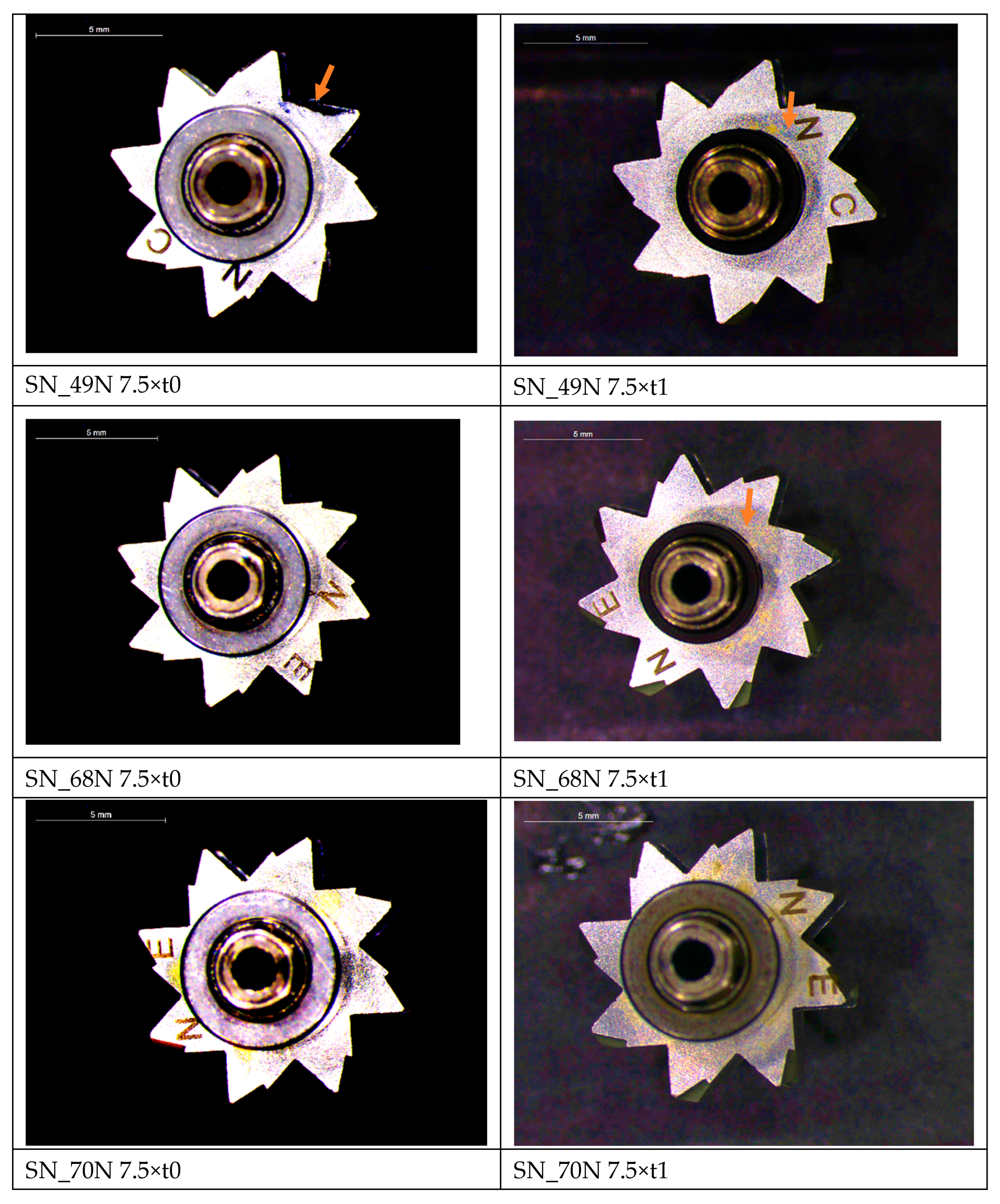

Table 1.
The results of free-running rotational speeds (in rpm) before (t0) and after clinical use (t1). Same uppercase letters indicate mean values with statistically insignificant differences.
Table 1.
The results of free-running rotational speeds (in rpm) before (t0) and after clinical use (t1). Same uppercase letters indicate mean values with statistically insignificant differences.
| Turbine | Serial Number (SN) | Speed (t0)/rpm | Speed (t1)/rpm |
| 1 | CTMN0084 | 340000 | 317000 |
| 2 | CTMN0068 | 329000 | 329000 |
| 3 | CTMN0107 | 335000 | Off |
| 4 | CTMN0101 | 325000 | 307000 |
| 5 | CTMN0115 | 327000 | Off |
| 6 | CTMN0110 | 330000 | 292000 |
| 7 | CTMN0075 | 334000 | 333700 |
| 8 | CTMN0124 | 326700 | 312000 |
| 9 | CTMN0049 | 331000 | 298000 |
| 10 | CTMN0070 | 336000 | 289000 |
| 11 | CTMN0086 | 328000 | 323000 |
| 12 | CTMN0118 | 334000 | 307000 |
| 13 | CTMN0119 | 332200 | 317000 |
| 14 | CTMN0090 | 340000 | 311000 |
| 15 | CTMN0116 | 325000 | 287000 |
| Means and standard deviations | 331608 (5051)a | 309438 (14851)b |
Table 2.
The results of friction grip force (in N) before (t0) and after clinical use (t1). Same uppercase letters indicate mean values with statistically insignificant differences.
Table 2.
The results of friction grip force (in N) before (t0) and after clinical use (t1). Same uppercase letters indicate mean values with statistically insignificant differences.
| Turbine | Serial Number (SN) | Friction grip (t0)/N | Friction grip (t1)/N |
| 1 | CTMN0084 | 28.1 | 25.8 |
| 2 | CTMN0068 | 29.4 | 29 |
| 3 | CTMN0107 | 28.8 | Off |
| 4 | CTMN0101 | 27.7 | 11.8 |
| 5 | CTMN0115 | 30.5 | Off |
| 6 | CTMN0110 | 30.2 | 13.7 |
| 7 | CTMN0075 | 29.4 | 18.9 |
| 8 | CTMN0124 | 28.3 | 16.1 |
| 9 | CTMN0049 | 29.6 | 16.1 |
| 10 | CTMN0070 | 29.3 | 24.5 |
| 11 | CTMN0086 | 28.5 | 24.2 |
| 12 | CTMN0118 | 29.7 | 12.5 |
| 13 | CTMN0119 | 29.1 | 21.4 |
| 14 | CTMN0090 | 28.7 | 16 |
| 15 | CTMN0116 | 28.1 | 22.6 |
| Means and standard deviations | 28.9 (0.8)a | 19.4 (5.5)b |
Disclaimer/Publisher’s Note: The statements, opinions and data contained in all publications are solely those of the individual author(s) and contributor(s) and not of MDPI and/or the editor(s). MDPI and/or the editor(s) disclaim responsibility for any injury to people or property resulting from any ideas, methods, instructions or products referred to in the content. |
© 2026 by the authors. Licensee MDPI, Basel, Switzerland. This article is an open access article distributed under the terms and conditions of the Creative Commons Attribution (CC BY) license (http://creativecommons.org/licenses/by/4.0/).
Copyright: This open access article is published under a Creative Commons CC BY 4.0 license, which permit the free download, distribution, and reuse, provided that the author and preprint are cited in any reuse.


