

Submitted:
21 April 2026
Posted:
22 April 2026
You are already at the latest version
Abstract
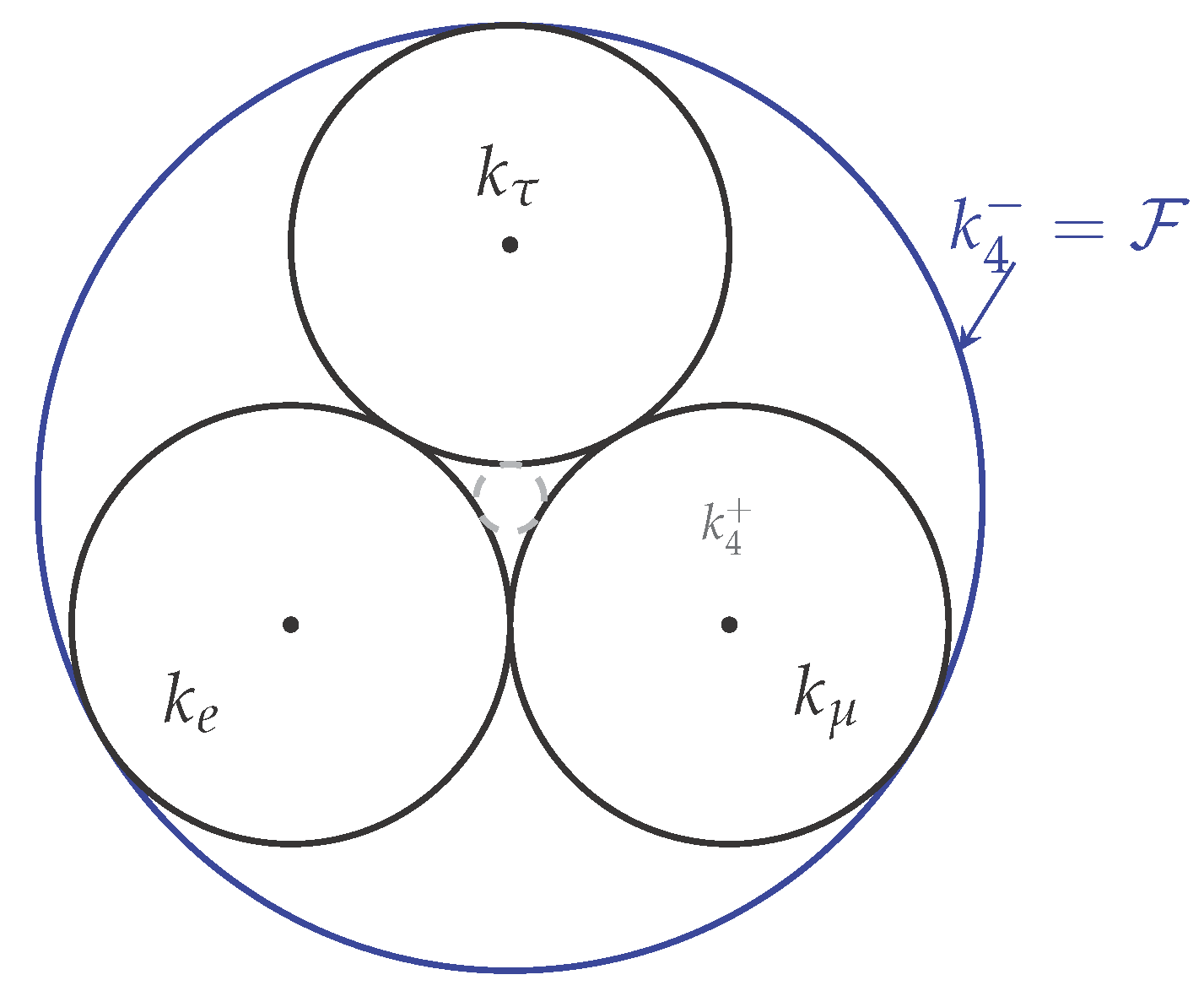
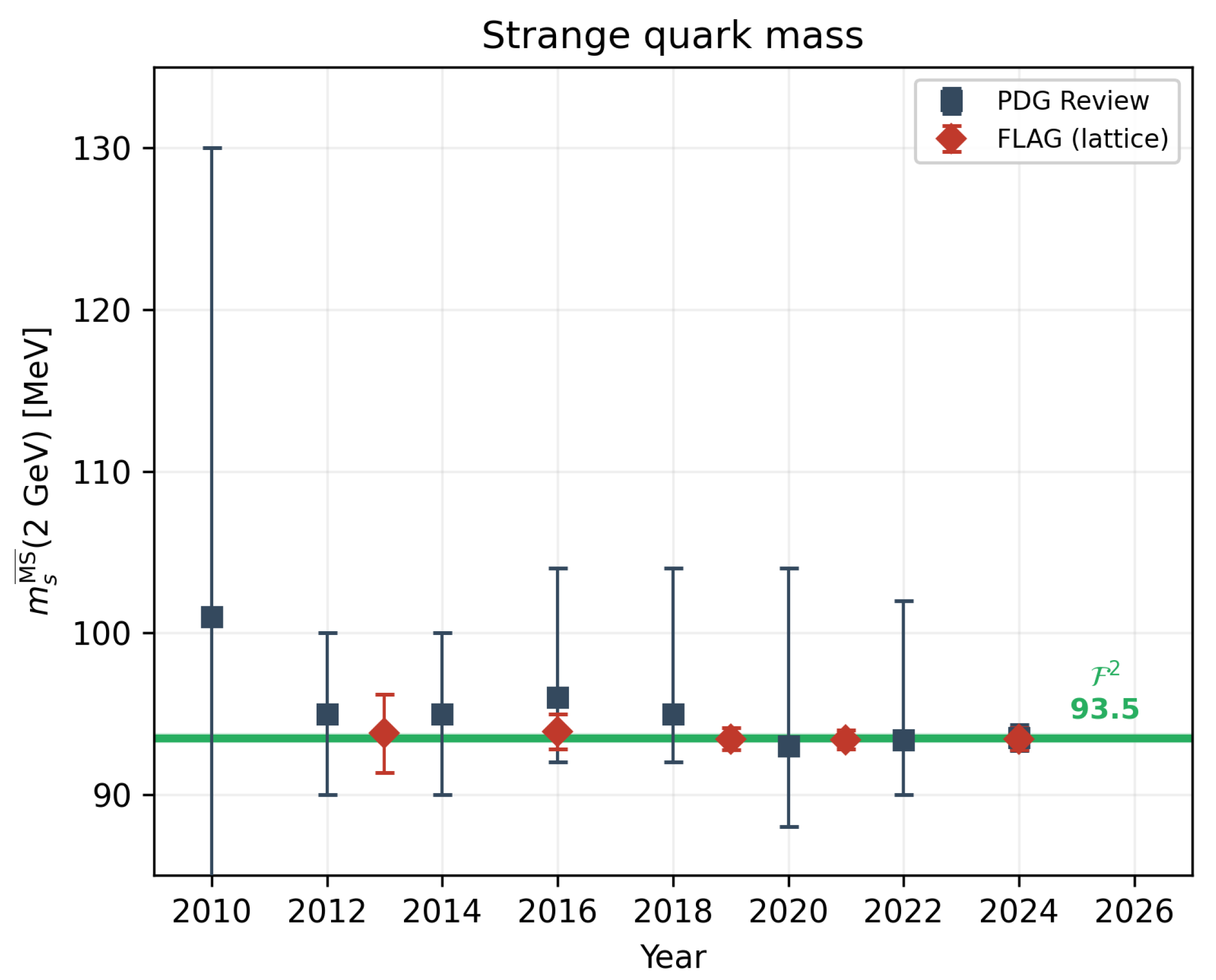
The Koide relation \( Q = (\sum m_\ell)/(\sum \sqrt{m_\ell})^2 = 2/3 \) for the charged leptons has held to one part in \( 10^5 \) for over forty years without an accepted derivation and is widely regarded as numerology. This paper takes the relation as a clue rather than an endpoint. Treating lepton mass square roots as Descartes-circle curvatures, the outer root of the Descartes quadratic equals the closed form \( \mathcal{F} = e_1 - \sqrt{p_2} \) when Koide holds exactly (Proposition 1); equivalently, \( \mathcal{F}^2 = \alpha_K^2\,\mu_\star \) with \( \alpha_K^2 = 5/2 - \sqrt{6} \) and \( \mu_\star = \sum_\ell m_\ell \) the lepton-sum scale. The three-input symmetric-polynomial identity thus collapses to one dimensionless Koide-determined constant times the lepton-sum scale. Kocik [1] first observed a Descartes-like reading of Koide; our mutually-tangent variant is mathematically distinct but follows the same geometric spirit. The four-curvature completion carries a testable consequence absent from the bare three-mass relation: evaluating the squared fourth curvature numerically, \( \mathcal{F}^2 = 95.113 \) MeV, and comparing against the strange-quark \( \bar{MS} \) mass at \( \mu_\star \) within current lattice precision yields a residual of \( +0.04 \) MeV against \( \pm 0.69 \) MeV, about \( +0.06\sigma \). The lepton-side quantity is fixed to better than \( 0.01\% \); future lattice improvements will sharpen or refute the present numerical agreement. To our knowledge this paper implements the first Monte Carlo null test of the Koide relation under a random-spectrum prior; a Koide-conditioned null-model calibration across four prior shapes pre-registered for the analysis gives hit fractions at the sub-percent level — model-conditional frequencies, not \( p \)-values. Scale, input, prior, and filter sensitivities, together with the error budget, are reported; full Monte Carlo protocols, numerical output, and pre-registration are in a companion methods note [2].
Keywords:
1. Introduction
2. The Koide Relation as a Descartes Condition
Koide factorization of .
3. The Outer Soddy Curvature of the Lepton Triple
The function in the Descartes framework.
Numerical value.
4. The Observation
Methodological note on order of operations.
5. Robustness
5.1. Input Sensitivity and Error Budget
| Source | contribution (MeV) |
| FLAG lattice | |
| Charm threshold GeV (not used for evolution) | |
| Four-loop truncation (4L vs 3L) | |
| Quadrature sum |
5.2. Continuous scale sensitivity
5.3. Alternative Scale Prescriptions
| Prescription | (MeV) | Hit (within )? |
| (baseline) | yes () | |
| yes (trivially equivalent) | ||
| no () | ||
| (conventional reference, not lepton-derived) | no () | |
| non-perturbative | ||
| non-perturbative | ||
| non-perturbative | ||
| (harmonic) | non-perturbative |
5.4. Random-Spectrum Null-Model Test
- A1 (Donoghue log-uniform), primary. log-uniform on ; r log-uniform on . Motivated by the observation [17] that the observed charged-fermion spectrum is approximately log-uniform over six decades.
- A2 (Hall–Salem–Watari log-normal). Log-normal centered on the geometric mean of the Standard-Model charged-fermion masses (median GeV) with ; log-normal r with median and . Motivated by the log-normal-like mass distributions that arise in Gaussian-landscape models [18].
- A4 (linear-uniform stress test). and r linear-uniform on the A1 supports. Included only to bound the sensitivity of the hit fraction to a worst-reasonable-case prior; not a physics proposal.

| Prior shape | Hit fraction | 95% CI |
|---|---|---|
| A1: Donoghue log-uniform (primary) | ||
| A2: Hall–Salem–Watari log-normal | ||
| A3: Yukawa-anarchy singular-value ratio | ||
| A4: linear-uniform stress test |
A remark on the anarchy prior.
5.5. Filter Sensitivity
| A1 hit fraction | |
| GeV (extrapolated) | |
| GeV (baseline) | |
| GeV | |
| GeV (excludes the observed lepton triple) |
5.6. Supplementary Checks
Measurement-noise bootstrap.
Comparison family of lepton functions.
Temporal trajectory.
| Epoch | (MeV) | Residual (MeV) | Within ? |
| FLAG 2013 | yes | ||
| FLAG 2016 | yes | ||
| FLAG 2019 | yes | ||
| FLAG 2021 | yes | ||
| FLAG 2024 | yes |
5.7. Interpretation
6. Caveats and Non-Claims
Not the only algebraic route to a comparable number.
Not a charm or bottom relation.
7. Discussion and Conclusions
Author’s tentative interpretation.
Outlook.
Conclusions.
8. Computational Note
Author Contributions
Funding
Data Availability Statement
Acknowledgments
Conflicts of Interest
References
- J. Kocik, The Koide Lepton Mass Formula and Geometry of Circles, arXiv:1201.2067 [physics.gen-ph] (2012).
- A. M. Brilliant, Pre-registered Monte Carlo protocols for the outer Soddy–Koide numerical observation, Zenodo, 2026. [CrossRef]
- Y. Koide, Fermion-Boson Two Body Model of Quarks and Leptons and Cabibbo Mixing, Lett. Nuovo Cim. 34, 201 (1982).
- Y. Koide, New view of quark and lepton mass hierarchy, Phys. Rev. D 28, 252 (1983); Erratum: Phys. Rev. D 29, 1544 (1984).
- S. Navas et al. (Particle Data Group), Review of Particle Physics, Phys. Rev. D 110, 030001 (2024). The tau-mass value 1776.93±0.09 MeV used here incorporates the PDGLive post-publication update including Belle II 2023 and KEDR 2023.
- A. Rivero and A. Gsponer, The strange formula of Dr. Koide, arXiv:hep-ph/0505220 (2005).
- R. Foot, A note on Koide’s lepton mass relation, arXiv:hep-ph/9402242 (1994).
- Y. Sumino, Family gauge symmetry as an origin of Koide’s mass formula and charged lepton spectrum, JHEP 05, 075 (2009), arXiv:0812.2103.
- W. Rodejohann and H. Zhang, Extension of an empirical charged lepton mass relation to the neutrino sector, Phys. Lett. B 698, 152 (2011), arXiv:1101.5525.
- A. Rivero, A new Koide tuple: strange-charm-bottom, arXiv:1111.7232 [hep-ph] (2011).
- W. Królikowski, Two options for the Koide-like formula generalized to neutrinos, arXiv:1404.5705 (2014).
- H. S. M. Coxeter, The problem of Apollonius, Amer. Math. Monthly 75, 5 (1968).
- E. Gross and O. Vitells, Trial factors for the look elsewhere effect in high energy physics, Eur. Phys. J. C 70, 525 (2010), arXiv:1005.1891.
- Y. Aoki et al. (Flavour Lattice Averaging Group, FLAG), FLAG review 2024, Phys. Rev. D 113, 014508 (2026), arXiv:2411.04268.
- B. Schmidt and M. Steinhauser, CRunDec: a C++ package for running and decoupling of the strong coupling and quark masses, Comput. Phys. Commun. 183, 1845 (2012); F. Herren and M. Steinhauser, Version 3 of RunDec and CRunDec, Comput. Phys. Commun. 224, 333 (2018).
- A. M. Brilliant, fermion_mass_mc: pre-registered Monte Carlo code for the Soddy–Koide and heavy-Koide analyses, GitHub repository (2026). https://github.com/AndBrilliant/fermion_mass_mc.
- J. F. Donoghue, The fine-tuning problems of particle physics and anthropic mechanisms, arXiv:hep-ph/9712333 (1998); see also J. F. Donoghue, K. Dutta, and A. Ross, Phys. Rev. D 73, 113002 (2006).
- L. J. Hall, M. P. Salem, and T. Watari, Neutrino mixing and mass hierarchy fluctuations, Phys. Rev. Lett. 100, 141801 (2008), arXiv:0707.3446.
- L. J. Hall, H. Murayama, and N. Weiner, Neutrino mass anarchy, Phys. Rev. Lett. 84, 2572 (2000), arXiv:hep-ph/9911341.
- A. de Gouvêa and H. Murayama, Statistical test of anarchy, Phys. Lett. B 573, 94 (2003), arXiv:hep-ph/0301050.
- C. J. Clopper and E. S. Pearson, The use of confidence or fiducial limits illustrated in the case of the binomial, Biometrika 26, 404 (1934).
- B. Efron and R. J. Tibshirani, An Introduction to the Bootstrap, Chapman & Hall/CRC, New York (1993).
- G. Cowan, K. Cranmer, E. Gross, and O. Vitells, Asymptotic formulae for likelihood-based tests of new physics, Eur. Phys. J. C 71, 1554 (2011), arXiv:1007.1727; Erratum: Eur. Phys. J. C 73, 2501 (2013).
- L. Lyons, Open statistical issues in particle physics, Ann. Appl. Stat. 2, 887 (2008).
- A. M. Brilliant, A constrained-search test of the lepton-scale hypothesis on the (c, b, t) heavy Koide combination, manuscript in preparation (2026).
| # | Expression | Value (MeV) |
|---|---|---|
| 1 | outer Soddy | |
| 2 | Prop. 1 surrogate | |
| 3 | inner Soddy | |
| 4 | Koide “+” branch squared | |
| 5 | ||
| 6 | ||
| 7 | ||
| 8 | ||
| 9 | ||
| 10 | ||
| 11 | (duplicate enumeration) | |
| 12 | ( under exact Koide) | |
| 13 | () | |
| 14 | arithmetic mean | |
| 15 | geometric mean | |
| 16 | harmonic mean | |
| 17 | ||
| 18 | (= row 17) | |
| 19 | ||
| 20 | ||
| 21 | ||
| 22 | reduced mass of | |
| 23 | ||
| 24 | (dim. ; see caption) |
Disclaimer/Publisher’s Note: The statements, opinions and data contained in all publications are solely those of the individual author(s) and contributor(s) and not of MDPI and/or the editor(s). MDPI and/or the editor(s) disclaim responsibility for any injury to people or property resulting from any ideas, methods, instructions or products referred to in the content. |
© 2026 by the authors. Licensee MDPI, Basel, Switzerland. This article is an open access article distributed under the terms and conditions of the Creative Commons Attribution (CC BY) license (http://creativecommons.org/licenses/by/4.0/).


