

Submitted:
08 April 2026
Posted:
09 April 2026
You are already at the latest version
Abstract
As cities worldwide face challenges of rapid urbanization and declining public transit ridership, traditional fixed-route systems often fail to meet evolving mobility needs. Urban planning issues, such as suburban sprawl and fragmented land use, exacerbate these limitations, leading to underutilized services, higher operational costs, and accessibility gaps, particularly for underserved communities. Demand-Responsive Transit (DRT) systems have emerged as an effective solution, offering flexible, on-demand services that dynamically adjust routes based on user demand. This review synthesizes insights from 65 studies, including 20 real-world implementations, examining DRT's potential to enhance accessibility, cost efficiency, and environmental sustainability. Key findings demonstrate that DRT systems reduce operational costs by 25-35% while increasing ridership up to 300%. Integration of AI-driven routing algorithms improves service reliability by 90-98% and reduces travel times by 35-50%. Multiple booking interfaces increase adoption by 40-60%, while multimodal integration expands service coverage by 100-150%. However, significant barriers persist, with 58% of DRT system models requiring subsidies and 51% facing equity challenges. The study proposes hybrid funding models, integrated multimodal platforms, and inclusive design approaches to address these challenges. By aligning with urban design principles and leveraging advanced technologies, DRT systems can enhance urban resilience while promoting sustainable development.
Keywords:
demand-responsive public transit
; urban design
; accessibility
; adaptability
; sustainability
Introduction
Urban areas increasingly face challenges from rapid population growth, rising density, and escalating environmental pressures. While traditional fixed-route bus transit systems are effective in dense urban centers where demand is consistently high, they often struggle to meet the needs of low-density suburban and rural areas. These systems frequently lack the flexibility to adapt to varying passenger demands and geographic spread. Moreover, such bus transit systems often suffer from issues like unreliability, which exacerbates passenger dissatisfaction. A major concern is the long waiting times commonly associated with these systems. Research indicates that extended waiting times are the primary reason preventing many individuals from using bus transit services (Basak et al. 2019). Passengers expect timely and reliable service, and when these expectations are not met, they are more likely to seek alternative modes of transportation. These limitations lead to inefficient service utilization, higher operational expenses, and limited accessibility for vulnerable groups, particularly low-income and minority communities (Brough, Freedman, and Phillips 2020; Covington 2018). This mismatch between service delivery and user expectations highlights the need for innovative bus transit solutions that prioritize efficiency, adaptability, and customer satisfaction.
Demand-Responsive Transit (DRT) systems address these challenges through dynamic routing and real-time demand response, enabled by advanced technologies. Key technological components—AI-driven algorithms, mobile applications, GPS tracking, and IoT devices—create an integrated ecosystem for route optimization and service delivery. Systems like Seattle’s OneBusAway demonstrate how real-time predictions can enhance user experience (Fujisaki et al. 2022), while emerging AI and machine learning applications promise improved demand modeling and resource allocation (Liezenga et al. 2024; Rashvand et al. 2023). Notable examples include Innisfil Transit in Canada and Wilson’s The RIDE in North Carolina, which demonstrate DRT’s ability to enhance accessibility, lower costs, and improve mobility for underserved populations (Itani et al. 2024; Tirachini and Cats 2020; Vansteenwegen et al. 2022). In addition to these operational benefits, DRT supports urban planning objectives by fostering first- and last-mile connectivity, encouraging compact urban growth, and reducing reliance on private vehicles (Yan et al. 2021). Moreover, DRT plays a critical role in promoting urban sustainability by lowering greenhouse gas emissions, advancing compact development, and addressing social equity challenges. By strategically serving regions with irregular or low demand, DRT contributes to the development of environmentally friendly and inclusive transit systems (Mehran, Yang, and Mishra 2020; Hosseini et al. 2023). This paper synthesizes insights from 65 studies, including 20 real-world implementations, to evaluate DRT systems potential as a complementary transit solution. Through analysis of technological innovations and urban design principles, it provides scalable pathways for developing equitable, sustainable DRT systems that enhance urban accessibility and resilience.
Research Objectives and Contributions
This paper critically examines Demand-Responsive Transit (DRT) systems through an urban design lens, focusing on their potential to enhance accessibility, cost efficiency, and sustainability across urban, suburban, and rural contexts. The study addresses the following objectives:
- Evaluating the role of DRT in promoting connectivity, equity, and compact urban growth by addressing first-/last-mile gaps and supporting transit-oriented development (TOD) through multimodal networks.
- Identifying key technological tools and frameworks that enable scalable integration of DRT systems with fixed-route networks.
- Analyzing financial and operational barriers to DRT adoption and proposing strategies to overcome these challenges.
To achieve these objectives, this paper answers the following research questions:
- How do DRT systems perform across different areas within an urban design framework?
- What technologies enable the scalability and integration of DRT systems with fixed-route transit?
- What barriers must be addressed to ensure equitable and sustainable DRT implementation?
This study delivers actionable contributions to the field of urban mobility by analyzing DRT systems and offering practical pathways for implementation and scalability:
- Integration with Urban Design Principles: The research demonstrates how DRT enhances connectivity, fosters equity, and promotes sustainability by supporting TOD, bridging first-/last-mile gaps, and encouraging compact urban growth through multimodal networks.
- Thematic Analysis of Key Dimensions: A synthesis of findings highlights DRT’s strengths and limitations across dimensions of accessibility, technological integration, and urban design, providing a framework for evaluating its role in complementing fixed-route systems.
- Scalable Models and Case Study Insights: By examining successful case studies, the study identifies scalable and equity-driven models adaptable to various geographic and demographic contexts.
- Actionable Recommendations: The study proposes hybrid funding strategies, real-time feedback mechanisms, and inclusive design frameworks to address financial sustainability, technological integration, and accessibility challenges. These recommendations offer clear guidance for policymakers and transit planners in designing equitable and efficient DRT systems.
1. Methodology
1.1. Literature Search and Selection Criteria
This study employs a systematic literature review (SLR) methodology to analyze and synthesize insights from 65 studies on Demand-Responsive Transit (DRT) systems, highlighting the diversity of approaches, contexts, and implementations. The review focuses on understanding key strategies, challenges, and outcomes within the context of DRT systems performance and scalability. A screening process, followed by detailed data extraction and thematic coding, ensured a structured and comprehensive analysis of the selected studies.
In the screening process, an initial pool of 65 studies was identified through structured searches across major academic databases, including IEEE Xplore, ScienceDirect, JSTOR, and Google Scholar, targeting publications from 2010 to 2024. This time frame reflects the evolution of DRT systems, particularly advancements in mobile technologies, IoT, and real-time analytics. Keywords such as “Demand-Responsive Transit,” “On-Demand Transit Systems,” and “Flexible Transit Services” were combined with terms like “Cost Efficiency,” “Accessibility,” and “Prediction Models” to capture relevant studies.
The identified studies were categorized into four groups based on their focus:
- Real-World Implementation DRT System Studies: Examining systems in operation with documented outcomes and user adoption.
- Simulated DRT System Studies: Exploring modeled scenarios for system performance and feasibility.
- Survey Studies for DRT Systems: Investigating user preferences, barriers to adoption, and system perceptions.
- Arrival Time & Demand Prediction Models for DRT Systems: Evaluating algorithms and models used for scheduling and demand forecasting.
The process focused exclusively on real-world implemented DRT systems, selecting those with the best documented results and measurable outcomes from various regions worldwide. From the initial 65 studies, 20 were chosen based on their ability to provide actionable insights into key metrics such as accessibility, cost efficiency, or environmental impact, while those lacking DRT-specific insights or only methodological quality were excluded. This process ensured the selection of high-quality and relevant studies for further analysis. Figure 1 illustrates a flowchart which provides a detailed overview of the literature selection process, illustrating the progression from initial searches to the final selection of 20 studies:
1.2. Data Extraction, Thematic Coding and Comparative Analysis
The 20 studies selected through the screening process were chosen for their strong real-world evidence and ability to provide meaningful insights into DRT implementations. During the analysis, these studies were evaluated using comprehensive and comparative data extraction criteria, ensuring a detailed examination of their outcomes and contributions. These Criteria included:
- Operational Models: Strategies for routing, scheduling, and resource allocation.
- Technological Tools: Utilization of advanced technologies like GPS, IoT, mobile applications, and real-time analytics.
- Challenges: Barriers such as digital adoption, scalability, and equity in service delivery.
- Urban Design Principles: Contributions to multimodal connectivity, compact urban growth, and equitable access.
- Outcomes: Metrics including service cost efficiency, environmental impact, accessibility, and user satisfaction.
The extracted data were thematically coded into five categories to enable a structured analysis: accessibility, equity, cost efficiency, environmental impact, and technological integration. Accessibility examined how DRT systems address service gaps in underserved and rural areas, while equity focused on inclusivity for low-income populations and individuals without access to digital platforms. Cost efficiency was analyzed in terms of resource optimization and operational cost reduction. Environmental impact highlighted efforts to lower greenhouse gas emissions, reduce vehicle miles traveled, and promote energy efficiency. Technological integration explored the use of advanced tools to enhance scalability, routing efficiency, and user experience. A comparative analysis was then conducted to synthesize findings across the selected studies, with attention to regional differences in geographic and demographic contexts, performance metrics such as ridership growth, response times, cost savings, and service reliability, as well as implementation challenges like resource allocation, fleet management, and the adoption of digital solutions. This comprehensive process ensured that the review captured a diverse range of DRT systems, identifying best practices, common challenges, and opportunities for scalability and sustainability.
1.3. Analytical Framework and Metrics for Success
The performance evaluation of the selected DRT systems was guided by a structured framework that aligned with the thematic coding categories. These metrics provided a consistent basis for assessing strengths, limitations, and opportunities for scalability and adaptation. Key metrics included:
- Operational Metrics: Includes ridership growth, fleet utilization, cost per passenger mile, and vehicle kilometers/miles traveled (VKT/VMT) for evaluating resource efficiency.
- Passenger-Centric Metrics: Focuses on accessibility improvements, reduced waiting times, and user satisfaction, often measured through surveys.
- Cost Efficiency: Evaluates operational cost per passenger mile and cost recovery ratios to determine financial sustainability.
- Environmental Sustainability: Assesses reductions in greenhouse gas (GHG) emissions, energy consumption, and fleet-related impacts, where reduced VKT/VMT contributes to lower emissions and better fuel efficiency.
- Service Quality: Measures on-time performance, system reliability, and responsiveness to real-time demand.
- Scalability and Flexibility: Examines adaptability to varying urban densities and geographic contexts, ensuring systems meet the unique demands of different regions.
- Technological Integration: Effectiveness of tools like real-time analytics, IoT, and mobile platforms in improving service efficiency and user experience (Vansteenwegen et al. 2022; Itani et al. 2024; Yan et al. 2021).
2. Findings and Thematic Analysis
2.1. Comparative Analysis of DRT and Fixed-Route Systems
The comparison of DRT and fixed-route systems based on urban density highlights the varying adaptability of DRT across different urban settings. DRT’s flexibility differs depending on the density of the area. In low-density areas, such as suburban regions, DRT excels at bridging first- and last-mile gaps, as demonstrated by Innisfil Transit’s cost-effective service (Itani et al. 2024). Moving to medium-density areas, transitional zones require more flexible models, like Edmonton On-Demand, which utilizes dynamic routing and integration with fixed-route systems to adapt to fluctuating peak and off-peak demand (Itani et al. 2024). In high-density areas, such as urban centers, DRT complements fixed-route transit during off-peak hours, as seen in Amsterdam’s successful integration (Melis, Queiroz, and Sörensen 2024). DRT stands out for its flexibility, accessibility, and cost efficiency, particularly in low-density areas. These systems dynamically adjust to real-time demand, effectively addressing these inefficiencies and providing a more adaptive and responsive transit solution. Table 1 presents a detailed comparison between DRT and fixed-route systems, highlighting their respective strengths and limitations.
2.2. Key Themes in DRT Studies
From the analysis of all 65 studies, several themes and recurring patterns emerged, illustrating DRT’s strengths and challenges across diverse urban settings.
- Technology Integration (58 studies): Technologies like mobile apps, GPS, IoT, and real-time data analytics enable dynamic routing and seamless booking, making DRT systems highly responsive. Seattle’s OneBusAway exemplifies this by integrating real-time transit predictions with multimodal systems, improving efficiency and user connectivity (Fernandes et al. 2018).
- Accessibility (45 studies): DRT systems enhance transit service in underserved areas by addressing gaps for seniors, low-income groups, and rural populations. Innisfil Transit subsidized Uber rides to ensure affordable and accessible mobility for suburban residents, and Valdosta On-Demand (GA) connected rural communities to essential services and transit hubs, demonstrating DRT’s role in reaching transit-dependent populations (Itani et al. 2024; Bergal 2022).
- Cost Efficiency (38 studies): DRT systems reduce operational costs by replacing underutilized fixed routes with demand-responsive services. For instance, Belleville On-Demand (Canada) demonstrated substantial cost savings in suburban areas by optimizing resource allocation, illustrating DRT’s efficiency in low-demand regions (Melis, Queiroz, and Sörensen 2024; Itani et al. 2024).
- Environmental Impact (25 studies): DRT promotes sustainability through shared rides and optimized routing. Dynamic Bus Routing (Singapore) minimized vehicle miles traveled and idle times, reducing emissions, while Edmonton On-Demand Transit aligned with sustainability goals by employing energy-efficient fleet management (Itani et al. 2024; Koh et al. 2018).
- Equity Challenges (33 studies): While DRT addresses many accessibility issues, its reliance on digital platforms creates barriers for populations without smartphones or digital literacy. For example, Valdosta On-Demand encountered adoption difficulties among older adults, emphasizing the need for inclusive design practices to bridge the digital divide (Bergal 2022).
- First-/Last-Mile Solutions (31 studies): DRT bridges first- and last-mile gaps by enhancing multimodal journeys and providing seamless connections to transit hubs. Utrecht’s Mixed Fixed-Flexible Network improved regional connectivity by integrating DRT with fixed-route systems, while Atlanta’s ODMTS enhanced multimodal connections by offering flexible on-demand services during low-demand periods (Fielbaum and Alonso-Mora 2024; Melis, Queiroz, and Sörensen 2024; Auad et al. 2021).
2.3. Urban Design Integration and Principles
DRT aligns with critical urban design principles, offering transformative benefits in multimodal connectivity, spatial equity, sustainability, and human-centered design.
- Multimodal Connectivity: DRT integrates seamlessly with buses, trains, and cycling infrastructure, improving transit accessibility and supporting high-frequency transit hubs. For example, Seattle’s OneBusAway utilized real-time coordination to enhance multimodal connections between DRT and fixed-route transit (Fernandes et al. 2018).
- Spatial Equity: By prioritizing underserved populations such as seniors, low-income groups, and individuals with disabilities, DRT addresses critical gaps in accessibility. The RIDE in Wilson (NC) focused on equitable access, connecting vulnerable populations to healthcare and employment opportunities (Federal Transit Administration 2023).
- Environmental Sustainability: DRT reduces private vehicle dependency and lowers emissions through shared mobility and optimized routing. Singapore’s Dynamic Bus Routing exemplifies this by employing efficient routing algorithms to minimize environmental impacts (Koh et al. 2018).
- Urban Growth Strategies: DRT supports urban growth strategies, such as TOD and infill development. For instance, Valdosta On-Demand leveraged existing infrastructure to promote urban density, while DRT systems in Amsterdam strengthened connectivity to transit hubs, encouraging compact urban development (Melis, Queiroz, and Sörensen 2024; Bergal 2022).
- Human-Centered Design: Inclusive features like accessible interfaces and services tailored for elderly and disabled users demonstrate the importance of user-centric planning. Choisoko Mobility (Japan) incorporated features specifically designed for elderly populations, ensuring mobility for users with diverse needs (Fujisaki et al. 2022).
2.4. Review of Key DRT Systems Against Success Metrics
This section highlights DRT systems presented in Table 2, selected from the 20 real-world implementations, based on their outstanding performance in operational efficiency, accessibility, scalability, and environmental sustainability.
| DRT System | Region /Country | Target Population | Technology Used | Urban Design Principles |
Performance Outcomes & Success Metrics |
| BusPlus Project (Melis, Queiroz, and Sörensen 2024) | Canberra, Australia | General public |
Benders decomposition, Pareto cuts | Supports TOD with high-frequency connections between hubs. | Reduced transit time by 50%, while maintaining the same operational costs. |
| OneBusAway (Fernandes et al. 2018) | Seattle, USA |
Transit app users | Quantile dotplot visualization |
Enhances multimodal connectivity through real-time transit predictions. |
Reduced the variance in bus arrival time estimates by 1.15 times compared to density plots. |
| Innisfil Transit (Itani et al. 2024) | Innisfil, Canada | Suburban population | Uber platform | Promotes spatial equity and accessibility in low-density suburban areas. | Increased ridership, reduced operational costs, and expanded service coverage. |
| Dynamic Bus Routing (Koh et al. 2018) |
Singapore | High-density urban areas | IoT, GPS, real-time data analytics | Supports sustainable urban growth through optimized routing for reduced emissions. | Reduced idle times, optimized resource use, Significant emission reductions. |
| Valdosta On-Demand (Bergal 2022) |
Valdosta, GA, USA |
General public | Mobile app, phone-based booking | Encourages infill development by leveraging existing infrastructure. | High ride requests (~14,000 rides), 57% increase in rides from the first year, expanded service access, Reduced wait times. |
| Flexible Rerouting (Nannapaneni and Dubey 2019) | Nashville, TN, USA | General public transit users | DBSCAN clustering for flex stops | Optimizes routing for peak-demand clusters. | Successfully demonstrated flexible routing in high-demand areas. |
| Belleville On-Demand (Itani et al. 2024) |
Belleville, Canada | General public |
Mobile app, GPS |
Improves efficiency and connectivity in suburban regions. | 300% increase in nighttime bus ridership, Reduced costs, and better resource allocation. |
| The RIDE (Federal Transit Administration 2023) |
Wilson, NC, USA |
Seniors, students | Via platform | Focuses on equitable access, addressing underserved populations like seniors and students. |
Expanded hours, nearly doubling the ridership compared to the previous system, Increased service coverage by 150% without increasing the budget. |
| EBuxi (Thao, Imhof, and von Arx 2023) | Switzerland | Peri-urban residents | Smartphone app, GPS | Provides multimodal last-mile connectivity for suburban areas. |
Enhanced multimodal access but risks reducing walking/cycling habits. |
| Keoride (Freiberg et al. 2021) | Sydney, Australia | Public transport users |
Real-time optimization | Enhances multimodal networks by linking buses and rail systems. | Improved regional accessibility, Increased adoption in suburban areas, 98% users’ satisfaction. |
| Edmonton On-Demand (Itani et al. 2024) |
Edmonton, Canada | General public |
Mobile app, dynamic routing |
Aligns with sustainability through seamless integration with fixed routes. |
Enhanced service efficiency, suburban connectivity, and higher adoption rates. |
| Choisoko Mobility (Fujisaki et al. 2022) |
Yokosuka, Japan | Elderly, disabled individuals | QR codes, AI-based routing | Focuses on human-centered design, enhancing mobility for elderly and disabled populations. | Increased mobility, reduced car dependency for vulnerable groups. |
| Bus-on-Demand (Deka, Varshini, and Dilip 2023) | Dubai, UAE | Urban public transit users | Communication and tracking technologies | Balances sustainability and cost efficiency with transit integration | Balanced cost efficiency, sustainability, and integration with Dubai’s transit network. |
| BerlKönig (Barrett, Khanna, and Santha 2019) | Berlin, Germany | Urban and suburban residents | Various digital platforms | Enhances last-mile connectivity with dynamic routing. | Adjusted services based on customer feedback, Improved efficiency, 97% rider satisfaction rate. |
| Flow Optimization Transit (Melis, Queiroz, and Sörensen 2024) | New York City, USA | Urban and suburban residents | Flow optimization, network modeling | Integrates fixed and on-demand services for comprehensive mobility | 26% cost reduction, reduced transit time, higher adoption. |
| Variable-Route Demand Responsive Transit (Li et al. 2022) |
Yongcheng City, China | Students,migrant workers in urban and rural areas |
DK-means clustering for optimization | Links urban and rural areas, improving equity and flexibility. | Reduced costs by 9.5% and travel times by 9% compared to flexible bus systems; Improved layout and scheduling efficiency. |
| On-Demand Transit Services (Estrada et al. 2021) | Barcelona, Spain | Public transport users |
Analytical models for performance comparison. | Supports TOD and minimizes total system cost. | Demonstrated economic viability of on-demand services for different demand scenarios. |
| On-Demand Multimodal Transit Systems (ODMTS) (Basciftci and Van Hentenryck 2022) | Ann Arbor and Ypsilanti, Michigan, USA | Riders of varying income levels | Mixed-Integer Programs (MIP) for optimization | Integrates fixed routes with shuttles, supporting TOD and accessibility. | Reduced costs by 35% and transit times by 38%; Improved access and achieved 26% cost reduction compared to individual shuttles. |
| ODMTS (Auad et al. 2021) |
Atlanta, GA, USA |
Commuters in low-density areas | Optimization models for fleet sizing | Bridges first-/last-mile gaps, enhancing regional connectivity and multimodal integration. | Increased cost efficiency and accessibility, particularly during the pandemic. |
| Mixed Fixed-Flexible (Fielbaum and Alonso-Mora 2024) | Utrecht, Netherlands; Australia | Public transport users |
Simulation for demand-based routes | Integrates flexible routing with fixed lines for regional transit. |
Seamless integration with fixed routes, Improved regional accessibility. |
These systems exemplify best practices by leveraging innovative technologies and inclusive strategies to address diverse transit challenges while aligning with broader urban mobility goals. Innisfil Transit (Canada) and Belleville On-Demand (Canada) (Itani et al. 2024) showcase how DRT systems can efficiently replace underutilized fixed routes in suburban and medium-density areas, improving accessibility and reducing operational costs. Dynamic Bus Routing (Singapore) (Koh et al. 2018) demonstrates the environmental and operational benefits of optimized routing, lowering idle times and emissions in dense urban settings. ODMTS (Atlanta, USA) (Melis, Queiroz, and Sörensen 2024) highlights scalability and resilience by integrating flexible and fixed transit modes, addressing fluctuating demand while maintaining cost-effectiveness and accessibility. Finally, Choisoko Mobility (Japan) (Fujisaki et al. 2022) focuses on inclusivity by providing human-centered design solutions for elderly and disabled populations, leveraging AI-powered routing to ensure equitable and user-friendly services. Together, these systems reflect the potential of DRT to build equitable, adaptive, and sustainable transit networks, setting benchmarks for innovation and urban resilience (Fujisaki et al. 2022; Itani et al. 2024; Melis, Queiroz, and Sörensen 2024; Koh et al. 2018; Auad et al. 2021).
3. Research Gaps and Future Directions
3.1. Research Gaps
Our review of 65 studies identifies key gaps in DRT systems across the previously mentioned six thematic areas:
- Technology Integration: While 89% of studies emphasize mobile apps and real-time analytics, many systems lack offline functionality or standardized APIs, hindering integration with fixed-route transit. Among the 20 implemented studies, 30% successfully utilized real-time optimization technologies, such as Singapore’s Dynamic Bus Routing and Keoride in Australia, which improved multimodal connectivity and reduced idle times. In Seattle, OneBusAway improved service reliability by reducing the variance in bus arrival times by 1.15 times (Fernandes et al. 2018; Koh et al. 2018). However, 25% of systems lack real-time feedback mechanisms to adapt to user needs, as seen in EBuxi (Switzerland), limiting their responsiveness to changing demand (Thao, Imhof, and von Arx 2023).
- Accessibility: Although 69% of studies show DRT enhances coverage in underserved areas, 40% of the implemented systems specifically targeted accessibility improvements for rural or underserved populations. For example, Valdosta On-Demand recorded ~14,000 ride requests in its first year, with a 57% increase in rides, demonstrating effectiveness in rural areas (Bergal 2022). However, adoption barriers persist among seniors due to digital illiteracy, with 60% of seniors reporting difficulties using digital platforms. Expanding phone-based booking options, as seen in Keoride, which achieved a 98% user satisfaction rate, could provide a more inclusive framework for accessibility (Freiberg et al. 2021).
- Cost Efficiency: Economic sustainability remains a challenge, with 58% of studies noting heavy reliance on subsidies. Among the 20 implemented systems, 25% demonstrated significant cost reductions, such as Belleville On-Demand, which increased nighttime ridership by 300% while reducing costs (Itani et al. 2024). Similarly, ODMTS in Michigan achieved a 35% reduction in transit costs and a 38% decrease in travel times, showcasing the benefits of integrating fixed and flexible services for financial sustainability (Basciftci and Van Hentenryck 2022).
- Environmental Impact: Only 38% of studies explore DRT’s environmental impact, and among the 20 systems reviewed, 15% reported significant reductions in emissions or resource optimization. For instance, Singapore’s Dynamic Bus Routing reduced idle times and demonstrated its potential to support sustainable urban growth by optimizing resource use (Koh et al. 2018). However, gaps remain in the adoption of renewable energy sources and electric vehicles across DRT systems.
- Equity Challenges: Over 51% of studies report persistent equity issues, particularly for elderly users and low-income populations. Among the implemented systems, 20% addressed equity concerns through innovative strategies. For example, Valdosta On-Demand revealed that 60% of seniors struggled with digital platforms, underscoring the need for non-digital booking options (Bergal 2022). Meanwhile, Choisoko Mobility in Japan improved accessibility for elderly and disabled populations through human-centered design, highlighting the potential of inclusive approaches to reduce inequities (Fujisaki et al. 2022).
- First-/Last-Mile Solutions: In 48% of studies, DRT is recognized as bridging first- and last-mile gaps, but scalability challenges hinder broader adoption. Among the 20 systems, 20% specifically addressed first-/last-mile connectivity. For instance, The RIDE in Wilson, NC, expanded service coverage by 150% and nearly doubled ridership without increasing costs, demonstrating effective resource management in rural areas (Federal Transit Administration 2023). However, scalability remains a challenge for systems like Edmonton On-Demand, which continues to face inefficiencies in resource allocation during expansion (Itani et al. 2024).
3.2. Future Directions and Recommendations
To advance Demand-Responsive Transit (DRT) as a transformative transit model, future efforts should address the following priorities:
- Comprehensive Integration Frameworks: Synchronize DRT with fixed-route transit systems using real-time data-sharing platforms and adaptive scheduling. Establish standardized metrics to evaluate performance in areas like accessibility, cost efficiency, and environmental impact.
- AI-Driven Predictive Models: Leverage AI and machine learning for real-time demand forecasting, route optimization, and dynamic resource allocation to enhance both operational efficiency and user satisfaction.
- Inclusive Design for Equity: Enhance accessibility through inclusive tools such as phone-based booking systems, multilingual interfaces, and user-friendly dashboards to cater to underserved and digitally excluded populations.
- Sustainable Funding Models: Develop innovative funding strategies, including dynamic pricing, subscription-based frameworks, and Public-Private Partnerships (PPPs), to balance financial sustainability with accessibility and equity.
- Autonomous Systems for Sustainability: Integrate autonomous vehicles (AVs) with AI-based routing systems to improve resource utilization, reduce operational costs, and support environmentally sustainable transit operations.
- Feedback-Driven Optimization: Implement real-time feedback mechanisms, such as in-app surveys and passenger response tools, to adapt services dynamically based on user needs and satisfaction.
- Environmental Sustainability: Prioritize emissions reduction by incorporating eco-friendly routing algorithms, fleet electrification, and real-time monitoring of greenhouse gas (GHG) emissions and energy consumption.
- Data Visualization for Decision-Making: Develop interactive dashboards that aggregate operational metrics (e.g., fleet utilization, ridership growth) and environmental metrics (e.g., emissions data) to support adaptive and informed decision-making.
- Scalability Strategies: Transition from pilot projects to large-scale operations by using robust resource allocation models, adaptive fleet management systems, and scalable algorithms that accommodate diverse urban densities and geographic contexts.
- Equity and Inclusion: Address the needs of underserved populations by incorporating non-digital booking methods, affordability programs, and interfaces designed for elderly or disabled users.
- Real-Time Performance Metrics: Establish universal standards to measure service reliability, on-time performance, and responsiveness to real-time demand, ensuring consistent service quality across systems.
- Urban Sustainability Goals: Align DRT systems with broader urban planning principles, such as TOD, first-/last-mile connectivity, and compact urban growth, to promote sustainable and inclusive urban mobility.
Conclusions
This paper reviews Demand-Responsive Transit (DRT) systems, highlighting their potential to enhance accessibility, cost efficiency, and environmental sustainability. Case studies demonstrate the role of innovations like AI, IoT, and real-time data in improving routing and connectivity, as seen in systems like OneBusAway (Seattle) and Belleville On-Demand (Canada). DRT systems also align with climate goals by reducing greenhouse gas emissions, exemplified by Singapore’s Dynamic Bus Routing. Despite these benefits, challenges remain in scalability, equity, and integration with fixed-route systems. Addressing these requires predictive models, inclusive design strategies, and standardized frameworks. Best practices, such as hybrid funding models and real-time feedback mechanisms, offer practical solutions for building inclusive and sustainable transit networks. Future research should include diverse case studies and qualitative analyses to address existing gaps and advance DRT implementation.
References
- Auad, Ramon, Kevin Dalmeijer, Connor Riley, Tejas Santanam, Anthony Trasatti, Pascal Van Hentenryck, and Hanyu Zhang. 2021. “Resiliency of On-Demand Multimodal Transit Systems during a Pandemic.” Transportation Research Part C: Emerging Technologies 133 (December):103418. [CrossRef]
- Barrett, Simon, Ashish Khanna, and Natasha Santha. 2019. “On-Demand Public Transport: Key Learnings from Global Pilots.” Special Report, August 5. Accessed July 2, 2024. https://www.lek.com/insights/sr/key-learnings-global-pilots.
- Basak, Sanchita, Fangzhou Sun, Saptarshi Sengupta, and Abhishek Dubey. 2019. “Data-Driven Optimization of Public Transit Schedule.” Lecture Notes in Computer Science (Including Subseries Lecture Notes in Artificial Intelligence and Lecture Notes in Bioinformatics) 11932 LNCS (November):265–84. [CrossRef]
- Basciftci, Beste, and Pascal Van Hentenryck. 2022. “Capturing Travel Mode Adoption in Designing On-Demand Multimodal Transit Systems.” 57 (2): 351–75. [CrossRef]
- Bergal, Jenni. 2022. “On-Demand Microtransit: A Rural Solution to Public Transit?” Planning Magazine, November 10. Accessed September 27, 2024. https://www.planning.org/planning/2022/fall/on-demand-microtransit-a-rural-solution-to-public-transit/.
- Brough, Rebecca, Matthew Freedman, and David Phillips. 2020. “Understanding Socioeconomic Disparities in Travel Behavior during the COVID-19 Pandemic.” SSRN Electronic Journal, December. [CrossRef]
- Covington, Kenya L. 2018. “Overcoming Spatial Mismatch: The Opportunities and Limits of Transit Mode in Addressing the Black–White Unemployment Gap.” 17 (1): 211–35. [CrossRef]
- Deka, Utpal, Vetha Varshini, and Deepthi Mary Dilip. 2023. “The Journey of Demand Responsive Transportation: Towards Sustainable Services.” Frontiers in Built Environment 8 (January). [CrossRef]
- Estrada, Miquel, Josep Maria Salanova, Marcos Medina-Tapia, and Francesc Robusté. 2021. “Operational Cost and User Performance Analysis of On-Demand Bus and Taxi Systems.” Transportation Letters 13 (3): 229–42. [CrossRef]
- Federal Transit Administration. 2023. “Transforming Public Transit with a Rural On-Demand Microtransit Project Report Summary.” Last modified April 27, 2023. Accessed September 27, 2024. https://www.transit.dot.gov/research-innovation/transforming-public-transit-rural-demand-microtransit-project-report-summary.
- Fernandes, Michael, Logan Walls, Sean Munson, Jessica Hullman, and Matthew Kay. 2018. “Uncertainty Displays Using Quantile Dotplots or CDFs Improve Transit Decision-Making.” Conference on Human Factors in Computing Systems—Proceedings 2018-April (April). [CrossRef]
- Fielbaum, Andres, and Javier Alonso-Mora. 2024. “Design of Mixed Fixed-Flexible Bus Public Transport Networks by Tracking the Paths of on-Demand Vehicles.” Transportation Research Part C: Emerging Technologies, March, 104580. [CrossRef]
- Freiberg, German, Leonardo Bueno, Bruna Pizzol, David Escalante, and Tania Pérez. 2021. “Demand Responsive Transit: Understanding Emerging Solutions.” World Resources Institute. [CrossRef]
- Fujisaki, Koichi, Tomoko Yasuda, Takahiro Ishigami, Kazuhiko Makimura, and Haruo Ishida. 2022. “Empirical Recommendations Based on Case Studies in Japan for Sustainable Innovative Mobility in Rural Areas.” Asian Transport Studies 8 (January):100079. [CrossRef]
- Hosseini, Sanaz Sadat, Mona Azarbayjani, Jason Lawrence, and Hamed Tabkhi. 2023. “Towards Understanding the Benefits and Challenges of Demand Responsive Public Transit- A Case Study in the City of Charlotte, NC,” April. https://arxiv.org/abs/2304.06467v2.
- Itani, Alaa, Willem Klumpenhouwer, Amer Shalaby, and Brendon Hemily. 2024. “Guiding Principles for Integrating On-Demand Transit into Conventional Transit Networks: A Review of Literature and Practice.” Transport Policy 147 (March):183–97. [CrossRef]
- Koh, Kenneth, Cheryl Ng, Di Pan, and Keng Seng Mak. 2018. “Dynamic Bus Routing: A Study on the Viability of on-Demand High-Capacity Ridesharing as an Alternative to Fixed-Route Buses in Singapore.” IEEE Conference on Intelligent Transportation Systems, Proceedings, ITSC 2018-November (December):34–40. [CrossRef]
- Li, Peiqing, Longlong Jiang, Shunfeng Zhang, and Xi Jiang. 2022. “Demand Response Transit Scheduling Research Based on Urban and Rural Transportation Station Optimization.” Sustainability 2022, Vol. 14, Page 13328 14 (20): 13328. [CrossRef]
- Liezenga, A. M., T. Verma, J. R. Mayaud, N. Y. Aydin, and B. van Wee. 2024. “The First Mile towards Access Equity: Is on-Demand Microtransit a Valuable Addition to the Transportation Mix in Suburban Communities?” Transportation Research Interdisciplinary Perspectives 24 (March):101071. [CrossRef]
- Mehran, Babak, Yongzhe Yang, and Sushreeta Mishra. 2020. “Analytical Models for Comparing Operational Costs of Regular Bus and Semi-Flexible Transit Services.” Public Transport 12 (1): 147–69. [CrossRef]
- Melis, Lissa, Michell Queiroz, and Kenneth Sörensen. 2024. “The Integrated On-Demand Bus Routing Problem: Combining on-Demand Buses with a High-Frequency Fixed Line Public Transport Network.” Computers & Operations Research 164 (April):106554. [CrossRef]
- Nannapaneni, Saideep, and Abhishek Dubey. 2019. “Towards Demand-Oriented Flexible Rerouting of Public Transit under Uncertainty.” SCOPE 2019—Proceedings of the 2019 International Science of Smart City Operations and Platforms Engineering, April, 35–40. [CrossRef]
- Rashvand, Narges, Sanaz Sadat Hosseini, Mona Azarbayjani, and Hamed Tabkhi. 2023. “Real-Time Bus Arrival Prediction: A Deep Learning Approach for Enhanced Urban Mobility,” March. https://arxiv.org/abs/2303.15495v3.
- Thao, Vu Thi, Sebastian Imhof, and Widar von Arx. 2023. “Demand Responsive Transport: New Insights from Peri-Urban Experiences.” Travel Behaviour and Society 31 (April):141–50. [CrossRef]
- Tirachini, Alejandro, and Oded Cats. 2020. “COVID-19 and Public Transportation: Current Assessment, Prospects, and Research Needs.” Journal of Public Transportation 22 (1): 1–21. [CrossRef]
- Vansteenwegen, Pieter, Lissa Melis, Dilay Aktaş, Bryan David Galarza Montenegro, Fábio Sartori Vieira, and Kenneth Sörensen. 2022. “A Survey on Demand-Responsive Public Bus Systems.” Transportation Research Part C: Emerging Technologies 137 (April):103573. [CrossRef]
- Yan, Xiang, Xilei Zhao, Yuan Han, Pascal Van Hentenryck, and Tawanna Dillahunt. 2021. “Mobility-on-Demand versus Fixed-Route Transit Systems: An Evaluation of Traveler Preferences in Low-Income Communities.” Transportation Research Part A: Policy and Practice 148 (June):481–95. [CrossRef]
Figure 1.
A detailed overview of the literature selection process for DRT systems, including the initial search, screening process, study filtering, data extraction, thematic coding, and comparative analysis. Source: (Authors 2025).
Figure 1.
A detailed overview of the literature selection process for DRT systems, including the initial search, screening process, study filtering, data extraction, thematic coding, and comparative analysis. Source: (Authors 2025).
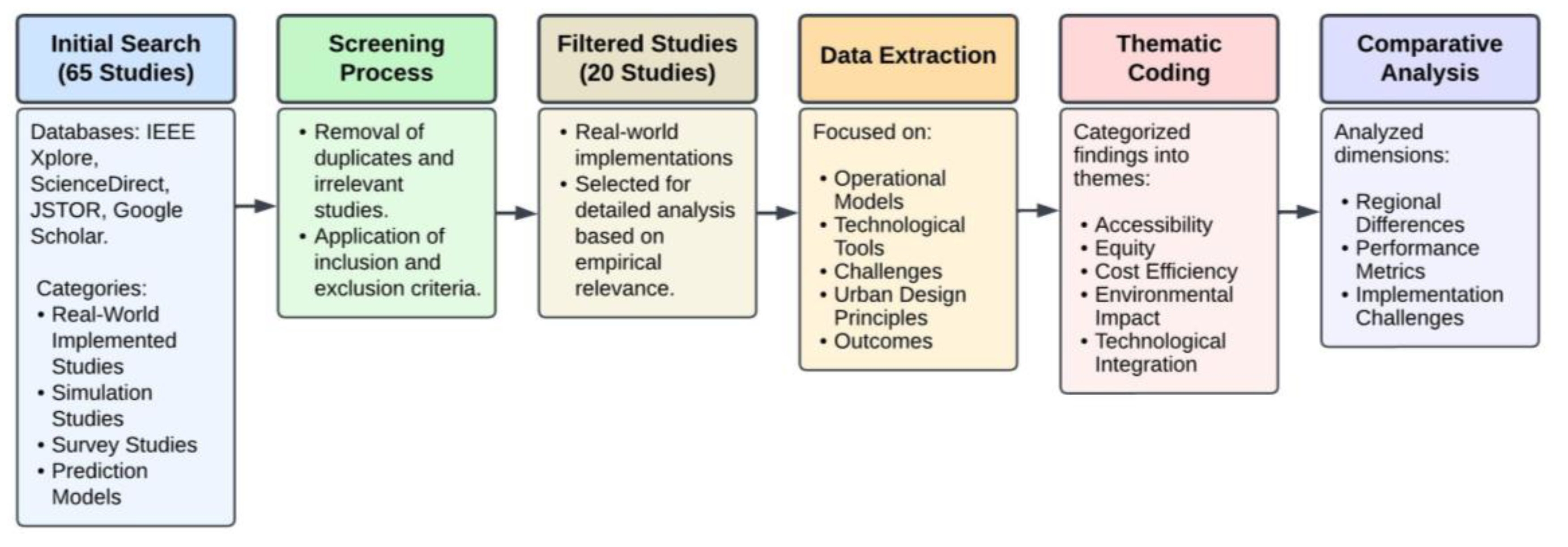

Table 1.
Comparison highlights between DRT and fixed-route systems across different aspects: flexibility, accessibility, cost efficiency, environmental impact, operational challenges, and rider experience. Source: (Authors 2025).
Table 1.
Comparison highlights between DRT and fixed-route systems across different aspects: flexibility, accessibility, cost efficiency, environmental impact, operational challenges, and rider experience. Source: (Authors 2025).
| Aspect | Demand-Responsive Transit (DRT) | Fixed-Route Transit |
|---|---|---|
| Flexibility | High—Dynamic routes and schedules | Low—Static routes and schedules |
| Accessibility | Serves low-density underserved areas | Primarily serves established corridors |
| Cost Efficiency | Cost-effective in low-demand areas | Cost-effective in high-demand areas |
| Environmental Impact | Optimized for low-demand areas | Lower emissions per passenger in dense areas |
| Operational Challenges | Technology reliance, service variability | Predictability, lacks adaptability |
| Rider Experience | Personalized, shorter wait times | Predictable, efficient in dense areas |
Disclaimer/Publisher’s Note: The statements, opinions and data contained in all publications are solely those of the individual author(s) and contributor(s) and not of MDPI and/or the editor(s). MDPI and/or the editor(s) disclaim responsibility for any injury to people or property resulting from any ideas, methods, instructions or products referred to in the content. |
© 2026 by the authors. Licensee MDPI, Basel, Switzerland. This article is an open access article distributed under the terms and conditions of the Creative Commons Attribution (CC BY) license (http://creativecommons.org/licenses/by/4.0/).
Copyright: This open access article is published under a Creative Commons CC BY 4.0 license, which permit the free download, distribution, and reuse, provided that the author and preprint are cited in any reuse.


